Showing posts with label superbubbles. Show all posts

Friday, March 01, 2019

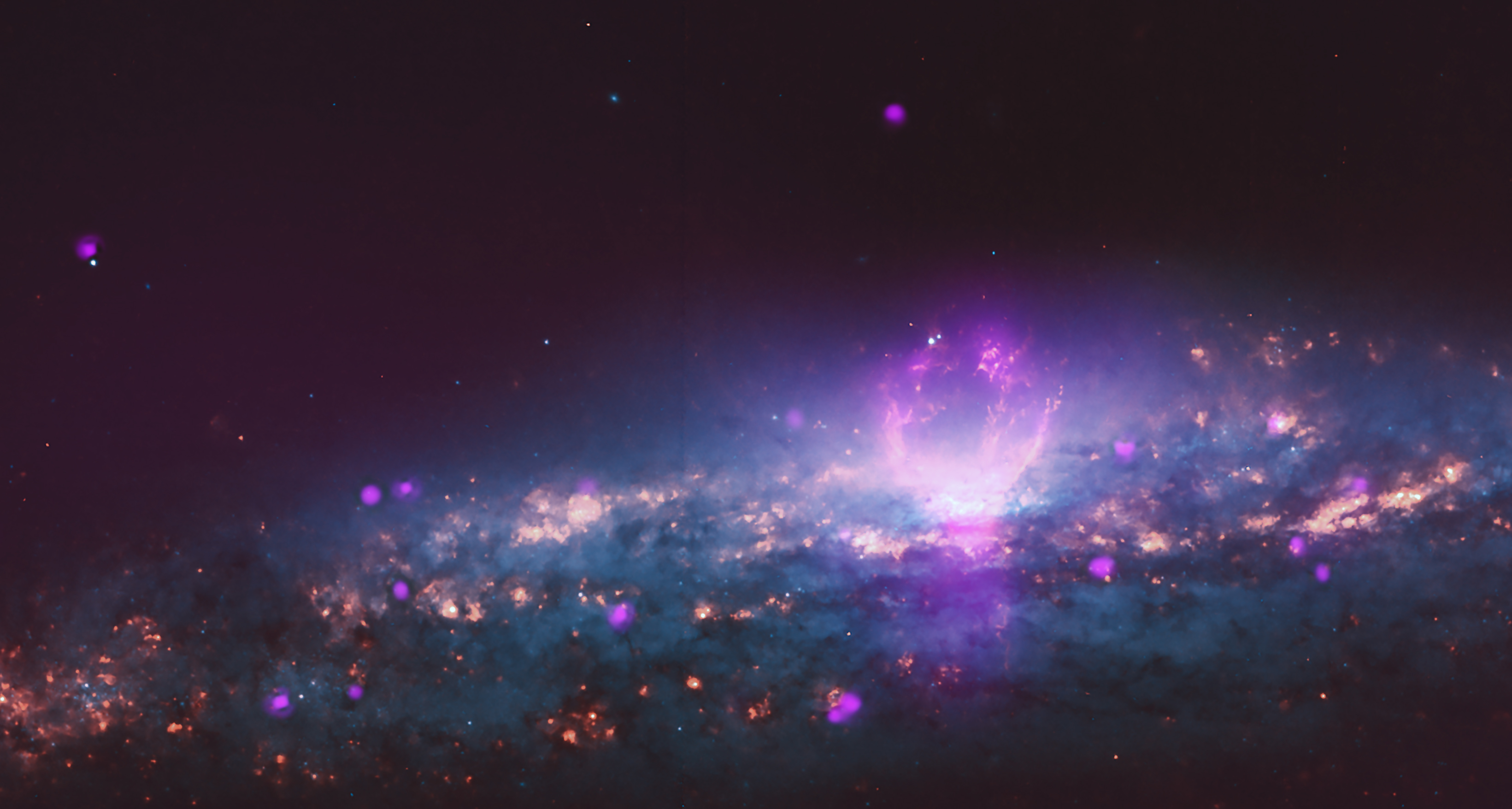
NGC 3079: Galactic Bubbles Play Cosmic Pinball with Energetic Particles

NGC 3079
Credit X-ray: NASA/CXC/University of Michigan/J-T Li et al.; Optical: NASA/STScI 

We all know bubbles from soapy baths or sodas. These bubbles of everyday experience on Earth are up to a few inches across, and consist of a thin film of liquid enclosing a small volume of air or other gas. In space, however, there are very different bubbles — composed of a lighter gas inside a heavier one — and they can be huge.

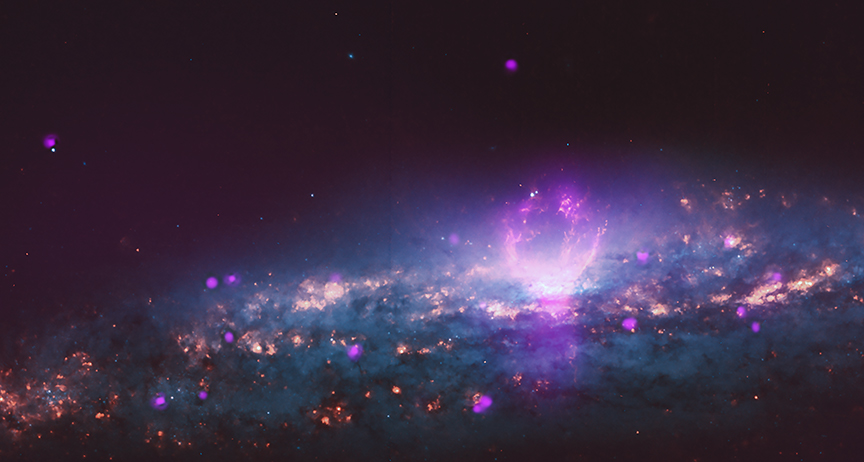
The galaxy NGC 3079, located about 67 million light years from Earth, contains two "superbubbles" unlike anything here on our planet. A pair of balloon-like regions stretch out on opposite sides of the center of the galaxy: one is 4,900 light years across and the other is only slightly smaller, with a diameter of about 3,600 light years. For context, one light year is about 6 trillion miles, or 9 trillion kilometers.

The superbubbles in NGC 3079 give off light in the form of X-ray, optical and radio emission, making them detectable by NASA telescopes. In this composite image, X-ray data from NASA's Chandra X-ray Observatory are shown in purple and optical data from NASA's Hubble Space Telescope are shown in orange and blue. A labeled version of the X-ray image shows that the upper superbubble is clearly visible, along with hints of fainter emission from the lower superbubble.

 NGC 3079  (Labeled)
Credit: NASA/CXC/University of Michigan/J-T Li et al.

New observations from Chandra show that in NGC 3079 a cosmic particle accelerator is producing ultra-energetic particles in the rims of the superbubbles. These particles can be much more energetic than those created by Europe's Large Hadron Collider (LHC), the world's most powerful human-made particle accelerator.

The superbubbles in NGC 3079 provide evidence that they and structures like them may be the source of high-energy particles called "cosmic rays" that regularly bombard the Earth. Shock waves — akin to sonic booms caused by supersonic planes — associated with exploding stars can accelerate particles up to energies about 100 times larger than those generated in the LHC, but astronomers are uncertain about where even more energetic cosmic rays come from. This new result suggests superbubbles may be one source of these ultra-energetic cosmic rays.

The outer regions of the bubbles generate shock waves as they expand and collide with surrounding gas. Scientists think charged particles scatter or bounce off tangled magnetic fields in these shock waves, much like balls rebounding off bumpers in a pinball machine. When the particles cross the shock front they are accelerated, as if they received a kick from a pinball machine's flipper. These energetic particles can escape and some may eventually strike the Earth's atmosphere in the form of cosmic rays.

The amount of radio waves or X-rays at different wavelengths, or "spectra," of one of the bubbles suggest that the source of the emission is electrons spiraling around magnetic field lines, and radiating by a process called synchrotron radiation. This is the first direct evidence of synchrotron radiation in high energy X-rays from a galaxy-sized superbubble, and it tells scientists about the maximum energies that the electrons have attained. It is not understood why synchrotron emission is detected from only one of the bubbles.

The radio and X-ray spectra, along with the location of the X-ray emission along the rims of the bubbles, imply that the particles responsible for the X-ray emission must have been accelerated in the shock waves there, because they would have lost too much energy while being transported from the center of the galaxy. 

NGC 3079's superbubbles are younger cousins of "Fermi bubbles," first located in the Milky Way galaxy in 2010. Astronomers think such superbubbles may form when processes associated with matter falling into a supermassive black hole in the center of galaxy, which leads to the release of enormous amounts of energy in the form of particles and magnetic fields. Superbubbles may also be sculpted by winds flowing from a large number of young, massive stars.

A paper describing these results was led by Jiangtao Li of the University of Michigan and appears in The Astrophysical Journal. It is also available online. NASA's Marshall Space Flight Center in Huntsville, Alabama, manages the Chandra program for NASA's Science Mission Directorate in Washington. The Smithsonian Astrophysical Observatory in Cambridge, Massachusetts, controls Chandra's science and flight operations.


Fast Facts for NGC 3079:

Scale: Image is 3.2 arcmin (about 62,000 light years) across.
Category: Normal Galaxies & Starburst Galaxies
Coordinates (J2000) : RA 10h 01m 57.8s | Dec +55° 40´ 47.2"
Constellation: Ursa Major
Observation Date: 4 observations: Mar 7, 2001; Dec 27, 2006; Jan 30, 2018; Feb 1, 2018
Observation Time: 35 hours 45 min (1 day 11 hours 45 minutes)
Obs. ID: 2038, 7851, 19307, 20947
Instrument: ACIS
References: Li, J-T. et al, 2019, ApJ, accepted. arXiv:1901.10536
Color Code X-ray: purple & pink; Optical: red & blue
Distance Estimate: About 67 million light years


Wednesday, May 30, 2018

A Crowded Neighbourhood

The rich region around the Tarantula Nebula in the Large Magellanic Cloud

Tarantula Nebula region in the constellation of Doradus

The rich region around the Tarantula Nebula in the Large Magellanic Cloud (annotated)


Videos

ESOcast 162 Light: A Crowded Neighbourhood (4K UHD)

Zooming in on the Tarantula Nebula


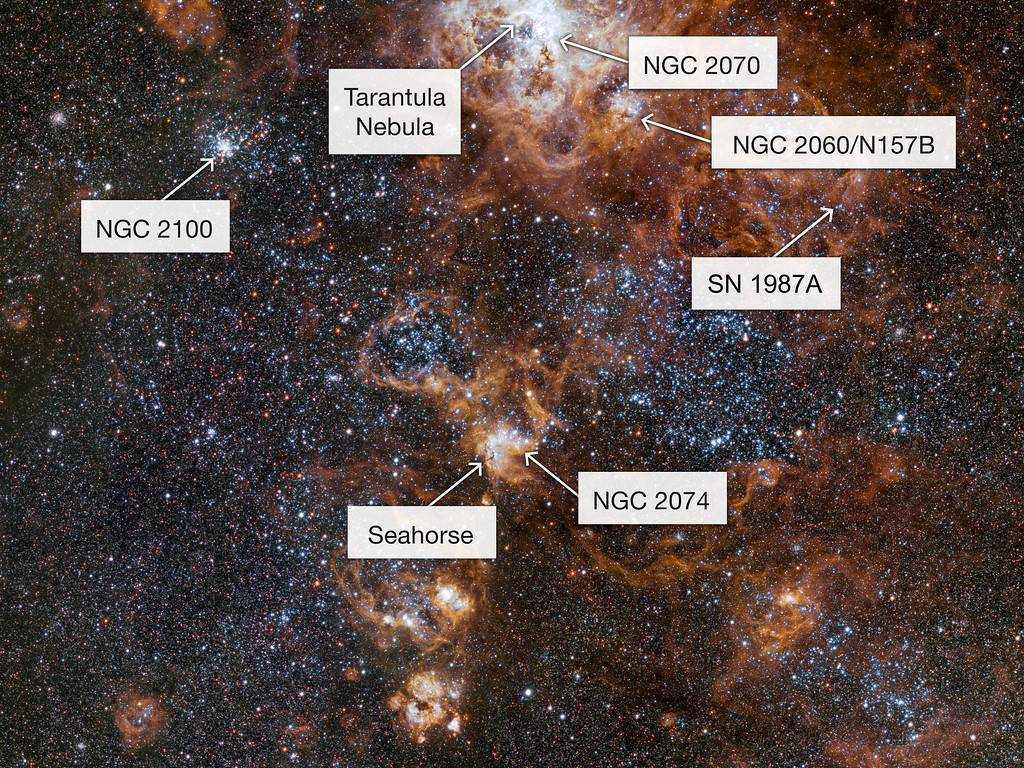
Glowing brightly about 160 000 light-years away, the Tarantula Nebula is the most spectacular feature of the Large Magellanic Cloud, a satellite galaxy to our Milky Way. The VLT Survey Telescope at ESO’s Paranal Observatory in Chile has imaged this region and its rich surroundings in exquisite detail. It reveals a cosmic landscape of star clusters, glowing gas clouds and the scattered remains of supernova explosions. This is the sharpest image ever of this entire field.

Taking advantage of the capacities of the VLT Survey Telescope (VST) at ESO’s Paranal Observatory in Chile, astronomers captured this very detailed new image of the Tarantula Nebula and its numerous neighbouring nebulae and star clusters. The Tarantula, which is also known as 30 Doradus, is the brightest and most energetic star-forming region in the Local Group of galaxies.

The Tarantula Nebula, at the top of this image, spans more than 1000 light-years and is located in the constellation of Dorado (The Dolphinfish) in the far southern sky. This stunning nebula is part of the Large Magellanic Cloud, a dwarf galaxy that measures about 14 000 light-years across. The Large Magellanic Cloud is one of the closest galaxies to the Milky Way.

At the core of the Tarantula Nebula lies a young, giant star cluster called NGC 2070, a starburst region whose dense core, R136, contains some of the most massive and luminous stars known. The bright glow of the Tarantula Nebula itself was first recorded by French astronomer Nicolas-Louis de Lacaille in 1751.

Another star cluster in the Tarantula Nebula is the much older Hodge 301, in which at least 40 stars are estimated to have exploded as supernovae, spreading gas throughout the region. One example of a supernova remnant is the superbubble SNR N157B, which encloses the open star cluster NGC 2060. This cluster was first observed by British astronomer John Herschel in 1836, using an 18.6-inch reflector telescope at the Cape of Good Hope in South Africa. On the outskirts of the Tarantula Nebula, on the lower right-hand side, it is possible to identify the location of the famous supernova SN 1987A [1].

Moving to the left-hand side of the Tarantula Nebula, one can see a bright open star cluster called NGC 2100, which displays a brilliant concentration of blue stars surrounded by red stars. This cluster was discovered by Scottish astronomer James Dunlop in 1826 while working in Australia, using his self-built 9-inch (23-cm) reflecting telescope.

At the centre of the image is the star cluster and emission nebula NGC 2074, another massive star-forming region discovered by John Herschel. Taking a closer look one can spot a dark seahorse-shaped dust structure — the “Seahorse of the Large Magellanic Cloud”. This is a gigantic pillar structure roughly 20 light-years long — almost five times the distance between the Sun and the nearest star, Alpha Centauri. The structure is condemned to disappear over the next million years; as more stars in the cluster form, their light and winds will slowly blow away the dust pillars.

Obtaining this image was only possible thanks to the VST’s specially designed 256-megapixel camera called OmegaCAM. The image was created from OmegaCAM images through four different coloured filters, including one designed to isolate the red glow of ionised hydrogen [2].


Notes

[1] SN 1987A was the first supernova to be observed with modern telescopes and the brightest since Kepler’s Star in 1604. SN 1987A was so intense that it blazed with the power of 100 million suns for several months following its discovery on 23 February 1987.

[2] The H-alpha emission line is a red spectral line created when the electron inside a hydrogen atom loses energy. This happens in hydrogen around hot young stars when the gas becomes ionised by the intense ultraviolet radiation and electrons subsequently recombine with protons to form atoms again. The ability of OmegaCAM to detect this line allows astronomers to characterise the physics of giant molecular clouds where new stars and planets form.


More Information

ESO is the foremost intergovernmental astronomy organisation in Europe and the world’s most productive ground-based astronomical observatory by far. It has 15 Member States: Austria, Belgium, the Czech Republic, Denmark, France, Finland, Germany, Italy, the Netherlands, Poland, Portugal, Spain, Sweden, Switzerland and the United Kingdom, along with the host state of Chile and with Australia as a strategic partner. ESO carries out an ambitious programme focused on the design, construction and operation of powerful ground-based observing facilities enabling astronomers to make important scientific discoveries. ESO also plays a leading role in promoting and organising cooperation in astronomical research. ESO operates three unique world-class observing sites in Chile: La Silla, Paranal and Chajnantor. At Paranal, ESO operates the Very Large Telescope and its world-leading Very Large Telescope Interferometer as well as two survey telescopes, VISTA working in the infrared and the visible-light VLT Survey Telescope. ESO is also a major partner in two facilities on Chajnantor, APEX and ALMA, the largest astronomical project in existence. And on Cerro Armazones, close to Paranal, ESO is building the 39-metre Extremely Large Telescope, the ELT, which will become “the world’s biggest eye on the sky”.


Links


Contacts


Richard Hook
ESO Public Information Officer
Garching bei München, Germany
Tel: +49 89 3200 6655
Cell: +49 151 1537 3591
Email:
rhook@eso.org


Source: ESO/News

Monday, May 08, 2017

Superbubbles in the Interstellar Medium of the Antennae Galaxies

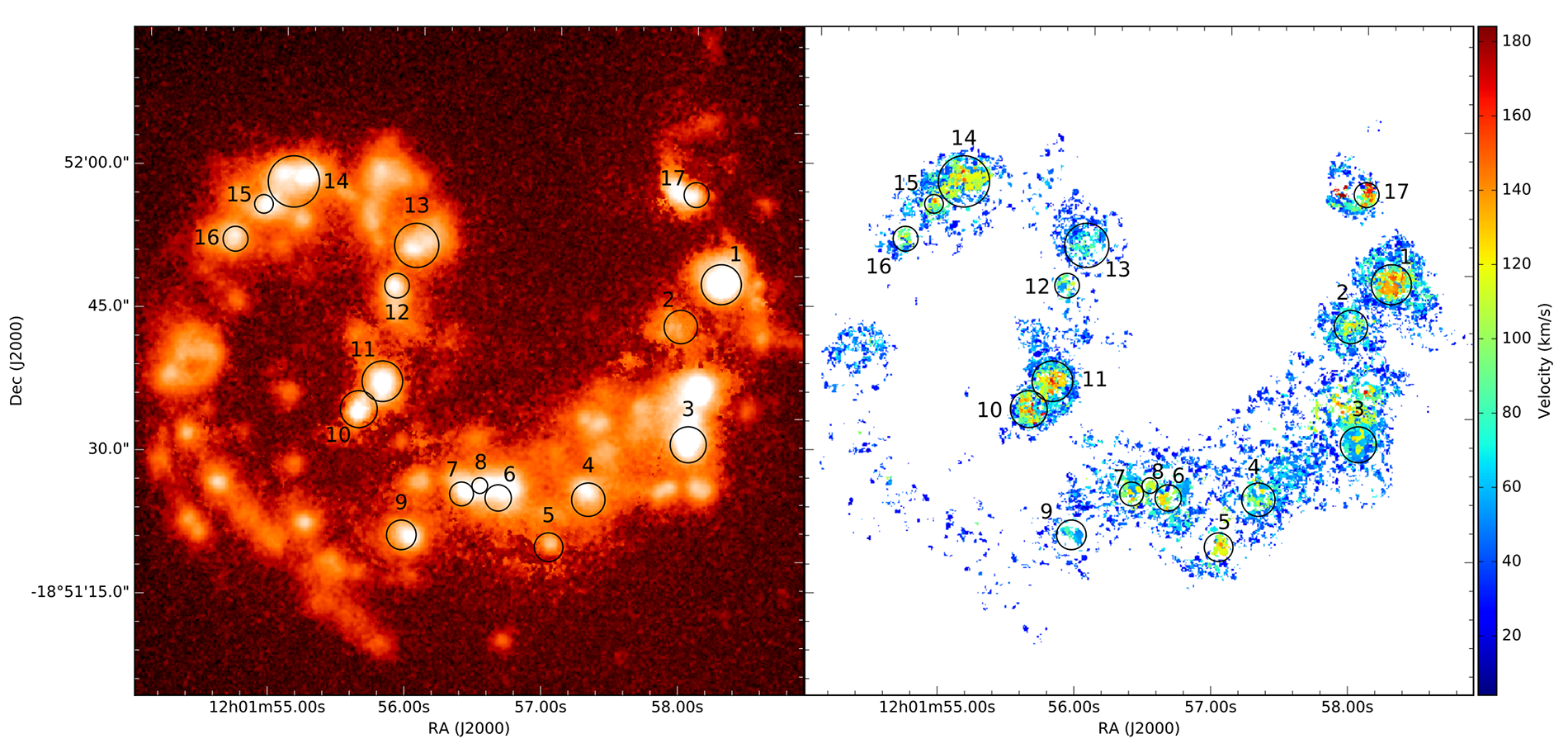
Left panel: map of the surface brightness of the "Antennae" in emission from ionized hydrogen. The brightest zones are the zones occupied by clusters of massive stars. Right panel: map of the expansion velocity of the bubbles detected in the Antennae, pushed outwards by the stellar winds and supernova explosions of the stars in the cluster. The colours give the values of the expansion velocity at each point on the map. The largest bubble is 1500 light years in size. Credit: IAC. Large format: PNG.


A team of scientists led by members of the Instituto de Astrofísica de Canarias (IAC), in collaboration with the Universidad Nacional Autónoma de México (UNAM), have detected and measured a complete "carpet" of expanding bubbles in the interstellar medium of the "Antennae", a pair of galaxies in interaction which will eventually merge. The work, published in Monthy Notices of the Royal Astronomical Society is based on observations with GHaFaS on the William Herschel Telescope (WHT). This instrument is capable of making a map of the velocities of a complete galaxy using the emission from the ionized hydrogen in its interstellar medium.

To detect the huge bubbles in the combined galaxy disc, the team has used BUBBLY, a method developed by some of the current authors which has already been published in the same journal in 2015. These huge bubbles in galaxy discs are caused by the stellar winds and supernova explosions in clusters of very hot very massive stars. They can range in size from a couple of light years to a thousand light years, depending on the number of stars in the cluster and how massive they are. The larger ones are often called "superbubbles".

In the study, the BUBBLY method has been applied to the "Antennae", in which the interaction between the galaxies is causing a major burst of star formation, leading to many star clusters, each surrounded by a bubble of expanding gas. The researchers have been able to calculate how much energy is being fed into the interstellar medium from each individual bubble, and from the sum total of all the bubbles, including a decent estimate for those which are too small to be fully detected.

"The importance of the bubbles", says Artemi Camps-Fariña, the lead author on both of the articles, "is that they let us measure the effects of feedback caused by massive star clusters on the rest of the galaxy in which they lie. This is being recognised as very important. Theorists who aim to model how galaxies are formed and evolve had a major problem when they made models without feedback. In those models star formation was far too rapid, so that all the available gas would have been used up when the universe had reached no more than one tenth of its present age. All galaxies would now be passive without any current star formation. But the feedback process, in which massive star clusters blow large bubbles, slows down the star formation rate, as it stops new gas from condensing so quickly into stars. It reduces the overall star formation rate by a big factor and has let galaxies such as the Milky Way produce their stellar populations in a much more extended time frame".

"Although this general idea is not new", says John Beckman, one of the authors of both articles, "our ability to measure the properties of the bubbles is giving us a way to quantify the effect and to match basic theory with the observed properties of galaxies".


More information:

Artemi Camps-Fariña, et al., 2017, "Physical properties of superbubbles in the Antennae galaxies", MNRAS, 468, 4134 [ ADS ].

Artemi Camps-Fariña, et al., 2015, "BUBBLY: a method for detecting and characterizing interstellar bubbles using Fabry-Perot spectroscopy", MNRAS, 447, 3840 [ ADS ].

"Superbubbles in the interstellar medium", IAC Press Release, 1st May 2017.


Contact: 

Javier Méndez
(Public Relations Officer)


Thursday, May 19, 2016

A Beautiful Instance of Stellar Ornamentation

The glowing gas cloud LHA 120-N55 in the Large Magellanic Cloud

PR Image eso1616b
LHA 120-N55 in the constellation of Dorado


Videos

Zooming in on the glowing gas cloud LHA 120-N55 in the Large Magellanic Cloud

Close-up view of the glowing gas cloud LHA 120-N55 in the Large Magellanic Cloud


In this image from ESO’s Very Large Telescope (VLT), light from blazing blue stars energises the gas left over from the stars’ recent formation. The result is a strikingly colourful emission nebula, called LHA 120-N55, in which the stars are adorned with a mantle of glowing gas. Astronomers study these beautiful displays to learn about the conditions in places where new stars develop.

LHA 120-N55, or N55 as it is usually known, is a glowing gas cloud in the Large Magellanic Cloud (LMC), a satellite galaxy of the Milky Way located about 163 000 light-years away. N55 is situated inside a supergiant shell, or superbubble called LMC 4. Superbubbles, often hundreds of light-years across, are formed when the fierce winds from newly formed stars and shockwaves from supernova explosions work in tandem to blow away most of the gas and dust that originally surrounded them and create huge bubble-shaped cavities.

The material that became N55, however, managed to survive as a small remnant pocket of gas and dust. It is now a standalone nebula inside the superbubble and a grouping of brilliant blue and white stars — known as LH 72 — also managed to form hundreds of millions of years after the events that originally blew up the superbubble. The LH 72 stars are only a few million years old, so they did not play a role in emptying the space around N55. The stars instead represent a second round of stellar birth in the region.

The recent rise of a new population of stars also explains the evocative colours surrounding the stars in this image. The intense light from the powerful, blue–white stars is stripping nearby hydrogen atoms in N55 of their electrons, causing the gas to glow in a characteristic pinkish colour in visible light. Astronomers recognise this telltale signature of glowing hydrogen gas throughout galaxies as a hallmark of fresh star birth.

While things seem quiet in the star-forming region of N55 for now, major changes lie ahead. Several million years hence, some of the massive and brilliant stars in the LH 72 association will themselves go supernova, scattering N55’s contents. In effect, a bubble will be blown within a superbubble, and the cycle of starry ends and beginnings will carry on in this close neighbour of our home galaxy.

This new image was acquired using the FOcal Reducer and low dispersion Spectrograph (FORS2) instrument attached to ESO's VLT. It was taken as part of the ESO Cosmic Gems programme, an outreach initiative to produce images of interesting, intriguing or visually attractive objects using ESO telescopes for the purposes of education and public outreach. The programme makes use of telescope time that cannot be used for science observations. All data collected may also be suitable for scientific purposes, and are made available to astronomers through ESO’s science archive.


More Information

ESO is the foremost intergovernmental astronomy organisation in Europe and the world’s most productive ground-based astronomical observatory by far. It is supported by 16 countries: Austria, Belgium, Brazil, the Czech Republic, Denmark, France, Finland, Germany, Italy, the Netherlands, Poland, Portugal, Spain, Sweden, Switzerland and the United Kingdom, along with the host state of Chile. ESO carries out an ambitious programme focused on the design, construction and operation of powerful ground-based observing facilities enabling astronomers to make important scientific discoveries. ESO also plays a leading role in promoting and organising cooperation in astronomical research. ESO operates three unique world-class observing sites in Chile: La Silla, Paranal and Chajnantor. At Paranal, ESO operates the Very Large Telescope, the world’s most advanced visible-light astronomical observatory and two survey telescopes. VISTA works in the infrared and is the world’s largest survey telescope and the VLT Survey Telescope is the largest telescope designed to exclusively survey the skies in visible light. ESO is a major partner in ALMA, the largest astronomical project in existence. And on Cerro Armazones, close to Paranal, ESO is building the 39-metre European Extremely Large Telescope, the E-ELT, which will become “the world’s biggest eye on the sky”.

Links

Contacts

Richard Hook
ESO Public Information Officer
Garching bei München, Germany
Tel: +49 89 3200 6655
Cell: +49 151 1537 3591
Email:
rhook@eso.org


Source: ESO

Monday, January 28, 2013

DEM L50: Stellar Effervescence on Display

 The superbubble DEM L50 (Labeled)
Credit X-ray: NASA/CXC/Univ of Michigan/A.E.Jaskot,
Optical: NOAO/CTIO/MCELS 


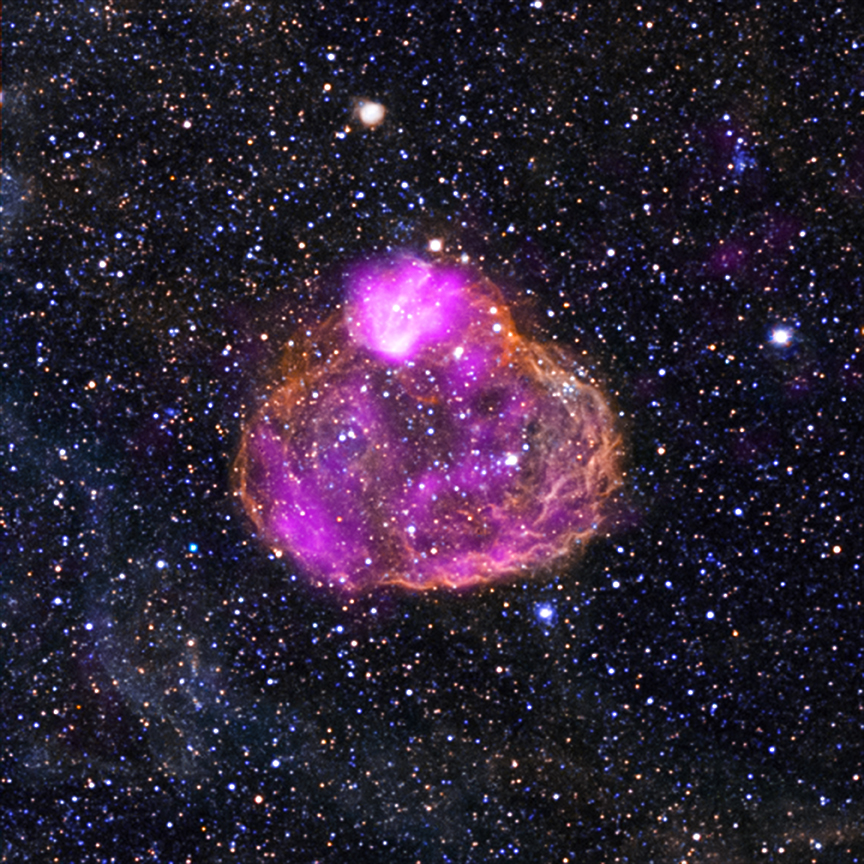
This composite image shows the superbubble DEM L50 (a.k.a. N186) located in the Large Magellanic Cloud about 160,000 light years from Earth. Superbubbles are found in regions where massive stars have formed in the last few million years. The massive stars produce intense radiation, expel matter at high speeds, and race through their evolution to explode as supernovas . The winds and supernova shock waves carve out huge cavities called superbubbles in the surrounding gas.

X-rays from NASA's Chandra X-ray Observatory are shown in pink and optical data from the Magellanic Cloud Emission Line Survey (MCELS) are colored in red, green and blue. The MCELS data were obtained with the University of Michigan's 0.9-meter Curtis Schmidt telescope at Cerro Tololo Inter-American Observatory (CTIO). The shape of DEM L50 is approximately an ellipse, with a supernova remnant named SNR N186 D located on its northern edge.

Like another superbubble in the LMC, N44 (see last year's press release), DEM L50 gives off about 20 times more X-rays than expected from standard models for the evolution of superbubbles. A Chandra study published in 2011 showed that there are two extra sources of the bright X-ray emission: supernova shock waves striking the walls of the cavities, and hot material evaporating from the cavity walls.

The Chandra study of DEM L50 was led by Anne Jaskot from the University of Michigan in Ann Arbor. The co-authors were Dave Strickland from Johns Hopkins University in Baltimore, MD, Sally Oey from University of Michigan, You-Hua Chu from University of Illinois and Guillermo Garcia-Segura from Instituto de Astronomia-UNAM in Ensenada, Mexico.

NASA's Marshall Space Flight Center in Huntsville, Ala., manages the Chandra program for NASA's Science Mission Directorate in Washington. The Smithsonian Astrophysical Observatory controls Chandra's science and flight operations from Cambridge, Mass.

Fast Facts for DEM L50: 

  • Scale: Image is 20.5 arcmin across (950 light years) 
  • Coordinates (J2000): RA 04h 59m 49.00s | Dec -70º 10' 28.00" 
  • Observation Date: Jan 1, 2003 
  • Observation Time: 10 hours 29 min 
  • Obs. ID: 3355 
  • Instrument: ACIS 
  • Color Code: X-ray (Magenta); Optical (Red, Green, Blue)

Friday, August 31, 2012

NGC 1929 in N44: A Surprisingly Bright Superbubble

Credit X-ray: NASA/CXC/U.Mich./S.Oey,

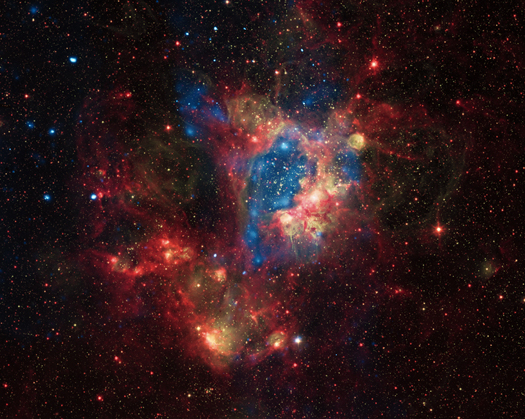
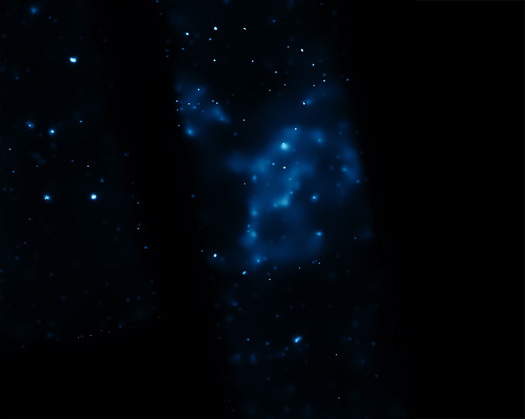
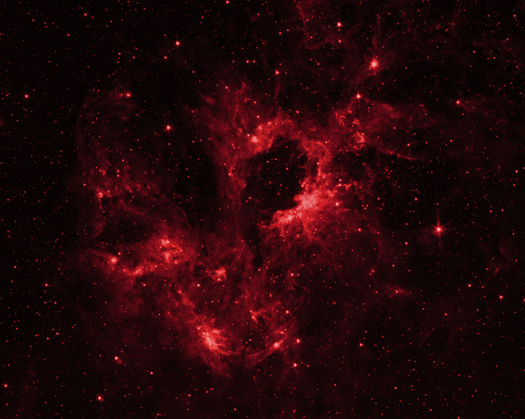
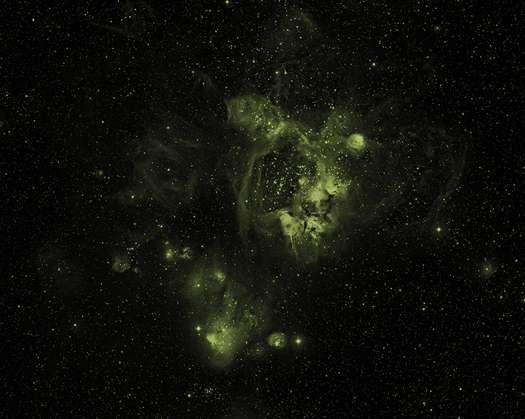
This composite image shows a superbubble in the Large Magellanic Cloud (LMC), a small satellite galaxy of the Milky Way, located about 160,000 light years from Earth. Many new stars, some of them very massive, are forming in the star cluster NGC 1929, which is embedded in the nebula N44. The massive stars produce intense radiation, expel matter at high speeds, and race through their evolution to explode as supernovas. The winds and supernova shock waves carve out huge cavities called superbubbles in the surrounding gas. X-rays from NASA's Chandra X-ray Observatory (blue) show hot regions created by these winds and shocks, while infrared data from NASA's Spitzer Space Telescope (red) outline where the dust and cooler gas are found. The optical light from the 2.2m Max-Planck-ESO telescope (yellow) in Chile shows where ultraviolet radiation from hot, young stars is causing gas in the nebula to glow.

A long-running problem in high-energy astrophysics has been that some superbubbles in the LMC, including N44, give off a lot more X-rays than expected from models of their structure. A Chandra study published in 2011 showed that there are two extra sources of the bright X-ray emission: supernova shock waves striking the walls of the cavities, and hot material evaporating from the cavity walls. The observations show no evidence for an enhancement of elements heavier than hydrogen and helium in the cavities, thus ruling out this possibility as an explanation for the bright X-ray emission. This is the first time that the data have been good enough to distinguish between different sources of the X-rays produced by superbubbles.

The Chandra study of N44 and another superbubble in the LMC was led by Anne Jaskot from the University of Michigan in Ann Arbor. The co-authors were Dave Strickland from Johns Hopkins University in Baltimore, MD, Sally Oey from University of Michigan, You-Hua Chu from University of Illinois and Guillermo Garcia-Segura from Instituto de Astronomia-UNAM in Ensenada, Mexico.

NASA's Marshall Space Flight Center in Huntsville, Ala., manages the Chandra program for NASA's Science Mission Directorate in Washington. The Smithsonian Astrophysical Observatory controls Chandra's science and flight operations from Cambridge, Mass.
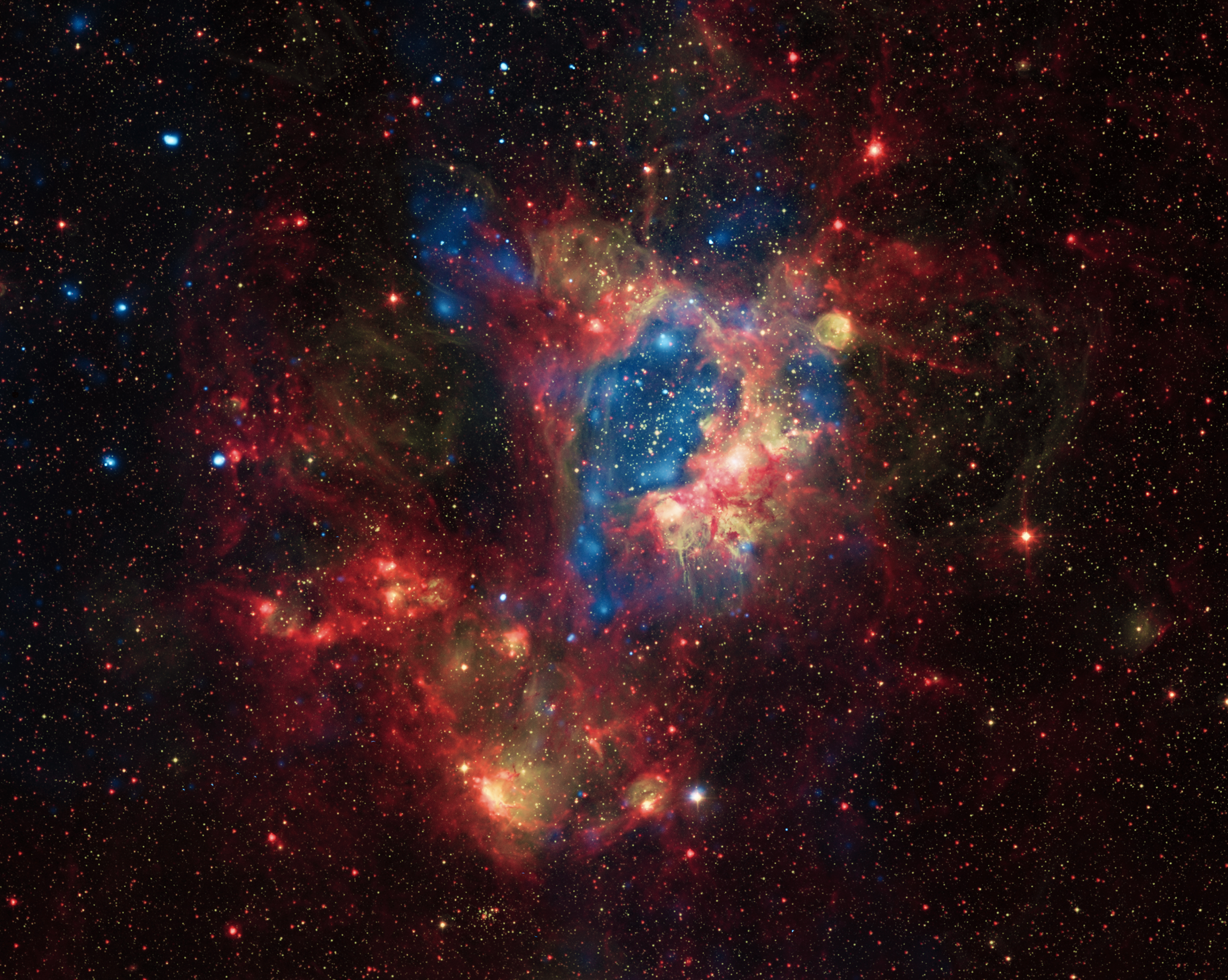
Fast Facts for NGC 1929:

Release Date: August 30, 2012
Scale: Image is 25 arcmin across (1200 light years)
Category:
Normal Stars & Star Clusters
Coordinates: (J2000) RA 05h 22m 17.00s | Dec -67° 76' 38.00"
Constellation:
Dorado
Observation Date: Sept 22, 2002
Observation Time: 5 hours 33 min.
Obs. ID: 3356
Instrument:
ACIS
References: Jaskot, A.E. et al 2011, ApJ, 729, 28; arXiv:1101.0280