Showing posts with label Vela. Show all posts

Thursday, March 14, 2024

Ghostly Stellar Tendrils Captured in Largest DECam Image Ever Released

PR Image noirlab2406a
Ghostly Stellar Tendrils of the Vela Supernova Remnant

PR Image noirlab2406b
Vela Supernova Remnant Excerpts

PR Image noirlab2406c
Open Star Cluster [FSR2007] 1410

PR Image noirlab2406d
Planetary Nebula PNG 262.4-01.9

PR Image noirlab2406e
Globular Star Cluster CI Ferrero 54

PR Image noirlab2406f
Supernova Remnant Puppis A

PR Image noirlab2406g
Dark Nebula TGU H1674

PR Image noirlab2406h
Background Galaxy Found in Image of Vela Supernova Remnant


Videos

Cosmoview Episode 77: Ghostly Stellar Tendrils Captured in Largest DECam Image Ever Released 
 PR Video noirlab2406a
Cosmoview Episode 77: Ghostly Stellar Tendrils Captured in Largest DECam Image Ever Released
Cosmoview Episodio 77: Filamentos estelares fantasmales capturados con la imagen de DECam más grande jamás publicada  
PR Video noirlab2406b
Cosmoview Episodio 77: 
Filamentos estelares fantasmales capturados con la imagen de DECam más grande jamás publicada
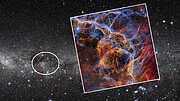
Pan on the Vela Supernova Remnant  
PR Video noirlab2406c
Pan on the Vela Supernova Remnant

Zooming into the Vela Supernova Remnant  
PR Video noirlab2406d
Zooming into the Vela Supernova Remnant


Dark Energy Camera captures remains of a massive star that exploded nearly 11,000 years ago in huge gigapixel image

With the powerful, 570-megapixel Department of Energy-fabricated Dark Energy Camera (DECam), astronomers have constructed a massive 1.3-gigapixel image showcasing the central part of the Vela Supernova Remnant, the cosmic corpse of a gigantic star that exploded as a supernova. DECam is one of the highest-performing wide-field imaging instruments in the world and is mounted on the US National Science Foundation's Víctor M. Blanco 4-meter Telescope at Cerro Tololo Inter-American Observatory, a Program of NSF’s NOIRLab.

This colorful web of wispy gas filaments is the Vela Supernova Remnant, an expanding nebula of cosmic debris left over from a massive star that exploded about 11,000 years ago. Located around 800 light-years away in the constellation Vela (the Sails), this nebula is one of the nearest supernova remnants to Earth. Though the unnamed star ended its life thousands of years ago, the shockwave its death produced is still propagating into the interstellar medium, carrying glowing tendrils of gas with it.

This image is one of the biggest ever made of this object and was taken with the state-of-the-art wide-field Dark Energy Camera (DECam), built by the Department of Energy and mounted on the US National Science Foundation's Víctor M. Blanco 4-meter Telescope at Cerro Tololo Inter-American Observatory in Chile, a Program of NSF’s NOIRLab. The striking reds, yellows, and blues in this image were achieved through the use of three DECam filters that each collect a specific color of light. Separate images were taken in each filter and then stacked on top of each other to produce this high-resolution color image that showcases the intricate web-like filaments snaking throughout the expanding cloud of gas. This is also the largest DECam image ever released publicly, containing an astounding 1.3 gigapixels [1].

The Vela Supernova Remnant is merely the ghost of a massive star that once was. When the star exploded 11,000 years ago, its outer layers were violently stripped away and flung into the surrounding region, driving the shockwave that is still visible today. As the shockwave expands into the surrounding region, the hot, energized gas flies away from the point of detonation, compressing and interacting with the interstellar medium to produce the stringy blue and yellow filaments seen in the image. The Vela Supernova Remnant is a gigantic structure, spanning almost 100 light-years and extending to twenty times the diameter of the full Moon in the night sky.

Despite the dramatics of the star’s final moments, it wasn’t entirely wiped from existence. After shedding its outer layers, the core of the star collapsed into a neutron star — an ultra-dense ball consisting of protons and electrons that have been smashed together to form neutrons. The neutron star, named the Vela Pulsar, is now an ultra-condensed object with the mass of a star like the Sun contained in a sphere just a few kilometers across. Located in the lower left region of this image, the Vela Pulsar is a relatively dim star that is indistinguishable from its thousands of celestial neighbors. Still reeling from its explosive death, the Vela Pulsar spins rapidly on its own axis and possesses a powerful magnetic field. These properties result in twin beams of radiation that sweep the sky 11 times per second, just like the consistent blips of a rotating lighthouse bulb.

This high-quality image demonstrates the incredible deep and wide capabilities of DECam. From its vantage point in the Chilean Andes, the Blanco telescope receives light that has traveled across the Universe. After entering the telescope’s tube, the light is reflected by a mirror 4-meters (13-feet) wide — a massive, aluminum-coated and precisely shaped piece of glass roughly the weight of a semi-truck. The light is then guided into the optical innards of DECam, passing through a corrective lens nearly a meter (3.3 feet) across before falling on a grid of 62 charge-coupled devices (CCDs), which act like the ‘eyes’ of the camera. The incoming light is then converted into electrical signals which are read out as pixels.

A single image taken with DECam has 570 megapixels, so with multiple exposures stacked on top of one another, the amount of detail that can be captured is truly remarkable. Owing to DECam’s large mosaic of CCDs, astronomers are able to create mesmerizing images of faint astronomical objects, such as the Vela Supernova Remnant, that offer a limitless starscape to explore.


Notes

[1] For comparison, the pixel count of an image taken with the camera in a standard smartphone can range from 12 to 48 megapixels. This image contains a total of 35786 x 35881 pixels, or 1.28 gigapixels.


More information

NSF’s NOIRLab (National Optical-Infrared Astronomy Research Laboratory), the US center for ground-based optical-infrared astronomy, operates the international Gemini Observatory (a facility of NSF, NRC–Canada, ANID–Chile, MCTIC–Brazil, MINCyT–Argentina, and KASI–Republic of Korea), Kitt Peak National Observatory (KPNO), Cerro Tololo Inter-American Observatory (CTIO), the Community Science and Data Center (CSDC), and Vera C. Rubin Observatory (in cooperation with DOE’s SLAC National Accelerator Laboratory). It is managed by the Association of Universities for Research in Astronomy (AURA) under a cooperative agreement with NSF and is headquartered in Tucson, Arizona. The astronomical community is honored to have the opportunity to conduct astronomical research on Iolkam Du’ag (Kitt Peak) in Arizona, on Maunakea in Hawai‘i, and on Cerro Tololo and Cerro Pachón in Chile. We recognize and acknowledge the very significant cultural role and reverence that these sites have to the Tohono O'odham Nation, to the Native Hawaiian community, and to the local communities in Chile, respectively.


Links


Contacts:

Josie Fenske
Jr. Public Information Officer
NSF’s NOIRLab
Email:
josie.fenske@noirlab.edu


Monday, October 31, 2022

ESO captures the ghost of a giant star

PR Image eso2214a
The Vela supernova remnant imaged by the VLT Survey Telescope

PR Image eso2214b
Highlights of the Vela supernova remnant

PR Image eso2214c
VST image processing workflow


Videos

Flying through the remnants of a dead star


A spooky spider web, magical dragons or wispy trails of ghosts? What do you see in this image of the Vela supernova remnant? This beautiful tapestry of colours shows the ghostly remains of a gigantic star, and was captured here in incredible detail with the VLT Survey Telescope, hosted at the European Southern Observatory’s (ESO’s) Paranal site in Chile.

The wispy structure of pink and orange clouds is all that remains of a massive star that ended its life in a powerful explosion around 11 000 years ago. When the most massive stars reach the end of their life, they often go out with a bang, in an outburst called a supernova. These explosions cause shock waves that move through the surrounding gas, compressing it and creating intricate thread-like structures. The energy released heats the gaseous tendrils, making them shine brightly, as seen in this image.

In this 554-million-pixel image, we get an extremely detailed view of the Vela supernova remnant, named after the southern constellation Vela (The Sails). You could fit nine full Moons in this entire image, and the whole cloud is even larger. At only 800 light-years away from Earth, this dramatic supernova remnant is one of the closest known to us.

As it exploded, the outermost layers of the progenitor star were ejected into the surrounding gas, producing the spectacular filaments that we observe here. What remains of the star is an ultra-dense ball in which the protons and electrons are forced together into neutrons — a neutron star. The neutron star in the Vela remnant, placed slightly outside of this image to the upper left, happens to be a pulsar that spins on its own axis at an incredible speed of more than 10 times per second.

This image is a mosaic of observations taken with the wide-field camera OmegaCAM at the VLT Survey Telescope (VST), hosted at ESO’s Paranal Observatory in Chile. The 268-million-pixel camera can take images through several filters that let through light of different colours. In this particular image of the Vela remnant, four different filters were used, represented here by a combination of magenta, blue, green and red.

The VST is owned by The National Institute for Astrophysics in Italy, INAF, and with its 2.6-metre mirror it is one of the largest telescopes dedicated to surveying the night sky in visible light. This image is an example from such a survey: the VST Photometric Hα Survey of the Southern Galactic Plane and Bulge (VPHAS+). For over seven years, this survey has mapped a considerable portion of our home galaxy, allowing astronomers to better understand how stars form, evolve and eventually die.


More Information

The European Southern Observatory (ESO) enables scientists worldwide to discover the secrets of the Universe for the benefit of all. We design, build and operate world-class observatories on the ground — which astronomers use to tackle exciting questions and spread the fascination of astronomy — and promote international collaboration in astronomy. Established as an intergovernmental organisation in 1962, today ESO is supported by 16 Member States (Austria, Belgium, the Czech Republic, Denmark, France, Finland, Germany, Ireland, Italy, the Netherlands, Poland, Portugal, Spain, Sweden, Switzerland and the United Kingdom), along with the host state of Chile and with Australia as a Strategic Partner. ESO’s headquarters and its visitor centre and planetarium, the ESO Supernova, are located close to Munich in Germany, while the Chilean Atacama Desert, a marvellous place with unique conditions to observe the sky, hosts our telescopes. ESO operates three observing sites: La Silla, Paranal and Chajnantor. At Paranal, ESO operates the Very Large Telescope and its Very Large Telescope Interferometer, as well as survey telescopes such as VISTA. Also at Paranal ESO will host and operate the Cherenkov Telescope Array South, the world’s largest and most sensitive gamma-ray observatory. Together with international partners, ESO operates APEX and ALMA on Chajnantor, two facilities that observe the skies in the millimetre and submillimetre range. At Cerro Armazones, near Paranal, we are building “the world’s biggest eye on the sky” — ESO’s Extremely Large Telescope. From our offices in Santiago, Chile we support our operations in the country and engage with Chilean partners and society.


Links


Contact:

Juan Carlos Muñoz Mateos
ESO Media Officer
Garching bei München, Germany
Tel: +49 89 3200 6176
Email:
press@eso.org

Source: ESO/News


Sunday, May 15, 2016

A Cosmic Hit and Run

Credit: ESO. Acknowledgements: Jean-Christophe Lambry

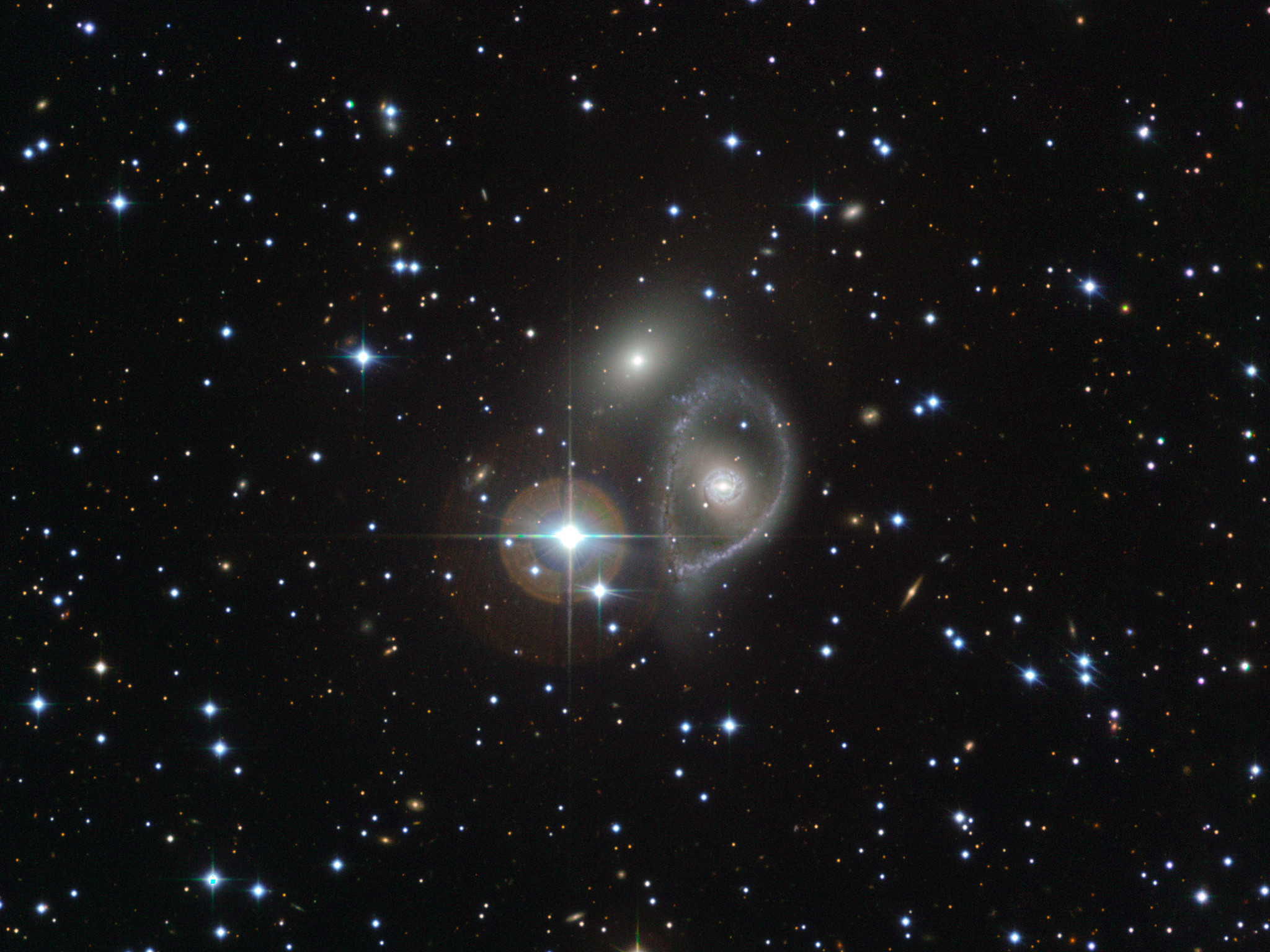
This Picture of the Week shows the Vela ring galaxy, visible as a bright core surrounded by a baby blue halo. As the name suggests, this ring galaxy — located in the southern constellation of Vela (The Sails) — is notable due to its compact core and large circular belt of gas and stars.

It is thought that ring galaxies like this are created when larger galaxies are punctured by a smaller galactic aggressor, which, passing through the heart of its more sizeable victim, triggers a shock wave that spreads outwards. This pushes gas to the galaxy’s periphery, where it begins to collapse and form new stars. The Vela ring galaxy is unusual in that it actually exhibits at least two rings, suggesting that the collision was not a recent one.

This picture also features a galaxy known as ESO 316-33, seen just above and to the left of the Vela ring galaxy, and a bright star known as HD 88170.

Source:  ESO/Images

Friday, March 01, 2013

Fermi's Motion Produces a Study in Spirograph

NASA's Fermi Gamma-ray Space Telescope orbits our planet every 95 minutes, building up increasingly deeper views of the universe with every circuit. Its wide-eyed Large Area Telescope (LAT) sweeps across the entire sky every three hours, capturing the highest-energy form of light -- gamma rays -- from sources across the universe. These range from supermassive black holes billions of light-years away to intriguing objects in our own galaxy, such as X-ray binaries, supernova remnants and pulsars.

Now a Fermi scientist has transformed LAT data of a famous pulsar into a mesmerizing movie that visually encapsulates the spacecraft's complex motion.

The Vela pulsar outlines a fascinating pattern in this movie showing 51 months of position and exposure data from Fermi's Large Area Telescope (LAT). The pattern reflects numerous motions of the spacecraft, including its orbit around Earth, the precession of its orbital plane, the manner in which the LAT nods north and south on alternate orbits, and more. The movie renders Vela's position in a fisheye perspective, where the middle of the pattern corresponds to the central and most sensitive portion of the LAT's field of view. The edge of the pattern is 90 degrees away from the center and well beyond what scientists regard as the effective limit of the LAT's vision. Better knowledge of how the LAT's sensitivity changes across its field of view helps Fermi scientists better understand both the instrument and the data it returns. Credit: NASA/DOE/Fermi LAT Collaboration . › Download video in HD formats  -  › Watch this video on YouTube
 
Pulsars are neutron stars, the crushed cores of massive suns that destroyed themselves when they ran out of fuel, collapsed and exploded. The blast simultaneously shattered the star and compressed its core into a body as small as a city yet more massive than the sun. The result is an object of incredible density, where a spoonful of matter weighs as much as a mountain on Earth. Equally incredible is a pulsar's rapid spin, with typical rotation periods ranging from once every few seconds up to hundreds of times a second. Fermi sees gamma rays from more than a hundred pulsars scattered across the sky.

One pulsar shines especially bright for Fermi. Called Vela, it spins 11 times a second and is the brightest persistent source of gamma rays the LAT sees. Although gamma-ray bursts and flares from distant black holes occasionally outshine the pulsar, they don't have Vela's staying power. Because pulsars emit beams of energy, scientists often compare them to lighthouses, a connection that in a broader sense works especially well for Vela, which is both a brilliant beacon and a familiar landmark in the gamma-ray sky.
Fermi's Large Area Telescope is the spacecraft's main scientific instrument. This animation shows how a gamma ray (purple) entering the LAT is converted into an electron (red) and a positron (blue). High-precision detectors track the motion of the particles, whose paths point back to the gamma ray's source.  Credit: NASA's Goddard Space Flight Center Conceptual Image Lab . › Download video in HD formats

This image compresses the Vela movie sequence into a single snapshot by merging pie-slice sections from eight individual frames. Credit: NASA/DOE/Fermi LAT Collaboration . › Larger image 
 
Most telescopes focus on a very small region of the sky, but the LAT is a wide-field instrument that can detect gamma rays across a large portion of the sky at once. The LAT is, however, much more sensitive to gamma rays near the center of its field of view than at the edges. Scientists can use observations of a bright source like Vela to track how this sensitivity varies across the instrument's field of view.

With this in mind, LAT team member Eric Charles, a physicist at the Kavli Institute for Particle Astrophysics and Cosmology and the SLAC National Accelerator Laboratory at Stanford University in California, used the famous pulsar to produce a novel movie. He tracked both Vela's position relative to the center of the LAT’s field of view and the instrument's exposure of the pulsar during the first 51 months of Fermi’s mission, from Aug. 4, 2008, to Nov. 15, 2012.

The movie renders Vela’s position in a fisheye perspective, where the middle of the pattern corresponds to the central and most sensitive portion of the LAT’s field of view. The edge of the pattern is 90 degrees away from the center and well beyond what scientists regard as the effective limit of the LAT's vision.
The pulsar traces out a loopy, hypnotic pattern reminiscent of art produced by the colored pens and spinning gears of a Spirograph, a children's toy that produces geometric patterns.

The pattern created in the Vela movie reflects numerous motions of the spacecraft. The first is Fermi's 95-minute orbit around Earth, but there's another, subtler motion related to it. The orbit itself also rotates, a phenomenon called precession. Similar to the wobble of an unsteady top, Fermi's orbital plane makes a slow circuit around Earth every 54 days.

In order to capture the entire sky every two orbits, scientists deliberately nod the LAT in a repeating pattern from one orbit to the next. It first looks north on one orbit, south on the next, and then north again. Every few weeks, the LAT deviates from this pattern to concentrate on particularly interesting targets, such as eruptions on the sun, brief but brilliant gamma-ray bursts associated with the birth of stellar-mass black holes, and outbursts from supermassive black holes in distant galaxies.

The Vela movie captures one other Fermi motion. The spacecraft rolls to keep the sun from shining on and warming up the LAT's radiators, which regulate its temperature by bleeding excess heat into space.

The braided loops and convoluted curves drawn by Vela hint at the complexity of removing these effects from the torrent of data Fermi returns, but that’s a challenge LAT scientists long ago proved they could meet. Still going strong after more than four years on the job, Fermi continues its mission to map the high-energy sky, which is now something everyone can envision as a celestial Spriograph traced by a pulsar pen.

Related Links


Wednesday, January 09, 2013

Vela Pulsar Jet: New Chandra Movie Features Neutron Star Action


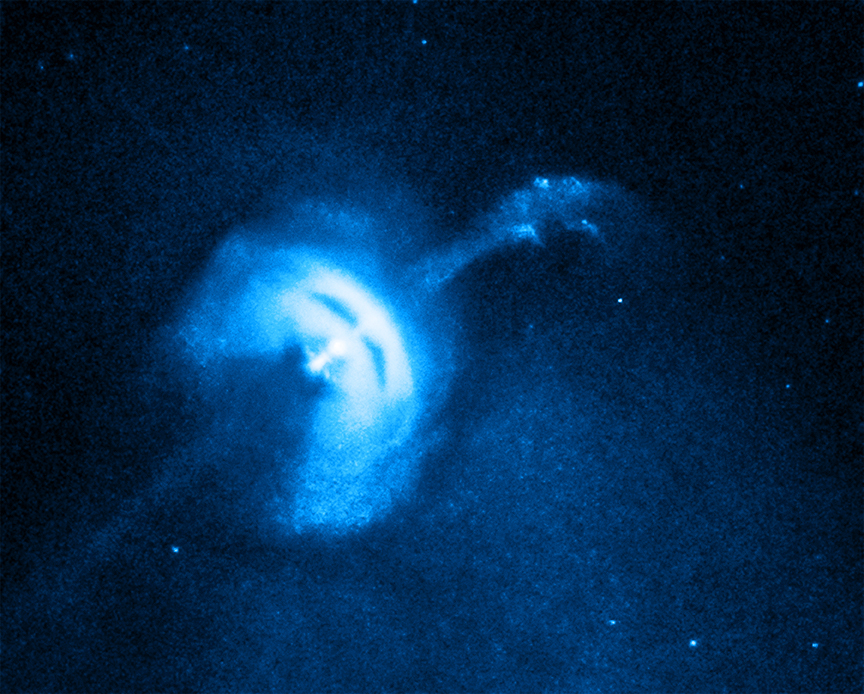
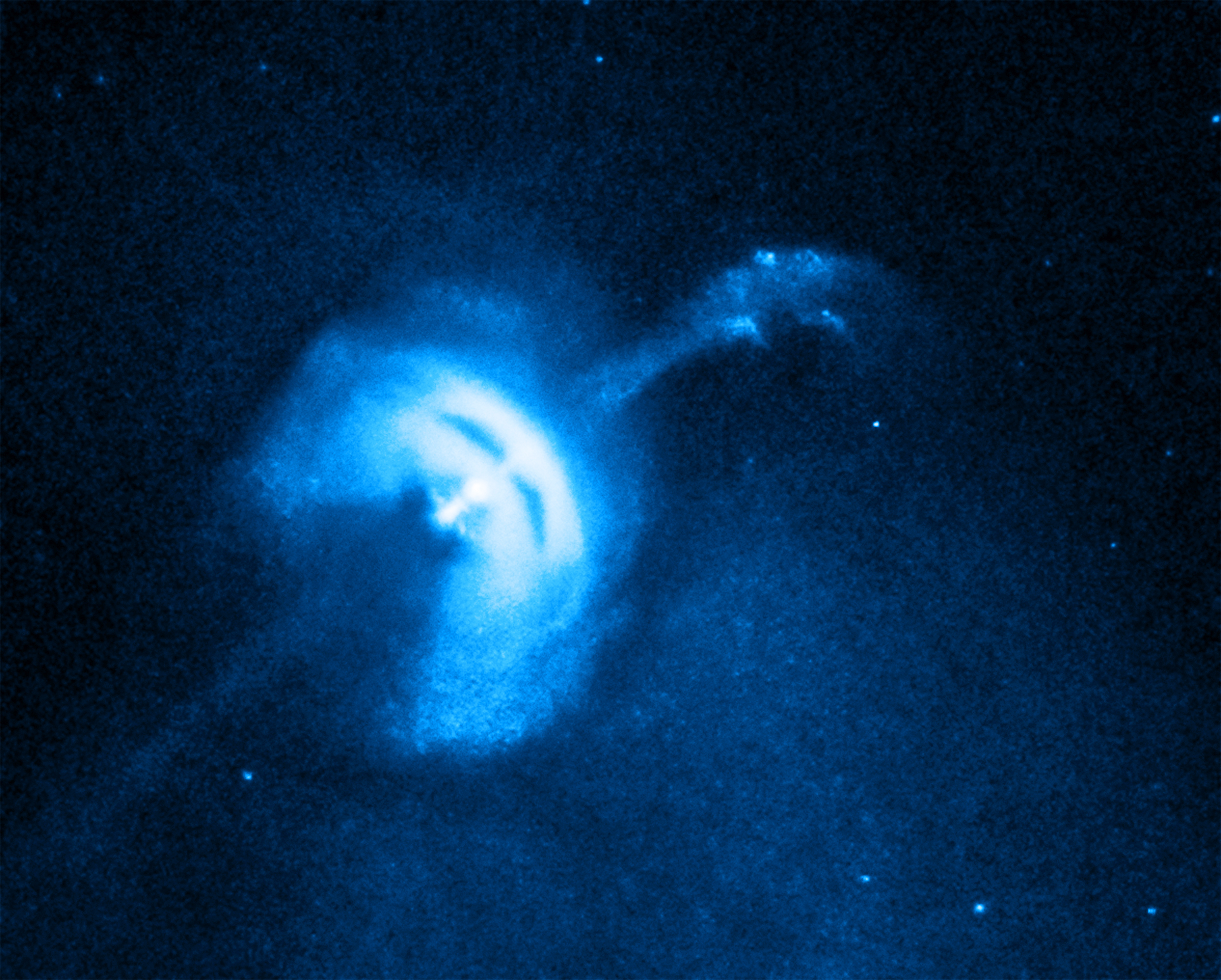
This movie from NASA's Chandra X-ray Observatory shows a fast moving jet of particles produced by a rapidly rotating neutron star , and may provide new insight into the nature of some of the densest matter in the universe.

The star of this movie is the Vela pulsar, a neutron star that was formed when a massive star collapsed. The Vela pulsar is about 1,000 light years from Earth, spans about 12 miles in diameter, and makes over 11 complete rotations every second, faster than a helicopter rotor. As the pulsar whips around, it spews out a jet of charged particles that race out along the pulsar's rotation axis at about 70% of the speed of light. In this still image from the movie, the location of the pulsar and the 0.7-light-year-long jet are labeled.


Labeled Vela Pulsar Jet
The Chandra data shown in the movie, containing 8 images obtained between June and September 2010, suggest that the pulsar may be slowly wobbling, or precessing, as it spins. The shape and the motion of the Vela jet look strikingly like a rotating helix, a shape that is naturally explained by precession, as shown in this animation. If the evidence for precession of the Vela pulsar is confirmed, it would be the first time that a jet from a neutron star has been found to be precessing in this way.

One possible cause of precession for a spinning neutron star is that it has become slightly distorted and is no longer a perfect sphere. This distortion might be caused by the combined action of the fast rotation and "glitches", sudden increases of the pulsar's rotational speed due to the interaction of the superfluid core of the neutron star with its crust.

A paper describing these results will be published in The Astrophysical Journal on January 10, 2013.  This is the second Chandra movie of the Vela pulsar, with the original having been released in 2003. The first Vela movie contained shorter, unevenly spaced observations so that the changes in the jet were less pronounced and the authors did not argue that precession was occurring. However, based on the same data, Avinash Deshpande of Arecibo Observatory in Puerto Rico and the Raman Research Institute in Bangalore, India, and the late Venkatraman Radhakrishnan, argued in a 2007 paper that the Vela pulsar might be precessing.

The Earth also precesses as it spins, with a period of about 26,000 years. In the future Polaris will no longer be the "north star" and other stars will take its place. The period of the Vela precession is much shorter and is estimated to be about 120 days.


Wide field Optical and X-ray

The supernova that formed the Vela pulsar exploded over 10,000 years ago. This optical image from the Anglo-Australian Observatory's UK Schmidt telescope shows the enormous apparent size of the supernova remnant formed by the explosion. The full size of the remnant is about eight degrees across, or about 16 times the angular size of the moon. The square near the center shows the Chandra image with a larger field-of-view than used for the movie, with the Vela pulsar in the middle.

Fast Facts for Vela Pulsar Jet:


Credit:
NASA/CXC/Univ of Toronto/M.Durant et al
Scale : Movie is 4.8 x 3.6 arcmin (1.4 x 1.0 light years)
Category : Neutron Stars/X-ray Binaries
Coordinates (J2000) : RA 08h 35m 20.60s | Dec -45° 10' 35.00"
Constellation : Vela
Observation Date : 8 pointings between Jul 2009 and Sep 2010
Observation Time : 89 hours (3 days, 17 hours)
Obs. ID : 10135-10139, 12073-12075
Instrument : ACIS
Color Code : X-ray (Blue)