Showing posts with label ULXs. Show all posts

Thursday, November 28, 2013

Do Black Holes Come in Size Medium?

The magenta spots in this image show two black holes in the spiral galaxy called NGC 1313, or the Topsy Turvy galaxy. Both black holes belong to a class called ultraluminous X-ray sources, or ULXs. The magenta X-ray data come from NASA's Nuclear Spectroscopic Telescopic Array, and are overlaid on a visible image from the Digitized Sky Survey. Image credit: NASA/JPL-Caltech/IRAP.  › Full image and caption

The magenta spots in this image show two black holes in the Circinus galaxy: the supermassive black hole at its heart, and a smaller one closer to the edge that belongs to a class called ultraluminous X-ray sources, or ULXs. The magenta X-ray data come from NASA's Nuclear Spectroscopic Telescopic Array, and are overlaid on a visible/infrared image from the Digitized Sky Survey. Image credit: NASA/JPL-Caltech.  › Full image and caption -  enlarge image
  
Black holes can be petite, with masses only about 10 times that of our sun -- or monstrous, boasting the equivalent in mass up to 10 billion suns. Do black holes also come in size medium? NASA's Nuclear Spectroscopic Telescope Array, or NuSTAR, is busy scrutinizing a class of black holes that may fall into the proposed medium-sized category.

"Exactly how intermediate-sized black holes would form remains an open issue," said Dominic Walton of the California Institute of Technology, Pasadena. "Some theories suggest they could form in rich, dense clusters of stars through repeated mergers, but there are a lot of questions left to be answered."

The largest black holes, referred to as supermassive, dominate the hearts of galaxies. The immense gravity of these black holes drags material toward them, forcing the material to heat up and release powerful X-rays. Small black holes dot the rest of the galactic landscape. They form under the crush of collapsing, dying stars bigger than our sun.

Evidence for medium-sized black holes lying somewhere between these two extremes might come from objects called ultraluminous X-ray sources, or ULXs. These are pairs of objects in which a black hole ravenously feeds off a normal star. The feeding process is somewhat similar to what happens around supermassive black holes, but isn't as big and messy. In addition, ULXs are located throughout galaxies, not at the cores.

The bright glow of X-rays coming from ULXs is too great to be the product of typical small black holes. This and other evidence indicates the objects may be intermediate in mass, with 100 to 10,000 times the mass of our sun. Alternatively, an explanation may lie in some kind of exotic phenomenon involving extreme accretion, or "feeding," of a black hole.

NuSTAR is joining with other telescopes to take a closer look at ULXs. It's providing the first look at these objects in focused, high-energy X-rays, helping to get better estimates of their masses and other characteristics.

In a new paper from Walton and colleagues accepted for publication in the Astrophysical Journal, the astronomers report serendipitously finding a ULX that had gone largely unnoticed before. They studied the object, which lies in the Circinus spiral galaxy 13 million light-years away, not only with NuSTAR but also with the European Space Agency's XMM-Newton satellite. Archival data from NASA's Chandra, Swift and Spitzer space telescopes as well as Japan's Suzaku satellite, were also used for further studies. "We went to town on this object, looking at a range of epochs and wavelengths," said Walton.

The results indicate the black hole in question is about 100 times the mass of the sun, putting it right at the border between small and medium black holes.

In another accepted Astrophysical Journal paper, Matteo Bachetti of the Institut de Recherche en Astrophysique et Planétologie and colleagues looked at two ULXs in NGC 1313, a spiral galaxy known as the "Topsy Turvy galaxy," also about 13 million light-years way.

These are among the best-studied ULXs known. A single viewing with NuSTAR showed that the black holes didn't fit with models of medium-size black holes. As a result, the researchers now think both ULXs harbor small, stellar-mass black holes. One of the objects is estimated to be big for its size category, at 70 to 100 solar masses.

"It's possible that these objects are ultraluminous because they are accreting material at a high rate and not because of their size," said Bachetti. "If intermediate-mass black holes are out there, they are doing a good job of hiding from us."

NuSTAR is a Small Explorer mission led by Caltech and managed by NASA's Jet Propulsion Laboratory, Pasadena, Calif., for NASA's Science Mission Directorate in Washington. The spacecraft was built by Orbital Sciences Corporation, Dulles, Va. Its instrument was built by a consortium including Caltech; JPL; the University of California, Berkeley; Columbia University, New York; NASA's Goddard Space Flight Center, Greenbelt, Md.; the Danish Technical University in Denmark; Lawrence Livermore National Laboratory, Livermore, Calif.; ATK Aerospace Systems, Goleta, Calif., and with support from the Italian Space Agency (ASI) Science Data Center.

NuSTAR's mission operations center is at UC Berkeley, with the ASI providing its equatorial ground station located at Malindi, Kenya. The mission's outreach program is based at Sonoma State University, Rohnert Park, Calif. NASA's Explorer Program is managed by Goddard. JPL is managed by Caltech for NASA.

Whitney Clavin 818-354-4673
Jet Propulsion Laboratory, Pasadena, Calif.

whitney.clavin@jpl.nasa.gov

Friday, December 07, 2012

NGC 922: Searching for the Best Black Hole Recipe

 NGC 922 - Composite
Credit:     X-ray (NASA/CXC/SAO/A.Prestwich et al); Optical (NASA/STScI)

In this holiday season of home cooking and carefully-honed recipes, some astronomers are asking: what is the best mix of ingredients for stars to make the largest number of plump black holes?


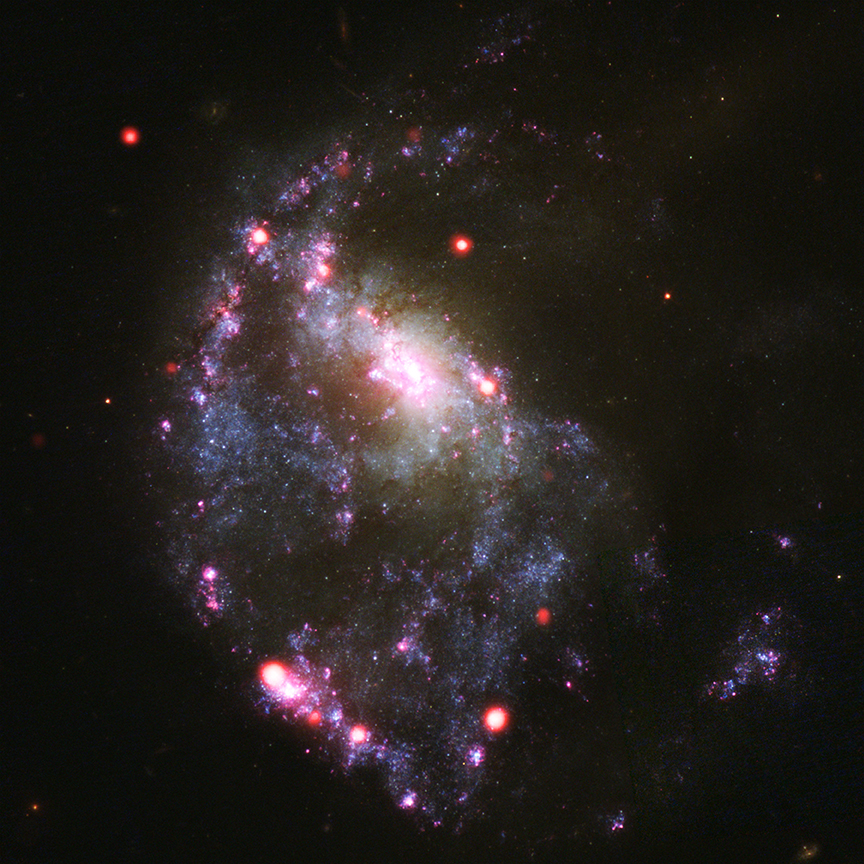
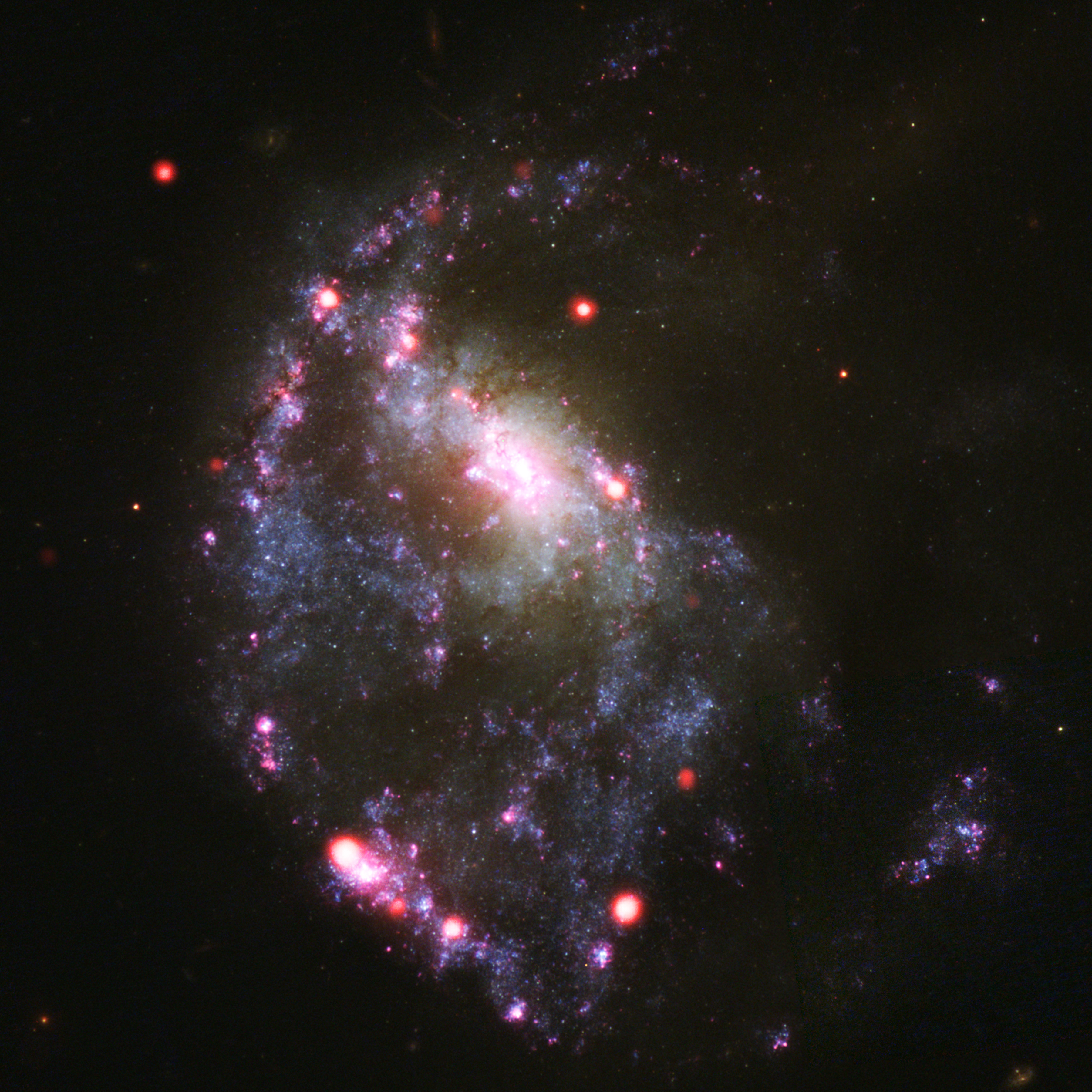
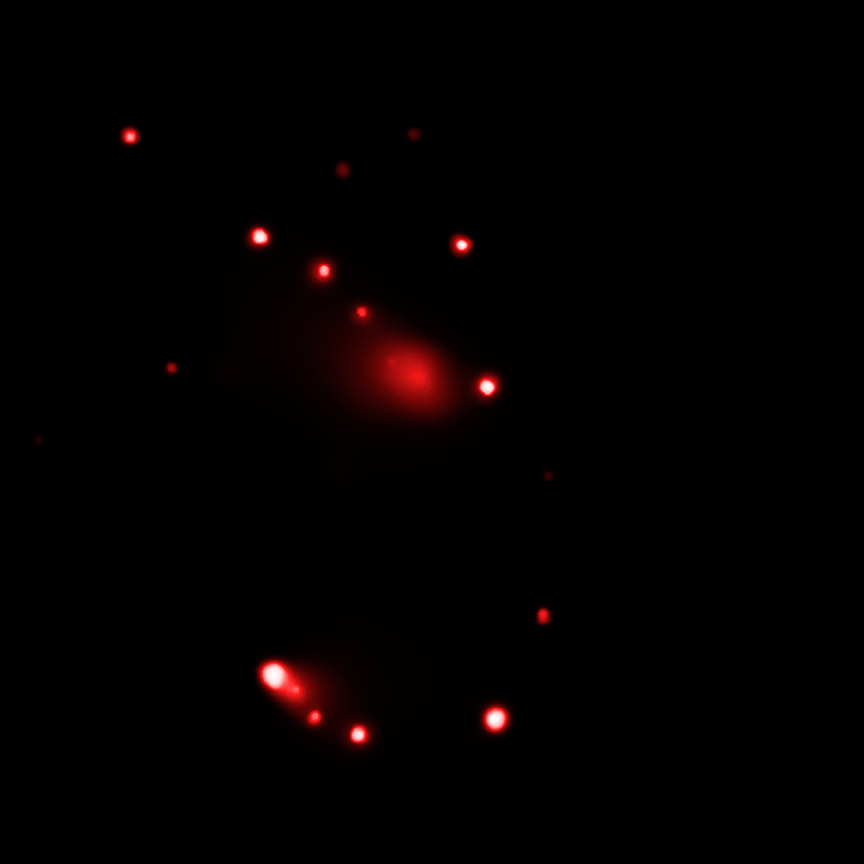
They are tackling this problem by studying the number of black holes in galaxies with different compositions. One of these galaxies, the ring galaxy NGC 922, is seen in this composite image containing X-rays from NASA's Chandra X-ray Observatory (red) and optical data from the Hubble Space Telescope (appearing as pink, yellow and blue).

NGC 922 was formed by the collision between two galaxies - one seen in this image and another located outside the field of view. This collision triggered the formation of new stars in the shape of a ring. Some of these were massive stars that evolved and collapsed to form black holes.

Most of the bright X-ray sources in Chandra's image of NGC 922 are black holes pulling material in from the winds of massive companion stars. Seven of these are what astronomers classify as "ultraluminous X-ray sources" (ULXs). These are thought to contain stellar-mass black holes that are at least ten times more massive than the sun, which places them in the upper range for this class of black hole. They are a different class from the supermassive black holes found at the centers of galaxies, which are millions to billions of times the mass of the sun. 

Theoretical work suggests that the most massive stellar-mass black holes should form in environments containing a relatively small fraction of elements heavier than hydrogen and helium. In massive stars, the processes that drive matter away from the stars in stellar winds work less efficiently if the fraction of metals is smaller. Thus, stars with fewer of these metals among their ingredients should lose less of their mass through winds as they evolve. A consequence of this reduced mass loss is that a larger proportion of massive stars will collapse to form black holes when their nuclear fuel is exhausted. This theory appeared to be supported by the detection of a large number (12) of ULXs in the Cartwheel galaxy, where stars typically contain only about 30% of the metals found in the sun.

To test this theory, scientists studied NGC 922, which contains about the same fraction of metals as the sun, meaning that this galaxy is about three times richer in metals than the Cartwheel galaxy. Perhaps surprisingly, the number of ULXs found in NGC 922 is comparable to the number seen in the Cartwheel galaxy. Rather, the ULX tally appears to depend only on the rate at which stars are forming in the two galaxies, not on the fraction of metals they contain.
 
Credit: Composite: NASA/JPL/Caltech/P.Appleton et al. 
X-ray: NASA/CXC/A.Wolter & G.Trinchieri et al.

One explanation for these results is that the theory predicting the most massive stellar-mass black holes should form in metal poor conditions is incorrect. Another explanation is that the metal fraction in the Cartwheel galaxy is not low enough to have a clear effect on the production of unusually massive stellar-mass black holes, and therefore will not cause an enhancement in the number of ULXs. Recent models incorporating the evolution of stars  suggest that a clear enhancement in the number of ULXs might only be seen when the metal fraction falls below about 15% of the Sun's value. Astronomers are investigating this possibility by observing galaxies with extremely low metal fractions using Chandra. The number of ULXs is being compared with the number found in galaxies with higher metal content. The results of this work will be published in a future paper.

A paper describing the results for NGC 922 was published in the March 10, 2012 issue of the Astrophysical Journal. The authors were Andrea Prestwich and Jose Luis Galache of the Harvard-Smithsonian Center for Astrophysics (CfA) in Cambridge, MA; Tim Linden from University of Santa Cruz in Santa Cruz, CA; Vicky Kalogera from Northwestern University in Evanston, IL; Andreas Zezas from CfA and University of Crete in Crete, Greece; Tim Roberts from University of Durham in Durham, UK; Roy Kilgard from Wesleyan University in Middletown, CT; Anna Wolter and Ginevra Trinchieri from INAF in Milano, Italy.

NASA's Marshall Space Flight Center in Huntsville, Ala., manages the Chandra program for NASA's Science Mission Directorate in Washington. The Smithsonian Astrophysical Observatory controls Chandra's science and flight operations from Cambridge, Mass.

Fast Facts for NGC 922:

Credit:     X-ray (NASA/CXC/SAO/A.Prestwich et al); Optical (NASA/STScI)
Release Date:     December 6, 2012
Scale:     Image is 1.6 arcmin across (about 73,000 light years)
Coordinates (J2000):     RA 02h 25m 04.40s | Dec -24° 47' 17.00"
Constellation:
    Fornax
Observation Date:      March 5 and October 2, 2009
Observation Time:      11 hours 11 min
Obs. ID:      10563-10564
Instrument:
    ACIS
References:     Prestwich, A., et al, 2012, ApJ, 747, 150  http://xxx.lanl.gov/abs/1212.1124
Color Code:     X-ray (Red); Optical (Red, Green, Blue)