Thursday, May 21, 2020

ESO Telescope Sees Signs of Planet Birth

SPHERE image of the disc around AB Aurigae

SPHERE image of the inner disc around AB Aurigae

SPHERE images of the AB Aurigae system (side by side)

SPHERE images of the AB Aurigae system (side by side, annotated)

Location of AB Aurigae in the constellation of Auriga

Wide-field view of the region of the sky where AB Aurigae is located


Videos

ESOcast 221 Light: ESO Telescope Sees Signs of Planet Birth
ESOcast 221 Li

Zooming in to the inner region of the AB Aurigae system

Zooming in to AB Aurigae


The Twist Marks the Spot

Observations made with the European Southern Observatory’s Very Large Telescope (ESO’s VLT) have revealed the telltale signs of a star system being born. Around the young star AB Aurigae lies a dense disc of dust and gas in which astronomers have spotted a prominent spiral structure with a ‘twist’ that marks the site where a planet may be forming. The observed feature could be the first direct evidence of a baby planet coming into existence.

“Thousands of exoplanets have been identified so far, but little is known about how they form,” says Anthony Boccaletti who led the study from the Observatoire de Paris, PSL University, France. Astronomers know planets are born in dusty discs surrounding young stars, like AB Aurigae, as cold gas and dust clump together. The new observations with ESO’s VLT, published in Astronomy & Astrophysics, provide crucial clues to help scientists better understand this process.

“We need to observe very young systems to really capture the moment when planets form,” says Boccaletti. But until now astronomers had been unable to take sufficiently sharp and deep images of these young discs to find the ‘twist’ that marks the spot where a baby planet may be coming to existence.

The new images feature a stunning spiral of dust and gas around AB Aurigae, located 520 light-years away from Earth in the constellation of Auriga (The Charioteer). Spirals of this type signal the presence of baby planets, which ‘kick’ the gas, creating “disturbances in the disc in the form of a wave, somewhat like the wake of a boat on a lake,” explains Emmanuel Di Folco of the Astrophysics Laboratory of Bordeaux (LAB), France, who also participated in the study. As the planet rotates around the central star, this wave gets shaped into a spiral arm. The very bright yellow ‘twist’ region close to the centre of the new AB Aurigae image, which lies at about the same distance from the star as Neptune from the Sun, is one of these disturbance sites where the team believe a planet is being made.

Observations of the AB Aurigae system made a few years ago with the Atacama Large Millimeter/submillimeter Array (ALMA), in which ESO is a partner, provided the first hints of ongoing planet formation around the star. In the ALMA images, scientists spotted two spiral arms of gas close to the star, lying within the disc’s inner region. Then, in 2019 and early 2020, Boccaletti and a team of astronomers from France, Taiwan, the US and Belgium set out to capture a clearer picture by turning the SPHERE instrument on ESO’s VLT in Chile toward the star. The SPHERE images are the deepest images of the AB Aurigae system obtained to date.

With SPHERE's powerful imaging system, astronomers could see the fainter light from small dust grains and emissions coming from the inner disc. They confirmed the presence of the spiral arms first detected by ALMA and also spotted another remarkable feature, a ‘twist’, that points to the presence of ongoing planet formation in the disc. "The twist is expected from some theoretical models of planet formation,” says co-author Anne Dutrey, also at LAB. “It corresponds to the connection of two spirals  — one winding inwards of the planet’s orbit, the other expanding outwards — which join at the planet location. They allow gas and dust from the disc to accrete onto the forming planet and make it grow."

ESO is constructing the 39-metre Extremely Large Telescope, which will draw on the cutting-edge work of ALMA and SPHERE to study extrasolar worlds. As Boccaletti explains, this powerful telescope will allow astronomers to get even more detailed views of planets in the making. “We should be able to see directly and more precisely how the dynamics of the gas contributes to the formation of planets,” he concludes.


More Information

This research was presented in the paper “Possible evidence of ongoing planet formation in AB Aurigae: A showcase of the SPHERE/ALMA synergy” to appear in Astronomy & Astrophysics (doi: 10.1051/0004-6361/202038008). 

The team is composed of A. Boccaletti (LESIA, Observatoire de Paris, Université PSL, CNRS, Sorbonne Université, Univ. Paris Diderot, Sorbonne Paris Cité, CNRS, France), E. Di Folco (Laboratoire d’Astrophysique de Bordeaux, Université de Bordeaux, CNRS, France [Bordeaux]), E. Pantin (Laboratoire CEA, IRFU/DAp, AIM, Université Paris-Saclay, Université Paris Diderot, Sorbonne Paris Cité, CNRS, France), A. Dutrey (Bordeaux), S. Guilloteau (Bordeaux), Y. W. Tang (Academia Sinica, Institute of Astronomy and Astrophysics, Taipei, Taiwan), V. Piétu (IRAM, Domaine Universitaire, France), E. Habart (Institut d’astrophysique spatiale, CNRS UMR 8617, Université Paris-Sud 11, France), J. Milli (CNRS, IPAG, Univ. Grenoble Alpes, France), T. L. Beck (Space Telescope Science Institute, Baltimore, MD, USA), and A.-L. Maire (STAR Institute, Université de Liège, Belgium).

ESO is the foremost intergovernmental astronomy organisation in Europe and the world’s most productive ground-based astronomical observatory by far. It has 16 Member States: Austria, Belgium, the Czech Republic, Denmark, France, Finland, Germany, Ireland, Italy, the Netherlands, Poland, Portugal, Spain, Sweden, Switzerland and the United Kingdom, along with the host state of Chile and with Australia as a Strategic Partner. ESO carries out an ambitious programme focused on the design, construction and operation of powerful ground-based observing facilities enabling astronomers to make important scientific discoveries. ESO also plays a leading role in promoting and organising cooperation in astronomical research. ESO operates three unique world-class observing sites in Chile: La Silla, Paranal and Chajnantor. At Paranal, ESO operates the Very Large Telescope and its world-leading Very Large Telescope Interferometer as well as two survey telescopes, VISTA working in the infrared and the visible-light VLT Survey Telescope. Also at Paranal ESO will host and operate the Cherenkov Telescope Array South, the world’s largest and most sensitive gamma-ray observatory. ESO is also a major partner in two facilities on Chajnantor, APEX and ALMA, the largest astronomical project in existence. And on Cerro Armazones, close to Paranal, ESO is building the 39-metre Extremely Large Telescope, the ELT, which will become “the world’s biggest eye on the sky”. 

The Atacama Large Millimeter/submillimeter Array (ALMA), an international astronomy facility, is a partnership of ESO, the U.S. National Science Foundation (NSF) and the National Institutes of Natural Sciences (NINS) of Japan in cooperation with the Republic of Chile. ALMA is funded by ESO on behalf of its Member States, by NSF in cooperation with the National Research Council of Canada (NRC) and the National Science Council of Taiwan (NSC) and by NINS in cooperation with the Academia Sinica (AS) in Taiwan and the Korea Astronomy and Space Science Institute (KASI). ALMA construction and operations are led by ESO on behalf of its Member States; by the National Radio Astronomy Observatory (NRAO), managed by Associated Universities, Inc. (AUI), on behalf of North America; and by the National Astronomical Observatory of Japan (NAOJ) on behalf of East Asia. The Joint ALMA Observatory (JAO) provides the unified leadership and management of the construction, commissioning and operation of ALMA.


Links


Contacts

Anthony Boccaletti
Laboratory for Space Science and Astrophysical Instrumentation (LESIA), Observatoire de Paris - PSL
Meudon, France
Cell: +33 (0)675465583
Email:
anthony.boccaletti@observatoiredeparis.psl.eu

Emmanuel Di Folco
Astrophysics Laboratory of Bordeaux (LAB)
Bordeaux, France
Cell: +33 (0)633966142
Email:
emmanuel.difolco@u-bordeaux.fr

Anne Dutrey
Astrophysics Laboratory of Bordeaux (LAB)
Bordeaux, France
Email:
anne.dutrey@u-bordeaux.fr

Bárbara Ferreira
ESO Public Information Officer
Garching bei München, Germany
Tel: +49 89 3200 6670
Cell: +49 151 241 664 00
Email:
pio@eso.org


Source:  ESO/News


Wednesday, May 20, 2020

Top Ten Discoveries from SOFIA

Ten years ago, NASA’s telescope on an airplane, the Stratospheric Observatory for Infrared Astronomy, or SOFIA, first peered into the cosmos. Since the night of May 26, 2010, SOFIA’s observations of infrared light, invisible to the human eye, have made many scientific discoveries about the hidden universe.

SOFIA’s maiden flight, known as “first light,” observed heat pouring out of Jupiter’s interior through holes in the clouds and peered through the dense dust clouds of the Messier 82 galaxy to catch a glimpse of tens of thousands of stars forming. The observatory was declared fully operational in 2014 — the equivalent to the launch of a space telescope — but it began making discoveries even while completing the testing of its instruments and telescope.

The modified Boeing 747SP flies a nearly 9-foot diameter telescope up to 45,000 feet in altitude, above 99% of the Earth's water vapor to get a clear view of the infrared universe not observable by ground-based telescopes. Its mobility also allows it to capture transitory events in astronomy over remote locations like the open ocean. Because SOFIA lands after each flight, it can be upgraded with the latest technology to respond to some of most pressing questions in science.

Using SOFIA, scientists detected the universe’s first type of molecule in space, unveiled new details about the birth and death of stars and planets, and explained what’s powering supermassive black holes, and how galaxies evolve and take shape, among other discoveries. Here are some of SOFIA’s top discoveries of the last decade:

The Universe’s First Type of Molecule Found at Last 

SOFIA found the first type of molecule to form in the universe, called helium hydride. It was first formed only 100,000 years after the Big Bang as the first step in cosmic evolution that eventually led to the complex universe we know today. The same kind of molecule should be present in parts of the modern universe, but it had never been detected outside of a laboratory until SOFIA found it in a planetary nebula called NGC 7027. Finding it in the modern universe confirms a key part of our basic understanding of the early universe.​

The powerful wind from the newly formed star at the heart of the Orion Nebula is creating the bubble (black) and preventing new stars from forming in its neighborhood. At the same time, the wind is pushing molecular gas (color) to the edges, creating a dense shell around the bubble where future generations of stars can form. Credits: NASA/SOFIA/Pabst et. al. Hi-res image

Weighing a Galactic Wind Provides Clues to the Evolution of Galaxies 

SOFIA found that the wind flowing from the center of the Cigar Galaxy (M82) is aligned along a magnetic field and transports a huge amount of material. Magnetic fields are usually parallel to the plane of the galaxy, but the wind is dragging it so it’s perpendicular. The powerful wind, driven by the galaxy's high rate of star birth, could be one of the mechanisms for material to escape the galaxy. Similar processes in the early universe would have affected the fundamental evolution of the first galaxies.

Composite image of the Cigar Galaxy (also called M82), a starburst galaxy about 12 million light-years away in the constellation Ursa Major. The magnetic field detected by SOFIA, shown as streamlines, appears to follow the bipolar outflows (red) generated by the intense nuclear starburst. The image combines visible starlight (gray) and a tracing of hydrogen gas (red) from the Kitt Peak Observatory, with near-infrared and mid-infrared starlight and dust (yellow) from SOFIA and the Spitzer Space Telescope. Credits: NASA/SOFIA; NASA/JPL-Caltech. Hi-res image

Nearby Planetary System Similar to Our Own 

The planetary system around the star Epsilon Eridani, or eps Eri for short, is the closest planetary system around a star similar to the early Sun. SOFIA studied the infrared glow from the warm dust, confirming that the system has an architecture remarkably similar to our solar system. Its material is arranged in at least one narrow belt near a Jupiter-sized planet.​

Artist's illustration of the Epsilon Eridani system showing Epsilon Eridani b. In the right foreground, a Jupiter-mass planet is shown orbiting its parent star at the outside edge of an asteroid belt. In the background can be seen another narrow asteroid or comet belt plus an outermost belt similar in size to our solar system's Kuiper Belt. The similarity of the structure of the Epsilon Eridani system to our solar system is remarkable, although Epsilon Eridani is much younger than our sun. SOFIA observations confirmed the existence of the asteroid belt adjacent to the orbit of the Jovian planet. Credits: NASA/SOFIA/Lynette Cook.
Hi-res image

Magnetic Fields May Be Feeding Active Black Holes 

Magnetic fields in the Cygnus A galaxy are feeding material into the galaxy’s central black hole. SOFIA revealed that the invisible forces, shown as streamlines in this illustration, are trapping material close to the center of the galaxy where it is close enough the be devoured by the hungry black hole. However, magnetic fields in other galaxies may be preventing black holes from consuming material.

Artist’s conception of the core of Cygnus A, including the dusty donut-shaped surroundings, called a torus, and jets launching from its center. Magnetic fields are illustrated trapping the dust in the torus. These magnetic fields could be helping power the black hole hidden in the galaxy’s core by confining the dust in the torus and keeping it close enough to be gobbled up by the hungry black hole. Credits: NASA/SOFIA/Lynette Cook.Hi-res image

Magnetic Fields May Be Keeping Milky Way’s Black Hole Quiet

This image shows the ring of material around the black hole at the center of our Milky Way galaxy. SOFIA detected magnetic fields, shown as streamlines, that may be channeling the gas into an orbit around the black hole, rather than directly into it. This may explain why our galaxy’s black hole is relatively quiet, while those in other galaxies are actively consuming material.

Streamlines showing magnetic fields layered over a color image of the dusty ring around the Milky Way’s massive black hole. The Y-shaped structure is warm material falling toward the black hole, which is located near where the two arms of the Y-shape intersect. The streamlines reveal that the magnetic field closely follows the shape of the dusty structure. Each of the blue arms has its own field that is totally distinct from the rest of the ring, shown in pink. Credits: Dust and magnetic fields: NASA/SOFIA; Star field image: NASA/Hubble Space Telescope.
Hi-res imge

“Kitchen Smoke” Molecules in Nebula Offer Clues to Building Blocks of Life

SOFIA found that the organic, complex molecules in the nebula NGC 7023 evolve into larger, more complex molecules when hit with radiation from nearby stars. Researchers were surprised to find that the radiation helped these molecules grow instead of destroying them. The growth of these molecules is one of the steps that could lead to the emergence of life under the right circumstances.

Combination of three color images of NGC 7023 from SOFIA (red & green) and Spitzer (blue) show different populations of PAH molecules. . Credit: NASA/DLR/SOFIA/B. Croiset, Leiden Observatory, and O. Berné, CNRS; NASA/JPL-Caltech/Spitzer.
Hi-res image

Dust Survives Obliteration in Supernova 

SOFIA discovered that a supernova explosion can produce a substantial amount of the material from which planets like Earth can form. Infrared observations of a cloud produced by a supernova 10,000 years ago contains enough dust to make 7,000 Earths. Scientists now know that material created by the first outward shock wave can survive the subsequent inward “rebound” wave generated when the first collides with surrounding interstellar gas and dust.

Illustration of a supernova as the powerful blast wave passes through its outer ring before a subsequent inward shock rebounds. SOFIA found the material produced from first outward wave can survive the second inward wave and can become seed material for new stars and planets. Credits: NASA/SOFIA/Symbolic Pictures/The Casadonte Group. Hi-res image

New View of Milky Way’s Center Reveals Birth of Massive Stars ​

SOFIA captured an extremely crisp infrared image of the center of our Milky Way galaxy. Spanning a distance of more than 600 light-years, this panorama reveals details within the dense swirls of gas and dust in high resolution, opening the door to future research into how massive stars are forming and what’s feeding the supermassive black hole at our galaxy’s core.

Composite infrared image of the center of our Milky way Galaxy. It spans 600+ lightyears across and is helping scientists learn how many massive stars are forming in our galaxy’s center. New data from SOFIA taken at 25 and 37 microns, shown in blue and green, is combined with data from the Herschel Space Observatory, shown in red (70 microns), and the Spitzer Space Telescope, shown in white (8 microns). SOFIA’s view reveals features that have never been seen before. Credits: NASA/SOFIA/JPL-Caltech/ESA/Herschel.
Hi-res image

What Happens When Exoplanets Collide 

Known as BD +20 307, this double-star system is more than 300 light years from Earth likely had an extreme collision between rocky exoplanets. A decade ago, observations of this system gave the first hints of a collision when they found debris that was warmer than expected to be around mature stars that are at least one billion years old. SOFIA’s observations discovered the infrared brightness from the debris has increased by more than 10%,  a sign that there is now even more warm dust and that a collision occurred relatively recently. A similar event in our own solar system may have formed our Moon.

Artist’s concept illustrating a catastrophic collision between two rocky exoplanets in the planetary system BD +20 307, turning both into dusty debris. Ten years ago, scientists speculated that the warm dust in this system was a result of a planet-to-planet collision. Now, SOFIA found even more warm dust, further supporting that two rocky exoplanets collided. This helps build a more complete picture of our own solar system’s history. Such a collision could be similar to the type of catastrophic event that ultimately created our Moon. Credits: NASA/SOFIA/Lynette Cook.
  Hi-res image

SOFIA, the Stratospheric Observatory for Infrared Astronomy, is a Boeing 747SP jetliner modified to carry a 106-inch diameter telescope. It is a joint project of NASA and the German Aerospace Center, DLR. NASA’s Ames Research Center in California’s Silicon Valley manages the SOFIA program, science and mission operations in cooperation with the Universities Space Research Association headquartered in Columbia, Maryland, and the German SOFIA Institute (DSI) at the University of Stuttgart. The aircraft is maintained and operated from NASA’s Armstrong Flight Research Center Building 703, in Palmdale, California.

Media Contact

Members of the news media interested in covering this topic should reach out to the NASA Ames newsroom.

Felicia Chou
NASA Headquarters, Washington 
202-358-0257

felicia.chou@nasa.gov


Editor: Kassandra Bell


Tuesday, May 19, 2020

Astronomers Confirm Existence of Two Giant Newborn Planets in PDS 70 System

A direct image of pds 70 protoplanets b and planet c (labeled with white arrows) with the circumstellar disk removed. the image was captured using w. m. keck observatory’s recently upgraded adaptive optics system. Image Credit: J. Wang, Caltech.


New Direct Images Captured with W. M. Keck Observatory’s Upgraded Adaptive Optics System Lead to First Independent Confirmation of PDS 70 Protoplanets

Maunakea, Hawaii – New evidence shows the first-ever pictures capturing the birth of a pair of planets orbiting the star PDS 70 are in fact authentic.

Using a new infrared pyramid wavefront sensor for adaptive optics (AO) correction at W. M. Keck Observatory on Maunakea in Hawaii, a Caltech-led team of astronomers applied a new method of taking family photos of the baby planets, or protoplanets, and confirmed their existence.

The team’s results are published in today’s issue* of The Astronomical Journal.

PDS 70 is the first known multiplanetary system where astronomers can witness planet formation in action. The first direct image of one of its planets, PDS 70b, was taken in 2018 followed by multiple images taken at different wavelengths of its sibling, PDS 70c, in 2019. Both Jupiter-like protoplanets were discovered by the European Southern Observatory’s Very Large Telescope (VLT).

“There was some confusion when the two protoplanets were first imaged,” said Jason Wang, a Heising-Simons Foundation 51 Pegasi b Fellow at Caltech and lead author of the study. “Planet embryos form from a disk of dust and gas surrounding a newborn star. This circumstellar material accretes onto the protoplanet, creating a kind of smokescreen that makes it difficult to differentiate the dusty, gaseous disk from the developing planet in an image.”

To help provide clarity, Wang and his team developed a method to disentangle the image signals from the circumstellar disk and the protoplanets.

“We know the disk’s shape should be a symmetrical ring around the star whereas a planet should be a single point in the image,” said Wang. “So even if a planet appears to sit on top of the disk, which is the case with PDS 70c, based on our knowledge of how the disk looks throughout the whole image, we can infer how bright the disk should be at the location of the protoplanet and remove the disk signal. All that’s left over is the planet’s emission.”

Artist’s impression of the PDS 70 system. The two planets are seen clearing a gap in the protoplanetary disk from which they were born. The planets are heated by infalling material that they are actively accreting and are glowing red. Note that the planets and star are not to scale and would be much smaller in size compared to their relative separations. Image Credit: W. M. Keck Observatory/Adam Makarenko


The team snapped images of PDS 70 with the Near-Infrared Camera (NIRC2) on the Keck II telescope, marking first science for a vortex coronagraphp installed in NIRC2 as part of a recent upgrade, combined with the Observatory’s upgraded AO system consisting of a new infrared pyramid wavefront sensor and real-time control computer.

“The new infrared detector technology used in our pyramid wavefront sensor has dramatically improved our ability to study exoplanets, especially those around low-mass stars where planet formation is actively occurring,” said Sylvain Cetre, software engineer at Keck Observatory and one of the lead developers of the AO upgrade. “It will also allow us to improve the quality of our AO correction for harder to image targets like the center of our galaxy.”

This project benefited from the innovative infrared sensor that measures distortions in light caused by the Earth’s atmosphere. “New technology is a science multiplier,” says Peter Kurczynski, program director at the National Science Foundation, which contributed funding to this project. “It enables investigations that were never before possible.”

AO is a technique used to remove the atmospheric blurring that distorts astronomical images. With the new infrared pyramid wavefront sensor and real-time controller installed, Keck Observatory’s AO system is able to deliver sharper, more detailed images.

“The PDS 70 imagery Jason’s team captured was among the first tests of the scientific quality produced by Keck’s pyramid wavefront sensor,” said AO scientist Charlotte Bond, who played a key role in the design and installation of the technology. “It’s exciting to see just how precise the new AO system corrects for the atmospheric turbulence of dusty objects like the young stars where protoplanets are expected to reside, allowing for the clearest, sharpest view of baby versions of our solar system.”

The W. M. Keck Observatory Adaptive Optics Near-Infrared Pyramid Wavefront Sensor development was supported by a grant from the National Science Foundation Advanced Telescopes and Instrumentation program and conducted in collaboration with the University of Hawaii and Caltech, as well as colleages from the Subaru Telescope, Arcetri Astrophysical Observatory, and the Laboratoire d’Astrophysique de Marseille.

*Posted May 18, 2020


;About Adaptive Optics

W. M. Keck Observatory is a distinguished leader in the field of adaptive optics (AO), a breakthrough technology that removes the distortions caused by the turbulence in the Earth’s atmosphere. Keck Observatory pioneered the astronomical use of both natural guide star (NGS) and laser guide star adaptive optics (LGS AO) and current systems now deliver images three to four times sharper than the Hubble Space Telescope. Keck AO has imaged the four massive planets orbiting the star HR8799, measured the mass of the giant black hole at the center of our Milky Way Galaxy, discovered new supernovae in distant galaxies, and identified the specific stars that were their progenitors.

The original Keck II AO system was built with funding from the W. M. Keck Foundation and NASA. The new RTC will build on a laser guide star facility upgrade completed in 2016 with the generous financial support of the Gordon and Betty Moore Foundation, W. M. Keck Foundation, the National Science Foundation, and other Friends of Keck including The Bob and Renee Parsons Foundation, Change Happens Foundation, Mt. Cuba Astronomical Foundation, and Sanford and Jeanne Robertson.

About NIRC2

The Near-Infrared Camera, second generation (NIRC2) works in combination with the Keck II adaptive optics system to obtain very sharp images at near-infrared wavelengths, achieving spatial resolutions comparable to or better than those achieved by the Hubble Space Telescope at optical wavelengths. NIRC2 is probably best known for helping to provide definitive proof of a central massive black hole at the center of our galaxy. Astronomers also use NIRC2 to map surface features of solar system bodies, detect planets orbiting other stars, and study detailed morphology of distant galaxies.

About W. M. Keck Observatory

The W. M. Keck Observatory telescopes are among the most scientifically productive on Earth. The two, 10-meter optical/infrared telescopes on the summit of Maunakea on the Island of Hawaii feature a suite of advanced instruments including imagers, multi-object spectrographs, high-resolution spectrographs, integral-field spectrometers, and world-leading laser guide star adaptive optics systems. Some of the data presented herein were obtained at Keck Observatory, which is a private 501(c) 3 non-profit organization operated as a scientific partnership among the California Institute of Technology, the University of California, and the National Aeronautics and Space Administration. The Observatory was made possible by the generous financial support of the W. M. Keck Foundation. The authors wish to recognize and acknowledge the very significant cultural role and reverence that the summit of Maunakea has always had within the Native Hawaiian community. We are most fortunate to have the opportunity to conduct observations from this mountain.

About The National Science Foundation

The U.S. National Science Foundation propels the nation forward by advancing fundamental research in all fields of science and engineering. NSF supports research and people by providing facilities, instruments and funding to support their ingenuity and sustain the U.S. as a global leader in research and innovation. With a fiscal year 2020 budget of $8.3 billion, NSF funds reach all 50 states through grants to nearly 2,000 colleges, universities and institutions. Each year, NSF receives more than 40,000 competitive proposals and makes about 11,000 new awards. Those awards include support for cooperative research with industry, Arctic and Antarctic research and operations, and U.S. participation in international scientific efforts.


Monday, May 18, 2020

TRAPPIST-1 Planetary Orbits not Misaligned: First Scientific Result by the New Spectrograph on the Subaru Telescope

Figure 1: Artist's impression of the TRAPPIST-1 exoplanet system.
Credit: NAOJ

Astronomers using the Subaru Telescope have determined that the Earth-like planets of the TRAPPIST-1 system are not significantly misaligned with the rotation of the star. This is an important result for understanding the evolution of planetary systems around very low-mass stars in general, and in particular the history of the TRAPPIST-1 planets including the ones near the habitable zone.

Stars like the Sun are not static, but rotate about an axis. This rotation is most noticeable when there are features like sunspots on the surface of the star. In the Solar System, the orbits of all of the planets are aligned to within 6 degrees with the Sun's rotation. In the past it was assumed that planetary orbits would be aligned with the rotation of the star, but there are now many known examples of exoplanet systems where the planetary orbits are strongly misaligned with the central star's rotation. This raises the question: can planetary systems form out of alignment, or did the observed misaligned systems start out aligned and were later thrown out of alignment by some perturbation?

The TRAPPIST-1 system has attracted attention because it has three small rocky planets located in or near the habitable zone where liquid water can exist. The central star is a very low-mass and cool star, called an M dwarf, and those planets are situated very close to the central star. Therefore, this planetary system is very different from our Solar System. Determining the history of this system is important because it could help determine if any of the potentially habitable planets are actually inhabitable. But it is also an interesting system because it lacks any nearby objects which could have perturbed the orbits of the planets, meaning that the orbits should still be located close to where the planets first formed. This gives astronomers a chance to investigate the primordial conditions of the system.

Because stars rotate, the side rotating into view has a relative velocity towards the viewer, while the side rotating out of view has a relative velocity away from the viewer. If a planet transits, passes between the star and the Earth and blocks a small portion of the light from the star, it is possible to tell which edge of the star the planet blocks first. This phenomenon is called the Rossiter-McLaughlin effect. Using this method, it is possible to measure the misalignment between the planetary orbit and the star's rotation. However, until now those observations have been limited to large planets such as Jupiter-like or Neptune-like ones.

A team of researchers, including members from the Tokyo Institute of Technology and the Astrobiology Center in Japan, observed TRAPPIST-1 with the Subaru Telescope to look for misalignment between the planetary orbits and the star. The team took advantage of a chance on August 31, 2018, when three of the exoplanets orbiting TRAPPIST-1 transited in front of the star in a single night. Two of the three were rocky planets near the habitable zone. Since low-mass stars are generally faint, it had been impossible to probe the stellar obliquity (spin-orbit angle) for TRAPPIST-1. But thanks to the light gathering power of the Subaru Telescope and high spectral resolution of the new infrared spectrograph IRD, the team was able to measure the obliquity. They found that the obliquity was low, close to zero. This is the first measurement of the stellar obliquity for a very low-mass star like TRAPPIST-1 and also the first Rossiter-McLaughlin measurement for planets in the habitable zone.

However the leader of the team, Teruyuki Hirano at the Tokyo Institute of Technology, cautions, "The data suggest alignment of the stellar spin with the planetary orbital axes, but the precision of the measurements was not good enough to completely rule out a small spin-orbit misalignment. Nonetheless, this is the first detection of the effect with Earth-like planets and more work will better characterize this remarkable exoplanet system."

These results appeared as Hirano, T. et. al. "Evidence for Spin–Orbit Alignment in the TRAPPIST-1 System" in The Astrophysical Journal Letters on February 25, 2020.

Relevant Links


Friday, May 15, 2020

Polarime-trying to Map Magnetic Fields in the Orion Nebula

The OMC-1 region of the Orion nebula, with overlaid magnetic field lines as measured by SOFIA. Credit: [NASA/SOFIA/D. Chuss et al. & ESO/M. McCaughrean et al.]


OMC-What?

The Orion Molecular Cloud 1 (OMC-1) is part of the Orion Nebula, and one of the most massive star-forming regions in the solar neighborhood. The gas and dust within OMC-1 act as a nursery for young stars, providing them with the necessary materials to develop. As such a close and large stellar nursery, OMC-1 is an easily accessible and important laboratory for studying the still-mysterious conditions that surround and encourage star formation. Today’s paper contributes to our understanding of star formation by determining OMC-1’s magnetic field and dust properties using polarimetry (more on this technique later!).

OMC-1 is a particularly interesting target for magnetic field and dust measurements because of the variation in structure across the cloud, which is shown in Figure 1. In front of OMC-1, there is an HII region ionized by a relatively young group of stars, the Trapezium cluster. The west side of OMC-1 hosts the Kleinman-Low (KL) Nebula and the Becklin-Neugebauer (BN) object. The KL Nebula is a clump of molecular gas and dust with a bunch of massive stars inside, of which the BN object is the brightest. In the infrared, the KL Nebula appears to be exploding because stellar winds from the massive stars heat up the surrounding gas. The southeast region of OMC-1 contains the Orion Bar, a photodissociation region that is cold, neutral, and creates the divide between HII and molecular gas. These features contribute to a complex magnetic field structure within OMC-1 that today’s authors map with polarimetry measurements.

Figure 1: The OMC-1 region, with overlaid magnetic field lines. Blue shows the KL Nebula and BN object, gray shows the HII region ionized by the Trapezium cluster, and purple shows the Orion bar.  Credit: [NASA/SOFIA/D. Chuss et al. & ESO/M. McCaughrean et al.]

So What Is This Polarimetry I Speak Of?

We’ve all heard of polarized sunglasses, which block sunlight and reduce glare. Thinking of light as a wave, it travels in one direction and oscillates in the two planes perpendicular to that direction of travel. Polarized sunglasses block out one of these planes of vibration, and allow only half of the light to travel through the lenses.

Polarization measurements in astronomy work much the same way. For today’s paper, we are looking at the infrared light that is emitted from dust, but stars and other sources can emit polarized light too. For dust, the primary concepts of polarization remain the same as the case of blocking light with sunglasses. However, instead of blocking the light, dust actually emits light that has one plane of vibration brighter than the other from the start. To understand the reason behind this, assume that the dust has an egg shape. Because there is more surface area along the long axis of the egg than the short axis, we get more emission traveling in the direction of the long axis. This creates a net polarization of the signal: we get more infrared light in the direction that is parallel to the long axis of the dust. Lots of theories suggest that dust aligns its long axis perpendicular to the magnetic field, so by measuring the direction of the polarization, we can infer the direction of the magnetic field!

Flying High

Today’s authors used the HAWC+ instrument onboard NASA’s airborne observatory (the Stratospheric Observatory for Infrared Astronomy, or SOFIA)  to look at the infrared emission of the dust in OMC-1. They measured the total flux and polarization at four different wavelengths, and the results of their measurements can be seen in Figure 2. Interestingly, they found that at the smaller wavelengths (upper two panels), the magnetic field direction near the BN/KL objects, represented by the white star, is radically different than the surrounding region. The authors also discovered that the magnetic field direction in the Orion Bar differs significantly from elsewhere in OMC-1, and the magnetic field strength and dust temperature are highest near the BN/KL explosion location.

Figure 2: Polarimetry measurements at 53, 89, 154, and 214 microns. The star symbol represents the location of the BN object, while the Orion Bar can be seen at the lower left. Colors represent total intensity, with red the highest and blue the lowest. Lines represent magnetic field direction. Click and zoom in to notice the change in the magnetic field with wavelength near the BN object!  Credit:  [Chuss et al. 2019]

Sweeping (Up the Dust) Conclusions

So why the change in magnetic field direction and strength across the OMC-1 region? The authors propose some interesting explanations. Remember how the KL nebula appears to be exploding from stellar winds? Well, it’s possible that this explosion has compressed the magnetic field opposite the material that it spits out, creating the distinctly different direction of the magnetic field that we see at shorter wavelengths. And the reason we don’t see the same compression at longer wavelengths? Longer wavelengths are emitted by the colder dust (Wein’s Law) that is likely to be outside of the explosion range! The authors also provide an explanation for the change in magnetic field direction that is present in the Orion Bar: the magnetic field of the bar may run parallel to its long side. When the vector of the magnetic field along the bar is added to the vector of the magnetic field in the surrounding region, it is likely to cancel itself out.

These insights on the magnetic field structure of OMC-1 demonstrate the power of polarimetry in astronomy, and the HAWC+ instrument on SOFIA will continue to make similar measurements more prevalent for molecular clouds. Because molecular clouds act as stellar nurseries, learning about their properties (like the direction and strength of their magnetic field) provides us with a better understanding of star formation processes. 

By Astrobites

Source: American Astronomical Society (AAS)


Editor’s note: 

Astrobites is a graduate-student-run organization that digests astrophysical literature for undergraduate students. As part of the partnership between the AAS and astrobites, we occasionally repost astrobites content here at AAS Nova. We hope you enjoy this post from astrobites; the original can be viewed at astrobites.org.


Title: HAWC+/SOFIA Multiwavelength Polarimetric Observations of OMC-1
Authors: David T. Chuss et al.
First Author’s Institution: Villanova University
Status:
Published in ApJ


About the author, Ashley Piccone:

I am a second year PhD student at the University of Wyoming, where I use polarimetry and spectroscopy to study the magnetic field and dust around bowshock nebulae. I love science communication and finding new ways to introduce people to astronomy and physics. In addition to stargazing at the clear Wyoming skies, I also enjoy backpacking, hiking, running and skiing.


Thursday, May 14, 2020

VLA Makes First Direct Image of Key Feature of Powerful Radio Galaxies

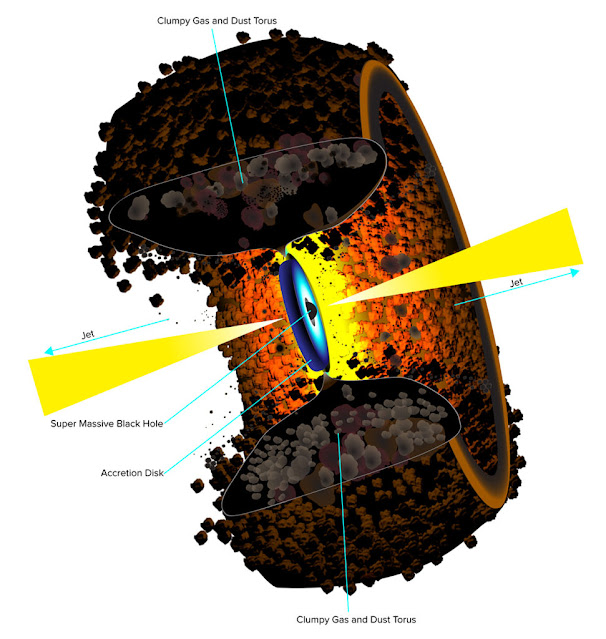
Artist's conception of the dusty, doughnut-shaped object surrounding the supermassive black hole, disk of material orbiting the black holNDF.
  Hi-Res File

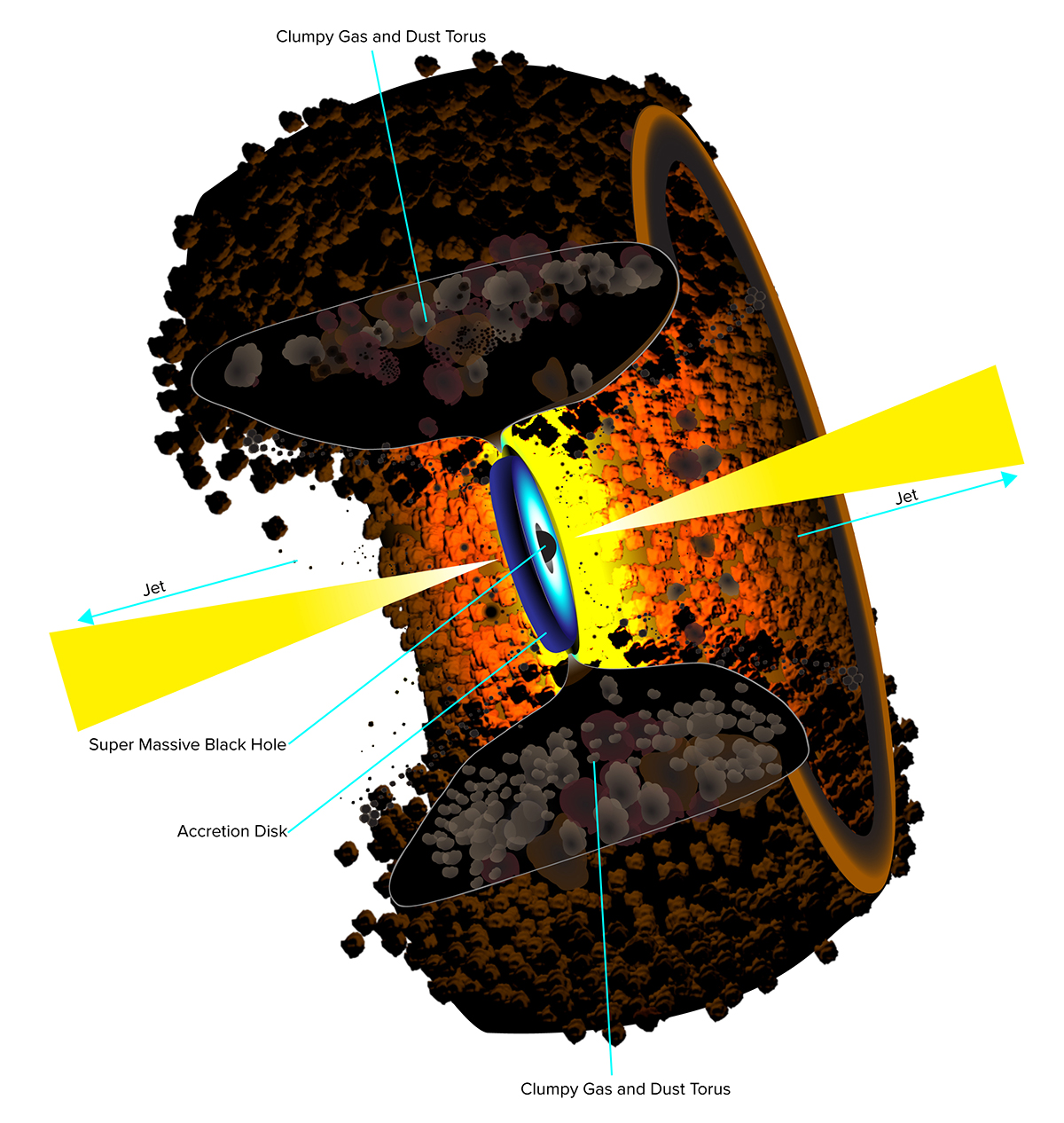
Artist's conception of active galactic nucleus, with labels.
Credit: Bill Saxton, NRAO/AUI/NSF. Hi-Res File

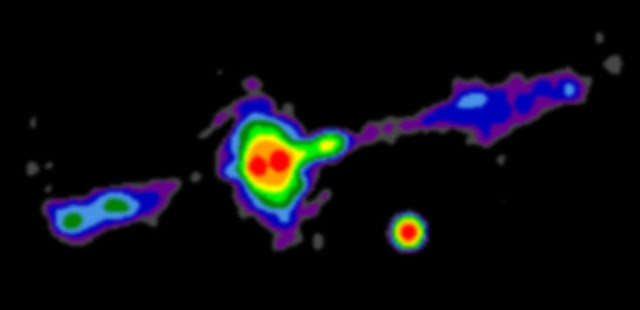
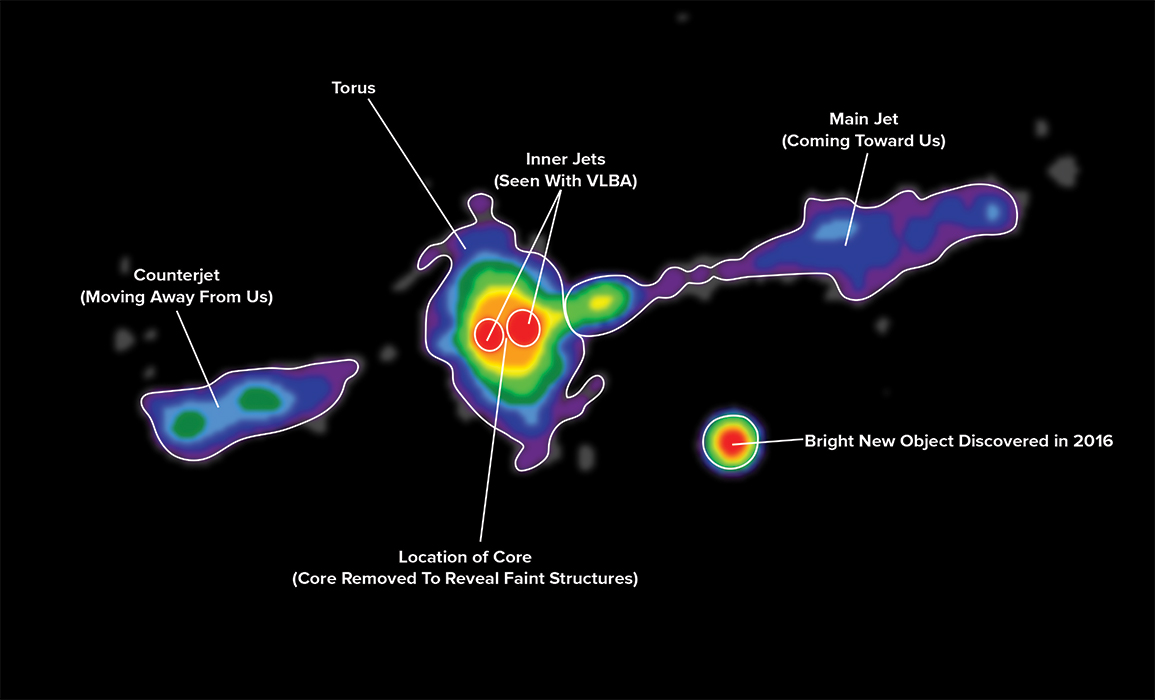
VLA image of the central region of the powerful radio galaxy Cygnus A, showing the doughnut-shaped torus surrounding the black hole and accretion disk. Credit: Carilli et al., NRAO/AUI/NSF.
Hi-Res File

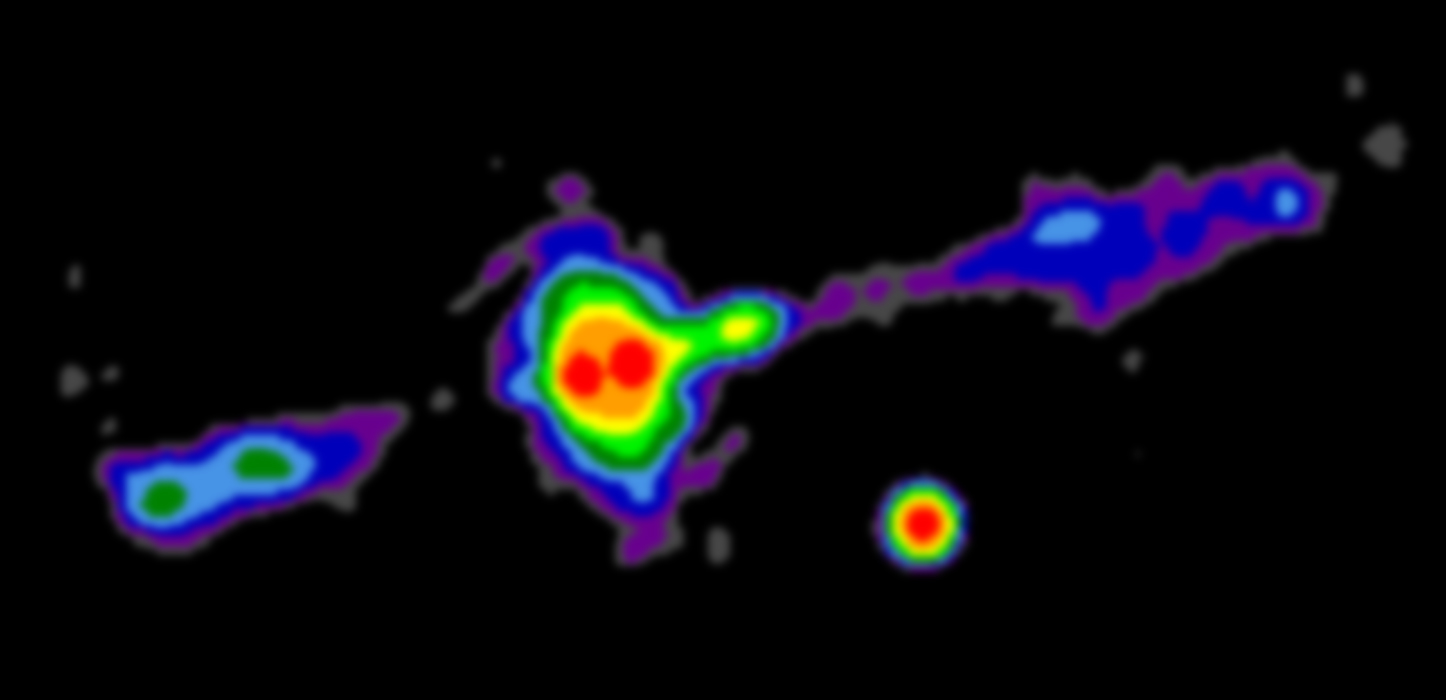
VLA image of Cygnus A's central region, with labels.
Credit: Carilli et al., NRAO/AUI/NSF. Hi-Res File


Video illustrates how the dusty, doughnut-shaped torus surrounding the black hole and accretion disk at the center of a powerful radio galaxy can obscure different features when viewed from different angles. This explains how the same type of "central engine" can appear different, leading to different names for objects seen from different angles. Credit: Bill Saxton, Sophia Dagnello, NRAO/AUI/NSF


Structure suggested by theorists decades ago

Astronomers used the National Science Foundation’s Karl G. Jansky Very Large Array (VLA) to make the first direct image of a dusty, doughnut-shaped feature surrounding the supermassive black hole at the core of one of the most powerful radio galaxies in the Universe — a feature first postulated by theorists nearly four decades ago as an essential part of such objects.

The scientists studied Cygnus A, a galaxy some 760 million light-years from Earth. The galaxy harbors a black hole at its core that is 2.5 billion times more massive than the Sun. As the black hole’s powerful gravitational pull draws in surrounding material, it also propels superfast jets of material traveling outward at nearly the speed of light, producing spectacular “lobes” of bright radio emission.

Black hole-powered “central engines” producing bright emission at various wavelengths, and jets extending far beyond the galaxy are common to many galaxies, but show different properties when observed. Those differences led to a variety of names, such as quasars, blazars, or Seyfert galaxies. To explain the differences, theorists constructed a “unified model” with a common set of features that would show different properties depending on the angle from which they are viewed.

The unified model includes the central black hole, a rotating disk of infalling material surrounding the black hole, and the jets speeding outward from the poles of the disk. In addition, to explain why the same type of object looks different when viewed from different angles, a thick, dusty, doughnut-shaped “torus” is included, surrounding the inner parts. The torus obscures some features when viewed from the side, leading to apparent differences to the observer, even for intrinsically similar objects. Astronomers generically call this common set of features an active galactic nucleus (AGN).

“The torus is an essential part of the AGN phenomenon, and evidence exists for such structures in nearby AGN of lower luminosity, but we’ve never before directly seen one in such a brightly-emitting radio galaxy,” said Chris Carilli, of the National Radio Astronomy Observatory (NRAO). “The torus helps explain why objects known by different names actually are the same thing, just observed from a different perspective,” he added.

In the 1950s, astronomers discovered objects that strongly emitted radio waves, but appeared point-like, similar to distant stars, when later observed with visible-light telescopes. In 1963, Maarten Schmidt of Caltech discovered that one of these objects was extremely distant, and more such discoveries quickly followed. To explain how these objects, dubbed quasars, could be so bright, theorists suggested that they must be tapping the tremendous gravitational energy of supermassive black holes. The combination of black hole, the rotating disk, called an accretion disk, and the jets was termed the “central engine” responsible for the objects’ prolific outpourings of energy.

The same type of central engine also appeared to explain the output of other types of objects, including radio galaxies, blazars, and Seyfert Galaxies. However, each showed a different set of properties. Theorists worked to develop a “unification scheme” to explain how the same thing could appear differently. In 1977, obscuration by dust was suggested as one element of that scheme. In a 1982 paper, Robert Antonucci, of the University of California, Santa Barbara, presented a drawing of an opaque torus — a doughnut-shaped object — surrounding the central engine. From that point on, an obscuring torus has been a common feature of astronomers’ unified view of all types of active galactic nuclei.

“Cygnus A is the closest example of a powerful radio-emitting galaxy — 10 times closer than any other with comparably powerful radio emission. That proximity allowed us to find the torus in a high-resolution VLA image of the galaxy’s core,” said Rick Perley, also of NRAO. “Doing more work of this type on weaker and more distant objects will almost certainly need the order-of-magnitude improvement in sensitivity and resolution that the proposed Next Generation Very Large Array (ngVLA) would bring,” he added.

The VLA observations directly revealed the gas in Cygnus A’s torus, which has a radius of nearly 900 light-years. Longstanding models for the torus suggest that the dust is in clouds embedded in the somewhat-clumpy gas.

“It’s really great to finally see direct evidence of something that we’ve long presumed should be there,” Carilli said. “To more accurately determine the shape and composition of this torus, we need to do further observing. For example, the Atacama Large Millimeter/submillimeter Array (ALMA) can observe at the wavelengths that will directly reveal the dust,” he added.

Carilli and Perley, with their colleagues Vivek Dhawan, also of NRAO, and Daniel Perley of Liverpool John Moores University in the UK, discovered the torus when following up their surprising discovery in 2016 of a new, bright object near the center of Cygnus A. That new object, they said, is most likely a second supermassive black hole that only recently encountered new material it could devour, causing it to produce bright emission the same way the central black hole does. The existence of the second black hole, they said, suggests that Cygnus A merged with another galaxy in the astronomically recent past.

Cygnus A, so named because it is the most powerful radio-emitting object in the constellation Cygnus, was discovered in 1946 by English physicist and radio astronomer J.S. Hey. It was matched to a visible-light, giant galaxy by Walter Baade and Rudolf Minkowski in 1951. It became an early target for the VLA soon after its completion in the early 1980s. Detailed VLA images of Cygnus A published in 1984 produced major advances in astronomers’ understanding of such galaxies.

The scientists are reporting their findings in the Astrophysical Journal Letters.

The National Radio Astronomy Observatory is a facility of the National Science Foundation, operated under cooperative agreement by Associated Universities, Inc.


Media Contact:

Dave Finley, Public Information Officer
(575) 835-7302


Wednesday, May 13, 2020

NASA’s TESS Enables Breakthrough Study of Perplexing Stellar Pulsations


Sound waves bouncing around inside a star cause it to expand and contract, which results in detectable brightness changes. This animation depicts one type of Delta Scuti pulsation — called a radial mode — that is driven by waves (blue arrows) traveling between the star’s core and surface. In reality, a star may pulsate in many different modes, creating complicated patterns that enable scientists to learn about its interior.  Credits: NASA's Goddard Space Flight Center


Tuesday, May 12, 2020

Signs of Collisions to Come

Artist’s impression of a neutron star threaded with a dipole magnetic field.
Credit:[ESO/L.Calçada].
Hi-res Image

Artist’s impression of the collision and merger of two neutron stars.
Credit:[NSF/LIGO/Sonoma State University/A. Simonnet].
Hi-res Image

We know that when two neutron stars — the dense, compact cores of evolved stars — collide, they produce signals that span the electromagnetic spectrum. But could these binaries also flare before they merge, as well?

A Broad Range of Signals

The discovery and follow-up of the gravitational-wave event GW170817, a collision of two neutron stars, provided the first direct evidence of the many forms of light that are emitted in these mergers. Between the instant of collision and the months that followed, observatories around the world recorded everything from high-energy gamma rays to late-time radio emission.

But emission might not be restricted to during and after the merger! A new study conducted by two researchers from the Flatiron Institute, Elias R. Most (also of Goethe University Frankfurt, Germany) and Alexander Philippov, explores the possibility that neutron star binaries may also produce flares of emission in the time leading up to their final impact.

This plot of the out-of-plane magnetic field density indicates the twist in flux tubes connecting the two neutron stars seen at the center of the plot. Here, an electromagnetic flare is launched from the binary after a significant twist has built up due to relative rotation of the right star. [Most & Philippov 2020].
Hi-res Image

What About Magnetic Fields?

In particular, Most and Philippov focus on how the magnetospheres of the two neutron stars — the magnetized environment surrounding each body — interact shortly before the objects collide.

The authors conduct special-relativistic force-free simulations of orbiting pairs of neutron stars in which each star is threaded with the strong dipole magnetic field expected for these bodies. The simulations then track how the stars’ magnetic fields evolve, twist, and interact as the bodies orbit each other.

A Twisted Fate


Most and Philippov find that dramatic releases of magnetic energy are a common outcome if the neutron stars orbit close enough to one another that their magnetospheres interact.

The authors show that the brightness of the flare luminosity depends only on how far apart the neutron stars are in the simulation: the smaller the separation, the brighter the flare. This dependence demonstrates that the flaring events are driven primarily by the energy stored in the twisted tube of magnetic flux that forms connecting the two neutron stars.

When the two neutron stars spin at different speeds, the magnetic field loop that forms between the stars becomes progressively more twisted — until this stored rotational energy is abruptly ejected. And even if neither neutron star is spinning, the authors show that magnetic flux twist still builds up and releases as a result of the binary’s orbital motion, assuming that the magnetic fields of the two stars are not aligned.

Here, the twisted flux tube and resultant flaring is caused by orbital motion of 45° misaligned magnetic fields, rather than by one star spinning. The bottom panel shows a 3D visualization of the field line configuration at the time of flaring. [Most & Philippov 2020].
Hi-res Image

Look for Radio Clues


So can we observe these sudden releases of energy? Most and Philippov argue that we should be able to spot the drama in radio emission: a radio afterglow will be produced behind the magnetized bubble that’s ejected from the twisted loop, and additional radio emission can be produced when the bubble collides with surrounding plasma.

Future work on this topic will explore the impacts of the neutron stars’ inspiral, and how the interactions of the magnetospheres change when the neutron stars carry unequal charge. The current study, however, indicates it’s worth keeping a radio eye out to see if we can spot signs of collisions to come!

Citation

“Electromagnetic Precursors to Gravitational-wave Events: Numerical Simulations of Flaring in Pre-merger Binary Neutron Star Magnetospheres,” Elias R. Most and Alexander A. Philippov 2020 ApJL 893 L6. doi:10.3847/2041-8213/ab8196