Showing posts with label M82. Show all posts

Saturday, June 27, 2026

NASA’s Webb Pinpoints Millions of Stars Within Cigar Galaxy

Scientists used NASA’s James Webb Space Telescope to image edge-on starburst galaxy Messier 82 and trace its evolutionary history. This Webb and Hubble composite image includes 16.5 million stars (blue-white), dust grains (red-orange), and ionized hydrogen gas (yellow). Credit Image: NASA, ESA, CSA, Adam Smercina (STScI, Tufts), Thomas Williams (University of Manchester); Image Processing: Alyssa Pagan (STScI)

NASA’s James Webb Space Telescope observed edge-on starburst galaxy Messier 82, peering through dust to reveal 16.5 million stars and the galaxy’s distended disk structure. Scientists seek to learn the galaxy’s evolutionary history with the Webb data. Credit Image: NASA, ESA, CSA, Adam Smercina (STScI, Tufts), Thomas Williams (University of Manchester); Image Processing: Alyssa Pagan (STScI)

Side-by-side comparison of a portion of starburst galaxy Messier 82 (M82) as seen by NASA’s Hubble (left) and James Webb (right) space telescopes. Hubble detailed M82’s gas and dust structure, while Webb pierced through the dust and resolved millions of stars in infrared light. Credit Image: NASA, ESA, CSA, Adam Smercina (STScI, Tufts), Thomas Williams (University of Manchester); Image Processing: Alyssa Pagan (STScI)

Annotated image of the starburst galaxy Messier 82 captured by Webb's NIRCam (Near-Infrared Camera) instrument, with compass arrows, a scale bar, and color key for reference. Credit Image: NASA, ESA, CSA, Adam Smercina (STScI, Tufts), Thomas Williams (University of Manchester); Image Processing: Alyssa Pagan (STScI)

NASA’s James Webb Space Telescope’s near-infrared observation of M82 is the most recent addition to overall data on this starburst galaxy. The Hubble Space Telescope is one observatory that has previously looked at M82, detailing the gas and dust structure seen in visible light. Credit Video: NASA, ESA, CSA, STScI, Alyssa Pagan (STScI)


Located 12 million light-years away and undergoing rapid star formation, edge-on spiral galaxy Messier 82 (M82) is a scientifically unique sight to behold, and now NASA’s James Webb Space Telescope has revealed previously unseen details.

M82’s intense star formation, thought to be the result of a galaxy merger, will be a short-lived event in astronomical terms, estimated to last a few hundred million years in its entirety. This temporary phase of extreme star formation relative to the galaxy’s mass, as well as its location in the local universe, are among the factors that make M82, also known as the Cigar galaxy, a one-of-a-kind environment to study.

A team of astronomers recently completed an imaging survey with the Webb telescope. This program entailed a total of 65 hours of observation time with Webb’s NIRCam (Near-Infrared Camera) instrument and revealed never-seen-before details of the starburst galaxy, including its distended disk structure and millions of individual stars. Webb’s high-resolution imaging, specifically of the main plane of the galactic disk, has unlocked vital information for astronomers as they seek to uncover M82’s formation history. Additionally, the Webb data will help scientists understand the current processes occurring within the starburst galaxy.

“M82 is a mess, but it’s a beautiful mess. We don’t fully understand what’s going on, especially concerning its evolutionary history. What could have triggered such an elevated rate of star formation? How long has this galaxy been driving plumes of material away from its center?” said principal investigator Adam Smercina, a NASA Hubble Fellow at the Space Telescope Science Institute in Baltimore, and incoming Assistant Professor at Tufts University in Massachusetts. “M82 is an ideal galaxy evolution laboratory because it has properties that allow us to probe important physical processes, such as how stars form in such environments and how that activity drives outflows. M82 provides a simultaneous window onto many astrophysical questions, in a way that no other galaxy in the local universe can.”

Prior to Webb, many observatories looked at the starburst galaxy, including NASA’s Hubble and retired Spitzer space telescopes. However, the sheer volume of dust within that galaxy limited the amount of information astronomers could acquire on M82 at high resolution. While Webb has previously looked at this galaxy, the duration of the new imaging survey, combined with the telescope’s infrared sensitivity, enabled it to pierce through the thick dust.

The telescope’s near-infrared-light view is a snapshot of a scene that has been evolving over a couple hundred million years. Webb’s image contains approximately 16.5 million individual stars dispersed throughout the galaxy. The light from these stellar sources is depicted as luminous blue granules. This is only a small portion of the total amount of stars astronomers think reside in a galaxy like M82, with the majority too faint to be seen.

“The sheer number of stars that we were able to resolve with Webb is incredible,” said team member Benjamin Williams of the University of Washington. “It’s a whole different world from what we’ve been able to see with other telescopes. All of these stars collectively provide a detailed fossil record of the formation and evolution of M82.”

Moving inward, the increase in brightness and the asymmetrical shape of the galactic disk hints at the spiral galaxy’s unique underlying structure. The differing radii between the two sides suggests that M82 has a distorted shape, which can happen during intense galaxy mergers.

“At first glance, the disk of the galaxy may seem less spectacular because Webb sees through the dust,” said team member Eric Bell of the University of Michigan. “But M82 is a delightfully complex system. Webb’s observations will help us address some ongoing mysteries, such as how star formation has moved within M82 over the last few billion years.”

Because of the extreme star formation within the galaxy, which is 10 times faster than the Milky Way galaxy’s star formation rate, stellar birth will eventually be disrupted. M82’s stellar frenzy is causing bipolar plumes of material to be ejected above and below the disk. Though it looks like a tumultuous region, the hourglass-shaped outflows appear to have a layered structure. The yellow tendrils of material closest to the galaxy’s disk represent ionized gas, whereas the orange material farther away depicts small dust grains. These grains are called polycyclic aromatic hydrocarbons and are helpful in tracing material in the space between the galaxy’s stars, also known as the interstellar medium.

The information collected as part of this Webb study is just one dataset scientists will analyze as they seek to piece together this starburst galaxy’s formation history.

“Galaxies are such intricate ecosystems that if you truly want to understand them, you have to pull datasets from different missions together,” said team member Kristen McQuinn of the Space Telescope Science Institute. “One mission cannot fully answer all of the questions we have about M82. Combining the data collected by different telescopes, like Webb and Hubble, is powerful. When you marry the datasets, you expand what you can probe, and the questions that you can pose are even more complex.”

The James Webb Space Telescope is the world’s premier space science observatory. Webb is solving mysteries in our solar system, looking beyond to distant worlds around other stars, and probing the mysterious structures and origins of our universe and our place in it. Webb is an international program led by NASA with its partners, ESA (European Space Agency) and CSA (Canadian Space Agency).


Details:

Last Updated: Jun 23, 2026
Location:
NASA Goddard Space Flight Center

Contact Media:

Laura Betz
NASA’s Goddard Space Flight Center
Greenbelt, Maryland

laura.e.betz@nasa.gov

Abigail Major
Space Telescope Science Institute
Baltimore, Maryland


Christine Pulliam
Space Telescope Science Institute
Baltimore, Maryland


Thursday, November 06, 2025

Particle Physics in Space: In Search of the Elusive Axion

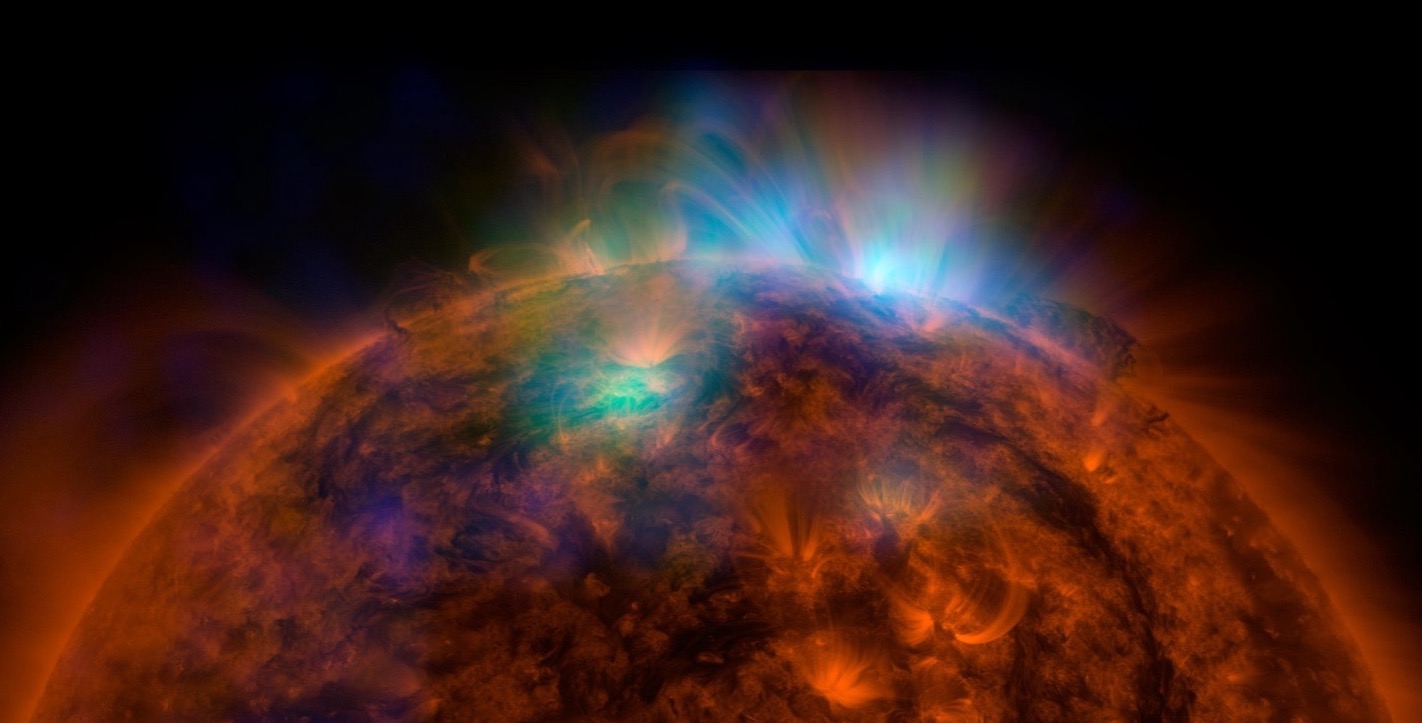
Composite image of the Sun including high-energy X-ray data from NuSTAR (blue); low-energy X-ray data from Hinode (green); and ultraviolet data from Solar Dynamics Observatory (red). The centers of stars like or even bigger than our Sun are unimaginably hot environments that may hold the key to detecting dark matter.
Download Image


NuSTAR is best known for observing some of the hottest, brightest, and most extreme phenomena in the Universe, such as supernovae explosions and the immediate surroundings of black holes. But did you know that it can also be used to search for some of the smallest and most elusive particles in existence?

For decades we've known that a large portion of the mass in the Universe—even more than all the stars and galaxies that we can see—consists of dark matter. We know it's there because we can see its gravitational effects on the matter we can observe—just like we can't see air but can see its effect on the world around us when trees sway in the wind. But dark matter itself, like its name suggests, is invisible to us, as it does not give off or interact with light. This makes trying to find out what it's actually made of incredibly difficult.

Axions

Many different kinds of particles and objects have been put forward as possible candidates to be dark matter, one of which is the axion. If you think that sounds a bit like the name of a cleaning product, you'd be right—it was named after a laundry detergent brand because it 'cleans up' a messy problem in particle physics called charge-parity violation. Under the Standard Model of particle physics, the laws of physics apply in the same way to particles and their corresponding anti-particles. But if this were the case, why is there so much more matter in the Universe than anti-matter? Axions present a possible solution to this problem and would emerge naturally from the breaking of this matter/anti-matter symmetry.

If axions were to exist, they would be extremely light and interact so weakly with normal matter that trillions could pass through you every second and you wouldn't even notice. This also makes them a compelling candidate for dark matter. However, if we are to demonstrate that this theorized particle exists, first we need to detect it. And that's no small feat, since there is a wide range of possible masses and degrees to which they interact with light or matter that could apply to an axion—in other words, they might be out there but we're not exactly sure what they look like. Axions are so elusive that all ground-based efforts to date have failed to detect them. So, scientists have turned to space to continue the search.

The Sun as a Particle Physics Laboratory

Inside our own Sun, high-energy X-ray photons released in the thermonuclear core face a long, slow journey to the surface, repeatedly absorbed and re-emitted by the densely packed matter inside, losing energy along the way until they finally emerge as visible light thousands to millions of years later. However, the interaction of a high-energy photon with the electric fields of an atomic nucleus or electron could also generate an axion, which then streams directly out of the Sun. Once outside, the axion interacts again with the Sun's magnetic field and can turn back into a photon. Depending on the properties of the axion, this could be an X-ray photon.

This is where NuSTAR comes in. Unlike most sensitive X-ray astrophysics observatories, NuSTAR is able to safely look at the Sun, making it useful for studying flares and hotspots on the Sun's surface. Scientists can also use this Solar data to look for the distinct predicted signatures of axions.

So far, NuSTAR has not detected an axion signal from the Sun. In science, a non-detection is not bad news! Since we know a lot about the Sun's properties, we know that if axions were larger or more interactive than certain values, we would have detected them. The fact that we haven't allows us to rule out certain possibilities for those properties. If axions exist, they must be sufficiently light and non-interactive that the signal from the Sun is too weak to detect.

The next step is to find somewhere that might produce a stronger axion signal than the Sun. Axion emission is directly related to the temperature inside a star. In other words, we're going to need a bigger, hotter star.

Let's go bigger!

On the left shoulder of Orion is an enormous red supergiant star called Betelgeuse, the tenth-brightest star in our night sky. Hundreds of times larger than the Sun, its radius would engulf the orbit of Mars if it were in our Solar system. The temperature of its core is also far higher than the Sun's, implying that it could be a far more efficient source of axions. In 2019, NuSTAR observed Betelgeuse in search of signs of a specific theorized axion production mechanism that Betelgeuse is hot enough to achieve—the de-excitation of iron nuclei. This kind of atomic transition happens at a very specific energy, meaning that the axion-to-photon transformations in the Sun’s outer magnetic field would result in a distinctive X-ray emission line at 14.4 keV.

While the 14.4 keV line was not detected from Betelgeuse, this doesn’t imply that axions cannot exist. Once more, the lack of a signal instead rules out certain possible properties of axions, providing orders of magnitude better constraints on their mass and the strength of their interactions with normal matter than we could achieve with the Sun.

Since axions weren't detected from Betelgeuse, can we find an even bigger, hotter laboratory than that? What if we didn't just look at one star, but a whole galaxy of hot massive stars?

M82, also known as the Cigar Galaxy for its narrow, edge-on shape, is a nearby galaxy undergoing intense star formation, meaning that it is full of newly formed, very massive and very hot stars. If each of these stars could potentially be giving off a very faint axion signal, then by observing the galaxy NuSTAR could pick up their combined signal. This would appear as a high-energy X-ray glow around the galaxy.

"By analyzing over a million seconds of NuSTAR X-ray observations of M82, we found no excess X-ray signal attributable to decaying axions," said Francisco Rodríguez Candón, PhD student at the University of Zaragoza in Spain and the first author of a paper on this new approach. "This null result enabled us to set some of the strictest limits to date on axion properties."

Once more, no signal was detected—which means that we can rule out further swaths of possible combinations of axion mass and photon coupling from the potential axion parameter space. Little by little, we are narrowing down the possibilities and, if axions are truly what makes up dark matter, closing in on their nature.

In the meantime, the search for axion signals continues. These studies demonstrate the importance of using astronomical observations with X-ray telescopes to probe particle physics in environments and on scales that would be impossible to replicate on Earth. With the help of telescopes like NuSTAR, the Universe itself is our particle physics laboratory.


Wednesday, September 17, 2025

The smouldering heart of a celestial cigar

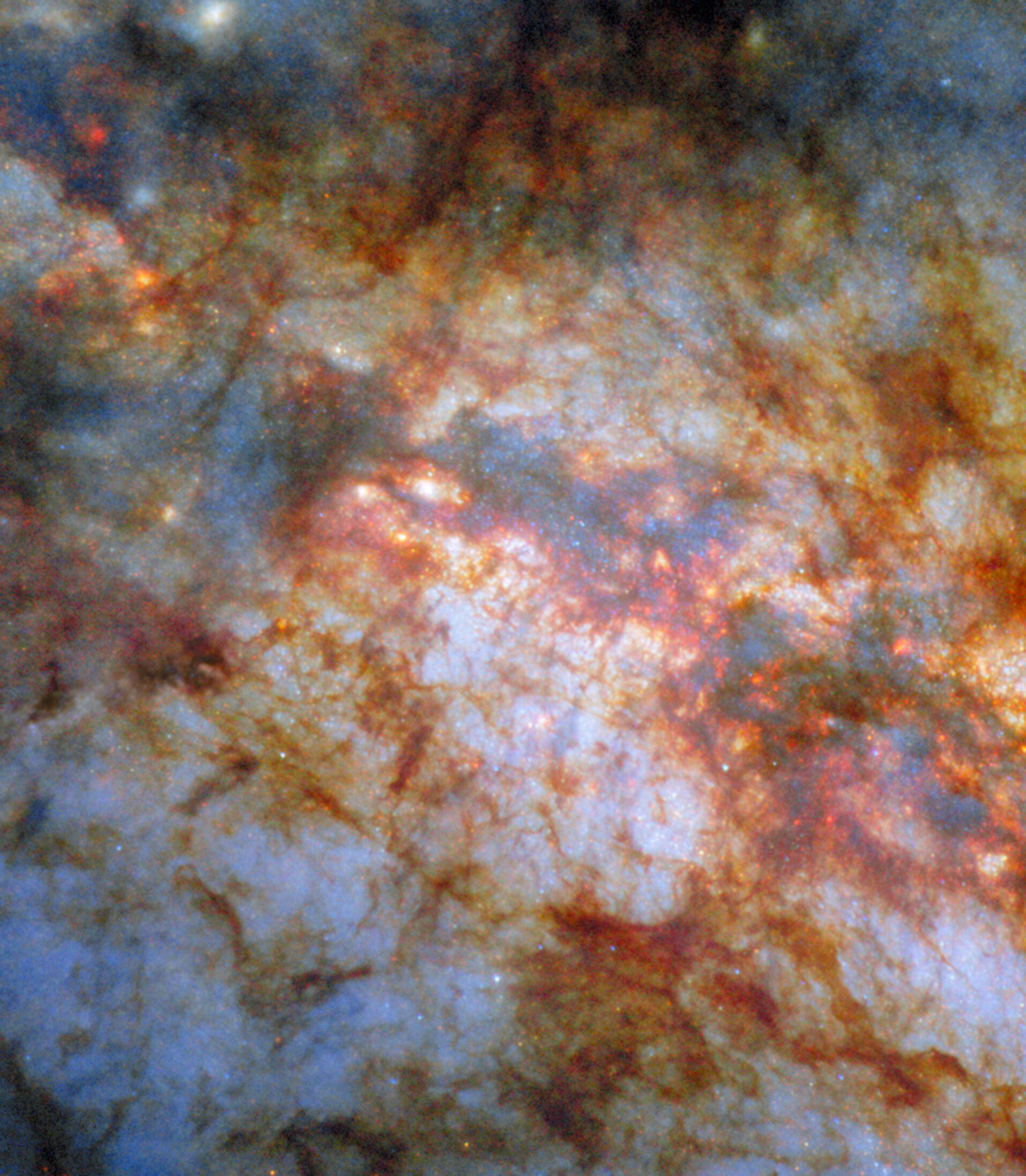
A close-in view of the centre of galaxy M82. Bright, bluish light radiating from the centre is due to stars actively forming there. A thick lane of gas, black in the centre and red around the edges, crosses the centre and blocks much of the light. Thinner strands and clumps of reddish dust cover much of the rest of the view. Credit: ESA/Hubble & NASA, W. D. Vacca

What lurks behind the dense, dusty clouds of this galactic neighbour? There lies the star-powered heart of the galaxy Messier 82 (M82), also known as the Cigar Galaxy. Located just 12 million light-years away in the constellation Ursa Major (The Great Bear), the Cigar Galaxy is considered a nearby galaxy. As this NASA/ESA Hubble Space Telescope Picture of the Week shows in great detail, it’s home to brilliant stars whose light is shaded by sculptural clouds, clumps and streaks of dust and gas.

It’s no surprise that the Cigar Galaxy is so packed with stars, obscured though they might be by the distinctive clouds pictured here. Forming stars 10 times faster than the Milky Way, the Cigar Galaxy is what astronomers call a starburst galaxy. The intense starburst period that grips this galaxy has given rise to super star clusters in the galaxy’s heart. Each of these super star clusters contains hundreds of thousands of stars and is more luminous than a typical star cluster. Researchers used Hubble to home in on these massive clusters and reveal how they form and evolve.

Hubble’s views of the Cigar Galaxy have been featured before, both as a previous Picture of the Week in 2012 and as an image released in celebration of Hubble’s 16th birthday. The NASA/ESA/CSA James Webb Space Telescope has also turned toward the Cigar Galaxy, producing infrared images in 2024 and earlier this year.

This image features something not seen in previously released Hubble images of the galaxy: data from the High Resolution Channel of the Advanced Camera for Surveys (ACS). The High Resolution Channel is one of three sub-instruments of ACS, which was installed in 2002. In five years of operation, the High Resolution Channel returned fantastically detailed observations of crowded, starry environments like the centres of starburst galaxies. An electronics fault in 2007 unfortunately left the High Resolution Channel disabled.

Links


Sunday, August 03, 2025

NuSTAR Observes a Nearby Supernova

An astrophotographer's optical image of the supernova host galaxy NGC 7331. SN 2025rbs is visible as a bright point close to the galaxy center. An animated GIF showing the appearance of the supernova can be found at:
https://ssr.app.astrobin.com/i/pnplmb?r=C. Image credit: GalacticRAVE/M. Steinmetz. Download Image

During the past week, NuSTAR responded to a community target-of-opportunity (ToO) request to observe the young, Type Ia supernova SN 2025rbs, which is located in the galaxy NGC 7331. Type Ia supernovae are the result of a white dwarf accreting material from a companion star until it exceeds the Chandrasekhar mass and explodes. These explosions have regular enough time profiles and overall luminosity that they are regularly used to measure the distance scale of the Universe. However, their underlying physics is relatively poorly understood since there are few Type Ia supernovae that are close enough to study in detail. In their early lives, the supernovae are powered by radioactive decay of material (primarily 56Ni) that releases gamma-rays that thermalize into the supernova atmosphere so that the ejecta glows in optical light. NuSTAR provides a unique capability to study the hard X-ray (>50 keV) emission from these systems, which arises as the ejecta expands and becomes optically thin to the gamma-ray photons so that hard X-rays “leak out” of the ejecta. SN 2025rbs is the closest Type Ia supernova to the Earth since SN 2014J exploded in M82, which NuSTAR observed in January/February 2014 for nearly a month. The NuSTAR ToO observation of SN 2025rbs occurred prior to the optical peak of the emission, only six days after the supernova was classified as a Type Ia and a few days before the optical peak. An Astronomer’s Telegram (ATel) reporting early results was posted the same day the data were received at the NuSTAR Science Operations Center (SOC), thanks to the ability of the SOC to provide “quicklook” unprocessed data products to the community. These data will provide the most stringent limits on any high-energy emission from the supernova explosion.

Authors: Brian Grefenstette (NuSTAR Instrument Scientist, Caltech)


Saturday, August 02, 2025

Chandra X-Ray Observatory Captures Breathtaking New Images


The images feature data from the Smithsonian Astrophysical Observatory along with a host of other NASA telescopes including the James Webb Space Telescope, Hubble Space Telescope and more.

Top row:

N79 is a giant region of star formation in the Large Magellanic Cloud, a small satellite neighbor galaxy to the Milky Way. Chandra sees the hot gas created by young stars, which helps astronomers better understand how stars like our Sun formed billions of years ago. [X-rays from Chandra (purple) and infrared data from Webb (blue, grey and gold)]

NGC 2146 is a spiral galaxy with one of its dusty arms obscuring the view of its center from Earth.. X-rays from Chandra reveal double star systems and hot gas being expelled from the galaxy by supernova explosions and strong winds from giant stars. [X-rays from Chandra (pink and purple), optical data from Hubble and the Las Cumbres Observatory in Chile and infrared data from NSF’s Kitt Peak (red, green and blue)]

IC 348 is a star-forming region in our Milky Way galaxy. The wispy structures that dominate the image are interstellar material that reflects light from the cluster’s stars. The point-like sources in Chandra’s X-ray data are young stars forming in the cluster. [X-rays from Chandra (red, green and blue) and Webb infrared data (pink, orange and purple)]

Middle row:

M83, a spiral galaxy similar to the Milky Way, is oriented face-on toward Earth, providing an unobstructed view of its entire structure that is often not possible with galaxies viewed atdifferent angles. Chandra has detected the explosions of stars, or supernovas, and their aftermath across M83. [X-rays from Chandra (red, green and blue) with ground-based optical data (pink, gold and gray)].

M82 is a so-called starburst galaxy where stars are forming at rates tens to hundreds of times higher than normal galaxies. Chandra sees supernovas that produce expanding bubbles of multimillion-degree gas that extend for millions of light-years away from the galaxy's disk. [X-rays from Chandra (purple) with Hubble optical data (red, green, and blue)]

NGC 1068 is a relatively nearby spiral galaxy containing a black hole at its center that is twice as massive as the one in the Milky Ways. Chandra shows a million-mile-per-hour wind is being driven from NGC 1068’s black hole which lights (?) up the center of the galaxy in X-rays. [X-rays from Chandra (blue), radio data from NSF’s VLA radio data (pink), and optical data from Hubble and Webb (yellow, grey and gold)]

Bottom row:

NGC 346 is a young cluster home to thousands of newborn stars. The cluster’s most massive stars createpowerful winds and produce intense radiation. X-rays from Chandra reveal output from massive stars in the cluster and diffuse emission from a supernova remnant, the glowing debris of an exploded star. [X-rays from Chandra (purple) with optical and ultraviolet from Hubble blue, brown and gold)]

IC 1623 is a system where two galaxies are erging. As the galaxies collide, they trigger new bursts of star formation that glow intensely in certain kinds of light which is detected by Chandara and other telescopesThe merging galaxies may also be in the process of forming a supermassive black hole. [X-rays from Chandra (magenta) with Webb infrared data (red, gold and gray)]

Westerlund 1 is the biggest and closest “super” star cluster to Earth. Data from Chandra and other telescopes is helping astronomers delve deeper into this galactic factory where stars are being produced at extraordinarily high rates. Observations from Chandra have uncovered thousands of individual stars pumping out X-ray emission into the cluster. [X-rays from Chandra (pink, blue, purple and orange) with Webb infrared data (yellow, gold and blue) and Hubble optical data (cyan, grey and light yellow)]

NASA's Marshall Space Flight Center in Huntsville, Alabama, manages the Chandra program. The Smithsonian Astrophysical Observatory's Chandra X-ray Center, part of the Center for Astrophysics | Harvard & Smithsonian, controls science operations from Cambridge, Massachusetts, and flight operations from Burlington, Massachusetts.


Media Contact:

Megan Watzke
Chandra X-Ray Observatory
mwatzke@cfa.harvard.edu


Image Credits:

NGC 2146: X-ray: NASA/CXC/SAO; Optical: NASA/ESA/STScI and NOIRLab/NSF/AURA; Infrared: NSF/NOAO/KPNO; Image Processing: NASA/CXC/SAO/L. Frattare

IC 348: X-ray: NASA/CXC/SAO; Infrared: NASA/ESA/CSA/STScI; Image Processing: NASA/CXC/SAO/J. Major

M83: X-ray: NASA/CXC/SAO; Optical: NASA/ESA/AURA/STScI, Hubble Heritage Team, W. Blair (STScI/Johns Hopkins University) and R. O'Connell (University of Virginia); Image Processing: NASA/CXC/SAO/L. Frattare

M82: X-ray: NASA/CXC/SAO; Optical/IR: NASA/ESA/STScI; Image Processing: NASA/CXC/SAO/J. Major

NGC 1068: X-ray: NASA/CXC/SAO; Optical/IR: NASA/ESA/CSA/STScI (HST and JWST); Radio: NSF/NRAO/VLA; Image Processing: NASA/CXC/SAO/J. Schmidt and N. Wolk

NGC 346: X-ray: NASA/CXC/SAO; Optical/IR: NASA/ESA/CSA/STScI (HST and JWST); Radio: NSF/NRAO/VLA; Image Processing: NASA/CXC/SAO/J. Schmidt and N. Wolk

IC 1623: X-ray: NASA/CXC/SAO; IR: NASA/ESA/CSA/STScI; Image Processing: NASA/CXC/SAO/L. Frattare and J. Major

Westerlund 1: X-ray: NASA/CXC/SAO; Optical: NASA/ESA/STScI; IR: NASA/ESA/CSA/STScI; Image Processing: NASA/CXC/SAO/L. Frattare


Friday, April 12, 2024

NASA's Webb Probes an Extreme Starburst Galaxy

M82 (Hubble and Webb)
Credit: Image: NASA, ESA, CSA, STScI, Alberto Bolatto (UMD)

M82 (NIRCam Image)
Credit: Image: NASA, ESA, CSA, STScI, Alberto Bolatto (UMD)

M82 (NIRCam Image)
Credit: Image: NASA, ESA, CSA, STScI, Alberto Bolatto (UMD)


A team of astronomers has used NASA’s James Webb Space Telescope to survey the starburst galaxy Messier 82 (M82). Located 12 million light-years away in the constellation Ursa Major, this galaxy is relatively compact in size but hosts a frenzy of star formation activity. For comparison, M82 is sprouting new stars 10 times faster than the Milky Way galaxy.

Led by Alberto Bolatto at the University of Maryland, College Park, the team directed Webb’s NIRCam (Near-Infrared Camera) instrument toward the starburst galaxy’s center, attaining a closer look at the physical conditions that foster the formation of new stars.

“M82 has garnered a variety of observations over the years because it can be considered as the prototypical starburst galaxy,” said Bolatto, lead author of the study. “Both NASA’s Spitzer and Hubble space telescopes have observed this target. With Webb’s size and resolution, we can look at this star-forming galaxy and see all of this beautiful, new detail.”

A Vibrant Community of Stars

Star formation continues to maintain a sense of mystery because it is shrouded by curtains of dust and gas, creating an obstacle in observing this process. Fortunately, Webb’s ability to peer in the infrared is an asset in navigating these murky conditions. Additionally, these NIRCam images of the very center of the starburst were obtained using an instrument mode that prevented the very bright source from overwhelming the detector.

While dark brown tendrils of heavy dust are threaded throughout M82’s glowing white core even in this infrared view, Webb’s NIRCam has revealed a level of detail that has historically been obscured. Looking closer toward the center, small specks depicted in green denote concentrated areas of iron, most of which are supernova remnants. Small patches that appear red signify regions where molecular hydrogen is being lit up by a nearby young star’s radiation.

“This image shows the power of Webb,” said Rebecca Levy, second author of the study at the University of Arizona in Tucson. “Every single white dot in this image is either a star or a star cluster. We can start to distinguish all of these tiny point sources, which enables us to acquire an accurate count of all the star clusters in this galaxy.”

Finding Structure in Lively Conditions

Looking at M82 in slightly longer infrared wavelengths, clumpy tendrils represented in red can be seen extending above and below the galaxy’s plane. These gaseous streamers are a galactic wind rushing out from the core of the starburst.

One area of focus for this research team was understanding how this galactic wind, which is caused by the rapid rate of star formation and subsequent supernovae, is being launched and influencing its surrounding environment. By resolving a central section of M82, scientists could examine where the wind originates, and gain insight on how hot and cold components interact within the wind.

Webb’s NIRCam instrument was well-suited to trace the structure of the galactic wind via emission from sooty chemical molecules known as polycyclic aromatic hydrocarbons (PAHs). PAHs can be considered as very small dust grains that survive in cooler temperatures but are destroyed in hot conditions.

Much to the team’s surprise, Webb’s view of the PAH emission highlights the galactic wind’s fine structure – an aspect previously unknown. Depicted as red filaments, the emission extends away from the central region where the heart of star formation is located. Another unanticipated find was the similar structure between the PAH emission and that of hot, ionized gas.

“It was unexpected to see the PAH emission resemble ionized gas,” said Bolatto. “PAHs are not supposed to live very long when exposed to such a strong radiation field, so perhaps they are being replenished all the time. It challenges our theories and shows us that further investigation is required.”

Lighting a Path Forward

Webb’s observations of M82 in near-infrared light spur further questions about star formation, some of which the team hopes to answer with additional data gathered with Webb, including that of another starburst galaxy. Two other papers from this team characterizing the stellar clusters and correlations among wind components of M82 are almost finalized.

In the near future, the team will have spectroscopic observations of M82 from Webb ready for their analysis, as well as complementary large-scale images of the galaxy and wind. Spectral data will help astronomers determine accurate ages for the star clusters and provide a sense of timing for how long each phase of star formation lasts in a starburst galaxy environment. On a broader scale, inspecting the activity in galaxies like M82 can deepen astronomers’ understanding of the early universe.

“Webb’s observation of M82, a target closer to us, is a reminder that the telescope excels at studying galaxies at all distances,” said Bolatto. “In addition to looking at young, high-redshift galaxies, we can look at targets closer to home to gather insight into the processes that are happening here – events that also occurred in the early universe.”

These findings have been accepted for publication in The Astrophysical Journal.

The James Webb Space Telescope is the world’s premier space science observatory. Webb is solving mysteries in our solar system, looking beyond to distant worlds around other stars, and probing the mysterious structures and origins of our universe and our place in it. Webb is an international program led by NASA with its partners, ESA (European Space Agency) and the Canadian Space Agency.


About This Release

Credits:

Media Contact:

Abigail Major
Space Telescope Science Institute, Baltimore, Maryland

Christine Pulliam
Space Telescope Science Institute, Baltimore, Maryland

Science: Alberto Bolatto (UMD)

Permissions: Content Use Policy

Contact Us: Direct inquiries to the News Team

Related Links and Documents


Wednesday, May 20, 2020

Top Ten Discoveries from SOFIA

Ten years ago, NASA’s telescope on an airplane, the Stratospheric Observatory for Infrared Astronomy, or SOFIA, first peered into the cosmos. Since the night of May 26, 2010, SOFIA’s observations of infrared light, invisible to the human eye, have made many scientific discoveries about the hidden universe.

SOFIA’s maiden flight, known as “first light,” observed heat pouring out of Jupiter’s interior through holes in the clouds and peered through the dense dust clouds of the Messier 82 galaxy to catch a glimpse of tens of thousands of stars forming. The observatory was declared fully operational in 2014 — the equivalent to the launch of a space telescope — but it began making discoveries even while completing the testing of its instruments and telescope.

The modified Boeing 747SP flies a nearly 9-foot diameter telescope up to 45,000 feet in altitude, above 99% of the Earth's water vapor to get a clear view of the infrared universe not observable by ground-based telescopes. Its mobility also allows it to capture transitory events in astronomy over remote locations like the open ocean. Because SOFIA lands after each flight, it can be upgraded with the latest technology to respond to some of most pressing questions in science.

Using SOFIA, scientists detected the universe’s first type of molecule in space, unveiled new details about the birth and death of stars and planets, and explained what’s powering supermassive black holes, and how galaxies evolve and take shape, among other discoveries. Here are some of SOFIA’s top discoveries of the last decade:

The Universe’s First Type of Molecule Found at Last 

SOFIA found the first type of molecule to form in the universe, called helium hydride. It was first formed only 100,000 years after the Big Bang as the first step in cosmic evolution that eventually led to the complex universe we know today. The same kind of molecule should be present in parts of the modern universe, but it had never been detected outside of a laboratory until SOFIA found it in a planetary nebula called NGC 7027. Finding it in the modern universe confirms a key part of our basic understanding of the early universe.​

The powerful wind from the newly formed star at the heart of the Orion Nebula is creating the bubble (black) and preventing new stars from forming in its neighborhood. At the same time, the wind is pushing molecular gas (color) to the edges, creating a dense shell around the bubble where future generations of stars can form. Credits: NASA/SOFIA/Pabst et. al. Hi-res image

Weighing a Galactic Wind Provides Clues to the Evolution of Galaxies 

SOFIA found that the wind flowing from the center of the Cigar Galaxy (M82) is aligned along a magnetic field and transports a huge amount of material. Magnetic fields are usually parallel to the plane of the galaxy, but the wind is dragging it so it’s perpendicular. The powerful wind, driven by the galaxy's high rate of star birth, could be one of the mechanisms for material to escape the galaxy. Similar processes in the early universe would have affected the fundamental evolution of the first galaxies.

Composite image of the Cigar Galaxy (also called M82), a starburst galaxy about 12 million light-years away in the constellation Ursa Major. The magnetic field detected by SOFIA, shown as streamlines, appears to follow the bipolar outflows (red) generated by the intense nuclear starburst. The image combines visible starlight (gray) and a tracing of hydrogen gas (red) from the Kitt Peak Observatory, with near-infrared and mid-infrared starlight and dust (yellow) from SOFIA and the Spitzer Space Telescope. Credits: NASA/SOFIA; NASA/JPL-Caltech. Hi-res image

Nearby Planetary System Similar to Our Own 

The planetary system around the star Epsilon Eridani, or eps Eri for short, is the closest planetary system around a star similar to the early Sun. SOFIA studied the infrared glow from the warm dust, confirming that the system has an architecture remarkably similar to our solar system. Its material is arranged in at least one narrow belt near a Jupiter-sized planet.​

Artist's illustration of the Epsilon Eridani system showing Epsilon Eridani b. In the right foreground, a Jupiter-mass planet is shown orbiting its parent star at the outside edge of an asteroid belt. In the background can be seen another narrow asteroid or comet belt plus an outermost belt similar in size to our solar system's Kuiper Belt. The similarity of the structure of the Epsilon Eridani system to our solar system is remarkable, although Epsilon Eridani is much younger than our sun. SOFIA observations confirmed the existence of the asteroid belt adjacent to the orbit of the Jovian planet. Credits: NASA/SOFIA/Lynette Cook.
Hi-res image

Magnetic Fields May Be Feeding Active Black Holes 

Magnetic fields in the Cygnus A galaxy are feeding material into the galaxy’s central black hole. SOFIA revealed that the invisible forces, shown as streamlines in this illustration, are trapping material close to the center of the galaxy where it is close enough the be devoured by the hungry black hole. However, magnetic fields in other galaxies may be preventing black holes from consuming material.

Artist’s conception of the core of Cygnus A, including the dusty donut-shaped surroundings, called a torus, and jets launching from its center. Magnetic fields are illustrated trapping the dust in the torus. These magnetic fields could be helping power the black hole hidden in the galaxy’s core by confining the dust in the torus and keeping it close enough to be gobbled up by the hungry black hole. Credits: NASA/SOFIA/Lynette Cook.Hi-res image

Magnetic Fields May Be Keeping Milky Way’s Black Hole Quiet

This image shows the ring of material around the black hole at the center of our Milky Way galaxy. SOFIA detected magnetic fields, shown as streamlines, that may be channeling the gas into an orbit around the black hole, rather than directly into it. This may explain why our galaxy’s black hole is relatively quiet, while those in other galaxies are actively consuming material.

Streamlines showing magnetic fields layered over a color image of the dusty ring around the Milky Way’s massive black hole. The Y-shaped structure is warm material falling toward the black hole, which is located near where the two arms of the Y-shape intersect. The streamlines reveal that the magnetic field closely follows the shape of the dusty structure. Each of the blue arms has its own field that is totally distinct from the rest of the ring, shown in pink. Credits: Dust and magnetic fields: NASA/SOFIA; Star field image: NASA/Hubble Space Telescope.
Hi-res imge

“Kitchen Smoke” Molecules in Nebula Offer Clues to Building Blocks of Life

SOFIA found that the organic, complex molecules in the nebula NGC 7023 evolve into larger, more complex molecules when hit with radiation from nearby stars. Researchers were surprised to find that the radiation helped these molecules grow instead of destroying them. The growth of these molecules is one of the steps that could lead to the emergence of life under the right circumstances.

Combination of three color images of NGC 7023 from SOFIA (red & green) and Spitzer (blue) show different populations of PAH molecules. . Credit: NASA/DLR/SOFIA/B. Croiset, Leiden Observatory, and O. Berné, CNRS; NASA/JPL-Caltech/Spitzer.
Hi-res image

Dust Survives Obliteration in Supernova 

SOFIA discovered that a supernova explosion can produce a substantial amount of the material from which planets like Earth can form. Infrared observations of a cloud produced by a supernova 10,000 years ago contains enough dust to make 7,000 Earths. Scientists now know that material created by the first outward shock wave can survive the subsequent inward “rebound” wave generated when the first collides with surrounding interstellar gas and dust.

Illustration of a supernova as the powerful blast wave passes through its outer ring before a subsequent inward shock rebounds. SOFIA found the material produced from first outward wave can survive the second inward wave and can become seed material for new stars and planets. Credits: NASA/SOFIA/Symbolic Pictures/The Casadonte Group. Hi-res image

New View of Milky Way’s Center Reveals Birth of Massive Stars 

SOFIA captured an extremely crisp infrared image of the center of our Milky Way galaxy. Spanning a distance of more than 600 light-years, this panorama reveals details within the dense swirls of gas and dust in high resolution, opening the door to future research into how massive stars are forming and what’s feeding the supermassive black hole at our galaxy’s core.

Composite infrared image of the center of our Milky way Galaxy. It spans 600+ lightyears across and is helping scientists learn how many massive stars are forming in our galaxy’s center. New data from SOFIA taken at 25 and 37 microns, shown in blue and green, is combined with data from the Herschel Space Observatory, shown in red (70 microns), and the Spitzer Space Telescope, shown in white (8 microns). SOFIA’s view reveals features that have never been seen before. Credits: NASA/SOFIA/JPL-Caltech/ESA/Herschel.
Hi-res image

What Happens When Exoplanets Collide 

Known as BD +20 307, this double-star system is more than 300 light years from Earth likely had an extreme collision between rocky exoplanets. A decade ago, observations of this system gave the first hints of a collision when they found debris that was warmer than expected to be around mature stars that are at least one billion years old. SOFIA’s observations discovered the infrared brightness from the debris has increased by more than 10%,  a sign that there is now even more warm dust and that a collision occurred relatively recently. A similar event in our own solar system may have formed our Moon.

Artist’s concept illustrating a catastrophic collision between two rocky exoplanets in the planetary system BD +20 307, turning both into dusty debris. Ten years ago, scientists speculated that the warm dust in this system was a result of a planet-to-planet collision. Now, SOFIA found even more warm dust, further supporting that two rocky exoplanets collided. This helps build a more complete picture of our own solar system’s history. Such a collision could be similar to the type of catastrophic event that ultimately created our Moon. Credits: NASA/SOFIA/Lynette Cook.
  Hi-res image

SOFIA, the Stratospheric Observatory for Infrared Astronomy, is a Boeing 747SP jetliner modified to carry a 106-inch diameter telescope. It is a joint project of NASA and the German Aerospace Center, DLR. NASA’s Ames Research Center in California’s Silicon Valley manages the SOFIA program, science and mission operations in cooperation with the Universities Space Research Association headquartered in Columbia, Maryland, and the German SOFIA Institute (DSI) at the University of Stuttgart. The aircraft is maintained and operated from NASA’s Armstrong Flight Research Center Building 703, in Palmdale, California.

Media Contact

Members of the news media interested in covering this topic should reach out to the NASA Ames newsroom.

Felicia Chou
NASA Headquarters, Washington 
202-358-0257

felicia.chou@nasa.gov


Editor: Kassandra Bell


Monday, March 11, 2019

Galactic Wind Provides Clues to Evolution of Galaxies

The magnetic field lines of the the Cigar Galaxy (also called M82) appear in this composite image. The lines follow the bipolar outflows (red) generated by exceptionally high rates of star formation. Credit: NASA/SOFIA/E. Lopez-Rodiguez; NASA/Spitzer/J. Moustakas et al.  › Full image and caption


The Cigar Galaxy (also known as M82) is famous for its extraordinary speed in making new stars, with stars being born 10 times faster than in the Milky Way. Now, data from the Stratospheric Observatory for Infrared Astronomy, or SOFIA, have been used to study this galaxy in greater detail, revealing how material that affects the evolution of galaxies may get into intergalactic space.

Researchers found, for the first time, that the galactic wind flowing from the center of the Cigar Galaxy (M82) is aligned along a magnetic field and transports a very large mass of gas and dust - the equivalent mass of 50 million to 60 million Suns. 

"The space between galaxies is not empty," said Enrique Lopez-Rodriguez, a Universities Space Research Association (USRA) scientist working on the SOFIA team. "It contains gas and dust - which are the seed materials for stars and galaxies. Now, we have a better understanding of how this matter escaped from inside galaxies over time." 

Besides being a classic example of a starburst galaxy, which means it is forming an extraordinary number of new stars compared with most other galaxies, M82 also has strong winds blowing gas and dust into intergalactic space. Astronomers have long theorized that these winds would also drag the galaxy's magnetic field in the same direction, but despite numerous studies, there has been no observational proof of the concept.

Researchers using the airborne observatory SOFIA found definitively that the wind from the Cigar Galaxy not only transports a huge amount of gas and dust into the intergalactic medium, but also drags the magnetic field so it is perpendicular to the galactic disc. In fact, the wind drags the magnetic field more than 2,000 light-years across - close to the width of the wind itself.

"One of the main objectives of this research was to evaluate how efficiently the galactic wind can drag along the magnetic field," said Lopez-Rodriguez. "We did not expect to find the magnetic field to be aligned with the wind over such a large area." 

These observations indicate that the powerful winds associated with the starburst phenomenon could be one of the mechanisms responsible for seeding material and injecting a magnetic field into the nearby intergalactic medium. If similar processes took place in the early universe, they would have affected the fundamental evolution of the first galaxies.

The results were published in January 2019 in the Astrophysical Journal Letters.

SOFIA's newest instrument, the High-resolution Airborne Wideband Camera-Plus, or HAWC+, uses far-infrared light to observe celestial dust grains, which align along magnetic field lines. From these results, astronomers can infer the shape and direction of the otherwise invisible magnetic field. Far-infrared light provides key information about magnetic fields because the signal is clean and not contaminated by emission from other physical mechanisms, such as scattered visible light.

"Studying intergalactic magnetic fields - and learning how they evolve - is key to understanding how galaxies evolved over the history of the universe," said Terry Jones, professor emeritus at the University of Minnesota, in Minneapolis, and lead researcher for this study. "With SOFIA's HAWC+ instrument, we now have a new perspective on these magnetic fields."

The HAWC+ instrument was developed and delivered to NASA by a multi-institution team led by the Jet Propulsion Laboratory. JPL scientist and HAWC+ Principal Investigator Darren Dowell, along with JPL scientist Paul Goldsmith, were part of the research team using HAWC+ to study the Cigar Galaxy.

SOFIA, the Stratospheric Observatory for Infrared Astronomy, is a Boeing 747SP jetliner modified to carry a 106-inch diameter telescope. It is a joint project of NASA and the German Aerospace Center, DLR. NASA's Ames Research Center in California's Silicon Valley manages the SOFIA program, science and mission operations in cooperation with the Universities Space Research Association headquartered in Columbia, Maryland, and the German SOFIA Institute (DSI) at the University of Stuttgart. The aircraft is maintained and operated from NASA's Armstrong Flight Research Center Hangar 703, in Palmdale, California.

News Media Contact

Calla Cofield
Jet Propulsion Laboratory, Pasadena, Calif.
626-808-2469

calla.e.cofield@jpl.nasa.gov

Written by Kassandra Bell and Arielle Moullet, USRA SOFIA Science Center


Thursday, November 09, 2017

Hubble Movie Shows Movement of Light Echo Around Exploded Star

Light Echo around SN 2014J in M82  
Credits: NASA, ESA, and Y. Yang (Texas A&M University and Weizmann Institute of Science, Israel)
Acknowledgment: M. Mountain (AURA) and The Hubble Heritage Team (STScI/AURA)


Voices reverberating off mountains and the sound of footsteps bouncing off walls are examples of an echo. Echoes happen when sound waves ricochet off surfaces and return to the listener. 

Space has its own version of an echo. It’s not made with sound but with light, and occurs when light bounces off dust clouds. 

The Hubble telescope has just captured one of these cosmic echoes, called a “light echo,” in the nearby starburst galaxy M82, located 11.4 million light-years away. A movie assembled from more than two years’ worth of Hubble images reveals an expanding shell of light from a supernova explosion sweeping through interstellar space three years after the stellar blast was discovered. The “echoing” light looks like a ripple expanding on a pond. The supernova, called SN 2014J, was discovered on Jan. 21, 2014.

A light echo occurs because light from the stellar blast travels different distances to arrive at Earth. Some light comes to Earth directly from the supernova blast. Other light is delayed because it travels indirectly. In this case, the light is bouncing off a huge dust cloud that extends 300 to 1,600 light-years around the supernova and is being reflected toward Earth.
So far, astronomers have spotted only 15 light echoes around supernovae outside our Milky Way galaxy. Light echo detections from supernovae are rarely seen because they must be nearby for a telescope to resolve them.


Related Links
This site is not responsible for content found on external links
 
Contact


Donna Weaver / Ray Villard
Space Telescope Science Institute, Baltimore, Maryland
410-338-4493 / 410-338-4514

dweaver@stsci.edu / villard@stsci.edu

Yi Yang
Weizmann Institute of Science, Rehovot, Israel
972-8-934-6505

yi.yang@weizmann.ac.il


Wednesday, November 02, 2016

Studying diffuse, warm gas in the outskirts of galaxies

An optical image of galaxy M82 with the ionized gas of hydrogen (Hα) shown in pink flowing out of the galaxy. 
Image Credit: NASA, ESA, The Hubble Heritage Team, (STScI/AURA)


The diffuse gas around galaxies is hard to detect, but shows properties which are quite different to the star-forming gas inside a galaxy. Scientists at MPA have used observations from the recent MaNGA survey to study how the ionized gas changes with distance from the center of the galaxy. They have demonstrated the usefulness of adding spectra from multiple galaxies in order to analyze the gas in the outskirts of galaxies. Their study shows that the brightness of the gas decreases, while its temperature increases the further the gas is located from the center of the galaxy. The differences between star-forming and circumgalactic gas also seem to correlate with the star-formation rate and stellar mass of the galaxies.

Understanding gas in and around galaxies is crucial to understanding star formation. The gas within a galaxy is the main ingredient for forming stars, and these stars, in turn, enrich the gas with heavy elements, or “metals”. Continuous star formation needs a constant supply of gas, and most likely this comes from a reservoir of gas surrounding the galaxy in its outskirts, or halo, called the circum-galactic medium (CGM). Additionally, enriched gas flows out of the galaxies through supernova explosions, galactic winds, active galactic nuclei, etc. (see Fig 1 for an example of gas outflows). By studying the gas in the CGM and near the disk-halo boundary we can better understand these regulatory processes, gas properties and flows. 

Gas in the halo is difficult to study because it is very faint and diffuse. Cold neutral gas can be seen by looking for neutral hydrogen (HI), and through HI surveys it is known that most galaxies have large reservoirs of gas surrounding the galaxies. Warm ionized gas with temperatures around 1000 K can be detected with optical emission lines and in the outskirts of galaxies this is called extra-planar, diffuse ionized gas (eDIG). Most previous work has been done with long exposures of individual nearby galaxies, including our own Milky Way. 

With optical spectroscopy, only a few handfuls of galaxies have been studied, as it is difficult to obtain exposures deep enough to detect and analyze the diffuse gas. These studies find that the eDIG has different properties compared to gas in star-forming regions. Both the eDIG and star-forming gas are ionized mostly by energy from massive OB stars. As these stars are located in the disk of the galaxy, many of the differences arise because the eDIG is farther away from the OB stars than the gas in star-forming regions. Some other differences are not so easy to explain and vary from galaxy to galaxy. In some galaxies an additional source of energy may be needed to explain the properties of the eDIG, such as turbulence or shocks in the gas, or hot evolved stars in the outskirts of galaxies. 

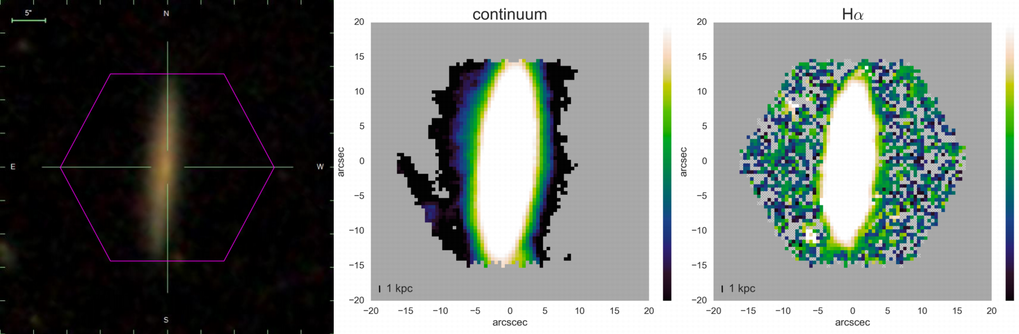
An example of one of the MaNGA galaxies. The left panel is an SDSS image with the MaNGA field of view overlaid.The middle panel shows a map of the brightness of the galaxy seen with MaNGA and the right panel shows a map of the ionized gas of hydrogen (Hα). The color bars are in logarithmic units. For an individual galaxy, the gas can barely be detected in the outskirts. Thus, for scientific analysis, spectra from many galaxies have to be added to increase the signal far enough above the noise level. © MPA. Hi-res image

With a new dataset from the survey Mapping Nearby Galaxies at APO (MaNGA), which is part of the Sloan Digital Sky Survey (SDSS) IV, a group of MPA scientists addressed these differences and questions about the eDIG. As an Integral Field Unit survey, MaNGA takes spectra at multiple spatial locations. The eDIG is faint and diffuse and in Fig 2 we show an example for the MaNGA observations of one particular galaxy. Adding multiple spectra taken at similar locations from similar edge-on, late-type galaxies, we can study the faint diffuse gas. 

The first year of MaNGA data includes a sample of 49 galaxies that are suitable for this study. We add the spectra from these 49 galaxies from 7 different locations off the disk of the galaxies to find how the eDIG varies with distance from the center of the galaxy. Our analysis shows that the brightness of the eDIG decreases logarithmically with distance and that most likely the temperature of the gas increases with distance from the center of the galaxies. 

For a more detailed analysis, e.g. to figure out which type of galaxies need an additional energy source and what type of source, we to split the sample by different properties of the galaxies, such as stellar mass or star formation. With the first year of data we split the full sample in half and find that in galaxies with a higher star formation rate, the eDIG is more similar to the star-forming gas inside the galaxies compared to low star-forming galaxies where the eDIG is markedly different. Moreover, galaxies with higher stellar mass have a steeper temperature gradient compared to those with lower stellar mass. In the future, with more data, we will be able to split the sample even further to better understand these questions.


Author:

Postdoc

Phone: 2215


Original Publication

1. A. Jones, G. Kauffmann, R. D'Souza, D. Bizyaev, D. Law, L. Haffner, Y. Bahe, B. Andrews, M. Bershady, J. Brownstein, B. Cherinka, A.Diamond-Stanic, N. Drory, R. A. Riffel, S. F. Sanchez, D. Thomas, D. Wake, R. Yan, K. Zhang.    

SDSS IV MaNGA: Deep observations of extra-planar, diffuse ionized gas around late-type galaxies from stacked IFU spectra
2016, submitted to A&A


Saturday, August 08, 2015

The Ghostly Remnants of Galaxy Interactions Uncovered in a Nearby Galaxy Group

Figure 1: Pseudo-color images from HSC observation which contains M81, M82, and NGC 3077. Diameter of the FOV is 1.5 degrees. Bottom-left: close-up of M81. Bottom-center: further close-up of M81 showing the spiral arm. Bottom-right: color composite of the images used for the analysis. Click to enlarge each frame. (Credit: NAOJ/HSC Project)

Movie: Neighborhood of the spiral galaxy M81 
Credit: NAOJ/HSC Project)


Cosmological archaeological studies such as this one help astronomers refine their understanding of galaxy formation and evolution. The currently favored cosmological galaxy models are based on the idea of hierarchical structure formation: that structures in the universe such as galaxies develop from small "overdensities" to become large-scale objects. For example, the Milky Way and M81 first formed as part of a local over-density in the primordial matter distribution – that is, the earliest accumulations of matter in the young universe. They grew over time via the agglomeration of numerous smaller building blocks, some of which may have survived later mergers to become present-day dwarf satellite galaxies. Establishing the presence and nature of these satellites, and determining the large-scale structure and stellar content of halos in spiral galaxies, is essential to understand and explain the physics of hierarchical galaxy assembly.

Over the last decade, astronomers doing large photometric surveys (that is, measuring the light intensities of celestial objects) have found a number of new satellite galaxies, stellar streams, and over-densities around the Milky Way and the Andromeda galaxies. The detailed properties of stars in these systems are studied to reconstruct the stellar contents of galaxies in the early stage, which is called "Galactic Archeology" or "near-field cosmology". For the Galactic Archeology study, it is necessary to resolve individual stars in a galaxy, and observe across a good fraction of the galaxy's radius.

Until now, the outskirts of the Milky Way and Andromeda are the only places that have been surveyed to sufficiently faint depths to enable detailed tests of hierarchical galaxy assembly process across wide scales.

The observing team started the M81 archeology study by using Hyper Suprime-Cam (HSC). M81, also known as Bode's Galaxy, is located at a distance of 11.7 million light-years, and is one of the nearest massive spiral galaxies similar to the Milky Way. The super-wide field of view of the HSC allowed the team to observe out to a projected radius of a half-million light-years from the center of M81. The field includes 18 known member galaxies of the M81 group in only seven pointings. The camera's high sensitivity enabled the team to observe vast numbers of old red giant branch (RGB) stars as well as young main-sequence (MS) stars, red supergiants, and asymptotic giant-branch stars at the distance of M81.

The left panel in Figure 2 shows the spatial distribution of young MS stars and core helium-burning stars, which are color-coded according to their i-band luminosity. Bright stars are mainly located in the inner disk of M81, while most of the young stars in outlying concentrations are fainter than i=24 mag and have similar luminosity distributions as that of the stellar stream between M81 and NGC 3077. They are between 30-160 million years old. The study indicates the ages of stars in these tidal features are synchronized to each other, and that these systems were produced by recent tidal interactions between M81, M82 and NGC 3077.

Figure 2: Young main-sequence (MS) stars and red-giant branch (RGB) stars around M81, M82, and NGC 3077. Left: yellow is brighter stars, and blue is fainter stars. Right: color-coded for the metallicity, namely yellow is metal rich, blue is metal poor. Solid line shows the R25 radius of the galaxy measured in the visible light. (Credit: NAOJ)


The distribution of RGB stars in the right panel of Figure 2 shows that the extended stellar halos of the three main galaxies overlap each other, and that the outer regions of M82 and NGC 3077 are highly perturbed. This is likely a consequence of the recent gravitational encounter.

The color of each point in the figure is a rough proxy for metallicity. The RGB stars in M82's outer halo have significantly bluer colors, showing that they are more metal-poor than those in M81, the NGC 3077 halos and the inner halo of M82. The satellite galaxies, KDG 61, BK5N, and IKN cannot be seen in the maps of young stars, but appear as over-densities of old populations in the right panel. 

This implies they are not the product of the recent interaction between M81, M82 and NGC 3077.

The science team for this study consists of astronomers at Shanghai Astronomical Observatory, National Astronomical Observatory of Japan, Hiroshima University, University of Edinburgh, and University of Cambridge. Their first results from the M81 study with Suprime-Cam on Subaru Telescope were released in March 2010 at: (http://www.subarutelescope.org/Pressrelease/2010/03/18/index.html).

Team member Dr. Sakurako Okamoto (Shanghai Astronomical Observatory) commented on this program: "Our deep panoramic view of the M81 group demonstrates that the complexity long known to be present in neutral hydrogen (HI) is equally matched in the low surface brightness stellar component. Together with the Galactic Archeology study based on the HSC wide-field survey of the Subaru Strategic Program, we hope to establish the presence and nature of satellite galaxies, and determine the large-scale structure and stellar content of halos of spiral galaxies in general".

The team members are grateful to the entire staff at Subaru Telescope and the HSC team. They acknowledge the importance of Maunakea within the indigenous Hawaiian community.

The research paper titled "A Hyper Suprime-Cam View of the Interacting Galaxies of the M81 Group" will be published in the Astrophysical Journal Letters. This work was supported by the grants of CAS (XDB09010100), NSFC (11333003), and JSPS (Grant-in-Aid for Young Scientists B, 26800103).


Members of the research team:
  • Sakurako Okamoto: Shanghai Astronomical Observatory, China
  • Nobuo Arimoto: Subaru Telescope, National Astronomical Observatory of Japan/SOKENDAI (The Graduate University for Advanced Stuties), Japan
  • Yoshihiko Yamada: Subaru Telescope, National Astronomical Observatory of Japan
  • Yosuke Utsumi: Hiroshima Astrophysical Science Center, Hiroshima University, Japan
  • Annette Ferguson: Institute for Astronomy, University of Edinburgh, Royal Observatory, UK
  • Edouard Bernard: Institute for Astronomy, University of Edinburgh, Royal Observatory, UK
  • Mike Irwin: Institute of Astronomy, University of Cambridge, UK