Tuesday, June 10, 2025

Frigid Exoplanet in Strange Orbit Imaged by NASA’s Webb

This image of exoplanet 14 Herculis c was taken by NASA’s James Webb Space Telescope’s NIRCam (Near-Infrared Camera). A star symbol marks the location of the host star 14 Herculis, whose light has been blocked by a coronagraph on NIRCam (shown here as a dark circle outlined in white). Credit: NASA, ESA, CSA, STScI, W. Balmer (JHU), D. Bardalez Gagliuffi (Amherst College


A planetary system described as abnormal, chaotic, and strange by researchers has come into clearer view with NASA’s James Webb Space Telescope. Using Webb’s NIRCam (Near-Infrared Camera), researchers have successfully imaged one of two known planets surrounding the star 14 Herculis, located 60 light-years away from Earth in our own Milky Way galaxy.

The exoplanet, 14 Herculis c, is one of the coldest imaged to date. While there are nearly 6,000 exoplanets that have been discovered, only a small number of those have been directly imaged, most of those being very hot (think hundreds or even thousands of degrees Fahrenheit). The new data suggests 14 Herculis c, which weighs about 7 times the planet Jupiter, is as cool as 26 degrees Fahrenheit (minus 3 degrees Celsius).

The team’s results covering 14 Herculis c have been accepted for publication in The Astrophysical Journal Letters and were presented in a press conference Tuesday at the 246th meeting of the American Astronomical Society in Anchorage, Alaska.

“The colder an exoplanet, the harder it is to image, so this is a totally new regime of study that Webb has unlocked with its extreme sensitivity in the infrared,” said William Balmer, co-first author of the new paper and graduate student at Johns Hopkins University. “We are now able to add to the catalog of not just hot, young exoplanets imaged, but older exoplanets that are far colder than we’ve directly seen before Webb.”

Webb’s image of 14 Herculis c also provides insights into a planetary system unlike most others studied in detail with Webb and other ground- and space-based observatories. The central star, 14 Herculis, is almost Sun-like – it is similar in age and temperature to our own Sun, but a little less massive and cooler.

There are two planets in this system – 14 Herculis b is closer to the star, and covered by the coronagraphic mask in the Webb image. These planets don’t orbit the host star on the same plane like our solar system. Instead, they cross each other like an ‘X’, with the star being at the center. That is, the orbital planes of the two planets are inclined relative to one another at an angle of about 40 degrees. The planets tug and pull at one another as they orbit the star.
This is the first time an image has ever been snapped of an exoplanet in such a mis-aligned system.

Scientists are working on several theories for just how the planets in this system got so “off track.” One of the leading concepts is that the planets scattered after a third planet was violently ejected from the system early in its formation.

“The early evolution of our own solar system was dominated by the movement and pull of our own gas giants,” added Balmer. “They threw around asteroids and rearranged other planets. Here, we are seeing the aftermath of a more violent planetary crime scene. It reminds us that something similar could have happened to our own solar system, and that the outcomes for small planets like Earth are often dictated by much larger forces.”

Understanding the Planet’s Characteristics With Webb

Webb’s new data is giving researchers further insights into not just the temperature of 14 Herculis c, but other details about the planet’s orbit and atmosphere.

Findings indicate the planet orbits around 1.4 billion miles from the host star in a highly elliptical, or football-shaped orbit, closer in than previous estimates. This is around 15 times farther from the Sun than Earth. On average, this would put 14 Herculis c between Saturn and Uranus in our solar system.

The planet’s brightness at 4.4 microns measured using Webb’s coronagraph, combined with the known mass of the planet and age of the system, hints at some complex atmospheric dynamics at play.

“If a planet of a certain mass formed 4 billion years ago, then cooled over time because it doesn't have a source of energy keeping it warm, we can predict how hot it should be today,” said Daniella C. Bardalez Gagliuffi of Amherst College, co-first author on the paper with Balmer. “Added information, like the perceived brightness in direct imaging, would in theory support this estimate of the planet’s temperature.”

However, what researchers expect isn’t always reflected in the results. With 14 Herculis c, the brightness at this wavelength is fainter than expected for an object of this mass and age. The research team can explain this discrepancy, though. It’s called carbon disequilibrium chemistry, something often seen in brown dwarfs.

“This exoplanet is so cold, the best comparisons we have that are well-studied are the coldest brown dwarfs,” Bardalez Gagliuffi explained. “In those objects, like with 14 Herculis c, we see carbon dioxide and carbon monoxide existing at temperatures where we should see methane. This is explained by churning in the atmosphere. Molecules made at warmer temperatures in the lower atmosphere are brought to the cold, upper atmosphere very quickly.”

Researchers hope Webb’s image of 14 Herculis c is just the beginning of a new phase of investigation into this strange system.

While the small dot of light obtained by Webb contains a plethora of information, future spectroscopic studies of 14 Herculis could better constrain the atmospheric properties of this interesting planet and help researchers understand the dynamics and formation pathways of the system.

The James Webb Space Telescope is the world’s premier space science observatory. Webb is solving mysteries in our solar system, looking beyond to distant worlds around other stars, and probing the mysterious structures and origins of our universe and our place in it. Webb is an international program led by NASA with it,s partners, ESA (European Space Agency) and CSA (Canadian Space Agency).

To learn more about Webb, visit: https://science.nasa.gov/webb


About This Release

Credits:

Media Contact:

Hannah Braun
Space Telescope Science Institute, Baltimore

Christine Pulliam
Space Telescope Science Institute, Baltimore

Permissions: Content Use Policy

Contact Us: Direct inquiries to the News Team.


Moons of Uranus Surprise Scientists in NASA Hubble Study

The five largest moons of Uranus – sometimes called the “classical moons” -- appear in a jagged, roughly diagonal line from top right to bottom left. These are labeled Titania, Oberon, Umbriel, Miranda and Ariel. Also visible is Ariel’s shadow, which is superimposed on Uranus. Faint, ghostly, Saturn-like rings encircle the blue ice giant. Credits/Science: NASA, ESA, STScI, Christian Soto (STScI). Image Processing: Joseph DePasquale (STScI)

This image of Uranus and its five classical moons -- Titania, Oberon, Umbriel, Miranda and Ariel -- was captured by the Hubble Space Telescope’s. div style="text-align: justify;">Advanced Camera for Surveys (ACS). The image shows a scale bar, compass arrows, and color key for reference. The five largest moons of Uranus – sometimes called the “classical moons” -- appear in a jagged, roughly diagonal line from top right to bottom left. These are labeled Titania, Oberon, Umbriel, Miranda and Ariel. Also visible is Ariel’s shadow, which is superimposed on Uranus. Faint, ghostly, Saturn-like rings encircle the blue ice giant. Credits/Science: NASA, ESA, STScI, Christian Soto (STScI). Image Processing: Joseph DePasquale (STScI). The scale bar is labeled in miles along the top and kilometers along the bottom. The north and east compass arrows show the orientation of the image on the sky. Note that the relationship between north and east on the sky (as seen from below) is flipped relative to direction arrows on a map of the ground (as seen from above). This image shows visible wavelengths of light that have been translated into visible-light colors. The color key shows which ACS filters were used when collecting the light. The color of each filter name is the visible-light color used to represent the light that passes through that filter. Credits/Science: NASA, ESA, STScI, Christian Soto (STScI). Image Processing: Joseph DePasquale (STScI)


Scientists using NASA’s Hubble Space Telescope went looking for evidence of one phenomenon and found quite another.

The research team studied the four largest moons of the ice giant Uranus, the seventh planet from our Sun, searching for signs of ,. interactions between Uranus' magnetosphere and the surfaces of the moons. (A magnetosphere is a region surrounding a celestial body where particles with an electrical charge are affected by the astronomical object’s magnetic field.)

In particular, the team predicted that, based on interactions with Uranus' magnetosphere, the “leading” sides of these tidally locked moons, which always face in the same direction in which they are orbiting the planet, would be brighter than the “trailing” sides, always facing away. This would be due to radiation darkening of their trailing sides by charged particles such as electrons trapped in Uranus’ magnetosphere.

Instead, they found no evidence for darkening on the moons’ trailing sides, and clear evidence for darkening of the leading sides of the outer moons. This surprised the team and indicates that Uranus’ magnetosphere might not interact much with its large moons, contradicting existing data collected over near-infrared wavelengths.

Hubble’s sharp ultraviolet vision and spectroscopic capabilities were critical for allowing the team to investigate the surface conditions on these moons and uncover the surprising finding.

The Complicated Magnetic Environment of ‘Weird’ Uranus

The four moons in this study — Ariel, Umbriel, Titania, and Oberon — are tidally locked to Uranus, so that they always show the same side to the planet. The side of the moon facing the direction of travel is called the leading hemisphere, while the side that faces backward is called the trailing hemisphere. The thinking was that charged particles trapped along the magnetic field lines primarily hit each moon’s trailing side, which would darken that hemisphere.

“Uranus is weird, so it's always been uncertain how much the magnetic field actually interacts with its satellites,” explained principal investigator Richard Cartwright of the Johns Hopkins University’s Applied Physics Laboratory. “For starters, it is tilted by 98 degrees relative to the ecliptic.”

This means Uranus is dramatically tipped relative to the orbital plane of the planets. It rolls very slowly around the Sun on its side as it completes its 84-Earth-year orbit.

“At the time of the Voyager 2 flyby, the magnetosphere of Uranus was tilted by about 59 degrees from the orbital plane of the satellites. So, there's an additional tilt to the magnetic field,” explained Cartwright.

Because Uranus and its magnetic field lines rotate faster than its moons orbit the planet, the magnetic field lines constantly sweep past the moons. If the magnetosphere of Uranus interacts with its moons, charged particles should preferentially hit the surface of the trailing sides.

These charged particles, as well as our galaxy’s cosmic rays, should darken the trailing hemispheres of Ariel, Umbriel, Titania, and Oberon and possibly generate the carbon dioxide detected on these moons. The team expected that, especially for the inner moons Ariel and Umbriel, the trailing hemispheres would be darker than the leading sides in ultraviolet and visible wavelengths.

But that’s not what they found. Instead, the leading and trailing hemispheres of Ariel and Umbriel are actually very similar in brightness. However, the researchers did see a difference between the hemispheres of the two outer moons, Titania and Oberon — not the moons they expected.

Like Bugs on a Windshield

Even stranger, the difference in brightness was the opposite of what they expected. The two outer moons have darker and redder leading hemispheres compared with their trailing hemispheres. The team thinks that dust from some of Uranus’ irregular satellites is coating the leading sides of Titania and Oberon.

Irregular satellites are natural bodies that have large, eccentric, and inclined orbits relative to their parent planet’s equatorial plane. Micrometeorites are constantly hitting the surfaces of Uranus’ irregular satellites, ejecting small bits of material into orbit around the planet.

Over millions of years, this dusty material moves inward toward Uranus and eventually crosses the orbits of Titania and Oberon. These outer moons sweep through the dust and pick it up primarily on their leading hemispheres, which face forward. It's much like bugs hitting the windshield of your car as you drive down a highway.

This material causes Titania and Oberon to have darker and redder leading hemispheres. These outer moons effectively shield the inner moons Ariel and Umbriel from the dust, which is why the inner moons’ hemispheres do not show a difference in brightness.

“We see the same thing happening in the Saturn system and probably the Jupiter system as well,” said co-investigator Bryan Holler of the Space Telescope Science Institute. “This is some of the first evidence we’re seeing of a similar material exchange among the Uranian satellites.”

“So that supports a different explanation,” said Cartwright. “That's dust collection. I didn't even expect to get into that hypothesis, but you know, data always surprise you.”

Based on these findings, Cartwright and his team suspect that Uranus' magnetosphere may be fairly quiescent, or it may be more complicated than previously thought. Perhaps interactions between Uranus' moons and magnetosphere are happening, but for some reason, they’re not causing asymmetry in the leading and trailing hemispheres as researchers suspected. The answer will require further investigation into enigmatic Uranus, its magnetosphere, and its moons.

Hubble’s Unique Ultraviolet Vision

To observe the brightnesses of the four largest Uranian moons, the researchers required Hubble’s unique ultraviolet capabilities. Observing targets in ultraviolet light is not possible from the ground because of the filtering effects of Earth’s protective atmosphere. No other present-day space telescopes have comparable ultraviolet vision and sharpness.

“Hubble, with its ultraviolet capabilities, is the only facility that could test our hypothesis,” said the Space Telescope Science Institute’s Christian Soto, who conducted much of the data extraction and analysis. Soto presented results from this study on June 10 at the 246th Meeting of American Astronomical Society in Anchorage, Alaska.

Complementary data from NASA’s James Webb Space Telescope will help to provide a more comprehensive understanding of the Uranian satellite system and its interactions with the planet’s magnetosphere.

The Hubble Space Telescope has been operating for over three decades and continues to make ground-breaking discoveries that shape our fundamental understanding of the universe. Hubble is a project of international cooperation between NASA and ESA (European Space Agency). NASA’s Goddard Space Flight Center in Greenbelt, Maryland, manages the telescope and mission operations. Lockheed Martin Space, based in Denver, also supports mission operations at Goddard. The Space Telescope Science Institute in Baltimore, which is operated by the Association of Universities for Research in Astronomy, conducts Hubble science operations for NASA.

The Space Telescope Science Institute is expanding the frontiers of space astronomy by hosting the science operations center of the Hubble Space Telescope, the science and mission operations centers for the James Webb Space Telescope, and the science operations center for the Nancy Grace Roman Space Telescope. STScI also houses the Barbara A. Mikulski Archive for Space Telescopes (MAST) which is a NASA-funded project to support and provide to the astronomical community a variety of astronomical data archives, and is the data repository for the Hubble, Webb, Roman, Kepler, K2, TESS missions and more. STScI is operated by the Association of Universities for Research in Astronomy in Washington, D.C.


About This Release

Credits:

Media Contact:

Ann Jenkins
Space. Telescope Science Institute, Baltimore

Ray Villard
Space Telescope Science Institute, Baltimore

Permissions: Content Use Policy

Contact Us: Direct inquiries to the News Team.


Monday, June 09, 2025

Stirring the interstellar soup

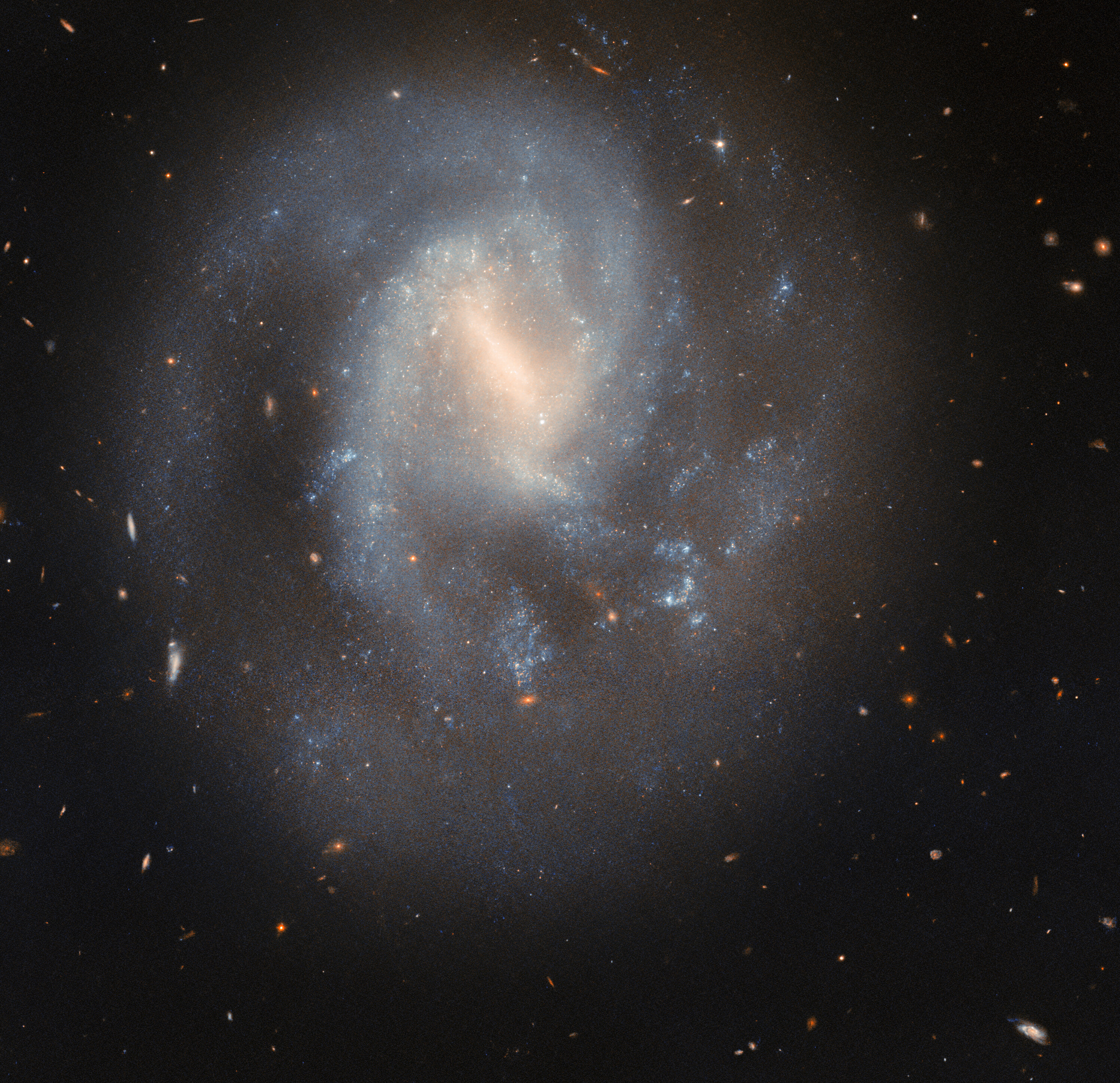
A spiral galaxy with a generally soft and slightly faint appearance. It glows most brightly around the pale yellow bar across its centre. It has two spiral arms which wrap around the centre, quickly broadening out to join a wide, faint circular halo around the galaxy. Glowing, sparkling patches in the disc show stars forming in nebulae. Behind the galaxy, distant galaxies appear as orange dots on a black background, Credit: ESA/Hubble & NASA, C. Kilpatrick

This serene spiral galaxy hides a cataclysmic past. The galaxy IC 758, shown here in today’s NASA/ESA Hubble Space Telescope Picture of the Week, is situated 60 million light-years away in the constellation Ursa Major.

In this Hubble image captured in 2023, IC 758 appears peaceful, its soft blue spiral arms curving gently around its hazy barred centre. But in 1999, astronomers spotted a powerful explosion in this galaxy: the
supernova SN 1999bg. SN 1999bg marked the dramatic end of a star far more massive than the Sun.

It’s not yet known how massive this star was before it exploded. Researchers will use these Hubble observations to measure the masses of stars in SN 1999bg’s neighbourhood, which will help them estimate the mass of the star that went supernova. The Hubble data may also reveal whether SN 1999bg’s progenitor star had a companion, which would give additional clues about the star’s life and death.

A supernova represents more than just the demise of a single star — it’s also a powerful force that can shape its neighbourhood. When a massive star collapses, triggering a supernova, its outer layers rebound off its shrunken core. The explosion stirs the interstellar soup of gas and dust out of which new stars form. This interstellar shakeup can scatter and heat nearby gas clouds, preventing new stars from forming, or it can compress them, creating a burst of new stars. The cast-off layers also become ingredients for new stars.


NASA’s Chandra Sees Surprisingly Strong Black Hole Jet at Cosmic “Noon”

A black hole has blasted out a surprisingly powerful jet in the distant universe, according to a study from NASA’s Chandra X-ray Observatory. X-ray: NASA/CXC/CfA/J. Maithil et al.; Illustration: NASA/CXC/SAO/M. Weiss; Image Processing: NASA/CXC/SAO/N. Wolk


black hole has blasted out a surprisingly powerful jet in the distant universe, according to a new study from NASA’s Chandra X-ray Observatory. This jet exists early enough in the cosmos that it is being illuminated by the leftover glow from the big bang itself.

Astronomers used Chandra and the Karl G. Jansky Very Large Array (VLA) to study this black hole and its jet at a period they call “cosmic noon,” which occurred about three billion years after the universe began. During this time most galaxies and supermassive black holes were growing faster than at any other time during the history of the universe.

The main graphic is an artist’s illustration showing material in a disk that is falling towards a supermassive black hole. A jet is blasting away from the black hole towards the upper right, as Chandra detected in the new study. The black hole is located 11.6 billion light-years from Earth when the cosmic microwave background (CMB), the leftover glow from the big bang, was much denser than it is now. As the electrons in the jets fly away from the black hole, they move through the sea of CMB radiation and collide with microwave photons. These collisions boost the energy of the photons up into the X-ray band (purple and white), allowing them to be detected by Chandra even at this great distance, which is shown in the inset.

Researchers, in fact, identified and then confirmed the existence of two different black holes with jets over 300,000 light-years long. The two black holes are 11.6 billion and 11.7 billion light-years away from Earth, respectively. Particles in one jet are moving at between 95% and 99% of the speed of light (called J1405+0415) and in the other at between 92% and 98% of the speed of light (J1610+1811). The jet from J1610+1811 is remarkably powerful, carrying roughly half as much energy as the intense light from hot gas orbiting the black hole.

The team was able to detect these jets despite their great distances and small separation from the bright, growing supermassive black holes — known as “quasars” — because of Chandra’s sharp X-ray vision, and because the CMB was much denser then than it is now, enhancing the energy boost described above.

When quasar jets approach the speed of light, Einstein’s theory of special relativity creates a dramatic brightening effect. Jets aimed toward Earth appear much brighter than those pointed away. The same brightness astronomers observe can come from vastly different combinations of speed and viewing angle. A jet racing at near-light speed but angled away from us can appear just as bright as a slower jet pointed directly at Earth.

The researchers developed a novel statistical method that finally cracked this challenge of separating effects of speed and of viewing angle. Their approach recognizes a fundamental bias: astronomers are more likely to discover jets pointed toward Earth simply because relativistic effects make them appear brightest. They incorporated this bias using a modified probability distribution, which accounts for how jets oriented at different angles are detected in surveys. Their method works by first using the physics of how jet particles scatter the CMB to determine the relationship between jet speed and viewing angle. Then, instead of assuming all angles are equally likely, they apply the relativistic selection effect: jets beamed toward us (smaller angles) are overrepresented in our catalogs. By running ten thousand simulations that match this biased distribution to their physical model, they could finally determine the most probable viewing angles: about 9 degrees for J1405+0415 and 11 degrees for J1610+1811.

These results were presented by Jaya Maithil (Center for Astrophysics | Harvard & Smithsonian) at the 246th meeting of the American Astronomical Society in Anchorage, AK, and are also being published in The Astrophysical Journal. A preprint is available here. NASA’s Marshall Space Flight Center in Huntsville, Alabama, manages the Chandra program. The Smithsonian Astrophysical Observatory’s Chandra X-ray Center controls science operations from Cambridge, Massachusetts, and flight operations from Burlington, Massachusetts.


Visual Description

This release is supported by an artist’s illustration of a jet blasting away from a supermassive black hole.

The black hole sits near the center of the illustration. It resembles a black marble with a fine yellow outline. Surrounding the black hole is a swirling disk, resembling a dinner plate tilted to face our upper right. This disk comprises concentric rings of fiery swirls, dark orange near the outer edge, and bright yellow near the core.

Shooting out of the black hole are two streaky beams of silver and pale violet. One bright beam shoots up toward our upper right, and a second somewhat dimmer beam shoots in the opposite direction, down toward our lower left. These beams are encircled by long, fine, corkscrewing lines that resemble stretched springs.

This black hole is located 11.6 billion light-years from Earth, much earlier in the history of the universe. Near this black hole, the leftover glow from the big bang, known as the cosmic microwave background or CMB, is much denser than it is now. As the electrons in the jets blast away from the black hole, they move through the sea of CMB radiation. The electrons boost the energies of the CMB light into the X-ray band, allowing the jets to be detected by Chandra, even at this great distance.

Inset at our upper righthand corner is an X-ray image depicting this interaction. Here, a bright white circle is ringed with a band of glowing purple energy. The jet is the faint purple line shooting off that ring, aimed toward our upper right, with a blob of purple energy at its tip
.


News Media Contact

Megan Watzke
Chandra X-ray Center
Cambridge, Mass.
617-496-7998

mwatzke@cfa.harvard.edu

Lane Figueroa
Marshall Space Flight Center, Huntsville, Alabama
256-544-0034

lane.e.figueroa@nasa.gov


Sunday, June 08, 2025

New Laser Guide Star System Debuts in the Night Sky of Maunakea


When we look up at the night sky, we see stars that appear to twinkle. This twinkling occurs because the light from the stars is disturbed by turbulence in Earth’s atmosphere caused by changes in the air’s refractive index. For ground-based telescopes, this atmospheric turbulence results in blurry images of stars.

Adaptive optics is a technology that overcomes the effects of atmospheric turbulence. It works by using a wavefront sensor to detect how the light from a nearby bright star, called a guide star, is being distorted as it passes through the atmosphere. The system then controls a deformable mirror to cancel out the distortions, allowing telescopes to capture much sharper images of stars as if they were in outer space.

If there is no bright star near the target object, an artificial guide star, called a laser guide star, can be generated from a laser beam. In this image, the laser beam from the laser guide star system stretches across the night sky of Maunakea. By utilizing adaptive optics technology in conjunction with the laser guide star system, the Subaru Telescope and other large ground-based telescopes can capture sharp images of stars. (Credit: Dr. Vera Maria Passegger/NAOJ)


Relevant Links


Saturday, June 07, 2025

JWST Examines the Ring Nebula


The iconic and widely photographed Ring Nebula is one of the most recognizable planetary nebulae: short-lived, often brilliantly colored nebulae that form when low- to intermediate-mass stars shed their outer layers. The three images above show the central region of the Ring Nebula through the eyes of JWST’s Mid Infrared Instrument. The leftmost image clearly shows the Ring Nebula’s central star: a hot, crystallized stellar core called a white dwarf. In a recent research article, Raghvendra Sahai (Jet Propulsion Laboratory) and collaborators analyzed these JWST observations, leading to the discovery of a dusty disk around the Ring Nebula’s central star. This is just the second time that a resolved disk has been discovered around the central star of a planetary nebula. Disks with radii from 0.01 to 1,000 au have been found around evolved stars in the asymptotic giant branch phase through the planetary nebula phase, but it’s not yet clear how these disks form and how long they last. Most intriguingly, the presence of disks around highly evolved stars raises the possibility of a second phase of planet formation. To learn more about the JWST observations of the Ring Nebula, and what they tell us about the properties of the central star and its disk, be sure to check out the full research article linked below.<;div>

By Kerry Hensley

Citation

“JWST Observations of the Ring Nebula (NGC 6720). III. A Dusty Disk Around Its Central Star,” Raghvendra Sahai et al 2025 ApJ 985 101. doi:10.3847/1538-4357/adc91c


Friday, June 06, 2025

Star Quakes and Monster Shock Waves

Artist's concept of a black hole orbited by a cracked neutron star. Before a black hole consumes a neutron star, tidal forces from its immense gravity shears the star's surface, causing quakes and the opening of rifts. In this artwork, the gravity of both the black hole and neutron star can be seen bending our view of the background. The neutron star, though less massive than the black hole, has strong enough gravity to warp the view of the black hole as well. Credit: Caltech/R. Hurt (IPAC)

This snapshot from a simulation shows a magnetized outflow of plasma launched following the merger of a black hole and a magnetized neutron star. The light blue color maps show the strength of magnetic fields within this wind. The magnetized outflow is powered by the spin of the remnant black hole, like a rotating fan pushing air around. Credit: Yoonsoo Kim/Caltech

A side view from a simulation of a "black hole pulsar," a hypothetical object in which a black hole launches magnetized outflows that sweep around the black hole, like a lighthouse beacon, as it spins. The yellow lines show where magnetic fields that are pointing in different directions meet up. Electric currents flow along this interface and heat up plasma, which takes on a characteristic "ballerina's skirt" geometry. Credit: Yoonsoo Kim/Caltech

A series of three simulated images showing a black hole eat a neutron star. These three panels are taken from a supercomputer simulation of a merger between a black hole (large black circle) and a neutron star (colored blob). The images, which move forward in time from left to right, show how the intense gravity of the black hole stretches the neutron star, before the black hole ultimately consumes it. Credit: Elias Most/Caltech


Across the cosmos, many stars can be found in pairs, gracefully circling one another. Yet one of the most dramatic pairings occurs between two orbiting black holes, formed after their massive progenitor stars exploded in supernova blasts. If these black holes lie close enough together, they will ultimately collide and form an even more massive black hole. Sometimes a black hole is orbited by a neutron star—the dense corpse of a star also formed from a supernova explosion but which contains less mass than a black hole. When these two bodies finally merge, the black hole will typically swallow the neutron star whole.

To better understand the extreme physics underlying such a grisly demise, researchers at Caltech are using supercomputers to simulate black hole–neutron star collisions. In one study appearing in The Astrophysical Journal Letters, the team, led by Elias Most, a Caltech assistant professor of theoretical astrophysics, developed the most detailed simulation yet of the violent quakes that rupture a neutron star's surface roughly a second before the black hole consumes it.

"The neutron star's crust will crack open just like the ground in an earthquake," Most says. "The black hole's gravity first shears the surface, causing quakes in the star and the opening of rifts."

While cracks in the crust of a neutron star had been predicted before, the simulation is the first to demonstrate what kinds of light flares astronomers might see in the future when pointing telescopes in space and on the ground at such an event.

"This goes beyond educated models for the phenomenon—it is an actual simulation that includes all the relevant physics taking place when the neutron star breaks like an egg," says co-author Katerina Chatziioannou, assistant professor of physics at Caltech and a William H. Hurt Scholar.

In a second, more recent paper in The Astrophysical Journal Letters, published March 31 of this year, the team used a supercomputer to simulate what happens after the neutron star fractures—a brief milliseconds-long window when monster shock waves, the most powerful predicted shock waves in the universe, shoot outward from the star. These monster shock waves had only recently been predicted by co-author Andrei Beloborodov of Columbia University. Now, the simulation, along with another from a different study published by the team last year, are the first to show how they form.

What is more, the most recent simulation does not stop when the monster shock waves form—it proceeds to show the neutron star being swallowed, which then triggers the creation of an exotic object called a "black hole pulsar."

A classic pulsar is a highly magnetized neutron star that emits beams of radiation, which sweep around like a lighthouse beacon as the star spins on its axis. A black hole pulsar is a hypothetical object in which a black hole launches magnetic winds that would also sweep around it as it spins, mimicking the appearance of a pulsar. While black hole pulsars had been previously conjectured, the simulation is the first to show how such a rare object could actually form in nature from the collision of a neutron star and black hole.

"When the neutron star plunges into the black hole, the monster shock waves are launched," says Yoonsoo Kim (MS '24), a Caltech graduate student working with Most, and lead author of the study on monster shock waves and black hole pulsars. "After the star is sucked in, whipping winds are formed, creating the black hole pulsar. But the black hole cannot sustain its winds and will become quiet again within seconds."

This snippet from a supercomputer simulation shows the aftermath of a collision between a black hole and a neutron star. After the black hole consumes the magnetized neutron star, a hypothetical object called a "black hole pulsar" is formed, in which magnetic outflows sweep around the black hole as it spins. The thin yellow lines represent the interface where magnetic fields pointing in opposite directions meet. Electric currents form at this interface and heat up plasma, which can power bright gamma and X-ray emissions. This movie covers a period of about eight milliseconds.

Like the simulation depicting how a neutron star cracks, this one also predicts the characteristics of the resulting flares astronomers might see through telescopes. In the fleeting moments when monster shock waves rip outward and a black hole pulsar forms, telescopes may be able to catch outbursts of radio waves or a combination of X-rays and gamma rays. In short, the simulations performed by Most and colleagues provide a deeper understanding of the physics driving some of the most energetic events in the universe

Undulating Space and Time

When two black holes collide, they generate not only shock waves and flares of light but also another type of radiation known as gravitational waves. These ripples in the fabric of space and time itself were first predicted more than 100 years ago by Albert Einstein. The Caltech- and MIT-led LIGO (Laser Interferometer Gravitational-wave Observatory), which is funded by the National Science Foundation (NSF), famously made the first direct detection of gravitational waves, generated from the coalescence of two black holes, in 2015. The achievement would later earn three of the collaboration's leading teammates the 2017 Nobel Prize in Physics.

In 2017, LIGO and Virgo, its European sister observatory, observed a different kind of collision: that between two neutron stars. The fiery explosion, called a kilonova, unleashed a spray of metals, including the element gold. That event emitted both gravitational waves and light. LIGO–Virgo first caught the blast in gravitational waves and then notified astronomers around the world who followed up with telescopes in space and on the ground to detect a broad range of electromagnetic, or light, wavelengths, ranging from high-energy gamma rays to low-energy radio waves.

Whether a neutron star–black hole collision would also produce a similar light show is not clear, but so far none have been seen. Still, it is possible that the neutron star–black hole mergers, even if they fail to produce a cloud of glowing material, might flash with brief radio and/or other electromagnetic signals right before and during the collisions. Simulations like those from Most and his colleagues help astronomers know which electromagnetic signals to look for.

To aid in the hunt for these precursor signals, the LIGO team is working to detect mergers up to a minute before they occur, which would give astronomers more time to point their telescopes at the blasts and search for tell-tale signs of an impending crash.

LIGO can detect mergers before they happen because the pair of colliding objects emit gravitational waves in the frequency band that LIGO detects as they spiral closer and closer together," says Chatziioannou, who is part of the LIGO team. "Currently, we can detect the collisions just seconds before they occur, and we are working up to a full minute. The gravitational waves are one piece of the puzzle while the electromagnetic radiation is another. We want to put the puzzle pieces together."

The Most Advanced Computers

A major factor in the success of the team's recent neutron star–black hole simulations is the use of supercomputers containing GPUs (graphics processing units). For these recent studies, the team used the Perlmutter supercomputer located at the Lawrence Berkeley National Laboratory in Berkeley (named after astronomer Saul Perlmutter, who won the 2011 Nobel Prize in Physics with two other scientists for discovering that the universe is accelerating). GPUs provide processing power for video games and AI programs like ChatGPT; in this case, the massive parallel computing power of GPUs allowed the Perlmutter supercomputer to handle the codes needed to simulate the intricate interactions between a converging neutron star and black hole.

"When you simulate two black holes merging," Most says, "you need the equations of general relativity to describe the gr

avitational waves. But when you have a neutron star, there's a lot more physics taking place including the complex nuclear physics of the star and plasma dynamics around it."

The actual simulations take about four to five hours to run. Most and his team had been working on similar simulations for about two years using supercomputers without GPUs before they ran them on Perlmutter. "That's what unlocked the problem," Most says. "With GPUs, suddenly, everything worked and matched our expectations. We just did not have enough computing power before to numerically model these highly complex physical systems in a sufficient detail.

Simulation Secrets

The first cracking simulation reveals the drama of what unfolds as the neutron star gets close to its partner black hole. First, gravitational forces from the massive black hole shear the dead star's surface, causing it to shatter. Neutron stars are surrounded by an intense magnetic field, and when their surface shatters due to these so-called tidal forces, the magnetic field wiggles around. This leads to magnetic ripples called Alfvén waves, named after the Swedish physicist Hannes Alfvén who won the 1970 Nobel Prize in Physics for his work on magnetohydrodynamics, a theory that describes how electromagnetic fields behave in a plasma.

"The magnetic field can be thought of as strings attached to the neutron star," Most says. "The neutron star's quake violently shakes these strings like a whip, and then it makes a cracking sound."

The Alfvén waves eventually transform into a blast wave that produces a burst of radio waves about a second before the neutron star is swallowed. In the future, Caltech's planned Deep Synoptic Array-2000, or DSA-2000—an array of 2,000 radio dishes to be built in the Nevada desert—may be able to pick up these radio wave bursts, (called fast radio bursts or FRBs), indicating the death of the neutron star.

"Before this simulation, people thought you could crack a neutron star like an egg, but they never asked if you could hear the cracking," Most says. "Our work predicts that, yes, you could hear or detect it as a radio signal."

The team's second simulation reveals what happens further along in the neutron's star demise. When the dead star is slurped up by the black hole, some of the strongest shock waves in the universe are produced.

"It's like an ocean wave," Kim says. "The ocean is initially quiet, but as the waves come ashore, they steepen until they finally break. In our simulation, we can see the magnetic field waves break into a monster shock wave."

Those monster shock waves would convert into blast waves that are stronger than the ones generated by the neutron star's cracking, and they too would produce radio signals. That means astronomers observing a neutron star and black hole in the second before they collide might detect two radio signals, one after the other

"What this means is that a neutron star-black hole collision, while it might not erupt with material like a neutron star–neutron star collision, could power strong signals that telescopes can detect," Most says.

Brief Beacons

Finally, after the neutron star is gulped down by the black hole, the second simulation shows how a black hole pulsar is born.

"If the black hole eats up the neutron star, it's also eating up its magnetic field," Most explains. "And it needs to get rid of that. The black hole doesn't want the magnetic field; it repels it. What the simulation shows is that it actually does that in a way that forms a state that looks like a pulsar."

The black hole essentially drags the unwanted magnetic field around with it, and this creates magnetic winds that whip around the black hole, making it resemble a pulsar for a brief period lasting just under a second. The data show that such an event would emit a short burst of high-energy X-rays and/or higher-energy gamma rays.

In the future, the researchers hope to explore whether this same phenomenology extends to other types of binary systems. With the help of supercomputers, they aim to unravel the wondrous physics driving the universe's most cataclysmic events.

The neutron-star cracking study, titled "Nonlinear Alfvén-wave Dynamics and Premerger Emission from Crustal Oscillations in Neutron Star Mergers," was funded by NSF and the Simons Foundation. Other authors include Caltech graduate student Isaac Legred (MS '24).

The monster shock waves and black hole pulsar study, titled "Black Hole Pulsars and Monster Shocks as Outcomes of Black Hole–Neutron Star Mergers," was funded by the Sherman Fairchild Foundation, NSF, NASA, Natural Sciences & Engineering Research Council of Canada, the Canadian Space Agency, and the Simons Foundation. Other authors include Bart Ripperda from the Canadian Institute for Theoretical Astrophysics.

Written by Whitney Clavin

Source: Caltech/News


Thursday, June 05, 2025

3 Black Holes Caught Eating Massive Stars in NASA Data

A disk of hot gas swirls around a black hole in this illustration. Some of the gas came from a star that was pulled apart by the black hole, forming the long stream of hot gas on the right, feeding into the disk. Credits: NASA/JPL-Caltech

This illustration shows a glowing stream of material from a star as it is being devoured by a supermassive black hole. When a star passes within a certain distance of a black hole -- close enough to be gravitationally disrupted -- the stellar material gets stretched and compressed as it falls into the black hole. NASA/JPL-Caltech


Black holes are invisible to us unless they interact with something else. Some continuously eat gas and dust, and appear to glow brightly over time as matter falls in. But other black holes secretly lie in wait for years until a star comes close enough to snack on.

A new study using space and ground-based data from NASA, ESA (European Space Agency), and other institutions describes three extreme examples of supermassive black holes feasting on massive stars. These events released more energy than 100 supernovae, and represent the most energetic type of cosmic explosion since the big bang discovered so far.

Each supermassive black hole sits at the center of a distant galaxy, and suddenly brightened when it destroyed a star three to 10 times heavier than our Sun. The brightness then lasted for several months.

Scientists describe these rare occurrences as a new category of cosmic events called “extreme nuclear transients.” Looking for more of these extreme nuclear transients could help unveil some of the most massive supermassive black holes in the universe that are usually quiet.

“These events are the only way we can have a spotlight that we can shine on otherwise inactive massive black holes,” said Jason Hinkle, graduate student at the University of Hawaii and lead author of a new study in the journal Science Advances describing this phenomenon.

These events unleash enormous amounts of high-energy radiation on the central regions of their host galaxies. "That has implications for the environments in which these events are occurring,” Hinkle said. “If galaxies have these events, they’re important for the galaxies themselves.”

The stars’ destruction produces high-energy light that takes over 100 days to reach peak brightness, then more than 150 days to dim to half of its peak. The way the high-energy radiation affects the environment results in lower-energy emissions that telescopes can also detect.

One of these star-destroying events, nicknamed “Barbie” because of its catalog identifier ZTF20abrbeie, was discovered in 2020 by the Zwicky Transient Facility at Caltech’s Palomar Observatory in California, and documented in two 2023 studies. The other two black holes were detected by ESA’s Gaia mission in 2016 and 2018 and are studied in detail in the new paper.

NASA’s Neil Gehrels Swift Observatory was critical in confirming that these events must have been related to black holes, not stellar explosions or other phenomena.  The way that the X-ray, ultraviolet, and optical light brightened and dimmed over time was like a fingerprint matching that of a black hole ripping a star apart.

Scientists also used data from NASA’s WISE spacecraft, which was operated from 2009 to 2011 and then was reactivated as NEOWISE and retired in 2024. Under the WISE mission the spacecraft mapped the sky at infrared wavelengths, finding many new distant objects and cosmic phenomena. In the new study, the spacecraft's data helped researchers characterize dust in the environments of each black hole. Numerous ground-based observatories additionally contributed to this discovery, including the W. M. Keck Observatory telescopes through their NASA-funded archive and the NASA-supported Near-Earth Object surveys ATLAS, Pan-STARRS, and Catalina.

“What I think is so exciting about this work is that we're pushing the upper bounds of what we understand to be the most energetic environments of the universe,” said Anna Payne, a staff scientist at the Space Telescope Science Institute and study co-author, who helped look for the chemical fingerprints of these events with the University of Hawaii 2.2-meter Telescope.

A Future Investigators in NASA Earth and Space Science and Technology (FINESST) grant from the agency helped enable Hinkle to search for these black hole events. “The FINESST grant gave Jason the freedom to track down and figure out what these events actually were,” said Ben Shappee, associate professor at the Institute for Astronomy at the University of Hawaii, a study coauthor and advisor to Hinkle.

Hinkle is set to follow up on these results as a postdoctoral fellow at the University of Illinois Urbana-Champaign through the NASA Hubble Fellowship Program. “One of the biggest questions in astronomy is how black holes grow throughout the universe,” Hinkle said.

The results complement recent observations from NASA’s James Webb Space Telescope showing how supermassive black holes feed and grow in the early universe. But since only 10% of early black holes are actively eating gas and dust, extreme nuclear transients — that is, catching a supermassive black hole in the act of eating a massive star — are a different way to find black holes in the early universe.

Events like these are so bright that they may be visible even in the distant, early universe. Swift showed that extreme nuclear transients emit most of their light in the ultraviolet. But as the universe expands, that light is stretched to longer wavelengths and shifts into the infrared — exactly the kind of light NASA’s upcoming Nancy Grace Roman Space Telescope was designed to detect.

With its powerful infrared sensitivity and wide field of view, Roman will be able to spot these rare explosions from more than 12 billion years ago, when the universe was just a tenth of its current age. Scheduled to launch by 2027, and potentially as early as fall 2026, Roman could uncover many more of these dramatic events and offer a new way to explore how stars, galaxies, and black holes formed and evolved over time.

“We can take these three objects as a blueprint to know what to look for in the future,” Payne said.

Elizabeth Landau

Source: NASA/Science


Wednesday, June 04, 2025

Galaxy Clusters on Course to Crash Again, NASA’s Chandra Finds

PSZ2 G181.06+48.47
X-ray: NASA/CXC/CfA/Stroe, A. et al.; Optical: PanSTARRS; Radio: ASTRON/LOFAR;
Image Processing: NASA/CXC/SAO/N. Wolk


New observations from NASA’s Chandra X-ray Observatory and other telescopes have captured a rare cosmic event: two galaxy clusters have collided and are now poised to head back for another swipe at each other.

Galaxy clusters are some of the largest structures in the universe. Held together by gravity, they are monster-sized collections of hundreds or thousands of individual galaxies, massive amounts of superheated gas, and invisible dark matter.

The galaxy cluster PSZ2 G181.06+48.47 (PSZ2 G181 for short) is about 2.8 billion light-years from Earth. Previously, radio observations from the LOw Frequency ARray (LOFAR), an antenna network in the Netherlands, spotted parentheses-shaped structures on the outside of the system. In this new composite image, X-rays from Chandra (represented in purple) and ESA’s (European Space Agency’s) XMM-Newton (blue) have been combined with LOFAR data (red) and an optical image from the Panoramic Survey Telescope and Rapid Response System (Pan-STARRS) of the stars in the field of view.

These structures are probably shock fronts – similar to those created by jets that have broken the sound barrier – likely caused by disruption of gas from the initial collision about a billion years ago. Since the collision they have continued traveling outwards and are currently separated by about 11 million light-years, the largest separation of these kinds of structures that astronomers have ever seen.

Colliding galaxy clusters PSZ2 G181.06+48.47 (Labeled).
X-ray: NASA/CXC/CfA/Stroe, A. et al.; Optical: PanSTARRS; Radio: ASTRON/LOFAR; 
Image Processing: NASA/CXC/SAO/N. Wolk

Now, data from NASA’s Chandra and ESA’s XMM-Newton, a mission with NASA contributions, is providing evidence that PSZ2 G181 is poised for another collision. Having a first pass at ramming each other, the two clusters have slowed down and begun heading back toward a second crash.

Astronomers made a detailed study of the X-ray observations of this collision site and found three shock fronts. These are aligned with the axis of the collision, and the researchers think they are early signs of the second, oncoming crash.

The researchers are still trying to determine how much mass each of the colliding clusters contains. Regardless, the total mass of the system is less than others where galaxy clusters have collided. This makes PSZ2 G181 an unusual case of a lower-mass system involved in the rare event of colliding galaxy clusters.

A paper describing these results appears in a recent issue of The Astrophysical Journal (ApJ) and is led by Andra Stroe from the Center for Astrophysics | Harvard & Smithsonian (CfA) and collaborators. It is part of a series of three papers in ApJ. The second paper is led by Kamlesh Rajpurohit, also of CfA, and the third paper is led by Eunmo Ahn, from Yonsei University in the Republic of Korea.

NASA’s Marshall Space Flight Center in Huntsville, Alabama, manages the Chandra program. The Smithsonian Astrophysical Observatory’s Chandra X-ray Center controls science operations from Cambridge, Massachusetts, and flight operations from Burlington, Massachusetts.


Visual Description

In this release, a composite image illustrates a dramatic cosmic story unfolding 2.8 billion light years from Earth. Presented both with and without labels, the image details the fallout when two galaxy clusters collide.

At the center of the image are the colliding galaxy clusters, which together are known as PSZ2 G181. This combined cluster somewhat resembles an irregular violet peanut shell, with bulbous ends linked by a tapered middle. Inside each bulbous end are several glowing dots; some of the galaxies within the clusters. The violet peanut shape is tilted at a slight angle, surrounded by a blue haze of X-ray gas.

Far from the bulbous ends, at our upper left and lower right, are two blotchy, thick red lines. These are probably shock fronts, similar to those created by jets that have broken the sound barrier. Bracketing the combined galaxy cluster, these shock fronts were caused by the initial collision about a billion years ago. They are currently separated by 11 million light-years.

New data from the Chandra and XMM-Newton observatories suggests that PSZ2 G181 is poised for another powerful cosmic event. Having already taken one swipe at each other, the two clusters within are once again on a collision course.


News Media Contact:

Megan Watzke
Chandra X-ray Center
Cambridge, Mass.
617-496-7998

mwatzke@cfa.harvard.edu

Lane Figueroa
Marshall Space Flight Center, Huntsville, Alabama
256-544-0034

lane.e.figueroa@nasa.gov


Biggest Boom Since the Big Bang: Hawaiʻi-Based Astronomers Uncover the Most Energetic Explosions In The Universe Yet Discovered

Artist’s concept of the formation of Extreme Nuclear Transients (ENTs)
Credit: W. M. Keck Observatory / Adam Makarenko

Releasing more energy than 100 supernovae, Extreme Nuclear Transients (ENTs) are the most energetic transients yet observed

Maunakea, Hawaiʻi – Astronomers using data from the W. M. Keck Observatory on Maunakea, Hawaiʻi Island discovered the most energetic cosmic explosions discovered to date, naming the new class of events “extreme nuclear transients” (ENTs). These extraordinary phenomena occur when massive stars—at least three times heavier than our Sun—are torn apart after wandering too close to a supermassive black hole. Their disruption releases vast amounts of energy visible across enormous distances.

The team’s findings were detailed today in the journal Science Advances.

“We’ve observed stars getting ripped apart as tidal disruption events for over a decade, but these ENTs are different beasts, reaching brightnesses nearly ten times more than what we typically see,” said Jason Hinkle, who led the study as the final piece of his doctoral research at the University of Hawaiʻi’s Institute for Astronomy (IfA). “Not only are ENTs far brighter than normal tidal disruption events, but they remain luminous for years, far surpassing the energy output of even the brightest known supernova explosions.”

The immense total energy output of these ENTs are truly unprecedented. The most energetic ENT studied, named Gaia18cdj, emitted an astonishing 25 times more energy than the most energetic supernovae known. While typical supernovae emit as much energy as the Sun does in its 10 billion-year lifetime, ENTs radiate the energy of 100 Suns.

ENTs were first uncovered when Hinkle began a systematic search of public surveys for long-lived flares emanating from the centers of galaxies. He identified two unusual flares in data from the European Space Agency’s Gaia mission that were detected in 2016 and 2018.

“Gaia doesn’t tell you the physics of the event, just that something changed in brightness,” said Hinkle. The discovery launched a multi-year follow-up campaign to figure out what these sources were.

Meanwhile, a third event with similar properties was discovered in 2020 by the Zwicky Transient Facility (ZTF) and reported independently by two teams in 2023. Using data from the Keck Observatory Archive (KOA) for this new ZTF object showed it was similar to the two Gaia ENTs, adding strong support that ENTs are a distinct new class of extreme astrophysical events.

Drawing on observations from a wide array of ground- and space-based telescopes, the team determined these extraordinary events could not be supernovae because they release far more energy than any known stellar explosion. The sheer energy budget, combined with their smooth and prolonged light curves, firmly pointed to an alternative mechanism: accretion onto a supermassive black hole.

However, ENTs differ significantly from normal black hole accretion, when materials surrounding the black hole heat up and emit light and typically show irregular and unpredictable changes in brightness. The smooth and long-lived flares of ENTs indicate a distinct physical process—the gradual accretion of a disrupted star by a supermassive black hole.

Benjamin Shappee, Associate Professor at IfA and study co-author, emphasized the implications: “ENTs provide a valuable new tool for studying massive black holes in distant galaxies. Because they’re so bright, we can see them across vast cosmic distances—and in astronomy, looking far away means looking back in time. By observing these prolonged flares, we gain insights into black hole growth during a key era known as cosmic noon, when the universe was half its current age when galaxies were happening places—forming stars and feeding their supermassive black holes 10 times more vigorously than they do today.”

The rarity of ENTs, occurring at least 10 million times less frequently than supernovae, makes their detection challenging and dependent on sustained monitoring of the cosmos. Future observatories like the Vera C. Rubin Observatory and NASA’s Nancy Grace Roman Space Telescope promise to uncover many more of these spectacular events, revolutionizing our understanding of black hole activity in the distant, early universe.

“These ENTs don’t just mark the dramatic end of a massive star’s life,” stated Hinkle. “They illuminate the processes responsible for growing the largest black holes in the universe.”


Related Links:


Media Contact:

Meagan O’Shea

moshea@keck.hawaii.edu


Tuesday, June 03, 2025

Cosmic Himalayas Quasar Cluster Defies Explanation

The densest cluster of supermassive black holes identified in the Universe. The background image was taken by Hyper Suprime-Cam on the Subaru Telescope. The red and blue shadows represent the density of the supermassive black holes (quasars) and the surrounding hundreds of young, star-forming galaxies, respectively. The white squares frame the quasars, and the larger squares show close up images. (Credit: Subaru Telescope / SDSS, Liang et al.)

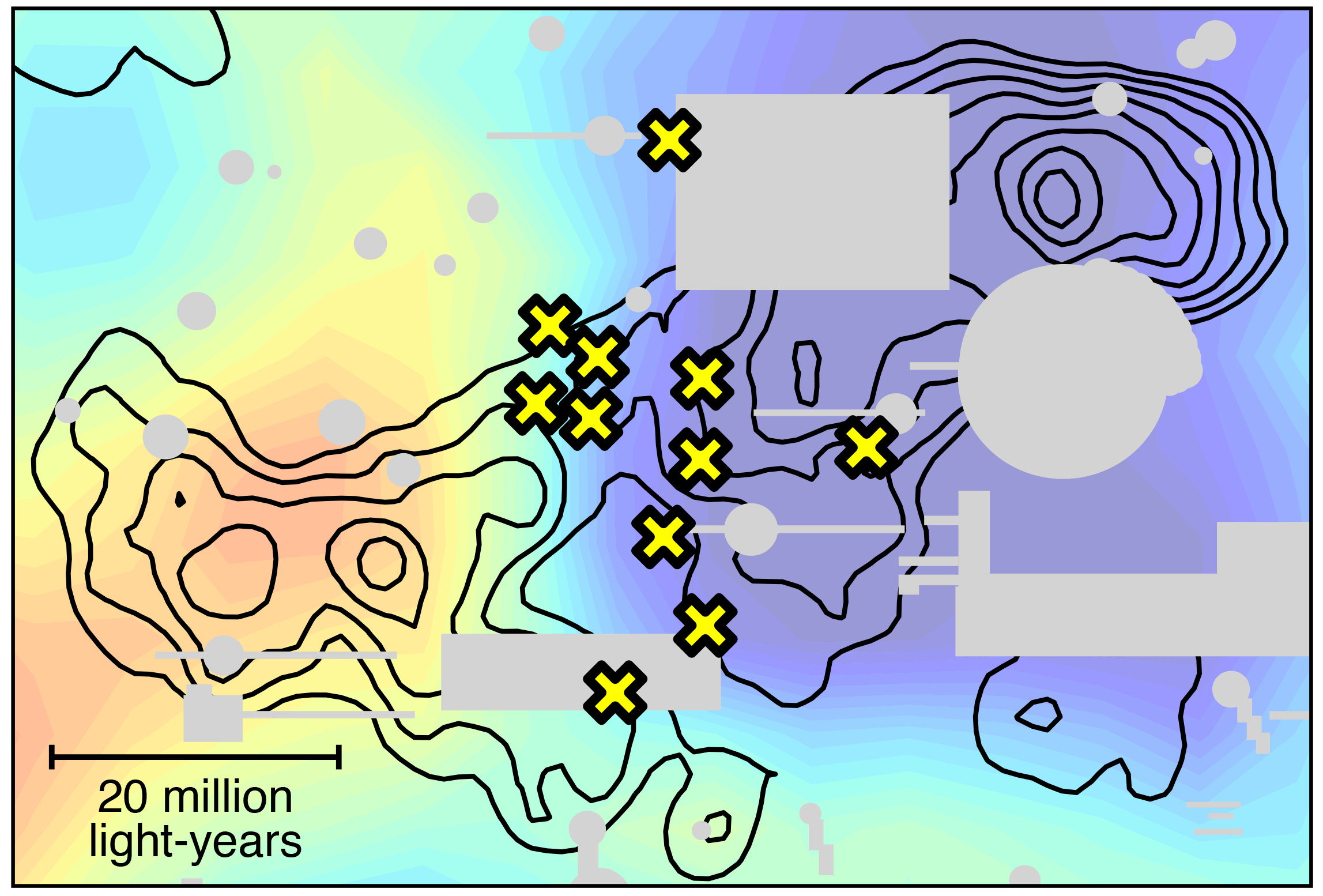
A newly discovered cluster of eleven quasars has shattered the previous record of five. Rather than being associated with a dense group of galaxies, these quasars sit on the boundary between two groups of galaxies. This structure, dubbed the “Cosmic Himalayas,” cannot be explained by conventional theories, forcing astronomers to rethink the formation scenarios for quasars.

Quasars are some of the brightest objects in the Universe. A quasar is powered by large amounts of matter falling into the supermassive black hole at the center of a galaxy. Collisions and mergers between galaxies can cause quasar activity by feeding addition matter into the center of a galaxy. Quasar activity peaked in the early Universe, but even then they were relatively rare. So an international research team led by Yongming Liang at the National Astronomical Observatory of Japan was surprised when they found a group of elven quasars in an area of space where you would normally expect to see maybe one, while analyzing data from the Sloan Digital Sky Survey. The previous record holder for quasar over-density had been five.

Follow-up observations with the Subaru Telescope revealed another mystery. The quasars do not coincide with a dense group of galaxies. Instead, they sit on the boundary between two groups. If galaxy collisions and mergers are responsible for quasar activity, then the densest groups of quasars should be found in the densest group of galaxies. A new formation scenario is needed to explain this group of quasars, which could change the way we think about the evolution of other structures in the Universe. The team hopes that new data from next-generation instruments like the Prime Focus Spectrograph on the Subaru Telescope will help to solve the mysteries of the Cosmic Himalayas.

The research team named this formation the Cosmic Himalayas in reference to how the towering Himalayas on Earth form a boundary between plains and plateaus. The Cosmic Himalayas date back 10.8 billion years. As seen from Earth, this cluster lies in the direction of the constellation Cetus.

The "Cosmic Himalayas": a towering cluster of energetic quasars shaping the cosmic landscape. Yellow X marks indicate the positions of quasars. The color scale represents the density of neutral hydrogen gas, with red indicating high density and blue indicating low density, or in other words, the blue region is rich in ionized gas. Therefore, the neutral gas concentrates in the left cluster of galaxies, while the ionized gas preferentially appears around the right galaxy clump. Black contour lines show the galaxy density. Gray regions are masked areas due to poor image mosaic or saturation near bright stars. (Credit: Subaru Telescope / SDSS, Liang et al.) Download image (626KB)


Detailed Article(s)

The Giant Supermassive Black Hole Cluster Discovered in the Distant Universe: New Puzzles in the Cosmic Matter Distribution
Subaru Telescope


Release Information

Researcher(s) Involved in this Release
Yongming Liang (National Astronomical Observatory of Japan)
Masami Ouchi (National Astoronomical Observatory of Japan / The University of Tokyo)

Coordinated Release Organization(s)
National Astronomical Observatory of Japan
Institute for Cosmic Ray Research, the University of Tokyo

Paper(s)
Liang et al. “Cosmic Himalayas: The Highest Quasar Density Peak Identified in a 10,000 deg2 Sky with Spatial Discrepancies between Galaxies, Quasars, and IGM HI”, in The Astrophysical Journal, DOI: 10.3847/1538-4357/adc1bb

Monday, June 02, 2025

Starry spectacle

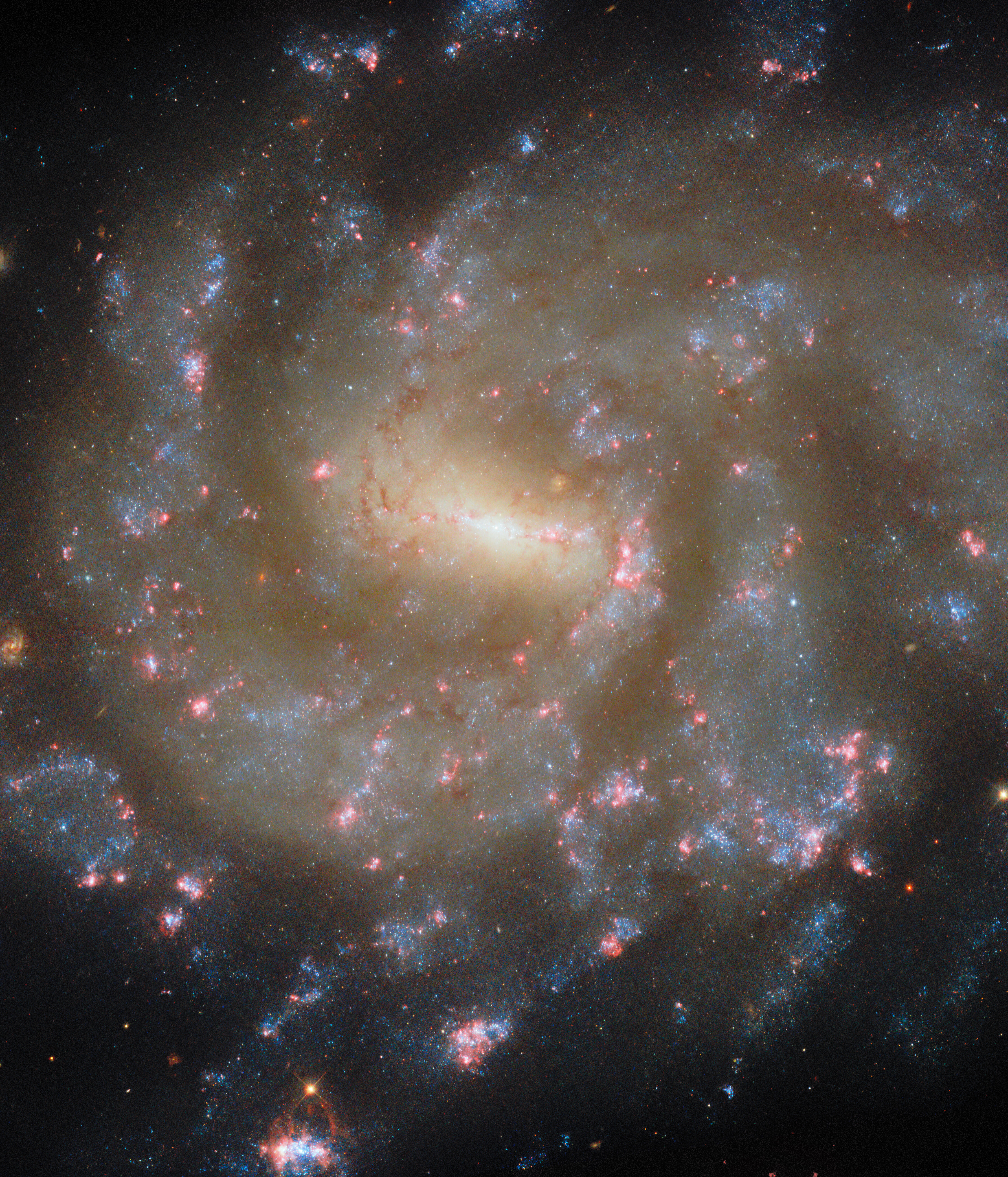
A spiral galaxy seen directly on. It glows strongly at its centre and has a short horizontal bar. Two spiral arms extend from this bar, but they are broad and irregularly-shaped. They are filled with tiny blue dots - stars - and glowing pink clouds - star-forming nebulae. The arms break apart into many strands at the edge of the disc. Beyond this is a dark background.

A galaxy ablaze with young stars is the subject of today’s NASA/ESA Hubble Space Telescope Picture of the Week. This galaxy is called NGC 685 and is situated about 64 million light-years away in the constellation Eridanus (The River). NGC 685 is classified as a barred spiral because its feathery spiral arms sprout from the ends of a bar of stars at the galaxy’s centre. The Milky Way is also a barred spiral, but our galaxy is a little less than twice the size of NGC 685.

Astronomers used Hubble to study NGC 685 for two observing programmes, both of which focus on star formation. It’s no surprise that NGC 685 was chosen for these programmes: numerous patches of young blue stars highlight the galaxy’s spiral arms. Many of these star clusters are cocooned in pink gas clouds, which are called H II (pronounced ‘H-two’) regions. An H II region is a gas cloud that glows for a short time when particularly hot and massive stars are born. An especially eye-catching H II region peeks out at the bottom edge of the image. Despite the dozens of star-forming regions evident in this image, NGC 685 converts an amount of gas equivalent to less than half the mass of the Sun into stars each year.

The Hubble data collected for the two observing programmes will allow astronomers to catalogue 50 000 H II regions and 100 000 star clusters in nearby galaxies. By combining Hubble’s sensitive visible and ultraviolet observations with infrared data from the NASA/ESA/CSA James Webb Space Telescope and radio data from the Atacama Large Millimeter/submillimeter Array, researchers will peer into the depths of dusty stellar nurseries and illuminate the stars forming there.


Sunday, June 01, 2025

Triple Stellar Systems as Gravitational Wave Sources

Scientific visualization of numerical relativity simulations showing gravitational waves emitted by inspiraling compact objects. Credit: T. Dietrich, S. Ossokine, H. Pfeiffer, and A. Buonanno (Max Planck Institute for Gravitational Physics).


A schematic diagram of possible key processes that drive the evolutionary phases of a triple evolution leading to the formation of double white dwarfs in the LISA frequency bandwidth. Depending on the separation of the inner binary and the inclination angle of the two orbital planes, the third star can interact in various ways with the inner binary. Just over half the systems retain the third star, though it is typically too distant to affect the gravitational wave signal significantly. © MPA


Ground-based gravitational wave detectors like LIGO and Virgo have brought significant attention to binary systems composed of black holes and neutron stars as gravitational wave sources. However, two white dwarfs in a binary system are expected to be far more numerous. In particular, the pre-merger phase of double white dwarfs could lead to high-energy astrophysical events that would emit gravitational waves detectable by the European Space Agency’s upcoming Laser Interferometer Space Antenna (LISA) mission. Understanding how these double white dwarfs form is essential to interpreting the future LISA data. For the first time, researchers at the Max Planck Institute for Astrophysics (MPA) have now quantitatively assessed the impact of triple evolution on LISA sources. This study underscores the importance of triple interactions in the formation of double white dwarfs, revealing previously unexplored pathways that contribute to the gravitational-wave sources LISA will observe.

Stars often form in hierarchical triples, where a close binary system is orbited by a distant third star. These triple systems undergo complex gravitational interactions, which can dramatically alter the evolution of the stars. Such interactions can induce mass exchange between stars, mergers, or the disruption of one of the stars, all of which influence the final configuration of the system. Thus, triple dynamics can play a pivotal role in driving white dwarf binaries into the gravitational wave frequency range detectable by LISA.

In this research, doctoral student Abinaya Swaruba Rajamuthukumar, along with a group of MPA researchers, studied how triple star systems contribute to the population of double white dwarfs detectable by LISA. They combined simulations of triple star evolution using the Multiple Stellar Evolution (MSE) code with a Milky Way-like galaxy from the cosmological simulation TNG50. The study found that approximately 7.2 million double white dwarfs emitting gravitational waves in the LISA frequency band originate from triple systems, nearly double the number formed in isolated binaries, which account for about 3.8 million. Moreover, about 57% of the LISA double white dwarfs from triples retain a bound third star, though it is typically too distant to leave an observable imprint on the gravitational wave signal.

The team identified five key evolutionary pathways through which triple systems can produce LISA-detectable sources. These include induced mass transfer, outer binary mergers, ejected tertiaries, triple common envelope phases, and effectively isolated inner binaries (see graphic). The overall population properties of double white dwarfs from triple systems and those with a binary-origin are largely indistinguishable. Interestingly, the triple channel introduces a rare but intriguing subset of highly eccentric systems that emit burst-like gravitational wave signals, offering a distinct observational signature for LISA.

This study provides the first detailed exploration of triple-star evolution in the context of gravitational wave astrophysics. As LISA prepares for launch in 2035, these findings will be essential for accurately interpreting the Galactic population of gravitational wave sources and refining data analysis techniques. The results underscore the need to account for triple evolution when modeling LISA sources, paving the way for a more comprehensive understanding of the Milky Way’s gravitational wave sources.


Authors:

Abinaya Swaruba Rajamuthukumar
PhD student
tel:2248
abinaya@mpa-garching.mpg.de

Valeriya Korol
Postdoc
tel:2252
korol@mpa-garching.mpg.de

Jakob Stegmann

tel:2237
stegmaja@mpa-garching.mpg.de


Original publication

Rajamuthukumar, Abinaya Swaruba; Korol, Valeriya; Stegmann, Jakob; Preece, Holly; Pakmor, Rüdiger; Justham, Stephen; Toonen, Silvia; de Mink, Selma E.
The role of triple evolution in the formation of LISA double white dwarfs
submitted
Source