Showing posts with label planetary disks. Show all posts

Saturday, June 07, 2025

JWST Examines the Ring Nebula


The iconic and widely photographed Ring Nebula is one of the most recognizable planetary nebulae: short-lived, often brilliantly colored nebulae that form when low- to intermediate-mass stars shed their outer layers. The three images above show the central region of the Ring Nebula through the eyes of JWST’s Mid Infrared Instrument. The leftmost image clearly shows the Ring Nebula’s central star: a hot, crystallized stellar core called a white dwarf. In a recent research article, Raghvendra Sahai (Jet Propulsion Laboratory) and collaborators analyzed these JWST observations, leading to the discovery of a dusty disk around the Ring Nebula’s central star. This is just the second time that a resolved disk has been discovered around the central star of a planetary nebula. Disks with radii from 0.01 to 1,000 au have been found around evolved stars in the asymptotic giant branch phase through the planetary nebula phase, but it’s not yet clear how these disks form and how long they last. Most intriguingly, the presence of disks around highly evolved stars raises the possibility of a second phase of planet formation. To learn more about the JWST observations of the Ring Nebula, and what they tell us about the properties of the central star and its disk, be sure to check out the full research article linked below.<;div>

By Kerry Hensley

Citation

“JWST Observations of the Ring Nebula (NGC 6720). III. A Dusty Disk Around Its Central Star,” Raghvendra Sahai et al 2025 ApJ 985 101. doi:10.3847/1538-4357/adc91c


Thursday, August 25, 2022

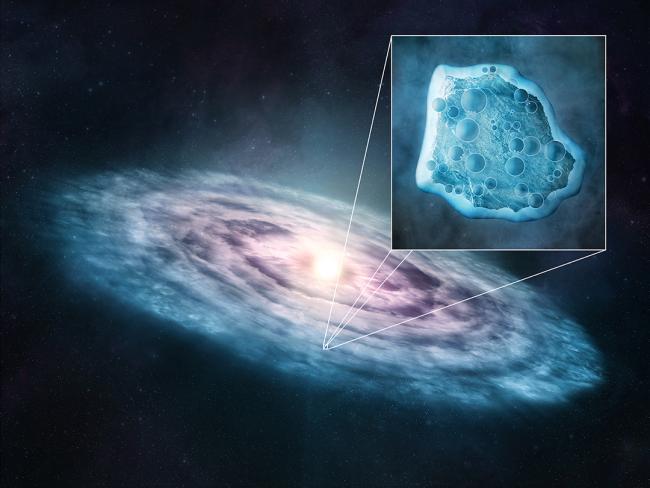
Case Solved: Missing Carbon Monoxide was Hiding in the Ice

Credit Required: M.Weiss/Center for Astrophysics | Harvard & Smithsonian

In planetary disks, carbon monoxide is lurking in large chunks of ice, solving the decade-old question, 'Where is the CO?'

Cambridge, MA – Astronomers frequently observe carbon monoxide in planetary nurseries. The compound is ultra-bright and extremely common in protoplanetary disks — regions of dust and gas where planets form around young stars — making it a prime target for scientists.

But for the last decade or so, something hasn't been adding up when it comes to carbon monoxide observations, says Diana Powell, a NASA Hubble Fellow at the Center for Astrophysics | Harvard & Smithsonian.

A huge chunk of carbon monoxide is missing in all observations of disks, if astronomers' current predictions of its abundance are correct.

Now, a new model — validated by observations with ALMA — has solved the mystery: carbon monoxide has been hiding in ice formations within the disks. The findings are described today in the journal Nature Astronomy.

"This may be one of the biggest unsolved problems in planet-forming disks," says Powell, who led the study. "Depending on the system observed, carbon monoxide is three to 100 times less than it should be; it's off by a really huge amount."

And carbon monoxide inaccuracies could have huge implications for the field of astrochemistry.

"Carbon monoxide is essentially used to trace everything we know about disks — like mass, composition and temperature," Powell explains. "This could mean many of our results for disks have been biased and uncertain because we don't understand the compound well enough."

Intrigued by the mystery, Powell put on her detective hat and leaned on her expertise in the physics behind phase changes — when matter morphs from one state to another, like a gas changing into a solid.

On a hunch, Powell made alterations to an astrophysical model that's currently used to study clouds on exoplanets, or planets beyond our solar system.

"What's really special about this model is that it has detailed physics for how ice forms on particles," she explains. "So how ice nucleates onto small particles and then how it condenses. The model carefully tracks where ice is, on what particle it's located on, how big the particles are, how small they are and then how they move around."

Powell applied the adapted model to planetary disks, hoping to generate an in-depth understanding of how carbon monoxide evolves over time in planetary nurseries. To test the model’s validity, Powell then compared its output to real ALMA observations of carbon monoxide in four well-studied disks — TW Hya, HD 163296, DM Tau and IM Lup.

The results and models worked really well, Powell says.

The new model lined up with each of the observations, showing that the four disks weren’t actually missing carbon monoxide at all — it had just morphed into ice, which is currently undetectable with a telescope.

Radio observatories like ALMA allow astronomers to view carbon monoxide in space in its gas phase, but ice is much harder to detect with current technology, especially large formations of ice, Powell says.

The model shows that unlike previous thinking, carbon monoxide is forming on large particles of ice — especially after one million years. Prior to a million years, gaseous carbon monoxide is abundant and detectable in disks.

"This changes how we thought ice and gas were distributed in disks," Powell says. "It also shows that detailed modelling like this is important to understand the fundamentals of these environments."

Powell hopes her model can be further validated using observations with NASA’s Webb Telescope — which may be powerful enough to finally detect ice in disks, but that remains to be seen.

Powell, who loves phase changes and the complicated processes behind them, says she is in awe of their influence. "Small-scale ice formation physics influences disk formation and evolution — now that’s really cool."


About the Center for Astrophysics | Harvard & Smithsonian

The Center for Astrophysics | Harvard & Smithsonian is a collaboration between Harvard and the Smithsonian designed to ask—and ultimately answer—humanity's greatest unresolved questions about the nature of the universe. The Center for Astrophysics is headquartered in Cambridge, MA, with research facilities across the U.S. and around the world.

Media Contact:

Nadia Whitehead
Public Affairs Officer
Center for Astrophysics | Harvard & Smithsonian

nadia.whitehead@cfa.harvard.edu
617-721-7371


Wednesday, April 20, 2022

Grab Your Umbrellas, ’Cause It’s Raining Grazing Planets!

From our perspective, exoplanets on grazing orbits just barely skim their host stars.

Title: Accurate Modeling of Grazing Transits Using Umbrella Sampling
Author: Gregory J. Gilbert
Author’s Institution: University of Chicago
Status: Published in AJ

Today’s author uses umbrellas to accurately model the planets that “graze” their stellar hosts.

Planets That Graze on Their Stars

Roughly 75% of all known exoplanets were discovered via transit surveys. These surveys monitor many stars at once to look for dips in brightness that could be caused by a planet passing, or “transiting,” in front of a star. Although rare, some of these planets only “graze” their host stars, meaning that they only partially transit their parent star’s disk (check out this astrobite to learn more about a specific case of a grazing planet).

In astronomical terms, “grazing” planets are defined as those that have an impact parameter that is larger than the ratio of the planet’s radius to the star’s radius. The impact parameter is defined as the distance between the center of the stellar disk and the center of the planetary disk at conjunction, where conjunction is the point in a planet’s orbit where it is most closely aligned with its star, as viewed from Earth. A perfectly centered transit has an impact parameter of 0 while a transit in which only half of the planetary disk passes in front of the stellar disk has an impact parameter of 1.


Figure 1: The impact parameter (the distance between the centers of the stellar and planetary disks at conjunction) changes the shape of a transiting planet’s light curve. On this plot, the flux, or brightness, of the star normalized to 1 is on the y-axis. The time before and after the transit in hours is on the x-axis. Planets that have a high impact parameter graze the disk of their host star during their transit, making it more difficult to characterize a planet using its light curve. [Gilbert 2022]

Figure 1 demonstrates how the shape of the light curve from a transiting planet changes as a function of the impact parameter. The depth of the dip in a light curve allows astronomers to estimate the planet’s radius relative to the star, but this estimation becomes more difficult if the planet is grazing. For example, the light curve of a smaller, non-grazing planet could look the same as the light curve from a larger, grazing planet. One therefore needs to simulate grazing transits even in cases where it is unlikely that the planet grazes its host star.

However, today’s author shows that standard Monte Carlo methods, which are frequently used by exoplanet scientists to model grazing planets, can lead to unreliable results! Identical runs of the same model can return differing results, or results where it is not obvious that the model is wrong (Figure 2). When dealing with a handful of planets, one can let the simulation run for a longer period of time or add additional data, such as the spectrum of the star, to the model. However, for larger samples, a more efficient method is needed. What can astronomers do instead?


Figure 2: Plots of the posterior distributions from four identical Monte Carlo simulations. The parameters explored are the impact parameter, b, and the ratio of the planet’s radius to the star’s radius, r. Although the simulations are identical at the start, they devolve into four wildly different scenarios. In Panel A, the simulation is mostly consistent with a non-grazing planet (b < 1). In Panel B, the simulation fails to explore entirely whether the planet is grazing or not. In Panel C, the simulation gets caught at the boundary between a grazing and non-grazing planet. In Panel D, the simulation has a bimodal posterior distribution that barely explores whether the planet is grazing at all. [Gilbert 2022]


Umbrella-ella-ella

They can use umbrella sampling! Umbrella sampling is a technique that has been used in other scientific fields for decades, but not by astronomers until recently (specifically, Matthews et al. (2018) was the first to introduce umbrella sampling to the field of astronomy). This technique splits a distribution into sub-regions, draws samples from each of these sub-regions independently, and recombines these samples into a single posterior distribution (Figure 3). The author finds that this technique returns more reliable results than those from standard Monte Carlo methods (Figure 4).


Figure 3: On the top left, the target distribution is split into three sub-regions, each of which is assigned a function. On the top right, after sampling from each of these sub-regions independently, each sub-region is assigned a biased distribution. On the bottom left, the three unbiased sub-distributions are shown. On the bottom right, the three unbiased sub-distributions are combined into a single posterior distribution. [Gilbert 2022]


Figure 4: Posterior distributions of radius, impact parameter, and transit duration for a mini-Neptune orbiting a K-dwarf star. The vertical dashed lines represent ground-truth values for this system. These plots demonstrate how standard Monte Carlo methods fail to properly explore the parameters of grazing planets and show that umbrella sampling produces more robust results! [Gilbert 2022]

A good deal of math is needed to properly weight the sub-regions relative to one another; these calculations are described in detail in the article, and a step-by-step tutorial can be found on the author’s GitHub. Nonetheless, the math is worth it — this technique can be used to explore any complicated distribution, so it can be used in fields beyond exoplanet science. This means you should get out your umbrellas, ‘cause it’s gonna be raining grazing planets!

Original astrobite edited by Jana Steuer.

 About the author, Catherine Clark:
 
Catherine Clark is a PhD candidate at Northern Arizona University and Lowell Observatory. Her research focuses on the smallest, coldest, faintest stars, and she uses high-resolution imaging techniques to look for them in multi-star systems. She is also working on a Graduate Certificate in Science Communication. Previously she attended the University of Michigan, where she studied astronomy and astrophysics as well as Spanish. Outside of research, she enjoys spending time outdoors hiking and photographing, and spending time indoors playing games and playing with her cats.

Monday, March 10, 2014

Loops of Gas and Dust Rise from Planetary Disks

Magnetic loops carry gas and dust above disks of planet-forming material circling stars, as shown in this artist's conception. These loops give off extra heat, which NASA's Spitzer Space Telescope detects as infrared light. The colors in this illustration show what an alien observer with eyes sensitive to both visible light and infrared wavelengths might see. Credit: NASA/JPL-Caltech/R. Hurt (IPAC).

Astronomers say that magnetic storms in the gas orbiting young stars may explain a mystery that has persisted since before 2006.

Researchers using NASA's Spitzer Space Telescope to study developing stars have had a hard time figuring out why the stars give off more infrared light than expected. The planet-forming disks that circle the young stars are heated by starlight and glow with infrared light, but Spitzer detected additional infrared light coming from an unknown source.

A new theory, based on three-dimensional models of planet-forming disks, suggests the answer: Gas and dust suspended above the disks on gigantic magnetic loops like those seen on the sun absorb the starlight and glow with infrared light.

"If you could somehow stand on one of these planet-forming disks and look at the star in the center through the disk atmosphere, you would see what looks like a sunset," said Neal Turner of NASA's Jet Propulsion Laboratory, Pasadena, Calif.

The new models better describe how planet-forming material around stars is stirred up, making its way into future planets, asteroids and comets.

While the idea of magnetic atmospheres on planet-forming disks is not new, this is the first time they have been linked to the mystery of the observed excess infrared light.  According to Turner and colleagues, the magnetic atmospheres are similar to what takes place on the surface of our sun, where moving magnetic field lines spur tremendous solar prominences to flare up in big loops.

Stars are born out of collapsing pockets in enormous clouds of gas and dust, rotating as they shrink down under the pull of gravity. As a star grows in size, more material rains down toward it from the cloud, and the rotation flattens this material out into a turbulent disk. Ultimately, planets clump together out of the disk material.

In the 1980s, the Infrared Astronomical Satellite mission, a joint project that included NASA, began finding more infrared light than expected around young stars.  Using data from other telescopes, astronomers pieced together the presence of dusty disks of planet-forming material.  But eventually it became clear the disks alone weren't enough to account for the extra infrared light -- especially in the case of stars a few times the mass of the sun.

One theory introduced the idea that instead of a disk, the stars were surrounded by a giant dusty halo, which intercepted the star's visible light and re-radiated it at infrared wavelengths. Then, recent observations from ground-based telescopes suggested that both a disk and a halo were needed. Finally, three-dimensional computer modeling of the turbulence in the disks showed the disks ought to have fuzzy surfaces, with layers of low-density gas supported by magnetic fields, similar to the way solar prominences are supported by the sun's magnetic field.

The new work brings these pieces together by calculating how the starlight falls across the disk and its fuzzy atmosphere. The result is that the atmosphere absorbs and re-radiates enough to account for all the extra infrared light.  

"The starlight-intercepting material lies not in a halo, and not in a traditional disk either, but in a disk atmosphere supported by magnetic fields," said Turner. "Such magnetized atmospheres were predicted to form as the disk drives gas inward to crash onto the growing star."

Over the next few years, astronomers will further test these ideas about the structure of the disk atmospheres by using giant ground-based telescopes linked together as interferometers.  An interferometer combines and processes data from multiple telescopes to show details finer than each telescope can see alone. Spectra of the turbulent gas in the disks will also come from NASA's SOFIA telescope, the Atacama Large Millimeter/submillimeter Array (ALMA) telescope in Chile, and from NASA's James Webb Space Telescope after its launch in 2018.

JPL manages the Spitzer Space Telescope mission for NASA's Science Mission Directorate, Washington. Science operations are conducted at the Spitzer Science Center at the California Institute of Technology in Pasadena. Spacecraft operations are based at Lockheed Martin Space Systems Company, Littleton, Colo. Data are archived at the Infrared Science Archive housed at the Infrared Processing and Analysis Center at Caltech. Caltech manages JPL for NASA.