Sunday, November 10, 2024

Triple Ring Galaxy

Triple Ring Galaxy
Detail :
Low Res. (96 KB) / Mid. Res. (813 KB) / High Res. (7.6 MB)

The Hubble Classification, also known as the Hubble Sequence, is a widely recognized method for systematically categorizing galaxy morphology. Galaxies are classified into elliptical, lenticular, and spiral (or barred spiral) galaxies. Galaxies with irregular shapes that do not fit into any categories are classified as irregular galaxies. While this classification can be used for most galaxies, some do not fit into any category, though they have regular shapes.

A ring galaxy is one of them that has a ring feature. There are various theories about their origin, but one leading hypothesis asserts that ring galaxies originate from galactic interactions and mergers. The citizen science project GALAXY CRUISE, using vast cosmic images captured by the Subaru Telescope, regards ring galaxies as interacting.

Ring galaxies are rare and difficult to find. This galaxy features three rings, which is exceptionally rare and valuable to scientific research.

Distance from Earth: About 800 million light-years
Instrument: Hyper Suprime-Cam (HSC)

Relevant Links


Saturday, November 09, 2024

Rapidly merging stars and black holes - the birth of supermassive black holes in dense star clusters in the early Universe

Fig 1: The complex formation channel of a supermassive black hole with 2200 solar masses. Six sub-clusters in the collapsing region contribute stars and black holes for the forming massive star cluster. Many stellar collisions (red and blue circles) rapidly form a 2025 solar mass black hole within only a few million years. Thereafter the black hole grows by mergers with other, smaller, black holes and by tidally disrupting stars. Some lower mass black holes are ejected by gravitational recoil kicks.

New observations by the James Webb Space Telescope (JWST) have revealed that supermassive black holes (SMBHs) of more than one million solar masses were already present only 450 million years after the Big Bang. How did these first SMBHs form? A team of researchers at MPA has used modern supercomputer simulations to show that progenitors of SMBHs (seeds) of a few thousand solar masses can form rapidly in dense and structured star clusters forming in the early Universe. They emerge from collisions of massive stars which form supermassive stars and then collapse directly into black holes, which can further grow by merging with other black holes. This new and more realistic model resembles JWST observations and can explain the formation of SMBH seeds which are massive enough to further grow into the earliest SMBHs observed. For this SMBH seed formation process, the researchers predict a unique gravitational wave fingerprint from black hole merger that can be directly tested with the next-generation gravitational wave observatories.

Supermassive black holes (SMBHs) with masses exceeding one million solar masses are found in all nearby massive galaxies including our own Milky Way. New observations by the James Webb Space Telescope (JWST) have revealed that SMBHs were already present only 450 million years after the Big Bang. The origin of these most massive black holes in the Universe is a major unsolved puzzle in modern astrophysics and an active area of research.

The very first stars in the Universe may have left behind black holes with masses up to a few hundred solar masses. However, models with such ‘light’ SMBH seeds struggle to explain the observed high redshift population of accreting SMBHs. The maximum sustainable SMBH gas accretion rate, the so-called Eddington rate, places limits on how fast SMBH seeds may grow after their formation. The light SMBH seeds simply do not have enough time to grow enough only in a few hundred million years. Therefore, more popular theoretical SMBH formation models assume that the SMBH seeds formed ‘heavy’ with masses exceeding a thousand solar masses. These heavy seeds black holes have a head start against the light seeds in their growth into the observed population of early accreting SMBHs. The major proposed heavy seed formation scenarios include runaway stellar collisions in dense star clusters, directly collapsing metal-free gas clouds in atomic cooling halos, and more exotic ‘new’ physics such as primordial black holes.

In dense star clusters, repeated stellar collisions may build up very massive and even supermassive stars. In early Universe which is still little enriched with heavy elements, stellar winds are typically weak and the stellar collision products will retain most of their mass. At the ends of their lives, these collisionally formed supermassive stars collapse and form the seeds for SMBHs.

Past simulations had focused on studying isolated, spherical star clusters. Both the JWST observations and state-of-the-art hydrodynamical galaxy formation simulations instead support the picture that massive star clusters form through a complex hierarchical assembly. This was the key motivation for the researchers at the MPA to re-explore the runaway collisional SMBH seed formation scenario in the more realistic clustered setup. Such a scenario is very different to the direct collapse gas cloud scenario which relies on avoiding cloud cooling and fragmentation into clusters of stars.

The researchers performed new simulations of massive star clusters with several million individual stars forming from the rapid assembly of several hundred proto-clusters. The newly developed direct N-body simulation code BIFROST used for the simulations runs on energy-efficient GPU hardware can follow stellar evolution, stellar mergers and accurately accounts for general relativistic effects during the interaction of black holes. In particular, the code computes the gravitational wave emission when two black holes merge. At the end of the merger anisotropic gravitational wave emission can kick the newly formed black holes up to speeds of several thousand km/s. These gravitational wave recoil kicks which can eject black hole merger remnants from their birth clusters are also modelled with the code.

Fig 2: Primary and secondary masses of black holes merging in early star clusters by the emission of gravitational waves from the simulation (black circles). Observed gravitational waves from black hole mergers are indicated by yellow crosses (Advanced LIGO and Advanced Virgo). The model predicts mergers of ~ 1000 solar mass black holes with several 10 to 100 solar mass black holes which can be detected with the next generation gravitational wave telescopes like the Einstein Telescope (https://en.wikipedia.org/wiki/Einstein_Telescope) or LISA (https://de.wikipedia.org/wiki/Laser_Interferometer_Space_Antenna)

The collision pathways massive stars and the formed SMBH seeds are illustrated in Fig. 1. Typically, only the most massive star in sub-clusters grows rapidly by collisions with other massive stars. Once the stars exceed the mass of several hundred solar masses, stellar evolution models predict that they directly collapse into black holes at the end of their lives. After their formation, the several SMBH seeds in the assembled massive star cluster experience a rich history of interactions and mergers by which the SMBH seeds can further grow. Several black holes are ejected from the cluster through strong Newtonian few-body interactions or relativistic gravitational wave recoil kicks. The hierarchical runaway scenario predicts a population of gravitational wave mergers at high redshifts in which the SMBH seeds merge with stellar mass black holes of several 10 to 100 solar masses (Fig. 2). Current gravitational wave observatories cannot detect black hole mergers above 500 solar masses or high redshifts very well. However, the scenario of the MPA researchers can be tested with the next-generation gravitational wave experiments such as LISA and the Einstein Telescope.
 

Antti Rantala, Thorsten Naab & Natalia Lahen


The authors thank Markus Rampp and Klaus Reuter of the Max Planck Computing and Data Facility (MPCDF) for performance optimization of the BIFROST GPU code. The simulations for the study were run using the MPCDF supercomputer Raven in Garching


Author:

Antti Rantala
Postdoc
tel:2253

anttiran@mpa-garching.mpg.de

Natalia Lahén
Postdoc
tel:2253

nlahen@mpa-garching.mpg.de

Thorsten Naab
Scientific Staff
tel:2295

tnaab@mpa-garching.mpg.de

Original Publication

https://ui.adsabs.harvard.edu/abs/2024MNRAS.531.3770R/abstract

https://ui.adsabs.harvard.edu/abs/2023MNRAS.522.5180R/abstract
BIFROST Code


Friday, November 08, 2024

Physicists discover first “black hole triple”

Depicted in this artist’s rendering is the central black hole, V404 Cygni (black dot), in the process of consuming a nearby star (orange body at left), while a second star (upper white flash) orbits at a much farther distance. Credits: Image: Jorge Lugo

System observed 8,000 light-years away may be the first direct evidence of “gentle” black hole formation.

Many black holes detected to date appear to be part of a pair. These binary systems comprise a black hole and a secondary object — such as a star, a much denser neutron star, or another black hole — that spiral around each other, drawn together by the black hole’s gravity to form a tight orbital pair.

Now a surprising discovery is expanding the picture of black holes, the objects they can host, and the way they form.

In a study appearing today in Nature, physicists at MIT and Caltech report that they have observed a “black hole triple” for the first time. The new system holds a central black hole in the act of consuming a small star that’s spiraling in very close to the black hole, every 6.5 days — a configuration similar to most binary systems. But surprisingly, a second star appears to also be circling the black hole, though at a much greater distance. The physicists estimate this far-off companion is orbiting the black hole every 70,000 years.

That the black hole seems to have a gravitational hold on an object so far away is raising questions about the origins of the black hole itself. Black holes are thought to form from the violent explosion of a dying star — a process known as a supernova, by which a star releases a huge amount of energy and light in a final burst before collapsing into an invisible black hole.

The team’s discovery, however, suggests that if the newly-observed black hole resulted from a typical supernova, the energy it would have released before it collapsed would have kicked away any loosely bound objects in its outskirts. The second, outer star, then, shouldn’t still be hanging around.

Instead, the team suspects the black hole formed through a more gentle process of “direct collapse,” in which a star simply caves in on itself, forming a black hole without a last dramatic flash. Such a gentle origin would hardly disturb any loosely bound, faraway objects.

Because the new triple system includes a very far-off star, this suggests the system’s black hole was born through a gentler, direct collapse. And while astronomers have observed more violent supernovae for centuries, the team says the new triple system could be the first evidence of a black hole that formed from this more gentle process.

“We think most black holes form from violent explosions of stars, but this discovery helps call that into question,” says study author Kevin Burdge, a Pappalardo Fellow in the MIT Department of Physics. “This system is super exciting for black hole evolution, and it also raises questions of whether there are more triples out there.”

The study’s co-authors at MIT are Erin Kara, Claude Canizares, Deepto Chakrabarty, Anna Frebel, Sarah Millholland, Saul Rappaport, Rob Simcoe, and Andrew Vanderburg, along with Kareem El-Badry at Caltech.

Tandem motion

The discovery of the black hole triple came about almost by chance. The physicists found it while looking through Aladin Lite, a repository of astronomical observations, aggregated from telescopes in space and all around the world. Astronomers can use the online tool to search for images of the same part of the sky, taken by different telescopes that are tuned to various wavelengths of energy and light.

The team had been looking within the Milky Way galaxy for signs of new black holes. Out of curiosity, Burdge reviewed an image of V404 Cygni — a black hole about 8,000 light years from Earth that was one of the very first objects ever to be confirmed as a black hole, in 1992. Since then, V404 Cygni has become one of the most well-studied black holes, and has been documented in over 1,300 scientific papers. However, none of those studies reported what Burdge and his colleagues observed.

As he looked at optical images of V404 Cygni, Burdge saw what appeared to be two blobs of light, surprisingly close to each other. The first blob was what others determined to be the black hole and an inner, closely orbiting star. The star is so close that it is shedding some of its material onto the black hole, and giving off the light that Burdge could see. The second blob of light, however, was something that scientists did not investigate closely, until now. That second light, Burdge determined, was most likely coming from a very far-off star.

“The fact that we can see two separate stars over this much distance actually means that the stars have to be really very far apart,” says Burdge, who calculated that the outer star is 3,500 astronomical units (AU) away from the black hole (1 AU is the distance between the Earth and sun). In other words, the outer star is 3,500 times father away from the black hole as the Earth is from the sun. This is also equal to 100 times the distance between Pluto and the sun.

The question that then came to mind was whether the outer star was linked to the black hole and its inner star. To answer this, the researchers looked to Gaia, a satellite that has precisely tracked the motions of all the stars in the galaxy since 2014. The team analyzed the motions of the inner and outer stars over the last 10 years of Gaia data and found that the stars moved exactly in tandem, compared to other neighboring stars. They calculated that the odds of this kind of tandem motion are about one in 10 million.

“It’s almost certainly not a coincidence or accident,” Burdge says. “We’re seeing two stars that are following each other because they’re attached by this weak string of gravity. So this has to be a triple system.”

Pulling strings

How, then, could the system have formed? If the black hole arose from a typical supernova, the violent explosion would have kicked away the outer star long ago.

“Imagine you’re pulling a kite, and instead of a strong string, you’re pulling with a spider web,” Burdge says. “If you tugged too hard, the web would break and you’d lose the kite. Gravity is like this barely bound string that’s really weak, and if you do anything dramatic to the inner binary, you’re going to lose the outer star.”

To really test this idea, however, Burdge carried out simulations to see how such a triple system could have evolved and retained the outer star.

At the start of each simulation, he introduced three stars (the third being the black hole, before it became a black hole). He then ran tens of thousands of simulations, each one with a slightly different scenario for how the third star could have become a black hole, and subsequently affected the motions of the other two stars. For instance, he simulated a supernova, varying the amount and direction of energy that it gave off. He also simulated scenarios of direct collapse, in which the third star simply caved in on itself to form a black hole, without giving off any energy.

“The vast majority of simulations show that the easiest way to make this triple work is through direct collapse,” Burdge says.

In addition to giving clues to the black hole’s origins, the outer star has also revealed the system’s age. The physicists observed that the outer star happens to be in the process of becoming a red giant — a phase that occurs at the end of a star’s life. Based on this stellar transition, the team determined that the outer star is about 4 billion years old. Given that neighboring stars are born around the same time, the team concludes that the black hole triple is also 4 billion years old.

“We’ve never been able to do this before for an old black hole,” Burdge says. “Now we know V404 Cygni is part of a triple, it could have formed from direct collapse, and it formed about 4 billion years ago, thanks to this discovery.”

This work was supported, in part, by the National Science Foundation.

Jennifer Chu | MIT News


Thursday, November 07, 2024

Asteroid grains shed light on the outer solar system’s origins

Artist's conception of the dust and gas surrounding a newly formed planetary system
Credit: NASA

A weak magnetic field likely pulled matter inward to form the outer planetary bodies, from Jupiter to Neptune

Tiny grains from a distant asteroid are revealing clues to the magnetic forces that shaped the far reaches of the solar system over 4.6 billion years ago.

Scientists at MIT and elsewhere have analyzed particles of the asteroid Ryugu, which were collected by the Japanese Aerospace Exploration Agency’s (JAXA) Hayabusa2 mission and brought back to Earth in 2020. Scientists believe Ryugu formed on the outskirts of the early solar system before migrating in toward the asteroid belt, eventually settling into an orbit between Earth and Mars.

The team analyzed Ryugu’s particles for signs of any ancient magnetic field that might have been present when the asteroid first took shape. Their results suggest that if there was a magnetic field, it would have been very weak. At most, such a field would have been about 15 microtesla. (The Earth’s own magnetic field today is around 50 microtesla.)

Even so, the scientists estimate that such a low-grade field intensity would have been enough to pull together primordial gas and dust to form the outer solar system’s asteroids and potentially play a role in giant planet formation, from Jupiter to Neptune.

The team’s results, which are published today (November 6, 2024) in the journal AGU Advances, show for the first time that the distal solar system likely harbored a weak magnetic field. Scientists have known that a magnetic field shaped the inner solar system, where Earth and the terrestrial planets were formed. But it was unclear whether such a magnetic influence extended into more remote regions, until now.

“We’re showing that, everywhere we look now, there was some sort of magnetic field that was responsible for bringing mass to where the sun and planets were forming,” says study author Benjamin Weiss, the Robert R. Shrock Professor of Earth and Planetary Sciences at MIT. “That now applies to the outer solar system planets.”

The study’s lead author is Elias Mansbach PhD ’24, who is now a postdoc at Cambridge University. MIT co-authors include Eduardo Lima, Saverio Cambioni, and Jodie Ream, along with Michael Sowell and Joseph Kirschvink of Caltech, Roger Fu of Harvard University, Xue-Ning Bai of Tsinghua University, Chisato Anai and Atsuko Kobayashi of the Kochi Advanced Marine Core Research Institute, and Hironori Hidaka of Tokyo Institute of Technology.

A far-off field

Around 4.6 billion years ago, the solar system formed from a dense cloud of interstellar gas and dust, which collapsed into a swirling disk of matter. Most of this material gravitated toward the center of the disk to form the sun. The remaining bits formed a solar nebula of swirling, ionized gas. Scientists suspect that interactions between the newly formed sun and the ionized disk generated a magnetic field that threaded through the nebula, helping to drive accretion and pull matter inward to form the planets, asteroids, and moons.

“This nebular field disappeared around 3 to 4 million years after the solar system’s formation, and we are fascinated with how it played a role in early planetary formation,” Mansbach says.

Scientists previously determined that a magnetic field was present throughout the inner solar system — a region that spanned from the sun to about 7 astronomical units (AU), out to where Jupiter is today. (One AU is the distance between the sun and the Earth.) The intensity of this inner nebular field was somewhere between 50 to 200 microtesla, and it likely influenced the formation of the inner terrestrial planets. Such estimates of the early magnetic field are based on meteorites that landed on Earth and are thought to have originated in the inner nebula.

“But how far this magnetic field extended, and what role it played in more distal regions, is still uncertain because there haven’t been many samples that could tell us about the outer solar system,” Mansbach says.

Rewinding the tape

The team got an opportunity to analyze samples from the outer solar system with Ryugu, an asteroid that is thought to have formed in the early outer solar system, beyond 7 AU, and was eventually brought into orbit near the Earth. In December 2020, JAXA’s Hayabusa2 mission returned samples of the asteroid to Earth, giving scientists a first look at a potential relic of the early distal solar system.

The researchers acquired several grains of the returned samples, each about a millimeter in size. They placed the particles in a magnetometer — an instrument in Weiss’ lab that measures the strength and direction of a sample’s magnetization. They then applied an alternating magnetic field to progressively demagnetize each sample.

“Like a tape recorder, we are slowly rewinding the sample’s magnetic record,” Mansbach explains. “We then look for consistent trends that tell us if it formed in a magnetic field.” They determined that the samples held no clear sign of a preserved magnetic field. This suggests that either there was no nebular field present in the outer solar system where the asteroid first formed, or the field was so weak that it was not recorded in the asteroid’s grains. If the latter is the case, the team estimates such a weak field would have been no more than 15 microtesla in intensity.

The researchers also reexamined data from previously studied meteorites. They specifically looked at “ungrouped carbonaceous chondrites” — meteorites that have properties that are characteristic of having formed in the distal solar system. Scientists had estimated the samples were not old enough to have formed before the solar nebula disappeared. Any magnetic field record the samples contain, then, would not reflect the nebular field. But Mansbach and his colleagues decided to take a closer look.

“We reanalyzed the ages of these samples and found they are closer to the start of the solar system than previously thought,” Mansbach says. “We think these samples formed in this distal, outer region. And one of these samples does actually have a positive field detection of about 5 microtesla, which is consistent with an upper limit of 15 microtesla.”

This updated sample, combined with the new Ryugu particles, suggest that the outer solar system, beyond 7 AU, hosted a very weak magnetic field, that was nevertheless strong enough to pull matter in from the outskirts to eventually form the outer planetary bodies, from Jupiter to Neptune.

“When you’re further from the sun, a weak magnetic field goes a long way,” Weiss notes. “It was predicted that it doesn’t need to be that strong out there, and that’s what we’re seeing.”

The team plans to look for more evidence of distal nebular fields with samples from another far-off asteroid, Bennu, which were delivered to Earth in September 2023 by NASA’s OSIRIS-REx spacecraft.

“Bennu looks a lot like Ryugu, and we’re eagerly awaiting first results from those samples,” Mansbach says.

This research was supported, in part, by NASA.

Jennifer Chu | MIT News


Galaxy light show

A spiral galaxy with an oval-shaped disc. Two large arms curve out away from the ends of the disc. The arms are traced by bright pink patches where stars are forming and by dark reddish threads of dust. The core is very bright and star-filled. Some large stars appear in front of the galaxy. Directly under the point where the right arm joins the disc, a fading supernova is visible as a green dot. Credit: ESA/Hubble & NASA, O. Fox, L. Jenkins, S. Van Dyk, A. Filippenko, J. Lee and the PHANGS-HST Team, D. de Martin (ESA/Hubble), M. Zamani (ESA/Hubble)

This Hubble Picture of the week features NGC 1672, a barred spiral galaxy located 49 million light-years from Earth in the constellation Dorado. This galaxy is a multi-talented light show, showing off an impressive array of different celestial lights. Like any spiral galaxy, its disc is filled with billions of shining stars that give it a beautiful glow. Along its two large arms, bubbles of hydrogen gas are made to shine a striking red light by the powerful radiation of newly-forming stars within. Near to the centre lie some particularly spectacular stars; newly-formed and extremely hot, they are embedded in a ring of hot gas and are emitting powerful X-rays. And in the very centre sits an even more brilliant source of X-rays, an active galactic nucleus created by the heated accretion disc around NGC 1672’s supermassive black hole; this makes NGC 1672 a Seyfert galaxy.

But a highlight of this image is the most fleeting and temporary of these lights: supernova SN 2017GAX, visible in just one of the six Hubble images that make up this composite image. This was a Type I supernova caused by the core-collapse and subsequent explosion of a giant star, going from invisibility to a new light in the sky in just a matter of days. In that image from later that year, the supernova is already fading, and so is only just visible here as a small green dot, just below the crook of the spiral arm on the right side. In fact this was on purpose, as astronomers wanted to look for any companion star that the supernova progenitor may have had — something impossible to spot beside a live supernova! For a closer look at the supernova’s appearance, you can compare the two images with this slider tool.

Recently, NGC 1672 was also among a crop of galaxies imaged with the NASA/ESA/CSA James Webb Space Telescope, showing the ring of gas and the structure of dust in its spiral arms. A Hubble image was also released previously in 2007.

Links


Wednesday, November 06, 2024

NASA's Hubble, Webb Probe Surprisingly Smooth Disk Around Vega

Credits/Image: NASA, ESA, CSA, STScI, S. Wolff (University of Arizona), K. Su (University of Arizona), A. Gáspár (University of Arizona)

Credits/Image: NASA, ESA, STScI, S. Wolff (University of Arizona)

Vega Webb Compass Image
Credits/Image: NASA, ESA, CSA, STScI, K. Su (University of Arizona), A. Gáspár (University of Arizona)


In the 1997 movie "Contact," adapted from Carl Sagan's 1985 novel, the lead character scientist Ellie Arroway (played by actor Jodi Foster) takes a space-alien-built wormhole ride to the star Vega. She emerges inside a snowstorm of debris encircling the star – but no obvious planets are visible.

It looks like the filmmakers got it right.

A team of astronomers at the University of Arizona, Tucson used NASA's Hubble and James Webb space telescopes for an unprecedented in-depth look at the nearly 100-billion-mile-diameter debris disk encircling Vega. "Between the Hubble and Webb telescopes, you get this very clear view of Vega. It's a mysterious system because it's unlike other circumstellar disks we've looked at," said Andras Gáspár of the University of Arizona, a member of the research team. "The Vega disk is smooth, ridiculously smooth."

The big surprise to the research team is that there is no obvious evidence for one or more large planets plowing through the face-on disk like snow tractors. "It's making us rethink the range and variety among exoplanet systems," said Kate Su of the University of Arizona, lead author of the paper presenting the Webb findings.

Webb sees the infrared glow from a disk of particles the size of sand swirling around the sizzling blue-white star that is 40 times brighter than our Sun. Hubble captures an outer halo of this disk, with particles no bigger than the consistency of smoke that are reflecting starlight.

The distribution of dust in the Vega debris disk is layered because the pressure of starlight pushes out the smaller grains faster than larger grains. "Different types of physics will locate different-sized particles at different locations," said Schuyler Wolff of the University of Arizona team, lead author of the paper presenting the Hubble findings. "The fact that we're seeing dust particle sizes sorted out can help us understand the underlying dynamics in circumstellar disks."

The Vega disk does have a subtle gap, around 60 AU (astronomical units) from the star (twice the distance of Neptune from the Sun), but otherwise is very smooth all the way in until it is lost in the glare of the star. This shows that there are no planets down at least to Neptune-mass circulating in large orbits, as in our solar system, say the researchers.

Disk Diversity

Newly forming stars accrete material from a disk of dust and gas that is the flattened remnant of the cloud from which they are forming. In the mid-1990s Hubble found disks around many newly forming stars. The disks are likely sites of planet formation, migration, and sometimes destruction. Fully matured stars like Vega have dusty disks enriched by ongoing "bumper car" collisions among orbiting asteroids and debris from evaporating comets. These are primordial bodies that can survive up to the present 450-million-year age of Vega (our Sun is approximately ten times older than Vega). Dust within our solar system (seen as the Zodiacal light) is also replenished by minor bodies ejecting dust at a rate of about 10 tons per second. This dust is shoved around by planets. This provides a strategy for detecting planets around other stars without seeing them directly – just by witnessing the effects they have on the dust.

"Vega continues to be unusual," said Wolff. "The architecture of the Vega system is markedly different from our own solar system where giant planets like Jupiter and Saturn are keeping the dust from spreading the way it does with Vega."

For comparison, there is a nearby star, Fomalhaut, which is about the same distance, age and temperature as Vega. But Fomalhaut's circumstellar architecture is greatly different from Vega's. Fomalhaut has three nested debris belts.

Planets are suggested as shepherding bodies around Fomalhaut that gravitationally constrict the dust into rings, though no planets have been positively identified yet. "Given the physical similarity between the stars of Vega and Fomalhaut, why does Fomalhaut seem to have been able to form planets and Vega didn't?" said team member George Rieke of the University of Arizona, a member of the research team. "What's the difference? Did the circumstellar environment, or the star itself, create that difference? What's puzzling is that the same physics is at work in both," added Wolff.

First Clue to Possible Planetary Construction Yards

Located in the summer constellation Lyra, Vega is one of the brightest stars in the northern sky. Vega is legendary because it offered the first evidence for material orbiting a star – presumably the stuff for making planets – as potential abodes of life. This was first hypothesized by Immanuel Kant in 1775. But it took over 200 years before the first observational evidence was collected in 1984. A puzzling excess of infrared light from warm dust was detected by NASA's IRAS (Infrared Astronomy Satellite). It was interpreted as a shell or disk of dust extending twice the orbital radius of Pluto from the star.

In 2005 NASA's infrared Spitzer Space Telescope mapped out a ring of dust around Vega . This was further confirmed by observations using submillimeter telescopes including Caltech's Submillimeter Observatory on Mauna Kea, Hawaii, and also the Atacama Large Millimeter/submillimeter Array (ALMA) in Chile, and ESA's (European Space Agency's) Herschel Space Telescope, but none of these telescopes could see much detail. "The Hubble and Webb observations together provide so much more detail that they are telling us something completely new about the Vega system that nobody knew before," said Rieke.

Two papers from the Arizona team will be published in The Astrophysical Journal.

The James Webb Space Telescope is the world's premier space science observatory. Webb is solving mysteries in our solar system, looking beyond to distant worlds around other stars, and probing the mysterious structures and origins of our universe and our place in it. Webb is an international program led by NASA with its partners, ESA (European Space Agency) and CSA (Canadian Space Agency).

The Hubble Space Telescope has been operating for over three decades and continues to make ground-breaking discoveries that shape our fundamental understanding of the universe. Hubble is a project of international cooperation between NASA and ESA (European Space Agency). NASA's Goddard Space Flight Center in Greenbelt, Maryland, manages the telescope and mission operations. Lockheed Martin Space, based in Denver, Colorado, also supports mission operations at Goddard. The Space Telescope Science Institute in Baltimore, Maryland, which is operated by the Association of Universities for Research in Astronomy, conducts Hubble science operations for NASA.


About This Release

Credits:

Media Contact:

Ray Villard
Space Telescope Science Institute, Baltimore, Maryland

Christine Pulliam
Space Telescope Science Institute, Baltimore, Maryland

Permissions: Content Use Policy

Contact Us: Direct inquiries to the News Team.

Related Links and Documents


Tuesday, November 05, 2024

eROSITA unveils asymmetries in temperature and shape of our Local Hot Bubble

3D model of the solar neighbourhood. The colour bar represents the temperature of the LHB as coloured on the LHB surface. The direction of the Galactic Centre (GC) and Galactic North (N) is shown in the bottom right. The link to the interactive version can be found at the bottom of the page. © Michael Yeung / MPE


Our Solar System dwells in a low-density environment called the Local Hot Bubble (LHB), filled by a tenuous, million-degree hot gas emitting dominantly in soft X-rays. A team led by scientists at the Max Planck Institute for Extraterrestrial Physics (MPE) used the eROSITA All-Sky Survey data and found a large-scale temperature gradient in this bubble, possibly linked with past supernova explosions that expanded and reheated the bubble. The wealth of the eROSITA data also allowed the team to create a new 3D model of the hot gas in the solar neighbourhood. The highlight of this work features the discovery of a new interstellar tunnel towards the constellation Centaurus, potentially joining our LHB with a neighbouring superbubble.

The idea of the Local Hot Bubble has been around for about half a century, first developed to explain the ubiquitous X-ray background below 0.2 keV. Photons of such energies cannot travel very far in the interstellar medium before they are absorbed. In conjunction with the observation that there is almost no interstellar dust in our immediate environment, the scenario where a soft X-ray emitting plasma displaces the neutral materials in the solar neighbourhood, forming the ‘Local Hot Bubble’, was put forth.

This understanding of our immediate environment was not without its challenges, especially after the discovery of the solar wind charge exchange process in 1996 — an interaction between the solar wind ions and neutral atoms within the Earth’s geocorona and the heliosphere that emits X-rays at similar energies as the LHB. After years of analysis, the consensus now is that both contribute to the soft X-ray background, and the LHB must exist to explain the observations.

The eROSITA telescope is the first X-ray observatory to observe the sky from an orbit completely external to the Earth’s geocorona, avoiding the latter’s contamination. Also, the timing of the first eROSITA All-Sky Survey (eRASS1) coincided with the solar minimum, significantly reducing the heliospheric solar wind charge exchange contamination. ‘In other words, the eRASS1 data released to the public this year provides the cleanest view of the X-ray sky to date, making it the perfect instrument for studying the LHB, ‘says Michael Yeung from MPE, the lead author of this work.

3D structure of the LHB with colours indicating its temperature. The two surfaces indicate the measurement uncertainty of the LHB extent: the most probable extent most likely lies between the two. The location of the Sun and a sphere of 100 parsec radius are marked for comparison. © Michael Yeung / MPE

eROSITA’s Unparalleled X-ray Observations

The team divided the western Galactic hemisphere into about 2000 regions, and extracted and analysed the spectra from each one. They also leveraged data from ROSAT, the predecessor of eROSITA built also by MPE, which complements the eROSITA spectra at energies lower than 0.2 keV. They found a clear temperature dichotomy in the LHB, with the Galactic South (0.12 keV; 1.4 MK) slightly hotter than the Galactic North (0.10 keV; 1.2 MK). This feature could be explained by the latest numerical simulations of the LHB caused by supernova explosions in the last few million years.

Diffuse X-ray background spectra inform scientists not just of the temperature but also of the 3D structure of the hot gas. Previous work by the same team has established that the density of the LHB is relatively uniform, calibrating the density of the hot gas with sight lines to giant molecular clouds located on the surface of the LHB. Relying on this assumption, they generated a new 3D model of the LHB from the measured intensity of the LHB emission in each sight line. They found the LHB has a larger extent towards the Galactic poles as expected, as the hot gas prefers to expand towards directions of the least resistance, away from the Galactic disc.

‘This is not surprising, as was already found by the ROSAT survey’, pointed out by Michael Freyberg, a core author of this work and was a part of the pioneering work in the ROSAT era three decades ago. ‘What we didn’t know was the existence of an interstellar tunnel towards Centaurus, which carves a gap in the cooler interstellar medium (ISM). This region stands out in stark relief thanks to the much-improved sensitivity of eROSITA and a vastly different surveying strategy compared to ROSAT,’ added Freyberg. The authors of this work suggest the Centaurus tunnel may just be a local example of a wider hot ISM network sustained by stellar feedback across the Galaxy — a popular idea proposed in the 70s that remains difficult to prove.

Temperature map of the LHB in the western Galactic hemisphere in zenithal equal-area projection. The high-latitude region in the northern and southern hemispheres exhibits a clear temperature dichotomy. © Michael Yeung / MPE

A 3D Model of the Solar Neighbourhood

In addition to the 3D LHB model, the team compiled a list of known supernova remnants, superbubbles, and 3D dust information from the literature and created an interactive 3D model of the solar neighbourhood. Some features of the LHB could be easily appreciated from such representation, for instance, the well-known Canis Majoris tunnel on the Galactic disc, possibly connecting the LHB to the Gum nebula or another superbubble (called GSH238+00+09), as well as dense molecular clouds (in orange) lying close to the surface of the LHB in the direction of the Galactic Centre (GC). Recent works found that these clouds possess velocities in the radial direction (away from us). The location and the velocity of the clouds could be explained if they were formed from the condensation of swept-up materials during the early stage of the LHB formation. ‘Another interesting fact is that the Sun must have entered the LHB a few million years ago, a short time compared to the age of the Sun, remarked Gabriele Ponti, a co-author of this work. ‘It is purely coincidental that the Sun seems to occupy a relatively central position in the LHB as we continuously move through the Milky Way.’

3D interactive view of the LHB and the solar neighbourhood


Contacts:

Michael Yeung
PhD Student Highenergy-Group
tel:+49 89 30000-3899

mjf@mpe.mpg.de
Max Planck Institute for Extraterrestrial Physics

Dr. Michael Freyberg
Scientist Highenergy Group
tel:+49 89 30000-3849

myeung@mpe.mpg.de
Max Planck Institute for Extraterrestrial Physics

Dr. Gabriele Ponti
Visiting Scientist Highenergy Group
tel:+49 89 30000-3572

ponti@mpe.mpg.de
Max Planck Institute for Extraterrestrial Physics

Dr. Andrea Merloni
Senior Scientist Highenergy Group; PI eROSITA
tel:+49 89 30000-3893

am@mpe.mpg.de
Max Planck Institute for Extraterrestrial Physics


Original Publication

M. C. H. Yeung, G. Ponti, M. J. Freyberg et al.
The SRG/eROSITA diffuse soft X-ray background. I. The local hot bubble in the western Galactic hemisphere
A&A, 690, A399


Source


Further Information

eROSITA website of the MPE

eROSITA finds hot gas all around the Milky Way – closer than expected

December 14, 2023
A new all-sky map by the eROSITA telescope reveals X-rays emitted by million-degree hot plasma in and around the Milky Way. This discovery sheds light on the shape and size of a large portion of the Milky Way circumgalactic medium, providing a large reservoir of gas to fuel future star formation.

Massive black holes in low-mass galaxies: what happened to the X-ray Corona?

June 11, 2024
Identifying massive black holes in low-mass galaxies is crucial for understanding black hole formation and growth over cosmic time but challenging due to their low accretion luminosities. Astronomers at MPE, led by Riccardo Arcodia, used the eROSITA X-ray telescope's all-sky survey to study massive black hole candidates selected based on variability in other wavelength ranges.

The X-ray sky opens to the world

January 31, 2024
First eROSITA sky-survey data release makes public the largest ever catalogue of high-energy cosmic sources


Monday, November 04, 2024

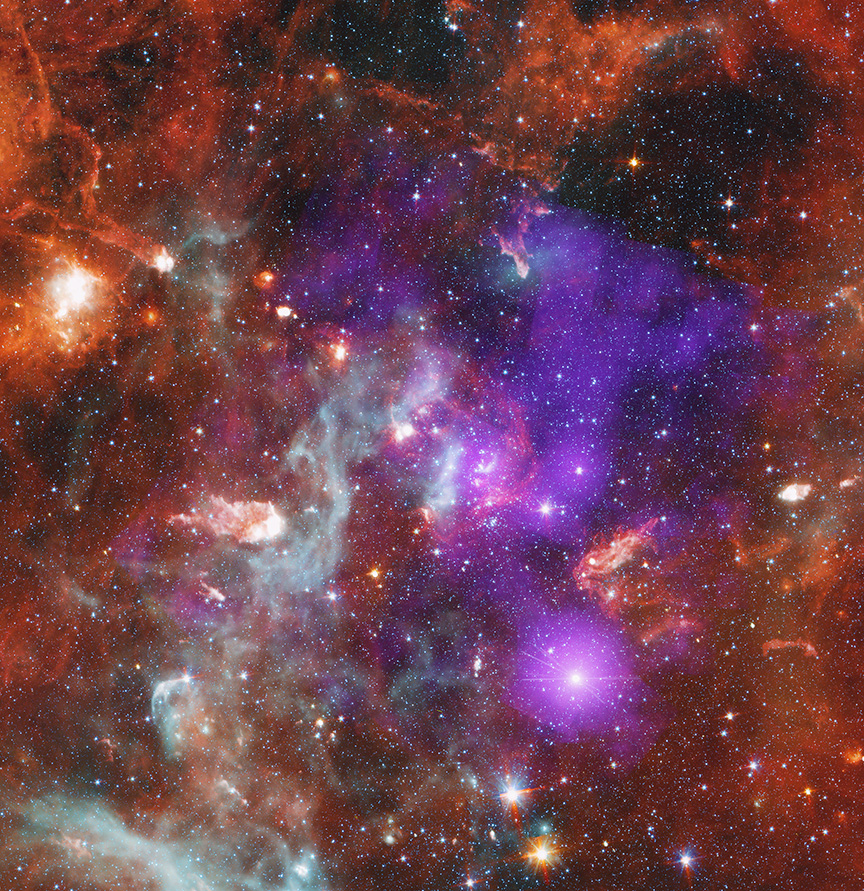
Planets Beware: NASA Unburies Danger Zones of Star Cluster

Cygnus OB2

Credit X-ray: NASA/CXC/SAO/J. Drake et al, IR: NASA/JPL-Caltech/Spitzer; Image Processing: NASA/CXC/SAO/N. Wolk

JPEG (697.3 kb) - Large JPEG (14.3 MB) - Tiff (24 MB - More Images

A Tour of 3C 58 - More Videos


Most stars form in collections, called clusters or associations, that include very massive stars. These giant stars send out large amounts of high-energy radiation, which can disrupt relatively fragile disks of dust and gas that are in the process of coalescing to form new planets.

A team of astronomers used NASA’s Chandra X-ray Observatory, in combination with ultraviolet, optical, and infrared data, to show where some of the most treacherous places in a star cluster may be, where planets’ chances to form are diminished.

The target of the observations was Cygnus OB2, which is the nearest large cluster of stars to our Sun — at a distance of about 4,600 light-years. The cluster contains hundreds of massive stars as well as thousands of lower-mass stars. The team used long Chandra observations pointing at different regions of Cygnus OB2, and the resulting set of images were then stitched together into one large image.

The deep Chandra observations mapped out the diffuse X-ray glow in between the stars, and they also provided an inventory of the young stars in the cluster. This inventory was combined with others using optical and infrared data to create the best census of young stars in the cluster.

In this new composite image, the Chandra data (purple) shows the diffuse X-ray emission and young stars in Cygnus OB2, and infrared data from NASA’s now-retired Spitzer Space Telescope (red, green, blue, and cyan) reveals young stars and the cooler dust and gas throughout the region.
In these crowded stellar environments, copious amounts of high-energy radiation produced by stars and planets are present. Together, X-rays and intense ultraviolet light can have a devastating impact on planetary disks and systems in the process of forming.

Planet-forming disks around stars naturally fade away over time. Some of the disk falls onto the star and some is heated up by X-ray and ultraviolet radiation from the star and evaporates in a wind. The latter process, known as “photoevaporation,” usually takes between 5 and 10 million years with average-sized stars before the disk disappears. If massive stars, which produce the most X-ray and ultraviolet radiation, are nearby, this process can be accelerated.

The researchers using this data found clear evidence that planet-forming disks around stars indeed disappear much faster when they are close to massive stars producing a lot of high-energy radiation. The disks also disappear more quickly in regions where the stars are more closely packed together.

For regions of Cygnus OB2 with less high-energy radiation and lower numbers of stars, the fraction of young stars with disks is about 40%. For regions with more high-energy radiation and higher numbers of stars, the fraction is about 18%. The strongest effect — meaning the worst place to be for a would-be planetary system — is within about 1.6 light-years of the most massive stars in the cluster.

A separate study by the same team examined the properties of the diffuse X-ray emission in the cluster. They found that the higher-energy diffuse emission comes from areas where winds of gas blowing away from massive stars have collided with each other. This causes the gas to become hotter and produce X-rays. The less energetic emission probably comes from gas in the cluster colliding with gas surrounding the cluster.

Two separate papers describing the Chandra data of Cygnus OB2 are available. The paper about the planetary danger zones, led by Mario Giuseppe Guarcello (National Institute for Astrophysics in Palermo, Italy), appeared in the November 2023 issue of the Astrophysical Journal Supplement Series, and is available here. The paper about the diffuse emission, led by Juan Facundo Albacete-Colombo (University of Rio Negro in Argentina) was published in the same issue of Astrophysical Journal Supplement, and is available here.

NASA's Marshall Space Flight Center in Huntsville, Alabama, manages the Chandra program. The Smithsonian Astrophysical Observatory's Chandra X-ray Center controls science operations from Cambridge, Massachusetts, and flight operations from Burlington, Massachusetts.

JPL managed the Spitzer Space Telescope mission for NASA’s Science Mission Directorate in Washington until the mission was retired in January 2020. Science operations were conducted at the Spitzer Science Center at Caltech. Spacecraft operations were based at Lockheed Martin Space in Littleton, Colorado. Data are archived at the Infrared Science Archive operated by IPAC at Caltech. Caltech manages JPL for NASA.


Visual Description:

This release features a composite image of the Cygnus OB2 star cluster, which resembles a night sky blanketed in orange, purple, and grey clouds.

The center of the square image is dominated by purple haze. This haze represents diffuse X-ray emissions, and young stars, detected by the Chandra X-ray observatory. Surrounding the purple haze is a mottled, streaky, brick orange cloud. Another cloud resembling a tendril of grey smoke stretches from our lower left to the center of the image. These clouds represent relatively cool dust and gas observed by the Spitzer Space Telescope.

Although the interwoven clouds cover most of the image, the thousands of stars within the cluster shine through. The lower-mass stars present as tiny specks of light. The massive stars gleam, some with long refraction spikes.


Fast Facts for Cygnus OB2:

Scale: Image is about 1.5 arcmin (120 light-years) across.
Category: Normal Stars & Star Clusters
Coordinates (J2000): RA 20h 33m 12s | Dec +41° 19´ 00"
Constellation: Cygnus
Observation Dates: 40 pointings between January 2004 and March 2010
Observation Time: 331 hours 30 minutes (13 days 19 hours 30 minutes)
Obs. ID: 4501, 4511, 7426, 10939-10974, 12099
Instrument: ACIS
References: Guarcell, M.G. et al, 2023, ApJS, 269, 13; Albacete-Colombo, J.F. et al, 2023, ApJS, 269, 14.
Color Code: X-ray: purple; Infrared (IRAC): red, green, blue; Infrared (MIPS): cyan;
Distance Estimate: About 4,600 light-years


Sunday, November 03, 2024

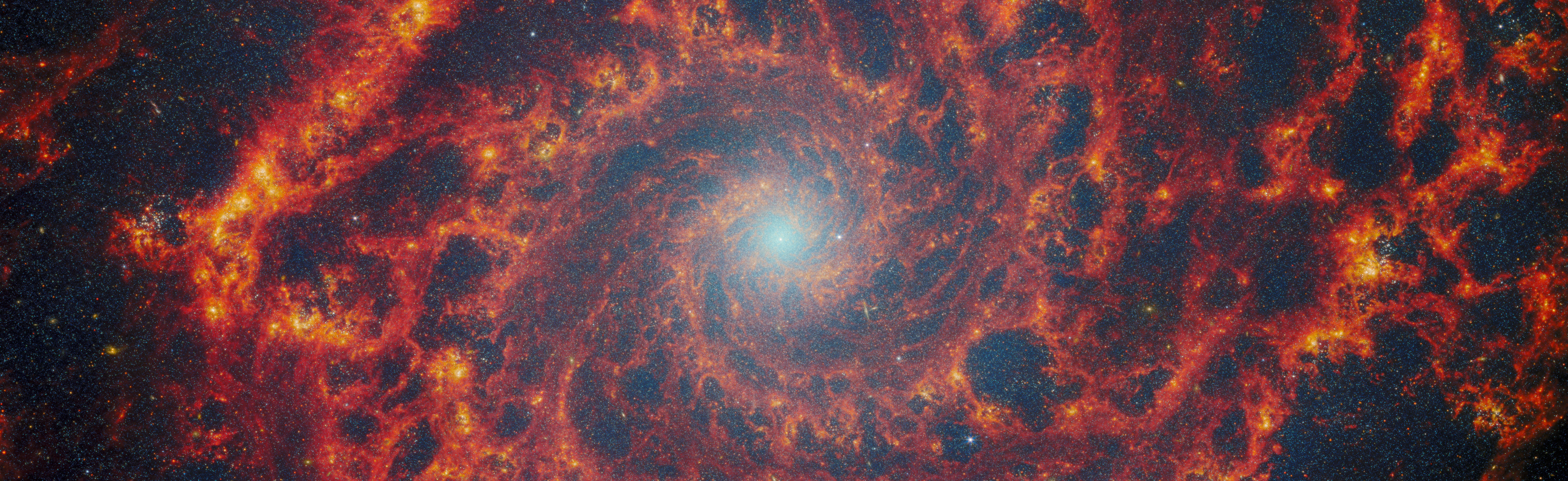
Catching the edge of the Phantom Galaxy (NIRCam and MIRI image)

A large spiral galaxy takes up the entirety of the image. The core is mostly bright white, but there are also swirling, detailed structures that resemble water circling a drain. There is small white and pale blue light that emanates from stars and dust at the core’s centre, but it is tightly limited to the core. The rings feature colours of deep red and orange and highlight filaments of dust around cavernous black bubbles.

In August 2022, to mark the launch of the Picture of the Month series, ESA/Webb published a stunning image of the Phantom Galaxy (also known as M74 and NGC 628). Now, this series is revisiting the target to feature new data on this iconic spiral galaxy.

M74 resides around 32 million light-years away from Earth in the constellation Pisces, and lies almost face-on to Earth. This, coupled with its well-defined spiral arms, makes it a favourite target for astronomers studying the origin and structure of galactic spirals.

This image features data from two of Webb’s instruments: MIRI (Mid-InfraRed Instrument) and NIRCam (Near-InfraRed Camera). Observations in the infrared reveal the galaxy’s creeping tendrils of gas, dust and stars. In this image the dark red regions trace the filamentary warm dust permeating the galaxy. The red regions show the reprocessed light from complex molecules forming on dust grains, while orange and yellow colours reveal the regions of gas ionised by the recently formed star clusters. Stellar feedback has a dramatic effect on the medium within the galaxy and creates a complex network of bright knots as well as cavernous black bubbles. The lack of gas in the nuclear region of this galaxy also provides an unobscured view of the nuclear star cluster at the galaxy's centre. M74 is a particular class of spiral galaxy known as a ‘grand design spiral’, meaning that its spiral arms are prominent and well-defined, unlike the patchy and ragged structure seen in some spiral galaxies.

M74 was observed by Webb as part of a series of observations collectively entitled Feedback in Emerging extrAgalactic Star clusTers, or FEAST (PI: A. Adamo). Many other targets of the FEAST programme, including NGC 4449, M51, and M83, were the subjects of previous ESA/Webb Picture of the Month images in 2023 and 2024. The FEAST observations were designed to shed light on the interplay between stellar feedback and star formation in environments outside the Milky Way galaxy. Stellar feedback is the term used to describe the outpouring of energy from stars into the environments which form them, and is a process that contributes significantly to determining the rates at which stars form. Understanding stellar feedback is vital for building accurate universal models of star formation.

The new Webb data obtained by the FEAST team has allowed scientists to look at the stellar nurseries in galaxies that are many light years away. Astronomers are learning how other galaxies are forming stars and how stars actively participate to model the galaxy interstellar medium. They have found that newly born stars slowly carve they gas and dust nurseries modifying the morphological appearance and essentially destructing them, as Webb has shown that this evolution is connected with star clusters. Furthermore, the team has concluded from their studies that the spiral arms captured by the extended coverage of the FEAST programme are the places where stars are forming more actively in the galaxy. The brighter and larger complexes of stellar nurseries are in the spiral arms fully captured by the new Webb data. The telescope is now revealing the map of hydrogen emission lines in the near-infrared. These lines are less affected than the dusts and reveals the places where new massive stars have just formed.

Links

Polar Ring Galaxy NGC 660


NGC 660 is a polar ring galaxy located in the constellation Pisces. It features a large, extended ring structure surrounding the central spiral galaxy at a near-perpendicular angle. The ring emits blue light from active star-forming regions within it. The dark lanes in the ring and the galactic disk intersect, highlighting its complicated structure. This ring structure is thought to have been formed through the gravitational interaction of the central galaxy with another galaxy.

Distance from Earth: About 44 million light-years
Instrument: Hyper Suprime-Cam (HSC)


Saturday, November 02, 2024

A galactic rejuvenation

Astronomers observing the galaxy NGC 1386, located 53 million light-years away, have discovered a unique pattern of star formation. Using data from the VLT Survey Telescope, ALMA, and other instruments, they found a central blue ring filled with young stars that all formed nearly simultaneously 4 million years ago—a rare synchronized event for a galaxy with mostly older stars. Also, ALMA data revealed gas clouds forming a golden ring, suggesting a new wave of star formation may begin in about 5 million years. Credit: ESO/ALMA (ESO/NAOJ/NRAO)/A. Prieto et al./Fornax Deep Survey. Crdit: ESO/ALMA (ESO/NAOJ/NRAO)/A. Prieto et al./Fornax Deep Survey

Something odd is happening in NGC 1386, a spiral galaxy located 53 million light-years away in Eridanus's constellation. This Picture combines data from the Atacama Large Millimetre/Submillimetre Array (ALMA) and the VLT Survey Telescope (VST), hosted at ESO’s Paranal Observatory in Chile. When astronomers observed the central regions of this galaxy, they found new stars forming… albeit in a peculiar way.

Stars often form within stellar clusters – groups of thousands of stars that originate from massive clouds of molecular gas. The blue ring at the center of this galaxy is ripe with stellar clusters full of young stars, as seen by VST. A new study led by Almudena Prieto, an astronomer at the Instituto de Astrofísica de Canarias in Spain, used data from ESO’s Very Large Telescope (VLT) and the NASA/ESA Hubble Space Telescope to look at this ring in more detail. The data shows that all these star clusters formed almost simultaneously 4 million years ago. It is the first time synchronized star formation has been observed in a galaxy mainly containing old stars.

The same study used ALMA to reveal even more secrets in this galaxy. Shown in this picture as a golden ring is a multitude of gas clouds, ready to form a second batch of young stars. However, we will still have to wait 5 million years for these to be born. Even if old, NGC 1386 keeps rejuvenating itself.

Scienfic Paper


Additional Information

The Atacama Large Millimeter/submillimeter Array (ALMA), an international astronomy facility, is a partnership of the European Organisation for Astronomical Research in the Southern Hemisphere (ESO), the US National Science Foundation (NSF) and the National Institutes of Natural Sciences (NINS) of Japan in cooperation with the Republic of Chile. ALMA is funded by ESO on behalf of its Member States, by NSF in cooperation with the National Research Council of Canada (NRC) and the National Science and Technology Council (NSTC) in Taiwan and by NINS in cooperation with the Academia Sinica (AS) in Taiwan and the Korea Astronomy and Space Science Institute (KASI).

ALMA construction and operations are led by ESO on behalf of its Member States; by the National Radio Astronomy Observatory (NRAO), managed by Associated Universities, Inc. (AUI), on behalf of North America; and by the National Astronomical Observatory of Japan (NAOJ) on behalf of East Asia. The Joint ALMA Observatory (JAO) provides the unified leadership and management of the construction, commissioning and operation of ALMA.


Contacts:

Nicolás Lira
Education and Public Outreach Coordinator
Joint ALMA Observatory, Santiago - Chile
Phone:
+56 2 2467 6519
Cel: +56 9 9445 7726
Email: nicolas.lira@alma.cl

Juan Carlos Muñoz Mateos
ESO Media Officer
Garching bei München, Germany
Phone: +49 89 3200 6176
Email:
press@eso.org


Friday, November 01, 2024

'Blood-Soaked' Eyes: NASA's Webb, Hubble Examine Galaxy Pair

Galaxies IC 2163 and NGC 2207 (Webb and Hubble Image)
Credits/Image: NASA, ESA, CSA, STScI

Galaxies IC 2163 and NGC 2207 (Webb MIRI Image)
Credits/Image: NASA, ESA, CSA, STScI


Stare deeply at these galaxies. They appear as if blood is pumping through the top of a flesh-free face. The long, ghastly “stare” of their searing eye-like cores shines out into the supreme cosmic darkness.

It’s good fortune that looks can be deceiving.

These galaxies have only grazed one another to date, with the smaller spiral on the left, cataloged as IC 2163, ever so slowly “creeping” behind NGC 2207, the spiral galaxy at right, millions of years ago.

The pair’s macabre colors represent a combination of mid-infrared light from NASA’s James Webb Space Telescope with visible and ultraviolet light from NASA’s Hubble Space Telescope.

Look for potential evidence of their “light scrape” in the shock fronts, where material from the galaxies may have slammed together. These lines represented in brighter red, including the “eyelids,” may cause the appearance of the galaxies’ bulging, vein-like arms.

The galaxies’ first pass may have also distorted their delicately curved arms, pulling out tidal extensions in several places. The diffuse, tiny spiral arms between IC 2163’s core and its far left arm may be an example of this activity. Even more tendrils look like they’re hanging between the galaxies’ cores. Another extension “drifts” off the top of the larger galaxy, forming a thin, semi-transparent arm that practically runs off screen.

Both galaxies have high star formation rates, like innumerable individual hearts fluttering all across their arms. Each year, the galaxies produce the equivalent of two dozen new stars that are the size of the Sun. Our Milky Way galaxy only forms the equivalent of two or three new Sun-like stars per year. Both galaxies have also hosted seven known supernovae in recent decades, a high number compared to an average of one every 50 years in the Milky Way. Each supernova may have cleared space in their arms, rearranging gas and dust that later cooled, and allowed many new stars to form.

To spot the star-forming “action sequences,” look for the bright blue areas captured by Hubble in ultraviolet light, and pink and white regions detailed mainly by Webb’s mid-infrared data. Larger areas of stars are known as super star clusters. Look for examples of these in the top-most spiral arm that wraps above the larger galaxy and points left. Other bright regions in the galaxies are mini starbursts — locations where many stars form in quick succession. Additionally, the top and bottom “eyelid” of IC 2163, the smaller galaxy on the left, is filled with newer star formation and burns brightly.

What’s next for these spirals? Over many millions of years, the galaxies may swing by one another repeatedly. It’s possible that their cores and arms will meld, leaving behind completely reshaped arms, and an even brighter, cyclops-like “eye” at the core. Star formation will also slow down once their stores of gas and dust deplete, and the scene will calm.

Want to “pull apart” these images? Examine the galaxies’ skeleton-like appearance in Webb’s mid-infrared image, and compare the Hubble and Webb images side by side.

The James Webb Space Telescope is the world’s premier space science observatory. Webb is solving mysteries in our solar system, looking beyond to distant worlds around other stars, and probing the mysterious structures and origins of our universe and our place in it. Webb is an international program led by NASA with its partners, ESA (European Space Agency) and CSA (Canadian Space Agency).

The Hubble Space Telescope has been operating for over three decades and continues to make ground-breaking discoveries that shape our fundamental understanding of the universe. Hubble is a project of international cooperation between NASA and ESA (European Space Agency). NASA’s Goddard Space Flight Center in Greenbelt, Maryland, manages the telescope and mission operations. Lockheed Martin Space, based in Denver, Colorado, also supports mission operations at Goddard. The Space Telescope Science Institute in Baltimore, Maryland, which is operated by the Association of Universities for Research in Astronomy, conducts Hubble science operations for NASA.


About This Release

Credits:

Media Contact:

Claire Blome
Space Telescope Science Institute, Baltimore, Maryland

Christine Pulliam
Space Telescope Science Institute, Baltimore, Maryland


Permissions: Content Use Policy

Contact Us: Direct inquiries to the News Team.

Related Links and Documents


Revisiting an old beauty

A large spiral galaxy is seen tilted diagonally. The arms of the galaxy’s disc are speckled with glowing patches; some are blue in colour, others are pink, showing gas illuminated by new stars. A faint glow surrounds the galaxy, which lies on a dark, nearly empty background. The galaxy's centre glows in white.

This image from the NASA/ESA Hubble Space Telescope unbarred spiral galaxy roughly 51 million light-years away from Earth in the constellation Coma Berenices.

You can see an old image of NGC 4414 that features Hubble data from 1995 and 1999 here, which was captured as one of the telescope’s primary missions to determine the distance to galaxies. This was achieved as part of an ongoing research effort to study Cepheid variable stars. Cepheids are a special type of variable star with very stable and predictable brightness variations. The period of these variations depends on physical properties of the stars such as their mass and true brightness. This means that astronomers, just by looking at the variability of their light, can find out about the Cepheids' physical nature, which then can be used very effectively to determine their distance. For this reason cosmologists call Cepheids 'standard candles'.

Astronomers have used Hubble to observe Cepheids, like those that reside in NGC 4414, with extraordinary results. The Cepheids have then been used as stepping-stones to make distance measurements for supernovae, which have, in turn, given a measure for the scale of the Universe. Today we know the age of the Universe to a much higher precision than before Hubble: around 13.7 billion years.

Links