Showing posts with label IC 2163. Show all posts

Wednesday, November 26, 2025

Fall Collection: Before Fall Leaves, See Seasonal Offerings from NASA's Chandra


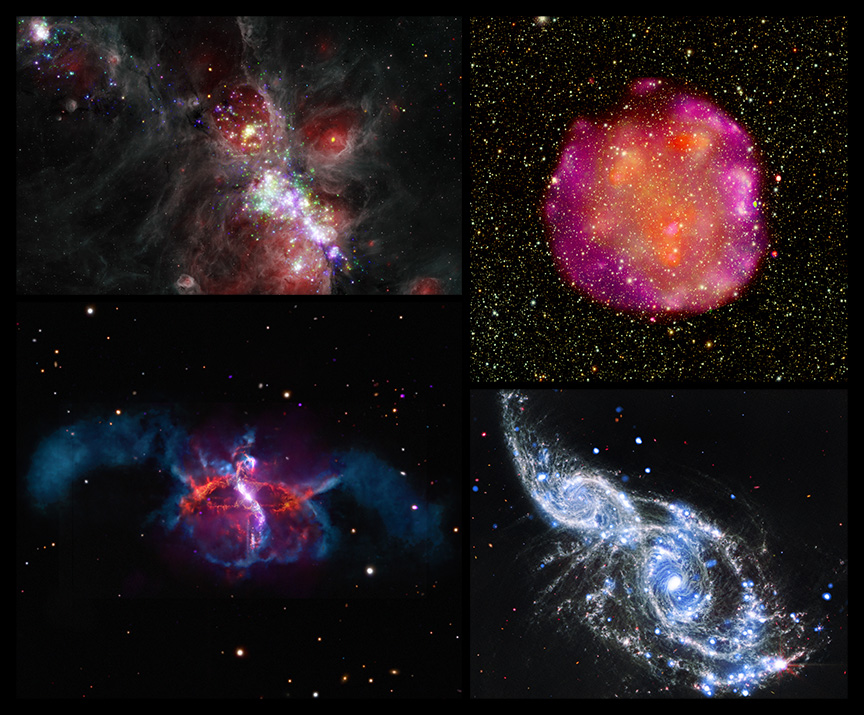
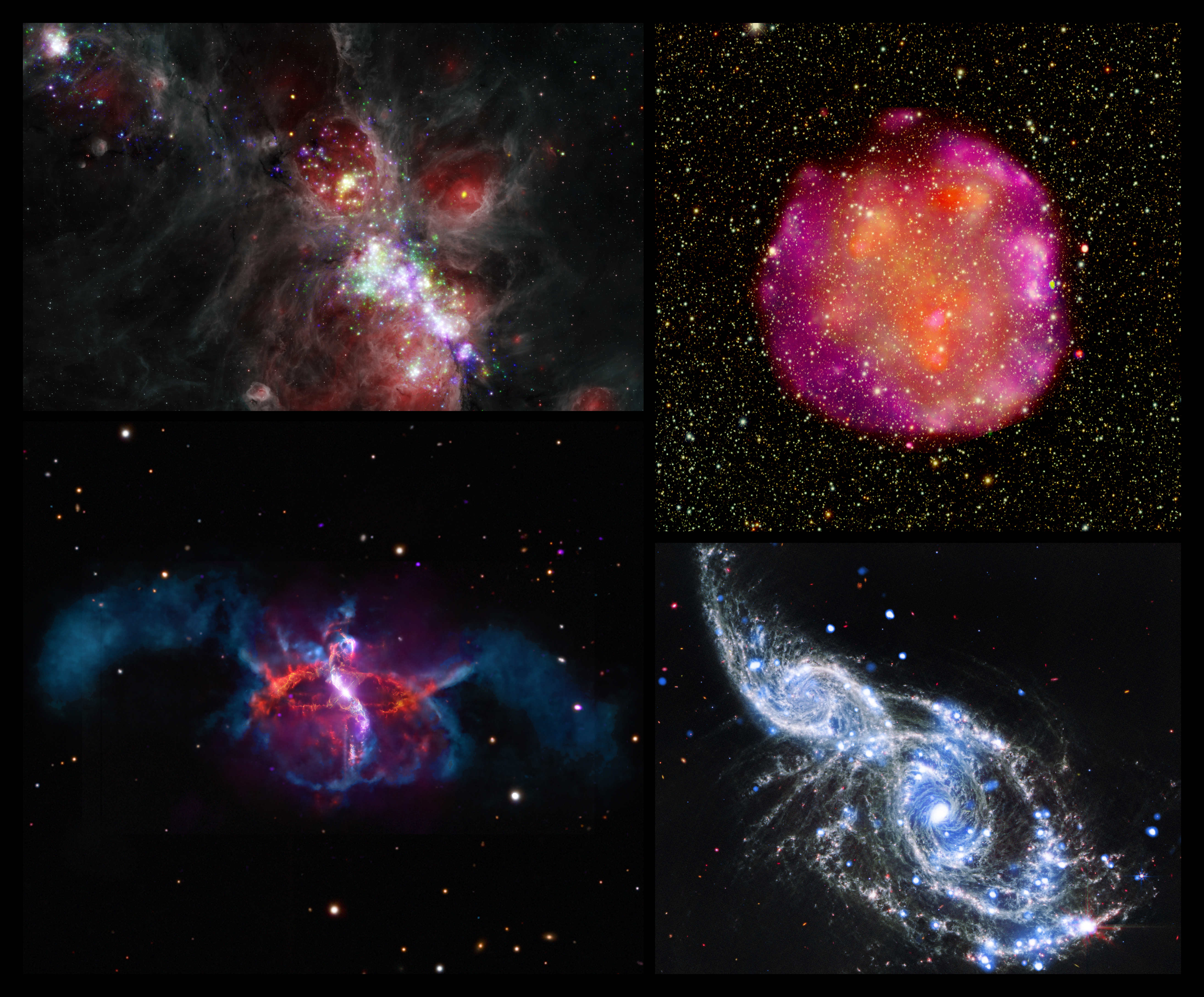
  • Four images that one can imagine connections to fall have been released by NASA’s Chandra X-ray Observatory.

  • The images are the star-forming region NGC 6334, supernova remnant G272.2-0.3, interacting spiral galaxies NGC 2207 and IC 2163, as well as R Aquarii.

  • Each image contains X-rays from Chandra that have been combined with data from other telescopes that detect different types of light.

  • Pareidolia is the phenomenon that allows people to see familiar patterns or shapes in data.

Before fall gives way to winter in the northern hemisphere, NASA’s Chandra X-ray Observatory has several images that celebrate autumn and its many delights to share. In spirit of the season, this collection gathers Chandra data with those from its telescopic family including NASA’s James Webb, Hubble, and Spitzer Space Telescopes, plus others in space and on the ground.

Here is a sample of the seasonal offerings that space has in store:

NGC 6334: COSMIC LEAVES BLOWING
For many, nothing evokes fall more than fallen leaves. In this view of NGC 6334, glowing pockets of dust and gas in the nebula resemble leaves that have been picked up by a wind gust. This region is actually home to strong winds blowing from the young stars that have formed there. This image contains X-ray data from Chandra (blue, green, and yellow) that shows the effects of these winds, which have been combined with infrared data from the now-retired Spitzer Space Telescope (red, brown), which shows the dust and gas that fuels the growing stars.

G272: THE SPACE PUMPKIN
Born after a violent explosion of a star, this cosmic gourd is the supernova remnant G272.2-03.2. X-ray observations (orange and magenta) from Chandra provide evidence that G272 is the result of a Type Ia supernova explosion, where a white dwarf star pulls material from a companion star until it triggers a thermonuclear explosion and obliterates the star. The inside of the “pumpkin” is superheated gas that is filling the space cleared out by the explosion as it moves outward.

R AQUARII: A COSMIC SWEATER
Multiple telescopes teamed up to capture an image that looks like a cozy sweater with fuzzy arms. X-rays from Chandra and ESA’s XMM-Newton (purple), optical light data from Hubble and the Very Large Telescope in Chile (orange, red, and violet), and an optical image from astrophotographer Bob Fera (deep blue) combine to reveal R Aquarii. Nestled within the cozy ‘body’ of R Aquarii is a pair of stars where a white dwarf is pulling material from a much larger red giant companion. When enough material accumulates on the surface of the white dwarf, it triggers an outburst that sends a jet out into space. Over time, these jets twist and loop around each other weaving the structure seen today.

NGC 2207 and IC 2163: A PAIR OF GALACTIC CORNUCOPIA
A cornucopia is a horn-shaped basket that traditionally carries fruits and vegetables. There is nothing edible in this pair of galactic cornucopias but there are a bounty of stars, dust, and other ingredients than make up these two spiral galaxies, known as NGC 2207 (right) and IC 2163 (left), that we see face-on. This view of NGC 2207 and IC 2163 takes a James Webb infrared image (white, gray, and red) and adds the X-ray view from Chandra (blue). Together, it is quite an eye-catching result.

NASA's Marshall Space Flight Center in Huntsville, Alabama, manages the Chandra program. The Smithsonian Astrophysical Observatory's Chandra X-ray Center controls science operations from Cambridge, Massachusetts, and flight operations from Burlington, Massachusetts.

Quick Look: Before Fall Leaves, See Seasonal Offer ings from NASA's Chandra


Visual Description:

This release highlights a collection of four composite images, presented in a two-by-two grid. Each image features data gathered by the Chandra X-ray Observatory and additional NASA and other telescopes.

At our upper left is NGC 6334, a massive nebula and star-forming region. In this image, scores of glowing young stars, depicted as tiny specs of distant light, illuminate an otherwise dark scene. The specs of red, green, yellow, purple, and white, are clustered near the center of the image, but extend to the edges of the frame in faint streaks. Partially masking the specs of color are tendrils of grey clouds; strong winds of dust and gas blowing from the still-forming stars.

The image at our upper right features a supernova remnant called G272.2-3.2. Here, a white dwarf star has pulled material from a companion star, triggering a thermonuclear explosion. What remains is a giant ball of superheated gas, set against a densely-packed field of distant stars and galaxies. In this image, the ball of gas is a mottled, translucent orange sphere with patches of hot pink at the outer edges.

The image at the grid's lower right depicts a pair of colliding spiral galaxies. Here, both spirals are shown face on, with the smaller of the two galaxies, IC 2163, at the upper left of the larger galaxy, NGC 2207, which dominates the center and lower right of the image. Both galaxies have long, spiraling, silver blue arms, dotted with specs of blue and red. Toward our upper left, the curving arms overlap, and bend toward their neighbors' core.

Finally, at our lower left, is R Aquarii, a symbiotic binary star. Here, a white dwarf star pulls material from a much larger red giant companion, sending looping jets of matter into space. In this composite image, which includes an optical image from astrophotographer Bob Fera, the resulting structure resembles a cozy sweater with a red body, and blue wooly arms opened wide.


Fast Facts for NGC 6334:

Credit: X-ray: NASA/SAO/CXC; Infrared: NASA/JPL/CalTech/Spitzer; Image Processing: NASA/CXC/SAO/J. Schmidt
Release Date: November 24, 2025
Scale: Image is about 72 arcmin (115.2 light-years) across.
Category: Normal Stars and Star Clusters
Coordinates (J2000): RA: 17h 20m 50.9s | Dec: -36° 06' 54"
Constellation: Scorpius
Observation Date(s): 10 observations from August 2002 to July 2016
Observation Time: 85 hours 28 minutes (3 days 13 hours 28 minutes)
Obs. IDs: 2573, 2574 ,3844, 4591, 8975, 12382, 13436, 18082, 18081, 18876
Instrument: ACIS
Color Code: X-ray: red, orange, green, and purple; Infrared: white and red
Distance Estimate: About 5,500 light-years from Earth


Fast Facts for SNR G272.2-03.2:

Credit: X-ray: NASA/CXC/SA0; Optical: NOIRLab/DECaPS2; Image Processing: NASA/CXC/SAO/L. Frattare
Release Date: November 24, 2025
Scale: Image is about 2.8 arcmin (5.7 light-years) across.
Category: Supernovas & Supernova Remnants
Coordinates (J2000): RA: 9h 06m 47s | Dec: -52° 05' 50"
Constellation: Vela
Observation Date(s): 2 observations Aug 26-27, 2008
Observation Time: 17 hours 55 minutes
Obs. IDs: 9147, 10572
Instrument: ACIS
Color Code: X-ray: cyan, yellow, and magenta; Optical: red, green, and blue
Distance Estimate: About 7,000 light-years from Earth


Fast Facts for R Aquarii:

Credit: X-ray: NASA/CXC/SAO; ESA/XMM-Newton; Optical HST: NASA/ESA/STScI; Optical Ground: Deep Space Remote observatories/B. Fera; ESO/VLT; Image Processing: NASA/CXC/SAO/L. Frattare
Release Date: November 24, 2025
Scale: Image is about 9.5 arcmin (1.8 light-years) across.
Category: White Dwarfs and Planetary Nebulas
Coordinates (J2000): RA: 23h 43m 49.5s | Dec: -15° 17' 04"
Constellation: Aquarius
Observation Date(s): 3 pointings between Sep 2001 and Oct 2005
Observation Time: 34 hours 54 minutes (1 day 10 hours 54 minutes)
Obs. IDs: 651, 4546, 5438
Instrument: ACIS
Color Code: X-ray: purple and blue; Optical (HST): cyan and orange; Optical (Ground): red, green, and blue; Radio: red with green
Distance Estimate: About 650 light-years from Earth


Fast Facts for NGC 2207 & IC 2163:

Credit: X-ray: NASA/CXC/SAO; Infrared: NASA/ESA/CSA/STScI/Webb; Image Processing: NASA/CXC/SAO/L. Frattare
Release Date: November 24, 2025
Scale Image is about 5 arcmin (189,000 light-years) across.
Category: Normal Galaxies, Starburst Galaxies, & Black Holes
Coordinates (J2000): RA: 6h 16m 22.1s | Dec: -21° 22′ 22"
Constellation: Canis Major
Observation Date(s): 4 observations from July 2010 to August 2013
Observation Time: 17 hours 20 minutes
Obs. IDs: 11228, 14914, 14799, 14915
Instrument: ACIS
Color Code: X-ray: blue; Infrared: white, red, green, and blue
Distance Estimate: About 130 million light-years from Earth


Friday, November 01, 2024

'Blood-Soaked' Eyes: NASA's Webb, Hubble Examine Galaxy Pair

Galaxies IC 2163 and NGC 2207 (Webb and Hubble Image)
Credits/Image: NASA, ESA, CSA, STScI

Galaxies IC 2163 and NGC 2207 (Webb MIRI Image)
Credits/Image: NASA, ESA, CSA, STScI


Stare deeply at these galaxies. They appear as if blood is pumping through the top of a flesh-free face. The long, ghastly “stare” of their searing eye-like cores shines out into the supreme cosmic darkness.

It’s good fortune that looks can be deceiving.

These galaxies have only grazed one another to date, with the smaller spiral on the left, cataloged as IC 2163, ever so slowly “creeping” behind NGC 2207, the spiral galaxy at right, millions of years ago.

The pair’s macabre colors represent a combination of mid-infrared light from NASA’s James Webb Space Telescope with visible and ultraviolet light from NASA’s Hubble Space Telescope.

Look for potential evidence of their “light scrape” in the shock fronts, where material from the galaxies may have slammed together. These lines represented in brighter red, including the “eyelids,” may cause the appearance of the galaxies’ bulging, vein-like arms.

The galaxies’ first pass may have also distorted their delicately curved arms, pulling out tidal extensions in several places. The diffuse, tiny spiral arms between IC 2163’s core and its far left arm may be an example of this activity. Even more tendrils look like they’re hanging between the galaxies’ cores. Another extension “drifts” off the top of the larger galaxy, forming a thin, semi-transparent arm that practically runs off screen.

Both galaxies have high star formation rates, like innumerable individual hearts fluttering all across their arms. Each year, the galaxies produce the equivalent of two dozen new stars that are the size of the Sun. Our Milky Way galaxy only forms the equivalent of two or three new Sun-like stars per year. Both galaxies have also hosted seven known supernovae in recent decades, a high number compared to an average of one every 50 years in the Milky Way. Each supernova may have cleared space in their arms, rearranging gas and dust that later cooled, and allowed many new stars to form.

To spot the star-forming “action sequences,” look for the bright blue areas captured by Hubble in ultraviolet light, and pink and white regions detailed mainly by Webb’s mid-infrared data. Larger areas of stars are known as super star clusters. Look for examples of these in the top-most spiral arm that wraps above the larger galaxy and points left. Other bright regions in the galaxies are mini starbursts — locations where many stars form in quick succession. Additionally, the top and bottom “eyelid” of IC 2163, the smaller galaxy on the left, is filled with newer star formation and burns brightly.

What’s next for these spirals? Over many millions of years, the galaxies may swing by one another repeatedly. It’s possible that their cores and arms will meld, leaving behind completely reshaped arms, and an even brighter, cyclops-like “eye” at the core. Star formation will also slow down once their stores of gas and dust deplete, and the scene will calm.

Want to “pull apart” these images? Examine the galaxies’ skeleton-like appearance in Webb’s mid-infrared image, and compare the Hubble and Webb images side by side.

The James Webb Space Telescope is the world’s premier space science observatory. Webb is solving mysteries in our solar system, looking beyond to distant worlds around other stars, and probing the mysterious structures and origins of our universe and our place in it. Webb is an international program led by NASA with its partners, ESA (European Space Agency) and CSA (Canadian Space Agency).

The Hubble Space Telescope has been operating for over three decades and continues to make ground-breaking discoveries that shape our fundamental understanding of the universe. Hubble is a project of international cooperation between NASA and ESA (European Space Agency). NASA’s Goddard Space Flight Center in Greenbelt, Maryland, manages the telescope and mission operations. Lockheed Martin Space, based in Denver, Colorado, also supports mission operations at Goddard. The Space Telescope Science Institute in Baltimore, Maryland, which is operated by the Association of Universities for Research in Astronomy, conducts Hubble science operations for NASA.


About This Release

Credits:

Media Contact:

Claire Blome
Space Telescope Science Institute, Baltimore, Maryland

Christine Pulliam
Space Telescope Science Institute, Baltimore, Maryland


Permissions: Content Use Policy

Contact Us: Direct inquiries to the News Team.

Related Links and Documents


Tuesday, November 08, 2016

Tsunami of Stars and Gas Produces Dazzling Eye-shaped Feature in Galaxy

Dazzling eyelid-like features bursting with stars in galaxy IC 2163 formed from a tsunami of stars and gas triggered by a glancing collision with galaxy NGC 2207 (a portion of its spiral arm is shown on right side of image). ALMA image of carbon monoxide (orange), which revealed motion of the gas in these features, is shown on top of Hubble image (blue) of the galaxy. Credit: M. Kaufman; B. Saxton (NRAO/AUI/NSF); ALMA (ESO/NAOJ/NRAO); NASA/ESA Hubble Space Telescope

Annotated image showing dazzling eyelid-like features bursting with stars in galaxy IC 2163 formed from a tsunami of stars and gas triggered by a glancing collision with galaxy NGC 2207 (a portion of its spiral arm is shown on right side of image). ALMA image of carbon monoxide (orange), which revealed motion of the gas in these features, is shown on top of Hubble image (blue) of the galaxy. Credit: M. Kaufman; B. Saxton (NRAO/AUI/NSF); ALMA (ESO/NAOJ/NRAO); NASA/ESA Hubble Space Telescope

Galaxies IC 2163 (left) and NGC 2207 (right) recently grazed past each other, triggering a tsunami of stars and gas in IC 2163 and producing the dazzling eyelid-like features there. ALMA image of carbon monoxide (orange), which revealed motion of the gas in these features, is shown on top of Hubble image (blue) of the galaxy pair. Credit: M. Kaufman; B. Saxton (NRAO/AUI/NSF); ALMA (ESO/NAOJ/NRAO); NASA/ESA Hubble Space Telescope


Astronomers using the Atacama Large Millimeter/submillimeter Array (ALMA) have discovered a tsunami of stars and gas that is crashing midway through the disk of a spiral galaxy known as IC 2163. This colossal wave of material – which was triggered when IC 2163 recently sideswiped another spiral galaxy dubbed NGC 2207 – produced dazzling arcs of intense star formation that resemble a pair of eyelids.

“Although galaxy collisions of this type are not uncommon, only a few galaxies with eye-like, or ocular, structures are known to exist,” said Michele Kaufman, an astronomer formerly with The Ohio State University in Columbus and lead author on a paper published in the Astrophysical Journal.

Kaufman and her colleagues note that the paucity of similar features in the observable universe is likely due to their ephemeral nature. “Galactic eyelids last only a few tens of millions of years, which is incredibly brief in the lifespan of a galaxy. Finding one in such a newly formed state gives us an exceptional opportunity to study what happens when one galaxy grazes another,” said Kaufman.

The interacting pair of galaxies resides approximately 114 million light-years from Earth in the direction of the constellation Canis Major. These galaxies brushed past each other – scraping the edges of their outer spiral arms – in what is likely the first encounter of an eventual merger.

Using ALMA’s remarkable sensitivity and resolution, the astronomers made the most detailed measurements ever of the motion of carbon monoxide gas in the galaxy’s narrow eyelid features. Carbon monoxide is a tracer of molecular gas, which is the fuel for star formation.

The data reveal that the gas in the outer portion of IC 2163’s eyelids is racing inward at speeds in excess of 100 kilometers a second. This gas, however, quickly decelerates and its motion becomes more chaotic, eventually changing trajectory and aligning itself with the rotation of the galaxy rather than continuing its pell-mell rush toward the center.

“What we observe in this galaxy is very much like a massive ocean wave barreling toward shore until it interacts with the shallows, causing it to lose momentum and dump all of its water and sand on the beach,” said Bruce Elmegreen, a scientist with IBM’s T.J. Watson Research Center in Yorktown Heights, New York, and co-author on the paper.

“Not only do we find a rapid deceleration of the gas as it moves from the outer to the inner edge of the eyelids, but we also measure that the more rapidly it decelerates, the denser the molecular gas becomes,” said Kaufman. “This direct measurement of compression shows how the encounter between the two galaxies drives gas to pile up, spawn new star clusters and form these dazzling eyelid features.”

Computer models predict that such eyelid-like features could evolve if galaxies interacted in a very specific manner. "This evidence for a strong shock in the eyelids is terrific. It's all very well to have a theory and simulations suggesting it should be true, but real observational evidence is great," said Curtis Struck, a professor of astrophysics at Iowa State University in Ames and co-author on the paper.

“ALMA showed us that the velocities of the molecular gas in the eyelids are on the right track with the predictions we get from computer models,” said Kaufman. “This critical test of encounter simulations was not possible before.”

Astronomers believe that such collisions between galaxies were common in the early universe when galaxies were closer together. At that time, however, galactic disks were generally clumpy and irregular, so other processes likely overwhelmed the formation of similar eyelid features.

The authors continue to study this galaxy pair and currently are comparing the properties (e.g., locations, ages, and masses) of the star clusters previously observed with NASA’s Hubble Space Telescope with the properties of the molecular clouds observed with ALMA. They hope to better understand the differences between molecular clouds and star clusters in the eyelids and those elsewhere in the galaxy pair.

The National Radio Astronomy Observatory is a facility of the National Science Foundation, operated under cooperative agreement by Associated Universities, Inc.

# # #

This research is presented in a paper titled “Ocular Shock Front in the Colliding Galaxy IC 2163” by M. Kaufman et al., published in Astrophysical Journal. [Preprint: https://arxiv.org/abs/1608.02130].

The Atacama Large Millimeter/submillimeter Array (ALMA), an international astronomy facility, is a partnership of ESO, the U.S. National Science Foundation (NSF) and the National Institutes of Natural Sciences (NINS) of Japan in cooperation with the Republic of Chile. ALMA is funded by ESO on behalf of its Member States, by NSF in cooperation with the National Research Council of Canada (NRC) and the National Science Council of Taiwan (NSC) and by NINS in cooperation with the Academia Sinica (AS) in Taiwan and the Korea Astronomy and Space Science Institute (KASI).

ALMA construction and operations are led by ESO on behalf of its Member States; by the National Radio Astronomy Observatory (NRAO), managed by Associated Universities, Inc. (AUI), on behalf of North America; and by the National Astronomical Observatory of Japan (NAOJ) on behalf of East Asia. The Joint ALMA Observatory (JAO) provides the unified leadership and management of the construction, commissioning and operation of ALMA.

Contact: 

Charles Blue
NRAO Public Information Officer
+1 434.296.0314; cblue@nrao.edu


Thursday, December 11, 2014

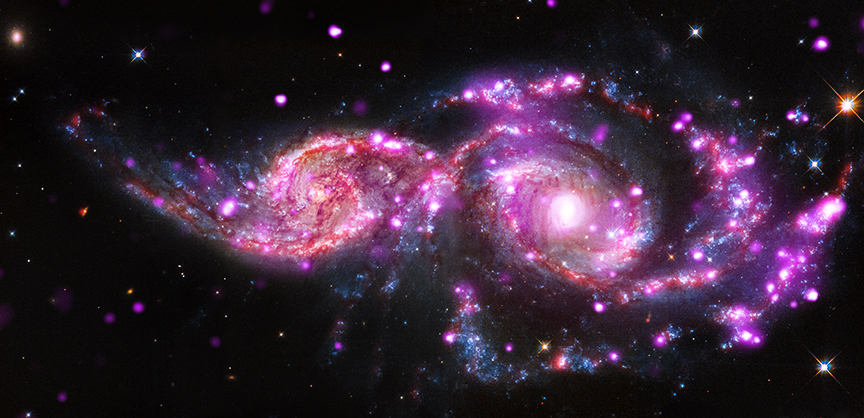
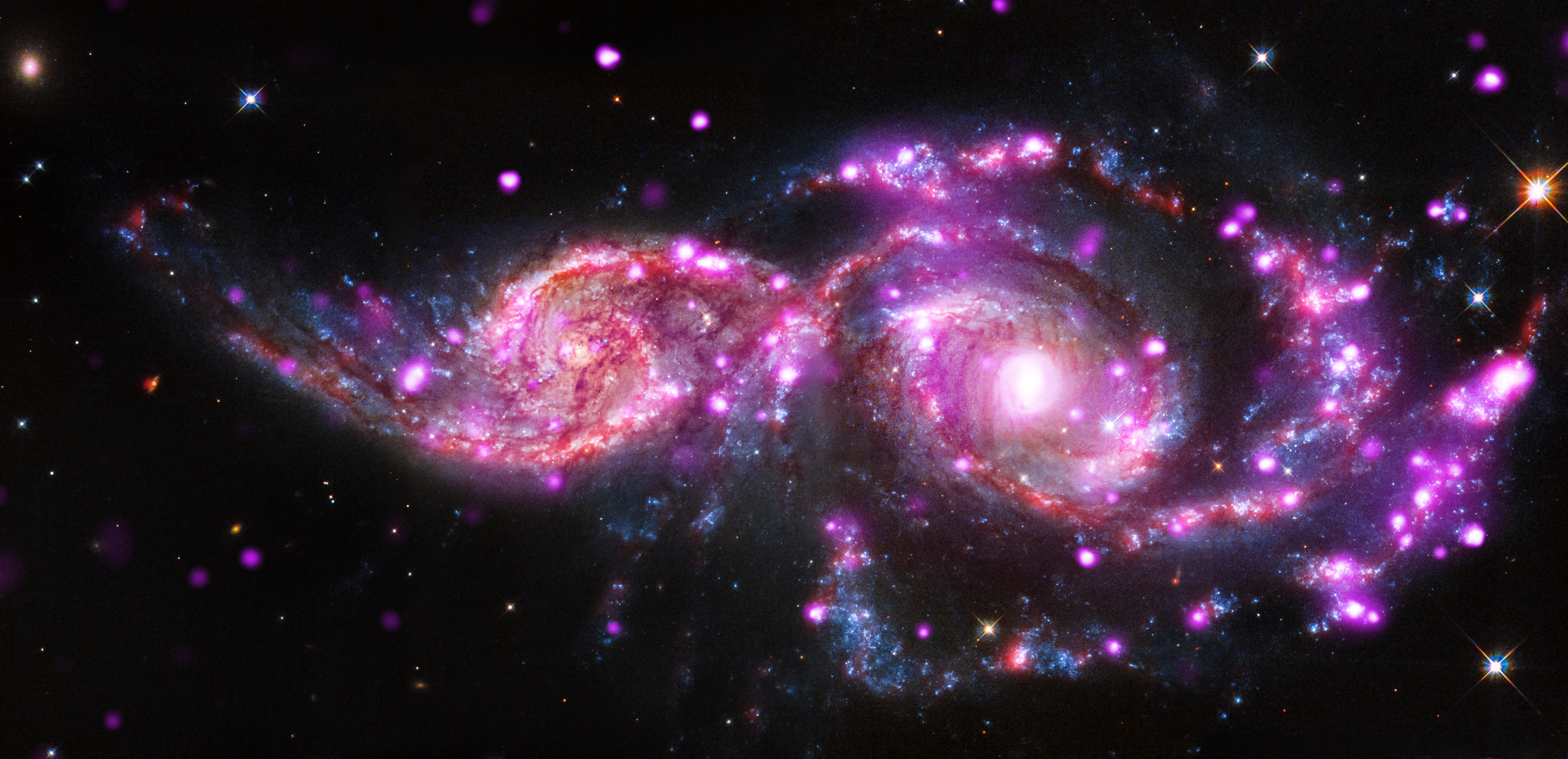
NGC 2207 and IC 2163: Galactic Get-Together has Impressive Light Display

NGC 2207 and IC 2163 (Composite)
Credit  X-ray: NASA/CXC/SAO/S.Mineo et al, Optical: NASA/STScI, Infrared: NASA/JPL-Caltech


At this time of year, there are lots of gatherings often decorated with festive lights. When galaxies get together, there is the chance of a spectacular light show as is the case with NGC 2207 and IC 2163

Located about 130 million light years from Earth, in the constellation of Canis Major, this pair of spiral galaxies has been caught in a grazing encounter. NGC 2207 and IC 2163 have hosted three supernova explosions in the past 15 years and have produced one of the most bountiful collections of super bright X-ray lights known. These special objects - known as "ultraluminous X-ray sources" (ULXs) - have been found using data from NASA's Chandra X-ray Observatory.

As in our Milky Way galaxy, NGC 2207 and IC 2163 are sprinkled with many star systems known as X-ray binaries, which consist of a star in a tight orbit around either a neutron star or a "stellar-mass" black hole. The strong gravity of the neutron star or black hole pulls matter from the companion star. As this matter falls toward the neutron star or black hole, it is heated to millions of degrees and generates X-rays.

ULXs have far brighter X-rays than most "normal" X-ray binaries. The true nature of ULXs is still debated, but they are likely a peculiar type of X-ray binary. The black holes in some ULXs may be heavier than stellar mass black holes and could represent a hypothesized, but as yet unconfirmed, intermediate-mass category of black holes.

This composite image of NGC 2207 and IC 2163 contains Chandra data in pink, optical light data from the Hubble Space Telescope in red, green, and blue (appearing as blue, white, orange, and brown), and infrared data from the Spitzer Space Telescope in red.

The new Chandra image contains about five times more observing time than previous efforts to study ULXs in this galaxy pair. Scientists now tally a total of 28 ULXs between NGC 2207 and IC 2163. Twelve of these vary over a span of several years, including seven that were not detected before because they were in a "quiet" phase during earlier observations.

The scientists involved in studying this system note that there is a strong correlation between the number of X-ray sources in different regions of the galaxies and the rate at which stars are forming in these regions. The composite image shows this correlation through X-ray sources concentrated in the spiral arms of the galaxies, where large amounts of stars are known to be forming. This correlation also suggests that the companion star in the binary systems is young and massive.

Colliding galaxies like this pair are well known to contain intense star formation. Shock waves - like the sonic booms from supersonic aircraft - form during the collision, leading to the collapse of clouds of gas and the formation of star clusters. In fact, researchers estimate that the stars associated with the ULXs are very young and may only be about 10 million years old. In contrast, our Sun is about halfway through its 10-billion-year lifetime. Moreover, analysis shows that stars of various masses are forming in this galaxy pair at a rate equivalent to form 24 stars the mass of our sun per year. In comparison, a galaxy like our Milky Way is expected to spawn new stars at a rate equivalent to only about one to three new suns every year.

A paper describing these results has been accepted for publication in The Astrophysical Journal and is available online. The authors of the paper are Stefano Mineo of the Harvard-Smithsonian Center for Astrophysics in Cambridge, MA; Saul Rappaport from the Massachusetts Institute of Technology (MIT) in Cambridge, MA; Alan Levine from MIT; David Pooley from Sam Houston State University in Huntsville, TX; Benjamin Steinhorn from Harvard Medical School in Boston, MA, and Jeroen Homan from MIT.


Fast Facts for NGC 2207 and IC 2163:

Scale: Image is 5 arcmin across (about 180,000 light years)
Category: Normal Galaxies & Starburst Galaxies
Coordinates (J2000): RA 06h 16m 22.10s | Dec -21° 22' 21.80"
Constellation: Canis Major
Observation Date: 4 pointings between Jul 2010 and Aug 2013
Observation Time: 17 hours 20 min
Obs. ID: 11228, 14799, 14914, 14915
Instrument: ACIS
References: Mineo, S. et al, 2014, ApJ, 797, 91; arXiv:1410.2472
Color Code: X-ray (Pink), Optical (Red, Green, Blue), Infrared (Red)
Distance Estimate: About 130 million light years


Wednesday, April 26, 2006

NGC 2207 and IC 2163

Eyes in the Sky
 Credit: NASA, ESA/JPL-Caltech/STScI/D. Elmegreen (Vassar)


These shape-shifting galaxies have taken on the form of a giant mask. The icy blue eyes are actually the cores of two merging galaxies, called NGC 2207 and IC 2163, and the mask is their spiral arms. The false-colored image consists of infrared data from NASA's Spitzer Space Telescope (red) and visible data from NASA's Hubble Space Telescope (blue/green). 

NGC 2207 and IC 2163 met and began a sort of gravitational tango about 40 million years ago. The two galaxies are tugging at each other, stimulating new stars to form. Eventually, this cosmic ball will come to an end, when the galaxies meld into one. The dancing duo is located 140 million light-years away in the Canis Major constellation. 

The infrared data from Spitzer highlight the galaxies' dusty regions, while the visible data from Hubble indicates starlight. In the Hubble-only image (not pictured here), the dusty regions appear as dark lanes. 

The Hubble data correspond to light with wavelengths of .44 and .55 microns (blue and green, respectively). The Spitzer data represent light of 8 microns.