Showing posts with label Phantom Galaxy. Show all posts

Sunday, November 03, 2024

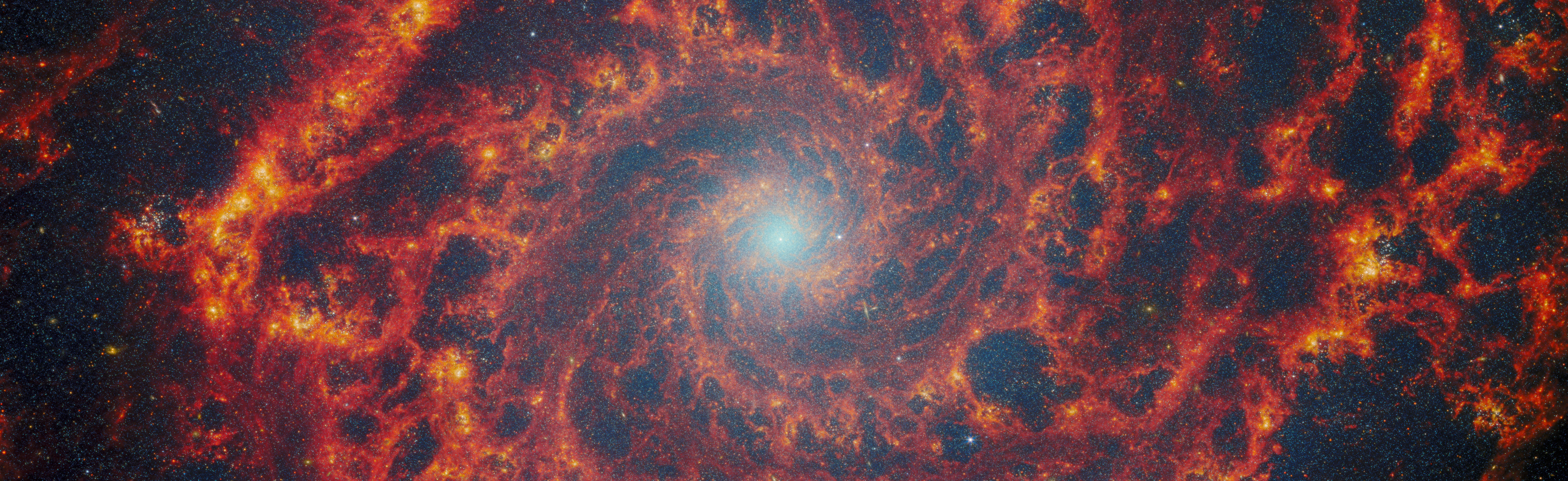
Catching the edge of the Phantom Galaxy (NIRCam and MIRI image)

A large spiral galaxy takes up the entirety of the image. The core is mostly bright white, but there are also swirling, detailed structures that resemble water circling a drain. There is small white and pale blue light that emanates from stars and dust at the core’s centre, but it is tightly limited to the core. The rings feature colours of deep red and orange and highlight filaments of dust around cavernous black bubbles.

In August 2022, to mark the launch of the Picture of the Month series, ESA/Webb published a stunning image of the Phantom Galaxy (also known as M74 and NGC 628). Now, this series is revisiting the target to feature new data on this iconic spiral galaxy.

M74 resides around 32 million light-years away from Earth in the constellation Pisces, and lies almost face-on to Earth. This, coupled with its well-defined spiral arms, makes it a favourite target for astronomers studying the origin and structure of galactic spirals.

This image features data from two of Webb’s instruments: MIRI (Mid-InfraRed Instrument) and NIRCam (Near-InfraRed Camera). Observations in the infrared reveal the galaxy’s creeping tendrils of gas, dust and stars. In this image the dark red regions trace the filamentary warm dust permeating the galaxy. The red regions show the reprocessed light from complex molecules forming on dust grains, while orange and yellow colours reveal the regions of gas ionised by the recently formed star clusters. Stellar feedback has a dramatic effect on the medium within the galaxy and creates a complex network of bright knots as well as cavernous black bubbles. The lack of gas in the nuclear region of this galaxy also provides an unobscured view of the nuclear star cluster at the galaxy's centre. M74 is a particular class of spiral galaxy known as a ‘grand design spiral’, meaning that its spiral arms are prominent and well-defined, unlike the patchy and ragged structure seen in some spiral galaxies.

M74 was observed by Webb as part of a series of observations collectively entitled Feedback in Emerging extrAgalactic Star clusTers, or FEAST (PI: A. Adamo). Many other targets of the FEAST programme, including NGC 4449, M51, and M83, were the subjects of previous ESA/Webb Picture of the Month images in 2023 and 2024. The FEAST observations were designed to shed light on the interplay between stellar feedback and star formation in environments outside the Milky Way galaxy. Stellar feedback is the term used to describe the outpouring of energy from stars into the environments which form them, and is a process that contributes significantly to determining the rates at which stars form. Understanding stellar feedback is vital for building accurate universal models of star formation.

The new Webb data obtained by the FEAST team has allowed scientists to look at the stellar nurseries in galaxies that are many light years away. Astronomers are learning how other galaxies are forming stars and how stars actively participate to model the galaxy interstellar medium. They have found that newly born stars slowly carve they gas and dust nurseries modifying the morphological appearance and essentially destructing them, as Webb has shown that this evolution is connected with star clusters. Furthermore, the team has concluded from their studies that the spiral arms captured by the extended coverage of the FEAST programme are the places where stars are forming more actively in the galaxy. The brighter and larger complexes of stellar nurseries are in the spiral arms fully captured by the new Webb data. The telescope is now revealing the map of hydrogen emission lines in the near-infrared. These lines are less affected than the dusts and reveals the places where new massive stars have just formed.

Links

Sunday, March 03, 2024

Listen to the Universe: New NASA Sonifications and Documentary

IC 443 (Jellyfish Nebula)/M74 (Phantom Galaxy)/MSH 15-52 / PSR B1509-58
Credit Chandra X-ray: NASA/CXC/B.Gaensler et al; ROSAT X-ray: NASA/ROSAT/Asaoka & Aschenbach; Radio Wide: NRC/DRAO/D.Leahy; Optical: DSS; Sonification: NASA/CXC/SAO/K.Arcand, SYSTEM Sounds (M. Russo, A. Santaguida)


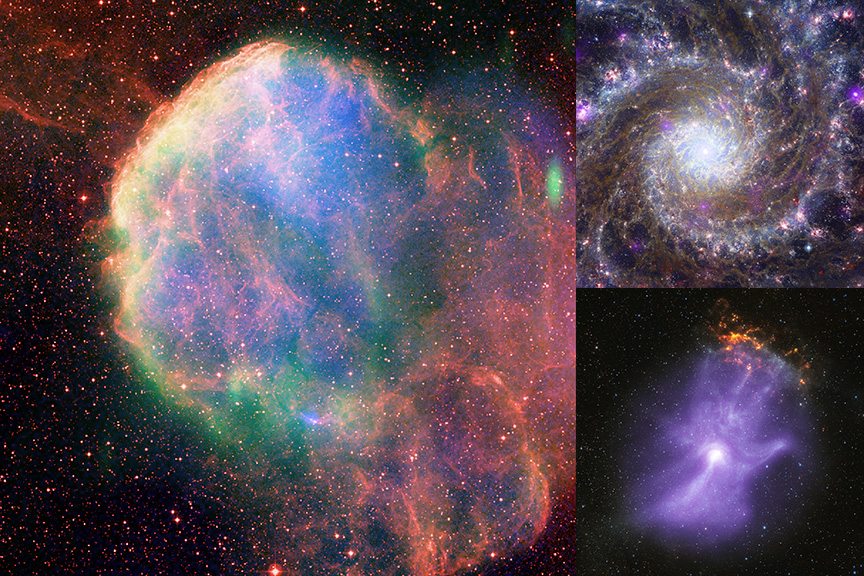
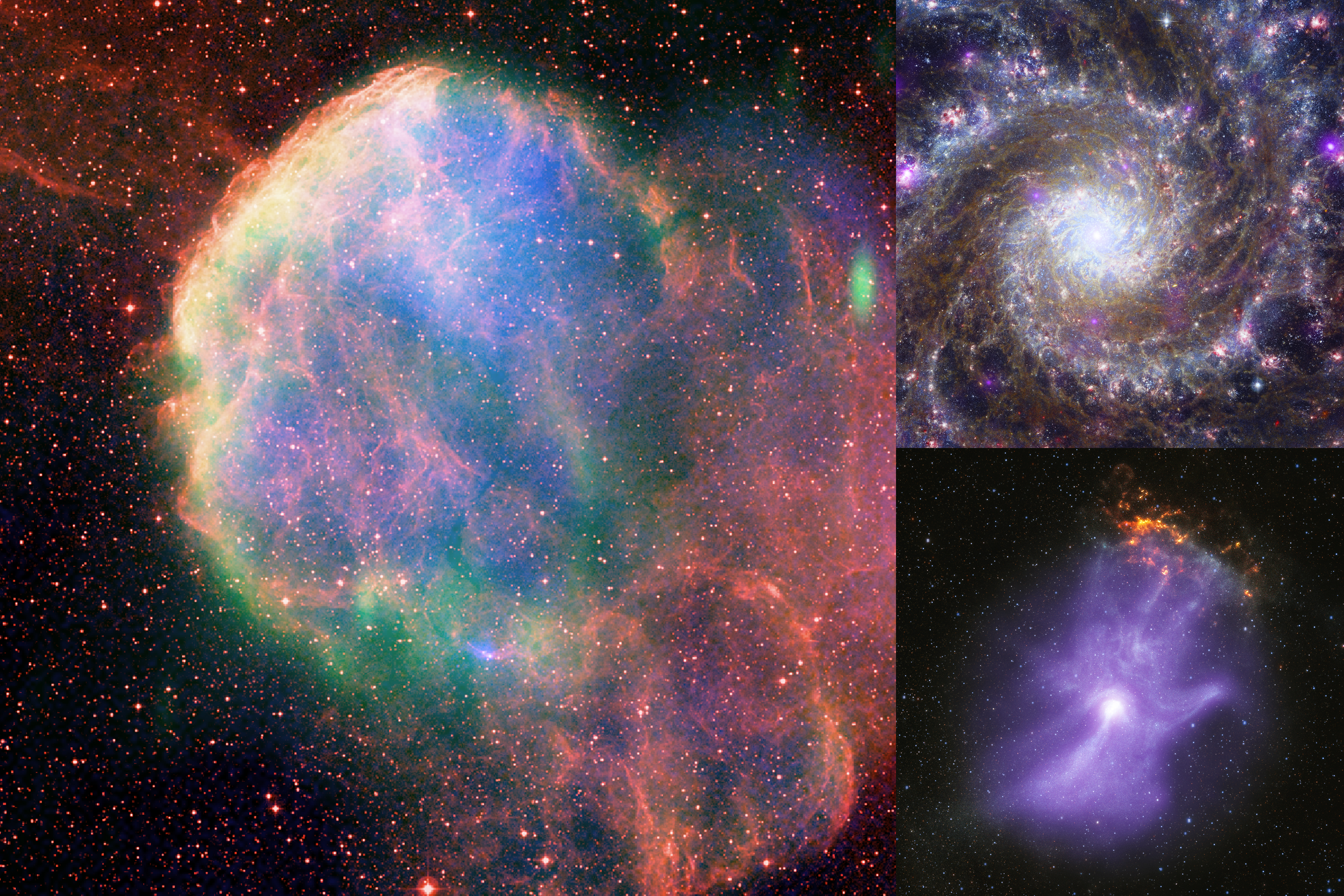
Three new sonifications of images from NASA’s Chandra X-ray Observatory and other telescopes have been released. This work is also being featured in a new NASA+ documentary, "Listen to the Universe."

Sonification is the process of translating data into sounds. In the case of Chandra and other telescopes, scientific data are collected from space as digital signals that are commonly turned into visual imagery. The sonification project takes these data through another step of mapping the information into sound.


IC 443 (Jellyfish Nebula)
(above)

IC 443 is a supernova remnant, or the debris of an exploded star, which astronomers have nicknamed the Jellyfish Nebula. A visual composite image of IC 443 includes X-rays from NASA’s Chandra X-ray Observatory and German ROSAT X-ray telescope (blue) along with radio data from the NSF’s Very Large Array (green) and optical data from the Digitized Sky Survey (red). The sonification of IC 443 begins with a top-down scan as the brightness of the data is correlated to the volume of the sound. The sounds are mapped to colors in the image with red light being heard as lower pitches, the green as medium, and the blue light as the higher pitches. This creates notes that sweep up and down in pitch continuously. Several colors are isolated and control the volume of sustained tones with red controlling the lowest note and white controlling the highest note. The background stars in the optical image have been converted to water drop sounds in the sonification.


M74 (Phantom Galaxy):


SonificationMessier 74 is a spiral galaxy like our Milky Way, which is seen face-on from Earth’s vantage point some 32 million light-years away. X-rays from Chandra (purple) have been combined with an infrared view of M74 from NASA’s James Webb Space Telescope (green, yellow, red, and magenta) as well as optical data from NASA’s Hubble Space Telescope (orange, cyan, and blue). In sonifying these data, a clockwise-moving radar-like scan starts around 12 o’clock. The distance from the center controls the frequencies of sound with light farther from the center being higher pitched. The Chandra sources correspond to relatively high musical pitches of glassy ethereal and clear plucked sounds. In the Webb data, large, medium, and small features are represented by low, medium, and high frequency ranges of pitches respectively with the brightest stars being heard as percussive sounds. The Hubble data have been turned into breathy synthesizer sounds along with thin metallic plucked sounds for bright stars and clusters.


MSH 15-52 / PSR B1509-58:


The third new sonification is of MSH 15-52, a cloud of energized particles blown away from a dead, collapsed star. This image includes X-rays from the Imaging X-ray Polarimetry Explorer, or IXPE, (purple) as well as Chandra (orange, green, and blue). These data have been combined with infrared data from the Dark Energy Plane Survey 2 (red and blue). In sound, the scan goes from the bottom to the top. The brightness of the Chandra data of the cloud have been converted into rough string-like sounds, while the blast wave is represented by a range of pitches of firework-type noises. The IXPE data are heard as wind-like sounds. The infrared data are mapped to musical pitches of a synthesizer sound. The light curve, or brightness over time, from the dead star’s collapsed core is heard in pulses that occur almost 7 times every second as it does in the original data.

These sonifications were led by the Chandra X-ray Center (CXC) and included as part of NASA's Universe of Learning (UoL) program. The collaboration was driven by visualization scientist Kimberly Arcand (CXC), astrophysicist Matt Russo, and musician Andrew Santaguida, (both of the SYSTEM Sounds project), along with consultant Christine Malec.

NASA's Marshall Space Flight Center manages the Chandra program. The Smithsonian Astrophysical Observatory's Chandra X-ray Center controls science from Cambridge Massachusetts and flight operations from Burlington, Massachusetts. NASA's Universe of Learning materials are based upon work supported by NASA under cooperative agreement award number NNX16AC65A to the Space Telescope Science Institute, working in partnership with Caltech/IPAC, Center for Astrophysics | Harvard & Smithsonian, and the Jet Propulsion Laboratory.


Visual Description:

The first image in this release is the Jellyfish Nebula, also called IC 443. This supernova remnant is shaped like a huge, colorful bubble containing shades of pink, blue, red, and green. Cloud-like structures, both inside the bubble and stretching outside of the bubble to our right and upper left, are filamentary in nature, as if fingers pulled at the edges of a cotton ball. Stars, seen as red dots, are flecked across the entire image.

The second image is Messier 74, a spiral galaxy like our own Milky Way. Seen face-on from our vantage point on Earth, the galaxy's sparkling arms spiral out from a bright white core. The core appears vibrant and alive, and crackles with lightning-like, pale blue light. Glowing, high-energy stars in purple, white, and orange, dot the lengths of the spiraling arms. Webs of murky dust crisscross the space between the curving silver blue arms, also known as dust lanes.

The last image is MSH 15-52, a pulsar wind nebula, which strongly resembles a ghostly purple hand with sparkling fingertips. A pulsar is a highly magnetized collapsed star that rotates and creates jets of matter flowing away from its poles. These jets, along with intense winds of particles, form pulsar wind nebulae. Here, the pulsar wind nebula known as MSH 15-52 resembles a hazy purple cloud set against a black, starry backdrop.

The shape of this pulsar wind nebula strongly resembles a human hand, including five fingers, a palm and wrist. The bright white spot near the base of the palm is the pulsar itself. The three longest fingertips of the hand shape point toward our upper right, or 1:00 on a clock face. There, a small, mottled, orange and yellow cloud appears to sparkle or glow like embers. This orange cloud is part of the remains of the supernova explosion that created the pulsar. The backdrop of stars was captured in infrared light.


Fast Facts for IC 443 (Jellyfish Nebula):

Credit: Chandra X-ray: NASA/CXC/B.Gaensler et al; ROSAT X-ray: NASA/ROSAT/Asaoka & Aschenbach; Radio Wide: NRC/DRAO/D.Leahy; Optical: DSS; Sonification: NASA/CXC/SAO/K.Arcand, SYSTEM Sounds (M. Russo, A. Santaguida)

About the Sound

Top-down scan with brightness controlling volume
Colors appearing in the nebula are mapped to sound in two ways.
Redder light is mapped to lower pitches while bluer light is mapped to higher pitches. This creates notes that sweep up and down in pitch continuously.
Several colors are isolated and control the volume of sustained tones with red controlling the lowest note and white controlling the highest note.
Background stars are converted to water drop sounds. The brightness of each star is mapped to volume and pitch and reverb is controlled by the brightness of the nebula in front of them.

Scale: The image is about 46.5 arcmin across (66 light-years across)
Category: Neutron Stars/X-ray Binaries, Supernovas & Supernova Remnants
Coordinates (J2000): RA 06h 17m 05.20s | Dec +22° 21´ 26.70"
Constellation: Gemini
Observation Date: January 12, 2005
Observation Time: 11 hours
Obs. ID: 5531
Instrument: ACIS
References: B. Gaensler et al. 2006, arXiv: astro-ph/0601304v2
Color Code: X-ray: blue; Radio: green; Optical: red
Distance Estimate: About 5,000 light-years


Fast Facts for M74 (Phantom Galaxy):

Credit: X-ray: NASA/CXC/SAO; Optical: ESA/Hubble & NASA; IR: ESA/Webb, NASA & CSA, J. Lee and the PHANGS-JWST Team; Image Processing: N. Wolk and K. Arcand; Sonification: NASA/CXC/SAO/K.Arcand, SYSTEM Sounds (M. Russo, A. Santaguida)

About the Sound:

Radar-like scan, clockwise from 12:00.
Brightness is mapped to volume and the distance from the center is mapped to pitch is various ways (farther from the center is higher pitched).

Binaural panning moves the apparent position of the sound clockwise around the listener’s head.

Infrared (JWST)

Distance from the center controls the pitch with large, medium, and small scale features mapped to low, med, and high ranges of frequencies.
Bright stars appearing red are accompanied by a percussive sound.

Optical (HST)

The distance from the center is mapped to musical pitches of a breathy synth sound.
Bright stars and clusters are rendered as thin plucked sounds.

X-ray (Chandra)

The distance from the center is mapped to high musical pitches of a glassy ethereal sound.
Compact sources are rendered as high musical pitches of a clear plucked sound.

Scale: Image is about 3.4 arcmin (32,000 light-years) across
Category: Normal Galaxies & Starburst Galaxies
Coordinates (J2000): RA 1h 36m 42s | Dec +15° 47´ 01"
Constellation: Pisces
Observation Date: 13 observations from Jun 2001-Nov 2019
Observation Time: 81 hours 48 minutes (3 days 9 hours 48 minutes)
Obs. ID: 2057, 2058, 4753, 4854, 14801, 16000-16003, 16484, 16485, 20333, 21000
Instrument: ACIS
Color Code: X-ray: purple; Optical: orange, cyan, blue, IR: green, yellow, red, magenta
Distance Estimate: About 32 million light-years


Fast Facts for MSH 15-52 / PSR B1509-58:

Credit: X-ray: NASA/CXC/Stanford Univ./R. Romani et al. (Chandra); NASA/MSFC (IXPE); Infrared: NASA/JPL-Caltech/DECaPS; Image Processing: NASA/CXC/SAO/J. Schmidt; Sonification: NASA/CXC/SAO/K.Arcand, SYSTEM Sounds (M. Russo, A. Santaguida)

About the Sound

Bottom to top scan with brightness converted to audio frequency and volume using various techniques.
Horizontal position in the image is reflected in the stereo position of the sound.
Chandra (X-ray)

Brightness of pulsar nebula mapped to musical pitch on a rough string-like sound.
Brightness of blastwave emission mapped to pitch of affected fireworks sounds.

IXPE (X-ray)

Brightness mapped to continuous audio frequencies producing a wind-like sound.

DECAPS

The brightness of stars is mapped to musical pitches with a dreamy percussive synthesizer sound.

Pulsar Lightcurve

The composite includes a real-time sonification of the central pulsar’s X-ray emission (NuSTAR) which exhibits pulses 6.67 times every second. Its volume is loudest as the scanning line passes the pulsar itself.

Scale: Image is about 20 arcmin (93 light-years) across
Category: Supernovas & Supernova Remnants, Neutron Stars/X-ray Binaries
Coordinates (J2000): RA 15h 13m 55.52s | Dec -59° 08´ 08.8"
Constellation: Circinus
Observation Date: 10 pointings between 14 Aug 2000 and 19 June 2008
Observation Time: 93 hours 50 minutes (3 days 21 hours 50 minutes)
Obs. ID: 754, 3833, 3834, 4384, 5534, 5535, 5562, 6116, 6117, 9138
Instrument: ACIS
References: Romani, R. et al., ApJ, 2023; arXiv:2309.16067
Color Code: X-ray: orange, green, blue (Chandra), purple (IXPE); Infrared: red, blue
Distance Estimate: About 16,000 light-years