Showing posts with label NGC 628. Show all posts

Sunday, November 03, 2024

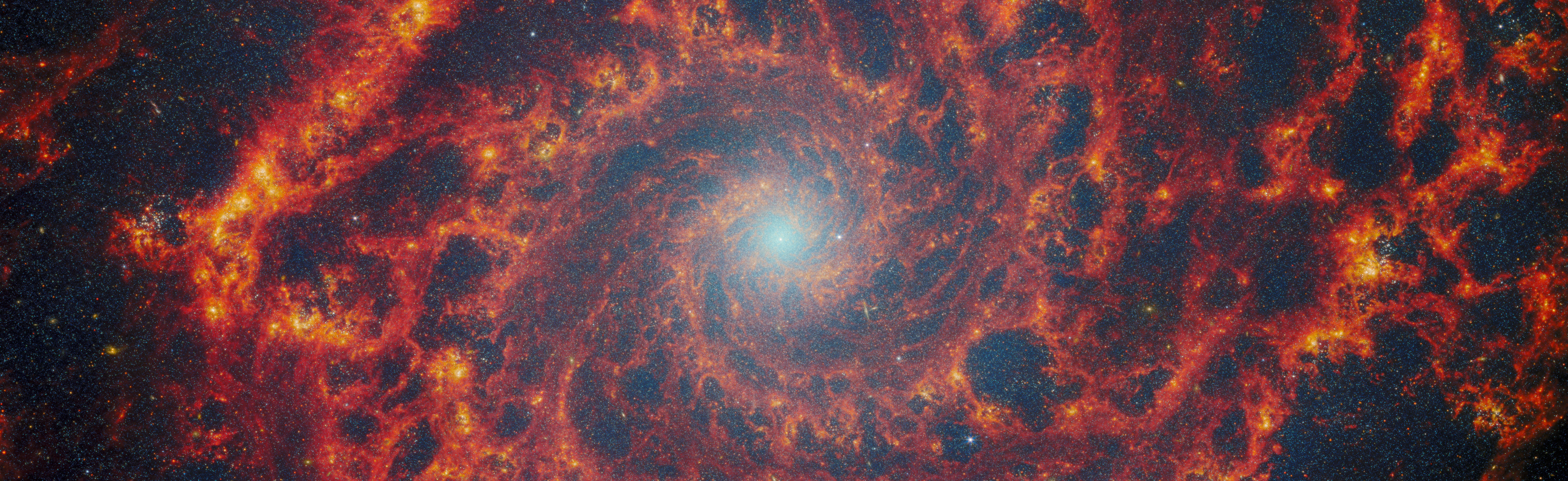
Catching the edge of the Phantom Galaxy (NIRCam and MIRI image)

A large spiral galaxy takes up the entirety of the image. The core is mostly bright white, but there are also swirling, detailed structures that resemble water circling a drain. There is small white and pale blue light that emanates from stars and dust at the core’s centre, but it is tightly limited to the core. The rings feature colours of deep red and orange and highlight filaments of dust around cavernous black bubbles.

In August 2022, to mark the launch of the Picture of the Month series, ESA/Webb published a stunning image of the Phantom Galaxy (also known as M74 and NGC 628). Now, this series is revisiting the target to feature new data on this iconic spiral galaxy.

M74 resides around 32 million light-years away from Earth in the constellation Pisces, and lies almost face-on to Earth. This, coupled with its well-defined spiral arms, makes it a favourite target for astronomers studying the origin and structure of galactic spirals.

This image features data from two of Webb’s instruments: MIRI (Mid-InfraRed Instrument) and NIRCam (Near-InfraRed Camera). Observations in the infrared reveal the galaxy’s creeping tendrils of gas, dust and stars. In this image the dark red regions trace the filamentary warm dust permeating the galaxy. The red regions show the reprocessed light from complex molecules forming on dust grains, while orange and yellow colours reveal the regions of gas ionised by the recently formed star clusters. Stellar feedback has a dramatic effect on the medium within the galaxy and creates a complex network of bright knots as well as cavernous black bubbles. The lack of gas in the nuclear region of this galaxy also provides an unobscured view of the nuclear star cluster at the galaxy's centre. M74 is a particular class of spiral galaxy known as a ‘grand design spiral’, meaning that its spiral arms are prominent and well-defined, unlike the patchy and ragged structure seen in some spiral galaxies.

M74 was observed by Webb as part of a series of observations collectively entitled Feedback in Emerging extrAgalactic Star clusTers, or FEAST (PI: A. Adamo). Many other targets of the FEAST programme, including NGC 4449, M51, and M83, were the subjects of previous ESA/Webb Picture of the Month images in 2023 and 2024. The FEAST observations were designed to shed light on the interplay between stellar feedback and star formation in environments outside the Milky Way galaxy. Stellar feedback is the term used to describe the outpouring of energy from stars into the environments which form them, and is a process that contributes significantly to determining the rates at which stars form. Understanding stellar feedback is vital for building accurate universal models of star formation.

The new Webb data obtained by the FEAST team has allowed scientists to look at the stellar nurseries in galaxies that are many light years away. Astronomers are learning how other galaxies are forming stars and how stars actively participate to model the galaxy interstellar medium. They have found that newly born stars slowly carve they gas and dust nurseries modifying the morphological appearance and essentially destructing them, as Webb has shown that this evolution is connected with star clusters. Furthermore, the team has concluded from their studies that the spiral arms captured by the extended coverage of the FEAST programme are the places where stars are forming more actively in the galaxy. The brighter and larger complexes of stellar nurseries are in the spiral arms fully captured by the new Webb data. The telescope is now revealing the map of hydrogen emission lines in the near-infrared. These lines are less affected than the dusts and reveals the places where new massive stars have just formed.

Links

Wednesday, January 16, 2019

What 100,000 Star Factories in 74 Galaxies Tell Us about Star Formation across the Universe

 
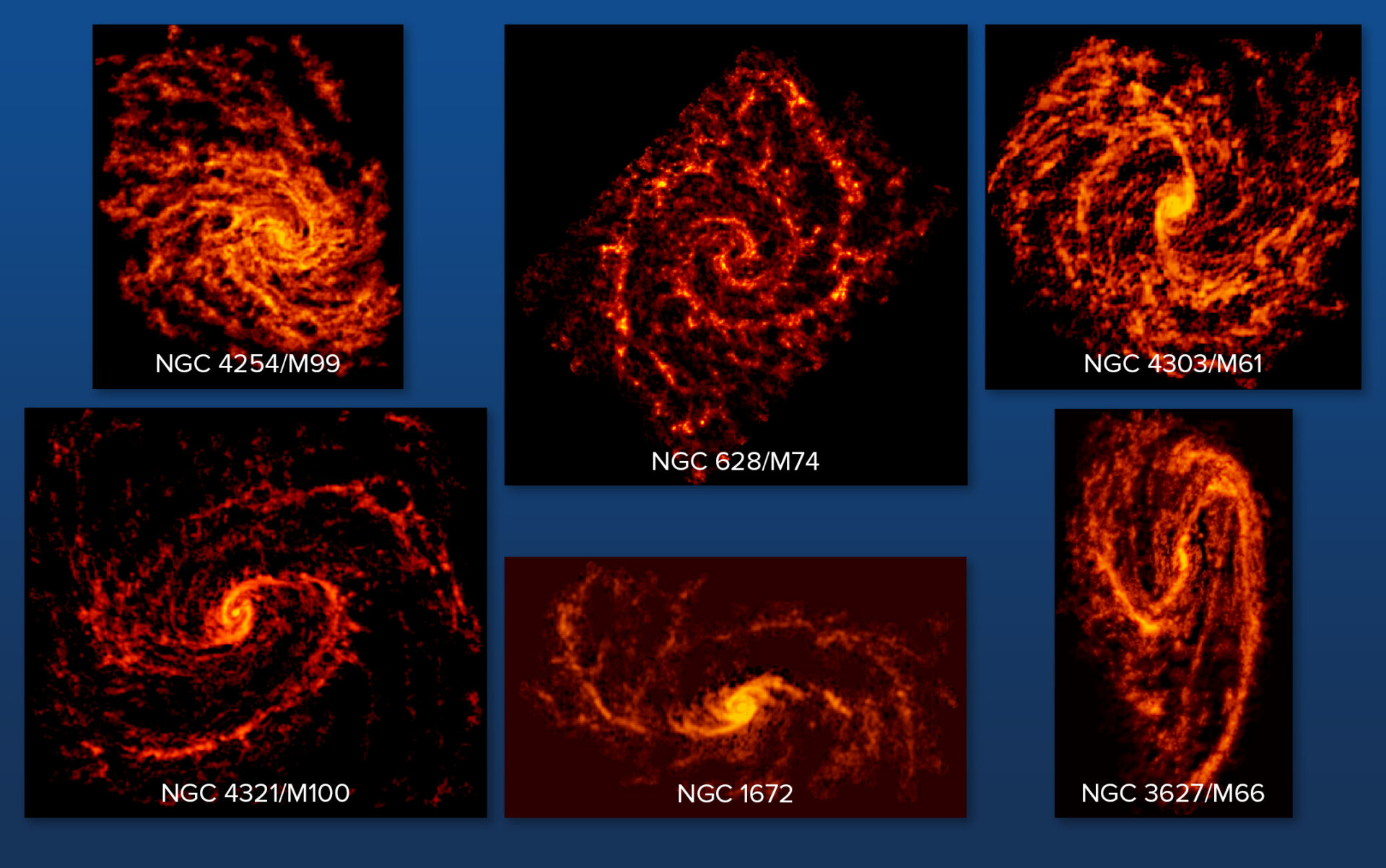
Six ALMA-imaged galaxies out of a collection of the 74. The images were taken as part of the PHANGS-ALMA survey to study the properties of star-forming clouds in disk galaxies. Credit: ALMA (ESO/NAOJ/NRAO); NRAO/AUI/NSF, B. Saxton. Hi-res image

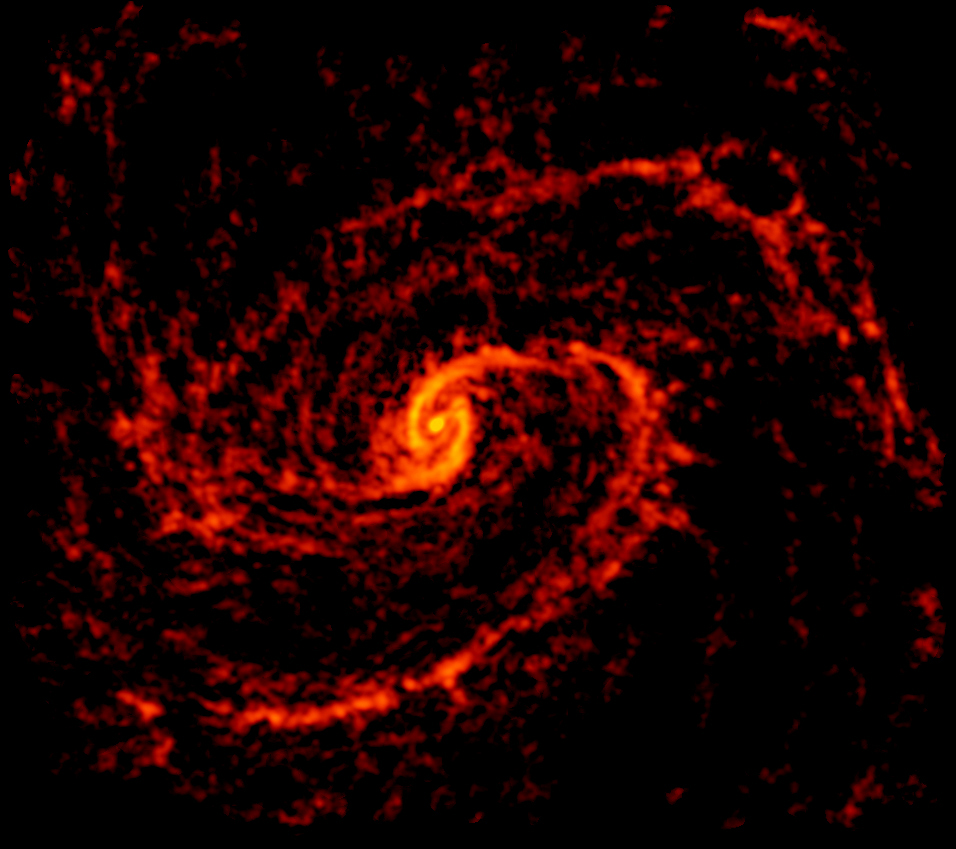
ALMA image of galaxy NGC 4321, also known as Messier 100, an intermediate spiral galaxy located about 55 million light-years from Earth in the constellation Coma Berenices. It is imaged as part of the PHANGS-ALMA survey to study the properties of star-forming clouds in disk galaxies. Credit: ALMA (ESO/NAOJ/NRAO); NRAO/AUI/NSF, B. Saxton. Hi-res image

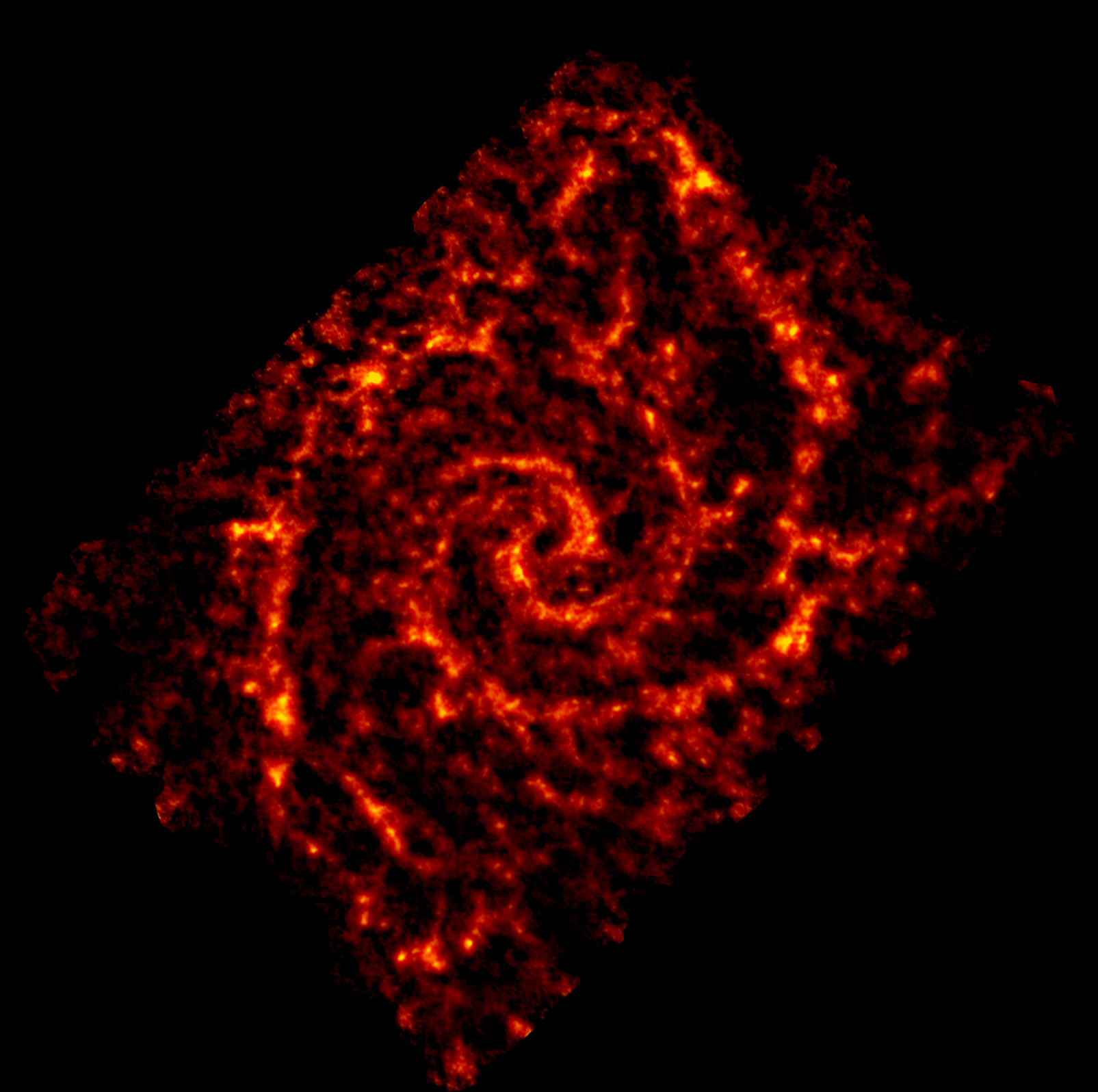
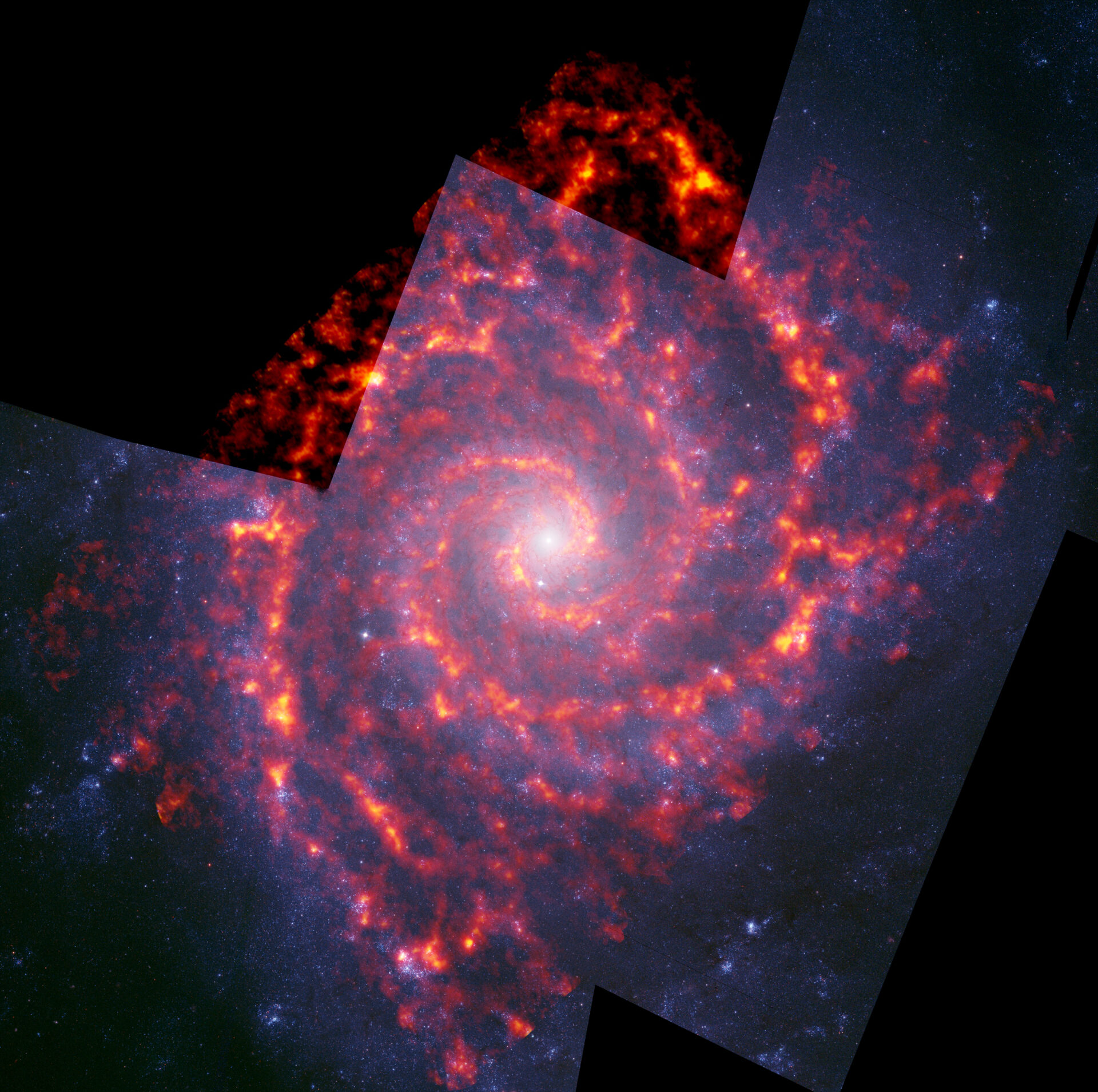
ALMA image of NGC 628, also known as Messier 74, a spiral galaxy in the constellation Pisces, located approximately 32 million light-years from Earth. It is imaged as part of the PHANGS-ALMA survey to study the properties of star-forming clouds in disk galaxies. Credit: ALMA (ESO/NAOJ/NRAO); NRAO/AUI/NSF, B. Saxton. Hi-res image

Composite ALMA (orange) and Hubble (blue) image of NGC 628, also known as Messier 74, a spiral galaxy in the constellation Pisces, located approximately 32 million light-years from Earth. It is imaged as part of the PHANGS-ALMA survey to study the properties of star-forming clouds in disk galaxies. Credit: NRAO/AUI/NSF, B. Saxton: ALMA (ESO/NAOJ/NRAO); NASA/Hubble. Hi-res image


Galaxies come in a wide variety of shapes and sizes. Some of the most significant differences among galaxies, however, relate to where and how they form new stars. Compelling research to explain these differences has been elusive, but that is about to change. The Atacama Large Millimeter/submillimeter Array (ALMA) is conducting an unprecedented survey of nearby disk galaxies to study their stellar nurseries. With it, astronomers are beginning to unravel the complex and as-yet poorly understood relationship between star-forming clouds and their host galaxies.

A vast, new research project with ALMA, known as PHANGS-ALMA (Physics at High Angular Resolution in Nearby GalaxieS), delves into this question with far greater power and precision than ever before by measuring the demographics and characteristics of a staggering 100,000 individual stellar nurseries spread throughout 74 galaxies.

PHANGS-ALMA, an unprecedented and ongoing research campaign, has already amassed a total of 750 hours of observations and given astronomers a much clearer understanding of how the cycle of star formation changes, depending on the size, age, and internal dynamics of each individual galaxy. This campaign is ten- to one-hundred-times more powerful (depending on your parameters) than any prior survey of its kind.

“Some galaxies are furiously bursting with new stars while others have long ago used up most of their fuel for star formation. The origin of this diversity may very likely lie in the properties of the stellar nurseries themselves,” said Erik Rosolowsky, an astronomer at the University of Alberta in Canada and a co-Principal Investigator of the PHANGS-ALMA research team.

He presented initial findings of this research at the 233rd meeting of the American Astronomical Society being held this week in Seattle, Washington. Several papers based on this campaign have also been published in the Astrophysical Journal and the Astrophysical Journal Letters. 

“Previous observations with earlier generations of radio telescopes provide some crucial insights about the nature of cold, dense stellar nurseries,” Rosolowsky said. “These observations, however, lacked the sensitivity, fine-scale resolution, and power to study the entire breadth of stellar nurseries across the full population of local galaxies. This severely limited our ability to connect the behavior or properties of individual stellar nurseries to the properties of the galaxies that they live in.”

For decades, astronomers have speculated that there are fundamental differences in the way disk galaxies of various sizes convert hydrogen into new stars. Some astronomers theorize that larger, and generally older galaxies, are not as efficient at stellar production as their smaller cousins. The most logical explanation would be that these big galaxies have less efficient stellar nurseries. But testing this idea with observations has been difficult.

For the first time, ALMA is allowing astronomers to conduct the necessary wide-ranging census to determine how the large-scale properties (size, motion, etc.) of a galaxy influence the cycle of star formation on the scale of individual molecular clouds. These clouds are only about a few tens to a few hundreds of light-years across, which is phenomenally small on the scale of an entire galaxy, especially when seen from millions of light-years away.

“Stars form more efficiently in some galaxies than others, but the dearth of high-resolution, cloud-scale observations meant our theories were weakly tested, which is why these ALMA observations are so critical,” said Adam Leroy, an astronomer at The Ohio State University and co-Principal Investigator on the PHANGS-ALMA team.

Part of the mystery of star formation, the astronomers note, has to do with the interstellar medium – all the matter and energy that fills the space between the stars.

Astronomers understand that there is an ongoing feedback loop in and around the stellar nurseries. Within these clouds, pockets of dense gas collapse and form stars, which disrupts the interstellar medium.

“Indeed, comparing early PHANGS observations with the locations of newly formed stars shows that the newly formed stars quickly destroy their birth clouds,” said Rosolowsky. “The PHANGS team is studying how this disruption plays out in different types of galaxies, which may be a key factor in star-forming efficiency.”

For this research, ALMA is observing molecules of carbon monoxide (CO) from all relatively massive, generally face-on spiral galaxies visible from the Southern Hemisphere. Molecules of CO naturally emit the millimeter-wavelength light that ALMA can detect. They are particularly effective at highlighting the location of star-forming clouds.

“ALMA is a stunningly efficient machine to map carbon monoxide over large areas in nearby galaxies,” said Leroy. “It was able to perform this survey because of the combined power of the 12-meter dishes, which study fine-scale features, and the smaller, 7-meter dishes at the center of the array, which are sensitive to large-scale features, essentially filling in the gaps.”

A companion survey, PHANGS-MUSE, is using the Very Large Telescope to obtain optical imaging of the first 19 galaxies observed by ALMA. MUSE stands for the Multi-Unit Spectroscopic Explorer. Another survey, PHANGS-HST uses the Hubble Space Telescope to survey 38 of these galaxies to find their youngest stellar clusters. Together, these three surveys give a startlingly complete picture of how well galaxies form stars by probing cold molecular gas, its motion, the location of ionized gas (regions where stars are already forming), and the galaxies’ complete stellar populations.

“In astronomy, we have no ability to watch the cosmos change over time; the timescales simply dwarf human existence,” noted Rosolowsky. “We can’t watch one object forever, but we can observe hundreds of thousands of star-forming clouds in galaxies of different sizes and ages to infer how galactic evolution works. That is the real value of the PHANGS-ALMA campaign.”

“We also look at thousands to tens of thousands of star-forming regions within each galaxy, catching them across their life cycle. This lets us build a picture of the birth and death of stellar nurseries across galaxies, something almost impossible before ALMA,” added Leroy.

So far, PHANGS-ALMA has studied about 100,000 Orion Nebula-like objects in the nearby universe. It is expected that the campaign will eventually observe around 300,000 star-forming regions.


Additional Information

These results are being published in a series of papers in the Astrophysical Journal and the Astrophysical Journal Letters. Already accepted and published:

“Cloud-scale Molecular Gas Properties in 15 Nearby Galaxies,” J. Sun, et al., 2018 June. 25, Astrophysical Journal [http://iopscience.iop.org/article/10.3847/1538-4357/aac326]

“Star Formation Efficiency per Free-fall Time in nearby Galaxies,” D. Utomo, et al., 2018 July 11, Astrophysical Journal Letters [http://iopscience.iop.org/article/10.3847/2041-8213/aacf8f/meta]

“A 50 pc Scale View of Star Formation Efficiency across NGC 628,” K. Kreckel, et al., 2018 August 14, Astrophysical Journal Letters [http://iopscience.iop.org/article/10.3847/2041-8213/aad77d]

The Atacama Large Millimeter/submillimeter Array (ALMA), an international astronomy facility, is a partnership of the European Southern Observatory (ESO), the U.S. National Science Foundation (NSF) and the National Institutes of Natural Sciences (NINS) of Japan in cooperation with the Republic of Chile. ALMA is funded by ESO on behalf of its Member States, by NSF in cooperation with the National Research Council of Canada (NRC) and the Ministry of Science and Technology (MOST) in Taiwan and by NINS in cooperation with the Academia Sinica (AS) in Taiwan and the Korea Astronomy and Space Science Institute (KASI).

ALMA construction and operations are led by ESO on behalf of its Member States; by the National Radio Astronomy Observatory (NRAO), managed by Associated Universities, Inc. (AUI), on behalf of North America; and by the National Astronomical Observatory of Japan (NAOJ) on behalf of East Asia. The Joint ALMA Observatory (JAO) provides the unified leadership and management of the construction, commissioning and operation of ALMA.


Contacts

Nicolás Lira
Education and Public Outreach Coordinator
Joint ALMA Observatory, Santiago - Chile
Phone: +56 2 2467 6519
Cell phone: +56 9 9445 7726
Email: nicolas.lira@alma.cl

Charles E. Blue
Public Information Officer
National Radio Astronomy Observatory Charlottesville, Virginia - USA
Phone: +1 434 296 0314
Cell phone: +1 202 236 6324
Email: cblue@nrao.edu

Calum Turner
ESO Assistant Public Information Officer
Garching bei München, Germany
Phone: +49 89 3200 6670
Email: calum.turner@eso.org

Masaaki Hiramatsu
Education and Public Outreach Officer, NAOJ Chile
Observatory
, Tokyo - Japan
Phone: +81 422 34 3630
Email: hiramatsu.masaaki@nao.ac.jp


Tuesday, November 03, 2015

The Distribution of Atomic Hydrogen in Simulated Galaxies

In simulated galaxies of the hydrodynamical cosmological “EAGLE” simulation the distribution of atomic hydrogen agrees with observations in unprecedented detail. This success means that EAGLE can aid astrophysicists to better understand the processes shaping real galaxies, such as the origin of their atomic hydrogen. EAGLE is not quite perfect, however: the study also found that some simulated galaxies contain unphysically large holes in their atomic hydrogen discs, meaning further work for simulators to improve the models underlying the treatment of supernova explosions and the interstellar matter.


Atomic hydrogen (abbreviated as “H I”) is an important component of galaxies, it is believed to feed the dense ‘interstellar matter’ from which stars can form. Although invisible to optical telescopes, astronomers have been able to make ever more accurate observations of this gas component using radio telescopes: this has revealed, for instance, that galaxies with the same stellar mass can differ in their H I content by more than an order of magnitude. By combining several radio antennas into one `supertelescope’ with the aid of interferometry it has also become possible to create high resolution maps showing the distribution of atomic hydrogen within individual galaxies (for an example, see Fig. 1).

But despite this wealth of observational data, astronomers are still puzzled by the question of why some galaxies contain so much more H I than others, and especially why `normal’ and `H I-rich’ galaxies still appear to follow common relations, as shown recently by the MPA-led “Bluedisk” project (see monthly highlights May 2013 and March 2014). A fundamental problem is that galaxies only evolve over periods of many millions of years, so that it is impossible to directly observe how the H I reservoir is built up. Instead, astronomers have to try and answer this question with the aid of models and simulations.


Fig. 2:  Gas in the large EAGLE simulation. Blue represents “cold” gas (T greater then 30,000 K), green warm, and red the hottest gas with T > 300,000 K. The small insets zoom in towards a single galaxy, highlighting the huge dynamic range of the simulation. © Richard Bower / James Trayford, ICC Durham


An international collaboration has recently completed the “EAGLE” simulation of galaxies which matches observed galaxies in several properties such as their stellar mass and size with unprecedented accuracy (see Fig. 2). A research team led by MPA scientist Yannick Bahe has now studied how well these simulated galaxies agree with real ones in terms of their atomic hydrogen content: an important test for the simulation model, which also determines whether EAGLE can give trustworthy clues on the evolution of H I in real galaxies.

To make this comparison, the scientists first had to post-process the simulation and calculate how much of the hydrogen in each simulation particle is actually atomic, i.e. not ionised or molecular. Once this was done, the total mass of H I in over 2000 simulated galaxies could be computed and compared to observational data from the “GASS” project. The resulting match between simulation and data is extremely good: it represents a significant improvement compared to previous simulations and indicates that the models used in EAGLE provide a reasonable description of the physical processes involved in forming galaxies.

Fig. 3:  The surface density of atomic hydrogen, plotted against distance from the galaxy centre. Yellow and blue bands show data from the “Bluedisk” project, comparing galaxies with normal (yellow) and exceptionally high (blue) total atomic hydrogen content. Red and green circles show simulated galaxies from EAGLE in the same categories. © MPA

 
Motivated by this initial success, the scientists tested the EAGLE simulations in more detail by comparing not just the total mass of H I, but also its distribution within galaxies to observations. The above-mentioned “Bluedisk” project has shown that this distribution is surprisingly independent of the total mass of H I as long as the galaxies’ H I discs are scaled to a common size (so called “self-similarity”). For an accurate comparison, the team now ‘observed’ the EAGLE galaxies in the same way as was done in Bluedisk. As can be seen in Fig. 3, both agree surprisingly well: EAGLE reproduces both the self-similarity between ‘normal’ and ‘H I-rich’ galaxies (red and green symbols in Fig. 3) and the detailed shape of the surface density profile – at least in the outer parts of the simulated galaxies.

In the central regions, however, EAGLE galaxies typically contain not enough atomic hydrogen. To test this discrepancy further, the scientists inspected more than 2000 images of the simulated galaxies, which finally gave the crucial clue: many simulated galaxies contain ‘holes’ in their hydrogen discs that are much larger than what is seen in observations. Once all simulated galaxies showing these large holes were excluded, the density profiles matched observations almost perfectly even in the centre.

Fig. 4:  Synthetic image showing atomic hydrogen in a simulated galaxy, in analogy to Fig. 1. 
Clearly visible are a number of large holes in the hydrogen disc. © MPA


Why, now, do some EAGLE galaxies contain these large holes? The scientists have not yet found a definitive answer, but it is likely that the way in which supernova explosions are modelled in the simulation plays a major role. This critical part of galaxy formation is still causing headaches for simulators: to include them in galaxy simulations in a fully self-consistent fashion, the resolution of the simulations would need to go up by many orders of magnitude. This will be, regrettably, impossible for a long time to come – even the biggest supercomputers today are just not big enough (see also highlight August 2015). As a result, EAGLE has to resort to using a highly simplified model for the effects of such supernovae. Another simplified model has to be employed for the dense interstellar matter, because a resolution level that would allow a fully self-consistent treatment can also not yet be achieved in simulations of a representative portion of the Universe. Although these simplified models produce galaxies which are realistic in many ways – such as their size – they do leave a noticeable artefact in some of the simulated hydrogen discs: the large holes discovered by the researchers.

It is therefore an important challenge for astrophysicists to optimise both the simulation codes and the models in such a way that – in conjunction with continually more powerful supercomputers – a self-consistent treatment of the dense interstellar medium can be achieved. Combined with improved supernova models, these future simulations will, hopefully, produce galaxies that match the real Universe even better than EAGLE does. However, the current study also demonstrates that EAGLE can already give valuable insight into the evolution of atomic hydrogen in galaxies. In a follow-up project, the researchers will examine the formation of the simulated galaxies to find out how and why some of them got so much more hydrogen than others.

 
Bahe, Yannick
Author: Bahe, Yannick