Saturday, August 17, 2024

A 5D Map of the Milky Way


Ready to be mesmerized by an elegant data visualization? You can now watch the endless, swirling trajectories of 170 million stars in our galaxy using a simple interactive tool. A team led by Joshua Speagle (沈佳士) from the University of Toronto used data from five surveys — the Panoramic Survey Telescope and Rapid Response System (Pan-STARRS), the Two Micron All Sky Survey (2MASS), the United Kingdom Infrared Telescope Infrared Deep Sky Survey (UKIDSS), the “unofficial” Wide-field Infrared Survey Explorer (unWISE), and the Gaia survey — to craft this visualization. In the image above, the color scale shows the tangential speed of stars within a certain distance bin, while the white streamlines show the stars’ tangential velocity. You can play around with the full visualization, which allows you to filter by distance and switch the color overlay between velocity, density, metallicity, and age. To learn more about the data selection process and the construction of the final star catalog, be sure to check out the full research article linked below.

By Kerry Hensley

Citation

“Mapping the Milky Way in 5D with 170 Million Stars,” Joshua S. Speagle et al 2024 ApJ 970 121. doi:10.3847/1538-4357/ad2b62

Friday, August 16, 2024

NASA Telescopes Work Out Black Hole's Snack Schedule

AT2018fyk
Credit Illustration: NASA/CXC/M. Weiss; Image: X-ray: NASA/SAO/Kavli Inst. at MIT/D.R. Pasham;
Optical: NSF/Legacy Survey/SDSS


By using new data from NASA’s Chandra X-ray Observatory and Neil Gehrels Swift Observatory as well as ESA’s XMM-Newton, a team of researchers have made important headway in understanding how — and when — a supermassive black hole obtains and then consumes material, as described in our latest press release.

This artist’s impression shows a star that has partially been disrupted by such a black hole in the system known as AT2018fyk. The supermassive black hole in AT2018fyk — with about 50 million times more mass than the sun — is in the center of a galaxy located about 860 million light-years from Earth.

Astronomers have determined that a star is on a highly elliptical orbit around the black hole in AT2018fyk so that its point of farthest approach from the black hole is much larger than its closest. During its closest approach, tidal forces from the black hole pull some material from the star, producing two tidal tails of “stellar debris”.

The illustration shows a point in the orbit soon after the star is partially destroyed, when the tidal tails are still in close proximity to the star. Later in the star's orbit, the disrupted material returns to the black hole and loses energy, leading to a large increase in X-ray brightness occurring later in the orbit (not shown here). This process repeats each time the star returns to its point of closest approach, which is approximately every 3.5 years. The illustration depicts the star during its second orbit, and the disk of X-ray emitting gas around the black hole that is produced as a byproduct of the first tidal encounter.

Researchers took note of AT2018fyk in 2018 when the optical ground-based survey ASAS-SN detected that the system had become much brighter. After observing it with NASA’s NICER and Chandra, and XMM-Newton, researchers determined that the surge in brightness came from a “tidal disruption event,” or TDE, which signals that a star was completely torn apart and partially ingested after flying too close to a black hole. Chandra data of AT2018fyk is shown in the inset of an optical image of a wider field-of-view.

X-ray and optical image of AT2018fyk
Credit: X-ray: NASA/SAO/Kavli Inst. at MIT/D.R. Pasham; Optical: NSF/Legacy Survey/SDSS

When material from the destroyed star approached close to the black hole, it got hotter and produced X-ray and ultraviolet (UV) light. These signals then faded, agreeing with the idea that nothing was left of the star for the black hole to digest.

However, about two years later, the X-ray and UV light from the galaxy got much brighter again. This meant, according to astronomers, that the star likely survived the initial gravitational grab by the black hole and then entered a highly elliptical orbit with the black hole. During its second close approach to the black hole, more material was pulled off and produced more X-ray and UV light.

Based on what they had learned about the star and its orbit, a team of astronomers predicted that the black hole’s second meal would end in August 2023 and applied for Chandra observing time to check. Chandra observations on August 14, 2023, indeed showed the telltale sign of the black hole feeding coming to an end with a sudden drop in X-rays. The researchers also obtained a better estimate of how long it takes the star to complete an orbit, and predicted future mealtimes for the black hole.

A paper describing these results appears in the August 14, 2024 issue of The Astrophysical Journal and is available online. The authors are Dheeraj Passam (Massachusetts Institute of Technology), Eric Coughlin (Syracuse University), Muryel Guolo (Johns Hopkins University), Thomas Wevers (Space Telescope Science Institute), Chris Nixon (University of Leeds, UK), Jason Hinkle (University of Hawaii at Manoa), and Ananaya Bandopadhyay (Syracuse).

NASA's Marshall Space Flight Center manages the Chandra program. The Smithsonian Astrophysical Observatory's Chandra X-ray Center controls science from Cambridge Massachusetts and flight operations from Burlington, Massachusetts.


Visual Description:

In this digital illustration, a star sheds stellar debris as it orbits a supermassive black hole. This artist’s impression represents the center of a galaxy about 860 million light-years from Earth.

The supermassive black hole sits at our upper left. It resembles an irregular, pitch-black sphere at the heart of an almond-shaped pocket of swirling sand and dirt. Though gritty in texture, the swirling brown and grey pocket is actually a disk of hot gas.

Near our lower right is the orbiting star. In this illustration, the star is relatively close to us, with the black hole far behind it. The star is a blue-white ball that, from this perspective, appears slightly larger than the distant black hole.

Two tapered streaks peel off of the glowing star like the pulled-back corners of a smile. These streaks represent tidal tails of stellar debris; material pulled from the surface of the star by the gravity of the black hole. This partial destruction of the star occurs every 3.5 years, when the star’s orbit brings it closest to the supermassive black hole.

During the orbit, the stellar debris from the tidal tails is ingested by the black hole. A byproduct of this digestion is the X-ray gas which swirls in a disk around the black hole.


Fast Facts for AT2018fyk:

Scale: Image is about 10 arcsec (42,000 light-years) across.
Category: Black Holes, Quasars & Active Galaxies
Coordinates (J2000): RA 22h 50m 16.1s | Dec -44° 51´ 53.5"
Constellation: Grus
Observation Dates: 2 observations, Oct 10-11, 2023
Observation Time: 14 hours 34 minutes
Obs. ID: 28294, 28972
Instrument: ACIS
References: Pasham, D. et al, 2024, ApJ Letters, Accepted. arXiv:2406.18124
Color Code: X-ray: purple; Optical: red, green, and blue
Distance Estimate: About 860 million light-years


Thursday, August 15, 2024

Primordial Black Holes Could Kick Out Stars and Replace Them.

This artist's illustration shows what primordial black holes might look like. In reality, the black holes would struggle to form accretion disks, as shown. Image Credit: NASA’s Goddard Space Flight Center

Primordial black holes formed during the earliest stages of the evolution of the universe. Their immense gravity may be playing havoc in stellar systems. They can transfer energy into wide binary systems disrupting their orbits. Like celestial bullies their disruption might lead to extreme outcomes though like the ejection of a star, only to be replaced by the black hole itself! A new paper studies the interactions of systems like these and looks at ways we might be able to detect them.

It’s been theorised that during the earliest moments after the Big Bang, black holes may have formed. They are not the result of supermassive stars having collapsed but instead have formed out of fluctuations in the density of matter. Regions with great density would simply collapse under their own gravitational influence forming what have been dubbed primordial black holes (PBHs). They are thought to vary in size from subatomic to some that are more massive than the Sun.

Whether primordial black holes really do account for dark matter in the universe is still up for debate. Among the astronomical community it is generally accepted that they cannot account for all dark matter but probably account for up to 10% of dark matter in the planetary mass range (10-7 to 10-3 solar masses.) Whether this is PBHs account for any of the dark matter in the universe requires further analysis.

Researchers are making progress mapping dark matter, but they don’t know what it is. This is a 3D density map of dark matter in the local universe, with the Milky Way marked by an X. Dots are galaxies, and the arrows indicate the directions of motion derived from the reconstructed gravitational potential of dark matter. Image Credit: Hong et al., doi: 10.3847/1538-4357/abf040.

If large scale is taken into account then PBHs are indistinguishable from a background of particle dark matter. At small scales the distribution of PBHs is not uniform across the universe relative to the background of particle dark matter and so we are forced to look for a unique and new theory. Observing PBHs to understand how close the model is to reality is difficult but it is possible to study their interactions with star systems.

In a paper published by Badal Bhalla from the University of Oklahoma and a team of astronomers they explore the way PBHs can lose energy when interacting with stellar binary systems. These interactions can result in any one of 5 possible outcomes;

1: Hardening – the two bound objects lose energy to the third free object causing their separation to decrease;

2: Softening – the free body transfers energy to the bound system causing their separation to increase but remain bound;

3: Disruption – the free body transfers enough energy to the bound system that the components become unbound and all objects continue unbound;

4: Capture – the bound objects capture the free object;

5: Exchange – the free object transfers enough energy to unbind one of the bound objects and in doing so loses sufficient energy to become bound to the remaining one.

Previous studies have explored softening and disruption in PBH and binary interactions as has the capture model. The team propose that hardening is also unlikely and so explore the possibility of the exchange model. They find that the exchange model should lead to a population of PBH binaries in the Milky Way and indeed some observations hint that they may exist. The team also suggest it may be possible to detect PBHs in binary systems with a sub-solar mass PBH by the properties of the system. Observations are now needed to validate the model. The discovery of black holes in a binary system may be detectable and go some way to support the findings.
 
 
Posted  by Mark Thompson


Wednesday, August 14, 2024

Scientist performs the first nonlinear study of black hole mimickers

Gravitational waves emitted from a black hole mimicker at the center. Brighter colors indicate higher amplitudes of the waves. The semi-circles expand over time as the waves propagate outward. Credit: Nils Siemonsen.


In recent research, a scientist from Princeton University has performed the first nonlinear study of the merger of a black hole mimicker, aiming to understand the nature of gravitational wave signals emitted by these objects, which could potentially help to identify black holes more accurately.

Black hole mimickers are hypothetical astronomical objects that mimic black holes, specifically in their gravitational wave signals and their effect on surrounding objects. However, they lack an event horizon, which is the point of no return.

The research was conducted by Nils Siemonsen, Associate Research Scholar at Princeton University, who spoke to Phys.org about his work.

"Black hole mimickers are objects remarkably close to black holes but lacking an event horizon. Observationally, we may be able to distinguish black holes from objects mimicking most of their properties using gravitational wave observations," he said.

The study, published in Physical Review Letters, focuses on a type of black hole mimicker called boson stars. The key to distinguishing them from black holes, according to Dr. Siemonsen, lies in the gravitational waves emitted when boson stars collide and merge.

Binary boson stars and mergers

Boson stars are one of the potential candidates for black hole mimickers, and as the name suggests, consist of bosons. Bosons are subatomic particles, like photons and the Higgs particle.

Boson stars consist of scalar bosons like the hypothetical axions, which are bosons with no spin, meaning they have no intrinsic angular momentum. The scalar fields of the particles form a gravitationally bound, stable configuration without needing strong interaction.

Previous research has shown that the merger of a binary boson star system leads to gravitational wave signals, which are ripples in spacetime caused by violent processes.

These signals are universally identical to that of a black hole ringdown (or the post-merger phase) independently of the black hole mimicker's internal structure.

The difference in the emitted gravitational wave signals is seen after a light-crossing time of the interior of the mimicker, which is the time taken by light to travel the diameter of the mimicker, which in this case is the boson star.

In the case of a black hole mimicker, this is characterized by repeated burst-like gravitational echoes.

In aiming to refine earlier research, Dr. Siemonsen sought to address issues like the lack of consideration for nonlinear gravitational effects and the exclusion of self-interactions among the matter of the object.

Nonlinear and self-consistent treatment of black hole mimickers

To address the limitations of the previous studies, Dr. Siemonsen used numerical simulations to solve the full Einstein-Klein-Gordon equations, which describe the evolution of scalar fields, such as those in boson stars.

For the merger, the study focused on large mass-ratio scenarios, i.e., the merger of a smaller boson star with a larger, more compact one, with the Klein-Gordon equations describing the head-on collision of the binary star system.

The Klein-Gordon equation, coupled with Einstein's field equations, which describe the gravitational dynamics, allows for the study of the self-consistent evolution of the system.

For solving the set of equations, Dr. Siemonsen used the Newton-Raphson relaxation technique with the fifth-order finite difference methods.

He explained the challenges with implementing these techniques: "Only under certain conditions does a black hole mimicker form from the merger of two boson stars. The region in the solution, where this occurs, is particularly challenging to simulate due to the large separation of scales."

To overcome these, methods like adaptive mesh refinement and very high resolution were used.

High frequency bursts

The simulations revealed that the gravitational wave signal of the ringdown contains a burst-like component with different properties, as previously believed, as well as a long-lived gravitational wave component.

"Neither of these components are present in a regular binary black hole merger and ringdown. This may guide future gravitational wave searches focusing on testing the black hole paradigm," explained Dr. Siemonsen.

However, the initial gravitational wave signal of a mimicker is similar to that of a rotating black hole, known as a Kerr black hole, as the primary (or larger) boson star becomes more compact and dense.


The study found that the timings of the bursts depend on the size of the smaller boson star involved in the merger.

Additionally, they found a long-lived component with a frequency comparable to what would be expected from a black hole, likely due to oscillations of the remnant object.

"Black holes settle down to their quiescent state over very short timescales. Black hole mimickers, on the other hand, are generically believed to re-emit some of the available energy at the merger in the form of gravitational waves during the latter's ringdown over relatively long timescales," explained Dr. Siemonsen.

Finally, the study revealed that the total energy emitted in the gravitational waves is significantly larger than expected from an equivalent black hole merger event.

Future work

The two components identified in the study could be used as a differentiator between a black hole merger remnant and a black hole mimicker.

"However, there are still many unanswered questions about properties of well-motivated black hole mimickers and their merger and ringdown dynamics," added Dr. Siemonsen.

Speaking of future work, he noted, "One interesting future direction is to consider a well-motivated black hole mimicker and understand its inspiral, merger, and ringdown dynamics in the context of a binary.

"Furthermore, analyzing the ringdown of these well-motivated mimickers using perturbative techniques and connecting these to nonlinear treatments is crucial to guide future tests of the black hole paradigm using gravitational wave observations."

by Tejasri Gururaj , Phys.org


More information: Nils Siemonsen, Nonlinear Treatment of a Black Hole Mimicker Ringdown, Physical Review Letters (2024). DOI: 10.1103/PhysRevLett.133.031401. On arXiv: DOI: 10.48550/arxiv.2404.14536

Tuesday, August 13, 2024

Tracking a Lone Star Speeding Across the Milky Way

Artist’s illustration of a hypothetical J1249+36-white dwarf binary pair that ends with the white dwarf exploding into a supernova (left), which sends its companion L subdwarf star flying out across the Milky Way. Credit: W. M. Keck Observatory/Adam Makarenko


Artist’s simulation of one possible explanation for CWISE J124909+362116.0’s speed. In this scenario, the L subdwarf may have been a part of a white dwarf binary system that ended with the white dwarf exploding into a supernova and ejecting the L subdwarf. Credit: W. M. Keck Observatory/ Adam Makarenko


Hawaiʻi telescopes investigate newly-discovered hypervelocity star spotted by citizen scientists

Maunakea and Haleakalā, Hawaiʻi – It may seem like the Sun is stationary while the planets in its orbit are moving, but the Sun is actually orbiting around the Milky Way galaxy at an impressive rate of about 220 kilometers per second — almost half a million miles per hour.

As swift as that may seem, when a faint red star was discovered moving even faster across the sky, clocking in at a speed of about 1.3 million miles per hour (600 kilometers per second), scientists took notice.

This rare stellar speedster is the first “hypervelocity” very low mass star found, thanks to the efforts of citizen scientists and a team of astronomers from around the country using several telescopes, including two in Hawaiʻi – W. M. Keck Observatory on Maunakea, Hawaiʻi Island and the University of Hawaiʻi Institute for Astronomy Pan-STARRS on Haleakalā, Maui. Located just 400 light-years from Earth, it is the nearest known hypervelocity star to us.

More remarkably, this star may be on an unusual trajectory that could cause it to leave the Milky Way altogether.

The research, led by University of California (UC) San Diego Professor of Astronomy and Astrophysics Adam Burgasser, has recently been accepted for publication in The Astrophysical Journal Letters and is available in preprint format on arXiv.org.

The star, named CWISE J124909+362116.0 (or “J1249+36” for short), was first spotted by some of the over 80,000 citizen science volunteers participating in the Backyard Worlds: Planet 9 project, who comb through enormous reams of data collected over the past 14 years by NASA’s Wide-field Infrared Survey Explorer (WISE) mission. This project capitalizes on the keen ability of humans, who are evolutionarily programmed to look for patterns and spot anomalies in a way that is unmatched by computer technology. Volunteers tag moving objects in data files and when enough volunteers tag the same object, astronomers investigate.

J1249+36 immediately stood out because it was moving at about .1 percent the speed of light.

“This is where the source became very interesting, as its speed and trajectory showed that it was moving fast enough to potentially escape the Milky Way,” says Burgasser.

To better understand the nature of this object, Burgasser turned to Keck Observatory’s Near-Infrared Echellette Spectrograph (NIRES) and measured its infrared spectrum. The data revealed the object was an L subdwarf — a class of stars with very low masses and cooler temperatures than our Sun. Subdwarfs represent the oldest stars in the Milky Way.

The team compared Keck Observatory’s insight into J1249+36’s composition with a new set of atmosphere models created by UC San Diego alumnus Roman Gerasimov, who worked with UC LEADS scholar Efrain Alvarado III to generate models specifically tuned to study L subdwarfs.

“It was exciting to see that our models were able to accurately match the spectrum obtained with Keck’s NIRES,” says Alvarado.

The spectral data, along with imaging data from Pan-STARRS and several other ground-based telescopes, allowed the team to accurately measure J1249+36’s position and velocity in space, and thereby predict its orbit through the Milky Way.

What gave this star a kick?

Researchers focused on two possible scenarios to explain J1249+36’s unusual trajectory.

In the first scenario, J1249+36 was originally the low-mass companion of a white dwarf. White dwarfs are the remnant cores of stars that have depleted their nuclear fuel and died out. When a stellar companion is in a very close orbit with a white dwarf, it can transfer mass, resulting in periodic outbursts called novae. If the white dwarf collects too much mass, it can collapse and explode as a supernova.

“In this kind of supernova, the white dwarf is completely destroyed, so its companion is released and flies off at whatever orbital speed it was originally moving, plus a little bit of a kick from the supernova explosion as well,” says Burgasser. “Our calculations show this scenario works. However, the white dwarf isn’t there anymore and the remnants of the explosion, which likely happened several million years ago, have already dissipated, so we don’t have definitive proof that this is its origin.”

In the second scenario, J1249+36 was originally a member of a globular cluster, a tightly bound cluster of stars, immediately recognizable by its distinct spherical shape. The centers of these clusters are predicted to contain black holes of a wide range of masses. These black holes can also form binaries, and such systems turn out to be great catapults for any stars that happen to wander too close to them.

“When a star encounters a black hole binary, the complex dynamics of this three-body interaction can toss that star right out of the globular cluster,” says Kyle Kremer, incoming Assistant Professor in UC San Diego’s Department of Astronomy and Astrophysics.

Kremer ran a series of simulations and found that on rare occasions these kinds of interactions can kick a low-mass subdwarf out of a globular cluster and on a trajectory similar to that observed for J1249+36.

“It demonstrates a proof of concept,” says Kremer, “but we don’t actually know what globular cluster this star is from.” Tracing J1249+36 back in time puts it in a very crowded part of the sky that may hide undiscovered clusters.

To determine whether either of these scenarios, or some other mechanism, can explain J1249+36’s trajectory, Burgasser said the team hopes to look more closely at its elemental composition. For example, when a white dwarf explodes, it creates heavy elements that could have “polluted” the atmosphere of J1249+36 as it was escaping. The stars in globular clusters and satellite galaxies of the Milky Way also have distinct element abundance patterns that may reveal the origin of J1249+36.

“We’re essentially looking for a chemical fingerprint that would pinpoint what system this star is from,” said Gerasimov, whose modeling work has enabled him to measure the element abundances of cool stars in several globular clusters.

Whether J1249+36’s speedy journey was because of a supernova, a chance encounter with a black hole binary, or some other scenario, its discovery provides a new opportunity for astronomers to learn more about the history and dynamics of the Milky Way.


About NIRES

The Near-Infrared Echellette Spectrograph (NIRES) is a prism cross-dispersed near-infrared spectrograph built at the California Institute of Technology by a team led by Chief Instrument Scientist Keith Matthews and Prof. Tom Soifer. Commissioned in 2018, NIRES covers a large wavelength range at moderate spectral resolution for use on the Keck II telescope and observes extremely faint red objects found with the Spitzer and WISE infrared space telescopes, as well as brown dwarfs, high-redshift galaxies, and quasars. Support for this technology was generously provided by the Mt. Cuba Astronomical Foundation.

About W.M. Keck Observatory

The W. M. Keck Observatory telescopes are among the most scientifically productive on Earth. The two 10-meter optical/infrared telescopes atop Maunakea on the Island of Hawaii feature a suite of advanced instruments including imagers, multi-object spectrographs, high-resolution spectrographs, integral-field spectrometers, and world-leading laser guide star adaptive optics systems. Some of the data presented herein were obtained at Keck Observatory, which is a private 501(c) 3 non-profit organization operated as a scientific partnership among the California Institute of Technology, the University of California, and the National Aeronautics and Space Administration. The Observatory was made possible by the generous financial support of the W. M. Keck Foundation. The authors wish to recognize and acknowledge the very significant cultural role and reverence that the summit of Maunakea has always had within the Native Hawaiian community. We are most fortunate to have the opportunity to conduct observations from this mountain.


Monday, August 12, 2024

Rings and things Rings and things

A glowing bar stretching across its core; from the ends of the bar, thin spiral arms wrap around the galaxy to form a closed disc. The arms are fuzzy from the dust and stars they contain. The galaxy is on a black, mostly-empty background. A few foreground stars with cross-shaped diffraction spikes can be seen, as well as some distant galaxies in the background. Credit: ESA/Hubble & NASA, I. Chilingarian

The subject of this week’s circular Hubble Picture of the Week is situated in the Perseus Cluster, also known as Abell 426, 320 million light-years from Earth. It’s a barred spiral galaxy known as MCG+07-07-072, seen here among a number of photobombing stars that are much closer to Earth than it is.

MCG+07-07-072 has quite an unusual shape, for a spiral galaxy, with thin arms emerging from the ends of its barred core to draw a near-circle around its disc. It is classified, using a common extension of the basic Hubble scheme, as an SBc(r) galaxy: the c denotes that its two spiral arms are loosely wound, each only performing a half-turn around the galaxy, and the (r) is for the ring-like structure they create. Rings in galaxies come in quite a few forms, from merely uncommon, to rare and astrophysically important!

Lenticular galaxies are a type that sit between elliptical and spiral galaxies. They feature a large disc, unlike an elliptical galaxy, but lack any spiral arms. Lenticular means lens-shaped, and these galaxies often feature ring-like shapes in their discs. Meanwhile, the classification of “ring galaxy” is reserved for peculiar galaxies with a round ring of gas and star formation, much like spiral arms look, but completely disconnected from the galactic nucleus - or even without any visible nucleus! They’re thought to be formed in galactic collisions. Finally, there are the famous gravitational lenses, where the ring is in fact a distorted image of a distant, background galaxy, formed by the ‘lens’ galaxy bending light around it. Ring-shaped images, called Einstein rings, only form when the lensing and imaged galaxies are perfectly aligned.


Saturday, August 10, 2024

The hidden intricacies of Messier 106

The central region of a spiral galaxy. Its core is a small bright point radiating bright, bluish-white light over the scene. The white light is diffuse and many point-like stars in the galaxy (and even background galaxies) can be seen through it. The galaxy’s arms can be seen as broad, swirling streaks of glowing gas and dust, coloured red and orange. Two additional arms are revealed in green. Credit: ESA/Webb, NASA & CSA, J. Glenn

Featured in this new image from the NASA/ESA/CSA James Webb Space Telescope is Messier 106, also known as NGC 4258. This is a nearby spiral galaxy that resides roughly 23 million light-years away in the constellation Canes Venatici, practically a neighbour by cosmic standards. Messier 106 is one of the brightest and nearest spiral galaxies to our own and two supernovae have been observed in this galaxy in 1981 and 2014.

At its heart, as in most spiral galaxies, is a supermassive black hole, but this one is particularly active. Unlike the black hole at the centre of the Milky Way, which pulls in wisps of gas only occasionally, Messier 106’s black hole is actively gobbling up material. As the gas spirals towards the black hole, it heats up and emits powerful radiation.

This image was captured with Webb’s Near-InfraRed Camera (NIRCam). This observation was taken as part of a dedicated programme to study the galaxy’s Active Galactic Nucleus, the galaxy’s bright central region that is dominated by the light emitted by dust and gas as it falls into the black hole. The blue regions in this image reflect stellar distribution throughout the central region of the galaxy. The orange regions indicate warmer dust and the stronger red hues represent colder dust. The teal, green and yellow tones near the centre of the image depict varying gas distributions throughout the region.

The galaxy has a remarkable feature – it is known to have two “anomalous” extra arms visible in radio and X-ray wavelengths, rather than in the visible. Unlike the normal arms, these are composed of hot gas instead of stars. Astronomers believe these extra arms result from the black hole’s activity, a feedback effect seen in other galaxies as well. They are likely caused by outflowing material produced by the violent churning of gas around the black hole, creating a phenomenon analogous to a wave crashing up out of the ocean when it hits a rock near the shore.

Despite carrying his name, Messier 106 was neither discovered nor catalogued by the renowned 18th century astronomer Charles Messier. Discovered by his assistant, Pierre Méchain, the galaxy was never added to the catalogue in his lifetime. Along with six other objects discovered but not logged by the pair, Messier 106 was posthumously added to the Messier catalogue in the 20th century.

The central region of a spiral galaxy. Its core is a small bright point radiating bright, bluish-white light over the scene. The white light is diffuse and many point-like stars in the galaxy (and even background galaxies) can be seen through it. The galaxy’s arms can be seen as broad, swirling streaks of glowing gas and dust, coloured red and orange. Two additional arms are revealed in green.

Links


Friday, August 09, 2024

Astronomers discover two new super-Earths orbiting nearby stars

Target pixel file (TPF) of TOI-6002 (TIC 102734241) in TESS sector 14
Credit: Ghachoui et al., 2024


Using NASA's Transiting Exoplanet Survey Satellite (TESS), an international team of astronomers has detected two new super-Earth exoplanets orbiting nearby M-dwarf stars. The newfound exoplanets, designated TOI-6002 b and TOI-5713 b, are two times larger than our planet. The finding was reported in a paper published August 1 on the pre-print server arXiv.

TESS is conducting a survey of about 200,000 of the brightest stars near the sun with the aim of searching for transiting exoplanets. So far, it has identified over 7,200 candidate exoplanets (TESS Objects of Interest, or TOI), of which 543 have been confirmed.

The group of astronomers led by Mourad Ghachoui of the University of Liège in Belgium has confirmed another two planets monitored by TESS. They found that transit signals in the light curves of two M dwarfs known as TOI-6002 and TOI-5713, are of planetary nature.

"We used the 2-min-cadence TESS observations from four sectors for each target, ground-based photometry, high-angular resolution imaging, and spectroscopic observations to validate the planetary nature of the detected transit events. We jointly analyzed the transit light curves observed by TESS and ground-based facilities to characterize the planets," the researchers explained.

According to the study, TOI-6002 b has a radius of 1.65 Earth radii and is estimated to be nearly four times more massive than the Earth. The planet orbits its host star every 10.9 days, at a distance of some 0.06 AU. The equilibrium temperature of TOI-6002 b was calculated to be 321.1 K.

When it comes to TOI-5713 b, it is about 77% larger than the Earth and its mass is estimated to be about 4.3 Earth masses. The exoplanet has an orbital period of approximately 10.44 days and is separated from the parent star by 0.06 AU. It is estimated that the equilibrium temperature of TOI-5713 b is at a level of 347.2 K.

Based on the derived parameters, the authors of the paper classified the two newfound alien worlds as super-Earths. The so-called super-Earths are planets more massive than Earth but not exceeding the mass of Neptune. Although the term super-Earth refers only to the mass of the planet, it is also used by astronomers to describe planets bigger than Earth but smaller than the so-called mini-Neptunes (with a radius between two to four Earth radii).

The researchers added that the composition of the two planets is still uncertain, as they could be either rocky or water-rich worlds.

In concluding remarks, the astronomers underlined that both TOI-6002 b and TOI-5713 b are located just outside but near the inner edge of the habitable zone around their host stars. This makes them interesting targets for future studies aiming to explore the evolution of exoplanets from hot but potentially habitable to Venus-like worlds.

by Tomasz Nowakowski (Phys.org)


More information: M. Ghachoui et al, TESS discovery of two super-Earths orbiting the M-dwarf stars TOI-6002 and TOI-5713 near the radius valley, arXiv (2024). DOI: 10.48550/arxiv.2408.00709

Journal information: arXiv 

© 2024 Science X Network


Explore further


Thursday, August 08, 2024

Plasma Bubbles and the “Engine” of Fast Radio Bursts


Credit: S. Dagnello, NSF/AUI/NRAO


Unveiled Origins of Persistent Emissions in Fast Radio Bursts

Socorro, NM – The US National Science Foundation (NSF) National Radio Astronomy Observatory (NRAO) and the Karl G. Jansky Very Large Array (VLA) have played a pivotal role in uncovering the origins of persistent emissions observed in some fast radio bursts (FRBs). An international team of astronomers has demonstrated that this persistent radiation originates from a plasma bubble, shedding new light on the enigmatic sources powering these cosmic phenomena. The groundbreaking results are published today in the journal Nature.

Fast radio bursts, first discovered just over a decade ago, are one of the most powerful and mysterious events in the universe, releasing vast amounts of energy within milliseconds. Despite extensive research, the precise mechanisms driving these bursts remain unclear. However, in a few instances, the brief flash of an FRB is accompanied by a weaker, persistent radio emission.

A new study, led by researchers from the Italian National Institute for Astrophysics (INAF) and involving collaborators from institutions worldwide, focused on FRB20201124A. You can read their full press release here (link). This particular burst, located approximately 1.3 billion light-years from Earth, provided the team with unprecedented data, thanks to the VLA, currently the most sensitive radio telescope in the world. Observations from the VLA enabled the team to verify that a plasma bubble was responsible for the persistent emission observed in conjunction with FRBs. This supports the theoretical model predicting such an origin. The data suggest that the engine driving these FRBs could be a magnetar (a highly magnetized neutron star) or a high-accretion x-ray binary system, where intense winds from the magnetar or the binary system’s accretion process create this plasma bubble. The persistent emission associated with FRB20201124A is the weakest ever detected for an FRB, expanding the known range of these emissions by two orders of magnitude.

Gabriele Bruni, INAF researcher and lead author of the paper, explains, “Our observations confirm that the persistent radio emissions from FRBs behave as expected from the nebular emission model, indicating a bubble of ionized gas surrounding the central engine. This allows us to better understand the physical relationship between the engine of FRBs and the surrounding nebula.”

Luigi Piro, INAF researcher and co-author of the study, adds, “This research campaign, conducted at higher spatial resolution with the VLA, combined with observations in different bands from the NOEMA interferometer and the Gran Telescopio Canarias, has allowed us to reconstruct a comprehensive picture of the host galaxy and confirm the presence of a compact radio source— the FRB plasma bubble—within a star-forming region.”

The VLA’s advanced capabilities were crucial in distinguishing the weak, compact emission from the surrounding diffuse emission, providing insights that previous studies could not achieve.


About NRAO

The National Radio Astronomy Observatory (NRAO) is a facility of the U.S. National Science Foundation, operated under cooperative agreement by Associated Universities, Inc.


Wednesday, August 07, 2024

A Hard Look at a Soft-State X-ray Binary

At the center of this image, in between the glowing star-forming region at center left and the bright star at center right, is a bluish star with an unseen companion. This binary system is designated Cygnus X-1. Credit: DSS

Astronomers recently tracked a famous X-ray binary system through a change in its accretion state. What does this transition tell us about how black holes accrete gas?

An artist’s impression of an X-ray binary, in which a compact object accretes material from a companion star and emits X-rays during intermittent outbursts. Credit: ESO/L. Calçada; CC BY 4.0

Accretion Questions

X-ray binaries contain a star and a compact object — either a black hole or a neutron star. As the compact object ensnares gas from its stellar companion, a number of X-ray-bright features can emerge: the gas collects in a super-hot accretion disk and in a tenuous structure called the corona, and transient outflowing jets can appear.

Astronomers have discovered hundreds of X-ray binaries in the Milky Way, but there are still many open questions about the accretion process: What’s the origin of the corona, and how is it structured? Does it sit high above the compact object, or does it hover just above the surface of the disk? What’s the connection between the disk, the corona, and the jets?

One way to potentially answer these questions is to track an X-ray binary as it undergoes a state transition, shifting from producing more low-energy X-rays (“soft state”) to more high-energy X-rays (“hard state”). State transitions are thought to occur when a binary changes how it’s accreting gas, so observing a binary across state transitions can reveal whether the binary’s geometry changes in different accretion modes. Luckily, one of the best-studied X-ray binaries in our galaxy recently gave researchers a chance to study a state transition with a powerful observatory.

Side view of the favored coronal geometry; a wedge-shaped corona (blue) lies parallel to the accretion disk (yellow). The arrows show the direction of the black hole’s spin. Credit: AAS Nova/Kerry Hensley

From Hard to Soft

Cygnus X-1 is an X-ray binary containing a 41-solar-mass supergiant star and a 21-solar-mass black hole. Over decades of monitoring, scientists have witnessed Cygnus X-1 repeatedly transition between soft and hard states. Phase switches happen randomly, and a phase can last weeks or years.

Since the launch of the new Imaging X-ray Polarimetry Explorer (IXPE) spacecraft in 2021, Cygnus X-1 has held steady in a hard state. When researchers examined Cygnus X-1’s hard-state behavior with IXPE, they found that the X-ray emission was unexpectedly strongly polarized. In other words, the orientation of the X-rays as they traveled through space was more orderly than expected. Based on these observations, a “lamppost” model — in which the corona is situated above the black hole’s poles — is now disfavored. Instead, researchers favor a model in which the corona lies parallel to the accretion disk.

Left: Polarization degree and polarization angle for the hard (blue) and soft (red) states. Right: Polarization degree and angle as a function of energy for the soft state. Click to enlarge. Credit: Steiner et al. 2024

Soft-State Insights

In April 2023, Cygnus X-1 transitioned out of its long-lived hard state, giving researchers their first opportunity to study the system’s soft-state behavior with IXPE. James Steiner (Center for Astrophysics ∣ Harvard & Smithsonian) and collaborators analyzed five epochs of IXPE data spread over two months. They found that while Cygnus X-1’s X-ray emission in the soft state is less polarized — 2% polarization compared to 4% in the hard state — the two states were otherwise similar; the polarization angle is parallel to the outflowing jet, and the degree of polarization increases with the temperature of the gas.

Using a fully relativistic spectral model, Steiner’s team found that the corona likely lies parallel to the accretion disk, just as in the hard state. While there are many similarities between the hard and soft states of this system, the team suggested that the majority of the polarized light in each state comes from a different source.

In the hard state, X-ray photons become polarized when they scatter off the corona. In the soft state, a substantial fraction of the X-ray photons from the accretion disk are bent back toward the disk by the black hole’s immense gravity, and they become polarized when they are reflected off the surface of the disk. In other words, X-rays from the accretion disk undergo gravitational lensing — showing that the same process that bends the light from distant galaxies is at work in a system billions of times less massive!

Citation

“An IXPE-led X-Ray Spectropolarimetric Campaign on the Soft State of Cygnus X-1: X-Ray Polarimetric Evidence for Strong Gravitational Lensing,” James F. Steiner et al 2024 ApJL 969 L30. doi:10.3847/2041-8213/ad58e4


By Kerry Hensley

Tuesday, August 06, 2024

Using small black holes to detect big black holes

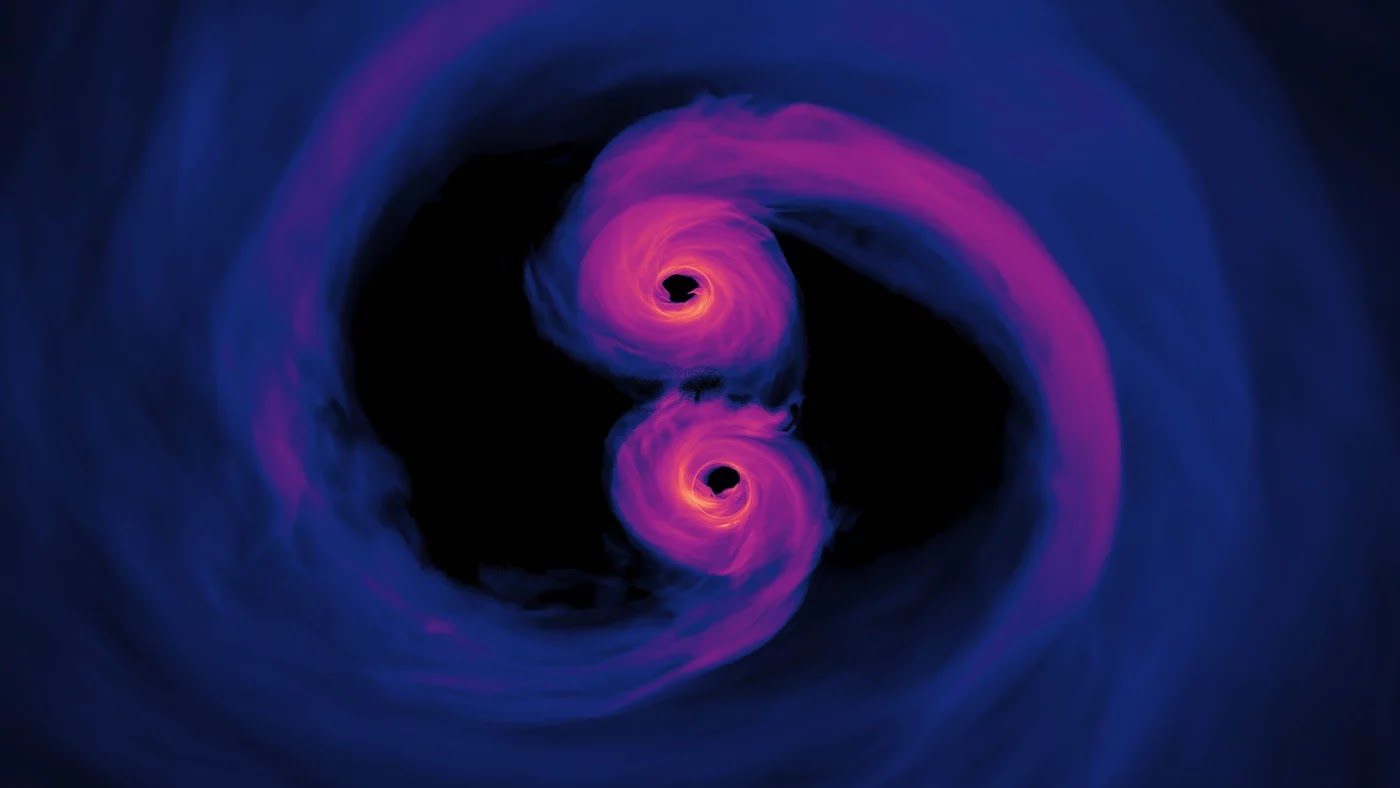
Simulation of two colliding supermassive black holes emitting gravitational waves that could be detected with this novel method. Credit: NASA's Goddard Space Flight Center/Scott Noble; simulation data, d'Ascoli et al. 2018.

MPA researcher proposes a new idea to detect pairs of the biggest black holes, which occupies the centres of galaxies, by analysing gravitational waves from nearby small black holes, which are the remnants of stars. This approach, now published in Nature Astronomy, which will require a deci-Hz gravitational-wave detector, would enable studying supermassive black hole binaries, which might remain inaccessible otherwise.

The origin of supermassive black holes found at the centres of galaxies, is still one of the biggest mysteries in astronomy. They may have always been massive and formed when the Universe was still very young. Alternatively, they may have grown over time by accreting matter and other black holes. When a supermassive black hole is about to eat another massive black hole, this will emit gravitational waves, which are ripples in spacetime that propagate through the Universe.

Gravitational waves have recently been detected, but only from small black holes which are the remnant of stars. Detecting the signals of individual pairs of big black holes is still impossible, because present-day detectors are not sensitive to the very low gravitational-wave frequencies they emit. Planned future detectors, such as the space-based ESA-led mission LISA, will remedy this, but detecting the most massive black hole pairs will still remain extremely challenging.

“Our idea basically works like listening to a radio channel. We propose to use the signal from pairs of small black holes similar to how radio waves carry the signal. The supermassive black holes are the music that is encoded in the frequency modulation (FM) of the detected signal.” said Jakob Stegmann, lead author of the study and postdoctoral research fellow at MPA. “The novel aspect of this idea is to utilise high frequencies that are easy to detect to probe lower frequencies that we are not sensitive to yet.”

Recent results from pulsar timing arrays already support the existence of merging supermassive black hole binaries. This evidence is, however, indirect and comes from the collective signal of many distant binaries that effectively create background noise.

The proposed method to detect individual supermassive black hole binaries leverages the subtle changes they cause in the gravitational waves emitted by a pair of nearby small stellar-mass black holes. The small black hole binary effectively works as a beacon revealing the existence of the bigger black holes. By detecting the tiny modulations in signals from small black hole binaries, scientists could thus identify previously hidden supermassive black hole binaries with masses ranging from 10 million to 100 million times that of our Sun, even at vast distances.

Lucio Mayer, who is a co-author of the study and black hole theorist at the University of Zurich, added, “As the path for the Laser Interferometer Space Antenna (LISA) is now set, after adoption by ESA last January, the community needs to evaluate the best strategy for the following generation of gravitational detectors, above all in which frequency range to focus – studies like this bring a strong motivation to prioritise a deci-Hz detector design.”

“This paper presents a very cool and clever idea, which is still Science Fiction until we have a deci-Hz detector”, says Selma E. de Mink, director at MPA who is not involved in this work, “but we really need creative and out-of-the-box ideas like this if we want a chance to solve the biggest mysteries in the Universe.”


Contact:

Jakob Stegmann
2237
stegmaja@mpa-garching.mpg.de

Selma E. de Mink
Director
2041

sedemink@mpa-garching.mpg.de


Original Publication

Stegmann J.; Zwick L.; Vermeulen S. M.; Antonini F.; Mayer L.
Imprints of massive black-hole binaries on neighbouring decihertz gravitational-wave sources
Nature Astronomy (2024)


Source | DOI


Monday, August 05, 2024

A supernova spotlight

A close-in view of a barred spiral galaxy. The bright, glowing bar crosses the centre of the galaxy, with blurred spiral arms curving away from its ends and continuing out of view. It’s surrounded by bright points of light that indicate stars and galaxies. The galaxy also hosts a bright supernova in its central bar.Credit: ESA/Hubble & NASA, R. J. Foley

This Hubble Picture of the Week features the galaxy LEDA 857074, located in the constellation Eridanus. LEDA 857074 is a barred spiral galaxy, with partially broken spiral arms. It also has a particularly bright spot right in its bar: this is a supernova snapped by Hubble, named SN 2022ADQZ, and quite relevant to this Picture of the Week.

The NASA/ESA Hubble Space Telescope has observed a vast range of celestial objects, from galaxies, to nebulae, to star clusters, to planets in the Solar System and beyond. Observing programmes usually seek to gather data so that astronomers can answer a specific question. Naturally, this means most scheduled observations target an object that astronomers have already researched. Some are famous, like the Crab Nebula or the globular cluster Omega Centauri; others might not be so well known to the public, but still be featured in hundreds of scientific papers, such as the Spider Galaxy or NGC 4753. Not so with this galaxy: LEDA 857074 is named in fewer than five papers, one of which is the Lyon-Meudon Extragalactic Database itself. Virtually no data have been recorded about it, other than its position: since its discovery, it simply hasn’t been studied. So how did it attract the gaze of the legendary Hubble?

The supernova is the answer — SN 2022ADQZ was detected by an automated survey in late 2022, and led to Hubble being pointed at its host galaxy, LEDA 857074, in early 2023. Astronomers have catalogued millions of galaxies, so while today tens of thousands of supernovae are detected annually, the chance that one is spotted in any particular galaxy is slim. We also do not know how actively LEDA 857074 is forming stars, and therefore how often it might host a supernova. This galaxy is therefore an unlikely and lucky target of Hubble, thanks to this supernova shining a spotlight on it! It now joins the ranks of many more famous celestial objects, with its own Hubble image.


Saturday, August 03, 2024

The Penguin and the Egg Galaxies (Arp 142)

NGC 2936/NGC 2937 (Arp 142)
High Res.(10.8 MB)

In the vast cosmic images captured through the Hyper Suprime-Cam Subaru Strategic Program (HSC-SSP), a large-scale survey spanning 330 nights of Subaru Telescope operations starting in 2014 and lasting over seven years, many interacting or colliding galaxies are captured, affecting each other’s shapes through mutual gravitation. Interacting galaxies have a wide variety of shapes; one galaxy pair looks like a jellyfish, and the other looks like a penguin holding an egg.

This image shows a pair of interacting galaxies in the Hydra constellation. The galaxy resembling a penguin is NGC 2936, which is thought to be distorted by the strong gravity of NGC 2937, an elliptical galaxy in the lower left of the penguin that looks like an egg. The pair are jointly known as Arp 142.

NGC 2936 is a distorted spiral galaxy. The brightest part, resembling a penguin's eye, is the center of the galaxy. The blueish areas of the galaxy, looking like the penguin's beak and outline, contain many newly formed stars induced by gravity interactions, and newborn stars emit blue light. In contrast, the elliptical, egg-like galaxy looks red or orangish due to the dominance of old stars.

The fuzzy features surrounding the penguin show gravitational interaction events between the two galaxies. A small-aperture telescope cannot capture these faint features, but the Subaru Telescope, with its 8.2-meter primary mirror, successfully detected them. Additionally, Hyper Suprime-Cam (HSC), the ultra-wide field of view camera, captured a faint feature apart from the penguin in the upper-left direction. Credit: NAOJ)

Distance from Earth: About 330 million light-years
Instrument: Hyper Suprime-Cam (HSC)


Friday, August 02, 2024

How do Lyman-alpha photons escape from Galactic Labyrinths?


With the recent advancements in the Lyman-alpha observations, it becomes more and more important to have theoretical models to help us decode the intricate Lyman-alpha spectral line. Scientists at MPA developed a theoretical approach to describe the escape of Lyman-alpha from scenarios where there is an empty hole to emulate the porous gas around galaxies.

Hydrogen is the most abundant element in the Universe, so it is no surprise that its first transition from an excited state to the ground state is crucial for studying the cosmos. This transition, known as the Lyman-alpha spectral line, lies in the ultraviolet region of the electromagnetic spectrum with a resting wavelength of 1215.67 angstroms. Over 50 years ago, Partridge and Peebles first highlighted the importance of Lyman-alpha for studying the high-redshift Universe, recognizing its brightness as particularly effective for detecting the most distant galaxies and learning about their formation.

Since then, scientists have made significant efforts to observe it through instruments like MUSE on the Very Large Telescope (VLT). The most recent step in this development came through the launch of the James Webb Space Telescope (JWST), which has revolutionized the observation of Lyman-alpha and opened new doors for exploring the high-redshift Universe. Alongside the observational data, there is a growing need for theoretical models to describe and interpret this spectral line fully.

Just like galaxies, the gas around them is highly anisotropic. It is subject to phenomena such as galactic outflows induced by supernova explosions. These outflows often clear out gas, creating low-density channels or holes and making the gas porous, facilitating the escape of radiation from the host galaxy. The study of Lyman alpha emission in this environment is particularly interesting as it provides information about the distribution and state of hydrogen in the Universe. Furthermore, in the Epoch of reionization, these holes and their signature in the Lyman-alpha profile could explain how ionizing photons escaped to reionize the Universe.

With all this in mind, a group of scientists at MPA led by PhD student Silvia Almada Monter performed a theoretical study of the behavior of Lyman-alpha photons in a slab filled with neutral gas in the presence of a simple empty hole. While this setup does not fully represent the complex gas geometry in real galaxies, boiling this problem down to the essentials helped to formulate a theory and understand how Lyman-alpha photons escape even in more complicated setups. This theoretical study was backed by Monte-Carlo radiative transfer simulations, which are known to yield highly accurate numerical results by tracking individual photon "packages" in space (and frequency). Despite the seemingly straightforward setup, these simulations revealed an unexpected and puzzling result.

Figure 1 Lyman-alpha unexpected triple-peaks emerge from a setup of a slab with a hole. Different colors indicate different hole sizes and the gas is more dense in the panels from left to right.

The puzzle: Walls or windows?

In a high-density medium, Lyman alpha photons diffuse in frequency due to Doppler shifts caused by the thermal motion of hydrogen atoms, resulting in a double-peak line. Conversely, in low-density environments, Lyman alpha behaves as a single-peaked line (like in the video). However, the probability of photons escaping through very dense gas is much smaller than the probability of them finding the hole and escaping through it with no resistance, as the hole is empty. This reasoning naively leads to the thought that the emerging Lyman-alpha from the slab with a pinched hole would be a centered single-peaked line because most of the light we see should have escaped through the hole.

We know this phenomenon when we see the light through a window: if the window is clean, the light gets through without any resistance, while a wall blocks the light completely. Similarly, in galaxies, abundant neutral hydrogen should act like a wall, completely stopping light from escaping, while empty channels should behave like clean windows, allowing light to escape effortlessly. In other words, one would expect all Lyman-alpha photons to escape through the low-density channel (window) and not through the wall (high-density gas). Surprisingly, the theoretical and simulation results are out of common sense. They found triple-peaked spectra: the expected two peaks emerge from the high-density gas, while a central peak exits from the empty channel. Lyman alpha photons escape not only from the path of least resistance (the window) but also somehow manage to get through the thick wall! How is this possible?

Figure 2 The transmission fraction of the simulations (data points) aligns better with the new theoretical approach (solid line) than with the previously expected theoretical one (dashed lines). As the optical depth grows, the data points start approaching the oldt theoretical approach.

The solution: The Gambler's Ruin and the Fall of a Goat.

After examining the interaction of Lyman alpha photons with the gas, specifically their transmission and reflection, the MPA scientists solved the riddle. Due to the high column densities (the wall), most Lyman alpha photons are reflected upon encountering the gas. However, instead of simply bouncing out like ping-pong balls, they penetrate the gas, scatter, and then are reflected. How many times do they scatter? To answer this question, imagine a goat standing one step to the right of a cliff. The goat can either move right and fall or go left and survive. It makes this decision consecutively, performing a random walk until it reaches a safe place or falls to the cliff. The scenario of the goat falling off the cliff after having a random walk is an analogy for a photon scattering in the gas before being reflected. This problem is also known in statistics as 'The Gambler's Ruin Problem,' where, instead of photons (or goats), a gambler bets one euro on each turn, with the possibility of either winning or losing one euro. In this scenario, the probability of losing all the money (or the goat falling off the cliff/the photon being reflected) is 100%. Thus, eventually, all gamblers and goats face an unfortunate destiny. However, the expected time to reach this destiny is infinite! The gambler has no time limit to bet, the goat has no time limit to walk, and the photon has no time limit to scatter. Hence, it scatters many, many times.

This mathematical result directly affects the escaping Lyman-alpha photons and is the key to explaining the puzzling results. A large number of scattering events increases the chances of the photon shifting in frequency and mean free path enough to 'jump' the wall instead of crashing against it. Many more photons manage to pass through the high-density gas. After solving the appropriate diffusion equations, the MPA scientists found that the number of scattering events per reflection closely follows a Lévy distribution and is much greater than expected. This result implies that the transmission probability is orders of magnitude greater than anticipated. In the context of the slab with the hole, the probability of photons finding the hole is not as different than the probability of being transmitted through the gas as expected. As a result, the spectrum's double arise simultaneously with the central peak.

According to the literature, the presence of low-density channels in galaxies implies that the Lyman-alpha emission traces only the gas within them. However, these recent results indicate that due to the increased transmission probability, Lyman-alpha photons could trace the gas simultaneously in both high-density regions and low-density channels. In other words, Lyman-alpha can trace more average quantities of gas. Furthermore, it was previously believed that obtaining triple-peaked spectra was only possible with a tiny channel, an assumption that could be relaxed thanks to these findings. Additionally, these results affect the use of Lyman-alpha as a tracer for Lyman Continuum, as ionized channels are a likely escape route.


Author:

Silvia Elizabeth Almada Monter
PhD student
2011

almada@mpa-garching.mpg.de

Original Publication:

Silvia Almada Monter, Max Gronke
Crossing walls and windows: the curious escape of Lyman-𝛼 photons through ionised channels

https://arxiv.org/pdf/2404.07169

Source


Thursday, August 01, 2024

Unveiling the Secrets of our Galaxy’s Supermassive Black Hole

By monitoring the high-energy X-ray emission from the center of our Galaxy, NuSTAR probes the current and past activity of Sagittarius A*, the supermassive at the center of the Milky Way. These images capture a flare observed in July 2012 over a 2-day period. In the middle panel, the black hole was consuming and heating matter to temperatures up to 180 million degrees Fahrenheit (100 million degrees Celsius). Image Credit: NASA/JPL-Caltech.

Black holes are notoriously difficult to study, in part because not even light can escape their immense gravity. Researchers typically infer their properties by observing the gravitational influence of a black hole on nearby stars, gas, energetic plasmas, and other related phenomena. Astronomers also learn both about the environment around the black hole and its past activity by observing echoes reflected off nearby structures (with the caveat that astronomers might have a different understanding of "nearby" than other people). Using X-ray data from NuSTAR, researchers at Michigan State University (MSU) have made groundbreaking discoveries about Sagittarius A*, the supermassive black hole at the center of our Milky Way galaxy. These findings were presented at the 244th meeting of the American Astronomical Society, held in Madison, Wisconsin in June.

Galactic fireworks

Grace Sanger-Johnson, a postbaccalaureate researcher at MSU, analyzed 10 years of NuSTAR data looking for X-ray flares from Sagittarius A*. In doing so, she discovered nine flares that had previously gone unnoticed. These flares are dramatic bursts of high-energy light that provide a unique opportunity to study the environment around the black hole. This region is typically invisible due to the dense gas and dust that blocks most light, but not the penetrating, high-energy X-rays observed by NuSTAR. Sagittarius A* is the closest supermassive black hole to Earth. Data from Sagittarius A*, and its flares, are one of the only ways currently known to study the physics and physical environment of a black hole. Sanger-Johnson meticulously sifted through a decade's worth of X-ray data collected between 2015 and 2024 by NuSTAR. Each of the nine newly-discovered flares provides unique insight into the black hole's environment and activities.

"We are sitting in the front row to observe these unique cosmic fireworks at the center of our own Milky Way galaxy," said Prof. Shuo Zhang, Sanger-Johnson's advisor. "Flares light up the darkness and help us observe things we wouldn't normally be able to." Analyzing the properties of these X-ray flares will help astronomers infer the physical conditions of the extreme environment around the supermassive black hole.

`Echoes' of a black hole

While Sanger-Johnson focused on the brilliant flares from Sagittarius A*, Jack Uteg, an undergraduate researcher, examined the black hole's activity using a technique akin to listening to echoes. Uteg analyzed more than 20 years of data targeting a giant molecular cloud known as "the Bridge" near Sagittarius A*. This monitoring began before Uteg was born.

Unlike the central black hole, clouds of gas and dust in interstellar space cannot generate their own X-rays. So, when X-ray telescopes detected photons from the Bridge, the emission was inferred to be delayed reflection of past X-ray outbursts by Sagittarius A*. The X-ray luminosity of the Bridge first began to increase around 2008 and then increased over the next 12 years until it hit peak brightness in 2020. This "echo" light from the black hole traveled for hundreds of years from Sgr A* to the molecular cloud, and then traveled another roughly 26,000 years before reaching Earth.

By analyzing these X-ray echoes, Uteg was able to reconstruct a timeline of our black hole's past activity, offering insights that would not be possible through direct observations alone. Uteg's analysis used data from NuSTAR as well as from the European Space Agency's XMM-Newton satellite, which studies the universe in lower energy X-rays.

"One of the main reasons we care about this cloud getting brighter is that it lets us constrain how bright Sagittarius A* was in the past," Uteg said. Based on these data, the team determined that, about 200 years ago, the black hole at the center of the Milky Way was about 10,000 times brighter in X-rays compared to how we see it today. As the United States was celebrating its first July 4th, Sagittarius A* was feasting on nearby material, heating it up, and producing copious amounts of X-rays. Today, the black hole just nibbles. "The black hole at the center of our Galaxy was producing fireworks just 200 years ago, but today it is merely a sparkler," said Dr. Brian Grefenstette, a NuSTAR staff scientist at the California Institute of Technology.

This is the first long-term X-ray variability study of a molecular cloud surrounding Sagittarius A* to detect its peak X-ray luminosity. "This allows us to tell the past activity of Sgr A*, and we will continue this astro-archaeological study to further unravel the mysteries of the Milky Way's center," Zhang said.

While the exact mechanisms triggering X-ray flares and the life cycles of black holes remain mysteries and areas of active study, NuSTAR is helping spark further investigations and improve our understanding of these enigmatic objects.