Friday, December 14, 2018

In Search of Missing Worlds, Hubble Finds a Fast Evaporating Exoplanet

This artist's illustration shows a giant cloud of hydrogen streaming off a warm, Neptune-sized planet just 97 light-years from Earth. The exoplanet is tiny compared to its star, a red dwarf named GJ 3470. The star's intense radiation is heating the hydrogen in the planet's upper atmosphere to a point where it escapes into space. The alien world is losing hydrogen at a rate 100 times faster than a previously observed warm Neptune whose atmosphere is also evaporating away. Credits: NASA, ESA, and D. Player (STScI)

This graphic plots exoplanets based on their size and distance from their star. Each dot represents an exoplanet. Planets the size of Jupiter (located at the top of the graphic) and planets the size of Earth and so-called super-Earths (at the bottom) are found both close to and far from their star. But planets the size of Neptune (in the middle of the plot) are scarce close to their star. This so-called desert of hot Neptunes shows that such alien worlds are rare, or, they were plentiful at one time, but have since disappeared. The detection that GJ 3470b, a warm Neptune at the border of the desert, is fast losing its atmosphere suggests that hotter Neptunes may have eroded down to smaller, rocky super-Earths. Credits: NASA, ESA, and A. Feild (STScI).  Science: NASA, ESA, and V. Bourrier (University of Geneva, Switzerland)


Fishermen would be puzzled if they netted only big and little fish, but few medium-sized fish. Astronomers likewise have been perplexed in conducting a census of star-hugging extrasolar planets. They have found hot Jupiter-sized planets and hot super-Earths (planets no more than 1.5 times Earth's diameter). These planets are scorching hot because they orbit very close to their star. But so-called "hot Neptunes," whose atmospheres are heated to more than 1,700 degrees Fahrenheit, have been much harder to find. In fact, only about a handful of hot Neptunes have been found so far.

In fact, most of the known Neptune-sized exoplanets are merely "warm," because they orbit farther away from their star than those in the region where astronomers would expect to find hot Neptunes. The mysterious hot-Neptune deficit suggests that such alien worlds are rare, or, they were plentiful at one time, but have since disappeared.

A few years ago astronomers using NASA's Hubble Space Telescope found that one of the warmest known Neptunes (GJ 436b) is losing its atmosphere. The planet isn't expected to evaporate away, but hotter Neptunes might not have been so lucky.

Now, astronomers have used Hubble to nab a second "very warm" Neptune (GJ 3470b) that is losing its atmosphere at a rate 100 times faster than that of GJ 436b. Both planets reside about 3.7 million miles from their star. That's one-tenth the distance between our solar system's innermost planet, Mercury, and the Sun.

"I think this is the first case where this is so dramatic in terms of planetary evolution," said lead researcher Vincent Bourrier of the University of Geneva in Sauverny, Switzerland. "It's one of the most extreme examples of a planet undergoing a major mass-loss over its lifetime. This sizable mass loss has major consequences for its evolution, and it impacts our understanding of the origin and fate of the population of exoplanets close to their stars."

As with the previously discovered evaporating planets, the star's intense radiation heats the atmosphere to a point where it escapes the planet's gravitational pull like an untethered hot air balloon. The escaping gas forms a giant cloud around the planet that dissipates into space. One reason why GJ 3470b may be evaporating faster than GJ 436b is that it is not as dense, so it is less able to gravitationally hang on to the heated atmosphere.

What's more, the star hosting GJ 3470b is only 2 billion years old, compared to the 4-billion- to 8-billion-year-old star that planet GJ 436b orbits. The younger star is more energetic, so it bombards the planet with more blistering radiation than GJ 436b receives. Both are red dwarf stars, which are smaller and longer-lived than our Sun.

Uncovering two evaporating warm Neptunes reinforces the idea that the hotter version of these distant worlds may be a class of transitory planet whose ultimate fate is to shrink down to the most common type of known exoplanet, mini-Neptunes — planets with heavy, hydrogen-dominated atmospheres that are larger than Earth but smaller than Neptune. Eventually, these planets may downsize even further to become super-Earths, more massive, rocky versions of Earth.

"The question has been, where have the hot Neptunes gone?" said Bourrier. "If we plot planetary size and distance from the star, there's a desert, a hole, in that distribution. That's been a puzzle. We don't really know how much the evaporation of the atmospheres played in forming this desert. But our Hubble observations, which show a large amount of mass loss from a warm Neptune at the edge of the desert, is a direct confirmation that atmospheric escape plays a major role in forming this desert."

The researchers used Hubble's Space Telescope Imaging Spectrograph to detect the ultraviolet-light signature of hydrogen in a huge cocoon surrounding the planet as it passed in front of its star. The intervening cocoon of hydrogen filters out some of the starlight. These results are interpreted as evidence of the planet's atmosphere bleeding off into space.

The team estimates that the planet has lost as much as 35 percent of its material over its lifetime, because it was probably losing mass at a faster rate when its red-dwarf star was younger and emitting even more radiation. If the planet continues to rapidly lose material, it will shrink down to a mini-Neptune in a few billion years.

Hydrogen probably isn't the only element evaporating away: it may be a tracer for other material streaming off into space. The researchers plan to use Hubble to hunt for elements heavier than hydrogen and helium that have hitched a ride with the hydrogen gas to escape the planet. "We think that the hydrogen gas could be dragging heavy elements such as carbon, which reside deeper in the atmosphere, upward and out into space," Bourrier said.

The observations are part of the Panchromatic Comparative Exoplanet Treasury (PanCET) survey, a Hubble program to look at 20 exoplanets, mostly hot Jupiters, in the first large-scale ultraviolet, visible, and infrared comparative study of distant worlds.

Observing the evaporation of these two warm Neptunes is encouraging, but team members know they need to study more of them to confirm predictions. Unfortunately, there may be no other planets of this class residing close enough to Earth to observe. The problem is that hydrogen gas cannot be detected in warm Neptunes farther away than 150 light-years from Earth because it is obscured by interstellar gas. GJ 3470b resides 97 light-years away.

However, helium is another tracer for material escaping a warm Neptune's atmosphere. Astronomers could use Hubble and the upcoming NASA James Webb Space Telescope to search in infrared light for helium, because it is not blocked by interstellar material in space.

"Looking for helium could expand our survey range," Bourrier said. "Webb will have incredible sensitivity, so we would be able to detect helium escaping from smaller planets, such as mini-Neptunes."

The researcher's paper will appear in the Dec. 13 issue of Astronomy and Astrophysics.

The Hubble Space Telescope is a project of international cooperation between NASA and ESA (European Space Agency). NASA's Goddard Space Flight Center in Greenbelt, Maryland, manages the telescope. The Space Telescope Science Institute (STScI) in Baltimore, Maryland, conducts Hubble science operations. STScI is operated for NASA by the Association of Universities for Research in Astronomy in Washington, D.C.


Related  Links

This site is not responsible for content found on external links


Contact

Donna Weaver / Ray Villard
Space Telescope Science Institute, Baltimore, Maryland
410-338-4493 / 410-338-4514

dweaver@stsci.edu / villard@stsci.edu

Vincent Bourrier
University of Geneva, Sauverny, Switzerland
011-41-22-379-2449

vincent.bourrier@unige.ch


Thursday, December 13, 2018

Dancing with the Enemy

R Aquarii peculiar stellar relationship captured by SPHERE

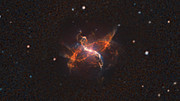
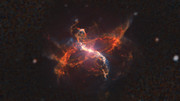
PR Image eso1840b
R Aquarii viewed by the Very Large Telescope and Hubble
R Aquarii In the constellation Aquarius

PR Image eso1840d
Digitized Sky Survey image around R Aquarii 


Video

ESOcast 188 Light: Dancing with the Enemy

Zooming in on R Aquarii

The ever-changing R Aquarii
PR Video eso1840c
The ever-changing R Aquarii 

A vampiric star
A vampiric star

Close-up of a red giant star

Jet outburst of a vampiric star

Changing brightness of R Aquarii

Close-up of jets

Close-up of jets


ESO’s R Aquarii Week continues with the sharpest R Aquarii image ever

While testing a new subsystem on the SPHERE planet-hunting instrument on ESO’s Very Large Telescope, astronomers were able to capture dramatic details of the turbulent stellar relationship in the binary star R Aquarii with unprecedented clarity — even compared to observations from Hubble.

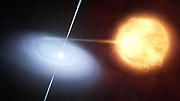
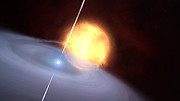
This spectacular image — the second instalment in ESO’s R Aquarii Week — shows intimate details of the dramatic stellar duo making up the binary star R Aquarii. Though most binary stars are bound in a graceful waltz by gravity, the relationship between the stars of R Aquarii is far less serene. Despite its diminutive size, the smaller of the two stars in this pair is steadily stripping material from its dying companion — a red giant.

Years of observation have uncovered the peculiar story behind the binary star R Aquarii, visible at the heart of this image. The larger of the two stars, the red giant, is a type of star known as a Mira variable. At the end of their life, these stars start to pulsate, becoming 1000 times as bright as the Sun as their outer envelopes expand and are cast into the interstellar void.

The death throes of this vast star are already dramatic, but the influence of the companion white dwarf star transforms this intriguing astronomical situation into a sinister cosmic spectacle. The white dwarf — which is smaller, denser and much hotter than the red giant — is flaying material from the outer layers of its larger companion. The jets of stellar material cast off by this dying giant and white dwarf pair can be seen here spewing outwards from R Aquarii.
<

Occasionally, enough material collects on the surface of the white dwarf to trigger a thermonuclear nova explosion, a titanic event which throws a vast amount of material into space. The remnants of past nova events can be seen in the tenuous nebula of gas radiating from R Aquarii in this image. <

R Aquarii lies only 650 light-years from Earth — a near neighbour in astronomical terms — and is one of the closest symbiotic binary stars to Earth. As such, this intriguing binary has received particular attention from astronomers for decades. Capturing an image of the myriad features of R Aquarii was a perfect way for astronomers to test the capabilities of the Zurich IMaging POLarimeter (ZIMPOL), a component on board the planet-hunting instrument SPHERE. The results exceeded observations from space — the image shown here is even sharper than observations from the famous NASA/ESA Hubble Space Telescope. <

SPHERE was developed over years of studies and construction to focus on one of the most challenging and exciting areas of astronomy: the search for exoplanets. By using a state-of-the-art adaptive optics system and specialised instruments such as ZIMPOL, SPHERE can achieve the challenging feat of directly imaging exoplanets. However, SPHERE’s capabilities are not limited to hunting for elusive exoplanets. The instrument can also be used to study a variety of astronomical sources — as can be seen from this spellbinding image of the stellar peculiarities of R Aquarii.


More Information

This research was presented in the paper “SPHERE / ZIMPOL observations of the symbiotic system R Aqr. I. Imaging of the stellar binary and the innermost jet clouds” by H.M. Schmid et. al, which was published in the journal Astronomy & Astrophysics.

The team was composed of H. M. Schmid (ETH Zurich, Institute for Astronomy, Switzerland), A. Bazzon (ETH Zurich, Institute for Astronomy, Switzerland), J. Milli (European Southern Observatory), R. Roelfsema (NOVA Optical Infrared Instrumentation Group at ASTRON, the Netherlands), N. Engler (ETH Zurich, Institute for Astronomy, Switzerland) , D. Mouillet (Université Grenoble Alpes and CNRS, France), E. Lagadec (Université Côte d’Azur, France), E. Sissa (INAF and Dipartimento di Fisica e Astronomia “G. Galilei” Universitá di Padova, Italy), J.-F. Sauvage (Aix Marseille Univ, France), C. Ginski (Leiden Observatory and Anton Pannekoek Astronomical Institute, the Netherlands), A. Baruffolo (INAF), J.L. Beuzit (Université Grenoble Alpes and CNRS, France), A. Boccaletti (LESIA, Observatoire de Paris, France), A. J. Bohn (ETH Zurich, Institute for Astronomy, Switzerland), R. Claudi (INAF, Italy), A. Costille (Aix Marseille Univ, France), S. Desidera (INAF, Italy), K. Dohlen (Aix Marseille Univ, France), C. Dominik (Anton Pannekoek Astronomical Institute, the Netherlands), M. Feldt (Max-Planck-Institut für Astronomie, Germany), T. Fusco (ONERA, France), D. Gisler (Kiepenheuer-Institut für Sonnenphysik, Germany), J.H. Girard (European Southern Observatory), R. Gratton (INAF, Italy), T. Henning (Max-Planck-Institut für Astronomie, Germany), N. Hubin (European Southern Observatory), F. Joos (ETH Zurich, Institute for Astronomy, Switzerland), M. Kasper (European Southern Observatory), M. Langlois (Centre de Recherche Astrophysique de Lyon and Aix Marseille Univ, France), A. Pavlov (Max-Planck-Institut für Astronomie, Germany), J. Pragt (NOVA Optical Infrared Instrumentation Group at ASTRON, the Netherlands), P. Puget (Université Grenoble Alpes, France), S.P. Quanz (ETH Zurich, Institute for Astronomy, Switzerland), B. Salasnich (INAF, Italy), R. Siebenmorgen (European Southern Observatory), M. Stute (Simcorp GmbH, Germany), M. Suarez (European Southern Observatory), J. Szulagyi (ETH Zurich, Institute for Astronomy, Switzerland), C. Thalmann (ETH Zurich, Institute for Astronomy, Switzerland), M. Turatto (INAF, Italy), S. Udry (Geneva Observatory, Switzerland), A. Vigan (Aix Marseille Univ, France), and F. Wildi (Geneva Observatory, Switzerland).

ESO is the foremost intergovernmental astronomy organisation in Europe and the world’s most productive ground-based astronomical observatory by far. It has 16 Member States: Austria, Belgium, the Czech Republic, Denmark, France, Finland, Germany, Ireland, Italy, the Netherlands, Poland, Portugal, Spain, Sweden, Switzerland and the United Kingdom, along with the host state of Chile and with Australia as a Strategic Partner. ESO carries out an ambitious programme focused on the design, construction and operation of powerful ground-based observing facilities enabling astronomers to make important scientific discoveries. ESO also plays a leading role in promoting and organising cooperation in astronomical research. ESO operates three unique world-class observing sites in Chile: La Silla, Paranal and Chajnantor. At Paranal, ESO operates the Very Large Telescope and its world-leading Very Large Telescope Interferometer as well as two survey telescopes, VISTA working in the infrared and the visible-light VLT Survey Telescope. ESO is also a major partner in two facilities on Chajnantor, APEX and ALMA, the largest astronomical project in existence. And on Cerro Armazones, close to Paranal, ESO is building the 39-metre Extremely Large Telescope, the ELT, which will become “the world’s biggest eye on the sky”.


Links


Contacts

Calum Turner
ESO Public Information Officer
Garching bei München, Germany
Tel: +49 89 3200 6670
Cell: +49 151 1537 3591
Email: pio@eso.org

Source: ESO/News


Wednesday, December 12, 2018

ALMA Campaign Provides Unprecedented Views of the Birth of Planets

ALMA’s high-resolution images of nearby protoplanetary disks, which are results of the Disk Substructures at High Angular Resolution Project (DSHARP). Credit: ALMA (ESO/NAOJ/NRAO), S. Andrews et al.; N. Lira

Animated GIF showing the ALMA images of 20 protoplanetary disks observed by DSHARP project. Credit: ALMA (ESO/NAOJ/NRAO), Andrews et al.; N. Lira.


Astronomers have already cataloged nearly 4,000 exoplanets in orbit around distant stars. Though we have learned much about these newfound worlds, there is still much we do not know about the steps of planet formation and the precise cosmic recipes that spawn the wide array of planetary bodies we have already uncovered, including so-called hot Jupiters, massive rocky worlds, icy dwarf planets, and – hopefully someday soon – distant analogs of Earth.

To help answer these and other intriguing questions about the birth of planets, a team of astronomers using the Atacama Large Millimeter/submillimeter Array (ALMA)has conducted one of the deepest surveys ever of protoplanetary disks, the planet-forming dust belts around young stars.

“This specific Large Programis important because it takes one of the fundamental science goals of ALMA, which is to understand the process of planet formation and takes it from previous studies, which were either very small samples or single objects, to a completely new context, allowing statistical views” explains Stuartt Corder, Deputy Director of ALMA; “Are these kinds of structures common or rare? This more statistical approach allows researchers to answer questions that are much more fundamental to the process of planet formation.”

Known as the Disk Substructures at High Angular Resolution Project (DSHARP), this Large Programof ALMA has yielded stunning, high-resolution images of 20 nearby protoplanetary disks and given astronomers new insights into the variety of features they contain and the speed with which planets can emerge.

The results of this survey are contained in a series of ten papers that are accepted for publication in the Astrophysical Journal Letters.

According to the researchers, the most compelling interpretation of these observations is that large planets, likely similar in size and composition to Neptune or Saturn, form quickly, much faster than current theory would indicate. The also tend to form in the outer reaches of their solar systems at tremendous distances from their host stars.

Such precocious formation could also help explain how rocky, Earth-size worlds are able to evolve and grow, surviving their presumed self-destructive adolescence.

“The goal of this months-long observing campaign was to search for structural commonalities and differences in protoplanetary disks. ALMA’s remarkably sharp vision has revealed previously unseen structures and unexpectedly complex patterns,” said Sean Andrews, an astronomer at the Harvard-Smithsonian Center for Astrophysics (CfA) and a leader of the ALMA observing campaign along with Andrea Isella of Rice University, Laura Pérez of the University of Chile, and Cornelis Dullemond of Heidelberg University. “We are seeing distinct details around a wide assortment of young stars of various masses. The most compelling interpretation of these highly diverse, small-scale features is that there are unseen planets interacting with the disk material.”

The leading models for planet formation hold that planets are born by the gradual accumulation of dust and gas inside a protoplanetary disk, beginning with grains of dust that coalesce to form larger and larger rocks, until asteroids, planetesimals, and planets emerge. This hierarchical process should take many millions of years to unfold, suggesting that its impact on protoplanetary disks would be most prevalent in older, more mature systems. Mounting evidence, however, indicates that is not always the case.

ALMA’s early observations of young protoplanetary disks, some only about one million years old, reveal striking and surprising structures, including prominent rings and gaps, which appear to be the hallmarks of planets. Astronomers were initially cautious to ascribe these features to the actions of planets since other natural process could be at play.

“It was surprising to see possible signatures of planet formation in the very first high-resolution images of young disks. It was important to find out whether these were anomalies or if those signatures were common in disks,” said Jane Huang, a graduate student at CfA and a member of the research team.

Since the sample set was so small, however, it was impossible to draw any overarching conclusions. It could have been that astronomers were observing atypical systems. More observations on a variety of protoplanetary disks were needed to determine the most likely cause of the features we were seeing.

The DSHARP campaign was designed to do precisely that by studying the relatively small-scale distribution of dust particles around 20 nearby protoplanetary disks. These dust particles naturally glow in millimeter-wavelength light, enabling ALMA to precisely map the density distribution of small, solid particles around young stars.

Depending on the star’s distance from Earth, ALMA was able to distinguish features as small as a few Astronomical Units(An Astronomical Unit is the average distance of the Earth to the Sun – about 150 million kilometers, which is a useful scale for measuring distances on the scale of star systems). Using these observations, the researchers were able to image an entire population of nearby protoplanetary disks and study their AU-scale features.

The researchers found that many substructures – concentric gaps, narrow rings – are common to nearly all the disks, while large-scale spiral patterns and arc-like features are also present in some of the cases. Also, the disks and gaps are present at a wide range of distances from their host stars, from a few AU to more than 100 AU, which is more than three times the distance of Neptune from our Sun. These features, which could be the imprint of large planets, may explain how rocky Earth-like planets are able to form and grow. For decades, astronomers have puzzled over a major hurdle in planet-formation theory: Once planetesimals grow to a certain size – about one kilometer is diameter – the dynamics of a smooth protoplanetary disk would induce them to fall in on their host star, never acquiring the mass necessary to form planets like Mars, Venus, and Earth.

The dense rings of dust we now see with ALMA would produce a safe haven for rocky worlds to fully mature. Their higher densities and the concentration of dust particles would create perturbations in the disk, forming zones where planetesimals would have more time to grow into fully fledged planets.

“When ALMA truly revealed its capabilities with its iconic image of HL Tau, we had to wonder if that was an outlier since the disk was comparatively massive and young,” noted Laura Perez with the University of Chile and a member of the research team. “These latest observations show that, though striking, HL Tau is far from unusual and may actually represent the normal evolution of planets around young stars.”


Additional Information

This research is presented in the following papers accepted to the Astrophysical Journal Letters.

  • “The Disk Substructures at High Angular Resolution Project (DSHARP): I. Motivation, Sample, Calibration, and Overview: S. Andrews, et al.
  • “The Disk Substructures at High Angular Resolution Project (DSHARP): II. Characteristics of Annular Substructures,” J. Huang, et al.
  • “The Disk Substructures at High Angular Resolution Project (DSHARP): III. Spiral Structures in the Millimeter Continuum of the Elias 27, IM Lup, and WaOph 6 Disks,” J. Huang, et al.
  • “The Disk Substructures at High Angular Resolution Project (DSHARP): IV. Characterizing Substructures and Interactions in Disks around Multiple Star Systems,” N. Kurtovic, et al.
  • “The Disk Substructures at High Angular Resolution Project (DSHARP): V. Interpreting ALMA Maps of Protoplanetary Disks in Terms of a Dust Model” T. Birnstiel, et al.
  • “The Disk Substructures at High Angular Resolution Project (DSHARP): VI. Dust Trapping in Thin-Ringed Protoplanetary Disks,” C. Dullemond, et al.
  • “The Disk Substructures at High Angular Resolution Project (DSHARP): VII. The Planet-Disk Interactions Interpretation” S. Zhang, et al.
  • “The Disk Substructures at High Angular Resolution Project (DSHARP): VIII. The Rich Ringed Substructures in the AS 209 Disk,” V, Guzmán, et al.
  • “The Disk Substructures at High Angular Resolution Project (DSHARP): IX. A High Definition Study of the HD 163296 Planet Forming Disk” A. Isella, et al.
  • “The Disk Substructures at High Angular Resolution Project (DSHARP): X. Multiple Rings, a Misaligned Inner Disk, and a Bright Arc in the Disk around the T Tauri Star HD 143006,” L. Pérez, et al.
  • The Atacama Large Millimeter/submillimeter Array (ALMA), an international astronomy facility, is a partnership of the European Southern Observatory (ESO), the U.S. National Science Foundation (NSF) and the National Institutes of Natural Sciences (NINS) of Japan in cooperation with the Republic of Chile. ALMA is funded by ESO on behalf of its Member States, by NSF in cooperation with the National Research Council of Canada (NRC) and the Ministry of Science and Technology (MOST) in Taiwan and by NINS in cooperation with the Academia Sinica (AS) in Taiwan and the Korea Astronomy and Space Science Institute (KASI).

ALMA construction and operations are led by ESO on behalf of its Member States; by the National Radio Astronomy Observatory (NRAO), managed by Associated Universities, Inc. (AUI), on behalf of North America; and by the National Astronomical Observatory of Japan (NAOJ) on behalf of East Asia. The Joint ALMA Observatory (JAO) provides the unified leadership and management of the construction, commissioning and operation of ALMA.


Thursday, December 06, 2018

Unknown Treasure Trove of Planets Found Hiding in Dust

The Taurus Molecular Cloud, pictured here by ESA's Herschel Space Observatory, is a star-forming region about 450 light-years away. The image frame covers roughly 14 by 16 light-years and shows the glow of cosmic dust in the interstellar material that pervades the cloud, revealing an intricate pattern of filaments dotted with a few compact, bright cores — the seeds of future stars. (Image: ESA/Herschel/PACS, SPIRE/Gould Belt survey Key) Programme/Palmeirim et al. 2013

Until recently, protoplanetary disks were believed to be smooth, pancake-like objects. The results from this study show that some disks are more like doughnuts with holes, but even more often appear as a series of rings. The rings are likely carved by planets that are otherwise invisible to us. Image: Feng Long


The first unbiased survey of protoplanetary disks surrounding young stars in the Taurus star-forming region turned up a higher-than-expected number of disks with features suggesting nascent planets.

"Super-Earths" and Neptune-sized planets could be forming around young stars in much greater numbers than scientists thought, new research by an international team of astronomers suggests.

Observing a sampling of young stars in a star-forming region in the constellation Taurus, researchers found many of them to be surrounded by structures that can best be explained as traces created by invisible, young planets in the making. The research, published in the Astrophysical Journal, helps scientists better understand how our own solar system came to be.

Some 4.6 billion years ago, our solar system was a roiling, billowing swirl of gas and dust surrounding our newborn sun. At the early stages, this so-called protoplanetary disk had no discernable features, but soon, parts of it began to coalesce into clumps of matter – the future planets. As they picked up new material along their trip around the sun, they grew and started to plow patterns of gaps and rings into the disk from which they formed. Over time, the dusty disk gave way to the relatively orderly arrangement we know today, consisting of planets, moons, asteroids and the occasional comet.

Scientists base this scenario of how our solar system came to be on observations of protoplanetary disks around other stars that are young enough to currently be in the process of birthing planets. Using the Atacama Large Millimeter Array, or ALMA, comprising 45 radio antennas in Chile's Atacama Desert, the team performed a survey of young stars in the Taurus star-forming region, a vast cloud of gas and dust located a modest 450 light-years from Earth. When the researchers imaged 32 stars surrounded by protoplanetary disks, they found that 12 of them – 40 percent – have rings and gaps, structures that according to the team's measurements and calculations can be best explained by the presence of nascent planets.

"This is fascinating because it is the first time that exoplanet statistics, which suggest that super-Earths and Neptunes are the most common type of planets, coincide with observations of protoplanetary disks," said the paper's lead author, Feng Long, a doctoral student at the Kavli Institute for Astronomy and Astrophysics at Peking University in Bejing, China.

While some protoplanetary disks appear as uniform, pancake-like objects lacking any features or patterns, concentric bright rings separated by gaps have been observed, but since previous surveys have focused on the brightest of these objects because they are easier to find, it was unclear how common disks with ring and gap structures really are in the universe. This study presents the results of the first unbiased survey in that the target disks were selected independently of their brightness – in other words, the researchers did not know whether any of their targets had ring structures when they selected them for the survey.

"Most previous observations had been targeted to detect the presence of very massive planets, which we know are rare, that had carved out large inner holes or gaps in bright disks," said the paper's second author Paola Pinilla, a NASA Hubble Fellow at the University of Arizona's Steward Observatory. "While massive planets had been inferred in some of these bright disks, little had been known about the fainter disks."

The team, which also includes Nathan Hendler and Ilaria Pascucci at the UA's Lunar and Planetary Laboratory, measured the properties of rings and gaps observed with ALMA and analyzed the data to evaluate possible mechanisms that could cause the observed rings and gaps. While these structures may be carved by planets, previous research has suggested that they may also be created by other effects. In one commonly suggested scenario, so-called ice lines caused by changes in the chemistry of the dust particles across the disc in response to the distance to the host star and its magnetic field create pressure variations across the disk. These effects can create variations in the disk, manifesting as rings and gaps.

The researchers performed analyses to test these alternative explanations and could not establish any correlations between stellar properties and the patterns of gaps and rings they observed.

"We can therefore rule out the commonly proposed idea of ice lines causing the rings and gaps," Pinilla said. "Our findings leave nascent planets as the most likely cause of the patterns we observed, although some other processes may also be at work."

Since detecting the individual planets directly is impossible because of the overwhelming brightness of the host star, the team performed calculations to get an idea of the kinds of planets that might be forming in the Taurus star-forming region. According to the findings, Neptune-sized gas planets or so-called super-Earths – terrestrial planets of up to 20 Earth masses – should be the most common. Only two of the observed disks could potentially harbor behemoths rivaling Jupiter, the largest planet in the solar system.

"Since most of the current exoplanet surveys can't penetrate the thick dust of protoplanetary disks, all exoplanets, with one exception, have been detected in more evolved systems where a disk is no longer present," Pinilla said.

Going forward, the research group plans to move ALMA's antennas farther apart, which should increase the array's resolution to around five astronomical units (one AU equals the average distance between the Earth and the sun), and to make the antennas sensitive to other frequencies that are sensitive to other types of dust.

"Our results are an exciting step in understanding this key phase of planet formation," Long said, "and by making these adjustments, we are hoping to better understand the origins of the rings and gaps.”

This work was made possible through an international collaboration, including astronomers at UA's Steward Observatory and LPL. For a complete list of authors and funding information, please see the paper, "Gaps and Rings in an ALMA Survey of Disks in the Taurus Star-forming Region." A preprint of the article is available at https://arxiv.org/abs/1810.06044. Funding for this project was provided by Peking University, National Science Foundation of China, the Hubble Fellowship Program, the National Science Foundation, and the


Wednesday, December 05, 2018

First Light for SPECULOOS

SPECULOOS gazing into the night

First Light for SPECULOOS Southern Observatory’s Europa Telescope 

First Light for SPECULOOS Southern Observatory’s Europa Telescope

First Light for SPECULOOS Southern Observatory’s Callisto Telescope


More Images

SPECULOOS gazes upwards
SPECULOOS and VLT
SPECULOOS at Paranal
Night falls over SPECULOOS
Sunset over SPECULOOS


Four telescopes devoted to the search for habitable planets around nearby ultra-cool stars get off to a successful start at ESO’s Paranal Observatory

The SPECULOOS project has made its first observations at the European Southern Observatory’s Paranal Observatory in northern Chile. SPECULOOS will focus on detecting Earth-sized planets orbiting nearby ultra-cool stars and brown dwarfs.

The SPECULOOS Southern Observatory (SSO) has been successfully installed at the Paranal Observatory and has obtained its first engineering and calibration images — a process known as first light. After finishing this commissioning phase, this new array of planet-hunting telescopes will begin scientific operations, starting in earnest in January 2019.

SSO is the core facility of a new exoplanet-hunting project called Search for habitable Planets EClipsing ULtra-cOOl Stars (SPECULOOS) [1], and consists of four telescopes equipped with 1-metre primary mirrors. The telescopes  — named Io, Europa, Ganymede and Callisto after the four Galilean moons of Jupiter — will enjoy pristine observing conditions at the Paranal site, which is also home to ESO’s flagship Very Large Telescope (VLT). Paranal provides a near-perfect site for astronomy, with dark skies and a stable, arid climate.

These telescopes have a momentous task — SPECULOOS aims to search for potentially habitable Earth-sized planets surrounding ultra-cool stars or brown dwarfs, whose planetary populations are still mostly unexplored. Only a few exoplanets have been found orbiting such stars, and even fewer lie within their parent star’s habitable zone. Even though these dim stars are hard to observe, they are abundant — comprising about 15% of the stars in the nearby universe. SPECULOOS is designed to explore 1000 such stars, including the nearest, brightest, and smallest, in search of Earth-sized habitable planets.

SPECULOOS gives us an unprecedented ability to detect terrestrial planets eclipsing some of our smallest and coolest neighbouring stars,” elaborated Michaël Gillon of the University of Liège, principal investigator of the SPECULOOS project. “This is a unique opportunity to uncover the details of these nearby worlds.”

SPECULOOS will search for exoplanets using the transit method [2], following the example of its prototype TRAPPIST-South telescope at ESO’s La Silla Observatory. That telescope has been operational since 2011 and detected the famous TRAPPIST-1 planetary system. As a planet passes in front of its star it blocks some of the star’s light — essentially causing a small partial eclipse — resulting in a subtle but detectable dimming of the star. Exoplanets with smaller host stars block more of their star’s light during a transit, making these periodic eclipses much easier to detect than those associated with larger stars.

Thus far, only a small fraction of the exoplanets detected by this method have been Earth-sized or smaller. However, the small size of the SPECULOOS target stars combined with the high sensitivity of its telescopes allows detection of Earth-sized transiting planets located in the habitable zone. These planets will be ideally suited for follow-up observations with large ground- or space-based facilities.
The telescopes are kitted out with cameras that are highly sensitive in the near-infrared,” explained Laetitia Delrez of the Cavendish Laboratory, Cambridge, a co-investigator in the SPECULOOS team. “This radiation is a little beyond what human eyes can detect, and is the primary emission from the dim stars SPECULOOS will be targeting.

The telescopes and their brightly coloured mounts were built by the German company ASTELCO and are protected by domes made by the Italian manufacturer Gambato. The project will receive support from the two TRAPPIST 60-cm telescopes, one at ESO’s La Silla Observatory and the other in Morocco [3]. The project will in due course also include the SPECULOOS Northern Observatory and SAINT-Ex, which are currently under construction in Tenerife, Spain, and at San Pedro Mártir, Mexico, respectively.

There is also potential for an exciting future collaboration with the Extremely Large Telescope (ELT), ESO’s future flagship telescope, currently under construction on Cerro Armazones. The ELT will be able to observe planets detected by SPECULOOS in unprecedented detail — perhaps even analysing their atmospheres.

These new telescopes will allow us to investigate nearby Earth-like worlds in the Universe in greater detail than we could have imagined only ten years ago,” concluded Gillon. “These are tremendously exciting times for exoplanet science.


Videos

ESOcast 187 Light: First Light for SPECULOOS

Stars wheel over SPECULOOS

Drone Footage of SPECULOOS

Sunset at SPECULOOS

SPECULOOS flyby

Aerial view of SPECULOOS

SPECULOOS on display

Night flight over SPECULOOS


Notes


[1] Speculoos, or speculaas, is a delicious type of spiced biscuit traditionally baked in Belgium and other countries for Saint Nicholas's day on December 6. The name, with its sweet connotations, reflects the Belgian origins of the SPECULOOS project. The TRAPPIST project also has a similar Belgian namesake — it was named after Trappist beers, most of which are brewed in Belgium.


[2] The transit method is one of several ways exoplanets are discovered. A variety of instruments, including ESO’s planet-hunting HARPS spectrograph at the La Silla Observatory, use the radial velocity method to detect exoplanets, measuring changes in a star’s velocity due to an orbiting exoplanet.

[3] SSO also received funding from the European Research Council under the European Union's Seventh Framework Programme (FP7/2007-2013)/ ERC grant agreement number 336480, from the Simons and MERAC Foundations, and from private sponsors.


More Information

ESO is the foremost intergovernmental astronomy organisation in Europe and the world’s most productive ground-based astronomical observatory by far. It has 16 Member States: Austria, Belgium, the Czech Republic, Denmark, France, Finland, Germany, Ireland, Italy, the Netherlands, Poland, Portugal, Spain, Sweden, Switzerland and the United Kingdom, along with the host state of Chile and with Australia as a Strategic Partner. ESO carries out an ambitious programme focused on the design, construction and operation of powerful ground-based observing facilities enabling astronomers to make important scientific discoveries. ESO also plays a leading role in promoting and organising cooperation in astronomical research. ESO operates three unique world-class observing sites in Chile:  La Silla, Paranal and Chajnantor. At Paranal, ESO operates the Very Large Telescope and its world-leading Very Large Telescope Interferometer as well as two survey telescopes, VISTA working in the infrared and the visible-light VLT Survey Telescope. ESO is also a major partner in two facilities on Chajnantor, APEX and ALMA, the largest astronomical project in existence. And on Cerro Armazones, close to Paranal, ESO is building the 39-metre Extremely Large Telescope, the ELT, which will become “the world’s biggest eye on the sky”.

The SPECULOOS Southern Observatory (SSO) is a project conducted by the University of Liège (Belgium), the Cavendish Laboratory, Cambridge (UK) and the King Abdulaziz University (Saudi Arabia), under the leadership of Michaël Gillon, research scientist and head of the group EXOplanets in Transit: Identification and Characterization  (EXOTIC) at the Department of Astrophysics, Geophysics and Oceanography (AGO) of the University of Liège. SSO also involves scientists from the Universities of Bern, Birmingham, and Warwick. ESO supports SSO and hosts it at the Paranal Observatory in the Chilean Atacama Desert.


Links


Contacts

Michaël Gillon
SPECULOOS Principal Investigator
University of Liège, Belgium
Tel: +32 4366 9743
Cell: +32 473 346 402

Didier Queloz
SPECULOOS co-Principal Investigator, University of Cambridge
UK
Tel: +44 7746 010890

Calum Turner
ESO Public Information Officer
Garching bei München, Germany
Tel: +49 89 3200 6655
Cell: +49 151 1537 3591
Email: pio@eso.org

Source: ESO/News


Tuesday, December 04, 2018

Double Trouble: A White Dwarf Surprises Astronomers

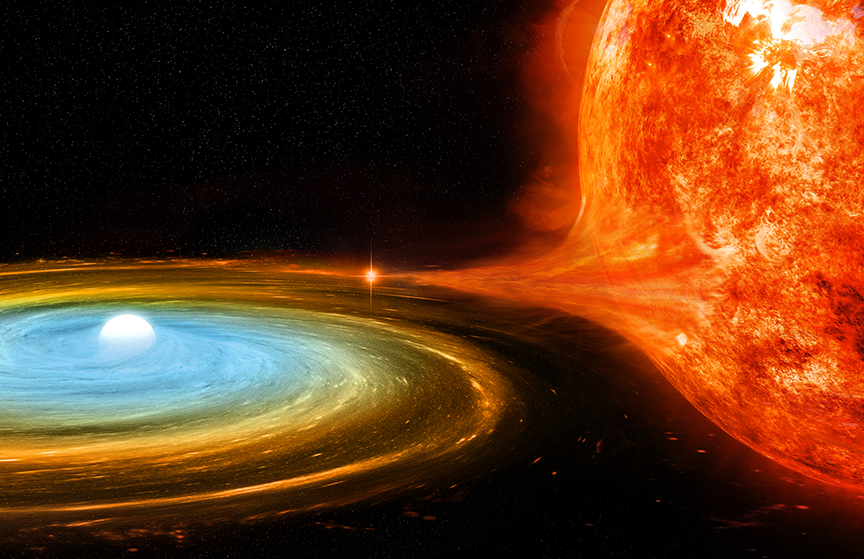
ASASSN-16oh
Illustration Credit NASA/CXC/M.Weiss


Astronomers have detected a bright X-ray outburst from a star in the Small Magellanic Cloud, a nearby galaxy almost 200,000 light years from Earth. A combination of X-ray and optical data indicate that the source of this radiation is a white dwarf star that may be the fastest-growing white dwarf ever observed.

In several billion years, our Sun will run out of most of its nuclear fuel and shrink down to a much smaller, fainter "white dwarf" star about the size of Earth. Because a mass equivalent to that of the Sun is packed into such a small volume, the gravity on the surface of a white dwarf is several hundred thousand times that of Earth.

Unlike our Sun, most stars including white dwarfs, do not exist in isolation, but instead are part of pairs called "binary systems." If the stars are close enough, the gravity of the white dwarf can pull matter away from its companion. 

A new study based on observations with NASA's Chandra X-ray Observatory and Neil Gehrels Swift Observatory has reported the discovery of distinctive X-ray emission from a binary system containing a white dwarf called ASASSN-16oh. The discovery involves the detection of low-energy — what astronomers refer to as "soft" — X-rays, produced by gas at temperatures of several hundred thousand degrees. In contrast, higher-energy X-rays reveal phenomena at temperatures of tens of millions of degrees. The X-ray emission from ASASSN-16oh is much brighter than the soft X-rays produced by the atmospheres of normal stars, placing it in the special category of a supersoft X-ray source. 

For years, astronomers have thought that supersoft X-ray emission from white dwarf stars is produced by nuclear fusion in a hot, dense layer of hydrogen and helium nuclei. This volatile material accumulated from the infall of matter from the companion star onto the surface of the white dwarf, and led to a nuclear fusion explosion much like a hydrogen bomb. 

However, ASASSN-16oh shows there is more to the story. This binary was first discovered by the All-Sky Automated Survey for Supernovae (ASASSN), a collection of about 20 optical telescopes distributed around the globe to automatically survey the entire sky every night for supernovas and other transient events. Astronomers then used Chandra and Swift to detect the supersoft X-ray emission. 

"In the past, the supersoft sources have all been associated with nuclear fusion on the surface of white dwarfs," said lead author Tom Maccarone, a professor in the Texas Tech Department of Physics & Astronomy who led the new paper that appears in the December 3rd issue of Nature Astronomy.

If nuclear fusion is the cause of the supersoft X-rays from ASASSN-16oh then it should begin with an explosion and the emission should come from the entire surface of the white dwarf. However, the optical light does not increase quickly enough to be caused by an explosion and the Chandra data show that the emission is coming from a region smaller than the surface of the white dwarf. The source is also a hundred times fainter in optical light than white dwarfs known to be undergoing fusion on their surface. These observations, plus the lack of evidence for gas flowing away from the white dwarf, provide strong arguments against fusion having taken place on the white dwarf.

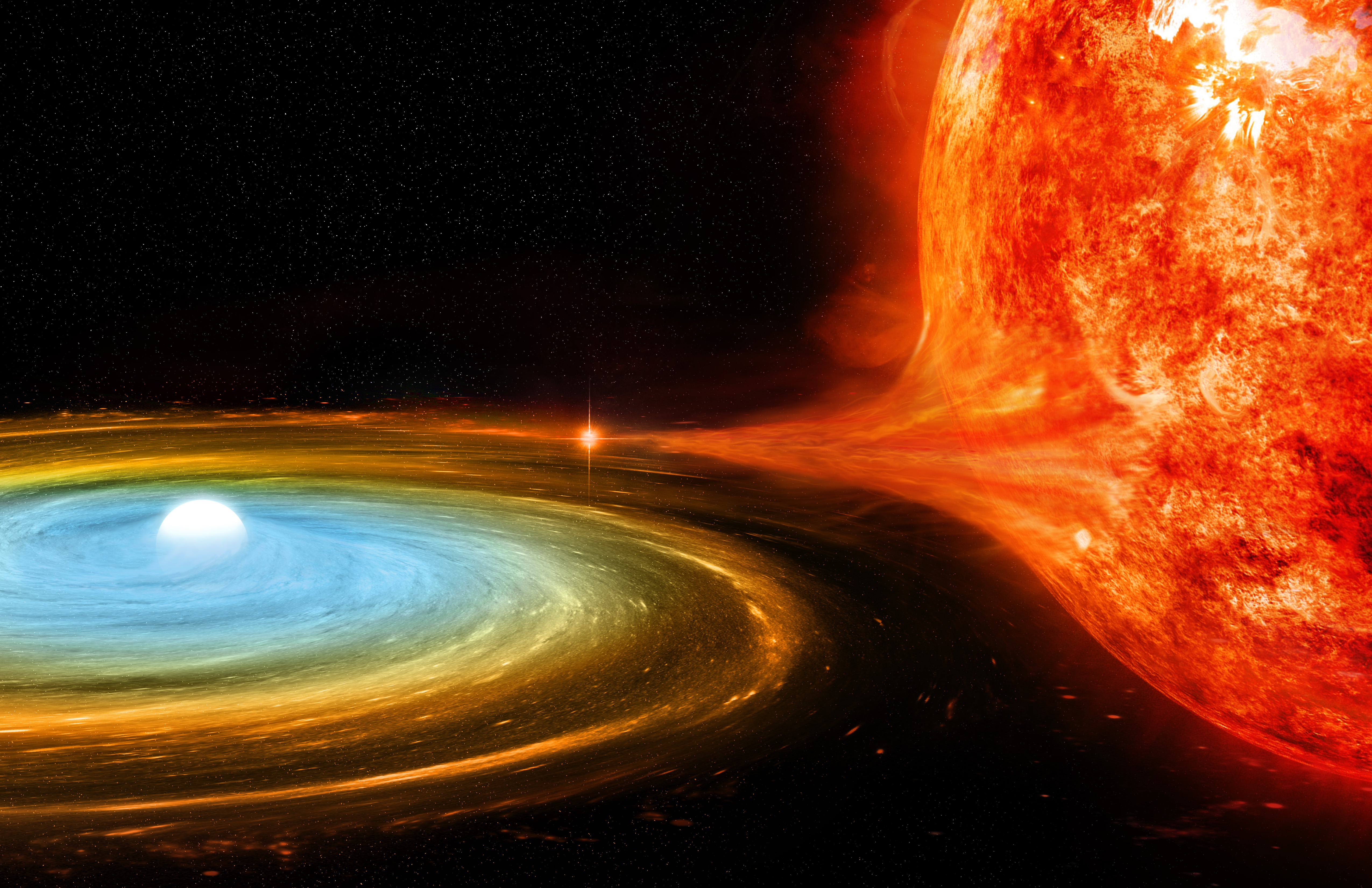
Because none of the signs of nuclear fusion are present, the authors present a different scenario. As with the fusion explanation the white dwarf is pulling gas away from a companion star, a red giant. In a process called accretion, the gas is pulled onto a large disk surrounding the white dwarf and becomes hotter as it spirals toward the white dwarf, as shown in our illustration. The gas then falls onto the white dwarf, producing X-rays along a belt where the disk meets the star. The rate of inflow of matter through the disk varies by a large amount. When the material starts flowing more quickly, the X-ray brightness of the system becomes much higher.

"The transfer of mass is happening at a higher rate than in any system we've caught in the past," added Maccarone.

If the white dwarf keeps gaining mass it may reach a mass limit and destroy itself in a Type Ia supernova explosion, a type of event used to discover that the expansion of the universe is accelerating. The team's analysis suggests that the white dwarf is already unusually massive so ASASSN-16oh may be relatively close — in astronomical terms — to exploding as a supernova.

"Our result contradicts a decades-long consensus about how supersoft X-ray emission from white dwarfs is produced," said co-author Thomas Nelson from the University of Pittsburgh. "We now know that the X-ray emission can be made in two different ways: by nuclear fusion or by the accretion of matter from a companion."

Also involved in the study were scientists from Texas A&M University, NASA Goddard Space Flight Center, University of Southampton, University of the Free State in the Republic of South Africa, the South African Astronomical Observatory, Michigan State University, State University of New Jersey, Warsaw University Observatory, Ohio State University and the University of Warwick.

NASA's Marshall Space Flight Center in Huntsville, Alabama, manages the Chandra program for NASA's Science Mission Directorate in Washington. The Smithsonian Astrophysical Observatory in Cambridge, Massachusetts, controls Chandra's science and flight operations.


Fast Facts for ASASSN-16oh:

Category: White Dwarfs & Planetary Nebulas
Coordinates (J2000): RA 1h 57m 43s | Dec -73° 37´ 32.5"
Constellation: Tucana
Observation Date: December 28, 2016
Observation Time: 13 hours 36 minutes
Obs. ID: 19983
Instrument: HRC
References: Maccarone, T et al, 2018, Nature Astronomy (published Dec 3rd)
Distance Estimate: About 200,000 light years


Monday, December 03, 2018

Studying Lyman-α-galaxies with strong gravitational lensing

Images by the Hubble Space telescope of all gravitational lens systems. The surface brightness scale is in electrons per second. The lensing morphologies are quite varied, from nearly complete Einstein rings to very compact 2-image systems. © MPA

These images show the lens model of one of the systems in the sample showing the actual data, the model, normalized residuals, and the reconstruction of the source (from left). Critical curves and caustics are plotted in grey. © MPA

The star-formation rate intensity of the objects from Fig. 1, based on the source reconstructions from the grid-based gravitational lens modelling. The colour-scale for each object is in units of solar masses per year in a square with 1 kiloparsec on the side. (The reconstruction of the object J0201+3228 was not included as this presented strong residuals.) © MPA


Strong gravitational lensing is an extremely powerful tool to go beyond the current limits in angular resolution and to investigate the high-redshift, i.e. distant Universe. Scientists at MPA take advantage of this phenomenon to perform a detailed study of 17 Lyman-α-galaxies and present an analysis of the sizes and star formation rates of their reconstructed ultra-violet (UV) continuum emission.

Lyman-α-emitting (LAE) galaxies represent a unique probe of the young Universe, about 1 to 2 billion years after the Big Bang. Typical LAEs are characterised by high-ionisation and strong star formation with low metallicity (i.e. few elements heavier than hydrogen and in general a low mass. The Lyman-α emission is produced when electrons recombine with the ionized hydrogen atoms and the properties cited above, combined with low dust content, allow for the escape of a significant fraction of these photons. While this emission is thought to have had a crucial role in the reionisation of the young Universe, very little is known about the detailed structure of these galaxies and, most importantly, about the mechanism that leads to the production of these high-energy photons.

So far the study of these high-redshift objects has been limited to quantifying the properties of their strong optical lines. Alternatively, many efforts have been spent to identify local analogues, i.e. nearby galaxies presenting similar physical and morphological characteristics. Both these approaches, however, require significant investment in telescope time.

Another resource to study these galaxies lies in high-resolution imaging studies that so far have been very useful to reveal their structure. LAEs are found to be quite compact objects and there is no evidence that they change their size as they evolve. Moreover they are surrounded by a large Lyman-α-emitting halo which is on average 10 times more extended than the UV continuum emitting region. Also this halo does not show an evolution in size with redshift. However, such studies are currently limited by the angular resolution of the observations and struggle to reveal the detailed structure of these objects.

Strong gravitational lensing can be used to overcome these limits. The first statistically significant sample of LAEs at z~2.5 strongly lensed by early type galaxies at z~0.5, has recently been revealed by observations with the Hubble Space Telescope. Due to the lensing magnification by a factor of about 20, we can access and probe the detailed structure of these galaxies at scales around 100 pc (some 300 light-years).

We have studied the intrinsic properties of the UV-continuum emission of these LAEs and we found that they have a median star formation rate of 1.4 solar masses per year with peaks of up to 54 solar masses per year. (This is actually a lower limit as we could not correct for dust attenuation.) We have found these galaxies to be quite compact, with a median size of about 500 pc and a range of radii from 200 to 1800 pc – our Milky Way with about 60 000 pc is gigantic compared to these LAE. Interestingly, they show quite complex morphologies with several compact and diffuse components, while in some cases they appear to be interacting. In two cases (14 percent of 17?) the galaxies seem to have off-axis components that may be associated with mergers.

Most interestingly, our LAEs are found to be quite elliptical, with a mean axis-ratio of about 0.5. This morphology is consistent with disk-like structures of star-formation for three-quarters of our sample, which would rule out models where the Lyman-α-emission is only seen perpendicular to the disk to favour instead clumpy models. Our results are in agreement with the studies of non-lensed LAEs at similar redshifts, but are more robust given the improved angular resolution of our analysis and given that no stacking techniques are needed.

With 200 pc, our lower limit on the intrinsic size of these objects is a factor of two smaller than what is achieved in non-lensed LAEs studies. In general our analysis further promotes gravitational lensing as a powerful tool to analyse and resolve the detailed structure of high-redshift galaxies, allowing the study of their physical and morphological properties at a resolution otherwise only achievable with nearby targets.


Authors

Ritondale, Elisa Ritondale, Elisa PhD student
Phone: 2233
Email: elisa@mpa-garching.mpg.de
Room: 252

Vegetti, Simona Vegetti, Simona
Scientific Staff
Phone: 2285
Email: svegetti@mpa-garching.mpg.de
Room: 107


Saturday, December 01, 2018

Kepler’s Supernova Experiment Captures First Moments of a Dying Star

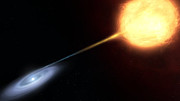
The above animation shows the scenario leading to a particular kind of Type Ia supernova in which a single white dwarf siphons off so much material from its companion star that it can no longer sustain its own weight and blows up. It is one theory explaining the data from SN 2018oh.Image Credit: NASA/JPL-Caltech. Release image

In a galaxy far away, an old star exploded and became a supernova. About 170 million years later on Feb. 4, 2018, the light emanating from the explosion was received by an arsenal of high-powered telescopes.

NASA’s Kepler space telescope detected the unfurling light of SN 2018oh, as it has been labeled. The first ground-based facility to identify the signal was with the All-Sky Automated Survey for Supernova and soon observatories around the globe were monitoring the supernova as part of a unique scientific experiment designed to help solve the mystery of how stars explode.

NASA retired the Kepler space telescope on October 30, following the exhaustion of fuel supplies after nine and a half years of ground-breaking operations. But from December to May, while there was still fuel left, the Kepler team oriented the spacecraft toward two distinct patches of sky that were simultaneously observable from Earth by ground-based observatories. The telescopes were able to view both patches of sky teeming with galaxies. Each of these thousands of galaxies has billions of stars.

While the telescopes watched, a few of those stars ended their long lives in dramatic explosions. With its unique capabilities, Kepler observed the minute changes in brightness of these explosions from their very beginnings while the ground-based telescopes tracked changes in color and the atomic composition of these dying stars.

With the combined data from these telescopes, astronomers achieved what they had hoped for — an unprecedented observation of the onset of a supernova. Three research papers by 130 scientists attempt to explain the unusual data revealed in the details of SN 2018oh, which was caught in the spiral galaxy UGC 4780 in the Cancer constellation. One of the papers has been accepted for publication in The Astrophysical Journal Letters, while the other two have been accepted to The Astrophysical Journal.

A hot, bright burn

SN 2018oh is an example of a Type Ia supernova — the kind that astronomers use to track the expansion of the universe and probe the nature of the invisible “dark energy” that glues together the cosmos.

A typical Type Ia supernova brightens over the course of three weeks before gradually fading away. But Kepler observed this particular supernova brightening rapidly a few days after the initial explosion — about three times faster than a typical supernova at this time period — before reaching peak brightness. Meanwhile, color details obtained by the Dark Energy Camera at Cerro Tololo Inter-American Observatory in Chile, and the Panoramic Survey Telescope and Rapid Response System at Haleakala Observatory in Hawaii, showed this supernova gleaming blue during this period of intensity, an indication of high temperatures.

For nearly a decade, scientists have been in search of a signal of a supernova similar to this one. Because Kepler was already staring at this patch of sky before the supernova went off, it was able to detect its early signals and measure it continuously for weeks.

The scenarios giving rise to Type Ia supernovae have been long-debated. So far, most evidence points to the merging of two white dwarfs, the compact corpses of stars, as the source of these explosions. Yet theoretical models have held out the possibility of an alternative scenario, in which a single degenerate white dwarf siphons off so much material from its companion star that it can no longer sustain its own weight and blows up.

Some of the scientists examining SN 2018oh’s peculiar data believe it is a compelling example of this alternative scenario. They explain that the shock wave from the exploding white dwarf ran into the companion star, creating an extremely hot and bright gaseous material that accounts for the added brightness and heat observed.

Another group of scientists favor a different mechanism to explain the excess flux of light and temperature. Type Ia supernovae produce radioactive nickel during the explosion. The radioactive decay of this heavy metal produces much of the light we see from Type Ia supernovae. If a large amount of nickel was located in the outer layers of the exploding material it would produce the observed early bump in the light.

Refining the models

If the single degenerate white dwarf theory holds true for SN 2018oh, the next step is to figure out the frequency of this kind of Type Ia supernova. If, however, the theory of nickel in the outer layers prevails, we will glean details about the inner workings of supernova explosions. Either way, understanding the details of Type Ia supernovae are important for refining the models used in cosmology to estimate the expansion rate of the universe.

The team of astronomers detected more than 40 supernova candidates during this experiment with Kepler, including several others that are also proving scientifically interesting. Though Kepler’s fuel has run out and cannot be replaced, the data it has collected on supernovae, exoplanets and other astronomical phenomena will be studied for many years to come.

The authors of these papers include scientists from dozens of institutions, including members of the Kepler team. Additional observatories providing valuable data to support the experiment include Las Cumbres Observatory, a global network of robotic telescopes based in Goleta, California; Tsinghua-NAOC and Lijiang Telescopes in China; Konkoly Observatory in Hungary; Lick Observatory on Mount Hamilton in California; Las Campanas Observatory in Chile, and others.

NASA's Ames Research Center in California’s Silicon Valley manages the Kepler and K2 missions for NASA’s Science Mission Directorate. NASA's Jet Propulsion Laboratory in Pasadena, California, managed Kepler mission development. Ball Aerospace & Technologies Corporation operates the flight system with support from the Laboratory for Atmospheric and Space Physics at the University of Colorado in Boulder.

The above animation shows the scenario leading to a particular kind of Type Ia supernova in which a single white dwarf siphons off so much material from its companion star that it can no longer sustain its own weight and blows up. It is one theory explaining the data from SN 2018oh. Image Credit: NASA/JPL-Caltech

Editor: Rick Chen