Showing posts with label R Aquarii. Show all posts

Wednesday, November 26, 2025

Fall Collection: Before Fall Leaves, See Seasonal Offerings from NASA's Chandra


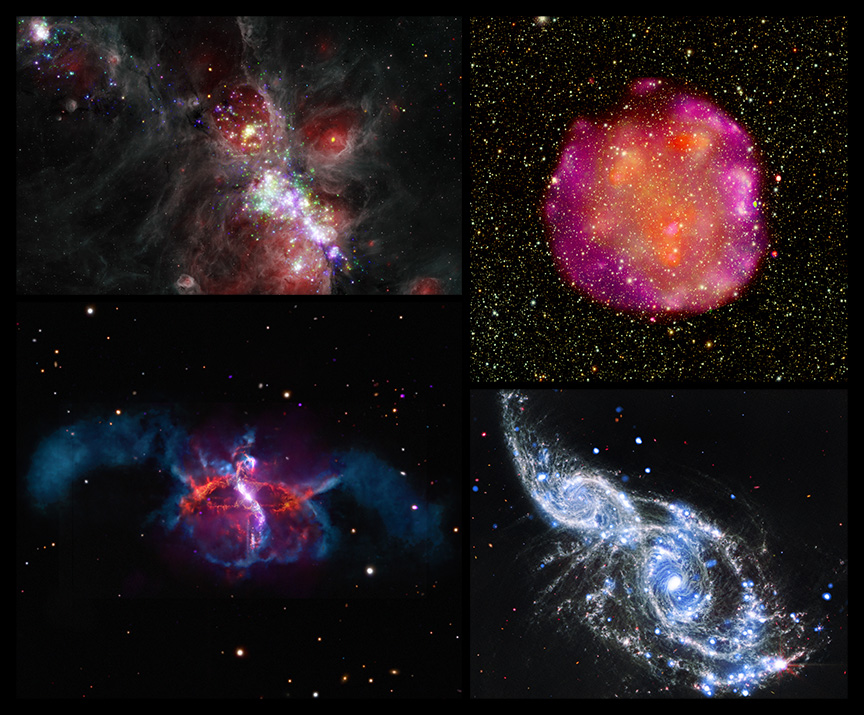
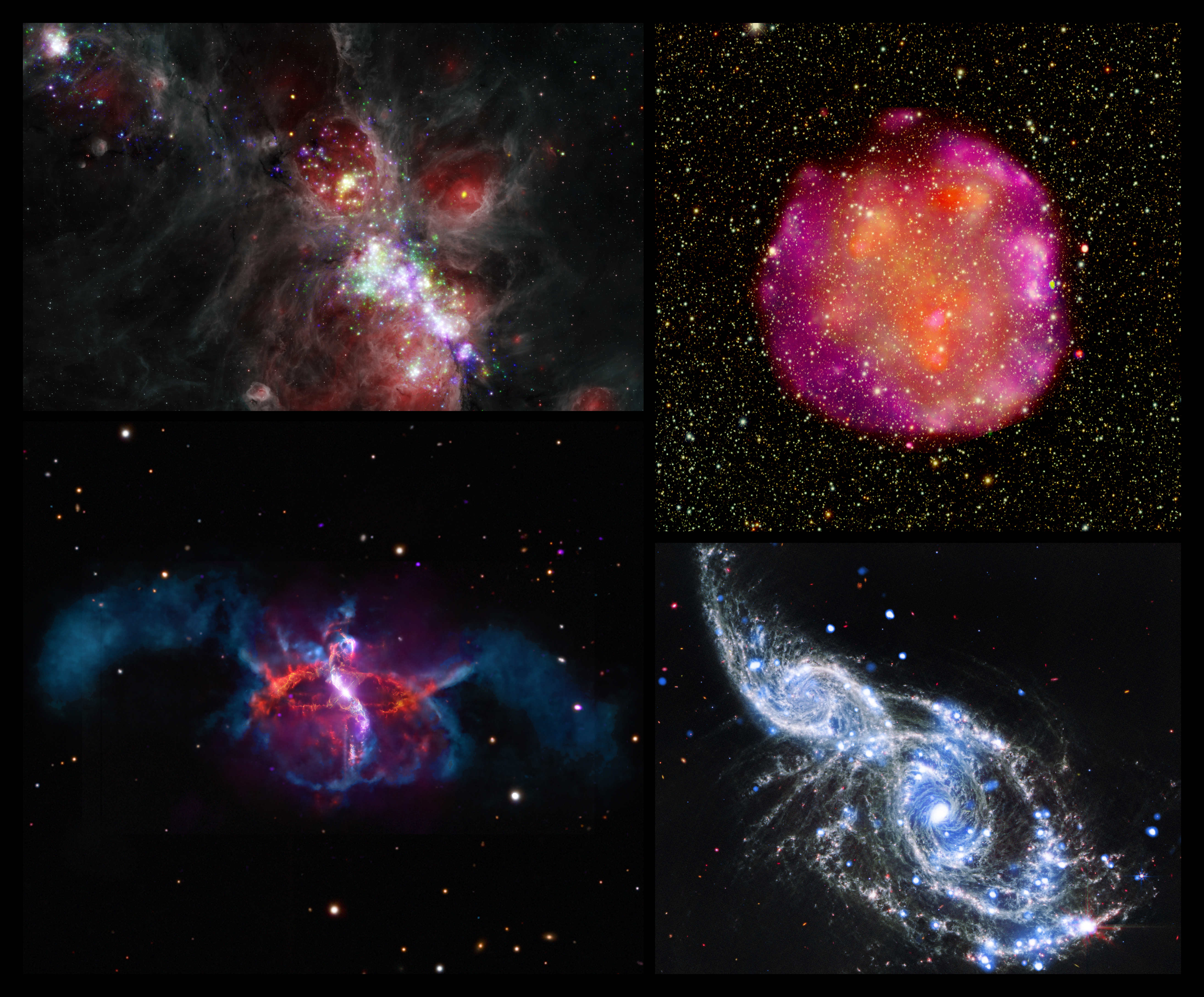
  • Four images that one can imagine connections to fall have been released by NASA’s Chandra X-ray Observatory.

  • The images are the star-forming region NGC 6334, supernova remnant G272.2-0.3, interacting spiral galaxies NGC 2207 and IC 2163, as well as R Aquarii.

  • Each image contains X-rays from Chandra that have been combined with data from other telescopes that detect different types of light.

  • Pareidolia is the phenomenon that allows people to see familiar patterns or shapes in data.

Before fall gives way to winter in the northern hemisphere, NASA’s Chandra X-ray Observatory has several images that celebrate autumn and its many delights to share. In spirit of the season, this collection gathers Chandra data with those from its telescopic family including NASA’s James Webb, Hubble, and Spitzer Space Telescopes, plus others in space and on the ground.

Here is a sample of the seasonal offerings that space has in store:

NGC 6334: COSMIC LEAVES BLOWING
For many, nothing evokes fall more than fallen leaves. In this view of NGC 6334, glowing pockets of dust and gas in the nebula resemble leaves that have been picked up by a wind gust. This region is actually home to strong winds blowing from the young stars that have formed there. This image contains X-ray data from Chandra (blue, green, and yellow) that shows the effects of these winds, which have been combined with infrared data from the now-retired Spitzer Space Telescope (red, brown), which shows the dust and gas that fuels the growing stars.

G272: THE SPACE PUMPKIN
Born after a violent explosion of a star, this cosmic gourd is the supernova remnant G272.2-03.2. X-ray observations (orange and magenta) from Chandra provide evidence that G272 is the result of a Type Ia supernova explosion, where a white dwarf star pulls material from a companion star until it triggers a thermonuclear explosion and obliterates the star. The inside of the “pumpkin” is superheated gas that is filling the space cleared out by the explosion as it moves outward.

R AQUARII: A COSMIC SWEATER
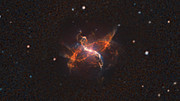
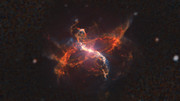
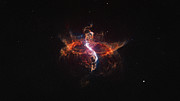
Multiple telescopes teamed up to capture an image that looks like a cozy sweater with fuzzy arms. X-rays from Chandra and ESA’s XMM-Newton (purple), optical light data from Hubble and the Very Large Telescope in Chile (orange, red, and violet), and an optical image from astrophotographer Bob Fera (deep blue) combine to reveal R Aquarii. Nestled within the cozy ‘body’ of R Aquarii is a pair of stars where a white dwarf is pulling material from a much larger red giant companion. When enough material accumulates on the surface of the white dwarf, it triggers an outburst that sends a jet out into space. Over time, these jets twist and loop around each other weaving the structure seen today.

NGC 2207 and IC 2163: A PAIR OF GALACTIC CORNUCOPIA
A cornucopia is a horn-shaped basket that traditionally carries fruits and vegetables. There is nothing edible in this pair of galactic cornucopias but there are a bounty of stars, dust, and other ingredients than make up these two spiral galaxies, known as NGC 2207 (right) and IC 2163 (left), that we see face-on. This view of NGC 2207 and IC 2163 takes a James Webb infrared image (white, gray, and red) and adds the X-ray view from Chandra (blue). Together, it is quite an eye-catching result.

NASA's Marshall Space Flight Center in Huntsville, Alabama, manages the Chandra program. The Smithsonian Astrophysical Observatory's Chandra X-ray Center controls science operations from Cambridge, Massachusetts, and flight operations from Burlington, Massachusetts.

Quick Look: Before Fall Leaves, See Seasonal Offer ings from NASA's Chandra


Visual Description:

This release highlights a collection of four composite images, presented in a two-by-two grid. Each image features data gathered by the Chandra X-ray Observatory and additional NASA and other telescopes.

At our upper left is NGC 6334, a massive nebula and star-forming region. In this image, scores of glowing young stars, depicted as tiny specs of distant light, illuminate an otherwise dark scene. The specs of red, green, yellow, purple, and white, are clustered near the center of the image, but extend to the edges of the frame in faint streaks. Partially masking the specs of color are tendrils of grey clouds; strong winds of dust and gas blowing from the still-forming stars.

The image at our upper right features a supernova remnant called G272.2-3.2. Here, a white dwarf star has pulled material from a companion star, triggering a thermonuclear explosion. What remains is a giant ball of superheated gas, set against a densely-packed field of distant stars and galaxies. In this image, the ball of gas is a mottled, translucent orange sphere with patches of hot pink at the outer edges.

The image at the grid's lower right depicts a pair of colliding spiral galaxies. Here, both spirals are shown face on, with the smaller of the two galaxies, IC 2163, at the upper left of the larger galaxy, NGC 2207, which dominates the center and lower right of the image. Both galaxies have long, spiraling, silver blue arms, dotted with specs of blue and red. Toward our upper left, the curving arms overlap, and bend toward their neighbors' core.

Finally, at our lower left, is R Aquarii, a symbiotic binary star. Here, a white dwarf star pulls material from a much larger red giant companion, sending looping jets of matter into space. In this composite image, which includes an optical image from astrophotographer Bob Fera, the resulting structure resembles a cozy sweater with a red body, and blue wooly arms opened wide.


Fast Facts for NGC 6334:

Credit: X-ray: NASA/SAO/CXC; Infrared: NASA/JPL/CalTech/Spitzer; Image Processing: NASA/CXC/SAO/J. Schmidt
Release Date: November 24, 2025
Scale: Image is about 72 arcmin (115.2 light-years) across.
Category: Normal Stars and Star Clusters
Coordinates (J2000): RA: 17h 20m 50.9s | Dec: -36° 06' 54"
Constellation: Scorpius
Observation Date(s): 10 observations from August 2002 to July 2016
Observation Time: 85 hours 28 minutes (3 days 13 hours 28 minutes)
Obs. IDs: 2573, 2574 ,3844, 4591, 8975, 12382, 13436, 18082, 18081, 18876
Instrument: ACIS
Color Code: X-ray: red, orange, green, and purple; Infrared: white and red
Distance Estimate: About 5,500 light-years from Earth


Fast Facts for SNR G272.2-03.2:

Credit: X-ray: NASA/CXC/SA0; Optical: NOIRLab/DECaPS2; Image Processing: NASA/CXC/SAO/L. Frattare
Release Date: November 24, 2025
Scale: Image is about 2.8 arcmin (5.7 light-years) across.
Category: Supernovas & Supernova Remnants
Coordinates (J2000): RA: 9h 06m 47s | Dec: -52° 05' 50"
Constellation: Vela
Observation Date(s): 2 observations Aug 26-27, 2008
Observation Time: 17 hours 55 minutes
Obs. IDs: 9147, 10572
Instrument: ACIS
Color Code: X-ray: cyan, yellow, and magenta; Optical: red, green, and blue
Distance Estimate: About 7,000 light-years from Earth


Fast Facts for R Aquarii:

Credit: X-ray: NASA/CXC/SAO; ESA/XMM-Newton; Optical HST: NASA/ESA/STScI; Optical Ground: Deep Space Remote observatories/B. Fera; ESO/VLT; Image Processing: NASA/CXC/SAO/L. Frattare
Release Date: November 24, 2025
Scale: Image is about 9.5 arcmin (1.8 light-years) across.
Category: White Dwarfs and Planetary Nebulas
Coordinates (J2000): RA: 23h 43m 49.5s | Dec: -15° 17' 04"
Constellation: Aquarius
Observation Date(s): 3 pointings between Sep 2001 and Oct 2005
Observation Time: 34 hours 54 minutes (1 day 10 hours 54 minutes)
Obs. IDs: 651, 4546, 5438
Instrument: ACIS
Color Code: X-ray: purple and blue; Optical (HST): cyan and orange; Optical (Ground): red, green, and blue; Radio: red with green
Distance Estimate: About 650 light-years from Earth


Fast Facts for NGC 2207 & IC 2163:

Credit: X-ray: NASA/CXC/SAO; Infrared: NASA/ESA/CSA/STScI/Webb; Image Processing: NASA/CXC/SAO/L. Frattare
Release Date: November 24, 2025
Scale Image is about 5 arcmin (189,000 light-years) across.
Category: Normal Galaxies, Starburst Galaxies, & Black Holes
Coordinates (J2000): RA: 6h 16m 22.1s | Dec: -21° 22′ 22"
Constellation: Canis Major
Observation Date(s): 4 observations from July 2010 to August 2013
Observation Time: 17 hours 20 minutes
Obs. IDs: 11228, 14914, 14799, 14915
Instrument: ACIS
Color Code: X-ray: blue; Infrared: white, red, green, and blue
Distance Estimate: About 130 million light-years from Earth


Thursday, October 17, 2024

NASA's Hubble Sees a Stellar Volcano

Credits/Image: NASA, ESA, Matthias Stute , Margarita Karovska , Davide De Martin (ESA/Hubble), Mahdi Zamani (ESA/Hubble)

Credits/Visualization: NASA, ESA, Matthias Stute , Margarita Karovska , Davide De Martin , Mahdi Zamani , N. Bartmann (ESA/Hubble)

Credits/Visualization: NASA, ESA, Matthias Stute , Margarita Karovska , Davide De Martin , Mahdi Zamani , N. Bartmann (ESA/Hubble)


A bright binary star surrounded by a colorful nebula on the black background of space. The star in the center is a large white spot surrounded by a circular glow. It has a large, X-shaped set of diffraction spikes around it. The nebula extends far above, below, left and right of the star in long, arcing shapes made of thin, multicolored filaments — mostly red and greenish colors, but lit in a bright cyan near the star where its light illuminates the gas.

NASA's Hubble Space Telescope has provided a dramatic and colorful close-up look at one of the most rambunctious stars in our galaxy, weaving a huge spiral pattern among the stars.

Located approximately 700 light-years away, a binary star system called R Aquarii undergoes violent eruptions that blast out huge filaments of glowing gas. The twisted stellar outflows make the region look like a lawn sprinkler gone berserk. This dramatically demonstrates how the universe redistributes the products of nuclear energy that form deep inside stars and jet back into space.

R Aquarii belongs to a class of double stars called symbiotic stars. The primary star is an aging red giant and its companion is a compact burned-out star known as a white dwarf. The red giant primary star is classified as a Mira variable that is over 400 times larger than our Sun. The bloated monster star pulsates, changes temperature, and varies in brightness by a factor of 750 times over a roughly 390-day period. At its peak the star is blinding at nearly 5,000 times our Sun's brightness.

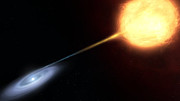
When the white dwarf star swings closest to the red giant along its 44-year orbital period, it gravitationally siphons off hydrogen gas. This material accumulates on the dwarf star's surface until it undergoes spontaneous nuclear fusion, making that surface explode like a gigantic hydrogen bomb. After the outburst, the fueling cycle begins again.

This outburst ejects geyser-like filaments shooting out from the core, forming weird loops and trails as the plasma emerges in streamers. The plasma is twisted by the force of the explosion and channeled upwards and outwards by strong magnetic fields. The outflow appears to bend back on itself into a spiral pattern. The plasma is shooting into space over 1 million miles per hour – fast enough to travel from Earth to the Moon in 15 minutes! The filaments are glowing in visible light because they are energized by blistering radiation from the stellar duo.

Hubble first observed the star in 1990. R Aquarii was resolved into two very bright stars separated by about 1.6 billion miles. The ESA/Hubble team now has made a unique timelapse of R Aquarii's dynamic behavior, from observations spanning from 2014 to 2023. Across the five images, the rapid and dramatic evolution of the binary star and its surrounding nebula can be seen. The binary star dims and brightens due to strong pulsations in the red giant star.

The scale of the event is extraordinary even in astronomical terms. Space-blasted material can be traced out to at least 248 billion miles from the stars, or 24 times our solar system's diameter. Images like these and more from Hubble are expected to revolutionize our ideas about such unique stellar "volcanoes" as R Aquarii.

The Hubble Space Telescope has been operating for over three decades and continues to make ground-breaking discoveries that shape our fundamental understanding of the universe. Hubble is a project of international cooperation between NASA and ESA (European Space Agency). NASA's Goddard Space Flight Center in Greenbelt, Maryland, manages the telescope and mission operations. Lockheed Martin Space, based in Denver, Colorado, also supports mission operations at Goddard. The Space Telescope Science Institute in Baltimore, Maryland, which is operated by the Association of Universities for Research in Astronomy, conducts Hubble science operations for NASA.


About This Release

Credits:

Media Contact:

Ray Villard
Space Telescope Science Institute, Baltimore, Maryland

Bethany Downer
ESA/Hubble

Permissions: Content Use Policy

Contact Us: Direct inquiries to the News Team.

Related Links and Documents


Thursday, December 13, 2018

Dancing with the Enemy

R Aquarii peculiar stellar relationship captured by SPHERE

PR Image eso1840b
R Aquarii viewed by the Very Large Telescope and Hubble
R Aquarii In the constellation Aquarius

PR Image eso1840d
Digitized Sky Survey image around R Aquarii 


Video

ESOcast 188 Light: Dancing with the Enemy

Zooming in on R Aquarii

The ever-changing R Aquarii
PR Video eso1840c
The ever-changing R Aquarii 

A vampiric star
A vampiric star

Close-up of a red giant star

Jet outburst of a vampiric star

Changing brightness of R Aquarii

Close-up of jets

Close-up of jets


ESO’s R Aquarii Week continues with the sharpest R Aquarii image ever

While testing a new subsystem on the SPHERE planet-hunting instrument on ESO’s Very Large Telescope, astronomers were able to capture dramatic details of the turbulent stellar relationship in the binary star R Aquarii with unprecedented clarity — even compared to observations from Hubble.

This spectacular image — the second instalment in ESO’s R Aquarii Week — shows intimate details of the dramatic stellar duo making up the binary star R Aquarii. Though most binary stars are bound in a graceful waltz by gravity, the relationship between the stars of R Aquarii is far less serene. Despite its diminutive size, the smaller of the two stars in this pair is steadily stripping material from its dying companion — a red giant.

Years of observation have uncovered the peculiar story behind the binary star R Aquarii, visible at the heart of this image. The larger of the two stars, the red giant, is a type of star known as a Mira variable. At the end of their life, these stars start to pulsate, becoming 1000 times as bright as the Sun as their outer envelopes expand and are cast into the interstellar void.

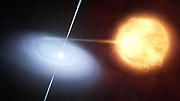
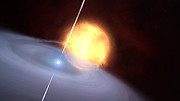
The death throes of this vast star are already dramatic, but the influence of the companion white dwarf star transforms this intriguing astronomical situation into a sinister cosmic spectacle. The white dwarf — which is smaller, denser and much hotter than the red giant — is flaying material from the outer layers of its larger companion. The jets of stellar material cast off by this dying giant and white dwarf pair can be seen here spewing outwards from R Aquarii.
<

Occasionally, enough material collects on the surface of the white dwarf to trigger a thermonuclear nova explosion, a titanic event which throws a vast amount of material into space. The remnants of past nova events can be seen in the tenuous nebula of gas radiating from R Aquarii in this image. <

R Aquarii lies only 650 light-years from Earth — a near neighbour in astronomical terms — and is one of the closest symbiotic binary stars to Earth. As such, this intriguing binary has received particular attention from astronomers for decades. Capturing an image of the myriad features of R Aquarii was a perfect way for astronomers to test the capabilities of the Zurich IMaging POLarimeter (ZIMPOL), a component on board the planet-hunting instrument SPHERE. The results exceeded observations from space — the image shown here is even sharper than observations from the famous NASA/ESA Hubble Space Telescope. <

SPHERE was developed over years of studies and construction to focus on one of the most challenging and exciting areas of astronomy: the search for exoplanets. By using a state-of-the-art adaptive optics system and specialised instruments such as ZIMPOL, SPHERE can achieve the challenging feat of directly imaging exoplanets. However, SPHERE’s capabilities are not limited to hunting for elusive exoplanets. The instrument can also be used to study a variety of astronomical sources — as can be seen from this spellbinding image of the stellar peculiarities of R Aquarii.


More Information

This research was presented in the paper “SPHERE / ZIMPOL observations of the symbiotic system R Aqr. I. Imaging of the stellar binary and the innermost jet clouds” by H.M. Schmid et. al, which was published in the journal Astronomy & Astrophysics.

The team was composed of H. M. Schmid (ETH Zurich, Institute for Astronomy, Switzerland), A. Bazzon (ETH Zurich, Institute for Astronomy, Switzerland), J. Milli (European Southern Observatory), R. Roelfsema (NOVA Optical Infrared Instrumentation Group at ASTRON, the Netherlands), N. Engler (ETH Zurich, Institute for Astronomy, Switzerland) , D. Mouillet (Université Grenoble Alpes and CNRS, France), E. Lagadec (Université Côte d’Azur, France), E. Sissa (INAF and Dipartimento di Fisica e Astronomia “G. Galilei” Universitá di Padova, Italy), J.-F. Sauvage (Aix Marseille Univ, France), C. Ginski (Leiden Observatory and Anton Pannekoek Astronomical Institute, the Netherlands), A. Baruffolo (INAF), J.L. Beuzit (Université Grenoble Alpes and CNRS, France), A. Boccaletti (LESIA, Observatoire de Paris, France), A. J. Bohn (ETH Zurich, Institute for Astronomy, Switzerland), R. Claudi (INAF, Italy), A. Costille (Aix Marseille Univ, France), S. Desidera (INAF, Italy), K. Dohlen (Aix Marseille Univ, France), C. Dominik (Anton Pannekoek Astronomical Institute, the Netherlands), M. Feldt (Max-Planck-Institut für Astronomie, Germany), T. Fusco (ONERA, France), D. Gisler (Kiepenheuer-Institut für Sonnenphysik, Germany), J.H. Girard (European Southern Observatory), R. Gratton (INAF, Italy), T. Henning (Max-Planck-Institut für Astronomie, Germany), N. Hubin (European Southern Observatory), F. Joos (ETH Zurich, Institute for Astronomy, Switzerland), M. Kasper (European Southern Observatory), M. Langlois (Centre de Recherche Astrophysique de Lyon and Aix Marseille Univ, France), A. Pavlov (Max-Planck-Institut für Astronomie, Germany), J. Pragt (NOVA Optical Infrared Instrumentation Group at ASTRON, the Netherlands), P. Puget (Université Grenoble Alpes, France), S.P. Quanz (ETH Zurich, Institute for Astronomy, Switzerland), B. Salasnich (INAF, Italy), R. Siebenmorgen (European Southern Observatory), M. Stute (Simcorp GmbH, Germany), M. Suarez (European Southern Observatory), J. Szulagyi (ETH Zurich, Institute for Astronomy, Switzerland), C. Thalmann (ETH Zurich, Institute for Astronomy, Switzerland), M. Turatto (INAF, Italy), S. Udry (Geneva Observatory, Switzerland), A. Vigan (Aix Marseille Univ, France), and F. Wildi (Geneva Observatory, Switzerland).

ESO is the foremost intergovernmental astronomy organisation in Europe and the world’s most productive ground-based astronomical observatory by far. It has 16 Member States: Austria, Belgium, the Czech Republic, Denmark, France, Finland, Germany, Ireland, Italy, the Netherlands, Poland, Portugal, Spain, Sweden, Switzerland and the United Kingdom, along with the host state of Chile and with Australia as a Strategic Partner. ESO carries out an ambitious programme focused on the design, construction and operation of powerful ground-based observing facilities enabling astronomers to make important scientific discoveries. ESO also plays a leading role in promoting and organising cooperation in astronomical research. ESO operates three unique world-class observing sites in Chile: La Silla, Paranal and Chajnantor. At Paranal, ESO operates the Very Large Telescope and its world-leading Very Large Telescope Interferometer as well as two survey telescopes, VISTA working in the infrared and the visible-light VLT Survey Telescope. ESO is also a major partner in two facilities on Chajnantor, APEX and ALMA, the largest astronomical project in existence. And on Cerro Armazones, close to Paranal, ESO is building the 39-metre Extremely Large Telescope, the ELT, which will become “the world’s biggest eye on the sky”.


Links


Contacts

Calum Turner
ESO Public Information Officer
Garching bei München, Germany
Tel: +49 89 3200 6670
Cell: +49 151 1537 3591
Email: pio@eso.org

Source: ESO/News


Wednesday, June 07, 2017

R Aquarii: Watching a Volatile Stellar Relationship

R Aquarii
Credit  X-ray: NASA/CXC/SAO/R. Montez et al.; 
Optical: Adam Block/Mt. Lemmon SkyCenter/U. Arizona


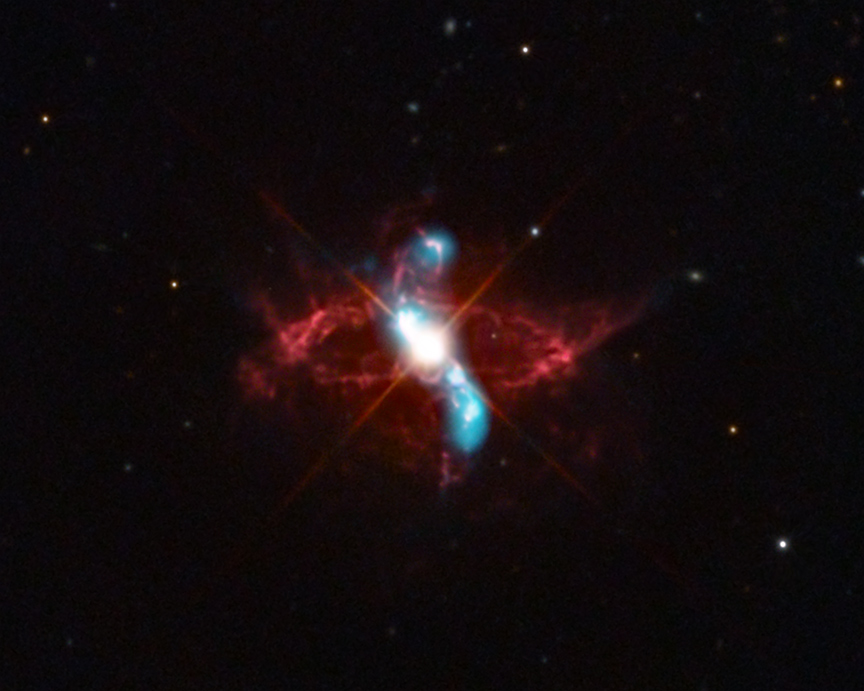
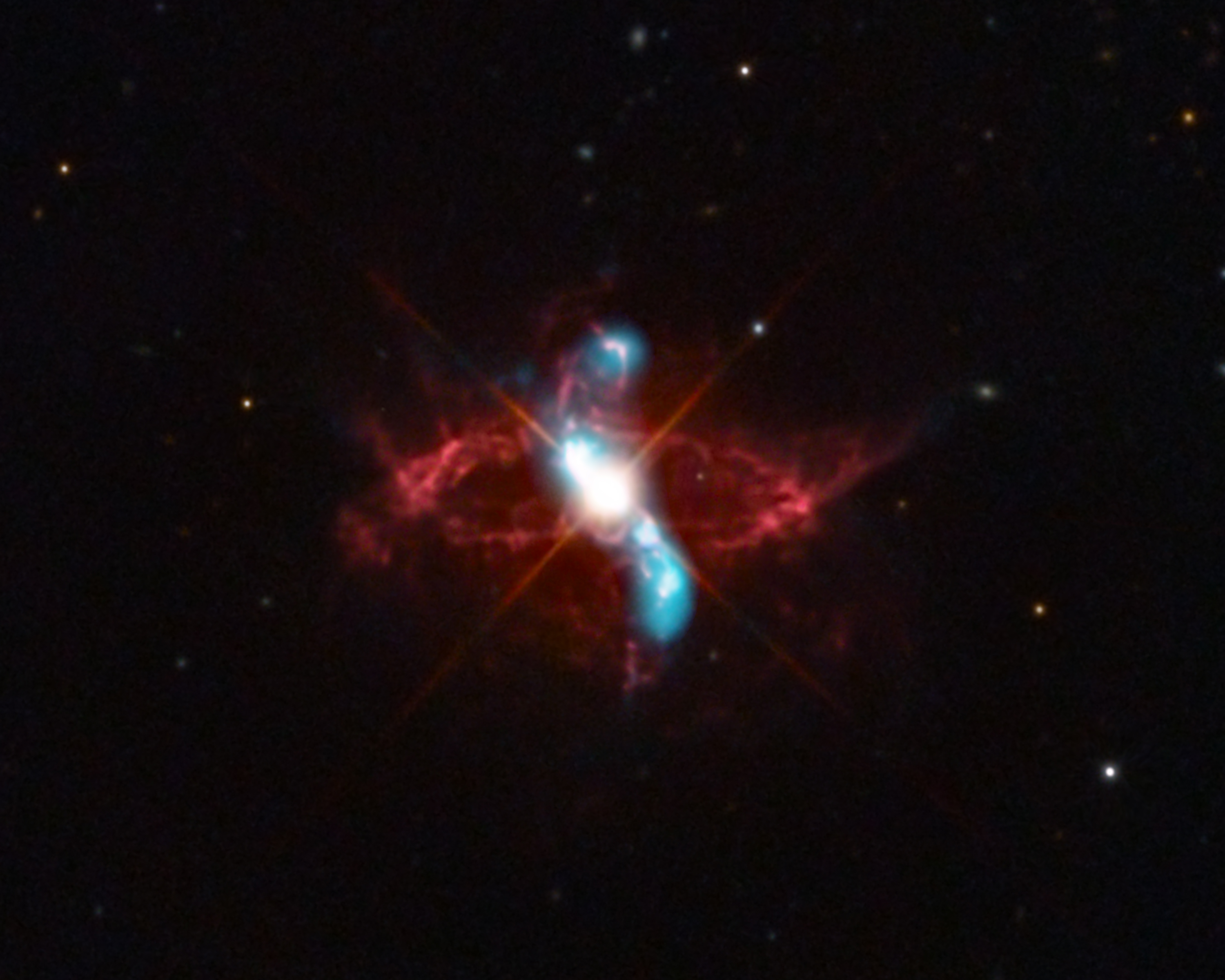
In biology, "symbiosis" refers to two organisms that live close to and interact with one another. Astronomers have long studied a class of stars — called symbiotic stars — that co-exist in a similar way. Using data from NASA’s Chandra X-ray Observatory and other telescopes, astronomers are gaining a better understanding of how volatile this close stellar relationship can be.

R Aquarii (R Aqr, for short) is one of the best known of the symbiotic stars. Located at a distance of about 710 light years from Earth, its changes in brightness were first noticed with the naked eye almost a thousand years ago. Since then, astronomers have studied this object and determined that R Aqr is not one star, but two: a small, dense white dwarf and a cool red, giant star.

The red giant star has its own interesting properties. In billions of years, our Sun will turn into a red giant once it exhausts the hydrogen nuclear fuel in its core and begins to expand and cool. Most red giants are placid and calm, but some pulsate with periods between 80 and 1,000 days like the star  Mira and undergo large changes in brightness. This subset of red giants is called "Mira variables."
The red giant in R Aqr is a Mira variable and undergoes steady changes in brightness by a factor of 250 as it pulsates, unlike its white dwarf companion that does not pulsate. There are other striking differences between the two stars. The white dwarf is about ten thousand times brighter than the red giant. The white dwarf has a surface temperature of some 20,000 K while the Mira variable has a temperature of about 3,000 K. In addition, the white dwarf is slightly less massive than its companion but because it is much more compact, its gravitational field is stronger. The gravitational force of the white dwarf pulls away the sloughing outer layers of the Mira variable toward the white dwarf and onto its surface.

Occasionally, enough material will accumulate on the surface of the white dwarf to trigger thermonuclear fusion of hydrogen. The release of energy from this process can produce a nova, an asymmetric explosion that blows off the outer layers of the star at velocities of ten million miles per hour or more, pumping energy and material into space. An outer ring of material provides clues to this history of eruptions. Scientists think a nova explosion in the year 1073 produced this ring.

Evidence for this explosion comes from optical telescope data, from Korean records of a “guest” star at the position of R Aqr in 1073 and information from Antarctic ice cores. An inner ring was generated by an eruption in the early 1770s. Optical data (red) in a new composite image of R Aqr shows the inner ring. The outer ring is about twice as wide as the inner ring, but is too faint to be visible in this image.

Since shortly after Chandra launched in 1999, astronomers began using the X-ray telescope to monitor the behavior of R Aqr, giving them a better understanding of the behavior of R Aqr in more recent years. Chandra data (blue) in this composite reveal a jet of X-ray emission that extends to the upper left. The X-rays have likely been generated by shock waves, similar to sonic booms around supersonic planes, caused by the jet striking surrounding material.

As astronomers have made observations of R Aqr with Chandra over the years, in 2000, 2003, and 2005, they have seen changes in this jet. Specifically, blobs of X-ray emission are moving away from the stellar pair at speeds of about 1.4 million and 1.9 million miles per hour. Despite travelling at a slower speed than the material ejected by the nova, the jets encounter little material and do not slow down much. On the other hand, matter from the nova sweeps up a lot more material and slows down significantly, explaining why the rings are not much larger than the jets.


Using the distances of the blobs from the binary, and assuming that the speeds have remained constant, a team of scientists from the Harvard-Smithsonian Center for Astrophysics (CfA) in Cambridge, Mass, estimated that eruptions in the 1950s and 1980s produced the blobs. These eruptions were less energetic and not as bright as the nova explosion in 1073.

In 2007 a team led by Joy Nichols from CfA reported the possible detection of a new jet in R Aqr using the Chandra data. This implies that another eruption occurred in the early 2000s. If these less powerful and poorly understood events repeat about every few decades, the next one is due within the next 10 years.

Some binary star systems containing white dwarfs have been observed to produce nova explosions at regular intervals. If R Aqr is one of these recurrent novas, and the spacing between the 1073 and 1773 events repeats itself, the next nova explosion should not occur again until the 2470s. During such an event the system may become several hundred times brighter, making it easily visible to the naked eye, and placing it among the several dozen brightest stars.

Close monitoring of this stellar couple will be important for trying to understand the nature of their volatile relationship.

Rodolfo ("Rudy") Montez of the Harvard-Smithsonian Center for Astrophysics (CfA) in Cambridge, Mass, presented these results at the 230th meeting of the American Astronomical Society in Austin, TX. His co-authors are Margarita Karovska, Joy Nichols, and Vinay Kashyap, all from CfA.

NASA's Marshall Space Flight Center in Huntsville, Alabama, manages the Chandra program for NASA’s Science Mission Directorate in Washington. The Smithsonian Astrophysical Observatory in Cambridge, Massachusetts, controls Chandra’s science and flight operations.


Fast Facts for R Aquarii:

Scale: Image is 4.2 x 3.4 arcmin (About 0.86 x 0.70 light years).
Category: Normal Stars & Star Clusters, White Dwarfs & Planetary Nebulas
Coordinates (J2000): RA 23h 49m 34.6s | Dec -15° 17' 04"
Constellation: Aquarius
Observation Date: 3 pointings between Sep 2001 and Oct 2005
Observation Time: 34 hours 58 minutes (individual times: 6.3 hours, 18.5 hours, 10.1 hours)
Obs. ID: 651, 4546, 5438
Instrument: ACIS
Color Code: X-ray (Cyan); Optical (Red)
Distance Estimate: About 710 light years