Friday, January 05, 2018

W. M. Keck Observatory Achieves First Light with NIRES

The “first-light” image from NIRES is of NGC 7027, a planetary nebula. The NIRES spectrum shows the near-IR spectrum of this nebula dominated by emission lines of hydrogen and helium. The direct image shows NBC 7027 in the K’ filters at 2.2 microns. Credit: W.M. Keck Observatory

NIRES arrived at Keck Observatory from Caltech on April 17 and was installed on Keck II on September 28. This long-awaited instrument is perfectly suited for time domain astronomy follow-up observations of targets identified by new surveys that are designed to find transients and exotic objects. Credit: W.M. Keck Observatory

NIRES Principal Investigator Keith Matthews of Caltech (left) with W. M. Keck Observatory Director Hilton Lewis (right) after successfully achieving “first light” with a spectral image of planetary nebula NGC 7027. Credit: W.M. Keck Observatory
Left to right: Keck Observatory Director Hilton Lewis, NIRES Principal Investigator Keith Matthews of Caltech, and Keck Observatory Senior Software Engineer Kevin Tsubota celebrated with a toast alongside the entire NIRES team after achieving first light. Credit: W.M. Keck Observatory


Near-Infrared Echellette Spectrometer Designed to Find the Faintest, Most Violent Objects in the Universe


Maunakea, Hawaii – Astronomers at W. M. Keck Observatory have successfully met a major milestone after capturing the very first science data from Keck Observatory’s newest instrument, the Caltech-built Near-Infrared Echellette Spectrometer (NIRES). 

The Keck Observatory-Caltech NIRES team just completed the instrument’s first set of commissioning observations and achieved “first light” with a spectral image of the planetary nebula NGC 7027.

“The Keck Observatory continually strives to provide instrumentation that meets the high aspirations of our scientific community and responds to changing scientific needs,” said Keck Observatory Director Hilton Lewis. “NIRES is expected to be one of the most efficient single-object, near-infrared spectrographs on an eight to ten-meter telescope, designed to study explosive, deep sky phenomena such as supernovae and gamma ray bursts, a capability that is in high demand.”

“The power of NIRES is that it can cover a whole spectral range simultaneously with one observation,” said Keith Matthews, the instrument’s principal investigator and a chief instrument scientist at Caltech. “It’s a cross-dispersed spectrograph that works in the infrared from where the visual cuts off out to 2.4 microns where the background from the thermal emission gets severe.” 

Matthews developed the instrument with the help of Tom Soifer, the Harold Brown Professor of Physics, Emeritus, at Caltech and member of the Keck Observatory Board of Directors, Jason Melbourne, a former postdoctoral scholar at Caltech, and University of Toronto Department of Astronomy and Astrophysics Professor Dae-Sik Moon, who is also associated with Dunlap Institute, and started working on NIRES with Matthews and Soifer when he was a Millikan postdoctoral fellow at Caltech about a decade ago.

Because NIRES will be on the telescope at all times, its specialty will be capturing Targets of Opportunity (ToO) – astronomical objects that unexpectedly go ‘boom.’ This capability is now more important than ever, especially with the recent discovery, announced October 16, of gravitational waves caused by the collision of two neutron stars. For the first time in history, astronomers around the world detected both light and gravitational waves of this event, triggering a new era in astronomy.

“NIRES will be very useful in this new field of ‘multi-messenger’ astronomy,” said Soifer. “NIRES does not have to be taken off of the telescope, so it can respond very quickly to transient phenomena. Astronomers can easily turn NIRES to the event and literally use it within a moment’s notice.” 

With its high-sensitivity, NIRES will also allow astronomers to observe extremely faint objects found with the Spitzer and WISE infrared space telescopes. Such ancient objects, like high-redshift galaxies and quasars, can give clues about what happened just after the Big Bang.

“NIRES is yet another revolutionary Keck Observatory instrument developed by Keith and Tom; they built our very first instrument, NIRC, which was so sensitive it could detect the equivalent of a single candle flame on the Moon,” said Lewis. “Keith and Tom also developed its successor, NIRC2, and Keith was key to the success of MOSFIRE. They are instrumentation pioneers, and we are grateful to them and the entire NIRES team for helping Keck Observatory continue to advance our technological capabilities.” 

NIRES arrived at Keck Observatory in April. It will be available to the Keck Observatory science community in February.


Media  Contact:

Mari-Ela Chock, 
Communications Officer
(808) 554-0567
mchock@keck.hawaii.edu


Thursday, January 04, 2018

NASA’s Webb Telescope to Investigate Mysterious Brown Dwarfs

Stellar cluster NGC 1333 is home to a large number of brown dwarfs. Astronomers will use Webb’s powerful infrared instruments to learn more about these dim cousins to the cluster’s bright newborn stars.Credits: NASA/CXC/JPL


Twinkle, twinkle, little star, how I wonder what you are. Astronomers are hopeful that the powerful infrared capability of NASA’s James Webb Space Telescope will resolve a puzzle as fundamental as stargazing itself — what IS that dim light in the sky? Brown dwarfs muddy a clear distinction between stars and planets, throwing established understanding of those bodies, and theories of their formation, into question.

Several research teams will use Webb to explore the mysterious nature of brown dwarfs, looking for insight into both star formation and exoplanet atmospheres, and the hazy territory in-between where the brown dwarf itself exists. Previous work with Hubble, Spitzer, and ALMA have shown that brown dwarfs can be up to 70 times more massive than gas giants like Jupiter, yet they do not have enough mass for their cores to burn nuclear fuel and radiate starlight. Though brown dwarfs were theorized in the 1960s and confirmed in 1995, there is not an accepted explanation of how they form: like a star, by the contraction of gas, or like a planet, by the accretion of material in a protoplanetary disk? Some have a companion relationship with a star, while others drift alone in space.

At the Université de Montréal, Étienne Artigau leads a team that will use Webb to study a specific brown dwarf, labeled SIMP0136. It is a low-mass, young, isolated brown dwarf — one of the closest to our Sun — all of which make it fascinating for study, as it has many features of a planet without being too close to the blinding light of a star. SIMP0136 was the object of a past scientific breakthrough by Artigau and his team, when they found evidence suggesting it has a cloudy atmosphere. He and his colleagues will use Webb’s spectroscopic instruments to learn more about the chemical elements and compounds in those clouds. 

“Very accurate spectroscopic measurements are challenging to obtain from the ground in the infrared due to variable absorption in our own atmosphere, hence the need for space-based infrared observation. Also, Webb allows us to probe features, such as water absorption, that are inaccessible from the ground at this level of precision,” Artigau explains.

Artist’s conception of a brown dwarf, featuring the cloudy atmosphere of a planet and the residual light of an almost-star.
Credits: NASA/ESA/JPL


These observations could lay groundwork for future exoplanet exploration with Webb, including which worlds could support life. Webb’s infrared instruments will be capable of detecting the types of molecules in the atmospheres of exoplanets by seeing which elements are absorbing light as the planet passes in front of its star, a scientific technique known as transit spectroscopy.

“The brown dwarf SIMP0136 has the same temperature as various planets that will be observed in transit spectroscopy with Webb, and clouds are known to affect this type of measurement; our observations will help us better understand cloud decks in brown dwarfs and planet atmospheres in general,” Artigau says.

The search for low-mass, isolated brown dwarfs was one of the early science goals put forward for the Webb telescope in the 1990s, says astronomer Aleks Scholz of the University of St. Andrews. Brown dwarfs have a lower mass than stars and do not “shine” but merely emit the dim afterglow of their birth, and so they are best seen in infrared light, which is why Webb will be such a valuable tool in this research.

Scholz, who also leads the Substellar Objects in Nearby Young Clusters (SONYC) project, will use Webb’s Near-Infrared Imager and Slitless Spectrograph (NIRISS) to study NGC 1333 in the constellation of Perseus. NGC 1333 is a stellar nursery that has also been found to harbor an unusually high number of brown dwarfs, some of them at the very low end of the mass range for such objects – in other words, not much heavier than Jupiter.

"In more than a decade of searching, our team has found it is very difficult to locate brown dwarfs that are less than five Jupiter-masses - the mass where star and planet formation overlap. That is a job for the Webb telescope,” Scholz says. “It has been a long wait for Webb, but we are very excited to get an opportunity to break new ground and potentially discover an entirely new type of planets, unbound, roaming the Galaxy like stars."

Both of the projects led by Scholz and Artigau are making use of Guaranteed Time Observations (GTOs), observing time on the telescope that is granted to astronomers who have worked for years to prepare Webb’s scientific operations
.
The James Webb Space Telescope, the scientific complement to NASA's Hubble Space Telescope, will be the premier space observatory of the next decade. Webb is an international project led by NASA with its partners, ESA (European Space Agency) and CSA (Canadian Space Agency).

For more information about the Webb telescope, visit www.nasa.gov/webb or www.webbtelescope.org

By Leah Ramsay
Space Telescope Science Institute, Baltimore, Md.

Editor: Lynn Jenner


Wednesday, January 03, 2018

Dwarf galaxy Kiso 5639


Copyright NASA, ESA, D. Elmegreen (Vassar College), B. Elmegreen (IBM’s Thomas J. Watson Research Center), J. Sánchez Almeida, C. Munoz-Tunon & M. Filho (Instituto de Astrofísica de Canarias), J. Mendez-Abreu (University of St Andrews), J. Gallagher (University of Wisconsin-Madison), M. Rafelski (NASA Goddard Space Flight Center) & D. Ceverino (Center for Astronomy at Heidelberg University). Hi-re image
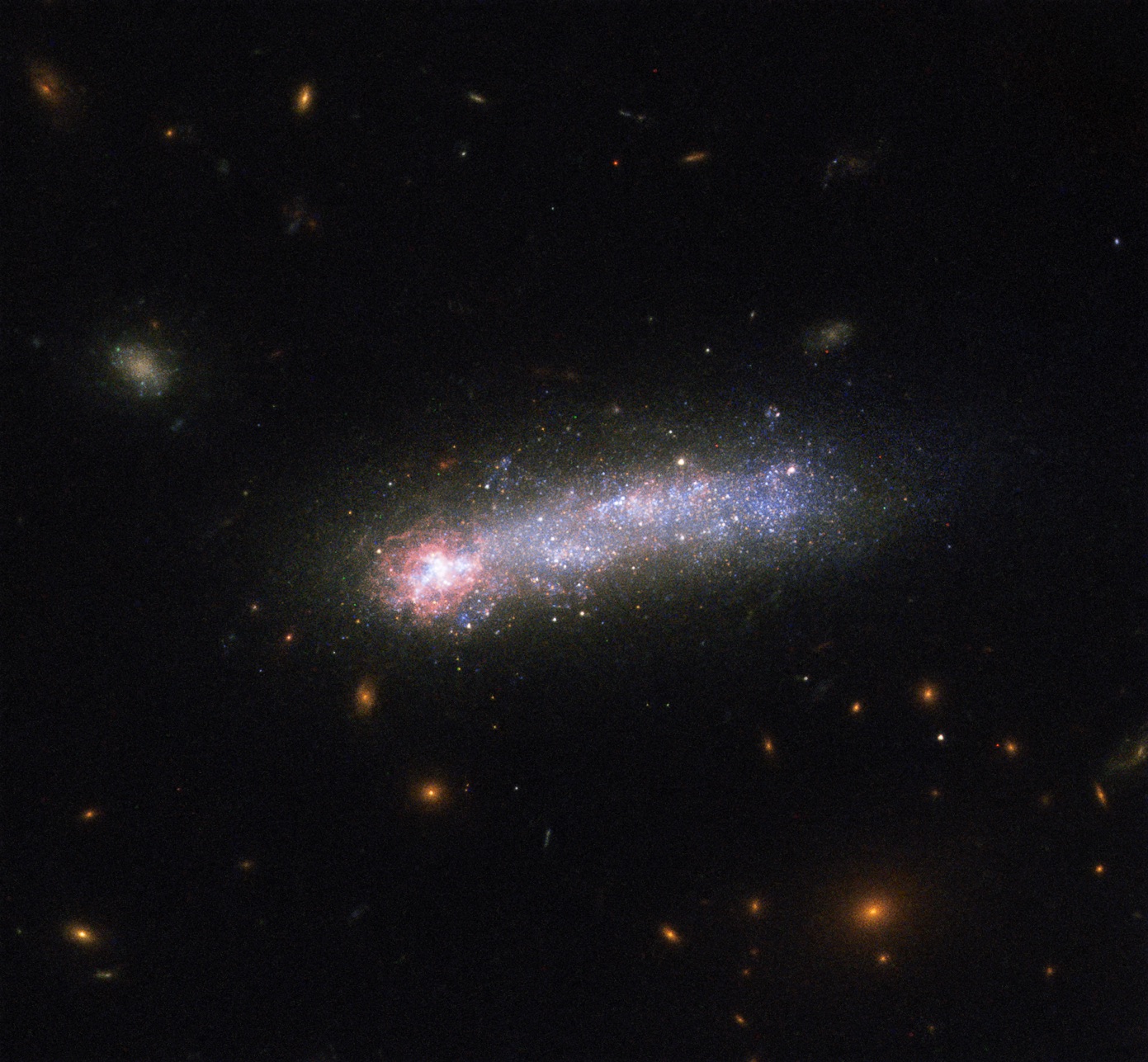
In this NASA/ESA Hubble Space Telescope image, a firestorm of star birth is lighting up one end of the dwarf galaxy Kiso 5639.

Kiso 5639 is shaped like a pancake but, because it is tilted edge-on, it resembles a skyrocket, with a brilliant blazing head and a long, star-studded tail. Its appearance earns it a place in the “tadpole” class of galaxies.

The bright pink head is from the glow of hydrogen, lit up by the burst of new stars. The mass of these young stars equals about a million Suns. The stars are grouped into large clusters that formed less than a million years ago.

Stars consist mainly of hydrogen and helium, but cook up heavier elements such as oxygen and carbon. When the stars die, they release their heavy elements and enrich the surrounding gas. In Kiso 5639, the bright gas in the galaxy’s head is more deficient in heavy elements than the rest of the galaxy. Astronomers think that the latest star-formation event was triggered when the galaxy accreted primordial gas from its surroundings, since intergalactic space contains more pristine, hydrogen-rich gas.

Cavities in the gas are due to numerous supernova detonations – like bursts of fireworks in the sky – carving out holes of superheated gas.

The elongated tail, seen stretching away from the galaxy’s head and scattered with bright blue stars, contains at least four distinct star-forming regions. These stars appear to be older than those in the star-forming head.

Wispy filaments, comprising gas and some stars, extend from the main body of the cosmic tadpole.

The observations were taken in February 2015 and July 2015 with Hubble's Wide Field Camera 3. Kiso 5639 is 82 million light-years from us and its head is some 2700 light-years across.

 This image was first released in June 2016.


Monday, January 01, 2018

Neutron Stars on the Brink of Collapse

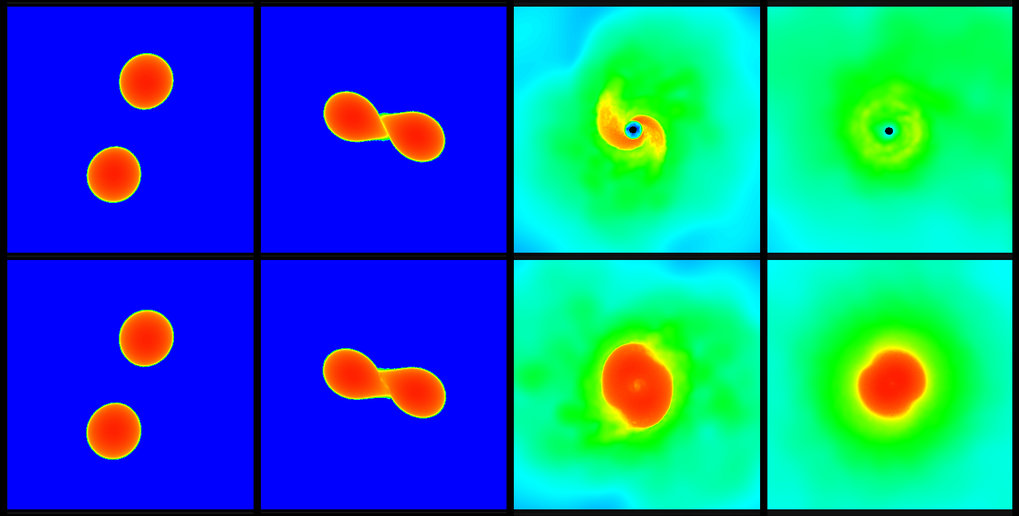
The upper and lower series of pictures each show a simulation of a neutron star merger. In the scenario displayed in the upper panels the star collapses after the merger and forms a black hole, whereas the scenario displayed in the lower row leads to an at least temporarily stable star. © Andreas Bauswein, HIT. Hi-res image


Neutron stars are the densest objects in the Universe; however, their exact characteristics remain unknown. Using recent observations and simulations, an international team of scientists including researchers at the Max Planck Institute for Astrophysics (MPA) has managed to narrow down the size of these stars. Thus the scientists were able to exclude a number of theoretical descriptions for the neutron star matter.

When a very massive star dies, its core collapses in a fraction of a second. In the following supernova explosion, the star’s outer layer gets expelled, leaving behind an ultra-compact neutron star. For the first time, the LIGO and Virgo Observatories have recently been able to observe the merger of two neutron stars by detecting the gravitational waves emitted and to measure the mass of the merging stars. Together, the neutron stars had a mass of 2.74 solar masses. Based on these observational data, the international team of scientists from Germany, Greece, and Japan managed to narrow down the size of neutron stars with the aid of computer simulations. The calculations suggest that the neutron star radius must be at least 10.7 km.

In neutron star collisions, two neutron stars orbit around each other, eventually merging to form a star with approximately twice the mass of the individual stars. In this cosmic event, gravitational waves – oscillations of spacetime – whose signal characteristics are related to the mass of the stars, are emitted. This event resembles what happens when a stone is thrown into water and waves form on the water’s surface. The heavier the stone, the higher the waves.

The scientists calculated different merger scenarios for the recently measured masses to determine the radius of the neutron stars. In so doing, they relied on different models and equations of state describing the exact structure of neutron stars. Then, the team of scientists checked whether the calculated merger scenarios are consistent with the observations. The conclusion: All models that lead to the immediate collapse of the merger remnant can be ruled out because a collapse leads to the formation of a black hole, which in turn means that relatively little light is emitted during the collision. However, different telescopes have observed a bright light source at the location of the stars’ collision, which provides clear evidence against the hypothesis of collapse directly after the neutron-star collision.

The results thereby rule out a number of theories for neutron star matter, namely all model descriptions that predict a neutron star radius smaller than 10.7 kilometers. However, the internal structure of neutron stars is still not entirely understood. The radii and structure of neutron stars are of particular interest not only to astrophysicists, but also to nuclear and particle physicists because the inner structure of these stars reflects the properties of high-density nuclear matter found in every atomic nucleus.

While neutron stars have a slightly larger mass than our Sun, their diameter is only a few 10 km. These stars thus contain a large mass in a very small volume, which leads to extreme conditions in their interior. Researchers have been exploring these internal conditions for several decades already and are particularly interested in better narrowing down the radius of these stars as their size depends on the unknown properties of ultra-dense matter.

The new measurements and new calculations help theoreticians to better understand the properties of high-density matter in our Universe. The recently published study represents a significant scientific progress as it has ruled out some theoretical models. But there is still a large variety of other models with neutron star radii greater than 10.7 km.
However, the scientists have been able to demonstrate that further observations of neutron star mergers will continue to improve these measurements. The LIGO and Virgo Observatories have just begun taking measurements, and the sensitivity of the instruments will continue to increase over the next few years and provide even better observational data.

Andreas Bauswein (HITS)

Janka, Hans-Thomas
Scientific Staff
Phone: 2228
Email: thj@mpa-garching.mpg.de

Oliver Just


Links:
  • personal homepage (the institute is not responsible for the contents of personal homepages)


Original Publication

1. Bauswein, Andreas; Just, Oliver; Janka, Hans-Thomas; Stergioulas, Nikolaos

Neutron-star Radius Constraints from GW170817 and Future Detections

The Astrophysical Journal Letters, 850, L34, (2017)

Source/DO


More Information

Neutron Stars on the Brink of Collapse

HITS Press Release


Friday, December 29, 2017

Comparison image: Hubble and HAWK-I explore a cluster with the mass of two quadrillion Suns

Hubble and HAWK-I explore a cluster with the mass of two quadrillion Suns 

Galaxy cluster RCS2 J2327

This image shows something spectacular: a galaxy cluster so massive that it is warping the space around it! The cluster, whose heart is at the centre of the frame, is named RCS2 J2327, and is one of the most massive clusters known as its distance or beyond.

Massive objects such as RCS2 J2327 have such a strong influence on their surroundings that they actually warp the space around them — this effect is known as gravitational lensing, and can cause light from more distant objects to be bent, distorted, and amplified, allowing us to see galaxies that would otherwise be far too distant for us to detect. Gravitational lensing is one of the predictions of Albert Einstein's General Theory of Relativity and can be observed in three different regimes: strong lensing, weak lensing, and microlensing. Unlike strong lensing, which produces stunning images of distorted galaxies, sweeping arcs, and phenomena known as Einstein rings, weak gravitational lensing is mostly studied statistically — but offers a way to measure the masses of cosmic objects, as shown here.

This image is a composite of observations from the HAWK-I instrument on ESO’s Very Large Telescope and the NASA/ESA Hubble Space Telescope’s Advanced Camera for Surveys, and demonstrates an impressively detailed collaborative approach to studying weak lensing in the cosmos. The study found RCS2 J2327 to contain the mass of two quadrillion Suns!

Using the slider a mass map becomes visible, showing the amount of mass thought to be contained within each part of the cluster. The creation of the map was only possible due to the exact measurements on the amount of gravitational lensing in the different areas of the cluster.
Link

Credit
  • ESO & ESA/Hubble & NASA


Thursday, December 28, 2017

Radio Observations Point to Likely Explanation for Neutron-Star Merger Phenomena

Different scenarios for the aftermath of the collision of two neutron stars. At left (in the short gamma-ray burst [SGRB] scenario), a jet of material moving at nearly the speed of light is propelled from the collision site into a sphere of material initially blown out by the resulting explosion. If viewed from an angle away (off-axis) from the center of the jet, the long-term emission of X-rays and radio waves would be getting weaker. At right, the jet cannot punch out of the shell of explosion debris, but instead sweeps up material into a broad "cocoon," which absorbs the jet's energy and emits X-rays and radio waves over a wider angle. In this case, such emission is still growing in intensity, as now observed with both radio and X-ray telescopes. Credit: NRAO/AUI/NSF: D. Berry. Hi-Res File


Three months of observations with the National Science Foundation’s Karl G. Jansky Very Large Array (VLA) have allowed astronomers to zero in on the most likely explanation for what happened in the aftermath of the violent collision of a pair of neutron stars in a galaxy 130 million light-years from Earth. What they learned means that astronomers will be able to see and study many more such collisions.

On August 17, 2017, the LIGO and VIRGO gravitational-wave observatories combined to locate the faint ripples in spacetime caused by the merger of two superdense neutron stars. It was the first confirmed detection of such a merger and only the fifth direct detection ever of gravitational waves, predicted more than a century ago by Albert Einstein.

The gravitational waves were followed by outbursts of gamma rays, X-rays, and visible light from the event. The VLA detected the first radio waves coming from the event on September 2. This was the first time any astronomical object had been seen with both gravitational waves and electromagnetic waves.

The timing and strength of the electromagnetic radiation at different wavelengths provided scientists with clues about the nature of the phenomena created by the initial neutron-star collision. Prior to the August event, theorists had proposed several ideas — theoretical models — about these phenomena. As the first such collision to be positively identified, the August event provided the first opportunity to compare predictions of the models to actual observations.

Astronomers using the VLA, along with the Australia Telescope Compact Array and the Giant Metrewave Radio Telescope in India, regularly observed the object from September onward. The radio telescopes showed the radio emission steadily gaining strength. Based on this, the astronomers identified the most likely scenario for the merger’s aftermath.

“The gradual brightening of the radio signal indicates we are seeing a wide-angle outflow of material, traveling at speeds comparable to the speed of light, from the neutron star merger,” said Kunal Mooley, now a National Radio Astronomy Observatory (NRAO) Jansky Postdoctoral Fellow hosted by Caltech.

The observed measurements are helping the astronomers figure out the sequence of events triggered by the collision of the neutron stars.

The initial merger of the two superdense objects caused an explosion, called a kilonova, that propelled a spherical shell of debris outward. The neutron stars collapsed into a remnant, possibly a black hole, whose powerful gravity began pulling material toward it. That material formed a rapidly-spinning disk that generated a pair of narrow, superfast jets of material flowing outward from its poles.

If one of the jets were pointed directly toward Earth, we would have seen a short-duration gamma-ray burst, like many seen before, the scientists said.

“That clearly was not the case,” Mooley said.

Some of the early measurements of the August event suggested instead that one of the jets may have been pointed slightly away from Earth. This model would explain the fact that the radio and X-ray emission were seen only some time after the collision.

“That simple model — of a jet with no structure (a so-called top-hat jet) seen off-axis — would have the radio and X-ray emission slowly getting weaker. As we watched the radio emission strengthening, we realized that the explanation required a different model,” said Alessandra Corsi, of Texas Tech University.

The astronomers looked to a model published in October by Mansi Kasliwal of Caltech, and colleagues, and further developed by Ore Gottlieb, of Tel Aviv University, and his colleagues. In that model, the jet does not make its way out of the sphere of explosion debris. Instead, it gathers up surrounding material as it moves outward, producing a broad “cocoon” that absorbs the jet’s energy.

The astronomers favored this scenario based on the information they gathered from using the radio telescopes. Soon after the initial observations of the merger site, the Earth’s annual trip around the Sun placed the object too close to the Sun in the sky for X-ray and visible-light telescopes to observe. 

For weeks, the radio telescopes were the only way to continue gathering data about the event.

“If the radio waves and X-rays both are coming from an expanding cocoon, we realized that our radio measurements meant that, when NASA’s Chandra X-ray Observatory could observe once again, it would find the X-rays, like the radio waves, had increased in strength,” Corsi said.

Mooley and his colleagues posted a paper with their radio measurements, their favored scenario for the event, and this prediction online on November 30. Chandra was scheduled to observe the object on December 2 and 6.

“On December 7, the Chandra results came out, and the X-ray emission had brightened just as we predicted,” said Gregg Hallinan, of Caltech.

“The agreement between the radio and X-ray data suggests that the X-rays are originating from the same outflow that’s producing the radio waves,” Mooley said.

“It was very exciting to see our prediction confirmed,” Hallinan said. He added, “An important implication of the cocoon model is that we should be able to see many more of these collisions by detecting their electromagnetic, not just their gravitational, waves.”

Mooley, Hallinan, Corsi, and their colleagues reported their findings in the scientific journal Nature.

The National Radio Astronomy Observatory is a facility of the National Science Foundation, operated under cooperative agreement by Associated Universities, Inc.


Media Contact:

Dave Finley, Public Information Officer
(575) 835-7302

dfinley@nrao.edu


Monday, December 25, 2017

ERC Grant for Sherry Suyu: Cosmic Fireworks Première

The first and only spatially-resolved strongly lensed Type Ia Supernova, iPTF16geu, discovered by Goobar et al. (2017). Left: HST image taken on 28 October 2016, showing four images of the same source around the foreground galaxy. Middle and right: Two different reconstructions from lens mass models of the system by More, Suyu, Oguri et al. (2017).  From More, Suyu et al.


Unravelling Enigmas of Type Ia SuperUnravelling Enigmas of Type Ia Supernova Progenitors and Cosmology through Strong Lensingnova Progenitors and Cosmology through Strong Lensing

End of November, the European Research Council announced that Sherry Suyu, research group leader at the Max Planck Institute for Astrophysics and member of the Max-Planck@TUM programme, is one of the awardees of the 2017 ERC Consolidator Grants. With this funding, Suyu can expand her group to study gravitationally lensed supernovae and find out more about their progenitors. Strongly lensed supernovae also provide an independent way of measuring the Hubble constant, which tells scientists about the rate of expansion of the Universe.

Gravitational lensing of the Type Ia Supernova iPTF16geu. The spacetime between the supernova (marked with a star symbol) and the observer (on Earth) is disturbed by the gravity of the lensing galaxy (in orange). The observer will see the host galaxy of the supernova form a ring-like structure in the background, and the supernova split into four images. As Type Ia Supernovae have a distinct light-curve shape, the time delay between the four images can easily be determined (bottom image).


The LENSNOVA project proposed by Sherry Suyu plans to capitalize on her experience in the field of strong lensing time delays. With the aid of lensing, SNe can be observed in their entirety with unprecedented temporal sampling. Observations of the beginning of SN explosions are key to revealing SN progenitors that have been under debate for decades. Strongly lensed SNe Ia also allow an independent measurement of the Hubble constant (H0) that sets the cosmic expansion rate. The independent measurement is important to ascertain the possible need of new physics beyond the standard cosmological model, given the tensions in current H0 measurements. Thus, the LENSNOVA project will shed light on the natures of SNe Ia progenitors and dark energy, two of the greatest puzzles in the present era.

The advent of new, powerful telescopes such as the Large Synoptic Survey Telescope and the Euclid mission makes LENSNOVA particularly timely for building the first sample of a handful of strongly lensed SNe Ia. The ERC grant now enables Sherry Suyu to recruit further researchers for her team and to acquire the computing resources needed to capitalise on the new data. Thus, the project could potentially revolutionise both the fields of stellar physics and cosmology.


The ERC Consolidator Grants are awarded to outstanding researchers of any nationality and age in any field of research, with at least seven and up to twelve years of experience after PhD, and a scientific track record showing great promise. Research must be conducted in a public or private research organisation located in one of the EU Member States or Associated Countries. The funding (maximum of €2 million per grant), is provided for up to five years and mostly covers the employment of researchers and other staff to consolidate the grantees' teams. Proposals are evaluated by selected international peer reviewers who assess them on the basis of excellence as the sole criterion. 


More Information

Cosmology and extragalactic astrophysics with gravitational lensing

Max Planck Research Group at the Max Planck Institute for Astrophysics


ERC Consolidator Grants 2017


1. More, Suyu, Oguri et al.
 
Interpreting the Strongly Lensed Supernova iPTF16geu: Time Delay Predictions,
Microlensing, and Lensing Rates


Sunday, December 24, 2017

A snowstorm of stars

Credit:NASA and ESA
Acknowledgement: S. Djorgovski (Caltech) and F. Ferraro (University of Bologna)


It’s beginning to look a lot like Christmas in this NASA/ESA Hubble Space Telescope image of a blizzard of stars, which resembles a swirling storm in a snow globe.

These stars make up the globular cluster Messier 79, located about 40 000 light-years from Earth in the constellation of Lepus (The Hare). Globular clusters are gravitationally bound groupings of up to one million stars. These giant “star globes” contain some of the oldest stars in our galaxy. Messier 79 is no exception; it contains about 150 000 stars, packed into an area measuring just roughly 120 light-years across.

This 11.7-billion-year-old star cluster was first discovered by French astronomer Pierre Méchain in 1780. Méchain reported the finding to his colleague Charles Messier, who included it in his catalogue of non-cometary objects: The Messier catalogue. About four years later, using a larger telescope than Messier’s, William Herschel was able to resolve the stars in Messier 79 and described it as a “globular star cluster.”

In this sparkling Hubble image, Sun-like stars appear yellow-white and the reddish stars are bright giants that are in the final stages of their lives. Most of the blue stars sprinkled throughout the cluster are aging “helium-burning” stars, which have exhausted their hydrogen fuel and are now fusing helium in their cores.


Saturday, December 23, 2017

Cosmic Filament Probes Our Galaxy’s Giant Black Hole

In 2016, Farhad Yusef-Zadeh of Northwestern University reported the discovery of an unusual filament near the center of the Milky Way Galaxy using the NSF’s Karl G. Jansky Very Large Array (VLA). The filament is about 2.3 light years long and curves around to point at the supermassive black hole, called Sagittarius A* (Sgr A*), located in the Galactic center.

Now, another team of astronomers has employed a pioneering technique to produce the highest-quality image yet obtained of this curved object.

“With our improved image, we can now follow this filament much closer to the Galaxy’s central black hole, and it is now close enough to indicate to us that it must originate there,” said Mark Morris of the University of California, Los Angeles, who led the study. “However, we still have more work to do to find out what the true nature of this filament is.”

The researchers have considered three main explanations for the filament. The first is that it is caused by high-speed particles kicked away from the supermassive black hole. A spinning black hole coupled with gas spiraling inwards can produce a rotating, vertical tower of magnetic field that approaches or even threads the event horizon, the point of no return for infalling matter. Within this tower, particles would be sped up and produce radio emission as they spiral around magnetic field lines and stream away from the black hole.

The second, more fantastic, possibility is that the filament is a cosmic string, theoretical, as-yet undetected objects that are long, extremely thin objects that carry mass and electric currents. Previously, theorists had predicted that cosmic strings, if they exist, would migrate to the centers of galaxies. If the string moves close enough to the central black hole it might be captured once a portion of the string crosses the event horizon.

The final option is that the position and the direction of the filament aligning with the black hole are merely coincidental superpositions, and there is no real association between the two. This would imply it is like dozens of other known filaments found farther away from the center of the Galaxy. However, such a coincidence is quite unlikely to happen by chance.

“Part of the thrill of science is stumbling across a mystery that is not easy to solve,” said co-author Jun-Hui Zhao of the Harvard-Smithsonian Center for Astrophysics in Cambridge, Mass. “While we don’t have the answer yet, the path to finding it is fascinating. This result is motivating astronomers to build next generation radio telescopes with cutting edge technology.”

Each of the scenarios being investigated would provide intriguing insight if proven true. For example, if the filament is caused by particles being ejected by Sgr A*, this would reveal important information about the magnetic field in this special environment, showing that it is smooth and orderly rather than chaotic.

The second option, the cosmic string, would provide the first evidence for a highly speculative idea with profound implications for understanding gravity, space-time and the Universe itself.

Evidence for the idea that particles are being magnetically kicked away from the black hole would come from observing that particles further away from Sgr A* are less energetic than those close in. A test for the cosmic string idea will capitalize on the prediction by theorists that the string should move at a high fraction of the speed of light. Follow-up observations with the VLA should be able to detect the corresponding shift in position of the filament.

Even if the filament is not physically tied to Sgr A*, the bend in the shape of this filament is still unusual. The bend coincides with, and could be caused by, a shock wave, akin to a sonic boom, where the blast wave from an exploded star is colliding with the powerful winds blowing away from massive stars surrounding the central black hole.

“We will keep hunting until we have a solid explanation for this object,” said co-author Miller Goss, from the National Radio Astronomy Observatory in Socorro, New Mexico. “And we are aiming to next produce even better, more revealing images.”

A paper describing these results appeared in the December 1st, 2017 issue of The Astrophysical Journal Letters.

Headquartered in Cambridge, Mass., the Harvard-Smithsonian Center for Astrophysics (CfA) is a collaboration between the Smithsonian Astrophysical Observatory and the Harvard College Observatory. CfA scientists, organized into six research divisions, study the origin, evolution and ultimate fate of the universe.

For more information, contact:

Megan Watzke
Harvard-Smithsonian Center for Astrophysics
+1 617-496-7998
mwatzke@cfa.harvard.edu

Peter Edmonds
Harvard-Smithsonian Center for Astrophysics
+1 617-571-7279
pedmonds@cfa.harvard.edu


Friday, December 22, 2017

Astronomers Shed Light on Formation of Black Holes and Galaxies

Image of the quasar host galaxy from the UC San Diego research team’s data. The distance to this quasar galaxy is ~9.3 billion light years. The four-color image shows findings from use of the Keck Observatory and ALMA. As seen from Keck Observatory, the green colors highlight the energetic gas across the galaxy that is being illuminated by the quasar. The blue color represents powerful winds blowing throughout the galaxy. The red-orange colors represent the cold molecular gas in the system as seen from ALMA. The supermassive black hole sits at the center of the bright red-orange circular area slightly below the middle of the image. Credit: A. Vayner and Team


Maunakea, Hawaii – Stars forming in galaxies appear to be influenced by the supermassive black hole at the center of the galaxy, but the mechanism of how that happens has not been clear to astronomers until now.

“Supermassive black holes are captivating,” says lead author Shelley Wright, a University of California San Diego Professor of Physics. “Understanding why and how galaxies are affected by their supermassive black holes is an outstanding puzzle in their formation.” 

In a study published today in The Astrophysical Journal, Wright, graduate student Andrey Vayner, and their colleagues examined the energetics surrounding the powerful winds generated by the bright, vigorous supermassive black hole (known as a “quasar”) at the center of the 3C 298 host galaxy, located approximately 9.3 billion light years away.

“We study supermassive black holes in the very early universe when they are actively growing by accreting massive amounts of gaseous material,” says Wright. “While black holes themselves do not emit light, the gaseous material they chew on is heated to extreme temperatures, making them the most luminous objects in the universe.”

The UC San Diego team’s research revealed that the winds blow out through the entire galaxy and impact the growth of stars. 

“This is remarkable that the supermassive black hole is able to impact stars forming at such large distances,” says Wright.

Today, neighboring galaxies show that the galaxy mass is tightly correlated with the supermassive black hole mass. Wright’s and Vayner’s research indicates that 3C 298 does not fall within this normal scaling relationship between nearby galaxies and the supermassive black holes that lurk at their center. But, in the early universe, their study shows that the 3C 298 galaxy is 100 times less massive than it should be given its behemoth supermassive black hole mass.

This implies that the supermassive black hole mass is established well before the galaxy, and potentially the energetics from the quasar are capable of controlling the growth of the galaxy.

To conduct the study, the UC San Diego researchers utilized multiple state-of-the-art astronomical facilities. The first of these was Keck Observatory’s instrument OSIRIS (OH-Suppressing Infrared Imaging Spectrograph) and its advanced adaptive optics (AO) system. An AO system allows ground-based telescopes to achieve higher quality images by correcting for the blurring caused by the Earth’s atmosphere. The resulting images are as good as those obtained from space. 

The second major facility was the Atacama Large Millimeter/submillimeter Array, known as “ALMA,” an international observatory in Chile that is able to detect millimeter wavelengths using up to 66 antennae to achieve high-resolution images of the gas surrounding the quasar.

“The most enjoyable part of researching this galaxy has been putting together all the data from different wavelengths and techniques,” said Vayner. “Each new dataset that we obtained on this galaxy answered one question and helped us put some of the pieces of the puzzle together. However, at the same time, it created new questions about the nature of galaxy and supermassive black hole formation.”

Wright agreed, saying that the data sets were “tremendously gorgeous” from both Keck Observatory and ALMA, offering a wealth of new information about the universe.

These findings are the first results from a larger survey of distant quasars and their energetics’ impact on star formation and galaxy growth. Vayner and the team will continue developing results on more distant quasars using the new facilities and capabilities from Keck Observatory and ALMA.


About OSIRIS


The OH-Suppressing Infrared Imaging Spectrograph (OSIRIS) is one of W. M. Keck Observatory’s "integral field spectrographs." The instrument works behind the adaptive optics system, and uses an array of lenslets to sample a small rectangular patch of the sky at resolutions approaching the diffraction limit of the 10-meter Keck Telescope. OSIRIS records an infrared spectrum at each point within the patch in a single exposure, greatly enhancing its efficiency and precision when observing small objects such as distant galaxies. It is used to characterize the dynamics and composition of early stages of galaxy formation.

About W.M. Keck Observatory


The W. M. Keck Observatory telescopes are among the most scientifically productive on Earth. The two, 10-meter optical/infrared telescopes on the summit of Maunakea on the Island of Hawaii feature a suite of advanced instruments including imagers, multi-object spectrographs, high-resolution spectrographs, integral-field spectrometers, and world-leading laser guide star adaptive optics systems.

Some of the data presented herein were obtained at Keck Observatory, which is a private 501(c) 3 non-profit organization operated as a scientific partnership among the California Institute of Technology, the University of California, and the National Aeronautics and Space Administration. The Observatory was made possible by the generous financial support of the W. M. Keck Foundation.
The authors wish to recognize and acknowledge the very significant cultural role and reverence that the summit of Maunakea has always had within the indigenous Hawaiian community. We are most fortunate to have the opportunity to conduct observations from this mountain. 

Article Summary


Latest findings using the W. M. Keck Observatory on Maunakea, Hawaii increase scientific understanding of how powerful winds generated by supermassive black holes impact and regulate the growth of 3C 298 Quasar Host Galaxy.


Thursday, December 21, 2017

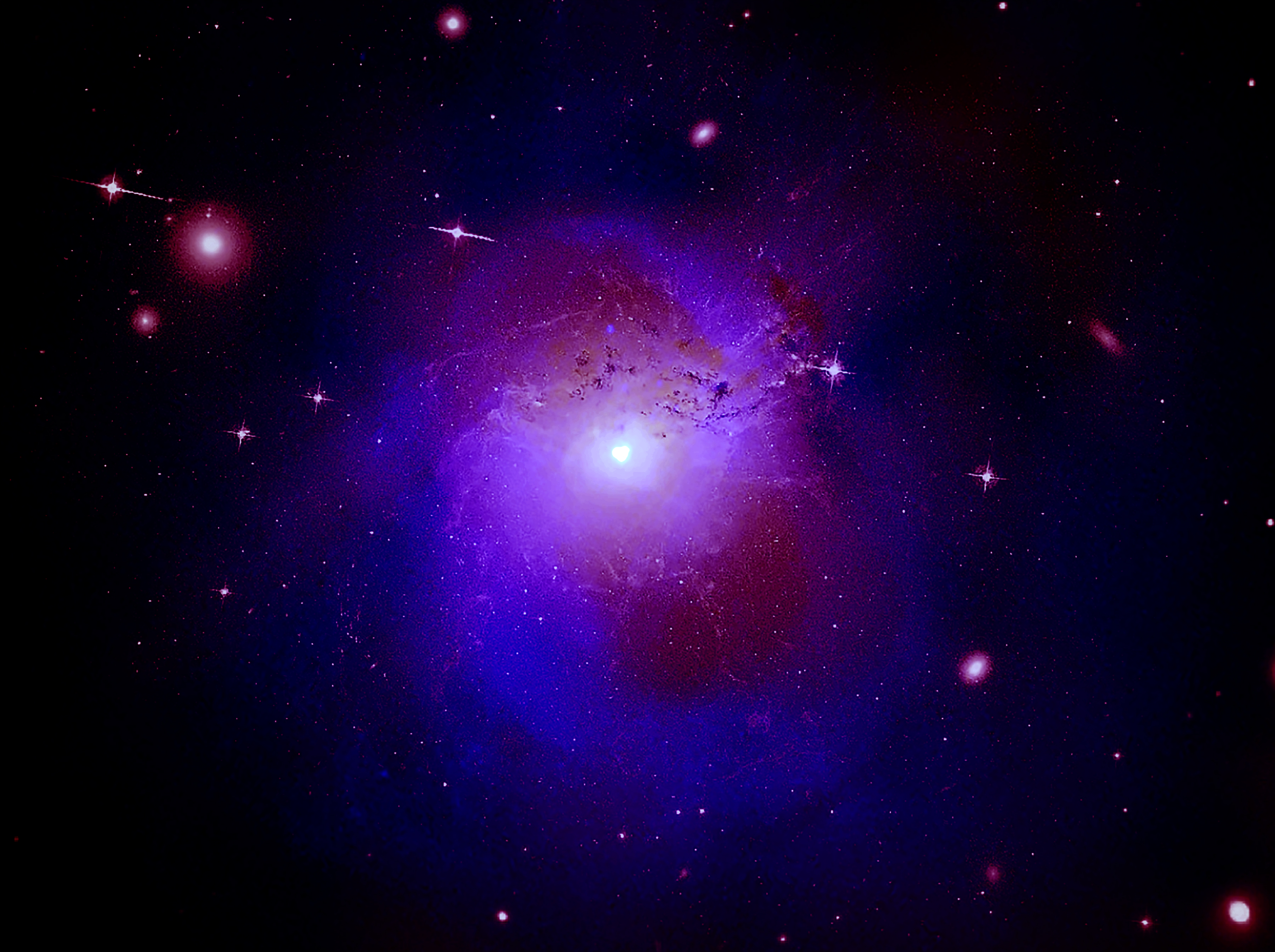
Perseus Cluster: A New Twist in the Dark Matter Tale A Quick Look at the Perseus Cluster

Perseus Cluster
Credit: X-ray: NASA/CXO/Oxford University/J. Conlon et al. Radio: NRAO/AUI/NSF/Univ. of Montreal/Gendron-Marsolais et al.
Optical: NASA/ESA/IoA/A. Fabian et al.; DSS

Tour of Perseus Cluster - More Animations


An innovative interpretation of X-ray data from a galaxy cluster could help scientists understand the nature of dark matter, as described in our latest press release. The finding involves a new explanation for a set of results made with NASA's Chandra X-ray Observatory, ESA's XMM-Newton and Hitomi, a Japanese-led X-ray telescope. If confirmed with future observations, this may represent a major step forward in understanding the nature of the mysterious, invisible substance that makes up about 85% of matter in the Universe.

The image shown here contains X-ray data from Chandra (blue) of the Perseus galaxy cluster, which has been combined with optical data from the Hubble Space Telescope (pink) and radio emission from the Very Large Array (red). In 2014, researchers detected an unusual spike of intensity, known as an emission line, at a specific wavelength of X-rays (3.5 keV) in the hot gas within the central region of the Perseus cluster. They also reported the presence of this same emission line in a study of 73 other galaxy clusters.

In the subsequent months and years, astronomers have tried to confirm the existence of this 3.5 keV line. They are eager to do so because it may give us important clues about the nature of dark matter. However, it has been debated in the astronomical community exactly what the original and follow-up observations have revealed.

Credit: NASA/CXC/M. Weiss

A new analysis of Chandra data by a team from Oxford University, however, is providing a fresh take on this debate. The latest work shows that absorption of X-rays at an energy of 3.5 keV is detected when observing the region surrounding the supermassive black hole at the center of Perseus. This suggests that dark matter particles in the cluster are both absorbing and emitting X-rays (see our artist's impression above for a diagram helping to explain this behavior, where 3.5 keV X-rays are shown). If the new model turns out to be correct, it could provide a path for scientists to one day identify the true nature of dark matter. For next steps, astronomers will need further observations of the Perseus cluster and others like it with current X-ray telescopes and those being planned for the next decade and beyond.

A paper describing these results was published in Physical Review D on December 19, 2017 and a preprint is available online. The authors of the paper are Joseph Conlon, Francesca Day, Nicolas Jennings, Sven Krippendorf and Markus Rummel, all from Oxford University in the UK. NASA's Marshall Space Flight Center in Huntsville, Alabama, manages the Chandra program for NASA's Science Mission Directorate in Washington. The Smithsonian Astrophysical Observatory in Cambridge, Massachusetts, controls Chandra's science and flight operations. 


Fast Facts for Perseus Cluster:

Scale: Image is 3.87 arcmin (about 280,000 light years) across
Category:   Groups & Clusters of Galaxies, Cosmology/Deep Fields/X-ray Background
Coordinates (J2000): RA 03h 19m 47.60s | Dec +41° 30´ 37.00"
Constellation: Perseus
Observation Date: 2009
Observation Time: 55 hours 33 minutes (2 days 7 hours 33 minutes)
Obs. ID: 11713,12025,12044, 12036
Instrument: ACIS
Also Known As: Abell 426
References: Conlon et al. 2017 Physical Review D, 90, 123009; arXiv: 1086.01684
Color Code: X-ray (Blue); Optical (Pink); Radio (Red)
Distance Estimate: About 250 million light years


Wednesday, December 20, 2017

Giant Bubbles on Red Giant Star’s Surface

The surface of the red giant star π1 Gruis from PIONIER on the VLT

PR Image eso1741b
Widefield image of the sky around π1 Gruis

PR Image eso1741c
The red giant star π1 Gruis in the constellation of Grus


Videos
 
ESOcast 144 Light: Giant Bubbles on Red Giant Star’s Surface (4K UHD)
ESOcast 144 Light: Giant Bubbles on Red Giant Star’s Surface (4K UHD) 

Zooming in on the red giant star π1 Gruis
Zooming in on the red giant star π1 Gruis 


Astronomers using ESO’s Very Large Telescope have for the first time directly observed granulation patterns on the surface of a star outside the Solar System — the ageing red giant π1 Gruis. This remarkable new image from the PIONIER instrument reveals the convective cells that make up the surface of this huge star, which has 350 times the diameter of the Sun. Each cell covers more than a quarter of the star’s diameter and measures about 120 million kilometres across. These new results are being published this week in the journal Nature.

Located 530 light-years from Earth in the constellation of Grus (The Crane), π1 Gruis is a cool red giant. It has about the same mass as our Sun, but is 350 times larger and several thousand times as bright [1]. Our Sun will swell to become a similar red giant star in about five billion years.

An international team of astronomers led by Claudia Paladini (ESO) used the PIONIER instrument on ESO’s Very Large Telescope to observe π1 Gruis in greater detail than ever before. They found that the surface of this red giant has just a few convective cells, or granules, that are each about 120 million kilometres across — about a quarter of the star’s diameter [2]. Just one of these granules would extend from the Sun to beyond Venus. The surfaces  — known as photospheres —  of many giant stars are obscured by dust, which hinders observations. However, in the case of π1 Gruis, although dust is present far from the star, it does not have a significant effect on the new infrared observations [3].

When π1 Gruis ran out of hydrogen to burn long ago, this ancient star ceased the first stage of its nuclear fusion programme. It shrank as it ran out of energy, causing it to heat up to over 100 million degrees. These extreme temperatures fueled the star’s next phase as it began to fuse helium into heavier atoms such as carbon and oxygen. This intensely hot core then expelled the star’s outer layers, causing it to balloon to hundreds of times larger than its original size. The star we see today is a variable red giant. Until now, the surface of one of these stars has never before been imaged in detail.

By comparison, the Sun’s photosphere contains about two million convective cells, with typical diameters of just 1500 kilometres. The vast size differences in the convective cells of these two stars can be explained in part by their varying surface gravities. π1 Gruis is just 1.5 times the mass of the Sun but much larger, resulting in a much lower surface gravity and just a few, extremely large, granules.

While stars more massive than eight solar masses end their lives in dramatic supernovae explosions, less massive stars like this one gradually expel their outer layers, resulting in beautiful planetary nebulae. Previous studies of π1 Gruis found a shell of material 0.9 light-years away from the central star, thought to have been ejected around 20 000 years ago. This relatively short period in a star's life lasts just a few tens of thousands of years – compared to the overall lifetime of several billion – and these observations reveal a new method for probing this fleeting red giant phase.


Notes

[1] π1 Gruis is named following the Bayer designation system. In 1603 the German astronomer Johann Bayer classified 1564 stars, naming them by a Greek letter followed by the name of their parent constellation. Generally, stars were assigned Greek letters in rough order of how bright they appeared from Earth, with the brightest designated Alpha (α). The brightest star of the Grus constellation is therefore Alpha Gruis.


π1 Gruis is one of an attractive pair of stars of contrasting colours that appear close together in the sky, the other one naturally being named π2 Gruis. They are bright enough to be well seen in a pair of binoculars. Thomas Brisbane realised in the 1830s that π1 Gruis was itself also a much closer binary star system. Annie Jump Cannon, credited with the creation of the Harvard Classification Scheme, was the first to report the unusual spectrum of π1 Gruis in 1895.

[2] Granules are patterns of convection currents in the plasma of a star. As plasma heats up at the centre of the star it expands and rises to the surface, then cools at the outer edges, becoming darker and more dense, and descends back to the centre. This process continues for billions of years and plays a major role in many astrophysical processes including energy transport, pulsation, stellar wind and dust clouds on brown dwarfs.

[3] π1 Gruis is one of the brightest members of the rare S class of stars that was first defined by the American astronomer Paul W. Merrill to group together stars with similarly unusual spectra. π1 Gruis, R Andromedae and R Cygni became prototypes of this type. Their unusual spectra is now known to be the result of the “s-process” or “slow neutron capture process” — responsible for the creation of half the elements heavier than iron.


More Information


This research was presented in a paper “Large granulation cells on the surface of the giant star π1 Gruis”, by C. Paladini et al., published in the journal Nature on 21 December 2017.

The team is composed of C. Paladini (Institut d’Astronomie et d’Astrophysique, Université libre de Bruxelles, Brussels, Belgium; ESO, Santiago, Chile), F. Baron (Georgia State University, Atlanta, Georgia, USA), A. Jorissen (Institut d’Astronomie et d’Astrophysique, Université libre de Bruxelles, Brussels, Belgium), J.-B. Le Bouquin (Université Grenoble Alpes, CNRS, IPAG, Grenoble, France), B. Freytag (Uppsala University, Uppsala, Sweden), S. Van Eck (Institut d’Astronomie et d’Astrophysique, Université libre de Bruxelles, Brussels, Belgium), M. Wittkowski (ESO, Garching, Germany), J. Hron (University of Vienna, Vienna, Austria), A. Chiavassa (Laboratoire Lagrange, Université de Nice Sophia-Antipolis, CNRS, Observatoire de la Côte d’Azur, Nice, France), J.-P. Berger (Université Grenoble Alpes, CNRS, IPAG, Grenoble, France), C. Siopis (Institut d’Astronomie et d’Astrophysique, Université libre de Bruxelles, Brussels, Belgium), A. Mayer (University of Vienna, Vienna, Austria), G. Sadowski (Institut d’Astronomie et d’Astrophysique, Université libre de Bruxelles, Brussels, Belgium), K. Kravchenko (Institut d’Astronomie et d’Astrophysique, Université libre de Bruxelles, Brussels, Belgium), S. Shetye (Institut d’Astronomie et d’Astrophysique, Université libre de Bruxelles, Brussels, Belgium), F. Kerschbaum (University of Vienna, Vienna, Austria), J. Kluska (University of Exeter, Exeter, UK) and S. Ramstedt (Uppsala University, Uppsala, Sweden).

ESO is the foremost intergovernmental astronomy organisation in Europe and the world’s most productive ground-based astronomical observatory by far. It is supported by 16 countries: Austria, Belgium, Brazil, the Czech Republic, Denmark, France, Finland, Germany, Italy, the Netherlands, Poland, Portugal, Spain, Sweden, Switzerland and the United Kingdom, along with the host state of Chile and by Australia as a strategic partner. ESO carries out an ambitious programme focused on the design, construction and operation of powerful ground-based observing facilities enabling astronomers to make important scientific discoveries. ESO also plays a leading role in promoting and organising cooperation in astronomical research. ESO operates three unique world-class observing sites in Chile: La Silla, Paranal and Chajnantor. At Paranal, ESO operates the Very Large Telescope and its world-leading Very Large Telescope Interferometer as well as two survey telescopes, VISTA working in the infrared and the visible-light VLT Survey Telescope. ESO is also a major partner in two facilities on Chajnantor, APEX and ALMA, the largest astronomical project in existence. And on Cerro Armazones, close to Paranal, ESO is building the 39-metre Extremely Large Telescope, the ELT, which will become “the world’s biggest eye on the sky”.


Links


Contacts 

Claudia Paladini
ESO
Santiago, Chile
Email:
cpaladin@eso.org

Alain Jorissen
Institut d’Astronomie et d’Astrophysique, Université libre de Bruxelles
Brussels, Belgium
Tel: +32 (0) 2 6502834
Email:
Alain.Jorissen@ulb.ac.be

Fabien Baron
Georgia State University
Atlanta, Georgia, USA
Email:
fbaron@gsu.edu

Richard Hook
ESO Public Information Officer
Garching bei München, Germany
Tel: +49 89 3200 6655
Cell: +49 151 1537 3591
Email:
rhook@eso.org

Source: ESO