Showing posts with label NGC 7027. Show all posts

Tuesday, November 21, 2023

Gemini North Peers Deeper Into the Dust with New Instrument

PR Image noirlab2331a
IGRINS-2 First-Light spectrum

PR Image noirlab2331b
IGRINS-2 captures spectrum of Jewel Bug Nebula

PR Image noirlab2331c
The blue IGRINS-2 spectrum (no labels)

PR Image noirlab2331d
The red IGRINS-2 spectrum (no labels)

PR Image noirlab2331e
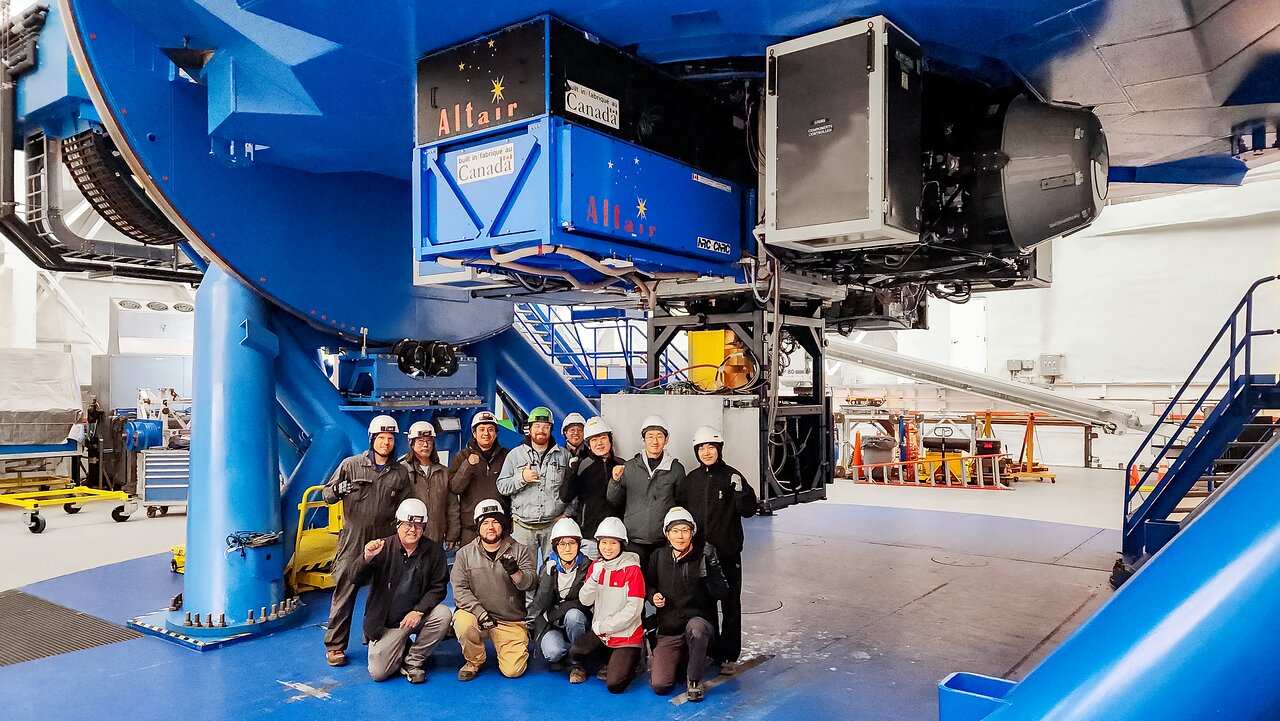
KASI and Gemini IGRINS-2 team photo on the night of first light

PR Image noirlab2331f
IGRINS-2 on Gemini North Telescope

PR Image noirlab2331g
The blue IGRINS-2 spectrum (with labels)

PR Image noirlab2331h
The red IGRINS-2 spectrum (with labels)
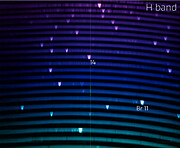


Image Comparisons

The blue IGRINS-2 spectrum with and without labels
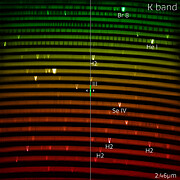

The red IGRINS-2 spectrum with and without labels


Videos
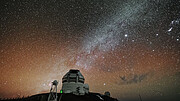
Gemini North Observing  
PR Video noirlab2331a
Gemini North Observing

Gemini North Observing  
PR Video noirlab2331b
Gemini North Observing


IGRINS-2, a new high-resolution near-infrared spectrograph on Gemini North, sees First Light

Gemini North, one half of the International Gemini Observatory operated by NSF’s NOIRLab, is now peering deeper into the dusty dwellings of young stars with its new IGRINS-2 instrument. This next-generation spectrograph is an upgraded version of the high-demand visiting instrument IGRINS on Gemini South that will expand our understanding of cosmic objects shrouded by dust and gas.

IGRINS-2 (Immersion GRating INfrared Spectrograph-2) has set its ‘eyes’ on the sky for the first time. Mounted on the Gemini North telescope, one half of the International Gemini Observatory operated by NSF’s NOIRLab, the new instrument obtained spectra of the planetary nebula NGC 7027, nicknamed the Jewel Bug Nebula. NGC 7027 is one of the visually brightest planetary nebulae, and its resplendent rosette — made of layers of gas ejected during the dying breaths of its central star — makes for an exciting first light target.

Spectrographs are arguably the most important science instruments in all of astronomy. Unlike high-resolution cameras that capture amazing details of distant stars, galaxies and nebulae, spectrographs precisely analyze the spectrum of light emitted by these objects, revealing detailed information about their chemical composition. The expansion of NGC 7027’s dynamic gasses out into the surrounding space produces a striking spectrum that illustrates the power of the instrument.

With the new infrared IGRINS-2 on Gemini North complementing the new optical GHOST on Gemini South, we now have two cutting-edge high-resolution spectrographs,” said Jennifer Lotz, Director of Gemini Observatory. “This expanded capability of our observatory opens up exciting windows of discovery.

Although its first spectrum is of the death throes of a star, IGRINS-2 is actually designed to witness the first moments of nascent stars. “The main science goal of IGRINS-2 is observing young stars being born inside a dusty environment,” said IGRINS-2 Project Manager and Technical Representative Hwihyun Kim. While these dusty birthplaces are impenetrable to visible light, a near-infrared spectrograph like IGRINS-2 can pierce through the dust and observe young stars in their early development.

With its ability to see through gas, dust, and other opaque materials, IGRINS-2 is also well-suited to studying brown dwarfs, exoplanets, the interstellar medium and the evolution of galaxies. Not only is IGRINS-2 able to see through dust, it does so with remarkable resolution, allowing astronomers to resolve details about stellar atmospheres and the structures of galaxies.

IGRINS-2 was built by the Korea Astronomy and Space Science Institute (KASI) on behalf of the International Gemini Observatory. Initiated in March 2020, this instrument was constructed during the COVID-19 pandemic. “It has been gratifying to see our efforts come to fruition,” said KASI Principal Investigator Chan Park. “We delivered this instrument and its components without any delays — all in the middle of a global pandemic — thanks to the valiant efforts of our team and our partners at Gemini Observatory.

During the highly-anticipated first-light event, excitement filled the Gemini North control room as IGRINS-2 captured its first spectra. “It’s difficult to describe the emotion of people when they saw the first observations; it was a mix of excitement, awe, relief, and joy,” said Ruben Diaz, Gemini’s acting Associate Director of Development. Kim adds that she was told by her Gemini North colleagues they had never seen so many people in the control room at one time.

Following this significant milestone, the KASI and Gemini teams will begin integrating IGRINS-2 with the software and subsystems at Gemini North, a process that will take several months. Gemini staff will then be trained in maintaining and operating the instrument. In addition, documentation will be developed to assist the user community with the instrument. IGRINS-2 will be available for use by the broader astronomy community in the second half of 2024.

“The ability of IGRINS-2 to peer within otherwise opaque regions of the Universe will allow us to better understand how stars are born and many other astronomical phenomena hidden behind galactic dust,” said Martin Still, NSF Program Director for the International Gemini Observatory. “NSF congratulates our Gemini partner, KASI, and the entire telescope staff for achieving the critical milestone of IGRINS-2 first light.”


More information

NSF’s NOIRLab (National Optical-Infrared Astronomy Research Laboratory), the US center for ground-based optical-infrared astronomy, operates the International Gemini Observatory (a facility of NSF, NRC–Canada, ANID–Chile, MCTIC–Brazil, MINCyT–Argentina, and KASI–Republic of Korea), Kitt Peak National Observatory (KPNO), Cerro Tololo Inter-American Observatory (CTIO), the Community Science and Data Center (CSDC), and Vera C. Rubin Observatory (operated in cooperation with the Department of Energy’s SLAC National Accelerator Laboratory). It is managed by the Association of Universities for Research in Astronomy (AURA) under a cooperative agreement with NSF and is headquartered in Tucson, Arizona. The astronomical community is honored to have the opportunity to conduct astronomical research on Iolkam Du’ag (Kitt Peak) in Arizona, on Maunakea in Hawai‘i, and on Cerro Tololo and Cerro Pachón in Chile. We recognize and acknowledge the very significant cultural role and reverence that these sites have to the Tohono O’odham Nation, to the Native Hawaiian community, and to the local communities in Chile, respectively.


Links


Contacts

Jennifer Lotz
Director, International Gemini Observatory
Email:
jennifer.lotz@noirlab.edu

Ruben Diaz
Head of Instrumentation, International Gemini Observatory
Email:
ruben.diaz@noirlab.edu

Hwihyun Kim
Instrumentation Program Scientist, International Gemini Observatory
Email:
hwihyun.kim@noirlab.edu

Josie Fenske
NSF’s NOIRLab Communications
Email:
josie.fenske@noirlab.edu


Friday, June 19, 2020

Hubble Provides Holistic View of Stars Gone Haywire

Two Planetary Nebulas: NGC 6302 AND NGC 7027
Credits: NASA, ESA, and J. Kastner (RIT) - Hi-res image

As nuclear fusion engines, most stars live placid lives for hundreds of millions to billions of years. But near the end of their lives they can turn into crazy whirligigs, puffing off shells and jets of hot gas. Astronomers have employed Hubble's full range of imaging capabilities to dissect such crazy fireworks happening in two nearby young planetary nebulas. NGC 6303 is dubbed the Butterfly Nebula because of its wing-like appearance. In addition, NGC 7027 resembles a jewel bug, an insect with a brilliantly colorful metallic shell.

The researchers have found unprecedented levels of complexity and rapid changes in jets and gas bubbles blasting off of the stars at the centers of both nebulas. Hubble is allowing the researchers to converge on an understanding of the mechanisms underlying the chaos.

"When I looked in the Hubble archive and realized no one had observed these nebulas with Hubble's Wide Field Camera 3 across its full wavelength range, I was floored," said Joel Kastner of Rochester Institute of Technology, Rochester, New York, leader of the new study. "These new multi-wavelength Hubble observations provide the most comprehensive view to date of both of these spectacular nebulas. As I was downloading the resulting images, I felt like a kid in a candy store."

By examining this pair of nebulas with Hubble's full, panchromatic capabilities — making observations in near-ultraviolet to near-infrared light — the team has had several "aha" moments. In particular, the new Hubble images reveal in vivid detail how both nebulas are splitting themselves apart on extremely short timescales — allowing astronomers to see changes over the past couple decades. Some of this rapid change may be indirect evidence of one star merging with its companion star.

"The nebula NGC 7027 shows emission at an incredibly large number of different wavelengths, each of which highlights not only a specific chemical element in the nebula, but also the significant, ongoing changes in its structure," said Kastner. The research team also observed the Butterfly Nebula, which is a counterpart to the "jewel bug" nebula: Both are among the dustiest planetary nebulas known and both also contain unusually large masses of gas because they are so newly formed. This makes them a very interesting pair to study in parallel, say researchers.

Hubble's broad multi-wavelength views of each nebula are helping the researchers to trace the nebulas' histories of shock waves. Such shocks typically are generated when fresh, fast stellar winds slam into and sweep up more slowly expanding gas and dust ejected by the star in its recent past, generating bubble-like cavities with well-defined walls.

Researchers suspect that at the hearts of both nebulas are — or were — two stars circling around each other, like a pair of figure skaters. Evidence for such a central "dynamic duo" comes from the bizarre shapes of these nebulas. Each has a pinched, dusty waist and polar lobes or outflows, as well as other, more complex symmetrical patterns.

A leading theory for the generation of such structures in planetary nebulas is that the mass-losing star is one of two stars in a binary system. The two stars orbit one another closely enough that they eventually interact, producing a gas disk around one or both stars. The disk is the source of outflowing material directed in opposite directions from the central star.

Similarly, the smaller star of the pair may merge with its bloated, more rapidly evolving stellar companion. This also can create outflowing jets of material that may wobble over time. This creates a symmetric pattern, perhaps like the one that gives NGC 6302 its "butterfly" nickname. Such outflows are commonly seen in planetary nebulas.

"The suspected companion stars in NGC 6302 and NGC 7027 haven't been directly detected because they are next to, or perhaps have already been swallowed by, larger red giant stars, a type of star that is hundreds to thousands of times brighter than the Sun," said team member Bruce Balick of the University of Washington in Seattle. "The hypothesis of merging stars seems the best and simplest explanation for the features seen in the most active and symmetric planetary nebulas. It's a powerful unifying concept, so far without rival."

The Butterfly Nebula

magine a lawn sprinkler spinning wildly, tossing out two S-shaped streams. At first it appears chaotic, but if you stare for a while, you can trace its patterns. The same S-shape is present in the Butterfly Nebula, except in this case it is not water in the air, but gas blown out at high speed by a star. And the "S" only appears when captured by the Hubble camera filter that records near-infrared emission from singly ionized iron atoms.

"The S-shape in the iron emission from the Butterfly Nebula is a real eye-opener," Kastner said. The S-shape directly traces the most recent ejections from the central region, since the collisions within the nebula are particularly violent in these specific regions of NGC 6302. "This iron emission is a sensitive tracer of energetic collisions between slower winds and fast winds from the stars," Balick explained. "It's commonly observed in supernova remnants and active galactic nuclei, and outflowing jets from newborn stars, but is very rarely seen in planetary nebulas."

"The fact that the iron emission is only showing up along these opposing, off-center directions implies that the source of the fast flows is wobbling over time, like a spinning top that's about to fall," added Kastner. "That's another tell-tale sign of the presence of a disk, which directs the flow, and also a binary companion."   Hi-res image

Hubble was recently retrained on NGC 6302, known as the "Butterfly Nebula," to observe it across a more complete spectrum of light, from near-ultraviolet to near-infrared, helping researchers better understand the mechanics at work in its technicolor "wings" of gas. The observations highlight a new pattern of near-infrared emission from singly ionized iron, which traces an S-shape from lower left to upper right. This iron emission likely traces the central star system’s most recent ejections of gas, which are moving at much faster speeds than the previously expelled mass. The star or stars at its center are responsible for the nebula's appearance. In their death throes, they have cast off layers of gas periodically over the past couple thousand years. The "wings" of NGC 6302 are regions of gas heated to more than 36,000 degrees Fahrenheit that are tearing across space at more than 600,000 miles an hour. NGC 6302 lies between 2,500 and 3,800 light-years away in the constellation Scorpius. Credits: NASA, ESA and J. Kastner (RIT).  
Hi-res image

The 'Jewel Bug' Nebula

The planetary nebula NGC 7027 had been slowly puffing away its mass in quiet, spherically symmetric or perhaps spiral patterns for centuries — until relatively recently. "In some respects, the changes within this nebula are even more dramatic than those within the Butterfly," Kastner said. "Something recently went haywire at the very center, producing a new cloverleaf pattern, with bullets of material shooting out in specific directions."

The research team's new images of NGC 7027 show emission from singly ionized iron that closely resembles observations made by NASA's Chandra X-ray Observatory in 2000 and 2014 as part of earlier research by Kastner, team member Rodolfo Montez Jr. of the Center for Astrophysics | Harvard & Smithsonian, and collaborators. The iron emission traces the southeast-to-northwest-oriented outflows that also produce the X-ray-emitting shocks imaged by Chandra. "We have a sneaking suspicion that this nebula is a great example of what happens when a red giant star abruptly swallows a companion," Montez Jr. said.

Recently, NGC 7027's central star was identified in a new wavelength of light — near-ultraviolet — for the first time by using Hubble's unique capabilities. The near-ultraviolet observations will help reveal how much dust obscures the star and how hot the star really is. This object, which resembles a colorful jewel bug, is a visibly diffuse region of gas and dust that may be the result of ejections by closely orbiting binary stars that were first slowly sloughing off material over thousands of years, and then entered a phase of more violent and highly directed mass ejections. Hubble first looked at this planetary nebula in 1998. By comparing the old and new Hubble observations, researchers now have additional opportunities to study the object as it changes over time. Planetary nebulas are expanding shells of gas created by dying stars that are shedding their outer layers. When new ejections encounter older ejections, the resulting energetic collisions shape the nebula. The mechanisms underlying such sequences of stellar mass expulsion are far from fully understood, but researchers theorize that binary companions to the central, dying stars play essential roles in shaping them. NGC 7027 is approximately 3,000 light-years away in the constellation Cygnus. Credits: NASA, ESA and J. Kastner (RIT).
  Hi-res image

The research team also includes Ph.D. students Jesse Bublitz and Paula Moraga of Rochester Institute of Technology, and Adam Frank and Eric Blackman of the University of Rochester.

The team's paper, "First Results from a Panchromatic HST/WFC3 Imaging Study of the Young, Rapidly Evolving Planetary Nebulae NGC 7027 and NGC 6302" was published on June 15, 2020, in the journal Galaxies.

The Hubble Space Telescope is a project of international cooperation between NASA and ESA (European Space Agency). NASA's Goddard Space Flight Center in Greenbelt, Maryland, manages the telescope. The Space Telescope Science Institute (STScI) in Baltimore conducts Hubble science operations. STScI is operated for NASA by the Association of Universities for Research in Astronomy in Washington, D.C.


Contacts

Claire Andreoli
NASA's Goddard Space Flight Center, Greenbelt, Md.
301-286-1940

Claire Blome / Ray Villard
Space Telescope Science Institute, Baltimore
667-218-6426 / 410-338-4514

cblome@stsci.edu / villard@stsci.edu

Joel Kastner
Rochester Institute of Technology, Rochester, N.Y.

jhk@cis.rit.edu

Editor: Rob Garner

Source: NASA/Hubble


Friday, January 05, 2018

W. M. Keck Observatory Achieves First Light with NIRES

The “first-light” image from NIRES is of NGC 7027, a planetary nebula. The NIRES spectrum shows the near-IR spectrum of this nebula dominated by emission lines of hydrogen and helium. The direct image shows NBC 7027 in the K’ filters at 2.2 microns. Credit: W.M. Keck Observatory

NIRES arrived at Keck Observatory from Caltech on April 17 and was installed on Keck II on September 28. This long-awaited instrument is perfectly suited for time domain astronomy follow-up observations of targets identified by new surveys that are designed to find transients and exotic objects. Credit: W.M. Keck Observatory

NIRES Principal Investigator Keith Matthews of Caltech (left) with W. M. Keck Observatory Director Hilton Lewis (right) after successfully achieving “first light” with a spectral image of planetary nebula NGC 7027. Credit: W.M. Keck Observatory
Left to right: Keck Observatory Director Hilton Lewis, NIRES Principal Investigator Keith Matthews of Caltech, and Keck Observatory Senior Software Engineer Kevin Tsubota celebrated with a toast alongside the entire NIRES team after achieving first light. Credit: W.M. Keck Observatory


Near-Infrared Echellette Spectrometer Designed to Find the Faintest, Most Violent Objects in the Universe


Maunakea, Hawaii – Astronomers at W. M. Keck Observatory have successfully met a major milestone after capturing the very first science data from Keck Observatory’s newest instrument, the Caltech-built Near-Infrared Echellette Spectrometer (NIRES). 

The Keck Observatory-Caltech NIRES team just completed the instrument’s first set of commissioning observations and achieved “first light” with a spectral image of the planetary nebula NGC 7027.

“The Keck Observatory continually strives to provide instrumentation that meets the high aspirations of our scientific community and responds to changing scientific needs,” said Keck Observatory Director Hilton Lewis. “NIRES is expected to be one of the most efficient single-object, near-infrared spectrographs on an eight to ten-meter telescope, designed to study explosive, deep sky phenomena such as supernovae and gamma ray bursts, a capability that is in high demand.”

“The power of NIRES is that it can cover a whole spectral range simultaneously with one observation,” said Keith Matthews, the instrument’s principal investigator and a chief instrument scientist at Caltech. “It’s a cross-dispersed spectrograph that works in the infrared from where the visual cuts off out to 2.4 microns where the background from the thermal emission gets severe.” 

Matthews developed the instrument with the help of Tom Soifer, the Harold Brown Professor of Physics, Emeritus, at Caltech and member of the Keck Observatory Board of Directors, Jason Melbourne, a former postdoctoral scholar at Caltech, and University of Toronto Department of Astronomy and Astrophysics Professor Dae-Sik Moon, who is also associated with Dunlap Institute, and started working on NIRES with Matthews and Soifer when he was a Millikan postdoctoral fellow at Caltech about a decade ago.

Because NIRES will be on the telescope at all times, its specialty will be capturing Targets of Opportunity (ToO) – astronomical objects that unexpectedly go ‘boom.’ This capability is now more important than ever, especially with the recent discovery, announced October 16, of gravitational waves caused by the collision of two neutron stars. For the first time in history, astronomers around the world detected both light and gravitational waves of this event, triggering a new era in astronomy.

“NIRES will be very useful in this new field of ‘multi-messenger’ astronomy,” said Soifer. “NIRES does not have to be taken off of the telescope, so it can respond very quickly to transient phenomena. Astronomers can easily turn NIRES to the event and literally use it within a moment’s notice.” 

With its high-sensitivity, NIRES will also allow astronomers to observe extremely faint objects found with the Spitzer and WISE infrared space telescopes. Such ancient objects, like high-redshift galaxies and quasars, can give clues about what happened just after the Big Bang.

“NIRES is yet another revolutionary Keck Observatory instrument developed by Keith and Tom; they built our very first instrument, NIRC, which was so sensitive it could detect the equivalent of a single candle flame on the Moon,” said Lewis. “Keith and Tom also developed its successor, NIRC2, and Keith was key to the success of MOSFIRE. They are instrumentation pioneers, and we are grateful to them and the entire NIRES team for helping Keck Observatory continue to advance our technological capabilities.” 

NIRES arrived at Keck Observatory in April. It will be available to the Keck Observatory science community in February.


Media  Contact:

Mari-Ela Chock, 
Communications Officer
(808) 554-0567
mchock@keck.hawaii.edu


Wednesday, June 11, 2014

GREAT Far-IR Spectrometer Opens Window to New Science Opportunities


With successful commissioning of its high-frequency channel, the GREAT (German Receiver for Astronomy at Terahertz Frequencies) far-infrared spectrometer onboard SOFIA is ready to explore new realms.

The new so-called H-channel was first tested during SOFIA flights on May 14, 16, and 17, and confirmed to be working perfectly. It is based upon an extremely sensitive superconductive detector and a novel "quantum cascade" terahertz laser. With that receiver added, the GREAT instrument is now capable of high-resolution spectroscopy of astrophysically important lines of atomic neutral oxygen [OI] at a wavelength of 63 μm (frequency of 4.74 TeraHertz).

First-light spectra were obtained towards planetary nebula NGC 7027 (Figure 1). That nebula is an expanding bubble of gas expelled by a dying star with approximately twice the mass of our Sun, 3,000 light-years away in the constellation of Cygnus. The nebula has been extensively studied at other wavelengths, but only GREAT can resolve the velocities of the expanding envelope in the [OI] line. The spectrum (Figure 2) represents only 2 minutes of integration, illustrating the superb sensitivity of the GREAT instrument carried into the stratosphere by SOFIA.


GREAT is a Principal Investigator-class instrument for SOFIA, developed and maintained by the Max Planck Institute for Radio Astronomy (PI: Rolf Guesten) and KOSMA at the University of Cologne (Co-I: Juergen Stutzki), in collaboration with the DLR Institute of Planetary Research (Co-I: Heinz-Wilhelm Huebers) and the Max Planck Institute for Solar System Research (Co-I: Paul Hartogh).

SOFIA is a joint project of NASA and the German Aerospace Center (DLR). The aircraft is based at NASA Armstrong Flight Research Center that manages the program. NASA Ames Research Center at Moffett Field, Calif., manages the SOFIA science and mission operations in cooperation with the Universities Space Research Association (USRA) headquartered in Columbia, Md., and the German SOFIA Institute (DSI) at the University of Stuttgart.

 
CONTACT

Dr. Norbert Junkes
Presse- und Öffentlichkeitsarbeit
Phone:+49 228 525-399
Max-Planck-Institut für Radioastronomie, Bonn

Dr. Dana Backman
SOFIA Outreach / SOFIA Science Center,
Phone:+1 650 604-2128
NASA Ames Research Center, Moffett Field, CA, USA