Showing posts with label Neutron-Star Merger. Show all posts

Wednesday, September 05, 2018

Radio Observations Confirm Superfast Jet of Material From Neutron Star Merger

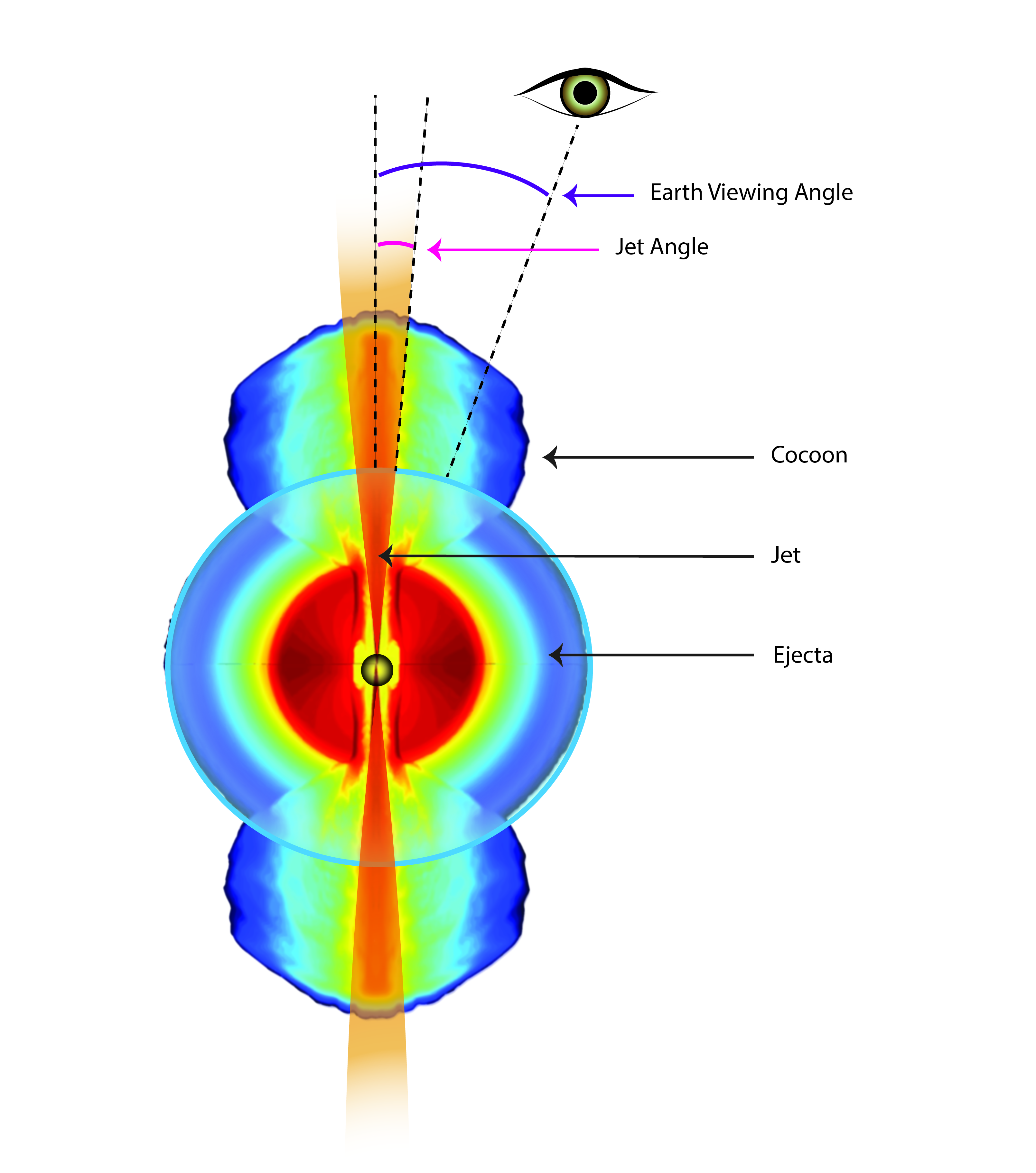
Aftermath of the merger of two neutron stars. Ejecta from an initial explosion formed a shell around the black hole formed from the merger. A jet of material propelled from a disk surrounding the black hole first interacted with the ejecta material to form a broad "cocoon." Later, the jet broke through to emerge into interstellar space, where its extremely fast motion became apparent. Credit: Sophia Dagnello, NRAO/AUI/NSF.  Hi-Res File

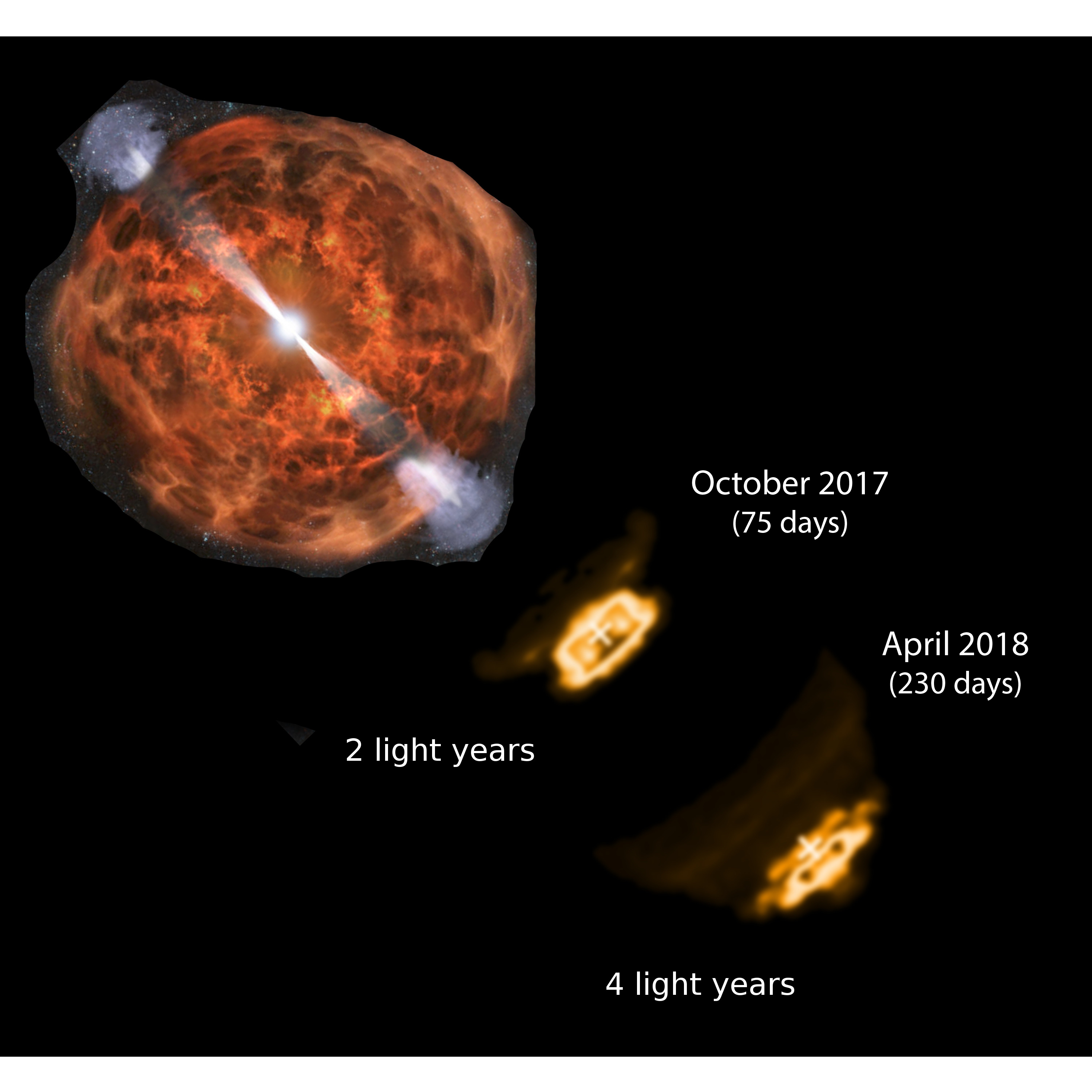
As the jet from the neutron-star merger event emerged into space, simulated radio images in this artist's conception illustrate its extremely fast motion. In the 155 days between two observations, the jet appeared to move two light-years, a distance that would require it to travel four times faster than light. This "superluminal motion" is an illusion created as the jet is pointed nearly toward the Earth and it is actually moving more than 97 percent of light speed. (Not to Scale.) Credit: D. Berry, O. Gottlieb, K. Mooley, G. Hallinan, NRAO/AUI/NSF.  Hi-Res File


Jet appeared to move four times faster than light

Precise measurement using a continent-wide collection of National Science Foundation (NSF) radio telescopes has revealed that a narrow jet of particles moving at nearly the speed of light broke out into interstellar space after a pair of neutron stars merged in a galaxy 130 million light-years from Earth. The merger, which occurred in August of 2017, sent gravitational waves rippling through space. It was the first event ever to be detected both by gravitational waves and electromagnetic waves, including gamma rays, X-rays, visible light, and radio waves.

The aftermath of the merger, called GW170817, was observed by orbiting and ground-based telescopes around the world. Scientists watched as the characteristics of the received waves changed with time, and used the changes as clues to reveal the nature of the phenomena that followed the merger.

One question that stood out, even months after the merger, was whether or not the event had produced a narrow, fast-moving jet of material that made its way into interstellar space. That was important, because such jets are required to produce the type of gamma ray bursts that theorists had said should be caused by the merger of neutron-star pairs.

The answer came when astronomers used a combination of the NSF’s Very Long Baseline Array (VLBA), the Karl G. Jansky Very Large Array (VLA), and the Robert C. Byrd Green Bank Telescope (GBT) and discovered that a region of radio emission from the merger had moved, and the motion was so fast that only a jet could explain its speed.

“We measured an apparent motion that is four times faster than light. That illusion, called superluminal motion, results when the jet is pointed nearly toward Earth and the material in the jet is moving close to the speed of light,” said Kunal Mooley, of the National Radio Astronomy Observatory (NRAO) and Caltech.

The astronomers observed the object 75 days after the merger, then again 230 days after.

“Based on our analysis, this jet most likely is very narrow, at most 5 degrees wide, and was pointed only 20 degrees away from the Earth’s direction,” said Adam Deller, of the Swinburne University of Technology and formerly of the NRAO. “But to match our observations, the material in the jet also has to be blasting outwards at over 97 percent of the speed of light,” he added.

The scenario that emerged is that the initial merger of the two superdense neutron stars caused an explosion that propelled a spherical shell of debris outward. The neutron stars collapsed into a black hole whose powerful gravity began pulling material toward it. That material formed a rapidly-spinning disk that generated a pair of jets moving outward from its poles.

As the event unfolded, the question became whether the jets would break out of the shell of debris from the original explosion. Data from observations indicated that a jet had interacted with the debris, forming a broad “cocoon” of material expanding outward. Such a cocoon would expand more slowly than a jet.

“Our interpretation is that the cocoon dominated the radio emission until about 60 days after the merger, and at later times the emission was jet dominated,” said Ore Gottlieb, of the Tel Aviv University, a leading theorist on the study.

“We were lucky to be able to observe this event, because if the jet had been pointed much farther away from Earth, the radio emission would have been too faint for us to detect,” said Gregg Hallinan of Caltech.

The detection of a fast-moving jet in GW170817 greatly strengthens the connection between neutron star mergers and short-duration gamma-ray bursts, the scientists said. They added that the jets need to be pointed relatively closely toward the Earth for the gamma ray burst to be detected.

“Our study demonstrates that combining observations from the VLBA, the VLA and the GBT is a powerful means of studying the jets and physics associated with gravitational wave events,” Mooley said.

“The merger event was important for a number of reasons, and it continues to surprise astronomers with more information,” said Joe Pesce, NSF Program Director for NRAO. “Jets are enigmatic phenomena seen in a number of environments, and now these exquisite observations in the radio part of the electromagnetic spectrum are providing fascinating insight into them, helping us understand how they work.”

Mooley and his colleagues reported their findings in the September 5 online version of the journal Nature.

The National Radio Astronomy Observatory is a facility of the National Science Foundation, operated under cooperative agreement by Associated Universities, Inc.

###

Media Contact:

Dave Finley, Public Information Officer
(575) 835-7302
dfinley@nrao.edu


Monday, January 22, 2018

Neutron-star merger yields new puzzle for astrophysicists

GW170817 - NGC 4993
Credit: NASA/CXC/McGill University/J. Ruan et al.


The afterglow from the distant neutron-star merger detected last August has continued to brighten – much to the surprise of astrophysicists studying the aftermath of the massive collision that took place about 138 million light years away and sent gravitational waves rippling through the universe.

New observations from NASA's orbiting Chandra X-ray Observatory, reported in Astrophysical Journal Letters, indicate that the gamma ray burst unleashed by the collision is more complex than scientists initially imagined.

"Usually when we see a short gamma-ray burst, the jet emission generated gets bright for a short time as it smashes into the surrounding medium – then fades as the system stops injecting energy into the outflow," says McGill University astrophysicist Daryl Haggard, whose research group led the new study. "This one is different; it's definitely not a simple, plain-Jane narrow jet."

Cocoon theory

The new data could be explained using more complicated models for the remnants of the neutron star merger. One possibility: the merger launched a jet that shock-heated the surrounding gaseous debris, creating a hot 'cocoon' around the jet that has glowed in X-rays and radio light for many months.

The X-ray observations jibe with radio-wave data reported last month by another team of scientists, which found that those emissions from the collision also continued to brighten over time.

While radio telescopes were able to monitor the afterglow throughout the fall, X-ray and optical observatories were unable to watch it for around three months, because that point in the sky was too close to the Sun during that period. "When the source emerged from that blind spot in the sky in early December, our Chandra team jumped at the chance to see what was going on," says John Ruan, a postdoctoral researcher at the McGill Space Institute and lead author of the new paper. "Sure enough, the afterglow turned out to be brighter in the X-ray wavelengths, just as it was in the radio."

Physics puzzlev

That unexpected pattern has set off a scramble among astronomers to understand what physics is driving the emission. "This neutron-star merger is unlike anything we've seen before," says Melania Nynka, another McGill postdoctoral researcher. "For astrophysicists, it's a gift that seems to keep on giving." Nynka also co-authored the new paper, along with astronomers from Northwestern University and the University of Leicester.

The neutron-star merger was first detected on Aug. 17 by the U.S.-based Laser Interferometer Gravitational-Wave Observatory (LIGO). The European Virgo detector and some 70 ground- and space-based observatories helped confirm the discovery.

The discovery opened a new era in astronomy. It marked the first time that scientists have been able to observe a cosmic event with both light waves -- the basis of traditional astronomy -- and gravitational waves, the ripples in space-time predicted a century ago by Albert Einstein's general theory of relativity. Mergers of neutron stars, among the densest objects in the universe, are thought to be responsible for producing heavy elements such as gold, platinum, and silver.

"Brightening X-ray Emission from GW170817/GRB170817A: Further Evidence for an Outflow," John J. Ruan et al, Astrophysical Journal Letters, Jan. 18, 2018. https://doi.org/10.3847/2041-8213/aaa4f3

Funding for the research was provided by the National Sciences and Engineering Research Council of Canada, the Fonds de recherche du Québec – Nature et technologies, the McGill Trottier Chair in Astrophysics and Cosmology, and the Canadian Institute for Advanced Research.


Media contacts:

Daryl Haggard
Assistant Professor of Physics
McGill University/McGill Space Institute
daryl.haggard@mcgill.ca

Chris Chipello
Media Relations
McGill University
514-398-4201
christopher.chipello@mcgill.ca


Thursday, December 28, 2017

Radio Observations Point to Likely Explanation for Neutron-Star Merger Phenomena

Different scenarios for the aftermath of the collision of two neutron stars. At left (in the short gamma-ray burst [SGRB] scenario), a jet of material moving at nearly the speed of light is propelled from the collision site into a sphere of material initially blown out by the resulting explosion. If viewed from an angle away (off-axis) from the center of the jet, the long-term emission of X-rays and radio waves would be getting weaker. At right, the jet cannot punch out of the shell of explosion debris, but instead sweeps up material into a broad "cocoon," which absorbs the jet's energy and emits X-rays and radio waves over a wider angle. In this case, such emission is still growing in intensity, as now observed with both radio and X-ray telescopes. Credit: NRAO/AUI/NSF: D. Berry. Hi-Res File


Three months of observations with the National Science Foundation’s Karl G. Jansky Very Large Array (VLA) have allowed astronomers to zero in on the most likely explanation for what happened in the aftermath of the violent collision of a pair of neutron stars in a galaxy 130 million light-years from Earth. What they learned means that astronomers will be able to see and study many more such collisions.

On August 17, 2017, the LIGO and VIRGO gravitational-wave observatories combined to locate the faint ripples in spacetime caused by the merger of two superdense neutron stars. It was the first confirmed detection of such a merger and only the fifth direct detection ever of gravitational waves, predicted more than a century ago by Albert Einstein.

The gravitational waves were followed by outbursts of gamma rays, X-rays, and visible light from the event. The VLA detected the first radio waves coming from the event on September 2. This was the first time any astronomical object had been seen with both gravitational waves and electromagnetic waves.

The timing and strength of the electromagnetic radiation at different wavelengths provided scientists with clues about the nature of the phenomena created by the initial neutron-star collision. Prior to the August event, theorists had proposed several ideas — theoretical models — about these phenomena. As the first such collision to be positively identified, the August event provided the first opportunity to compare predictions of the models to actual observations.

Astronomers using the VLA, along with the Australia Telescope Compact Array and the Giant Metrewave Radio Telescope in India, regularly observed the object from September onward. The radio telescopes showed the radio emission steadily gaining strength. Based on this, the astronomers identified the most likely scenario for the merger’s aftermath.

“The gradual brightening of the radio signal indicates we are seeing a wide-angle outflow of material, traveling at speeds comparable to the speed of light, from the neutron star merger,” said Kunal Mooley, now a National Radio Astronomy Observatory (NRAO) Jansky Postdoctoral Fellow hosted by Caltech.

The observed measurements are helping the astronomers figure out the sequence of events triggered by the collision of the neutron stars.

The initial merger of the two superdense objects caused an explosion, called a kilonova, that propelled a spherical shell of debris outward. The neutron stars collapsed into a remnant, possibly a black hole, whose powerful gravity began pulling material toward it. That material formed a rapidly-spinning disk that generated a pair of narrow, superfast jets of material flowing outward from its poles.

If one of the jets were pointed directly toward Earth, we would have seen a short-duration gamma-ray burst, like many seen before, the scientists said.

“That clearly was not the case,” Mooley said.

Some of the early measurements of the August event suggested instead that one of the jets may have been pointed slightly away from Earth. This model would explain the fact that the radio and X-ray emission were seen only some time after the collision.

“That simple model — of a jet with no structure (a so-called top-hat jet) seen off-axis — would have the radio and X-ray emission slowly getting weaker. As we watched the radio emission strengthening, we realized that the explanation required a different model,” said Alessandra Corsi, of Texas Tech University.

The astronomers looked to a model published in October by Mansi Kasliwal of Caltech, and colleagues, and further developed by Ore Gottlieb, of Tel Aviv University, and his colleagues. In that model, the jet does not make its way out of the sphere of explosion debris. Instead, it gathers up surrounding material as it moves outward, producing a broad “cocoon” that absorbs the jet’s energy.

The astronomers favored this scenario based on the information they gathered from using the radio telescopes. Soon after the initial observations of the merger site, the Earth’s annual trip around the Sun placed the object too close to the Sun in the sky for X-ray and visible-light telescopes to observe. 

For weeks, the radio telescopes were the only way to continue gathering data about the event.

“If the radio waves and X-rays both are coming from an expanding cocoon, we realized that our radio measurements meant that, when NASA’s Chandra X-ray Observatory could observe once again, it would find the X-rays, like the radio waves, had increased in strength,” Corsi said.

Mooley and his colleagues posted a paper with their radio measurements, their favored scenario for the event, and this prediction online on November 30. Chandra was scheduled to observe the object on December 2 and 6.

“On December 7, the Chandra results came out, and the X-ray emission had brightened just as we predicted,” said Gregg Hallinan, of Caltech.

“The agreement between the radio and X-ray data suggests that the X-rays are originating from the same outflow that’s producing the radio waves,” Mooley said.

“It was very exciting to see our prediction confirmed,” Hallinan said. He added, “An important implication of the cocoon model is that we should be able to see many more of these collisions by detecting their electromagnetic, not just their gravitational, waves.”

Mooley, Hallinan, Corsi, and their colleagues reported their findings in the scientific journal Nature.

The National Radio Astronomy Observatory is a facility of the National Science Foundation, operated under cooperative agreement by Associated Universities, Inc.


Media Contact:

Dave Finley, Public Information Officer
(575) 835-7302

dfinley@nrao.edu