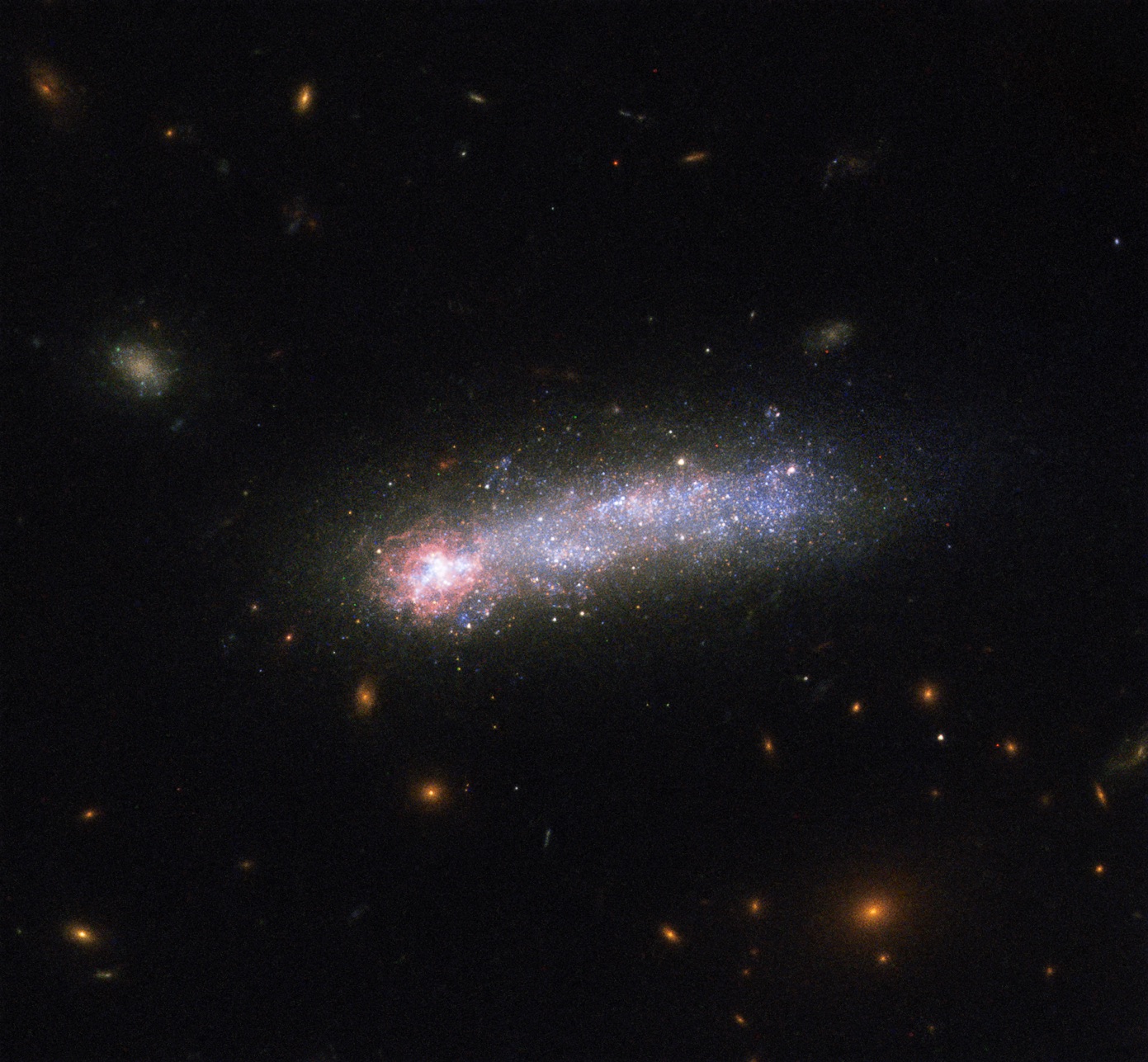
Kiso 5639, KUG 1138+327
Credit: NASA, ESA,
and D. Elmegreen (Vassar College), B. Elmegreen (IBM's Thomas J.
Watson Research Center), J. Sánchez Almeida, C. Munoz-Tunon, and M.
Filho (Instituto de Astrofísica de Canarias), J. Mendez-Abreu
(University of St. Andrews), J. Gallagher (University of
Wisconsin-Madison), M. Rafelski (NASA Goddard Space Flight Center), and D. Ceverino (Center for Astronomy at Heidelberg University). Release images
Fireworks shows are not just confined to Earth's skies. NASA's Hubble
Space Telescope has captured a spectacular fireworks display in a
small, nearby galaxy, which resembles a July 4th skyrocket.
A firestorm of star birth is lighting up one end of the diminutive
galaxy Kiso 5639. The dwarf galaxy is shaped like a flattened pancake,
but because it is tilted edge-on, it resembles a skyrocket, with a
brilliant blazing head and a long, star-studded tail.
Kiso 5639 is a rare, nearby example of elongated galaxies that occur
in abundance at larger distances, where we observe the universe during
earlier epochs. Astronomers suggest that the frenzied star birth is
sparked by intergalactic gas raining on one end of the galaxy as it
drifts through space.
"I think Kiso 5639 is a beautiful, up-close example of what must have
been common long ago," said lead researcher Debra Elmegreen of Vassar
College, in Poughkeepsie, New York. "The current thinking is that
galaxies in the early universe grow from accreting gas from the
surrounding neighborhood. It's a stage that galaxies, including our
Milky Way, must go through as they are growing up."
Observations of the early universe, such as Hubble's Ultra Deep
Field, reveal that about 10 percent of all galaxies have these
elongated shapes, and are collectively called "tadpoles." But studies
of the nearby universe have turned up only a few of these unusual
galaxies, including Kiso 5639. The development of the nearby star-making
tadpole galaxies, however, has lagged behind that of their peers,
which have spent billions of years building themselves up into many of
the spiral galaxies seen today.
Elmegreen used Hubble's Wide Field Planetary Camera 3 to conduct a
detailed imaging study of Kiso 5639. The images in different filters
reveal information about an object by dissecting its light into its
component colors. Hubble's crisp resolution helped Elmegreen and her
team analyze the giant star-forming clumps in Kiso 5639 and determine
the masses and ages of the star clusters.
The international team of researchers selected Kiso 5639 from a
spectroscopic survey of 10 nearby tadpole galaxies, observed with the
Grand Canary Telescope in La Palma, Spain, by J. Sánchez Almeida and
collaborators at the Instituto de Astrofísica de Canarias. The
observations revealed that in most of those galaxies, including Kiso
5639, the gas composition is not uniform.
The bright gas in the galaxy's head contains fewer heavier elements
(collectively called "metals"), such as carbon and oxygen, than the
rest of the galaxy. Stars consist mainly of hydrogen and helium, but
cook up other "heavier" elements. When the stars die, they release
their heavy elements and enrich the surrounding gas.
"The metallicity suggests that there has to be rather pure gas,
composed mostly of hydrogen, coming into the star-forming part of the
galaxy, because intergalactic space contains more pristine
hydrogen-rich gas," Elmegreen explained. "Otherwise, the starburst
region should be as rich in heavy elements as the rest of the galaxy."
Hubble offers a detailed view of the galaxy's star-making frenzy. The
telescope uncovered several dozen clusters of stars in the galaxy's
star-forming head, which spans 2,700 light-years across. These clusters
have an average age of less than 1 million years and masses that are
three to six times larger than those in the rest of the galaxy. Other
star formation is taking place throughout the galaxy but on a much
smaller scale. Star clusters in the rest of the galaxy are between
several million to a few billion years old.
"There is much more star formation going on in the head than what you
would expect in such a tiny galaxy," said team member Bruce Elmegreen
of IBM's Thomas J. Watson Research Center, in Yorktown Heights, New
York. "And we think the star formation is triggered by the ongoing
accretion of metal-poor gas onto a part of an otherwise quiescent dwarf
galaxy."
Hubble also revealed giant holes peppered throughout the galaxy's
starburst head. These cavities give the galaxy's head a Swiss-cheese
appearance because numerous supernova detonations — like firework
aerial bursts — have carved out holes of rarified superheated gas.
The galaxy, located 82 million light-years away, has taken billions
of years to develop because it has been drifting through an isolated
"desert" in the universe, devoid of much gas.
What triggered the starburst in such a backwater galaxy? Based on
simulations by Daniel Ceverino of the Center for Astronomy at
Heidelberg University in Germany, and other team members, the
observations suggest that less than 1 million years ago, Kiso 5639's
leading edge encountered a filament of gas. The filament dropped a large
clump of matter onto the galaxy, stoking the vigorous star birth.
Debra Elmegreen expects that in the future other parts of the galaxy
will join in the star-making fireworks show. "Galaxies rotate, and as
Kiso 5639 continues to spin, another part of the galaxy may receive an
infusion of new gas from this filament, instigating another round of
star birth," she said.
The team's results have been accepted for publication in The Astrophysical Journal.
Other team members include Casiana Muñoz-Tuñón and Mercedes Filho
(Instituto de Astrofísica de Canarias, Canary Islands), Jairo
Mendez-Abreu (University of St. Andrews, United Kingdom), John
Gallagher (University of Wisconsin-Madison), and Marc Rafelski (NASA
Goddard Space Flight Center, Greenbelt, Maryland).
Contact
Donna Weaver / Ray Villard
Space Telescope Science Institute, Baltimore, Maryland
410-338-4493 / 410-338-4514
dweaver@stsci.edu / villard@stsci.edu
Debra Elmegreen
Vassar College, Poughkeepsie, New York
elmegreen@vassar.edu