Saturday, June 10, 2017

Hubble Astronomers Develop a New Use for a Century-Old Relativity Experiment to Measure a White Dwarf’s Mass


Hubble Measures Deflection of Starlight by a Foreground Object
Credits: NASA, ESA, and K. Sahu (STScI)
Release images


Astronomers have used the sharp vision of NASA’s Hubble Space Telescope to repeat a century-old test of Einstein’s general theory of relativity. The Hubble team measured the mass of a white dwarf, the burned-out remnant of a normal star, by seeing how much it deflects the light from a background star.

This observation represents the first time Hubble has witnessed this type of effect created by a star. The data provide a solid estimate of the white dwarf’s mass and yield insights into theories of the structure and composition of the burned-out star.

First proposed in 1915, Einstein’s general relativity theory describes how massive objects warp space, which we feel as gravity. The theory was experimentally verified four years later when a team led by British astronomer Sir Arthur Eddington measured how much the sun’s gravity deflected the image of a background star as its light grazed the sun during a solar eclipse, an effect called gravitational microlensing.

Astronomers can use this effect to see magnified images of distant galaxies or, at closer range, to measure tiny shifts in a star’s apparent position on the sky. Researchers had to wait a century, however, to build telescopes powerful enough to detect this gravitational warping phenomenon caused by a star outside our solar system. The amount of deflection is so small only the sharpness of Hubble could measure it.

Hubble observed the nearby white dwarf star Stein 2051 B as it passed in front of a background star. During the close alignment, the white dwarf’s gravity bent the light from the distant star, making it appear offset by about 2 milliarcseconds from its actual position. This deviation is so small that it is equivalent to observing an ant crawl across the surface of a quarter from 1,500 miles away.

Using the deflection measurement, the Hubble astronomers calculated that the white dwarf’s mass is roughly 68 percent of the sun’s mass. This result matches theoretical predictions.

The technique opens a window on a new method to determine a star’s mass. Normally, if a star has a companion, astronomers can determine its mass by measuring the double-star system’s orbital motion. Although Stein 2051 B has a companion, a bright red dwarf, astronomers cannot accurately measure its mass because the stars are too far apart. The stars are at least 5 billion miles apart – almost twice Pluto’s present distance from the sun.

“This microlensing method is a very independent and direct way to determine the mass of a star,” explained lead researcher Kailash Sahu of the Space Telescope Science Institute (STScI) in Baltimore, Maryland. “It’s like placing the star on a scale: the deflection is analogous to the movement of the needle on the scale.”

Sahu will present his team’s findings at 11:15 a.m. (EDT), June 7, at the American Astronomical Society meeting in Austin, Texas.

The Hubble analysis also helped the astronomers to independently verify the theory of how a white dwarf’s radius is determined by its mass, an idea first proposed in 1935 by Indian American astronomer Subrahmanyan Chandrasekhar. “Our measurement is a nice confirmation of white-dwarf theory, and it even tells us the internal composition of a white dwarf,” said team member Howard Bond of Pennsylvania State University in University Park.

Sahu’s team identified Stein 2051 B and its background star after combing through data of more than 5,000 stars in a catalog of nearby stars that appear to move quickly across the sky. Stars with a higher apparent motion across the sky have a greater chance of passing in front of a distant background star, where the deflection of light can be measured.

After identifying Stein 2051 B and mapping the background star field, the researchers used Hubble’s Wide Field Camera 3 to observe the white dwarf seven different times over a two-year period as it moved past the selected background star.

The Hubble observations were challenging and time-consuming. The research team had to analyze the white dwarf’s velocity and the direction it was moving in order to predict when it would arrive at a position to bend the starlight so the astronomers could observe the phenomenon with Hubble.

The astronomers also had to measure the tiny amount of deflected starlight. “Stein 2051 B appears 400 times brighter than the distant background star,” said team member Jay Anderson of STScI, who led the analysis to precisely measure the positions of stars in the Hubble images. “So measuring the extremely small deflection is like trying to see a firefly move next to a light bulb. The movement of the insect is very small, and the glow of the light bulb makes it difficult to see the insect moving.” In fact, the slight movement is about 1,000 times smaller than the measurement made by Eddington in his 1919 experiment.

Stein 2051 B is named for its discoverer, Dutch Roman Catholic priest and astronomer Johan Stein. It resides 17 light-years from Earth and is estimated to be about 2.7 billion years old. The background star is about 5,000 light-years away.

The researchers plan to use Hubble to conduct a similar microlensing study with Proxima Centauri, our solar system’s closest stellar neighbor.

The team’s result will appear in the journal Science [advance online paper ] on June 9.

The Hubble Space Telescope is a project of international cooperation between NASA and ESA (European Space Agency). NASA’s Goddard Space Flight Center in Greenbelt, Maryland, manages the telescope. The Space Telescope Science Institute (STScI) in Baltimore conducts Hubble science operations. STScI is operated for NASA by the Association of Universities for Research in Astronomy, Inc., in Washington, D.C.


Related Links

This site is not responsible for content found on external links


Contacts 

Donna Weaver / Ray Villard
Space Telescope Science Institute, Baltimore, Maryland
410-338-4493 / 410-338-4514
dweaver@stsci.edu / villard@stsci.edu

Kailash Sahu
Space Telescope Science Institute, Baltimore, Maryland
410-338-4930
ksahu@stsci.edu

Friday, June 09, 2017

Waltzing dwarfs

Credit: ESA/Hubble & NASA, L. Bedin et al.


This seemingly unspectacular series of dots with varying distances between them actually shows the slow waltz of two brown dwarfs. The image is a stack of 12 images made over the course of three years with the NASA/ESA Hubble Space Telescope. Using high-precision astrometry, an Italian-led team of astronomers tracked the two components of the system as they moved both across the sky and around each other.

The observed system, Luhman 16AB, is only about six light-years away and is the third closest stellar system to Earth — after the triple star system Alpha Centauri and Barnard’s Star. Despite its proximity, Luhman 16AB was only discovered in 2013 by the astronomer Kevin Luhman. The two brown dwarfs that make up the system, Luhman 16A and Luhman 16B, orbit each other at a distance of only three times the distance between the Earth and the Sun, and so these observations are a showcase for Hubble’s precision and high resolution.

The astronomers using Hubble to study Luhman 16AB were not only interested in the waltz of the two brown dwarfs, but were also searching for a third, invisible, dancing partner. Earlier observations with ESO’s Very Large Telescope indicated the presence of an exoplanet in the system. The team wanted to verify this claim by analysing the movement of the brown dwarfs in great detail over a long period of time, but the Hubble data showed that the two dwarfs are indeed dancing alone, unperturbed by a massive planetary companion.

Links

Thursday, June 08, 2017

ALMA Finds Ingredient of Life Around Infant Sun-like Stars

ALMA detects methyl isocyanate around young Sun-like stars

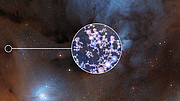
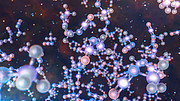
ALMA detects methyl isocyanate around young Sun-like stars (artist's impression)
 
IRAS 16293-2422 in the constellation of Ophiuchus

The Rho Ophiuchi star formation region in the constellation of Ophiuchus


Videos
 
ESOcast 110 Light: Ingredient for life found around infant stars (4K UHD)

ALMA detects ingredient of life around young Sun-like stars
ALMA detects ingredient of life around young Sun-like stars 


ALMA has observed stars like the Sun at a very early stage in their formation and found traces of methyl isocyanate — a chemical building block of life. This is the first ever detection of this prebiotic molecule towards solar-type protostars, the sort from which our Solar System evolved. The discovery could help astronomers understand how life arose on Earth.

Two teams of astronomers have harnessed the power of the Atacama Large Millimeter/submillimeter Array (ALMA) in Chile to detect the prebiotic complex organic molecule methyl isocyanate [1] in the multiple star system IRAS 16293-2422. One team was co-led by Rafael Martín-Doménech at the Centro de Astrobiología in Madrid, Spain, and Víctor M. Rivilla, at the INAF-Osservatorio Astrofisico di Arcetri in Florence, Italy; and the other by Niels Ligterink at the Leiden Observatory in the Netherlands and Audrey Coutens at University College London, United Kingdom.

“This star system seems to keep on giving! Following the discovery of sugars, we’ve now found methyl isocyanate. This family of organic molecules is involved in the synthesis of peptides and amino acids, which, in the form of proteins, are the biological basis for life as we know it,” explain Niels Ligterink and Audrey Coutens [2].

ALMA’s capabilities allowed both teams to observe the molecule at several different and characteristic wavelengths across the radio spectrum [3]. They found the unique chemical fingerprints located in the warm, dense inner regions of the cocoon of dust and gas surrounding young stars in their earliest stages of evolution. Each team identified and isolated the signatures of the complex organic molecule methyl isocyanate [4]. They then followed this up with computer chemical modelling and laboratory experiments to refine our understanding of the molecule’s origin [5].

IRAS 16293-2422 is a multiple system of very young stars, around 400 light-years away in a large star-forming region called Rho Ophiuchi in the constellation of Ophiuchus (The Serpent Bearer). The new results from ALMA show that methyl isocyanate gas surrounds each of these young stars

Earth and the other planets in our Solar System formed from the material left over after the formation of the Sun. Studying solar-type protostars can therefore open a window to the past for astronomers and allow them to observe conditions similar to those that led to the formation of our Solar System over 4.5 billion years ago.

Rafael Martín-Doménech and Víctor M. Rivilla, lead authors of one of the papers, comment: “We are particularly excited about the result because these protostars are very similar to the Sun at the beginning of its lifetime, with the sort of conditions that are well suited for Earth-sized planets to form. By finding prebiotic molecules in this study, we may now have another piece of the puzzle in understanding how life came about on our planet.”

Niels Ligterink is delighted with the supporting laboratory results: "Besides detecting molecules we also want to understand how they are formed. Our laboratory experiments show that methyl isocyanate can indeed be produced on icy particles under very cold conditions that are similar to those in interstellar space This implies that this molecule — and thus the basis for peptide bonds — is indeed likely to be present near most new young solar-type stars."


Notes

[1] A complex organic molecule is defined in astrochemistry as consisting of six or more atoms, where at least one of the atoms is carbon. Methyl isocyanate contains carbon, hydrogen, nitrogen and oxygen atoms in the chemical configuration CH3NCO. This very toxic substance was the main cause of death following the tragic Bhopal industrial accident in 1984.

[2]  The system was previously studied by ALMA in 2012 and found to contain molecules of the simple sugar glycolaldehyde, another ingredient for life.

[3] The team led by Rafael Martín-Doménech used new and archive data of the protostar taken across a large range of wavelengths across ALMA’s receiver Bands 3, 4 and 6. Niels Ligterink and his colleagues used data from the ALMA Protostellar Interferometric Line Survey (PILS), which aims to chart the chemical complexity of IRAS 16293-2422 by imaging the full wavelength range covered by ALMA's Band 7 on very small scales, equivalent to the size of our Solar System.

[4] The teams carried out spectrographic analysis of the protostar’s light to determine the chemical constituents. The amount of methyl isocyanate they detected — the abundance — with respect to molecular hydrogen and other tracers is comparable to previous detections around two high-mass protostars (i.e. within the massive hot molecular cores of Orion KL and Sagittarius B2 North).

[5] Martín-Doménech’s team chemically modelled gas-grain formation of methyl isocyanate. The observed amount of the molecule could be explained by chemistry on the surface of dust grains in space, followed by chemical reactions in the gas phase. Moreover, Ligterink's team demonstrated that the molecule can be formed at extremely cold interstellar temperatures, down to 15 Kelvin (–258 degrees Celsius), using cryogenic ultra-high-vacuum experiments in their laboratory in Leiden.


More Information

This research was presented in two papers: “First Detection of Methyl Isocyanate (CH3NCO) in a solar-type Protostar” by R. Martín-Doménech et al. and “The ALMA-PILS survey: Detection of CH3NCO toward the low-mass protostar IRAS 16293-2422 and laboratory constraints on its formation”, by N. F. W. Ligterink et al.. Both papers will appear in the same issue of the Monthly Notices of the Royal Astronomical Society.

One team is composed of: R. Martín-Doménech (Centro de Astrobiología, Spain), V. M. Rivilla (INAF-Osservatorio Astrofisico di Arcetri, Italy), I. Jiménez-Serra (Queen Mary University of London, UK), D. Quénard (Queen Mary University of London, UK), L. Testi (INAF-Osservatorio Astrofisico di Arcetri, Italy; ESO, Garching, Germany; Excellence Cluster “Universe”, Germany) and J. Martín-Pintado (Centro de Astrobiología, Spain).

The other team is composed of: N. F. W. Ligterink (Sackler Laboratory for Astrophysics, Leiden Observatory, the Netherlands), A. Coutens (University College London, UK), V. Kofman (Sackler Laboratory for Astrophysics, The Netherlands), H. S. P. Müller (Universität zu Köln, Germany), R. T. Garrod (University of Virginia, USA), H. Calcutt (Niels Bohr Institute & Natural History Museum, Denmark), S. F. Wampfler (Center for Space and Habitability, Switzerland), J. K. Jørgensen (Niels Bohr Institute & Natural History Museum, Denmark), H. Linnartz (Sackler Laboratory for Astrophysics, The Netherlands) and E. F. van Dishoeck (Leiden Observatory, The Netherlands; Max-Planck-Institut für Extraterrestrische Physik, Germany).

The Atacama Large Millimeter/submillimeter Array (ALMA), an international astronomy facility, is a partnership of ESO, the U.S. National Science Foundation (NSF) and the National Institutes of Natural Sciences (NINS) of Japan in cooperation with the Republic of Chile. ALMA is funded by ESO on behalf of its Member States, by NSF in cooperation with the National Research Council of Canada (NRC) and the National Science Council of Taiwan (NSC) and by NINS in cooperation with the Academia Sinica (AS) in Taiwan and the Korea Astronomy and Space Science Institute (KASI).
ALMA construction and operations are led by ESO on behalf of its Member States; by the National Radio Astronomy Observatory (NRAO), managed by Associated Universities, Inc. (AUI), on behalf of North America; and by the National Astronomical Observatory of Japan (NAOJ) on behalf of East Asia. The Joint ALMA Observatory (JAO) provides the unified leadership and management of the construction, commissioning and operation of ALMA.

ESO is the foremost intergovernmental astronomy organisation in Europe and the world’s most productive ground-based astronomical observatory by far. It is supported by 16 countries: Austria, Belgium, Brazil, the Czech Republic, Denmark, France, Finland, Germany, Italy, the Netherlands, Poland, Portugal, Spain, Sweden, Switzerland and the United Kingdom, along with the host state of Chile. ESO carries out an ambitious programme focused on the design, construction and operation of powerful ground-based observing facilities enabling astronomers to make important scientific discoveries. ESO also plays a leading role in promoting and organising cooperation in astronomical research. ESO operates three unique world-class observing sites in Chile: La Silla, Paranal and Chajnantor. At Paranal, ESO operates the Very Large Telescope and its world-leading Very Large Telescope Interferometer as well as two survey telescopes, VISTA working in the infrared and the visible-light VLT Survey Telescope. ESO is also a major partner in two facilities on Chajnantor, APEX and ALMA, the largest astronomical project in existence. And on Cerro Armazones, close to Paranal, ESO is building the 39-metre Extremely Large Telescope, the ELT, which will become “the world’s biggest eye on the sky”.


Links


Contacts

Rafael Martín-Doménech
Centro de Astrobiología
Madrid, Spain
Email:
rmartin@cab.inta-csic.es

Victor Rivilla
INAF-Osservatorio Astrofisico di Arcetri
Italy
Email:
rivilla@arcetri.astro.it

Audrey Coutens
Laboratoire d’Astrophysique de Bordeaux
France
Email:
audrey.coutens@u-bordeaux.fr

Niels Ligterink
Sackler Laboratory for Astrophysics, Leiden Observatory
Netherlands
Tel: +31 (0) 71 527 5844
Email:
ligterink@strw.leidenuniv.nl

Richard Hook
ESO Public Information Officer
Garching bei München, Germany
Tel: +49 89 3200 6655
Cell: +49 151 1537 3591
Email:
rhook@eso.org


Source: ESO/News

Jackpot! Cosmic Magnifying-Glass Effect Captures Universe's Brightest Galaxies

  Hubble Gallery of Ultra-Bright Galaxies
Credits: NASA, ESA, and J. Lowenthal (Smith College)


Boosted by natural magnifying lenses in space, NASA's Hubble Space Telescope has captured unique close-up views of the universe's brightest infrared galaxies, which are as much as 10,000 times more luminous than our Milky Way.

The galaxy images, magnified through a phenomenon called gravitational lensing, reveal a tangled web of misshapen objects punctuated by exotic patterns such as rings and arcs. The odd shapes are due largely to the foreground lensing galaxies' powerful gravity distorting the images of the background galaxies. The unusual forms also may have been produced by spectacular collisions between distant, massive galaxies in a sort of cosmic demolition derby.

"We have hit the jackpot of gravitational lenses," said lead researcher James Lowenthal of Smith College in Northampton, Massachusetts. "These ultra-luminous, massive, starburst galaxies are very rare. Gravitational lensing magnifies them so that you can see small details that otherwise are unimaginable. We can see features as small as about 100 light-years or less across. We want to understand what's powering these monsters, and gravitational lensing allows us to study them in greater detail."

The galaxies are ablaze with runaway star formation, pumping out more than 10,000 new stars a year. This unusually rapid star birth is occurring at the peak of the universe's star-making boom more than 8 billion years ago. The star-birth frenzy creates lots of dust, which enshrouds the galaxies, making them too faint to detect in visible light. But they glow fiercely in infrared light, shining with the brilliance of 10 trillion to 100 trillion suns.

Gravitational lenses occur when the intense gravity of a massive galaxy or cluster of galaxies magnifies the light of fainter, more distant background sources. Previous observations of the galaxies, discovered in far-infrared light by ground- and space-based observatories, had hinted of gravitational lensing. But Hubble's keen vision confirmed the researchers' suspicion.

Lowenthal is presenting his results at 3:15 p.m. (EDT), June 6, at the American Astronomical Society meeting in Austin, Texas.

According to the research team, only a few dozen of these bright infrared galaxies exist in the universe, scattered across the sky. They reside in unusually dense regions of space that somehow triggered rapid star formation in the early universe.

The galaxies may hold clues to how galaxies formed billions of years ago. "There are so many unknowns about star and galaxy formation," Lowenthal explained. "We need to understand the extreme cases, such as these galaxies, as well as the average cases, like our Milky Way, in order to have a complete story about how galaxy and star formation happen."

In studying these strange galaxies, astronomers first must detangle the foreground lensing galaxies from the background ultra-bright galaxies. Seeing this effect is like looking at objects at the bottom of a swimming pool. The water distorts your view, just as the lensing galaxies' gravity stretches the shapes of the distant galaxies. "We need to understand the nature and scale of those lensing effects to interpret properly what we're seeing in the distant, early universe," Lowenthal said. "This applies not only to these brightest infrared galaxies, but probably to most or maybe even all distant galaxies."

Lowenthal's team is halfway through its Hubble survey of 22 galaxies. An international team of astronomers first discovered the galaxies in far-infrared light using survey data from the European Space Agency's (ESA) Planck space observatory, and some clever sleuthing. The team then compared those sources to galaxies found in ESA's Herschel Space Observatory's catalog of far-infrared objects and to ground-based radio data taken by the Very Large Array in New Mexico. The researchers next used the Large Millimeter Telescope (LMT) in Mexico to measure their exact distances from Earth. The LMT's far-infrared images also revealed multiple objects, hinting that the galaxies were being gravitationally lensed.

These bright objects existed between 8 billion and 11.5 billion years ago, when the universe was making stars more vigorously than it is today. The galaxies' star-birth production is 5,000 to 10,000 times higher than that of our Milky Way. However, the ultra-bright galaxies are pumping out stars using only the same amount of gas contained in the Milky Way.

So, the nagging question is, what is powering the prodigious star birth? "We've known for two decades that some of the most luminous galaxies in the universe are very dusty and massive, and they're undergoing bursts of star formation," Lowenthal said. "But they've been very hard to study because the dust makes them practically impossible to observe in visible light. They're also very rare: they don't appear in any of Hubble's deep-field surveys. They are in random parts of the sky that nobody's looked at before in detail. That's why finding that they are gravitationally lensed is so important."

These galaxies may be the brighter, more distant cousins of the ultra-luminous infrared galaxies (ULIRGS), hefty, dust-cocooned, starburst galaxies, seen in the nearby universe. The ULIRGS' star-making output is stoked by the merger of two spiral galaxies, which is one possibility for the stellar baby boom in their more-distant relatives. However, Lowenthal said that computer simulations of the birth and growth of galaxies show that major mergers occur at a later epoch than the one in which these galaxies are seen.

Another idea for the star-making surge is that lots of gas, the material that makes stars, is flooding into the faraway galaxies. "The early universe was denser, so maybe gas is raining down on the galaxies, or they are fed by some sort of channel or conduit, which we have not figured out yet," Lowenthal said. "This is what theoreticians struggle with: How do you get all the gas into a galaxy fast enough to make it happen?"

The research team plans to use Hubble and the Gemini Observatory in Hawaii to try to distinguish between the foreground and background galaxies so they can begin to analyze the details of the brilliant monster galaxies.

Future telescopes, such as NASA's James Webb Space Telescope, an infrared observatory scheduled to launch in 2018, will measure the speed of the galaxies' stars so that astronomers can calculate the mass of these ultra-luminous objects.

"The sky is covered with all kinds of galaxies, including those that shine in far-infrared light," Lowenthal said. "What we're seeing here is the tip of the iceberg: the very brightest of all."

The Hubble Space Telescope is a project of international cooperation between NASA and ESA (European Space Agency). NASA's Goddard Space Flight Center in Greenbelt, Maryland, manages the telescope. The Space Telescope Science Institute (STScI) in Baltimore conducts Hubble science operations. STScI is operated for NASA by the Association of Universities for Research in Astronomy, Inc., in Washington, D.C.


Related Links


This site is not responsible for content found on external links


Contacts

Donna Weaver / Ray Villard
Space Telescope Science Institute, Baltimore, Maryland
410-338-4493 / 410-338-4514

dweaver@stsci.edu / villard@stsci.edu

James Lowenthal
Smith College, Northampton, Massachusetts
413-585-6995

jlowenth@smith.edu
Source: HubbleSite/News

Wednesday, June 07, 2017

Mini-Flares Potentially Jeopardize Habitability of Planets Circling Red Dwarf Stars

Flaring Red Dwarf Star (Artist's Illustration)
Credit: NASA, ESA, and G. Bacon (STScI)


Cool dwarf stars are hot targets for exoplanet hunting right now. The discoveries of planets in the habitable zones of the TRAPPIST-1 and LHS 1140 systems, for example, suggest that Earth-sized worlds might circle billions of red dwarf stars, the most common type of star in our galaxy. But, like our own sun, many of these stars erupt with intense flares. Are red dwarfs really as friendly to life as they appear, or do these flares make the surfaces of any orbiting planets inhospitable?

To address this question, a team of scientists has combed 10 years of ultraviolet observations by the Galaxy Evolution Explorer (GALEX) spacecraft looking for rapid increases in the brightnesses of stars due to flares. Flares emit radiation across a wide swath of wavelengths, with a significant fraction of their total energy released in the ultraviolet bands where GALEX observed. At the same time, the red dwarfs from which the flares arise are relatively dim in the ultraviolet. This contrast, combined with the time resolution of the GALEX detectors, allowed the team to measure events with less total energy than many previously detected flares. This is important because, although individually less energetic and therefore less hostile to life, smaller flares might be much more frequent and add up over time to produce an inhospitable environment.

“What if planets are constantly bathed by these smaller, but still significant, flares?” asked Scott Fleming of the Space Telescope Science Institute (STScI) in Baltimore, Maryland. “There could be a cumulative effect.”

To detect and accurately measure these flares, the team had to slice the GALEX data into very high time resolution. From images with exposure times of nearly half an hour, the team was able to reveal stellar variations lasting just seconds.

First author Chase Million of Million Concepts in State College, Pennsylvania, led a project called gPhoton that reprocessed more than 100 terabytes of GALEX data held at the Mikulski Archive for Space Telescopes (MAST), located at STScI. The team then used custom software developed by Million and Clara Brasseur (STScI) to search several hundred red dwarf stars and detected dozens of flares.

“We have found dwarf star flares in the whole range that we expected GALEX to be sensitive to, from itty bitty baby flares that last a few seconds, to monster flares that make a star hundreds of times brighter for a few minutes,” said Million.

The flares GALEX detected are similar in strength to flares produced by our own sun. However, because a planet would have to orbit much closer to a cool, red dwarf star to maintain a temperature friendly to life as we know it, such planets would be subjected to more of a flare’s energy than Earth.
Large flares can strip away a planet’s atmosphere. Strong ultraviolet light from flares that penetrates to a planet’s surface could damage organisms or prevent life from arising.

Currently, team members Rachel Osten (STScI) and Brasseur are examining stars observed by both the GALEX and Kepler missions to look for similar flares. The team expects to eventually find hundreds of thousands of flares hidden in the GALEX data.

"These results show the value of a survey mission like GALEX, which was instigated to study the evolution of galaxies across cosmic time and is now having an impact on the study of nearby habitable planets," said Don Neill, research scientist at Caltech in Pasadena, California, who was part of the GALEX collaboration. "We did not anticipate that GALEX would be used for exoplanets when the mission was designed."

New and powerful instruments like the James Webb Space Telescope, scheduled for launch in 2018, ultimately will be needed to study atmospheres of planets orbiting nearby red dwarf stars and search for signs of life. But as researchers pose new questions about the cosmos, archives of data from past projects and missions, like those held at MAST, continue to produce exciting new scientific results.
These results were presented in a press conference at a meeting of the American Astronomical Society in Austin, Texas.

The GALEX mission, which ended in 2013 after more than a decade of scanning the skies in ultraviolet light, was led by scientists at Caltech. NASA's Jet Propulsion Laboratory, also in Pasadena, California, managed the mission and built the science instrument. JPL is managed by Caltech for NASA.

The Space Telescope Science Institute (STScI) in Baltimore, Maryland, conducts Hubble Space Telescope science operations and is the mission and science operations center for the James Webb Space Telescope. STScI is operated for NASA by the Association of Universities for Research in Astronomy in Washington, D.C.


Related Links

This site is not responsible for content found on external links


Contacts

Christine Pulliam / Ray Villard
Space Telescope Science Institute, Baltimore, Maryland
410-338-4366 / 410-338-4514

cpulliam@stsci.edu / villard@stsci.edu

Chase Million
Million Concepts, State College, Pennsylvania
765-914-5336

chase.million@gmail.com


Source: HubbleSite

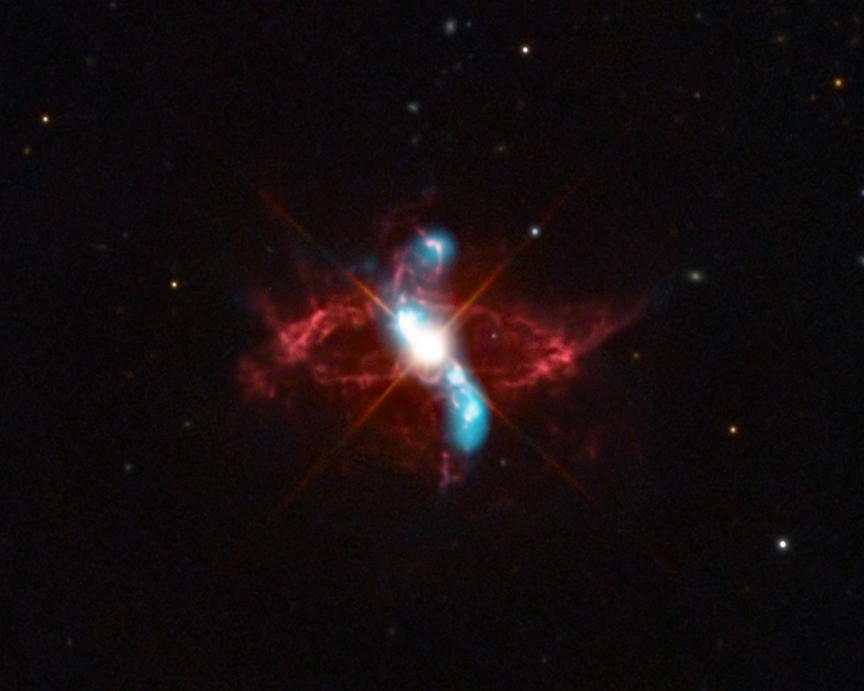
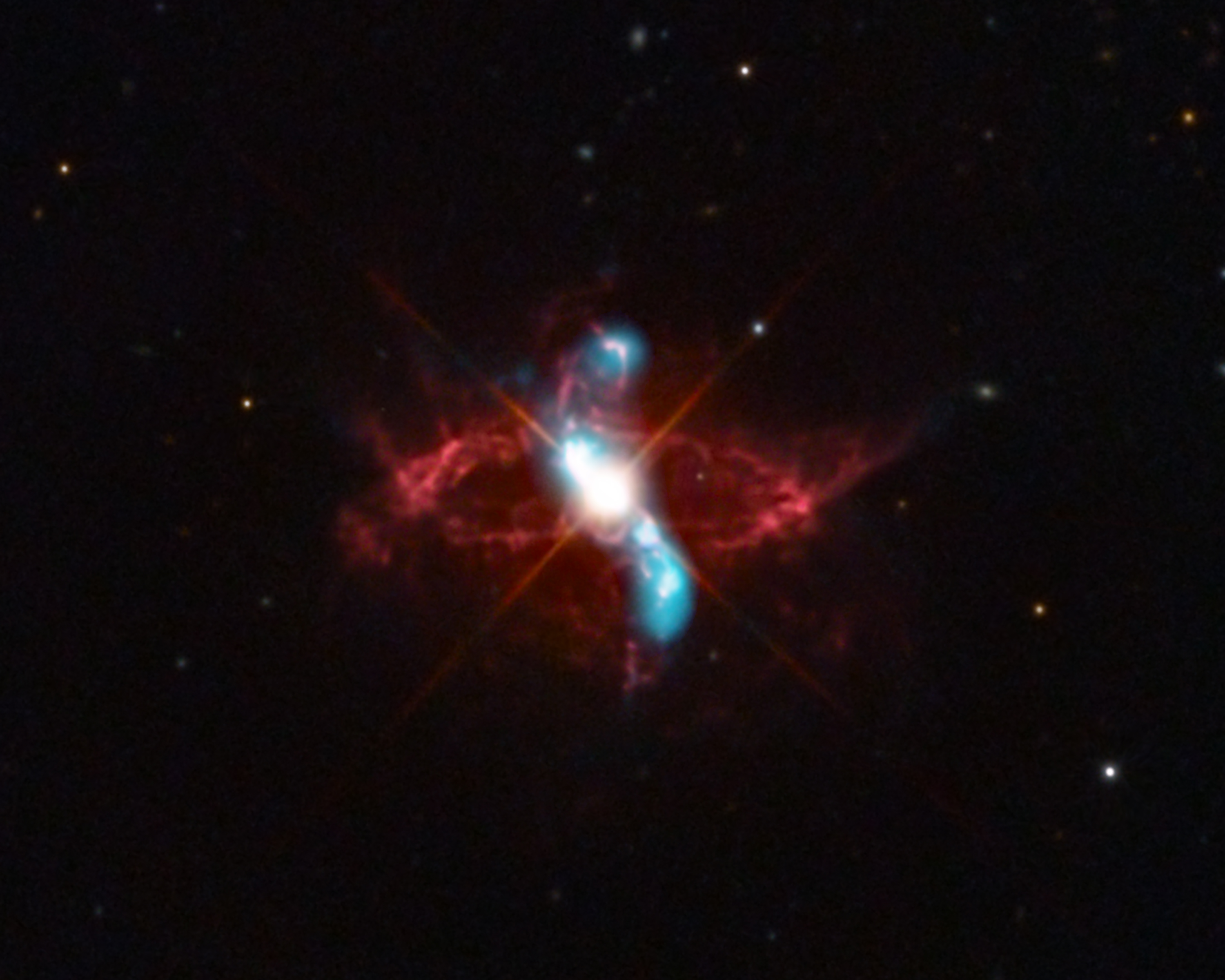
R Aquarii: Watching a Volatile Stellar Relationship

R Aquarii
Credit  X-ray: NASA/CXC/SAO/R. Montez et al.; 
Optical: Adam Block/Mt. Lemmon SkyCenter/U. Arizona


In biology, "symbiosis" refers to two organisms that live close to and interact with one another. Astronomers have long studied a class of stars — called symbiotic stars — that co-exist in a similar way. Using data from NASA’s Chandra X-ray Observatory and other telescopes, astronomers are gaining a better understanding of how volatile this close stellar relationship can be.

R Aquarii (R Aqr, for short) is one of the best known of the symbiotic stars. Located at a distance of about 710 light years from Earth, its changes in brightness were first noticed with the naked eye almost a thousand years ago. Since then, astronomers have studied this object and determined that R Aqr is not one star, but two: a small, dense white dwarf and a cool red, giant star.

The red giant star has its own interesting properties. In billions of years, our Sun will turn into a red giant once it exhausts the hydrogen nuclear fuel in its core and begins to expand and cool. Most red giants are placid and calm, but some pulsate with periods between 80 and 1,000 days like the star  Mira and undergo large changes in brightness. This subset of red giants is called "Mira variables."
The red giant in R Aqr is a Mira variable and undergoes steady changes in brightness by a factor of 250 as it pulsates, unlike its white dwarf companion that does not pulsate. There are other striking differences between the two stars. The white dwarf is about ten thousand times brighter than the red giant. The white dwarf has a surface temperature of some 20,000 K while the Mira variable has a temperature of about 3,000 K. In addition, the white dwarf is slightly less massive than its companion but because it is much more compact, its gravitational field is stronger. The gravitational force of the white dwarf pulls away the sloughing outer layers of the Mira variable toward the white dwarf and onto its surface.

Occasionally, enough material will accumulate on the surface of the white dwarf to trigger thermonuclear fusion of hydrogen. The release of energy from this process can produce a nova, an asymmetric explosion that blows off the outer layers of the star at velocities of ten million miles per hour or more, pumping energy and material into space. An outer ring of material provides clues to this history of eruptions. Scientists think a nova explosion in the year 1073 produced this ring.

Evidence for this explosion comes from optical telescope data, from Korean records of a “guest” star at the position of R Aqr in 1073 and information from Antarctic ice cores. An inner ring was generated by an eruption in the early 1770s. Optical data (red) in a new composite image of R Aqr shows the inner ring. The outer ring is about twice as wide as the inner ring, but is too faint to be visible in this image.

Since shortly after Chandra launched in 1999, astronomers began using the X-ray telescope to monitor the behavior of R Aqr, giving them a better understanding of the behavior of R Aqr in more recent years. Chandra data (blue) in this composite reveal a jet of X-ray emission that extends to the upper left. The X-rays have likely been generated by shock waves, similar to sonic booms around supersonic planes, caused by the jet striking surrounding material.

As astronomers have made observations of R Aqr with Chandra over the years, in 2000, 2003, and 2005, they have seen changes in this jet. Specifically, blobs of X-ray emission are moving away from the stellar pair at speeds of about 1.4 million and 1.9 million miles per hour. Despite travelling at a slower speed than the material ejected by the nova, the jets encounter little material and do not slow down much. On the other hand, matter from the nova sweeps up a lot more material and slows down significantly, explaining why the rings are not much larger than the jets.


Using the distances of the blobs from the binary, and assuming that the speeds have remained constant, a team of scientists from the Harvard-Smithsonian Center for Astrophysics (CfA) in Cambridge, Mass, estimated that eruptions in the 1950s and 1980s produced the blobs. These eruptions were less energetic and not as bright as the nova explosion in 1073.

In 2007 a team led by Joy Nichols from CfA reported the possible detection of a new jet in R Aqr using the Chandra data. This implies that another eruption occurred in the early 2000s. If these less powerful and poorly understood events repeat about every few decades, the next one is due within the next 10 years.

Some binary star systems containing white dwarfs have been observed to produce nova explosions at regular intervals. If R Aqr is one of these recurrent novas, and the spacing between the 1073 and 1773 events repeats itself, the next nova explosion should not occur again until the 2470s. During such an event the system may become several hundred times brighter, making it easily visible to the naked eye, and placing it among the several dozen brightest stars.

Close monitoring of this stellar couple will be important for trying to understand the nature of their volatile relationship.

Rodolfo ("Rudy") Montez of the Harvard-Smithsonian Center for Astrophysics (CfA) in Cambridge, Mass, presented these results at the 230th meeting of the American Astronomical Society in Austin, TX. His co-authors are Margarita Karovska, Joy Nichols, and Vinay Kashyap, all from CfA.

NASA's Marshall Space Flight Center in Huntsville, Alabama, manages the Chandra program for NASA’s Science Mission Directorate in Washington. The Smithsonian Astrophysical Observatory in Cambridge, Massachusetts, controls Chandra’s science and flight operations.


Fast Facts for R Aquarii:

Scale: Image is 4.2 x 3.4 arcmin (About 0.86 x 0.70 light years).
Category: Normal Stars & Star Clusters, White Dwarfs & Planetary Nebulas
Coordinates (J2000): RA 23h 49m 34.6s | Dec -15° 17' 04"
Constellation: Aquarius
Observation Date: 3 pointings between Sep 2001 and Oct 2005
Observation Time: 34 hours 58 minutes (individual times: 6.3 hours, 18.5 hours, 10.1 hours)
Obs. ID: 651, 4546, 5438
Instrument: ACIS
Color Code: X-ray (Cyan); Optical (Red)
Distance Estimate: About 710 light years


Tuesday, June 06, 2017

Hubble's Tale of Two Exoplanets: Nature vs. Nurture

This diagram compares Hubble Space Telescope observations of two "hot Jupiter"-class planets orbiting very closely to different sunlike stars. Astronomers measured how light from each parent star is filtered through each planet's atmosphere. HAT-P-38 b did have a water signature indicated by the absorption-feature peak in the spectrum. This is interpreted as indicating the upper atmosphere is free of clouds or hazes. WASP-67 b, has a flat spectrum that lacks any water-absorption feature, suggesting most of the planet's atmosphere is masked by high-altitude clouds. Credits: Artwork: NASA, ESA, and Z. Levy (STScI); Credit: Science: NASA, ESA, and G. Bruno (STScI)

This diagram compares Hubble Space Telescope observations of two "hot Jupiter"-class planets orbiting very closely to different sunlike stars. Astronomers measured how light from each parent star is filtered through each planet's atmosphere. HAT-P-38 b did have a water signature indicated by the absorption-feature peak in the spectrum. This is interpreted as indicating the upper atmosphere is free of clouds or hazes. WASP-67 b, has a flat spectrum that lacks any water-absorption feature, suggesting most of the planet's atmosphere is masked by high-altitude clouds. Credits: Artwork: NASA, ESA, and Z. Levy (STScI); Credit: Science: NASA, ESA, and G. Bruno (STScI)


Is it a case of nature versus nurture when it comes to two "cousin" exoplanets? In a unique experiment, scientists used NASA's Hubble Space Telescope to study two "hot Jupiter" exoplanets. Because these planets are virtually the same size and temperature, and orbit around nearly identical stars at the same distance, the team hypothesized that their atmospheres should be alike. What they found surprised them.

Lead researcher Giovanni Bruno of the Space Telescope Science Institute in Baltimore, Maryland, explained, "What we're seeing in looking at the two atmospheres is that they're not the same. One planet—WASP-67 b—is cloudier than the other—HAT-P-38 b. We don't see what we're expecting, and we need to understand why we find this difference."

The team used Hubble's Wide Field Camera 3 to look at the planets' spectral fingerprints, which measure chemical composition. "The effect that clouds have on the spectral signature of water allows us to measure the amount of clouds in the atmosphere," Bruno said. "More clouds mean that the water feature is reduced." The teams found that for WASP-67 b there are more clouds at the altitudes probed by these measurements.

"This tells us that there had to be something in their past that is changing the way these planets look," said Bruno.

Today the planets whirl around their yellow dwarf stars once every 4.5 Earth days, tightly orbiting their stars closer than Mercury orbits our sun. But in the past, the planets probably migrated inward toward the star from the locations where they formed.

Perhaps one planet formed differently than the other, under a different set of circumstances. "You can say it's nature versus nurture," explains co-investigator Kevin Stevenson. "Right now, they appear to have the same physical properties. So, if their measured composition is defined by their current state, then it should be the same for both planets. But that's not the case. Instead, it looks like their formation histories could be playing an important role."

The clouds on these hot, Jupiter-like gas giants are nothing like those on Earth. Instead, they are probably alkali clouds, composed of molecules such as sodium sulfide and potassium chloride. The average temperature on each planet is more than 1,300 degrees Fahrenheit.

The exoplanets are tidally locked, with the same side always facing the parent star. This means they have a very hot day-side and a cooler night-side. Instead of sporting multiple cloud bands like Jupiter does, each probably has just one broad equatorial band that slowly moves the heat around from the day-side to the night-side.

The team is just beginning to learn what factors are important in making some exoplanets cloudy and some clear. To better understand what the planets' pasts may have been, scientists will need future observations with Hubble and the soon-to-be-launched James Webb Space Telescope.

The team's results were presented on June 5 at the 230th meeting of the American Astronomical Society in Austin, Texas.

The Hubble Space Telescope is a project of international cooperation between NASA and ESA (European Space Agency). NASA's Goddard Space Flight Center in Greenbelt, Maryland, manages the telescope. The Space Telescope Science Institute (STScI) in Baltimore conducts Hubble science operations. STScI is operated for NASA by the Association of Universities for Research in Astronomy, Inc., in Washington, D.C.

For more information about NASA's Hubble Space Telescope, visit:  www.nasa.gov/hubble

For additional information, visit: http://hubblesite.org/news_release/news/2017-22
 

Editor: Sara Blumberg

 Source: NASA/Hubble

Monday, June 05, 2017

Intense radiation and winds emitted by massive stars regulate star formation in galaxies

Fig. 1: Edge-on (top) and face-on (bottom) slices through the center of the simulation box for density and temperature (left two panels), projections of the total gas density (3rd panel) and the density of the different forms of hydrogen, ionized, atomic and molecular, (bluish panels) and an image of the resulting emission in the Hα line (right). The locations of the star clusters are indicated with white circles.
The images are for a simulation with all three feedback processes included, and a giant region of ionized hydrogen created by the ionizing radiation can be seen in the ionized hydrogen (H+) and Hα images. © MPA


Only a small fraction of the stars that form in the Milky Way are much more massive than our Sun and explode as supernovae type II at the end of their lifetimes. Still, these high-mass stars influence the surrounding interstellar medium (ISM) much more than their small number might suggest, both by their intense radiation and powerful winds (“pre-supernova feedback”) and through their violent supernova explosions (“supernova feedback”). Scientists at the Max Planck Institute for Astrophysics, in the framework of the SILCC collaboration, use complex supercomputer simulations to investigate the detailed impact of the different feedback processes on the ISM with conditions similar to our solar neighborhood. Ionizing radiation from young, massive stars dominates their energy output and can exceed the energy released during supernova explosions by an order of magnitude. Only if the simulation includes this radiative feedback and the momentum input from stellar winds are the results consistent with observations of the ISM and the star formation rate is reduced.

High-mass stars dominate the energy output of newly formed stellar populations. Most of the energy is emitted in the form of radiation, followed by supernova explosions and stellar winds. When the radiation deposits its energy in the ISM, the photoelectric heating of dust and photo-ionization can lead to temperatures of a few thousand degrees and more. The photo-ionizing radiation is also a major source of ionized hydrogen in the ISM and drives the formation of so-called “H II regions”, which consist of hot gas with temperatures of ten thousand degrees around young, massive clusters. Supernovae and to some degree stellar winds are energetic enough to shock-heat the ISM to temperatures of a few million degrees.

The emission of radiation, stellar winds and supernova explosions therefore all have different effects in shaping the structure of the ISM and should be considered in concert. Modern attempts to improve the numerical modelling towards a consistent theory of the ISM and star formation need to take all three processes into account. A successful model should then be able to reproduce the ISM as seen in the Milky Way and the observed relation between the amount of dense molecular gas and star formation in galaxies.

Together with a European team of experts, scientists at MPA have used complex supercomputer simulations to investigate the impact of stellar radiation, stellar winds and supernova explosions on the ISM of a galactic disk. For the first time, the simulations include all three dominant forms of stellar feedback and follow the chemical transitions from ionized over neutral atomic to molecular gas. In the simulations, star clusters form dynamically out of parcels of gas collapsing under their own gravity. The team has investigated the effects of the different forms of feedback from the stars in these clusters on the structure of the surrounding ISM and the resulting star formation rate (SFR) in the simulations (see Fig. 1).

Photoionization heating is the dominant energy source in the ISM, it exceeds the energy input from supernovae by one and from winds by two orders of magnitude. All the different photochemical processes started by radiation can individually impart more energy into the ISM than supernovae as a whole. This radiation, however, is not a constant source; the star cluster luminosities are highly variable with time because they are dominated by extremely massive stars that shine very brightly but have lifetimes of only a few million years.


The time variability of the cluster luminosities has important consequences for SFR measurements (Fig. 2). The observed SFR only matches the true SFR when very massive stars are present in the clusters. Less massive stars do not produce enough ionizing radiation and measurements of the so-called “Hα-line” then underestimate the SFR by up to an order of magnitude; and this result is independent of the calibration used.

Observationally, the amount of star formation within a patch inside a galaxy is closely related to the amount of molecular gas that is present there. The ratio of these two quantities is called the depletion time, and it is universally found to be around 2 billion years. The simulation with radiation naturally exhibits a similar depletion time, while the other simulations fail to do so (Fig. 3).


Fig. 3: The simulations predict the effect of supernova feedback (blue) in the combination with stellar winds (green) and stellar radiation (red) on the star formation rate and the mass in molecular gas. Stellar winds reduce the amount of newly forming stars but do not affect the molecular gas (blue to green). Additional stellar radiation destroys molecular gas but does not change the star formation rate (green to red). Observed galaxies lie in the grey shaded area. The timescales by which all molecular gas would be converted into stars (depletion time - the ratio of star formation rate to molecular gas mass) are indicated by the dotted lines. For galaxies this timescale is around 2 billion years in good agreement with simulations including stellar winds, radiation and supernova explosions. © MPA 

The “pre-supernova feedback” by both radiation and winds also influences the third process by significantly reducing the environmental density of supernova explosion sites. For a simulation with supernova feedback only, 80% of all supernovae go off in gas with mean densities below 100 particles per cubic centimeter. If winds are included in the simulation, this density is reduced by a factor of more than 10, and with radiation by another factor of 100. Exploding at lower environmental densities the supernova can cause more “damage” to the ISM and even drive gas out of the galaxy.

The presence of radiative feedback significantly affects also the mass fractions of the different chemical states of hydrogen. The photoionization by star clusters ionizes the gas in the ISM. This ionized gas then cools radiatively and produces gas in the warm phase, at the same time leading to a substantial reduction of the fraction of gas in the hot phase compared to simulations without radiation. This process is essential to match the observed fractions of the warm and hot phases.

The simulations thus indicate that “pre-supernova feedback” can regulate star formation and the abundance of molecular, neutral and warm ionized gas. “Supernova feedback” determines large-scale turbulent structure of the ISM, its hot gas volume filling fraction and the driving of outflows.

To understand which physical processes produce the ISM and star formation observed in galaxies, it is crucial to run complex simulations that include all important ingredients, which are at work simultaneously in complex star forming regions. The simulations of the SILCC collaboration are therefore an important step forward in this endeavor.

Thomas Peters and Thorsten Naab for the SILCC collaboration

Notes:

The SILCC project (Simulating the Life Cycle of molecular Clouds) is a supercomputing initiative of a group of European scientists to investigate the formation of molecular clouds, star formation and the impact of massive stars on parental cloud dispersal and the driving of galactic outflows. The team consists of Stefanie Walch, Dominik Derigs, Annika Franeck & Daniel Seifried (University of Cologne), Andrea Gatto, Philipp Girichidis, Thorsten Naab, Anabele Pardi & Thomas Peters (Max-Planck-Institute for Astrophysics), Simon Glover & Ralf Klessen (University of Heidelberg), Christian Baczynski (University of St Andrews), Richard Wunsch (Astronomical Institute of the Czech Academy of Sciences), Paul Clark (Cardiff University). Computations are performed at the Leibnitz Supercomputing Centre and the Max Planck Computing and Data Facility.


Authors

Peters, Thomas
Postdoc
Phone: 2195
Email: tpeters@mpa-garching.mpg.de


Naab, Thorsten
Scientific Staff
Phone: 2295
Email: tnaab@mpa-garching.mpg.de


Links: personal homepage (the institute is not responsible for the contents of personal homepages)


Original Publication


Peters, Thomas; Naab, Thorsten; Walch, Stefanie; Glover, Simon C. O.; Girichidis, Philipp; Pellegrini, Eric; Klessen, Ralf S.; Wünsch, Richard; Gatto, Andrea; Baczynski, Christian.

The SILCC project - IV. Impact of dissociating and ionizing radiation on the interstellar medium and Hα emission as a tracer of the star formation rate


Friday, June 02, 2017

Viewing the Vermin Galaxy

Vermin Galaxy
Credit: ESA/Hubble & NASA


The NASA/ESA Hubble Space Telescope is famous for its jaw-dropping snapshots of the cosmos. At first glance this Picture of the Week appears to be quite the opposite, showing just a blur of jagged spikes, speckled noise, and weird, clashing colours — but once you know what you are looking at, images like this one are no less breathtaking.

This shows a distant galaxy — visible as the smudge to the lower right — as it begins to align with and pass behind a star sitting nearer to us within the Milky Way. This is an event known as a transit. The star is called HD 107146, and it sits at the centre of the frame. Its light has been blocked in this image to make its immediate surroundings and the faint galaxy visible — the position of the star is marked with a green circle.

The concentric orange circle surrounding HD 107146 is a circumstellar disc — a disc of debris orbiting the star. In the case of HD 107146 we see the disc face-on. As this star very much resembles our Sun, it is an interesting scientific target to study: its circumstellar disc could be analogous to the asteroids in our Solar System and the Kuiper belt.

A detailed study of this system is possible because of the much more distant galaxy — nicknamed the “Vermin Galaxy” by some to reflect their annoyance at its presence — as the star passes in front of it. The unusual pairing was first observed in 2004 by Hubble’s Advanced Camera for Surveys, and again in 2011 by Hubble’s Space Telescope Imaging Spectrograph. The latter image is shown here, as the Vermin Galaxy began its transit behind HD 107146. The galaxy will not be fully obscured until around 2020, but interesting science can be done even while the galaxy is only partly obscured. Light from the galaxy will pass through the star’s debris discs before reaching our telescopes, allowing us to study the properties of the light and how it changes, and thus infer the characteristics of the disc itself.


Thursday, June 01, 2017

Chandra Deep Field South : Early Black Holes May Have Grown in Fits and Spurts

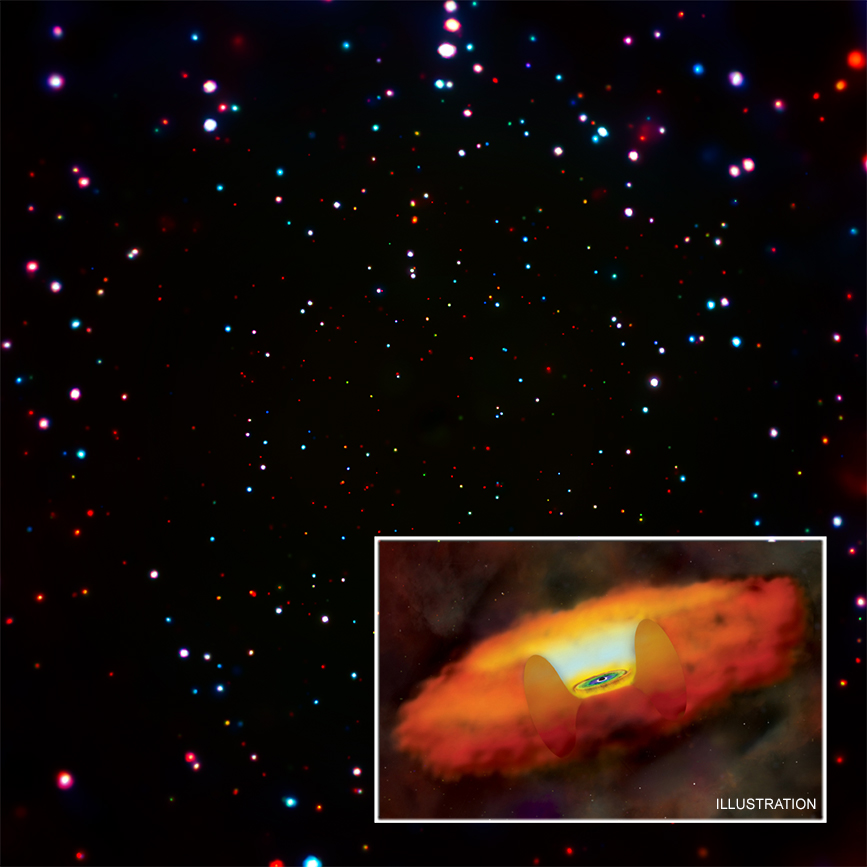
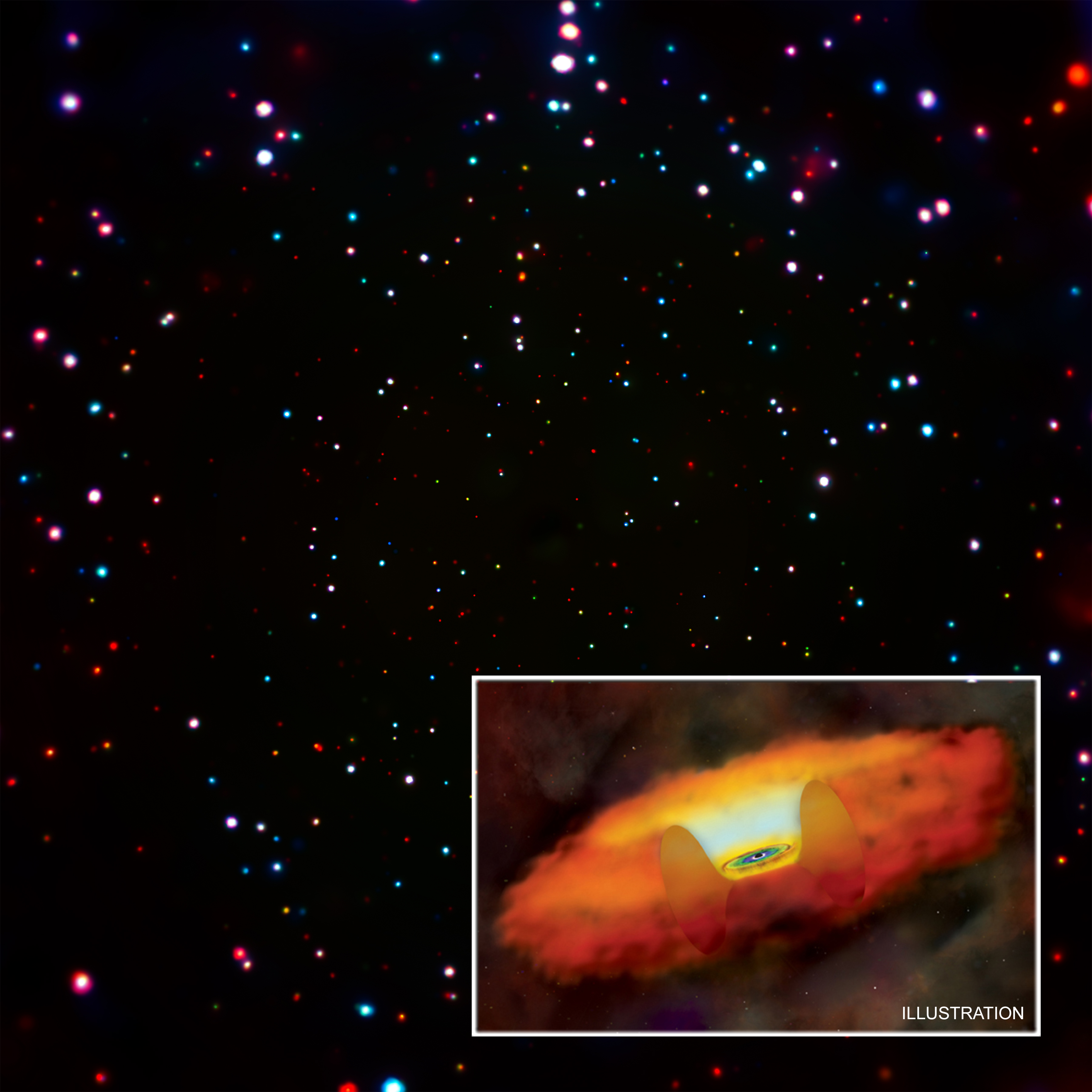
Chandra Deep Field South (CDF-S) 
Credit: X-ray: NASA/CXC/Univ. of Rome/E.Pezzulli et al. 
Illustration: NASA/CXC/M.Weiss
JPEG (260.9 kb) - Large JPEG (2.1 MB) - Tiff (8.1 MB) - More Images


New research using NASA's Chandra X-ray Observatory and the Sloan Digital Sky Survey (SDSS) suggests supermassive black holes in the early Universe underwent sporadic yet intense periods of growth in the first billion years after the Big Bang as described in our latest press release. Scientists determined this by comparing theoretical models to data from the Chandra Deep Field-South (CDF-S), the deepest X-ray image ever obtained, and other Chandra surveys. This central region of the CDF-S, where red, green, and blue represent low, medium, and high-energy X-rays.

When material is falling toward a black hole, it becomes heated, and produces large amounts of electromagnetic radiation, including copious X-ray emission. The artist's illustration in the inset depicts gas falling onto an actively growing black hole via a disk. X-rays from this disk can penetrate the cocoon of material surrounding the black hole. Rapidly growing black holes in the very early Universe should be detectable with Chandra. However, these growing supermassive black holes have proved to be elusive, with only a few, yet to be confirmed candidates found in long Chandra observations such as the CDF-S. 

To address this conundrum, a team of researchers examined different theoretical models and tested them against optical data from the SDSS and X-ray data from Chandra. Their findings indicate that black hole feeding during this era may turn on abruptly and last for short periods of time, which means this growth may be difficult to spot. 

The timing of such growth may be key. The authors' model suggests that 13 billion years ago, about one third of supermassive black holes may have been accreting enough matter to be detectable. Just 200 million years earlier — a veritable blip in cosmic time — the number of potentially detectable black holes is only about 3%. In order to test this idea further, the researchers suggest that surveys that look at larger swaths of the sky in X-rays are necessary. 

These results recently appeared in a paper in the April 2017 issue of the Monthly Notices of the Royal Astronomical Society and is available online. The all-female research team from Italy included Edwige Pezzulli (University of Rome), Rosa Valiante (INAF), Maria Orofino (Scuola Normale Superiore), Simona Gallerani (Scuola Normale Superiore), Tullia Sbarrato (Bicocca University), and Raffaella Schneider (Sapienza University). 

NASA's Marshall Space Flight Center in Huntsville, Alabama, manages the Chandra program for NASA's Science Mission Directorate in Washington. The Smithsonian Astrophysical Observatory in Cambridge, Massachusetts, controls Chandra's science and flight operations.

A Quick Look at Faint Active Nuclei in Chandra Deep Field South


Fast Facts for Chandra Deep Field South :

Scale: Image is 16 arcmin across.
Coordinates (J2000): RA 03h 32m 28s | Dec -27° 48' 30.00"
Constellation: Fornax
Observation Date: 102 pointings between 1999 and 2016
Observation Time: 1944 hours 27 min
Obs. ID: 1431, 441, 582, 1672, 2239, 2312, 2313, 2405, 2406, 2409, 8591-8597, 9575, 9578, 9593, 9596, 9718, 12043-12055, 12123, 12128, 12129, 12135, 12137, 12138, 12213, 12218-12220, 12222, 12223, 12227, 12230-12234, 16175-16191, 16450-16463, 16620, 16641, 16644, 17416, 17417, 17535, 17542, 17546, 17552, 17556, 17573, 17633, 17634, 17677, 18709, 18719, 18730
Instrument: ACIS
References: Luo, B. et al, 2016, ApJS (in press); arXiv:1611.03501; Vito, F. et al, 2016, MNRAS, 463, 348; arXiv:1608.02614
Color Code: X-ray (Red, Green, Blue)
Distance Estimate: About 11.9 to 12.9 billion light years