Credit
X-ray: NASA/CXC/Penn. State/G. Yang et al
& NASA/CXC/ICE/M. Mezcua et al.;
Optical: NASA/STScI; Illustration:
NASA/CXC/A. Jubett
The growth of the biggest black holes in the Universe is outrunning the rate of formation of stars in the galaxies
they inhabit, according to two new studies using data from NASA's
Chandra X-ray Observatory and other telescopes and described in our
latest press release.
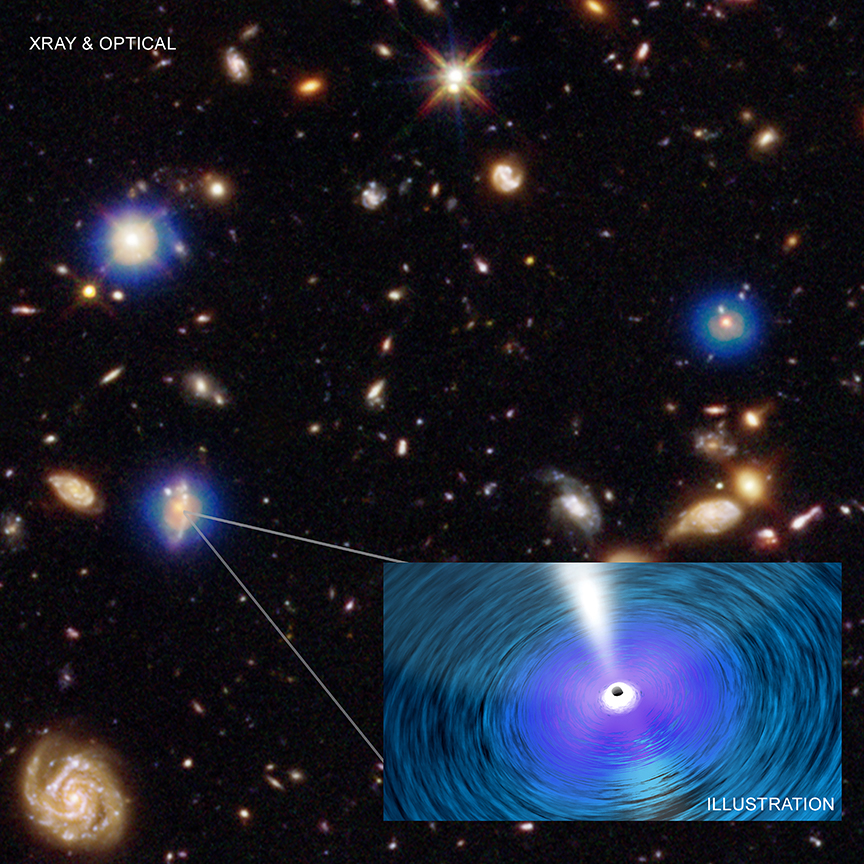
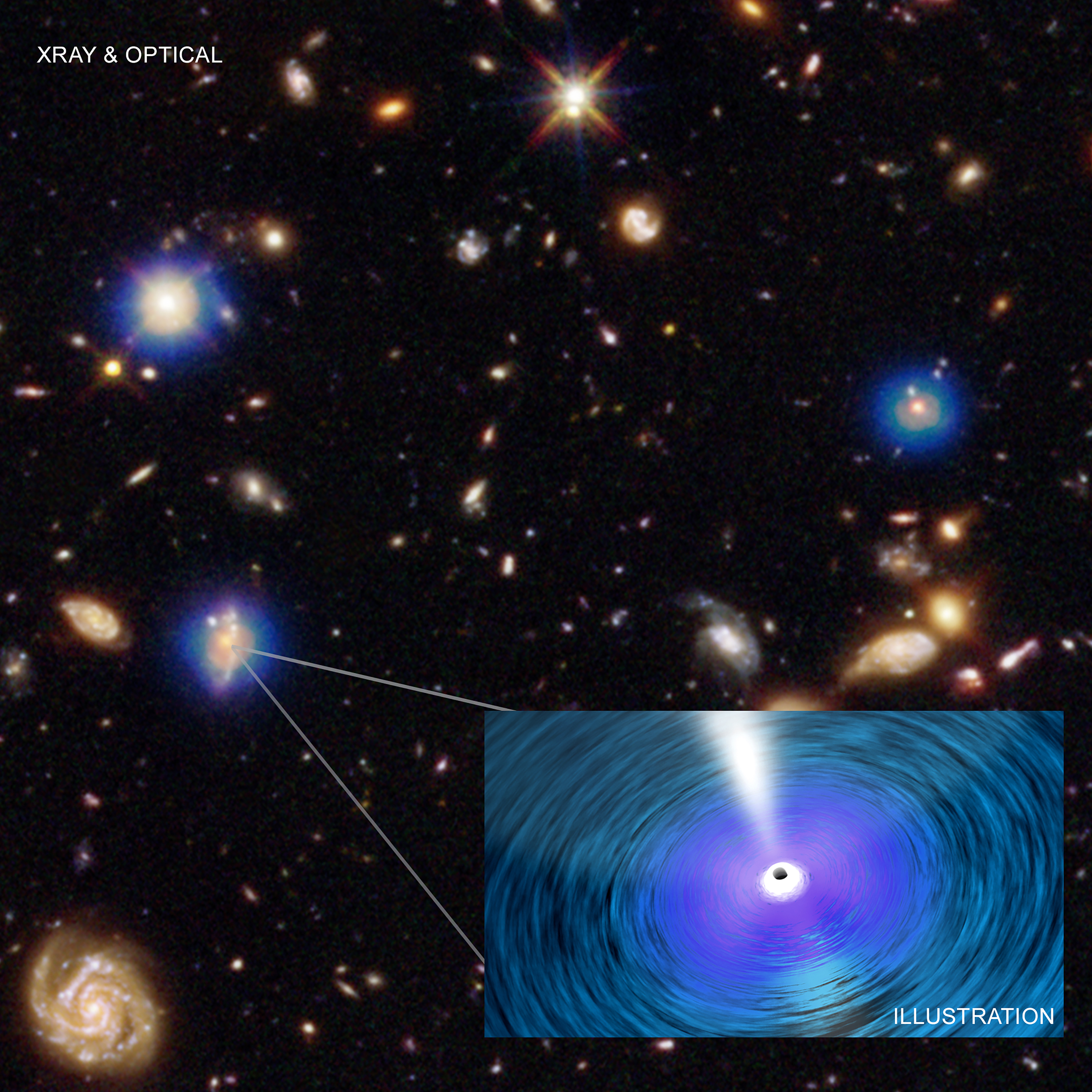
In this graphic an image from the Chandra Deep Field-South is shown. The Chandra image (blue) is the deepest ever obtained in X-rays.
It has been combined with an optical and infrared image from the Hubble
Space Telescope (HST), colored red, green, and blue. Each Chandra
source is produced by hot gas falling towards a supermassive black hole
in the center of the host galaxy, as depicted in the artist's illustration.
One team of researchers, led by Guang Yang at Penn State, calculated
the ratio between a supermassive black hole's growth rate and the growth
rate of stars in its host galaxy and found it is much higher for more
massive galaxies. For galaxies containing about 100 billion solar masses
worth of stars, the ratio is about ten times higher than it is for
galaxies containing about 10 billion solar masses worth of stars.
Using large amounts of data from Chandra, HST and other
observatories, Yang and his colleagues studied the growth rate of black
holes in galaxies at distances of 4.3 to 12.2 billion light years from Earth. The X-ray data included the Chandra Deep Field-South and North surveys and the COSMOS-Legacy surveys.
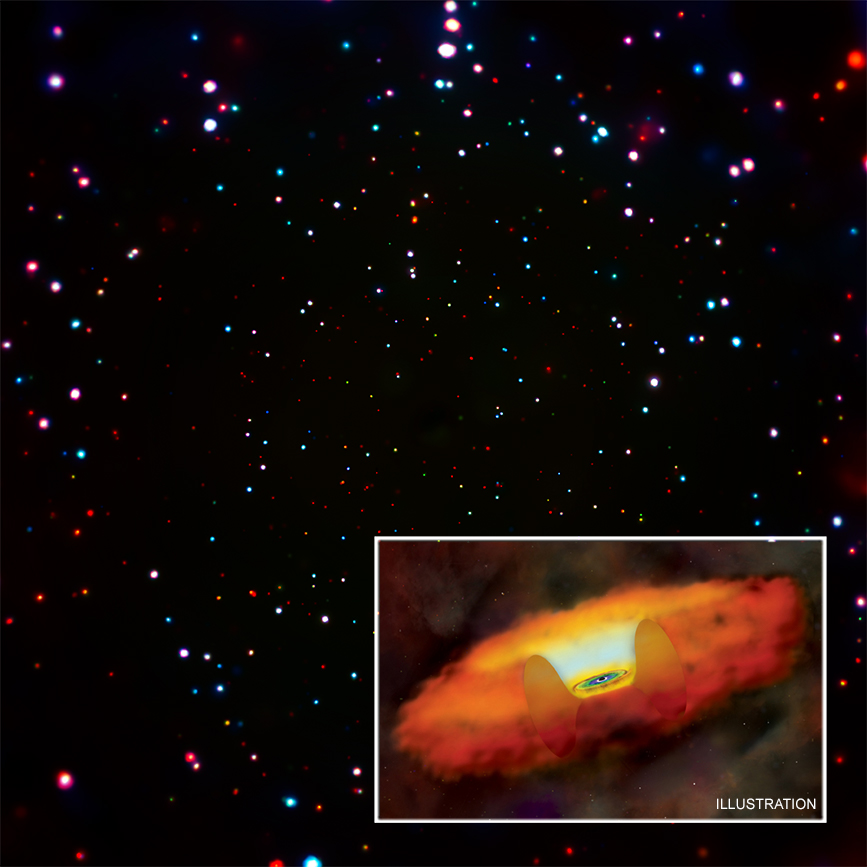
Another group of scientists, led by Mar Mezcua of the Institute of
Space Sciences in Spain, independently studied 72 galaxies located at
the center of galaxy clusters at distances ranging up to about 3.5
billion light years from Earth and compared their properties in X-ray
and radio waves. Their work indicates that the black hole masses were
about ten times larger than masses estimated by another method using the
assumption that the black holes and galaxies grew in tandem.

Hercules A
Credit: X-ray: NASA/CXC/SAO, Optical: NASA/STScI, Radio: NSF/NRAO/VLA
The Mezcua study used X-ray data from Chandra and radio data from the
Australia Telescope Compact Array, the Karl G. Jansky Very Large Array
(VLA) and Very Long Baseline Array. One object in their sample is the
large galaxy in the center of the Hercules galaxy cluster. The image shown above includes Chandra data (purple), VLA data (blue) and HST optical data (appearing white).
Two papers describing these results have been accepted in the Monthly
Notices of the Royal Astronomical Society (MNRAS). The work by Mezcua
et al. was published in the February 2018 issue MNRAS (available online:
https://arxiv.org/abs/1710.10268). The paper by Yang et al. will appear in its April 2018 issue (available online: https://arxiv.org/abs/1710.09399).
NASA's Marshall Space Flight Center in Huntsville, Alabama, manages
the Chandra program for NASA's Science Mission Directorate in
Washington. The Smithsonian Astrophysical Observatory in Cambridge,
Massachusetts, controls Chandra's science and flight operations.
Fast Facts for Chandra Deep Field South:
Scale: Image is 9.25 arcsec (About 574,000 light years) across;
Category: Cosmology/Deep Fields/X-ray Background, Black Holes
Constellation: Fornax
Observation Date: 54 pointings between Oct 15, 1999 to Jul 22, 2010
Observation Time: 1111 hours 6 minutes (46 days 7 hours 6 min)
Obs. ID: 441, 581-582, 1431, 1672, 2239, 2312-2313, 2405-2406, 2409, 8591-8597, 9575, 9578, 9593, 9596, 9718, 12043-12055, 12123, 12128-12129, 12135, 12137-12138, 12213, 12218-12220, 12222-12223, 12227, 12230-12234
Instrument: ACIS
References: "Linking black hole growth with host galaxies: the accretion-stellar mass relation and its cosmic evolution",G. Yang et al., 2018, MNRAS, 475, 1887. arXiv:1710.09399 "The most massive black holes on the Fundamental Plane of Black Hole Accretion", M. Mazcua et al., 2018, MNRAS, 474, 1342. arXiv:1710.10268
Color Code: X-ray (Blue); IR (Red, Green); Optical (Green, Blue)Distance Estimate: Range of about 12.7 - 12.9 billion light years
Source: NASA’s Chandra X-ray Observatory