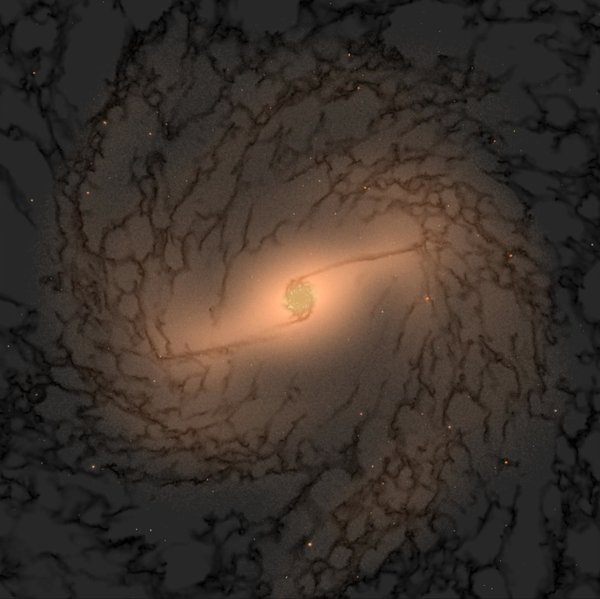
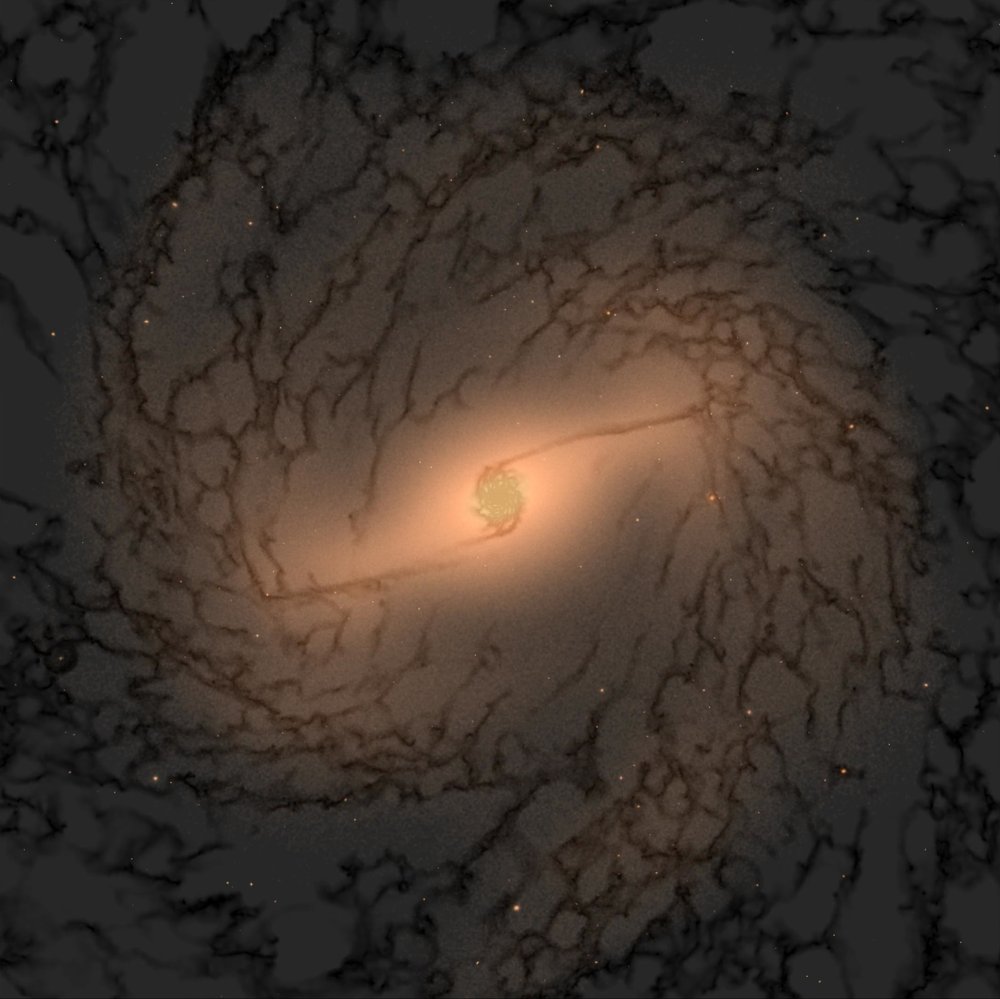
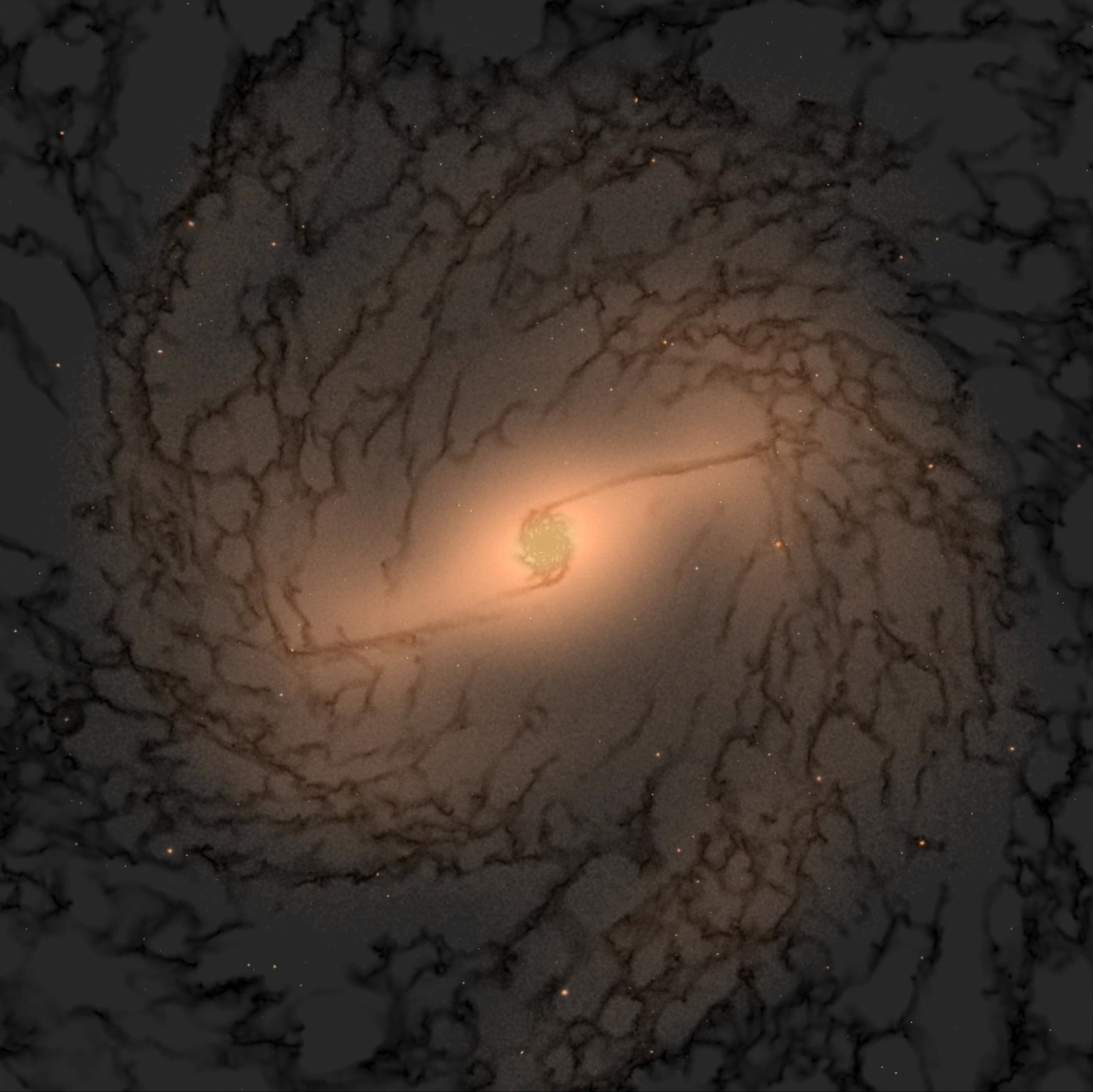
Simulation of the SMUGGLE-Ring project: In a Milky Way-like galaxy, a stellar bar forms, channelling gas along its inflow paths towards the centre. There, a compact central stellar cluster and a surrounding nuclear stellar disc grow together. Downloads: Original Video [129.1 MB]
Aug. 6, 2026 // Using a state-of-the-art galaxy simulation, a team led by scientists from the Leibniz Institute for Astrophysics Potsdam (AIP) gained new insights into the processes shaping galactic centres across the Universe and the formation history of the Milky Way, bridging theory and observations. The study indicates that nuclear star clusters and nuclear stellar discs found in the inner core of galaxies are not independent, but closely linked components that grow together, fed by gas funneled inward by the galaxy’s stellar bar and shaped further by the accretion of massive star clusters. For the first time, the simulation directly reveals an evolutionary link between the formation of nuclear star clusters and nuclear stellar discs.
Understanding the formation and evolution of the centres of galaxies is one of the most intriguing challenges in astrophysics. The new study aims at unveiling the physical processes which led to the formation of two striking features that surround the black holes at the centres of a majority of galaxies: nuclear star clusters and nuclear stellar discs. Only during the last decade, such galactic structures have been observed in the MilkyWay and in extragalactic systems. Observationally, these two structures were viewed as products of separate formation processes, with observational surveys showing no clear correlation between their masses and sizes. However, the formation process is not understood and so far, realistic simulations have been lacking.
This long-standing mystery is now challenged by a new galaxy simulation from the SMUGGLE-Ring project, offering a fresh perspective and bridging theory and observations. In a paper accepted as a Letter to the Editor in Astronomy & Astrophysics, AIP researcher Dr. SungWon Kwak and collaborators demonstrate, for the first time, that a fully self-consistent, high-resolution hydrodynamical simulation of a Milky-Way-like barred galaxy can naturally form both, a nuclear star cluster and a nuclear stellar disk, and follow their growth over billions of years.
The simulation reveals that the galaxy’s stellar bar plays a central role in this process. “Our simulation achieves this by showing how the galactic bar acts like a cosmic conveyor belt, channeling gas inward to feed both structures simultaneously from the exact same reservoir,” explains SungWon Kwak. As gas accumulates in the central region, stellar feedback from dying stars generates shocks that repeatedly trigger new episodes of star formation. Over the course of several billion years, hundreds of millions of solar masses of stars are assembled in these central structures.
One of the key advantages of the simulation is that it allows researchers to observe processes that cannot be directly seen in real galaxies. Astronomical observations provide only a single snapshot of a galaxy at the present day. By contrast, the simulation follows the evolution of the galaxy over four billion years, allowing scientists to watch the stellar bar form, trace the inward flow of gas, monitor bursts of star formation, and observe how the nuclear stellar disk grows outward from the centre over time.
The results also explain why observations have struggled to reveal a clear connection between nuclear star clusters and nuclear stellar disks. "The apparent disconnection does not mean that the stars themselves differ fundamentally in age, chemical composition, or motion," explains Dr. Cristina Chiappini, also a scientist from AIP and co-author of the study. Instead, the simulation shows that the structural relationship between the two components naturally evolves over time. During long periods of steady growth, the relative masses and sizes of the cluster and the disk gradually drift apart. As a result, the nuclear star clusters and nuclear stellar disks of galaxies observed at different stages of their evolution can appear remarkably different, even if the underlying growth mechanism is the same.
Including realistic dark matter dynamics in the simulation plays a crucial role in this finding. "Previous studies rely on fixed background potentials for the galactic bar and dark matter halo, but the realistic dynamical treatment between stars and the dark matter halo using live particles in our model allows us to form a realistic bar that evolves in time and then naturally forms nuclear structures," explains Dr. Ivan Minchev, co-author of the study. "Furthermore, our model also exhibits a 'dark gap' around the bar region, which is found in many observations and is known as evidence of the interaction between stars and dark matter by the rotation of the stellar bar."
The picture becomes even more fascinating, since in the simulation a particularly massive star cluster with roughly 30 million solar masses spirals into the galactic centre and merges with the nuclear star cluster. Interestingly, the recent observations have captured such massive star clusters inside the bar of NGC 1365, some of which are expected to spiral into its centre and merge with the galaxy’s nuclear star cluster. Such merger events can alter the mass and size of the nuclear star cluster over a short timescale. This makes the co-evolution history of the galactic centres more complex, yet interesting, since a supermassive black hole is lurking inside the nuclear star cluster in galaxies. Consequently, those merger events might leave an imprint on the mass of the supermassive black hole, potentially expanding the connection between galactic components and allowing us to interpret future observations.
Understanding the formation and evolution of the centres of galaxies is one of the most intriguing challenges in astrophysics. The new study aims at unveiling the physical processes which led to the formation of two striking features that surround the black holes at the centres of a majority of galaxies: nuclear star clusters and nuclear stellar discs. Only during the last decade, such galactic structures have been observed in the MilkyWay and in extragalactic systems. Observationally, these two structures were viewed as products of separate formation processes, with observational surveys showing no clear correlation between their masses and sizes. However, the formation process is not understood and so far, realistic simulations have been lacking.
This long-standing mystery is now challenged by a new galaxy simulation from the SMUGGLE-Ring project, offering a fresh perspective and bridging theory and observations. In a paper accepted as a Letter to the Editor in Astronomy & Astrophysics, AIP researcher Dr. SungWon Kwak and collaborators demonstrate, for the first time, that a fully self-consistent, high-resolution hydrodynamical simulation of a Milky-Way-like barred galaxy can naturally form both, a nuclear star cluster and a nuclear stellar disk, and follow their growth over billions of years.
The simulation reveals that the galaxy’s stellar bar plays a central role in this process. “Our simulation achieves this by showing how the galactic bar acts like a cosmic conveyor belt, channeling gas inward to feed both structures simultaneously from the exact same reservoir,” explains SungWon Kwak. As gas accumulates in the central region, stellar feedback from dying stars generates shocks that repeatedly trigger new episodes of star formation. Over the course of several billion years, hundreds of millions of solar masses of stars are assembled in these central structures.
One of the key advantages of the simulation is that it allows researchers to observe processes that cannot be directly seen in real galaxies. Astronomical observations provide only a single snapshot of a galaxy at the present day. By contrast, the simulation follows the evolution of the galaxy over four billion years, allowing scientists to watch the stellar bar form, trace the inward flow of gas, monitor bursts of star formation, and observe how the nuclear stellar disk grows outward from the centre over time.
The results also explain why observations have struggled to reveal a clear connection between nuclear star clusters and nuclear stellar disks. "The apparent disconnection does not mean that the stars themselves differ fundamentally in age, chemical composition, or motion," explains Dr. Cristina Chiappini, also a scientist from AIP and co-author of the study. Instead, the simulation shows that the structural relationship between the two components naturally evolves over time. During long periods of steady growth, the relative masses and sizes of the cluster and the disk gradually drift apart. As a result, the nuclear star clusters and nuclear stellar disks of galaxies observed at different stages of their evolution can appear remarkably different, even if the underlying growth mechanism is the same.
Including realistic dark matter dynamics in the simulation plays a crucial role in this finding. "Previous studies rely on fixed background potentials for the galactic bar and dark matter halo, but the realistic dynamical treatment between stars and the dark matter halo using live particles in our model allows us to form a realistic bar that evolves in time and then naturally forms nuclear structures," explains Dr. Ivan Minchev, co-author of the study. "Furthermore, our model also exhibits a 'dark gap' around the bar region, which is found in many observations and is known as evidence of the interaction between stars and dark matter by the rotation of the stellar bar."
The picture becomes even more fascinating, since in the simulation a particularly massive star cluster with roughly 30 million solar masses spirals into the galactic centre and merges with the nuclear star cluster. Interestingly, the recent observations have captured such massive star clusters inside the bar of NGC 1365, some of which are expected to spiral into its centre and merge with the galaxy’s nuclear star cluster. Such merger events can alter the mass and size of the nuclear star cluster over a short timescale. This makes the co-evolution history of the galactic centres more complex, yet interesting, since a supermassive black hole is lurking inside the nuclear star cluster in galaxies. Consequently, those merger events might leave an imprint on the mass of the supermassive black hole, potentially expanding the connection between galactic components and allowing us to interpret future observations.
The letter was published in Astronomy & Astrophysics:
SungWon Kwak, Mathias Schultheis, Ivan Minchev, Cristina Chiappini, Woong-Tae Kim, Seungwon Baek, Federico Marinacci, Mark Vogelsberger, Laura V. Sales, Hui Li, and Matthias Steinmetz (2026): SMUGGLE-Ring: Evolutionary link between nuclear star cluster and nuclear disk, A&A
Contacts:
Dr. SungWon Kwak
Science contact:
Phone: +49 331 7499 285
Email: skwak@aip.de
Dr. Ivan Minchev
Science contact:
Phone: +49 331 7499 259
Email: iminchev@aip.de
Tilo Bergemann
Media contact:
Phone: +49 331 7499 803
Email: presse@aip.de
The Leibniz Institute for Astrophysics Potsdam (AIP) is dedicated to astrophysical questions ranging from the study of our sun to the evolution of the cosmos. The key areas of research focus on stellar, solar and exoplanetary physics as well as extragalactic astrophysics. A considerable part of the institute's efforts aims at the development of research technology in the fields of spectroscopy, robotic telescopes, and e-science. The AIP is the successor of the Berlin Observatory founded in 1700 and of the Astrophysical Observatory of Potsdam founded in 1874. The latter was the world’s first observatory to emphasize explicitly the research area of astrophysics. The AIP has been a member of the Leibniz Association since 1992.


![Small screen size [600 x 600, 50 KB]](https://www.aip.de/media/images/ztf20171114a.width-600.jpg)
![Big screen size [1000 x 1000, 160 KB]](https://www.aip.de/media/images/ztf20171114a.width-1000.jpg)
![Original size [1024 x 1024, 210 KB]](https://www.aip.de/media/images/ztf20171114a.original.jpg)