Showing posts with label baryonic matter. Show all posts

Tuesday, June 24, 2025

A New GPS for the Intergalactic Medium: Astronomers Have Found the Home Address for Universe's "Missing" Matter

A landmark study led by the Center for Astrophysics | Harvard & Smithsonian (CfA) has pinpointed the Universe’s “missing” matter using Fast Radio Bursts (FRBs)— brief, bright radio signals from distant galaxies— as a guide. This artist’s conception depicts a bright pulse of radio waves (the FRB) on its journey through the fog between galaxies, known as the intergalactic medium. Long wavelengths, shown in red, are slowed down compared to shorter, bluer wavelengths, allowing astronomers to “weigh” the otherwise invisible ordinary matter. Credit: Melissa Weiss/CfA


Cambridge, MA— A new landmark study has pinpointed the location of the Universe's "missing" matter, and detected the most distant fast radio burst (FRB) on record. Using FRBs as a guide, astronomers at the Center for Astrophysics | Harvard & Smithsonian (CfA) and Caltech have shown that more than three-quarters of the Universe's ordinary matter has been hiding in the thin gas between galaxies, marking a major step forward in understanding how matter interacts and behaves in the Universe. They’ve used the new data to make the first detailed measurement of ordinary matter distribution across the cosmic web.

For decades, scientists have known that at least half of the Universe's ordinary, or baryonic matter—composed primarily of protons—was unaccounted for. Previously, astronomers have used techniques including X-ray emission and ultraviolet observations of distant quasars to find hints of vast amounts of this missing mass in the form of very thin, warm gas in between galaxies. Because that matter exists as hot, low-density gas, it was largely invisible to most telescopes, leaving scientists to estimate but not confirm its amount or location.

Enter FRBs— brief, br ight radio signals from distant galaxies that scientists only recently showed could measure baryonic matter in the Universe, but until now could not find its location. In the new study, researchers analyzed 60 FRBs, ranging from ~11.74 million light years away—FRB20200120E in galaxy M81—to ~9.1 billion light years away—FRB 20230521B, the most distant FRB on record. This allowed them to pin down the missing matter to the space between galaxies, or the intergalactic medium (IGM).

"The decades-old 'missing baryon problem' was never about whether the matter existed," said Liam Connor, CfA astronomer and lead author of the new study. "It was always: Where is it? Now, thanks to FRBs, we know: three-quarters of it is floating between galaxies in the cosmic web." In other words, scientists now know the home address of the “missing” matter.

By measuring how much each FRB signal was slowed down as it passed through space, Connor and his team tracked the gas along its journey. "FRBs act as cosmic flashlights," Connor, who is also an assistant professor of astronomy at Harvard, said. "They shine through the fog of the intergalactic medium, and by precisely measuring how the light slows down, we can weigh that fog, even when it's too faint to see."

The results were clear: Approximately 76% of the Universe's baryonic matter lies in the IGM. About 15% resides in galaxy halos, and a small fraction is burrowed in stars or amid cold galactic gas.

This distribution lines up with predictions from advanced cosmological simulations, but has never been directly confirmed until now.

"It's a triumph of modern astronomy," said Vikram Ravi, an assistant professor of astronomy at Caltech and co-author of the paper. "We're beginning to see the Universe's structure and composition in a whole new light, thanks to FRBs. These brief flashes allow us to trace the otherwise invisible matter that fills the vast spaces between galaxies."

Finding the missing baryons isn’t just an exercise in building an address book or taking a census. Their distribution holds the key to unlocking deep mysteries about how galaxies form, how matter clumps in the Universe, and how light travels across billions of light-years.

"Baryons are pulled into galaxies by gravity, but supermassive black holes and exploding stars can blow them back out—like a cosmic thermostat cooling things down if the temperature gets too high," said Connor. "Our results show this feedback must be efficient, blasting gas out of galaxies and into the IGM."

And this is just the beginning for FRB cosmology. "We're entering a golden age," said Ravi, who also serves as the co-PI of Caltech’s Deep Synoptic Array-110 (DSA-110). "Next-generation radio telescopes like the DSA-2000 and the Canadian Hydrogen Observatory and Radio-transient Detector will detect thousands of FRBs, allowing us to map the cosmic web in incredible detail."/div>
The study is published today in Nature Astronomy.


Reference

Connor, L., et al. (2025). A gas-rich cosmic web revealed by the partitioning of the missing baryons. Nature Astronomy. doi:10.1038/s41550-025-02566-y


About the Center for Astrophysics | Harvard & Smithsonian

The Center for Astrophysics | Harvard & Smithsonian is a collaboration between Harvard and the Smithsonian designed to ask—and ultimately answer—humanity's greatest unresolved questions about the nature of the universe. The Center for Astrophysics is headquartered in Cambridge, MA, with research facilities across the U.S. and around the world.


Thursday, November 21, 2024

Unveiling the 'Ghost' Baryonic Matter

This image shows the 3D structure of the over 7,000 cosmic filaments identified through SDSS optical surveys and the corresponding eRASS X-ray map in the same part of the sky. The colors of the filaments indicate the redshifts. © Xiaoyuan Zhang, Nicola Malavasi / MPE

The stacked 0.3—1.2 keV surface brightness profile of the 7817 cosmic filaments. Based on the knowledge of X-rays from extragalactic galaxies, the team estimated that a 40% of the stacked signal is contaminated by halo gas, active galactic nuclei, and X-ray binaries associated with galaxies in filaments. The remaining 60% is from the diffuse WHIM. © MPE/Xiaoyuan Zhang


A team of scientists from the Max Planck Institute for Extraterrestrial Physics has shed light on one of the most elusive components of the universe: the warm-hot intergalactic medium (WHIM). This "ghost" form of ordinary matter, long hypothesized but rarely detected, is thought to account for a significant portion of the universe's missing baryons — the matter that makes up stars, planets, and galaxies.

Led by Dr. Xiaoyuan Zhang, a postdoctoral fellow at the Max Planck Institute for Extraterrestrial Physics (MPE), the team of scientists revealed the existence of high-temperature, high-density regions of the WHIM by utilizing data from the eROSITA All-Sky Survey (eRASS). Over the course of two years, eROSITA, a powerful X-ray telescope aboard the Spektr-RG spacecraft, observed weak X-ray emission from the WHIM. To amplify these faint signals, the researchers employed a technique known as stacking, analyzing X-ray data at the locations of more than 7,000 cosmic filaments identified through the optical Sloan Digital Sky Survey (SDSS).

Due to its extremely low density (10 particles per cubic meter on average), the WHIM is notoriously difficult to observe. "Numerous studies have attempted to detect the WHIM using X-ray absorption, emission through X-rays, and the Sunyaev-Zeldovich effect. While some have yielded modestly positive results, they are often questioned due to potential contamination and systematic uncertainties. Now, with the eROSITA All-Sky Survey providing the deepest all-sky X-ray data, we have a unique opportunity to detect WHIM X-ray emission associated with large-scale cosmic structure." remarks Esra Bulbul, who is leading the clusters and cosmology group at the Max Planck Institute for Extraterrestrial Physics (MPE).

Tracing Cosmic Filaments

Cosmic filaments, the largest structures in the universe, form part of the intricate network of the cosmic web, which connects galaxies and galaxy clusters. Up to half of the matter in the Universe resides in filaments, which occupy less than 10% of its volume. Due to their anisotropic geometry and low density, filaments are difficult to detect in any of their components, such as gas or galaxies. “The most immediate way to achieve this is through the galaxy distribution. A breakthrough was accomplished when large-scale spectroscopic surveys such as SDSS became accessible and were coupled with complex algorithms to detect the filaments. This is the approach that we followed, which allowed us to trace the position of filaments to then allow for their stacking analysis.” says Dr. Nicola Malavasi, a Marie Skłodowska-Curie fellow at MPE, who performed the filament finding. Within these filaments resides the WHIM, a diffuse gas that emits only weak X-rays, making it nearly impossible to detect directly. However, the team’s sophisticated stacking method has allowed for a clearer picture of this emission, revealing the presence of WHIM and a measurement of its average temperature and density. This discovery brings scientists closer to resolving the long-standing puzzle of the universe's missing baryons and offers new insights into the structure and evolution of the cosmic web.

“Surprisingly, we had a strong X-ray detection (9σ) of the cosmic web. This was not the end of the story. We also needed to carefully model the contamination from the undetected galactic sources, which was the key to disclosing how much of our signal is from the WHIM.” said Xiaoyuan Zhang, the study's leading author. The study introduces an innovative method for estimating contamination from unmasked X-ray halos, active galactic nuclei, and X-ray binaries associated with filament galaxies. The analysis revealed an approximate 40% contamination fraction, indicating that around 60% of the detected signal may originate from the WHIM, with a detection significance of 5.4σ.

The team looked deeper into the properties of the recently detected WHIM, which allows them to gather critical insights into its nature. Their findings of the state-of-the-art numerical simulation indicate that the observed X-ray signal likely originates from WHIM regions with temperatures in the range of several million Kelvin and densities of approximately 100 particles per cubic meter.

Next-Generation Galaxy Surveys

Dr. Zhang adds, “Our new results demonstrate the immense potential of eROSITA’s survey data in detecting extremely faint diffuse cosmic plasmas.” Their work not only confirms the existence of the elusive WHIM but also opens new avenues for studying the role of these ghostly baryons in shaping the universe’s large-scale structure. This discovery marks a significant step forward in understanding the universe’s composition and the hidden ordinary matter that weaves the vast cosmic web together.

Andrea Merloni, Principal Investigator of the eROSITA project at MPE, ventures a look into the future: “Over the next few years, new large-scale spectroscopic galaxy surveys such as DESI and 4MOST will provide larger, more detailed galaxy and filament maps. The much larger overlap of these surveys with the eROSITA all-sky data will ensure a more refined analysis of the stacked X-ray data and bring to light new pieces of information on the WHIM physical state”.


This project has received funding from the European Research Council (ERC) under the European Union’s Horizon 2020 research and innovation programme (grant agreement No 101002585)


Contact:

Dr. Xiaoyuan Zhang
Postdoc Highenergy Group
tel:+49 89 30000-3807

xzhang@mpe.mpg.de
Max Planck Institute for Extraterrestrial Physics

Dr. Esra Bulbul
Head of galaxy clusters group
tel:+49 89 30000-3502

ebulbul@mpe.mpg.de
Max Planck Institute for Extraterrestrial Physics

Nicola Malavasi
Marie Sklodowska-Curie EU Research Fellow High-Energy Group
tel:+49 89 30000-3040

malavasi@mpe.mpg.de
Max Planck Institute for Extraterrestrial Physics


Original Publication

Zhang, X.; Bulbul, E.; Malavasi, N.; Ghirardini, V. ; et al.
The SRG/eROSITA all-sky survey. X-ray emission from the warm-hot phase gas in long cosmic filaments.
A&A, 691, A234 (2024)


DOI


Further Information

ERC Project DarkQuest
Webpages of the ERC funded project led by Esra Bulbul

Cosmic dance of the ‘Space Clover’
April 30, 2024
A group led by MPE has, for the first time, detected X-ray gas at the location of the cloverleaf ORC, an odd radio circle (ORC). The origin of ORCs is unknown; in the case of the cloverleaf ORC, the combined data from different wavelengths indicate that the emission is due to a merger of two small galaxy groups.
Results from the first X-ray sky survey resolve the previous inconsistency between competing measurements of the structure of the Universe
The Cluster and Cosmology working group is led by Dr. Esra Bulbul from MPE and consists of other researchers from MPE as well as from the Institute for Astro- and Particle Physics of Innsbruck University (IAPP).


Tuesday, November 14, 2023

Astronomers carry out largest ever cosmological computer simulation


The background image shows the present-day distribution of matter in a slice through the largest FLAMINGO simulation, which is a cubic volume of 2.8 Gpc (9.1 billion light years) on a side. The luminosity of the background image gives the present-day distribution of dark matter, while the colour encodes the distribution of neutrinos. The insets show three consecutive zooms centred on the most massive cluster of galaxies; in order, these show the gas temperature, the dark matter density, and a virtual X-ray observation (from Figure 1 from Schaye et al. 2023).Credit:Josh Borrow, the FLAMINGO team and the Virgo Consortium.
https://ras.ac.uk/media/1463

Licence type: Attribution (CC BY 4.0)


An international team of astronomers has carried out what is believed to be the largest ever cosmological computer simulation, tracking not only dark but also ordinary matter (such as planets, stars and galaxies), giving us a glimpse into how our Universe may have evolved. The FLAMINGO simulations calculate the evolution of all components of the universe - ordinary matter, dark matter, and dark energy - according to the laws of physics. As the simulation progresses, virtual galaxies and clusters of galaxies emerge. Three papers have been published in Monthly Notices of the Royal Astronomical Society: one describing the methods, another presenting the simulations and the third examining how well the simulations reproduce the large-scale structure of the Universe.

Facilities such as the Euclid Space Telescope recently launched by the European Space Agency (ESA) and NASA’s JWST collect impressive amounts of data on galaxies, quasars, and stars. Simulations such as FLAMINGO play a key role in the scientific interpretation of the data by connecting predictions from theories of our universe to the observed data.

According to the theory, the properties of our entire universe are set by a few numbers called 'cosmological parameters' (six of them in the simplest version of the theory). The values of these parameters can be measured very precisely in various ways. One of these methods relies on the properties of the cosmic microwave background (CMB), a faint background glow left over from the early Universe. However, these values do not match those measured by other techniques that rely on the way in which the gravitational force of galaxies bends light (lensing). These ‘tensions’ could signal the demise of the standard model of cosmology – the cold dark matter model.

The computer simulations may be able to reveal the cause of these tensions because they can inform scientists about possible biases (systematic errors) in the measurements. If none of these prove sufficient to explain away the tensions, the theory will be in real trouble.

So far, the computer simulations used to compare to the observations only track cold dark matter. “Although the dark matter dominates gravity, the contribution of ordinary matter can no longer be neglected,” says research leader Joop Schaye (Leiden University), “since that contribution could be similar to the deviations between the models and the observations.”

The first results show that both neutrinos and ordinary matter are essential for making accurate predictions, but do not eliminate the tensions between the different cosmological observations.

Simulations that also track ordinary, baryonic matter (also known as baryonic matter) are much more challenging and require much more computing power. This is because ordinary matter - which makes up only sixteen per cent of all matter in the universe - feels not only gravity but also gas pressure, which can cause matter to be blown out of galaxies by active black holes and supernovae far into intergalactic space. The strength of these intergalactic winds depends on explosions in the interstellar medium and is very difficult to predict. On top of this, the contribution of neutrinos, subatomic particles of very small but not precisely known mass, is also important but their motion has not been simulated so far.

The astronomers have completed a series of computer simulations tracking structure formation in dark matter, ordinary matter, and neutrinos. PhD student Roi Kugel (Leiden University) explains: “The effect of galactic winds was calibrated using machine learning, by comparing the predictions of lots of different simulations of relatively small volumes with the observed masses of galaxies and the distribution of gas in clusters of galaxies.”

The researchers simulated the model that best describes the calibration observations with a supercomputer in different cosmic volumes and at different resolutions. In addition, they varied the parameters of the model, including the strength of galactic winds, the mass of neutrinos, and the cosmological parameters in simulations of slightly smaller but still large volumes.

The largest simulation uses 300 billion resolution elements (particles with the mass of a small galaxy) in a cubic volume with edges of ten billion light years. This is believed to be the largest cosmological computer simulation with ordinary matter ever completed. Matthieu Schaller (Leiden University): “To make this simulation possible, we developed a new code, SWIFT, which efficiently distributes the computational work over 30 thousand CPUs.”

The FLAMINGO simulations open a new virtual window on the universe that will help make the most of cosmological observations. In addition, the large amount of (virtual) data creates opportunities to make new theoretical discoveries and to test new data analysis techniques, including machine learning. Using machine learning, astronomers can then make predictions for random virtual universes. By comparing these with large-scale structure observations, they can measure the values of cosmological parameters. Moreover, they can measure the corresponding uncertainties by comparing with observations that constrain the effect of galactic winds.

Submitted by Robert Masse


Media contacts:

Leighton Kitson
Communications and Engagement Manager (External)
Durham University
Tel: +44(0)191 334 8623

leighton.kitson@durham.ac.uk

Marieke Baan
Head of Communications
Netherlands Research School for Astronomy NOVA
Mob: +31614322627

H.M.Baan@uva.nl

Dr Robert Massey
Royal Astronomical Society
Mob: +44 (0)7802 877699

press@ras.ac.uk


Science contacts:

Prof. Dr Joop Schaye, Leiden Observatory, Leiden University

schaye@strw.leidenuniv.nl

Roi Kugel, PhD candidate at Leiden Observatory, Leiden University
kugel@strw.leidenuniv.nl

Dr Matthieu Schaller, Assistant Professor at Leiden Observatory, Leiden University
schaller@strw.leidenuniv.nl

Prof. Dr Ian McCarthy, Liverpool John Moores University
I.G.McCarthy@ljmu.ac.uk


Further information

FLAMINGO is a project of the VIRGO consortium for cosmological supercomputer simulations. The acronym stands for Full-hydro Large-scale structure simulations with All-sky Mapping for the Interpretation of Next Generation Observations. The FLAMINGO team is led by Joop Schaye (Leiden University) and within the team, scientists mainly from the Netherlands and the UK collaborate. The computer simulations were carried out with the DiRAC COSMA8 computer in Durham, UK.

FLAMINGO project website with images, videos, and interactive visualisations.

“The FLAMINGO project: cosmological hydrodynamical simulations for large-scale structure and galaxy cluster surveys”, J. Schaye et al., Monthly Notices of the Royal Astronomical Society, 2023.

“FLAMINGO: Calibrating large cosmological hydrodynamical simulations with machine learning”, R. Kugel et al, Monthly Notices of the Royal Astronomical Society, 2023.

The FLAMINGO project: revisiting the S8 tension and the role of baryonic physics”, I. McCarthy et al., Monthly Notices of the Royal Astronomical Society, 2023.


Notes for editors

The Royal Astronomical Society (RAS), founded in 1820, encourages and promotes the study of astronomy, solar-system science, geophysics and closely related branches of science. The RAS organises scientific meetings, publishes international research and review journals, recognises outstanding achievements by the award of medals and prizes, maintains an extensive library, supports education through grants and outreach activities and represents UK astronomy nationally and internationally. Its more than 4,000 members (Fellows), a third based overseas, include scientific researchers in universities, observatories and laboratories as well as historians of astronomy and others.

The RAS accepts papers for its journals based on the principle of peer review, in which fellow experts on the editorial boards accept the paper as worth considering. The Society issues press releases based on a similar principle, but the organisations and scientists concerned have overall responsibility for their content.


Monday, March 29, 2021

New light on baryonic matter and gravity on cosmic scales

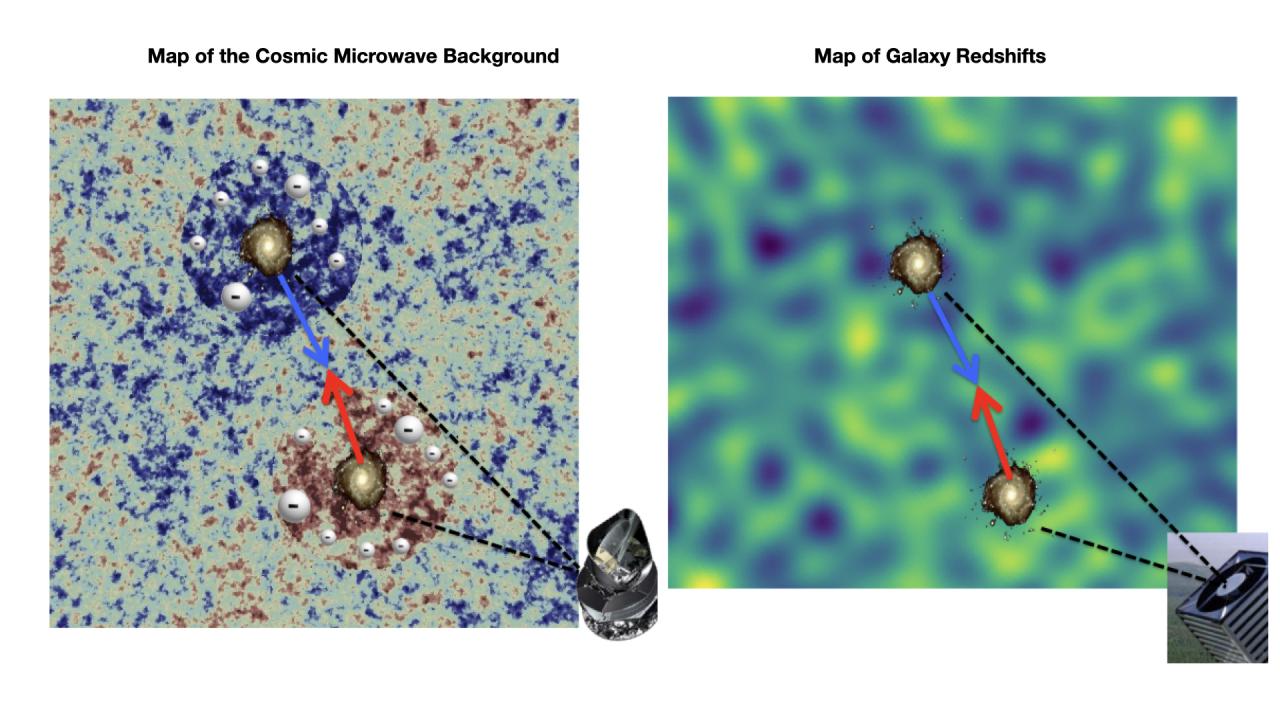
The presence of ionized gas around galaxies with moves with them leaves a trace in the microwave background radiation which can be detected knowing the pattern of velocities of the galaxies provided by the map. Credit: Carlos Hernández-Monteagudo (IAC).

Scientists estimate that dark matter and dark energy together are some 95% of the gravitational material in the universe while the remaining 5% is baryonic matter, which is the “normal” matter composing stars, planets, and living beings. However for decades almost one half of this matter has not been found either. Now, using a new technique, a team in which the Instituto de Astrofísica de Canarias (IAC) has participated, has shown that this “missing” baryonic matter is found filling the space between the galaxies as hot, low density gas. The same technique also gives a new tool that shows that the gravitational attraction experienced by galaxies is compatible with the theory of General Relativity. This research is published today in three articles in the journal Monthly Notices of the Royal Astronomical Society (MNRAS).

In designing this new technique they have analyzed the changes in the electromagnetic spectrum, its shift to the red, caused by the reddening of the light from the galaxies as they speed away from us. In the Universe, the sources which move away show a redder spectrum, and those which approach us show a bluer spectrum. This effect has given essential data for the development of modern cosmology. Almost a century ago, Edwin Hubble discovered that the redshifts of galaxies are bigger the further away from us they are, and this was the initial evidence which eventually led to the Big Bang model of the universe. Since then these redshifts have been used to find the distances to the galaxies and to build three dimensional maps of their distribution in the Universe.

In the work we are reporting here a new method has been developed, which studies the statistics of the redshifts of galaxies, without converting them to distances. In their first article, the team shows that these maps are sensitive to the gravitational attraction between galaxies on cosmological scales. In a second article, the same team compare the maps with observations of the cosmic microwave background,, and they permit, for the first time, a complete census of the baryonic matter during 90% of the life of the Universe.

“Most of this 'ordinary' matter is invisible to us because it is not sufficiently hot to emit energy. However, by using maps of the redshifts of the galaxies we find that all of this matter fills the space between them”, explains Jonás Chaves-Montero, a researcher at the Donostia International Physics Center (DIPC) and first author of this article.

Finally, as found in a third article, the researchers have also used the redshift maps of the galaxies to study the nature of gravity. “In contrast to previous approaches, our new method is not based on any conversion of redshift to distance, and it is shown to be robust agains noise and data impurities. Thanks to that it allow us to conclude with high accuracy, that the observations are compatible with Einstein’s theory of gravity”, notes Carlos Hernández-Monteagudo, an IAC researcher who is the first author on this third article.

These studies have been performed by researchers Carlos Hernández-Monteagudo, Jonás Chaves-Montero, Raúl Angulo and Giovanni Aricò, who designed the research during their time at the Centre for Studies of Cosmic Physics of Aragón (CEFCA), even though now they are working at other Spanish research centres, such as the Instituto de Astrofísica de Canarias, and the Donostia International Physics Center. In one of the articles there was participation also by J. D. Emberson, a Canadian researcher at the Argonne National Laboratory, Illinois, USA.

 Authors

Articles:

Hernandez-Monteagudo, Carlos; Chaves-Montero, Jonas; Angulo, Raul E. “Angular Redshift Fluctuations: a New Cosmological Observable”. MNRAS: https://ui.adsabs.harvard.edu/abs/2019arXiv191112056H/abstract

Chaves-Montero, Jonas; Hernandez-Monteagudo, Carlos; Angulo, Raul E.; Emberson, J. D. “Measuring the evolution of intergalactic gas from z=0 to 5 using the kinematic Sunyaev-Zel'dovich effect”. MNRAS: https://ui.adsabs.harvard.edu/abs/2019arXiv191110690C/abstract

Hernández-Monteagudo, Carlos; Chaves-Montero, Jonás; Angulo, Raúl E.; Ariccò, Giovanni. “Tomographic Constraints on Gravity from Angular Redshift Fluctuations in the Late Universe”, MNRAS: https://ui.adsabs.harvard.edu/abs/2020arXiv200506568H/abstract  

Contact at the IAC: 

Carlos Hernández-Monteagudo: carlos.hernandez.monteagudo@iac.es

Source: Instituto de Astrofísica de Canarias - (IAC)/News