Showing posts with label Perseus. Show all posts

Monday, December 20, 2021

Our Milky Way may be more fluffy, less wiry


In a map of the Milky Way, the neighboring spiral arm just beyond the Sun is known as the Perseus arm. Astronomers created this map by measuring the locations of natural radio sources known as masers (pink dots in pullouts at right) and dust clouds (blue dots). At upper right, a shaded region shows the previously believed shape of the Perseus arm, demarcated by a combination of masers and dust clouds. New measurements (middle right) show that some of these dust clouds are much closer or farther from the Sun than originally thought. As a result, the Perseus arm may be much clumpier and less well-defined (lower right). Credits: Science: Joshua Peek (STScI) - Illustration: Robert L. Hurt (Caltech, IPAC), Leah Hustak (STScI).
Release images

Our Milky Way has long been known to be a spiral galaxy, shaped much like a fried egg with a bulbous central bulge and a thin, flat disk of stars. For decades, astronomers have struggled to map the Milky Way’s disk and its associated spiral arms. As the old saying goes, you can’t see the forest for the trees, and if you’re in the middle of the forest, how can you map its groves without a bird’s-eye view?

Previous work has suggested that the Milky Way is what’s known as a “grand design” spiral, with long, narrow, well-defined spiral arms. However, new research finds that at least one portion of the outer Milky Way (beyond the Sun’s location) is much more clumpy and chaotic.

“We have long had a picture of the galaxy in our minds, based on a combination of measurements and inference,” said Josh Peek of the Space Telescope Science Institute (STScI) in Baltimore, Maryland. “This work calls that picture into question. We don’t see evidence that pieces we’ve been connecting up are actually connected.”

Distances are Key

When mapping our galaxy, the biggest challenge is finding the distance to any given star, star cluster, or gas clump. The gold standard is to use parallax measurements of naturally occurring radio sources called masers, some of which are found in high-mass star-forming regions. However, this technique inevitably leaves gaps.

To fill those gaps, astronomers switch from examining star-forming regions to gas clouds, and more specifically, the motions of those gas clouds. In an ideal situation, the line-of-sight motion we measure for a gas cloud is directly related to its distance due to the overall rotation of the Milky Way. As a result, by measuring gas velocities, we can determine distances and hence the underlying structure of the galaxy.

The question then becomes, what about a non-ideal situation? While the motion of any given gas cloud might be dominated by its rotation around the galactic center, it undoubtedly has some additional, more random motions as well. Can those extra motions throw off our maps?

Chunky and Lumpy

To investigate this question, Peek and his colleagues examined not the gas, but the dust. In general within our galaxy, gas and dust are closely associated, so if you can map one, you also map the other.)

3D dust maps can be created by examining the colors of large collections of stars spread across the sky. The more dust that is between the star and our telescope, the redder the star will appear compared to its natural color.)

Peek and his team examined a region of space known as the Perseus spiral arm, which is beyond our Sun in the Milky Way’s disk. They compared the distances measured via dust reddening to those determined by the velocity relationship. They found that many of the clouds do not, in fact, lie at the distance of the Perseus arm, but instead stretch along a distance of some 10,000 light-years.)

“We don’t have long, skinny spiral arms after all, at least in this section of the galaxy. There are chunks and lumps that don’t look like anything,” explained Peek. “It’s a good possibility that the outer disk of the Milky Way resembles the nearby galaxy Messier 83, with shorter, chopped-up pieces of arms.”

Revising Our Map

While this latest research focused on the outer Milky Way, Hubble Fellow Catherine Zucker, a member of Peek’s team at STScI, is planning to extend that work to the inner Milky Way. The region interior to the Sun’s orbit is where the spiral arms that are most actively forming stars reside.

Zucker plans to create 3D dust maps using existing large-scale infrared surveys to measure the reddening of some 1 to 2 billion stars. By linking those new dust maps with existing gas velocity surveys, astronomers can refine our map of the inner Milky Way much as they have already done with the outer galaxy.

“Previous 3D dust mapping efforts have largely relied on data at wavelengths visible to the human eye. No one has used deep infrared data to create a 3D dust map,” said Zucker. “We may find that this region, like the Perseus arm, is more chaotic and less well defined.”

Even more insights may come from the upcoming Nancy Grace Roman Space Telescope and Vera Rubin Observatory. The Roman Space Telescope will have the capability to map the entire galactic plane in a few hundred hours. Also, its infrared measurements will cut through the dust.

“We could see clear to the other side of the galaxy for the first time. If a survey like this is selected for Roman, it would be stunning,” said Peek.)

Rubin, on the other hand, will be able to make deep observations of faint objects at a variety of optical wavelengths. By combining Roman’s infrared view of the sky with Rubin’s deep, multi-wavelength optical data, we may finally map our own cosmic “forest.”

This work is accepted for publication in The Astrophysical Journal.

The Space Telescope Science Institute is expanding the frontiers of space astronomy by hosting the science operations center of the Hubble Space Telescope, the science and mission operations centers for the James Webb Space Telescope, and the science operations center for the Nancy Grace Roman Space Telescope. STScI also houses the Barbara A. Mikulski Archive for Space Telescopes (MAST) which is a NASA-funded project to support and provide to the astronomical community a variety of astronomical data archives, and is the data repository for the Hubble, Webb, Roman, Kepler, K2, TESS missions and more. STScI is operated for NASA by the Association of Universities for Research in Astronomy in Washington, D.C.


Media Contact:

Christine Pulliam[
Space Telescope Science Institute, Baltimore, Maryland

Contact us: Direct inquiries to the
 News Team.

Related links and documents:

Science Paper: The science paper by J. Peek et al., PDF (9.64 MB)


Tuesday, October 28, 2014

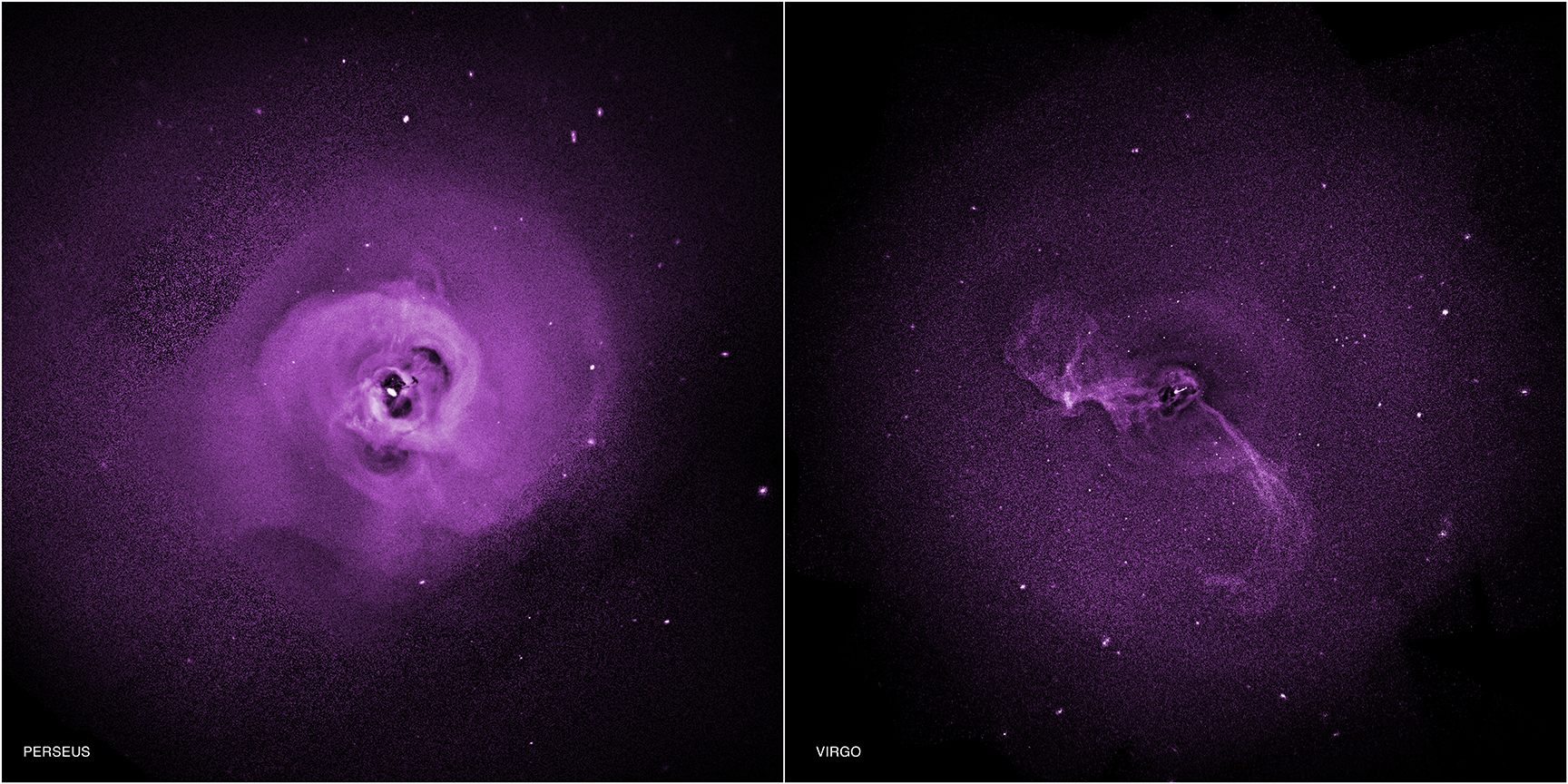
Perseus Cluster and Virgo Cluster: NASA's Chandra Observatory Identifies Impact of Cosmic Chaos on Star Birth

 Galaxy Clusters - Perseus e Virgo Cluster
Credit: NASA/CXC/Stanford/I.Zhuravleva et al


animation


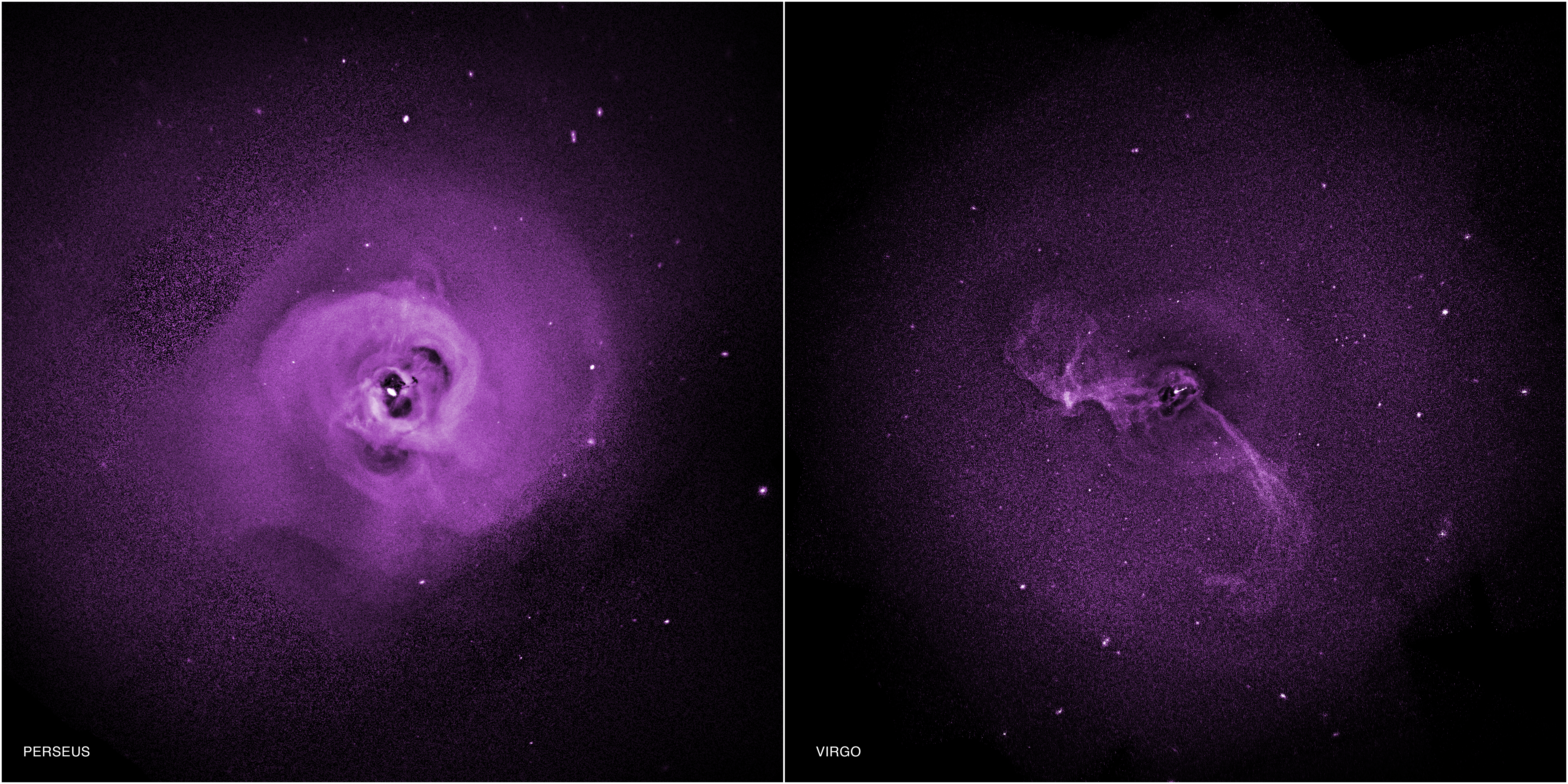
These two Chandra images of galaxy clusters - known as Perseus and Virgo - have provided direct evidence that turbulence is helping to prevent stars from forming. These new results could answer a long-standing question about how these galaxy clusters keep their enormous reservoirs of hot gas from cooling down to form stars, as discussed in our latest press release [link to PR].

Galaxy clusters are the largest objects in the Universe held together by gravity. They contain hundreds or thousands of individual galaxies that are immersed in gas with temperatures of millions of degrees. This hot gas, which is the heftiest component of the galaxy clusters aside from dark matter, glows brightly in X-ray light. Over time in the centers of clusters, this gas should cool enough so that stars form at prodigious rates. This, however, is not what astronomers have observed in many galaxy clusters.

A team of researchers have found evidence that the heat is generated by turbulent motions, which they identified from signatures in the Chandra data. Previously, other scientists have shown the key role of supermassive black holes in the centers of large galaxies in the middle of galaxy clusters. These black holes pump vast quantities of energy into the volumes around them through powerful jets of energetic particles. Chandra and other X-ray telescopes have detected giant cavities created in the hot cluster gas by the jets.

The latest research provides insight into just how energy can be transferred from the cavities to the surrounding gas. The interaction of the cavities with the gas may be generating turbulence, or chaotic motion similar to that on a bumpy airplane ride, which then dissipates to keep the gas hot for billions of years.

The scientists targeted Perseus and Virgo because they are both extremely large and relatively bright, thus providing an opportunity to see details that would be very difficult to detect in other clusters. The evidence for turbulence can be seen most clearly in the ripple-like structures in the Chandra image of Perseus. When combined with careful analysis of the data with theoretical models, this new result provides the clearest evidence to date that turbulence is the mechanism that prevents the hot gas in these clusters from cooling.

The paper describing these results is available online.

These results appeared online in the journal Nature on October 26, 2014. The authors were Irina Zhuravleva (Stanford University), Eugene Churazov (Max Planck Institute for Astrophysics), Alexander Schekochinhin (University of Oxford), Steve Allen (Stanford), Patricia Arevalo (Pontificia Universidad Catolica de Chile), Andy Fabian (University of Cambridge), William Forman (Harvard-Smithsonian Center for Astrophysics), Jeremy Sanders (Max Planck Institute for Extraterrestrial Physics), Aurora Simionescu (JAXA), Rasheed Sunayev (Max Planck Institute for Astrophysics), Alexey Vikhlinin (Harvard-Smithsonian Center for Astrophysics), and Norbert Werner (Stanford).

NASA's Marshall Space Flight Center in Huntsville, Alabama, manages the Chandra program for NASA's Science Mission Directorate in Washington, DC. The Smithsonian Astrophysical Observatory in Cambridge, Massachusetts, controls Chandra's science and flight operations.


Fast Facts for Perseus Cluster: 


Release: Date October 27, 2014
Scale: Image is 20 arcmin across (about 1.5 million light years).
Category: Groups & Clusters of Galaxies
Coordinates (J2000): RA 03h 19m 47.60s | Dec +41° 30' 37.00"
Constellation: Perseus
Observation Dates: 25 pointings between Sep 1999 and Dec 2009
Observation Time: 416 hours 32 min (17 days 8 hours 32 min)
Obs. IDs: 502, 503, 1513, 3209, 3404, 4289, 4946-4953, 6139, 6145, 6146, 11713-11716, 12025, 12033, 12036, 12037
Instrument: ACIS
Also Known As: Abell 426
References: Zhuravleva, I. et al, 2014, Nature (in press); arXiv:1410.6485
Color Code: X-ray: Purple X-ray
Distance Estimate: About 250 million light years


Fast Facts for Virgo Cluster:


Release Date: October 27, 2014  
Scale: Image is 22 arcmin across (about 320,000 light years).  
Category: Groups & Clusters of Galaxies  
Coordinates (J2000): RA 12h 30m 49.40s | Dec +12° 23' 28.00"  
Constellation: Virgo
Observation Dates: 2 pointings in Jul 2002, and 7 between Jan and Nov 2005 
Observation Time: 159 hours (6 days 15 hours) 
Obs. IDs: 2707, 3717, 5826-5828, 6186, 7210-7212 
Instrument: ACIS  
References: Zhuravleva, I. et al, 2014, Nature (in press); arXiv:1410.6485 
Color Code: X-ray: Purple
Distance Estimate: About 55 million light years 


Wednesday, January 12, 2011

Planck sees new, mysterious components in Milky Way and Magellanic Clouds

Thanks to its broad spectral coverage and very high sensitivity, Planck is peering deep into the interstellar medium of the Milky Way and discovering new components and physical mechanisms taking place therein. The results emerging from Planck's first all-sky survey include strong evidence for the presence of extremely rapidly spinning dust grains, an excess emission explained in terms of a previously poorly quantified 'dark gas' and the characterisation of an excess emission arising from the interstellar medium that permeates the Small Magellanic Cloud, a nearby galaxy orbiting our own Milky Way. These are amongst the highlights presented by the Planck Collaboration at a conference held from 10 to 14 January 2011 in Paris, France.


Map of the galactic distribution of the excess emission, with insets showing anomalous dust emission from the Perseus and Rho Ophiuchus molecular clouds, superimposed on top of the all-sky image of the microwave sky as seen by Planck after its first-year survey. Credit: ESA/Planck Collaboration. Hi-Res [tif] - Hi-Res [jpg] - Wallpaper [jpg]

The interstellar medium (ISM), the mixture of gas and dust that permeates the Milky Way, plays a crucial role in regulating the life cycle of stars in the Galaxy. Although the general picture of its composition and dynamics is fairly well understood, many details are still poorly known. While performing its all-sky observations in the microwave and submillimetre regions of the electromagnetic spectrum, targeting the first light emitted in cosmic history, Planck's detectors also absorb substantial amounts of radiation emitted by the ISM: albeit a nuisance for cosmologists, these data represent a rich reservoir of information for all astrophysicists studying the dust and gas that fill our Galaxy.

The dust component in the ISM is known to shine brightly at far infrared and submillimetre wavelengths, but it is not expected to emit at the longest radio wavelengths. Surprisingly, in the 1990s a significant emission, coming from dust-dominated regions of the Milky Way, was detected in the microwave band of radio waves—this was dubbed the Anomalous Microwave Emission (AME). Several theoretical mechanisms have been developed since then to try and explain this mysterious emission and now, thanks to the broad spectral range of Planck and the excellent quality data collected during its first all-sky survey, astronomers are finally able to shed some light on this highly debated topic.

"We are now becoming rather confident that the emission is due to nano-scale spinning grains of dust, which rotate up to ten thousand million times per second," says Clive Dickinson from the University of Manchester, who led an analysis of the AME using Planck's maps. "These are the smallest dust grains known, comprising only 10 to 50 atoms; spun up by collisions with atoms or photons, they emit radiation at frequencies between 10 and 60 GHz," he explains.

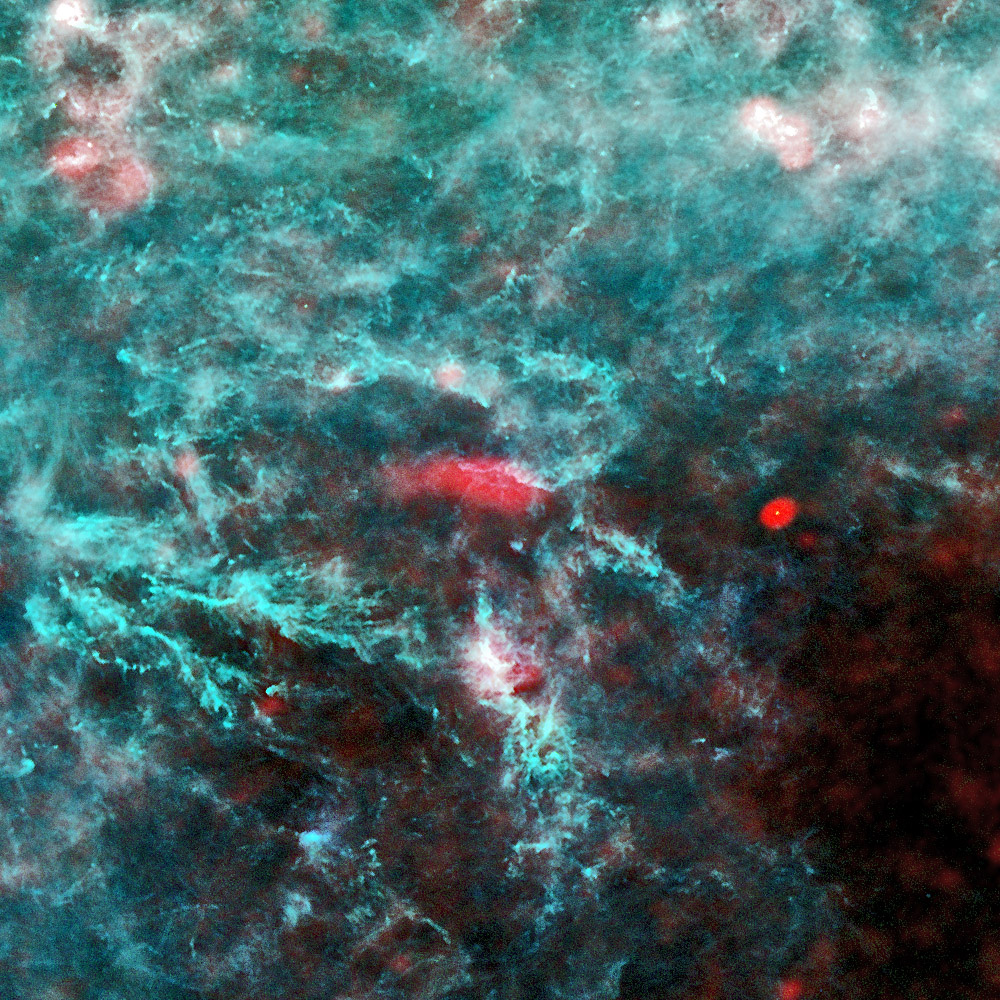
Individual maps and three-colour composite of (left) the Perseus and (right) the Rho Ophiuchus molecular cloud, combining observations at 0.4 GHz, 30 GHz and 857 GHz and highlighting (in red) the anomalous dust emission arising from nano-sized spinning dust grains. Credit: ESA/Planck Collaboration. Perseus - RHo Ophiuchus

The investigation focussed on two, very well studied regions of star formation in the Milky Way, the Perseus and the Rho Ophiuchus molecular clouds. Thanks to Planck's high sensitivity and to its unprecedented spectral coverage, it has been possible to characterise the anomalous emission arising from these two objects in such great detail that many of the alternative theories could be discarded, and to show that at least a significant contribution to the AME, if not the only one, is due to nano-scale spinning dust grains.

The mechanism of spinning dust has also been invoked, in another study, to explain an anomalous emission detected in the Small Magellanic Cloud, one of our two, closest galactic neighbours. "Both Magellanic Clouds are known to exhibit an excess of radiation in the submillimetre range," explains Jean-Philippe Bernard from the Institut de Recherche en Astrophysique et Planétologie (IRAP) in Toulouse, France, who led an analysis of the Magellanic Clouds based on Planck data. "In the case of the Large Magellanic Cloud, we have demonstrated that this excess is due to the cosmic microwave background fluctuations, whereas, for the Small Magellanic Cloud, we have confirmed the previously recorded excess emission. The excess radiation can be explained in terms of a combination of emission from spinning dust grains and from large, amorphous dust grains," he adds.

Planck's first all-sky survey has also allowed astronomers to detect and for the first time quantify accurately on large scales another peculiar component of the ISM which had remained elusive thus far. Apparent as an excess of dust emission, sometimes referred to as 'dark gas', this component is thought to be composed of molecular gas which remained largely unnoticed because it contains too little carbon monoxide (CO), the molecule employed by astronomers to trace the presence and to measure the amount of molecular hydrogen (H2) in the interstellar medium. "We believe that this 'dark gas' may be associated with the periphery of dense molecular clouds, where energetic ultraviolet photons destroy the CO molecules but leave the H2) undisturbed," notes Bernard, who led also the study revealing this previously poorly quantified constituent of the ISM.

Map of the galactic distribution of the excess dust emission, superimposed on top of the all-sky image of the microwave sky as seen by Planck after its first-year survey. Credit: ESA/Planck Collaboration. Hi-Res [tif] - Hi-Res [jpg] - Wallpaper [jpg]

These results highlight the ability of Planck to measure the temperature and the column density of gas in the ISM with such a high accuracy that it has been possible to uncover the presence of components in the ISM which have previously been suspected but not confirmed. "By literally revealing to us what has only been guessed at before, Planck is enabling us to probe new components and physical processes in the ISM, in the process shedding new light on the complex mixture that regulates the evolution of the Milky Way and other galaxies," concludes Jan Tauber, ESA's Planck Project Scientist.

Notes for editors

ESA's Planck mission maps the sky in nine frequencies using two state-of-the-art instruments, designed to produce high-sensitivity, multi-frequency measurements of the diffuse sky radiation: the High Frequency Instrument (HFI) includes the frequency bands 100 – 857 GHz, and the Low Frequency Instrument (LFI) includes the frequency bands 30-70 GHz.

The Planck Early Release Compact Source Catalogue (ERCSC) and the first scientific results to emerge from this mission are being presented this week (10-14 January 2011) at the conference "The Millimeter and Submillimeter Sky in the Planck Mission Era" held in Paris, France.

The Planck Scientific Collaboration consists of all the scientists who have contributed to the development of the Planck mission, and who participate in the scientific exploitation of the Planck data during the proprietary period, which nominally ends with the release of the scientific products to the community 3.5 yr after launch, i.e. in January 2013. These scientists are members of one or more of four consortia: the LFI Consortium, the HFI Consortium, the DK-Planck Consortium, and ESA's Planck Science Office.

Related publications

Planck Collaboration 2011, "Planck Early Results: Origin of the submm excess dust emission in the Magellanic Clouds", submitted to Astronomy & Astrophysics

Planck Collaboration 2011, "Planck Early Results: All sky temperature and dust optical depth from Planck and IRAS: Constraints on the "dark gas" in our galaxy", submitted to Astronomy & Astrophysics

Planck Collaboration 2011,"Early Planck Results: New Light on Anomalous Microwave Emission from Spinning Dust Grains", submitted to Astronomy & Astrophysics

Contacts

Clive Dickinson
Jodrell Bank Centre for Astrophysics
University of Manchester
Manchester, UK
Email: Clive.Dickinson@manchester.ac.uk
Phone: +44 (0)161 275 4232

Jean-Philippe Bernard
Institut de Recherche en Astrophysique et Planétologie (IRAP)
Toulouse, France
Email: Jean-Philippe.Bernard@cesr.fr
Phone: +33 5 61 55 75 38

Jan Tauber
ESA Planck Project Scientist
Directorate of Science & Robotic Exploration
ESA, The Netherlands
Email: jtauber@rssd.esa.int
Phone: +31 71 565 5342

Monday, April 26, 2010

Planck highlights the complexity of star formation

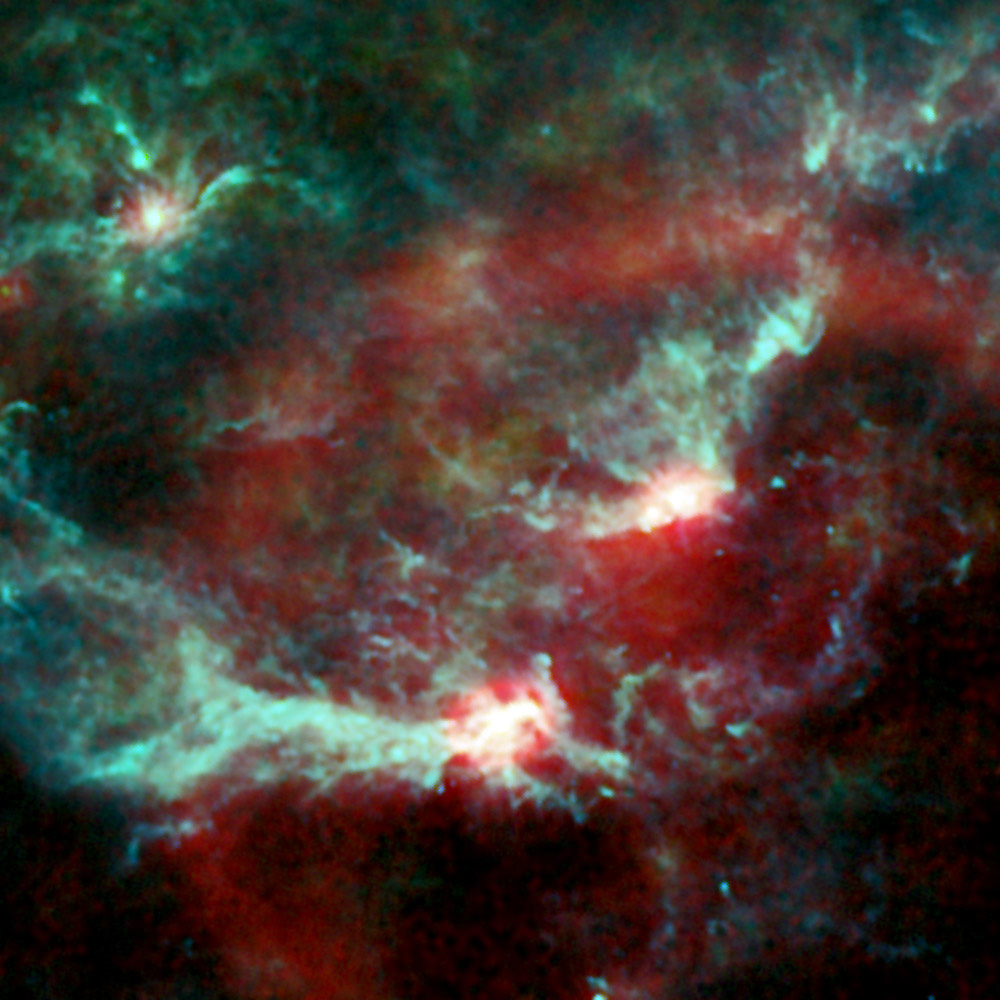
An active star-formation region in the Orion Nebula, as seen By Planck. This image covers a region of 13x13 degrees. It is a three-colour combination constructed from three of Planck's nine frequency channels: 30, 353 and 857 GHz. Credits: ESA/LFI & HFI Consortia

Download the individual channels:


HI-RES JPEG (Size: 257 kb)

New images from ESA’s Planck space observatory reveal the forces driving star formation and give astronomers a way to understand the complex physics that shape the dust and gas in our Galaxy.

Star formation takes place hidden behind veils of dust but that doesn’t mean we can’t see through them. Where optical telescopes see only black space, Planck’s microwave eyes reveal myriad glowing structures of dust and gas. Now, Planck has used this ability to probe two relatively nearby star-forming regions in our Galaxy.
The Orion region is a cradle of star formation, some 1500 light-years away. It is famous for the Orion Nebula, which can be seen by the naked eye as a faint smudge of pink.

A low activity, star-formation region in the constellation Perseus, as seen with Planck. This image covers a region of 30x30 degrees. It is a three-colour combination constructed from three of Planck's nine frequency channels: 30, 353 and 857 GHz. Credits: ESA/LFI & HFI Consortia

Download the individual channels:


HI-RES JPEG (Size: 605 kb)

The first image covers much of the constellation of Orion. The nebula is the bright spot to the lower centre. The bright spot to the right of centre is around the Horsehead Nebula, so called because at high magnifications a pillar of dust resembles a horse’s head.

The giant red arc of Barnard’s Loop is thought to be the blast wave from a star that blew up inside the region about two million years ago. The bubble it created is now about 300 light-years across.

In contrast to Orion, the Perseus region is a less vigorous star-forming area but, as Planck shows in the other image, there is still plenty going on.

The images both show three physical processes taking place in the dust and gas of the interstellar medium. Planck can show us each process separately. At the lowest frequencies, Planck maps emission caused by high-speed electrons interacting with the Galaxy’s magnetic fields. An additional diffuse component comes from spinning dust particles emitting at these frequencies.

The region of sky covered by the Planck images is shown on a view of half the sky as seen in visible and infrared light. The smaller patch corresponds to Orion and the larger to Perseus. Credits: ESA/LFI & HFI Consortia/STScI DSS - HI-RES JPEG (Size: 450 kb)

At intermediate wavelengths of a few millimetres, the emission is from gas heated by newly formed hot stars.

At still higher frequencies, Planck maps the meagre heat given out by extremely cold dust. This can reveal the coldest cores in the clouds, which are approaching the final stages of collapse, before they are reborn as fully-fledged stars. The stars then disperse the surrounding clouds.

The delicate balance between cloud collapse and dispersion regulates the number of stars that the Galaxy makes. Planck will advance our understanding of this interplay hugely, because, for the first time, it provides data on several major emission mechanisms in one go.

Planck’s primary mission is to observe the entire sky at microwave wavelengths in order to map the variations in the ancient radiation given out by the Big Bang. Thus, it cannot help but observe the Milky Way as it rotates and sweeps its electronic detectors across the night sky.