Showing posts with label massive cluster. Show all posts

Saturday, March 16, 2024

An unlikely spiral

A distorted dwarf galaxy, obscured by dust and by bright outbursts caused by star formation, floats roughly in the centre. A few distant galaxies are visible in the background around it, many as little spirals, and also including a prominent elliptical galaxy. A bright star hangs above the galaxy in the foreground, marked by cross-shaped diffraction spikes. Credit: ESA/Hubble & NASA, M. Sun

This image shows LEDA 42160, a galaxy about 52 million light-years from Earth in the constellation Virgo. The dwarf galaxy is one of many forcing its way through the comparatively dense gas in the Virgo cluster, a massive cluster of galaxies. The pressure exerted by this intergalactic gas, known as ram pressure, has dramatic effects on star formation in LEDA 42160, which are presently being studied using the Hubble Space Telescope.

LEDA 42160 falls into the category of ‘Magellanic spiral galaxy’, or type Sm for short, under the de Vaucouleurs galaxy classification system. Magellanic spiral galaxies can be further sub-categorised as barred (SBm), unbarred (SAm) and weakly barred (SABm), where a ‘bar’ is an elongated bar-shape at a galaxy’s core. Generally speaking, Magellanic spiral galaxies are dwarf galaxies with only one single spiral arm. They are named after their prototype, the Large Magellanic Cloud, which is an SBm galaxy. Magellanic spiral galaxies are an interesting example of how galaxy categorisation is actually more nuanced than simply ‘spiral’, ‘elliptical’ or ‘irregular’.


Monday, November 06, 2017

Gemini Observatory Confirms Spiral Nature of Extremely Distant Lensed Galaxy

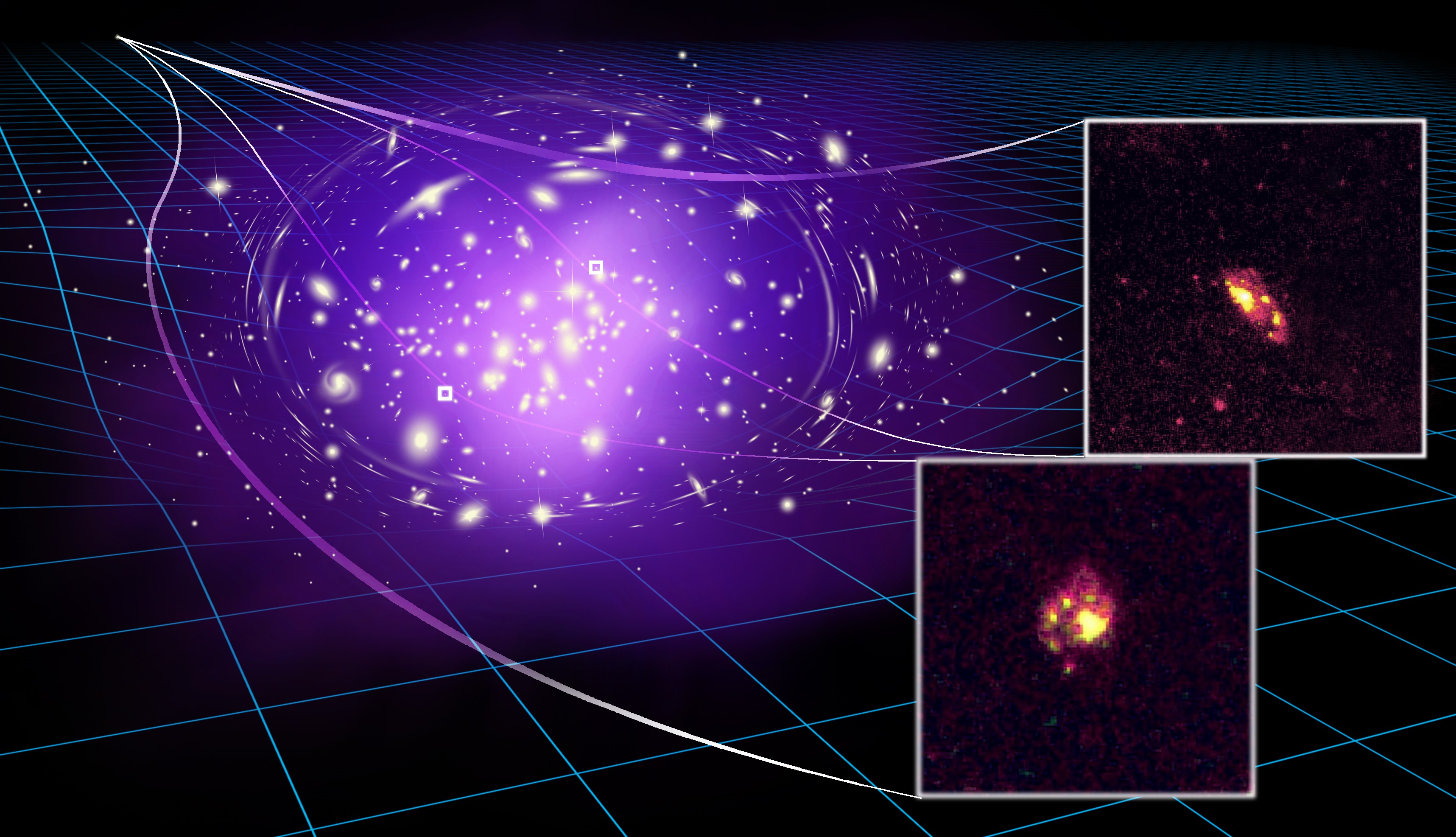
The massive galaxy cluster bends the light of the most ancient spiral galaxy behind it, producing two highly magnified images that allow astronomers to study the spiral structures in great details. Image credit: James Josephides. Full resolution JPEG


Gemini Observatory, using the Near-Infrared Integral Field Spectrograph on the Gemini North telescope in Hawai‘i, has confirmed the spiral nature of what is now the most distant known spiral galaxy. The galaxy's light, revealing how the galaxy looked some 11 billion years ago, is gravitationally lensed by a massive foreground cluster of galaxies to help reveal the distant pinwheel nature of the galaxy.

The following is a press release from Swinburne University of Technology in Australia.

The most ancient spiral galaxy discovered to date is revealing its secrets to a team of astronomers at Swinburne University of Technology and the Australian National University (ANU), both part of the Australian Research Council Centre of Excellence in All Sky Astrophysics in 3D (ASTRO 3D). The galaxy, known as A1689B11, existed 11 billion years in the past, just 2.6 billion years after the Big Bang, when the Universe was only one fifth of its present age. It is thus the most ancient spiral galaxy discovered so far.

The researchers used a powerful technique that combines gravitational lensing with the cutting-edge instrument, the Near-infrared Integral Field Spectrograph (NIFS) on the Gemini North telescope in Hawai‘i, to verify the vintage and spiral nature of this galaxy. NIFS is Australia’s first Gemini instrument that was designed and built by the late Peter McGregor at the ANU.

Gravitational lenses are Nature’s largest telescopes, created by massive clusters composed of thousands of galaxies and dark matter. The cluster bends and magnifies the light of galaxies behind it in a manner similar to an ordinary lens, but on a much larger scale. “This technique allows us to study ancient galaxies in high resolution with unprecedented detail,” says Swinburne astronomer Dr Tiantian Yuan, who led the research team.

“We are able to look 11 billion years back in time and directly witness the formation of the first, primitive spiral arms of a galaxy.” Co-author, Princeton University’s Dr Renyue Cen, says: “Studying ancient spirals like A1689B11 is a key to unlocking the mystery of how and when the Hubble sequence emerges.”

“Spiral galaxies are exceptionally rare in the early Universe, and this discovery opens the door to investigating how galaxies transition from highly chaotic, turbulent discs to tranquil, thin discs like those of our own Milky Way galaxy.”

Dr Yuan says the study shows some surprising features of A1689B11.

“This galaxy is forming stars 20 times faster than galaxies today – as fast as other young galaxies of similar masses in the early Universe. However, unlike other galaxies of the same epoch, A1689B11 has a very cool and thin disc, rotating calmly with surprisingly little turbulence. This type of spiral galaxy has never been seen before at this early epoch of the Universe!”

This research is an international collaboration including astrophysicists from the University of Lyon in France, Princeton University in the USA and Hebrew University in Israel. It has been accepted for publication in The Astrophysical Journal. A preprint version is available here.


Science Contacts:

Tiantian Yuan
Swinburne University of Technology
Email: tiantianyuan@swin.edu.au
Desk: +613 9214 5948
Cell: +61 404 029 550


Media Contacts:

Lea Kivivali
Swinburne University of Technology
Email: lkivivali@swin.edu.au
Desk: +613 9214 5428
Cell: +61 410 569 311

Peter Michaud
Public Information and Outreach Manager
Gemini Observatory
Hilo, Hawai‘i
Email: pmichaud@gemini.edu
Desk: 808 974-2510
Cell: 808 936-6643


Thursday, May 26, 2016

A Young Mammoth Cluster of Galaxies Sighted in the Early Universe

The newly discovered protocluster of galaxies located in the Bootes field of the NOAO Deep Wide-field Survey.. Green circles identify the confirmed cluster members. Density contours (white lines) emphasize the concentration of member galaxies toward the center of the image. The patch of sky shown is roughly 20 arcminutes x 17 arcminutes in size. The cluster galaxies are typically very faint, about 10 million times fainter than the faintest stars visible to the naked eye on a dark night. The inset images highlight two example members that glow in the Ly-alpha line of atomic hydrogen. The protocluster is massive, with its core weighing as much as a quadrillion suns. The protocluster is likely to evolve, over 12 billion years, into a system much like the nearby Coma cluster of galaxies, shown in the image below. Credit: Dr. Rui Xue, Purdue University. Hi-res image

Coma Cluster image from the Sloan Digital Sky Survey
Credit: Dustin Lang and SDSS Collaboration 


Astronomers have uncovered evidence for a vast collection of young galaxies 12 billion light years away. The newly discovered “proto-cluster” of galaxies, observed when the universe was only 1.7 billion years old (12% of its present age), is one of the most massive structures known at that distance. The discovery, made using telescopes at Kitt Peak National Observatory in Arizona and the W. M. Keck Observatory on Mauna Kea, has been reported in the Astrophysical Journal.

“The protocluster will very likely grow into a massive cluster of galaxies like the Coma cluster, which weighs more than a quadrillion suns,” said Purdue University astrophysicist Dr. Kyoung-Soo Lee, who initially spotted the protocluster and is one of the authors in this study. Clusters this massive are extremely rare: only a handful of candidates are known at such early times. The new system is the first to be confirmed using extensive spectroscopy to establish cluster membership.

The team, led by Dr. Lee (Purdue University) and Dr. Arjun Dey of the National Optical Astronomy Observatory, used the Mayall telescope on Kitt Peak to obtain very deep images of a small patch of sky, about the size of two full moons, in the constellation of Bootes. The team then used the Keck II Telescope on Mauna Kea to measure distances to faint galaxies in this patch, which revealed the large grouping. “Many of the faint galaxies in this patch lie at the same distance,” say Dr. Dey. “They are clumped together due to gravity and the evidence suggests that the cluster is in the process of forming.”

Matter in the universe organizes itself into large structures through the action of gravity. Most stars are in galaxies, which in turn collect in groups and clusters. Galaxy clusters are commonly observed in the present-day universe and contain some of the oldest and most massive galaxies known. The formation and early history of these clusters is not well understood. The discovery of young proto-clusters allows scientists to directly witness and study their formation. The prevalence of massive clusters in the young universe can help constrain the size and expansion history of the universe.

The team is now searching larger areas of sky to uncover more examples of such young and massive protoclusters. “The discovery and confirmation of one distant and very massive protocluster is very exciting,” said Dr. Naveen Reddy, an astrophysicist at the University of California at Riverside and a coauthor of the study, “but it is important to find a large sample of these so we can understand the possibly varied formation history of the population as a whole.”

The other members of the team are Dr. Michael Cooper (University of California, Irvine), Dr. Hanae Inami (Observatoire de Lyon), Dr. Sungryong Hong (University of Texas, Austin), Dr. Anthony Gonzalez (University of Florida), and Dr. Buell Jannuzi (University of Arizona).

Reference: “Spectroscopic Confirmation of a Protocluster at z=3.786,” Arjun Dey, Kyoung-Soo Lee, Naveen Reddy et al., 2016 May 20, Astrophysical Journal

preprint: http://arxiv.org/abs/1604.08627

Kitt Peak National Observatory and the National Optical Astronomy Observatory are operated by the Association of Universities for Research in Astronomy under a Cooperative Agreement with the National Science Foundation. The W. M. Keck Observatory is a scientific partnership between the National Aeronautics and Space Administration, the California Institute of Technology and the University of California, and made possible by the generous financial support of the W. M. Keck Foundation. The research was funded by the National Aeronautics and Space Administration and by NOAO.


Media Contact:

Dr. Joan Najita
National Optical Astronomy Observatory
950 N Cherry Ave
Tucson AZ 85719 USA
+1 520-318-8416
E-mail: najita@noao.edu


Science Contacts

Dr. Kyoung-Soo Lee
Purdue University
Tel: 765-494-3047
email: soolee@purdue.edu

Dr. Arjun Dey
National Optical Astronomy Observatory
Tel: 520-318-8429
email: dey@noao.edu


Monday, April 27, 2015

Astronomers Find New Details about Star Formation in Ancient Galaxy Protoclusters

Figure 1: Pseudo-color composite image of PKS 1138-262 region, derived from Hubble Space Telescope's ACS/WFC data archive (F814W and F475W). This region is one of the target protoclusters observed by MOIRCS on Subaru Telescope. (Credit: NAOJ/HST)

Figure 2: Mass-growth history expected of massive cluster of galaxies that have about 10^15 solar masses present day. Red spots are from this study. Black and grayer are for other massive cluster of galaxies, studied by the author's team and other research teams, respectively. (Credit: NAOJ)

Figure 3: Plot of stellar mass of the galaxies versus metallicity of gas in them. Gray and pale blue curves are for the present-day (nearby) galaxies and field galaxies at 11 billion years ago, respectively. Red is the current study about the proto-cluster of galaxies. The galaxies in the proto-clusters clearly show higher metallicity compared with the ones in the general fields at about the same time of the history in the universe. (Credit: NAOJ)


Figure 4: Illustrations of the metal enrichment processes (chemical evolution) in the field galaxies and the proto-cluster galaxies. Left (figure 4a) is for the galaxies in the general fields while the middle and the right (figures 4b and 4c, respectively) show their model that explain the unique enrichment processes of the heavy elements in the galaxies in the proto-clusters. (Credit: NAOJ)


Ongoing studies of distant galaxy protoclusters using the Multi-Object Infrared Camera and Spectrograph (MOIRCS) instrument on the Subaru Telescope is giving astronomers a closer look at the characteristics of star-forming regions in galaxies in the early universe. A team of astronomers from the National Astronomical Observatory of Japan (NAOJ) and SOKENDAI (Graduate University of Advanced Studies, Japan) are tracking velocity structures and gaseous metallicities in galaxies in two protoclusters located in the direction of the constellation Serpens. These appear around the radio galaxies PKS 1138-262 (at a redshift of 2.2, Figure 1) and USS 1558-003 (at a redshift of 2.5). The clusters appear as they would have looked 11 billion years ago, and the team concluded that they are in the process of cluster formation that has led to present-day galaxy clusters.

The MOIRCS near-infrared spectrograph is very effective for studies focused on the distant, early universe because strong emission lines from star-forming galaxies are redshifted from the optical to the near-infrared regime. This gives astronomers unique insights into these activities. (Note 1)

Based on the MOIRCS data, the team estimated that both protoclusters have a weight of about 10^14 solar masses (Figure 2). These follow the typical mass growth history of the today's most massive clusters, such as the 'Coma Cluster.' That makes the two protoclusters ideal laboratories for exploring early phasesof galaxy formation in a unique clustered environment.

The metallicity of the gases in the protocluster galaxies was studied using multiple spectral lines emitted from them. The result shows their gaseous metallicities are chemically enriched compared with those of galaxies in the general fields (Figure 3). Metals (elements heavier than hydrogen and helium) are created in the interiors of stars as they evolve and then released into surrounding gas through supernova explosions or stellar winds (often referred to as chemical evolution; Figure 4a).

The difference in gaseous metallicity between protoclusters and general fields suggests that star-formation histories and/or gas inflow/outflow processes should be different in the protocluster regions. The result also suggests that galaxy formation has already been influenced by environmental conditions in the era that star-formation activities are the most active across the universe. This would be an early phase of strong environmental effects seen in the present galaxy clusters.

In order to explain the metallicity excess in the protoclusters, the team members focused attention on the environmental effects of inflow and outflow mechanism on the galaxy formation process. Recent works report that inflow and outflow activities were most significant eleven billion years ago (at redshift ~2), and were about a hundred times more active relative to those in the local universe.

Clusters of galaxies are large self-gravitating systems in which galaxies and ionized gas are bound by massive amounts of dark matter. In such unique, dense environments, galaxies move at a speed of about 1000 kilometers per second. Due to this high speed, the galaxies are exposed to high pressure from intercluster medium. As a result, the outer regions with relatively poor metallicity are stripped. It is like the strong air resistance of air a bicycle rider experiences. In this case, the gaseous metallicities become higher because the chemical enrichment process takes place mainly in metal-rich central regions (Figure 4b). Another possibility is that the surrounding high-pressure, inter-cluster medium prevents outflowing gas from escaping from the galaxies (Figure 4c). This also results in higher gaseous metallicities of the cluster galaxies.

The research team concludes that the metallicity excess in the protocluster regions results from unique phenomena occurring in the cluster environment. The PI of this research, Mr. Rhythm Shimakawa of NAOJ and SOKENDAI (Note 2), is determined to continue studying the detailed physical properties of individual forming galaxies in the protoclusters to find clear evidence that proves this hypothesis.

This article is based on results from two research papers published in the Monthly Notices of the Royal Astronomical Society:

Rhythm Shimakawa, Tadayuki Kodama, Ken-ichi Tadaki, Ichi Tanaka, Masao Hayashi and Yusei Koyama, "Identification of the progenitors of rich clusters and member galaxies in rapid formation at z > 2", Volume 441, Issue 1, p.L1-L5, published in June 11, 2014,
and
Rhythm Shimakawa, Tadayuki Kodama, Ken-ichi Tadaki, Masao Hayashi, Yusei Koyama, Ichi Tanaka "An early phase of environmental effects on galaxy properties unveiled by near-infrared spectroscopy of protocluster galaxies at z>2", Volume 448, Issue 1, p.666-680, published in March 21, 2015.

This research is supported in part by a Grant-in-Aid for the Scientific Research (Nos. 21340045 and 24244015) by the Japanese Ministry of Education, Culture, Sports, Science and Technology.

Authors:

  • Rhythm Shimakawa (Subaru Telescope, National Astronomical Observatory of Japan [NAOJ]/SOKENDAI(Graduate University for Advanced Studies))
  • Tadayuki Kodama (Optical and Infrared Astronomy Division, NAOJ/SOKENDAI)
  • Ichi Tanaka (Subaru Telescope, NAOJ)
  • Kenichi Tadaki (Max-Planck-Institute fur Extraterrestrische Physic, Germany)
  • Masao Hayashi (Optical and Infrared Astronomy Division, NAOJ)
  • Yusei Koyama (Institute of Space Astronomical Science, Japan Aerospace Exploration Agency)

Notes:

  1. See the Web release by M. Hayashi, "Discovery of an Ancient Celestial City Undergoing Rapid Growth: A Young Protocluster of Active Star-Forming Galaxies".
  2. Mr. Rhythm Shimakawa received the first "SOKENDAI Future Scientist Award" for his research "Environmental effects on galaxy formation: When and how did spiral and elliptical galaxies diverge?", which includes the two papers referred in this article.

Thursday, September 04, 2014

Newly Identified Galactic Supercluster Is Home to the Milky Way

A slice of the Laniakea Supercluster in the supergalactic equatorial plane -- an imaginary plane containing many of the most massive clusters in this structure. The colors represent density within this slice, with red for high densities and blue for voids -- areas with relatively little matter. Individual galaxies are shown as white dots. Velocity flow streams within the region gravitationally dominated by Laniakea are shown in white, while dark blue flow lines are away from the Laniakea local basin of attraction. The orange contour encloses the outer limits of these streams, a diameter of about 160 Mpc. This region contains the mass of about 100 million billion suns. Credit: SDvision interactive visualization software by DP at CEA/Saclay, France.

Two views of the Laniakea Supercluster. The outer surface shows the region dominated by Laniakea’s gravity. The streamlines shown in black trace the paths along which galaxies flow as they are pulled closer inside the supercluster. Individual galaxies’ colors distinguish major components within the Laniakea Supercluster: the historical Local Supercluster in green, the Great Attractor region in orange, the Pavo-Indus filament in purple, and structures including the Antlia Wall and Fornax-Eridanus cloud in magenta. Credit: SDvision interactive visualization software by DP at CEA/Saclay, France.


This is a short video about Laniakea that gives the viewer a general sense of the structure of our home supercluster and of galaxy motions in the nearby Universe. Credit: This video is a preview of "Laniakea Supercluster", a film produced as part of the following publication: "The Laniakea Supercluster of Galaxies" published in Nature, volume 513, number 7516, p.71 (4 September 2014) by R. Brent Tully, Hélène Courtois, Yehuda Hoffman, and Daniel Pomarède.

Astronomers using the National Science Foundation’s Green Bank Telescope (GBT) -- among other telescopes -- have determined that our own Milky Way galaxy is part of a newly identified ginormous supercluster of galaxies, which they have dubbed “Laniakea,” which means “immense heaven” in Hawaiian.

This discovery clarifies the boundaries of our galactic neighborhood and establishes previously unrecognized linkages among various galaxy clusters in the local Universe.

“We have finally established the contours that define the supercluster of galaxies we can call home,” said lead researcher R. Brent Tully, an astronomer at the University of Hawaii at Manoa. “This is not unlike finding out for the first time that your hometown is actually part of much larger country that borders other nations.”

The paper explaining this work is the cover story of the September 4 issue of the journal Nature.

Superclusters are among the largest structures in the known Universe. They are made up of groups, like our own Local Group, that contain dozens of galaxies, and massive clusters that contain hundreds of galaxies, all interconnected in a web of filaments. Though these structures are interconnected, they have poorly defined boundaries.

To better refine cosmic mapmaking, the researchers are proposing a new way to evaluate these large-scale galaxy structures by examining their impact on the motions of galaxies. A galaxy between structures will be caught in a gravitational tug-of-war in which the balance of the gravitational forces from the surrounding large-scale structures determines the galaxy’s motion.

By using the GBT and other radio telescopes to map the velocities of galaxies throughout our local Universe, the team was able to define the region of space where each supercluster dominates. “Green Bank Telescope observations have played a significant role in the research leading to this new understanding of the limits and relationships among a number of superclusters,” said Tully.

The Milky Way resides in the outskirts of one such supercluster, whose extent has for the first time been carefully mapped using these new techniques. This so-called Laniakea Supercluster is 500 million light-years in diameter and contains the mass of one hundred million billion Suns spread across 100,000 galaxies.

This study also clarifies the role of the Great Attractor, a gravitational focal point in intergalactic space that influences the motion of our Local Group of galaxies and other galaxy clusters.

Within the boundaries of the Laniakea Supercluster, galaxy motions are directed inward, in the same way that water streams follow descending paths toward a valley. The Great Attractor region is a large flat bottom gravitational valley with a sphere of attraction that extends across the Laniakea Supercluster.

The name Laniakea was suggested by Nawa‘a Napoleon, an associate professor of Hawaiian Language and chair of the Department of Languages, Linguistics, and Literature at Kapiolani Community College, a part of the University of Hawaii system. The name honors Polynesian navigators who used knowledge of the heavens to voyage across the immensity of the Pacific Ocean.

The other authors are Hélène Courtois (University Claude Bernard Lyon 1, Lyon, France), Yehuda Hoffman (Racah Institute of Physics, Hebrew University, Jerusalem), and Daniel Pomarède (Institute of Research on Fundamental Laws of the Universe, CEA/Saclay, France).

The GBT is the world's largest fully steerable radio telescope. Its location in the National Radio Quiet Zone and the West Virginia Radio Astronomy Zone protects the incredibly sensitive telescope from unwanted radio interference.

The National Radio Astronomy Observatory is a facility of the National Science Foundation, operated under cooperative agreement by Associated Universities, Inc.

Founded in 1967, the Institute for Astronomy at the University of Hawaii at Manoa conducts research into galaxies, cosmology, stars, planets, and the sun. Its faculty and staff are also involved in astronomy education, deep space missions, and in the development and management of the observatories on Haleakala and Maunakea. The Institute operates facilities on the islands of Oahu, Maui, and Hawaii.

Contacts:

Mr. Charles E. Blue, NRAO Public Information Officer
(434) 296-0314; cblue@nrao.edu

Dr. R. Brent Tully
+1 808-956-8606; tully@ifa.hawaii.edu

Dr. Roy Gal
Cell: +1 301-728-8637, rgal@ifa.hawaii.edu 

Ms. Talia Ogliore, Media Contact
(808) 956-4531; togliore@hawaii.edu


Thursday, April 03, 2014

NASA Hubble Team Finds Monster "El Gordo" Galaxy Cluster Bigger Than Thought

This is a Hubble image of the most massive cluster of galaxies ever seen to exist when the universe was just half its current age of 13.8 billion years. The cluster contains several hundred galaxies.  Image Credit: NASA, ESA, and J. Jee (University of California, Davis)

NASA's Hubble Space Telescope has weighed the largest known galaxy cluster in the distant universe, catalogued as ACT-CL J0102-4915, and found it definitely lives up to its nickname -- El Gordo (Spanish for "the fat one").

By measuring how much the cluster's gravity warps images of galaxies in the distant background, a team of astronomers has calculated the cluster's mass to be as much as 3 million billion times the mass of our sun. Hubble data show the galaxy cluster, which is 9.7 billion light-years away from Earth, is roughly 43 percent more massive than earlier estimates.

The team used Hubble to measure how strongly the mass of the cluster warped space. Hubble's high resolution allowed measurements of so-called "weak lensing," where the cluster's immense gravity subtly distorts space like a funhouse mirror and warps images of background galaxies. The greater the warping, the more mass is locked up in the cluster.

"What I did is basically look at the shapes of the background galaxies that are farther away than the cluster itself," explained lead author James Jee of the University of California at Davis. "It's given us an even stronger probability that this is really an amazing system very early in the universe."

A fraction of this mass is locked up in several hundred galaxies that inhabit the cluster and a larger fraction is in hot gas that fills the entire volume of the cluster. The rest is tied up in dark matter, an invisible form of matter that makes up the bulk of the mass of the universe.

Though equally massive galaxy clusters are found in the nearby part of the universe, such as the Bullet cluster, nothing like this has ever been discovered to exist so far back in time, when the universe was roughly half its current estimated age of 13.8 billion years. The team suspects such monster galaxy clusters are rare in the early universe, based on current cosmological models.

The immense size of El Gordo was first reported in January 2012. Astronomers estimated its mass based on observations made by NASA's Chandra X-ray Observatory, and galaxy velocities measured by the European Southern Observatory's Very Large Telescope array in Paranal, Chile. They were able to put together estimates of the cluster's mass based on the motions of the galaxies moving inside the cluster and the temperatures of the hot gas between those galaxies.

The challenge was that El Gordo looked as if it might have been the result of a titanic collision between a pair of galaxy clusters -- an event researchers describe as two cosmic cannonballs hitting each other.

"We wondered what happens when you catch a cluster in the midst of a major merger and how the merger process influences both the X-ray gas and the motion of the galaxies," explained John Hughes of Rutgers University. "So, the bottom line is because of the complicated merger state, it left some questions about the reliability of the mass estimates we were making."

That is where the Hubble data came in, according to Felipe Menanteau of the University of Illinois at Urbana-Champaign.

"We were in dire need for an independent and more robust mass estimate given how extreme this cluster is and how rare its existence is in the current cosmological model. There was all this kinematic energy that was unaccounted for and could potentially suggest that we were actually underestimating the mass," Menanteau said. 

The expectation of "unaccounted energy" comes from the fact the merger of galaxy clusters is occurring tangentially to the observers' line-of-sight. This means they are potentially missing a good fraction of the kinetic energy of the merger because their spectroscopic measurements only track the radial speeds of the galaxies.

The team's next step with Hubble will be to compile an image of the cluster. Because El Gordo does not fit into Hubble's field of view, the team will capture images of sections of the galaxy cluster and piece them together into a mosaic.

Researchers say it is like observing a giant from the side.

"We can tell it's a pretty big El Gordo, but we don't know what kind of legs he has, so we need to have a larger field of view to get the complete picture of the giant," said Menanteau.

The Hubble Space Telescope is a project of international cooperation between NASA and the European Space Agency. NASA's Goddard Space Flight Center in Greenbelt, Md., manages the telescope. The Space Telescope Science Institute (STScI) in Baltimore conducts Hubble science operations. STScI is operated for NASA by the Association of Universities for Research in Astronomy, Inc., in Washington.

For images and more information about Hubble, visit:  http://www.nasa.gov/hubble


J.D. Harrington
Headquarters, Washington
202-358-5241

j.d.harrington@nasa.gov

Ray Villard
Space Science Telescope Institute, Baltimore, Md.
410-338-4493 / 410-338-4514

villard@stsci.edu


Wednesday, January 08, 2014

Hubble's First Frontier Field Finds Thousands of Unseen, Faraway Galaxies

Credit: NASA, ESA, and J. Lotz, M. Mountain, A. Koekemoer, 
and the HFF Team (STScI) 
Highest-quality image

The first of a set of unprecedented, super-deep views of the universe from an ambitious collaborative program called The Frontier Fields is being released today (Jan 7, 2014) at the 223rd meeting of the American Astronomical Society in Washington, D.C.

The long-exposure image taken with NASA's Hubble Space Telescope is the deepest-ever picture taken of a cluster of galaxies, and also contains images of some of the intrinsically faintest and youngest galaxies ever detected.

The target is the massive cluster Abell 2744, which contains several hundred galaxies as they looked 3.5 billion years ago. The immense gravity in this foreground cluster is being used as a "gravitational lens," which warps space to brighten and magnify images of far-more-distant background galaxies as they looked over 12 billion years ago, not long after the big bang.

"The Frontier Fields is an experiment; can we use Hubble's exquisite image quality and Einstein's theory of General Relativity to search for the first galaxies?" said Space Telescope Science Institute Director Matt Mountain. "With the other Great Observatories, we are undertaking an ambitious joint program to use galaxy clusters to explore the first billion years of the universe's history."

Simultaneous observations of this field are being done with NASA's two other Great Observatories, the Spitzer Space Telescope and the Chandra X-ray Observatory. The assembly of all this multispectral information is expected to provide new insights into the origin and evolution of galaxies and their accompanying black holes.

The Hubble exposure reveals nearly 3,000 of these background galaxies interleaved with images of hundreds of foreground galaxies in the cluster. The many background galaxies would otherwise be invisible without the boost from gravitational lensing. Their images not only appear brighter, but also smeared, stretched, and duplicated across the field.

Thanks to the gravitational lensing phenomenon, the background galaxies are magnified to appear up to 10 to 20 times larger than they would normally appear. What's more, the faintest of these highly magnified objects have intrinsic brightnesses roughly 10 to 20 times fainter than any galaxies ever previously observed.

The Hubble data are immediately being made available to the worldwide astronomy community where teams of researchers will do a detailed study of the visual crazy quilt of intermingled background and cluster galaxies to better understand the stages of galaxy development.

Though the foreground cluster Abell 2744 has been intensively studied as one of the most massive clusters in the universe, the Frontier Fields exposure reveals new details of the cluster population. Hubble sees dwarf galaxies in the cluster as small as 1/1,000th the mass of the Milky Way. At the other end of the size spectrum, Hubble detects the extended light from several monster central cluster galaxies that are as much as 100 times more massive than our Milky Way. Also visible is faint intra-cluster light from stars inside the cluster that have been stripped out of galaxies by gravitational interactions. These new deep images will also help astronomers map out the dark matter in the cluster with unprecedented detail, by charting its distorting effects on background light. An unseen form of matter, dark matter makes up the bulk of the mass of the cluster.

As the Abell cluster was being photographed with Hubble's Wide Field Camera 3, the telescope's Advanced Camera for Surveys was trained on a nearby parallel field that is 6 arc minutes away from the cluster. In this field, Hubble resolves roughly 10,000 galaxies seen in visible light, most of which are randomly scattered galaxies. The blue galaxies are distant star-forming galaxies seen from up to 8 billion years ago; the handful of larger, red galaxies are in the outskirts of the Abell 2744 cluster.

Hubble will again view these two Frontier Fields in May 2014, but Hubble's visible-light and infrared camera will switch targets. This will allow for both fields to be observed over a full range of colors, from ultraviolet light to near-infrared.

With each new camera installed on Hubble, the space telescope has been used to make successively deeper, groundbreaking views of the universe. To get a better assessment of whether doing more deep field observations was scientifically compelling or urgent, the Space Telescope Science Institute or STScI in Baltimore, Md., chartered a "Hubble Deep Field Initiative" working group. The Hubble Frontier Fields initiative grew out of the working group's high-level discussions at STScI concerning what important, forward-looking science Hubble should be doing in upcoming years. Despite several deep field surveys, astronomers realized that a lot was still to be learned about the far universe. Such knowledge would help in planning the observing strategy for the upcoming James Webb Space Telescope.

The astronomers also considered synergies with other observatories, such as Spitzer, Chandra, and the new Atacama Large Millimeter/submillimeter Array or ALMA. Over the coming years five more pairs of fields will be imaged. The next scheduled target is the massive cluster MACS J0416.1-2403, for which observations are starting this week.

CONTACT

Ray Villard
Space Telescope Science Institute, Baltimore, Md.
410-338-4514

villard@stsci.edu

Wednesday, January 12, 2011

NASA Telescopes Help Identify Most Distant Galaxy Cluster

Astronomers have discovered a massive cluster of young galaxies forming in the distant universe. Image credit: Subaru/NASA/JPL-Caltech. Full image and caption

PASADENA, Calif. -- Astronomers have uncovered a burgeoning galactic metropolis, the most distant known in the early universe. This ancient collection of galaxies presumably grew into a modern galaxy cluster similar to the massive ones seen today.

The developing cluster, named COSMOS-AzTEC3, was discovered and characterized by multi-wavelength telescopes, including NASA's Spitzer, Chandra and Hubble space telescopes, and the ground-based W.M. Keck Observatory and Japan's Subaru Telescope.

"This exciting discovery showcases the exceptional science made possible through collaboration among NASA projects and our international partners," said Jon Morse, NASA's Astrophysics Division director at NASA Headquarters in Washington.

Scientists refer to this growing lump of galaxies as a proto-cluster. COSMOS-AzTEC3 is the most distant massive proto-cluster known, and also one of the youngest, because it is being seen when the universe itself was young. The cluster is roughly 12.6 billion light-years away from Earth. Our universe is estimated to be 13.7 billion years old. Previously, more mature versions of these clusters had been spotted at 10 billion light-years away.

The astronomers also found that this cluster is buzzing with extreme bursts of star formation and one enormous feeding black hole.

"We think the starbursts and black holes are the seeds of the cluster," said Peter Capak of NASA's Spitzer Science Center at the California Institute of Technology in Pasadena. "These seeds will eventually grow into a giant, central galaxy that will dominate the cluster -- a trait found in modern-day galaxy clusters." Capak is first author of a paper appearing in the Jan. 13 issue of the journal Nature.

Most galaxies in our universe are bound together into clusters that dot the cosmic landscape like urban sprawls, usually centered around one old, monstrous galaxy containing a massive black hole. Astronomers thought that primitive versions of these clusters, still forming and clumping together, should exist in the early universe. But locating one proved difficult-until now.

Capak and his colleagues first used the Chandra X-ray Observatory and the United Kingdom's James Clerk Maxwell Telescope on Mauna Kea, Hawaii, to search for the black holes and bursts of star formation needed to form the massive galaxies at the centers of modern galaxy cities. The astronomers then used the Hubble and Subaru telescopes to estimate the distances to these objects, and look for higher densities of galaxies around them. Finally, the Keck telescope was used to confirm that these galaxies were at the same distance and part of the same galactic sprawl.

Once the scientists found this lumping of galaxies, they measured the combined mass with the help of Spitzer. At this distance, the optical light from stars is shifted, or stretched, to infrared wavelengths that can only be observed in outer space by Spitzer. The lump sum of the mass turned out to be a minimum of 400 billion suns -- enough to indicate that the astronomers had indeed uncovered a massive proto-cluster. The Spitzer observations also helped confirm that a massive galaxy at the center of the cluster was forming stars at an impressive rate.

Chandra X-ray observations were used to find and characterize the whopping black hole with a mass of more than 30 million suns. Massive black holes are common in present-day galaxy clusters, but this is the first time a feeding black hole of this heft has been linked to a cluster that is so young.

Finally, the Institut de Radioastronomie Millimétrique's interferometer telescope in France and 30-meter (about 100-foot) telescope in Spain, along with the National Radio Astronomy Observatory's Very Large Array telescope in New Mexico, measured the amount of gas, or fuel for future star formation, in the cluster. The results indicate the cluster will keep growing into a modern city of galaxies.

"It really did take a village of telescopes to nail this cluster," said Capak. "Observations across the electromagnetic spectrum, from X-ray to millimeter wavelengths, were all critical in providing a comprehensive view of the cluster's many facets."

COSMOS-AzTEC3, located in the constellation Sextans, is named after the region where it was found, called COSMOS after the Cosmic Evolution Survey. AzTEC is the name of the camera used on the James Clerk Maxwell Telescope; this camera is now on its way to the Large Millimeter Telescope located in Mexico's Puebla state.

NASA's Jet Propulsion Laboratory, Pasadena, Calif., manages the Spitzer Space Telescope mission for NASA's Science Mission Directorate, Washington. Science operations are conducted at the Spitzer Science Center at Caltech in Pasadena. Caltech manages JPL for NASA. More information about Spitzer is at: http://spitzer.caltech.edu/ and http://www.nasa.gov/spitzer .

Contact

Whitney Clavin 818-354-4673

Jet Propulsion Laboratory, Pasadena, Calif.
whitney.clavin@jpl.nasa.gov

Trent Perrotto 202-358-0321
NASA Headquarters, Washington
trent.j.perrotto@nasa.gov