Showing posts with label M87. Show all posts

Thursday, September 17, 2026

Smithsonian Astrophysical Observatory Receives $3.6M from Gordon and Betty Moore Foundation to Advance Next-Generation Event Horizon Telescop

A still image simulation of the kinds of imagery and video that the ngEHT will make possible.
Credit: Smithsonian Astrophysical Observatory/S. Doeleman & N. Conroy


The funding will support expansions to the telescope collaboration that will enable the first full-color, high-definition movies of black holes

Cambridge, MA (September 17, 2026) — The Smithsonian Astrophysical Observatory (SAO), part of the Center for Astrophysics, has been awarded $3,597,771 from the Gordon and Betty Moore Foundation (GBMF) to enable the first full-color, high-definition movies of black holes.

The three-year award will advance the next-generation Event Horizon Telescope (ngEHT) by supporting construction of the new Tenerife Event-horizon Antenna, site preparation at three additional locations, and the design of a pathfinder telescope for Mount Kilimanjaro.

“This award marks an exciting turning point for the ngEHT,” said Sheperd Doeleman, astrophysicist at SAO and the project’s principal investigator. “We’re moving from successful prototypes and designs to building the instruments and sites that will make high-definition, full-color movies of black holes possible.”

By tracking the motion of matter and light near the edge of the black hole in our neighboring M87 galaxy , the project will help scientists investigate some of the most fundamental questions in physics, including: Does Einstein’s theory of gravity hold under the black hole’s extreme conditions? How do they accrete matter and grow over cosmic time? How do spinning black holes power jets that can pierce entire galaxies?

<
Diagram of the dish structure for construction of new radio dishes for the Next Generation Event Horizon Telescope.
Credit: ngEHT

“This Gordon and Betty Moore Foundation funding continues their generous commitment to the cutting edge of astronomy,” said Lisa Kewley, director of the Center for Astrophysics | Harvard & Smithsonian and the Smithsonian Astrophysical Observatory. “We are proud to receive their support, which will help advance the ngEHT and bring its quest to understand black holes closer to reality.”

Completing the Tenerife Event-horizon Antenna: A major focus of the award is the completion of the Tenerife Event-horizon Antenna, or TEA, in the Canary Islands. The project team will develop and engineer a new digital system at the TEA capable of processing the unprecedented data output of the ngEHT. The upgrade will increase the antenna’s bandwidth and frequency coverage, as well as improving its ability to compensate for atmospheric turbulence. It will also establish a model for future ngEHT telescope sites.

Preparing the Global Array for Expansion:
The grant will also fund the development of three future ngEHT telescope sites. It will support assessments to evaluate both engineering design plans and environmental and cultural impact of telescope sites in San Pedro Mártir, Mexico; Las Campanas, Chile; and Mt. Jelm, Wyoming. This work will include infrastructure planning, site assessments, architectural layouts, and environmental reviews.

Designing a Kilimanjaro Pathfinder Telescope:
The award will further support a collaboration of SAO with the Open University of Tanzania to design a mobile, transportable pathfinder dish for near Mt. Kilimanjaro in Tanzania.This small, mobile radio telescope will test whether the Kilimanjaro Saddle area is suitable for a full-scale ngEHT facility. This design will contribute to a broad international feasibility study, and any future development would proceed through close engagement with local communities, educational institutions, government agencies, environmental organizations, and local cultural groups.

Earlier support from the Gordon and Betty Moore Foundation helped advance the ngEHT’s key telescope systems, including its state-of-the-art digital backend, its high-frequency data receivers, and a new 13-meter antenna. The project’s international partners are working toward a distributed array capable of producing increasingly detailed and dynamic images of black holes in the early 2030s.

“This support brings us closer to seeing how black holes change in real time and to answering some of the biggest questions in modern physics,” said Doeleman.

The award, titled “The Next-Generation Event Horizon Telescope: Site Development Phase II,” supports work from July 1, 2026, through June 30, 2029.

This project is funded by the Gordon and Betty Moore Foundation, Grant GBMF14361.


About the Gordon and Betty Moore Foundation:

Gordon and Betty Moore established the foundation to create positive outcomes for future generations. In pursuit of that vision, we advance scientific discovery, environmental conservation, and the special character of the San Francisco Bay Area. Visit Moore.org and follow @MooreFound.

About the Next Generation Event Horizon Telescope:

The next generation Event Horizon Telescope (ngEHT) will capture the sharpest images and videos of black holes. Building on the success of the original Event Horizon Telescope (EHT) and its release in 2019 of the first black hole picture, the ngEHT develops state-of-the-art technology to modernize existing instrumentation and realize new capabilities while expanding the geographical footprint of the array with new dishes at optimized locations around the world. By achieving the highest angular resolution possible from the surface of the Earth, the ngEHT will produce full-color, high-definition black hole “cinema” to test Einstein’s theory of gravity, and the fundamental nature of supermassive black holes.

About the Smithsonian Astrophysical Observatory:

The Smithsonian Astrophysical Observatory is a research center of the Smithsonian Institution and part of the Center for Astrophysics, the largest astrophysics research center in the world. The Observatory has been a pioneer in space exploration and discovery since its founding in 1890. Today, in addition to performing groundbreaking astronomical research, SAO operates multiple satellites, including NASA's Chandra X-ray Observatory, and runs the Minor Planet Center that tracks all known asteroids in the solar system.

About the Center for Astrophysics | Harvard & Smithsonian

The Center for Astrophysics | Harvard & Smithsonian is a collaboration between the Smithsonian Astrophysical Observatory and the Harvard College Observatory designed to ask, and ultimately answer, humanity’s greatest unresolved questions about the universe.


Monday, February 02, 2026

New Even Horizon Telescope Results Trace M87 Jet Back to Its Black Hole

A Hubble Space Telescope image of the giant elliptical galaxy M87 with its blowtorch-like jet. The visible part of this giant stream of particles spans around 3000 light-years. © NASA, ESA, A. Lessing (Stanford University), E. Baltz (Stanford University), M. Shara (AMNH), J. DePasquale (STScI)

At 230 GHz (bottom), data from the EHT reveal the fine structure of the ring surrounding the supermassive black. © Bottom: Saurabh et al.: “Probing jet base emission of M87* with the 2021 Event Horizon Telescope observations”, Astronomy & Astrophysics 705 (2026), Figure 6. Upper Right: Lu, R.-S. et al.: “A ring-like accretion structure in M87 connecting its black hole and jet”. Nature 616 (2023), Figure 1

Selected sites from the 2021 EHT observing campaign, highlighting additional stations: the 12−m Kitt Peak (KP) Telescope, USA and the NOrthern Extended Millimeter Array (NOEMA), France. This introduces two critical intermediate-length baselines to the Submillimeter Telescope (SMT), USA and IRAM 30−m, Spain, providing sensitivity to emission structures close to the base of the jet. © Saurabh/MPIfR


To the point:

• Recently published data from the Event Horizon Telescope (EHT) of the galaxy Messier 87 facilitate new insights into the direct environment of the central supermassive black hole.

• Measured differences in the radio light on different spatial scales can be explained by the presence of an as of yet undetected jet at frequencies of 230 Gigahertz at spatial scales comparable to the size of the black hole.

• The most likely location of the jet base is determined through detailed modeling.


Observations with the Event Horizon Telescope enable researchers to localize the likely base of the central outflow in a massive galaxy

Some galaxies eject powerful streams of charged particles—jets—from their centers into space. The prominent jet of Messier 87 (M87) in the constellation Virgo is visible over distances of 3000 light-years and can be observed over the full electromagnetic spectrum. It is powered by the central engine, the supermassive black hole at the heart of the galaxy with a mass of around six billion times that of our Sun. The exact location around the black hole where the jets originate is still unknown. Using observations from the Event Horizon Telescope (EHT) from 2021, an international research team led by Saurabh (Max Planck Institute for Radio Astronomy, MPIfR), Hendrik Müller (National Radio Astronomy Observatory, NRAO) and Sebastiano von Fellenberg (formerly at MPIfR, currently at the Canadian Institute for Theoretical Astrophysics, CITA) has found first hints of the jet base in M87. The results are published in the current issue of the journal Astronomy & Astrophysics.

Observing different scales

M87*, the supermassive black hole at the center of the galaxy M87, is about 55 million light years (5 × 1020 kilometers) away from Earth. In 2019, the first images of its shadow and the glowing ring of hot gas around it went around the world. In order to resolve these structures, radio telescopes around the world must be combined into a single virtual telescope such as the EHT. This technique is called Very Long Baseline Interferometry (VLBI). The images produced in this way are sensitive to emission on different scales, depending on the distances between telescopes (baselines): With long baselines of several thousand kilometers, the smallest structures—such as the luminous ring—around M87* can be depicted. Short baselines of a few hundred meters, on the other hand, reveal emission emanating from much larger spatial scales in M87 (the extended jet), but are blind to details near the black hole. Intermediate baselines of a few hundred to a few thousand kilometers are the important link. They can be used to establish a connection between the material around the black hole and the jet. Precisely these intermediate baselines enabled the research team to determine the probable position of the jet base. "This study represents an early step toward connecting theoretical ideas about jet launching with direct observations. Identifying where the jet may originate and how it connects to the black hole’s shadow, adds a key piece to the puzzle and points toward a better understanding of how the central engine operates", explains Saurabh.

The decisive difference

The researchers find hints to the base of the jet by comparing the measured radio intensity on different spatial scales: On short to intermediate baselines, the measured intensity is higher compared to that on long baselines. This indicates that what is observed with long baselines—the luminous ring of hot gas around the black hole—is not solely responsible for the detected radio emission. Instead, the current data show that part of the missing emission is captured on intermediate baselines. One possibility is the jet, which has not yet been observed at a radio frequency of 230 gigahertz (GHz) with the EHT.

EHT observations from 2017 and 2018 lacked the intermediate baselines to detect it. However, with the recently published data, Saurabh's team was able to show with numerous model calculations that part of the missing emission can be best explained by an additional compact region. From our perspective, this region is about 0.09 light-years away from M87* and associated with the base of the jet. The position of the region appears to coincide with the southern arm of a radio jet discovered at a different frequency (86 GHz) in 2018. "We have observed the inner part of the jet of M87 with global VLBI experiments for many years, with ever increasing resolution, and finally managed to resolve the black hole shadow in 2019. It is amazing to see that we are gradually moving towards combining these breakthrough observations across multiple frequencies and complete the picture of the jet launching region", says Hendrik Müller.

What’s next?

The current study shows that these interesting structures around M87* become visible at radio frequencies of 230 GHz with intermediate baselines. However, further observations with the EHT will be necessary to further constrain the morphology of the jet. These observations will then make it possible to not only deduce structures such as the jet base, but to image them. This opens up new possibilities for probing the direct environment of supermassive black holes and for testing theories of black hole physics. "Newly observed data—now being correlated and calibrated with support from MPIfR—will soon add back the Large Millimetre Telescope in Mexico. This will bring an even sharper view of the jet‑launching region within reach", says Sebastiano von Fellenberg.


Additional Information

The following scientists affiliated to the MPIfR are coauthors of this publication: Saurabh, Sebastiano D. von Fellenberg, Michael Janssen, Thomas P. Krichbaum, Dhanya G. Nair, Walter Alef, Rebecca Azulay, Uwe Bach, Anne-Kathrin Baczko, Silke Britzen, Gregory Desvignes, Sergio A. Dzib, Ralph P. Eatough, Christian M. Fromm, Ramesh Karuppusamy, Joana A. Kramer, Michael Kramer, Jun Liu, Andrei P. Lobanov, Ru-Sen Lu, Nicholas R. MacDonald, Nicola Marchili, Karl M. Menten, Cornelia Müller, Georgios Filippos Paraschos, Alexander Plavin, Eduardo Ros, Helge Rottmann, Alan L. Roy, Tuomas Savolainen, Lijing Shao, Pablo Torne, Efthalia Traianou, Jan Wagner, Robert Wharton, Gunther Witzel, Jompoj Wongphexhauxsorn, J. Anton Zensus, and Guang-Yao Zhao.


Contacts:

Mr. Saurabh
Tel:
+49 228 525-366
saurabh@mpifr-bonn.mpg.de
Max Planck Institute for Radio Astronomy, Bonn

Dr. Hendrick Müller
Tel:
+1 626 781-0043
hmuller@nrao.edu
National Radio Astronomy Observatory (NRAO), USA

Dr. Sebastiano von Fellenberg
Tel:
+1 437 328-5547
sfellenberg@utoronto.ca
Canadian Institute for Theoretical Astrophysics (CITA), University of Toronto, Canada

Dr. Nina Brinkmann
Press and Public Relations
Tel:
+49 228 525-399
brinkmann@mpifr-bonn.mpg.de
Max Planck Institute for Radio Astronomy, Bonn


Original publication

Saurabh et al.
Probing jet base emission of M87* with the 2021 Event Horizon Telescope observations
Astronomy & Astrophysics 705 (2026)
[doi.org/10.1051/0004-6361/202557022]


Parallel Press Release

CITA Press Release
From the Canadian Institute for Theoretical Astrophysics

Saurabh/MPIfR

Animation (open in full screen)


Images

Tuesday, December 16, 2025

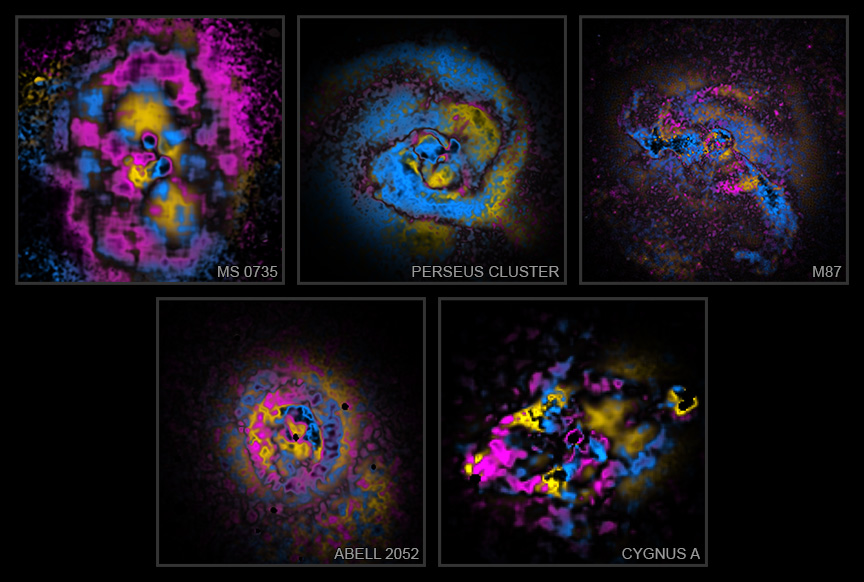
Painting Galaxy Clusters by Numbers (and Physics)

MS 0735.6+7421 - Perseus Cluster - M87 - Abell 2052 - Cygnus A
Credit: X-ray: NASA/CXC/Univ. of Chicago/H. McCall


JPEG (168.9 kb) - Large JPEG (10.5 MB) - Tiff (34.6 MB) - More Images

MS 0735.6+7421 - Perseus Cluster - M87 - Abell 2052 - Cygnus A
Astronomical Images of Objects Processed Using X-arithmetic Technique (Labeled) Credit: X-ray: NASA/CXC/Univ. of Chicago/H. McCall; Image processing: NASA/CXC/SAO/N. Wolk

A Tour of X-arithmetic - More Videos


Galaxy clusters are the most massive objects in the universe held together by gravity, containing up to several thousand individual galaxies and huge reservoirs of superheated, X-ray-emitting gas. The mass of this hot gas is typically about five times higher than the total mass of all the galaxies in galaxy clusters. In addition to these visible components, 80% of the mass of galaxy clusters is supplied by dark matter. These cosmic giants are bellwethers not only for the galaxies, stars and black holes within them, but also for the evolution and growth of the universe itself.

It is no surprise then that NASA’s Chandra X-ray Observatory has observed many galaxy clusters over the lifetime of the mission. Chandra’s X-ray vision allows it to see the enormous stockpiles of hot cluster gas, with temperatures as high as 100 million degrees, with exquisite clarity. This blazing gas tells stories about past and present activity within galaxy clusters.

Many of these galaxy clusters host supermassive black holes at their centers, which periodically erupt in powerful outbursts. These explosions generate jets that are visible in radio wavelengths, which inflate bubbles full of energetic particles; these bubbles carry energy out into the surrounding gas. Chandra’s images have revealed a wealth of other structures formed during these black hole outbursts, including hooks, rings, arcs, and wings. However, appearances alone don’t tell us what these structures are or how they formed.

To tackle this problem, a team of astronomers developed a novel image-processing technique to analyze X-ray data, allowing them to identify features in the gas of galaxy clusters like never before, classifying them by their nature rather than just their appearance. Prior to this technique, which they call “X-arithmetic,” scientists could only identify the nature of some of the features and in a much less efficient way, via studies of the amounts of X-ray energy dispersed at different wavelengths. The authors applied X-arithmetic to 15 galaxy clusters and galaxy groups (these are similar to galaxy clusters but with fewer member galaxies). By comparing the outcome from the X-arithmetic technique to computer simulations, researchers now have a new tool that will help in understanding the physical processes inside these important titans of the universe.

A new paper looks at how these structures appear in different parts of the X-ray spectrum. By splitting Chandra data into lower-energy and higher-energy X-rays and comparing the strengths of each structure in both, researchers can classify them into three distinct types, which they have colored differently. A pink color is given to sound waves and weak shock fronts, which arise from pressure disturbances traveling at close to the speed of sound, compressing the hot gas into thin layers. The bubbles inflated by jets are colored yellow, and cooling or slower-moving gas is blue. The resulting images, “painted” to reflect the nature of each structure, offer a new way to interpret the complex aftermath of black hole activity using only X-ray imaging data. This method works not only on Chandra (and other X-ray) observations, but also on simulations of galaxy clusters, providing a tool to bridge data and theory.

The images in this new collection show the central regions of five galaxy clusters in the sample: Abell 2052 and Cygnus A in the top row and MS 0735+7421, the Perseus Cluster, and M87 in the Virgo Cluster on the bottom row. All of these objects have been released to the public before by the Chandra X-ray Center, but this is the first time this special technique has been applied. The new treatment highlights important differences between the galaxy clusters and galaxy groups in the study.

The galaxy clusters in the study often have large regions of cooling or slow-moving gas near their centers, and only some show evidence for shock fronts. The galaxy groups, on the other hand, are different. They show multiple shock fronts in their central regions and smaller amounts of cooling and slow-moving gas compared to the sample of galaxy clusters.

This contrast between galaxy clusters and galaxy groups suggests that black hole feedback — that is, the interdependent relationship between outbursts from a black hole and its environment — appears stronger in galaxy groups. This may be because feedback is more violent in the groups than in the clusters, or because a galaxy group has weaker gravity holding the structure together than a galaxy cluster. The same outburst from a black hole, with the same power level, can therefore more easily affect a galaxy group than a galaxy cluster.

There are still many open questions about these black hole outbursts. For example, scientists would like to know how much energy they put into the gas around them and how often they occur. These violent events play a key role in regulating the cooling of the hot gas and controlling the formation of stars in clusters. By revealing the physics underlying the structures they leave behind, the X-arithmetic technique brings us closer to understanding the influence of black holes on the largest scales.

A paper describing this new technique and its results has been published in The Astrophysical Journal and is led by Hannah McCall from the University of Chicago. The other authors are Irina Zhuravleva (University of Chicago), Eugene Churazov (Max Planck Institute for Astrophysics, Germany), Congyao Zhang (University of Chicago), Bill Forman and Christine Jones (Center for Astrophysics | Harvard & Smithsonian), and Yuan Li (University of Massachusetts at Amherst).

NASA's Marshall Space Flight Center in Huntsville, Alabama, manages the Chandra program. The Smithsonian Astrophysical Observatory's Chandra X-ray Center controls science operations from Cambridge, Massachusetts, and flight operations from Burlington, Massachusetts.


Visual Description:

This release includes two sets of images featuring galaxy clusters. The first set of five images are traditional composite renderings. The second set of images features the same galaxy clusters rendered with a new image-processing technique called "X-arithmetic".

The traditional composite renderings share many visual similarities with digital photography; the images are relatively crisp, and feature cloud-like objects with blended colors, set against black backgrounds, dotted with distant specks of light. The X-arithmetic images are more visually similar to color MRI scans; they feature pixelated objects with distinct patches of vibrant color, set against neutral black backgrounds.

The first image in the two sets features the seemingly spherical galaxy cluster Abell 2052. In the composite rendering, the cluster resembles a pink rose in a cloud of powder blue haze. In the X-arithmetic rendering, interwoven pockets of hot pink, neon blue, and golden yellow appear brighter near the center, and somewhat muted near the outer edges.

The second image in the two sets features Cygnus A, a galaxy cluster with jets blasting in opposite directions out of a central black hole. In the composite image, the black hole appears as bright white light, the cluster resembles a neon blue cloud, and the jets exiting the cluster are surrounded by plumes resembling red smoke. In the X-arithmetic rendering, Cygnus A is depicted as a marbled ball of pixelated pockets in neon pink, blue, and golden yellow.

The third image in the sets features the galaxy cluster MS 0735. In the composite rendering, a vertical red cloud squiggle with a bright yellow dot in the center, is surrounded by a faint blue haze. In the X-arithmetic rendering, large pockets of yellow are surrounded by irregular hot pink shapes and dappled pockets of blue, which grow more granular near the outer edges.

The fourth pair of images feature the Perseus Cluster. The composite rendering resembles the view down a swirling cone of pink cotton candy, with a collection of dark blue filaments at the distant center. In the X-arithmetic rendering, the cluster resembles a corkscrew swirl of neon blue water, dotted with pink flecks, and blobs of golden yellow.

The fifth and final pair of images feature the galaxy cluster M87. In the composite rendering, the cluster is presented as ethereal overlapping clouds in purple, red, and white, with a golden orange embryonic shape at the core. The X-arithmetic rendering of the same cluster resembles a faint yellow cloud, digitally spattered with blue and pink pixels.


Fast Facts for MS 0735.6+7421:

Credit: X-ray: NASA/CXC/Univ. of Chicago/H. McCall
Release Date: December 9, 2025
Scale: Image is about 4.0 arcmin (2.8 million light-years) across.
Category: Groups and Clusters of Galaxies
Coordinates (J2000): RA 07h 41m 50.20s | Dec +74° 14´ 51.00"
Constellation: Camelopardalis
Observation Dates: 9 observations from Nov 2003 to Jan 2015
Observation Time: 149 hours 27 minute (6 days 5 hours 27 minutes)
Obs. ID: 4197, 10468-10471, 10822, 10918, 10922, 16275
Instrument:
ACIS
References: McCall, H. et al, 2025, ApJ, 989,159; DOI 10.3847/1538-4357/adea67
Color Code: X-ray: pink, yellow, blue
Distance Estimate: About 2.6 billion light-years from Earth


Fast Facts for Perseus Cluster:

Credit: X-ray: NASA/CXC/Univ. of Chicago/H. McCall
Release Date: December 9, 2025
Scale: Image is about 6 arcmin (410,000 light-years) across.
Category: Groups and Clusters of Galaxies
Coordinates (J2000): RA 3h 19m 47.60 | Dec +41° 30´ 37.00"
Constellation: Perseus
Observation Dates: 16 observations from Aug 2002 to Dec 2009
Observation Time: 330 hours 14 minutes (13 days 18 hours 14 minutes)
Obs. ID: 3209, 4289, 4946-4949, 6139, 4951-4953, 6139, 6145, 6146, 11713-11716
Instrument: ACIS
References: McCall, H. et al, 2025, ApJ, 989,159; DOI 10.3847/1538-4357/adea67
Color Code: X-ray: pink, yellow, blue
Distance Estimate: About 240 million light-years from Earth


Fast Facts for M87:

Credit: X-ray: NASA/CXC/Univ. of Chicago/H. McCall
Release Date: December 9, 2025v Scale: Image is about 15 arcmin (230,000 light-years) across.
Category: Groups and Clusters of Galaxies
Coordinates (J2000): RA 12h 30m 49.19s | Dec +12° 22´ 47.86"
Constellation: Virgo
Observation Dates: 10 observations from Jul 2003 to Apr 2010
Observation Time: 174 hours 26 minutes (7 days 6 hours 26 minutes)
Obs. ID: 2707, 3717, 5826-5828, 6186, 7210-7212, 11783
Instrument: ACIS
References: McCall, H. et al, 2025, ApJ, 989,159; DOI 10.3847/1538-4357/adea67
Color Code: X-ray: pink, yellow, blue
Distance Estimate: About 54 million light-years from Earth


Fast Facts for Abell 2052:

Credit: X-ray: NASA/CXC/Univ. of Chicago/H. McCall
Release Date: December 9, 2025
Scale: Image is about 4.4 arcmin (600,000 light-years) across.
Category: Groups and Clusters of Galaxies
Coordinates (J2000): RA 15h 16m 44.40s | Dec +07° 01´ 20.00"
Constellation: Serpens
Observation Dates: 10 observations from Mar, 2006 to Jun, 2009
Observation Time: 171 hours 28 minutes (7 days 3 hours 28 minutes)
Obs. ID: 5807, 10477-10480, 10879, 10914-10917
Instrument: ACIS
References: McCall, H. et al, 2025, ApJ, 989,159; DOI 10.3847/1538-4357/adea67
Color Code: X-ray: pink, yellow, blue
Distance Estimate: About 480 million light-years from Earth


Fast Facts for Cygnus A:

Credit: X-ray: NASA/CXC/Univ. of Chicago/H. McCall
Release Date: December 9, 2025
Scale: Image is about 3.4 arcmin (740,000 light-years) across.
Category: Groups and Clusters of Galaxies
Coordinates (J2000): RA 19h 59m 28.3s | Dec +44° 44´ 02"
Constellation: Cygnus
Observation Dates: 26 observations from Feb 2005 to May 2017
Observation Time: 221 hours 5 minutes (9 days 5 hours 5 minutes)
Obs. ID: 5830, 5831, 6225, 6226, 6228, 6229, 6250, 6252, 17133-17136, 17507-17514, 18688, 18871, 19989, 19996, 20077, 20079
Instrument: ACIS
References: McCall, H. et al, 2025, ApJ, 989,159; DOI 10.3847/1538-4357/adea67
Color Code: X-ray: pink, yellow, blue
Distance Estimate: About 760 million light-years from Earth


Saturday, October 11, 2025

Event Horizon Telescope images reveal new dark matter detection method

Simulated images of the supermassive black hole M87*. Left panel shows radiation from astrophysical plasma and right panel illustrates potential emission from dark matter annihilation. Credit: Yifan Chen.


According to a new Physical Review Letters study, black holes could help solve the dark matter mystery. The shadowy regions in black hole images captured by the Event Horizon Telescope can act as ultra-sensitive detectors for the invisible material that makes up most of the universe's matter.

Dark matter makes up roughly 85% of the universe's matter, but scientists still don't know what it actually is. While researchers have proposed countless ways to detect it, this study introduces black hole imaging as a fresh detection method—one that comes with some distinct benefits.

The Event Horizon Telescope's stunning images of supermassive black holes have revealed more than just the geometry of spacetime; they've opened an unexpected window into the search for dark matter.

Phys.org spoke to co-authors Jing Shu from Peking University and Yifan Chen from the Niels Bohr Institute. "I have always been fascinated by instruments like the Event Horizon Telescope (EHT), which allow us to probe the extreme environments around supermassive black holes and challenge the boundaries of known physical laws," Shu said.

Chen added, "I've been fascinated by the idea of using black holes as detectors for new particles. Their extreme gravity makes them natural concentrators of matter, creating a unique meeting point for particle physics, gravity, and astrophysical observation."

The research team focused on a striking feature of black hole images: the shadow region that appears dark in EHT observations of M87* and Sagittarius A*.

A cosmic darkroom

The Event Horizon Telescope is a global network of radio observatories working in concert to achieve Earth-sized resolution through Very Long Baseline Interferometry. Working at a frequency of 230 GHz, the telescope captures synchrotron radiation—light produced when electrons spiral along the intense magnetic field lines near supermassive black holes.

To understand what they're seeing, astrophysicists run complex computer simulations.

The magnetically arrested disk (MAD) model has consistently delivered the best agreement with EHT observations. The MAD model depicts strong magnetic fields penetrating the accretion disk, where they both regulate the flow of infalling matter and power jets that erupt perpendicular to the disk.

Crucially, the MAD model explains why black hole shadows appear dark: most electrons reside in the accretion disk, while the jet regions above and below are relatively particle-poor, creating a sharp contrast in the images.

"Ordinary astrophysical plasma is often expelled by powerful jets, leaving the shadow region especially faint," Chen explained. "Dark matter, however, could continuously inject new particles that radiate in this region."

Because dark matter is expected to concentrate densely near the black hole's center, even faint annihilation signals could stand out against this low astrophysical background, making the shadow an ideal testing ground.

Modeling dark matter

The gravitational pull of supermassive black holes causes dark matter to concentrate dramatically in their vicinity, forming what physicists call a "dark matter spike." These regions achieve densities orders of magnitude higher than anywhere else in the galaxy.

Since dark matter annihilation rates depend on density squared, these enhanced densities could produce detectable signals—if the annihilation occurs at all.

The research team developed a sophisticated framework that builds directly on the MAD model by adding dark matter physics to the astrophysical baseline.

The team applied general relativistic magnetohydrodynamic (GRMHD) simulations along with detailed particle propagation modeling. With this framework, they could model how electrons and positrons from hypothetical dark matter annihilation would behave in the magnetic field structures extracted from the MAD model.

Unlike previous studies that relied on simplified spherical models, this approach uses the realistic, asymmetric magnetic field configurations extracted from the MAD simulations—the same fields that shape the astrophysical emission we observe.

"What we see in black hole images is not the black hole itself, but light emitted by ordinary electrons in the surrounding accretion disk, whose behavior we can model using well-known physics," Shu said.

"If dark matter particles were annihilating near the black hole, they would produce extra electrons and positrons whose radiation looks slightly different from the normal emission."

The critical distinction emerges in spatial distribution. In the MAD model, electrons concentrate in the accretion disk with sparse populations in the jet regions—creating the dark shadow.

But electrons and positrons from dark matter annihilation would be distributed more uniformly throughout both disk and jet regions, because dark matter annihilation continuously supplies particles even where astrophysical processes produce few electrons.

The team examined two annihilation channels—bottom quark-antiquark pairs and electron-positron pairs—across dark matter masses ranging from sub-GeV to approximately 10 TeV.

For each scenario, they calculated the resulting synchrotron radiation and generated synthetic black hole images that combined both astrophysical emission (from MAD) and potential dark matter signals.

Morphology as a probe

The researchers' approach to exploiting the morphology of the black hole images rather than just the total brightness makes the work stand out.

They required that dark matter annihilation signals remain below astrophysical emission at every point in the image, particularly within the inner shadow region.

"By comparing these predictions with real EHT images at the 'darkroom,' we can search for subtle signals that may reveal dark matter," Shu said.

This morphological approach proves significantly more powerful than previous constraints based on total intensity alone. The analysis excludes substantial regions of previously unexplored parameter space, setting limits on annihilation cross sections down to approximately 10-27 cm³/s for current EHT observations.

"Our exclusions based on current EHT observations already probe large regions of previously unexplored parameter space, surpassing other searches that assume similar density profiles," Chen said.

The constraints remain robust against astrophysical uncertainties, including variations in black hole spin and plasma temperature parameters—factors that typically introduce significant uncertainties in indirect dark matter searches.

Future prospects The true power of this approach will be realized with anticipated EHT upgrades. Future improvements promise to increase dynamic range by nearly 100 times and achieve angular resolution equivalent to approximately one gravitational radius, enabling them to probe deeper into the darkest regions of the shadow.

"The key upgrade is improving the telescope's dynamic range, which is its ability to reveal very faint details right next to extremely bright features," Chen explained.

"A common example is the 'high dynamic range' (HDR) mode on many smartphones, which uses advanced processing to bring out details in both dark shadows and bright highlights in the same image."

These enhancements could enable detection of dark matter with annihilation cross sections near the thermal relic value, a theoretically well-motivated target, for masses up to approximately 10 TeV.

Looking ahead, the researchers envision several directions for expanding this research.

"The black hole shadow is not just a static image; it is a dynamic, multi-layered laboratory," Shu said. "Beyond the intensity maps, polarization data from the EHT also open new windows, because polarization encodes how magnetic fields and plasma shape the radiation."

Multi-frequency observations will also prove crucial, according to Shu. Different radiation mechanisms scale differently with frequency, allowing researchers to determine the source of radiation—essentially using multiple colors to distinguish dark matter signals from astrophysical backgrounds.

by Tejasri Gururaj, Phys.org


More information: Yifan Chen et al, Illuminating Black Hole Shadows with Dark Matter Annihilation, Physical Review Letters (2025). DOI: 10.1103/yxqg-363n.

Journal information: Physical Review Letters


Written for you by our author Tejasri Gururaj, edited by Gaby Clark, and fact-checked and reviewed by Robert Egan—this article is the result of careful human work. We rely on readers like you to keep independent science journali.sm alive. If this reporting matters to you, please consider a donation (especially monthly). You'll get an ad-free account as a thank-you.


Monday, July 14, 2025

Event Horizon Telescope reveals why M87’s black hole ring is not a perfect circle

This figure compares simulated (left) and observed (right) images of the black hole M87*. In simulations, the actual shadow of a spinning black hole (outlined in blue) appears less than 2% squished due to gravity alone. However, with the current resolution of the EHT, due to turbulent plasma near the black hole the ring can appear 2–20% distorted. The EHT observations (right) reveal the ring is squished by about 8%, with its major axis tilted 50° counterclockwise from north, roughly aligned with the brightest spot. This suggests the observed ellipticity is driven NOT by gravity or spin, but by turbulent matter swirling around the black hole. Credit: Rohan Dahale (IAA-CSIC), Ilje Cho (KASI/Yonsei University


Study co-led by the Instituto de Astrofísica de Andalucía (IAA-CSIC) reveals that the ellipticity of the M87* ring is due to plasma turbulence and not due to its spin.

The results, published in Astronomy & Astrophysics, bring the scientific community closer to isolating the gravitational signature of a black hole and directly measuring its spin.

The galaxy M87, located about 55 million light-years from Earth, hosts at its core the supermassive black hole M87*, whose image whose image went viral around the globe in 2019 thanks to the Event Horizon Telescope (EHT). That historic photograph revealed a luminous ring around M87* with a slightly elongated shape that raised many questions: why is it not perfectly circular? Today, the journal Astronomy & Astrophysics (A&A) publishes a study co-led by the Instituto de Astrofísica de Andalucía (IAA-CSIC) that sheds light on the issue.

“We have demonstrated that the slightly elongated shape of the ring is not caused by gravity or by the black hole’s spin, but by turbulent astrophysical processes in the surrounding plasma,” explains Rohan Dahale, researcher at the IAA-CSIC and co-lead author of the study.

Einstein’s general theory of relativity predicts that the “shadow” of a spinning black hole is slightly flattened, adopting an elliptical shape due to the distortion of spacetime caused by its spin. Quantifying this ellipticity provides a direct path to estimating the black hole’s spin—one of the two parameters, along with mass, that fully define its appearance and physical properties.

Beyond a perfect circle: What the shape of M87*reveals

To refine this measurement, the scientific team added the Greenland Telescope to the EHT network in 2018, increasing both the spatial resolution and the sensitivity of the collaboration, which tripled compared to previous campaigns. Using five independent image reconstruction algorithms based on aperture synthesis techniques, they consistently found that the ring deviates from a perfect circle by about 8%. They also discovered that the ellipse is tilted roughly 50° counterclockwise from North, roughly aligned with the brightest point on the ring.

To determine whether gravity alone could explain the elongated shape, the team compared the real images with a series of computer simulations exploring different physical scenarios, including various spin values for the black hole. Surprisingly, they found no clear relationship between spin and the elliptical shape in the simulated images. Instead, they discovered that the elongation of the ring was associated with what they call “non-ring emission”: a diffuse glow surrounding the main ring, more intense in models with very energetic electrons and a brighter jet.

“These results suggest that the ellipticity of M87* is mainly a footprint of the turbulent plasma swirling around the black hole, rather than a direct reflection of its gravitational strength or spin,” says Ilje Cho (KASI/Yonsei University), co-lead author of the study. “This allows us to better disentangle the role of gravity from that of astrophysical processes in shaping these remarkable images and brings us a step closer to understanding how matter behaves in the most extreme environments in the universe.”

Although measuring the spin of M87* in the presence of such turbulence remains a major challenge, the team proposes moving forward through two complementary approaches: first, by conducting sustained observations over the years to smooth out short-term fluctuations and reveal the subtle gravitational distortions currently obscured; second, by launching space-based telescopes that, through very long baseline interferometry (VLBI), would be capable of directly resolving the “photon ring”—the thin light shell orbiting the black hole that carries a purer gravitational signal, ideal for measuring spin.

“With the upgrades in the next-generation EHT (ngEHT) and space missions, we are getting closer to isolating the true gravitational signature of a black hole,” explains Rohan Dahale (IAA-CSIC). “And thus, the information contained in the images themselves will allow us to directly measure spin,” he concludes.

TCredit: Rohan Dahale (IAA-CSIC), Ilje Cho (KASI/Yonsei University)


About theEvent Horizon Telescope

The Event Horizon Telescope (EHT) is an international collaboration that has created a virtual Earth-sized telescope by computationally linking radio observatories around the globe. It is designed to image black holes and test fundamental physics in extreme gravitational environments.


Reference:

Origin of the ring ellipticity in the black hole images of M87*

https://www.aanda.org/10.1051/0004-6361/202555235

More info:

Rohan Dahale (Instituto de Astrofísica de Andalucía) -
rdahale@iaa.es
Dr. Ilje Cho (Korea Astronomy and Space Science Institute (KASI) / Yonsei University) - icho@kasi.re.kr

Contact:

Instituto de Astrofísica de Andalucía (IAA-CSIC)
Unidad de Divulgación y Comunicación
Amanda López –
alm@iaa.es
Emilio García – garcia@iaa.es - 649 407 445 (vía whatssap)
Celia Navas - navas@iaa.es
https://www.iaa.csic.es
https://divulgacion.iaa.csic.es


Tuesday, October 01, 2024

NASA's Hubble Finds that a Black Hole Beam Promotes Stellar Eruptions

This is an artist's concept looking down into the core of the giant elliptical galaxy M87. A supermassive black hole ejects a 3,000-light-year-long jet of plasma, traveling at nearly the speed of light. In the foreground, to the right is a binary star system. The system is far from the black hole, but in the vicinity of the jet. In the system an aging, swelled-up, normal star spills hydrogen onto a burned-out white dwarf companion star. As the hydrogen accumulates on the surface of the dwarf, it reaches a tipping point where it explodes like a hydrogen bomb. Novae frequently pop-off throughout the giant galaxy of 1 trillion stars, but those near the jet seem to explode more frequently. So far, it's anybody's guess why black hole jets enhance the rate of nova eruptions. Credits: Artwork: NASA, ESA, Joseph Olmsted (STScI) 

A Hubble Space Telescope image of the giant galaxy M87 shows a 3,000-light-year-long jet of plasma blasting from the galaxy's 6.5-billion-solar-mass central black hole. The blowtorch-like jet seems to cause stars to erupt along its trajectory. These novae are not caught inside the jet, but are apparently in a dangerous neighborhood nearby. During a recent 9-month survey, astronomers using Hubble found twice as many of these novae going off near the jet as elsewhere in the galaxy. The galaxy is the home of several trillion stars and thousands of star-like globular star clusters. Credits: Science: NASA, ESA, STScI, Alec Lessing (Stanford University), Mike Shara (AMNH) Acknowledgment: Edward Baltz (Stanford University) - Image Processing: Joseph DePasquale (STScI)


In a surprise finding, astronomers using NASA's Hubble Space Telescope have discovered that the blowtorch-like jet from a supermassive black hole at the core of a huge galaxy seems to cause stars to erupt along its trajectory. The stars, called novae, are not caught inside the jet, but apparently in a dangerous neighborhood nearby.

The finding is confounding researchers searching for an explanation. "We don't know what's going on, but it's just a very exciting finding," said Alec Lessing of Stanford University, lead author of the paper accepted for publication in The Astrophysical Journal. "This means there's something missing from our understanding of how black hole jets interact with their surroundings."

A nova erupts in a double-star system where an aging, swelled-up, normal star spills hydrogen onto a burned-out white dwarf companion star. When the dwarf has tanked up a mile-deep surface layer of hydrogen that layer explodes like a giant nuclear bomb. The white dwarf isn't destroyed by the nova eruption, which ejects its surface layer and then goes back to siphoning fuel from its companion, and the nova-outburst cycle starts over again.

Hubble found twice as many novae going off near the jet as elsewhere in the giant galaxy during the surveyed time period. The jet is launched by a 6.5-billion-solar-mass central black hole surrounded by a disk of swirling matter. The black hole, engorged with infalling matter, launches a 3,000-light-year-long jet of plasma blazing through space at nearly the speed of light. Anything caught in the energetic beam would be sizzled. But being near its blistering outflow is apparently also risky, according to the new Hubble findings.

The finding of twice as many novae near the jet implies that there are twice as many nova-forming double-star systems near the jet or that these systems erupt twice as often as similar systems elsewhere in the galaxy.

"There's something that the jet is doing to the star systems that wander into the surrounding neighborhood. Maybe the jet somehow snowplows hydrogen fuel onto the white dwarfs, causing them to erupt more frequently," said Lessing. "But it's not clear that it's a physical pushing. It could be the effect of the pressure of the light emanating from the jet. When you deliver hydrogen faster, you get eruptions faster. Something might be doubling the mass transfer rate onto the white dwarfs near the jet." Another idea the researchers considered is that the jet is heating the dwarf's companion star, causing it to overflow further and dump more hydrogen onto the dwarf. However, the researchers calculated that this heating is not nearly large enough to have this effect.

"We're not the first people who've said that it looks like there's more activity going on around the M87 jet," said co-investigator Michael Shara of the American Museum of Natural History in New York City. "But Hubble has shown this enhanced activity with far more examples and statistical significance than we ever had before."

Shortly after Hubble's launch in 1990, astronomers used its first-generation Faint Object Camera (FOC) to peer into the center of M87 where the monster black hole lurks. They noted that unusual things were happening around the black hole. Almost every time Hubble looked, astronomers saw bluish "transient events" that could be evidence for novae popping off like camera flashes from nearby paparazzi. But the FOC's view was so narrow that Hubble astronomers couldn't look away from the jet to compare with the near-jet region. For over two decades, the results remained mysteriously tantalizing.

Compelling evidence for the jet's influence on the stars of the host galaxy was collected over a nine-month interval of Hubble observing with newer, wider-view cameras to count the erupting novae. This was a challenge for the telescope's observing schedule because it required revisiting M87 precisely every five days for another snapshot. Adding up all of the M87 images led to the deepest images of M87 that have ever been taken.

Hubble found 94 novae in the one-third of M87 that its camera can encompass. "The jet was not the only thing that we were looking at — we were looking at the entire inner galaxy. Once you plotted all known novae on top of M87 you didn't need statistics to convince yourself that there is an excess of novae along the jet. This is not rocket science. We made the discovery simply by looking at the images. And while we were really surprised, our statistical analyses of the data confirmed what we clearly saw," said Shara.

This accomplishment is entirely due to Hubble's unique capabilities. Ground-based telescope images do not have the clarity to see novae deep inside M87. They cannot resolve stars or stellar eruptions close to the galaxy's core because the black hole's surroundings are far too bright. Only Hubble can detect novae against the bright M87 background.

Novae are remarkably common in the universe. One nova erupts somewhere in M87 every day. But since there are at least 100 billion galaxies throughout the visible universe, around 1 million novae erupt every second somewhere out there.
The Hubble Space Telescope has been operating for over three decades and continues to make ground-breaking discoveries that shape our fundamental understanding of the universe. Hubble is a project of international cooperation between NASA and ESA (European Space Agency). NASA's Goddard Space Flight Center in Greenbelt, Maryland, manages the telescope and mission operations. Lockheed Martin Space, based in Denver, Colorado, also supports mission operations at Goddard. The Space Telescope Science Institute in Baltimore, Maryland, which is operated by the Association of Universities for Research in Astronomy, conducts Hubble science operations for NASA.


About This Release

Credits:

Media Contact:

Ray Villard Space Telescope Science Institute, Baltimore, Maryland

Science Contact:

Alec Lessing
Stanford University, Stanford, California

Michael Shara
American Museum of Natural History, New York, New York

Permissions:
Content Use Policy

Contact Us: Direct inquiries to the News Team.

Related Links and Documents


Thursday, March 28, 2024

Astronomers unveil strong magnetic fields spiraling at the edge of Milky Way’s central black hole

PR Image eso2406a
A view of the Milky Way supermassive black hole Sagittarius A* in polarised light

PR Image eso2406b
M87* and Sgr A* side-by-side in polarised light

PR Image eso2406c
First image of our black hole

PR Image eso2406d
A view of the M87 supermassive black hole in polarised light

PR Image eso2406e
Comparison of the sizes of two black holes: M87* and Sagittarius A*

PR Image eso2406f
Locations of the telescopes that make up the EHT array

PR Image eso2406g
Wide-field view of the centre of the Milky Way

PR Image eso2406h
Sagittarius A* in the constellation of Sagittarius


Videos

A new view of our black hole | ESO News  
PR Video eso2406abh
A new view of our black hole | ESO News

Zoom in to view the black hole at the Milky Way centre in a new light  
PR Video eso2406bbh
Zoom in to view the black hole at the Milky Way centre in a new light


A new image from the Event Horizon Telescope (EHT) collaboration has uncovered strong and organised magnetic fields spiraling from the edge of the supermassive black hole Sagittarius A* (Sgr A*). Seen in polarised light for the first time, this new view of the monster lurking at the heart of the Milky Way galaxy has revealed a magnetic field structure strikingly similar to that of the black hole at the centre of the M87 galaxy, suggesting that strong magnetic fields may be common to all black holes. This similarity also hints toward a hidden jet in Sgr A*. The results were published today in The Astrophysical Journal Letters.

In 2022 scientists unveiled the first image of Sgr A* at press conferences around the world, including at the European Southern Observatory (ESO). While the Milky Way’s supermassive black hole, which is roughly 27 000 light-years away from Earth, is more than a thousand times smaller and less massive than M87’s, the first-ever black hole imaged, the observations revealed that the two look remarkably similar. This made scientists wonder whether the two shared common traits outside of their looks. To find out, the team decided to study Sgr A* in polarised light. Previous studies of light around the M87 black hole (M87*) revealed that the magnetic fields around it allowed the black hole to launch powerful jets of material back into the surrounding environment. Building on this work, the new images have revealed that the same may be true for Sgr A*.

>“What we’re seeing now is that there are strong, twisted, and organised magnetic fields near the black hole at the centre of the Milky Way galaxy,” said Sara Issaoun, NASA Hubble Fellowship Program Einstein Fellow at the Center for Astrophysics | Harvard & Smithsonian, US, and co-lead of the project. “Along with Sgr A* having a strikingly similar polarisation structure to that seen in the much larger and more powerful M87* black hole, we’ve learned that strong and ordered magnetic fields are critical to how black holes interact with the gas and matter around them.”

Light is an oscillating, or moving, electromagnetic wave that allows us to see objects. Sometimes, light oscillates in a preferred orientation, and we call it ‘polarised’. Although polarised light surrounds us, to human eyes it is indistinguishable from ‘normal’ light. In the plasma around these black holes, particles whirling around magnetic field lines impart a polarisation pattern perpendicular to the field. This allows astronomers to see in increasingly vivid detail what’s happening in black hole regions and map their magnetic field lines.

“By imaging polarised light from hot glowing gas near black holes, we are directly inferring the structure and strength of the magnetic fields that thread the flow of gas and matter that the black hole feeds on and ejects,” said Harvard Black Hole Initiative Fellow and project co-lead Angelo Ricarte. “Polarised light teaches us a lot more about the astrophysics, the properties of the gas, and mechanisms that take place as a black hole feeds.”

But imaging black holes in polarised light isn’t as easy as putting on a pair of polarised sunglasses, and this is particularly true of Sgr A*, which is changing so fast that it doesn’t sit still for pictures. Imaging the supermassive black hole requires sophisticated tools above and beyond those previously used for capturing M87*, a much steadier target. EHT Project Scientist Geoffrey Bower from the Institute of Astronomy and Astrophysics, Academia Sinica, Taipei said, “Because Sgr A* moves around while we try to take its picture, it was difficult to construct even the unpolarised image,” adding that the first image was an average of multiple images owing to Sgr A*’s movement. “We were relieved that polarised imaging was even possible. Some models were far too scrambled and turbulent to construct a polarised image, but Nature was not so cruel.”

Mariafelicia De Laurentis, EHT Deputy Project Scientist and professor at the University of Naples Federico II, Italy, said, “With a sample of two black holes — with very different masses and very different host galaxies — it’s important to determine what they agree and disagree on. Since both are pointing us toward strong magnetic fields, it suggests that this may be a universal and perhaps fundamental feature of these kinds of systems. One of the similarities between these two black holes might be a jet, but while we’ve imaged a very obvious one in M87*, we’ve yet to find one in Sgr A*.”

To observe Sgr A*, the collaboration linked eight telescopes around the world to create a virtual Earth-sized telescope, the EHT. The Atacama Large Millimeter/submillimeter Array (ALMA), in which ESO is a partner, and the ESO-hosted Atacama Pathfinder Experiment (APEX), both in northern Chile, were part of the network that made the observations, conducted in 2017.

"As the largest and most powerful of the telescopes in the EHT, ALMA played a key role in making this image possible,” says ESO’s María Díaz Trigo, European ALMA Programme Scientist. “ALMA is now planning an ‘extreme makeover’, the Wideband Sensitivity Upgrade, which will make ALMA even more sensitive and keep it a fundamental player in future EHT observations of Sgr A* and other black holes."

The EHT has conducted several observations since 2017 and is scheduled to observe Sgr A* again in April 2024. Each year, the images improve as the EHT incorporates new telescopes, larger bandwidth, and new observing frequencies. Planned expansions for the next decade will enable high-fidelity movies of Sgr A*, may reveal a hidden jet, and could allow astronomers to observe similar polarisation features in other black holes. Meanwhile, extending the EHT into space would provide sharper images of black holes than ever before.

Source: ESO/News


More information

This research was presented in two papers by the EHT Collaboration published today in The Astrophysical Journal Letters: "First Sagittarius A* Event Horizon Telescope Results. VII. Polarization of the Ring" (doi:10.3847/2041-8213/ad2df0) and "First Sagittarius A* Event Horizon Telescope Results. VIII.: Physical interpretation of the polarized ring" (doi:10.3847/2041-8213/ad2df1).

The EHT collaboration involves more than 300 researchers from Africa, Asia, Europe, and North and South America. The international collaboration is working to capture the most detailed black hole images ever obtained by creating a virtual Earth-sized telescope. Supported by considerable international investment, the EHT links existing telescopes using novel systems — creating a fundamentally new instrument with the highest angular resolving power that has yet been achieved.

The individual telescopes involved in the EHT in April 2017, when the observations were conducted, were: the Atacama Large Millimeter/submillimeter Array (ALMA), the Atacama Pathfinder EXperiment (APEX), the Institut de Radioastronomie Millimetrique (IRAM) 30-meter Telescope, the James Clerk Maxwell Telescope (JCMT), the Large Millimeter Telescope Alfonso Serrano (LMT), the Submillimeter Array (SMA), the UArizona Submillimeter Telescope (SMT), and the South Pole Telescope (SPT). Since then, the EHT has added the Greenland Telescope (GLT), the IRAM NOrthern Extended Millimeter Array (NOEMA) and the UArizona 12-meter Telescope on Kitt Peak to its network.

The EHT consortium consists of 13 stakeholder institutes: the Academia Sinica Institute of Astronomy and Astrophysics, the University of Arizona, the University of Chicago, the East Asian Observatory, Goethe-Universitaet Frankfurt, Institut de Radioastronomie Millimétrique, Large Millimeter Telescope, Max Planck Institute for Radio Astronomy, MIT Haystack Observatory, National Astronomical Observatory of Japan, Perimeter Institute for Theoretical Physics, Radboud University and the Smithsonian Astrophysical Observatory.

The Atacama Large Millimeter/submillimeter Array (ALMA), an international astronomy facility, is a partnership of ESO, the U.S. National Science Foundation (NSF) and the National Institutes of Natural Sciences (NINS) of Japan in cooperation with the Republic of Chile. ALMA is funded by ESO on behalf of its Member States, by NSF in cooperation with the National Research Council of Canada (NRC) and the National Science and Technology Council (NSTC) in Taiwan and by NINS in cooperation with the Academia Sinica (AS) in Taiwan and the Korea Astronomy and Space Science Institute (KASI). ALMA construction and operations are led by ESO on behalf of its Member States; by the National Radio Astronomy Observatory (NRAO), managed by Associated Universities, Inc. (AUI), on behalf of North America; and by the National Astronomical Observatory of Japan (NAOJ) on behalf of East Asia. The Joint ALMA Observatory (JAO) provides the unified leadership and management of the construction, commissioning and operation of ALMA.


Links


Contacts

Sara Issaoun
Center for Astrophysics | Harvard & Smithsonian
USA
Email:
sara.issaoun@cfa.harvard.edu

Angelo Ricarte
Center for Astrophysics | Harvard & Smithsonian
USA
Email:
angelo.ricarte@cfa.harvard.edu

Geoffrey Bower
EHT Project Scientist
Institute of Astronomy and Astrophysics, Academic Sinica, Taiwan
Email:
gbower@asiaa.sinica.edu.tw

Mariafelicia De Laurentis
EHT Deputy Project Scientist, University of Naples Federico II
Italy
Email:
mariafelicia.delaurentis@unina.it

María Diaz Trigo
ALMA Programme Scientist, European Southern Observatory
Garching bei München, Germany
Email:
mdiaztri@eso.org

Bárbara Ferreira
ESO Media Manager
Garching bei München, Germany
Tel: +49 89 3200 6670
Cell: +49 151 241 664 00
Email:
press@eso.org


Monday, January 22, 2024

M87* One Year Later: Proof of a persistent black hole shadow


The Event Horizon Telescope (EHT) Collaboration has released new images of M87* from observations taken in April 2018, one year after the first observations in April 2017. The new observations in 2018, which feature the first participation of the Greenland Telescope, reveal a familiar, bright ring of emission of the same size as we found in 2017. This bright ring surrounds a dark central shadow, and the brightest part of the ring in 2018 has shifted by about 30º relative from 2017 to now lie in the 5 o’clock position. Credit: EHT Collaboration. Download image (220KB)

The Event Horizon Telescope (EHT) Collaboration has released new images of M87*, the supermassive black hole at the center of the galaxy Messier 87, using data from observations taken in April 2018. With the participation of the newly commissioned Greenland Telescope and a dramatically improved recording rate across the array, the 2018 observations give us a view of the source independent from the first observations in 2017. A recent paper published in the journal Astronomy & Astrophysics presents new images from the 2018 data that reveal a familiar ring the same size as the one observed in 2017. This bright ring surrounds a deep central depression, “the shadow of the black hole,” as predicted by general relativity. Excitingly, the brightness peak of the ring has shifted by about 30º compared to the images from 2017, which is consistent with our theoretical understanding of variability from turbulent material around black holes.

“A fundamental requirement of science is to be able to reproduce results,” says Dr. Keiichi Asada, an associate research fellow at Academia Sinica Institute for Astronomy and Astrophysics in Taiwan. “Confirmation of the ring in a completely new data set is a huge milestone for our collaboration and a strong indication that we are looking at a black hole shadow and the material orbiting around it.”

In 2017, the EHT took the first image of a black hole. This object, M87*, is the beating heart of the giant elliptical galaxy Messier 87 and lives 55 million light years away from Earth. The image of the black hole revealed a bright circular ring, brighter in the southern part of the ring. Further analysis of the data also revealed the structure of M87* in polarized light, giving us greater insight into the geometry of the magnetic field and the nature of the plasma around the black hole.

The new era of black hole direct imaging, spearheaded by the extensive analysis of the 2017 observations of M87* opened a new window that lets us investigate black hole astrophysics and allows us to test the theory of general relativity at a fundamental level. Our theoretical models tell us that the state of the material around M87* should be uncorrelated between 2017 and 2018. Thus, multiple observations of M87* will help us place independent constraints on the plasma and magnetic field structure around the black hole and help us disentangle the complicated astrophysics from the effects of general relativity.

To help accomplish new and exciting science, the EHT is under continuous development. The Greenland Telescope joined the EHT for the first time in 2018, just five months after its construction was completed far above the Arctic Circle. This new telescope significantly improved the image fidelity of the EHT array, improving the coverage, particularly in the North-South direction. The Large Millimeter Telescope also participated for the first time with its full 50 m surface, greatly improving the sensitivity. The EHT array was also upgraded to observe in four frequency bands around 230 GHz, compared to only two bands in 2017.

Repeated observations with an improved array are essential to demonstrate the robustness of our findings and strengthen our confidence in our results. In addition to the groundbreaking science, the EHT also serves as a technology testbed for cutting-edge development in high-frequency radio interferometry.

“Advancing scientific endeavors requires continuous enhancement in data quality and analysis techniques,” says Rohan Dahale, a PhD candidate at the Instituto de Astrofísica de Andalucía (IAA-CSIC) in Spain. “The inclusion of the Greenland Telescope in our array filled critical gaps in our earth-sized telescope. The 2021, 2022, and the forthcoming 2024 observations witness improvements to the array, fueling our enthusiasm to push the frontiers of black hole astrophysics.”

The analysis of the 2018 data features eight independent imaging and modeling techniques, including methods used in the previous 2017 analysis of M87* and new ones developed from the collaboration’s experience analyzing Sgr A*.

The image of M87* taken in 2018 is remarkably similar to what we saw in 2017. We see a bright ring of the same size, with a dark central region and one side of the ring brighter than the other. The mass and distance of M87* will not appreciably increase throughout a human lifetime, so general relativity predicts that the ring diameter should stay the same from year to year. The stability of the measured diameter in the images from 2017 to 2018 robustly supports the conclusion that M87* is well described by general relativity. “One of the remarkable properties of a black hole is that its radius is strongly dependent on only one quantity: its mass,” says Dr. Nitika Yadlapalli Yurk, a former graduate student at the California Institute of Technology (Caltech), now a postdoctoral fellow at the Jet Propulsion Laboratory in California. “Since M87* is not accreting material (which would increase its mass) at a rapid rate, general relativity tells us that its radius will remain fairly unchanged over human history. It’s pretty exciting to see that our data confirm this prediction.”

While the size of the black hole shadow did not change between 2017 and 2018, the location of the brightest region around the ring did change significantly. The bright region rotated about 30º counterclockwise to settle in the bottom right part of the ring at about the 5 o’clock position. Historical observations of M87* with a less sensitive array and fewer telescopes also indicated that the shadow structure changes yearly (Wielgus 2020, ApJ, 901, 67) but with less precision. While the 2018 EHT array still cannot observe the jet emerging from M87*, the black hole spin axis predicted from the location of the brightest region around the ring is more consistent with the jet axis seen at other wavelengths.

“The biggest change, that the brightness peak shifted around the ring, is actually something we predicted when we published the first results in 2019,” says Dr. Britt Jeter, a postdoctoral fellow at Academia Sinica Institute for Astronomy and Astrophysics in Taiwan. “While general relativity says the ring size should stay pretty fixed, the emission from the turbulent, messy accretion disk around the black hole will cause the brightest part of the ring to wobble around a common center. The amount of wobble we see over time is something we can use to test our theories for the magnetic field and plasma environment around the black hole.”

While all the EHT papers published so far have featured an analysis of our first observations in 2017, this result represents the first efforts to explore the many additional years of data we’ve collected. In addition to 2017 and 2018, the EHT conducted successful observations in 2021 and 2022 and is scheduled to observe in the first half of 2024. Each year, the EHT array has improved in some way, either through the addition of new telescopes, better hardware, or additional observing frequencies. Within the collaboration, we are working very hard to analyze all this data and are excited to show you more results in the future.


Detailed Article(s)

M87* One Year Later: Proof of a persistent black hole shadow
Event Horizon Telescope Japan

M87* One Year Later: Proof of a persistent black hole shadow
Event Horizon Telescope


Release Information

Researcher(s) Involved in this Release

Shoko Koyama (Assistant Professor @ Graduate School of Science and Technology / College of Creative Studies, Niigata University, Visiting Scholar @ Institute of Astronomy and Astrophysics, ACADEMIA SINICA)
Masanori Nakamura (Professor @ Department of General Science and Education, Hachinohe National College of Technology, Visiting Scholar @ Institute of Astronomy and Astrophysics, ACADEMIA SINICA)
Yutaro Kofuji (Doctoral Student @ Department of Astronomy, School of Science, The University of Tokyo)
Mareki Honma (Professor / Director @ Mizusawa VLBI Observatory, National Astronomical Observatory of Japan)


Coordinated Release Organization(s)

Niigata University
Osaka Metropolitan University
Kogakuin University
National Astronomical Observatory of Japan
The Institute of Statistical Mathematics
The Graduate University for Advanced Studies, SOKENDAI
Tokyo Institute of Technology
School of Science, The University of Tokyo
Institute for Cosmic Ray Research The University of Tokyo
Tohoku University
Hachinohe National College of Technology
Institute of Astronomy and Astrophysics, ACADEMIA SINICA
EHT collaboration


Paper(s)

Event Horizon Telescope Collaboration et al. “The persistent shadow of the supermassive black hole of M87.I.Observations, calibration, imaging, and analysis”, in Astronomy & Astrophysics, DOI: 10.1051/0004-6361/202347932