Wednesday, August 18, 2021

Nearby star-forming region yields clues to the formation of our solar system


Multi-wavelength observations of the Ophiuchus star-forming region reveal interactions between clouds of star-forming gas and radionuclides produced in a nearby cluster of young stars. The top image (a) shows the distribution of aluminum-26 in red, traced by gamma-ray emissions. The central box represents the area covered in the bottom left image (b), which shows the distribution of protostars in the Ophiuchus clouds as red dots. The area in the box is shown in the bottom right image (c), a deep near-infrared color composite image of the L1688 cloud, containing many well known prestellar dense-gas cores with disks and protostars (see larger image below). (Credit: Forbes et al., Nature Astronomy 2021)


Deep near-infrared color composite image of the L1688 cloud in the Ophiuchus star-forming complex from the VISIONS European Southern Observatory public survey, where blue, green and red are mapped to the NIR bands J (1.2 μm), H (1.6 μm) and KS (2.2 μm), respectively. (Image credit: João Alves/ESO VISIONS)


The Ophiuchus star-forming complex offers an analog for the formation of the solar system, including the sources of elements found in primitive meteorites

A region of active star formation in the constellation Ophiuchus is giving astronomers new insights into the conditions in which our own solar system was born. In particular, a new study of the Ophiuchus star-forming complex shows how our solar system may have become enriched with short-lived radioactive elements.

Evidence of this enrichment process has been around since the 1970s, when scientists studying certain mineral inclusions in meteorites concluded that they were pristine remnants of the infant solar system and contained the decay products of short-lived radionuclides. These radioactive elements could have been blown onto the nascent solar system by a nearby exploding star (a supernova) or by the strong stellar winds from a type of massive star known as a Wolf-Rayet star.

The authors of the new study, published August 16 in Nature Astronomy, used multi-wavelength observations of the Ophiuchus star-forming region, including spectacular new infrared data, to reveal interactions between the clouds of star-forming gas and radionuclides produced in a nearby cluster of young stars. Their findings indicate that supernovas in the star cluster are the most likely source of short-lived radionuclides in the star-forming clouds.

“Our solar system was most likely formed in a giant molecular cloud together with a young stellar cluster, and one or more supernova events from some massive stars in this cluster contaminated the gas which turned into the sun and its planetary system,” said coauthor Douglas N. C. Lin, professor emeritus of astronomy and astrophysics at UC Santa Cruz. “Although this scenario has been suggested in the past, the strength of this paper is to use multi-wavelength observations and a sophisticated statistical analysis to deduce a quantitative measurement of the model’s likelihood.”

First author John Forbes at the Flatiron Institute’s Center for Computational Astrophysics said data from space-based gamma-ray telescopes enable the detection of gamma rays emitted by the short-lived radionuclide aluminum-26. “These are challenging observations. We can only convincingly detect it in two star-forming regions, and the best data are from the Ophiuchus complex,” he said.

The Ophiuchus cloud complex contains many dense protostellar cores in various stages of star formation and protoplanetary disk development, representing the earliest stages in the formation of a planetary system. By combining imaging data in wavelengths ranging from millimeters to gamma rays, the researchers were able to visualize a flow of aluminum-26 from the nearby star cluster toward the Ophiuchus star-forming region.

“The enrichment process we’re seeing in Ophiuchus is consistent with what happened during the formation of the solar system 5 billion years ago,” Forbes said. “Once we saw this nice example of how the process might happen, we set about trying to model the nearby star cluster that produced the radionuclides we see today in gamma rays.”

Forbes developed a model that accounts for every massive star that could have existed in this region, including its mass, age, and probability of exploding as a supernova, and incorporates the potential yields of aluminum-26 from stellar winds and supernovas. The model enabled him to determine the probabilities of different scenarios for the production of the aluminum-26 observed today.

“We now have enough information to say that there is a 59 percent chance it is due to supernovas and a 68 percent chance that it’s from multiple sources and not just one supernova,” Forbes said.

This type of statistical analysis assigns probabilities to scenarios that astronomers have been debating for the past 50 years, Lin noted. “This is the new direction for astronomy, to quantify the likelihood,” he said.

The new findings also show that the amount of short-lived radionuclides incorporated into newly forming star systems can vary widely. “Many new star systems will be born with aluminum-26 abundances in line with our solar system, but the variation is huge—several orders of magnitude,” Forbes said. “This matters for the early evolution of planetary systems, since aluminum-26 is the main early heating source. More aluminum-26 probably means drier planets.”

The infrared data, which enabled the team to peer through dusty clouds into the heart of the star-forming complex, was obtained by coauthor João Alves at the University of Vienna as part of the European Southern Observatory’s VISION survey of nearby stellar nurseries using the VISTA telescope in Chile.

“There is nothing special about Ophiuchus as a star formation region,” Alves said. “It is just a typical configuration of gas and young massive stars, so our results should be representative of the enrichment of short-lived radioactive elements in star and planet formation across the Milky Way.”

The team also used data from the European Space Agency’s (ESA) Herschel Space Observatory, the ESA’s Planck satellite, and NASA’s Compton Gamma Ray Observatory.


Tuesday, August 17, 2021

Reweighing a Heavy Neutron Star


Artist’s impression of how the pulses emitted by the pulsar PSR J0740+6620 are affected by the gravity of its white-dwarf companion. Credits:B. Saxton/NRAO/AUI/NSF


Neutron stars represent some of the most extreme environments in the universe
Credit:
Kevin Gill

What does the inside of a neutron star — the incredibly dense remnant of an evolved star — look like? New observations of one of the most massive neutron stars provide some clues.
 
Mysterious Interior

With the mass of multiple Suns packed into the rough size of a city, neutron stars represent one of the most dense, exotic environments in the universe. We can’t create an equivalent environment on Earth, so we rely on theoretical models — constrained by observations — to understand how matter behaves under these extreme circumstances.

Different theoretical models predict different interior structures for neutron stars, each described by an equation of state. In turn, each equation of state predicts a different maximum mass that a neutron star can reach before the overwhelming crush of gravity causes it to collapse into a black hole.

The heaviest neutron stars we spot in the universe, then, can help us to set upper limits and rule out some equations of state, narrowing down which models of neutron star interiors are most likely.

The catch? Measuring the precise masses of objects located thousands of light-years away is difficult! Luckily, the universe occasionally offers up clever tricks for doing so.

The posterior distribution of PSR J0740+6620’s measured mass, using several different models
Credit: Fonseca et al. 2021


A Delay from Gravity

Some highly magnetized neutron stars emit beams of light that regularly pulse across our line of sight as they rotate. If these incredibly precise cosmic clocks — pulsars — have a binary companion, and if we view that binary edge-on, then we have a unique opportunity for some mass measurements.

In such a system, the distortion of spacetime caused by the gravity of the companion object can affect the signal of the pulsar, such that the pulses arrive at Earth at slightly offset times. This effect, known as the Shapiro time delay, allows us to precisely measure the companion’s mass — which can then be used with the binary orbit to establish the pulsar’s mass.

In a recent study, a team of scientists led by Emmanuel Fonseca (McGill University, Canada; West Virginia University) have now used this approach with new observations of the pulsar PSR J0740+6620 to place the tightest constraints on its mass yet — and it’s a doozy.


Mass distribution of neutron stars in known binary systems (click to enlarge). PSR J0740+6620 is currently the heaviest neutron star with a precisely measured mass. Credit:
Paulo Freire / Vivek Krishnan

Tipping the Scales


Fonseca and collaborators use observations from the 100-m Green Bank Telescope and the Canadian Hydrogen Intensity Mapping Experiment (CHIME) telescope to carefully model the Shapiro delay and measure the properties of PSR J0740+6620 and its companion, significantly improving upon previous measurements. The authors show that PSR J0740+6620 weighs in at 2.01–2.15 solar masses — confirming its status as the heaviest precisely measured neutron star currently known. They also confirm that the binary lies ~3,700 light-years away, and that the companion is an unusually cold white dwarf of just 0.25 solar mass.

Even more precise constraints — both on PSR J0740+6620 and other high-mass neutron stars — will be enabled by ongoing observations with currently technology, and by future studies using next-generation telescopes. Each improvement brings us a little closer to understanding the matter in these extreme objects.

Citation

“Refined Mass and Geometric Measurements of the High-mass PSR J0740+6620,” E. Fonseca et al 2021 ApJL 915 L12.doi:10.3847/2041-8213/ac03b8

By Susanna Kohler


Monday, August 16, 2021

Black hole size revealed by its eating pattern


An artist’s impression of an accretion disk rotating around an unseen supermassive black hole. The accretion process produces random fluctuations in luminosity from the disk over time, a pattern found to be related to the mass of the black hole in a new sudy led by University of Illinois Urbana-Champaign researchers. Credit: Graphic courtesy Mark A. Garlick/Simons Foundation

CHAMPAIGN, Ill. — The feeding patterns of black holes offer insight into their size, researchers report. A new study revealed that the flickering in the brightness observed in actively feeding supermassive black holes is related to their mass.

Supermassive black holes are millions to billions of times more massive than the sun and usually reside at the center of massive galaxies. When dormant and not feeding on the gas and stars surrounding them, SMBHs emit very little light; the only way astronomers can detect them is through their gravitational influences on stars and gas in their vicinity. However, in the early universe, when SMBHs were rapidly growing, they were actively feeding – or accreting – materials at intensive rates and emitting an enormous amount of radiation – sometimes outshining the entire galaxy in which they reside, the researchers said.

The new study, led by the University of Illinois Urbana-Champaign astronomy graduate student Colin Burke and professor Yue Shen, uncovered a definitive relationship between the mass of actively feeding SMBHs and the characteristic timescale in the light-flickering pattern. The findings are published in the journal Science.

The observed light from an accreting SMBH is not constant. Due to physical processes that are not yet understood, it displays a ubiquitous flickering over timescales ranging from hours to decades. “There have been many studies that explored possible relations of the observed flickering and the mass of the SMBH, but the results have been inconclusive and sometimes controversial,” Burke said.

The team compiled a large data set of actively feeding SMBHs to study the variability pattern of flickering. They identified a characteristic timescale, over which the pattern changes, that tightly correlates with the mass of the SMBH. The researchers then compared the results with accreting white dwarfs, the remnants of stars like our sun, and found that the same timescale-mass relation holds, even though white dwarfs are millions to billions times less massive than SMBHs.

The light flickers are random fluctuations in a black hole’s feeding process, the researchers said. Astronomers can quantify this flickering pattern by measuring the power of the variability as a function of timescales. For accreting SMBHs, the variability pattern changes from short timescales to long timescales. This transition of variability pattern happens at a characteristic timescale that is longer for more massive black holes.

The team compared black hole feeding to our eating or drinking activity by equating this transition to a human belch. Babies frequently burp while drinking milk, while adults can hold in the burp for a more extended amount of time. Black holes kind of do the same thing while feeding, they said.

“These results suggest that the processes driving the flickering during accretion are universal, whether the central object is a supermassive black hole or a much more lightweight white dwarf,” Shen said.

“The firm establishment of a connection between the observed light flicker and fundamental properties of the accretor will certainly help us better understand accretion processes,” said Yan-Fei Jiang, a researcher at the Flatiron Institute and study co-author. Astrophysical black holes come in a broad spectrum of mass and size. In between the population of stellar-mass black holes, which weigh less than several tens of times the mass of the sun, and SMBHs, there is a population of black holes called intermediate-mass black holes that weigh between about 100 and 100,000 times the mass of the sun.

IMBHs are expected to form in large numbers through the history of the universe, and they may provide the seeds necessary to grow into SMBHs later. However, observationally this population of IMBHs is surprisingly elusive. There is only one indisputably confirmed IMBH that weighs about 150 times the mass of the sun. But that IMBH was serendipitously discovered by the gravitational wave radiation from the coalescence of two less-massive black holes.

“Now that there is a correlation between the flickering pattern and the mass of the central accreting object, we can use it to predict what the flickering signal from an IMBH might look like,” Burke said.

Astronomers worldwide are waiting for the official kickoff of an era of massive surveys that monitor the dynamic and variable sky. The Vera C. Rubin Observatory in Chile’s Legacy Survey of Space and Time will survey the sky over a decade and collect light flickering data for billions of objects, starting in late 2023.

“Mining the LSST data set to search for flickering patterns that are consistent with accreting IMBHs has the potential to discover and fully understand this long-sought mysterious population of black holes,” said co-author Xin Liu, an astronomy professor at the U. of I.

This study is a collaboration with astronomy and physics professor Charles Gammie and astronomy postdoctoral researcher Qian Yang, the Illinois Center for Advanced Study of the Universe, and researchers at the University of California, Santa Barbara; the University of St. Andrews, U.K.; the Flatiron Institute; the University of Southampton, U.K.; the United States Naval Academy; and Durham University, U.K.

Burke, Shen and Liu also are affiliated with the Center for Astrophysical Surveys at the National Center for Supercomputing Applications at Illinois.

The National Science Foundation, the Science and Technology Facilities Council and the Illinois Graduate Survey Science Fellowship supported this research.

Illinois Astronomy professor Yue Shen
Photo by L. Brian Stauffer


Editor’s notes:

To reach Yue Shen, email: shenyue@illinois.edu.

To reach Colin Burke, email: colinjb2@illinois.edu.

The paper “A characteristic optical variability timescale in astrophysical accretion disks” is available online and from the U. of I. News Bureau. DOI: 10.1126/science.abg9933.

This press release is modified from the original prepared by Shen and Thomas Sumner of the Flatiron Institute.


Saturday, August 14, 2021

Hubble Peers into a Dusty Stellar Nursery

AFGL 5180
Text credit: European Space Agency (ESA)
Image credit: ESA/Hubble & NASA, J. C. Tan (Chalmers University & University of Virginia), R. Fedriani (Chalmers University); Acknowledgment: Judy Schmidt

Nestled among the vast clouds of star-forming regions like this one lie potential clues about the formation of our own solar system.

This image from the NASA/ESA Hubble Space Telescope features AFGL 5180, a beautiful stellar nursery located in the constellation of Gemini (the Twins).

At the center of the image, a massive star is forming and blasting cavities through the clouds with a pair of powerful jets, extending to the top right and bottom left of the image. Light from this star is mostly escaping and reaching us by illuminating these cavities, like a lighthouse piercing through the storm clouds.

Stars are born in dusty environments and although this dust makes for spectacular images, it can prevent astronomers from seeing stars embedded in it. Hubble’s Wide Field Camera 3 (WFC3) instrument is designed to capture detailed images in both visible and infrared light, meaning that the young stars hidden in vast star-forming regions like AFGL 5180 can be seen much more clearly.

Media contact:

Claire Andreoli
NASA's Goddard Space Flight Center
301-286-1940

claire.andreoli@nasa.gov

Editor: Lynn Jenner


Friday, August 13, 2021

Seeing Quintuple

Credit: ESA/Hubble & NASA, T. Treu
Acknowledgment: J. Schmidt

Clustered at the centre of this image are six luminous spots of light, four of them forming a circle around a central pair. Appearances can be deceiving, however, as this formation is not composed of six individual galaxies, but only three: to be precise, a pair of galaxies and one distant quasar. Hubble data also indicates that there is a seventh spot of light in the very center, which is a rare fifth image of the distant quasar. This rare phenomenon is caused by the presence of two galaxies in the foreground that act as a lens.

These galaxies were imaged in spectacular detail by Hubble’s Wide Field Camera 3 (WFC3), which was installed on Hubble in 2009 during Hubble Servicing Mission 4, Hubble’s final servicing mission. The WFC3 was intended to operate until 2014, but 12 years after it was installed it continues to provide both top-quality data and fantastic images, such as this one.

The central pair of galaxies in this image are genuinely two separate galaxies. The four bright points circling them, and the fainter one in the very center, are actually five separate images of a single quasar (known as 2M1310-1714), an extremely luminous but distant object. The reason behind this “seeing quintuple” effect is a phenomenon known as gravitational lensing. Gravitational lensing occurs when a celestial object with an enormous amount of mass — such as a pair of galaxies — causes the fabric of space to warp such that the light travelling through that space from a distant object is bent and magnified sufficiently that humans here on Earth can observe multiple magnified images of the far-away source. The quasar in this image actually lies further away from Earth than the pair of galaxies. The light from the quasar has been bent around the galaxy pair because of their enormous mass, giving the incredible appearance that the galaxy pair are surrounded by four quasars — whereas in reality, a single quasar lies far beyond them!

Links


Thursday, August 12, 2021

The Hunt for Wandering Black Holes

Simulated image of a black hole wandering in the Milky Way
Credit: SXS Lensing

When two galaxies collide, the resulting galaxy will contain multiple supermassive black holes
Credit: NASA/Hubble Heritage Team (STScI)

Wandering supermassive black holes — those that don’t lie at their galaxies’ centers — may be tricky to find, but not all black holes that wander are lost! A new study demonstrates how we can hope to discover these missing nomads in the future.

When Galaxies Collide

We know that the center of every massive galaxy hosts a supermassive black hole weighing millions to billions of solar masses. But galactic centers aren’t the only place that supermassive black holes can lurk! In fact, we expect that the majority of galaxies host many more of these monsters beyond just the central supermassive black holes. Why? Because galaxies merge.

Structure in our universe is largely built hierarchically: over time, galaxies have frequently collided with each other, growing progressively larger with each merger. But with each of these mergers, at least two supermassive black holes — one from each of the merging galaxies — are introduced into the resulting turmoil.

While gas and stars reorder themselves neatly into a new galaxy, eventually erasing all evidence of the merger, the black holes aren’t as well-behaved. Indeed, simulations show that it can take billions of years for those supermassive black holes to make their way to the center of the newly formed galaxy and merge — if they even make it at all!

As more galaxy collisions occur, more off-center “wandering” supermassive black holes are produced — and by present day, galaxies can potentially host dozens of black holes above a million solar masses. So how do we find this vast population of wanderers? A new study led by Angelo Ricarte (Center for Astrophysics | Harvard & Smithsonian; Black Hole Initiative) explores the possibilities.


This extreme example shows a simulated galaxy whose halo contains dozens of black holes (circled) above a million solar masses, including five (orange circles) shining with a bolometric luminosity above 1042 erg/s. The galaxy’s stars (top) and gas (center) show no evidence of the past mergers that led to this accumulation of black holes. The simulated X-ray image of the galaxy (bottom) reveals the five brightest black holes. Credit: Adapted from Ricarte et al. 2021

Revealing a Hidden Population

Ricarte and collaborators use a suite of cosmological simulations called ROMULUS to produce a realistic expectation of the black holes lurking in our universe. These simulations carefully track the positions and dynamics of supermassive black holes as galaxies merge and evolve over time, allowing us to explore the population of wandering supermassive black holes predicted to arise in galaxies at different times in the universe.

From this simulated population, the authors then predict the ways in which these wanderers may betray their locations:

1. Hyperluminous X-ray sources
Some nearby, accreting, wandering black holes should be detectable as exceedingly bright X-ray sources.

2. Dual active galactic nuclei
The simulations predict that galaxies will often host more than one dramatically accreting supermassive black hole — particularly at higher redshifts.

3. X-ray halo
If the black holes are too distant or dim to resolve individually, we can identify wanderers by stacking images of galaxies of similar mass. The “halo” of excess X-ray radiation can then be used to describe the wandering black hole population.

4. Tidal disruption events
Wandering supermassive black holes can tear apart stars that come too close! These disruptions should produce transient signals offset from galactic centers. The ROMULUS simulations show that, for black holes smaller than 10 billion solar masses, wanderers greatly outnumber the central supermassive black holes in our universe. Ricarte and collaborators’ work demonstrates that we’ll need to consider this nomadic population carefully as we analyze our observations of the universe.

Citation

“Unveiling the Population of Wandering Black Holes via Electromagnetic Signatures,” Angelo Ricarte et al 2021 ApJL 916 L18. doi:10.3847/2041-8213/ac1170

By Susanna Kohler


Wednesday, August 11, 2021

Teardrop shape reveals supernova fate


Artist’s impression of the HD265435 system at around 30 million years from now, with the smaller white dwarf distorting the hot subdwarf into a distinct ‘teardrop’ shape. Credit: University of Warwick/Mark Garlick


Predicted evolutionary tracks for hot subdwarfs with a mass of 0.63 M⊙ and different masses of the hydrogen envelope. The purple line represents the favoured model (no wind) starting from the beginning of the binary run. The model including a weak wind is represented by the dashed orange line. The observed position of the hot subdwarf in the diagram is as indicated, with error bars representing the systematic uncertainty of the obtained spectral parameters. © MPA

Astronomers have made the rare sighting of two stars spiralling to their doom by spotting the tell-tale signs of a teardrop-shaped star. The tragic shape is caused by a massive nearby white dwarf distorting the star with its intense gravity, which will also be the catalyst for an eventual supernova that will consume both. Found by an international team of astronomers and astrophysicists led by the University of Warwick, it is one of only very small number of star systems that has been discovered that will one day see a white dwarf star reignite its core. Astrophycists at MPA confirmed the ultimate fate of the star with theoretical modelling.

The system called HD265435 is located roughly 1,500 light years away and comprises a hot subdwarf star and a white dwarf star orbiting each other closely at a rate of around 100 minutes. White dwarfs are ‘dead’ stars that have burnt out all their fuel and collapsed in on themselves, making them small but extremely dense.

A type Ia supernova is generally thought to occur when a white dwarf star’s core reignites, leading to a thermonuclear explosion. There are two scenarios where this can happen. In the first, the white dwarf gains enough mass to reach 1.4 times the mass of our Sun, known as the Chandrasekhar limit. HD265435 fits in the second scenario, in which the total mass of a close stellar system of multiple stars is near or above this limit. Only a handful of other star systems have been discovered that will reach this threshold and result in a Type Ia supernova.

Using data from NASA’s Transiting Exoplanet Survey Satellite (TESS), the team were able to observe the hot subdwarf, which is much brighter than the white dwarf, which was not directly observed. However, that brightness varies over time, which suggested the star was being distorted into a teardrop shape by a nearby massive object. Using radial velocity and rotational velocity measurements from the Palomar Observatory and the W. M. Keck Observatory, and by modelling the massive object’s effect on the hot subdwarf, the astronomers could confirm that the hidden white dwarf is as heavy as our Sun, but just slightly smaller than the Earth’s radius.

Theoretical models produced by researchers based at MPA reveal that the subdwarf star is currently about halfway through its expected lifetime, at the end of which it will collapse to become a white dwarf as well. In around 70 million years, this will lead to a supernova when it finally merges with the other white dwarf, as both stars combined have the mass needed to cause a Type Ia supernova. (The total mass of the system is found to be 1.65±0.25M⊙.) On the way to becoming a white dwarf itself, mass transfer from the subdwarf star will lead to a series of nova outbursts – less energetic cousins of the cataclysmic supernovae – as a precursor to the eventual explosive fate of the binary star.

Type Ia supernovae are important for cosmology as ‘standard candles’. Their brightness is constant and of a specific type of light, which means astronomers can compare what luminosity they should be with what we observe on Earth, and from that work out how distant they are with a good degree of accuracy. By observing supernovae in distant galaxies, astronomers combine what they know of how fast this galaxy is moving with our distance from the supernova and calculate the expansion of the universe. As the theoretical predictions show, this system impressively demonstrates that binary systems of a white dwarf with a subdwarf have to be taken into account in the hunt for the – still elusive – progenitor of Type Ia supernovae.

Patrick Neunteufel
Postdoc
Tel:2222


Original publication

1. I. Pelisoli, P. Neunteufel, S. Geier et al.

A hot subdwarf–white dwarf super-Chandrasekhar candidate supernova Ia progenitor

Nature Astronomy, 12 July 2021


Source / DOI

More Information

Teardrop star reveals hidden supernova doom
Press Release by the University Warwick


Tuesday, August 10, 2021

Did Nature Or Nurture Shape The Milky Way’s Most Common Planets?


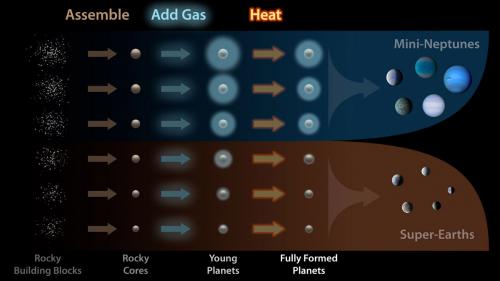
This diagram illustrates how planets are assembled and sorted into two distinct size classes. First, the rocky cores of planets are formed from smaller pieces. Then, the gravity of the planets attracts hydrogen and helium gas. Finally, the planets are "baked" by the starlight and lose some gas. The Magellan-TESS Survey aims to understand in more detail how the formation pathways for super-Earths and mini-Neptunes may differ. Credit: NASA/Kepler/Caltech (R. Hurt).


Artist’s conception of the Transiting Exoplanets Satellite Survey, or TESS, (left) which identified the planet candidates studied by the MTS team. Illustration is courtesy of NASA's Goddard Space Flight Center. Magellan Clay telescope at Carnegie’s Las Campanas Observatory (right), where the Planet Finder Spectrograph is used by the survey team and others. Photo by Yuri Beletsky, courtesy of the Carnegie Institution for Science.

Washington, DC—A Carnegie-led survey of exoplanet candidates identified by NASA’s Transiting Exoplanets Satellite Survey (TESS) is laying the groundwork to help astronomers understand how the Milky Way’s most common planets formed and evolved, and determine why our Solar System’s pattern of planetary orbits and sizes is so unusual.

Carnegie’s Johanna Teske, Tsinghua University’s Sharon Wang (formerly of Carnegie), and Angie Wolfgang (formerly of Penn State University and now at SiteZeus), headed up the Magellan-TESS Survey (MTS), which is halfway through its three-year planned duration. Their mid-survey findings, in collaboration with a large, international group of researchers, will be published in the Astrophysical Journal Supplement Series.

NASA’s Kepler Mission revealed that our galaxy is teeming with planets—discovering thousands of confirmed worlds and predicting that billions more exist. One of the surprises contained in this bounty is that exoplanets between the size of Earth and Neptune are the most common discovered so far, despite the fact that none exist in our own Solar System. These “in between” planets appear to come in two distinct sizes—roughly one to 1.7 (super-Earths) and roughly two to three (mini-Neptunes) times the size of the Earth—indicating different gas content in their compositions.

“We want to understand whether super-Earths and mini-Neptunes were distinct from their earliest origins, or whether some aspect of their evolution made them deviate from each other,” Teske explained. “In a sense, we are hoping to probe the nature-nurture question for the galaxy’s most common exoplanets—were these planets born differently, or did they diverge due to their environment? Or is it something in between?”

The survey is using TESS data and observations from the Magellan telescopes at Carnegie’s Las Campanas Observatory in Chile to study a selection of 30 small, relatively short-period planet candidates. The TESS data show dips in brightness when an object passes in front of its host star. The amount of dimming allows the survey team to measure the radius of a planet candidate. This information is combined with observations gathered by the Planet Finder Spectrograph at Las Campanas that works by using a technique called the radial velocity method, which is currently the most common way for astronomers to measure the masses of individual planets.

The Magellan-TESS survey team is interested in the interplay between key variables that could help astronomers better characterize the formation pathways of super-Earth and mini-Neptune planets. They are looking for trends in the relationships between a planet’s mass and its radius; the properties of its host star, including composition and the amount of energy it radiates onto the planet; and the architecture of the planetary system of which it the planet a member.

“The underlying relationship between radius and mass for these small planets is crucial to figuring out their general compositions, via their overall density, as well as how much variation there is in their compositions,” explained Wolfgang. “Quantifying this relation will help us discern whether there is one formation pathway or multiple avenues.”

What sets this survey apart from prior work is its scope—the team designed the survey from the start to try to account for biases that could skew how the results are interpreted in a broader context. Their goal is to be able to draw robust conclusions about super-Earths and mini-Neptune planets as a population, versus just a collection of 30 individual objects.

The mid-survey findings, which represent a significant contribution to the number of small planets with known masses and radii, already hint at evidence for small observational selection biases that may have affected scientists’ work on mass measurements. The MTS could thus provide an important framework for future radial velocity studies of transiting planets.

Looking forward, the next half of the survey will focus on completing the sample—this paper contains 22 of the planned 30 candidates—as well as continuing to monitor all the systems for longer-period planets not detected by TESS to probe system architectures. Checking the influence of the host star composition is another next step, since past work has suggested that the compositions of planets may be related to those of the stars they orbit.

“We hope that gaining this multidimensional understanding will significantly improve our knowledge of exoplanet evolution, and perhaps explain why our own Solar System seems unusual,” Wang concluded.

Scientific Area: Earth & Planetary Science
Reference to Person: Johanna Teske
Reference to Department: Earth and Planets Laboratory


Monday, August 09, 2021

Huge Rings Around a Black Hole

V404 Cygni
Image credit: X-ray: NASA/CXC/U.Wisc-Madison/S. Heinz et al.; 
Optical/IR: Pan-STARRS

A spectacular set of rings around a black hole has been captured using NASA's Chandra X-ray Observatory and Neil Gehrels Swift Observatory. The X-ray images of the giant rings have revealed new information about dust located in our Galaxy, using a similar principle to the X-rays performed in doctor's offices and airports.

The black hole is part of a binary system called V404 Cygni, located about 7,800 light-years away from Earth. The black hole is actively pulling material away from a companion star — with about half the mass of the Sun — into a disk around the invisible object. This material glows in X-rays, so astronomers refer to these systems as "X-ray binaries."

On June 5 2015, Swift discovered a burst of X-rays from V404 Cygni. The burst created the high-energy rings from a phenomenon known as light echoes. Instead of sound waves bouncing off a canyon wall, the light echoes around V404 Cygni were produced when a burst of X-rays from the black hole system bounced off of dust clouds between V404 Cygni and Earth. Cosmic dust is not like household dust but is more like smoke, and consists of tiny, solid particles.

In a new composite image, X-rays from Chandra (light blue) have been combined with optical data from the Pan-STARRS telescope on Hawaii that show the stars in the field of view. The image contains eight separate concentric rings. Each ring is created by X-rays from V404 Cygni flares observed in 2015 that reflect off different dust clouds. (An artist's illustration explains how the rings seen by Chandra and Swift were produced. To simplify the graphic, the illustration shows only four rings instead of eight.)

The team analyzed 50 Swift observations made in 2015 between June 30 and August 25. Chandra observed the system on July 11 and 25. It was such a bright event that the operators of Chandra purposely placed V404 Cygni in between the detectors so that another bright burst would not damage the instrument.

The rings tell astronomers not only about the black hole's behavior, but also about the landscape between V404 Cygni and Earth. For example, the diameter of the rings in X-rays reveals the distances to the intervening dust clouds the light ricocheted off. If the cloud is closer to Earth, the ring appears to be larger and vice versa. The light echoes appear as narrow rings rather than wide rings or haloes because the X-ray burst lasted only a relatively short period of time.

The researchers also used the rings to probe the properties of the dust clouds themselves. The authors compared the X-ray spectra — that is, the brightness of X-rays over a range of wavelengths — to computer models of dust with different compositions. Different compositions of dust will result in different amounts of the lower energy X-rays being absorbed and prevented from being detected with Chandra. This is a similar principle to how different parts of our body or our luggage absorb different amounts of X-rays, giving information about their structure and composition.

The team determined that the dust most likely contains mixtures of graphite and silicate grains. In addition, by analyzing the inner rings with Chandra, they found that the densities of the dust clouds changes are not uniform in all directions. Previous studies have assumed that they did not.

This result is related to a similar finding of the X-ray binary Circinus X-1, which contains a neutron star rather than a black hole, published in a paper in the June 20, 2015, issue of The Astrophysical Journal, titled, "Lord of the Rings: A Kinematic Distance to Circinus X-1 from a Giant X-Ray Light Echo" (preprint). This study was also led by Sebastian Heinz.

The V404 Cygni results were led by the same astronomer, Sebastian Heinz of the University of Wisconsin in Madison. This paper was published in the July 1, 2016 issue of The Astrophysical Journal (preprint). The co-authors of the study are Lia Corrales (University of Michigan); Randall Smith (Center for Astrophysics | Harvard & Smithsonian); Niel Brandt (The Pennsylvania State University); Peter Jonker (Netherlands Institute for Space Research); Richard Plotkin (University of Nevada, Reno) and Joey Neilson (Villanova University). NASA's Marshall Space Flight Center manages the Chandra program. The Smithsonian Astrophysical Observatory's Chandra X-ray Center controls science from Cambridge, Massachusetts, and flight operations from Burlington, Massachusetts.

Read more from NASA's Chandra X-ray Observatory.

For more Chandra images, multimedia and related materials, visit: http://www.nasa.gov/chandra

Editor: Lee Mohon


Saturday, August 07, 2021

Tracking Down Diffuse Gamma Rays


The most prominent feature of the Fermi LAT 60-month sky map is the bright band of diffuse glow along the map’s center, within the central plane of the Milky Way galaxy. Credit: NASA/DOE/Fermi LAT Collaboration

The disk of the Milky Way glows with continuous emission of high-energy gamma-ray photons. Where does this diffuse emission come from? A new study suggests that we may be missing the complete picture.

Smashing Cosmic Rays

Roughly 80% of the gamma-ray photons detected by the Fermi LAT gamma-ray detector come from diffuse emission — emission produced in the plane of our galaxy that isn’t associated with specific sources. Scientists have identified speeding cosmic rays as the primary culprit: high-energy protons and atomic nuclei whiz through space at nearly the speed of light, slamming into the interstellar medium and producing byproducts of gamma rays, neutrinos, and more.

But does this picture tell the whole story? In a recent study, Nanjing University scientists Ruo-Yu Liu and Xiang-Yu Wang point out a possible concern with this model: if cosmic-ray collisions produce the galaxy’s diffuse gamma-ray emission … where are all the neutrinos?

Observations from this cosmic-ray observatory in Tibet reveal the diffuse gamma-ray emission in our galaxy’s disk
Credit: Institute of High Energy Physics of the Chinese Academy of Sciences

A Conflict from Missing Neutrinos

By modeling the interaction of galactic cosmic rays with the interstellar medium in the Milky Way, Liu and Wang illustrate the problem: in order to reproduce the spectrum of diffuse gamma-ray emission recently observed by detectors on the Tibetan Plateau, the cosmic-ray collisions would also produce a large number of neutrinos — so many, in fact, that they should be observable by detectors on Earth, like the IceCube neutrino observatory. The problem? Based on IceCube’s most recently released results, these predicted neutrinos aren’t there!

Since the neutrino and diffuse gamma-ray observations conflict, Liu and Wang argue, then the model must be missing something. The source of the seemingly diffuse gamma-ray emission from the galactic disk cannot only be cosmic-ray collisions with the interstellar medium. Instead, there must be a contribution from some additional source that produces high-energy gamma rays without also creating lots of neutrinos.

What is that source? The authors have found a potential culprit.


A grayscale infrared map of the Cygnus cocoon is overlaid here with colored gamma-ray data showing the excesses of high-energy photons. Credit: IFJ PAN / HAWC

Another Player

Of the highest-energy diffuse gamma-rays detected by the Tibet observatory, 40% come from a single region: the center of the Cygnus cocoon, a superbubble surrounding a site of massive star formation. Could this area be producing the extra gamma rays observed in the diffuse emission?

Liu and Wang describe several potential sources of gamma rays in the cocoon — like the massive star cluster Cygnus OB2, the supernova remnant γ Cygni, and a pulsar wind nebula — and demonstrate that, by adding contributions from these sources, they can successfully reproduce the diffuse gamma-ray emission we observe while not exceeding the upper limits on neutrino production set by the IceCube observations.

More exploration of this picture is still needed, but the authors’ work shows that we still plenty more to learn about the sources that produce high-energy particles in our galaxy!

Citation

“Origin of Galactic Sub-PeV Diffuse Gamma-Ray Emission: Constraints from High-energy Neutrino Observations,” Ruo-Yu Liu and Xiang-Yu Wang 2021 ApJL 914 L7. doi:10.3847/2041-8213/ac02c5 

By Susanna Kohler

Source: American Astronomical Society (AAS/Nova)


Friday, August 06, 2021

New ESO observations show rocky exoplanet has just half the mass of Venus

Artist’s impression of the L 98-59 planetary system
 
Comparison of the L 98-59 exoplanet system with the inner Solar System


Videos

A neighbouring planetary system reveals its secrets (ESOcast 242 Light)
 
Artist’s impression of L 98-59b
Artist’s impression of L 98-59b 
 
Artist’s impression of L 98-59c
Artist’s impression of L 98-59c 
 
Artist’s impression of L 98-59d
Artist’s impression of L 98-59d 
 
A “fly-to” the L 98-59 planetary system


A team of astronomers have used the European Southern Observatory’s Very Large Telescope (ESO’s VLT) in Chile to shed new light on planets around a nearby star, L 98-59, that resemble those in the inner Solar System. Amongst the findings are a planet with half the mass of Venus — the lightest exoplanet ever to be measured using the radial velocity technique — an ocean world, and a possible planet in the habitable zone.

"The planet in the habitable zone may have an atmosphere that could protect and support life,” says María Rosa Zapatero Osorio, an astronomer at the Centre for Astrobiology in Madrid, Spain, and one of the authors of the study published today in Astronomy & Astrophysics.

The results are an important step in the quest to find life on Earth-sized planets outside the Solar System. The detection of biosignatures on an exoplanet depends on the ability to study its atmosphere, but current telescopes are not large enough to achieve the resolution needed to do this for small, rocky planets. The newly studied planetary system, called L 98-59 after its star, is an attractive target for future observations of exoplanet atmospheres. Its orbits a star only 35 light-years away and has now been found to host rocky planets, like Earth or Venus, which are close enough to the star to be warm.

With the contribution of ESO’s VLT, the team was able to infer that three of the planets may contain water in their interiors or atmospheres. The two planets closest to the star in the L 98-59 system are probably dry, but might have small amounts of water, while up to 30% of the third planet’s mass could be water, making it an ocean world.

Furthermore, the team found “hidden” exoplanets that had not previously been spotted in this planetary system. They discovered a fourth planet and suspect there is a fifth, in a zone at the right distance from the star for liquid water to exist on its surface. “We have hints of the presence of a terrestrial planet in the habitable zone of this system,” explains Olivier Demangeon, a researcher at the Instituto de Astrofísica e Ciências do Espaço, University of Porto in Portugal and lead author of the new study.

The study represents a technical breakthrough, as astronomers were able to determine, using the radial velocity method, that the innermost planet in the system has just half the mass of Venus. This makes it the lightest exoplanet ever measured using this technique, which calculates the wobble of the star caused by the tiny gravitational tug of its orbiting planets.

The team used the Echelle SPectrograph for Rocky Exoplanets and Stable Spectroscopic Observations (ESPRESSO) instrument on ESO’s VLT to study L 98-59. “Without the precision and stability provided by ESPRESSO this measurement would have not been possible,” says Zapatero Osorio. “This is a step forward in our ability to measure the masses of the smallest planets beyond the Solar System.”

The astronomers first spotted three of L 98-59’s planets in 2019, using NASA’s Transiting Exoplanet Survey Satellite (TESS). This satellite relies on a technique called the transit method — where the dip in the light coming from the star caused by a planet passing in front of it is used to infer the properties of the planet — to find the planets and measure their sizes. However, it was only with the addition of radial velocity measurements made with ESPRESSO and its predecessor, the High Accuracy Radial velocity Planet Searcher (HARPS) at the ESO La Silla 3.6-metre telescope, that Demangeon and his team were able to find extra planets and measure the masses and radii of the first three. “If we want to know what a planet is made of, the minimum that we need is its mass and its radius,” Demangeon explains.

The team hopes to continue to study the system with the forthcoming NASA/ESA/CSA James Webb Space Telescope (JWST), while ESO’s Extremely Large Telescope (ELT), under construction in the Chilean Atacama Desert and set to start observations in 2027, will also be ideal for studying these planets. “The HIRES instrument on the ELT may have the power to study the atmospheres of some of the planets in the L 98-59 system, thus complementing the JWST from the ground,” says Zapatero Osorio.

“This system announces what is to come,” adds Demangeon. “We, as a society, have been chasing terrestrial planets since the birth of astronomy and now we are finally getting closer and closer to the detection of a terrestrial planet in the habitable zone of its star, of which we could study the atmosphere.”


More Information

This research was presented in a paper entitled “A warm terrestrial planet with half the mass of Venus transiting a nearby star” to appear in Astronomy & Astrophysics (doi: 10.1051/0004-6361/202140728).

The team is composed of Olivier D. S. Demangeon (Instituto de Astrofísica e Ciências do Espaço, Universidade do Porto, Portugal [IA/UPorto], Centro de Astrofísica da Universidade do Porto, Portugal [CAUP] and Departamento de Física e Astronomia, Faculdade de Ciências, Universidade do Porto, Portugal [FCUP]), M. R. Zapatero Osorio (Centro de Astrobiología, Madrid, Spain [CSIC-INTA]), Y. Alibert (Physics Institute, University of Bern, Switzerland [Bern]), S. C. C. Barros (IA/UPorto, CAUP and FCUP), V. Adibekyan (IA/UPorto, CAUP and FCUP), H. M. Tabernero (IA/UPorto and CAUP), A. Antoniadis-Karnavas (IA/UPorto & FCUP), J. D. Camacho (IA/UPorto & FCUP), A. Suárez Mascareño (Instituto de Astrofísica de Canarias, Tenerife, Spain [IAC] and Departamento de Astrofísica, Universidad de La Laguna, Tenerife, Spain [ULL]), M. Oshagh (IAC/ULL), G. Micela (INAF – Osservatorio Astronomico di Palermo, Palermo, Italy), S. G. Sousa (IA/UPortol & CAUP), C. Lovis (Observatoire de Genève, Université de Genève, Geneva, Switzerland [UNIGE]), F. A. Pepe (UNIGE), R. Rebolo (IAC/ULL & Consejo Superior de Investigaciones Científicas, Spain), S. Cristiani (INAF – Osservatorio Astronomico di Trieste, Italy [INAF Trieste]), N. C. Santos (IA/UPorto, CAUP and FCUP), R. Allart (Department of Physics and Institute for Research on Exoplanets, Université de Montréal, Canada and UNIGE), C. Allende Prieto (IAC/ULL), D. Bossini (IA/UPorto), F. Bouchy (UNIGE), A. Cabral (Instituto de Astrofísica e Ciências do Espaço, Faculdade de Ciências da Universidade de Lisboa, Portugal [IA/FCUL] and Departamento de Física da Faculdade de Ciências da Universidade de Lisboa, Portugal), M. Damasso (INAF – Osservatorio Astrofisico di Torino, Italy [INAF Torino]), P. Di Marcantonio (INAF Trieste), V. D’Odorico (INAF Trieste & Institute for Fundamental Physics of the Universe, Trieste, Italy [IFPU]), D. Ehrenreich (UNIGE), J. Faria (IA/UPorto, CAUP and FCUP), P. Figueira (European Southern Observatory, Santiago de Chile, Chile [ESO-Chile] and IA/UPorto), R. Génova Santos (IAC/ULL), J. Haldemann (Bern), J. I. González Hernández (IAC/ULL), B. Lavie (UNIGE), J. Lillo-Box (CSIC-INTA), G. Lo Curto (European Southern Observatory, Garching bei München, Germany [ESO]), C. J. A. P. Martins (IA/UPorto and CAUP), D. Mégevand (UNIGE), A. Mehner (ESO-Chile), P. Molaro (INAF Trieste and IFPU), N. J. Nunes (IA/FCUL), E. Pallé (IAC/ULL), L. Pasquini (ESO), E. Poretti (Fundación G. Galilei – INAF Telescopio Nazionale Galileo, La Palma, Spain and INAF – Osservatorio Astronomico di Brera, Italy), A. Sozzetti (INAF Torino), and S. Udry (UNIGE).

ESO is the foremost intergovernmental astronomy organisation in Europe and the world’s most productive ground-based astronomical observatory by far. It has 16 Member States: Austria, Belgium, the Czech Republic, Denmark, France, Finland, Germany, Ireland, Italy, the Netherlands, Poland, Portugal, Spain, Sweden, Switzerland and the United Kingdom, along with the host state of Chile and with Australia as a Strategic Partner. ESO carries out an ambitious programme focused on the design, construction and operation of powerful ground-based observing facilities enabling astronomers to make important scientific discoveries. ESO also plays a leading role in promoting and organising cooperation in astronomical research. ESO operates three unique world-class observing sites in Chile: La Silla, Paranal and Chajnantor. At Paranal, ESO operates the Very Large Telescope and its world-leading Very Large Telescope Interferometer as well as two survey telescopes, VISTA working in the infrared and the visible-light VLT Survey Telescope. Also at Paranal ESO will host and operate the Cherenkov Telescope Array South, the world’s largest and most sensitive gamma-ray observatory. ESO is also a major partner in two facilities on Chajnantor, APEX and ALMA, the largest astronomical project in existence. And on Cerro Armazones, close to Paranal, ESO is building the 39-metre Extremely Large Telescope, the ELT, which will become “the world’s biggest eye on the sky”.


Links


Contacts

Olivier Demangeon
Instituto de Astrofisica e Ciências do Espaço, Faculdade de Ciências, Universidade do Porto
Porto, Portugal
Tel: +351 226 089 855
Email:
olivier.demangeon@astro.up.pt

María Rosa Zapatero Osorio
Chair of the “Atmospheric Characterisation” working group of the ESPRESSO science team at Centro de Astrobiología (CSIC-INTA)
Madrid, Spain
Tel: +34 9 15 20 64 27
Email:
mosorio@cab.inta-csic.es

Nuno Santos
Instituto de Astrofisica e Ciências do Espaço, Faculdade de Ciências, Universidade do Porto
Porto, Portugal
Email:
nuno.santos@astro.up.pt

François Bouchy
Member of the “Transiting planets” working group of the ESPRESSO science team at Université de Genève
Genève, Switzerland
Tel: +41 22 379 24 60
Email:
Francois.Bouchy@unige.ch

Alejandro Suárez Mascareño
Instituto de Astrofísica de Canarias
Tenerife, Spain
Tel: +34 658 778 954
Email:
asm@iac.es

Mario Damasso
INAF – Osservatorio Astrofisico di Torino
Turin, Italy
Tel: +39 339 1816786
Email:
mario.damasso@inaf.it

Pedro Figueira
Astronomer at ESO and Instituto de Astrofísica e Ciências do Espaço, instrument scientist of ESPRESSO
Santiago, Chile
Tel: +56 2 2463 3074
Email:
pedro.figueira@eso.org

Bárbara Ferreira
ESO Media Manager
Garching bei München, Germany
Tel: +49 89 3200 6670
Cell: +49 151 241 664 00
Email:
press@eso.org

Source: ESO/News


Thursday, August 05, 2021

Stars Are Exploding in Dusty Galaxies. We Just Can’t Always See Them


The image shows galaxy Arp 148, captured by NASA's Spitzer and Hubble telescopes. Specially processed Spitzer data is shown inside the white circle, revealing infrared light from a supernova hidden by dust. Credit: NASA/JPL-Caltech.
 Full Image Details

Download this free poster from NASA, which commemorates the retired Spitzer Space Telescope
Available in English and Spanish. Credit: NASA/JPL-Caltech

Exploding stars generate dramatic light shows. Infrared telescopes like Spitzer can see through the haze and to give a better idea of how often these explosions occur. You’d think that supernovae – the death throes of massive stars and among the brightest, most powerful explosions in the universe – would be hard to miss. Yet the number of these blasts observed in the distant parts of the universe falls way short of astrophysicists’ predictions.

A new study using data from NASA’s recently retired Spitzer Space Telescope reports the detection of five supernovae that, going undetected in optical light, had never been seen before. Spitzer saw the universe in infrared light, which pierces through dust clouds that block optical light – the kind of light our eyes see and that unobscured supernovae radiate most brightly.

To search for hidden supernovae, the researchers looked at Spitzer observations of 40 dusty galaxies. (In space, dust refers to grain-like particles with a consistency similar to smoke.) Based on the number they found in these galaxies, the study confirms that supernovae do indeed occur as frequently as scientists expect them to. This expectation is based on scientists’ current understanding of how stars evolve. Studies like this are necessary to improve that understanding, by either reinforcing or challenging certain aspects of it.

“These results with Spitzer show that the optical surveys we’ve long relied on for detecting supernovae miss up to half of the stellar explosions happening out there in the universe,” said Ori Fox, a scientist at the Space Telescope Science Institute in Baltimore, Maryland, and lead author of the new study, published in the Monthly Notices of the Royal Astronomical Society. “It’s very good news that the number of supernovae we’re seeing with Spitzer is statistically consistent with theoretical predictions.”

The “supernova discrepancy” – that is, the inconsistency between the number of predicted supernovae and the number observed by optical telescopes – is not an issue in the nearby universe. There, galaxies have slowed their pace of star formation and are generally less dusty. In the more distant reaches of the universe, though, galaxies appear younger, produce stars at higher rates, and tend to have higher amounts of dust. This dust absorbs and scatters optical and ultraviolet light, preventing it from reaching telescopes. So researchers have long reasoned that the missing supernovae must exist and are just unseen.

“Because the local universe has calmed down a bit since its early years of star-making, we see the expected numbers of supernovae with typical optical searches,” said Fox. “The observed supernova-detection percentage goes down, however, as you get farther away and back to cosmic epochs where dustier galaxies dominated.”

Detecting supernovae at these far distances can be challenging. To perform a search for supernovae shrouded within murkier galactic realms but at less extreme distances, Fox’s team selected a local set of 40 dust-choked galaxies, known as luminous and ultra-luminous infrared galaxies (LIRGs and ULIRGs, respectively). The dust in LIRGs and ULIRGs absorbs optical light from objects like supernovae but allows infrared light from these same objects to pass through unobstructed for telescopes like Spitzer to detect.

The researchers’ hunch proved correct when the five never-before-seen supernovae came to (infrared) light. “It’s a testament to Spitzer’s discovery potential that the telescope was able to pick up the signal of hidden supernovae from these dusty galaxies,” said Fox.

“It was especially fun for several of our undergraduate students to meaningfully contribute to this exciting research,” added study co-author Alex Filippenko, a professor of astronomy at the University of California, Berkeley. “They helped answer the question, ‘Where have all the supernovae gone?’”

The types of supernovae detected by Spitzer are known as “core-collapse supernovae,” involving giant stars with at least eight times the mass of the Sun. As they grow old and their cores fill with iron, the big stars can no longer produce enough energy to withstand their own gravity, and their cores collapse, suddenly and catastrophically.

The intense pressures and temperatures produced during the rapid cave-in forms new chemical elements via nuclear fusion. The collapsing stars ultimately rebound off their ultra-dense cores, blowing themselves to smithereens and scattering those elements throughout space. Supernovae produce “heavy” elements, such as most metals. Those elements are necessary for building up rocky planets, like Earth, as well as biological beings. Overall, supernova rates serve as an important check on models of star formation and the creation of heavy elements in the universe.

“If you have a handle on how many stars are forming, then you can predict how many stars will explode,” said Fox. “Or, vice versa, if you have a handle on how many stars are exploding, you can predict how many stars are forming. Understanding that relationship is critical for many areas of study in astrophysics.”

Next-generation telescopes, including NASA’s Nancy Grace Roman Space Telescope and the James Webb Space Telescope, will detect infrared light, like Spitzer.

“Our study has shown that star formation models are more consistent with supernova rates than previously thought,” said Fox. “And by revealing these hidden supernovae, Spitzer has set the stage for new kinds of discoveries with the Webb and Roman space telescopes.”

More About the Mission

NASA’s Jet Propulsion Laboratory in Southern California conducted mission operations and managed the Spitzer Space Telescope mission for the agency’s Science Mission Directorate in Washington. Science operations were conducted at the Spitzer Science Center at Caltech in Pasadena. Spacecraft operations were based at Lockheed Martin Space in Littleton, Colorado. Data are archived at the Infrared Science Archive housed at IPAC at Caltech. Caltech manages JPL for NASA.

More information about Spitzer is available at: https://www.nasa.gov/mission_pages/spitzer/main

News Media Contact

Calla Cofield
Jet Propulsion Laboratory, Pasadena, Calif.
626-808-2469

calla.e.cofield@jpl.nasa.gov

Written by Adam Hadhazy


Wednesday, August 04, 2021

NASA Model Describes Nearby Star which Resembles Ours in its Youth


A view of the Sun from the Extreme ultraviolet Imaging Telescope on ESA/NASA's Solar and Heliospheric Observatory, or SOHO. Credits: ESA/NASA

New research led by NASA provides a closer look at a nearby star thought to resemble our young Sun. The work allows scientists to better understand what our Sun may have been like when it was young, and how it may have shaped the atmosphere of our planet and the development of life on Earth.

Many people dream of meeting with a younger version of themselves to exchange advice, identify the origins of their defining traits, and share hopes for the future. At 4.65 billion years old, our Sun is a middle-aged star. Scientists are often curious to learn exactly what properties enabled our Sun, in its younger years, to support life on nearby Earth.

Illustration of what the Sun may have been like 4 billion years ago, around the time life developed on Earth
Credits: NASA's Goddard Space Flight Center/Conceptual Image Lab

Without a time machine to transport scientists back billions of years, retracing our star’s early activity may seem an impossible feat. Luckily, in the Milky Way galaxy – the glimmering, spiraling segment of the universe where our solar system is located – there are more than 100 billion stars. One in ten share characteristics with our Sun, and many are in the early stages of development.

“Imagine I want to reproduce a baby picture of an adult when they were one or two years old, and all of their pictures were erased or lost. I would look at a photo of them now, and their close relatives’ photos from around that age, and from there, reconstruct their baby photos,” said Vladimir Airapetian, senior astrophysicist in the Heliophysics Division at NASA’s Goddard Space Flight Center in Greenbelt, Maryland, and first author on the new study. “That’s the sort of process we are following here – looking at characteristics of a young star similar to ours, to better understand what our own star was like in its youth, and what allowed it to foster life on one of its nearby planets.”

Kappa 1 Ceti is one such solar analogue. The star is located about 30 light-years away (in space terms, that’s like a neighbor who lives on the next street over) and is estimated to be between 600 to 750 million years old, around the same age our Sun was when life developed on Earth. It also has a similar mass and surface temperature to our Sun, said the study’s second author, Meng Jin, a heliophysicist with the SETI Institute and the Lockheed Martin Solar and Astrophysics Laboratory in California. All of those factors make Kappa 1 Ceti a “twin” of our young Sun at the time when life arose on Earth, and an important target for study.

Airapetian, Jin, and several colleagues have adapted an existing solar model to predict some of Kappa 1 Ceti’s most important, yet difficult to measure, characteristics. The model relies on data input from a variety of space missions including the NASA/ESA Hubble Space Telescope, NASA’s Transiting Exoplanet Survey Satellite and NICER missions, and ESA’s XMM-Newton. The team published their study today in The Astrophysical Journal.

Star Power

Like human toddlers, toddler stars are known for their high bursts of energy and activity. For stars, one way this pent-up energy is released is in the form of a stellar wind.

Stellar winds, like stars themselves, are mostly made up of a superhot gas known as plasma, created when particles in a gas have split into positively charged ions and negatively charged electrons. The most energetic plasma, with the help of a star’s magnetic field, can shoot off away from the outermost and hottest part of a star’s atmosphere, the corona, in an eruption, or stream more steadily toward nearby planets as stellar wind. “Stellar wind is continuously flowing out from a star toward its nearby planets, influencing those planets’ environments,” Jin said.

Younger stars tend to generate hotter, more vigorous stellar winds and more powerful plasma eruptions than older stars do. Such outbursts can affect the atmosphere and chemistry of planets nearby, and possibly even catalyze the development of organic material – the building blocks for life – on those planets.

Stellar wind can have a significant impact on planets at any stage of life. But the strong, highly dense stellar winds of young stars can compress the protective magnetic shields of surrounding planets, making them even more susceptible to the effects of the charged particles.

An artist concept of a coronal mass ejection hitting young Earth's weak magnetosphere.
Credits: NASA/GSFC/CIL

Our Sun is a perfect example. Compared to now, in its toddlerhood, our Sun likely rotated three times faster, had a stronger magnetic field, and shot out more intense high-energy radiation and particles. These days, for lucky spectators, the impact of these particles is sometimes visible near the planet’s poles as aurora, or the Northern and Southern Lights. Airapetian says 4 billion years ago, considering the impact of our Sun’s wind at that time, these tremendous lights were likely often visible from many more places around the globe.

That high level of activity in our Sun’s nascence may have pushed back Earth’s protective magnetosphere, and provided the planet – not close enough to be torched like Venus, nor distant enough to be neglected like Mars – with the right atmospheric chemistry for the formation of biological molecules.

Similar processes could be unfolding in stellar systems across our galaxy and universe.

“It’s my dream to find a rocky exoplanet in the stage that our planet was in more than 4 billion years ago, being shaped by its young, active star and nearly ready to host life,” Airapetian said. “Understanding what our Sun was like just as life was beginning to develop on Earth will help us to refine our search for stars with exoplanets that may eventually host life.”

A Solar Twin 

Though solar analogues can help solve one of the challenges of peeking into the Sun’s past, time isn’t the only complicating factor in studying our young Sun. There’s also distance.

We have instruments capable of accurately measuring the stellar wind from our own Sun, called the solar wind. However, it’s not yet possible to directly observe the stellar wind of other stars in our galaxy, like Kappa 1 Ceti, because they are too far away.

When scientists wish to study an event or phenomenon that they cannot directly observe, scientific modeling can help fill in the gaps. Models are representations or predictions of an object of study, built on existing scientific data. While scientists have previously modeled the stellar wind from this star, Airapetian said, they used more simplified assumptions.

The basis for the new model of Kappa 1 Ceti by Airapetian, Jin, and colleagues is the Alfvén Wave Solar Model, which is within the Space Weather Modeling Framework developed by the University of Michigan. The model works by inputting known information about a star, including its magnetic field and ultraviolet emission line data, to predict stellar wind activity. When the model has been tested on our Sun, it has been validated and checked against observed data to verify that its predictions are accurate.

“It’s capable of modeling our star’s winds and corona with high fidelity,” Jin said. “And it’s a model we can use on other stars, too, to predict their stellar wind and thereby investigate habitability. That’s what we did here.”

Previous studies have drawn on data gathered by the Transiting Exoplanet Survey Satellite (TESS) and Hubble Space Telescope (HST) to identify Kappa 1 Ceti as a young solar proxy, and to gather the necessary inputs for the model, such as magnetic field and ultraviolet emission line data.


The hot stellar corona, the outermost layer in a star's atmosphere, expands into the stellar wind, driven by heating from the star’s magnetic field and magnetic waves. The researchers modeled the stellar magnetic corona of Kappa 1 Ceti in 3D, based on data from 2012 and 2013.  Credits: NASA .
Video

“Every model needs input to get output,” Airapetian said. “To get useful, accurate output, the input needs to be solid data, ideally from multiple sources across time. We have all that data from Kappa 1 Ceti, but we really synthesized it in this predictive model to move past previous purely observational studies of the star.”

Airapetian likens his team’s model to a doctor’s report. To get a full picture of how a patient is doing, a doctor is likely to talk to the patient, gather markers like heart rate and temperature, and if needed, conduct several more specialized tests, like a blood test or ultrasound. They are likely to formulate an accurate assessment of patient well-being with a combination of these metrics, not just one.

Similarly, by using many pieces of information about Kappa 1 Ceti gathered from different space missions, scientists are better able to predict its corona and the stellar wind. Because stellar wind can affect a nearby planet’s magnetic shield, it plays an important role in habitability. The team is also working on another project, looking more closely at the particles that may have emerged from early solar flares, as well as prebiotic chemistry on Earth.

Our Sun’s Past, Written in the Stars

The researchers hope to use their model to map the environments of other Sun-like stars at various life stages.

Specifically, they have eyes on the infant star EK Dra – 111 light-years away and only 100 million years old – which is likely rotating three times faster and shooting off more flares and plasma than Kappa 1 Ceti. Documenting how these similar stars of various ages differ from one another will help characterize the typical trajectory of a star’s life.

Their work, Airapetian said, is all about “looking at our own Sun, its past and its possible future, through the lens of other stars.”

To learn more about our Sun's stormy youth, watch this video and see how energy from our young Sun — 4 billion years ago — aided in creating molecules in Earth's atmosphere, allowing it to warm up enough to incubate life.

By Alison Gold
NASA’s Goddard Space Flight Center, Greenbelt, Md.

Editor: Denise Hill

Source: NASA/Sun