Showing posts with label massive star. Show all posts

Friday, February 13, 2026

Keck Observatory observations help constrain a long-predicted pathway for black hole formation

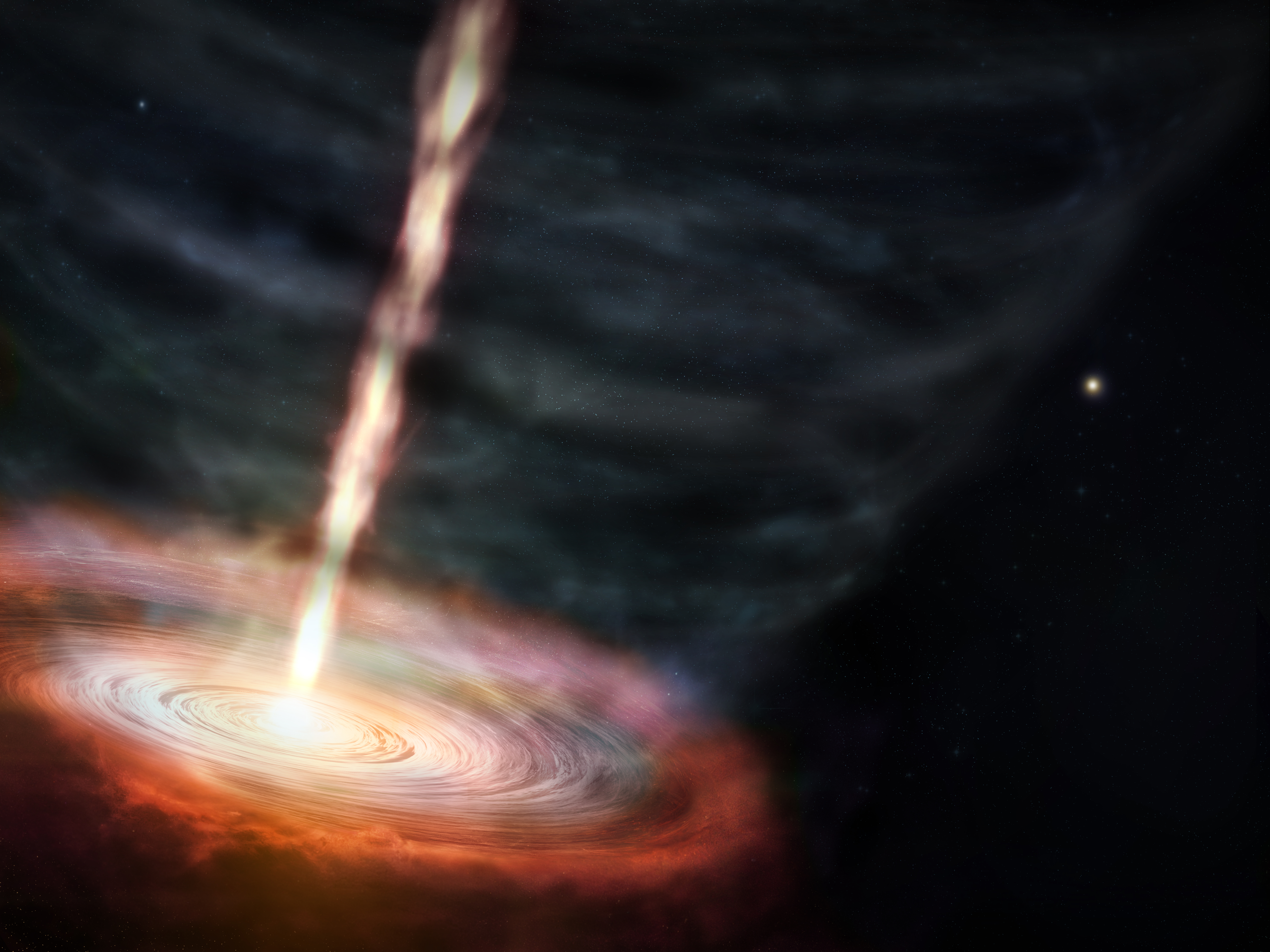
Birth of a black hole: These images and animation shows a shell of thick gas and dust (red) expelled from the outer layers of a star as its core collapsed into a black hole. The inner regions show a heated sphere of gas continuing to fall into the black hole that is hidden inside the hot gas. Credit: Keith Miller, Caltech/IPAC – SELab. Video


Maunakea, Hawaiʻi – Astronomers using W. M. Keck Observatory on Maunakea, Hawaiʻi Island contributed key observations to the identification of a rare stellar death in which a massive star appears to have collapsed directly into a black hole without first exploding as a supernova. The event occurred in the Andromeda galaxy and provides strong observational support for a long-theorized but rarely confirmed route to black hole formation.

The study, led by researchers at Columbia University, is published in today’s issue of the journal Science and combines archival space-based data with targeted ground-based follow-up observations from multiple observatories.

“This has probably been the most surprising discovery of my life,” said Kishalay De, professor of astronomy at Columbia University and lead author of the study. “The evidence of the disappearance of the star was lying in public archival data, and nobody noticed it for years until we picked it out.”

A quiet stellar death in Andromeda

The object, designated M31-2014-DS1, was a supergiant star located about 2.5 million light-years from Earth in the Andromeda galaxy. When it formed, the star was roughly 13 times the mass of the Sun. Over its lifetime, powerful stellar winds stripped away much of that mass, leaving it with about five times the mass of the Sun at the end of its life.

Archival observations from NASA’s NEOWISE mission revealed that the star gradually brightened in infrared light over several years before fading dramatically and disappearing from view. Unlike a typical supernova, the event showed no evidence of a powerful outward explosion. Instead, it left behind a shell of dust and a faint infrared glow.

“The dramatic and sustained fadig of this star is very unusual, and suggests a supernova failed to occur, leading to the collapse of the star’s core directly into a black hole,” De said.

Critical follow up from the ground

To better constrain the nature of the event, the team conducted follow-up observations using the Near-Infrared Echellette Spectrograph (NIRES) on the Keck II Telescope, with observing time awarded via the NASA-Keck partnership.

Prior to the Keck observations, there were no ground-based infrared spectra of the source at sufficient sensitivity to test whether the star had truly faded at infrared wavelengths.

NIRES is optimized for studying extremely faint infrared sources and isparticularly well suited to probing dusty stellar remnants. The data placed important limits on the temperature, composition, and evolution of the material left behind after the star disappeared, including faint emissio from material expelled by the star, helping rule out alternative explanations such as an unusual supernova or intrinsic stellar variability.

“It was only with Keck’s sensitivity in the near infrared that we could confirm the star had truly faded at all wavelengths,” De said. “Even with NIRES, the source was barely detected, which allowed us to rule out normal hints of stellar variability or dust obscuration and strengthened the case that the star had genuinely disappeared.”

The Keck observations were analyzed alongside data from space-based telescopes and other ground-based facilities as part of a coordinated, multi-wavelength campaign.

A Rare View into Direct Collapse

Astronomers have long known that black holes originate from massive stars, but direct observational evidence of that transformation has been scarce. While gravitational-wave detections have revealed black hole mergers across the universe, they do not show how those black holes initially formed.

Only one other candidate direct-collapse event has been reported previously, but it was significantly more distant and fainter, leaving its interpretation uncertain. The relative proximity of Andromeda and the quality of the available data make M31-2014-DS1 a particularly compelling case.

“We’ve known that black holes must come from stars,” said Morgan MacLeod, lecturer in astronomy at Harvard University and co-author of the study. “With events like this, we’re getting to watch it happen, and are learning a huge amount about how that process works along the way.”

Looking ahead

The findings suggest that direct collapse may be a more common outcome for massive stars than previously assumed. Future infrared surveys, combined with sensitive ground-based facilities like Keck Observatory, are expected to uncover additional examples and further clarify the physical conditions that determine how massive stars end their lives.


Related Links:


About NIRES

The Near-Infrared Echellette Spectrograph (NIRES) is a prism cross-dispersed near-infrared spectrograph built at the California Institute of Technology by a team led by Chief Instrument Scientist Keith Matthews and Prof. Tom Soifer. Commissioned in 2018, NIRES covers a large wavelength range at moderate spectral resolution for use on the Keck II telescope and observes extremely faint red objects found with the Spitzer and WISE infrared space telescopes, as well as brown dwarfs, high-redshift galaxies, and quasars. Support for this technology was generously provided by the Mt. Cuba Astronomical Foundation.

About W.M. Keck Observatory

The W. M. Keck Observatory telescopes are among the most scientifically productive on Earth. The two 10-meter optical/infrared telescopes atop Maunakea on the Island of Hawaiʻi feature a suite of advanced instruments including imagers, multi-object spectrographs, high-resolution spectrographs, integral-field spectrometers, and world-leading laser guide star adaptive optics systems. Some of the data presented herein were obtained at Keck Observatory, which is a private 501(c) 3 non-profit organization operated as a scientific partnership among the California Institute of Technology, the University of California, and the National Aeronautics and Space Administration. The Observatory was made possible by the generous financial support of the W. M. Keck Foundation. The authors wish to recognize and acknowledge the very significant cultural role and reverence that the summit of Maunakea has always had within the Native Hawaiian community. We are most fortunate to have the opportunity to conduct observations from this mountain. For more information, visit: www.keckobservatory.org

Monday, April 15, 2024

Beautiful nebula, violent history: clash of stars solves stellar mystery

PR Image eso2407a
The nebula (NGC 6164/6165) surrounding HD 148937 as seen in visible light

PR Image eso2407b
Artist's impression: the violent history of stellar pair HD 148937

PR Image eso2407c
Wide-field view of the region of the sky around the nebula NGC 6164/6165

PR Image eso2407d
The nebula NGC 6164/6165 in the constellation of Norma


Videos

Clash of stars solves stellar mystery | ESO News
PR Video eso2407a
Clash of stars solves stellar mystery | ESO News

Artist's animation: the violent history of stellar pair HD 148937
PR Video eso2407b
Artist's animation: the violent history of stellar pair HD 148937

Zooming in on the NGC 6164/6165 nebula surrounding the HD 148937 stellar pair
PR Video eso2407c
Zooming in on the NGC 6164/6165 nebula surrounding the HD 148937 stellar pair

3D view of the NGC 6164/6165 nebula surrounding the HD 148937 stellar pair
PR Video eso2407d
3D view of the NGC 6164/6165 nebula surrounding the HD 148937 stellar pair


When astronomers looked at a stellar pair at the heart of a stunning cloud of gas and dust, they were in for a surprise. Star pairs are typically very similar, like twins, but in HD 148937, one star appears younger and, unlike the other, is magnetic. New data from the European Southern Observatory (ESO) suggest there were originally three stars in the system, until two of them clashed and merged. This violent event created the surrounding cloud and forever altered the system’s fate.

“When doing background reading, I was struck by how special this system seemed,” says Abigail Frost, an astronomer at ESO in Chile and lead author of the study published today in Science. The system, HD 148937, is located about 3800 light-years away from Earth in the direction of the Norma constellation. It is made up of two stars much more massive than the Sun and surrounded by a beautiful nebula, a cloud of gas and dust. “A nebula surrounding two massive stars is a rarity, and it really made us feel like something cool had to have happened in this system. When looking at the data, the coolness only increased.”

“After a detailed analysis, we could determine that the more massive star appears much younger than its companion, which doesn't make any sense since they should have formed at the same time!” Frost says. The age difference — one star appears to be at least 1.5 million years younger than the other — suggests something must have rejuvenated the more massive star.

Another piece of the puzzle is the nebula surrounding the stars, known as NGC 6164/6165. It is 7500 years old, hundreds of times younger than both stars. The nebula also shows very high amounts of nitrogen, carbon and oxygen. This is surprising as these elements are normally expected deep inside a star, not outside; it is as if some violent event had set them free.

To unravel the mystery, the team assembled nine years' worth of data from the PIONIER and GRAVITY instruments, both on ESO’s Very Large Telescope Interferometer (VLTI), located in Chile’s Atacama Desert. They also used archival data from the FEROS instrument at ESO’s La Silla Observatory.

“We think this system had at least three stars originally; two of them had to be close together at one point in the orbit whilst another star was much more distant,” explains Hugues Sana, a professor at KU Leuven in Belgium and the principal investigator of the observations. “The two inner stars merged in a violent manner, creating a magnetic star and throwing out some material, which created the nebula. The more distant star formed a new orbit with the newly merged, now-magnetic star, creating the binary we see today at the centre of the nebula.”

“The merger scenario was already in my head back in 2017 when I studied nebula observations obtained with the European Space Agency’s Herschel Space Telescope,” adds co-author Laurent Mahy, currently a senior researcher at the Royal Observatory of Belgium. “Finding an age discrepancy between the stars suggests that this scenario is the most plausible one and it was only possible to show it with the new ESO data.”

This scenario also explains why one of the stars in the system is magnetic and the other is not — another peculiar feature of HD 148937 spotted in the VLTI data.

At the same time, it helps solve a long-standing mystery in astronomy: how massive stars get their magnetic fields. While magnetic fields are a common feature of low-mass stars like our Sun, more massive stars cannot sustain magnetic fields in the same way. Yet some massive stars are indeed magnetic.

Astronomers had suspected for some time that massive stars could acquire magnetic fields when two stars merge. But this is the first time researchers find such direct evidence of this happening. In the case of HD 148937, the merger must have happened recently. “Magnetism in massive stars isn't expected to last very long compared to the lifetime of the star, so it seems we have observed this rare event very soon after it happened,” Frost adds.

ESO’s Extremely Large Telescope (ELT), currently under construction in the Chilean Atacama Desert, will enable researchers to work out what happened in the system in more detail, and perhaps reveal even more surprises.

Source: ESO/News


More information

This research was presented in a paper entitled “A magnetic massive star has experienced a stellar merger” to appear in Science (www.science.org/doi/10.1126/science.adg7700). The paper will be published by Science in print on Friday, 12 April 2024, and will be released online at 14:00 U.S. Eastern Time Thursday (20:00 CEST), 11 April 2024. For the final version of the embargoed paper, please check https://www.eurekalert.org/press/scipak/ or contact scipak@aaas.org while the embargo lasts.

It has received funding from the European Research Council (ERC) under the European Union’s Horizon 2020 research and innovation programme (grant agreement number 772225: MULTIPLES; PI: Hugues Sana).

The team is composed of A. J. Frost (European Southern Observatory, Santiago, Chile [ESO Chile] and Institute of Astronomy, KU Leuven, Belgium [KU Leuven]), H. Sana (KU Leuven), L. Mahy (Royal Observatory of Belgium, Belgium and KU Leuven), G. Wade (Department of Physics & Space Science, Royal Military College of Canada, Canada [RMC Space Science]), J. Barron (Department of Physics, Engineering & Astronomy, Queen’s University, Canada and RMC Space Science), J.-B. Le Bouquin (Université Grenoble Alpes, Centre national de la Recherche Scientifique, Institute de Planétologie et d’Astrophyisique de Grenoble, France), A. Mérand (European Southern Observatory, Garching, Germany [ESO]), F. R. N. Schneider (Heidelberger Institut für Theoretische Studien, Germany and Astronomisches Rechen-Institut, Zentrum für Astronomie der Universität Heidelberg, Germany), T. Shenar (The School of Physics and Astronomy, Tel Aviv University, Israel and KU Leuven), R. H. Barbá (Departamento de Física y Astronomía, Universidad de La Serena, Chile), D. M. Bowman (School of Mathematics, Statistics and Physics, Newcastle University, UK and KU Leuven), M. Fabry (KU Leuven), A. Farhang (School of Astronomy, Institute for Research in Fundamental Sciences, Iran), P. Marchant (KU Leuven), N. I. Morrell (Las campanas Observatory, Carnegie Observatories, Chile) and J. V. Smoker (ESO Chile and UK Astronomy Technology centre, Royal Observatory, UK).

The European Southern Observatory (ESO) enables scientists worldwide to discover the secrets of the Universe for the benefit of all. We design, build and operate world-class observatories on the ground — which astronomers use to tackle exciting questions and spread the fascination of astronomy — and promote international collaboration for astronomy. Established as an intergovernmental organisation in 1962, today ESO is supported by 16 Member States (Austria, Belgium, Czechia, Denmark, France, Finland, Germany, Ireland, Italy, the Netherlands, Poland, Portugal, Spain, Sweden, Switzerland and the United Kingdom), along with the host state of Chile and with Australia as a Strategic Partner. ESO’s headquarters and its visitor centre and planetarium, the ESO Supernova, are located close to Munich in Germany, while the Chilean Atacama Desert, a marvellous place with unique conditions to observe the sky, hosts our telescopes. ESO operates three observing sites: La Silla, Paranal and Chajnantor. At Paranal, ESO operates the Very Large Telescope and its Very Large Telescope Interferometer, as well as survey telescopes such as VISTA. Also at Paranal ESO will host and operate the Cherenkov Telescope Array South, the world’s largest and most sensitive gamma-ray observatory. Together with international partners, ESO operates ALMA on Chajnantor, a facility that observes the skies in the millimetre and submillimetre range. At Cerro Armazones, near Paranal, we are building “the world’s biggest eye on the sky” — ESO’s Extremely Large Telescope. From our offices in Santiago, Chile we support our operations in the country and engage with Chilean partners and society.


Links


Contacts

Abigail Frost
European Southern Observatory
Santiago, Chile
Tel: +44 79 8353 9292
Email:
Abigail.Frost@eso.org

Hugues Sana
KU Leuven
Leuven, Belgium
Tel: +32 479 50 46 73
Email:
hugues.sana@kuleuven.be

Laurent Mahy
Royal Observatory of Belgium
Brussels, Belgium
Tel: +32 476 23 60 06
Email:
laurent.mahy@oma.be

Bárbara Ferreira
ESO Media Manager
Garching bei München, Germany
Tel: +49 89 3200 6670
Cell: +49 151 241 664 00
Email:
press@eso.org

Lê Binh San PHAM
Communication Officer, Royal Observatory of Belgium
Brussels, Belgium
Email:
lebinhsan.pham@oma.be


Tuesday, January 17, 2023

Hydrogen Masers Reveal New Secrets of a Massive Star to ALMA Scientists


Scientists studying masers— naturally occurring lasers that amplify microwave radio emissions— around the massive star MWC 349A discovered a 500 km/s jet of material launching out of the star’s gas disk from within the winds that are flowing away from the star. The bigger surprise is that the jet may be caused by magnetic forces. This artist’s conception shows a zoomed in view of MWC 349A and its surrounding disk of gas and dust that are being shaped by the winds and high-speed jet. Credit: ALMA (ESO/NAOJ/NRAO), M. Weiss (NRAO/AUI/NSF).
Hi-res File


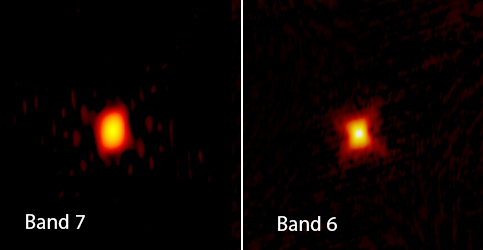
The massive star MWC 349A is one of the brightest radio sources in the sky. But, at 3,900 light-years away from Earth, scientists needed help to see what’s really going on, and in this case, to discover a jet of material blasting out from the star’s gas disk at 500 km/s. Previously hidden amongst the winds flowing out from the star, the jet was discovered using the combined resolving power of ALMA’s Band 6 (right) and Band 7 (left), and hydrogen masers— naturally occurring lasers that amplify microwave radio emissions, shown here in this ALMA science image. The revelation may help scientists to better understand the nature and evolution of massive stars. Credit: ALMA (ESO/NAOJ/NRAO), S. Prasad/CfA.
Hi-res File


Scientists used the unique hydrogen radio recombination lines on MWC 349A to reveal hidden collimated jets

While using the Atacama Large Millimeter/submillimeter Array (ALMA) to study the masers around oddball star MWC 349A scientists discovered something unexpected: a previously unseen jet of material launching from the star’s gas disk at impossibly high speeds. What’s more, they believe the jet is caused by strong magnetic forces surrounding the star. The discovery could help researchers to understand the nature and evolution of massive stars and how hydrogen masers are formed in space. The new observations were presented today in a press conference at the 241st meeting of the American Astronomical Society (AAS) in Seattle, Washington.

Located roughly 3,900 light-years away from Earth in the constellation Cygnus, MWC 349A’s unique features make it a hot spot for scientific research in optical, infrared, and radio wavelengths. The massive star— roughly 30 times the mass of the Sun— is one of the brightest radio sources in the sky, and one of only a handful of objects known to have hydrogen masers. These masers amplify microwave radio emissions, making it easier to study processes that are typically too small to see. It is this unique feature that allowed scientists to map MWC 349A’s disk in detail for the first time.

“A maser is like a naturally occurring laser,” said Sirina Prasad, an undergraduate research assistant at the Center for Astrophysics | Harvard & Smithsonian (CfA), and the primary author of the paper. “It’s an area in outer space that emits a really bright kind of light. We can see this light and trace it back to where it came from, bringing us one step closer to figuring out what’s really going on.” 

Leveraging the resolving power of ALMA’s Band 6, developed by the US National Science Foundation’s National Radio Astronomy Observatory (NRAO), the team was able to use the masers to uncover the previously unseen structures in the star’s immediate environment. Qizhou Zhang, a senior astrophysicist at CfA, and the project’s principal investigator added, “We used masers generated by hydrogen to probe the physical and dynamic structures in the gas surrounding MWC 349A and revealed a flattened gas disk with a diameter of 50 au, approximately the size of the Solar System, confirming the near-horizontal disk structure of the star. We also found a fast-moving jet component hidden within the winds flowing away from the star.” 

The observed jet is ejecting material away from the star at a blistering 500 km per second. That’s akin to traveling the distance between San Diego, California and Phoenix, Arizona in the literal blink of an eye. According to researchers, it is probable that a jet moving this fast is being launched by a magnetic force. In the case of MWC 349A, that force could be a magnetohydrodynamic wind— a type of wind whose movement is dictated by the interplay between the star’s magnetic field and gases present in its surrounding disk.

“Our previous understanding of MWC 349A was that the star was surrounded by a rotating disk and photo-evaporating wind. Strong evidence for an additional collimated jet had not yet been seen in this system. Although we don’t yet know for certain where it comes from or how it is made, it could be that a magnetohydrodynamic wind is producing the jet, in which case the magnetic field is responsible for launching rotating material from the system,” said Prasad. “This could help us to better understand the disk-wind dynamics of MWC 349A, and the interplay between circumstellar disks, winds, and jets in other star systems.”


About NRAO

The National Radio Astronomy Observatory (NRAO) is a facility of the National Science Foundation, operated under cooperative agreement by Associated Universities, Inc.</ div>

 About ALMA

The Atacama Large Millimeter/submillimeter Array (ALMA), an international astronomy facility, is a partnership of the European Organisation for Astronomical Research in the Southern Hemisphere (ESO), the U.S. National Science Foundation (NSF) and the National Institutes of Natural Sciences (NINS) of Japan in cooperation with the Republic of Chile. ALMA is funded by ESO on behalf of its Member States, by NSF in cooperation with the National Research Council of Canada (NRC) and the Ministry of Science and Technology (MOST) and by NINS in cooperation with the Academia Sinica (AS) in Taiwan and the Korea Astronomy and Space Science Institute (KASI).

ALMA construction and operations are led by ESO on behalf of its Member States; by the National Radio Astronomy Observatory (NRAO), managed by Associated Universities, Inc. (AUI), on behalf of North America; and by the National Astronomical Observatory of Japan (NAOJ) on behalf of East Asia. The Joint ALMA Observatory (JAO) provides the unified leadership and management of the construction, commissioning and operation of ALMA.


Media Contact:

Amy C. Oliver
Public Information Officer, ALMA
Public Information & News Manager, NRAO
+1 434 242 9584

aoliver@nrao.edu


Wednesday, January 26, 2022

Visualization explores a massive star's great eruption Eta Carinae: The Great Eruption of a Massive Star

 Eta Carinae: The Great Eruption of a Massive Star


A new astronomical visualization from NASA's Universe of Learning showcases the multiwavelength emissions (from infrared light through X-rays) and three-dimensional structures surrounding Eta Carinae, one of the most massive and eruptive stars in our galaxy. The video, "Eta Carinae: The Great Eruption of a Massive Star," is being released today on hubblesite.org and universe-of-learning.org

Eta Carinae, or Eta Car, is famous for a brilliant and unusual outburst, called the "Great Eruption," observed in the 1840s. This briefly made it one of the brightest stars in the night sky, releasing almost as much visible light as a supernova explosion.

The star survived the outburst, and slowly faded away for the next five decades. The primary cause of this brightness change is a small nebula of gas and dust, called the Homunculus Nebula, that was expelled during the blast, and has blocked the light of the star.

Observations using NASA's Hubble Space Telescope and Chandra X-ray Observatory reveal the details in visible, ultraviolet, and X-ray light. Astronomers and artists at the Space Telescope Science Institute (STScI) in Baltimore, Maryland have developed three-dimensional models to represent the hourglass shape of the Homunculus and the clouds of glowing gas that encompass it. The result is a stunning tour of the nested emissions that brings the 2D images to 3D life.

"The team did such an amazing job representing the volumetric layers that viewers can immediately and intuitively comprehend the complex structure around Eta Car," said Frank Summers, principal visualization scientist at STScI and project lead. "We can not only tell the story of the Great Eruption, but also showcase the resulting nebula in 3D."

In addition, Eta Car is extremely bright at infrared wavelengths, and its radiation impacts the much larger Carina Nebula where it resides. Working with NASA's Spitzer Space Telescope observations, the team was able to place Eta Car in context of the dazzling infrared view of the star-forming region.

"Spitzer's infrared image lets us peer through the dust that obscures our view in visible light to reveal the intricate details and extent of the Carina Nebula around this brilliant star," commented Robert Hurt, lead visualization scientist at Caltech/IPAC and team member.

Extending the goals of NASA's Universe of Learning, the visualization assets promote learning beyond the video sequence. "We can take these models like the one for Eta Car and use them in 3D printing and augmented reality programs," noted Kim Arcand, visualization lead scientist at the Chandra X-ray Center in Cambridge, Massachusetts. "This means more people can put their hands on the data – literally and virtually – and this makes for better learning and engagement."

Eta Carinae is one of the most massive stars known. These exceptional stars are prone to outbursts during their lives. They will end their lives by collapsing into a black hole, probably accompanied by a supernova explosion. Eta Car is one of the nearest and best studied examples for learning about the energetic life and death of very massive stars.

Want to learn more? The visualization video and extensive related resources, which will include an upcoming Universe of Learning online live chat with Summers about the visualization, can be found at https://universeunplugged.ipac.caltech.edu/video/astroviz-eta-car .

NASA's Universe of Learning is part of the NASA Science Activation program. The Science Activation program connects NASA science experts, real content and experiences, and community leaders in a way that activates minds and promotes deeper understanding of our world and beyond. Using its direct connection to the science and the experts behind the science, NASA's Universe of Learning provides resources and experiences that enable youth, families, and lifelong learners to explore fundamental questions in science, experience how science is done, and discover the universe for themselves.

NASA's Universe of Learning materials are based upon work supported by NASA under cooperative agreement award number NNX16AC65A to the Space Telescope Science Institute, working in partnership with Caltech/IPAC, Center for Astrophysics | Harvard & Smithsonian, and Jet Propulsion Laboratory.

Credits:

Media Contact:

Ray Villard
Space Telescope Science Institute, Baltimore, Maryland

Science Contact:

Frank Summers
Space Telescope Science Institute, Baltimore, Maryland


Contact Us:

Direct inquiries to the
News Team.

Related Links and Documents:  NASA's Universe of Learning portal

Saturday, August 07, 2021

Tracking Down Diffuse Gamma Rays


The most prominent feature of the Fermi LAT 60-month sky map is the bright band of diffuse glow along the map’s center, within the central plane of the Milky Way galaxy. Credit: NASA/DOE/Fermi LAT Collaboration

The disk of the Milky Way glows with continuous emission of high-energy gamma-ray photons. Where does this diffuse emission come from? A new study suggests that we may be missing the complete picture.

Smashing Cosmic Rays

Roughly 80% of the gamma-ray photons detected by the Fermi LAT gamma-ray detector come from diffuse emission — emission produced in the plane of our galaxy that isn’t associated with specific sources. Scientists have identified speeding cosmic rays as the primary culprit: high-energy protons and atomic nuclei whiz through space at nearly the speed of light, slamming into the interstellar medium and producing byproducts of gamma rays, neutrinos, and more.

But does this picture tell the whole story? In a recent study, Nanjing University scientists Ruo-Yu Liu and Xiang-Yu Wang point out a possible concern with this model: if cosmic-ray collisions produce the galaxy’s diffuse gamma-ray emission … where are all the neutrinos?

Observations from this cosmic-ray observatory in Tibet reveal the diffuse gamma-ray emission in our galaxy’s disk
Credit: Institute of High Energy Physics of the Chinese Academy of Sciences

A Conflict from Missing Neutrinos

By modeling the interaction of galactic cosmic rays with the interstellar medium in the Milky Way, Liu and Wang illustrate the problem: in order to reproduce the spectrum of diffuse gamma-ray emission recently observed by detectors on the Tibetan Plateau, the cosmic-ray collisions would also produce a large number of neutrinos — so many, in fact, that they should be observable by detectors on Earth, like the IceCube neutrino observatory. The problem? Based on IceCube’s most recently released results, these predicted neutrinos aren’t there!

Since the neutrino and diffuse gamma-ray observations conflict, Liu and Wang argue, then the model must be missing something. The source of the seemingly diffuse gamma-ray emission from the galactic disk cannot only be cosmic-ray collisions with the interstellar medium. Instead, there must be a contribution from some additional source that produces high-energy gamma rays without also creating lots of neutrinos.

What is that source? The authors have found a potential culprit.


A grayscale infrared map of the Cygnus cocoon is overlaid here with colored gamma-ray data showing the excesses of high-energy photons. Credit: IFJ PAN / HAWC

Another Player

Of the highest-energy diffuse gamma-rays detected by the Tibet observatory, 40% come from a single region: the center of the Cygnus cocoon, a superbubble surrounding a site of massive star formation. Could this area be producing the extra gamma rays observed in the diffuse emission?

Liu and Wang describe several potential sources of gamma rays in the cocoon — like the massive star cluster Cygnus OB2, the supernova remnant γ Cygni, and a pulsar wind nebula — and demonstrate that, by adding contributions from these sources, they can successfully reproduce the diffuse gamma-ray emission we observe while not exceeding the upper limits on neutrino production set by the IceCube observations.

More exploration of this picture is still needed, but the authors’ work shows that we still plenty more to learn about the sources that produce high-energy particles in our galaxy!

Citation

“Origin of Galactic Sub-PeV Diffuse Gamma-Ray Emission: Constraints from High-energy Neutrino Observations,” Ruo-Yu Liu and Xiang-Yu Wang 2021 ApJL 914 L7. doi:10.3847/2041-8213/ac02c5 

By Susanna Kohler

Source: American Astronomical Society (AAS/Nova)