Radio image of the S-shaped precessing jet launched by the neutron star in
Circinus X-1. Both Cir X-1 itself (centre of the image) and a background
source have been subtracted from the image to make the S-shape clearer.
The jets are fast, narrow flows of material outwards from Cir X-1. The
size of the jets against the sky is the same apparent size as a penny
viewed from 100 metres away, but their real size is greater than five
light-years. Credit:Fraser Cowie
Licence type: Attribution (CC BY 4.0)A strange 'garden sprinkler-like' jet coming from a neutron star has been pictured for the first time.
The S-shaped structure is created as the jet changes direction due to the wobbling of the disc of hot gas around the star – a process called precession, which has been observed with black holes but, until now, never with neutron stars.
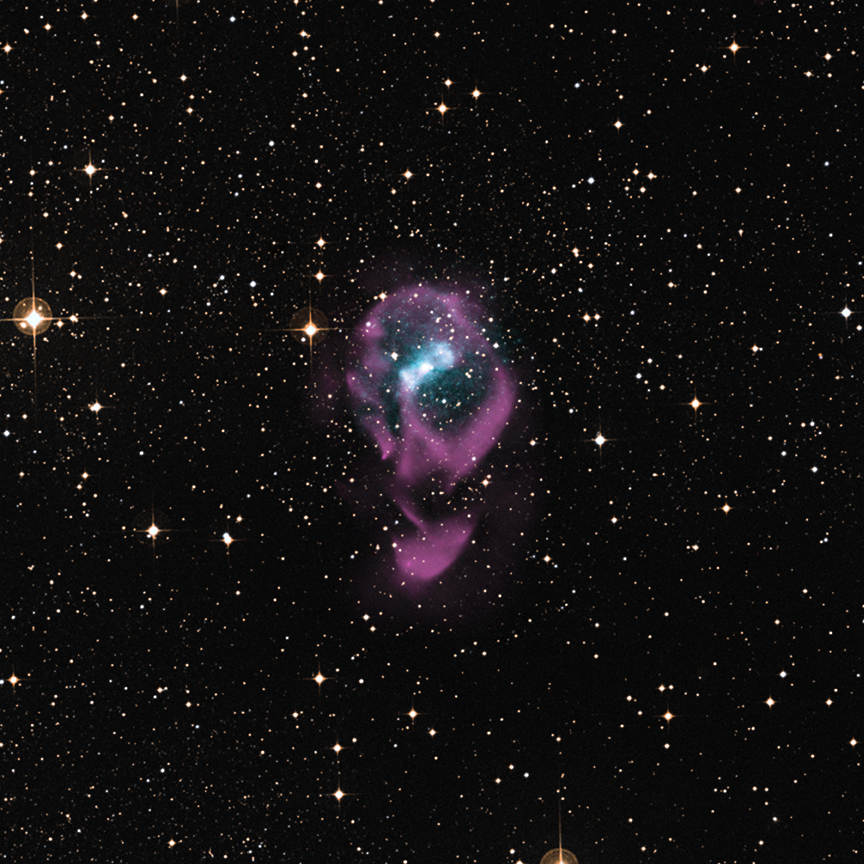
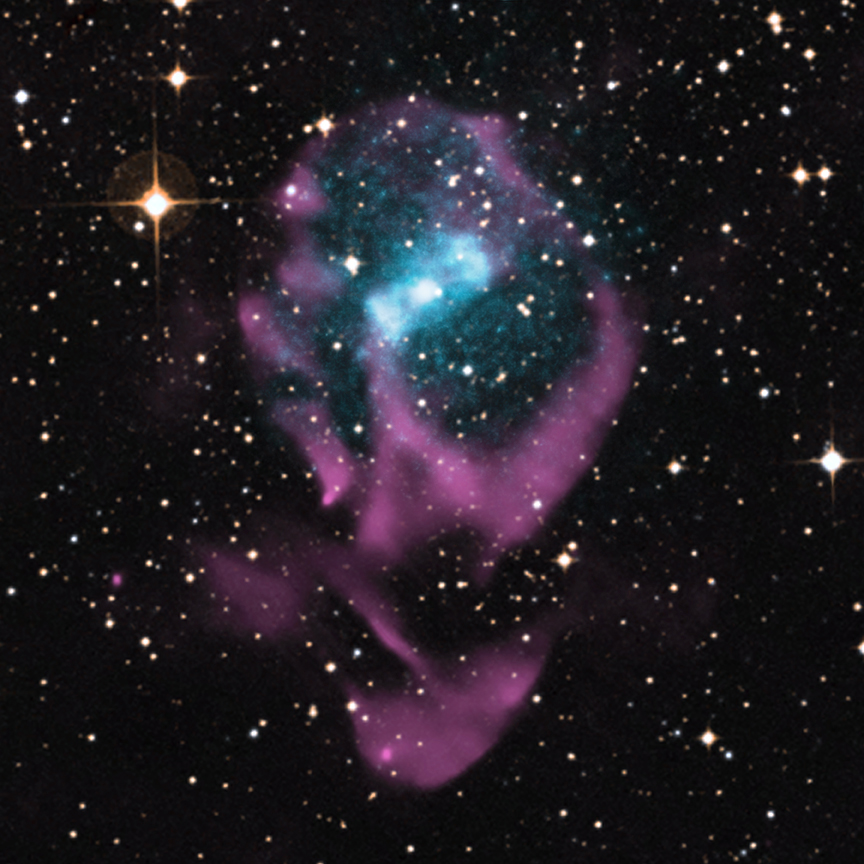
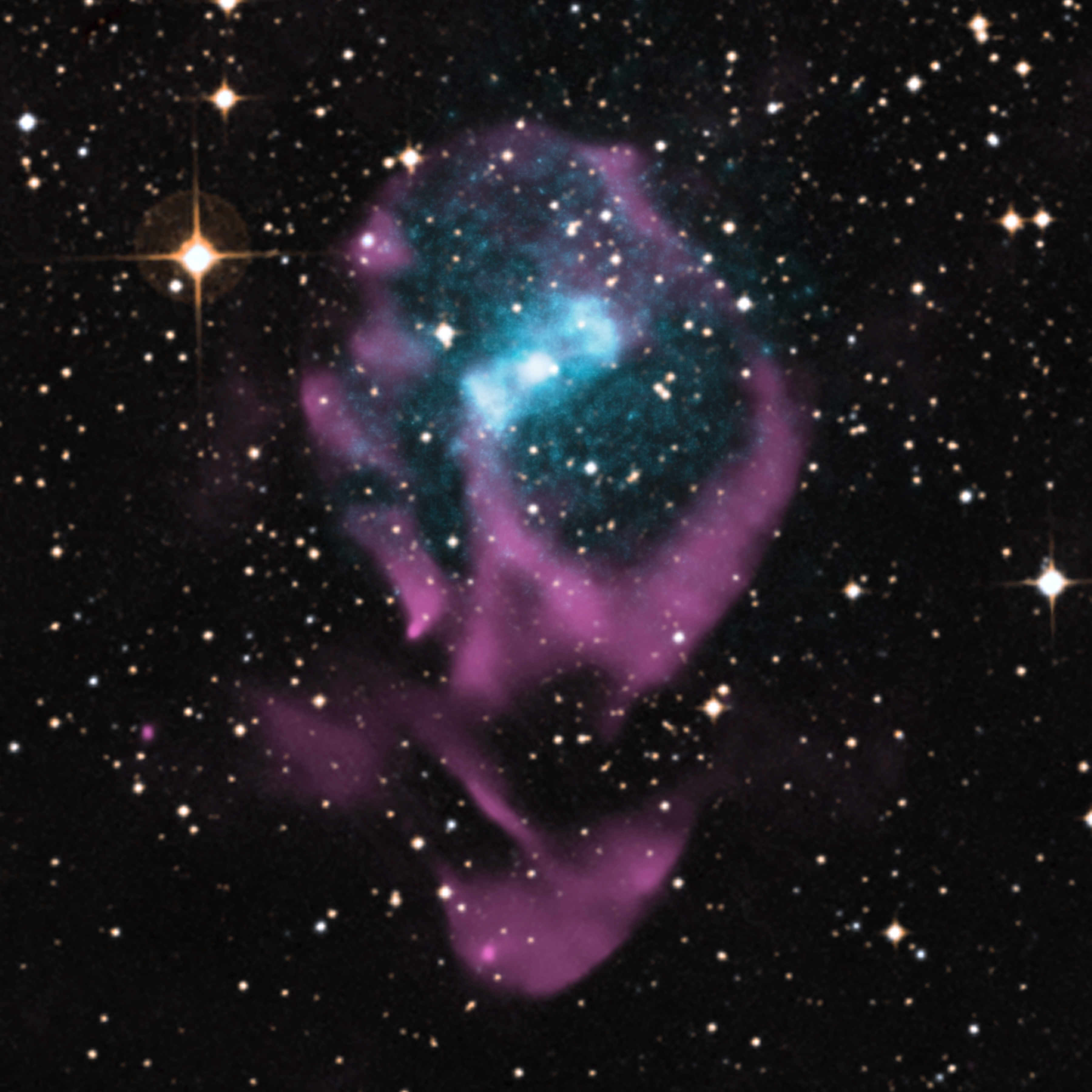
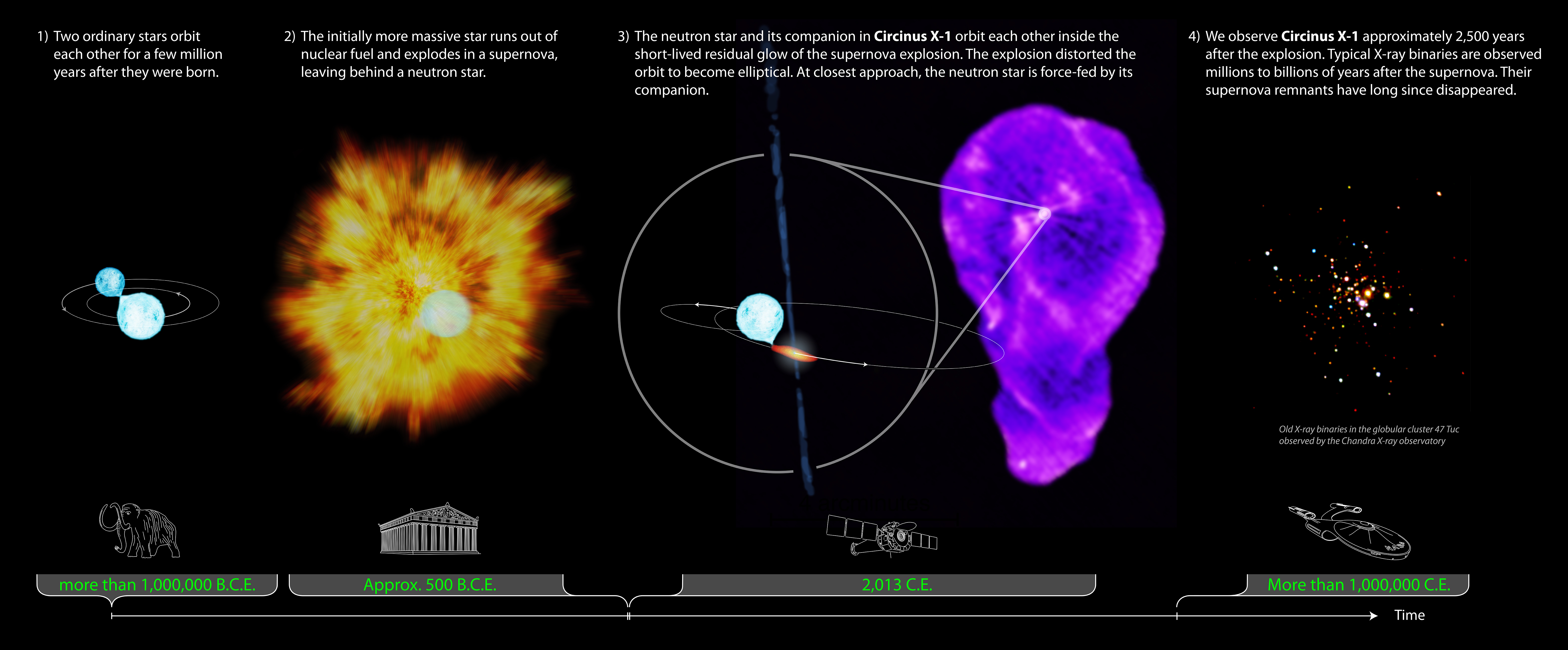
This particular object sits in the binary system Circinus X-1 more than 30,000 light-years from Earth and formed from the core of a massive supergiant star that collapsed around the same time Stonehenge was built.
This particular object sits in the binary system Circinus X-1 more than 30,000 light-years from Earth and formed from the core of a massive supergiant star that collapsed around the same time Stonehenge was built.
It is so dense that a teaspoon of its material weighs as much as Mount Everest.
Binary systems have two stars that are bound together by gravity. In the case of Circinus X-1, one of these is a neutron star.
Both neutron stars and black holes are cosmological monsters which form when the biggest stars in the Universe die and collapse under their own gravity.
However, the latter are considerably more massive and can only be detected through their gravitational effects, while the former can be observed directly despite their denseness.
However, the latter are considerably more massive and can only be detected through their gravitational effects, while the former can be observed directly despite their denseness.
They are some of the most extreme objects in the Universe and have interiors almost entirely made of neutrons.

Radio image from the MeerKAT telescope showing Circinus X-1 in the centre,
within the spherical remnant of the supernova it was born in. The
shockwaves caused by the jets are seen above and below Cir X-1, and the
S-shape structure in the jets is somewhat obscured by a bright source in
the background. Credit: Fraser Cowie
Licence type: Attribution (CC BY 4.0)
The jet emanating from the neutron star was spotted by a team of
astronomers at the University of Oxford, who used MeerKAT - a radio
telescope in South Africa - to create the most detailed, high-resolution
images of Circinus X-1.
The pictures, which were presented at this week’s National Astronomy Meeting at the University of Hull, include the first-ever image of an S-shaped jet coming from a confirmed neutron star – a breakthrough that could help unravel the extreme physics behind the astronomical phenomenon.
Lead researcher Fraser Cowie said there was another system known for its S-shaped jets, called SS433, but recent results suggest that object is likely a black hole.
The pictures, which were presented at this week’s National Astronomy Meeting at the University of Hull, include the first-ever image of an S-shaped jet coming from a confirmed neutron star – a breakthrough that could help unravel the extreme physics behind the astronomical phenomenon.
Lead researcher Fraser Cowie said there was another system known for its S-shaped jets, called SS433, but recent results suggest that object is likely a black hole.
"This image is the first time we have seen strong evidence for a precessing jet from a confirmed neutron star," he said.
"This evidence comes from both the symmetric S shape of the radio-emitting
plasma in the jets and from the fast, wide shockwave, which can only be
produced by a jet changing direction.
"This will give valuable information about the extreme physics behind the launching of the jet, a phenomenon which is still not well understood."
The neutron star's huge density creates a strong force of gravity that strips gas from the companion star, forming a disc of hot gas around it that spirals down towards its surface.
This process, called accretion, releases huge amounts of energy per second with more power than a million Suns. Some of this energy powers jets – narrow beams of outflowing material from the binary system travelling close to the speed of light.
"This will give valuable information about the extreme physics behind the launching of the jet, a phenomenon which is still not well understood."
The neutron star's huge density creates a strong force of gravity that strips gas from the companion star, forming a disc of hot gas around it that spirals down towards its surface.
This process, called accretion, releases huge amounts of energy per second with more power than a million Suns. Some of this energy powers jets – narrow beams of outflowing material from the binary system travelling close to the speed of light.
Cowie3 Moving shocks Cir X 1
Recent upgrades to the MeerKAT telescope have resulted in excellent sensitivity and higher-resolution images. With these the team saw clear evidence of an S-shaped structure, similar in shape to water spraying from a garden sprinkler, in Circinus X-1's jet.
Not only that, but researchers also discovered moving termination shocks – the first recorded from an X-ray binary. These are regions where the jet violently rams into the surrounding material, causing a shockwave.
Cowie's team measured the waves moving at roughly 10 per cent of the speed of light, confirming that they were caused by the fast-moving jet and not something slower such as a wind of material from the stars.
"The fact that these shockwaves span a wide angle agrees with our model," Cowie said. "So we have two strong pieces of evidence telling us the neutron star jet is precessing."
Not only that, but researchers also discovered moving termination shocks – the first recorded from an X-ray binary. These are regions where the jet violently rams into the surrounding material, causing a shockwave.
Cowie's team measured the waves moving at roughly 10 per cent of the speed of light, confirming that they were caused by the fast-moving jet and not something slower such as a wind of material from the stars.
"The fact that these shockwaves span a wide angle agrees with our model," Cowie said. "So we have two strong pieces of evidence telling us the neutron star jet is precessing."
Measuring the velocity of the shockwaves will also help astronomers understand what the jet causing them is made from.
The shockwaves effectively act as particle accelerators in space - producing high-energy cosmic rays - and the maximum energy of particles that can be accelerated depends on their velocity.
"Circinus X-1 is one of the brightest objects in the X-ray sky and has been studied for over half a century," Cowie said. "But despite this, it remains one of the most enigmatic systems we know of.
"Several aspects of its behaviour are not well explained so it's very rewarding to help shed new light on this system, building on 50 years of work from others."
"Circinus X-1 is one of the brightest objects in the X-ray sky and has been studied for over half a century," Cowie said. "But despite this, it remains one of the most enigmatic systems we know of.
"Several aspects of its behaviour are not well explained so it's very rewarding to help shed new light on this system, building on 50 years of work from others."
He added: "The next steps will be to continue to monitor the jets and see if they change over time in the way we expect.
"This will allow us to more precisely measure their properties and continue to learn more about this puzzling object."
The research was performed as part of the X-KAT and ThunderKAT projects on the MeerKAT telescope operated by the South African Radio Astronomy Observatory (SARAO). The observations were carried out using the recently installed S-band receivers provided by the Max-Planck Institute (MPG).
Media contacts:
Sam Tonkin
Royal Astronomical Society
+44 (0)7802 877 700
press@ras.ac.uk
Dr Robert Massey
Royal Astronomical Society
Mob: +44 (0)7802 877 699
press@ras.ac.uk
Megan Eaves
Royal Astronomical Society
press@ras.ac.uk
Science contacts:
Fraser Cowie
University of Oxford
fraser.cowie@physics.ox.ac.uk
Images and captions
Fig 1: Cowie1 - s-shape-jet
Caption: Radio image of the S-shaped precessing jet launched by the neutron star
in Circinus X-1. Both Cir X-1 itself (centre of the image) and a
background source have been subtracted from the image to make the
S-shape clearer. The jets are fast, narrow flows of material outwards
from Cir X-1. The size of the jets against the sky is the same apparent
size as a penny viewed from 100 metres away, but their real size is
greater than five light-years. Credit: Fraser Cowie
Fig 2: Cowie2 - rotated_zoomed_out_snr
Caption: Radio image from the MeerKAT telescope showing Circinus X-1 in the
centre, within the spherical remnant of the supernova it was born in.
The shockwaves caused by the jets are seen above and below Cir X-1, and
the S-shape structure in the jets is somewhat obscured by a bright
source in the background. Credit: Fraser Cowie
Fig 3: Cowie3 - Moving shocks Cir X-1
Caption: GIF of moving termination shocks from Circinus-1. These are regions
where the jet violently rams into the surrounding material causing a
shockwave travelling at a significant fraction of the speed of light. Credit: Fraser Cowie
Further information
Circinus X-1 lies in the constellation Circinus, a small, faint constellation
that can be observed in the southern sky. It was first noted by French
astronomer Nicolas-Louis de Lacaille in 1756. The name ‘Circinus’ is
Latin for ‘compass’, referring to the drafting tool.
In July 2007, observations of Circinus X-1 revealed the system is highly luminous in X-rays and emits jets normally found in black hole systems – the first of this kind discovered to display this similarity to black holes. This makes Circinus X-1 a peculiar system that defies conventional classification. Discovered in the late 1960s, it has shown variation over several orders of magnitude in X-ray and radio on time periods from hours to decades. Strong evidence suggests it is surrounded by its natal supernova remnant, aged at ~4000 years, making Circinus X-1 the youngest known X-ray binary star system. This provides a unique, complex laboratory for astronomers to test their knowledge of accretion, jets, jet interactions with surrounding material and much more.
In July 2007, observations of Circinus X-1 revealed the system is highly luminous in X-rays and emits jets normally found in black hole systems – the first of this kind discovered to display this similarity to black holes. This makes Circinus X-1 a peculiar system that defies conventional classification. Discovered in the late 1960s, it has shown variation over several orders of magnitude in X-ray and radio on time periods from hours to decades. Strong evidence suggests it is surrounded by its natal supernova remnant, aged at ~4000 years, making Circinus X-1 the youngest known X-ray binary star system. This provides a unique, complex laboratory for astronomers to test their knowledge of accretion, jets, jet interactions with surrounding material and much more.
Notes for editors
The NAM 2024 conference is principally sponsored by the Royal Astronomical
Society, the Science and Technology Facilities Council and the
University of Hull.
About the Royal Astronomical Society
The Royal Astronomical Society (RAS), founded in 1820, encourages and
promotes the study of astronomy, solar-system science, geophysics and
closely related branches of science.
The RAS organises scientific meetings, publishes international research and review journals, recognises outstanding achievements by the award of medals and prizes, maintains an extensive library, supports education through grants and outreach activities and represents UK astronomy nationally and internationally. Its more than 4,000 members (Fellows), a third based overseas, include scientific researchers in universities, observatories and laboratories as well as historians of astronomy and others.
The RAS accepts papers for its journals based on the principle of peer review, in which fellow experts on the editorial boards accept the paper as worth considering. The Society issues press releases based on a similar principle, but the organisations and scientists concerned have overall responsibility for their content.
The RAS organises scientific meetings, publishes international research and review journals, recognises outstanding achievements by the award of medals and prizes, maintains an extensive library, supports education through grants and outreach activities and represents UK astronomy nationally and internationally. Its more than 4,000 members (Fellows), a third based overseas, include scientific researchers in universities, observatories and laboratories as well as historians of astronomy and others.
The RAS accepts papers for its journals based on the principle of peer review, in which fellow experts on the editorial boards accept the paper as worth considering. The Society issues press releases based on a similar principle, but the organisations and scientists concerned have overall responsibility for their content.
Keep up with the RAS on X, Facebook, LinkedIn and YouTube
About the Science and Technology Facilities Council
The Science and Technology Facilities Council (STFC)
is part of UK Research and Innovation – the UK body which works in
partnership with universities, research organisations, businesses,
charities, and government to create the best possible environment for
research and innovation to flourish.
STFC funds and supports research in particle and nuclear physics, astronomy, gravitational research and astrophysics, and space science and also operates a network of five national laboratories, including the Rutherford Appleton Laboratory and the Daresbury Laboratory, as well as supporting UK research at a number of international research facilities including CERN, FERMILAB, the ESO telescopes in Chile and many more.
STFC's Astronomy and Space Science programme provides support for a wide range of facilities, research groups and individuals in order to investigate some of the highest priority questions in astrophysics, cosmology and solar system science.
STFC funds and supports research in particle and nuclear physics, astronomy, gravitational research and astrophysics, and space science and also operates a network of five national laboratories, including the Rutherford Appleton Laboratory and the Daresbury Laboratory, as well as supporting UK research at a number of international research facilities including CERN, FERMILAB, the ESO telescopes in Chile and many more.
STFC's Astronomy and Space Science programme provides support for a wide range of facilities, research groups and individuals in order to investigate some of the highest priority questions in astrophysics, cosmology and solar system science.
STFC's astronomy and space science programme
is delivered through grant funding for research activities, and also
through support of technical activities at STFC's UK Astronomy
Technology Centre and RAL Space at the Rutherford Appleton Laboratory.
STFC also supports UK astronomy through the international European
Southern Observatory and the Square Kilometre Array Organisation.
Visit https://stfc.ukri.org/ for more information. Follow STFC on Twitter: @STFC_Matters
About the University of Hull’s E.A. Milne Centre
The E.A. Milne Centre for Astrophysics at the University of Hull brings
together experts who study the evolution of structure in the
Universe ranging from stars through to galaxies and galaxy clusters,
right up to the largest structures in the cosmos.
The centre employs observations, theory and computational methods in collaboration with international partners. Postgraduate and undergraduate students work alongside staff to understand the wonders of the Universe. Through a series of outreach activities, the centre also aims to share its passion for astronomy and astrophysics with the region and beyond.
The centre employs observations, theory and computational methods in collaboration with international partners. Postgraduate and undergraduate students work alongside staff to understand the wonders of the Universe. Through a series of outreach activities, the centre also aims to share its passion for astronomy and astrophysics with the region and beyond.
Submitted by Sam Tonkin