Sunday, May 21, 2017

SKA precursor telescope MeerKAT releases new 1.5 images using its current 32 antennas

Large scale bubbles and arcs seen with MeerKAT show stellar nurseries (where stars are born) in the Milky Way. For comparison, the previous best image of this star-forming region is shown at the bottom, obtained with the Australia Telescope Compact Array (ATCA). Credit: SKA SA


Friday 19 May 2017, Cape Town –  The South African SKA precursor telescope MeerKAT has just released its recent AR1.5 results, images achieved by using various configurations of the 32 antennas currently operational in the Karoo.

The Minister of Science and Technology, Naledi Pandor, preceding the delivery of the Budget Vote of the Department of Science and Technology to the South African parliament, embarked on a tour of the Iziko Museum, where SKA South Africa joined other exhibitors for a showcase. During this exhibition, SKA SA Chief Scientist Dr Fernando Camilo and SKA SA Head of Science Commissioning Dr Sharmila Goedhart presented the AR1.5 results to the minister.

This milestone of the integration of 32 antennas with single polarisation correlator was achieved on schedule by the end of March 2017. The 32 antennas are part of the eventual 64 antennas which are being built at the Losberg site in the Northern Cape.

In her Budget Vote, the Minister announced that the Research Development and Support Programme will transfer R693 million to the National Research Foundation to ensure the completion of MeerKAT, as a key priority for 2017/18.

MeerKAT is one of the precursor telescopes to the SKA and will eventually be integrated into SKA1-mid after being a world-class instrument in its own right for several years.


Saturday, May 20, 2017

Hubble Spots Moon Around Third Largest Dwarf Planet

 Dwarf Planet 2007 OR10
Credits: NASA, ESA, C. Kiss (Konkoly Observatory), and J. Stansberry (STScI)


The combined power of three space observatories, including NASA's Hubble Space Telescope, has helped astronomers uncover a moon orbiting the third largest dwarf planet, catalogued as 2007 OR10. The pair resides in the frigid outskirts of our solar system called the Kuiper Belt, a realm of icy debris left over from our solar system's formation 4.6 billion years ago.

With this discovery, most of the known dwarf planets in the Kuiper Belt larger than 600 miles across have companions. These bodies provide insight into how moons formed in the young solar system.

"The discovery of satellites around all of the known large dwarf planets — except for Sedna — means that at the time these bodies formed billions of years ago, collisions must have been more frequent, and that's a constraint on the formation models," said Csaba Kiss of the Konkoly Observatory in Budapest, Hungary. He is the lead author of the science paper announcing the moon's discovery. "If there were frequent collisions, then it was quite easy to form these satellites."

The objects most likely slammed into each other more often because they inhabited a crowded region. "There must have been a fairly high density of objects, and some of them were massive bodies that were perturbing the orbits of smaller bodies," said team member John Stansberry of the Space Telescope Science Institute in Baltimore, Maryland. "This gravitational stirring may have nudged the bodies out of their orbits and increased their relative velocities, which may have resulted in collisions."

But the speed of the colliding objects could not have been too fast or too slow, according to the astronomers. If the impact velocity was too fast, the smash-up would have created lots of debris that could have escaped from the system; too slow and the collision would have produced only an impact crater.

Collisions in the asteroid belt, for example, are destructive because objects are traveling fast when they smash together. The asteroid belt is a region of rocky debris between the orbits of Mars and the gas giant Jupiter. Jupiter's powerful gravity speeds up the orbits of asteroids, generating violent impacts.

The team uncovered the moon in archival images of 2007 OR10 taken by Hubble's Wide Field Camera 3. Observations taken of the dwarf planet by NASA's Kepler Space Telescope first tipped off the astronomers of the possibility of a moon circling it. Kepler revealed that 2007 OR10 has a slow rotation period of 45 hours. "Typical rotation periods for Kuiper Belt Objects are under 24 hours," Kiss said. "We looked in the Hubble archive because the slower rotation period could have been caused by the gravitational tug of a moon. The initial investigator missed the moon in the Hubble images because it is very faint."

The astronomers spotted the moon in two separate Hubble observations spaced a year apart. The images show that the moon is gravitationally bound to 2007 OR10 because it moves with the dwarf planet, as seen against a background of stars. However, the two observations did not provide enough information for the astronomers to determine an orbit.

"Ironically, because we don't know the orbit, the link between the satellite and the slow rotation rate is unclear," Stansberry said.

The astronomers calculated the diameters of both objects based on observations in far-infrared light by the Herschel Space Observatory, which measured the thermal emission of the distant worlds. The dwarf planet is about 950 miles across, and the moon is estimated to be 150 miles to 250 miles in diameter. 2007 OR10, like Pluto, follows an eccentric orbit, but it is currently three times farther than Pluto is from the sun.

2007 OR10 is a member of an exclusive club of nine dwarf planets. Of those bodies, only Pluto and Eris are larger than 2007 OR10. It was discovered in 2007 by astronomers Meg Schwamb, Mike Brown, and David Rabinowitz as part of a survey to search for distant solar system bodies using the Samuel Oschin Telescope at the Palomar Observatory in California.

The team's results appeared in The Astrophysical Journal Letters.

The Hubble Space Telescope is a project of international cooperation between NASA and ESA (European Space Agency). NASA's Goddard Space Flight Center in Greenbelt, Maryland, manages the telescope. The Space Telescope Science Institute (STScI) in Baltimore conducts Hubble science operations. STScI is operated for NASA by the Association of Universities for Research in Astronomy, Inc., in Washington, D.C.


Related Links 
This site is not responsible for content found on external links 


Contacts


Donna Weaver / Ray Villard
Space Telescope Science Institute, Baltimore, Maryland
410-338-4493 / 410-338-4514

dweaver@stsci.edu / villard@stsci.edu

Csaba Kiss
Konkoly Observatory, Budapest, Hungary
011-36-1-391-9341

kiss.csaba@csfk.mta.hu

John Stansberry
Space Telescope Science Institute, Baltimore, Maryland
410-338-2442

jstans@stsci.edu

Source: HubbleSite

Friday, May 19, 2017

ALMA Eyes Icy Ring Around Young Planetary System

Composite image of the Fomalhaut star system. The ALMA data, shown in orange, reveal the distant and eccentric debris disk in never-before-seen detail. The central dot is the unresolved emission from the star, which is about twice the mass of the Sun. Optical data from the Hubble Space Telescope is in blue; the dark region is a coronagraphic mask, which filtered out the otherwise overwhelming light of the central star. Credit: ALMA (ESO/NAOJ/NRAO), M. MacGregor; NASA/ESA Hubble, P. Kalas; B. Saxton (NRAO/AUI/NSF) | Download image

ALMA image of the debris disk in the Fomalhaut star system. The ring is approximately 20 billion kilometers from the central star and it is about 2 billion kilometers wide. The central dot is the unresolved emission from the star, which is about twice the mass of the Sun. Credit: ALMA (ESO/NAOJ/NRAO); M. MacGregor | Download image


An international team of astronomers using the Atacama Large Millimeter/submillimeter Array (ALMA) has made the first complete millimeter-wavelength image of the ring of dusty debris surrounding the young star Fomalhaut. This remarkably well-defined band of rubble and gas is likely the result of exocomets smashing together near the outer edges of a planetary system 25 light-years from Earth. Observations Suggest Chemical Kinship to Comets in Our Own Solar System.

Earlier ALMA observations of Fomalhaut — taken in 2012 when the telescope was still under construction – revealed only about one half of the debris disk. Though this first image was merely a test of ALMA’s initial capabilities, it nonetheless provided tantalizing hints about the nature and possible origin of the disk.

The new ALMA observations offer a stunningly complete view of this glowing band of debris and suggest that there are chemical similarities between its icy contents and comets in our own solar system.

ALMA has given us this staggeringly clear image of a fully formed debris disk,” said Meredith MacGregor, an astronomer at the Harvard-Smithsonian Center for Astrophysics in Cambridge, Massachusetts, USA, and lead author on one of two papers accepted for publication in the Astrophysical Journal describing these observations.“We can finally see the well-defined shape of the disk, which may tell us a great deal about the underlying planetary system responsible for its highly distinctive appearance.”

Fomalhaut is a relatively nearby star system and one of only about 20 in which planets have been imaged directly. The entire system is approximately 440 million years old, or about one-tenth the age of our solar system.

As revealed in the new ALMA image, a brilliant band of icy dust about 2 billion kilometers wide has formed approximately 20 billion kilometers from the star.

Debris disks are common features around young stars and represent a very dynamic and chaotic period in the history of a solar system. Astronomers believe they are formed by the ongoing collisions of comets and other planetesimals in the outer reaches of a recently formed planetary system. The leftover debris from these collisions absorbs light from its central star and reradiates that energy as a faint millimeter-wavelength glow that can be studied with ALMA.

Using the new ALMA data and detailed computer modeling, the researchers could calculate the precise location, width, and geometry of the disk. These parameters confirm that such a narrow ring is likely produced through the gravitational influence of planets in the system, noted MacGregor.

The new ALMA observations are also the first to definitively show “apocenter glow,” a phenomenon predicted in a 2016 paper by lead author Margaret Pan, a scientist at the Massachusetts Institute of Technology in Cambridge and co-author on the new ALMA papers. Like all objects with elongated orbits, the dusty material in the Fomalhaut disk travels more slowly when it is farthest from the star. As the dust slows down, it piles up, forming denser concentrations in the more distant portions of the disk. These dense regions can be seen by ALMA as brighter millimeter-wavelength emission.

Using the same ALMA dataset, but focusing on distinct millimeter-wavelength signals naturally emitted by molecules in space, the researchers also detected vast stores of carbon monoxide gas in precisely the same location as the debris disk.

“These data allowed us to determine that the relative abundance of carbon monoxide plus carbon dioxide around Fomalhaut is about the same as found in comets in our own solar system,” said Luca Matrà with the University of Cambridge, UK, and lead author on the team’s second paper.“This chemical kinship may indicate a similarity in comet formation conditions between the outer reaches of this planetary system and our own.” Matrà and his colleagues believe this gas is either released from continuous comet collisions or the result of a single, large impact between supercomets hundreds of times more massive than Hale-Bopp.

The presence of this well-defined debris disk around Fomalhaut, along with its curiously familiar chemistry, may indicate that this system is undergoing its own version of the Late Heavy Bombardment, a period approximately 4 billion years ago when the Earth and other planets were routinely struck by swarms of asteroids and comets left over from the formation of the Solar System.

“Twenty years ago, the best millimeter-wavelength telescopes gave the first fuzzy maps of sand grains orbiting Fomalhaut. Now with ALMA’s full capabilities the entire ring of material has been imaged,”
concluded Paul Kalas, an astronomer at the University of California at Berkeley and principal investigator on these observations. “One day we hope to detect the planets that influence the orbits of these grains.”


Additional information

This research is presented in a paper titled “A complete ALMA map of the Fomalhaut debris disk,” M. MacGregor, et al., appearing in the Astrophysical Journal, and “Detection of exocometary CO within the 440MYR-old Fomalhaut belt: A similar CO+CO2 ice abundance in exocomets and solar system comets,” L. Matrà et al., appearing in the Astrophysical Journal.

This work benefited from: NASA’s Nexus for Exoplanet System Science (NExSS) research coordination network sponsored by NASA’s Science Mission Directorate, NASA grants NNX15AC89G, NNX15AD95G, NSF grant AST-1518332, NSF Graduate Research Fellowship DGE1144152, and from NRAO Student Observing Support. This work has also been possible thanks to an STFC postgraduate studentship and the European Union through ERC grant number 279973.

The Atacama Large Millimeter/submillimeter Array (ALMA), an international astronomy facility, is a partnership of the European Organisation for Astronomical Research in the Southern Hemisphere (ESO), the U.S. National Science Foundation (NSF) and the National Institutes of Natural Sciences (NINS) of Japan in cooperation with the Republic of Chile. ALMA is funded by ESO on behalf of its Member States, by NSF in cooperation with the National Research Council of Canada (NRC) and the National Science Council of Taiwan (NSC) and by NINS in cooperation with the Academia Sinica (AS) in Taiwan and the Korea Astronomy and Space Science Institute (KASI).

ALMA construction and operations are led by ESO on behalf of its Member States; by the National Radio Astronomy Observatory (NRAO), managed by Associated Universities, Inc. (AUI), on behalf of North America; and by the National Astronomical Observatory of Japan (NAOJ) on behalf of East Asia. The Joint ALMA Observatory (JAO) provides the unified leadership and management of the construction, commissioning and operation of ALMA.


  Contacts

Nicolás Lira T.
Press Coordinator
Joint ALMA Observatory
Santiago, Chile
Tel: +56 2 24 67 65 19
Cell: +56 9 94 45 77 26
Email: nicolas.lira@alma.cl

Charles E. Blue
Public Information Officer
National Radio Astronomy Observatory
Charlottesville, Virginia, USA
Tel: +1 434 296 0314
Cell: +1 202 236 6324
E-mail: cblue@nrao.edu

Masaaki Hiramatsu

Education and Public Outreach Officer, NAOJ Chile
Observatory
Tokyo, Japan

Tel: +81 422 34 3630

E-mail: hiramatsu.masaaki@nao.ac.jp

Richard Hook
Public Information Officer, ESO

Garching bei München, Germany

Tel: +49 89 3200 6655

Cell: +49 151 1537 3591
Email: rhook@eso.org


Thursday, May 18, 2017

Punching Above Its Weight, a Brown Dwarf Launches a Parsec-Scale Jet

The image shows the jet HH 1165 (in green) launched by the brown dwarf Mayrit 1701117. The image is composed of observations of Hα (from ionised hydrogen), of [SII] (ionised sulfur) and in the R-band (red optical wavelengths) obtained with the SOAR telescope of the Cerro Tololo Inter-American Observatory. The jet extends over a distance of 0.7 light years (equivalent to 0.2 parsecs) northwest of the brown dwarf.


Astronomers led by the Max Planck Institute for Extraterrestrial Physics and using the Cerro Tololo Inter-American Observatory report the discovery of a spectacular extended jet from a young brown dwarf. With masses too low to sustain hydrogen fusion in their interiors, brown dwarfs occupy the mass range between stars and giant planets. While young stars are commonly found to launch jets that extend over a light year or more, this is the first jet with a similar extent detected from a brown dwarf. The result lends new insight into how sub-stellar objects form.

Intrinsically faint, brown dwarfs have been more elusive and difficult to study than stars. While not quite massive enough to sustain nuclear fusion at their core – the main energy source for brightly shining stars, they are substantially more massive than giant planets, with about ten times the mass of Jupiter or more. Brown dwarfs are actually quite numerous; there are many more brown dwarfs in our Galaxy than stars like the Sun. Nevertheless, observational information about brown dwarfs in scarce and there is an ongoing debate between astronomers if they form rather like planets or rather like stars do.

“We were looking for very young brown dwarfs, and picked this particular object because it showed a wealth of prominent emission lines associated with strong outflow activity from previous ESO VLT spectral observations, which indicated that there is a shock front close to the source,” explains Basmah Riaz, from the Max Planck Institute for Extraterrestrial Physics, who led the study. The image obtained over a total of three nights with the SOAR telescope of the Cerro Tololo Inter-American Observatory shows the newly detected jet, HH 1165, launched by the brown dwarf Mayrit 1701117, which is located in the outer periphery of the 3 million year old sigma Ori cluster. As described by co-author Cesar Briceno from the Cerro Tololo Inter-American Observatory: “We could see surprisingly extended jet emission after the first 30 minutes of integration. It was a real ‘Wow’ moment!”

The jet extends over a distanced of 0.7 light years (equivalent to 0.2 parsecs) northwest of the brown dwarf. The emission knots along the jet reveal that the mass loss is time variable, probably a result of episodic accretion onto the brown dwarf. While outflows have been detected previously from young brown dwarfs, the earlier detections were of "microjets" 10-100 times smaller in extent. “This discovery shows that, like young stars, brown dwarfs can launch powerful parsec-scale jets, and that they build up their mass through an unsteady, episodic process,” explains Basmah Riaz.


The surroundings of the HH 1165 jet is shown in this WISE infrared image. Its host brown dwarf Mayrit 1701117 is located in the outer periphery of the 3 million year old sigma Ori cluster, whose core is marked to the west. The star HR 1950 is located very close to the brown dwarf and several other B-type stars are marked as well, which trace the ionisation front (bright yellow region) to the east of Mayrit 1701117. © MPE, NOAO


“The HH 1165 jet shows all the familiar hallmarks of outflows from stars: emission knots, a cavity with reflection nebulosity, and bow shocks at the ends of the flow. It checks all the boxes quite convincingly,” commented co-author Emma Whelan from the National University of Ireland.

Brown dwarfs are known to be surrounded by disks at birth and to build up their masses by accretion from molecular cloud cores. While it may seem counterintuitive that mass loss (in a jet) is an integral part of how an object grows or gains mass, this situation may arise because of excess angular momentum. When spinning skaters pull in their arms, they spin faster as a result of conservation of angular momentum. Similarly, when large, slowly rotating molecular cloud cores collapse, they may spin up too fast to squeeze down to the much smaller sizes of stars or sub-stellar objects like brown dwarfs.

Riaz speculates that indeed “Molecular cloud cores have much more angular momentum than can be contained by stars or brown dwarfs. So the system needs to lose angular momentum for the object to grow in mass. By removing angular momentum from the system, jets help solve the `angular momentum problem’ faced by stars as well as brown dwarfs.”

To test this hypothesis, the team is on the hunt for more extended jets from brown dwarfs, to understand how commonly they occur. Such jets may be rare due to a lack of the environmental conditions needed to allow the jet to propagate to, and still be visible at, large distances from the source. We would expect that low-luminosity sources are more likely to be found in low-density environments, after disruption and fragmentation of very-low-mass cloud cores. So the problem is more likely to be a lack of dense material to shock against than the difficulty of propagation, which should be easier in a lower density medium.


Contact


Riaz, Basmah
Marie Sklodowska-Curie EU Research Fellow
Phone: +49 (0)89 30000-3007
Fax: +49 (0)89 30000-3950
Email: hanneh@mpe.mpg.de

Hämmerle, Hannelore
press officer
Phone: +49 (0)89 30000-3980
Fax: +49 (0)89 30000-3569
Email: hanneh@mpe.mpg.de


Original Publication

Basmah Riaz et al.
First Large Scale Herbig-Haro Jet Driven by a Proto-Brown Dwarf
Astrophysical Journal, in press

Source


More Information


Wednesday, May 17, 2017

Feeding a Baby Star with a Dusty Hamburger

Credit: ALMA (ESO/NAOJ/NRAO)/ Lee et al.


This intriguing image may look like a collection of coloured blobs, but it is actually a high-resolution snapshot of a newborn star enshrouded in dust. Just 1300 light-years away in the Orion Nebula, the star, named HH 212, is remarkably young. The average lifespan of such a low-mass star is around 100 billion years, but this star is only 40 000 years old — truly an infant in stellar terms.

In the cores of the vast molecular clouds in star formation regions, an ongoing battle rages; gravity versus the pressure of gas and dust. If gravity wins, it forces the gas and dust to collapse into a hot dense core that eventually ignites — forming a protostar. All the leftover gas and dust form a spinning disc around this baby star, and in many star systems they eventually coalesce to make planets. Such very young protostellar discs have been hard to image because of their relatively small size, but now the exceedingly high resolution of the Atacama Large Millimeter/submillimeter Array (ALMA) makes it possible to understand the intricate details of star and planet formation.

A closer look at HH 212 reveals a prominent, cool, dark dust lane running through the disc, sandwiched between two brighter regions that are heated by the protostar. The result resembles a cosmic “hamburger”. This is the very first time astronomers have spotted such a dust lane in the earliest phases of star formation, and so it may provide clues as to how planetary systems are born.


Source: ESO/Potw

Tuesday, May 16, 2017

Gemini Tracks Distant Star Cluster with Adaptive Optics

Figure 1: Gemini Multi-Object Spectrograph (GMOS-South) of the Pyxis field (left image), with the center of the cluster marked with a red star. A zoom of the pseudo color image of Pyxis observed with the Gemini South Adaptive Optics Imager (GSAOI) used with the Gemini Multi-conjugate adaptive optics System (GeMS) is shown at right. The field of view of GMOS is 5 x 5 arcminutes, 85 x 85 arcseconds for GeMS.

Figure 2: Absolute velocity of Pyxis. Each blue dot stands for a velocity derived from a single background galaxy. The red box shows the weighted average velocity derived from all galaxies. Only galaxies with small errors are shown for clarity.


Researchers combine images from Gemini South’s wide-field adaptive optics system (GeMS/GSAOI) with data from the Hubble Space Telescope (HST) to determine the proper motion of a distant cluster of stars. The observations, the first to use ground-based adaptive optics to precisely measure the motion of a cluster at such a large distance, allowed astronomers to set a lower limit for the mass of our Milky Way while providing clues about the cluster’s origin. 
 
A study of the proper motion (apparent motion in the sky due to an object's motion around our galaxy) of several substructures across the Milky Way’s halo is underway at Gemini South. As part of this study the team used Adaptive Optics (AO) at Gemini South, along with data from HST, to focus on a distant cluster called Pyxis. The work allowed the team to set a lower limit for the Milky Way’s mass of 950 million solar masses. This value is consistent with most, but not all, previous determinations.

The wide-field Gemini Multi-conjugate adaptive optics System (GeMS) combined with the Gemini South Adaptive Optics Imager (GSAOI) provided the Gemini data. “We used GeMS/GSAOI to estimate the proper motion for halo objects because normal (seeing limited) ground-based telescopes need a time baseline of more than 15 years for this measurement,” says Tobias Fritz (University of Virginia) who leads the research team. “GeMS/GSAOI with its better spatial resolution can make that measurement in five years, the same types of baselines required from space-based proper motions (like HST),” continues Fritz. The team was able to measure absolute proper motions of Pyxis using GeMS/GSAOI, which provided a resolution of 0.08 arcsecond and combined that with archival HST images, with a resolution of ~ 0.1 arcsecond. Fritz adds, “The study of motions for halo objects, like Pyxis, can constrain the mass distribution of our Galaxy at large distances and thus the mass of the Milky Way.”

Pyxis, a densely packed collection of ancient stars, is one of the most distant examples of a globular clusters, dense clusters of stars which orbit our galaxy. The cluster is located some 130,000 light years away and is thought to be about 2 billion years younger than other globular clusters with the same ratio of heavier elements (metallicity). Together, these characteristics imply Pyxis did not form with other Milky Way clusters. Instead, it is likely that Pyxis was formed in a massive dwarf galaxy that was then accreted by the Milky Way. Thus, Pyxis has an extragalactic origin. However, the orbits of the known massive dwarf galaxies are inconsistent with the orbit of Pyxis, which is derived from the new proper motion measurements.

The paper, titled: The Proper Motion of Pyxis: The First Use of Adaptive Optics in Tandem with HST on a Faint Halo Object is published in The Astrophysical Journal. The work is part of a Large and Long program at Gemini that is also targeting other clusters, dwarf galaxies, and individual stars in stellar streams.

Abstract

We present a proper motion measurement for the halo globular cluster Pyxis, using HST/ACS data as the first epoch, and GeMS/GSAOI Adaptive Optics data as the second, separated by a baseline of ∼ 5 years. This is both the first measurement of the proper motion of Pyxis and the first calibration and use of Multi-Conjugate Adaptive Optics data to measure an absolute proper motion for a faint, distant halo object. Consequently, we present our analysis of the Adaptive Optics data in detail. We obtain a proper motion of µα cos(δ) =1.09±0.31 mas yr−1 and µδ =0.68±0.29 mas yr−1. From the proper motion and the line-of-sight velocity we find the orbit of Pyxis is rather eccentric with its apocenter at more than 100 kpc and its pericenter at about 30 kpc. We also investigate two literature-proposed associations for Pyxis with the recently discovered ATLAS stream and the Magellanic system. Combining our measurements with dynamical modeling and cosmological numerical simulations we find it unlikely Pyxis is associated with either system. We examine other Milky Way satellites for possible association using the orbit, eccentricity, metallicity, and age as constraints and find no likely matches in satellites down to the mass of Leo II. We propose that Pyxis probably originated in an unknown galaxy, which today is fully disrupted. Assuming that Pyxis is bound and not on a first approach, we derive a 68% lower limit on the mass of the Milky Way of 0.95×10¹² M⊙.


Monday, May 15, 2017

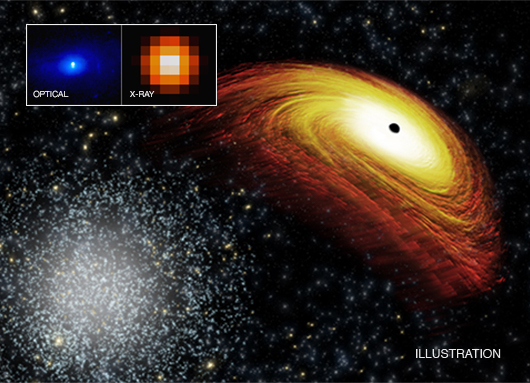
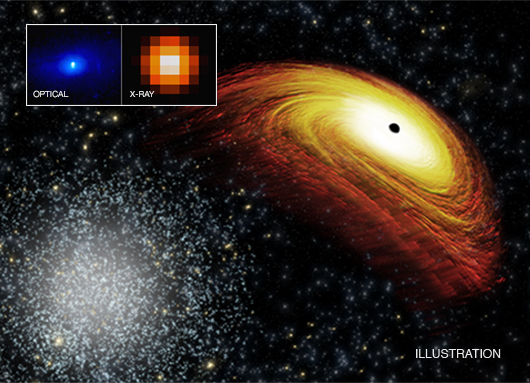
CXO J101527.2+625911: Astronomers Pursue Renegade Supermassive Black Hole

 CXO J101527.2+625911
 Credit  X-ray: NASA/CXC/NRAO/D.-C.Kim; Optical: NASA/STScI; 
Illustration: NASA/CXC/M.Weiss

JPEG (180.1 kb) - Large JPEG (206.5 kb)  - Tiff (1.9 MB) -  More Images


 Tour of CXO J101527.2+625911

animation

More Animations


Supermassive holes are generally stationary objects, sitting at the centers of most galaxies. However, using data from NASA's Chandra X-ray Observatory and other telescopes, astronomers recently hunted down what could be a supermassive black hole that may be on the move.

This possible renegade black hole, which contains about 160 million times the mass of our Sun, is located in an elliptical galaxy about 3.9 billion light years from Earth. Astronomers are interested in these moving supermassive black holes because they may reveal more about the properties of these enigmatic objects.

This black hole may have "recoiled," in the terminology used by scientists, when two smaller supermassive black holes collided and merged to form an even larger one. At the same time, this collision would have generated gravitational waves that emitted more strongly in one direction than others. This newly formed black hole could have received a kick in the opposite direction of those stronger gravitational waves. This kick would have pushed the black hole out of the galaxy's center, as depicted in the artist's illustration.

The strength of the kick depends on the rate and direction of spin of the two smaller black holes before they merge. Therefore, information about these important but elusive properties can be obtained by studying the speed of recoiling black holes.

Astronomers found this recoiling black hole candidate by sifting through X-ray and optical data for thousands of galaxies. First, they used Chandra observations to select galaxies that contain a bright X-ray source and were observed as part of the Sloan Digital Sky Survey (SDSS). Bright X-ray emission is a common feature of supermassive black holes that are rapidly growing.

Next, the researchers looked to see if Hubble Space Telescope observations of these X-ray bright galaxies revealed two peaks near their center in the optical image. These two peaks might show that a pair of supermassive black holes is present or that a recoiling black hole has moved away from the cluster of stars in the center of the galaxy.

If those criteria were met, then the astronomers examined the SDSS spectra, which show how the amount of optical light varies with wavelength. If the researchers found telltale signatures in the spectra indicative of the presence of a supermassive black hole, they followed up with an even closer examination of those galaxies.

After all of this searching, a good candidate for a recoiling black hole was discovered. The left image in the inset is from the Hubble data, which shows two bright points near the middle of the galaxy. One of them is located at the center of the galaxy and the other is located about 3,000 light years away from the center. The latter source shows the properties of a growing supermassive black hole and its position matches that of a bright X-ray source detected with Chandra (right image in inset). Using data from the SDSS and the Keck telescope in Hawaii, the team determined that the growing black hole located near, but visibly offset from, the center of the galaxy has a velocity that is different from the galaxy. These properties suggest that this source may be a recoiling supermassive black hole.

The host galaxy of the possible recoiling black hole also shows some evidence of disturbance in its outer regions, which is an indication that a merger between two galaxies occurred in the relatively recent past. Since supermassive black hole mergers are thought to occur when their host galaxies merge, this information supports the idea of a recoiling black hole in the system.

Moreover, stars are forming at a high rate in the galaxy, at several hundred times the mass of the Sun per year. This agrees with computer simulations, which predict that star formation rates may be enhanced for merging galaxies particularly those containing recoiling black holes.
Another possible explanation for the data is that two supermassive black holes are located in the center of the galaxy but one of them is not producing detectable radiation because it is growing too slowly. The researchers favor the recoiling black hole explanation, but more data are needed to strengthen their case.

A paper describing these results was recently accepted for publication in The Astrophysical Journal and is available online. The first author is Dongchan Kim from the National Radio Astronomy Observatory in Charlottesville, Virginia. NASA's Marshall Space Flight Center in Huntsville, Alabama, manages the Chandra program for NASA's Science Mission Directorate in Washington. The Smithsonian Astrophysical Observatory in Cambridge, Massachusetts, controls Chandra's science and flight operations.


Fast Facts for CXO J101527.2+625911:

Scale: Inset images are 10 arcsec across (about 163,000 light years)
Category: Quasars & Active Galaxies, Black Holes
Coordinates (J2000): RA 10h 15m 27.2s | Dec +62° 59' 11.5"
Constellation: Ursa Major
Observation Date: 1 pointing in Apr 2008
Observation Time: 0 hours 51 minutes 40 seconds
Obs. ID: 9203
Instrument: ACIS
References: Kim, D.-C. et al., 2017, ApJ [in print]; arXiv: 1704.05549v1
Distance Estimate: About 3.9 billion light years (z=0.3504)


Saturday, May 13, 2017

Discovery in the early universe poses black hole growth puzzle


Quasars are luminous objects with supermassive black holes at their centers, visible over vast cosmic distances. Infalling matter increases the black hole mass and is also responsible for a quasar's brightness. Now, using the W.M. Keck observatory in Hawaii, astronomers led by Christina Eilers have discovered extremely young quasars with a puzzling property: these quasars have the mass of about a billion suns, yet have been collecting matter for less than 100,000 years. Conventional wisdom says quasars of that mass should have needed to pull in matter a thousand times longer than that – a cosmic conundrum. The results have been published in the May 2 edition of the Astrophysical Journal.

Within the heart of every massive galaxy lurks a supermassive black hole. How these black holes formed, and how they have grown to be as massive as millions or even billions of suns, is an open question. At least some phases of vigorous growth are highly visible to astronomical observers: Whenever there are substantial amounts of gas swirling into the black hole, matter in the direct vicinity of the black hole emits copious amount of light. The black hole has intermittently turned into a quasar, one of the most luminous objects in the universe.

Now, researchers from the Max Planck Institute for Astronomy (MPIA) have discovered three quasars that challenge conventional wisdom on black hole growth. These quasars are extremely massive, but should not have had sufficient time to collect all that mass. The discovery, which is based on observations at the W.M. Keck observatory in Hawaii, glimpses into ancient cosmic history: Because of their extreme brightness, quasars can be observed out to large distances. The astronomers observed quasars whose light took nearly 13 billion years to reach Earth. In consequence, the observations show these quasars not as they are today, but as they were almost 13 billion years ago, less than a billion years after the big bang.

The quasars in question have about a billion times the mass of the sun. All current theories of black hole growth postulate that, in order to grow that massive, the black holes would have needed to collect infalling matter, and shine brightly as quasars, for at least a hundred million years. But these three quasars proved to be have been active for a much shorter time, less than 100,000 years. “This is a surprising result,” explains Christina Eilers, a doctoral student at MPIA and lead author of the present study. “We don’t understand how these young quasars could have grown the supermassive black holes that power them in such a short time.”

To determine how long these quasars had been active, the astronomers examined how the quasars had influenced their environment – in particular, they examined heated, mostly transparent “proximity zones” around each quasar. “By simulating how the light from quasars ionizes and heats gas around them, we can predict how large the proximity zone of each quasar should be,” explains Frederick Davies, a postdoctoral researcher at MPIA who is an expert in the interaction between quasar light and intergalactic gas. Once the quasar has been “switched on” by infalling matter, these proximity zones grow very quickly. “Within a lifetime of 100,000 years, quasars should already have large proximity zones.”

Surprisingly, three of the quasars had very small proximity zones – indicating that the active quasar phase cannot have set in more than 100,000 years earlier. “No current theoretical models can explain the existence of these objects,” says Professor Joseph Hennawi, who leads the research group at MPIA that made the discovery. “The discovery of these young objects challenges the existing theories of black hole formation and will require new models to better understand how black holes and galaxies formed.“

The astronomers have already planned their next steps. “We would like to find more of these young quasars,“ says Christina Eilers, “While finding these three unusual quasars might have been a fluke, finding additional examples would imply that a significant fraction of the known quasar population is much younger than expected.” The scientists have already applied for telescope time to observe several additional candidates. The results, they hope, will constrain new theoretical models about the formation of the first supermassive black holes in the universe – and, by implication, help astronomers understand the history of the giant supermassive black holes at the center of present-day galaxies like our own Milky Way.


Background information 

The work described here has been published as A. C. Eilers, "Implications of z ∼ 6 Quasar Proximity Zones for the Epoch of Reonisation and Quasar Lifetimes" in the May 2 edition of the Astrophysical Journal.
The MPIA researchers involved are:

Anna-Christina Eilers, Frederick B. Davies, Joseph F. Hennawi, (also University of California at Santa Barbara), and Chiara Mazzuchelli
in collaboration with
J. Xavier Prochaska (University of California, Santa Cruz) and Zarija Lukic (Lawrence Berkeley National Laboratory).
Both A. C. Eilers and C. Mazzuchelli are members of the International Max Planck Research School for Astronomy and Cosmic Physics at the University of Heidelberg.


Science Contact:

Eilers, Anna-Christina
Anna-Christina Eilers
Phone: (+49|0) 6221 528-432

Public Information Office: 

Markus Pössel
Öffentlichkeitsarbeit
Phone:(06221) 528-261
Email: pr@mpia.de


Friday, May 12, 2017

Close encounter

Credit: ESA/Hubble & NASA

This image from the NASA/ESA Hubble Space Telescope shows the unusual galaxy IRAS 06076-2139, found in the constellation Lepus (The Hare). Hubble’s Wide Field Camera 3 (WFC3) and Advanced Camera for Surveys (ACS) instruments observed the galaxy from a distance of 500 million light-years.

This particular object stands out from the crowd by actually being composed of two separate galaxies rushing past each other at about 2 million kilometres per hour. This speed is most likely too fast for them to merge and form a single galaxy. However, because of their small separation of only about 20 000 light-years, the galaxies will distort one another through the force of gravity while passing each other, changing their structures on a grand scale.

Such galactic interactions are a common sight for Hubble, and have long been a field of study for astronomers. The intriguing behaviours of interacting galaxies take many forms; galactic cannibalism, galaxy harassment and even galaxy collisions. The Milky Way itself will eventually fall victim to the latter, merging with the Andromeda Galaxy in about 4.5 billion years. The fate of our galaxy shouldn’t be alarming though: whilst galaxies are populated by billions of stars, the distances between individual stars are so large that hardly any stellar collisions will occur.


Thursday, May 11, 2017

Crab Nebula: Observatories Combine to Crack Open the Crab Nebula

NGC 1952/Crab Nebula
Credit  X-ray: NASA/CXC/SAO; Optical: NASA/STScI; Infrared: NASA/JPL/Caltech; 
Radio: NSF/NRAO/VLA; Ultraviolet: ESA/XMM-Newton


A Quick Look at the Crab Nebula
 
animation


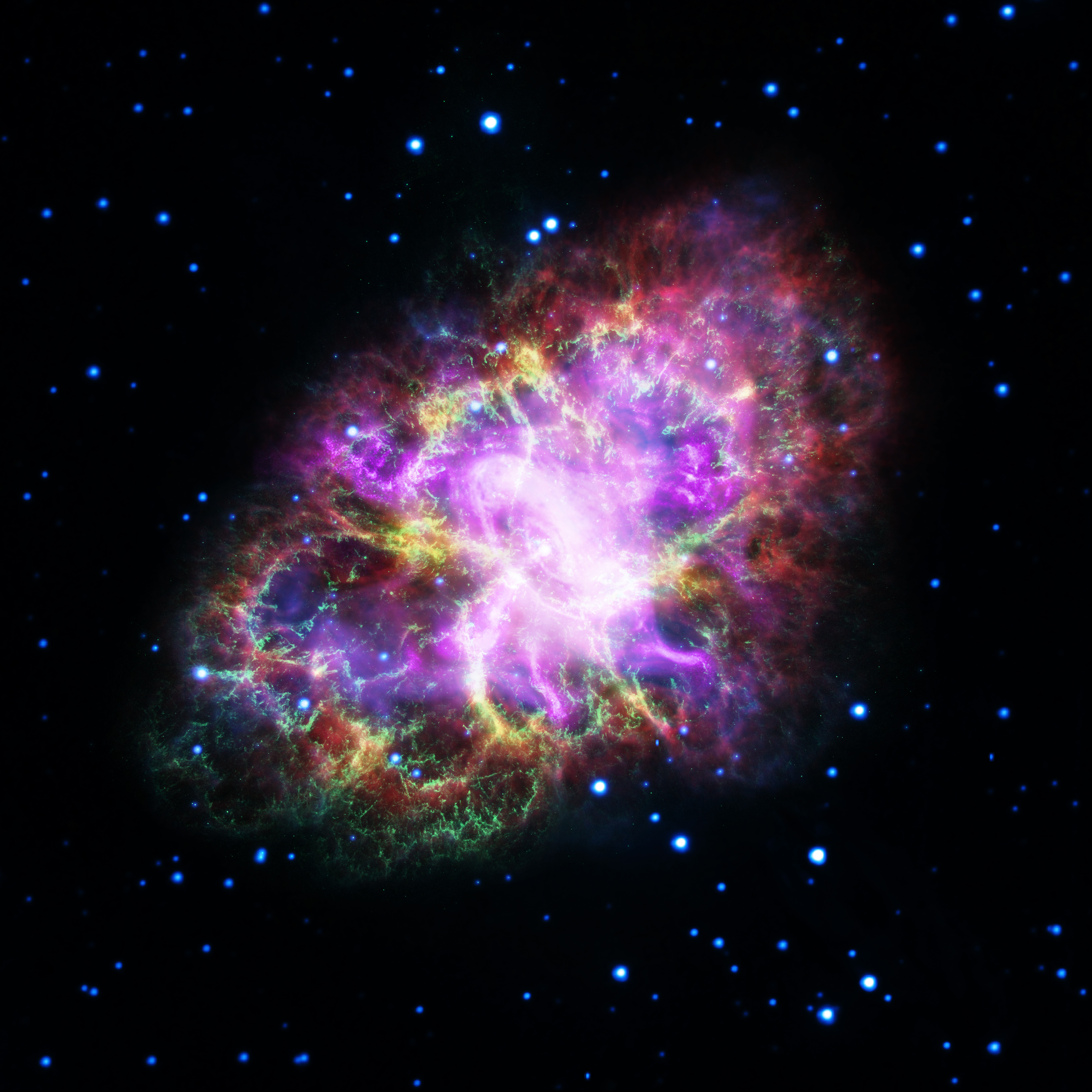
Astronomers have produced a highly detailed image of the Crab Nebula, by combining data from telescopes spanning nearly the entire breadth of the electromagnetic spectrum, from radio waves seen by the Karl G. Jansky Very Large Array (VLA) to the powerful X-ray glow as seen by the orbiting Chandra X-ray Observatory. And, in between, the Hubble Space Telescope's crisp visible-light view and the infrared perspective of the Spitzer Space Telescope.

The Crab Nebula, the result of a bright supernova explosion seen by Chinese and other astronomers in the year 1054, is 6,500 light-years from Earth. At its center is a super-dense neutron star, rotating once every 33 milliseconds, shooting out rotating lighthouse-like beams from radio waves to gamma-ray wavelengths — a pulsar. The nebula's intricate shape is caused by a complex interplay of the pulsar, a fast-moving wind of particles coming from the pulsar, and material originally ejected by the supernova explosion and by the star itself before the explosion.

This image combines data from five different telescopes: The VLA (radio) in red; Spitzer Space Telescope (infrared) in yellow; Hubble Space Telescope (visible) in green; XMM-Newton (ultraviolet) in blue; and Chandra X-ray Observatory (X-ray) in purple.

The new VLA, Hubble, and Chandra observations were largely made at about the same time in November 2012. Chandra has been observing the Crab Nebula since shortly after the telescope was launched into space in 1999 and has repeatedly done so in the years since. X-ray data reveal the distribution and behavior of the high-energy particles being spewed from the pulsar at the center of the Crab, which provides important clues to the workings of this mighty cosmic generator producing energy at the rate of 1,000 suns.

A paper describing the latest multi-wavelength work on the Crab, led by Gloria Dubner (IAFE), appears in The Astrophysical Journal and is available online. NASA's Marshall Space Flight Center in Huntsville, Alabama, manages the Chandra program for NASA's Science Mission Directorate in Washington. The Smithsonian Astrophysical Observatory in Cambridge, Massachusetts, controls Chandra's science and flight operations.


Fast Facts for Crab Nebula:

Scale: Image is about 5 arcmin across (10 light years)
Category: Supernovas & Supernova Remnants, Neutron Stars/X-ray Binaries
Coordinates (J2000): RA 05h 34m 32s | Dec +22° 0.0' 52.00"
Constellation: Taurus
Observation Date: 48 pointings between March 2000 and Nov 2013
Observation Time: 25 hours 28 min. (1 day 1 hour 28 min)
Obs. ID: 769-773, 1994-2001, 4607, 13139, 13146, 13147, 13150-13154, 13204-13210, 13750-13752, 13754-13757, 14416, 14458, 14678-14682, 14685, 16245, 16257, 16357, 16358
Instrument: ACIS
Also Known As: NGC 1952
References: Dubner, G. et al., 2017, ApJ [in print]; arXiv: 1704.02968
Color Code: X-ray (Purple), Ultraviolet (Blue), Optical (Green), Infrared (Yellow-Green), Radio (Red)
Distance Estimate: About 6,500 light years


Wednesday, May 10, 2017

Merging Galaxies Have Enshrouded Black Holes

This illustration compares growing supermassive black holes in two different kinds of galaxies. A growing supermassive black hole in a normal galaxy would have a donut-shaped structure of gas and dust around it (left). In a merging galaxy, a sphere of material obscures the black hole (right). Credit: National Astronomical Observatory of Japan.  › Larger view


Black holes get a bad rap in popular culture for swallowing everything in their environments. In reality, stars, gas and dust can orbit black holes for long periods of time, until a major disruption pushes the material in.

A merger of two galaxies is one such disruption. As the galaxies combine and their central black holes approach each other, gas and dust in the vicinity are pushed onto their respective black holes. An enormous amount of high-energy radiation is released as material spirals rapidly toward the hungry black hole, which becomes what astronomers call an active galactic nucleus (AGN).

A study using NASA's NuSTAR telescope shows that in the late stages of galaxy mergers, so much gas and dust falls toward a black hole that the extremely bright AGN is enshrouded. The combined effect of the gravity of the two galaxies slows the rotational speeds of gas and dust that would otherwise be orbiting freely. This loss of energy makes the material fall onto the black hole.

"The further along the merger is, the more enshrouded the AGN will be," said Claudio Ricci, lead author of the study published in the Monthly Notices Royal Astronomical Society. "Galaxies that are far along in the merging process are completely covered in a cocoon of gas and dust."

Ricci and colleagues observed the penetrating high-energy X-ray emission from 52 galaxies. About half of them were in the later stages of merging. Because NuSTAR is very sensitive to detecting the highest-energy X-rays, it was critical in establishing how much light escapes the sphere of gas and dust covering an AGN.

The study was published in the Monthly Notices of the Royal Astronomical Society. Researchers compared NuSTAR observations of the galaxies with data from NASA's Swift and Chandra and ESA's XMM-Newton observatories, which look at lower energy components of the X-ray spectrum. If high-energy X-rays are detected from a galaxy, but low-energy X-rays are not, that is a sign that an AGN is heavily obscured.

The study helps confirm the longstanding idea that an AGN's black hole does most of its eating while enshrouded during the late stages of a merger.

"A supermassive black hole grows rapidly during these mergers," Ricci said. "The results further our understanding of the mysterious origins of the relationship between a black hole and its host galaxy."

NuSTAR is a Small Explorer mission led by Caltech and managed by NASA's Jet Propulsion Laboratory for NASA's Science Mission Directorate in Washington. NuSTAR was developed in partnership with the Danish Technical University and the Italian Space Agency (ASI). The spacecraft was built by Orbital Sciences Corp., Dulles, Virginia. NuSTAR's mission operations center is at UC Berkeley, and the official data archive is at NASA's High Energy Astrophysics Science Archive Research Center. ASI provides the mission's ground station and a mirror archive. JPL is managed by Caltech for NASA.

For more information on NuSTAR, visit:  http://www.nasa.gov/nustar  -  http://www.nustar.caltech.edu


News Media Contact

Elizabeth Landau
Jet Propulsion Laboratory, Pasadena, Calif.
818-354-6425

elizabeth.landau@jpl.nasa.gov


Tuesday, May 09, 2017

Ripples in the Cosmic Web

Volume rendering of the output from a supercomputer simulation showing part of the cosmic web, 11.5 billion years ago. This and other models of the universe were generated and directly compared with quasar pair data in order to measure the small-scale ripples in the cosmic web. The cube is 24 million light years on a side. Credit: J. Onorbe /MPIA

Schematic representation of the technique used to probe the small-scale structure of the cosmic web using light from a rare quasar pair. The spectra (bottom right) contain information about the hydrogen gas the light has encountered, as well as the distance of that gas. Credit: Springel et al. (2005) (cosmic web)/J. Neidel, MPIA

Spectra of both members of a close quasar pair used in the study. The subtle differences in the absorption features between the two sight lines allow the researchers to probe the small-scale structure of the cosmic web. Credit: Rorai et al./MPIA 


Maunakea, Hawaii – Astronomers for the first time have measured small ripples in the cosmic web using W. M. Keck Observatory images of rare double quasars.

The most barren regions of the universe are the far-flung corners of intergalactic space. In these vast expanses between the galaxies there is just one solitary atom per cubic meter — a diffuse haze of hydrogen gas left over from the Big Bang.

On the largest scales, this diffuse material is arranged in a vast network of filamentary structures known as the “cosmic web,” its tangled strands spanning billions of light years and accounting for the majority of atoms in the universe.

Now, a team of astronomers has made the first measurements of small-scale ripples in this primeval hydrogen gas. Although the regions of cosmic web they studied lie nearly 11 billion light years away, they were able to measure variations in its structure on scales 100,000 times smaller, comparable to the size of a single galaxy. The results appear in the journal Science.

Intergalactic gas is so tenuous that it emits no light of its own. Instead astronomers study it indirectly by observing how it selectively absorbs the light coming from faraway sources known as quasars.

Quasars constitute a brief hyperluminous phase of the galactic life-cycle powered by the infall of matter onto a galaxy’s central supermassive black hole. Quasars act like cosmic lighthouses — bright, distant beacons that allow astronomers to study intergalactic atoms residing between the location of the quasar and the Earth.

But because these hyperluminous episodes last only a tiny fraction of a galaxy’s lifetime, quasars are correspondingly rare on the sky and are typically separated by hundreds of millions of light years from each other.

In order to probe the cosmic web on much smaller length scales, the astronomers exploited a fortuitous cosmic coincidence: They identified exceedingly rare pairs of quasars right next to each other on the sky and measured subtle differences in the absorption of intergalactic atoms measured along the two sightlines.

“Pairs of quasars are like needles in a haystack. In order to find them we combed through images of billions of celestial objects, millions of times fainter than what the naked eye can see,” explains Joseph Hennawi, an associate professor at University of California Santa Barbara’s Department of Physics.

Hennawi pioneered the application of algorithms from ‘machine learning’, a branch of artificial intelligence, to efficiently locate quasar pairs in the massive amounts of data produced by digital imaging surveys of the night sky.

Once identified, the quasar pairs were observed with the largest telescopes in the world, including the 10-meter telescopes at the W. M. Keck Observatory on Maunakea, Hawaii. The University of California (UC) is a founding partner of Keck Observatory, and UC astronomers have access to its telescopes.

The discovery team gathered a majority of the data using the Low Resolution Imaging Spectrometer (LRIS), a faint-light instrument on the Keck I telescope capable of taking spectra and images of the most distant known objects in the universe, along with the Echellette Spectrograph and Imager (ESI) on Keck II to capture high-resolution spectra of the rare double quasars.

“One of the biggest challenges was developing the mathematical and statistical tools to quantify the tiny differences we measured in this new kind of data,” said lead author Alberto Rorai, Hennawi’s former PhD student, who is now a postdoctoral researcher at Cambridge University. Rorai developed these tools as part of the research for his doctoral degree, and applied them to spectra of quasars obtained with Hennawi and other colleagues.

The astronomers compared their measurements to supercomputer models that simulate the formation of cosmic structures from the Big Bang to the present.

“The input to our simulations are the laws of physics and the output is an artificial universe, which can be directly compared to astronomical data,” said co-author Jose Oñorbe, a postdoctoral researcher at the Max Planck Institute for Astronomy who led the supercomputer simulation effort. “I was delighted to see that these new measurements agree with the well-established paradigm for how cosmic structures form.”

On a single laptop, these complex calculations would have required almost 1,000 years to complete, but modern supercomputers enabled the researchers to carry them out in just a few weeks.

“One reason these small-scale fluctuations are so interesting is that they encode information about the temperature of gas in the cosmic web just a few billion years after the Big Bang,” explained Hennawi.

Astronomers believe that the matter in the universe went through phase transitions billions of years ago, which dramatically changed its temperature. These phase transitions, known as cosmic re-ionization, occurred when the collective ultraviolet glow of all stars and quasars in the universe became intense enough to strip electrons off atoms in intergalactic space.

How and when re-ionization occurred is one of the biggest open questions in the field of cosmology, and these new measurements provide important clues that will help narrate this chapter of the history of the universe.


Media Contact:

Mari-Ela Chock, Communications Officer
W. M. Keck Observatory
(808) 554-0567
mchock@keck.hawaii.edu

Science Contacts:

Alberto Rorai, Lead Author
University of Cambridge
+44 01223 746433
arorai@ast.cam.ac.uk

Joseph Hennawi, Co-author
University of California - Santa Barbara
(805) 893-3503
joe@physics.ucsb.edu


About W. M. Keck Observatory


The W. M. Keck Observatory operates the largest, most scientifically productive telescopes on Earth. The two, 10-meter optical/infrared telescopes on the summit of Maunakea on the Island of Hawaii feature a suite of advanced instruments including imagers, multi-object spectrographs, high-resolution spectrographs, integral-field spectrometers, and world-leading laser guide star adaptive optics systems. The Observatory is a private 501(c) 3 non-profit organization and a scientific partnership of the California Institute of Technology, the University of California, and NASA.


Monday, May 08, 2017

Superbubbles in the Interstellar Medium of the Antennae Galaxies

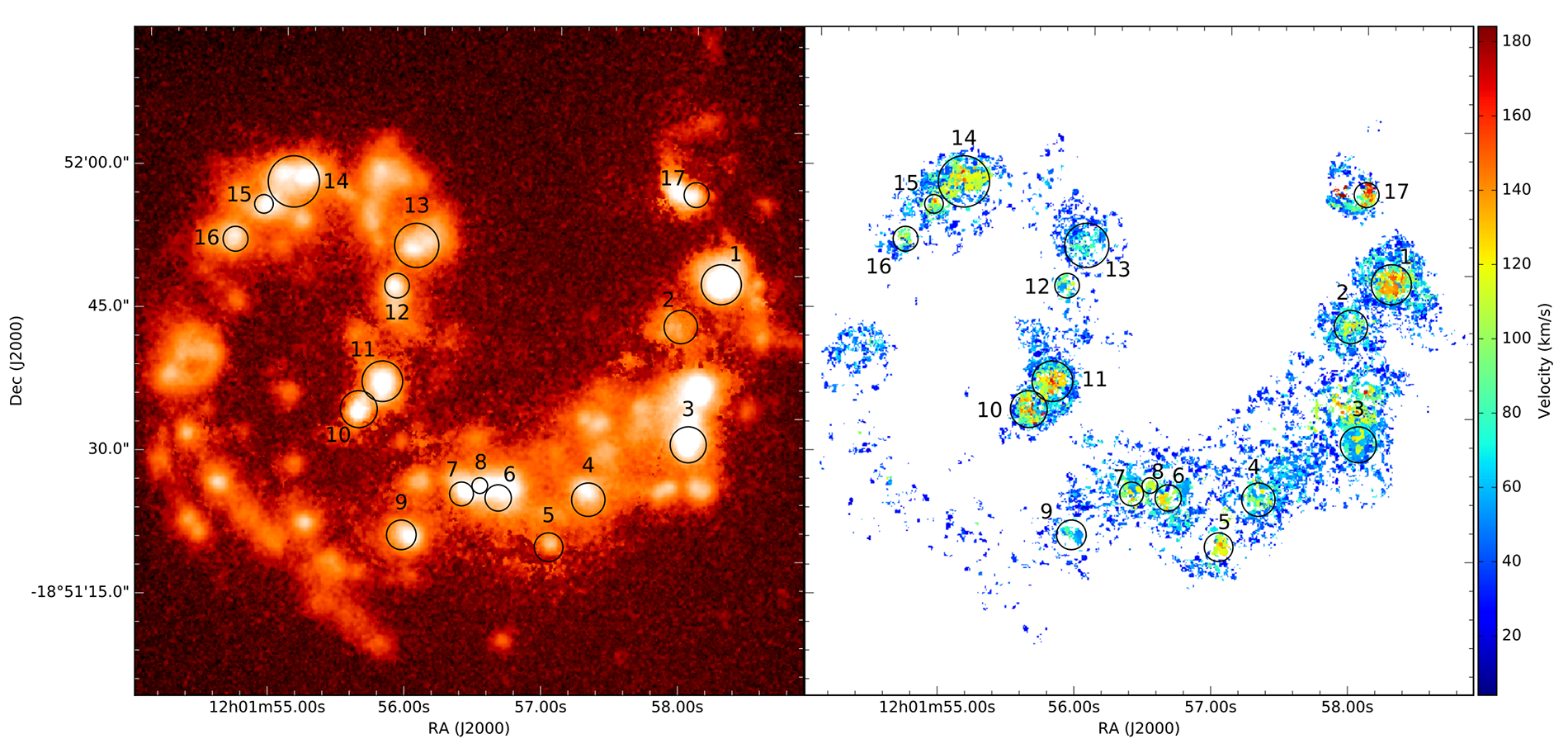
Left panel: map of the surface brightness of the "Antennae" in emission from ionized hydrogen. The brightest zones are the zones occupied by clusters of massive stars. Right panel: map of the expansion velocity of the bubbles detected in the Antennae, pushed outwards by the stellar winds and supernova explosions of the stars in the cluster. The colours give the values of the expansion velocity at each point on the map. The largest bubble is 1500 light years in size. Credit: IAC. Large format: PNG.


A team of scientists led by members of the Instituto de Astrofísica de Canarias (IAC), in collaboration with the Universidad Nacional Autónoma de México (UNAM), have detected and measured a complete "carpet" of expanding bubbles in the interstellar medium of the "Antennae", a pair of galaxies in interaction which will eventually merge. The work, published in Monthy Notices of the Royal Astronomical Society is based on observations with GHaFaS on the William Herschel Telescope (WHT). This instrument is capable of making a map of the velocities of a complete galaxy using the emission from the ionized hydrogen in its interstellar medium.

To detect the huge bubbles in the combined galaxy disc, the team has used BUBBLY, a method developed by some of the current authors which has already been published in the same journal in 2015. These huge bubbles in galaxy discs are caused by the stellar winds and supernova explosions in clusters of very hot very massive stars. They can range in size from a couple of light years to a thousand light years, depending on the number of stars in the cluster and how massive they are. The larger ones are often called "superbubbles".

In the study, the BUBBLY method has been applied to the "Antennae", in which the interaction between the galaxies is causing a major burst of star formation, leading to many star clusters, each surrounded by a bubble of expanding gas. The researchers have been able to calculate how much energy is being fed into the interstellar medium from each individual bubble, and from the sum total of all the bubbles, including a decent estimate for those which are too small to be fully detected.

"The importance of the bubbles", says Artemi Camps-Fariña, the lead author on both of the articles, "is that they let us measure the effects of feedback caused by massive star clusters on the rest of the galaxy in which they lie. This is being recognised as very important. Theorists who aim to model how galaxies are formed and evolve had a major problem when they made models without feedback. In those models star formation was far too rapid, so that all the available gas would have been used up when the universe had reached no more than one tenth of its present age. All galaxies would now be passive without any current star formation. But the feedback process, in which massive star clusters blow large bubbles, slows down the star formation rate, as it stops new gas from condensing so quickly into stars. It reduces the overall star formation rate by a big factor and has let galaxies such as the Milky Way produce their stellar populations in a much more extended time frame".

"Although this general idea is not new", says John Beckman, one of the authors of both articles, "our ability to measure the properties of the bubbles is giving us a way to quantify the effect and to match basic theory with the observed properties of galaxies".


More information:

Artemi Camps-Fariña, et al., 2017, "Physical properties of superbubbles in the Antennae galaxies", MNRAS, 468, 4134 [ ADS ].

Artemi Camps-Fariña, et al., 2015, "BUBBLY: a method for detecting and characterizing interstellar bubbles using Fabry-Perot spectroscopy", MNRAS, 447, 3840 [ ADS ].

"Superbubbles in the interstellar medium", IAC Press Release, 1st May 2017.


Contact: 

Javier Méndez
(Public Relations Officer)