Showing posts with label Antennae Galaxies. Show all posts

Monday, May 08, 2017

Superbubbles in the Interstellar Medium of the Antennae Galaxies

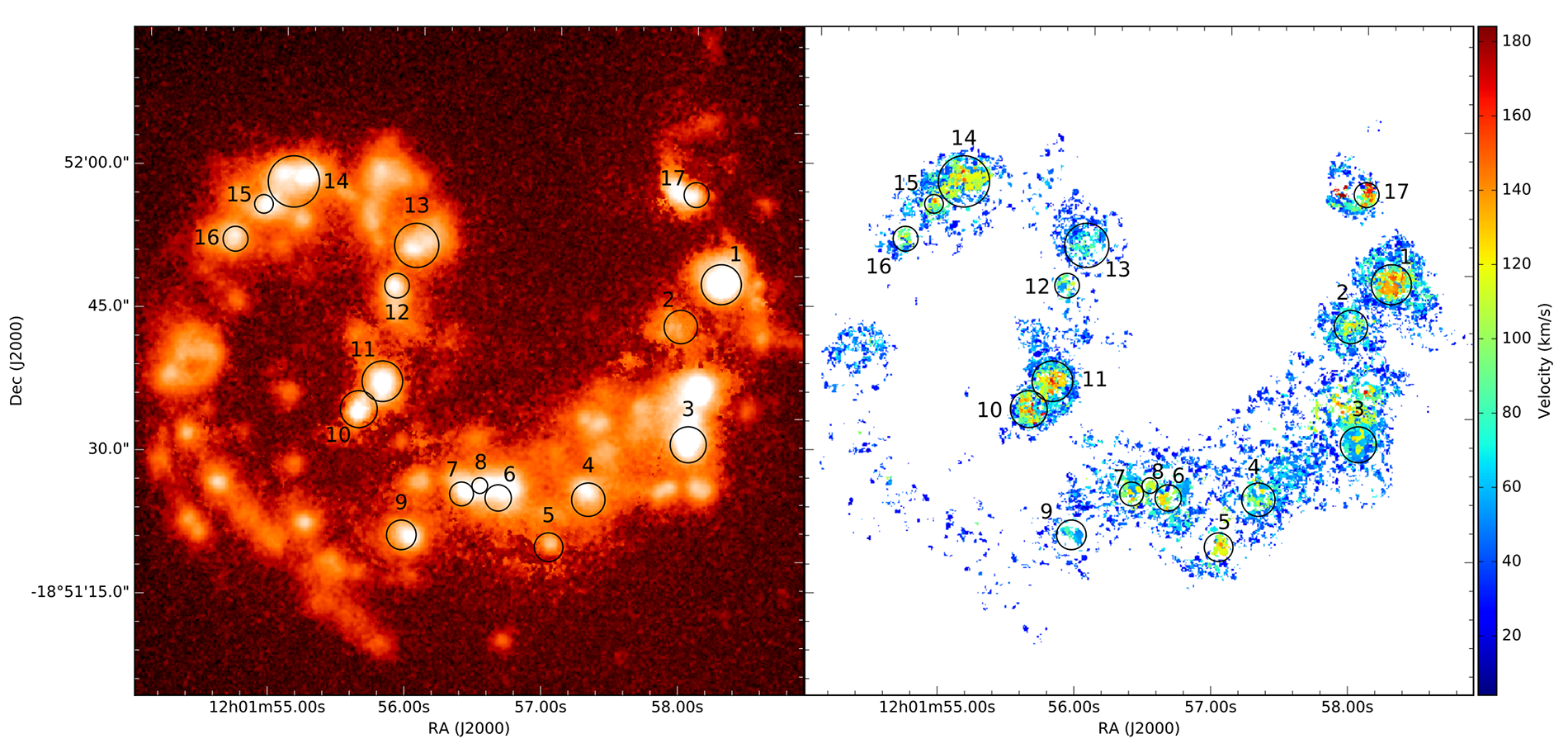
Left panel: map of the surface brightness of the "Antennae" in emission from ionized hydrogen. The brightest zones are the zones occupied by clusters of massive stars. Right panel: map of the expansion velocity of the bubbles detected in the Antennae, pushed outwards by the stellar winds and supernova explosions of the stars in the cluster. The colours give the values of the expansion velocity at each point on the map. The largest bubble is 1500 light years in size. Credit: IAC. Large format: PNG.


A team of scientists led by members of the Instituto de Astrofísica de Canarias (IAC), in collaboration with the Universidad Nacional Autónoma de México (UNAM), have detected and measured a complete "carpet" of expanding bubbles in the interstellar medium of the "Antennae", a pair of galaxies in interaction which will eventually merge. The work, published in Monthy Notices of the Royal Astronomical Society is based on observations with GHaFaS on the William Herschel Telescope (WHT). This instrument is capable of making a map of the velocities of a complete galaxy using the emission from the ionized hydrogen in its interstellar medium.

To detect the huge bubbles in the combined galaxy disc, the team has used BUBBLY, a method developed by some of the current authors which has already been published in the same journal in 2015. These huge bubbles in galaxy discs are caused by the stellar winds and supernova explosions in clusters of very hot very massive stars. They can range in size from a couple of light years to a thousand light years, depending on the number of stars in the cluster and how massive they are. The larger ones are often called "superbubbles".

In the study, the BUBBLY method has been applied to the "Antennae", in which the interaction between the galaxies is causing a major burst of star formation, leading to many star clusters, each surrounded by a bubble of expanding gas. The researchers have been able to calculate how much energy is being fed into the interstellar medium from each individual bubble, and from the sum total of all the bubbles, including a decent estimate for those which are too small to be fully detected.

"The importance of the bubbles", says Artemi Camps-Fariña, the lead author on both of the articles, "is that they let us measure the effects of feedback caused by massive star clusters on the rest of the galaxy in which they lie. This is being recognised as very important. Theorists who aim to model how galaxies are formed and evolve had a major problem when they made models without feedback. In those models star formation was far too rapid, so that all the available gas would have been used up when the universe had reached no more than one tenth of its present age. All galaxies would now be passive without any current star formation. But the feedback process, in which massive star clusters blow large bubbles, slows down the star formation rate, as it stops new gas from condensing so quickly into stars. It reduces the overall star formation rate by a big factor and has let galaxies such as the Milky Way produce their stellar populations in a much more extended time frame".

"Although this general idea is not new", says John Beckman, one of the authors of both articles, "our ability to measure the properties of the bubbles is giving us a way to quantify the effect and to match basic theory with the observed properties of galaxies".


More information:

Artemi Camps-Fariña, et al., 2017, "Physical properties of superbubbles in the Antennae galaxies", MNRAS, 468, 4134 [ ADS ].

Artemi Camps-Fariña, et al., 2015, "BUBBLY: a method for detecting and characterizing interstellar bubbles using Fabry-Perot spectroscopy", MNRAS, 447, 3840 [ ADS ].

"Superbubbles in the interstellar medium", IAC Press Release, 1st May 2017.


Contact: 

Javier Méndez
(Public Relations Officer)


Tuesday, August 26, 2014

Best View Yet of Merging Galaxies in Distant Universe

PR Image eso1426a
Merging galaxies in the distant Universe through a gravitational magnifying glass
 
How gravitational lensing acts like a magnifying glass
Wide-field view of the sky around the gravitationally lensed galaxy merger H-ATLAS J142935.3-002836
 
Merging galaxies in the distant Universe through a gravitational magnifying glass


*  *  *   *   *   *   *    *   *   *   *   *   *   *   *

Videos

Zooming in on a gravitationally lensed galaxy merger in the distant Universe

Artist's impression of gravitational lensing of a distant merger


ALMA applies methods of Sherlock Holmes

Using the Atacama Large Millimeter/submillimeter Array (ALMA), and many other telescopes on the ground and in space, an international team of astronomers has obtained the best view yet of a collision that took place between two galaxies when the Universe was only half its current age. They enlisted the help of a galaxy-sized magnifying glass to reveal otherwise invisible detail. These new studies of the galaxy H-ATLAS J142935.3-002836 have shown that this complex and distant object looks like the well-known local galaxy collision, the Antennae Galaxies.

The famous fictional detective Sherlock Holmes used a magnifying lens to reveal barely visible but important evidence. Astronomers are now combining the power of many telescopes on Earth and in space [1] with a vastly larger form of cosmic lens to study a case of vigorous star formation in the early Universe.

While astronomers are often limited by the power of their telescopes, in some cases our ability to see detail is hugely boosted by natural lenses, created by the Universe,” explains lead author Hugo Messias of the Universidad de Concepción (Chile) and the Centro de Astronomia e Astrofísica da Universidade de Lisboa (Portugal). “Einstein predicted in his theory of general relativity that, given enough mass, light does not travel in a straight line but will be bent in a similar way to light refracted by a normal lens.

These cosmic lenses are created by massive structures like galaxies and galaxy clusters, which deflect the light from objects behind them due to their strong gravity — an effect, called gravitational lensing. The magnifying properties of this effect allow astronomers to study objects which would not be visible otherwise and to directly compare local galaxies with much more remote ones, seen when the Universe was significantly younger.

But for these gravitational lenses to work, the lensing galaxy, and the one far behind it, need to be very precisely aligned.

H-ATLAS J142935.3-002836 (or just H1429-0028 for short) is one of these sources and was found in the Herschel Astrophysical Terahertz Large Area Survey (H-ATLAS). Although very faint in visible light pictures, it is among the brightest gravitationally lensed objects in the far-infrared regime found so far, even though we are seeing it at a time when the Universe was just half its current age.

Probing this object was at the limit of what is possible, so the international team of astronomers started an extensive follow-up campaign using the most powerful telescopes — both on the ground as well as in space — including the NASA/ESA Hubble Space Telescope, ALMA, the Keck Observatory, the Karl Jansky Very Large Array (JVLA), and others. The different telescopes provided different views, which could be combined to get the best insight yet into the nature of this unusual object.

The Hubble and Keck images revealed a detailed gravitationally-induced ring of light around the foreground galaxy. These high resolution images also showed that the lensing galaxy is an edge-on disc galaxy — similar to our galaxy, the Milky Way — which obscures parts of the background light due to the large dust clouds it contains.

But this obscuration is not a problem for ALMA and the JVLA, since these two facilities observe the sky at longer wavelengths, which are unaffected by dust. Using the combined data the team discovered that the background system was actually an ongoing collision between two galaxies. From this point on, ALMA and the JVLA started to play a key role in further characterising this object.

In particular, ALMA traced carbon monoxide, which allows detailed studies of star formation mechanisms in galaxies. The ALMA observations also allowed the motion of the material in the more distant object to be measured. This was essential to show that the lensed object is indeed an ongoing galactic collision forming hundreds of new stars each year, and that one of the colliding galaxies still shows signs of rotation; an indication that it was a disc galaxy just before this encounter.

The system of these two colliding galaxies resembles an object that is much closer to us: the Antennae Galaxies. This is a spectacular collision between two galaxies, which are believed to have had a disc structure in the past. While the Antennae system is forming stars at a rate of only a few tens of the mass of our Sun each year, H1429-0028 turns more than 400 times the mass of the Sun of gas into new stars each year.

Rob Ivison, ESO’s Director of Science and a co-author of the new study, concludes: “ALMA enabled us to solve this conundrum because it gives us information about the velocity of the gas in the galaxies, which makes it possible to disentangle the various components, revealing the classic signature of a galaxy merger. This beautiful study catches a galaxy merger red handed as it triggers an extreme starburst.”

Notes

[1] Among the armada of instruments that were used to provide evidence to help unravel the mysteries of this case were no fewer than three ESO telescopes — ALMA, APEX and VISTA. The other telescopes and surveys that were brought to bear were: the NASA/ESA Hubble Space Telescope, the Gemini South telescope, the Keck-II telescope, the NASA Spitzer Space Telescope, the Jansky Very Large Array, CARMA, IRAM and SDSS and WISE.

More information 

The Atacama Large Millimeter/submillimeter Array (ALMA), an international astronomy facility, is a partnership of Europe, North America and East Asia in cooperation with the Republic of Chile. ALMA is funded in Europe by the European Southern Observatory (ESO), in North America by the U.S. National Science Foundation (NSF) in cooperation with the National Research Council of Canada (NRC) and the National Science Council of Taiwan (NSC) and in East Asia by the National Institutes of Natural Sciences (NINS) of Japan in cooperation with the Academia Sinica (AS) in Taiwan. ALMA construction and operations are led on behalf of Europe by ESO, on behalf of North America by the National Radio Astronomy Observatory (NRAO), which is managed by Associated Universities, Inc. (AUI) and on behalf of East Asia by the National Astronomical Observatory of Japan (NAOJ). The Joint ALMA Observatory (JAO) provides the unified leadership and management of the construction, commissioning and operation of ALMA.

This research was presented in a paper entitled “Herschel-ATLAS and ALMA HATLAS J142935.3-002836, a lensed major merger at redshift 1.027”, by Hugo Messias et al., to appear online on 26 August 2014 in the journal Astronomy & Astrophysics.

The team is composed of Hugo Messias (Universidad de Concepción, Barrio Universitario, Chile; Centro de Astronomia e Astrofísica da Universidade de Lisboa, Portugal), Simon Dye (School of Physics and Astronomy, University of Nottingham, UK), Neil Nagar (Universidad de Concepción, Barrio Universitario, Chile), Gustavo Orellana (Universidad de Concepción, Barrio Universitario, Chile), R. Shane Bussmann (Harvard-Smithsonian Center for Astrophysics, USA), Jae Calanog (Department of Physics & Astronomy, University of California, USA), Helmut Dannerbauer (Universität Wien, Institut für Astrophysik, Austria), Hai Fu (Astronomy Department, California Institute of Technology, USA), Edo Ibar (Pontificia Universidad Católica de Chile, Departamento de Astronomía y Astrofísica, Chile), Andrew Inohara (Department of Physics & Astronomy, University of California, USA), R. J. Ivison (Institute for Astronomy, University of Edinburgh, Royal Observatory, UK; ESO, Garching, Germany), Mattia Negrello (INAF, Osservatorio Astronomico di Padova, Italy), Dominik A. Riechers (Astronomy Department, California Institute of Technology, USA; Department of Astronomy, Cornell University, USA), Yun-Kyeong Sheen (Universidad de Concepción, Barrio Universitario, Chile), Simon Amber (The Open University, Milton Keynes, UK), Mark Birkinshaw (H. H. Wills Physics Laboratory, University of Bristol, UK; Harvard-Smithsonian Center for Astrophysics, USA), Nathan Bourne (School of Physics and Astronomy, University of Nottingham, UK), Dave L. Clements (Astrophysics Group, Imperial College London, UK), Asantha Cooray (Department of Physics & Astronomy, University of California, USA; Astronomy Department, California Institute of Technology, USA), Gianfranco De Zotti (INAF, Osservatorio Astronomico di Padova, Italy), Ricardo Demarco (Universidad de Concepción, Barrio Universitario, Chile), Loretta Dunne (Department of Physics and Astronomy, University of Canterbury, New Zealand; Institute for Astronomy, University of Edinburgh, Royal Observatory, UK), Stephen Eales (School of Physics and Astronomy, Cardiff University,UK), Simone Fleuren (School of Mathematical Sciences, University of London, UK), Roxana E. Lupu (Department of Physics and Astronomy, University of Pennsylvania, USA), Steve J. Maddox (Department of Physics and Astronomy, University of Canterbury, New Zealand; Institute for Astronomy, University of Edinburgh, Royal Observatory, UK), Michał J. Michałowski (Institute for Astronomy, University of Edinburgh, Royal Observatory, UK), Alain Omont (Institut d’Astrophysique de Paris, UPMC Univ. Paris, France), Kate Rowlands (School of Physics & Astronomy, University of St Andrews, UK), Dan Smith (Centre for Astrophysics Research, Science & Technology Research Institute, University of Hertfordshire, UK), Matt Smith (School of Physics and Astronomy, Cardiff University,UK) and Elisabetta Valiante (School of Physics and Astronomy, Cardiff University, UK).

ESO is the foremost intergovernmental astronomy organisation in Europe and the world’s most productive ground-based astronomical observatory by far. It is supported by 15 countries: Austria, Belgium, Brazil, the Czech Republic, Denmark, France, Finland, Germany, Italy, the Netherlands, Portugal, Spain, Sweden, Switzerland and the United Kingdom. ESO carries out an ambitious programme focused on the design, construction and operation of powerful ground-based observing facilities enabling astronomers to make important scientific discoveries. ESO also plays a leading role in promoting and organising cooperation in astronomical research. ESO operates three unique world-class observing sites in Chile: La Silla, Paranal and Chajnantor. At Paranal, ESO operates the Very Large Telescope, the world’s most advanced visible-light astronomical observatory and two survey telescopes. VISTA works in the infrared and is the world’s largest survey telescope and the VLT Survey Telescope is the largest telescope designed to exclusively survey the skies in visible light. ESO is the European partner of a revolutionary astronomical telescope ALMA, the largest astronomical project in existence. ESO is currently planning the 39-metre European Extremely Large optical/near-infrared Telescope, the E-ELT, which will become “the world’s biggest eye on the sky”.

Links


Contacts


Hugo Messias
Universidad de Concepción, Chile / Centro de Astronomia e Astrofísica da Universidade de Lisboa, Portugal
Tel: +351 21 361 67 47/30
Email: hmessias@oal.ul.pt

Richard Hook
ESO, Public Information Officer
Garching bei München, Germany
Tel: +49 89 3200 6655
Cell: +49 151 1537 3591
Email: rhook@eso.org

Source: ESO

Friday, November 15, 2013

Antennae Galaxies reloaded

Credit: ESA/Hubble & NASA

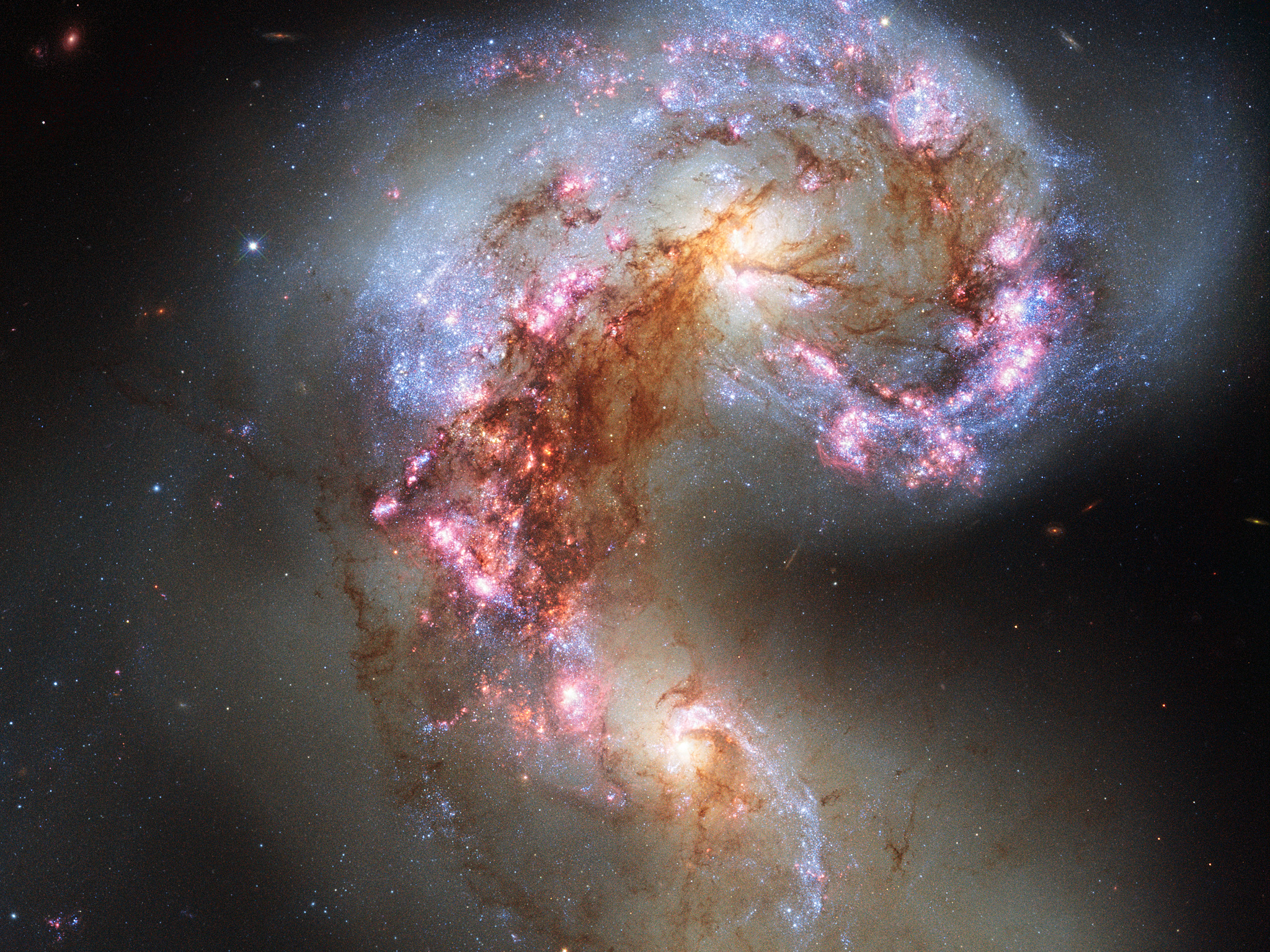
The NASA/ESA Hubble Space Telescope has snapped the best ever image of the Antennae Galaxies. Hubble has released images of these stunning galaxies twice before, once using observations from its Wide Field and Planetary Camera 2 (WFPC2) in 1997, and again in 2006 from the Advanced Camera for Surveys (ACS). Each of Hubble’s images of the Antennae Galaxies has been better than the last, due to upgrades made during the famous servicing missions, the last of which took place in 2009.

The galaxies — also known as NGC 4038 and NGC 4039 — are locked in a deadly embrace. Once normal, sedate spiral galaxies like the Milky Way, the pair have spent the past few hundred million years sparring with one another. This clash is so violent that stars have been ripped from their host galaxies to form a streaming arc between the two. In wide-field images of the pair the reason for their name becomes clear — far-flung stars and streamers of gas stretch out into space, creating long tidal tails reminiscent of antennae.

This new image of the Antennae Galaxies shows obvious signs of chaos. Clouds of gas are seen in bright pink and red, surrounding the bright flashes of blue star-forming regions — some of which are partially obscured by dark patches of dust. The rate of star formation is so high that the Antennae Galaxies are said to be in a state of starburst, a period in which all of the gas within the galaxies is being used to form stars. This cannot last forever and neither can the separate galaxies; eventually the nuclei will coalesce, and the galaxies will begin their retirement together as one large elliptical galaxy.

This image uses visible and near-infrared observations from Hubble’s Wide Field Camera 3 (WFC3), along with some of the previously-released observations from Hubble’s Advanced Camera for Surveys (ACS).


Monday, May 09, 2011

Galactic Fountain of Youth

Credit: ESA/Hubble & NASA

This NASA/ESA Hubble Space Telescope image shows the edge-on profile of the slender spiral galaxy NGC 5775. Although the spiral is tilted away from us, with only a thin slither on view, such a perspective can be advantageous for astronomers because the regions above and below the galaxy’s disc can be seen much more clearly.

For instance, astronomers have previously used the high inclination of this spiral to study the properties of the halo of hot gas that is visible when the galaxy is observed at X-ray wavelengths. The mechanism behind such haloes is unclear, but they are found around spirals that have a high star formation rate, like NGC 5775. Some astronomers think that hot gas from the disc is driven into the halo by supernova explosions, which is then returned to the disc as it cools — like a massive galactic fountain.

Meanwhile, there is further disruption taking place in the disc of NGC 5775, as it is in the early stages of a galactic merger. Astronomers have observed bridges of hydrogen gas connecting this edge-on galaxy with a neighbouring face-on spiral (NGC 5774). But neither galaxy yet features a tidal tail — a disrupted stream of gas and stars that extends into space — which are commonplace in strongly interacting pairs, such as the Antennae Galaxies.

NGC 5775 and 5774 are members of the Virgo Cluster and lie at a distance of about 85 million light-years. This colour picture was created from images taken using the Wide Field Channel of Hubble’s Advanced Camera for Surveys. Images through a red filter (F625W) were coloured blue and images through a filter that isolates the glow from hydrogen gas (F658N) have been coloured red. The exposure times were 2292 s and 6848 s, respectively, and the field of view is 3.2 arcminutes across.


Thursday, August 05, 2010

A Galactic Spectacle

NGC 4038/4039 - Antennae Galaxies
Credit: NASA, ESA, SAO, CXC, JPL-Caltech, and STScI
Acknowledgment: G. Fabbiano and Z. Wang (Harvard-Smithsonian CfA),
and B. Whitmore (STScI)

A beautiful new image of two colliding galaxies has been released by NASA's Great Observatories. The Antennae galaxies, located about 62 million light-years from Earth, are shown in this composite image from the Chandra X-ray Observatory (blue), the Hubble Space Telescope (gold and brown), and the Spitzer Space Telescope (red). The Antennae galaxies take their name from the long antenna-like "arms," seen in wide-angle views of the system. These features were produced by tidal forces generated in the collision.

The collision, which began more than 100 million years ago and is still occurring, has triggered the formation of millions of stars in clouds of dusts and gas in the galaxies. The most massive of these young stars have already sped through their evolution in a few million years and exploded as supernovas.

The X-ray image from Chandra shows huge clouds of hot, interstellar gas that have been injected with rich deposits of elements from supernova explosions. This enriched gas, which includes elements such as oxygen, iron, magnesium, and silicon, will be incorporated into new generations of stars and planets. The bright, point-like sources in the image are produced by material falling onto black holes and neutron stars that are remnants of the massive stars. Some of these black holes may have masses that are almost one hundred times that of the Sun.

The Spitzer data show infrared light from warm dust clouds that have been heated by newborn stars, with the brightest clouds lying in the overlapping region between the two galaxies.

The Hubble data reveal old stars and star-forming regions in gold and white, while filaments of dust appear in brown. Many of the fainter objects in the optical image are clusters containing thousands of stars.

The Chandra image was taken in December 1999. The Spitzer image was taken in December 2003. The Hubble image was taken in July 2004, and February 2005.

For additional information, contact:

Megan Watzke
Chandra X-ray Center, Cambridge, Mass.
617-496-7998

mwatzke@cfa.harvard.edu

Whitney Clavin
Jet Propulsion Laboratory, Pasadena, Calif.
818-354-4673

whitney.clavin@jpl.nasa.gov

Cheryl Gundy
Space Telescope Science Institute, Baltimore, Md.
410-338-4707

gundy@stsci.edu

Monday, May 12, 2008

Antennae Galaxies move closer

Credit: NASA, ESA, and the Hubble Heritage Team
(STScI/AURA)-ESA/Hubble Collaboration

Merging system's interaction sets standard for galaxy evolution.
Provided by European Space Agency

The Antennae Galaxies are among the closest known merging systems. Also known as NGC 4038 and NGC 4039, the two began interacting a few hundred million years ago, creating one of the most impressive sights in the night sky. They are used by scientists as a standard against which to validate theories of galactic evolution.

An international group of scientists led by Ivo Saviane from the European Southern Observatory used Hubble's Advanced Camera for Surveys and Wide Field Planetary Camera 2 to observe individual stars spawned by the colossal cosmic collision in the Antennae Galaxies. By measuring the colors and brightnesses of red giant stars in the system, the scientists found that the Antennae are much closer than previously thought: 45 million light-years instead of the previous best estimate of 65 million light-years.

The team targeted a region in the relatively quiescent outer regions in the southern tidal tail, away from the active central regions. This tail consists of material thrown from the main galaxies as they collided. The scientists needed to observe regions with older red giant stars to derive an accurate distance. Red giants are known to reach a standard brightness, which can then be used to infer their distance.

The previous distance to the Antennae Galaxy was about 65 million light-years, although values as high as 100 million light years have been used. Our Sun is only 8 light-minutes away from us, so the Antennae Galaxies may seem rather distant. But if we consider that we already know of galaxies more than 10 billion light-years away, the two galaxies are really our neighbors.

The new, smaller distance makes the Antennae Galaxies less extreme in terms of the physics needed to explain the observed phenomena. For instance, its infrared radiation is now that expected of a standard early merging event rather than that of an ultraluminous infrared galaxy. The size of the star clusters formed as a consequence of the Antennae merger now agree with those of clusters created in other mergers instead of being 1.5 times as large.

The Antennae Galaxies are named for the two long tails of stars, gas and dust that resemble the antennae of an insect. These "antennae" are a physical result of the collision between the two galaxies. Studying their properties gives us a preview of what may happen when our Milky Way Galaxy collides with the neighboring Andromeda galaxy in several billion years.


Saturday, February 11, 2006

Fire Within the Antennae Galaxies - Courtesy Nasa/JPL - Caltech/Z

Interacting Antennae Galaxies
Credit: NASA/JPL-Caltech/Z.Wang (Harvard-Smithsonian CfA)


This false-color image from NASA's Spitzer Space Telescope reveals hidden populations of newborn stars at the heart of the colliding "Antennae" galaxies. These two galaxies, known individually as NGC 4038 and 4039, are located around 68 million light-years away and have been merging together for about the last 800 million years. The latest Spitzer observations provide a snapshot of the tremendous burst of star formation triggered in the process of this collision, particularly at the site where the two galaxies overlap.