Showing posts with label Kuiper Belt objects (KBOs). Show all posts

Monday, May 25, 2026

The Origins of Nereid, Neptune's Most Eccentric Moon


Neptune

Short movie showing the orbits of Nereid, Triton, and the inner moons of Neptune. The innermost moons all orbit in the plane of Neptune's equator. Triton orbits the other way, with a significantly inclined orbit. Nereid is much further out, with a highly eccentric, or elliptical, orbit. Made using Universe Sandbox. Credit: M. Belyakov


Neptune, the farthest of the planets, acts like a shepherd for the outer solar system, gravitationally scattering distant asteroids known as Kuiper Belt Objects (KBOs). Understanding Neptune's history gives important clues to how the rest of the solar system evolved to its present state.

Neptune itself is unique—tilted 30 degrees on its side, it is host to a few unusual moons, including the Pluto-sized moon called Triton. Triton orbits Neptune backward, an indicator that it did not form around Neptune but was instead captured by Neptune's gravity after it formed elsewhere in the solar system. New observations coupled with simulations of Neptune's evolutionary history indicate that an oft-overlooked Neptunian moon called Nereid may reveal the planet's past.

The research was led by graduate student Matthew Belyakov and conducted as a collaboration between the laboratories of Professor of Planetary Science Konstantin Batygin (PhD '12), and Mike Brown, the Richard and Barbara Rosenberg Professor of Planetary Astronomy and Terence D. Barr Leadership Chair and director of the Center for Comparative Planetary Evolution. The work is reported in a paper appearing in Science Advances on May 20.

Jupiter, Saturn, and Uranus all have "typical" moon systems, with each planet possessing several large moons that orbit closely and along the host planet's equatorial plane, as well as many smaller moons, called irregular satellites, located farther out on tilted or "inclined" orbits. Neptune, on the other hand, has just one large moon, Triton, that contains 99.9 percent of the mass in its entire moon system. Triton's orbit is retrograde—it moves clockwise, while Neptune orbits the Sun counterclockwise. This means that Triton could not have coalesced in place, as Jupiter and Saturn's moons did, out of the disk of material orbiting counterclockwise around its planet. Instead, Triton is thought to be a Kuiper Belt Object, like Pluto, that was flung into Neptune's path and ensnared gravitationally.

Prior to Voyager 2's flyby of Neptune in August 1989, only one other moon was known around Neptune, Nereid. Discovered by Dutch astronomer Gerard Kuiper in 1949, Nereid has since presented a mystery. The moon follows an eccentric orbit, swinging around Neptune in an ellipse, and is far from its planet, but not nearly as distant as irregular satellites around the other giant planets. Interestingly, Nereid does not have a 14retrograde orbit like Triton, and its orbit is much less inclined than other irregular moons in the solar system. Given these details, scientists debated Nereid's origin for 70 years, unable to conclude whether the moon was captured or formed in place.

In 2024, Caltech graduate students Matthew Belyakov and M. Ryleigh Davis (MS '22) used the James Webb Space Telescope (JWST) to observe the Neptunian moon system, with Nereid as one of the targets. The team used JWST's near-infrared spectrograph, which splits light into its many wavelengths in order to obtain chemical information about astronomical targets. Nereid's spectrum appeared rather different from that of Kuiperbelt objects—Nereid was instead more similar to the moons of Uranus. Informed by the observational data, which hinted toward a noncaptured origin for Nereid, Belyakov then developed simulations of the evolution of Neptune's moons.

The simulations showed that as Triton crashed into the Neptunian system and was captured, existing Neptunian moons could have been kicked out on eccentric orbits that looked identical to ereid's. This suggests that Nereid formed in situ around Neptune, rather than being a captured foreign object.

"Understanding what transpired at Neptune is one of the ways that we can solve what happened in the early solar system, and Nereid is important for pinning down key events like Triton's capture," Belyakov says. "We're hoping this work motivates people to do creative observations of Nereid, even though it is faint and distant. It's just as important as Triton. I hope Nereid will be visited by a mission within my lifetime."

Without such a mission, much about Nereid is likely to remain a mystery.Voyager images of Nereid are only a few pixels across. In continuation of their work, the team aims to build more simulations to constrain the timing of Triton's capture and the possible configurations for the initial moon system around Neptune.

The paper is titled "Nereid as a Regular Satellite of Neptune." In addition to Belyakov, Batygin, Brown, and Davis, former Caltech graduate student Ian Wong (PhD '18), now of the Space Telescope Science Institute in Baltimore, Maryland, is a co-author. Funding was provided by NASA, the European Space Agency, and the Canadian Space Agency, which jointly operate JWST.

Written by Lori Dajose

Source: Caltech/News


Contact:

Lori Dajose
(626) 395‑1217

ldajose@caltech.edu


Friday, March 07, 2025

NASA's Hubble Finds Kuiper Belt Duo May Be Trio

This artist’s concept depicts one of the possible scenarios for the 148780 Altjira system in the solar system’s Kuiper Belt. It is likely a hierarchical triple formation, in which two very close companions are orbited by a third member at a greater distance. Credit:NASA, ESA, Joseph Olmsted (STScI).


Maunakea, Hawaiʻi – A team of researchers using data from W. M. Keck Observatory on Maunakea, Hawaiʻi Island and NASA’s Hubble Space Telescope have discovered what is likely a stable trio of icy space rocks in the solar system’s Kuiper Belt.

If confirmed as the second such three-body system found in the region, the 148780 Altjira system suggests there could be similar triples waiting to be discovered, which would support a particular theory of our solar system’s history and the formation of Kuiper Belt objects (KBOs).

The study, led by Brigham Young University, is published in today’s issue of the journal The Planetary Science Journal.

“The universe is filled with a range of three-body systems, including the closest stars to Earth, the Alpha Centauri star system, and we’re finding that the Kuiper Belt may be no exception,” said the study’s lead author Maia Nelsen, a physics and astronomy graduate of Brigham Young University in Provo, Utah.

Known since 1992, KBOs are primitive icy remnants from the early solar system found beyond the orbit of Neptune. To date, over 3,000 KBOs have been cataloged, and scientists estimate there could be several hundred thousand more that measure over 10 miles in diameter. The largest KBO is dwarf planet Pluto.

The team used a series of Keck Observatory NIRC2 narrow-field infrared camera data between 2006 and 2020 to model Altjira in different configurations.

“This discovery is scientifically fascinating because we don’t know how to distinguish between different models of how this part of the solar system formed, and the existence of triple systems helps rule one model out,” said John O’Meara, Keck Observatory Chief Scientist and Deputy Director. “With AO, we can be as sharp an eye on the sky as a space telescope, complimenting Hubble’s strengths.”

The Hubble finding is crucial support for a KBO formation theory, in which three small rocky bodies would not be the result of collision in a busy Kuiper Belt, but instead form as a trio directly from the gravitational collapse of matter in the disk of material surrounding the newly formed Sun, around 4.5 billion years ago. It’s well known that stars form by gravitational collapse of gas, commonly as pairs or triples, but that idea that cosmic objects like those in the Kuiper Belt form in a similar way is still under investigation.

The Altjira system is located in the outer reaches of the solar system, 3.7 billion miles away, or 44 times the distance between Earth and the Sun. Hubble images show two KBOs located about 4,700 miles (7,600 kilometers) apart. However, researchers say that repeated observations of the objects’ unique co-orbital motion indicate the inner object is actually two bodies that are so close together they can’t be distinguished at such a great distance.

“With objects this small and far away, the separation between the two inner members of the system is a fraction of a pixel on Hubble’s camera, so you have to use non-imaging methods to discover that it’s a triple,” said Nelsen

That is where Keck Observatory’s unique capabilities comes into play. “Keck Observatory is the one ground-based telescope that was able to do high-quality enough observations of Altjira for our study. All of our other observations were from HST, but those alone were not enough of an observational baseline for our models,” said Nelsen. “The extra points from Keck Observatory made for a better and more statistically robust result giving more credence to the strength of the hierarchical triple orientation of Altjira.

“In this case, its 10-meter mirror, coupled with its laser guide star adaptive optics system, provided small scales on the sky, which is what you need to do this type of work,” added O’Meara.

To conduct this research, scientists gathered a 17-year observational baseline of data from Keck Observatory and Hubble, watching the orbit of the Altjira system’s outer object.

“Over time, we saw the orientation of the outer object’s orbit change, indicating that the inner object was either very elongated or actually two separate objects,” said Darin Ragozzine, also of Brigham Young University, a co-author of the Altjira study.

Currently, there are about 40 identified binary objects in the Kuiper Belt. Now, with two of these systems likely triples, the researchers say it is more likely they are looking not at an oddball, but instead a population of three-body systems, formed by the same circumstances. However, building up that evidence takes time and repeated observations.

The only Kuiper Belt objects that have been explored in detail are Pluto and the smaller object Arrokoth, which NASA’s New Horizons mission visited in 2015 and 2019, respectively. New Horizons showed that Arrokoth is a contact binary, which for KBOs means that two objects that have moved closer and closer to one another are now touching and/or have merged, often resulting in a peanut shape. Ragozzine describes Altjira as a “cousin” of Arrokoth, a member of the same group of Kuiper Belt objects. They estimate Altjira is 10 times larger than Arrokoth, however, at 124 miles (200 kilometers) wide.

While there is no mission planned to fly by Altjira to get Arrokoth-level detail, Nelsen said there is a different upcoming opportunity for further study of the intriguing system.

Altjira has entered an eclipsing season, where the outer body passes in front of the central body. This will last for the next ten years, giving scientists a great opportunity to learn more about it,” Nelsen said. NASA’s James Webb Space Telescope is also joining in on the study of Altjira as it will check if the components look the same in its upcoming Cycle 3 observations.


About NIRC2

The Near-Infrared Camera, second generation (NIRC2) works in combination with the Keck II adaptive optics system to obtain very sharp images at near-infrared wavelengths, achieving spatial resolutions comparable to or better than those achieved by the Hubble Space Telescope at optical wavelengths. NIRC2 is probably best known for helping to provide definitive proof of a central massive black hole at the center of our galaxy. Astronomers also use NIRC2 to map surface features of solar system bodies, detect planets orbiting other stars, and study detailed morphology of distant galaxies.

About W. M. Keck Observatory

The W. M. Keck Observatory telescopes are among the most scientifically productive on Earth. The two 10-meter optical/infrared telescopes atop Maunakea on the Island of Hawaii feature a suite of advanced instruments including imagers, multi-object spectrographs, high-resolution spectrographs, integral-field spectrometers, and world-leading laser guide star adaptive optics systems. Some of the data presented herein were obtained at Keck Observatory, which is a private 501(c) 3 non-profit organization operated as a scientific partnership among the California Institute of Technology, the University of California, and the National Aeronautics and Space Administration. The Observatory was made possible by the generous financial support of the W. M. Keck Foundation. The authors wish to recognize and acknowledge the very significant cultural role and reverence that the summit of Maunakea has always had within the Native Hawaiian community. We are most fortunate to have the opportunity to conduct observations from this mountain. For more information, visit: www.keckobservatory.org.

This artist’s concept depicts one of the possible scenarios for the 148780 Altjira system in the solar system’s Kuiper Belt. It is likely a hierarchical triple formation, in which two very close companions are orbited by a third member at a greater distance. NASA, ESA, Joseph Olmsted (STScI).


Thursday, October 29, 2020

NASA’s Webb To Examine Objects in the Graveyard of the Solar System

Beyond the orbit of Neptune, a diverse collection of thousands of dwarf planets and other relatively small objects dwells in a region called the Kuiper Belt. These often-pristine leftovers from our solar system's days of planet formation are called Kuiper Belt Objects, or Trans-Neptunian Objects. NASA's upcoming James Webb Space Telescope will examine an assortment of these icy bodies in a series of programs called Guaranteed Time Observations shortly after its launch in 2021. The goal is to learn more about how our solar system formed.

"These are objects that are in the graveyard of solar system formation," explained Cornell University's Jonathan Lunine, a Webb Interdisciplinary Scientist who will use Webb to study some of these targets. "They're in a place where they could last for billions of years, and there aren't many places like that in our solar system. We'd love to know what they're like."

By studying these bodies, Lunine and his colleagues hope to learn about which ices were present in the early solar system. These are the coldest worlds to display geologic and atmospheric activity, so scientists are also interested in comparing them with the planets.

Kuiper Belt Objects are very cold and faint, yet they glow in infrared light, which is at wavelengths beyond what our human eyes can see. Webb is specifically designed to detect infrared light. To study these distant objects, scientists mainly will use a technique called spectroscopy, which divides light into its individual colors to determine the properties of materials that interact with that light.

 A Wide Assortment

The denizens of the Kuiper Belt come in various shapes and sizes. Some reside in pairs or multiples, while others have rings or moons. They exhibit a wide range of colors, which may indicate different formation histories or different exposure to sunlight.

"Some seem to be redder in color, others are bluer. Why is that?" said Heidi Hammel, a Webb Interdisciplinary Scientist for solar system observations. She is also Vice President for Science at the Association of Universities for Research in Astronomy (AURA) in Washington, D.C. "Using Webb, we will be able to get information about surface chemistry that might be able to give us some clues into why there are these different populations in the Kuiper Belt."

Kicked out of the Club

Between Jupiter and Neptune, and crossing the orbit of one or more of the giant planets, lies a different population of objects called centaurs. These are small solar system bodies that have been ejected from the Kuiper Belt. In addition to observing current Kuiper Belt Objects, these Webb programs will study such solar system bodies that have been "kicked out of the club." These former Kuiper Belt Objects have orbits that have been dramatically disturbed, bringing them significantly closer to the Sun.

"Because they cross the orbits of Neptune, Uranus, and Saturn, centaurs are short-lived. So they are typically only around for about 10 million years," explained John Stansberry of the Space Telescope Science Institute in Baltimore, Maryland. Stansberry is leading a different team that will use Webb to study Kuiper Belt Objects. "By that point, they have an interaction with one of the major planets that's very strong, and they either get thrown into the Sun or thrown out of the solar system."

Another body that Webb will study is Neptune's moon Triton. The largest of the ice giant's 13 moons, Triton shares many similarities with Pluto. "Even though it's Neptune's moon, we have evidence to suggest that it is a Kuiper Belt Object that got too close to Neptune sometime in its past, and it was captured into orbit around Neptune," said Hammel. "Triton was studied by the Voyager 2 probe in 1989. That spacecraft data will provide us very important 'ground truth' for our Webb observations of Kuiper Belt Objects."

Wednesday, January 02, 2019

New Horizons Successfully Explores Ultima Thule

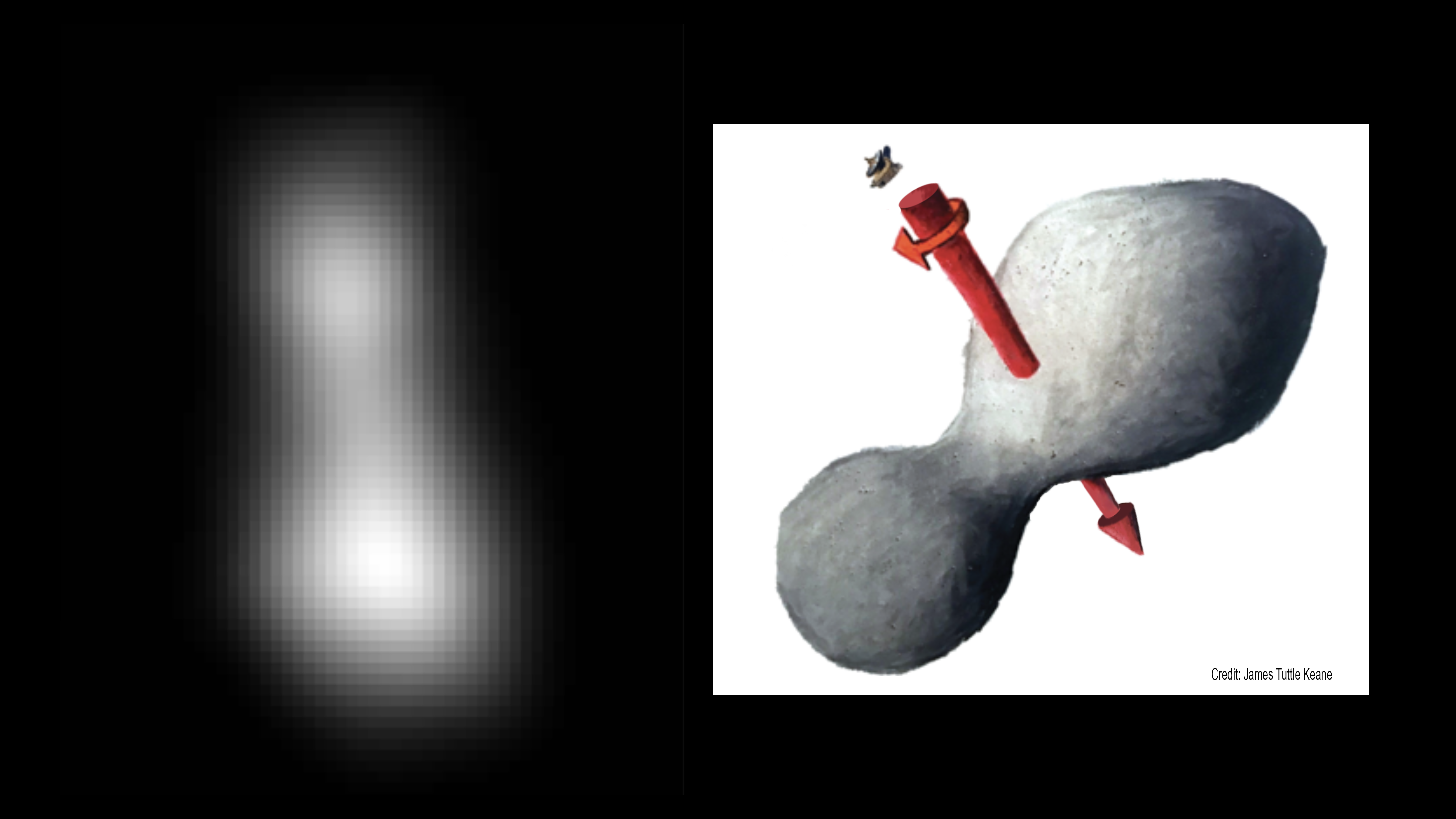
At left is a composite of two images taken by New Horizons' high-resolution Long-Range Reconnaissance Imager (LORRI), which provides the best indication of Ultima Thule's size and shape so far. Preliminary measurements of this Kuiper Belt object suggest it is approximately 20 miles long by 10 miles wide (32 kilometers by 16 kilometers). An artist's impression at right illustrates one possible appearance of Ultima Thule, based on the actual image at left. The direction of Ultima's spin axis is indicated by the arrows. Credits: NASA/JHUAPL/SwRI; sketch courtesy of James Tuttle Keane. Hi-res image

This sequence of three images, received on Dec. 31, 2018, and taken by the LORRI camera onboard New Horizons at 70 and 85 minutes apart illustrates the rotation of Ultima Thule. Credits: NASA/JHUAPL/SwRI

NASA Spacecraft Reaches Most Distant Target in History

NASA's New Horizons spacecraft flew past Ultima Thule in the early hours of New Year's Day, ushering in the era of exploration from the enigmatic Kuiper Belt, a region of primordial objects that holds keys to understanding the origins of the solar system.

"Congratulations to NASA's New Horizons team, Johns Hopkins Applied Physics Laboratory and the Southwest Research Institute for making history yet again. In addition to being the first to explore Pluto, today New Horizons flew by the most distant object ever visited by a spacecraft and became the first to directly explore an object that holds remnants from the birth of our solar system," said NASA Administrator Jim Bridenstine. "This is what leadership in space exploration is all about."

Signals confirming the spacecraft is healthy and had filled its digital recorders with science data on Ultima Thule reached the mission operations center at the Johns Hopkins Applied Physics Laboratory (APL) today at 10:29 a.m. EST, almost exactly 10 hours after New Horizons' closest approach to the object.

"New Horizons performed as planned today, conducting the farthest exploration of any world in history — 4 billion miles from the Sun," said Principal Investigator Alan Stern, of the Southwest Research Institute in Boulder, Colorado. "The data we have look fantastic and we're already learning about Ultima from up close. From here out the data will just get better and better!"

Images taken during the spacecraft's approach — which brought New Horizons to within just 2,200 miles (3,500 kilometers) of Ultima at 12:33 a.m. EST — revealed that the Kuiper Belt object may have a shape similar to a bowling pin, spinning end over end, with dimensions of approximately 20 by 10 miles (32 by 16 kilometers). Another possibility is Ultima could be two objects orbiting each other. Flyby data have already solved one of Ultima's mysteries, showing that the Kuiper Belt object is spinning like a propeller with the axis pointing approximately toward New Horizons. This explains why, in earlier images taken before Ultima was resolved, its brightness didn't appear to vary as it rotated. The team has still not determined the rotation period.

As the science data began its initial return to Earth, mission team members and leadership reveled in the excitement of the first exploration of this distant region of space.

"New Horizons holds a dear place in our hearts as an intrepid and persistent little explorer, as well as a great photographer," said Johns Hopkins Applied Physics Laboratory Director Ralph Semmel. "This flyby marks a first for all of us — APL, NASA, the nation and the world — and it is a great credit to the bold team of scientists and engineers who brought us to this point."

"Reaching Ultima Thule from 4 billion miles away is an incredible achievement. This is exploration at its finest," said Adam L. Hamilton, president and CEO of the Southwest Research Institute in San Antonio. "Kudos to the science team and mission partners for starting the textbooks on Pluto and the Kuiper Belt. We're looking forward to seeing the next chapter."

The New Horizons spacecraft will continue downloading images and other data in the days and months ahead, completing the return of all science data over the next 20 months. When New Horizons launched in January 2006, George W. Bush was in the White House, Twitter had just been launched and Time Magazine's Person of the Year was "you — all the worldwide web users." Nine years into its journey, the spacecraft began its exploration of the Kuiper Belt with a flyby of Pluto and its moons. Almost 13 years after the launch, the spacecraft will continue its exploration of the Kuiper Belt until at least 2021. Team members plan to propose more Kuiper Belt exploration.

The Johns Hopkins Applied Physics Laboratory in Laurel, Maryland, designed, built and operates the New Horizons spacecraft, and manages the mission for NASA's Science Mission Directorate. The Southwest Research Institute, based in San Antonio, leads the science team, payload operations and encounter science planning. New Horizons is part of the New Frontiers Program managed by NASA's Marshall Space Flight Center in Huntsville, Alabama. Follow the New Horizons mission on Twitter and use the hashtags #UltimaThule, #UltimaFlyby and #askNewHorizons to join the conversation. Live updates and links to mission information are also available on http://pluto.jhuapl.edu and www.nasa.gov.


Wednesday, May 09, 2018

Exiled Asteroid Discovered in Outer Reaches of Solar System

Artist’s impression of exiled asteroid 2004 EW95
Orbital exile


Videos

ESOcast 160 Light: Lost in Space (4K UHD)

Lost in space (artist's impression)

Asteroid fly-by
Asteroid fly-by

Orbit in exile
Orbit in exile 


ESO telescopes find first confirmed carbon-rich asteroid in Kuiper Belt


An international team of astronomers has used ESO telescopes to investigate a relic of the primordial Solar System. The team found that the unusual Kuiper Belt Object 2004 EW95 is a carbon-rich asteroid, the first of its kind to be confirmed in the cold outer reaches of the Solar System. This curious object likely formed in the asteroid belt between Mars and Jupiter and has been flung billions of kilometres from its origin to its current home in the Kuiper Belt.

The early days of our Solar System were a tempestuous time. Theoretical models of this period predict that after the gas giants formed they rampaged through the Solar System, ejecting small rocky bodies from the inner Solar System to far-flung orbits at great distances from the Sun [1]. In particular, these models suggest that the Kuiper Belt — a cold region beyond the orbit of Neptune — should contain a small fraction of rocky bodies from the inner Solar System, such as carbon-rich asteroids, referred to as carbonaceous asteroids [2].

Now, a recent paper has presented evidence for the first reliably-observed carbonaceous asteroid in the Kuiper Belt, providing strong support for these theoretical models of our Solar System’s troubled youth. After painstaking measurements from multiple instruments at ESO’s Very Large Telescope (VLT), a small team of astronomers led by Tom Seccull of Queen’s University Belfast in the UK was able to measure the composition of the anomalous Kuiper Belt Object 2004 EW95, and thus determine that it is a carbonaceous asteroid. This suggests that it originally formed in the inner Solar System and must have since migrated outwards [3].

The peculiar nature of 2004 EW95 first came to light during routine observations with the NASA/ESA Hubble Space Telescope by Wesley Fraser, an astronomer from Queen’s University Belfast who was also a member of the team behind this discovery. The asteroid’s reflectance spectrum — the specific pattern of wavelengths of light reflected from an object — was different to that of similar small Kuiper Belt Objects (KBOs), which typically have uninteresting, featureless spectra that reveal little information about their composition.

The reflectance spectrum of 2004 EW95 was clearly distinct from the other observed outer Solar System objects,” explains lead author Seccull. “It looked enough of a weirdo for us to take a closer look.

The team observed 2004 EW95 with the X-Shooter and FORS2 instruments on the VLT. The sensitivity of these spectrographs allowed the team to obtain more detailed measurements of the pattern of light reflected from the asteroid and thus infer its composition.

However, even with the impressive light-collecting power of the VLT, 2004 EW95 was still difficult to observe. Though the object is 300 kilometres across, it is currently a colossal four billion kilometres from Earth, making gathering data from its dark, carbon-rich surface a demanding scientific challenge.

It’s like observing a giant mountain of coal against the pitch-black canvas of the night sky,” says co-author Thomas Puzia from the Pontificia Universidad Católica de Chile.

Not only is 2004 EW95 moving, it’s also very faint,” adds Seccull. “We had to use a pretty advanced data processing technique to get as much out of the data as possible.

Two features of the object’s spectra were particularly eye-catching and corresponded to the presence of ferric oxides and phyllosilicates. The presence of these materials had never before been confirmed in a KBO, and they strongly suggest that 2004 EW95 formed in the inner Solar System.

Seccull concludes: “Given 2004 EW95’s  present-day abode in the icy outer reaches of the Solar System, this implies that it has been flung out into its present orbit by a migratory planet in the early days of the Solar System.”

While there have been previous reports of other ‘atypical’ Kuiper Belt Object spectra, none were confirmed to this level of quality,” comments Olivier Hainaut, an ESO astronomer who was not part of the team. “The discovery of a carbonaceous asteroid in the Kuiper Belt is a key verification of one of the fundamental predictions of dynamical models of the early Solar System.


Notes

[1] Current dynamical models of the evolution of the early Solar System, such as the grand tack hypothesis and the Nice model, predict that the giant planets migrated first inward and then outward, disrupting and scattering objects from the inner Solar System. As a consequence, a small percentage of rocky asteroids are expected to have been ejected into orbits in the Oort Cloud and Kuiper belt.

[2] Carbonaceous asteroids are those containing the element carbon or its various compounds. Carbonaceous — or C-type — asteroids can be identified by their dark surfaces, caused by the presence of carbon molecules.

[3] Other inner Solar System objects have previously been detected in the outer reaches of the Solar System, but this is the first carbonaceous asteroid to be found far from home in the Kuiper Belt.


More Information

This research was presented in a paper entitled “2004 EW95: A Phyllosilicate-bearing Carbonaceous Asteroid in the Kuiper Belt” by T. Seccull et al., which appeared in The Astrophysical Journal Letters.

The team was composed of Tom Seccull (Astrophysics Research Centre, Queen’s University Belfast, UK), Wesley C. Fraser (Astrophysics Research Centre, Queen’s University Belfast, UK) , Thomas H. Puzia (Institute of Astrophysics, Pontificia Universidad Católica de Chile, Chile), Michael E. Brown (Division of Geological and Planetary Sciences, California Institute of Technology, USA) and Frederik Schönebeck (Astronomisches Rechen-Institut, Zentrum für Astronomie der Universität Heidelberg, Germany).

ESO is the foremost intergovernmental astronomy organisation in Europe and the world’s most productive ground-based astronomical observatory by far. It has 15 Member States: Austria, Belgium, the Czech Republic, Denmark, France, Finland, Germany, Italy, the Netherlands, Poland, Portugal, Spain, Sweden, Switzerland and the United Kingdom, along with the host state of Chile and with Australia as a strategic partner. ESO carries out an ambitious programme focused on the design, construction and operation of powerful ground-based observing facilities enabling astronomers to make important scientific discoveries. ESO also plays a leading role in promoting and organising cooperation in astronomical research. ESO operates three unique world-class observing sites in Chile: La Silla, Paranal and Chajnantor. At Paranal, ESO operates the Very Large Telescope and its world-leading Very Large Telescope Interferometer as well as two survey telescopes, VISTA working in the infrared and the visible-light VLT Survey Telescope. ESO is also a major partner in two facilities on Chajnantor, APEX and ALMA, the largest astronomical project in existence. And on Cerro Armazones, close to Paranal, ESO is building the 39-metre Extremely Large Telescope, the ELT, which will become “the world’s biggest eye on the sky”.


Links


Contacts

Tom Seccull
Postgraduate Research Student — Queen's University, Belfast
Belfast, United Kingdom
Tel: +44 2890 973091

Wesley C. Fraser
Lecturer — Queen’s University, Belfast
Belfast, United Kingdom
Tel: +44 28 9097 1084

Thomas H. Puzia
Professor — Institute of Astrophysics, Pontificia Universidad Catolica
Santiago, Chile
Tel: +56-2 2354 1645

Calum Turner
ESO Assistant Public Information Officer
Garching bei München Tel: +49 89 3200 6670

Richard Hook
ESO Public Information Officer
Garching bei München, Germany
Tel: +49 89 3200 6655
Cell: +49 151 1537 3591

Source: ESO/News

Saturday, May 20, 2017

Hubble Spots Moon Around Third Largest Dwarf Planet

 Dwarf Planet 2007 OR10
Credits: NASA, ESA, C. Kiss (Konkoly Observatory), and J. Stansberry (STScI)


The combined power of three space observatories, including NASA's Hubble Space Telescope, has helped astronomers uncover a moon orbiting the third largest dwarf planet, catalogued as 2007 OR10. The pair resides in the frigid outskirts of our solar system called the Kuiper Belt, a realm of icy debris left over from our solar system's formation 4.6 billion years ago.

With this discovery, most of the known dwarf planets in the Kuiper Belt larger than 600 miles across have companions. These bodies provide insight into how moons formed in the young solar system.

"The discovery of satellites around all of the known large dwarf planets — except for Sedna — means that at the time these bodies formed billions of years ago, collisions must have been more frequent, and that's a constraint on the formation models," said Csaba Kiss of the Konkoly Observatory in Budapest, Hungary. He is the lead author of the science paper announcing the moon's discovery. "If there were frequent collisions, then it was quite easy to form these satellites."

The objects most likely slammed into each other more often because they inhabited a crowded region. "There must have been a fairly high density of objects, and some of them were massive bodies that were perturbing the orbits of smaller bodies," said team member John Stansberry of the Space Telescope Science Institute in Baltimore, Maryland. "This gravitational stirring may have nudged the bodies out of their orbits and increased their relative velocities, which may have resulted in collisions."

But the speed of the colliding objects could not have been too fast or too slow, according to the astronomers. If the impact velocity was too fast, the smash-up would have created lots of debris that could have escaped from the system; too slow and the collision would have produced only an impact crater.

Collisions in the asteroid belt, for example, are destructive because objects are traveling fast when they smash together. The asteroid belt is a region of rocky debris between the orbits of Mars and the gas giant Jupiter. Jupiter's powerful gravity speeds up the orbits of asteroids, generating violent impacts.

The team uncovered the moon in archival images of 2007 OR10 taken by Hubble's Wide Field Camera 3. Observations taken of the dwarf planet by NASA's Kepler Space Telescope first tipped off the astronomers of the possibility of a moon circling it. Kepler revealed that 2007 OR10 has a slow rotation period of 45 hours. "Typical rotation periods for Kuiper Belt Objects are under 24 hours," Kiss said. "We looked in the Hubble archive because the slower rotation period could have been caused by the gravitational tug of a moon. The initial investigator missed the moon in the Hubble images because it is very faint."

The astronomers spotted the moon in two separate Hubble observations spaced a year apart. The images show that the moon is gravitationally bound to 2007 OR10 because it moves with the dwarf planet, as seen against a background of stars. However, the two observations did not provide enough information for the astronomers to determine an orbit.

"Ironically, because we don't know the orbit, the link between the satellite and the slow rotation rate is unclear," Stansberry said.

The astronomers calculated the diameters of both objects based on observations in far-infrared light by the Herschel Space Observatory, which measured the thermal emission of the distant worlds. The dwarf planet is about 950 miles across, and the moon is estimated to be 150 miles to 250 miles in diameter. 2007 OR10, like Pluto, follows an eccentric orbit, but it is currently three times farther than Pluto is from the sun.

2007 OR10 is a member of an exclusive club of nine dwarf planets. Of those bodies, only Pluto and Eris are larger than 2007 OR10. It was discovered in 2007 by astronomers Meg Schwamb, Mike Brown, and David Rabinowitz as part of a survey to search for distant solar system bodies using the Samuel Oschin Telescope at the Palomar Observatory in California.

The team's results appeared in The Astrophysical Journal Letters.

The Hubble Space Telescope is a project of international cooperation between NASA and ESA (European Space Agency). NASA's Goddard Space Flight Center in Greenbelt, Maryland, manages the telescope. The Space Telescope Science Institute (STScI) in Baltimore conducts Hubble science operations. STScI is operated for NASA by the Association of Universities for Research in Astronomy, Inc., in Washington, D.C.


Related Links 
This site is not responsible for content found on external links 


Contacts


Donna Weaver / Ray Villard
Space Telescope Science Institute, Baltimore, Maryland
410-338-4493 / 410-338-4514

dweaver@stsci.edu / villard@stsci.edu

Csaba Kiss
Konkoly Observatory, Budapest, Hungary
011-36-1-391-9341

kiss.csaba@csfk.mta.hu

John Stansberry
Space Telescope Science Institute, Baltimore, Maryland
410-338-2442

jstans@stsci.edu

Source: HubbleSite

Wednesday, July 20, 2016

Beyond the Kuiper Belt Edge

Kuiper Belt objects (KBOs) - 2014 FZ7 and 2015 FJ345
Image Credit: Johns Hopkins University Applied Physics Laboratory/Southwest Research Institute (JHUAPL/SwRI) & S. Sheppard, et. al.

Animation of Kuiper Belt Object 2014 FZ71 created from the discovery images. 
Each image in the sequence was taken approximately three hours apart. Image 
Credit: Scott S. Sheppard/Chad Trujillo/DECam


Two new Kuiper Belt objects, 2014 FZ71 and 2015 FJ345, are among the most distant bodies in the Solar System. They are always further than 50AU from the Sun, and only Sedna and 2012 VP113 have larger perihelia. The discovery was made using data from DECam on the Blanco 4-m telescope at CTIO.

The new trans-Neptunian objects were discovered by Scott Sheppard, Chad Trujillo, and David Tholen in their search for objects beyond the outer edge of the Kuiper Belt (at about 50 AU). Unlike the more extreme Sedna and 2012 VP113, the new objects have moderate eccentricities. All the new moderately eccentric objects beyond the Kuiper Belt edge are near strong Neptune mean motion resonances. These new moderately eccentric objects likely obtained their unusual orbits through a combined interaction between Neptune’s mean motion resonance and the Kozai resonance. The discovery images for 2014 FZ71, shown at right, were obtained on 24 March 2014. An arrow indicates the approximate position of 2014 FZ71, which moves relative to the background stars and galaxies in this sequence of 3 images taken approximately 3 hours apart. 


Monday, March 07, 2016

Versatile Instrument to Scout for Kuiper Belt Objects

This image of the Crab Pulsar was taken with CHIMERA, an instrument at the Palomar Observatory, which is operated by the California Institute of Technology. Credit: NASA/JPL-Caltech.  › Full image and caption


At the Palomar Observatory near San Diego, astronomers are busy tinkering with a high-tech instrument that could discover a variety of objects both far from Earth and closer to home.

The Caltech HIgh-speed Multi-color camERA (CHIMERA) system is looking for objects in the Kuiper Belt, the band of icy bodies beyond the orbit of Neptune that includes Pluto. It can also detect near-Earth asteroids and exotic forms of stars. Scientists at NASA's Jet Propulsion Laboratory and the California Institute of Technology, both in Pasadena, are collaborating on this instrument.

"The Kuiper Belt is a pristine remnant of the formation of our solar system," said Gregg Hallinan, CHIMERA principal investigator at Caltech. "By studying it, we can learn a large amount about how our solar system formed and how it's continuing to evolve."

The wide-field telescope camera system allows scientists to monitor thousands of stars simultaneously to see if a Kuiper Belt object passes in front of any of them. Such an object would diminish a star's light for only one-tenth of a second while traveling by, meaning a camera has to be fast in order to capture it.

"Each of CHIMERA's cameras will be taking 40 frames per second, allowing us to measure the distinct diffraction pattern in the wavelengths of light to which they are sensitive," said Leon Harding, CHIMERA instrument scientist at JPL. "This high-speed imaging technique will enable us to find new Kuiper Belt objects far less massive in size than any other ground-based survey to date."

Hallinan's CHIMERA team at Caltech and JPL published a paper led by Harding describing the instrument this week in the Monthly Notices of the Royal Astronomical Society.
 
Astronomers are particularly interested in finding Kuiper Belt objects smaller than 0.6 miles (1 kilometer) in diameter. Since so few such objects have ever been found, scientists want to figure out how common they are, what they are made of and how they collide with other objects. The CHIMERA astronomers estimate that in the first 100 hours of CHIMERA data, they could find dozens of these small, distant objects.

Another scientific focus for CHIMERA is near-Earth asteroids, which the instrument can detect even if they are only about 30 feet (10 meters) across. Mike Shao of JPL, who leads the CHIMERA group's near-Earth asteroid research effort, predicts that by using CHIMERA on the Hale telescope at Palomar, they could find several near-Earth objects per night of telescope observation.

Transient or pulsing objects such as binary star systems, pulsing white dwarfs and brown dwarfs can also be seen with CHIMERA.

"What makes CHIMERA unique is that it does high-speed, wide-field, multicolor imaging from the ground, and can be used for a wide variety of scientific purposes," Hallinan said. "It's the most sensitive instrument of its kind." 

CHIMERA uses detectors called electron multiplying charged-coupled devices (EMCCDs), making for an extremely high-sensitivity, low-noise camera system. One of the EMCCDs picks up near-infrared light, while the other picks up green and blue wavelengths, and the combination allows for a robust system of scanning perturbations in starlight. The detectors are capable of running at minus 148 degrees Fahrenheit (minus 100 degrees Celsius) in order to avoid noise when imaging fast objects.

"Not only can we image over a wide field, but in other modes we can also image objects rotating hundreds of times per second," Harding said.

One of the objects the CHIMERA team used in testing the instrument's imaging and timing abilities was the Crab Pulsar. This pulsar is the end result of a star whose mass collapsed at the end of its life. It weighs as much as our sun, but spins 32 times per second. The instrument focused on the pulsar for a 300-second exposure to produce a color image.

"Our camera can image the entire field of view at 40 frames per second," Hallinan said. "We zoomed in on the pulsar and imaged it very fast, then imaged the rest of the scene slowly to create an aesthetically-pleasing image."

Highlighting CHIMERA's versatility, the instrument also imaged the globular cluster M22, located in the constellation Sagittarius toward the busy center of our galaxy. A single 25-millisecond image captured more than 1,000 stars. The team will be observing M22, and other fields like it, for 50 nights over three years, to look for signatures of Kuiper Belt objects.

Caltech manages JPL for NASA.

Media Contact

Elizabeth Landau
Jet Propulsion Laboratory, Pasadena, Calif.
818-354-6425

Elizabeth.Landau@jpl.nasa.gov


Source: JPL-Caltech 

Thursday, October 16, 2014

NASA's Hubble Telescope Finds Potential Kuiper Belt Targets for New Horizons

Artist's Impression of Kuiper Belt Object (Annotated)

This is an artist's impression of a Kuiper Belt object (KBO), located on the outer rim of our solar system at a staggering distance of 4 billion miles from the Sun. Unlike asteroids, KBOs have not been significantly heated by the Sun, and so are thought to represent a pristine, well preserved, deep-freeze sample of what the outer solar system was like following its birth 4.6 billion years ago. A Hubble survey uncovered three KBOs, ranging from 27 to 35 miles across, that are potentially reachable by NASA's New Horizons spacecraft after it passes by Pluto in mid-2015.


The Sun appears as a bright star at image center in this graphic, which represents the view from the KBO. The Earth and other inner planets are too close to the Sun to be seen in this illustration. The bright "star" to the left of the Sun is the planet Jupiter, and the bright object below the Sun is the planet Saturn. Two bright pinpoints of light to the right of the Sun, midway to the edge of the frame, are the planets Uranus and Neptune, respectively. The planet positions are plotted for late 2018 when the New Horizons probe reaches a distance of 4 billion miles from the Sun. The Milky Way appears in the background. .  Illustration Credit: NASA, ESA, and G. Bacon (STScI)

Kuiper Belt Object 1110113Y

A Kuiper Belt object (KBO) that is potentially reachable by NASA's Pluto-bound New Horizons probe is visible in multiple exposures taken with the Hubble Space Telescope. Hubble tracked the KBO (named 1110113Y or "PT1") moving against the crowded background field of stars in the constellation Sagittarius. The object is no bigger than 19 to 28 miles across, and it is a deep-freeze relic of what the outer solar system was like 4.6 billion years ago, during the period when the Sun formed. As the KBO orbits the Sun, its position noticeably shifts between exposures taken approximately 10 minutes apart. Following an initial proof of concept of the Hubble pilot observing program in June, the New Horizons team was awarded telescope time by the Space Telescope Science Institute for a wider survey in July. When the search was completed in early September, the team identified this KBO as "definitely reachable" by the New Horizons spacecraft. Credit: NASA, ESA, SwRI, JHU/APL, and the New Horizons KBO Search Team

Hubble's Search for Kuiper Belt Objects

A Kuiper Belt object (KBO) that is potentially reachable by NASA's Pluto-bound New Horizons probe is visible in multiple exposures taken with the Hubble Space Telescope. Hubble tracked the KBO (labeled PT1) moving against the crowded background field of stars in the summer constellation Sagittarius. The object is no bigger than 19 to 28 miles across, and it is a deep-freeze relic of what the outer solar system was like 4.6 billion years ago, during the period when the Sun formed. The image at right shows the KBO at an estimated distance of approximately 4 billion miles from Earth. As the KBO orbits the Sun, its position noticeably shifts between exposures taken approximately 10 minutes apart. Following an initial proof of concept of the Hubble pilot observing program in June, the New Horizons team was awarded telescope time by the Space Telescope Science Institute for a wider survey in July. When the search was completed in early September, the team identified this KBO as "definitely reachable" by the New Horizons spacecraft. Credit: NASA, ESA SwRI, JHU/APL, and the New Horizons KBO Search Team


Peering out to the dim, outer reaches of our solar system, NASA's Hubble Space Telescope has uncovered three Kuiper Belt objects (KBOs) the agency's New Horizons spacecraft could potentially visit after it flies by Pluto in July 2015.

The KBOs were detected through a dedicated Hubble observing program by a New Horizons search team that was awarded telescope time for this purpose.

"This has been a very challenging search, and it's great that in the end Hubble could accomplish a detection — one NASA mission helping another," said Alan Stern of the Southwest Research Institute (SwRI) in Boulder, Colorado, principal investigator of the New Horizons mission.

The Kuiper Belt is a vast rim of primordial debris encircling our solar system. KBOs belong to a unique class of solar system objects that has never been visited by spacecraft and which contain clues to the origin of our solar system.

The KBOs that Hubble found are each about 10 times larger than typical comets, but only about 1-2 percent of the size of Pluto. Unlike asteroids, KBOs have not been heated by the Sun, and are thought to represent a pristine, well preserved, deep-freeze sample of what the outer solar system was like following its birth 4.6 billion years ago. The KBOs found in the Hubble data are thought to be the building blocks of dwarf planets such as Pluto.

The New Horizons team started to look for suitable KBOs in 2011 using some of the largest ground-based telescopes on Earth. They found several dozen KBOs, but none were reachable within the fuel supply available aboard the New Horizons spacecraft.

"We started to get worried that we could not find anything suitable, even with Hubble, but in the end the space telescope came to the rescue," said New Horizons science team member John Spencer of SwRI. "There was a huge sigh of relief when we found suitable KBOs; we are 'over the moon' about this detection."
Following an initial proof of concept of the Hubble pilot observing program in June, the New Horizons team was awarded telescope time by the Space Telescope Science Institute for a wider survey in July. When the search was completed in early September, the team identified one KBO that is "definitely reachable" and two other potentially accessible KBOs that will require more tracking over several months to know whether they too are accessible by the New Horizons spacecraft.

This was a needle-in-a-haystack search for the New Horizons team because the elusive KBOs are extremely small, faint, and difficult to pick out against myriad background stars in the constellation Sagittarius, which is in the present direction of Pluto. The three KBOs identified are each a whopping 1 billion miles beyond Pluto. Two of the KBOs are estimated to be as large as 34 miles (55 kilometers) across, and the third is perhaps as small as 15 miles (25 kilometers).

The New Horizons spacecraft, launched in 2006 from Florida, is the first mission in NASA's New Frontiers Program. Once a NASA mission completes its prime mission, the agency conducts an extensive science and technical review to determine whether extended operations are warranted.

The New Horizons team expects to submit such a proposal to NASA in late 2016 for an extended mission to fly by one of the newly identified KBOs. Hurtling across the solar system, the New Horizons spacecraft would reach the distance of 4 billion miles from the Sun at its farthest point roughly three to four years after its July 2015 Pluto encounter. Accomplishing such a KBO flyby would substantially increase the science return from the New Horizons mission as laid out by the 2003 Planetary Science Decadal Survey.

CONTACT

Dwayne Brown
Headquarters, Washington, D.C.
202-358-0257
dwayne.c.brown@nasa.gov

Ray Villard
Space Telescope Science Institute, Baltimore, Md.
410-338-4514
villard@stsci.edu

Source: HubbleSite