Thursday, August 20, 2015

SwRI scientists think “planetary pebbles” were the building blocks for the largest planets

This artist’s concept of a young star system shows gas giants forming first, while the gas nebula is present. Southwest Research Institute scientists used computer simulations to nail down how Jupiter and Saturn evolved in our own solar system. These new calculations show that the cores of gas giants likely formed by gradually accumulating a population of planetary pebbles – icy objects about a foot in diameter. Image Courtesy of NASA/JPL-Caltech. Hi-res image
 
 
Boulder, CO — Aug.19, 2015 — Researchers at Southwest Research Institute (SwRI) and Queen’s University in Canada have unraveled the mystery of how Jupiter and Saturn likely formed. This discovery, which changes our view of how all planets might have formed, will be published in the Aug. 20 issue of Nature.

Ironically, the largest planets in the solar system likely formed first. Jupiter and Saturn, which are mostly hydrogen and helium, presumably accumulated their gasses before the solar nebula dispersed. Observations of young star systems show that the gas disks that form planets usually have lifetimes of only 1 to 10 million years, which means the gas giant planets in our solar system probably formed within this time frame. In contrast, the Earth probably took at least 30 million years to form, and may have taken as long as 100 million years. So how could Jupiter and Saturn have formed so quickly?

The most widely accepted theory for gas giant formation is the so-called core accretion model. In this model, a planet-sized core of ice and rock forms first. Then, an inflow of interstellar gas and dust attaches itself to the growing planet. However, this model has an Achilles heel; specifically, the very first step in the process. To accumulate a massive atmosphere requires a solid core roughly 10 times the mass of Earth. Yet these large objects, which are akin to Uranus and Neptune, had to have formed in only a few million years.

In the standard model of planet formation, rocky cores grow as similarly sized objects accumulate and assimilate through a process called accretion. Rocks incorporate other rocks, creating mountains; then mountains merge with other mountains, leading to city-sized objects, and so on. However, this model is unable to produce planetary cores large enough, in a short enough period of time, to explain Saturn and Jupiter.

“The timescale problem has been sticking in our throats for some time,” said Dr. Hal Levison, an Institute scientist in the SwRI Planetary Science Directorate and lead author of the paper. Titled “Growing the Gas Giant Planets by the Gradual Accumulation of Pebbles,” the paper is co-authored by SwRI Research Scientist Dr. Katherine Kretke and Dr. Martin Duncan, a professor at Queen’s University in Kingston, Ontario.

“It wasn’t clear how objects like Jupiter and Saturn could exist at all,” continued Levison. New calculations by the team show that the cores of Jupiter and Saturn could form well within the 10-million-year time frame if they grew by gradually accumulating a population of planetary pebbles – icy objects about a foot in diameter. Recent research has shown that gas can play a vital role in increasing the efficiency of accretion. So pebbles entering orbit can spiral onto the protoplanet and assimilate, assisted by a gaseous headwind.

In their article, Levison, Kretke, and Duncan show that pebble accretion can produce the observed structure of the solar system as long as the pebbles formed slowly enough that the growing planets have time to gravitationally interact with one another.

“If the pebbles form too quickly, pebble accretion would lead to the formation of hundreds of icy Earths,” said Kretke. “The growing cores need some time to fling their competitors away from the pebbles, effectively starving them. This is why only a couple of gas giants formed.”

“As far as I know, this is the first model to reproduce the structure of the outer solar system, with two gas giants, two ice giants (Uranus and Neptune), and a pristine Kuiper belt,” says Levison.

“After many years of performing computer simulations of the standard model without success, it is a relief to find a new model that is so successful,” adds Duncan.

Levison is the principal investigator of the research, funded through a National Science Foundation Astronomy and Astrophysics Research Grant.


Editors: An image is available at http://www.swri.org/press/2015/planetary-pebbles-building-blocks-large-planets.htm.

For more information, contact Deb Schmid, (210) 522-2254, Communications Department, Southwest Research Institute, PO Drawer 28510, San Antonio, TX 78228-0510.


Wednesday, August 19, 2015

Sibling Stars

The rich star cluster IC 4651

The star cluster IC 4651 in the constellation of Ara 

Wide-field view of the sky around the bright star cluster IC 4651


Videos
 
Zooming in on the star cluster IC 4651

The rich star cluster IC 4651


Open star clusters like the one seen here are not just perfect subjects for pretty pictures. Most stars form within clusters and these clusters can be used by astronomers as laboratories to study how stars evolve and die. The cluster captured here by the Wide Field Imager (WFI) at ESO’s La Silla Observatory is known as IC 4651, and the stars born within it now display a wide variety of characteristics.

The loose speckling of stars in this new ESO image is the open star cluster IC 4651, located within the Milky Way, in the constellation of Ara (The Altar), about 3000 light-years away. The cluster is around 1.7 billion years old — making it middle-aged by open cluster standards. IC 4651 was discovered by Solon Bailey, who pioneered the establishment of observatories in the high dry sites of the Andes, and it was catalogued in 1896 by the Danish–Irish astronomer John Louis Emil Dreyer.

The Milky Way is known to contain over a thousand of these open clusters, with more thought to exist, and many have been studied in great depth. Observations of star clusters like these have furthered our knowledge of the formation and evolution of the Milky Way and the individual stars within it. They also allow astronomers to test their models of how stars evolve.

The stars in IC 4651 all formed around the same time out of the same cloud of gas [1]. These sibling stars are only bound together very loosely by their attraction to one another and also by the gas between them. As the stars within the cluster interact with other clusters and clouds of gas in the galaxy around them, and as the gas between the stars is either used up to form new stars or blown away from the cluster, the cluster’s structure begins to change. Eventually, the remaining mass in the cluster becomes small enough that even the stars can escape. Recent observations of IC 4651 showed that the cluster contains a mass of 630 times the mass of the Sun [2] and yet it is thought that it initially contained at least 8300 stars, with a total mass 5300 times that of the Sun.

As this cluster is relatively old, a part of this lost mass will be due to the most massive stars in the cluster having already reached the ends of their lives and exploded as supernovae. However, the majority of the stars that have been lost will not have died, but merely moved on. They will have been stripped from the cluster as it passed by a giant gas cloud or had a close encounter with a neighbouring cluster, or even simply drifted away.

A fraction of these lost stars may still be gravitationally bound to the cluster and surround it at a great distance. The remaining lost stars will have migrated away from the cluster to join others, or have settled elsewhere in the busy Milky Way. The Sun was probably once part of a cluster like IC 4651, until it and all its siblings were gradually separated and spread across the Milky Way.

This image was taken using the Wide Field Imager. This camera is permanently mounted at the MPG/ESO 2.2-metre telescope at the La Silla Observatory. It consists of several CCD detectors with a total of 67 million pixels and can observe an area as large as the full Moon. The instrument allows observations from visible light to the near infrared, with more than 40 filters available. For this image, only three of these filters were used.


Notes 

[1] Although many of the stars captured here belong to IC 4651, most of the very brightest in the picture actually lie between us and the cluster and most of the faintest ones are more distant.

[2] This quantity is in fact much larger than the numbers quoted by previous studies which surveyed smaller regions, leaving out many of the cluster’s stars that lie further from its core.


More Information

ESO is the foremost intergovernmental astronomy organisation in Europe and the world's most productive ground-based astronomical observatory by far. It is supported by 16 countries: Austria, Belgium, Brazil, the Czech Republic, Denmark, France, Finland, Germany, Italy, the Netherlands, Poland, Portugal, Spain, Sweden, Switzerland and the United Kingdom, along with the host state of Chile. ESO carries out an ambitious programme focused on the design, construction and operation of powerful ground-based observing facilities enabling astronomers to make important scientific discoveries. ESO also plays a leading role in promoting and organising cooperation in astronomical research. ESO operates three unique world-class observing sites in Chile: La Silla, Paranal and Chajnantor. At Paranal, ESO operates the Very Large Telescope, the world’s most advanced visible-light astronomical observatory and two survey telescopes. VISTA works in the infrared and is the world’s largest survey telescope and the VLT Survey Telescope is the largest telescope designed to exclusively survey the skies in visible light. ESO is a major partner in ALMA, the largest astronomical project in existence. And on Cerro Armazones, close to Paranal, ESO is building the 39-metre European Extremely Large Telescope, the E-ELT, which will become "the world’s biggest eye on the sky".


Contacts

Richard Hook
ESO Public Information Officer
Garching bei München, Germany
Tel: +49 89 3200 6655
Cell: +49 151 1537 3591
Email:
rhook@eso.org

Source: ESO

Tuesday, August 18, 2015

Rho Ophiuchi and Antares 520 light years

Rho Ophiuchi and  Antares
Image Credit: Australian Astronomical Observatory/David Malin
Download high-res image file | Download caption as .zip file


This dusty region between the constellations Ophiuchus (the "snake holder") and Scorpius (the "scorpion") contains a colorful cosmic vista. These colors tell some of the story behind the interplay between light and matter in this object. For example, the blue glow in the upper part of this image is reflected light from stars embedded in dust. The yellow glow in the lower left is light from the giant star Antares that is reflected by dust that the star itself has created. The darker black areas—especially the middle left of the picture—are caused by clouds that hide light from more distant stars in background stars. Light is commonly reflected and blocked both here on Earth and across the Universe.


Monday, August 17, 2015

Direct Imaging of a Young, Extrasolar Kuiper Belt

An infrared image of a bright, nearly edge-on dusty debris ring around the star HD115600. The ring resembles the Kuiper belt in our own solar system, the region that contains Pluto as well as thousands of remnants of the earliest stages of icy planet formation. The Sun-Pluto distance is projected onto the image for reference. The center of the disk (diamond) appears slightly offset from the location of the star (plus). Credit: Currie et al. 2015


The Kuiper belt is the region of the solar system situated just beyond Neptune's orbit, about 40 AU from the Sun (one AU - astronomical unit - is the Earth's average distance from the Sun). The Kuiper belt is the location of numerous dwarf planets, such as Pluto, and is also home to thousands of remnants of the earliest stages of icy planet formation which provide keys to understanding the early, unevolved solar system. 

Beyond the Kuiper belt lies the Oort cloud, a spherical cloud of comets and icy planetesimals that extends out to perhaps one hundred thousand AU. Presumably other stellar systems also contain analogs to the Kuiper belt, and they could help shed light on the Kuiper belt's evolution and composition. Until now, however, the few such rings that have been imaged are unreliable analogs; they are seen around nearby stars whose birth environments are unlike the massive stellar complex where the Sun was probably formed.

The situation has recently changed with the advent of a new generation of astronomical imaging instruments on large telescopes that use adaptive optics to obtain high spatial resolution images. CfA astronomer Scott Kenyon and his colleagues used the new spectrometer on the Gemini telescope to study a star slightly larger than the Sun located about 360 light-years away in a relatively young complex of massive stars, a region roughly analogous to the Sun’s suspected birth environment. The star has a large excess of infrared emission, a clear indication that it hosts a circumstellar dust disk that plausibly is forming a system of planets.

The astronomers imaged the disk, and found that the debris ring is confined to a Kuiper belt–like distance from the star. Moreover, they discovered from the spectrum of its reflected light that its dust has properties consistent with that of the major constituents of Kuiper belt bodies -- including water ice. The result provides a promising reference point for understanding the evolution and composition of the Kuiper belt, and for the early evolution of the whole solar system.


Reference(s): 

"Direct Imaging and Spectroscopy of a Young Extrasolar Kuiper Belt in the Nearest OB Association," Thayne Currie, Carey M. Lisse, Marc Kuchner, Nikku Madhusudhan, Scott J. Kenyon, Christian Thalmann, Joseph Carson, and John Debes, ApJL 807, L7, 2015.


Friday, August 14, 2015

GEMINI-Discovered world is most like Jupiter


Figure 1. Discovery image of 51 Eri b with the Gemini Planet Imager taken in the near-infrared light on December 18, 2014. The bright central star has been mostly removed by a hardware and software mask to enable the detection of the exoplanet one million times fainter. Credits: J. Rameau (UdeM) and C. Marois (NRC Herzberg) Full Resolution JPEG 

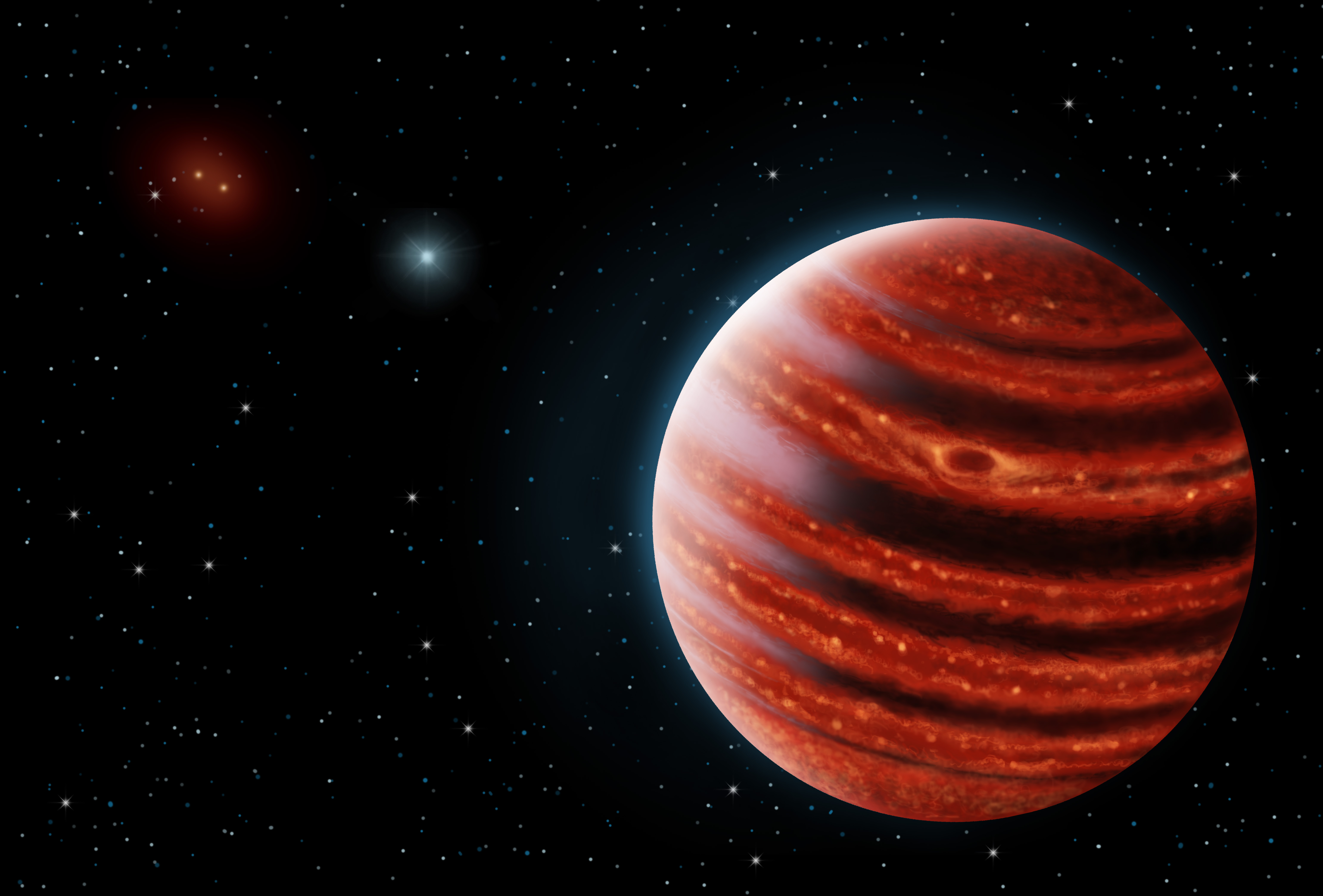
Figure 2. An artistic conception of the Jupiter-like exoplanet, 51 Eri b, seen in the near-infrared light that shows the hot layers deep in its atmosphere glowing through clouds. Because of its young age, this young cousin of our own Jupiter is still hot and carries information on the way it was formed 20 million years ago. Credits: Danielle Futselaar & Franck Marchis, SETI Institute Full Resolution JPEG

The simulated fly-by of the 51 Eridani star and planet system begins with the view of the sky showing the location of the star near the constellation Orion visible in the northern hemisphere winter. The young star 51 Eridani is 100 light-years from the Sun and a Jupiter-like planet is directly imaged in the infrared in an orbit similar in size to the Sun-Saturn distance. The star also has indirect evidence of belts of rocky debris orbiting closer and farther to the the star than the new planet. The fly-by ends with a view back toward the Sun from the newly discovered planet.Credits: J. Patience & J. Cornelison (ASU). Fly-by video in AVI (600MB)

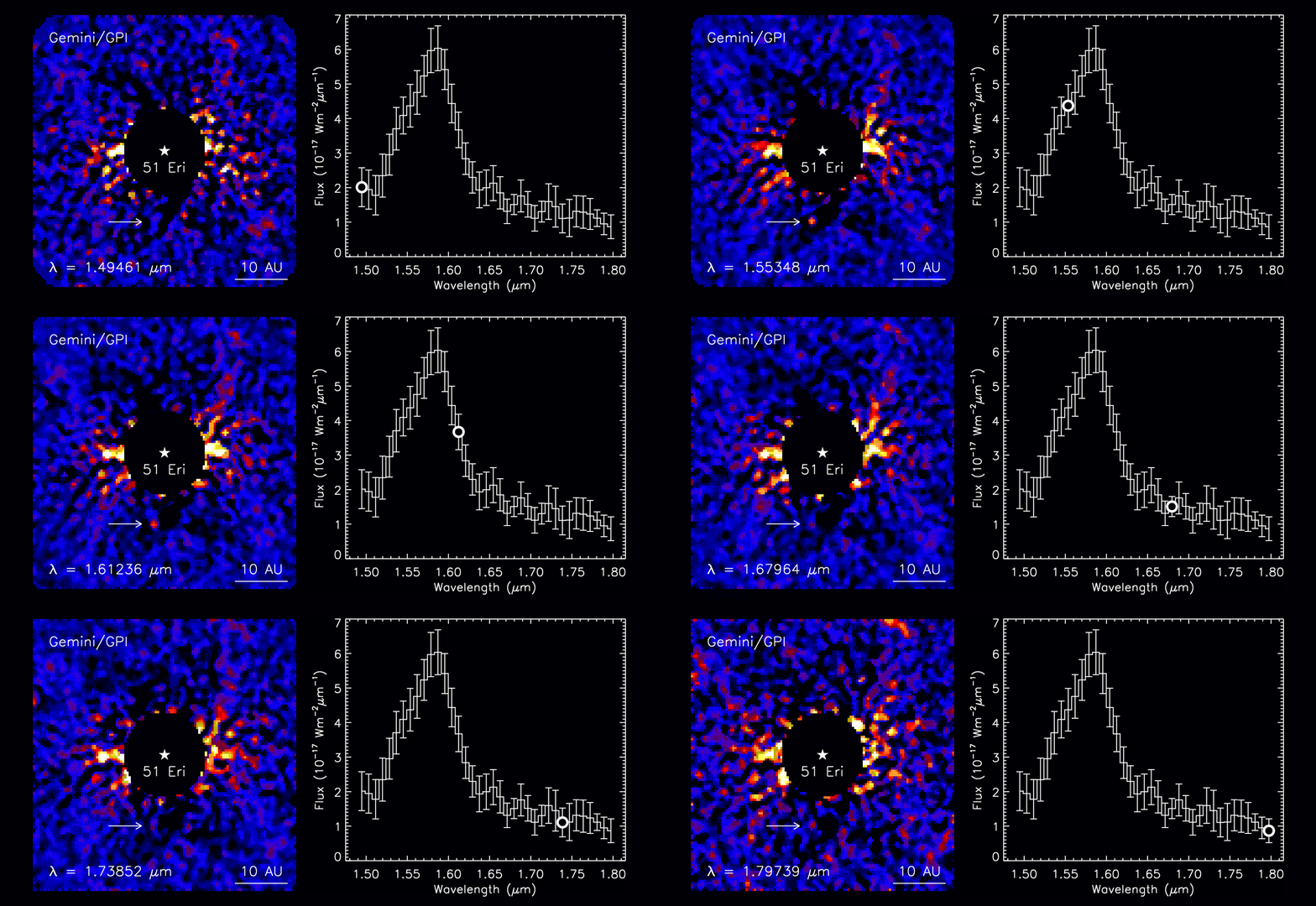
The Gemini Planet Imager utilizes an integral field spectrograph, an instrument capable of taking images at multiple wavelengths – or colors – of infrared light simultaneously, in order to search for young self-luminous planets around nearby stars. The left side of the animation shows the GPI images of the nearby star 51 Eridani in order of increasing wavelength from 1.5 to 1.8 microns. The images have been processed to suppress the light from 51 Eridani, revealing the exoplanet 51 Eridani b (indicated) which is approximately a million times fainter than the parent star. The bright regions to the left and right of the masked star are artifacts from the image processing algorithm, and can be distinguished from real astrophysical signals based on their brightness and position as a function of wavelength. The spectrum of 51 Eridani b, on the right side of the animation, shows how the brightness of the planet varies as a function of wavelength. If the atmosphere was entirely transmissive, the brightness would be approximately constant as a function of wavelength. This is not the case for 51 Eridani b, the atmosphere of which contains both water (H2O) and methane (CH4). Over the spectral range of this GPI dataset, water absorbs photons between 1.5 and 1.6 microns, and methane absorbs between 1.6 and 1.8 microns. This leads to a strong peak in the brightness of the exoplanet at 1.6 microns, the wavelength at which absorption by both water and methane is weakest.Robert De Rosa (UC Berkeley), Christian Marois (NRC Herzberg, University of Victoria).


Going beyond the discovery and imaging of a young Jupiter, astronomers using the Gemini Observatory's new Planet Imager (GPI) have probed a newly discovered world in unprecedented detail. What they found is a planet about two times the mass of Jupiter, and the most Solar System-like planet ever directly imaged around another star.

The planet, known as 51 Eridani b, orbits its host star at about 13 times the Earth-Sun distance (equivalent to being between Saturn and Uranus in our Solar System). The system is located about 100 light years away. The Gemini data also provide scientists with the strongest-ever spectroscopic detection of methane in the atmosphere of a planet outside of our Solar System, adding to its similarities to giant planets in our Solar System.

"Many of the exoplanets astronomers have imaged before have atmospheres that look like very cool stars" said Bruce Macintosh, of Stanford University who led the construction of GPI and now leads the planet-hunting survey. "This one looks like a planet."

The research is published in the August 13, 2015 issue of the journal Science.

"This superb result is a clear demonstration of the remarkable imaging and spectroscopic capabilities of GPI," said Chris Davis, the US National Science Foundation (NSF) Astronomy Division program officer who oversees Gemini Observatory funding. "The exoplanet surveys now possible with Gemini will undoubtedly lead to a far better understanding of the numbers of gas giants orbiting neighboring stars, the characteristics of their atmospheres, and ultimately the way in which giant planets like Jupiter and Saturn are formed."

The discovery is part of the team's broader effort to find and characterize new planets called the GPI Exoplanet Survey (GPIES). The survey expects to explore over 600 stars that could host planetary systems; so far they've looked at almost a hundred stars. "This is exactly the kind of system we envisioned discovering when we designed GPI", says James Graham, professor at UC Berkeley and Project Scientist for GPI. 

"GPI is capable of dissecting the light of exoplanets in unprecedented detail so we can now characterize other worlds like never before," says Christian Marois of the National Research Council of Canada (NRC). Marois, one of almost 90 researchers on the team, pioneered many of the observation strategies and data reduction techniques that played a critical role in the detection and analysis of the new planet. The light from the planet is very faint – a million times fainter than the star – but GPI can see it clearly. "The planet is so faint and located so close to its star, that it is also the first directly imaged exoplanet to be fully consistent with Solar System-like planet formation models," adds Marois.

The Gemini observations were also followed up by the W.M. Keck Observatory on Maunakea in Hawaii to verify the discovery.

GPI Instrument Scientist, Fredrik Rantakyro, added, "Since I was a child, I dreamed about planets around other stars and the possible lives that could be out there. As an astronomer, it's common to work with state-of-the-art telescopes but not to make your heart beat faster. This is exactly what happened with this dream-come-true discovery of this brother to Jupiter!"

51 Eridani is young – only 20 million years old – and this is exactly what made the direct detection of the planet possible. When planets coalesce, material falling into the planet releases energy and heats it up. Over the next hundred million years they radiate that energy away, mostly as infrared light, and gradually cool.

In addition to being what is likely the lowest-mass planet ever imaged, its atmosphere is also very cool – 430 degrees C (800 degrees Fahrenheit). It also features the strongest spectroscopic atmospheric methane signal, similar to the heavy methane dominated atmospheres of the gas giant planets in our Solar System.

GPI Exoplanet Survey (GPIES) is currently less than 20% through the 600 targets slated for observations during the 3-year campaign. The targets were selected because of their youth and relatively close proximity to our Solar System (within about 300 light years). The results of this survey will be remarkable, as it is probing a regime of exoplanet mass and separation that have never been properly surveyed before. It is expected to provide the first detailed census and demography of gas giant exoplanets, to find several multi-planet systems, and to perform detailed spectral characterization of many new exoplanets.

GPI was made possible with funding by the US National Science Foundation and Gemini partnership to support the work of an international team from the US and Canada. Lawrence Livermore National Laboratory constructed GPI's adaptive optics system and worked to match it to the Gemini telescope. Engineers with the National Research Council of Canada (NRC) designed and built GPI's optical-mechanical structure, and wrote the top level and mechanical control software. UCLA produced GPI's infrared spectrograph. The American Museum of Natural History developed starlight-blocking masks. JPL was responsible for a precision wavefront sensor. University of Montreal, the Space Telescope Science Institute, and other members of the GPI team produced the data analysis software.

A mess of stars

NGC 428
Credit: ESA/Hubble and NASA and S. Smartt (Queen's University Belfast)
Acknowledgements: Nick Rose and Flickr user penninecloud


Bursts of pink and red, dark lanes of mottled cosmic dust, and a bright scattering of stars — this NASA/ESA Hubble Space Telescope image shows part of a messy barred spiral galaxy known as NGC 428. It lies approximately 48 million light-years away from Earth in the constellation of Cetus (The Sea Monster).

Although a spiral shape is still just about visible in this close-up shot, overall NGC 428’s spiral structure appears to be quite distorted and warped, thought to be a result of a collision between two galaxies. There also appears to be a substantial amount of star formation occurring within NGC 428 — another telltale sign of a merger. When galaxies collide their clouds of gas can merge, creating intense shocks and hot pockets of gas and often triggering new waves of star formation.

NGC 428 was discovered by William Herschel in December 1786. More recently a type Ia supernova designated SN2013ct was discovered within the galaxy by Stuart Parker of the BOSS (Backyard Observatory Supernova Search) project in Australia and New Zealand, although it is unfortunately not visible in this image.

This image was captured by Hubble’s Advanced Camera for Surveys (ACS) and Wide Field and Planetary Camera 2 (WFPC2). A version of this image was entered into the Hubble’s Hidden Treasures Image Processing competition by contestants Nick Rose and the Flickr user penninecloud.

Links:


Thursday, August 13, 2015

NASA's Hubble Finds Supernovae in 'Wrong Place at Wrong Time' Release Image

 Host Galaxies of Calcium-Rich Supernovae
Credit: NASA, ESA, and R. Foley (University of Illinois)

Scenario for Homeless Supernovae (Artist's Illustration)
Credit: NASA, ESA, and P. Jeffries and A. Feild (STScI)

This illustration offers a plausible scenario for how vagabond stars exploded as supernovae outside the cozy confines of galaxies.
1) A pair of black holes comes together during a galaxy merger, dragging with them up to a million stars each.
2) A double-star system wanders too close to the two black holes.
3) The black holes then gravitationally catapult the stars out of the galaxy. At the same time, the stars are brought closer together.
4) After getting booted out of the galaxy, the binary stars move even closer together as orbital energy is carried away from the duo in the form of gravitational waves.
5) Eventually, the stars get close enough that one of them is ripped apart by tidal forces.
6) As material from the dead star is quickly dumped onto the surviving star, a supernova occurs.


Scientists have been fascinated by a series of unusual exploding stars-outcasts beyond the typical cozy confines of their galaxies. A new analysis of 13 supernovae — including archived data from NASA's Hubble Space Telescope — is helping astronomers explain how some young stars exploded sooner than expected, hurling them to a lonely place far from their host galaxies.

It's a complicated mystery of double-star systems, merging galaxies, and twin black holes that began in 2000 when the first such supernova was discovered, according to study leader Ryan Foley, University of Illinois at Urbana-Champaign. "This story has taken lots of twists and turns, and I was surprised every step of the way," he said. "We knew these stars had to be far from the source of their explosion as supernovae and wanted to find out how they arrived at their current homes."

Foley thought that the doomed stars had somehow migrated to their final resting spots. To prove his idea, he studied data from the Lick Observatory in California and the W. M. Keck Observatory and the Subaru Telescope, both in Hawaii, to determine how fast the stars were traveling. To his surprise, he discovered that the doomed stars were zipping along at about the same speed as stars that have been tossed out of our Milky Way galaxy by its central supermassive black hole, at more than 5 million miles (7 million kilometers) an hour. The astronomer then turned his attention to the aging galaxies in the area of the speeding supernovae. Studying Hubble archival images, he confirmed that many are massive elliptical galaxies that were merging or had recently merged with other galaxies. The lanes are the shredded remnants of a cannibalized galaxy. Other observations provided circumstantial evidence for such encounters, showing that the cores of many of these galaxies had active supermassive black holes fueled by the collision. Many of the galaxies also reside in dense environments at the heart of galaxy clusters, a prime area for mergers. The telltale clue was strong dust lanes piercing through the centers of several of them.

The location of the supernovae in relation to ancient galaxies indicates that the original stars must have been old, too, Foley reasoned. And if the stars were old, then they must have had companions with them that provided enough material to trigger a supernova blast.

How does a double-star system escape the boundaries of a galaxy?

Foley hypothesizes that a pair of supermassive black holes in the merging galaxies can provide the gravitational slingshot to rocket the binary stars into intergalactic space. Hubble observations reveal that nearly every galaxy has a massive black hole at its center. According to Foley's scenario, after two galaxies merge, their black holes migrate to the center of the new galaxy, each with a trailing a cluster of stars. As the black holes dance around each other, slowly getting closer, one of the binary stars in the black holes' entourage may wander too close to the other black hole. Many of these stars will be flung far away, and those ejected stars in surviving binary systems will orbit even closer after the encounter, which speeds up the merger.

"With a single black hole, occasionally a star will wander too close to it and have an extreme interaction," Foley said. "With two black holes, there are two reservoirs of stars being dragged close to another black hole. This dramatically increases the likelihood that a star is ejected." While the black hole at the center of the Milky Way may eject about one star a century, a binary supermassive black hole may kick out 100 stars a year.

After getting booted out of the galaxy, the binary stars move closer together as their orbits continue to accelerate, which speeds up the binary stars' aging process. The binary stars are likely both white dwarfs, which are the burned out relics of stars. Eventually, the white dwarfs get close enough that one is ripped apart by tidal forces. As material from the dead star is quickly dumped onto the surviving star, an explosion occurs, causing the supernova.

The time it takes for one of these ejected stars to explode is relatively short, about 50 million years. Normally, these kinds of binary stars take a long time to merge, probably much longer than the age of the universe, which is more than 13 billion years.

"The interaction with the black holes shortens that fuse," Foley explained.

While scientists think they have found what causes these outcast supernovae, some mysteries remain unsolved, such as why they are unusually weak. These supernovae produced more than five times as much calcium as other stellar explosions. Normally, supernova explosions have enough energy to create much heavier elements, such as iron and nickel, at the expense of producing the lighter calcium. However, for these atypical explosions, the fusion chain stops midway, leaving lots of calcium and very little iron.

"Everything points to a weak explosion," said Foley. "We know that these blasts have lower kinetic energy and less luminosity than typical supernovae. They also appear to have less ejected mass, whereas a more energetic explosion should completely unbind the star."

The results appear in the August 13 issue of the Monthly Notices of the Royal Astronomical Society.


Contact

Donna Weaver / Ray Villard
Space Telescope Science Institute, Baltimore, Maryland
410-338-4493 / 410-338-4514

dweaver@stsci.edu / villard@stsci.edu

Ryan Foley
University of Illinois at Urbana-Champaign, Urbana, Illinois
510-338-3364

rfoley@illinois.edu


 Source: HubbleSite
 

Wednesday, August 12, 2015

RGG 118: Oxymoronic Black Hole Provides Clues to Growth

RGG 118
Credit  X-ray: NASA/CXC/Univ of Michigan/V.F.Baldassare, et al; Optical: SDSS


animation


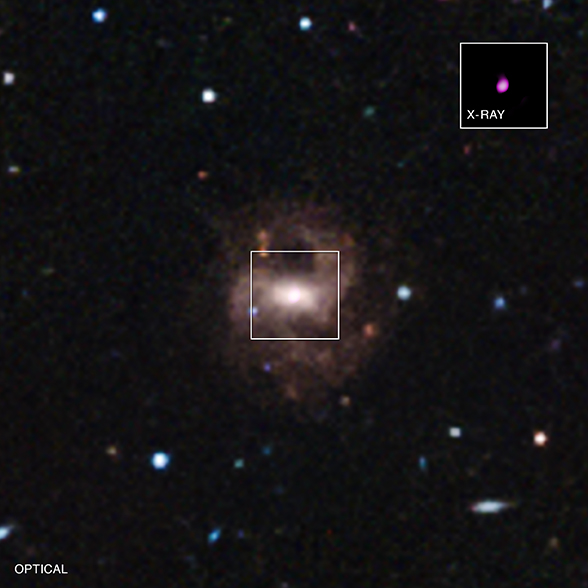
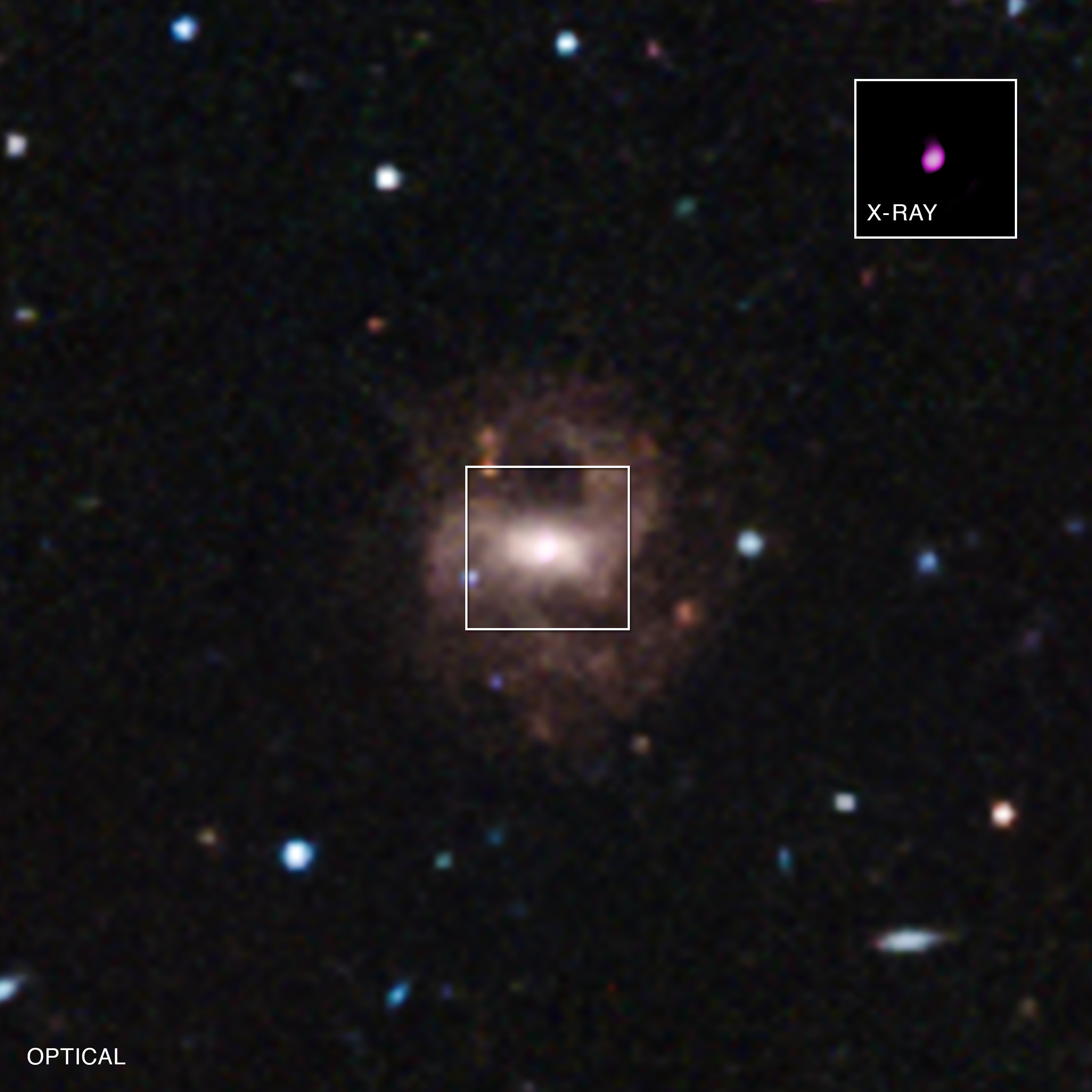
Astronomers using NASA's Chandra X-ray Observatory and the 6.5-meter Clay Telescope in Chile have identified the smallest supermassive black hole ever detected in the center of a galaxy, as described in our latest press release. This oxymoronic object could provide clues to how much larger black holes formed along with their host galaxies 13 billion years or more in the past.

Astronomers estimate this supermassive black hole is about 50,000 times the mass of the Sun. This is less than half the previous lowest mass for a black hole at the center of a galaxy.

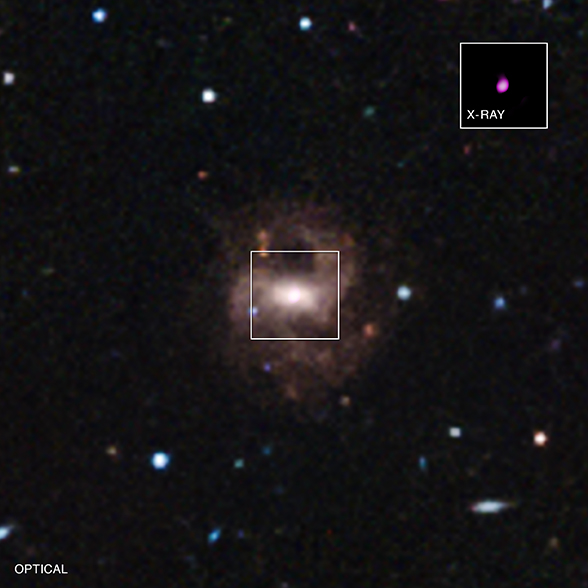
The tiny heavyweight black hole is located in the center of a dwarf disk galaxy, called RGG 118, about 340 million light years from Earth. Our graphic shows a Sloan Digital Sky Survey image of RGG 118 and the inset shows a Chandra image of the galaxy's center. The X-ray point source is produced by hot gas swirling around the black hole.

Researchers estimated the mass of the black hole by studying the motion of cool gas near the center of the galaxy using visible light data from the Clay Telescope. They used the Chandra data to figure out the brightness in X-rays of hot gas swirling toward the black hole. They found that the outward push of radiation pressure of this hot gas is about 1% of the black hole's inward pull of gravity, matching the properties of other supermassive black holes.

 
An artist's conception shows a black hole surrounded by a disk of hot gas, and a large doughnut or torus of cooler gas and dust. The light blue ring on the back of the torus is due to the fluorescence of iron atoms excited by X-rays from the hot gas disk.  (Credit: Illustration: NASA/CXC/M.Weiss)


Previously, a relationship has been noted between the mass of supermassive black holes and the range of velocities of stars in the center of their host galaxy. This relationship also holds for RGG 118 and its black hole.

The black hole in RGG 118 is nearly 100 times less massive than the supermassive black hole found in the center of the Milky Way. It is also about 200,000 times less massive than the heaviest black holes found in the centers of other galaxies.

Astronomers are trying to understand the formation of billion-solar-mass black holes that have been detected from less than a billion years after the Big Bang. The black hole in RGG 118 gives astronomers an opportunity to study a nearby small supermassive black hole in lieu of the first generation of black holes that are undetectable with current technology.

Astronomers think that supermassive black holes may form when a large cloud of gas, weighing about 10,000 to 100,000 times that of the Sun, collapses into a black hole. Many of these black hole seeds then merge to form much larger supermassive black holes. Alternately, a supermassive black hole seed could come from a giant star, about 100 times the Sun's mass, that ultimately forms into a black hole after it runs out of fuel and collapses.

Researchers will continue to look for other supermassive black holes that are comparable in size or even smaller than the one in RGG 118 to help choose between the two options mentioned above and refine their understanding of how these objects grow.

A preprint of these results is available online. The other co-author of the paper is Jenny Greene, from Princeton University in Princeton, New Jersey. NASA's Marshall Space Flight Center in Huntsville, Alabama, manages the Chandra program for NASA's Science Mission Directorate in Washington. The Smithsonian Astrophysical Observatory in Cambridge, Massachusetts, controls Chandra's science and flight operations.


Fast Facts for RGG 118:

Scale: Image is 3.2 arcmin across (about 317,000 light years)
Category: Quasars & Active Galaxies
Coordinates (J2000): RA 15h 23m 05.00s | Dec +11° 45' 53.60"
Constellation: Serpens
Observation Date: 26 Dec 2014
Observation Time: 5 hours 30 min
Obs. ID: 17538
Instrument: ACIS
References: Baldassare, V.F. et al, 2015, ApJ (accepted); arXiv:1406.07531
Color Code: Inset X-ray (Pink); Optical: (Red, Green, Blue)
Distance Estimate: About 340 million light years


Tuesday, August 11, 2015

Gravitational Constant Appears Universally Constant, Pulsar Study Suggests

A 21-year study of a pair of ancient stars -- one a pulsar and the other a white dwarf -- helps astronomers understand how gravity works across the cosmos. The study was conducted with the NSF's Green Bank Telescope and the Arecibo Observatory. Credit: B. Saxton (NRAO/AUI/NSF)

The NSF's Robert C. Byrd Green Bank Telescope, part of the National Radio Astronomy Observatory
Credit: NRAO/AUI/NSF


Gravity, one of the four fundamental forces of nature, appears reassuringly constant across the Universe, according to a decades-long study of a distant pulsar. This research helps to answer a long-standing question in cosmology: Is the force of gravity the same everywhere and at all times? The answer, so far, appears to be yes.

Astronomers using the National Science Foundation’s (NSF) Green Bank Telescope (GBT) in West Virginia and its Arecibo Observatory in Puerto Rico conducted a 21-year study to precisely measure the steady "tick-tick-tick" of a pulsar known as PSR J1713+0747. This painstaking research produced the best constraint ever of the gravitational constant measured outside of our Solar System.

Pulsars are the rapidly spinning, superdense remains of massive stars that detonated as supernova. They are detected from Earth by the beams of radio waves that emanate from their magnetic poles and sweep across space as the pulsar rotates. Since they are phenomenally dense and massive, yet comparatively small – a mere 20–25 kilometers across – some pulsars are able to maintain their rate of spin with a consistency that rivals the best atomic clocks on Earth. This makes pulsars exceptional cosmic laboratories to study the fundamental nature of space, time, and gravity.

This particular pulsar is approximately 3,750 light-years from Earth. It orbits a companion white dwarf star and is one of the brightest, most stable pulsars known. Previous studies show that it takes about 68 days for the pulsar to orbit its white dwarf companion, meaning they share an uncommonly wide orbit. This separation is essential for the study of gravity because the effect of gravitational radiation – the steady conversion of orbital velocity to gravitational waves as predicted by Einstein – is incredibly small and would have negligible impact on the orbit of the pulsar. A more pronounced orbital change would confound the accuracy of the pulsar timing experiment.

"The uncanny consistency of this stellar remnant offers intriguing evidence that the fundamental force of gravity – the big 'G' of physics – remains rock-solid throughout space," said Weiwei Zhu, an astronomer formerly with the University of British Columbia in Canada and lead author on a study accepted for publication in the Astrophysical Journal. "This is an observation that has important implications in cosmology and some of the fundamental forces of physics."

"Gravity is the force that binds stars, planets, and galaxies together," said Scott Ransom, a co-author and astronomer with the National Radio Astronomy Observatory in Charlottesville, Va. "Though it appears on Earth to be constant and universal, there are some theories in cosmology that suggest gravity may change over time or may be different in different corners of the Universe."

The data taken throughout this experiment are consistent with an unchanging gravitational constant in a distant star system. Earlier related research in our own Solar System, which was based on precise laser ranging studies of the Earth-Moon distance, found the same consistency over time.

"These results – new and old – allow us to rule out with good confidence that there could be 'special' times or locations with different gravitational behavior," added Ingrid Stairs, a co-author from the University of British Columbia in Canada. "Theories of gravity that are different from general relativity often make such predictions, and we have put new restrictions on the parameters that describe these theories."

Zhu concluded: "The gravitational constant is a fundamental constant of physics, so it is important to test this basic assumption using objects at different places, times, and gravitational conditions. The fact that we see gravity perform the same in our Solar System as it does in a distant star system helps to confirm that the gravitational constant truly is universal."

This work was part of the North American Nanohertz Observatory for Gravitational Waves (NANOGrav), a Physics Frontiers Center funded by the NSF.

The GBT is located in the National Radio Quiet Zone, which protects the incredibly sensitive telescope from unwanted radio interference, enabling it to study pulsars and other astronomical objects.

The National Radio Astronomy Observatory is a facility of the National Science Foundation, operated under cooperative agreement by Associated Universities, Inc.


Contact: 

Charles E. Blue
(434) 296-0314 

Email: cblue@nrao.edu


Monday, August 10, 2015

Charting the Slow Death of the Universe

Galaxy images from the GAMA survey


GAMA survey releases first data at IAU General Assembly


An international team of astronomers studying more than 200 000 galaxies has measured the energy generated within a large portion of space more precisely than ever before. This represents the most comprehensive assessment of the energy output of the nearby Universe. They confirm that the energy produced in a section of the Universe today is only about half what it was two billion years ago and find that this fading is occurring across all wavelengths from the ultraviolet to the far infrared. The Universe is slowly dying.

The study involves many of the world’s most powerful telescopes, including ESO's VISTA and VST survey telescopes at the Paranal Observatory in Chile. Supporting observations were made by two orbiting space telescopes operated by NASA (GALEX and WISE) and another belonging to the European Space Agency (Herschel) [1].

The research is part of the Galaxy And Mass Assembly (GAMA) project, the largest multi-wavelength survey ever put together.

“We used as many space and ground-based telescopes as we could get our hands on to measure the energy output of over 200 000 galaxies across as broad a wavelength range as possible,” says Simon Driver (ICRAR, The University of Western Australia), who heads the large GAMA team.

The survey data, released to astronomers around the world today, includes measurements of the energy output of each galaxy at 21 wavelengths, from the ultraviolet to the far infrared. This dataset will help scientists to better understand how different types of galaxies form and evolve.

All the energy in the Universe was created in the Big Bang, with some portion locked up as mass. Stars shine by converting mass back into energy, as described by Einstein’s famous equation E=mc2 [2]. The GAMA study sets out to map and model all of the energy generated within a large volume of space today and at different times in the past.

“While most of the energy sloshing around in the Universe arose in the aftermath of the Big Bang, additional energy is constantly being generated by stars as they fuse elements like hydrogen and helium together,” Simon Driver says. “This new energy is either absorbed by dust as it travels through the host galaxy, or escapes into intergalactic space and travels until it hits something, such as another star, a planet, or, very occasionally, a telescope mirror.”

The fact that the Universe is slowly fading has been known since the late 1990s, but this work shows that it is happening across all wavelengths from the ultraviolet to the infrared, representing the most comprehensive assessment of the energy output of the nearby Universe.

"The Universe will decline from here on in, sliding gently into old age. The Universe has basically sat down on the sofa, pulled up a blanket and is about to nod off for an eternal doze,” concludes Simon Driver.

The team of researchers hope to expand the work to map energy production over the entire history of the Universe, using a swathe of new facilities, including the world’s largest radio telescope, the Square Kilometre Array, which is due to be built in Australia and South Africa over the next decade.

The team will present this work at the International Astronomical Union XXIX General Assembly in Honolulu, Hawaii, on Monday 10 August 2015.


Notes

[1] The telescopes and survey data used, in order of increasing wavelength, were: GALEX, SDSS, VST (KiDS survey), AAT, VISTA (VIKING survey)/UKIRT, WISE, Herschel (PACS/SPIRE).

[2] Much of the Universe’s energy output comes from nuclear fusion in stars, when mass is slowly converted into energy. Another major source is the very hot discs around black holes at the centres of galaxies, where gravitational energy is converted to electromagnetic radiation in quasars and other active galactic nuclei. Much longer wavelength radiation comes from huge dust clouds that are re-radiating the energy from stars within them.


More Information

This research will be presented in a paper entitled “Galaxy And Mass Assembly (GAMA): Panchromatic Data Release (far-UV—far-IR) and the low-z energy budget”, by S. Driver et al., submitted to the journal Monthly Notices of the Royal Astronomical Society. It will also be the subject of a talk and press event at the IAU General Assembly in Hawaii on 10 August 2015.

The team is composed of Simon P. Driver (ICRAR, The University of Western Australia, Crawley, Western Australia, Australia [ICRAR]; University of St Andrews, United Kingdom), Angus H. Wright (ICRAR), Stephen K. Andrews (ICRAR), Luke J. Davies (ICRAR) , Prajwal R. Kafle (ICRAR), Rebecca Lange (ICRAR), Amanda J. Moffett (ICRAR) , Elizabeth Mannering (ICRAR), Aaron S. G. Robotham (ICRAR), Kevin Vinsen (ICRAR), Mehmet Alpaslan (NASA Ames Research Centre, Mountain View, California, United States), Ellen Andrae (Max Planck Institute for Nuclear Physics, Heidelberg, Germany [MPIK]), Ivan K. Baldry (Liverpool John Moores University, Liverpool, United Kingdom), Amanda E. Bauer (Australian Astronomical Observatory, North Ryde, NSW, Australia [AAO]), Steve Bamford (University of Nottingham, United Kingdom), Joss Bland-Hawthorn (University of Sydney, NSW, Australia), Nathan Bourne (Institute for Astronomy, University of Edinburgh, Royal Observatory, Edinburgh, United Kingdom), Sarah Brough (AAO), Michael J. I. Brown (Monash University, Clayton, Victoria, Australia), Michelle E. Cluver (The University of Western Cape, Bellville, South Africa), Scott Croom (University of Sydney, NSW, Australia), Matthew Colless (Australian National University, Canberra, ACT, Australia), Christopher J. Conselice (University of Nottingham, United Kingdom), Elisabete da Cunha (Macquarie University, Sydney NSW, Australia), Roberto De Propris (University of Turku, Piikkiö, Finland), Michael Drinkwater (Queensland University of Technology, Brisbane, Queensland, Australia), Loretta Dunne (Institute for Astronomy, University of Edinburgh, Royal Observatory, Edinburgh, United Kingdom; Cardiff University, Cardiff, United Kingdom), Steve Eales (Cardiff University, Cardiff, United Kingdom), Alastair Edge (Durham University, Durham, United Kingdom), Carlos Frenk (Durham University, Durham, United Kingdom), Alister W. Graham (Macquarie University, Sydney NSW, Australia), Meiert Grootes (MPIK), Benne W. Holwerda (Leiden Observatory, University of Leiden, Leiden, The Netherlands), Andrew M. Hopkins (AAO) , Edo Ibar (Universidad de Valparaso, Valparaiso, Chile), Eelco van Kampen (ESO, Garching, Germany), Lee S. Kelvin (Liverpool John Moores University, Liverpool, United Kingdom), Tom Jarrett (University of Cape Town, Rondebosch, South Africa), D. Heath Jones (Macquarie University, Sydney, NSW, Australia), Maritza A. Lara-Lopez (Universidad Nacional Automana de México, México), Angel R. Lopez-Sanchez (AAO), Joe Liske (Hamburger Sternwarte, Universität Hamburg, Hamburg, Germany), Jon Loveday (University of Sussex, Falmer, Brighton, United Kingdom), Steve J. Maddox (Institute for Astronomy, University of Edinburgh, Royal Observatory, Edinburgh, United Kingdom; Cardiff University, Cardiff, United Kingdom), Barry Madore (Observatories of the Carnegie Institution of Washington, Pasadena, California, United States [OCIW]), Martin Meyer (ICRAR) , Peder Norberg (Durham University, Durham, United Kingdom), Samantha J. Penny (University of Portsmouth, Portsmouth, United Kingdom), Stephen Phillipps (University of Bristol, Bristol, United Kingdom), Cristina Popescu (University of Central Lancashire, Preston, Lancashire), Richard J. Tuffs (MPIK), John A. Peacock (Institute for Astronomy, University of Edinburgh, Royal Observatory, Edinburgh, United Kingdom), Kevin A.Pimbblet (Monash University, Clayton, Victoria, Australia; University of Hull, Hull, United Kingdom), Kate Rowlands (University of St Andrews, United Kingdom), Anne E. Sansom (University of Central Lancashire, Preston, Lancashire), Mark Seibert (OCIW), Matthew W.L. Smith (Queensland University of Technology, Brisbane, Queensland, Australia), Will J. Sutherland (Queen Mary University London, London, United Kingdom), Edward N. Taylor (The University of Melbourne, Parkville, Victoria, Australia), Elisabetta Valiante (Cardiff University, Cardiff, United Kingdom), Lingyu Wang (Durham University, Durham, United Kingdom; SRON Netherlands Institute for Space Research, Groningen, The Netherlands), Stephen M. Wilkins (University of Sussex, Falmer, Brighton, United Kingdom) and Richard Williams (Liverpool John Moores University, Liverpool, United Kingdom).

The Galaxy and Mass Assembly Survey, or GAMA, is a collaboration involving nearly 100 scientists from more than 30 universities located in Australia, Europe and the United States.

ICRAR is a joint venture between Curtin University and The University of Western Australia with support and funding from the State Government of Western Australia.

ESO is the foremost intergovernmental astronomy organisation in Europe and the world’s most productive ground-based astronomical observatory by far. It is supported by 16 countries: Austria, Belgium, Brazil, the Czech Republic, Denmark, France, Finland, Germany, Italy, the Netherlands, Poland, Portugal, Spain, Sweden, Switzerland and the United Kingdom, along with the host state of Chile. ESO carries out an ambitious programme focused on the design, construction and operation of powerful ground-based observing facilities enabling astronomers to make important scientific discoveries. ESO also plays a leading role in promoting and organising cooperation in astronomical research. ESO operates three unique world-class observing sites in Chile: La Silla, Paranal and Chajnantor. At Paranal, ESO operates the Very Large Telescope, the world’s most advanced visible-light astronomical observatory and two survey telescopes. VISTA works in the infrared and is the world’s largest survey telescope and the VLT Survey Telescope is the largest telescope designed to exclusively survey the skies in visible light. ESO is a major partner in ALMA, the largest astronomical project in existence. And on Cerro Armazones, close to Paranal, ESO is building the 39-metre European Extremely Large Telescope, the E-ELT, which will become “the world’s biggest eye on the sky”.


Links

Contacts

Simon Driver
ICRAR – University of Western Australia
Tel: +61 400 713 514
Cell: +1 808 304 2392
Email:
simon.driver@icrar.org

Andrew Hopkins
Australian Astronomical Observatory
North Ryde, NSW, Australia
Tel: +61 432 855 049
Email:
andrew.hopkins@aao.gov.au

Joe Liske
Hamburger Sternwarte, Universität Hamburg
Hamburg, Germany
Email:
jochen.liske@uni-hamburg.de

Pete Wheeler
Media Contact. ICRAR – University of Western Australia
Australia
Tel: +61 423 982 018
Email:
pete.wheeler@icrar.org

Richard Hook
ESO Public Information Officer
Garching bei München, Germany
Tel: +49 89 3200 6655
Cell: +49 151 1537 3591
Email:
rhook@eso.org

Source: ESO

New Record: Keck Observatory Measures Most Distant Galaxy

EGSY8p7 is the most distant confirmed galaxy whose spectrum obtained with the W. M. Keck Observatory places it at a redshift of 8.68 at a time when the Universe was less than 600 million years old. The illustration shows the remarkable progress made in recent years in probing early cosmic history. Such studies are important in understanding how the Universe evolved from an early dark period to one when galaxies began to shine. Hydrogen emission from EGSY8p7 may indicate it is the first known example of an early generation of young galaxies emitting unusually strong radiation. Credit: Adi Zitrin, California Institute of Technology, 2015


MAUNAKEA, Hawaii – A team of astrophysicists using the W. M. Keck Observatory in Hawaii has successfully measured the farthest galaxy ever recorded and more interestingly, captured its hydrogen emission as seen when the Universe was less than 600 million years old. Additionally, the method in which the galaxy called EGSY8p7 was detected gives important insight into how the very first stars in the Universe lit-up after the Big Bang. The paper will be published shortly in the Astrophysical Journal Letters.

Using Keck Observatory’s powerful infrared spectrograph called MOSFIRE, the team dated the galaxy by detecting its Lyman-alpha emission line – a signature of hot hydrogen gas heated by strong ultraviolet emission from newly born stars. Although this is a frequently detected signature in galaxies close to Earth, the detection of Lyman-alpha emission at such a great distance is unexpected as it is easily absorbed by the numerous hydrogen atoms thought to pervade the space between galaxies at the dawn of the Universe. The result gives new insight into `cosmic reionization’, the process by which dark clouds of hydrogen were split into their constituent protons and electrons by the first generation of galaxies.

“We frequently see the Lyman-alpha emission line of hydrogen in nearby objects as it is one of most reliable tracers of star-formation,” said California Institute of Technology (Caltech) astronomer, Adi Zitrin, lead author of the discovery paper. “However, as we penetrate deeper into the Universe, and hence back to earlier times, the space between galaxies contains an increasing number of dark clouds of hydrogen which absorb this signal.”

Recent work has found the fraction of galaxies showing this prominent line declines markedly after when the Universe was about a billion years old, which is equivalent to a redshift of about 6. Redshift is a measure of how much the Universe has expanded since the light left a distant source and can only be determined for faint objects with a spectrograph on a powerful large telescope such as the Keck Observatory’s twin 10-meter telescopes, the largest on Earth.

"The surprising aspect about the present discovery is that we have detected this Lyman-alpha line in an apparently faint galaxy at a redshift of 8.68, corresponding to a time when the Universe should be full of absorbing hydrogen clouds,” said co-author and Caltech astronomer Richard Ellis. “Quite apart from breaking the earlier record redshift of 7.73, also obtained at the Keck Observatory, this detection is telling us something new about how the Universe evolved in its first few hundred million years.”

Computer simulations of cosmic reionization suggest the Universe was fully opaque to Lyman-alpha radiation in the first 400 million years of cosmic history and then gradually, as the first galaxies were born, the intense ultraviolet radiation from their young stars, burned off this obscuring hydrogen in bubbles of increasing radius which, eventually, overlapped so the entire space between galaxies became `ionized’, that is composed of free electrons and protons. At this point the Lyman-alpha radiation was free to travel through space unimpeded.

It may be that the galaxy we have observed, EGSY8p7, which is unusually (intrinsically) luminous, has special properties that enabled it to create a large bubble of ionized hydrogen much earlier than is possible for more typical galaxies at these times,” said Sirio Belli, a Caltech graduate student who helped undertake the key observations. “EGSY8p7 was found to be both luminous and at high redshift, and its colors measured by the Hubble and Spitzer Space Telescopes indicate it may be powered by a population of unusually hot stars.” 

Because the discovery of such an early source with powerful Lyman-alpha is somewhat unexpected, it provides new insight into the manner by which galaxies contributed to the process of reionization. 

Conceivably the process is patchy with some regions of space evolving faster than others, for example due to variations in the density of matter from place to place. Alternatively, EGSY8p7 may be the first example of an early generation which unusually strong ionizing radiation.

“In some respects, the period of cosmic reionization is the final missing piece in our overall understanding of the evolution of the Universe,” says Zitrin. “In addition to pushing back the frontier to a time when the Universe was only 600 million years old, what is exciting about the present discovery is that the study of sources such as EGSY8p7 will offer new insight into how this process occurred.”

The Caltech team reporting on this discovery consists of Zitrin, Ellis, and Belli who lead an international collaboration involving astronomers at Yale and the University of Arizona, and fellow European researchers from Leiden University in the Netherlands and the University of Durham and the Univeristy College London in England.

The research was funded in part by NASA.

The W. M. Keck Observatory operates the largest, most scientifically productive telescopes on Earth. The two, 10-meter optical/infrared telescopes near the summit of Mauna Kea on the Island of Hawaii feature a suite of advanced instruments including imagers, multi-object spectrographs, high-resolution spectrographs, integral-field spectrographs and world-leading laser guide star adaptive optics systems.

MOSFIRE (Multi-Object Spectrograph for Infrared Exploration) is a highly-efficient instrument that can take images or up to 46 simultaneous spectra. Using a sensitive state-of-the-art detector and electronics system, 

MOSFIRE obtains observations fainter than any other near infrared spectrograph. MOSFIRE is an excellent tool for studying complex star or galaxy fields, including distant galaxies in the early Universe, as well as star clusters in our own Galaxy. MOSFIRE was made possible by funding provided by the National Science Foundation and astronomy benefactors Gordon and Betty Moore.

Keck Observatory is a private 501(c) 3 non-profit organization and a scientific partnership of the California Institute of Technology, the University of California and NASA


Science contact

Adi Zitrin
California Institute of Technology
626-278-5854


Media contact 

Richard Ellis
California Institute of Technology
626-676-5530
rse@astro.caltech.edu


Sunday, August 09, 2015

Lost lithium destroyed by ancient stars

An illustration of a protostar (a pre-main sequence star) surrounded by a disk of gas and dust
Credit: NASA/CXC/M.Weiss. Click here for a full size image

‘Sunbirth’: a painting inspired by the formation of a star
Credit: Arthure Billard.


Lithium, the lightest metal, used in batteries and mood-stabilising drugs, is rarer than it should be. Models of the period after the Big Bang explain how it, hydrogen and helium were synthesised in nuclear reactions, before the universe cooled enough for the stars and planets that we see today to come into being. Astronomers though think that about three times as much lithium was produced in that earliest epoch than remains today in the oldest stars in the galaxy, and the difference has proved hard to explain.

Now a group of scientists, led by Xiaoting Fu of the International School for Advanced Studies in Trieste, Italy, think they have the answer to this so-called ‘lithium problem’: it was destroyed and re-accumulated by these stars shortly after they were born. The team publish their work in Monthly Notices of the Royal Astronomical Society.

In the past astronomers have speculated on what might be responsible for the lithium deficit. Ideas included as yet unknown aspects of particle physics, nuclear physics or even new models of cosmology.

Fu’s team instead looked at how much lithium there would have been when a particular subset of the first long-lived stars formed, just a few hundred million years after the Big Bang. These are still around today, so provide astronomers with some insight into the history of the universe and how its composition has changed.

The stars have between 50 and 85% of the mass of the Sun, have lives that are significantly longer, and are thought to remain stable on the so-called ‘main sequence’ for between 15 and 30 billion years. They are poor in most ‘metals’, which in astronomy means every element heavier than helium. The scientists modelled the way that these stars process lithium, starting with the early part of their lives when they are still contracting and heating up under the influence of gravity.

In that ‘pre-main sequence’ phase, the new model suggests that there is more mixing in the different layers of these objects. To put this in context, stars have a hot core, where nuclear fusion is converting hydrogen to helium, a cooler outer layer where convection cycles material from above the core to the surface and down again, and a surface where electromagnetic radiation (including light and heat) escapes into space.

The new work indicates that in this first phase of their lives, the low-mass stars have an extra mixing ‘overshooting’ at the base of the convection zone, where surface lithium is brought to the hot interior and almost completely destroyed.

Pre-main sequence stars are also surrounded by the residual gas and dust from which they formed. This cloud will over time be pulled on to the star, adding lithium to its surface. As the star ages, the convective zone becomes shallower, so material is no longer sent to the core, to some extent offsetting the earlier destruction of lithium.

Stars also shine brightly in ultraviolet light, and the ‘radiation pressure’ of this light eventually blows the disk materials away, stopping the star from accumulating more lithium. The stars then enter the main sequence and settle into a long period of stability. When we observe them now, between 10 and 12 billion years later, they show a constant abundance of lithium, which is about one third of the primordial level.

Fu comments: “Our work is a completely new approach to the lithium problem. The model not only may explain the loss of lithium in stars, but could also help explain why the Sun has fifty times less lithium than similar stars and why stars with planets have less lithium than stars on their own.”

In the next decade new observatories like the European Extremely Large Telescope (E-ELT) under construction in Chile should allow astronomers to look back at the first metal-poor stars as they formed, and confirm the rapid loss of lithium in the early Universe.


Media contact

Federica Sgorbissa
Sissa Medialab
Trieste
Italy
Tel: +39 40 3787644
Mob: +39 340 5473118
federica@medialab.sissa.i


Science contact

Xiaoting Fu
SISSA (International School for Advanced Studies)
Trieste
Italy
Tel: +39 040 3787 481
xtfu@sissa.it


Further information


The new work appears in  “Lithium evolution in metal-poor stars: from pre-main sequence to the Spite plateau", X. Fu, A. Bressan, P. Molaro, P. Marigo, Monthly Notices of the Royal Astronomical Society, in press.


Note for editors

The Royal Astronomical Society (RAS), founded in 1820, encourages and promotes the study of astronomy, solar-system science, geophysics and closely related branches of science. The RAS organises scientific meetings, publishes international research and review journals, recognizes outstanding achievements by the award of medals and prizes, maintains an extensive library, supports education through grants and outreach activities and represents UK astronomy nationally and internationally. Its more than 3800 members (Fellows), a third based overseas, include scientific researchers in universities, observatories and laboratories as well as historians of astronomy and others. Follow the RAS on Twitter via @royalastrosoc