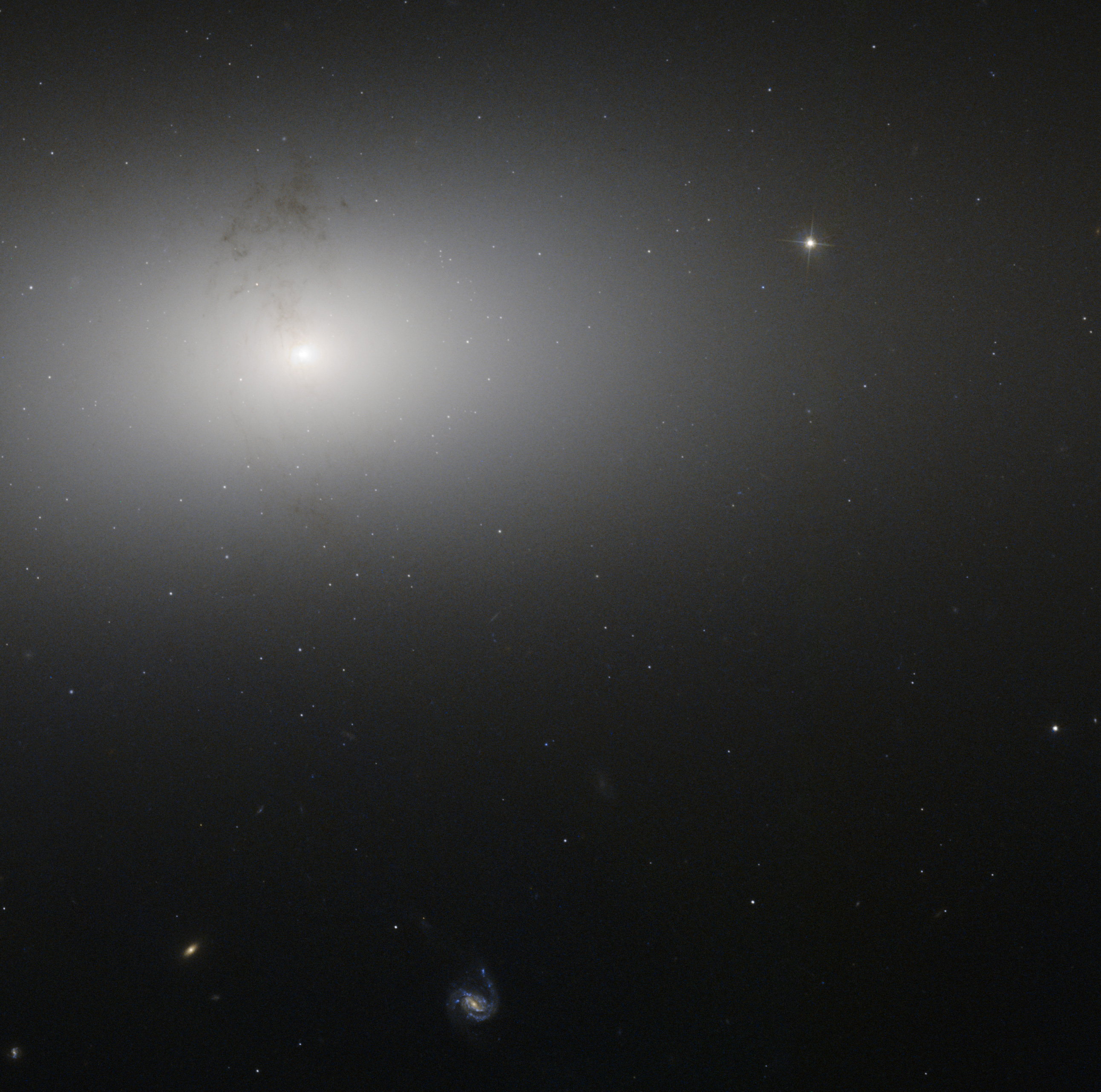
Host Galaxies of Calcium-Rich Supernovae
Credit: NASA, ESA, and R. Foley (University of Illinois)
Scenario for Homeless Supernovae (Artist's Illustration)
This illustration offers a plausible scenario for how vagabond stars
exploded as supernovae outside the cozy confines of galaxies.
1) A pair of black holes comes together during a galaxy merger, dragging with them up to a million stars each.
2) A double-star system wanders too close to the two black holes.
3) The black holes then gravitationally catapult the stars out of the
galaxy. At the same time, the stars are brought closer together.
4) After getting booted out of the galaxy, the binary stars move even
closer together as orbital energy is carried away from the duo in the
form of gravitational waves.
5) Eventually, the stars get close enough that one of them is ripped apart by tidal forces.
6) As material from the dead star is quickly dumped onto the surviving star, a supernova occurs.
Scientists have been fascinated by a series of unusual exploding
stars-outcasts beyond the typical cozy confines of their galaxies. A
new analysis of 13 supernovae — including archived data from NASA's
Hubble Space Telescope — is helping astronomers explain how some young
stars exploded sooner than expected, hurling them to a lonely place far
from their host galaxies.
It's a complicated mystery of double-star systems, merging galaxies,
and twin black holes that began in 2000 when the first such supernova
was discovered, according to study leader Ryan Foley, University of
Illinois at Urbana-Champaign. "This story has taken lots of twists and
turns, and I was surprised every step of the way," he said. "We knew
these stars had to be far from the source of their explosion as
supernovae and wanted to find out how they arrived at their current
homes."
Foley thought that the doomed stars had somehow migrated to their
final resting spots. To prove his idea, he studied data from the Lick
Observatory in California and the W. M. Keck Observatory and the Subaru
Telescope, both in Hawaii, to determine how fast the stars were
traveling. To his surprise, he discovered that the doomed stars were
zipping along at about the same speed as stars that have been tossed
out of our Milky Way galaxy by its central supermassive black hole, at
more than 5 million miles (7 million kilometers) an hour. The
astronomer then turned his attention to the aging galaxies in the area
of the speeding supernovae. Studying Hubble archival images, he
confirmed that many are massive elliptical galaxies that were merging
or had recently merged with other galaxies. The lanes are the shredded
remnants of a cannibalized galaxy. Other observations provided
circumstantial evidence for such encounters, showing that the cores of
many of these galaxies had active supermassive black holes fueled by
the collision. Many of the galaxies also reside in dense environments
at the heart of galaxy clusters, a prime area for mergers. The telltale
clue was strong dust lanes piercing through the centers of several of
them.
The location of the supernovae in relation to ancient galaxies
indicates that the original stars must have been old, too, Foley
reasoned. And if the stars were old, then they must have had companions
with them that provided enough material to trigger a supernova blast.
How does a double-star system escape the boundaries of a galaxy?
Foley hypothesizes that a pair of supermassive black holes in the
merging galaxies can provide the gravitational slingshot to rocket the
binary stars into intergalactic space. Hubble observations reveal that
nearly every galaxy has a massive black hole at its center. According
to Foley's scenario, after two galaxies merge, their black holes migrate
to the center of the new galaxy, each with a trailing a cluster of
stars. As the black holes dance around each other, slowly getting
closer, one of the binary stars in the black holes' entourage may
wander too close to the other black hole. Many of these stars will be
flung far away, and those ejected stars in surviving binary systems
will orbit even closer after the encounter, which speeds up the merger.
"With a single black hole, occasionally a star will wander too close
to it and have an extreme interaction," Foley said. "With two black
holes, there are two reservoirs of stars being dragged close to another
black hole. This dramatically increases the likelihood that a star is
ejected." While the black hole at the center of the Milky Way may eject
about one star a century, a binary supermassive black hole may kick out
100 stars a year.
After getting booted out of the galaxy, the binary stars move closer
together as their orbits continue to accelerate, which speeds up the
binary stars' aging process. The binary stars are likely both white
dwarfs, which are the burned out relics of stars. Eventually, the white
dwarfs get close enough that one is ripped apart by tidal forces. As
material from the dead star is quickly dumped onto the surviving star,
an explosion occurs, causing the supernova.
The time it takes for one of these ejected stars to explode is
relatively short, about 50 million years. Normally, these kinds of
binary stars take a long time to merge, probably much longer than the
age of the universe, which is more than 13 billion years.
"The interaction with the black holes shortens that fuse," Foley explained.
While scientists think they have found what causes these outcast
supernovae, some mysteries remain unsolved, such as why they are
unusually weak. These supernovae produced more than five times as much
calcium as other stellar explosions. Normally, supernova explosions
have enough energy to create much heavier elements, such as iron and
nickel, at the expense of producing the lighter calcium. However, for
these atypical explosions, the fusion chain stops midway, leaving lots
of calcium and very little iron.
"Everything points to a weak explosion," said Foley. "We know that
these blasts have lower kinetic energy and less luminosity than typical
supernovae. They also appear to have less ejected mass, whereas a more
energetic explosion should completely unbind the star."
The results appear in the August 13 issue of the Monthly Notices of the Royal Astronomical Society.
Contact
Donna Weaver / Ray Villard
Space Telescope Science Institute, Baltimore, Maryland
410-338-4493 / 410-338-4514
dweaver@stsci.edu / villard@stsci.edu
Ryan Foley
University of Illinois at Urbana-Champaign, Urbana, Illinois
510-338-3364
rfoley@illinois.edu