Showing posts with label Antares. Show all posts

Tuesday, June 16, 2020

Supergiant Atmosphere of Antares Revealed by Radio Telescopes

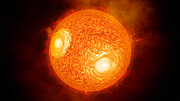
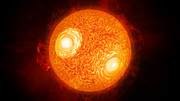
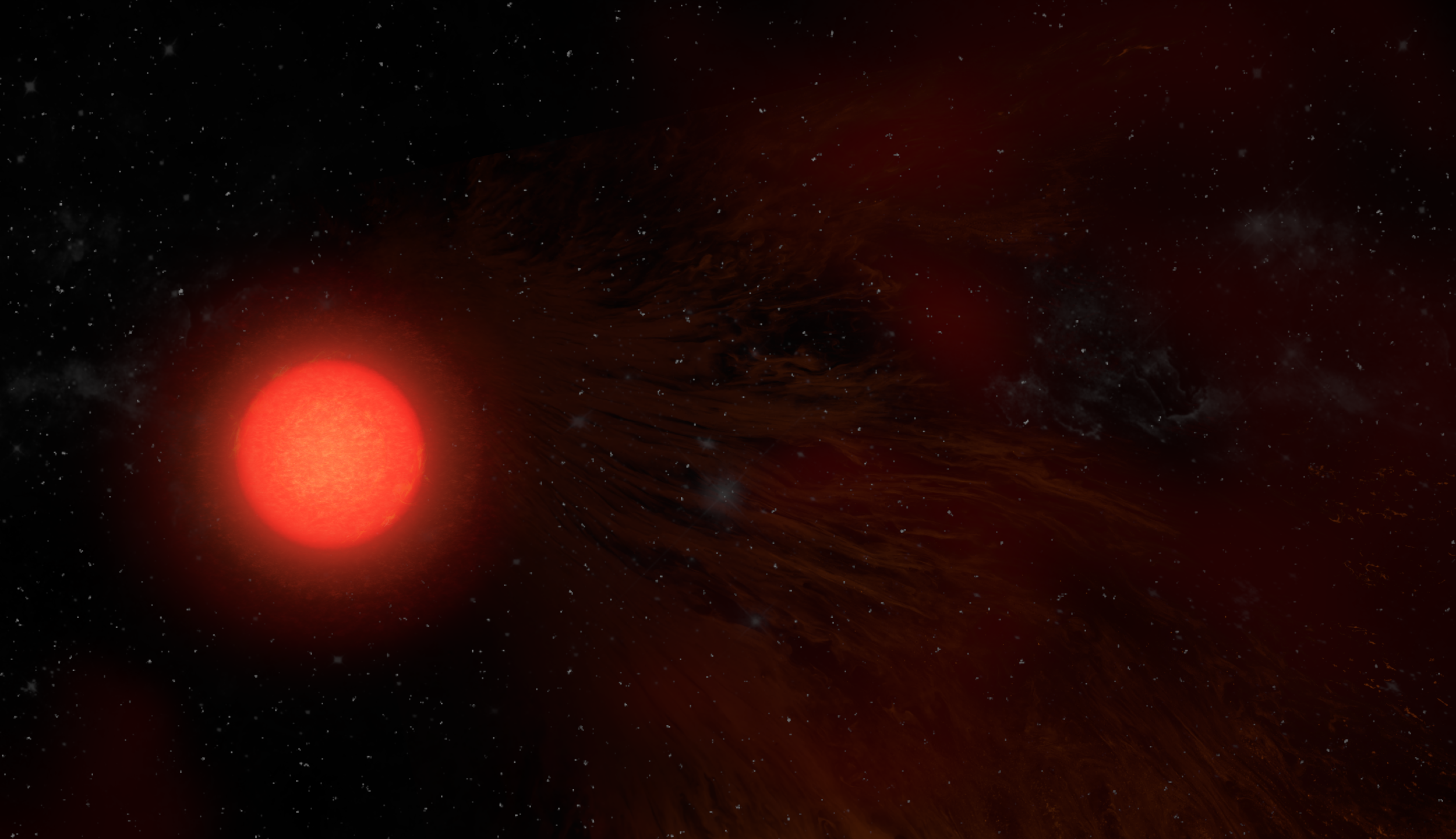
Artist impression of the atmosphere of Antares. As seen with the naked eye (up until the photosphere), Antares is around 700 times larger than our sun, big enough to fill the solar system beyond the orbit of Mars (Solar System scale shown for comparison). But ALMA and VLA showed that its atmosphere, including the lower and upper chromosphere and wind zones, reaches out 12 times farther than that. Credit: NRAO/AUI/NSF, S. Dagnello. Hi-Res File

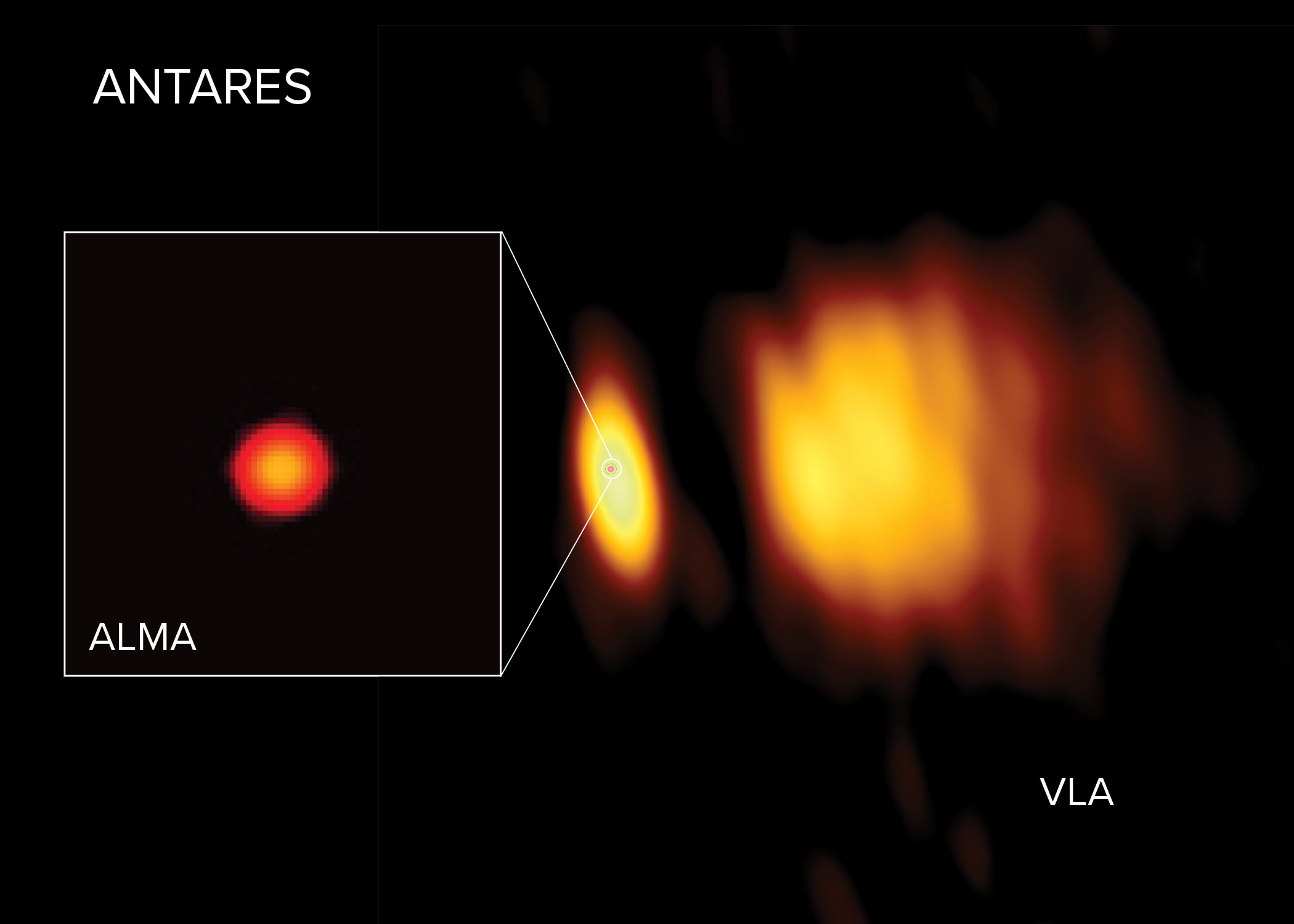
Radio images of Antares with ALMA and the VLA. ALMA observed Antares close to its surface in shorter wavelengths, and the longer wavelengths observed by the VLA revealed the star’s atmosphere further out. In the VLA image a huge wind is visible on the right, ejected from Antares and lit up by its smaller but hotter companion star Antares B. Credit: ALMA (ESO/NAOJ/NRAO), E. O’Gorman; NRAO/AUI/NSF, S. Dagnello. Hi-Res File

Artist impression of red supergiant star Antares
Credit: NRAO/AUI/NSF, S. Dagnell. Hi-Res File

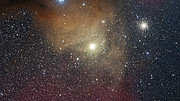
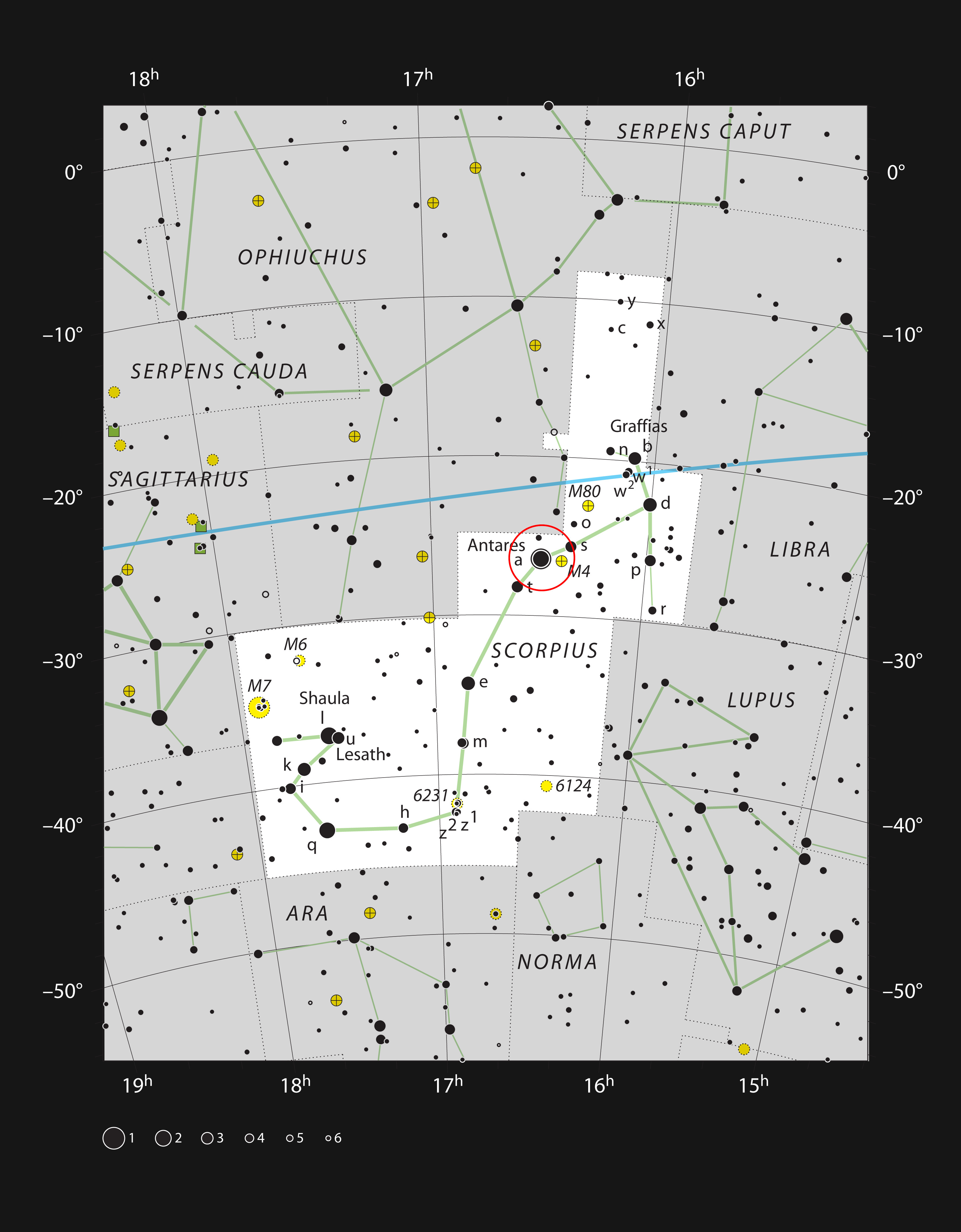
Antares Star Chart
Star chart showing the location of the bright red star Antares (encircled in red). Antares is the closest red supergiant to Earth (555 light years away) and is located in the constellation of Scorpius (The Scorpion). Credit: ESO, IAU, Sky & Telescope. Hi-Res File

Press Release Video
Brief video (1:33) explaining this research result.
Credit: NRAO/AUI/NSF, S. Dagnello. Download Video

An international team of astronomers has created the most detailed map yet of the atmosphere of the red supergiant star Antares. The unprecedented sensitivity and resolution of both the Atacama Large Millimeter/submillimeter Array (ALMA) and the National Science Foundation’s Karl G. Jansky Very Large Array (VLA) revealed the size and temperature of Antares’ atmosphere from just above the star’s surface, throughout its chromosphere, and all the way out to the wind region.

Red supergiant stars, like Antares and its more well-known cousin Betelgeuse, are huge, relatively cold stars at the end of their lifetime. They are on their way to run out of fuel, collapse, and become supernovae. Through their vast stellar winds, they launch heavy elements into space, thereby playing an important role in providing the essential building blocks for life in the universe. But it is a mystery how these enormous winds are launched. A detailed study of the atmosphere of Antares, the closest supergiant star to Earth, provides a crucial step towards an answer.

The ALMA and VLA map of Antares is the most detailed radio map yet of any star, other than the Sun. ALMA observed Antares close to its surface (its optical photosphere) in shorter wavelengths, and the longer wavelengths observed by the VLA revealed the star’s atmosphere further out. As seen in visible light, Antares’ diameter is approximately 700 times larger than the Sun. But when ALMA and the VLA revealed its atmosphere in radio light, the supergiant turned out to be even more gigantic.

“The size of a star can vary dramatically depending on what wavelength of light it is observed with,” explained Eamon O’Gorman of the Dublin Institute for Advanced Studies in Ireland and lead author of the study published in the June 16 edition of the journal Astronomy & Astrophysics. “The longer wavelengths of the VLA revealed the supergiant’s atmosphere out to nearly 12 times the star’s radius.”

The radio telescopes measured the temperature of most of the gas and plasma in Antares’ atmosphere. Most noticeable was the temperature in the chromosphere. This is the region above the star’s surface that is heated up by magnetic fields and shock waves created by the vigorous roiling convection at the stellar surface – much like the bubbling motion in a pot of boiling water. Not much is known about chromospheres, and this is the first time that this region has been detected in radio waves.

Thanks to ALMA and the VLA, the scientists discovered that the star’s chromosphere extends out to 2.5 times the star’s radius (our Sun’s chromosphere is only 1/200th of its radius). They also found that the temperature of the chromosphere is lower than previous optical and ultraviolet observations have suggested. The temperature peaks at 3,500 degrees Celsius (6,400 degrees Fahrenheit), after which it gradually decreases. As a comparison, the Sun’s chromosphere reaches temperatures of almost 20,000 degrees Celsius.

“We found that the chromosphere is ‘lukewarm’ rather than hot, in stellar temperatures,” said O’Gorman. “The difference can be explained because our radio measurements are a sensitive thermometer for most of the gas and plasma in the star’s atmosphere, whereas past optical and ultraviolet observations were only sensitive to very hot gas and plasma.”

“We think that red supergiant stars, such as Antares and Betelgeuse, have an inhomogeneous atmosphere,” said co-author Keiichi Ohnaka of the Universidad Católica del Norte in Chile who previously observed Antares’ atmosphere in infrared light. “Imagine that their atmospheres are a painting made out of many dots of different colors, representing different temperatures. Most of the painting contains dots of the lukewarm gas that radio telescopes can see, but there are also cold dots that only infrared telescopes can see, and hot dots that UV telescopes see. At the moment we can’t observe these dots individually, but we want to try that in future studies.”

In the ALMA and VLA data, astronomers for the first time saw a clear distinction between the chromosphere and the region where winds start to form. In the VLA image, a huge wind is visible, ejected from Antares and lit up by its smaller but hotter companion star Antares B.

“When I was a student, I dreamt of having data like this,” said co-author Graham Harper of the University of Colorado, Boulder. “Knowing the actual sizes and temperatures of the atmospheric zones gives us a clue of how these huge winds start to form and how much mass is being ejected.”

“Our innate understanding of the night sky is that stars are just points of light. The fact we can map the atmospheres of these supergiant stars in detail, is a true testament to technological advances in interferometry. These tour de force observations bring the universe close, right into our own backyard,” said Chris Carilli of the National Radio Astronomy Observatory, who was involved in the first observations of Betelgeuse at multiple radio wavelengths with the VLA in 1998.

The National Radio Astronomy Observatory is a facility of the National Science Foundation, operated under cooperative agreement by Associated Universities, Inc.

Source: National Radio Astronomy Observatory (NRAO)/Newa


Media contact:

Iris Nijman
NRAO News and Public Information Manager

inijman@nrao.edu


This research was presented in a paper titled “ALMA and VLA reveal the lukewarm chromospheres of the nearby red supergiants Antares and Betelgeuse,” by E. O’Gorman et al., appearing in the journal Astronomy & Astrophysics. www.aanda.org/10.1051/0004-6361/202037756

Read our press release on SpaceScoop.org, the astronomy news service for children!

The Atacama Large Millimeter/submillimeter Array (ALMA), an international astronomy facility, is a partnership of the European Organisation for Astronomical Research in the Southern Hemisphere (ESO), the U.S. National Science Foundation (NSF) and the National Institutes of Natural Sciences (NINS) of Japan in cooperation with the Republic of Chile. ALMA is funded by ESO on behalf of its Member States, by NSF in cooperation with the National Research Council of Canada (NRC) and the Ministry of Science and Technology (MOST) and by NINS in cooperation with the Academia Sinica (AS) in Taiwan and the Korea Astronomy and Space Science Institute (KASI).

ALMA construction and operations are led by ESO on behalf of its Member States; by the National Radio Astronomy Observatory (NRAO), managed by Associated Universities, Inc. (AUI), on behalf of North America; and by the National Astronomical Observatory of Japan (NAOJ) on behalf of East Asia. The Joint ALMA Observatory (JAO) provides the unified leadership and management of the construction, commissioning and operation of ALMA.


Thursday, August 24, 2017

Best Ever Image of a Star’s Surface and Atmosphere

 PR Image eso1726a
VLTI reconstructed view of the surface of Antares 

PR Image eso1726b
Artist’s impression of the red supergiant star Antares

PR Image eso1726c
VLTI velocity map of the surface of Antares

PR Image eso1726d
The bright red star Antares in the constellation of Scorpius 


Videos
 
ESOcast 123 Light: Best Ever Image of a Star’s Surface and Atmosphere (4K UHD)

Zooming in on the red supergiant star Antares

3D animation of Antares

Approaching Antares (artist's impression)


First map of motion of material on a star other than the Sun

Using ESO’s Very Large Telescope Interferometer astronomers have constructed the most detailed image ever of a star — the red supergiant star Antares. They have also made the first map of the velocities of material in the atmosphere of a star other than the Sun, revealing unexpected turbulence in Antares’s huge extended atmosphere. The results were published in the journal Nature.

To the unaided eye the famous, bright star Antares shines with a strong red tint in the heart of the constellation of Scorpius (The Scorpion). It is a huge and comparatively cool red supergiant star in the late stages of its life, on the way to becoming a supernova [1].

A team of astronomers, led by Keiichi Ohnaka, of the Universidad Católica del Norte in Chile, has now used ESO’s Very Large Telescope Interferometer (VLTI) at the Paranal Observatory in Chile to map Antares’s surface and to measure the motions of the surface material. This is the best image of the surface and atmosphere of any star other than the Sun.

The VLTI is a unique facility that can combine the light from up to four telescopes, either the 8.2-metre Unit Telescopes, or the smaller Auxiliary Telescopes, to create a virtual telescope equivalent to a single mirror up to 200 metres across. This allows it to resolve fine details far beyond what can be seen with a single telescope alone.

How stars like Antares lose mass so quickly in the final phase of their evolution has been a problem for over half a century,” said Keiichi Ohnaka, who is also the lead author of the paper. “The VLTI is the only facility that can directly measure the gas motions in the extended atmosphere of Antares — a crucial step towards clarifying this problem. The next challenge is to identify what’s driving the turbulent motions.”

Using the new results the team has created the first two-dimensional velocity map of the atmosphere of a star other than the Sun. They did this using the VLTI with three of the Auxiliary Telescopes and an instrument called AMBER to make separate images of the surface of Antares over a small range of infrared wavelengths. The team then used these data to calculate the difference between the speed of the atmospheric gas at different positions on the star and the average speed over the entire star [2]. This resulted in a map of the relative speed of the atmospheric gas across the entire disc of Antares — the first ever created for a star other than the Sun..

The astronomers found turbulent, low-density gas much further from the star than predicted, and concluded that the movement could not result from convection [3], that is, from large-scale movement of matter which transfers energy from the core to the outer atmosphere of many stars. They reason that a new, currently unknown, process may be needed to explain these movements in the extended atmospheres of red supergiants like Antares.

In the future, this observing technique can be applied to different types of stars to study their surfaces and atmospheres in unprecedented detail. This has been limited to just the Sun up to now,” concludes Ohnaka. “Our work brings stellar astrophysics to a new dimension and opens an entirely new window to observe stars.


Notes

[1] Antares is considered by astronomers to be a typical red supergiant. These huge dying stars are formed with between nine and 40 times the mass of the Sun. When a star becomes a red supergiant, its atmosphere extends outward so it becomes large and luminous, but low-density. Antares now has a mass about 12 times that of the Sun and a diameter about 700 times larger than the Sun’s. It is thought that it started life with a mass more like 15 times that of the Sun, and has shed three solar-masses of material during its life.

[2] The velocity of material towards or away from Earth can be measured by the Doppler Effect, which shifts spectral lines either towards the red or blue ends of the spectrum, depending on whether the material emitting or absorbing light is receding from or approaching the observer.

[3] Convection is the process whereby cold material moves downwards and hot material moves upwards in a circular pattern. The process occurs on Earth in the atmosphere and ocean currents, but it also moves gas around within stars.


More Information

This research was presented in a paper entitled “Vigorous atmospheric motion in the red supergiant star Antares”, by K. Ohnaka et al., published in the journal Nature.

The team is composed of K. Ohnaka (Universidad Católica del Norte, Antofagasta, Chile), G. Weigelt (Max- Planck-Institut für Radioastronomie, Bonn, Germany) and K. -H. Hofmann (Max- Planck-Institut für Radioastronomie, Bonn, Germany).

ESO is the foremost intergovernmental astronomy organisation in Europe and the world’s most productive ground-based astronomical observatory by far. It is supported by 16 countries: Austria, Belgium, Brazil, the Czech Republic, Denmark, France, Finland, Germany, Italy, the Netherlands, Poland, Portugal, Spain, Sweden, Switzerland and the United Kingdom, along with the host state of Chile. ESO carries out an ambitious programme focused on the design, construction and operation of powerful ground-based observing facilities enabling astronomers to make important scientific discoveries. ESO also plays a leading role in promoting and organising cooperation in astronomical research. ESO operates three unique world-class observing sites in Chile: La Silla, Paranal and Chajnantor. At Paranal, ESO operates the Very Large Telescope and its world-leading Very Large Telescope Interferometer as well as two survey telescopes, VISTA working in the infrared and the visible-light VLT Survey Telescope. ESO is also a major partner in two facilities on Chajnantor, APEX and ALMA, the largest astronomical project in existence. And on Cerro Armazones, close to Paranal, ESO is building the 39-metre Extremely Large Telescope, the ELT, which will become “the world’s biggest eye on the sky”.


Links


Contacts

Keiichi Ohnaka
Instituto de Astronomía — Universidad Católica del Norte
Antofagasta, Chile
Tel: +56 55 235 5493
Email: k1.ohnaka@gmail.com

Richard Hook
ESO Public Information Officer
Garching bei München, Germany
Tel: +49 89 3200 6655
Cell: +49 151 1537 3591
Email: rhook@eso.org

Source: ESO/News

Tuesday, August 18, 2015

Rho Ophiuchi and Antares 520 light years

Rho Ophiuchi and  Antares
Image Credit: Australian Astronomical Observatory/David Malin
Download high-res image file | Download caption as .zip file


This dusty region between the constellations Ophiuchus (the "snake holder") and Scorpius (the "scorpion") contains a colorful cosmic vista. These colors tell some of the story behind the interplay between light and matter in this object. For example, the blue glow in the upper part of this image is reflected light from stars embedded in dust. The yellow glow in the lower left is light from the giant star Antares that is reflected by dust that the star itself has created. The darker black areas—especially the middle left of the picture—are caused by clouds that hide light from more distant stars in background stars. Light is commonly reflected and blocked both here on Earth and across the Universe.