Thursday, February 20, 2014

Clouds circling supermassive black holes

Artist's concept of a supermassive black hole at the centre of a galaxy. 
Credit: NASA / JPL / Caltec 

Astronomers see huge clouds of gas orbiting supermassive black holes at the centres of galaxies. Once thought to be a relatively uniform, fog-like ring, the accreting matter instead forms clumps dense enough to intermittently dim the intense radiation blazing forth as these enormous objects condense and consume matter.

The international team reports their sightings in a paper to be published in the Monthly Notices of the Royal Astronomical Society, available online now. Videos depicting the swirling clouds are posted to YouTube.

Evidence for the clouds comes from records collected over 16 years by NASA's Rossi X-ray Timing Explorer, a satellite in low-earth orbit equipped with instruments that measured variations in X-ray sources. Those sources include active galactic nuclei, brilliantly luminous objects powered by supermassive black holes as they gather and condense huge quantities of dust and gas.


By sifting through records for 55 active galactic nuclei Alex Markowitz, an astrophysicist at the University of California, San Diego and the Karl Remeis Observatory in Bamberg, Germany and colleagues found a dozen instances when the X-ray signal dimmed for periods of time ranging from hours to years, presumably when a cloud of dense gas passed between the source and satellite.

Mirko Krumpe of the European Southern Observatory in Garching, Germany and Robert Nikutta, of Andrés Bello University in Santiago, Chile co-authored the report, which confirms what recent models of these systems have predicted.

The clouds they observed orbit a few light-weeks to a few light-years from the centre of the active galactic nuclei. One, in a spiral galaxy in the direction of the constellation Centaurus designated NGC 3783, appeared to be in the midst of being torn apart by tidal forces.

Support for this research came from NASA's Astrophysics Data Analysis Program (NNX11AD07G) and the European Community's Seventh Framework Program (229517). Nikutta acknowledges support from ALMA-CONICYT (31110001). Video produced by the Scientific Visualization Studio, Goddard Spaceflight Centre, NASA, based in part on visualisations created by Wolfgang Steffen, Institute of Astronomy, National Autonomous University of Mexico.


Science contacts

Alex Markowitz, in Germany
almarkowitz@ucsd.edu (preferred)
Tel: +49 (0)951 95222 26
Available for interviews in English only


Mirko Krumpe, in California, U.S.
Tel: +1 858 822 3435

mkrumpe@eso.org
Available for interviews in German (preferred) or English

Robert Nikutta, in Chile
Tel: +56 9 7370 1865
Available for interviews in German or English


Animations

YouTube animations of clouds in orbit around a black hole are available from
http://www.youtube.com/watch?v=fUQ29PQBXhQ
http://www.youtube.com/watch?v=vdQm9VGj7g4 (with weather symbols)
http://www.youtube.com/watch?v=OCLpFTm01VA (with a diagram showing changing X-ray emission)

A NASA video with accompanying soundtrack is available from http://youtu.be/QA8nzRkjOE


Further information


The researchers publish their work in “First X-ray-based statistical tests for clumpy-torus models: eclipse events from 230 years of monitoring of Seyfert AGN”, A. G. Markowitz, M. Krumpe and R. Nikutta4, Monthly Notices of the Royal Astronomical Society. The paper is available from http://mnras.oxfordjournals.org/content/early/2014/02/04/mnras.stt2492


Notes for editors


The Royal Astronomical Society (RAS, www.ras.org.uk),  founded in 1820, encourages and promotes the study of astronomy, solar-system science, geophysics and closely related branches of science. The RAS organizes scientific meetings, publishes international research and review journals, recognizes outstanding achievements by the award of medals and prizes, maintains an extensive library, supports education through grants and outreach activities and represents UK astronomy nationally and internationally. Its more than 3800 members (Fellows), a third based overseas, include scientific researchers in universities, observatories and laboratories as well as historians of astronomy and others.


Follow the RAS on Twitter via @royalastrosoc

Wednesday, February 19, 2014

Diamonds in the Tail of the Scorpion

The star cluster Messier 7

The bright star cluster Messier 7 in the constellation of Scorpius 

 **************************************

Videos

Zooming in on the bright star cluster Messier 7

Panning across the bright star cluster Messier 7


New ESO image of star cluster Messier 7


A new image from ESO’s La Silla Observatory in Chile shows the bright star cluster Messier 7. Easily spotted with the naked eye close to the tail of the constellation of Scorpius, it is one of the most prominent open clusters of stars in the sky — making it an important astronomical research target.
Messier 7, also known as NGC 6475, is a brilliant cluster of about 100 stars located some 800 light-years from Earth. In this new picture from the Wide Field Imager on the MPG/ESO 2.2-metre telescope it stands out against a very rich background of hundreds of thousands of fainter stars, in the direction of the centre of the Milky Way.

At about 200 million years old, Messier 7 is a typical middle-aged open cluster, spanning a region of space about 25 light-years across. As they age, the brightest stars in the picture — a population of up to a tenth of the total stars in the cluster — will violently explode as supernovae. Looking further into the future, the remaining faint stars, which are much more numerous, will slowly drift apart until they become no longer recognisable as a cluster.

Open star clusters like Messier 7 are groups of stars born at almost the same time and place, from large cosmic clouds of gas and dust in their host galaxy. These groups of stars are of great interest to scientists, because the stars in them have about the same age and chemical composition. This makes them invaluable for studying stellar structure and evolution.

An interesting feature in this image is that, although densely populated with stars, the background is not uniform and is noticeably streaked with dust. This is most likely to be just a chance alignment of the cluster and the dust clouds. Although it is tempting to speculate that these dark shreds are the remnants of the cloud from which the cluster formed, the Milky Way will have made nearly one full rotation during the life of this star cluster, with a lot of reorganisation of the stars and dust as a result. So the dust and gas from which Messier 7 formed, and the star cluster itself, will have gone their separate ways long ago.

The first to mention this star cluster was the mathematician and astronomer Claudius Ptolemy, as early as 130 AD, who described it as a “nebula following the sting of Scorpius”, an accurate description given that, to the naked eye, it appears as a diffuse luminous patch against the bright background of the Milky Way. In his honour, Messier 7 is sometimes called Ptolemy’s Cluster. In 1764 Charles Messier included it as the seventh entry in his Messier catalogue. Later, in the 19th century, John Herschel described the appearance of this object as seen through a telescope as a “coarsely scattered cluster of stars” — which sums it up perfectly.

More information

ESO is the foremost intergovernmental astronomy organisation in Europe and the world’s most productive ground-based astronomical observatory by far. It is supported by 15 countries: Austria, Belgium, Brazil, the Czech Republic, Denmark, France, Finland, Germany, Italy, the Netherlands, Portugal, Spain, Sweden, Switzerland and the United Kingdom. ESO carries out an ambitious programme focused on the design, construction and operation of powerful ground-based observing facilities enabling astronomers to make important scientific discoveries. ESO also plays a leading role in promoting and organising cooperation in astronomical research. ESO operates three unique world-class observing sites in Chile: La Silla, Paranal and Chajnantor. At Paranal, ESO operates the Very Large Telescope, the world’s most advanced visible-light astronomical observatory and two survey telescopes. VISTA works in the infrared and is the world’s largest survey telescope and the VLT Survey Telescope is the largest telescope designed to exclusively survey the skies in visible light. ESO is the European partner of a revolutionary astronomical telescope ALMA, the largest astronomical project in existence. ESO is currently planning the 39-metre European Extremely Large optical/near-infrared Telescope, the E-ELT, which will become “the world’s biggest eye on the sky”.

Links

Contacts

Richard Hook
ESO, Public Information Officer
Garching bei München, Germany
Tel: +49 89 3200 6655
Cell: +49 151 1537 3591
Email: rhook@eso.org


Source: ESO


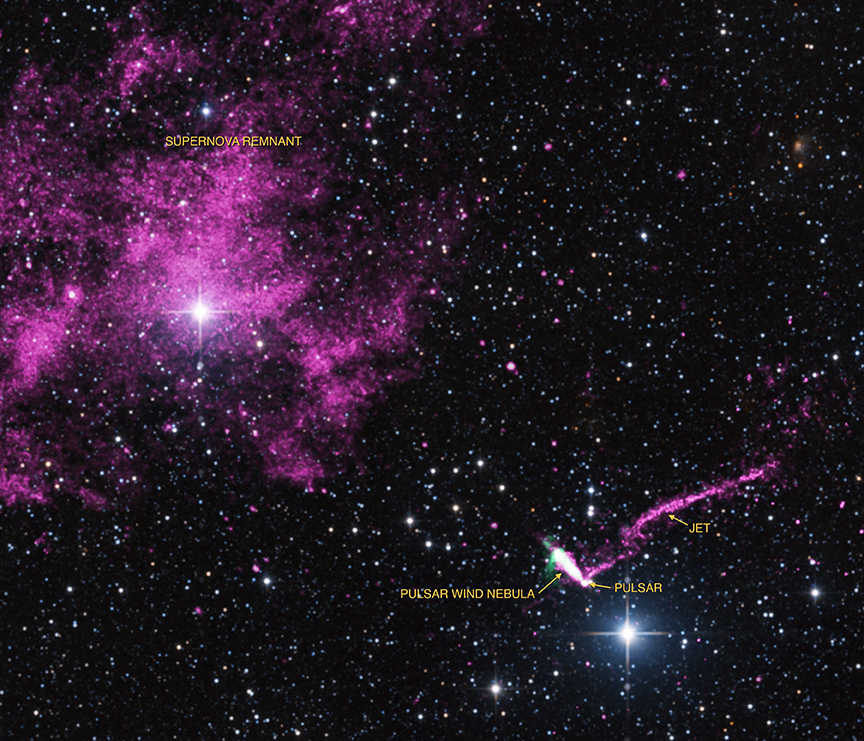
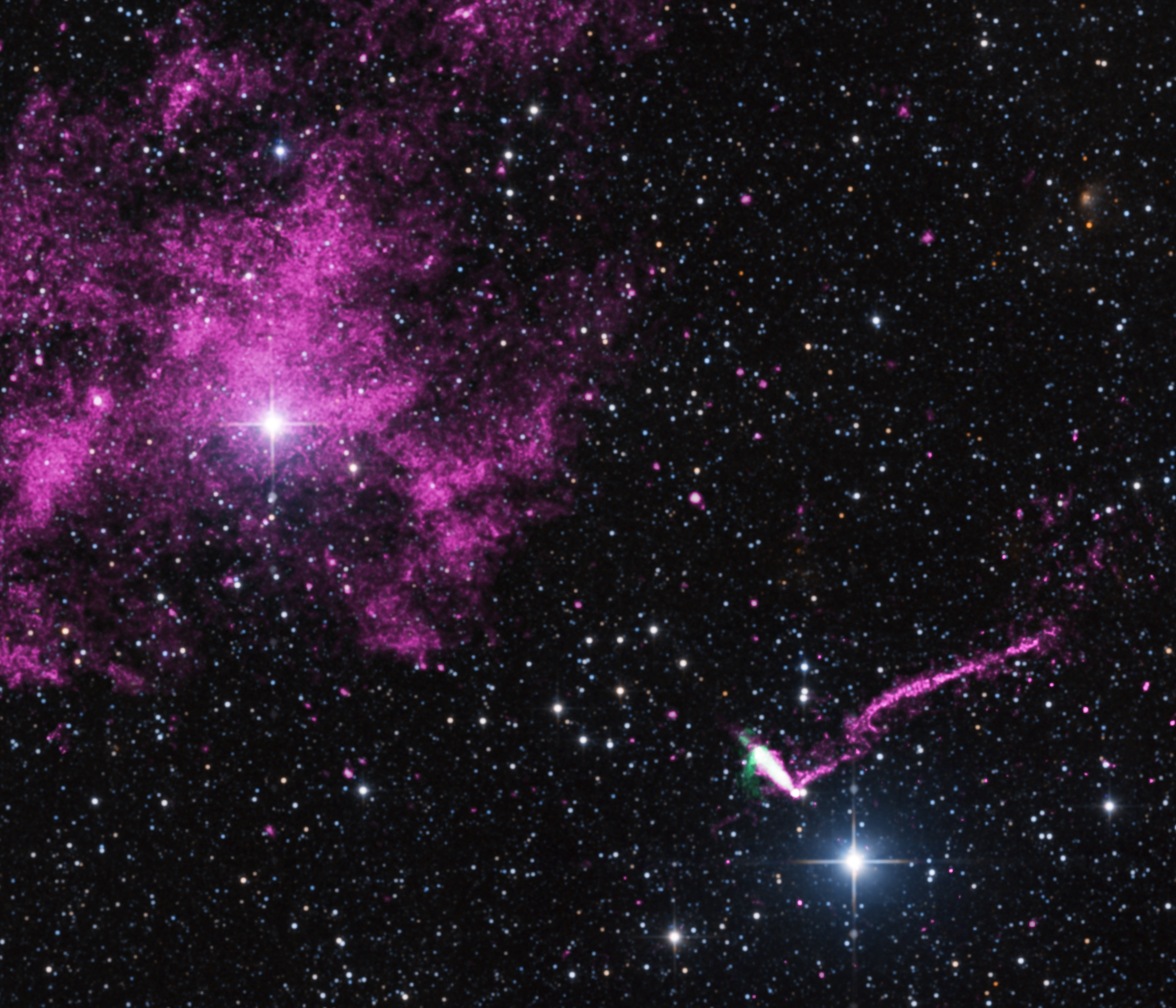
IGR J11014-6103: Runaway Pulsar Firing an Extraordinary Jet

Credit: X-ray: NASA/CXC/ISDC/L.Pavan et al, Radio: CSIRO/ATNF/ATCA
Optical: 2MASS/UMass/IPAC-Caltech/NASA/NSF


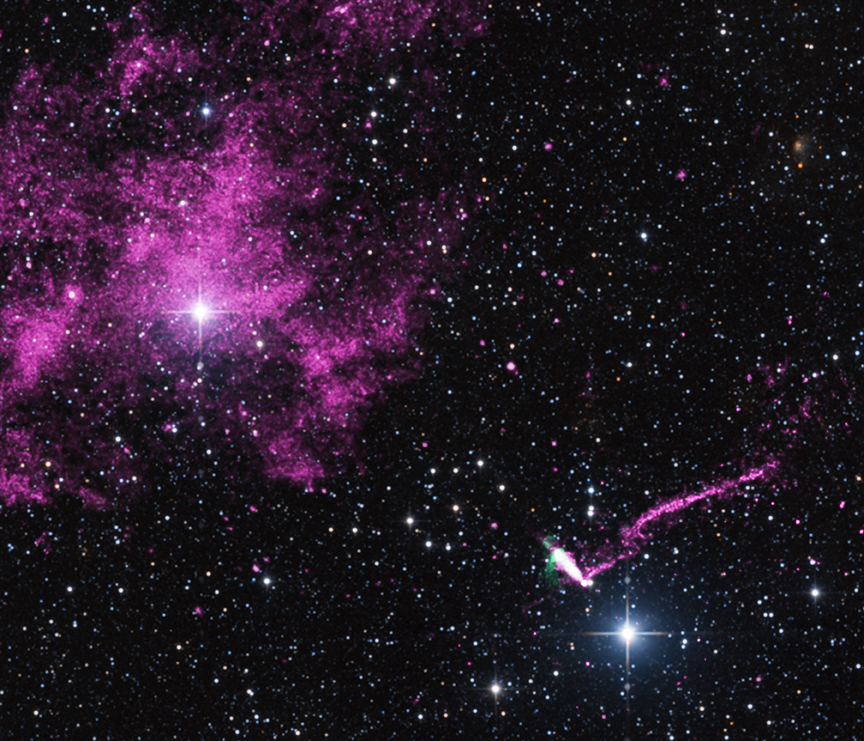
An extraordinary jet trailing behind a runaway pulsar is seen in this composite image that contains data from NASA's Chandra X-ray Observatory (purple), radio data from the Australia Compact Telescope Array (green), and optical data from the 2MASS survey (red, green, and blue). The pulsar - a spinning neutron star - and its tail are found in the lower right of this image (mouse over the image for a labeled version). The tail stretches for 37 light years , making it the longest jet ever seen from an object in the Milky Way galaxy, as described in our press release.

The pulsar, originally discovered by ESA's INTEGRAL satellite, is called IGR J1104-6103 and is moving away from the center of the supernova remnant where it was born at a speed between 2.5 million and 5 million miles per hour. This supersonic pace makes IGR J1104-6103 one of the fastest moving pulsars ever observed.

A massive star ran out of fuel and collapsed to form the pulsar along with the supernova remnant, the debris field seen as the large purple structure in the upper left of the image. The supernova remnant (known as SNR MSH 11-61A) is elongated along the top-right to bottom left direction, roughly in line with the tail's direction. These features and the high speed of the pulsar suggest that jets could have played an important role in the supernova explosion that formed IGR J1104-6103.

In addition to its exceptional length, the tail behind IGR J1104-6103 has other interesting characteristics. For example, there is a distinct corkscrew pattern in the jet. This pattern suggests that the pulsar is wobbling like a top as it spins, while shooting off the jet of particles.

Another interesting feature of this image is a structure called a pulsar wind nebula (PWN), a cocoon of high-energy particles that enshrouds the pulsar and produces a comet-like tail behind it. Astronomers had seen the PWN in previous observations, but the new Chandra and ATCA data show that the PWN is almost perpendicular to the direction of the jet. This is intriguing because usually the pulsar's direction of motion, its jet, and its PWN are aligned with one another.

One possibility requires an extremely fast rotation speed for the iron core of the star that exploded as the supernova. A problem with this scenario is that such fast speeds are not commonly expected to be achievable.

A paper, led by Lucia Pavan of the University of Geneva in Switzerland, describing these results appears in the February 18th issue of the journal Astronomy & Astrophysics and is also available online. Other authors include Pol Bordas (University of Tuebingen in Germany), Gerd Puehlhofer (Univ. of Tuebingen), Miroslav Filipovic (University of Western Sydney in Australia), A. De Horta (Univ. of Western Sydney), A. O'Brien (Univ. of Western Sydney), M. Balbo (Univ. of Geneva), R. Walter (Univ. of Geneva), E. Bozzo (Univ. of Geneva), C. Ferrigno (Univ. of Geneva), E. Crawford (Univ. of Western Sydney), and L. Stella (INAF).


Fast Facts for IGR J11014-6103:

Scale: Image is 22 arcmin across (about 147 light years)
Category: Supernovas & Supernova Remnants, Neutron Stars/X-ray Binaries
Coordinates (J2000): RA 11h 01m 22.08s | Dec -61° 03' 25.20"
Constellation: Carina
Observation Date: 11 Oct 2012
Observation Time: 13 hours 43 min
Obs. ID: 13787 
Instrument: ACIS
References: Pavan, L. et al, 2014 A&A, in press; arXiv:1309.6792
Color Code: X-ray: (Pink) Radio: (Green); Optical (Red, Green, Blue)
Distance Estimate: About 23,000 light years


Tuesday, February 18, 2014

Hubble Watches Stars' Clockwork Motion in Nearby Galaxy

Stars' Clockwork Motion Captured in Nearby Galaxy
Image Credit: NASA, ESA, A. Feild and Z. Levay (STScI), Y. Beletsky (Las Campanas Observatory), and R. van der Marel (STScI
Science Credit: NASA, ESA, R. van der Marel (STScI), and N. Kallivayalil (University of Virginia). Release Images

This animation illustrates the rotation rate of the Large Magellanic Cloud (LMC). Hubble Space Telescope observations have determined that the central part of the LMC completes a rotation every 250 million years. Hence, it takes more than 10 million years for even the small amount of rotation illustrated here.

Credit: NASA, ESA, and G. Bacon, R. van der Marel, A. Feild, L. Frattare, Z. Levay, and F. Summers (STScI).  Acknowlegment: S. Guisard (http://sguisard.astrosurf.com/). Release Videos

Using the sharp-eyed NASA Hubble Space Telescope, astronomers have for the first time precisely measured the rotation rate of a galaxy based on the clock-like movement of its stars.

According to their analysis, the central part of the neighboring galaxy, called the Large Magellanic Cloud (LMC), completes a rotation every 250 million years. Coincidentally, it takes our Sun the same amount of time to complete a rotation around the center of our Milky Way galaxy.

The Hubble team, composed of Roeland van der Marel of the Space Telescope Science Institute in Baltimore, Md., and Nitya Kallivayalil of the University of Virginia in Charlottesville, Va., used Hubble to measure the average motion of hundreds of individual stars in the LMC, located 170,000 light-years away. Hubble recorded the stars' slight movements over a seven-year period.

Disk-shaped galaxies, like the Milky Way and the LMC, generally rotate like a carousel. Hubble's precision tracking offers a new way to determine a galaxy's rotation by the "sideways" proper motion of its stars, as seen in the plane of sky. Astronomers have long measured the sideways motions of nearby celestial objects, but this is the first time that the precision has become sufficient to see another distant galaxy rotate.

For the past century astronomers have calculated galaxy rotation rates by observing a slight shift in the spectrum — called the Doppler effect — of its starlight. On one side of a galaxy's spinning stellar disk, the stars swinging in the direction of Earth will show a spectral blueshift (the compression of light waves due to motion toward the observer). Stars swinging away from Earth on the opposite side of a galaxy will show a spectral redshift (the stretching of light to redder wavelengths due to motion away from the observer).

The newly measured Hubble sideways motions and the Doppler motions measured previously each provide complementary information about the LMC's rotation rate. By combining the results, the Hubble team for the first time obtained a fully three-dimensional view of stellar motions in another galaxy.

"Determining a galaxy's rotation by measuring its instantaneous back and forth motions doesn't allow one to actually see things change over time," said van der Marel, the lead author on a paper in the Feb. 1 issue of the Astrophysical Journal describing and interpreting the results. "By using Hubble to study the stars' motions over several years, we can actually for the first time see a galaxy rotate in the plane of the sky."

Kallivayalil, who led the data analysis, added: "Studying this nearby galaxy by tracking the stars' movements gives us a better understanding of the internal structure of disk galaxies. Knowing a galaxy's rotation rate offers insight into how a galaxy formed, and it can be used to calculate its mass."

Hubble is the only telescope that can make this kind of observation because of its sharp resolution, its image stability, and its 24 years in space. "If we imagine a human on the Moon," van der Marel explained, "Hubble's precision would allow us to determine the speed at which the person's hair grows."

"This precision is crucial, because the apparent stellar motions are so small because of the galaxy's distance," he said. "You can think of the LMC as a clock in the sky, on which the hands take 250 million years to make one revolution. We know the clock's hands move, but even with Hubble we need to stare at them for several years to see any movement."

The research team used Hubble's Wide Field Camera 3 and Advanced Camera for Surveys to observe stars in 22 fields spread across the vast disk of the LMC, which appears in the southern night sky as an object about 20 times the angular diameter of the full moon. Arrows on the accompanying image show the predicted motion over the next 7 million years, based on the Hubble measurements.

Each field was chosen to contain not only dozens of LMC stars, but also a background quasar, a brilliant beacon of light powered by a black hole in the core of a distant active galaxy. The astronomers needed the quasars as fixed background reference points to measure the extremely subtle motion of the LMC stars.

This measurement is the culmination of ongoing work with Hubble by van der Marel and another team to refine the LMC's rotation rate. Van der Marel began analyzing the galaxy's rotation in 2002 by creating detailed predictions, now confirmed by Hubble, of what the rotation should look like.

"The LMC is a very important galaxy because it is very near to our Milky Way," he said. "Studying the Milky Way is very hard because everything you see is spread all over the sky. It's all at different distances, and you're sitting in the middle of it. Studying structure and rotation is much easier if you view a nearby galaxy from the outside."

"Because the LMC is so nearby, it is a benchmark for studies of stellar evolution and populations. For this, it's important to understand the galaxy's structure," Kallivayalil said. "Our technique for measuring the galaxy's rotation rate using fully three-dimensional motions is a new way to shed light on that structure. It opens a new window to our understanding of how stars in galaxies move."

In addition to the LMC's own rotation, it is also moving around the Milky Way as a whole. In earlier science papers, the team and its collaborators used Hubble data to show that the LMC moves faster around the Milky Way than previously believed. This research has revised our understanding of how many times these neighboring galaxies might have met and interacted in the past.

The team next plans to use Hubble to measure the stellar motions in the LMC's diminutive cousin, the Small Magellanic Cloud, using the same technique. The galaxies are interacting, and that study should also yield improved insight into how the galaxies are moving around each other and around the Milky Way.

CONTACT

Donna Weaver / Ray Villard
Space Telescope Science Institute, Baltimore, Md.
410-338-4493 / 410-338-4514

dweaver@stsci.edu / villard@stsci.edu

Roeland van der Marel
Space Telescope Science Institute, Baltimore, Md.
410-338-4931

marel@stsci.edu


Source: Hubble Site


Do Black Holes Have Hair?

A computer-generated image of a star field (left) as seen by an astronaut close to a black hole in the center of the field-of-view (right). The gravity of the black hole creates visual distortions, some quite unusual. A new theoretical paper finds there is a way in principle to make a black hole with no event horizon, a so-called "naked singularity."  Credit: Robert Nemeroff, MTU 

Black holes with masses of millions or even billions of suns appear to reside at the nuclei of galaxies. In dramatic cases like quasars they are thought to be responsible for the spectacular phenomena like the ejection of narrow jets of particles at nearly the speed of light. Such outflows are thought to be driven by matter accreting onto a hot disk around the black hole. Much smaller black holes, closer in size to one solar mass, are thought to form as the result of the cataclysmic death of a star in a supernova.

A black hole in the traditional theory is characterized by having “no hair”; that is, it is so simple that it can be completely described by just three parameters, its mass, its spin, and its electric charge. Even though it may have formed out of a complex mix of matter and energy, all the specific details are lost when it collapses to a singular point. In the standard paradigm, the black hole is surrounded by a “horizon,” and once anything – matter or light (energy) – falls within that horizon, it cannot escape. Hence, the singularity appears black. Outside this horizon an accreting disk (if there is one) can radiate freely.

This picture may be appealing, but there is no direct proof as yet that any suspected galactic nuclei candidates are necessarily black holes and have horizons. The equations describing the collapse of matter in general relativity allow for other solutions, and do not require in every case that the final end-state must be a black hole. If, for example, matter were to condense very gradually instead of rapidly in a supernova, theory suggests that it is possible for the final point-like product to lack an event horizon. Such an object is called a “naked singularity” (“singularity” because, like a black hole, it has point-like dimensions, but naked because it lacks an event horizon and so light can escape its vicinity – it is not black).

CfA astronomer Ramesh Narayan and two colleagues have devised a way, at least in theory, for such a gradually collapsing process to form a naked singularity. Moreover, they then explore ways in which it might be observationally possible to distinguish one from a black hole by using the character of the radiation emitted from a disk around it. The results are not only fun to think about, they help astronomers probe how these bizarre objects may have formed in the first place.

Reference: 
"Distinguishing Black Holes from Naked Singularities Through Their Accretion Disc Properties,” Pankaj S. Joshi, Daniele Malafarina, and Ramesh Narayan, Classical and Quantum Gravity, 31, 1, 2014.


Monday, February 17, 2014

Serendipitous Supernova

An image of the area of M82 acquired from the Keck Observatory using the NIRC2 instrument and the Keck II Adaptive Optics (AO) system showing the supernova SN2014J. By accurately matching the NIRC2 image to an archival HST image, astronomers can infer properties of the progenitor star or progenitor system that led to the supernova, confirming or discarding different hypotheses. Keck Observatory's AO systems allow astronomers to reduce the blurring effect of atmospheric turbulence and acquire images as sharp as observed from space. Credit: Caltech/UH

Two weeks ago a group of astronomy students from the University of London Observatory were getting an introductory demonstration on how to use a telescope-mounted camera. With clouds shrouding much of the sky, professor Steve Fossey decided to point the University’s 14-inch telescope at nearby galaxy Messier 82 (M82) and saw a very bright object that wasn't supposed to be there. After a bit of detective work, the group put out an Astronomical Telegram to the world’s scientific community. 

It was soon determined that M82 was hosting a rare, Type 1a supernova explosion – one of the brightest events in the sky and a once-in-a-century event. It was named SN2014J. 

The phones rang at Keck Observatory, home of the two largest and most scientifically productive telescopes on the Earth. Although time on the Keck telescopes is scheduled 6 months in advance and is highly coveted, the two different teams observing on Keck I and Keck II that night both agreed to interrupt their research and point the mighty 10-meter telescopes at M82 and gather valuable data and rare insight into the life cycle of type 1a supernova.

"It was very exciting: this was the second nearest supernova in recent history," said Michael Liu, the University of Hawaii astronomer who made the decision to observe the exploding star using the Keck II telescope. "Usually, we know what we are going to be observing for months before we get here."

While it’s known that Type 1a supernovae form from collapsing white dwarfs – the densest forms of matter after black holes and neutron stars – their formation theories come in two flavors: the single degenerate scenario in which a normal star is consumed by a white dwarf; and the double degenerate scenario in which two white dwarfs merge.

To determine which one this is, scientists need to compare the before and after images to determine which stars became the supernova, said Shriharsh Tendulkar, a post-doctoral researcher at the California Institute of Technology.

“Keck‘s Adaptive Optics system allows you to get very sharp images of the sky, as you would from space, and allows a very precise position of the supernova," he said. “We can compare it to old images to possibly determine the progenitor system." 

With the NIRC2 instrument and Keck II's Adaptive Optics system (AO), Liu’s team was able to capture very clear images of the supernova and the surrounding stars in Messier 82.

"While there are many supernovae explosions in the Universe, this one is important because it is close enough that with Keck’s AO, we have an excellent chance of identifying the progenitor," said Bob Goodrich, head of night-time operations for W. M. Keck Observatory

Critically, the supernova was discovered two weeks before its predicted peak luminosity, allowing an unprecedented opportunity to study the process of this stellar explosion.

"The physics of supernovae is very interesting," Shriharsh said. "For example, it’s really hard to model these explosions in [computer] simulations. These observations will help us make our simulations better."

Yale University astronomer Meg Urry also took time from her program on Keck I to gather data on M82 using the Observatory's newest instrument, MOSFIRE, the Multi-Object Spectrograph for Infrared Exploration. She wrote about her perspective in an interesting article for CNN.

"In addition to giving insight on how these supernovae are formed, gathering data on SN2014J will give us more accurate distances to other type 1a supernovae," Goodrich said. "Because the distance of M82 is precisely known, we can clearly determine the absolute brightness of SN2014J. Since all type 1a supernovae are equally bright, this valuable measurement can be used to calibrate data on all former (and future) such studies, including the one that lead to the Nobel Prize."

Type 1a supernovae have already played a profound role at the Keck Observatory when a team of astronomers were awarded the 2011 Nobel Prize in Physics. The scientists trained the mighty Keck telescopes at known supernovae and used their findings to determine that the expansion of the Universe was not slowing down, as was expected, but in fact was speeding up – driven by a mysterious repelling force now called Dark Energy. 

By Steve Jefferson


Friday, February 14, 2014

It came from outer space

Credit: NASA, ESA, and A. Sarajedini (University of Florida)
Acknowledgement: Gilles Chapdelaine

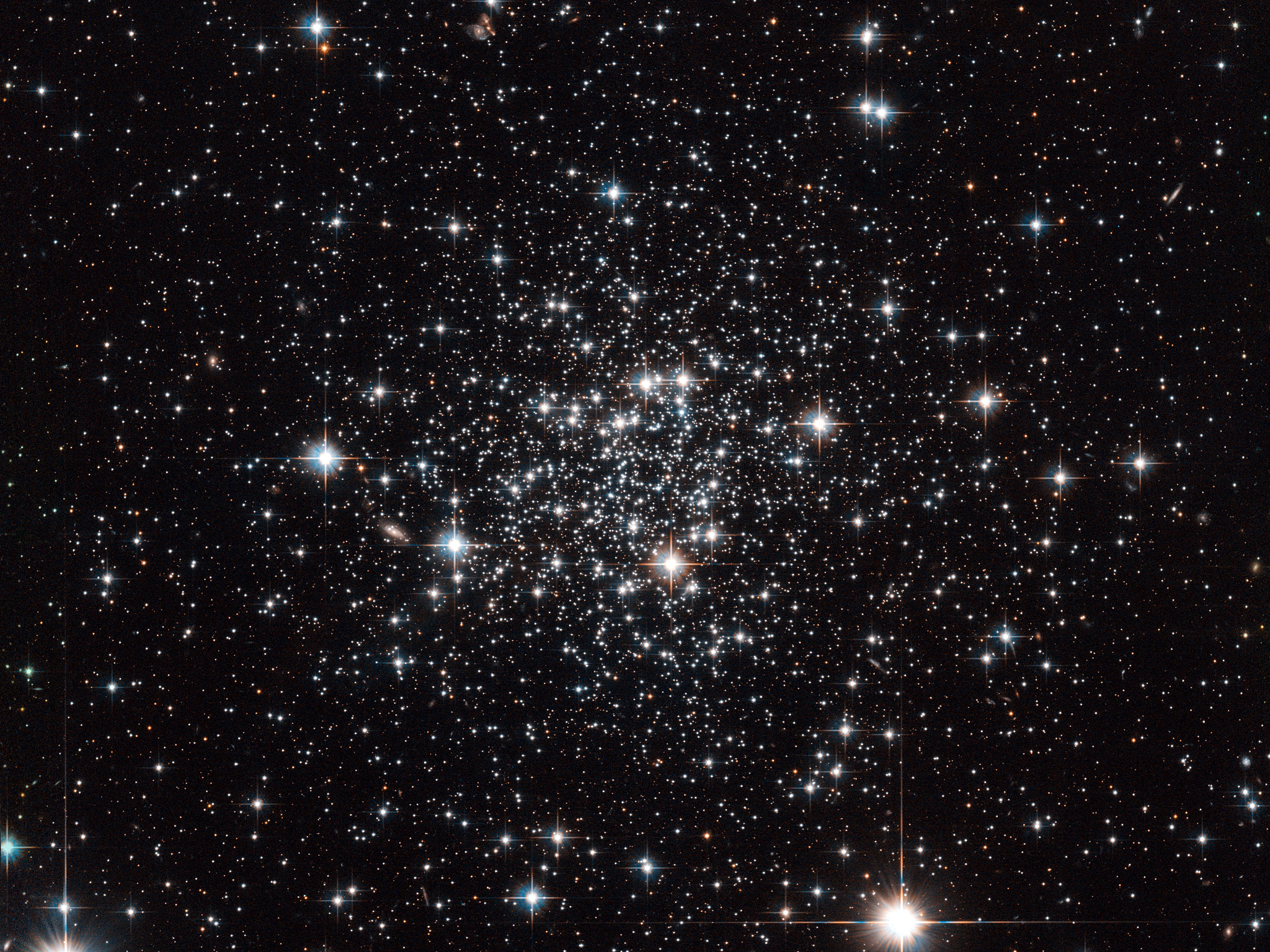
Named after its discoverer, the French-Armenian astronomer Agop Terzan, this is the globular cluster Terzan 7 — a densely packed ball of stars bound together by gravity. It lies just over 75 000 light-years away from us on the other side of our galaxy, the Milky Way. It is a peculiar cluster, quite unlike others we observe, making it an intriguing object of study for astronomers.

Evidence shows that Terzan 7 used to belong to a small galaxy called the Sagittarius Dwarf Galaxy, a mini-galaxy discovered in 1994. This galaxy is currently colliding with, and being absorbed by, the Milky Way, which is a monster in size when compared to this tiny one. It seems that this cluster has already been kidnapped from its former home and now is part of our own galaxy.

Astronomers recently discovered that all the stars in Terzan 7 were born at around the same time, and are about eight billion years old. This is unusually young for such a cluster. The shared birthday is another uncommon property; a large number of globular clusters, both in the Milky Way and in other galaxies, seem to have at least two clearly differentiated generations of stars that were born at different times.

Some explanations suggest that there is something different about clusters that form within dwarf galaxies, giving them a different composition. Others suggest that clusters like Terzan 7 only have enough material to form one batch of stars, or that perhaps its youthfulness has prevented it from yet forming another generation.
A version of this image was entered into the Hubble's Hidden Treasures image processing competition by contestant Gilles Chapdelaine.


Thursday, February 13, 2014

Four new galaxy clusters take researchers further back in time

Three (false) colour Herschel images of the clumps identified by Planck. Blue, green and red represent infrared light at successively longer wavelengths, of 250μm, 350μm and 500μm respectively. The green circle indicates the size of the Planck beam at the position of the source, which Herschel was able to resolve in far greater detail. Credit: D. Clements / ESA / NASA. Click here for a full-resolution image.

An artist's impression of the Herschel spacecraft. Credit: ESA/ AOES Medialab / NASA/ESA/STScI. Click here for a full-resolution image. 

Four previously unknown galaxy clusters – each potentially containing thousands of individual galaxies – have been discovered some 10 billion light years from Earth.

An international team of astronomers, led by Imperial College London, used a new way of combining data from the two European Space Agency satellites, Planck and Herschel, to identify more distant galaxy clusters than has previously been possible. The researchers believe up to 2000 further clusters could be identified using this technique, helping to build a more detailed timeline of how clusters are formed. They publish their work in a paper in the journal Monthly Notices of the Royal Astronomical Society.

Galaxy clusters are the most massive objects in the universe, containing hundreds to thousands of galaxies, bound together by gravity. While astronomers have identified many nearby clusters, they need to go further back in time to understand how these structures are formed. This means finding clusters at greater distances from the Earth.

The light from the most distant of the four new clusters identified by the team has taken over 10 billion years to reach us. This means the researchers are seeing what the cluster looked like when the universe was just three billion years old.

Lead researcher Dr David Clements, from the Department of Physics at Imperial College London, explains: “Although we’re able to see individual galaxies that go further back in time, up to now, the most distant clusters found by astronomers date back to when the universe was 4.5 billion years old. This equates to around nine billion light years away. Our new approach has already found a cluster in existence much earlier than that, and we believe it has the potential to go even further.”

The clusters can be identified at such distances because they contain galaxies in which huge amounts of dust and gas are being formed into stars. This process emits light that can be picked up by the satellite surveys.

Galaxies are divided into two types: elliptical galaxies that have many stars, but little dust and gas; and spiral galaxies like our own, the Milky Way, which contain lots of dust and gas. Most clusters in the universe today are dominated by giant elliptical galaxies in which the dust and gas has already been formed into stars.

“What we believe we are seeing in these distant clusters are giant elliptical galaxies in the process of being formed,” says Dr Clements.

Observations were recorded by the Spectral and Photometric Imaging Receiver (SPIRE) instrument as part of the Herschel Multi-tiered Extragalactic Survey (HerMES). Prof Seb Oliver, Head of the HerMES survey said: "The fantastic thing about Herschel-SPIRE is that we are able to scan very large areas of the sky with sufficient sensitivity and image sharpness that we can find these rare and exotic things. This result from Dr Clements is exactly the kind of thing we were hoping to find with the HerMES survey".

The researchers are among the first to combine data from two satellites that ended their operations last year: the Planck satellite, which scanned the whole sky, and the Herschel satellite, which surveyed certain sections in greater detail. The researchers used Planck data to find sources of far-infrared emission in areas covered by the Herschel satellite, then cross referenced with Herschel data to look at these sources more closely. Of sixteen sources identified by the researchers, most were confirmed as single, nearby galaxies that were already known. However, four were shown by Herschel to be formed of multiple, fainter sources, indicating previously unknown galaxy clusters.

The team then used additional existing data and new observations to estimate the distance of these clusters from Earth and to determine which of the galaxies within them were forming stars. The researchers are now looking to identify more galaxy clusters using this technique, with the aim of looking further back in time to the earliest stage of cluster formation.

The research involved scientists from the UK, Spain, USA, Canada, Italy and South Africa. It was part funded by the Science and Technology Facilities Research Council and the UK Space Agency.


Media contact


Gail Wilson
Research Media Officer – Faculty of Natural Sciences
Communications and Public Affairs
Imperial College London

gail.wilson@imperial.ac.uk

Tel: +44(0)20 7594 6702
Out of hours duty press officer: +44(0)7803 886 248


Image and caption


Caption: Three (false) colour Herschel images of the clumps identified by Planck. Blue, green and red represent infrared light at successively longer wavelengths, of 250μm, 350μm and 500μm respectively. The green circle indicates the size of the Planck beam at the position of the source, which Herschel was able to resolve in far greater detail. Credit: D. Clements / ESA / NASA


Further information


The new work appears in ‘HerMES: Clusters of Dusty Galaxies uncovered by Herschel and Planck’, D. L. Clements, F. G. Braglia, A. Hyde, I. Perez-Fournon, J. Bock, A. Cava, S. Chapman, A. Conley, A. Cooray, D. Farrah, E. A. Gonzalez Solares, L. Marchetti, G. Marsden, S. J. Oliver, I. G. Roseboom, B. Schulz, A. J. Smith, M. Vaccari, J. Vieira, M. Viero, L. Wang, J. Wardlow, M. Zemcov and G. de Zotti, Monthly Notices of the Royal Astronomical Society, Oxford University Press, in press.

A preprint of the paper is also available.


Notes for editors


About Planck and Herschel


Planck was an ESA science mission with instruments and contributions directly funded by ESA Member States, NASA & Canada. Planck was launched on May 14 2009 and was Europe’s first space mission to study the relic radiation from the Big Bang. It was named after the German physicist Max Planck, whose work on the behaviour of radiation won the Nobel Prize in 1918. Planck is an all sky survey mission and its main goal is to study the cosmic microwave background (CMB), but as a by-product it is producing all sky surveys in all its observational bands. Planck was deactivated in October 2013 when the tank of liquid helium used to cool the instruments finally ran dry.


Herschel was an ESA space observatory with science instruments provided by European-led Principal Investigator consortia and with important participation from NASA. Herschel was launched in tandem with Planck and its observations finished on April 29 2014. Scientific work on the data collected by Herschel will continue for many years. With its larger primary mirror and larger detector arrays, Herschel can reach higher angular resolutions and higher sensitivities than Planck, but it is not an all sky survey instrument, with its areal coverage limited to less than 10%  of the extragalactic sky.

STFC


The Science and Technology Facilities Council (STFC) is keeping the UK at the forefront of international science and tackling some of the most significant challenges facing society such as meeting our future energy needs, monitoring and understanding climate change, and global security.


The Council has a broad science portfolio and works with the academic and industrial communities to share its expertise in materials science, space and ground-based astronomy technologies, laser science, microelectronics, wafer scale manufacturing, particle and nuclear physics, alternative energy production, radio communications and radar.


STFC's Astronomy and Space Science programme provides support for a wide range of facilities, research groups and individuals in order to investigate some of the highest priority questions in astrophysics, cosmology and solar system science


STFC operates or hosts world class experimental facilities including:

  • in the UK; ISIS pulsed neutron source, the Central Laser Facility, and LOFAR.  STFC is also the majority shareholder in Diamond Light Source Ltd.
  • overseas; telescopes on La Palma and Hawaii

It enables UK researchers to access leading international science facilities by funding membership of international bodies including European Laboratory for Particle Physics (CERN), the Institut Laue Langevin (ILL), European Synchrotron Radiation Facility (ESRF) and the European Southern Observatory (ESO).  


STFC is one of seven publicly-funded research councils.  It is an independent, non-departmental public body of the Department for Business, Innovation and Skills (BIS).


Follow us on Twitter @STFC_Matters

About Imperial College London


Consistently rated amongst the world's best universities, Imperial College London is a science-based institution with a reputation for excellence in teaching and research that attracts 14,000 students and 6,000 staff of the highest international quality. Innovative research at the College explores the interface between science, medicine, engineering and business, delivering practical solutions that improve quality of life and the environment - underpinned by a dynamic enterprise culture.


Since its foundation in 1907, Imperial's contributions to society have included the discovery of penicillin, the development of holography and the foundations of fibre optics. This commitment to the application of research for the benefit of all continues today, with current focuses including interdisciplinary collaborations to improve global health, tackle climate change, develop sustainable sources of energy and address security challenges.


In 2007, Imperial College London and Imperial College Healthcare NHS Trust formed the UK's first Academic Health Science Centre. This unique partnership aims to improve the quality of life of patients and populations by taking new discoveries and translating them into new therapies as quickly as possible.


The Royal Astronomical Society


The Royal Astronomical Society (RAS, www.ras.org.uk) , founded in 1820, encourages and promotes the study of astronomy, solar-system science, geophysics and closely related branches of science. The RAS organizes scientific meetings, publishes international research and review journals, recognizes outstanding achievements by the award of medals and prizes, maintains an extensive library, supports education through grants and outreach activities and represents UK astronomy nationally and internationally. Its more than 3800 members (Fellows), a third based overseas, include scientific researchers in universities, observatories and laboratories as well as historians of astronomy and others.


Follow the RAS on Twitter via @royalastrosoc


Wednesday, February 12, 2014

How stellar death can lead to twin celestial jets

A Hubble Space Telescope image of the Rotten Egg Nebula, a pre-planetary nebula 5000 light years away in the constellation of Puppis. Credit: NASA/ESA & Valentin Bujarrabal (Observatorio Astronomico Nacional, Spain). Click here for a full-resolution image

Astronomers know that while large stars can end their lives as violently cataclysmic supernovae, smaller stars end up as planetary nebulae – colourful, glowing clouds of dust and gas. In recent decades these nebulae, once thought to be mostly spherical, have been observed to often emit powerful, bipolar jets of gas and dust. But how do spherical stars evolve to produce highly aspherical planetary nebulae?

In a theoretical paper published this week in the Monthly Notices of the Royal Astronomical Society, a University of Rochester professor and his undergraduate student  conclude that only “strongly interacting” binary stars – or a star and a massive planet – can feasibly give rise to these powerful jets.

When these smaller stars run out of hydrogen to burn they begin to expand and become Asymptotic Giant Branch (AGB) stars. This phase in a star’s life lasts at most 100,000 years. At some point some of these AGB stars, which represent the distended last spherical stage in the lives of low mass stars, become “pre-planetary” nebula, which are aspherical.

“What happens to change these spherical AGB stars into non-spherical nebulae, with two jets shooting out in opposite directions?” asks Eric Blackman, professor of physics and astronomy at Rochester. “We have been trying to come up with a better understanding of what happens at this stage.”

For the jets in the nebulae to form, the spherical AGB stars have to somehow become non-spherical and Blackman says that astronomers believe this occurs because AGB stars are not single stars but part of a binary system. The jets are thought to be produced by the ejection of material that is first pulled and acquired, or “accreted,” from one object to the other and swirled into a so-called accretion disk. There are, however, a range of different scenarios for the production of these accretion disks. All these scenarios involve two stars or a star and a massive planet, but it has been hard to rule any of them out until now because the “core” of the AGBs, where the disks form, are too small to be directly resolved by telescopes. Blackman and his student, Scott Lucchini, wanted to determine whether the binaries can be widely separated and weakly interacting, or whether they must be close and strongly interacting.

By studying the jets from pre-planetary and planetary nebulae, Blackman and Lucchini were able to connect the energy and momentum involved in the accretion process with that in the jets; the process of accretion is what in effect provides the fuel for these jets. As mass is accreted into one of the disks it loses gravitational energy. This is then converted into the kinetic energy and momentum of the outflowing jets, which is the mass that is expelled at a certain speed. Blackman and Lucchini determined the minimum power and minimum mass flows that these accretion processes needed to produce to account for the properties of the observed jets. They then compared the requirements to specific existing accretion models, which have predicted specific power and mass flow rates.

They found that only two types of accretion models, both of which involve the most strongly interacting binaries, could create these jetted pre-planetary nebulae. In the first type of model, the “Roche lobe overflow,” the companions are so close that the AGB stellar envelope gets pulled into a disk around the companion. In the second type of models, or “common envelope” models, the companion is even closer and fully enters the envelope of the AGB star so that the two objects have a "common" envelope. From within the common envelope, very high accretion rate disks can either form around the companion from the AGB star material, or the companion can be shredded into a disk around the AGB star core. Both of these scenarios could provide enough energy and momentum to produce the jets that have been observed.

The name planetary nebulae originally came from astronomer William Herschel, who first observed them in the 1780s, and thought they were newly forming gaseous planets.  Although the name has persisted, now we know that they are in fact the end states of low mass stars, and would only involve planets if a binary companion in one of the accretion scenarios above were in fact a large planet. “Pre-planetary” and “planetary” nebulae are different in the nature of the light they produce; pre-planetary nebulae reflect light, whereas mature planetary nebulae shine through ionisation (where atoms lose or gain electrons). Pre-planetary nebulae shoot out two jets of gas and dust, the latter forming in the jets as the outflows expand and cool. This dust reflects the light produced by the hotter core. In planetary nebulae, thought to be the evolved stage of pre-planetary nebula, the core is exposed and the hotter radiation it emits ionises the gas in the now weaker jets, which in turn glow.

The research was supported by the NSF grant AST-1109285.


Media contacts

Leonor Sierra
University of Rochester
United States
Tel: +1 585 276 6264

lsierra@rochester.edu

Robert Massey
Royal Astronomical Society
United Kingdom
Tel: +44 (0)20 7734 3307 x214
Mob: +44 (0)794 124 8035

rm@ras.org.uk


Image and caption

An image is available from https://www.ras.org.uk/images/stories/press/Rotteneggnebula.jpg

Caption: A Hubble Space Telescope image of the Rotten Egg Nebula, a pre-planetary nebula 5000 light years away in the constellation of Puppis. Credit:    NASA/ESA & Valentin Bujarrabal (Observatorio Astronomico Nacional, Spain)


Further information


The new work appears in “Using kinematic properties of pre-planetary nebulae to constrain engine paradigms”, Eric G. Blackman and Scott Luchini, Monthly Notices of the Royal Astronomical Society, Oxford University Press.

The paper is available from http://mnrasl.oxfordjournals.org/content/early/2014/01/30/mnrasl.slu001

A preprint of the paper is available from http://arxiv.org/pdf/1312.5372.pdf


Notes for editors

The University of Rochester (www.rochester.edu) is one of the leading private universities in the United States. Located in Rochester, New York, the University gives students exceptional opportunities for interdisciplinary study and close collaboration with faculty through its unique cluster-based curriculum. Its College, School of Arts and Sciences, and Hajim School of Engineering and Applied Sciences are complemented by its Eastman School of Music, Simon School of Business, Warner School of Education, Laboratory for Laser Energetics, School of Medicine and Dentistry, School of Nursing, Eastman Institute for Oral Health, and the Memorial Art Gallery.

The Royal Astronomical Society (RAS, www.ras.org.uk),  founded in 1820, encourages and promotes the study of astronomy, solar-system science, geophysics and closely related branches of science. The RAS organizes scientific meetings, publishes international research and review journals, recognizes outstanding achievements by the award of medals and prizes, maintains an extensive library, supports education through grants and outreach activities and represents UK astronomy nationally and internationally. Its more than 3800 members (Fellows), a third based overseas, include scientific researchers in universities, observatories and laboratories as well as historians of astronomy and others.

Follow the RAS on Twitter via @royalastrosoc


NASA Spacecraft Get a 360-Degree View of Saturn's Auroras

Ultraviolet and infrared images from NASA's Cassini spacecraft and Hubble Space Telescope show active and quiet auroras at Saturn's north and south poles. Full caption 

The dark region seen on the face of the sun at the end of March 2013 is a coronal hole (just above and to the right of the middle of the picture), which is a source of fast solar wind leaving the sun.  Image Credit: NASA/SDO/AIA. Full image and caption

While the curtain-like auroras we see at Earth are green at the bottom and red at the top, NASA's Cassini spacecraft has shown us similar curtain-like auroras at Saturn that are red at the bottom and purple at the top. Image Credit: NASA/JPL-Caltech/SSI.  Full image and caption

NASA trained several pairs of eyes on Saturn as the planet put on a dancing light show at its poles. While NASA's Hubble Space Telescope, orbiting around Earth, was able to observe the northern auroras in ultraviolet wavelengths, NASA's Cassini spacecraft, orbiting around Saturn, got complementary close-up views in infrared, visible-light and ultraviolet wavelengths. Cassini could also see northern and southern parts of Saturn that don't face Earth.

The result is a kind of step-by-step choreography detailing how the auroras move, showing the complexity of these auroras and how scientists can connect an outburst from the sun and its effect on the magnetic environment at Saturn.

"Saturn's auroras can be fickle -- you may see fireworks, you may see nothing," said Jonathan Nichols of the University of Leicester in England, who led the work on the Hubble images. "In 2013, we were treated to a veritable smorgasbord of dancing auroras, from steadily shining rings to super-fast bursts of light shooting across the pole."

The Hubble and Cassini images were focused on April and May of 2013. Images from Cassini's ultraviolet imaging spectrometer (UVIS), obtained from an unusually close range of about six Saturn radii, provided a look at the changing patterns of faint emissions on scales of a few hundred miles (kilometers) and tied the changes in the auroras to the fluctuating wind of charged particles blowing off the sun and flowing past Saturn.

"This is our best look yet at the rapidly changing patterns of auroral emission," said Wayne Pryor, a Cassini co-investigator at Central Arizona College in Coolidge, Ariz. "Some bright spots come and go from image to image. Other bright features persist and rotate around the pole, but at a rate slower than Saturn's rotation."

The UVIS images, which are also being analyzed by team associate Aikaterini Radioti at the University of Liege, Belgium, also suggest that one way the bright auroral storms may be produced is by the formation of new connections between magnetic field lines. That process causes storms in the magnetic bubble around Earth. The movie also shows one persistent bright patch of the aurora rotating in lockstep with the orbital position of Saturn's moon Mimas. While previous UVIS images had shown an intermittent auroral bright spot magnetically linked to the moon Enceladus, the new movie suggests another Saturn moon can influence the light show as well.

The new data also give scientists clues to a long-standing mystery about the atmospheres of giant outer planets.

"Scientists have wondered why the high atmospheres of Saturn and other gas giants are heated far beyond what might normally be expected by their distance from the sun," said Sarah Badman, a Cassini visual and infrared mapping spectrometer team associate at Lancaster University, England. "By looking at these long sequences of images taken by different instruments, we can discover where the aurora heats the atmosphere as the particles dive into it and how long the cooking occurs."

The visible-light data have helped scientists figure out the colors of Saturn's auroras. While the curtain-like auroras we see at Earth are green at the bottom and red at the top, Cassini's imaging cameras have shown us similar curtain-like auroras at Saturn that are red at the bottom and purple at the top, said Ulyana Dyudina, an imaging team associate at the California Institute of Technology, Pasadena, Calif.

The color difference occurs because Earth's auroras are dominated by excited nitrogen and oxygen molecules, and Saturn's auroras are dominated by excited hydrogen molecules.

"While we expected to see some red in Saturn's aurora because hydrogen emits some red light when it gets excited, we also knew there could be color variations depending on the energies of the charged particles bombarding the atmosphere and the density of the atmosphere," Dyudina said. "We were thrilled to learn about this colorful display that no one had seen before."

Scientists hope additional Cassini work will illuminate how clouds of charged particles move around the planet as it spins and receives blasts of solar material from the sun.

"The auroras at Saturn are some of the planet's most glamorous features – and there was no escaping NASA's paparazzi-like attention”, said Marcia Burton, a Cassini fields and particles scientist at NASA's Jet Propulsion Laboratory, Pasadena, Calif., who is helping to coordinate these observations. "As we move into the part of the 11-year solar cycle where the sun is sending out more blobs of plasma, we hope to sort out the differences between the effects of solar activity and the internal dynamics of the Saturn system."

There is still more work to do. A group of scientists led by Tom Stallard at the University of Leicester is busy analyzing complementary data taken during the same time window by two ground-based telescopes in Hawaii -- the W.M. Keck Observatory and NASA's Infrared Telescope Facility. The results will help them understand how particles are ionized in Saturn's upper atmosphere and will help them put a decade of ground-based telescope observations of Saturn in perspective, because they can see what disturbance in the data comes from Earth's atmosphere.


Jia-Rui Cook 818-354-0850
Jet Propulsion Laboratory, Pasadena, Calif.

jccook@jpl.nasa.gov


Tuesday, February 11, 2014

Connecting the formation of monster black holes to streaming motions in the early Universe

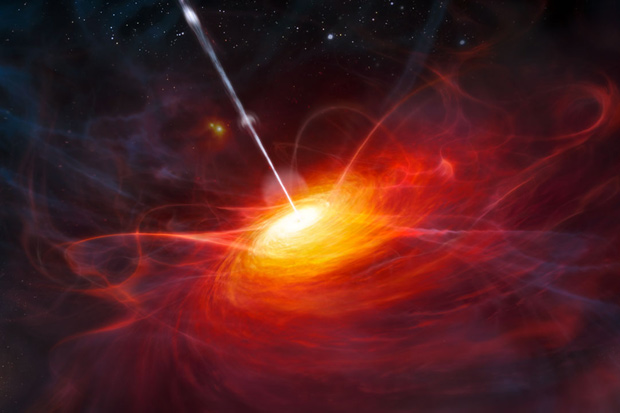
Fig. 1: Artist’s rendering of a quasar ingesting matter from its surroundings. Such a supermassive black hole shines very brightly and can therefore be observed at vast distances. Image credit: ESO/UKIDSS/SDSS

Fig. 2: A schematic cartoon of how the first structures form without (top) and with (bottom) streaming motions. Dark matter is represented by grey circles, while ordinary matter is represented by orange ones. If there are streaming motions (represented by arrows) between ordinary and dark matter, the clumps of ordinary matter form less quickly, resulting in a delay in the formation of the very first stars (depicted as blue symbols). 

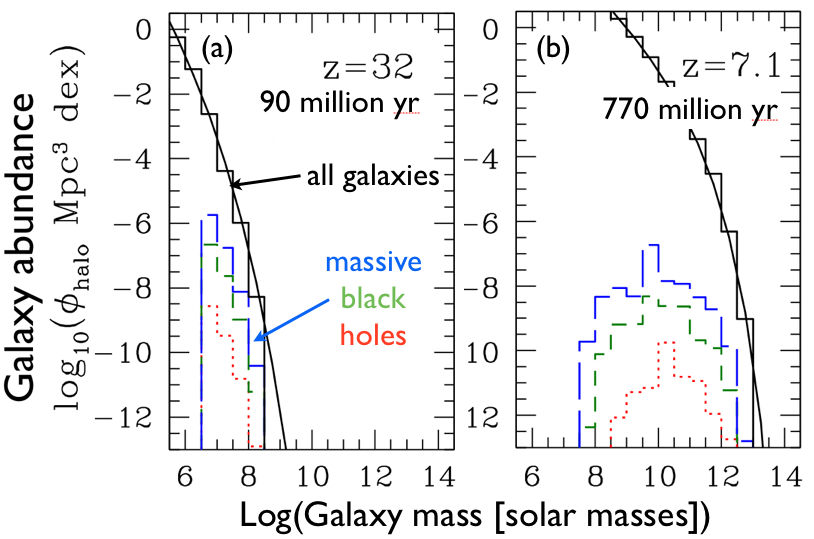
Fig. 3: The plot on the left shows the theoretical abundances of all galaxies (black lines) and only those galaxies with massive black holes (coloured histograms) when the universe was just 90 million years old. Streaming motions could help to form massive black holes much earlier than previously thought. (The different colours represent different interpretations of high-resolution simulations on how effectively the streaming motions delay star formation.)

The plot on the right is similar to the one on the left but at a later epoch. With the new scenario involving streaming motions, the prediction for the abundance of massive black holes is roughly consistent with the observed value (about 10-9 per cubic Megaparsec).

The origin of supermassive black holes in the centres of large galaxies is one of the most interesting unsolved problems in astrophysics. Recently, scientists at MPA investigated how the motions between ordinary matter and dark matter in the early Universe could have affected the formation of supermassive black holes alongside the first galaxies. 

A supermassive black hole with a mass several million or even billion times the mass of the Sun lies at the centre of every massive galaxy. Observations of quasars — supermassive black holes in luminous, gas-eating states — show that they must have formed at around the same time as the first stars and galaxies, during the first few hundred million years after the Big Bang. The origin of these gravitational monsters remains one of the major unsolved problems in astrophysics (see Research Highlight July 2012). 

The first stars and galaxies formed more than 13 billion years ago, when the mixture of primordial gas (mostly hydrogen and helium) and dark matter in the early Universe started to build up in dense pockets. There, the gas formed hydrogen molecules, and collapsed due to its own gravity to form the first stars. 

Astrophysicists believe that the first super-sized black holes formed shortly afterwards, by one of two possible processes. The first possibility is that massive stars left behind black holes when they ran out of fuel. These then consumed matter from their surroundings and fused together with each other until they became supermassive. The second possibility is that extra-massive black holes formed from the direct collapse of very massive clumps of hot gas (about 8000 Kelvin, hotter than the surface of the Sun) that did not form hydrogen molecules — gas without hydrogen molecules would not have collapsed into ordinary stars, but instead much more massive objects. 

As mentioned above, galaxies formed from — and consist of — a mixture of dark and ordinary matter. While ordinary matter is made of the familiar protons, electrons and neutrons, the dark matter interacts with normal, atomic matter only gravitationally. Actually, most of the mass inside a galaxy is in the form of this mysterious component. In a typical galaxy today, the union of the two types of matter — ordinary and dark — is peaceful, but this was not the case at the time when the first stars and galaxies formed. 

Recent studies have shown that in the early Universe, ordinary matter and dark matter did not move in unison — much as fish do not always swim with the current of water. Because of the fact that there were relative motions between ordinary and dark matter — that they “streamed” against each other — they cannot have gravitationally collapsed in the same way. The dark matter, being more abundant, collapsed first, and gravity pulled in the ordinary matter only after the motions had slowed down. This means that because of the primordial streaming motions, the first stars and galaxies formed somewhat later than previously thought (Figure 2). 

Recently, a collaboration between scientists at the Max Planck Institute of Astrophysics and the Columbia University (New York, USA) investigated the effects of these streaming motions on the formation of the first supermassive black holes. 

As stated above, one of the main effects of the streaming between two kinds of matter is that stars form later than previously believed. If monster black holes are descended from these first stars, then their rise in the Universe would also be delayed. Future telescopes such as the planned James Webb Space Telescope by NASA might be able to detect black holes at these early epochs, some 400 to 500 million years after the Big Bang. Models including streaming motions would predict as much as 10 times fewer massive black holes than previously expected. 

A second study found that in rare cases, primordial streaming motions could also help to make extra-large black holes directly. Such events could occur in rare places in the Universe where the streaming is especially vigorous, and also where large amounts of dark matter begin to accumulate exceptionally early. Under such conditions, large pockets of gas hotter than 8000 Kelvin can assemble before ever forming hydrogen molecules and stars, and therefore collapse into massive black holes much earlier than previously thought (Figure 3). It is uncertain how often this rare combination of conditions actually resulted in the formation of massive black holes. However, as it turns out, this mechanism could explain the abundance of the most luminous quasars observed when the Universe was 800 million to 1 billion years old — regardless of whether extreme streaming motions successfully formed massive black holes less than 1 per cent or nearly 100 per cent of the time. 

These studies reveal that primordial motions between ordinary mater and dark matter influence both scenarios proposed for the formation of supermassive black holes. These new insights could give valuable clues for the interpretation of future observations of the universe at early epochs.

Takamitsu Tanaka, Miao Li and Zoltán Haiman


References:

Takamitsu Tanaka, Miao Li & Zoltán Haiman, “The effect of baryonic streaming motions on the formation of the first supermassive black holes”, 2013, MNRAS, 435, 3559

Takamitsu Tanaka & Miao Li, "The formation of massive black holes in z~30 dark matter haloes with large baryonic streaming velocities", 2014, MNRAS, in press.