Showing posts with label SN2014J. Show all posts

Tuesday, September 09, 2014

Looking into the heart of a supernova explosion

Fig. 1: Top: The decay chain 56Ni -> 56Co -> 56Fe releases large amounts of energy as gamma-ray photons and positrons. Bottom: Predicted spectrum of emerging gamma-rays. Initially, most of the energy from the nickel decay chain is re-processed in the expanding, ejected material of the supernova, giving rise to powerful optical emission. After some time, the ejected material becomes transparent enough that the majority of gamma-ray photons can escape to form characteristic spectral features (shown here 75 days after the explosion).

Fig. 2: Spectrum of type II supernova SN1987A in Large Magellanic Cloud, observed 27 years ago using X-Ray devices aboard of MIR space station (Sunyaev et al., 1987). A detailed analysis of the observed spectrum proved that the scientists were dealing with gamma-rays of radioactive cobalt decay down-scattered in the optically thick envelope to the 20-200 keV spectral band due to multiple Compton scatterings and recoil effect.

Fig. 3: Spectrum of type Ia SN2014J obtained by INTEGRAL, 50 to 100 days after the explosion (Churazov et al., 2014). Red and blue points show data from the two instruments SPI and ISGRI/IBIS respectively. The black curve shows a fiducial model of the supernova spectrum for day 75 after the explosion. The top row shows images obtained in three high-energy spectral bands by INTEGRAL. A gamma-ray source is clearly visible in all images at the (optical) position of SN2014J. 

Fig. 4: Gamma-ray lines from 56Co decay in the expanding ejecta, broadened by the Doppler effect. 

First detection of Cobalt gamma-ray lines from a type Ia supernova (SN2014J) with INTEGRAL


The exceptional brightness and regular light-curves in the optical band have made supernova explosions of Type Ia (SNIa) a valuable "standard candle" in modern Cosmology. However, SNIa’s have never been detected directly in gamma-rays, limiting the analysis to re-processed emission and the outer layers of the material ejected in the stellar explosion. This year, however, a new supernova exploded in the nearby spiral galaxy M82. SN2014J, as the supernova was called, was close enough to ensure the first ever detection of gamma-ray lines by scientists at the Max Planck Institute for Astrophysics (MPA) - providing an unambiguous proof of the theoretical concept of SNIa's

A Type Ia supernova (SNIa) is believed to be the thermonuclear explosion of a white dwarf star - the stellar remnant of a normal star, such as our Sun, after the star has exhausted its hydrogen fuel. Such a white dwarf consists mainly of carbon and oxygen - the ashes of hydrogen and helium burning - and during the supernova explosion large amounts of a radioactive nickel isotope (56Ni) are produced. The subsequent decay chain from nickel to cobalt and eventually iron (see Fig. 1) releases huge amounts of energy in the form of highly energetic gamma-ray photons. These are re-processed in the expanding material ejected by the explosion, giving rise to a powerful optical emission, which has become an invaluable tool in cosmological studies as a distance indicator. 

Despite a long history of observations and simulations, the detailed physics of a SNIa explosion and the evolutionary path, which the compact object has to follow towards the explosion, remain a matter of debate. The majority of models predict that during the first 10-20 days after the explosion the ejected material is opaque for gamma-ray lines due to Compton scattering. As the ejected material becomes progressively more transparent, a large fraction of gamma-rays can finally escape. 

However, gamma-ray emission from SNIa's has never been detected, primarily because the objects were too far away. More than 27 years ago, hard X-rays and direct gamma-rays were detected from the supernova SN1987A in the Large Magellanic Cloud; this was the nearest core collapse supernova (a Type II) in recent history. Even though Type Ia events are intrinsically brighter, they are more rare and have remained elusive in gamma-rays until now. 

"In August 1987 we were very lucky", remembers MPA Director Rashid Sunyaev, "when we - together with the group of Prof. Joachim Trümper at the Max Planck Institute for Extraterrestrial Physics - detected extremely unusual hard X-Ray radiation (Fig. 2) coming from the Type II supernova SN1987A. Back then, we were able to use X-Ray devices aboard the MIR space station for these observations. And we are lucky again this year: three million seconds of INTEGRAL spacecraft observations permitted us to detect a Type Ia supernova with huge luminosity in two narrow gamma-ray lines." 

On 15 January 2014, a SNIa exploded in the spiral galaxy M82 and was discovered by S.J. Fossey and a team of students from University College London a few days later. At a distance of just over 10 million light-years, this is the nearest SNIa in at least four decades. The proximity of this supernova, dubbed SN2014J, triggered many follow-up observations, including those by ESA's gamma-ray observatory INTEGRAL. The data, taken by INTEGRAL between 50 and 100 days after the explosion, clearly show the two brightest of the expected cobalt gamma-ray lines at 847 and 1238 keV (see Fig. 3). Additionally, the flux at lower energies (200-400 keV) agrees with theoretical predictions as well. 

"The line fluxes suggest that a large amount of radioactive nickel was synthesized during the explosion, more than half the mass of our Sun," explains Eugene Churazov, the lead author of this study. Both observed gamma-ray lines are strongly broadened due to Doppler effect. This suggests that the cloud of radioactive materials expands with velocities of about 10000 km/s. Initially, the material is so dense that the gamma-rays produced by the radioactive decay of nickel to cobalt (with a typical time scale of 9 days) loose most of their energy due to Compton scattering and recoil effect. The subsequent decay of cobalt to iron takes much longer, about 111 days. During this time the ejected material becomes increasingly transparent, ultimately allowing the gammy-rays to escape and making SNIa a long-lasting source of gamma-rays. 

Further comparisons with several popular theoretical models, based on detailed calculations of the nucleosynthesis processes during the explosion, reveal good agreement of the SN2014J data with "canonical" models of SNIa explosions, where a white dwarf reaches the critical Chandrasekhar-mass and detonates. Strongly sub-Chandrasekhar-mass models or pure detonation models can already be ruled out by these observations. 

The overall, good agreement with the "canonical" models shows that in gamma-rays SN2014J looks like a proto-typical SNIa, even if strong and complicated extinction in the optical band makes the analysis challenging. "The INTEGRAL data provide unambiguous proof that SN2014J and therefore Type Ia supernovae are a thermonuclear explosion," concludes Eugene Churazov. "The data are consistent with the explosion of a white dwarf just massive enough to be unstable to gravitational collapse, but do not exclude merger scenarios that fuse comparable amounts of nickel."

E.Churazov, R.Sunyaev, J.Isern, J.Knödlseder, P.Jean, F.Lebrun, N.Chugai, S.Grebenev, E.Bravo, S.Sazonov, M.Renaud
 
Contact:
 
Dr. Eugene Churazov
Max-Planck-Institut für Astrophysik, Garching
Telefon: +49 98 30000-2219
E-Mail:
echurazov@mpa-garching.mpg.de


Original publications:


E.Churazov, R.Sunyaev, J.Isern, J.Knödlseder, P.Jean, F.Lebrun, N.Chugai, S.Grebenev, E.Bravo, S.Sazonov, M.Renaud 56CO gamma-ray emission lines from the type Ia supernova SN 2014J, Nature, Aug 28th, 2014

R. Sunyaev, A. Kaniovsky, V. Efremov, M. Gilfanov, E. Churazov, S. Grebenev, A.  Kuznetsov, A. Melioranskiy, N. Yamburenko, S. Yunin, D. Stepanov, I. Chulkov, N.  Pappe, M. Boyarskiy, E. Gavrilova, V. Loznikov, A. Prudkoglyad, V. Rodin, C.  Reppin, W. Pietsch, J. Engelhauser, J. Trümper, W. Voges, E. Kendziorra, M.  Bezler, R. Staubert, A. C. Brinkman, J. Heise, W. A. Mels, R. Jager, G. K.  Skinner, O. Al-Emam, T. G. Patterson & A. P. Willmore.Discovery of hard X-ray emission from supernova 1987A, Nature 330, 227 - 229 (19 November 1987)


Friday, August 29, 2014

INTEGRAL catches dead star exploding in a blaze of glory


Supernova explosion (annotated)
Astronomers studying SN2014J, a Type Ia supernova discovered in January 2014, have found proof that this type of supernova is caused by a white dwarf star reigniting and exploding.

This finding was made by using ESA’s Integral observatory to detect gamma rays from the radioactive elements created during the explosion.

This sequence shows some of the steps leading up to and following the explosion.

A white dwarf, a star that contain up to 1.4 times the mass of the Sun squeezed into a volume about the same size as the Earth, leeches matter from a companion star (image 1).  The Integral measurements suggest that a belt of gas from the companion star builds up around the equator of the white dwarf (image 2). This belt detonates (image 3) and triggers the internal explosion that becomes the supernova (image 4). Material from the explosion expands (image 5) and eventually becomes transparent to gamma rays (image 6). Copyright: ESA/ATG medialab. Hi-Res Image

 
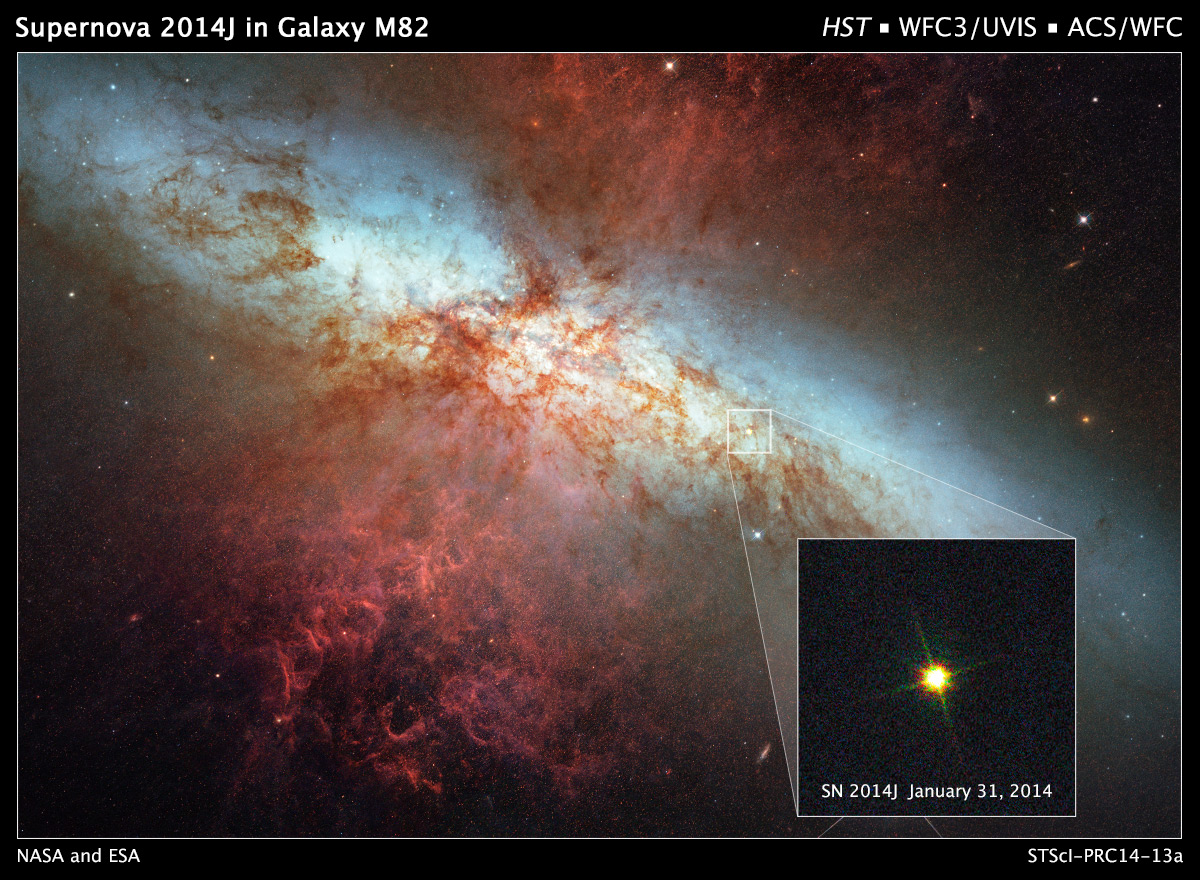
Supernova SN2014J in nearby galaxy M82
In January 2014, a supernova was discovered in the nearby galaxy M82. At a distance of about 11.5 million light-years from Earth, SN2014J as it is known, is the closest of its type to be detected in decades. 

This composite Hubble image shows the supernova in visible light, obtained on 31 January with Hubble’s Wide Field Camera 3, superimposed on a mosaic of the entire galaxy taken in 2006 with Hubble’s Advanced Camera for Surveys. Copyright: NASA, ESA, A. Goobar (Stockholm University), and the Hubble Heritage Team (STScI/AURA). 
Hi-Res Image

Astronomers using ESA’s INTEGRAL gamma-ray observatory have demonstrated beyond doubt that dead stars known as white dwarfs can reignite and explode as supernovae. The finding came after the unique signature of gamma rays from the radioactive elements created in one of these explosions was captured for the first time.

The explosions in question are known as Type Ia supernovae, long suspected to be the result of a white dwarf star blowing up because of a disruptive interaction with a companion star. However, astronomers have lacked definitive evidence that a white dwarf was involved until now. The ‘smoking gun’ in this case was evidence for radioactive nuclei being created by fusion during the thermonuclear explosion of the white dwarf star.

“INTEGRAL has all the capabilities to detect the signature of this fusion, but we had to wait for more than ten years for a once-in-a-lifetime opportunity to catch a nearby supernova,” says Eugene Churazov, from the Space Research Institute (IKI) in Moscow, Russia and the Max Planck Institute for Astrophysics,in Garching, Germany.

Although Type Ia supernovae are expected to occur frequently across the Universe they are rare occurrences in any one galaxy, with typical rates of one every few hundred years. 

INTEGRAL’s chance came on 21 January 2014, when students at the University College London’s teaching observatory at Mill Hill, UK detected a type Ia supernova, later named SN2014J, in the nearby galaxy M82.

According to the theory of such explosions, the carbon and oxygen found in a white dwarf should be fused into radioactive nickel during the explosion. This nickel should then quickly decay into radioactive cobalt, which would itself subsequently decay, on a somewhat longer timescale, into stable iron. 

Because of its proximity – at a distance of about 11.5 million light-years from Earth, SN2014J is the closest of its type to be detected in decades – INTEGRAL stood a good chance of seeing the gamma rays produced by the decay. Within one week of the initial discovery, an observing plan to use INTEGRAL had been drawn-up and approved.  

Using INTEGRAL to study the aftermath of the supernova explosion, scientists looked for the signature of cobalt decay – and they found it, in exactly the quantities that the models predicted. 

“The consistency of the spectra, obtained by INTEGRAL 50 days after the explosion, with that expected from cobalt decay in the expanding debris of the white dwarf was excellent,” says Churazov, who is lead author of a paper describing this study and reported in the journal Nature. 

With that confirmation in hand, other astronomers could begin to look into the details of the process. In particular, how the white dwarf is detonated in the first place. 

White dwarfs are inert stars that contain up to 1.4 times the mass of the Sun squeezed into a volume about the same size as the Earth. Being inert, they can’t simply blow themselves up. Instead, astronomers believe that they leech matter from a companion star, which builds up on the surface until a critical total mass is reached. At that point, the pressure in the heart of the white dwarf triggers a catastrophic thermonuclear detonation.

Early INTEGRAL observations of SN2014J tell a somewhat different story, and have been the focus of a separate study, reported online in Science Express by Roland Diehl from the Max Planck Institute for Extraterrestrial Physics, Germany, and colleagues.

Diehl and his colleagues detected gamma rays from the decay of radioactive nickel just 15 days after the explosion. This was unexpected, because during the early phase of a Type Ia supernova, the explosion debris is thought to be so dense that the gamma rays from the nickel decay should be trapped inside.

“We were puzzled by this surprising signal, and some from the group even thought it must be wrong,” says Diehl. “We had long and ultimately very fruitful discussions about what might explain these data.”

A careful examination of the theory showed that the signal would have been hidden only if the explosion had begun in the heart of the white dwarf. Instead, Diehl and colleagues think that what they are seeing is evidence for a belt of gas from the companion star that must have built up around the equator of the white dwarf. This outer layer detonated, forming the observed nickel and then triggering the internal explosion that became the supernova.

“Regardless of the fine details of how these supernovae are triggered, INTEGRAL has proved beyond doubt that a white dwarf is involved in these stellar cataclysms,” says Erik Kuulkers, ESA’s INTEGRAL Project Scientist. “This clearly demonstrates that even after almost twelve years in operation, INTEGRAL is still playing a crucial role in unraveling some of the mysteries of the high-energy Universe.”  

Notes for editors
 
“56Co gamma-ray emission lines from the type Ia supernova SN2014J” by E. Churazov et al., is published in the 28 August 2014 issue of Nature; DOI: 10.1038/nature13672 

“Early 56Ni decay γ rays from SN2014J suggest an unusual explosion” by R. Diehl et al., appeared online in Science Express on 31 July 2014; DOI: 10.1126/science.1254738

Some of the observations of SN2014J were obtained as part of an INTEGRAL Target of Opportunity programme led by Principal Investigator Jordi Isern (ICE-CSIC/IEEC, Spain). The INTEGRAL Project Scientist, Erik Kuulkers, made additional observing time available, on request of the INTEGRAL supernova community, to maximise the scientific return. This was supplemented by a contribution from the Russian guaranteed time on the recommendation of the Russian INTEGRAL Advisory Committee. 

Type Ia supernovae are particularly important because they are used to gauge distances across much of the visible Universe. In the 1990s, their study led to the discovery of the cosmic acceleration that is now thought to be powered by a mysterious form of energy called ‘dark energy’. The Nobel Prize for Physics in 2011 was awarded to Saul Perlmutter, Adam Riess, and Brian Schmidt for their role in the discovery of dark energy. 

The International Gamma-ray Astrophysics Laboratory (INTEGRAL) was launched on 17 October 2002. It is an ESA project with the instruments and a science data centre funded by ESA Member States (especially the Principal Investigator countries: Denmark, France, Germany, Italy, Spain, Switzerland), and with the participation of Russia and the USA. The mission is dedicated to the fine spectroscopy (E/∆E = 500) and fine imaging (angular resolution: 12 arcmin FWHM) of celestial gamma-ray sources in the energy range 15 keV to 10 MeV with concurrent source monitoring in the X-ray (4-35 keV) and optical (V-band, 550 nm) wavelengths.

For further information, please contact:
 
Markus Bauer
ESA Science and Robotic Exploration Communication Officer
Phone: +31 71 565 6799
Mobile: +31 61 594 3 954
Email:
markus.bauer@esa.int

Eugene Churazov
Space Research Institute (IKI), Moscow, Russia
Phone: +7-495-3333377
Email: churazov@hea.iki.rssi.ru
and Max Planck Institute for Astrophysics, Germany
Phone: +49-89-30000-2219
Email:
churazov@mpa-garching.mpg.de

Roland Diehl
Max Planck Institute for Extraterrestrial Physics, Germany
Phone: +49-89-30000-3850
Email:
rodmpe.mpg.de

Erik Kuulkers
INTEGRAL Project Scientist
Directorate of Science and Robotic Exploration
European Space Agency
Phone: +34-91-8131-358
Email:
Erik.Kuulkers@sciops.esa.int

Source: ESA  

Tuesday, August 05, 2014

Igniting a supernova explosion

Fig. 1: Artist's conception of a binary system, where a mass overflow from a donor star onto a white dwarf star may occur. Once enough accreted matter has accumulated on the surface of the dwarf star, this may initiate a nuclear explosion, which in turn would ignite the catastrophic nuclear burning and disruption of the dwarf star: a supernova of type Ia. Credit: ESA Noordwijk

Abb. 2: The INTEGRAL Space Observatory for gamma-rays from cosmic sources (up).   Credit: ESA Noordwijk.  The Spectrometer (SPI) instrument is optimized for spectroscopy of gamma-ray lines.  Credit: CNES Toulouse


Fig. 3: Detection of a nickel line in the Supernova SN2014J, some two weeks after the explosion. The position of the signal agrees within the measurement error with the position of the supernova (indicated by the cross). Adapted from R. Diehl,Th. Siegert,W. Hillebrandt et al. Science 31 July 2014.

High-energy observations with the INTEGRAL space observatory have revealed a surprising signal of gamma-rays from the surface of material ejected by a recent supernova explosion. This result challenges the prevailing explosion model for type Ia supernovae, indicating that such energetic events might be ignited from the outside as well rather than from the exploding dwarf star's centre. The scientists from the Max Planck Institutes for Extraterrestrial Physics and for Astrophysics present their findings in the current edition of Science to the astronomical community.

In January, a supernova explosion, called SN2014J, was reported in a nearby starburst galaxy, called M82. Just two weeks later, astronomers were able to take data with the INTEGRAL space telescope, revealing two characteristic gamma-ray lines from a radioactive nickel isotope (56Ni).

Supernovae are giant nuclear fusion furnaces, and the atomic nuclei of nickel are believed to be the main product of nuclear fusion inside the supernova. Presumably this radioactive element is created mainly in the centre of the exploding white dwarf star and therefore occulted from direct observation. As the explosion dilutes the entire stellar material, the outer layers get more and more transparent, and after several weeks to months also gamma-rays from the nickel decay chain are expected to be accessible to observation.

As the astronomers scrutinized the new data, however, they found traces of the decay of radioactive nickel just 15 days after the presumable explosion date. This implies that the observed material was near the surface of the explosion, which was a surprise.

"For quite a while, we were puzzled by this surprising signal", says Roland Diehl from the Max Planck Institute for Extraterrestrial Physics, the lead author of the study and Principal Investigator of the INTEGRAL spectrometer instrument. “But we could not find anything wrong, rather the gamma-ray lines from 56Ni faded away as expected after a few days, and clearly came from the direction of the supernova”, he explains the outcome of their analysis of the observations. At MPE, an expert analysis team has been developing special methods for high-resolution spectroscopy of gamma-ray lines for many years. This has been successfully applied to the study of nucleosynthesis throughout our Galaxy as well as for the Cassiopeia A supernova remnant - and now to the recent supernova observations.

"We know that the supernova burns an entire white dwarf star within a second, but we are not sure how the explosion is ignited in the first place", explains Wolfgang Hillebrandt, a co-author of the study from the Max Planck Institute for Astrophysics. "A companion star's action seems required", he continues, "and for a while, we believed that only those white dwarfs explode, which are loaded with material from the companion star until they reach a critical limiting mass." But then, the explosion would be ignited in the core of the white dwarf, and no nuclear fusion products should be seen on the outside.

Diehl, Hillebrandt, and their colleagues had argued over the result for a while, challenging the methods of data analysis as well as ideas about supernova explosion scenarios. They now report their finding, supported by statistical arguments, and their descriptions of their methods to help scientists judge this important discovery. They conclude that those gamma-rays shed new light on how a binary companion’s material flow can ignite such a supernova from outside, and without demand for exceeding a critical mass limit for white dwarf stars.

From the early appearance of the nickel gamma-rays it seems that some modest amount of outer material accreted from the companion star ignited, and was processed to fusion ashes including the observed nickel. This primary explosion then must have triggered the main supernova, which was also observed with a variety of telescopes at many other wavelength bands, and appears as a rather normal supernova in these observations.

Gamma-rays from radioactive decay directly trace nuclear fusion ashes, and thus make a unique contribution to what we can learn about such explosions. The scenario that the astrophysicists describe ties in with recent belief that rather rapid material flows such as they occur in merging white dwarfs may often be the origins of supernovae of this type. 


About INTEGRAL

The INTEGRAL gamma-ray space observatory was launched in 2002 for a nominal 3-year mission, and now, after almost 12 years, is still in good shape for many more years of observations. Together with the partner institute IRAP/CESR in Toulouse, MPE was responsible for one of the two main telescopes, the SPI spectrometer. INTEGRAL has discovered many new sources of the violent high-energy universe, among them active galaxies, new classes of accreting binary systems and pulsars, gamma-ray bursters, and surveys of nucleosynthesis gamma-rays from different sources plus a puzzling signal from annihilation of antimatter.

INTEGRAL is a mission of the European Space Agency ESA in cooperation with Russia and the United States.  Website: http://sci.esa.int/integral/ 

Original publication: ScienceXpress Online-Publikation 31Jul 2014
R. Diehl,Th. Siegert,W. Hillebrandt et al. Early 56Ni decay γ-rays from SN2014J suggest an unusual explosion Science 31 July 2014

Contact at MPE
 
Prof. Dr. Roland Diehl
Max-Planck-Institut für extraterrestrische Physik
E-Mail:
rod@mpe.mpg.de
Tel. +49 89 30000 3850 

Contact at MPA

Prof. Dr. Wolfgang Hillebrandt
Max-Planck-Institut für Astrophysik
E-Mail:
wfh@mpa-garching.mpg.de
Tel. +49 89 30000 2200 

Monday, February 17, 2014

Serendipitous Supernova

An image of the area of M82 acquired from the Keck Observatory using the NIRC2 instrument and the Keck II Adaptive Optics (AO) system showing the supernova SN2014J. By accurately matching the NIRC2 image to an archival HST image, astronomers can infer properties of the progenitor star or progenitor system that led to the supernova, confirming or discarding different hypotheses. Keck Observatory's AO systems allow astronomers to reduce the blurring effect of atmospheric turbulence and acquire images as sharp as observed from space. Credit: Caltech/UH

Two weeks ago a group of astronomy students from the University of London Observatory were getting an introductory demonstration on how to use a telescope-mounted camera. With clouds shrouding much of the sky, professor Steve Fossey decided to point the University’s 14-inch telescope at nearby galaxy Messier 82 (M82) and saw a very bright object that wasn't supposed to be there. After a bit of detective work, the group put out an Astronomical Telegram to the world’s scientific community. 

It was soon determined that M82 was hosting a rare, Type 1a supernova explosion – one of the brightest events in the sky and a once-in-a-century event. It was named SN2014J. 

The phones rang at Keck Observatory, home of the two largest and most scientifically productive telescopes on the Earth. Although time on the Keck telescopes is scheduled 6 months in advance and is highly coveted, the two different teams observing on Keck I and Keck II that night both agreed to interrupt their research and point the mighty 10-meter telescopes at M82 and gather valuable data and rare insight into the life cycle of type 1a supernova.

"It was very exciting: this was the second nearest supernova in recent history," said Michael Liu, the University of Hawaii astronomer who made the decision to observe the exploding star using the Keck II telescope. "Usually, we know what we are going to be observing for months before we get here."

While it’s known that Type 1a supernovae form from collapsing white dwarfs – the densest forms of matter after black holes and neutron stars – their formation theories come in two flavors: the single degenerate scenario in which a normal star is consumed by a white dwarf; and the double degenerate scenario in which two white dwarfs merge.

To determine which one this is, scientists need to compare the before and after images to determine which stars became the supernova, said Shriharsh Tendulkar, a post-doctoral researcher at the California Institute of Technology.

“Keck‘s Adaptive Optics system allows you to get very sharp images of the sky, as you would from space, and allows a very precise position of the supernova," he said. “We can compare it to old images to possibly determine the progenitor system." 

With the NIRC2 instrument and Keck II's Adaptive Optics system (AO), Liu’s team was able to capture very clear images of the supernova and the surrounding stars in Messier 82.

"While there are many supernovae explosions in the Universe, this one is important because it is close enough that with Keck’s AO, we have an excellent chance of identifying the progenitor," said Bob Goodrich, head of night-time operations for W. M. Keck Observatory

Critically, the supernova was discovered two weeks before its predicted peak luminosity, allowing an unprecedented opportunity to study the process of this stellar explosion.

"The physics of supernovae is very interesting," Shriharsh said. "For example, it’s really hard to model these explosions in [computer] simulations. These observations will help us make our simulations better."

Yale University astronomer Meg Urry also took time from her program on Keck I to gather data on M82 using the Observatory's newest instrument, MOSFIRE, the Multi-Object Spectrograph for Infrared Exploration. She wrote about her perspective in an interesting article for CNN.

"In addition to giving insight on how these supernovae are formed, gathering data on SN2014J will give us more accurate distances to other type 1a supernovae," Goodrich said. "Because the distance of M82 is precisely known, we can clearly determine the absolute brightness of SN2014J. Since all type 1a supernovae are equally bright, this valuable measurement can be used to calibrate data on all former (and future) such studies, including the one that lead to the Nobel Prize."

Type 1a supernovae have already played a profound role at the Keck Observatory when a team of astronomers were awarded the 2011 Nobel Prize in Physics. The scientists trained the mighty Keck telescopes at known supernovae and used their findings to determine that the expansion of the Universe was not slowing down, as was expected, but in fact was speeding up – driven by a mysterious repelling force now called Dark Energy. 

By Steve Jefferson