Friday, February 09, 2024

Rubin Observatory Will Unlock Fossil Record of Galaxy Cluster Evolution

PR Image noirlab2333a
Enhanced image of Intracluster light in the Abell 85 galaxy cluster

PR Image noirlab2333b
Rubin at sunset


Vera C. Rubin Observatory’s fast-moving telescope and huge digital camera will illuminate the faint glow of free-floating stars within galaxy clusters

Intracluster light, the collective glow of innumerable stars stripped from their home galaxies and left to wander vast intergalactic space, is incredibly faint and difficult to detect. Vera C. Rubin Observatory’s upcoming Legacy Survey of Space and Time will be the first astronomical survey to provide scientists with the data they need to detect intracluster light in thousands of galaxy clusters, unlocking clues to the evolutionary history of the Universe on large scales.

Galaxies, like our Milky Way galaxy, are collections of billions of stars held together by gravity. Sometimes galaxies clump together in clusters containing hundreds or even thousands of galaxies. These galaxy clusters are the largest objects in the Universe that are held together by their own gravity, and they take billions of years to form and change. If we could somehow watch their evolution in fast-forward, we wouldn’t need movies — the dramatic interactions between galaxies would keep us mesmerized. But there is a way we can read the stories of galaxy cluster history, and our cosmic storyteller is the population of stars that have been stripped from their home galaxies and strewn into the spaces between galaxies in the cluster. These stars give off a ghostly glow called intracluster light, and it’s at least 1000 times fainter than the darkest night sky we can perceive with our eyes. Intracluster light has stayed mostly hidden from existing telescopes and cameras because it’s so faint. But with the data from Vera C. Rubin Observatory’s Legacy Survey of Space and Time, which will begin in 2025, scientists will be able to observe this extremely faint light like never before.

Rubin Observatory is jointly funded by the U.S. National Science Foundation (NSF) and the US Department of Energy (DOE). Rubin is a Program of NSF’s NOIRLab, and SLAC National Accelerator Laboratory, which will jointly operate Rubin.

Over millions of years, as galaxies collide and merge, intracluster light forms a ‘fossil record’ of the dynamical interactions a galaxy cluster has experienced, offering a wealth of information about the history of the cluster system and the history of the Universe on large scales.

“Stars stripped from their galaxies end up populating the space between galaxies in a cluster. These stars are like the dust released from a piece of chalk when you write on a blackboard.” says Mireia Montes, research fellow at Instituto de Astrofísica de Canarias and member of the Rubin/LSST Galaxies Science Collaboration. "By tracking the stellar chalk dust with Rubin, we hope to be able to read the words on the galaxy cluster blackboard."

How many of a galaxy cluster’s stars are actually free-floating, contributing to the glow? How are they distributed in the cluster? The answers to these questions aren’t well known, because intracluster light has been so difficult to study until now. “There’s so much we don’t know about intracluster light,” says Montes. “The power of Rubin is that it’s going to provide us with lots of clusters of galaxies that we can explore.”

In addition to studying intracluster light for clues about the history of galaxy clusters, scientists can also use it to gain insight about the elusive substance known as dark matter — an invisible material that doesn’t emit or reflect light and is found in high concentrations around clusters of galaxies.

Rubin will scan the entire southern hemisphere sky every few nights for ten years with the largest digital camera in the world, revealing intracluster light that, until now, astronomers have largely been able to detect only with long and targeted observations of one galaxy cluster at a time. Over the course of its 10-year survey, Rubin will take millions of high-resolution images of distant galaxy clusters, and scientists will be able to stack these images together into the largest ultra-long-exposure images ever created of the southern hemisphere sky. The stacked images will give scientists more galaxy clusters with detectable intracluster light in each field of view than they've had in total to date. In this way, Rubin will expand the number of galaxy clusters we can study from just a handful to thousands, which will allow researchers like Montes to analyze the faint glow of intracluster light across the Universe.

From the evolution of galaxy clusters to the distribution of dark matter, intracluster light holds important clues about how the large-scale structure of the Universe came to be. “Intracluster light may look like something very small and insignificant, but it has a lot of implications,” Montes says. “It complements what we already know, and will open new windows into the history of our Universe.”


More information

Rubin Observatory is a joint initiative of the US National Science Foundation (NSF) and the Department of Energy (DOE). Its primary mission is to carry out the Legacy Survey of Space and Time, providing an unprecedented data set for scientific research supported by both agencies. Rubin is operated jointly by NSF’s NOIRLab and SLAC National Accelerator Laboratory (SLAC). NOIRLab is managed for NSF by the Association of Universities for Research in Astronomy (AURA) and SLAC is operated for DOE by Stanford University. Additional contributions from a number of international organizations and teams are acknowledged.

The US National Science Foundation (NSF) is an independent federal agency created by Congress in 1950 to promote the progress of science. NSF supports basic research and people to create knowledge that transforms the future.

DOE’s
Office of Science is the single largest supporter of basic research in the physical sciences in the United States and is working to address some of the most pressing challenges of our time.

NSF’s NOIRLab (National Optical-Infrared Astronomy Research Laboratory), the US center for ground-based optical-infrared astronomy, operates the international Gemini Observatory (a facility of NSF, NRC–Canada, ANID–Chile, MCTIC–Brazil, MINCyT–Argentina, and KASI–Republic of Korea), Kitt Peak National Observatory (KPNO), Cerro Tololo Inter-American Observatory (CTIO), the Community Science and Data Center (CSDC), and Vera C. Rubin Observatory (in cooperation with DOE’s SLAC National Accelerator Laboratory). It is managed by the Association of Universities for Research in Astronomy (AURA) under a cooperative agreement with NSF and is headquartered in Tucson, Arizona. The astronomical community is honored to have the opportunity to conduct astronomical research on Iolkam Du’ag (Kitt Peak) in Arizona, on Maunakea in Hawai‘i, and on Cerro Tololo and Cerro Pachón in Chile. We recognize and acknowledge the very significant cultural role and reverence that these sites have to the Tohono O’odham Nation, to the Native Hawaiian community, and to the local communities in Chile, respectively.


Links


Contacts

Mireia Montes
Member of the Rubin/LSST Galaxies Science Collaboration
Email:
mmontes@iac.es

Kristen Metzger
Communications Manager for Education and Public Outreach, Rubin Observatory
Email:
kristen.metzger@noirlab.edu

Bob Blum
Director for Operations, Vera C. Rubin Observatory, NSF’s NOIRLab
Tel: +1 520-318-8233
Email:
bob.blum@noirlab.edu

Željko Ivezić
Professor of Astronomy, University of Washington/AURA
Tel: +1-206-403-6132
Email:
ivezic@uw.edu

Josie Fenske
Communications NSF’s NOIRLab
Email:
fenske.josie@noirlab.edu

Manuel Gnida
Media Relations Manager, SLAC National Accelerator Laboratory
Tel: +1 650-926-2632 (office)
Cell: +1 415-308-7832 (cell)
Email:
mgnida@slac.stanford.edu


Thursday, February 08, 2024

The forest for the trees, the galaxy for the stars

An irregular galaxy: a cloud of tiny, point-like stars on a dark background. The cloud is densest along a broad, curved band across the centre of the image, coloured a faint blue with glowing purplish patches, and the stars grow more dense out to the edges but don’t fully vanish. A few distant background galaxies appear among the stars as glowing spots. Credit: ESA/Hubble & NASA, M. Messa

This image shows a densely packed field of stars, laid on top of a background of dust, gas, and light from more distant celestial objects. The stars take up so much of the field of view in this image that it is a little tricky to discern that you are in fact looking at most of a galaxy, known as ESO 245-5. This galaxy is a relatively close neighbour of the Milky Way, lying at the fairly modest distance of 15 million light-years from Earth in the constellation Phoenix.

Another reason that it is perhaps a little tricky to spot that ESO 245-5 is a galaxy is its apparent lack of structure. We frequently enjoy Hubble’s spectacular images of spiral galaxies, which are so interesting to look at in part because of their seemingly extraordinarily ordered arms of stars, gas and dust. ESO 245-5, in contrast, is classified as an IB(s)m type galaxy under the system of galaxy classification known as the De Vaucouleurs system. The IB(s)m designation specifically means that the galaxy is irregular (I), barred (B), has a slight spiral structure ((s)), and is of the Magellanic type (m).

Irregular in this context is quite intuitive: the galaxy does not appear to have a regular, ordered structure. In fact, essentially the entire view here is covered by the stars of this galaxy. The second term means that the galaxy has a barred shape at its centre: this is the dense stretch of stars that crosses through the centre of this image. The third term says that there are hints of a spiral structure, but nothing clear or definitive (hence the ‘s’ is bracketed). Finally, the last term indicates ESO 245-5’s similarity to the Magellanic clouds, the two dwarf galaxies that are close neighbours of the Milky Way.


Wednesday, February 07, 2024

'Old smokers' and 'squalling newborns' among hidden stars spotted for first time


Discovery: Pictured main is an artist’s impression of a cloud of gas and dust being thrown out by a new type of red giant star dubbed an 'old smoker'. It was spotted along with dozens of so-called 'squalling newborn' protostars (inset) at the heart of the Milky Way by an international team of astronomers.
Credit: Philip Lucas/University of Hertfordshire
Licence type: Attribution (CC BY 4.0)

'Hidden' stars including a new type of elderly giant nicknamed an 'old smoker' have been spotted for the first time by astronomers.

The mystery objects exist at the heart of our Milky Way galaxy and can sit quietly for decades – fading almost to invisibility – before suddenly puffing out clouds of smoke, according to a new study published today in the Monthly Notices of the Royal Astronomical Society.

An international team of scientists led by Professor Philip Lucas, of the University of Hertfordshire, made their ground-breaking discovery after monitoring almost a billion stars in infrared light during a 10-year survey of the night sky.

They also detected dozens of rarely-seen newborn stars, known as protostars, which undergo extreme outbursts over a period of months, years or decades, as part of the formation of a new solar system.

Most of these newly-spotted stars are hidden from view in visible light by large amounts of dust and gas in the Milky Way – but infrared light can get through, allowing scientists to see them for the first time.

Astronomers from the UK, Chile, South Korea, Brazil, Germany and Italy carried out their research with the help of the Visible and Infrared Survey Telescope (VISTA) – a British-built telescope high in the Chilean Andes at Cerro Paranal Observatory, which is part of the European Southern Observatory (ESO).

The team kept a watchful eye on hundreds of millions of stars and analysed 222 that showed the largest changes in brightness.

Professor Lucas said: "About two-thirds of the stars were easy to classify as well-understood events of various types.

"The rest were a bit more difficult so we used ESO's Very Large Telescope to get spectra of many of them individually. A spectrum shows us how much light we can see at a spread of different wavelengths, giving a much clearer idea of what we are looking at."

The work was carried out as part of a long-term survey called 'VISTA Variables in the Via Lactea', or VVV.

Dr Zhen Guo, formerly of the University of Hertfordshire and now based at the University of Valparaiso in Chile, led the work on the spectra.

He said: "Our main aim was to find rarely-seen newborn stars, also called protostars, while they are undergoing a great outburst that can last for months, years, or even decades.

"These outbursts happen in the slowly spinning disc of matter that is forming a new solar system. They help the newborn star in the middle to grow, but make it harder for planets to form.


"We don't yet understand why the discs become unstable like this."

The team discovered 32 erupting protostars that increased in brightness at least 40-fold, and in some cases over 300-fold.


Buried deep inside the dark cloud of gas and dust that fills the picture, this star gradually brightened 40-fold over the course of two years and has remained bright since 2015. The cause of such events is not clearly understood. This infrared image shows what we would see if our eyes were sensitive to wavelengths three times longer than visible light.


Most of the eruptions are still ongoing, allowing astronomers for the first time to analyse a large batch of these mysterious events throughout their evolution – from the initial quiescent state, through the peak of brightness, and into the declining stage.

However, the study also threw up something completely unexpected.

There were 21 red stars near the centre of the Milky Way that showed ambiguous changes in brightness during the 10-year survey.

Professor Lucas explained: "We weren’t sure if these 21 stars were protostars starting an eruption, squalling newborns if you will, or recovering from a dip in brightness caused by a disc or shell of dust in front of the star.

"A third option was that they were older giant stars throwing off matter in the late stages of their life, puffing out gas like old smokers."

Analysis of the spectra for seven of these stars, compared with data from earlier surveys, concluded that they were in fact a new type of red giant star.


Infrared images of a red giant star about 30,000 light years away, near the centre of our Milky Way galaxy, which faded away and then reappeared over the course of several years.

Professor Dante Minniti at Andrés Bello University, Chile, founder of the VVV survey, said: "These elderly stars sit quietly for years or decades and then puff out clouds of smoke in a totally unexpected way.

"They look very dim and red for several years, to the point that sometimes we can't see them at all."

A further clue about this new discovery lies in the location of these dwindling giant stars. They are heavily concentrated in the innermost part of the Milky Way, known as the Nuclear Disc, a region where stars tend to be richer in heavy elements than anywhere else.

This should make it easier for dust particles to condense out of gas in the relatively cool outer layers of red giant stars. However, how this leads to the ejection of puffs of dense smoke that the team observed remains a mystery.

The researchers said their discoveries could change what we know about the way that elements are distributed across space, as Professor Lucas explains.

"Matter ejected from old stars plays a key role in the life cycle of the elements, helping to form the next generation of stars and planets," he said.

"This was thought to occur mainly in a well-studied type of star called a Mira variable.

"However, the discovery of a new type of star that throws off matter could have wider significance for the spread of heavy elements in the Nuclear Disc and metal-rich regions of other galaxies."

The papers 'The most variable VVV sources: eruptive protostars, dipping giants in the Nuclear Disc and others', 'Spectroscopic confirmation of high-amplitude eruptive YSOs and dipping giants from the VVV survey' and 'On the incidence of episodic accretion in Class I YSOs from VVV' have all been published in the Monthly Notices of the Royal Astronomical Society.

Submitted by Sam Tonkin


Media contacts

Sam Tonkin
Royal Astronomical Society
Mob: +44 (0)7802 877700

press@ras.ac.uk

Robert Massey
Royal Astronomical Society
Mob: +44 (0)7802 877699

press@ras.ac.uk


Images and captions

All images in this release are public domain.


A newborn star erupts: Buried deep inside the dark cloud of gas and dust that fills the picture, this star gradually brightened 40-fold over the course of two years and has remained bright since 2015. The cause of such events is not clearly understood. This infrared image shows what we would see if our eyes were sensitive to wavelengths three times longer than visible light.

Red giant star: Infrared images of a red giant star about 30,000 light years away, near the centre of our Milky Way galaxy, which faded away and then reappeared over the course of several years.

Newborn star eruption: Artist's impression of an eruption in the disc of matter around a newborn star. The innermost part of the disc becomes hotter than the star itself.

Obscured red giant star: Artist's impression of a cloud of smoke and dust being thrown out by a red giant star. Seen from the left the star remains bright but if viewed from the right it fades to invisibility.


Science contacts:

Professor Philip Lucas, University of Hertfordshire

p.w.lucas@herts.ac.uk
Tel: +44 (0)7951 630957
Professor Dante Minniti, Universidad Andres Bello, Chile, the Vatican Observatory and Universidade Federal de Santa Catarina, Brazil
vvvdante@gmail.com
Tel: +562 2661 7893


Further information

The papers are available via the links below:


https://academic.oup.com/mnras/article-lookup/doi/10.1093/mnras/stad3929
https://academic.oup.com/mnras/article-lookup/doi/10.1093/mnras/stad3700
https://academic.oup.com/mnras/article-lookup/doi/10.1093/mnras/stad3780
https://academic.oup.com/mnrasl/article-lookup/doi/10.1093/mnrasl/slad201


Researchers and affiliations

Philip W. Lucas 1 , Zhen Guo 2, 3, 1, 4, Carlos Contreras Peña 5, Leigh Smith 6, Dante Minniti 7, 8, 9, Radostin Kurtev 2, 10, Jura Borissova 2, 10, Niall Miller 1, Javier Alonso-García 11, 10, Marcio Catelan 12,10, Sergey Yurchenko 13, Roberto K. Saito 9, Amelia Bayo 14, Dirk Froebrich 15, Alessio Caratti o Garatti 16, Maria Gabriela Navarro 17, Calum Morris 1, Hariharan D.S. Muthu 1, Valentin D. Ivanov 14, Jason L. Sanders 13, Jonathan Tennyson 13, K. Maucó 9, 3, A. Aguayo 2, 3.

(1) University of Hertfordshire, Hatfield, UK

(2) Universidad de Valparaí́so, Valparaí́so, Chile

(3) Núcleo Milenio de Formación Planetaria, Valparaíso, Valparaíso, Chile

(4) Universidad Técnica Federico Santa María, Valparaíso, Chile

(5) Seoul National University, Seoul, Republic of Korea

(6) University of Cambridge, Cambridge, UK

(7) Universidad Andres Bello, Santiago, Chile

(8) Vatican Observatory, Vatican City State, Italy

(9) Universidade Federal de Santa Catarina, Florianópolis, Brazil

(10) Millennium Institute of Astrophysics, Santiago, Chile

(11) Universidad de Antofagasta, Antofagasta, Chile

(12) Pontificia Universidad Católica de Chile, Santiago, Chile

(13) University College London, London, UK

(14) European Southern Observatory, Garching, Germany

(15) University of Kent, Canterbury, UK

(16) Osservatorio Astronomico di Capodimonte, Napoli, Italy

(17) Osservatorio Astronomico di Roma, Monte Porzio Catone, Italy


Notes for editors

About the Royal Astronomical Society

The Royal Astronomical Society (RAS), founded in 1820, encourages and promotes the study of astronomy, solar-system science, geophysics and closely related branches of science. The RAS organises scientific meetings, publishes international research and review journals, recognises outstanding achievements by the award of medals and prizes, maintains an extensive library, supports education through grants and outreach activities and represents UK astronomy nationally and internationally. Its more than 4,000 members (Fellows), a third based overseas, include scientific researchers in universities, observatories and laboratories as well as historians of astronomy and others.

The RAS accepts papers for its journals based on the principle of peer review, in which fellow experts on the editorial boards accept the paper as worth considering. The Society issues press releases based on a similar principle, but the organisations and scientists concerned have overall responsibility for their content.

Keep up with the RAS on X, Facebook, LinkedIn and YouTube.


About the University of Hertfordshire

From our pioneering beginnings as a leading educator within Britain’s aeronautical industry to our extensive offering today, we have always specialised in providing the environment and expertise needed to power every kind of potential. We target and fill key skills gaps. We deliver globally-recognised research. And we partner with industry to drive innovation and growth, here in the region and well beyond.

For our thriving community of more than 30,000 students from over 140 countries, that means high- quality teaching from experts engaged in pioneering research with real-world impact. Access to over 550 career-focused degree options and a chance to study at more than 170 universities worldwide. And industry connections that offer professional networking opportunities which take talents even further.

Herts: Discover a place where ideas move at a different pace.

Visit
herts.ac.uk

Read more about astrophysics research at the University of Hertfordshire.

About VISTA

Visible and Infrared Survey Telescope (VISTA), a British-built telescope high in the Chilean Andes at Cerro Paranal Observatory, part of the European Southern Observatory (ESO). VISTA was designed to survey large parts of the sky with a 67 Mega-pixel infrared camera, the largest of its type in the world.


Tuesday, February 06, 2024

Gas on the run – ALMA spots the shadow of a molecular outflow from a quasar when the Universe was less than one billion years old

Artist’s impression of an outflow of molecular gas from the quasar J2054-0005
Credit: ALMA (ESO/NAOJ/NRAO)

A quasar is a compact region powered by a supermassive black hole located in the center of a massive galaxy. They are extremely luminous, with a point-like appearance similar to stars, and are extremely distant from Earth. Owing to their distance and brightness, they provide a peek into conditions of the early Universe, when it was less than 1 billion years old.

A team of researchers led by Assistant Professor Dragan Salak at Hokkaido University, Assistant Professor Takuya Hashimoto at the University of Tsukuba, and Professor Akio Inoue at Waseda University, has discovered the first evidence of suppression of star formation driven by an outflow of molecular gas in a quasar-host galaxy in the early Universe. Their findings, based on observations they made using the Atacama Large Millimeter/submillimeter Array (ALMA), in Chile, were published in The Astrophysical Journal.

A group of ALMA 12-m antennas observing the night sky. Observations in this study were made using the 12-m antennas
Credit: ESO/Y. Beletsky

Molecular gas is vital to the formation of stars. As the primary fuel of star formation, the ubiquity and high concentrations of molecular gas within a galaxy would lead to a vast number of stars being formed. By ejecting this gas into intergalactic space faster than it could be consumed by star formation, molecular outflows effectively suppress the formation of stars in galaxies that host quasars.

“Theoretical work suggests that molecular gas outflows play an important role in the formation and evolution of galaxies from an early age, because they can regulate star formation,” Salak explains. “Quasars are especially energetic sources, so we expected that they may be able to generate powerful outflows.”

The quasar the researchers observed, J2054-0005, has a very high redshift—it and the Earth are apparently moving away from each other very fast. “J2054-0005 is one of the brightest quasars in the distant Universe, so we decided to target this object as an excellent candidate to study powerful outflows,” Hashimoto says. The researchers used ALMA to observe the outflow of molecular gas from the quasar. As the only telescope in the world that has the sensitivity and frequency coverage to detect molecular gas outflows in the early Universe, ALMA was key to this study.


The molecular gas outflow from the quasar includes hydroxyl (OH) (top). Due to the motion of the molecular gas toward the observer, the OH peak in the absorption spectrum (bottom, dashed blue line) appears at a shorter wavelength (solid blue line), a phenomenon known as the Doppler effect. Illustration: ALMA (ESO/NAOJ/NRAO) modified from Dragan Salak, et al. The Astrophysical Journal. February 1, 2024

Speaking about the method used in the study, Salak comments: “The outflowing molecular (OH) gas was discovered in absorption. This means we did not observe microwave radiation coming directly from the OH molecules; instead, we observed the radiation coming from the bright quasar—and absorption means that OH molecules happened to absorb a part of the radiation from the quasar. So, it was like revealing the presence of a gas by seeing the ‘shadow’ it cast in front of the light source.”

The findings from this study are the first strong evidence that powerful molecular gas outflows from quasar-host galaxies exist and impact galaxy evolution at the early cosmic age. “Molecular gas is a very important constituent of galaxies because it is the fuel for star formation,” Salak concludes. “Our findings show that quasars are capable of suppressing star formation in their host galaxies by ejecting molecular gas into intergalactic space.”

Scientific Paper


Additional Information

Dragan Salak, et al. Molecular outflow in the reionization-epoch quasar J2054-0005 revealed by OH 119 μm observations. The Astrophysical Journal. February 1, 2024.

This study was supported by the ALMA Japan Research Grant of National Astronomical Observatory of Japan (NAOJ) Atacama Large Millimeter/submillimeter Array (ALMA) Project (NAOJ-ALMA-294, NAOJ-ALMA-2018-09B); Leading Initiative for Excellent Young Researchers, Ministry of Education, Culture, Sports, Science and Technology of Japan (MEXT; HJH02007); Japan Society for the Promotion of Science (JSPS) KAKENHI (22H01258, 7H06130, 20H01951, 22H0493); National Science Center (NCN) SONATA (UMO-2020/39/D/ST9/00720); and the Japan Science and Technology Agency (JST) SPRING (JPMJSP2119).

The original Press Release was released by the National Astronomical Observatory of Japan (NAOJ), an ALMA partner on behalf of East Asia, along with Hokkaido University, University of Tsukuba, Waseda University, and the National Centre for Nuclear Research (NCBJ) Poland.

The Atacama Large Millimeter/submillimeter Array (ALMA), an international astronomy facility, is a partnership of the European Organisation for Astronomical Research in the Southern Hemisphere (ESO), the U.S. National Science Foundation (NSF) and the National Institutes of Natural Sciences (NINS) of Japan in cooperation with the Republic of Chile. ALMA is funded by ESO on behalf of its Member States, by NSF in cooperation with the National Research Council of Canada (NRC) and the National Science and Technology Council (NSTC) in Taiwan and by NINS in cooperation with the Academia Sinica (AS) in Taiwan and the Korea Astronomy and Space Science Institute (KASI).

ALMA construction and operations are led by ESO on behalf of its Member States; by the National Radio Astronomy Observatory (NRAO), managed by Associated Universities, Inc. (AUI), on behalf of North America; and by the National Astronomical Observatory of Japan (NAOJ) on behalf of East Asia. The Joint ALMA Observatory (JAO) provides the unified leadership and management of the construction, commissioning and operation of ALMA.


Contacts

Valeria Foncea
Education and Public Outreach Manager
Joint ALMA Observatory Santiago - Chile
Phone: +56 2 2467 6258
Cel:
+56 9 7587 1963
Email: valeria.foncea@alma.cl

Naoko Inoue
EPO officer, ALMA Project
National Astronomical Observatory of Japan (NAOJ)
Email:
naoko.inoue@nao.ac.jp

Jill Malusky
Public Information Officer
NRAO
Phone:
+1 304-456-2236
Email: jmalusky@nrao.edu

Bárbara Ferreira
ESO Media Manager
Garching bei München, Germany
Phone:
+49 89 3200 6670
Email: press@eso.org


Monday, February 05, 2024

Weighing a Black Hole in the early universe


Illustration of the GRAVITY+ observations of a quasar in the early universe. The background image shows the evolution of the universe since the Big Bang, with the quasar J0920 (artist’s impression) at a lookback time of 11 billion years. The observations now were possible by combining all four VLT telescopes to obtain velocity measurements of matter close to the central, supermassive black hole. © T. Shimizu; background image: NASA/WMAP; quasar illustration: ESO/M. Kornmesser; VLT array: ESO/G. Hüdepohl.

With the upgraded GRAVITY-instrument at the ESO VLTI, a team of astronomers led by the Max Planck Institute for Extraterrestrial Physics has determined the mass of a Black Hole in a galaxy only 2 billion years after the Big Bang. With 300 million solar masses, the black hole is actually under-massive compared to the mass of its host galaxy, indicating that at least for some systems there might be a delay between the growth of the galaxy and its central black hole.

In the more local universe, astronomers have observed tight relationships between the properties of galaxies and the mass of the supermassive black holes residing at their centers, suggesting that galaxies and black holes co-evolve. A crucial test would be to probe this relationship at early cosmic times, but for these far-away galaxies traditional direct methods of measuring the black hole mass are either impossible or extremely difficult. Even though these galaxies often shine very brightly (they were dubbed “quasars” or “quasi-stellar objects” when they were first discovered in the 1950s), they are so far away that they cannot be resolved with most telescopes.

“In 2018, we did the first breakthrough measurements of a quasar’s black hole mass with GRAVITY,” says Taro Shimizu, staff scientist at MPE and the corresponding author of the new study now published in Nature. “This quasar was very nearby, however. Now, we have pushed all the way out to a redshift of 2.3, corresponding to a lookback time of 11 billion years.” GRAVITY+ now opens a new and precise way to study black hole growth at this critical epoch, often called “cosmic noon”, when both black holes and galaxies were rapidly growing.

“This is really the next revolution in astronomy – we can now get images of black holes in the early universe, 40 times sharper than possible with the James Webb telescope,” points out Frank Eisenhauer, the MPE director who leads the group developing the GRAVITY instrument and the GRAVITY+ improvements.

GRAVITY combines all four 8-metre-telescopes of the ESO Very Large Telescope interferometrically, essentially creating one giant virtual telescope with a diameter of 130 metres. With the latest upgrades using a new wide-field, off-axis fringe-tracking mode, GRAVITY-Wide was now able to observe the central region of the galaxy SDSS J092034.17+065718.0, one of the most luminous quasars in the early universe.

The team was able to spatially resolve the so-called ‘broad line region’, observing the motion of gas clouds around the central black hole as they rotate in a thick disk. This allows a direct, dynamical measurement of the mass of the black hole. With 320 million solar masses, the black hole mass turns out to be actually underweight compared to its host galaxy which has a mass of about 60 billion solar masses. This suggests that the host galaxy grew faster than the supermassive black hole, indicating a delay between galaxy and black hole growth for some systems.

“The likely scenario for the evolution of this galaxy seems to be strong supernova feedback, where these stellar explosions expel gas from the central regions before it can reach the black hole at the galactic center,” says Jinyi Shangguan, postdoc in the MPE IR group. “The black hole can only start to grow rapidly – and to catch up to the galaxy’s growth overall – once the galaxy has become massive enough to retain a gas reservoir in its central regions even against supernova feedback.” To determine whether this scenario is also the dominant mode of the co-evolution for other galaxies and their central black holes, the team will follow-up with more high-precision mass measurements of black holes in the early universe are needed. Stay tuned for more quasar observations with GRAVITY+!

Contact:

Taro Shimizu
scientist
+49 89 30000-3392
+49 89 30000-3569
shimizu@mpe.mpg.de

Frank Eisenhauer
director
+49 89 30000-3100
+49 89 30000-3102
eisenhau@mpe.mpg.de

Hannelore Hämmerle
press officer
+49 89 30000-3980
+49 89 30000-3569
hanneh@mpe.mpg.de


Original publication 

Abuter, Allouche, Amorim, et al.
A dynamical measure of the black hole mass in a quasar 11 billion years ago
Nature, 29 January 2024


Source


Sunday, February 04, 2024

Monthly Roundup: Supernovae in the Spotlight

This narrow ribbon of glowing gas is a tiny section of the expanding bubble of the Cygnus Loop supernova remnant;

Credit:NASA, ESA, Ravi Sankrit (STScI)

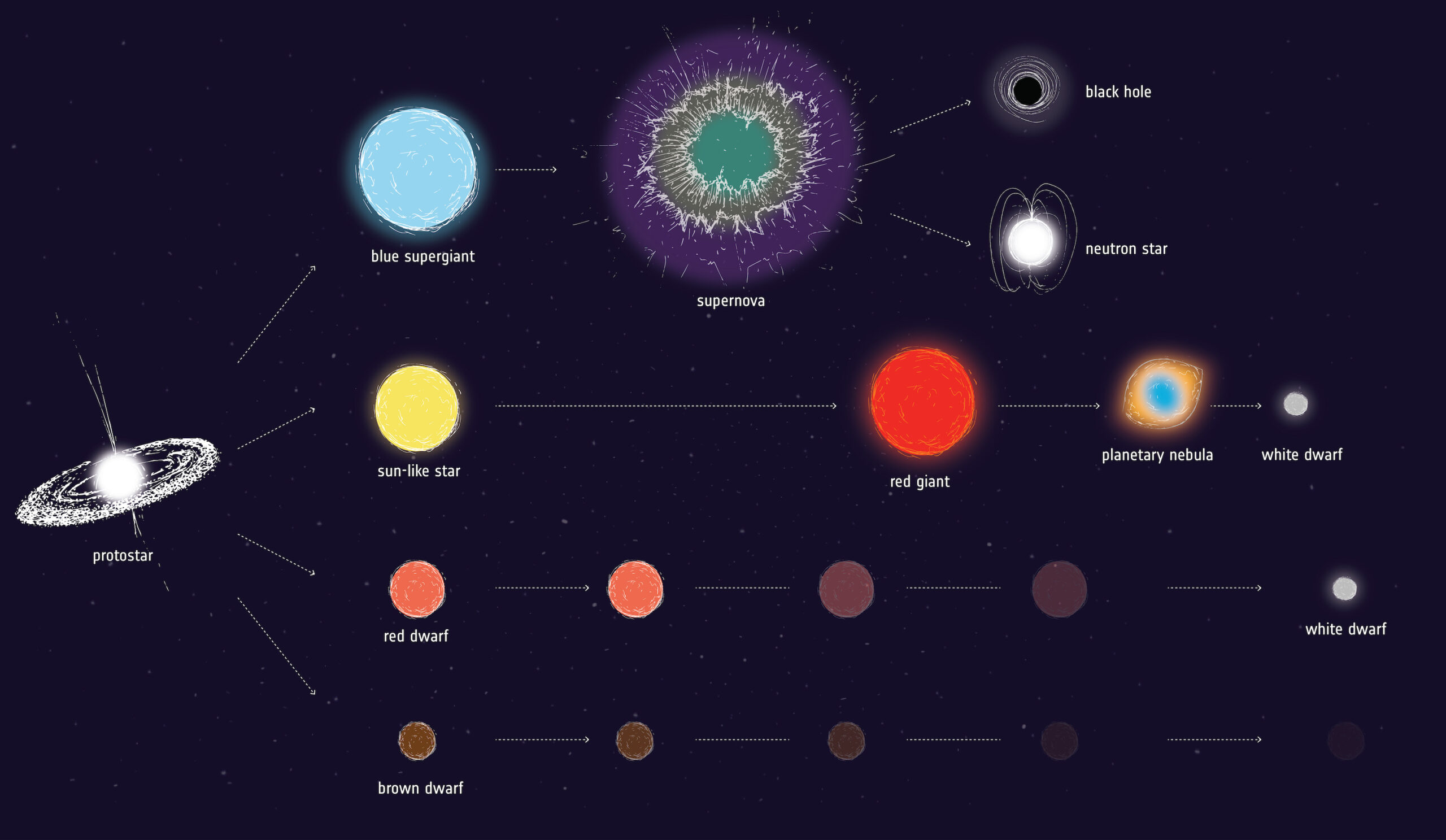
A supernova is a spectacular way for a star to die. Massive stars meet this fate when the outward pressure exerted by core nuclear fusion can no longer hold off the gravity of the star’s outer layers, and the remnants of lower-mass stars can attain this honor through accretion or collisions. Today we’ll introduce four research articles that examine various aspects of supernova science, from attempts to determine how lightweight a supernova progenitor star can be to exploring why some massive stars don’t produce supernovae at all.


The main stellar evolution pathways. It’s not yet clear exactly which stars explode as supernovae and which become white dwarfs. Credit:
ESA

Probing the Smallest Supernova Stars

Where is the dividing line between stars that end their lives in core-collapse supernovae and those that are fated to become white dwarfs? The least massive stars that undergo core collapse lie somewhere in the 8–12-solar-mass range, and refining the estimate further requires researchers to track down the faintest, most rapidly evolving supernovae.

Luckily, increasing coverage by transient-hunting surveys has generated a growing sample of these faint, fast events. Kaustav Das (California Institute of Technology) and coauthors studied nine supernovae detected by the Zwicky Transient Facility that were found to have certain chemical abundance ratios that hint at the progenitor stars being low mass. These supernovae are calcium-rich Type IIb supernovae, which have much larger [Ca II]/[O I] ratios than typical core-collapse supernovae.

Das’s team used spectra of each of these supernovae to measure the amount of oxygen present, which can be used in theoretical models to estimate the mass of the star that exploded. The mass estimates for all stars in the sample were less than 12 solar masses, suggesting that this type of supernova tends to arise from stars near the low-mass end of the progenitor mass range. The current sample of known calcium-rich Type IIb supernovae is still small, but future detections should allow researchers to refine models and improve estimates.

Not all massive stars end their lives as supernovae, leaving behind a supernova remnant like W49B shown here.
Credit: X-ray:
NASA/CXC/MIT/L.Lopez et al.; Infrared: Palomar; Radio: NSF/NRAO/VLA

Focusing on Failed Supernovae

When massive stars extinguish their core nuclear fusion and collapse, do they always generate luminous supernovae? Both observations and theory suggest that the answer is no, with some would-be supernovae forming a black hole with no accompanying supernova. Up to a third of massive stars might fail to generate a supernova!

Eric Coughlin (Syracuse University) performed a mathematical exploration of failed supernovae, focusing on the creation and propagation of a shock between the collapsing core and the outward-moving outer layers of the star. Coughlin showed that while some dying massive stars don’t produce supernovae per se, they still undergo an explosion that marks their impending demise. The strength of the explosion from a failed supernova depends on the properties of the star and how much of its mass is lost in the form of neutrinos: chargeless, nearly massless subatomic particles that rarely interact with matter.

In addition to the mathematical solutions that described the explosions, the equations also permitted a solution in which the matter settles near the central object. While we’ll have to wait for future work for a full examination of these solutions, it’s possible that they’ll apply to smaller stellar outbursts that do not destroy the star.


The event rates for a 1.98-solar-mass protoneutron star with various accretion rates as seen by Super-Kamiokande (left) and DUNE (right) and for normal (top) and inverted (bottom) neutrino mass hierarchies. Credit: Akaho et al. 2024

Prospects for Detecting Supernova Neutrinos

When a massive star’s core collapses, it can form a black hole or a neutron star: an extremely dense, rapidly spinning, city-sized sphere made almost entirely of neutrons. As protons and electrons are crushed into neutrons in the star’s core, the transformation produces neutrinos that push the star’s collapsing outer layers outward. While most of the star’s outer layers escape, forming the glowing, complex structures of a supernova remnant, a small fraction of the material falls back onto the protoneutron star, generating even more neutrinos.

Ryuichiro Akaho (Waseda University) and collaborators calculated the likelihood of detecting the neutrinos that are produced when material rebounding from the collapsed stellar core falls back onto the core. Using detailed neutrino radiation–hydrodynamics simulations, the team modeled the fluxes and flavors of the neutrinos produced about ten seconds after the supernova occurs.

Akaho’s team found that the mass of the protoneutron star and the rate at which it gathers material from its surroundings both have an impact on the output neutrino luminosity and the average energy of the neutrinos. For a supernova happening about 33,000 light-years away, the neutrino flux should rise above the background measured by the existing Super-Kamiokande and under-construction Deep Underground Neutrino Experiment (DUNE) detectors. The exact strength of the signal depends on several factors, including neutrino oscillation — the process through which a neutrino born in a certain “flavor” morphs to a different flavor as it travels through space.


Illustrations of the two main Type Ia supernova pathways: the single-degenerate model (top) and the double-degenerate model (bottom). Both images from NASA’s Goddard Space Flight Center Conceptual Image Lab

Investigating Type Ia Supernova Diversity

Supernovae aren’t always the result of massive stars collapsing. Many arise from white dwarfs, which are the exposed cores of low- to intermediate-mass stars that have finished fusing hydrogen in their cores and lost their outer layers. When a white dwarf accretes gas from a companion star, the white dwarf gains mass and heats up, eventually triggering a supernova. Alternatively, the collision of two white dwarfs can generate a supernova. Supernovae arising from white dwarfs are called Type Ia or thermonuclear runaway supernovae.

Observations show that Type Ia supernovae have substantial variety in their light curves and properties, leading Mao Ogawa (Kyoto University) and collaborators to investigate the origins of this diversity. Ogawa’s team focused on the division between normal-velocity and high-velocity supernovae, which are differentiated by the velocity of their ejecta.

The team selected a sample of 14 Type Ia supernovae for which spectra were collected within one week of the explosion being detected at Earth. The sample included high-velocity supernovae, normal-velocity supernovae, and some that were similar to the peculiar supernova SN 1999aa. The team then used radiative transfer modeling to model the spectra and extract the properties of the supernova ejecta. Ultimately, they found that the supernovae fell into two groups: one with high-density, carbon-poor ejecta, which makes up the high-velocity sample and some of the normal-velocity sample and one that has low-density, carbon rich ejecta, which makes up the remaining normal-velocity sample and those like SN 1999aa. While more work remains to be done, the team suspects these two groups might be the result of different formation mechanisms.

By Kerry Hensley


Citation

“Probing the Low-Mass End of Core-Collapse Supernovae Using a Sample of Strongly Stripped Calcium-Rich Type IIb Supernovae from the Zwicky Transient Facility,” Kaustav K. Das et al 2023 ApJ 959 12. doi:10.3847/1538-4357/acfeeb

“The Division Between Weak and Strong Explosions from Failed Supernovae,” Eric R Coughlin 2023 ApJ 955 110. doi:10.3847/1538-4357/acf313

“Detectability of Late-Time Supernova Neutrinos with Fallback Accretion onto Protoneutron Star,” Ryuichiro Akaho et al 2024 ApJ 960 116. doi:10.3847/1538-4357/ad118c

“Systematic Investigation of Very-early-phase Spectra of Type Ia Supernovae,” Mao Ogawa et al 2023 ApJ 955 49. doi:10.3847/1538-4357/acec74


Saturday, February 03, 2024

Decay of sunspot pair elucidates properties of nearby moving magnetic features


(a) The sunspot pair S1 and S2 with inner and outer boundaries of the penumbra, (b) mapping of the longitudinal magnetic fields of the pair, and (c) evolution of the rotation angle of the sunspots. Credit: The Astrophysical Journal (2024). DOI: 10.3847/1538-4357/ad063e

Scientists studying sunspots have found important clues about magnetic features in their decay that will help understand the evolution and real origin of these mysterious magnetic phenomena. The findings are published in The Astrophysical Journal.

Understanding sunspots is crucial to understanding the solar cycle, the approximately 11-year periodic change that changes the sun's energy output and the frequency and intensity of flares it sends into space that can negatively influence satellites and electrical networks on Earth. (The solar "cycle" can range from eight to 14 years in length.)

Sunspots look rather simple from a distance but are complex areas where light from the sun is trapped by twisted magnetic fields. They are temporary regions of reduced temperature that appear as dark spots on the surface of the sun, where constricted magnetic flux suppresses convection that brings the inner heat of the sun to the surface. A sunspot is about the size of the Earth, and they often come in pairs.

Sunspot decay is also not well understood. The central umbra of a sunspot is dark and has the strongest magnetic fields; the surrounding penumbra, which may surround multiple sunspots, is brighter (but still darker than the sun) and is composed of elongated regions called penumbral filaments.

Full-fledged sunspots are surrounded by granular regions of convection, and these can form supergranules called moat cells, mostly nonmagnetic annular regions. The moat cells extend 10 to 20 million meters beyond the boundary of the sunspot penumbra.

Within the moat cell is the moat flow, a slow, radially outward flow of plasma directed away from the sun's center, that is, away from the sunspot. Then within these motions are small, moving magnetic features (MMFs) that migrate away from the sunspot, and depend on magnetic fields in the sunspot's penumbra.

Scientists from China observed two adjacent sunspots for seven days in 2022, with data taken by the Helioseismic and Magnetic Imager on board the Solar Dynamics Observatory (launched in 2010) and focused on the relationship between the magnetic flux decay of the two sunspots and the transportation of the magnetic flux by MMFs. ("Magnetic flux" can be envisioned as the outflow or inflow of magnetic field lines through a bounded area.)

The sunspots rotated counterclockwise around one another by about 13 degrees per day for the first five days, then the rotation stopped. Determining the boundaries of the umbra and penumbras by changes in solar intensity relative to the mean of the solar quiet region, they observed horizontal velocity fields of the plasma, which in turn gave estimates of the magnetic flux of the MMFs.

The sunspots in the pair each decayed at a rate of roughly 15 million km2 per day, an area about the size of Antarctica. Correspondingly, the rate of decrease in magnetic flux through the sunspot is of order 1020 maxwells per day, where a maxwell (Mx) is the unit of magnetic flux, equal to one gauss per cm2. (The Earth's magnetic field, while variable, is about 0.2 to 0.6 gauss.)

Within this, MMFs, the small scale magnetic volumes that stream radially away from their sunspot, had a size about 2 arcseconds as seen from Earth, and move about 400 meters per second.

The relationship between the magnetic flux loss from a decaying sunspot and MMFs is still mysterious. But the quantitative parameters measured here establish that "the formation of moving magnetic features is dependent on penumbral magnetic fields," said Yang Peng and Zhike Xue by email, authors from, respectively, the Yunnan Observatory of the Chinese Academy of Sciences and the University of Chinese Academy of Sciences. "Our results show that a large number of MMFs will also generate in the penumbra-free region, and the vertical MMFs (MMFs whose magnetic field is vertical) in this region has greatly increased compared to that around the penumbra, which is closely related to the naked umbra in the granule."

These observations suggest that those MMFs with vertical magnetic fields are tightly related to the sunspot disintegration, and most of the MMFs from the gap region between the two sunspots may originate directly from the sunspot umbra.

"The results provide possible clues for the real origin of MMFs," said Peng and Xue.

by David Appell - Phys.org

Source: Phys.org


More information: Yang Peng et al, The Decay of Two Adjacent Sunspots Associated with Moving Magnetic Features, The Astrophysical Journal (2024). DOI: 10.3847/1538-4357/ad063e

Journal information: Astrophysical Journal


Friday, February 02, 2024

NASA Telescopes Find New Clues About Mysterious Deep Space Signals

In an ejection that would have caused its rotation to slow, a magnetar is depicted losing material into space in this artist’s concept. The magnetar’s strong, twisted magnetic field lines (shown in green) can influence the flow of electrically charged material from the object, which is a type of neutron star. NASA/JPL-Caltech

Using two of the agency’s X-ray telescopes, researchers were able to zoom in on a dead star’s erratic behavior as it released a bright, brief burst of radio waves.

What’s causing mysterious bursts of radio waves from deep space? Astronomers may be a step closer to providing one answer to that question. Two NASA X-ray telescopes recently observed one such event – known as a fast radio burst – mere minutes before and after it occurred. This unprecedented view sets scientists on a path to better understand these extreme radio events.

While they only last for a fraction of a second, fast radio bursts can release about as much energy as the Sun does in a year. Their light also forms a laserlike beam, setting them apart from more chaotic cosmic explosions.

Because the bursts are so brief, it’s often hard to pinpoint where they come from. Prior to 2020, those that were traced to their source originated outside our own galaxy – too far away for astronomers to see what created them. Then a fast radio burst erupted in Earth’s home galaxy, originating from an extremely dense object called a magnetar – the collapsed remains of an exploded star.

In October 2022, the same magnetar – called SGR 1935+2154 – produced another fast radio burst, this one studied in detail by NASA’s NICER (Neutron Star Interior Composition Explorer) on the International Space Station and NuSTAR (Nuclear Spectroscopic Telescope Array) in low Earth orbit. The telescopes observed the magnetar for hours, catching a glimpse of what happened on the surface of the source object and in its immediate surroundings, before and after the fast radio burst. The results, described in a new study published Feb. 14 in the journal Nature, are an example of how NASA telescopes can work together to observe and follow up on short-lived events in the cosmos.

The burst occurred between two “glitches,” when the magnetar suddenly started spinning faster. SGR 1935+2154 is estimated to be about 12 miles (20 kilometers) across and spinning about 3.2 times per second, meaning its surface was moving at about 7,000 mph (11,000 kph). Slowing it down or speeding it up would require a significant amount of energy. That’s why study authors were surprised to see that in between glitches, the magnetar slowed down to less than its pre-glitch speed in just nine hours, or about 100 times more rapidly than has ever been observed in a magnetar.

“Typically, when glitches happen, it takes the magnetar weeks or months to get back to its normal speed,” said Chin-Ping Hu, an astrophysicist at National Changhua University of Education in Taiwan and the lead author of the new study. “So clearly things are happening with these objects on much shorter time scales than we previously thought, and that might be related to how fast radio bursts are generated.”

Spin Cycle

When trying to piece together exactly how magnetars produce fast radio bursts, scientists have a lot of variables to consider.

For example, magnetars (which are a type of neutron star) are so dense that a teaspoon of their material would weigh about a billion tons on Earth. Such a high density also means a strong gravitational pull: A marshmallow falling onto a typical neutron star would impact with the force of an early atomic bomb.

The strong gravity means the surface of a magnetar is a volatile place, regularly releasing bursts of X-rays and higher-energy light. Before the fast radio burst that occurred in 2022, the magnetar started releasing eruptions of X-rays and gamma rays (even more energetic wavelengths of light) that were observed in the peripheral vision of high-energy space telescopes. This increase in activity prompted mission operators to point NICER and NuSTAR directly at the magnetar.

“All those X-ray bursts that happened before this glitch would have had, in principle, enough energy to create a fast radio burst, but they didn’t,” said study co-author Zorawar Wadiasingh, a research scientist at the University of Maryland, College Park and NASA’s Goddard Space Flight Center. “So it seems like something changed during the slowdown period, creating the right set of conditions.”

What else might have happened with SGR 1935+2154 to produce a fast radio burst? One factor might be that the exterior of a magnetar is solid, and the high density crushes the interior into a state called a superfluid. Occasionally, the two can get out of sync, like water sloshing around inside a spinning fishbowl. When this happens, the fluid can deliver energy to the crust. The paper authors think this is likely what caused both glitches that bookended the fast radio burst.

If the initial glitch caused a crack in the magnetar’s surface, it might have released material from the star’s interior into space like a volcanic eruption. Losing mass causes spinning objects to slow down, so the researchers think this could explain the magnetar’s rapid deceleration.

But having observed only one of these events in real time, the team still can’t say for sure which of these factors (or others, such as the magnetar’s powerful magnetic field) might lead to the production of a fast radio burst. Some might not be connected to the burst at all.

“We’ve unquestionably observed something important for our understanding of fast radio bursts,” said George Younes, a researcher at Goddard and a member of the NICER science team specializing in magnetars. “But I think we still need a lot more data to complete the mystery.”


More About the Mission

A Small Explorer mission led by Caltech and managed by NASA’s Jet Propulsion Laboratory in Southern California for the agency’s Science Mission Directorate in Washington, NuSTAR was developed in partnership with the Danish Technical University and the Italian Space Agency (ASI). The spacecraft was built by Orbital Sciences Corp. in Dulles, Virginia. NuSTAR’s mission operations center is at the University of California, Berkeley, and the official data archive is at NASA’s High Energy Astrophysics Science Archive Research Center at NASA’s Goddard Space Flight Center. ASI provides the mission’s ground station and a mirror data archive. Caltech manages JPL for NASA.

For more information about the NuSTAR mission, visit: https://www.nustar.caltech.edu/

NICER, an Astrophysics Explorer Mission of Opportunity, is an external payload on the International Space Station. NICER is managed by and operated at NASA’s Goddard Space Flight Center; its data is archived at NASA’s HEASARC. NASA’s Explorers program provides frequent flight opportunities for world-class scientific investigations from space utilizing innovative, streamlined, and efficient management approaches within the heliophysics and astrophysics science areas.

For more information about the NICER mission, visit: https://www.nasa.gov/nicer


News Media Contact

Calla Cofield
Jet Propulsion Laboratory, Pasadena, Calif.
626-808-2469

calla.e.cofield@jpl.nasa.gov


Astronomers produce most detailed sensitive image ever of ancient star cluster

The team identified a new radio source (white square) in the centre of the cluster (red circle)
Credit: Paduano et al.

The discovery was made using CSIRO’s Australia Telescope Compact Array.
Credit: Alex Cherney/CSIRO

The dense ball of stars that makes up globular cluster 47 Tucanae.
Credits: NASA, ESA, and the Hubble Heritage (STScI/AURA)-ESA/Hubble Collaboration


A global team of astronomers have created the most sensitive radio image ever of a globular cluster, an ancient ball of tightly-packed stars.

The image is of the second brightest globular cluster in the night sky—known as 47 Tucanae—and was produced by a team led by the Curtin University node of the International Centre for Radio Astronomy Research (ICRAR) in Western Australia.

The scientists also detected a previously undiscovered radio signal from the centre of the cluster.

The research was published overnight in The Astrophysical Journal.

Astronomer Dr Arash Bahramian, from ICRAR’s Curtin University node, says star clusters are an ancient relic of the early Universe.

“Globular clusters are very old, giant balls of stars that we see around the Milky Way,” he said. “They’re incredibly dense, with tens of thousands to millions of stars packed together in a sphere.

“Our image is of 47 Tucanae, one of the most massive globular clusters in the galaxy. It has over a million stars and a very bright, very dense core.”

Dr Bahramian said the ultra-sensitive image was created from more than 450 hours of observations on CSIRO’s Australia Telescope Compact Array (ATCA), on Gomeroi Country.

It is the deepest, most sensitive radio image ever compiled by any Australian radio telescope.

Dr Bahramian said 47 Tucanae can be seen with the naked eye, and was first catalogued in the 1700s.

But he said imaging it in such great detail allowed astronomers to discover an incredibly faint radio signal at the centre of the cluster that had not been detected before.

Lead author Dr Alessandro Paduano, from ICRAR’s Curtin University node, said the detection of the signal was an exciting discovery and could be attributed to one of two possibilities.

“The first is that 47 Tucanae could contain a black hole with a mass somewhere between the supermassive black holes found in the centres of galaxies and the stellar black holes created by collapsed stars.” he said.

“While intermediate-mass black holes are thought to exist in globular clusters, there hasn’t been a clear detection of one yet.

“If this signal turns out to be a black hole, it would be a highly-significant discovery and the first ever radio detection of one inside a cluster.”

The second possible source of the signal is a pulsar—a rotating neutron star that emits radio waves.

“A pulsar this close to a cluster centre is also a scientifically interesting discovery, as it could be used to search for a central black hole that is yet to be detected.” Dr Paduano said.

Co-author Dr Tim Galvin, a research scientist with CSIRO, said the project once again demonstrated the ongoing importance of ATCA.

“This project has stretched our software to its limits, in terms of both data management and processing, and it has been really exciting to see the wealth of science that these techniques have enabled.”

“Alessandro’s research represents a culmination of years of research and technological advancements, and ATCA’s ultra-deep image of 47 Tucanae represents just the beginning of the discoveries that are yet to come.”

The ultra-sensitive image produced is what researchers can expect from the SKA radio telescopes, currently being built in Australia and South Africa by the SKA Observatory (SKAO).

Once complete, the SKA telescopes will be the two largest radio telescope arrays in the world, transforming our understanding of the Universe and tackling some of the most fundamental scientific questions of our time.

Dr Bahramian said researchers are continually finding new and innovative ways to get the best out of the radio telescopes they use.

“We managed to achieve close to SKA-quality science with the current generation of radio telescopes, combining hundreds of hours of observations to reveal the faintest details.” he said.

“It gives us a glimpse of the exciting capabilities the next generation of radio telescopes will achieve when they come online.”

The technique used for the ultra-sensitive image could help future radio telescopes, such as the SKA, to detect some of the faintest objects in the Universe.

Multimedia

A short, narrated animation is available from
vimeo.com/icrar/47tuc


Thursday, February 01, 2024

NASA's Webb Depicts Staggering Structure in 19 Nearby Spiral Galaxies

Webb’s Stunning Collection of 19 Face-On Spiral Galaxies
Image: NASA, ESA, CSA, STScI, Janice Lee (STScI), Thomas Williams (Oxford), PHANGS Team
Designer: Elizabeth Wheatley (STScI)


It’s oh-so-easy to be absolutely mesmerized by these spiral galaxies. Follow their clearly defined arms, which are brimming with stars, to their centers, where there may be old star clusters and – sometimes – active supermassive black holes. Only NASA’s James Webb Space Telescope can deliver highly detailed scenes of nearby galaxies in a combination of near- and mid-infrared light – and a set of these images was publicly released today.

These Webb images are part of a large, long-standing project, the Physics at High Angular resolution in Nearby GalaxieS (PHANGS) program, which is supported by more than 150 astronomers worldwide. Before Webb took these images, PHANGS was already brimming with data from NASA’s Hubble Space Telescope, the Very Large Telescope’s Multi-Unit Spectroscopic Explorer, and the Atacama Large Millimeter/submillimeter Array, including observations in ultraviolet, visible, and radio light. Webb’s near- and mid-infrared contributions have provided several new puzzle pieces.

“Webb’s new images are extraordinary,” said Janice Lee, a project scientist for strategic initiatives at the Space Telescope Science Institute in Baltimore. “They’re mind-blowing even for researchers who have studied these same galaxies for decades. Bubbles and filaments are resolved down to the smallest scales ever observed, and tell a story about the star formation cycle.”

Excitement rapidly spread throughout the team as the Webb images flooded in. “I feel like our team lives in a constant state of being overwhelmed – in a positive way – by the amount of detail in these images,” added Thomas Williams, a postdoctoral researcher at the University of Oxford in the United Kingdom.

Follow the Spiral Arms

Webb’s NIRCam (Near-Infrared Camera) captured millions of stars in these images, which sparkle in blue tones. Some stars are spread throughout the spiral arms, but others are clumped tightly together in star clusters.

The telescope’s MIRI (Mid-Infrared Instrument) data highlights glowing dust, showing us where it exists around and between stars. It also spotlights stars that haven’t yet fully formed – they are still encased in the gas and dust that feed their growth, like bright red seeds at the tips of dusty peaks. “These are where we can find the newest, most massive stars in the galaxies,” said Erik Rosolowsky, a professor of physics at the University of Alberta in Edmonton, Canada.

Something else that amazed astronomers? Webb’s images show large, spherical shells in the gas and dust. “These holes may have been created by one or more stars that exploded, carving out giant holes in the interstellar material,” explained Adam Leroy, a professor of astronomy at the Ohio State University in Columbus.

Now, trace the spiral arms to find extended regions of gas that appear red and orange. “These structures tend to follow the same pattern in certain parts of the galaxies,” Rosolowsky added. “We think of these like waves, and their spacing tells us a lot about how a galaxy distributes its gas and dust.” Study of these structures will provide key insights about how galaxies build, maintain, and shut off star formation.

Dive Into the Interior

Evidence shows that galaxies grow from inside out – star formation begins at galaxies’ cores and spreads along their arms, spiraling away from the center. The farther a star is from the galaxy’s core, the more likely it is to be younger. In contrast, the areas near the cores that look lit by a blue spotlight are populations of older stars.

What about galaxy cores that are awash in pink-and-red diffraction spikes? “That’s a clear sign that there may be an active supermassive black hole,” said Eva Schinnerer, a staff scientist at the Max Planck Institute for Astronomy in Heidelberg, Germany. “Or, the star clusters toward the center are so bright that they have saturated that area of the image.”

Research Galore

There are many avenues of research that scientists can begin to pursue with the combined PHANGS data, but the unprecedented number of stars Webb resolved are a great place to begin. “Stars can live for billions or trillions of years,” Leroy said. “By precisely cataloging all types of stars, we can build a more reliable, holistic view of their life cycles.”

In addition to immediately releasing these images, the PHANGS team has also released the largest catalog to date of roughly 100,000 star clusters. “The amount of analysis that can be done with these images is vastly larger than anything our team could possibly handle,” Rosolowsky emphasized. “We’re excited to support the community so all researchers can contribute.”

Don’t miss the images below: Webb’s images are split with those of the same galaxies taken by NASA’s Hubble Space Telescope.

The James Webb Space Telescope is the world's premier space science observatory. Webb is solving mysteries in our solar system, looking beyond to distant worlds around other stars, and probing the mysterious structures and origins of our universe and our place in it. Webb is an international program led by NASA with its partners, ESA (European Space Agency) and the Canadian Space Agency.


About This Release

Credits:

Media Contact:

Claire Blome
Space Telescope Science Institute, Baltimore, Maryland

Christine Pulliam
Space Telescope Science Institute, Baltimore, Maryland

Science: Janice Lee (STScI)

Permissions: Content Use Policy

Contact Us: Direct inquiries to the News Team.

Related Links and Documents