Thursday, April 13, 2023

First Ever 3D Map of Messier 87 Galaxy Assembled

An image of the M87 galaxy captured with nasa's hubble space telescope.
Credit: NASA, ESA, Hubble Heritage Team (STScI/AURA); Acknowledgment: P. Cote (Herzberg Institute of Astrophysics), E. Baltz (Stanford University)

Maunakea, Hawaiʻi – A UC Berkeley-led team of astronomers has for the first time measured the three-dimensional shape of Messier 87 (M87), one of the biggest and closest elliptical galaxies to us. New data from W. M. Keck Observatory on Maunakea in Hawaiʻi show M87 isn’t perfectly symmetrical after all, but rather triaxial – similar to the uneven shape of a potato.

The study is published in The Astrophysical Journal Letters.

Located about 55 million light-years away from Earth in the constellation Virgo, M87 is close enough to see using binoculars or a small telescope. As with most celestial objects viewed from our vantage point, M87 appears flat.

The galaxy’s true form revealed itself through the lens of Keck Observatory’s cutting-edge instrument called the Keck Cosmic Web Imager (KCWI), which captures 3D data as opposed to the traditional 2D image or spectrum from conventional instruments.

The researchers used KCWI along with star brightness measurements of M87 from NASA’s Hubble Space Telescope to assemble a 3D view of the motion of stars orbiting M87’s supermassive black hole, named Pōwehi by Larry Kimura, a Hawaiian language professor at the University of Hawaiʻi at Hilo. This provided fresh insight into the galaxy’s shape and allowed the team to calculate with higher precision Pōwehi’s mass, which came out to about 5.4 billion times the mass of the Sun. Previous measurements taken in 2017 when the Event Horizon Telescope (EHT) snapped a direct image of Pōwehi found its mass to be about 6.5 billion solar masses.

Pōwehi means ‘embellished dark source of unending creation’ in Hawaiian and is the world’s first black hole to have its picture taken using EHT’s network of telescopes around the planet, including two Maunakea Observatories – the James Clerk Maxwell Telescope and the Submillimeter Array.


A photo of the huge elliptical galaxy M87 [left] is compared to its three-dimensional shape as gleaned from meticulous observations made with the Hubble and Keck telescopes [right]. Because the galaxy is too far away for astronomers to employ stereoscopic vision, they instead followed the motion of stars around the center of M87, like bees around a hive. This created a three-dimensional view of how stars are distributed within the galaxy. Credit: NASA, ESA, Joseph Olmsted (STScI), Frank Summers (STScI), Chung-Pei Ma (UC Berkeley)

While KCWI was unable to resolve the individual stars due to M87’s great distance from Earth, it was able to obtain spectra that revealed the range of the stars’ velocities as they whizzed around Pōwehi.

“It’s sort of like looking at a swarm of 100 billion bees that are going around in their own happy orbits,” said Chung-Pei Ma, a UC Berkeley professor of astronomy and of physics who led the research team. “Though we are looking at them from a distance and can’t discern individual bees, we are getting very detailed information about their collective velocities. It’s really the superb sensitivity of this spectrograph that allowed us to map out M87 so comprehensively.”

Ma, UC Berkeley graduate student and lead author of the study Emily Liepold, and Jonelle Walsh at Texas A&M University pointed the Keck II telescope at 62 locations across the galaxy and captured KCWI spectra of stars covering a region spanning 70,000 light years across. Gravity in the central 3,000 light-years of this region is largely dominated by Pōwehi. This marked the first time KCWI has been used to reconstruct the geometry of a distant galaxy.

“The Keck data are so good that we can measure the intrinsic shape of M87 along with the black hole at the same time,” said Ma. “We made the first measurement of the actual 3D shape of the galaxy. And since we allowed the swarm of bees to have a more general shape than just a sphere or disk, we have a more robust dynamical measurement of the mass of the central black hole that is governing the bees’ orbiting velocities.”

Ma’s team was also able to measure M87’s rotation, which clocks in at a relatively sedate 25 kilometers per second.

The new findings pave the way for an exciting investigation into M87 that wasn’t possible before – determining Pōwehi’s spin.

“Now that we know the direction of the net rotation of stars in M87 and have an updated mass of the black hole, we can combine this information with the amazing data from the EHT team to constrain the spin,” said Ma. “This may point toward a certain direction and range of spin for the black hole, which would be remarkable.”


Learn more:


About KCWI

The Keck Cosmic Web Imager (KCWI) is designed to provide visible band, integral field spectroscopy with moderate to high spectral resolution formats and excellent sky-subtraction. The astronomical seeing and large aperture of the telescope enables studies of the connection between galaxies and the gas in their dark matter halos, stellar relics, star clusters, and lensed galaxies. Support for this project was provided by the National Science Foundation, Heising-Simons Foundation, and Mt. Cuba Astronomical Foundation.

About W. M. Keck Observatory

The W. M. Keck Observatory telescopes are among the most scientifically productive on Earth. The two 10-meter optical/infrared telescopes atop Maunakea on the Island of Hawaii feature a suite of advanced instruments including imagers, multi-object spectrographs, high-resolution spectrographs, integral-field spectrometers, and world-leading laser guide star adaptive optics systems. Some of the data presented herein were obtained at Keck Observatory, which is a private 501(c) 3 non-profit organization operated as a scientific partnership among the California Institute of Technology, the University of California, and the National Aeronautics and Space Administration. The Observatory was made possible by the generous financial support of the W. M. Keck Foundation. The authors wish to recognize and acknowledge the very significant cultural role and reverence that the summit of Maunakea has always had within the Native Hawaiian community. We are most fortunate to have the opportunity to conduct observations from this mountain.


Wednesday, April 12, 2023

Historic Nebula Seen Like Never Before With NASA's IXPE

Crab Nebula
Credit: X-ray (IXPE: NASA), (Chandra: NASA/CXC/SAO) 
Image processing: NASA/CXC/SAO/K. Arcand & L. Frattare
JPEG | TIF


On Feb. 22, 1971, a sounding rocket lifted off from Wallops Island, Virginia, with specialized sensors aimed at the Crab Nebula, a bright cosmic object 6,500 light-years away. In those days, before recovering physical tapes from the experiment, scientists first received scientific data on a strip chart recorder, a device that printed signals on paper. Astronomer Martin Weisskopf and his colleagues began their analysis on launch day by measuring the distance between signals using a ruler and pencil.

“What makes science so beautiful and exciting is that for those few moments, you're seeing something that no one has ever seen before,” said Weisskopf, now an emeritus astronomer at NASA’s Marshall Space Flight Center in Huntsville, Alabama.

Decades later, Weisskopf proposed the development of an Earth-orbiting satellite with powerful instruments that could gather much more detailed measurements of the same kind about the Crab Nebula and other mysterious cosmic objects. That satellite became NASA’s Imaging X-ray Polarimetry Explorer (IXPE), which launched on December 9, 2021.

Now, more than 50 years after the sounding rocket experiment, scientists have used IXPE to create a detailed, nuanced map of the Crab Nebula’s magnetic field, revealing more of its inner workings than ever before. The new results, published in the journal Nature Astronomy (preprint available), help resolve longstanding mysteries about the well-studied Crab Nebula and open new questions for future study.

IXPE data show that the Crab Nebula’s magnetic field resembles that of the Vela Pulsar Wind Nebula, which is also donut-shaped. But at the Crab, scientists were surprised that areas of magnetic field turbulence were more patchy and asymmetrical than expected.

“This is a clear indication that even the more complex models developed in the past, with the use of advanced numerical techniques, do not fully capture the complexity of this object,” said Niccolò Bucciantini, lead author of the study and astronomer at the INAF Arcetri Observatory in Florence, Italy.

A favorite object of study among astronomers, the Crab Nebula resulted from a supernova documented in the year 1054. The explosion left behind a dense object called the Crab Pulsar, about the diameter of Huntsville, Alabama or the length of Manhattan, but with as much mass as about two Suns. The chaotic mess of gases, shock waves, magnetic fields and high-energy light and particles coming from the rotating pulsar is collectively called a “pulsar wind nebula.” These extreme conditions make for a bizarre environment that is not yet thoroughly understood.

Weisskopf and colleagues were hoping to understand this extreme environment in a new way by measuring the polarization of X-rays from the Crab Nebula, which shines brightly in X-rays. X-ray polarization gives scientists clues to the direction where the magnetic field points in different parts of a cosmic object, as well as how well ordered the magnetic field is. The magnetic field’s geometry and turbulence determines how particles get catapulted toward the speed of light.

In the five minutes that the 1971 sounding rocket experiment spent above Earth’s atmosphere, it produced the world’s first X-ray polarization measurements.

Scientists followed up with a satellite called OSO-8 in 1975, which also measured the X-ray polarization of the Crab Nebula. The rocket and the satellite produced generally the same result: That the Crab Nebula has an average polarization of about 20%.

As project scientist of NASA’s Chandra X-Ray Observatory, which launched in 1999, Weisskopf continued his exploration of the Crab Nebula in new ways. With Chandra, “we took beautiful images of the nebula and pulsar, and we could see the jets and the various structures,” he said. Chandra’s X-ray imaging revealed wisp-like structures that move in the nebula, and helped scientists to further understand the relationship between the pulsar’s energy and X-ray emissions.

Nearly every recent large telescope has pointed to the Crab Nebula to better understand this mysterious supernova remnant. But only IXPE can study X-rays from Crab in terms of polarization, a measure of the organization of electromagnetic fields.

“The Crab is one of the most-studied high-energy astrophysical objects in the sky. So it is extremely exciting that we could learn something new about this system by looking through IXPE's ‘polarized lenses,’” said Michela Negro, a research scientist at NASA Goddard Space Flight Center affiliated with the University of Maryland, Baltimore, and a co-author of the study.

Across the entire nebula, IXPE found about the same average polarization as Weisskopf and colleagues did in the 1970s. But with more sophisticated instruments, IXPE was able to refine the angle of polarization and examine the differences in polarization across the entire object. Scientists see areas of much polarization in the outer regions of the nebula, light-years away from the pulsar, where polarization is lower.

This enabled scientists to investigate not just X-rays from the Crab Nebula but also those coming from the pulsar itself, or the sphere of magnetic fields around it. The findings suggest that those X-rays originate in the outer magnetic field region, called the “wind” region, although exactly where and how is still unknown. Within the magnetic field, shocks generated by the pulsar’s “wind” are propelling particles close to the speed of light.

“I'm very proud of everybody associated with IXPE,” said Weisskopf, who was the mission’s first principal investigator. “Everybody has worked so hard, and it works as advertised.” Reflecting on his work on the 1971 experiment that laid the groundwork for the new results, Weisskopf says, “It's like somebody said to me, ‘Martin, you did good.’”

About the IXPE mission:

Part of NASA’s Small Explorer mission series, IXPE launched on a Falcon 9 rocket from NASA’s Kennedy Space Center in Florida in December 2021. It now orbits 370 miles, or roughly 595 kilometers, above Earth’s equator. The mission is a partnership between NASA and the Italian Space Agency, with partners and science collaborators in 13 countries. Ball Aerospace, headquartered in Broomfield, Colorado, manages spacecraft operations.


Written by:

Elizabeth Landau
NASA Headquarters, Washington
202-358-0845
elandau@nasa.gov

Media Contact:

Molly Porter
Marshall Space Flight Center, Huntsville, Alabama
256-544-0034

molly.a.porter@nasa.gov


Tuesday, April 11, 2023

Webb Reveals Never-Before-Seen Details in Cassiopeia A

Cassiopeia A (MIRI Image)
< div style="text-align: justify;"> Credits: Image: NASA, ESA, CSA, Danny Milisavljevic (Purdue University), Tea Temim (Princeton University), Ilse De Looze (UGent). Image Processing: Joseph DePasquale (STScI)


The explosion of a star is a dramatic event, but the remains the star leaves behind can be even more dramatic. A new mid-infrared image from NASA’s James Webb Space Telescope provides one stunning example. It shows the supernova remnant Cassiopeia A (Cas A), created by a stellar explosion 340 years ago. Cas A is the youngest known remnant from an exploding, massive star in our galaxy, which makes it a unique opportunity to learn more about how such supernovae occur.

“Cas A represents our best opportunity to look at the debris field of an exploded star and run a kind of stellar autopsy to understand what type of star was there beforehand and how that star exploded,” said Danny Milisavljevic of Purdue University in West Lafayette, Indiana, principal investigator of the Webb program that captured these observations.

“Compared to previous infrared images, we see incredible detail that we haven't been able to access before,” added Tea Temim of Princeton University in Princeton, New Jersey, a co-investigator on the program.

Cassiopeia A is a prototypical supernova remnant that has been widely studied by a number of ground-based and space-based observatories, including NASA’s Chandra X-ray Observatory . The multi-wavelength observations can be combined to provide scientists with a more comprehensive understanding of the remnant.

Dissecting the Image

The striking colors of the new Cas A image, in which infrared light is translated into visible-light wavelengths, hold a wealth of scientific information the team is just beginning to tease out. On the bubble’s exterior, particularly at the top and left, lie curtains of material appearing orange and red due to emission from warm dust. This marks where ejected material from the exploded star is ramming into surrounding circumstellar gas and dust.

Interior to this outer shell lie mottled filaments of bright pink studded with clumps and knots. This represents material from the star itself, which is shining due to a mix of various heavy elements, such as oxygen, argon, and neon, as well as dust emission.

“We’re still trying to disentangle all these sources of emission,” said Ilse De Looze of Ghent University in Belgium, another co-investigator on the program.

The stellar material can also be seen as fainter wisps near the cavity’s interior.

Perhaps most prominently, a loop represented in green extends across the right side of the central cavity. “We’ve nicknamed it the Green Monster in honor of Fenway Park in Boston. If you look closely, you’ll notice that it’s pockmarked with what look like mini-bubbles,” said Milisavljevic. “The shape and complexity are unexpected and challenging to understand.”

Origins of Cosmic Dust – and Us

Among the science questions that Cas A may help answer is: Where does cosmic dust come from? Observations have found that even very young galaxies in the early universe are suffused with massive quantities of dust. It’s difficult to explain the origins of this dust without invoking supernovae, which spew large quantities of heavy elements (the building blocks of dust) across space.

However, existing observations of supernovae have been unable to conclusively explain the amount of dust we see in those early galaxies. By studying Cas A with Webb, astronomers hope to gain a better understanding of its dust content, which can help inform our understanding of where the building blocks of planets and ourselves are created.

“In Cas A, we can spatially resolve regions that have different gas compositions and look at what types of dust were formed in those regions,” explained Temim.

Supernovae like the one that formed Cas A are crucial for life as we know it. They spread elements like the calcium we find in our bones and the iron in our blood across interstellar space, seeding new generations of stars and planets.

“By understanding the process of exploding stars, we’re reading our own origin story,” said Milisavljevic. “I’m going to spend the rest of my career trying to understand what’s in this data set.”

The Cas A remnant spans about 10 light-years and is located 11,000 light-years away in the constellation Cassiopeia.

The James Webb Space Telescope is the world’s premier space science observatory. Webb will solve mysteries in our solar system, look beyond to distant worlds around other stars, and probe the mysterious structures and origins of our universe and our place in it. Webb is an international program led by NASA with its partners, ESA (European Space Agency) and the Canadian Space Agency.


About This Release

Credits:

Media Contact:

Christine Pulliam
 Space Telescope Science Institute, Baltimore, Maryland

Permissions: Content Use Policy

Contact Us: Direct inquiries to theNews Team.

Monday, April 10, 2023

Dual Quasars Blaze Bright at the Center of Merging Galaxies


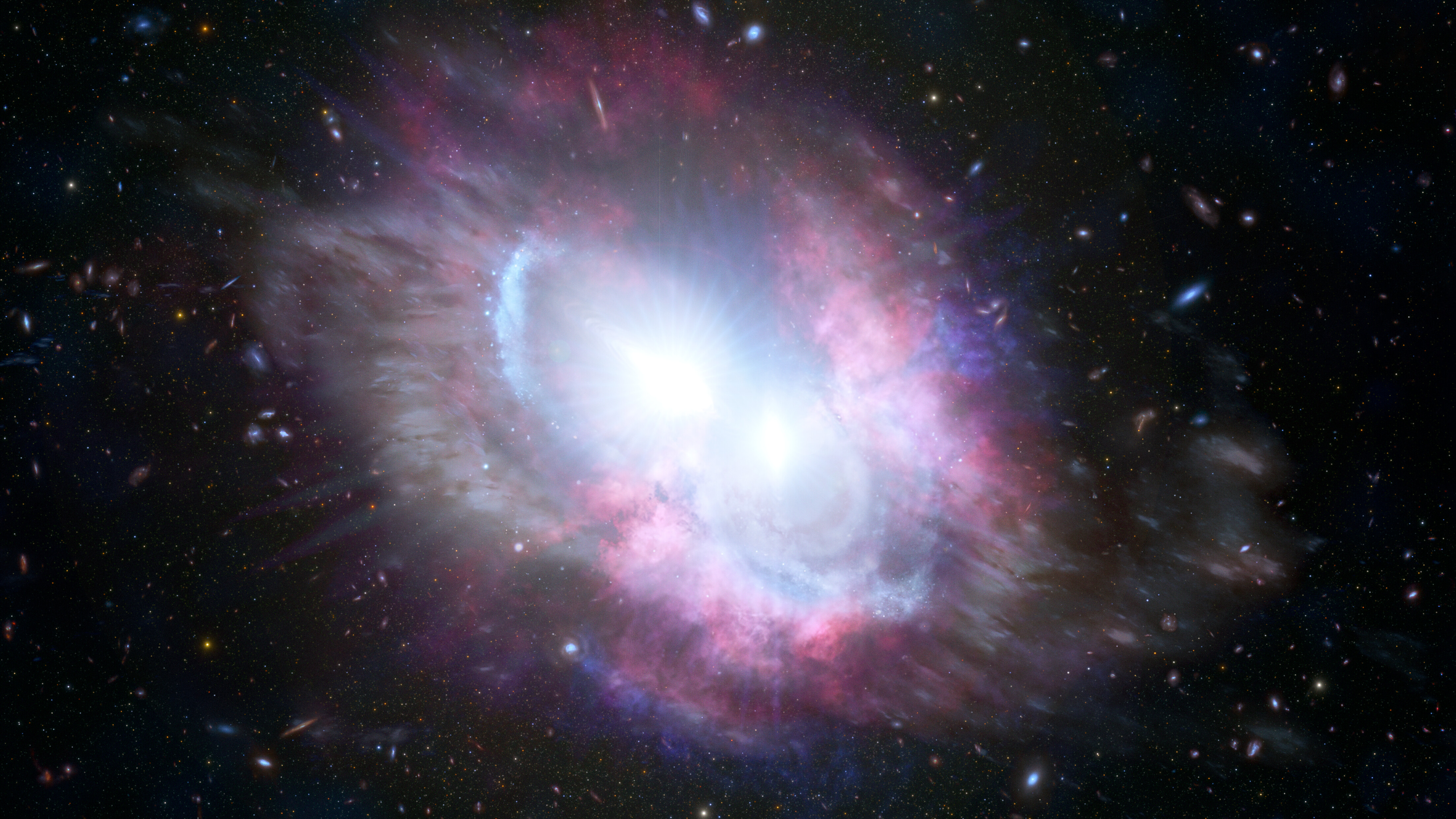
This artist's impression illustrates that astronomers using an array of ground- and space-based telescopes, including Gemini North on Hawai‘i, have uncovered a closely bound duo of energetic quasars — the hallmark of a pair of merging galaxies — seen when the Universe was only three billion years old. This discovery sheds light on the evolution of galaxies at “cosmic noon,” a period in the history of the Universe when galaxies underwent bursts of furious star formation. This merger also represents a system on the verge of becoming a giant elliptical galaxy.Credit: International Gemini Observatory/NOIRLab/NSF/AURA/M. Zamani, J. da Silva. download: Large JPEG

Gemini North helps confirm nature of cosmic system on the verge of becoming a giant elliptical galaxy 

Astronomers using an array of ground- and space-based telescopes, including Gemini North on Hawai‘i, have uncovered a closely bound duo of energetic quasars — the hallmark of a pair of merging galaxies — seen when the Universe was only three billion years old. This discovery sheds light on the evolution of galaxies at “cosmic noon,” a period in the history of the Universe when galaxies underwent bursts of furious star formation. This merger also represents a system on the verge of becoming a giant elliptical galaxy. 

Galaxies grow and evolve by merging with other galaxies, blending their billions of stars, triggering bursts of vigorous star formation, and often fueling their central supermassive black holes to produce luminous quasars that outshine the entire galaxy. Some of these mergers eventually go on to become massive elliptical galaxies that contain black holes that are many billions of times the mass of our Sun. Although astronomers have observed a veritable menagerie of merging galaxies with more than one quasar in our own cosmic neighborhood, more distant examples, seen when the Universe was only a quarter of its current age, are quite rare and extremely challenging to find.

By harnessing a bevy of ground- and space-based observatories — including Gemini North, one half of the International Gemini Observatory, operated by NSF’s NOIRLab — a team of astronomers has discovered a closely bound pair of actively feeding supermassive black holes — quasars. This discovery is the first confirmed detection of a pair of supermassive black holes in the same galactic real estate at ‘cosmic noon’ — a period of frenetic star formation at a time when the Universe was only three billion years old. 

Previous observations have identified similar systems in the early stages of merging, when the two galaxies could still be considered clearly separate entities. But these new results show a pair of quasars blazing away in such close proximity, a mere 10,000 light-years apart, that their original host galaxies are likely well on their way to becoming a single giant elliptical galaxy. 

Searching for pairs of supermassive black holes so close to each other during this early epoch is like trying to find the proverbial needle in a haystack. The challenge is that most black-hole pairs are too close to distinguish individually. To definitively detect such a system, the two supermassive black holes need to be actively accreting and shining as quasars simultaneously, conditions that are extremely rare. Statistically, for every 100 supermassive black holes only one should be actively accreting at a given time. 

Astronomers know, however, that the distant Universe should be brimming with pairs of supermassive black holes embedded within merging galaxies. The first hints of such a system were found in data from the NASA/ESA Hubble Space Telescope, which revealed two closely aligned pinpoints of light in the distant Universe. 

To verify the true nature of this system, the team searched through ESA’s Gaia observatory’s vast database and found that this system had an apparent “jiggle,” which could be the result of sporadic changes in a black hole's feeding activity. 

The team then used the Gemini Multi-Object Spectrograph (GMOS) and GNIRS on Gemini North, which provided the team with independent measurements of the distance to the quasars and confirmed that the two objects were both quasars rather than a chance alignment of a single quasar with a foreground star. Further studies with the W.M. Keck Observatory, NSF’s Karl G. Jansky Very Large Array, and NASA’s Chandra X-ray Observatory also helped to confirm these observations. 

“The confirmation process wasn’t easy and we needed an array of telescopes covering the spectrum from X-rays to the radio to finally confirm that this system is indeed a pair of quasars, instead of, say, two images of a gravitationally lensed quasar,” said co-author Yue Shen, an astronomer at the University of Illinois. 

“We don't see a lot of double quasars at this early time. And that's why this discovery is so exciting. Knowing about the progenitor population of black holes will eventually tell us about the emergence of supermassive black holes in the early Universe, and how frequent those mergers could be,” said graduate student Yu-Ching Chen of the University of Illinois at Urbana-Champaign, lead author of this study, which is published in the journal Nature.


More information 

NSF’s NOIRLab, the US center for ground-based optical-infrared astronomy, operates the International Gemini Observatory (a facility of NSF, NRC–Canada, ANID–Chile, MCTIC–Brazil, MINCyT–Argentina, and KASI–Republic of Korea), Kitt Peak National Observatory (KPNO), Cerro Tololo Inter-American Observatory (CTIO), the Community Science and Data Center (CSDC), and Vera C. Rubin Observatory (operated in cooperation with the Department of Energy’s SLAC National Accelerator Laboratory). It is managed by the Association of Universities for Research in Astronomy (AURA) under a cooperative agreement with NSF and is headquartered in Tucson, Arizona. The astronomical community is honored to have the opportunity to conduct astronomical research on Iolkam Du’ag (Kitt Peak) in Arizona, on Maunakea in Hawai‘i, and on Cerro Tololo and Cerro Pachón in Chile. We recognize and acknowledge the very significant cultural role and reverence that these sites have to the Tohono O’odham Nation, to the Native Hawaiian community, and to the local communities in Chile, respectively.


Links:


Contacts:

Xin Liu
University of Illinois at Urbana-Champaign 
Email:
xinliuxl@illinois.edu

Yu-Ching Chen, 
University of Illinois at Urbana-Champaign
Email:
ycchen@illinois.edu

Yue Shen 
University of Illinois at Urbana-Champaign
Email:
shenyue@illinois.edu

;Charles Blue
Public Information Officer
NSF’s NOIRLab
T: +1 202 236 6324
Email: charles.blue@noirlab.edu

Sunday, April 09, 2023

NASA’s Webb Scores Another Ringed World with New Image of Uranus

Uranus (NIRCam Image)
Credits: Science: NASA, ESA, CSA, STScI
Image Processing: Joseph DePasquale (STScI)


Following in the footsteps of the Neptune image released in 2022, NASA’s James Webb Space Telescope has taken a stunning image of the solar system’s other ice giant, the planet Uranus. The new image features dramatic rings as well as bright features in the planet’s atmosphere. The Webb data demonstrates the observatory's unprecedented sensitivity for the faintest dusty rings, which have only ever been imaged by two other facilities: the Voyager 2 spacecraft as it flew past the planet in 1986, and the Keck Observatory with advanced adaptive optics.

The seventh planet from the Sun, Uranus is unique: It rotates on its side, at roughly a 90-degree angle from the plane of its orbit. This causes extreme seasons since the planet’s poles experience many years of constant sunlight followed by an equal number of years of complete darkness. (Uranus takes 84 years to orbit the Sun.) Currently, it is late spring for the northern pole, which is visible here; Uranus’ northern summer will be in 2028. In contrast, when Voyager 2 visited Uranus it was summer at the south pole. The south pole is now on the ‘dark side’ of the planet, out of view and facing the darkness of space.

This infrared image from Webb’s Near-Infrared Camera (NIRCam) combines data from two filters at 1.4 and 3.0 microns, which are shown here in blue and orange, respectively. The planet displays a blue hue in the resulting representative-color image.

When Voyager 2 looked at Uranus, its camera showed an almost featureless blue-green ball in visible wavelengths. With the infrared wavelengths and extra sensitivity of Webb we see more detail, showing how dynamic the atmosphere of Uranus really is.

On the right side of the planet there’s an area of brightening at the pole facing the Sun, known as a polar cap. This polar cap is unique to Uranus – it seems to appear when the pole enters direct sunlight in the summer and vanish in the fall; these Webb data will help scientists understand the currently mysterious mechanism. Webb revealed a surprising aspect of the polar cap: a subtle enhanced brightening at the center of the cap. The sensitivity and longer wavelengths of Webb’s NIRCam may be why we can see this enhanced Uranus polar feature when it has not been seen as clearly with other powerful telescopes like the Hubble Space Telescope and Keck Observatory. At the edge of the polar cap lies a bright cloud as well as a few fainter extended features just beyond the cap’s edge, and a second very bright cloud is seen at the planet’s left limb. Such clouds are typical for Uranus in infrared wavelengths, and likely are connected to storm activity.

This planet is characterized as an ice giant due to the chemical make-up of its interior. Most of its mass is thought to be a hot, dense fluid of "icy" materials – water, methane and ammonia – above a small rocky core.

Uranus has 13 known rings and 11 of them are visible in this Webb image. Some of these rings are so bright with Webb that when they are close together, they appear to merge into a larger ring. Nine are classed as the main rings of the planet, and two are the fainter dusty rings (such as the diffuse zeta ring closest to the planet) that weren’t discovered until the 1986 flyby by Voyager 2. Scientists expect that future Webb images of Uranus will reveal the two faint outer rings that were discovered with Hubble during the 2007 ring-plane crossing.

Webb also captured many of Uranus’s 27 known moons (most of which are too small and faint to be seen here); the six brightest are identified in the wide-view image. This was only a short, 12-minute exposure image of Uranus with just two filters. It is just the tip of the iceberg of what Webb can do when observing this mysterious planet. Additional studies of Uranus are happening now, and more are planned in Webb’s first year of science operations.

In 2022, the National Academies of Sciences, Engineering, and Medicine identified Uranus science as a priority in its 2023-2033 Planetary Science and Astrobiology decadal survey.

The James Webb Space Telescope is the world's premier space science observatory. Webb will solve mysteries in our solar system, look beyond to distant worlds around other stars, and probe the mysterious structures and origins of our universe and our place in it. Webb is an international program led by NASA with its partners, ESA (European Space Agency) and the Canadian Space Agency.


About This Release

Credits: Release: NASA, ESA, CSA, STScI

Media Contact:

Ann Jenkins
Space Telescope Science Institute, Baltimore, Maryland

Christine Pulliam
Space Telescope Science Institute, Baltimore, Maryland

Permissions: Content Use Policy

Contact Us:
Direct inquiries to the News Team.


Saturday, April 08, 2023

Hubble Sees Possible Runaway Black Hole Creating a Trail of Stars

Runaway Supermassive Black Hole Illustration
Credits: Artwork: NASA, ESA, Leah Hustak (STScI)


Runaway Black Hole Near RCP28
Credits: Science: NASA, ESA, Pieter van Dokkum (Yale)
Image Processing: Joseph DePasquale (STScI)


Release Images


There's an invisible monster on the loose, barreling through intergalactic space so fast that if it were in our solar system, it could travel from Earth to the Moon in 14 minutes. This supermassive black hole, weighing as much as 20 million Suns, has left behind a never-before-seen 200,000-light-year-long "contrail" of newborn stars, twice the diameter of our Milky Way galaxy. It's likely the result of a rare, bizarre game of galactic billiards among three massive black holes.

Rather than gobbling up stars ahead of it, like a cosmic Pac-Man, the speedy black hole is plowing into gas in front of it to trigger new star formation along a narrow corridor. The black hole is streaking too fast to take time for a snack. Nothing like it has ever been seen before, but it was captured accidentally by NASA's Hubble Space Telescope.

"We think we're seeing a wake behind the black hole where the gas cools and is able to form stars. So, we're looking at star formation trailing the black hole," said Pieter van Dokkum of Yale University in New Haven, Connecticut. "What we're seeing is the aftermath. Like the wake behind a ship we're seeing the wake behind the black hole." The trail must have lots of new stars, given that it is almost half as bright as the host galaxy it is linked to.

The black hole lies at one end of the column, which stretches back to its parent galaxy. There is a remarkably bright knot of ionized oxygen at the outermost tip of the column. Researchers believe gas is probably being shocked and heated from the motion of the black hole hitting the gas, or it could be radiation from an accretion disk around the black hole. "Gas in front of it gets shocked because of this supersonic, very high-velocity impact of the black hole moving through the gas. How it works exactly is not really known," said van Dokkum.

"This is pure serendipity that we stumbled across it," van Dokkum added. He was looking for globular star clusters in a nearby dwarf galaxy. "I was just scanning through the Hubble image and then I noticed that we have a little streak. I immediately thought, 'oh, a cosmic ray hitting the camera detector and causing a linear imaging artifact.' When we eliminated cosmic rays we realized it was still there. It didn't look like anything we've seen before."

Because it was so weird, van Dokkum and his team did follow-up spectroscopy with the W. M. Keck Observatories in Hawaii. He describes the star trail as "quite astonishing, very, very bright and very unusual." This led to the conclusion that he was looking at the aftermath of a black hole flying through a halo of gas surrounding the host galaxy.

This intergalactic skyrocket is likely the result of multiple collisions of supermassive black holes. Astronomers suspect the first two galaxies merged perhaps 50 million years ago. That brought together two supermassive black holes at their centers. They whirled around each other as a binary black hole.

Then another galaxy came along with its own supermassive black hole. This follows the old idiom: "two's company and three's a crowd." The three black holes mixing it up led to a chaotic and unstable configuration. One of the black holes robbed momentum from the other two black holes and got thrown out of the host galaxy. The original binary may have remained intact, or the new interloper black hole may have replaced one of the two that were in the original binary, and kicked out the previous companion.

When the single black hole took off in one direction, the binary black holes shot off in the opposite direction. There is a feature seen on the opposite side of the host galaxy that might be the runaway binary black hole. Circumstantial evidence for this is that there is no sign of an active black hole remaining at the galaxy’s core. The next step is to do follow-up observations with NASA's James Webb Space Telescope and the Chandra X-ray Observatory to confirm the black hole explanation.

NASA's upcoming Nancy Grace Roman Space Telescope will have a wide-angle view of the universe with Hubble's exquisite resolution. As a survey telescope, the Roman observations might find more of these rare and improbable "star streaks" elsewhere in the universe. This may require machine learning using algorithms that are very good at finding specific weird shapes in a sea of other astronomical data, according to van Dokkum.

The research paper will be published on April 6 in The Astrophysical Journal Letters.

The Hubble Space Telescope is a project of international cooperation between NASA and ESA. NASA's Goddard Space Flight Center in Greenbelt, Maryland, manages the telescope. The Space Telescope Science Institute (STScI) in Baltimore conducts Hubble science operations. STScI is operated for NASA by the Association of Universities for Research in Astronomy, in Washington, D.C.


About This Release


Credits: Release: NASA, ESA, STScI

Media Contact:

Ray Villard
Space Telescope Science Institute, Baltimore, Maryland

Science Contact:

Pieter van Dokkum
Yale University, New Haven, Connecticut

Imad Pasha
Yale University, New Haven, Connecticut

Permissions:
Content Use Policy

Contact Us: Direct inquiries to the News Team.

Related Links and Documents


Friday, April 07, 2023

Aftermath of a cosmic explosion

A spiral galaxy is seen edge-on and tilted at an angle. The body of the galaxy is blue and obscured by threads of dark red dust, and it is surrounded by a pale glow. Three stars with prominent cross-shaped diffraction spikes are very bright in the foreground. The background is dark and sparsely-covered in small stars. Credit: ESA/Hubble & NASA, C. Kilpatrick

The somewhat amorphous spiral galaxy UGC 2890 appears side-on in this image from the NASA/ESA Hubble Space Telescope, with bright foreground stars studding the image. This galaxy lies around 30 million light-years away in the constellation Camelopardalis. In 2009 astronomers spotted a catastrophically powerful supernova explosion in UGC 2890. While the supernova itself has long since faded from view, Hubble recently took a break from its regular observing schedule to inspect the aftermath of this explosive event.

A Type II supernova is a spectacularly energetic explosion that marks the violent death of a massive star. As it runs out of the elements necessary to fuel nuclear fusion, the core of a massive star flickers out and stops producing energy. With nothing to support the crushing force of gravity, the core of the star shrinks and then suddenly implodes, leaving the star’s outer layers to collapse inwards and rebound out into space as a supernova explosion.

This observation is one of many Hubble investigations of Type II supernovae. Astronomers turned to Hubble’s Advanced Camera for Surveys to explore the surroundings of Type II supernovae in the hope of discovering the ages and masses of stars in the neighbourhood. This will reveal insights into the types of stars that eventually create Type II supernovae, as well as revealing any stellar survivors of colossal supernova explosions.


Thursday, April 06, 2023

Far, Far Away: Just How Distant Is That Galaxy?

Galaxies in Stephen's Quintet
Credit: NASA, ESA, and the Hubble SM4 ERO Team


Credit: NASA/ESA/CSA/T. Treu, UCLA/NAOJ/T. Bakx, Nagoya U


In December 2022, astronomers using the Atacama Large Millimeter/submillimeter Array (ALMA) confirmed the discovery of one of the most distant galaxies ever observed. The faint radio light ALMA captured began its journey to us when the universe was less than 360 million years old. It’s a tremendously distant galaxy, but just how far away is it really? The answer is a bit complicated, and it depends on what you mean by distance.

To begin with, astronomers can’t directly measure the distance of galaxies billions of light years away. Instead, they measure what is known as redshift, or z. In this case, the team measured a particular wavelength of light emitted by oxygen known as OIII. When we observe the OIII emission line in a lab here on Earth, it has a wavelength of 88 micrometers. The OIII line ALMA observed in this particular galaxy was much longer, about 1,160 micrometers. Since red light has a longer wavelength than blue light, we say the observed OII line is shifted to the red, or redshifted. Given these two numbers, calculating z is easy. It is just the relative redshift of the observed light, So z = (1160 – 88)/88 = 12.2 The bigger the z, the greater the redshift, and z = 12.2 is the largest confirmed redshift of a galaxy so far.

So what does this have to do with distance? There are two ways light from a galaxy can be redshifted. The first is known as the Doppler shift and is caused by the physical motion of a galaxy through space. You’re probably familiar with this effect in sound. When a train speeds past you, its horn sounds higher as the train approaches you and lower as it passes you and rolls away. The sound waves are bunched up as the train moves toward you and have a higher pitch, and they are stretched out as the train moves away from you, thus a lower pitch. The same thing happens with light. If a galaxy is moving toward us its light is blueshifted, and the light is redshifted if it’s moving away from us.

The second way redshift can occur is through cosmic expansion. The universe is expanding, and this means as light travels to us from a distant galaxy its wavelength is stretched out by the expansion of space. The longer the light travels the more the light is stretched, so the more the light is redshifted. This is known as cosmological redshift. For distant galaxies, almost all the redshift we observe is cosmological. This is how we know high redshift galaxies such as this one are very, very far away.

But this still doesn’t tell us the specific distance. To determine that we have to look at how the universe expands over time. Right now there’s a bit of uncertainty about the rate of cosmic expansion, known as the Hubble parameter. The Planck mission observations of the cosmic microwave background put the value at about 68 (km/s)/Mpc, while observations of the Hubble and Gaia spacecraft give it a higher value of about 72 (km/s)/Mpc. The bigger the value, the faster the universe is expanding and the farther away distant galaxies are. If we pick a middle value of 70 (km/s)/Mpc, then we can calculate a reasonable distance using general relativity, but even then our answer will depend on how we define distance.

One definition would be to ask how long the light traveled from the galaxy to us. This is known as the light travel time and turns out to be about 13.1 billion years. Since the universe is about 13.46 billion years old (based on the Hubble parameter we chose), that means the light left the galaxy when the universe was about 360 million years old. This definition is useful for astronomers since distant galaxies tell us about the early universe. It’s more important for astronomers to know a galaxy’s place in history than its distance.

Since the light traveled for 13.1 billion years, does that mean the galaxy is 13.1 billion light-years away? Not quite. Because of cosmic expansion, the light traveled for much longer than it would have if the universe wasn’t expanding. The galaxy was closer to us when the light began its journey. Much closer. If we calculate how far away the galaxy was from us 13.1 billion years ago, we get 2.4 billion light-years. So this galaxy was only 2.4 billion light years away, but the universe expanded so much that its light took 13.1 billion light-years to reach us.

As light travels through the expanding universe, its wavelength is stretched
Credit: NASA, ESA, Leah Hustak (STScI) 
 
Of course, you probably want to know how far away the galaxy is now. Sure, the galaxy was 2.4 billion light years away, but once the light started heading our way the galaxy continued to move away from us because of the ever-expanding universe. So where is the galaxy now? If you do the math, it turns out the galaxy is now about 32 billion light-years away. But wait a minute? How can we see a galaxy 32 billion light-years away if the universe is less than 14 billion years old? The answer is that we can’t. ALMA’s view of the galaxy is how it looked when it was only 2.4 billion light-years away. We will never be able to see what the galaxy looks like now. It is too far away, and the universe is expanding too quickly for that light to reach us. We only see the optical echo of where it was and how it used to appear.

All of this is strange enough to tie anyone’s brain into a knot. This is why astronomers focus on the redshift z, and why we usually talk about how old the universe was when the galactic light began its journey. That’s enough to tell us that the galaxy is far away and seen from long ago. So long ago and so far away that its distance is hard to define.


About the Author:

Brian Koberlein is a Senior Science Writer for NRAO. He has a Ph.D. in Physics from the University of Connecticut, and has published research in physics and astrophysics. Together with David Meisel, he is the author of Astrophysics Through Computation, published by Cambridge University Press.

Recent Articles:


Wednesday, April 05, 2023

Hubble Unexpectedly Finds Double Quasar in Distant Universe

Dual Quasar (Artist's Illustration)
Credits: Artworks: NASA, ESA, Joseph Olmsted (STScI)

Dual Quasar (J0749+2255)
Credits: Science: NASA, ESA, Yu-Ching Chen (UIUC), Hsiang-Chih Hwang (IAS), Nadia Zakamska (JHU), Yue Shen (UIUC)


Release Images


The early universe was a rambunctious place where galaxies often bumped into each other and even merged together. Using NASA's Hubble Space Telescope and other space and ground-based observatories, astronomers investigating these developments have made an unexpected and rare discovery: a pair of gravitationally bound quasars, both blazing away inside two merging galaxies. They existed when the universe was just 3 billion years old.

Quasars are bright objects powered by voracious, supermassive black holes blasting out ferocious fountains of energy as they engorge themselves on gas, dust, and anything else within their gravitational grasp.

"We don't see a lot of double quasars at this early time in the universe. And that's why this discovery is so exciting," said graduate student Yu-Ching Chen of the University of Illinois at Urbana-Champaign, lead author of this study.

Finding close binary quasars is a relatively new area of research that has just developed in the past 10 to 15 years. Today's powerful new observatories have allowed astronomers to identify instances where two quasars are active at the same time and are close enough that they will eventually merge.

There is increasing evidence that large galaxies are built up through mergers. Smaller systems come together to form bigger systems and ever larger structures. During that process there should be pairs of supermassive black holes formed within the merging galaxies. "Knowing about the progenitor population of black holes will eventually tell us about the emergence of supermassive black holes in the early universe, and how frequent those mergers could be," said Chen.

We're starting to unveil this tip of the iceberg of the early binary quasar population," said Xin Liu of the University of Illinois at Urbana-Champaign. "This is the uniqueness of this study. It is actually telling us that this population exists, and now we have a method to identify double quasars that are separated by less than the size of a single galaxy."

This was a needle-in-haystack search that required the combined power of NASA's Hubble Space Telescope and the W.M. Keck Observatories in Hawaii. Multi-wavelength observations from the International Gemini Observatory in Hawaii, NSF's Karl G. Jansky Very Large Array in New Mexico, and NASA's Chandra X-ray Observatory also contributed to understanding the dynamic duo. And, ESA (European Space Agency)'s Gaia space observatory helped identify this double quasar in the first place.

"Hubble's sensitivity and resolution provided pictures that allow us to rule out other possibilities for what we are seeing," said Chen. Hubble shows, unequivocally, that this is indeed a genuine pair of supermassive black holes, rather than two images of the same quasar created by a foreground gravitational lens. And, Hubble shows a tidal feature from the merging of two galaxies, where gravity distorts the shape of the galaxies forming two tails of stars.

However, Hubble's sharp resolution alone isn't good enough to go looking for these dual light beacons. The researchers enlisted Gaia, which launched in 2013, to pinpoint potential double-quasar candidates. Gaia measures the positions, distances, and motions of nearby celestial objects very precisely. But in a novel technique, it can be used to explore the distant universe. Gaia's huge database can be used to search for quasars that mimic the apparent motion of nearby stars. The quasars appear as single objects in the Gaia data because they are so close together. However, Gaia can pick up a subtle, unexpected "jiggle" that mimics an apparent change in position of some of the quasars it observes.

In reality, the quasars aren't moving through space in any measurable way. Instead, their jiggle could be evidence of random fluctuations of light as each member of the quasar pair varies in brightness on timescales of days to months, depending on their black hole's feeding schedule. This alternating brightness between the quasar pair is similar to seeing a railroad crossing signal from a distance. As the lights on both sides of the stationary signal alternately flash, the sign gives the illusion of "jiggling."

Another challenge is that because gravity warps space like a funhouse mirror, a foreground galaxy could split the image of a distant quasar into two, creating the illusion it was really a binary pair. The Keck telescope was used to make sure there's no lensing galaxy in between us and the suspected double quasar.

Because Hubble peers into the distant past, this double quasar no longer exists. Over the intervening 10 billion years, their host galaxies have likely settled into a giant elliptical galaxy, like the ones seen in the local universe today. And, the quasars have merged to become a gargantuan, supermassive black hole at its center. The nearby giant elliptical galaxy, M87, has a monstrous black hole weighing 6.5 billion times the mass of our Sun. Perhaps this black hole was grown from one or more galaxy mergers over the past billions of years.

The upcoming NASA Nancy Grace Roman Space Telescope, having the same visual acuity as Hubble, is ideal for binary quasar hunting. Hubble has been used to painstakingly take data for individual targets. But Roman's very wide-angle infrared view of the universe is 200 times larger than Hubble's. "A lot of quasars out there could be binary systems. The Roman telescope can do huge improvements in this research area," said Liu.

The results will be published in the April 5 journal Nature.

The Hubble Space Telescope is a project of international cooperation between NASA and ESA. NASA's Goddard Space Flight Center in Greenbelt, Maryland, manages the telescope. The Space Telescope Science Institute (STScI) in Baltimore, Maryland, conducts Hubble and Webb science operations. STScI is operated for NASA by the Association of Universities for Research in Astronomy, in Washington, D.C.


About This Release


Credits:  Release: NASA, ESA, STScI

Media Contact:

Ray Villard
Space Telescope Science Institute, Baltimore, Maryland

Science Contact:

Yu-Ching Chen
University of Illinois Urbana-Champaign, Champaign, Illinois

Xin Liu
University of Illinois Urbana-Champaign, Champaign, Illinois


Permissions:  Content Use Policy

Contact Us: Direct inquiries to the News Team.

Related Links and Documents


Tuesday, April 04, 2023

Hubble Finds Saturn's Rings Heating Its Atmosphere

Saturn Lyman-alpha Image
Credits: Science: NASA, ESA, Lotfi Ben-Jaffel (IAP & LPL)

Release Images


The secret has been hiding in plain view for 40 years. But it took the insight of a veteran astronomer to pull it all together within a year, using observations of Saturn from NASA's Hubble Space Telescope and retired Cassini probe, in addition to the Voyager 1 and 2 spacecraft and the retired International Ultraviolet Explorer mission.

The discovery: Saturn's vast ring system is heating the giant planet's upper atmosphere. The phenomenon has never before been seen in the solar system. It's an unexpected interaction between Saturn and its rings that potentially could provide a tool for predicting if planets around other stars have glorious Saturn-like ring systems, too.

The telltale evidence is an excess of ultraviolet radiation, seen as a spectral line of hot hydrogen in Saturn's atmosphere. The bump in radiation means that something is contaminating and heating the upper atmosphere from the outside.

The most feasible explanation is that icy ring particles raining down onto Saturn's atmosphere cause this heating. This could be due to the impact of micrometeorites, solar wind particle bombardment, solar ultraviolet radiation, or electromagnetic forces picking up electrically charged dust. All this happens under the influence of Saturn's gravitational field pulling particles into the planet. When NASA's Cassini probe plunged into Saturn's atmosphere at the end of its mission in 2017, it measured the atmospheric constituents and confirmed that many particles are falling in from the rings.

"Though the slow disintegration of the rings is well known, its influence on the atomic hydrogen of the planet is a surprise. From the Cassini probe, we already knew about the rings' influence. However, we knew nothing about the atomic hydrogen content," said Lotfi Ben-Jaffel of the Institute of Astrophysics in Paris and the Lunar & Planetary Laboratory, University of Arizona, author of a paper published on March 30 in the Planetary Science Journal.

"Everything is driven by ring particles cascading into the atmosphere at specific latitudes. They modify the upper atmosphere, changing the composition," said Ben-Jaffel. "And then you also have collisional processes with atmospheric gasses that are probably heating the atmosphere at a specific altitude."

Ben-Jaffel's conclusion required pulling together archival ultraviolet-light (UV) observations from four space missions that studied Saturn. This includes observations from the two NASA Voyager probes that flew by Saturn in the 1980s and measured the UV excess. At the time, astronomers dismissed the measurements as noise in the detectors. The Cassini mission, which arrived at Saturn in 2004, also collected UV data on the atmosphere (over several years). Additional data came from Hubble and the International Ultraviolet Explorer, which launched in 1978, and was an international collaboration between NASA, ESA (European Space Agency), and the United Kingdom's Science and Engineering Research Council.

But the lingering question was whether all the data could be illusory, or instead reflected a true phenomenon on Saturn.

The key to assembling the jigsaw puzzle came in Ben-Jaffel's decision to use measurements from Hubble's Space Telescope Imaging Spectrograph (STIS). Its precision observations of Saturn were used to calibrate the archival UV data from all four other space missions that have observed Saturn. He compared the STIS UV observations of Saturn to the distribution of light from multiple space missions and instruments.

"When everything was calibrated, we saw clearly that the spectra are consistent across all the missions. This was possible because we have the same reference point, from Hubble, on the rate of transfer of energy from the atmosphere as measured over decades," Ben-Jaffel said. "It was really a surprise for me. I just plotted the different light distribution data together, and then I realized, wow— it's the same." Four decades of UV data cover multiple solar cycles and help astronomers study the Sun's seasonal effects on Saturn. By bringing all the diverse data together and calibrating it, Ben-Jaffel found that there is no difference to the level of UV radiation. "At any time, at any position on the planet, we can follow the UV level of radiation," he said. This points to the steady "ice rain" from Saturn's rings as the best explanation. "We are just at the beginning of this ring characterization effect on the upper atmosphere of a planet. We eventually want to have a global approach that would yield a real signature about the atmospheres on distant worlds. One of the goals of this study is to see how we can apply it to planets orbiting other stars. Call it the search for 'exo-rings.'" The Hubble Space Telescope is a project of international cooperation between NASA and ESA. NASA's Goddard Space Flight Center in Greenbelt, Maryland, manages the telescope. The Space Telescope Science Institute (STScI) in Baltimore conducts Hubble science operations. STScI is operated for NASA by the Association of Universities for Research in Astronomy, in Washington, D.C.


About This Release

Credits: Release: NASA, ESA, STScI

Media Contact:

Ray Villard
Space Telescope Science Institute, Baltimore, Maryland

Science Contact:

Lotfi Ben-Jaffel
Institut d'Astrophysique de Paris, Paris, France
Lunar and Planetary Laboratory–University of Arizona, Tucson, Arizona


Permissions: Content Use Policy

Contact Us: Direct inquiries to the News Team.

Related Links and Documents


Monday, April 03, 2023

Redness of Neptunian asteroids sheds light on early Solar System


This is an artist's concept of a craggy piece of solar system debris that belongs to a class of bodies called trans-Neptunian objects (TNOs). Most TNOs are small and faint, making them difficult to spot. Generally, they are more than 100 million times fainter than objects visible to the unaided eye. The newfound TNOs range from 40 to 100 kilometres across. In this illustration, the distant Sun is reduced to a bright star at a distance of about 5 billion kilometres. Credit: Artwork Credit: NASA, ESA, and G. Bacon (STScI). Science Credit: NASA, ESA, and C. Fuentes (Harvard-Smithsonian Center for Astrophysics)
Licence type
Attribution (
CC BY 4.0)

Asteroids sharing their orbits with the planet Neptune have been observed to exist in a broad spectrum of red colour, implying the existence of two populations of asteroids in the region, according to a new study by an international team of researchers. The research is published in the journal Monthly Notices of the Royal Astronomical Society: Letters.

The team of scientists from the USA, California, France, the Netherlands, Chile and Hawaii observed 18 asteroids sharing the orbit of Neptune, known as Neptunian Trojans. They are between 50 and 100 km in size and are located at a distance of around 4.5 billion kilometres from the Sun. Asteroids orbiting this far away are faint and so are challenging for astronomers to study. Before the new work, only about a dozen Neptunian Trojans had been studied, requiring the use of some of the largest telescopes on Earth.

The new data were gathered over the course of two years using the WASP wide field camera on the Palomar Observatory telescope in California, the GMOS cameras on the Gemini North and South telescopes in Hawaii and Chile, and the LRIS camera on the Keck Telescope in Hawaii.


Multi-band images of Neptunian Trojans 2015 VW165, 2014 QO441, 2014 YB92 and 2014 SC374 taken with the Palomar 200-inch, Gemini and Keck telescopes. Dr Bryce Bolin
Licence type
Attribution (
CC BY 4.0)

Of the 18 observed Neptunian Trojans, several were much redder than most asteroids, and compared with other asteroids in this group looked at in previous studies. Redder asteroids are expected to have formed much further from the Sun; one population of these is known as the Cold Classical trans-Neptunian objects found beyond the orbit of Pluto, at around 6 billion kilometres from the Sun. The newly observed Neptunian Trojans are also unlike asteroids located in the orbit of Jupiter, which are typically more neutral in colour.

The redness of the asteroids implies that they contain a higher proportion of more volatile ices such as ammonia and methanol. These are extremely sensitive to heat, and can rapidly transform into gas if the temperature rises, so are more stable at large distances from the Sun.

The location of the asteroids at the same orbital distance as Neptune also implies that they are stable on timescales comparable to the age of the Solar System. They effectively act as a time-capsule, recording the initial conditions of the Solar System.

The presence of redder asteroids among the Neptunian Trojans suggests the existence of a transition zone between more neutral coloured and redder objects. The redder Neptunian asteroids may have formed beyond this transition boundary before being captured into the orbit of Neptune. The Neptunian Trojans would have been captured into the same orbit as the planet Neptune as the ice giant planet migrated from the inner solar system to where it is now, some 4.5 billion kilometres from the Sun.

Lead author Dr Bryce Bolin of the NASA Goddard Space Flight Centre said, “In our new work we have more than doubled the sample of Neptunian Trojans studied with large telescopes. It’s exciting to find the first evidence of redder asteroids in this group.”

“Because we have a larger sample of Neptunian Trojans with measured colours, we can now start to see major differences between asteroid groups. Our observations also show that the Neptunian Trojans are also different in colour compared to asteroid groups even further from the Sun. A possible explanation may be that the processing of the surfaces of asteroids by the Sun’s heat may have different effects for asteroids at varying solar distances.”


Media Contacts:

Gurjeet Kahlon
Royal Astronomical Society
Mob: +44 (0)7802 877 700

press@ras.ac.uk

Dr Robert Massey
Royal Astronomical Society
Mob: +44 (0)7802 877699

press@ras.ac.uk

Science Contacts:

Dr Bryce Bolin
NASA Goddard Space Flight Centre

bolin.astro@gmail.com

Dr Ian Wong
NASA Goddard Space Flight Centre

ian.wong@nasa.gov


Further information

The research appears in 'Keck, gemini, and palomar 200-inch visible photometry of red and very-red neptunian trojans', Bolin et al., Monthly Notices of the Royal Astronomical Society:Letters, in press.

Notes for Editors

The Royal Astronomical Society (RAS), founded in 1820, encourages and promotes the study of astronomy, solar-system science, geophysics and closely related branches of science. The RAS organises scientific meetings, publishes international research and review journals, recognises outstanding achievements by the award of medals and prizes, maintains an extensive library, supports education through grants and outreach activities and represents UK astronomy nationally and internationally. Its more than 4,000 members (Fellows), a third based overseas, include scientific researchers in universities, observatories and laboratories as well as historians of astronomy and others.

All submissions to RAS journals undergo peer review, and their suitability for publication is assessed by appropriate specialist subject editors. The Society issues press releases based on a similar principle, but the organisations and scientists concerned have overall responsibility for their content.


Sunday, April 02, 2023

Everything, in one place, all at once


A spiral galaxy. It has two almost-straight arms coming from the left and right of the core that meet a starry ring around the galaxy’s edge. The ring is bluish in colour, and the core is golden and shining. A faint halo of light also surrounds the galaxy. There is one bright star with many diffraction spikes, and a few small stars all around on a black background. Credit: ESA/Hubble & NASA, A. Barth, R. Mushotzky.  
Hi-res image

This luminous Picture of the Week shows Z 229-15 — imaged here in beautiful detail by the NASA/ESA Hubble Space Telescope — a celestial object that lies about 390 million light-years from Earth in the constellation Lyra. Z 229-15 is one of those interesting celestial objects that, should you choose to research it, you will find defined as several different things: sometimes as an active galactic nucleus (an AGN); sometimes as a quasar; and sometimes as a Seyfert galaxy. Which of these is Z 229-15 really? The answer is that it is all of these things all at once, because these three definitions have significant overlap. 

AGNs and quasars are both described in detail in the Hubble Word Bank, but in essence an AGN is a small region at the heart of certain galaxies (called active galaxies) that is far brighter than just the galaxy’s stars would be. The extra luminosity is due to the presence of a supermassive black hole at the galaxy’s core. Material sucked into a black hole actually doesn’t fall directly into it, but instead is drawn into a swirling disc, from where it is inexorably tugged towards the black hole. This disc of matter gets so hot that it releases a large amount of energy across the electromagnetic spectrum, and that’s what makes AGNs appear so bright. 

Quasars are a particular type of AGN; they are typically both extremely bright and extremely distant from Earth — several hundred million light-years is considered nearby for a quasar, making Z 229-15 positively local. Often an AGN is so bright that the rest of the galaxy cannot be seen, but Seyfert galaxies are active galaxies that host very bright AGNs (quasars) while the rest of the galaxy is still observable. So Z 229-15 is a Seyfert galaxy that contains a quasar, and that, by definition, hosts an AGN. Classification in astronomy can be a challenge!

Source: ESA/Hubble/powt


Saturday, April 01, 2023

Investigating Polarized Magnetar Flares

>
An artist's impression of a magnetar with a cracked crust and a polar hot spot.
Credit: NASA/Goddard Space Flight Center Conceptual Image Lab

Astronomers have observed polarised X-rays emitted by a magnetar, opening the door to understanding these extreme objects in more detail.


A magnetar is a sub-type of a stellar remnant called a neutron star. Magnetars and neutron stars are made solely of neutrons, and they are about 10–15 miles across. This illustration places a neutron star next to Manhattan for comparison. Credit:
NASA/Goddard Space Flight Center

Magnetic Remnants

A magnetar is the remnant of the death a medium-sized star. It is a type of rapidly spinning neutron star with a typical rotation period of between one and twelve seconds. However, its magnetic field is one thousand times stronger than an ordinary neutron star. In fact, if you were to replace the Moon with a magnetar it would wipe the credit card details of everyone on Earth.

Their strong magnetic fields make magnetars prone to dramatic outbursts, emitting radiation across the electromagnetic spectrum. A magnetar’s X-ray bursts are particularly spectacular, with their X-ray flux suddenly leaping by a factor of up to a thousand.

An artist’s impression of the Imaging X-ray Polarimetry Explorer (IXPE) spacecraft.
Credit:
NASA

Focusing on Flares

It hasn’t always been clear, however, where these flares are coming from. They could spring from the crust of the magnetar itself, or they could launch from material trapped in an atmosphere around it. A team led by Silvia Zane (University College London) recently went looking for answers using the Imaging X-ray Polarimetry Explorer (IXPE). Launched at the end of 2021, it is a joint mission between NASA and the Italian Space Agency.

As its name suggests, IXPE observes the polarisation of X-rays. Light is polarised if its waves all vibrate in the same plane. Zane’s team used IXPE to observe the polarisation of the magnetar known as 1RXS J170849.0-40091 to see if they could work out what was corralling the X-rays.


Polarisation of the magnetar in different energy bands. The colors of the circles represent different detector units (DUs), and the orange stars and green crosses show the predictions for the “belt plus cap” and “cap plus cap” models, respectively. Credit: Adapted from Zane et al. 2023

Belts, Caps, and More

They found that about 20% of the low-energy X-rays produced by 1RXS J170849.0-40091 are polarised, but this rises to around 80% for higher-energy X-rays.

The team ran simulations of various magnetar configurations to see if they could explain this result, settling on two possibilities. The first, which they call “belt plus cap,” has a warm region around the magnetar’s equator and a hotter atmosphere confined to a circular polar cap. The second, called “cap plus cap,” has the X-ray emission emanating from two circular spots. One is on the surface of the magnetar, and there’s a hotter atmospheric spot located in the opposite hemisphere.

Further work to untangle these two possibilities could have wider implications. Astronomers have previously suggested that magnetars are the main source of fast radio bursts, for example. Understanding why magnetars flare could help cement this link and assist astronomers in explaining these mysterious events.

Citation

“A Strong X-Ray Polarization Signal from the Magnetar 1RXS J170849.0-400910,” Silvia Zane et al 2023 ApJL 944 L27.
doi:10.3847/2041-8213/acb703

By Colin Stuart