Saturday, January 14, 2023

NASA’s Webb Confirms Its First Exoplanet

Exoplanet LHS 475 b and Its Star (Illustration)
Credits: Illustration: NASA, ESA, CSA, Leah Hustak (STScI)

Exoplanet LHS 475 b (NIRSpec Transit Light Curve)
Credits: Illustration: NASA, ESA, CSA, Leah Hustak (STScI)

Science: Kevin B. Stevenson (APL), Jacob A. Lustig-Yaeger (APL), Erin M. May (APL), Guangwei Fu (JHU), Sarah E. Moran (University of Arizona)

Exoplanet LHS 475 b (Transmission Spectrum)
Credits: Illustration: NASA, ESA, CSA, Leah Hustak (STScI)
Science: Kevin B. Stevenson (APL), Jacob A. Lustig-Yaeger (APL), Erin M. May (APL), Guangwei Fu (JHU), Sarah E. Moran (University of Arizona)


Researchers confirmed an exoplanet, a planet that orbits another star, using NASA’s James Webb Space Telescope for the first time. Formally classified as LHS 475 b, the planet is almost exactly the same size as our own, clocking in at 99% of Earth’s diameter. The research team is led by Kevin Stevenson and Jacob Lustig-Yaeger, both of the Johns Hopkins University Applied Physics Laboratory in Laurel, Maryland.

The team chose to observe this target with Webb after carefully reviewing targets of interest from NASA’s Transiting Exoplanet Survey Satellite (TESS), which hinted at the planet’s existence. Webb’s Near-Infrared Spectrograph (NIRSpec) captured the planet easily and clearly with only two transit observations. “There is no question that the planet is there. Webb’s pristine data validate it,” said Lustig-Yaeger. “The fact that it is also a small, rocky planet is impressive for the observatory,” Stevenson added.

“These first observational results from an Earth-size, rocky planet open the door to many future possibilities for studying rocky planet atmospheres with Webb,” agreed Mark Clampin, Astrophysics Division director at NASA Headquarters in Washington. “Webb is bringing us closer and closer to a new understanding of Earth-like worlds outside our solar system, and the mission is only just getting started.”

Among all operating telescopes, only Webb is capable of characterizing the atmospheres of Earth-sized exoplanets. The team attempted to assess what is in the planet’s atmosphere by analyzing its transmission spectrum. Although the data show that this is an Earth-sized terrestrial planet, they do not yet know if it has an atmosphere. “The observatory’s data are beautiful,” said Erin May, also of the Johns Hopkins University Applied Physics Laboratory. “The telescope is so sensitive that it can easily detect a range of molecules, but we can’t yet make any definitive conclusions about the planet’s atmosphere.”

Although the team can’t conclude what is present, they can definitely say what is not present. “There are some terrestrial-type atmospheres that we can rule out,” explained Lustig-Yaeger. “It can’t have a thick methane-dominated atmosphere, similar to that of Saturn’s moon Titan.”

The team also notes that while it’s possible the planet has no atmosphere, there are some atmospheric compositions that have not been ruled out, such as a pure carbon dioxide atmosphere. “Counterintuitively, a 100% carbon dioxide atmosphere is so much more compact that it becomes very challenging to detect,” said Lustig-Yaeger. Even more precise measurements are required for the team to distinguish a pure carbon dioxide atmosphere from no atmosphere at all. The researchers are scheduled to obtain additional spectra with upcoming observations this summer.

Webb also revealed that the planet is a few hundred degrees warmer than Earth, so if clouds are detected, it may lead the researchers to conclude that the planet is more like Venus, which has a carbon dioxide atmosphere and is perpetually shrouded in thick clouds. “We’re at the forefront of studying small, rocky exoplanets,” Lustig-Yaeger said. “We have barely begun scratching the surface of what their atmospheres might be like.”

The researchers also confirmed that the planet completes an orbit in just two days, information that was almost instantaneously revealed by Webb’s precise light curve. Although LHS 475 b is closer to its star than any planet in our solar system, its red dwarf star is less than half the temperature of the Sun, so the researchers project it still could have an atmosphere.

The researchers’ findings have opened the possibilities of pinpointing Earth-sized planets orbiting smaller red dwarf stars. “This rocky planet confirmation highlights the precision of the mission’s instruments,” Stevenson said. “And it is only the first of many discoveries that it will make.” Lustig-Yaeger agreed. “With this telescope, rocky exoplanets are the new frontier.”

LHS 475 b is relatively close, at only 41 light-years away, in the constellation Octans.

The team’s results were presented at a press conference of the American Astronomical Society (AAS) on Wednesday, Jan. 11, 2023.

The James Webb Space Telescope is the world’s premier space science observatory. Webb will solve mysteries in our solar system, look beyond to distant worlds around other stars, and probe the mysterious structures and origins of our universe and our place in it. Webb is an international program led by NASA with its partners, ESA (European Space Agency) and CSA (Canadian Space Agency).


About This Release

Credits:

Media Contact:

Claire Blome
Space Telescope Science Institute, Baltimore, Maryland

Christine Pulliam
Space Telescope Science Institute, Baltimore, Maryland

Permissions:
Content Use Policy

Contact Us: Direct inquiries to the News Team.

Related Links and Documents


New Webb Image Reveals Dusty Disk Like Never Seen Before

AU Mic (NIRCam)
Credits: Science: NASA, ESA, CSA, Kellen Lawson (NASA-GSFC), Joshua E. Schlieder (NASA-GSFC)
Image Processing: Alyssa Pagan (STScI)

Release Images


NASA’s James Webb Space Telescope has imaged the inner workings of a dusty disk surrounding a nearby red dwarf star. These observations represent the first time the previously known disk has been imaged at these infrared wavelengths of light. They also provide clues to the composition of the disk.

The star system in question, AU Microscopium or AU Mic, is located 32 light-years away in the southern constellation Microscopium. It’s approximately 23 million years old, meaning that planet formation has ended since that process typically takes less than 10 million years. The star has two known planets, discovered by other telescopes. The dusty debris disk that remains is the result of collisions between leftover planetesimals – a more massive equivalent of the dust in our solar system that creates a phenomenon known as zodiacal light .

“A debris disk is continuously replenished by collisions of planetesimals. By studying it, we get a unique window into the recent dynamical history of this system,” said Kellen Lawson of NASA’s Goddard Space Flight Center, lead author on the study and a member of the research team that studied AU Mic.

“This system is one of the very few examples of a young star, with known exoplanets, and a debris disk that is near enough and bright enough to study holistically using Webb’s uniquely powerful instruments,” said Josh Schlieder of NASA’s Goddard Space Flight Center, principal investigator for the observing program and a study co-author.

The team used Webb’s Near-Infrared Camera (NIRCam) to study AU Mic. With the help of NIRCam's coronagraph, which blocks the intense light of the central star, they were able to study the region very close to the star. The NIRCam images allowed the researchers to trace the disk as close to the star as 5 astronomical units (460 million miles) – the equivalent of Jupiter’s orbit in our solar system.

“Our first look at the data far exceeded expectations. It was more detailed than we expected. It was brighter than we expected. We detected the disk closer in than we expected. We're hoping that as we dig deeper, there's going to be some more surprises that we hadn't predicted,” stated Schlieder.

The observing program obtained images at wavelengths of 3.56 and 4.44 microns. The team found that the disk was brighter at the shorter wavelength, or “bluer,” likely meaning that it contains a lot of fine dust that is more efficient at scattering shorter wavelengths of light. This finding is consistent with the results of prior studies, which found that the radiation pressure from AU Mic — unlike that of more massive stars — would not be strong enough to eject fine dust from the disk.

While detecting the disk is significant, the team’s ultimate goal is to search for giant planets in wide orbits, similar to Jupiter, Saturn, or the ice giants of our solar system. Such worlds are very difficult to detect around distant stars using either the transit or radial velocity methods.

. “This is the first time that we really have sensitivity to directly observe planets with wide orbits that are significantly lower in mass than Jupiter and Saturn. This really is new, uncharted territory in terms of direct imaging around low-mass stars,” explained Lawson.

These results are being presented today in a press conference at the 241st meeting of the American Astronomical Society. The observations were obtained as part of Webb’s Guaranteed Time program 1184.

The James Webb Space Telescope is the world's premier space science observatory. Webb will solve mysteries in our solar system, look beyond to distant worlds around other stars, and probe the mysterious structures and origins of our universe and our place in it. Webb is an international program led by NASA with its partners, ESA (European Space Agency) and CSA (Canadian Space Agency).


About This Release

Credits:

Media Contact:

Christine Pulliam
Space Telescope Science Institute, Baltimore, Maryland

Science: Kellen Lawson (NASA-GSFC), Joshua E. Schlieder (NASA-GSFC)

Permissions: Content Use Policy

Contact Us: Direct inquiries to the News Team.

Friday, January 13, 2023

Model-Independent Method to Weigh Protoplanetary Disks


Observational image of the protoplanetary disk around TW Hydrae showing the distributions of solid particles (red), carbon monoxide (blue), and dense gas (white). Credit: T. Yoshida, T. Tsukagoshi et al. - ALMA (ESO/NAOJ/NRAO).
Original size (158KB)

Astronomers have found a way to directly measure the amount of gas in protoplanetary disks without needing to make assumptions about the relative amounts of different types of gas, making this method more accurate and robust than previous methods.

Planets form in protoplanetary disks of gas and dust around young stars. Scientists study protoplanetary disks by looking at their spectra, the wavelengths of radio waves emitted by components of the disk. Hydrogen gas is the main constituent of protoplanetary disks, but it is difficult to measure directly because it doesn’t emit radio waves efficiently. Carbon monoxide is often used as a proxy, but the ratio of hydrogen to carbon monoxide can differ depending on the environment, leading to large uncertainties in estimates of the total mass.

A team led by Tomohiro Yoshida, a graduate student at the Graduate University for Advanced Studies in Japan, searched the Atacama Large Millimeter/submillimeter Array (ALMA) archival data for observations of the nearest protoplanetary disk, around the star TW Hydrae. From this, they produced a radio image 15 times more sensitive than previous studies, allowing them to examine not only the wavelengths of the spectral lines, but also their shapes.

From the shape of the carbon monoxide lines, the team was able to measure the gas pressure near the center of the disk. This pressure reveals the total mass of gas near the center, without needing to make any assumptions about the ratio of hydrogen to carbon monoxide. The team found that despite being near the end of the planet formation process, there is still enough gas in the inner region of the TW Hydrae system to make a Jupiter sized planet.

Yoshida, the lead author of this study, says “We would like to apply this novel technique to other disks and investigate the amount of gas in planet-forming disks with various characteristics and at various ages to clarify the gas dissipation process and the formation process of planetary systems.”

These results appeared as Yoshida et al. “Discovery of Line Pressure Broadening and Direct Constraint on Gas Surface Density in a Protoplanetary Disk” in The Astrophysical Journal Letters on September 22, 2022.

Related Links


Thursday, January 12, 2023

The Enduring Stellar Lifecycle in 30 Doradus

30 Doradus
Credit: X-ray: NASA/CXC/Penn State Univ./L. Townsley et al.
IR: NASA/ESA/CSA/STScI/JWST ERO Production Team


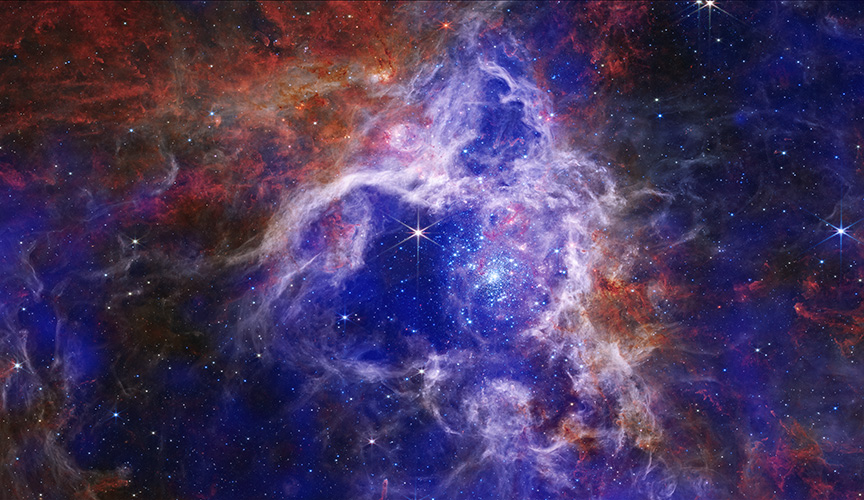
The largest and brightest region of star formation in the Local Group of galaxies, including the Milky Way, is called 30 Doradus (or, informally, the Tarantula Nebula). Located in the Large Magellanic Cloud, a small neighbor galaxy to the Milky Way, 30 Doradus has long been studied by astronomers who want to better understand how stars like the Sun are born and evolve.

NASA’s Chandra X-ray Observatory has frequently looked at 30 Doradus over the lifetime of the mission, often under the direction of Dr. Leisa Townsley who passed away in the summer of 2022. These data will continue to be collected and analyzed, providing opportunities for scientists both now and in the future to learn more about star formation and its related processes.

This new composite image combines the X-ray data from Chandra observations of 30 Doradus with an infrared image from NASA’s James Webb Space Telescope that was released in the fall of 2022. The X-rays (royal blue and purple) reveal gas that has been heated to millions of degrees by shock waves — similar to sonic booms from airplanes — generated by the winds from massive stars. The Chandra data also identify the remains of supernova explosions, which will ultimately send important elements such as oxygen and carbon into space where they will become part of the next generation of stars.


Fields of View: Chandra, Hubble, Spitzer, and Webb. (Credit: X-ray (Chandra): NASA/CXC/Penn State Univ./L. Townsley et al.; IR (Spitzer): NASA/JPL/PSU/L.Townsley et al. IR (JWST): NASA/ESA/CSA/STScI/JWST ERO Production Team; Optical (Hubble): NASA/STScI)

The infrared data from JWST (red, orange, green, and light blue) show spectacular canvases of cooler gas that provide the raw ingredients for future stars. JWST’s view also reveals “protostars,” that is, stars in their infancy, just igniting their stellar engines. The chemical composition of 30 Doradus is different from most of the nebulas found in the Milky Way. Instead it represents the conditions in our galaxy that existed several billion years ago when stars were forming at a much faster pace than astronomers see today. This, combined with its relative proximity and brightness, means that 30 Doradus provides scientists with an opportunity to learn more about how stars formed in our galaxy in the distant past.

NASA's Marshall Space Flight Center manages the Chandra program. The Smithsonian Astrophysical Observatory's Chandra X-ray Center controls science operations from Cambridge, Massachusetts, and flight operations from Burlington, Massachusetts.

The James Webb Space Telescope is the world's premier space science observatory. Webb will solve mysteries in our solar system, look beyond to distant worlds around other stars, and probe the mysterious structures and origins of our universe and our place in it. Webb is an international program led by NASA with its partners, ESA (European Space Agency) and the Canadian Space Agency.

Quick Look: The Enduring Stellar Lifecycle in 30 Doradus


Fast Facts for 30 Doradus (Tarantula Nebula):

Scale: Image is about 7.24 arcmin (360 light-years) across.
Category:
Normal Stars & Star Clusters
Coordinates (J2000): RA 5h 38m 42s | Dec -69° 06´ 03"
Constellation:
Dorado
Observation Dates: 54 observations from Jan 31, 2007 to Jan 23, 2016
Observation Time: 571 hours 55 minutes (23 days 19 hours 55 minutes)
Obs. ID: 5906, 7263, 7264, 16192-16203, 16442-16449, 16612, 16615-16617, 16621, 16640, 17413-17414, 17486, 17544-17545, 17555, 17561-17562, 17602-17603, 17640-17642, 17660, 18670-18672, 18706, 18720-18722, 18729, 18749-18750
Instrument: ACIS
Color Code: X-ray: dark blue; Infrared: red, orange, green, blue
Distance Estimate: About 170,000 light-years


Wednesday, January 11, 2023

Cosmic Burst Probes Milky Way's Halo

Artist's depiction of our Milky Way galaxy and its small galaxy companions surrounded by a giant halo of million-degree gas.
Credit: NASA/CXC/M.Weiss/Ohio State/A Gupta et al

The Deep Synoptic Array (DSA) at Caltech's Owens Valley Radio Observatory (OVRO).

Vikram Ravi


Astronomers have used an intense burst of radio waves originating from a nearby galaxy to inspect the halo of gas cocooning our own Milky Way galaxy. The scientists studied the way that the light of the so-called fast radio burst, or FRB, was dispersed as it traveled from deep space and into our galaxy as a means to estimate how much matter resides in the galaxy's halo. This is a bit like shining a flashlight through fog to see how thick the cloud is; the more matter there is, the more the light will disperse.

The results show that our galaxy has significantly less "regular," or baryonic, matter (the same type of matter that makes up stars, planets, and living beings) than expected. This, in turn, supports theories that say matter is regularly flung out of galaxies by powerful stellar winds, exploding stars, and actively feeding, or accreting, supermassive black holes.

"These results strongly support scenarios predicted by galaxy-formation simulations where feedback processes expel matter from the halos of galaxies, says Vikram Ravi, assistant professor of astronomy at Caltech, who presented the results on January 9 at the 241st meeting of the American Astronomical Society (AAS) in Seattle. "This is fundamental to galaxy formation, whereby matter is funneled in and blown out of galaxies in cycles," Ravi says.

The latest findings, submitted to The Astrophysical Journal, are part of a bevy of new results from Caltech's Deep Synoptic Array (DSA), a National Science Foundation (NSF)-funded collection of radio dishes located in the high desert at Owens Valley Radio Observatory, east of California's Sierra Nevada mountains. The purpose of the DSA is to discover and study FRBs—mysterious flashes of radio waves that typically originate from deep in the cosmos. The first FRB was discovered in 2007, and hundreds are now being observed each year.

One of the challenges in studying FRBs lies in identifying their place of origin. Knowing where the FRBs originate helps astronomers determine what may be triggering the intense cosmic flashes. Identifying their locations is also essential for using FRBs to study how baryonic matter is distributed across the universe. Of the several hundreds of FRBs discovered to date, only 21 have been pinpointed to known galaxies. The DSA, which began commissioning in February 2022, has already discovered and pinpointed the locations of 30 new FRBs.

"We were puzzled at first about why we were discovering so many FRBs," says Ravi, who is a co-investigator on DSA. "But it comes down to careful engineering of the antennas and receivers, and the software pipelines. We now rarely miss a thing."

In addition to finding less matter than expected in our Milky Way galaxy, other early results from the telescope array have led to new questions about the leading candidate for the cause of FRBs. Previous findings have indicated that recently deceased stars with extreme magnetization, called magnetars, may be the source of FRBs. For instance, in 2020, several telescopes, including Caltech's STARE2 (Survey for Transient Astronomical Radio Emission 2) caught a magnetar red-handed as it shot out an intense FRB in our own galaxy. New observations from DSA, however, show that FRBs originate from a diverse assortment of galaxies, including from older galaxies within rich galaxy clusters. These results suggest that if FRBs are emitted by magnetars, they are formed through multiple potentially unknown pathways.

"Magnetars like those in the Milky Way are formed during episodes of intense star formation," Ravi says. "To find FRBs from galaxies that have mostly stopped forming stars was surprising."

Ravi says that the DSA will become even more powerful as the team brings additional radio dishes online. So far, only 63 out of a total of 110 planned dishes are in operation.

"The DSA gathers and processes enormous amounts of data all the time," says Ravi. "The data rate is equivalent to watching 28,000 Netflix movies at once."

In the future, Caltech astronomers, together with collaborators, plan to build an even bigger array, called the DSA-2000, a network of 2,000 radio dishes that would be the most powerful radio survey telescope ever built. The project, which is funded by Schmidt Futures, would process a data rate equivalent to 20 percent of today's global internet traffic and detect a billion new radio sources, which is 100 times more than we know of today. This would include 40,000 new FRBs.

"The DSA-2000 will build upon progress with the DSA and revolutionize radio astronomy," says Gregg Hallinan, professor of astronomy at Caltech, director of the Owens Valley Radio Observatory, and principal investigator of DSA-2000.

More information about both DSA projects can be found online.

Written by Whitney Clavin

Contact:

Whitney Clavin
(626) 395‑1944

wclavin@caltech.edu

Source: Caltech/News


Tuesday, January 10, 2023

ALMA and JWST Reveal Galactic Shock is Shaping Stephan’s Quintet in Mysterious Ways


A team of astronomers using the Atacama Large Millimeter/submillimeter Array (ALMA) and the James Webb Space Telescope (JWST) discovered a recycling plant for warm and cold molecular hydrogen gas in Stephan’s Quintet, and it’s causing mysterious things to happen. At left: Field 6, which sits at the center of the main shock wave, is recycling warm and cold hydrogen gas as a giant cloud of cold molecules is stretched out into a warm tail of molecular hydrogen over and over again. At center: Field 5 unveiled two cold gas clouds connected by a stream of warm molecular hydrogen gas characterized by a high-speed collision that is feeding the warm envelope of gas around the region. At right: Field 4 revealed a steadier, less turbulent environment where hydrogen gas collapsed, forming what scientists believe to be a small dwarf galaxy in formation. Credit: ALMA (ESO/NAOJ/NRAO)/JWST/ P. Appleton (Caltech), B.Saxton (NRAO/AUI/NSF)


Stephan’s Quintet is a group of five galaxies—NGC 7317, NGC 7318a, NGC 7318b, NGC 7319, and NGC 7320— generally located about 270 million light-years from Earth in the constellation Pegasus. Credit: IAU/Sky Telescope


Hot, warm, and cold molecular gas are acting a little strange in Stephan’s Quintet – Astronomers used the Atacama Large Millimeter/submillimeter Array (ALMA) and the James Webb Space Telescope (JWST) to uncover just what is going on in Stephan’s Quintet, where hot, warm, and cold molecular gas are acting a little strange. This animated video highlights observational fields 4, 5, and 6, the areas where the team discovered that turbulence caused by a giant shockwave has created a recycling plant for warm and cold molecular gas, and is enabling the Quintet’s strange structural behaviors. Field 6 revealed the first indications of a recycling plant, with the area stretching a giant cloud of cold molecules into a tail of warm molecular hydrogen gas on repeat. Field 5 shockingly revealed a high-speed collision where a bullet of gas struck through a molecular cloud, creating a ring and connecting two cold gas clouds together. Field 4, the most normal, is a relatively steady environment, allowing for the growth of what may be a small dwarf galaxy. Credit: ALMA (ESO/NAOJ/NRAO)/JWST/ P. Appleton (Caltech), B.Saxton (NRAO/AUI/NSF).  Link Video


ALMA and JWST Reveal Galactic Shock is Shaping Stephan’s Quintet in Mysterious Ways

Shockwaves resulting from the violent collision between an intruder galaxy and Stephan’s Quintet are helping astronomers to understand how turbulence influences gas in the intergalactic medium. New observations with the Atacama Large Millimeter/submillimeter Array (ALMA) and the James Webb Space Telescope (JWST) have revealed that a sonic boom several times the size of the Milky Way has kickstarted a recycling plant for warm and cold molecular hydrogen gas. What’s more, scientists uncovered the break-up of a giant cloud into a fog of warm gas, the possible collision of two clouds forming a splash of warm gas around them, and the formation of a new galaxy. The observations were presented today in a press conference at the 241st meeting of the American Astronomical Society (AAS) in Seattle, Washington, USA.   Link Video

Stephan’s Quintet is a group of five galaxies—NGC 7317, NGC 7318a, NGC 7318b, NGC 7319, and NGC 7320— generally located about 270 million light-years from Earth in the constellation Pegasus. The group provides a pristine laboratory for the study of galaxy collisions and their impact on the surrounding environment. Typically galaxy collisions and mergers trigger a burst of star formation; that’s not the case in Stephan’s Quintet. Instead, this violent activity is taking place in the intergalactic medium, away from the galaxies in places where there is little to no star formation to obstruct the view. 

That clean window into the Universe has allowed astronomers to watch what’s happening as one of the galaxies, NGC 7318b, violently intrudes into the group at a relative speed of roughly 800 km/second. At that speed, a trip from Earth to the Moon would take just eight minutes. “As this intruder crashes into the group, it is colliding with an old gas streamer that likely was caused by a previous interaction between two of the other galaxies, and is causing a giant shockwave to form,” said Philip Appleton, an astronomer and senior scientist at Caltech’s IPAC, and lead investigator on the project. “As the shockwave passes through this clumpy streamer, it is creating a highly turbulent, or unsteady, cooling layer, and it’s in the regions affected by this violent activity that we’re seeing unexpected structures and the recycling of molecular hydrogen gas. This is important because molecular hydrogen forms the raw material that may ultimately form stars, so understanding its fate will tell us more about the evolution of Stephan’s Quintet and galaxies in general.”

The new observations using ALMA’s Band 6 (1.3mm wavelength) receiver— developed by NSF’s National Radio Astronomy Observatory (NRAO)— allowed scientists to zoom into three key regions in extreme detail, and for the first time, build a clear picture of how the hydrogen gas is moving and being shaped on a continuous basis.

“The power of ALMA is obvious in these observations, providing astronomers new insights and better understanding of these previously unknown processes,” said Joe Pesce, Program Officer for ALMA at the U.S. National Science Foundation (NSF).

The region at the center of the main shock wave, dubbed Field 6, revealed a giant cloud of cold molecules that is being broken apart and stretched out into a long tail of warm molecular hydrogen and repeatedly recycled through these same phases. “What we’re seeing is the disintegration of a giant cloud of cold molecules in super-hot gas, and interestingly, the gas doesn’t survive the shock, it just cycles through warm and cold phases,” said Appleton. “We don’t yet fully understand these cycles, but we know the gas is being recycled because the length of the tail is longer than the time it takes for the clouds it is made from to be destroyed.”

This intergalactic recycling plant isn’t the only strange activity resulting from the shockwaves. In the region dubbed Field 5, scientists observed two cold gas clouds connected by a stream of warm molecular hydrogen gas. Curiously, one of the clouds— which resembles a high-speed bullet of cold hydrogen gas colliding with a large thread-like filament of spread out gas— created a ring in the structure as it punched through. The energy caused by this collision is feeding the warm envelope of gas around the region, but scientists aren’t quite sure what that means because they don’t yet have detailed observational data for the warm gas. “A molecular cloud piercing through intergalactic gas, and leaving havoc in its wake, may be rare and not yet fully understood,” said Bjorn Emonts, an astronomer at NRAO and a co-investigator on the project. “​​But our data show that we have taken the next step in understanding the shocking behavior and turbulent life-cycle of molecular gas clouds in Stephan’s Quintet.”

Perhaps the most “normal” of the bunch is the region dubbed Field 4, where scientists found a steadier, less turbulent environment that allowed hydrogen gas to collapse into a disk of stars and what scientists believe is a small dwarf galaxy in formation. “In field 4, it is likely that pre-existing large clouds of dense gas have become unstable because of the shock, and have collapsed to form new stars as we expect, ” said Pierre Guillard, a researcher at the Institut d’Astrophysique de Paris and a co-investigator on the project, adding that all of the new observations have significant implications for theoretical models of the impact of turbulence in the Universe. “The shock wave in the intergalactic medium of Stephan’s Quintet has formed as much cold molecular gas as we have in our own Milky Way, and yet, it forms stars at a much slower rate than expected. Understanding why this material is sterile is a real challenge for theorists. Additional work is needed to understand the role of high levels of turbulence and efficient mixing between the cold and hot gas.”

  Prior to the ALMA observations, scientists had little idea all of this was playing out in the Quintet’s intergalactic medium, but it wasn’t for lack of trying. In 2010, the team used NASA’s Spitzer Space Telescope to observe Stephan’s Quintet and discovered large clouds of warm— estimated to be between 100° to 400° Kelvin, or roughly -280° to 260° Fahrenheit— molecular hydrogen mixed in with the super-hot gas. “These clouds should have been destroyed by the large-scale shockwave moving through the group, but weren’t. And we wanted to know, and still want to know, how did they survive?” said Appleton.

To solve the mystery, the team needed more and different technological power and capability. ALMA’s first light occurred more than a year later, in late 2011 and JWST captured its first images earlier this year. The combination of these powerful resources has provided strikingly beautiful infrared images of Stephan’s Quintet, and a tantalizing, though incomplete, understanding of the relationship between the cold, warm molecular, and ionized hydrogen gases in the wake of the giant shockwave. The team now needs spectroscopic data to unlock the secrets of the warm molecular hydrogen gas.

“These new observations have given us some answers, but ultimately showed us just how much we don’t yet know,” said Appleton. “While we now have a better understanding of the gas structures and the role of turbulence in creating and sustaining them, future spectroscopic observations will trace the motions of the gas through the doppler effect, tell us how fast the warm gas is moving, allow us to measure the temperature of the warm gas, and see how the gas is being cooled or warmed by the shockwaves. Essentially, we’ve got one side of the story. Now it’s time to get the other.”

Additional Information

The observations were presented in a press conference at the 241st meeting of the American Astronomical Society (AAS) in Seattle, Washington, USA.

The Atacama Large Millimeter/submillimeter Array (ALMA), an international astronomy facility, is a partnership of the European Organisation for Astronomical Research in the Southern Hemisphere (ESO), the U.S. National Science Foundation (NSF) and the National Institutes of Natural Sciences (NINS) of Japan in cooperation with the Republic of Chile. ALMA is funded by ESO on behalf of its Member States, by NSF in cooperation with the National Research Council of Canada (NRC) and the Ministry of Science and Technology (MOST) and by NINS in cooperation with the Academia Sinica (AS) in Taiwan and the Korea Astronomy and Space Science Institute (KASI).
ALMA construction and operations are led by ESO on behalf of its Member States; by the National Radio Astronomy Observatory (NRAO), managed by Associated Universities, Inc. (AUI), on behalf of North America; and by the National Astronomical Observatory of Japan (NAOJ) on behalf of East Asia. The Joint ALMA Observatory (JAO) provides the unified leadership and management of the construction, commissioning and operation of ALMA.


Monday, January 09, 2023

Gravitational lensing reveals the detailed shape of a galaxy


Best-fit image-plane (left) and source (right) models of the gravitational lens system MG J0751+2716 from Powell et al. (2022). The color maps show the radio emission, illustrating long, thin gravitational arcs resolved with VLBI. The relatively low-resolution infrared observation from the W.M. Keck adaptive optics system is shown with solid yellow contours; in the center of the lens we see the light from the lens galaxy itself. The critical curves, where the lensing magnification becomes infinite, are shown in dashed white lines. The arcs revealed by the high-resolution radio data are highly sensitive to the mass distribution in the lens galaxy. The details in the structure of the source – a jet stretching away from the host galaxy – can only be reconstructed if enough complexity is included in the lens model. © MPA

Einstein’s General Theory of Relativity predicts that large concentrations of mass – such as galaxies – will bend light rays passing nearby, a phenomenon known as gravitational lensing. When a distant galaxy (the lens) lies exactly between us and an even more distant object (the source), the source is distorted and magnified into several images around the lens galaxy. A group at MPA and other institutes used very long baseline radio interferometry (VLBI) to study a gravitational lens system in high resolution. This reveals extreme detail in the lensed images, and provides a new window into the physics of lens galaxies.

The precise shape and magnification of the images in a gravitational lens system allows us to learn about the way mass is distributed in the galaxy that is acting as a gravitational lens, which reveals information about the formation and evolution of the galaxy. For instance, gravitational lensing can show whether the center of a lens galaxy is puffy or concentrated, which tells us about the heating and galactic winds blown by supernovae and active galactic nuclei (AGN, supermassive black holes that launch outflows at relativistic speeds). Gravitational lensing can also reveal the presence of low-mass dark matter haloes, which are detectable only through their gravitational effect. This lets us study the nature of dark matter itself.

The success of gravitational lens observations in revealing these physics depends on the smallest level of detail that can be detected, i.e. the angular resolution of the observation. So far, most existing gravitational lens systems have been observed with the Hubble Space Telescope (~120 milli-arcsecond resolution). Some have been followed up using the W.M. Keck adaptive optics system (~70 mas), and still fewer with the Atacama Large Millimeter Array (ALMA; ~25 mas). These observations are sufficient to constrain some very simple mass models, or to detect dark matter sub-haloes as small as 100 million solar masses. Pushing the field of gravitational lens modeling into the milli-arcsecond regime drastically increases the amount of astrophysical information we can extract from gravitational lens observations; at present, very long baseline interferometry (VLBI) is the only observational tool that can resolve details smaller than 5 milli-arcseconds.

In this work, we present the first analysis of a gravitational lens system observed at <5 milli-arcsecond resolution using VLBI, in which both a detailed model for the mass of the lens galaxy and an image of the source are reconstructed. The analysis used an advanced pipeline for VLBI data developed by our group at MPA. This observation of the lensed radio jet MG J0751+2716 exhibits extremely long, thin lensed arcs covering a wide range of positions around the lens galaxy, which are perfect for revealing the underlying gravitational landscape. In the figure, one can clearly see the jet structure of the reconstructed source, with bright knots of radio emission stretching away from the host galaxy.

We needed to include significant complexity in the mass model of the lens galaxy in order to clearly reconstruct the source. We found that the mass in this lens is highly concentrated towards the center, indicating that supernova and AGN feedback are relatively weak in this galaxy, a result which has been found in other gravitational lens galaxies as well. We also had to include extra parameters (angular multipole perturbations) in order to account for the fact that the lens galaxy is not perfectly elliptical (as is often assumed in lens modeling), as well as parameters describing tidal forces due to nearby galaxies, which pull on and deform the lens galaxy.

Even though our model captures the mass distribution in the lens galaxy only on scales larger than 1-2 kiloparsecs, we found that it fits the data very well. For a high-resolution observation, which can resolve such fine details in the lensed arcs, this was quite unexpected. This intriguing result motivates our main goal to use gravitational lenses observed with VLBI to search for low-mass dark matter haloes, whose presence or absence will help to constrain dark matter particle models. Our work demonstrates how VLBI observations can play a key role in the science of galaxy-scale strong gravitational lensing, as they can reveal structure in the gravitational landscape that is otherwise inaccessible with current optical telescopes.

Contacts:

Powell, Devon
Postdoc

tel:2328
dmpowell@mpa-garching.mpg.de

Vegetti, Simona
Scientific Staff

tel:2285
svegetti@mpa-garching.mpg.de

Original publication

Devon M Powell, Simona Vegetti, J P McKean, Cristiana Spingola, Hannah R Stacey, Christopher D Fassnacht
A lensed radio jet at milliarcsecond resolution I: Bayesian comparison of parametric lens models
Monthly Notices of the Royal Astronomical Society, Volume 516, Issue 2, October 2022, Pages 1808–1828

Source / DOI


Friday, January 06, 2023

Hubble Finds that Ghost Light Among Galaxies Stretches Far Back in Time

Ghost Light Galaxy Clusters
These are Hubble Space Telescope images of two massive clusters of galaxies named MOO J1014+0038 (left panel) and SPT-CL J2106-5844 (right panel). The artificially added blue color is translated from Hubble data that captured a phenomenon called intracluster light. This extremely faint glow traces a smooth distribution of light from wandering stars scattered across the cluster. Billions of years ago the stars were shed from their parent galaxies and now drift through intergalactic space. Credits: Science: NASA, ESA, STScI, James Jee (Yonsei University) / Image Processing: Joseph DePasquale (STScI)


In giant clusters of hundreds or thousands of galaxies, innumerable stars wander among the galaxies like lost souls, emitting a ghostly haze of light. These stars are not gravitationally tied to any one galaxy in a cluster.

The nagging question for astronomers has been: how did the stars get so scattered throughout the cluster in the first place? Several competing theories include the possibility that the stars were stripped out of a cluster's galaxies, or they were tossed around after mergers of galaxies, or they were present early in a cluster's formative years many billions of years ago.

A recent infrared survey from NASA's Hubble Space Telescope, which looked for this so-called "intracluster light" sheds new light on the mystery. The new Hubble observations suggest that these stars have been wandering around for billions of years, and are not a product of more recent dynamical activity inside a galaxy cluster that would strip them out of normal galaxies.

The survey included 10 galaxy clusters as far away as nearly 10 billion light-years. These measurements must be made from space because the faint intracluster light is 10,000 times dimmer than the night sky as seen from the ground.

The survey reveals that the fraction of the intracluster light relative to the total light in the cluster remains constant, looking over billions of years back into time. "This means that these stars were already homeless in the early stages of the cluster's formation," said James Jee of Yonsei University in Seoul, South Korea. His results are bei ng published in the January 5 issue of Nature magazine.

Stars can be scattered outside of their galactic birthplace when a galaxy moves through gaseous material in the space between galaxies, as it orbits the center of the cluster. In the process, drag pushes gas and dust out of the galaxy. However, based on the new Hubble survey, Jee rules out this mechanism as the primary cause for the intracluster star production. That's because the intracluster light fraction would increase over time to the present if stripping is the main player. But that is not the case in the new Hubble data, which show a constant fraction over billions of years.

"We don't exactly know what made them homeless. Current theories cannot explain our results, but somehow they were produced in large quantities in the early universe," said Jee. "In their early formative years, galaxies might have been pretty small and they bled stars pretty easily because of a weaker gravitational grasp."

"If we figure out the origin of intracluster stars, it will help us understand the assembly history of an entire galaxy cluster, and they can serve as visible tracers of dark matter enveloping the cluster," said Hyungjin Joo of Yonsei University, the first author of the paper. Dark matter is the invisible scaffolding of the universe, which holds galaxies, and clusters of galaxies, together.

If the wandering stars were produced through a comparatively recent pinball game among galaxies, they do not have enough time to scatter throughout the entire gravitational field of the cluster and therefore would not trace the distribution of the cluster's dark matter. But if the stars were born in the cluster's early years, they will have fully dispersed throughout the cluster. This would allow astronomers to use the wayward stars to map out the dark matter distribution across the cluster.

This technique is new and complementary to the traditional method of dark matter mapping by measuring how the entire cluster warps light from background objects due to a phenomenon called gravitational lensing.

Intracluster light was first detected in the Coma cluster of galaxies in 1951 by Fritz Zwicky, who reported that one of his most interesting discoveries was observing luminous, faint intergalactic matter in the cluster. Because the Coma cluster, containing at least 1,000 galaxies, is one of the nearest clusters to Earth (330 million light-years), Zwicky was able to detect the ghost light even with a modest 18-inch telescope.

NASA's James Webb Space Telescope's near-infrared capability and sensitivity will greatly extend the search for intracluster stars deeper into the universe, and therefore should help solve the mystery.

The Hubble Space Telescope is a project of international cooperation between NASA and ESA. NASA's Goddard Space Flight Center in Greenbelt, Maryland, manages the telescope. The Space Telescope Science Institute (STScI) in Baltimore, Maryland, conducts Hubble and Webb science operations. STScI is operated for NASA by the Association of Universities for Research in Astronomy, in Washington, D.C.


About This Release

Credits:

Release: NASA, ESA, STScI

Media Contact: Ray Villard
Space Telescope Science Institute, Baltimore, Maryland

Science Contact:

James Jee
Yonsei University, Seoul, South Korea


Permissions: Content Use Policy

Contact Us: Direct inquiries to the News Team.

Related Links and Documents:


Thursday, January 05, 2023

From the Laboratory to CW Leonis: A Hunt for a Metallic Molecule


This ultraviolet image of CW Leonis from NASA's Galaxy Evolution Explorer spacecraft shows the remarkable shell surrounding the star. Credit:
NASA/JPL-Caltech

The sooty cloud surrounding the carbon star CW Leonis is known to contain more than 50 types of molecules, and the remaining unassigned spectral lines hint that many more molecules are present. Can a laboratory study of a metallic molecule help us identify some of these mystery spectral lines?


Another view of CW Leonis, this time from the Hubble Space Telescope. This image highlights the dusty layers shed by this evolved star. Credit:
ESA/Hubble & NASA, T. Ueta, H. Kim; CC BY 4.0

Searching Space for Chemical Compounds

Astronomers have discovered more than 200 molecules in space since the first molecule was found in 1937. These discoveries confirmed something incredible — that in the cold, sparse space environment, individual atoms can link up to form complex molecules. Finding molecules in space represents both a challenge and an opportunity: how can we explain the presence of molecules in such an unforgiving environment, and how can we use the fact that they do exist to learn about the chemistry of interstellar and circumstellar space?

One of the best sites to study extraterrestrial molecules is in the dusty shroud and outflows of the star CW Leonis, also known as IRC+10216. CW Leonis is a carbon star: a supergiant star with a high abundance of carbon in its atmosphere. Among CW Leonis’s many molecules are metal-containing species like silicon dicarbide (SiC2), leading researchers to wonder if similar molecules might be responsible for any of the remaining unidentified lines in CW Leonis’s spectrum.


Summary of the known transitions and energy levels for magnesium dicarbide, as determined from laboratory and astrophysical observations. Credit: Changala et al. 2022

Making Magnesium Molecules

A team led by Bryan Changala‬ (Center for Astrophysics ∣ Harvard & Smithsonian) focused their search on magnesium dicarbide (MgC2). Changala and collaborators considered it likely that CW Leonis’s dusty shroud contains magnesium dicarbide because it’s chemically similar to the already-discovered silicon dicarbide, and many other magnesium-containing molecules have been found there.

How do you determine if a star’s spectral lines are due to a particular molecule, though? In order to be confident that we’ve discovered a molecule in space, we need to know its spectrum, which is best determined by studying the molecule in a lab. In the case of magnesium dicarbide, researchers have used quantum mechanical models to predict the molecule’s spectrum but had never confirmed it in a lab.

Changala‬ and coauthors combined magnesium atoms with acetylene molecules, which are made of carbon and hydrogen, hoping to synthesize magnesium dicarbide. The team successfully matched a spectral line from their sample to a line predicted by quantum mechanical models and performed additional tests to ensure that the molecule they created was actually magnesium dicarbide.


Example of a spectral line attributed to magnesium dicarbide. The fitted line profile is shown in red, and the blue “U” indicates unidentified lines. Adapted from Changala et al. 2022

Seeking a Spectral Match

Ultimately, Changala and collaborators used the spectrum of the newly synthesized molecule to assign 14 of CW Leonis’s unknown spectral lines to magnesium dicarbide and its isotopologues — molecules with the same chemical formula and structure in which one or more atoms has a different number of neutrons. What does the discovery of magnesium dicarbide in CW Leonis’s spectrum tell us? By comparing the abundance of magnesium dicarbide in the star’s surroundings with the abundances of other magnesium-containing molecules, researchers might be able to glean how these molecules are made. Additionally, these observations may help us understand how metals affect the chemistry of carbon-rich environments like the surroundings of carbon stars, helping to lift the veil on these dusty objects.

Citation

“Laboratory and Astronomical Discovery of Magnesium Dicarbide, MgC2,” P. B. Changala et al 2022 ApJL 940 L42.
doi:10.3847/2041-8213/aca144

By
Kerry Hensley

Wednesday, January 04, 2023

Serpent in the sky captured with ESO telescope

PR Image eso2301a
The Sh2-54 nebula in the infrared with VISTA

The Sh2-54 nebula in visible light with the VST

PR Image eso2301c
The star cluster NGC 6604 in the constellation of Serpens


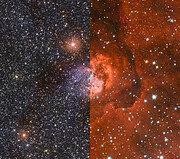
A myriad of stars is revealed behind the faint orange glow of the Sh2-54 nebula in this new infrared image. Located in the constellation Serpens, this stunning stellar nursery has been captured in all its intricate detail using the Visible and Infrared Survey Telescope for Astronomy (VISTA) based at ESO’s Paranal Observatory in Chile.

When the ancients looked up at the night sky they saw random patterns in the stars. The Greeks, for instance, named one of these “constellations” Serpens, because of its resemblance to a snake. What they wouldn’t have been able to see is that at the tail end of this constellation there is a wealth of stunning astronomical objects. These include the Eagle, the Omega and the Sh2-54 nebulae; the last of these is revealed, in a new light, in this spectacular infrared image.
Nebulae are vast clouds of gas and dust from which stars are born. Telescopes have allowed astronomers to identify and analyse these rather faint objects in exquisite detail. The nebula shown here, located about 6000 light-years away, is officially called Sh2-54; the “Sh” refers to the US astronomer Stewart Sharpless, who catalogued more than 300 nebulae in the 1950s.

As the technology used to explore the Universe progresses, so too does our understanding of these stellar nurseries. One of these advances is the ability to look beyond the light that can be detected by our eyes, such as infrared light. Just as the snake, the namesake of this nebula, evolved the ability to sense infrared light to better understand its environment, so too have we developed infrared instruments to learn more about the Universe.

Whilst visible light is easily absorbed by clouds of dust in nebulae, infrared light can pass through the thick layers of dust almost unimpeded. The image here therefore reveals a wealth of stars hidden behind the veils of dust. This is particularly useful as it allows scientists to study what happens in stellar nurseries in much greater detail, and thus learn more about how stars form.

This image was captured in infrared light using the sensitive 67-million-pixel camera on ESO’s VISTA telescope at Paranal Observatory in Chile. It was taken as part of the VVVX survey — the VISTA Variables in the Via Láctea eXtended survey. This is a multi-year project that has repeatedly observed a large portion of the Milky Way at infrared wavelengths, providing key data to understand stellar evolution.


More Information

The European Southern Observatory (ESO) enables scientists worldwide to discover the secrets of the Universe for the benefit of all. We design, build and operate world-class observatories on the ground — which astronomers use to tackle exciting questions and spread the fascination of astronomy — and promote international collaboration in astronomy. Established as an intergovernmental organisation in 1962, today ESO is supported by 16 Member States (Austria, Belgium, the Czech Republic, Denmark, France, Finland, Germany, Ireland, Italy, the Netherlands, Poland, Portugal, Spain, Sweden, Switzerland and the United Kingdom), along with the host state of Chile and with Australia as a Strategic Partner. ESO’s headquarters and its visitor centre and planetarium, the ESO Supernova, are located close to Munich in Germany, while the Chilean Atacama Desert, a marvellous place with unique conditions to observe the sky, hosts our telescopes. ESO operates three observing sites: La Silla, Paranal and Chajnantor. At Paranal, ESO operates the Very Large Telescope and its Very Large Telescope Interferometer, as well as survey telescopes such as VISTA. Also at Paranal ESO will host and operate the Cherenkov Telescope Array South, the world’s largest and most sensitive gamma-ray observatory. Together with international partners, ESO operates ALMA on Chajnantor, a facility that observes the skies in the millimetre and submillimetre range. At Cerro Armazones, near Paranal, we are building “the world’s biggest eye on the sky” — ESO’s Extremely Large Telescope. From our offices in Santiago, Chile we support our operations in the country and engage with Chilean partners and society.


Links


Contacts:
Juan Carlos Muñoz Mateos
ESO Media Officer
Garching bei München, Germany
Tel: +49 89 3200 6176
Email:
press@eso.org

Source: ESO/News


Tuesday, January 03, 2023

New Insights into the Puzzle of NGC 1068 What Does a Starburst Galaxy Look Like?

An optical image of NGC 1068 from the Hubble Space Telescope and the Sloan Digital Sky Survey, overlaid with X-ray observations (magenta) from the Nuclear Spectroscopic Telescope Array (NuSTAR). Credit: NASA/JPL-Caltech/Roma Tre Univ.

Title: Solving the Multi-Messenger Puzzle of the AGN-Starburst Composite Galaxy NGC 1068
Authors: Björn Eichmann et al.
First Author’s Institution: Norwegian University for Science and Technology; Ruhr University Bochum, Germany; Ruhr Astroparticle and Plasma Physics Center
Status: Published in ApJ

Starburst galaxies have an extremely high rate of star formation (between 10 and 300 times the mass of our Sun per year, while the Milky Way forms new stars at a rate of about 2 masses of the Sun per year)1 and supernova explosions, making them an incredibly interesting source for astronomers studying the evolution of stars and galaxies. But starburst galaxies can also be intriguing multi-messenger sources because of their emission of high-energy gamma rays, indicating that these sources can accelerate particles up to extremely high energies.

When high-energy particles (usually called cosmic rays) are accelerated to extreme energies, they can smash into each other, producing high-energy gamma rays and neutrinos. These messengers (cosmic rays, photons, and neutrinos) can give us immense amounts of information about their sources. Today’s authors delve into the starburst galaxy NGC 1068, which also has an active galactic nucleus at its center, making it an interesting source for multi-messenger study. The authors describe their model for emission of gamma rays and neutrinos from NGC 1068 and compare the model to observations from multiple telescopes (VLA, ALMA, Fermi-LAT, MAGIC, and IceCube).

What Does a Starburst Galaxy Look Like?

Figure 1 shows a sketch of the structure of NGC 1068, including its active galactic nucleus.


Figure 1: A sketch of the active galactic nucleus in a starburst galaxy (not to scale), highlighting different regions for the model. The active galactic nucleus can be seen at the center, surrounded by the corona (yellow, Zone I) and its accretion disk. At the edges, just past the torus, is the starburst region (purple with stars, Zone II). These show the two zones for emission in the model discussed in this research article. Credit: Eichmann et al. 2022

 
Starting from the center of the sketch, the supermassive black hole central to the active galactic nucleus can be seen. An accretion disk surrounds the active galactic nucleus, and this matter is being pulled inward towards the black hole (this is called accretion of the material, hence the name). Outside the plane of the accretion disk is the corona region of the active galactic nucleus. Moving outward, there is a torus region of colder gas. Outside of the torus region is the starburst region, where the rest of the galaxy resides and orbits around the active galactic nucleus.

Also on this sketch we can see the three different types of messengers that are being emitted by different regions. Cosmic rays (labeled CR) are shown in red, and they can be seen to meander due to the presence of magnetic fields acting on these charged particles. Photons can be seen in sine-wave-like lines, with the frequency indicated by the frequency of the sine wave. This article focuses on the highest energy photons, gamma rays, here labeled in pink, and other photons are labeled in black. However, NGC 1068 has also been observed with other frequencies of photons, so the authors incorporate radio and infrared data for NGC 1068 into the fit.

The green arrows represent neutrinos, which are being produced in cosmic ray interactions. Because neutrinos rarely interact, they travel away from the source virtually unimpeded.

So, what do we see when we look for gamma rays and neutrinos from this source? The authors describe emission from two main zones of NGC 1068:

Zone 1: Active galactic nucleus corona: here, particles are accelerated by the active galactic nucleus.

Zone 2: Starburst region: where nearby supernovae and star formation happens.

Only by using both of these regions, not a model only for a single region as has been done in previous works, can these authors explain both the photons and neutrinos seen from NGC 1068.

What Can This Model Say About NGC 1068?

After fitting their model using radio, infrared, gamma-ray and neutrino observations of NGC 1068, the authors plot the result of those fits and the total contributions in gamma rays and neutrinos. This plot can be seen in Figure 2.


Figure 2: This plot shows the predictions of photon and neutrino energy fluxes from this model across many orders of magnitudes in energy. The lines described by the legend on the right side of the figure show different parts of the model, with all red lines for emission from the corona (Zone I), all blue lines emission from the starburst region (Zone II), and black lines for total contributions of photons (solid black) and neutrinos (black with green outline). Overlaid on this are measurements from several radio (VLA, ALMA), gamma-ray (4FGL, MAGIC), and neutrino (IceCube) telescopes (legend on the top left of this plot). Credit: Eichmann et al. 2022

The authors show many individual processes that are fitted in the model to give the total expected emission in photons across a wide range of energies, from radio to gamma rays. The emission at the highest and lowest energies is expected by this model to come from the starburst region (blue solid line), while the middle energies come from the active galactic nucleus corona (red solid line). In neutrinos, the model expectation falls near the observations from IceCube of NGC 1068, shown here in the green region, which appear to come from the active galactic nucleus corona.

The model is able to explain all of the data across multiple wavelengths and messengers, with some small deviations. The authors see that the gamma-ray emission at the highest energies (above 1 GeV) comes from the starburst region (Zone II), while the high-energy neutrinos (around 1 TeV) come from the active galactic nucleus corona (Zone I). By using both zones in the model, all of the emission in both neutrinos and gamma rays can be explained by this model.

This is the first multi-messenger fit including photons over a wide range of energies and neutrinos for an active galactic nucleus–starburst composite galaxy. The entire model works well to explain all of the observed data seen in photons and neutrinos, making it an exciting evolution of astronomers’ understanding of NGC 1068, and other active galactic nucleus–starburst composite galaxies.

1 Source: Schneider, Peter. Extragalactic Astronomy and Cosmology: An Introduction. Berlin, Heidelberg: Springer Berlin Heidelberg, 2015.

Disclaimer: The author of this astrobite works with article coauthor Julia Becker Tjus but was not involved in this research.

Original astrobite edited by Pratik Gandhi.

By Astrobites


About the author, Jessie Thwaites:

Jessie is a PhD student at the Wisconsin IceCube Particle Astrophysics Center at the University of Wisconsin-Madison. They study possible astrophysical sources for high energy neutrinos through multimessenger astrophysics. Outside of physics, they play horn and enjoy spending time outdoors, especially skiing and biking.


Monday, January 02, 2023

Stargazing in NGC 6355

A dense collection of stars covers the view. Towards the centre the stars become even more dense in a circular region, and also more blue. Around the edges there are some redder foreground stars, and many small stars in the background. Credit: ESA/Hubble & NASA, E. Noyola, R. Cohen

The scattered stars of the globular cluster NGC 6355 are strewn across this image from the NASA/ESA Hubble Space Telescope. This globular cluster lies less than 50,000 light-years from Earth in the Ophiuchus constellation. NGC 6355 is a galactic globular cluster that resides in our Milky Way galaxy's inner regions.

Globular clusters are stable, tightly bound clusters of tens of thousands to millions of stars, and can be found in all types of galaxies. Their dense populations of stars and mutual gravitational attraction give these clusters a roughly spherical shape, with a bright concentration of stars surrounded by an increasingly sparse sprinkling of stars. The dense, bright core of NGC 6355 was picked out in crystal-clear detail by Hubble in this image, and is the crowded area of stars towards the centre of this image.

With its vantage point above the distortions of the atmosphere, Hubble has revolutionised the study of globular clusters. It is almost impossible to distinguish the stars in globular clusters from one another with ground-based telescopes, but astronomers have been able to use Hubble to study the constituent stars of globular clusters in detail. This Hubble image of NGC 6355 contains data from both the Advanced Camera for Surveys and Wide Field Camera 3.