Showing posts with label Tarantula Nebula. Show all posts

Friday, August 14, 2026

NASA Telescopes Create Colorful 'Craft' From Nearby Nebula

3 Doradus
Credit: X-ray: NASA/CXC/Ohio State Univ./J. Rodriguez et al; Infrared: NASA/ESA/CSA/STScI; Optical: NASA/ESA/STScI; Image Processing: NASA/CXC/SAO/P. Edmonds


  • A new study of the Tarantula Nebula is answering questions about why this star formation region in the Large Magellanic Cloud is losing energy from its center.

  • By combining data from Chandra, Hubble and Webb, and Spitzer, researchers identified what has tamed the Tarantula and where the energy has gone.

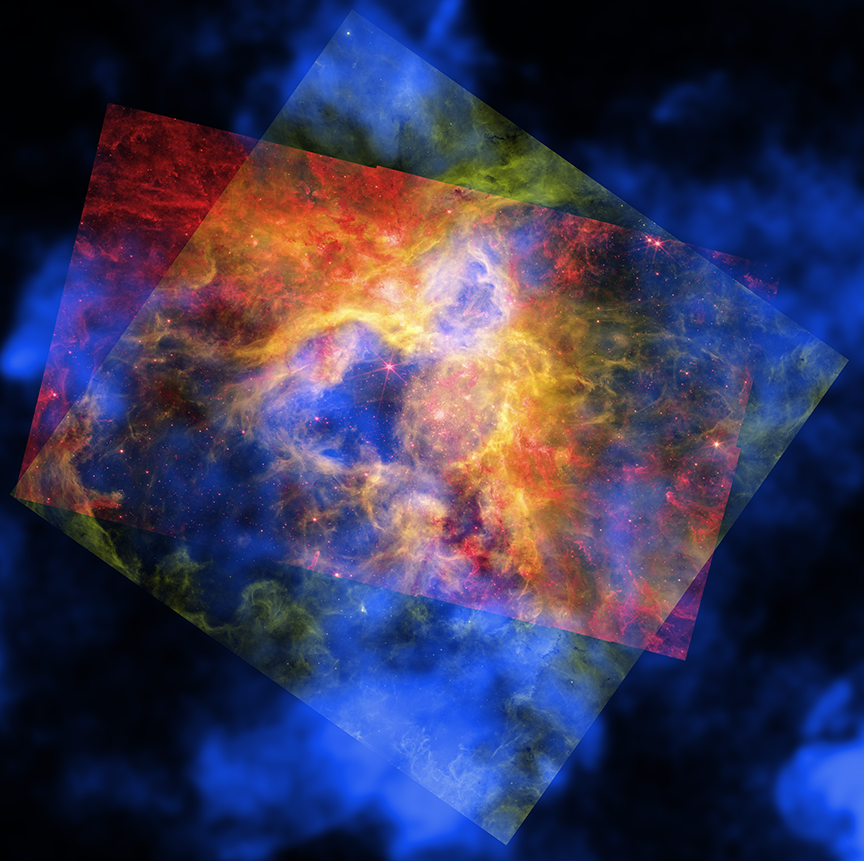
  • This new composite image has layers from three of these telescopes: Chandra (blue), Hubble (green), and Webb (red).

  • Scientists have concluded that energy has been lost through leakage of gas, the mixing of hot and cold gas and by conduction of heat.


Like a collage made of layered sheets of colored cellophane, a vibrant new image layers observations of a famous star-forming nebula from NASA space telescopes. The resulting cosmic “craft” reveals new details about the star formation region known as 30 Doradus, or the Tarantula Nebula.

Located in the Large Magellanic Cloud, a small neighbor galaxy to the Milky Way about 160,000 light-years from Earth, the Tarantula has thousands of young stars embedded in a vibrant honeycomb-like structure of gas and dust.

The new composite image contains X-rays from NASA’s Chandra X-ray Observatory, which has repeatedly observed the Tarantula Nebula over the course of its mission, in the layer that appears in blue. The X-ray data reveals gas blown away by winds from the surfaces of young, massive stars and heated to millions of degrees by shock waves, like sonic booms from supersonic jets.

The red represents infrared data from NASA’s James Webb Space Telescope showing thousands of young stars, plus swaths of cool dust that will provide the ingredients to form new stars and planets. Optical data in the green layer from NASA’s Hubble Space Telescope uncovers hydrogen gas that is warmer than seen with Webb, as well as some individual stars through the nebula.

The composite image shows the full Hubble and Webb images of this region, as well as a large section of the Chandra image, all recently published in a research paper in the Astrophysical Journal. In some regions the blue Chandra layer stands alone, and in others it combines with either the red Webb data or the green Hubble data. In the middle region all three images overlap to provide a holistic view in red, orange, yellow, green, and blue.

Tarantula Nebula (30 Doradus)
Optical + Infrared + X-ray

Previously, astronomers had studied the amount and the impact of energy produced by winds from young, massive stars in the Tarantula Nebula. Scientists expect that much of this energy should heat gas so that it produces X-rays. However, the research paper shows that there is much less X-ray-emitting gas in the nebula than expected. This led researchers to ask: Where has this energy gone and what tamed the Tarantula Nebula?

By studying the data from Chandra, Hubble, and Webb, combined with data from NASA’s retired Spitzer Space Telescope, the team concluded the Tarantula may be losing energy from several sources.

First, up to half of the hot gas is leaking through the shell walls of the gas and dust structures and escaping the nebula. Next, there is stirring and mixing between the cold gas near the shell walls and some of the hot gas, lowering the overall temperature of the gas. Finally, comparisons with computer simulations suggest the Tarantula may be losing energy through conduction. This involves direct physical contact between hot and cooler material, like with a frying pan on a burner, causing the hot and cooler material to equalize in temperature. In the case of the Tarantula Nebula, the hot gas would be conducting heat by being in direct contact with the cooler gas in the shells, especially in the densest regions. This scenario does not necessarily involve mixing the hot and cooler gas.

The combination of these three channels for losing large amounts of energy leads to this colorful and complex display revealed by NASA's telescopes working together.

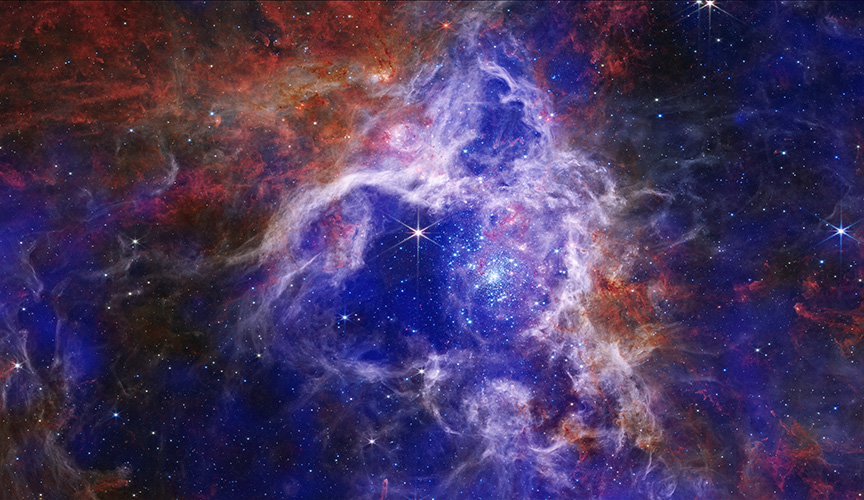
Tarantula Nebula / 30 Doradus, cropped version. Credit: X-ray: NASA/CXC/Ohio State Univ./J. Rodriguez et al; Infrared: NASA/ESA/CSA/STScI; Optical: NASA/ESA/STScI; Image Processing: NASA/CXC/SAO/P. Edmonds

The paper describing these results was led by Jennifer Rodriguez of The Ohio State University in Columbus. Additional authors on the paper include Laura Lopez, Ohio State; Lachlan Lancaster, Columbia University in New York City; Anna Rosen, San Diego State University; Omnaraynai Nayak, Space Telescope Science Institute in Baltimore; Sebastian Lopez, Ohio State; Tyler Holland-Ashford, NASA’s Goddard Space Flight Center in Greenbelt, Maryland; and Trinity Webb, Ohio State.

NASA's Marshall Space Flight Center in Huntsville, Alabama, manages the Chandra program. The Smithsonian Astrophysical Observatory's Chandra X-ray Center controls science operations from Cambridge, Massachusetts, and flight operations from Burlington, Massachusetts.


Visual Description:

This release features three images of the Tarantula Nebula, or 30 Doradus, a star-forming region of the Large Magellanic Cloud. Each image represents a different wavelength of light, presented in a different color. When layered atop one another, like sheets of colored cellophane, they combine to produce a vibrant and informative singular image.

The base layer of the nearly square, combined image, features a blanket of wispy blue clouds against a black backdrop. These clouds represent hot gas observed by NASA's Chandra X-ray Observatory. This layer reveals that gas has been blown from the surfaces of young, massive stars, and heated to millions of degrees by shock waves.

The second layer is a rectangular image cutting diagonally across the cloudy blue square, tilted from our upper left down toward our lower right. This layer features roiling red clouds and tiny, gleaming, red specks. These are swaths of cool, ingredient-rich dust, and scores of young stars. This red layer represents infrared data collected by NASA's James Webb Space Telescope.

The third layer is a tilted square, or diamond-shaped image, with its points touching the edges of the big blue base layer. Here, curling, sweeping tendrils of warm hydrogen gas swirl around the frame in shades of green. This layer represents data captured by NASA's Hubble Space Telescope.

In the center of the combined image, the three translucent layers overlap, resulting in a technicolor marvel; an image of intermingled blue, red, and green clouds that blend to include lively shades of fiery orange, golden yellow, and deep purple.


Fast Facts for Tarantula Nebula (30 Doradus)

Credit: X-ray: NASA/CXC/Ohio State Univ./J. Rodriguez et al; Infrared: NASA/ESA/CSA/STScI; Optical: NASA/ESA/STScI; Image Processing: NASA/CXC/SAO/P. Edmonds
Release Date: August 11, 2026
Scale: Image is about 10 arcmin (470 light-years) across.
Category:
Normal Stars & Star Clusters
Coordinates (J2000): RA 5h 38m 38s | Dec -69° 05´ 42"
Constellation:
Dorado
Observation Dates: 54 observations from January 2006 to January 2016
Observation Time: 571 hours (23 days 19 hours 56 minutes)
Obs. ID: 05906, 07263, 07264, 16192-16203, 16442-16449, 16612, 16615-16617, 16621, 16640, 17312-17414, 17486, 17544, 17545, 17555, 17561, 17562, 17602, 17603, 17640-17642, 17660, 18670-18672, 18706, 18720, 18721, 18722, 18729, 18749, 18750
Instrument: ACIS
Also Known As: 30 Doradus
References: Rodriguez, J.A., et al, 2026,
ApJ, 998, 318.
Color Code: X-ray: blue; Infrared: red; Optical (H-alpha): green
Distance Estimate: About 160,000 light-years from Earth


Wednesday, August 06, 2025

A sea monster and a Tarantula

A nebula. The top-left is dense with layers of fluffy pink and greenish clouds. Long strands of green clouds stretch out from here; a faint layer of translucent blue dust combines with them to create a three-dimensional scene. A sparse network of dark dust clouds in the foreground adds reddish-black patches atop the nebula. Blue-white and orange stars, from our galaxy and beyond, are spread amongst the clouds. Credit: ESA/Hubble & NASA, C. Murray


A scene from a star-forming factory shines in this NASA/ESA Hubble Space Telescope Picture of the Week. This Hubble picture captures incredible details in the dusty clouds in a star-forming region called the Tarantula Nebula. What’s possibly the most amazing aspect of this detailed image is that this nebula isn’t even in our galaxy. Instead, it’s in the Large Magellanic Cloud, a dwarf galaxy that is located about 160 000 light-years away in the constellations Dorado and Mensa.

The Large Magellanic Cloud is the largest of the dozens of small satellite galaxies that orbit the Milky Way. The Tarantula Nebula is the largest and brightest star-forming region not just in the Large Magellanic Cloud, but in the entire group of nearby galaxies to which the Milky Way belongs.

The Tarantula Nebula is home to the most massive stars known, some of which are roughly 200 times as massive as our Sun. The scene pictured here is located away from the centre of the nebula, where there is a super star cluster called R136, but very close to a rare type of star called a Wolf–Rayet star. Wolf–Rayet stars are massive stars that have lost their outer shell of hydrogen and are extremely hot and luminous, powering dense and furious stellar winds.

This nebula is a frequent target for Hubble, whose multiwavelength capabilities are critical for capturing sculptural details in the nebula’s dusty clouds. The data used to create this image come from an observing programme called Scylla, named for a multi-headed sea monster from the Greek myth of Ulysses. The Scylla programme was designed to complement another Hubble observing programme called ULYSSES (Ultraviolet Legacy library of Young Stars as Essential Standards). ULYSSES targets massive young stars in the Small and Large Magellanic Clouds, while Scylla investigates the structures of gas and dust that surround these stars.


Friday, January 24, 2025

A Tarantula’s outskirts

A section of a nebula, made up of layers of coloured clouds of gas, of varying thickness. In the background are bluish, translucent and wispy clouds; on top of these are stretches of redder and darker, clumpy dust, mostly along the bottom and right. In the bottom left corner are some dense bars of dust that block light and appear black. Small stars are scattered across the nebula. Credit: ESA/Hubble

Today’s NASA/ESA Hubble Space Telescope Picture of the Week features a dusty yet sparkling scene from one of the Milky Way’s satellite galaxies, the Large Magellanic Cloud. The Large Magellanic Cloud is a dwarf galaxy situated about 160 000 light-years away in the constellations Dorado and Mensa.

Despite being only 10–20% as massive as the Milky Way galaxy, the Large Magellanic Cloud contains some of the most impressive star-forming regions in the nearby Universe. The scene pictured here is on the outskirts of the Tarantula Nebula, the largest and most productive star-forming region in the local Universe. At its center, the Tarantula Nebula hosts the most massive stars known, which weigh in at roughly 200 times the mass of the Sun.

The section of the nebula shown here features serene blue gas, brownish-orange dust patches and a sprinkling of multicoloured stars. The stars within and behind the dust clouds appear redder than those that are not obscured by dust. Dust absorbs and scatters blue light more than red light, allowing more of the red light to reach our telescopes and making the stars appear redder than they are. This image incorporates ultraviolet and infrared light as well as visible light. Using Hubble observations of dusty nebulae in the Large Magellanic Cloud and other galaxies, researchers will study these distant dust grains, helping to understand the role that cosmic dust plays in the formation of new stars and planets.


Friday, March 29, 2024

Three-Year Study of Young Stars with NASA's Hubble Enters New Chapter

ULLYSES
The ULLYSES program studied two types of young stars: super-hot, massive, blue stars and cooler, redder, less massive stars than our Sun.
The top panel is a Hubble Space Telescope image of a star-forming region containing massive, young, blue stars in 30 Doradus, the Tarantula Nebula. Located within the Large Magellanic Cloud, this is one of the regions observed by ULLYSES.
The bottom panel shows an artist's concept of a cooler, redder, young star that's less massive than our Sun.This type of star is still gathering material from its surrounding, planet-forming disk.

Credits: Image: NASA, ESA, STScI, Francesco Paresce (INAF-IASF Bologna), Robert O'Connell (UVA), SOC-WFC3, ESO


In the largest and one of the most ambitious Hubble Space Telescope programs ever executed, a team of scientists and engineers collected information on almost 500 stars over a three-year period. This effort offers new insights into the stars' formation, evolution, and impact on their surroundings.

This comprehensive survey, called ULLYSES (Ultraviolet Legacy Library of Young Stars as Essential Standards), was completed in December 2023, and provides a rich spectroscopic dataset obtained in ultraviolet light that astronomers will be mining for decades to come. Because ultraviolet light can only be observed from space, Hubble is the only active telescope that can accomplish this research.

"I believe the ULLYSES project will be transformative, impacting overall astrophysics – from exoplanets, to the effects of massive stars on galaxy evolution, to understanding the earliest stages of the evolving universe," said Julia Roman-Duval, Implementation Team Lead for ULLYSES at the Space Telescope Science Institute (STScI) in Baltimore, Maryland. "Aside from the specific goals of the program, the stellar data can also be used in fields of astrophysics in ways we can’t yet imagine."

The ULLYSES team studied 220 stars, then combined those observations with information from the Hubble archive on 275 additional stars. The program also included data from some of the world's largest, most powerful ground-based telescopes and X-ray space telescopes. The ULLYSES dataset is made up of stellar spectra, which carry information about each star's temperature, chemical composition, and rotation.

One type of stars studied under ULLYSES is super-hot, massive, blue stars. They are a million times brighter than the Sun and glow fiercely in ultraviolet light that can easily be detected by Hubble. Their spectra include key diagnostics of the speed of their powerful winds. The winds drive galaxy evolution and seed galaxies with the elements needed for life. Those elements are cooked up inside the stars' nuclear fusion ovens and then injected into space as a star dies. ULLYSES targeted blue stars in nearby galaxies that are deficient in elements heavier than helium and hydrogen. This type of galaxy was common in the very early universe. "ULLYSES observations are a stepping stone to understanding those first stars and their winds in the universe, and how they impact the evolution of their young host galaxy," said Roman-Duval.

The other star category in the ULLYSES program is young stars less massive than our Sun. Though cooler and redder than our Sun, in their formative years they unleash a torrent of high-energy radiation, including blasts of ultraviolet light and X-rays. Because they are still growing, they are gathering material from their surrounding planet-forming disks of dust and gas. The Hubble spectra include key diagnostics of the process by which they acquire their mass, including how much energy this process releases into the surrounding planet-forming disk and nearby environment. The blistering ultraviolet light from young stars affects the evolution of these disks as they form planets, as well as the chances of habitability for newborn planets. The target stars are located in nearby star-forming regions in our Milky Way galaxy.

The ULLYSES concept was designed by a committee of experts with the goal of using Hubble to provide a legacy set of stellar observations. "ULLYSES was originally conceived as an observing program utilizing Hubble's sensitive spectrographs. However, the program was tremendously enhanced by community-led coordinated and ancillary observations with other ground- and space-based observatories," said Roman-Duval. "Such broad coverage allows astronomers to investigate the lives of stars in unprecedented detail and paint a more comprehensive picture of the properties of these stars and how they impact their environment."

To that end, STScI hosted a ULLYSES workshop March 11–14 to celebrate the beginning of a new era of research on young stars. The goal was to allow members of the astronomical community to collaborate on the data, so that they could gain momentum in the ongoing analyses, or kickstart new ideas for analysis. The workshop was one important step in exploiting this legacy spectral library to its fullest potential, fulfilling the promise of ULLYSES.

The Hubble Space Telescope has been operating for over three decades and continues to make ground-breaking discoveries that shape our fundamental understanding of the universe. Hubble is a project of international cooperation between NASA and ESA (European Space Agency). NASA's Goddard Space Flight Center in Greenbelt, Maryland, manages the telescope and mission operations. Lockheed Martin Space, based in Denver, Colorado, also supports mission operations at Goddard. The Space Telescope Science Institute in Baltimore, Maryland, which is operated by the Association of Universities for Research in Astronomy, conducts Hubble science operations for NASA.


About This Release

Credits:

Release: NASA, ESA, STScI

Media Contact:

Ann Jenkins
Space Telescope Science Institute, Baltimore, Maryland

Ray Villard
Space Telescope Science Institute, Baltimore, Maryland

Science Contact:

Julia Roman-Duval
Space Telescope Science Institute, Baltimore, Maryland


Permissions: Content Use Policy

Contact Us: Direct inquiries to the News Team.

Related Links and Documents


Saturday, February 04, 2023

Exploring a Turbulent Tarantula

Image description: Wispy, nebulous clouds extend from the lower-left of the image. At the top and right the dark background of space can be seen through the sparse nebula. Along the left and in the corner are many layers of brightly-coloured gas and dark, obscuring dust. A cluster of small, bright blue stars in the same corner expands out across the image. Many much smaller stars cover the background. Credit: ESA/Hubble & NASA, C. Murray, E. Sabbi

A snapshot of the Tarantula Nebula (also known as 30 Doradus) is the most recent Picture of the Week from the NASA/ESA Hubble Space Telescope. The Tarantula Nebula is a large star-forming region of ionised hydrogen gas that lies 161 000 light years from Earth in the Large Magellanic Cloud, and its turbulent clouds of gas and dust can be seen swirling between the region’s bright, newly-formed stars.

The Tarantula Nebula is a familiar site for Hubble. It is the brightest star-forming region in our galactic neighbourhood and home to the hottest, most massive stars known. This makes it a perfect natural laboratory in which to test out theories of star formation and evolution, and a rich variety of Hubble images of this region have been released to the public in recent years. The NASA/ESA/CSA James Webb Space Telescope also recently delved into this region, revealing thousands of never-before-seen young stars.

This new image combines data from two different observing proposals. The first was designed to explore the properties of the dust grains that exist in the void between stars and which make up the dark clouds winding through this image. This proposal, which astronomers named Scylla, complements another Hubble observing proposal called Ulysses and is revealing how interstellar dust interacts with starlight in a variety of environments. This image also incorporates data from an observing programme studying star formation in conditions similar to the early Universe, as well as cataloguing the stars of the Tarantula Nebula for future science with Webb.

Thursday, January 12, 2023

The Enduring Stellar Lifecycle in 30 Doradus

30 Doradus
Credit: X-ray: NASA/CXC/Penn State Univ./L. Townsley et al.
IR: NASA/ESA/CSA/STScI/JWST ERO Production Team


The largest and brightest region of star formation in the Local Group of galaxies, including the Milky Way, is called 30 Doradus (or, informally, the Tarantula Nebula). Located in the Large Magellanic Cloud, a small neighbor galaxy to the Milky Way, 30 Doradus has long been studied by astronomers who want to better understand how stars like the Sun are born and evolve.

NASA’s Chandra X-ray Observatory has frequently looked at 30 Doradus over the lifetime of the mission, often under the direction of Dr. Leisa Townsley who passed away in the summer of 2022. These data will continue to be collected and analyzed, providing opportunities for scientists both now and in the future to learn more about star formation and its related processes.

This new composite image combines the X-ray data from Chandra observations of 30 Doradus with an infrared image from NASA’s James Webb Space Telescope that was released in the fall of 2022. The X-rays (royal blue and purple) reveal gas that has been heated to millions of degrees by shock waves — similar to sonic booms from airplanes — generated by the winds from massive stars. The Chandra data also identify the remains of supernova explosions, which will ultimately send important elements such as oxygen and carbon into space where they will become part of the next generation of stars.


Fields of View: Chandra, Hubble, Spitzer, and Webb. (Credit: X-ray (Chandra): NASA/CXC/Penn State Univ./L. Townsley et al.; IR (Spitzer): NASA/JPL/PSU/L.Townsley et al. IR (JWST): NASA/ESA/CSA/STScI/JWST ERO Production Team; Optical (Hubble): NASA/STScI)

The infrared data from JWST (red, orange, green, and light blue) show spectacular canvases of cooler gas that provide the raw ingredients for future stars. JWST’s view also reveals “protostars,” that is, stars in their infancy, just igniting their stellar engines. The chemical composition of 30 Doradus is different from most of the nebulas found in the Milky Way. Instead it represents the conditions in our galaxy that existed several billion years ago when stars were forming at a much faster pace than astronomers see today. This, combined with its relative proximity and brightness, means that 30 Doradus provides scientists with an opportunity to learn more about how stars formed in our galaxy in the distant past.

NASA's Marshall Space Flight Center manages the Chandra program. The Smithsonian Astrophysical Observatory's Chandra X-ray Center controls science operations from Cambridge, Massachusetts, and flight operations from Burlington, Massachusetts.

The James Webb Space Telescope is the world's premier space science observatory. Webb will solve mysteries in our solar system, look beyond to distant worlds around other stars, and probe the mysterious structures and origins of our universe and our place in it. Webb is an international program led by NASA with its partners, ESA (European Space Agency) and the Canadian Space Agency.

Quick Look: The Enduring Stellar Lifecycle in 30 Doradus


Fast Facts for 30 Doradus (Tarantula Nebula):

Scale: Image is about 7.24 arcmin (360 light-years) across.
Category:
Normal Stars & Star Clusters
Coordinates (J2000): RA 5h 38m 42s | Dec -69° 06´ 03"
Constellation:
Dorado
Observation Dates: 54 observations from Jan 31, 2007 to Jan 23, 2016
Observation Time: 571 hours 55 minutes (23 days 19 hours 55 minutes)
Obs. ID: 5906, 7263, 7264, 16192-16203, 16442-16449, 16612, 16615-16617, 16621, 16640, 17413-17414, 17486, 17544-17545, 17555, 17561-17562, 17602-17603, 17640-17642, 17660, 18670-18672, 18706, 18720-18722, 18729, 18749-18750
Instrument: ACIS
Color Code: X-ray: dark blue; Infrared: red, orange, green, blue
Distance Estimate: About 170,000 light-years


Tuesday, September 06, 2022

A Cosmic Tarantula, Caught by NASA’s Webb

Tarantula Nebula (NIRCam Image)
Credits: Image: NASA, ESA, CSA, STScI, Webb ERO Production Team


Tarantula Nebula (MIRI Image)
Credits: Image: NASA, ESA, CSA, STScI, Webb ERO Production Team


Two Views of the Tarantula Nebula (NIRCam and MIRI images)
Credits: Image: NASA, ESA, CSA, STScI, Webb ERO Production Team


Tarantula Nebula (NIRSpec IFU)
Credits: Illustration: NASA, ESA, CSA, STScI, Webb ERO Production Team


Once upon a space-time, a cosmic creation story unfolded: Thousands of never-before-seen young stars spotted in a stellar nursery called 30 Doradus, captured by NASA’s James Webb Space Telescope. Nicknamed the Tarantula Nebula for the appearance of its dusty filaments in previous telescope images, the nebula has long been a favorite for astronomers studying star formation. In addition to young stars, Webb reveals distant background galaxies, as well as the detailed structure and composition of the nebula’s gas and dust.

At only 161,000 light-years away in the Large Magellanic Cloud galaxy, the Tarantula Nebula is the largest and brightest star-forming region in the Local Group, the galaxies nearest our Milky Way. It is home to the hottest, most massive stars known. Astronomers focused three of Webb’s high-resolution infrared instruments on the Tarantula. Viewed with Webb’s Near-Infrared Camera (NIRCam), the region resembles a burrowing tarantula’s home, lined with its silk. The nebula’s cavity centered in the NIRCam image has been hollowed out by blistering radiation from a cluster of massive young stars, which sparkle pale blue in the image. Only the densest surrounding areas of the nebula resist erosion by these stars’ powerful stellar winds, forming pillars that appear to point back toward the cluster. These pillars contain forming protostars, which will eventually emerge from their dusty cocoons and take their turn shaping the nebula. 

Webb’s Near-Infrared Spectrograph (NIRSpec) caught one very young star doing just that. Astronomers previously thought this star might be a bit older and already in the process of clearing out a bubble around itself. However, NIRSpec showed that the star was only just beginning to emerge from its pillar and still maintained an insulating cloud of dust around itself. Without Webb’s high-resolution spectra at infrared wavelengths, this episode of star formation-in-action could not have been revealed. 

The region takes on a different appearance when viewed in the longer infrared wavelengths detected by Webb’s Mid-infrared Instrument (MIRI). The hot stars fade, and the cooler gas and dust glow. Within the stellar nursery clouds, points of light indicate embedded protostars, still gaining mass. While shorter wavelengths of light are absorbed or scattered by dust grains in the nebula, and therefore never reach Webb to be detected, longer mid-infrared wavelengths penetrate that dust, ultimately revealing a previously unseen cosmic environment.  

One of the reasons the Tarantula Nebula is interesting to astronomers is that the nebula has a similar type of chemical composition as the gigantic star-forming regions observed at the universe’s “cosmic noon,” when the cosmos was only a few billion years old and star formation was at its peak. Star-forming regions in our Milky Way galaxy are not producing stars at the same furious rate as the Tarantula Nebula, and have a different chemical composition. This makes the Tarantula the closest (i.e., easiest to see in detail) example of what was happening in the universe as it reached its brilliant high noon. Webb will provide astronomers the opportunity to compare and contrast observations of star formation in the Tarantula Nebula with the telescope’s deep observations of distant galaxies from the actual era of cosmic noon.

Despite humanity’s thousands of years of stargazing, the star-formation process still holds many mysteries – many of them due to our previous inability to get crisp images of what was happening behind the thick clouds of stellar nurseries. Webb has already begun revealing a universe never seen before, and is only getting started on rewriting the stellar creation story.  

The James Webb Space Telescope is the world's premier space science observatory. Webb will solve mysteries in our solar system, look beyond to distant worlds around other stars, and probe the mysterious structures and origins of our universe and our place in it. Webb is an international program led by NASA with its partners, ESA (European Space Agency) and the Canadian Space Agency.


Credits:

Release: NASA, ESA, CSA, STScI


Media Contact:

Leah Ramsay
Space Telescope Science Institute, Baltimore, Maryland

Christine Pulliam
Space Telescope Science Institute, Baltimore, Maryland

Permissions:
Content Use Policy

Contact Us: Direct inquiries to the News Team


Monday, August 22, 2022

Sharpest Image Ever of Universe’s Most Massive Known Star

Sharpest Image Ever of R136a1, Largest Known Star

Comparison Observation of R136a1, Zorro and Hubble (Annotated) 
 
Illustration of Largest Known Star in the Universe


Groundbreaking observation from Gemini Observatory suggests this and possibly other colossal stars are less massive than previously thought

By harnessing the capabilities of the 8.1-meter Gemini South telescope in Chile, which is part of the International Gemini Observatory operated by NSF’s NOIRLab, astronomers have obtained the sharpest image ever of the star R136a1, the most massive known star in the Universe. Their research, led by NOIRLab astronomer Venu M. Kalari, challenges our understanding of the most massive stars and suggests that they may not be as massive as previously thought.

Astronomers have yet to fully understand how the most massive stars — those more than 100 times the mass of the Sun — are formed. One particularly challenging piece of this puzzle is obtaining observations of these giants, which typically dwell in the densely populated hearts of dust-shrouded star clusters. Giant stars also live fast and die young, burning through their fuel reserves in only a few million years. In comparison, our Sun is less than halfway through its 10 billion year lifespan. The combination of densely packed stars, relatively short lifetimes, and vast astronomical distances makes distinguishing individual massive stars in clusters a daunting technical challenge. 

By pushing the capabilities of the Zorro instrument on the Gemini South telescope of the International Gemini Observatory, operated by NSF’s NOIRLab, astronomers have obtained the sharpest-ever image of R136a1 — the most massive known star. This colossal star is a member of the R136 star cluster, which lies about 160,000 light-years from Earth in the center of the Tarantula Nebula in the Large Magellanic Cloud, a dwarf companion galaxy of the Milky Way. 

Previous observations suggested that R136a1 had a mass somewhere between 250 to 320 times the mass of the Sun. The new Zorro observations, however, indicate that this giant star may be only 170 to 230 times the mass of the Sun. Even with this lower estimate, R136a1 still qualifies as the most massive known star. 

Astronomers are able to estimate a star's mass by comparing its observed brightness and temperature with theoretical predictions. The sharper Zorro image allowed NSF's NOIRLab astronomer Venu M. Kalari and his colleagues to more accurately separated the brightness of R136a1 from its nearby stellar companions, which led to a lower estimate of its brightness and therefore its mass.

“Our results show us that the most massive star we currently know is not as massive as we had previously thought,” explained Kalari, lead author of the paper announcing this result. “This suggests that the upper limit on stellar masses may also be smaller than previously thought.”

This result also has implications for the origin of elements heavier than helium in the Universe. These elements are created during the cataclysmicly explosive death of stars more than 150 times the mass of the Sun in events that astronomers refer to as pair-instability supernovae. If R136a1 is less massive than previously thought, the same could be true of other massive stars and consequently pair instability supernovae may be rarer than expected.

The star cluster hosting R136a1 has previously been observed by astronomers using the NASA/ESA Hubble Space Telescope and a variety of ground-based telescopes, but none of these telescopes could obtain images sharp enough to pick out all the individual stellar members of the nearby cluster.

Gemini South’s Zorro instrument was able to surpass the resolution of previous observations by using a technique known as speckle imaging, which enables ground-based telescopes to overcome much of the blurring effect of Earth’s atmosphere [1]. By taking many thousands of short-exposure images of a bright object and carefully processing the data, it is possible to cancel out almost all this blurring [2]. This approach, as well as the use of adaptive optics, can dramatically increase the resolution of ground-based telescopes, as shown by the team’s sharp new Zorro observations of R136a1 [3].

“This result shows that given the right conditions an 8.1-meter telescope pushed to its limits can rival not only the Hubble Space Telescope when it comes to angular resolution, but also the James Webb Space Telescope,” commented Ricardo Salinas, a co-author of this paper and the instrument scientist for Zorro. “This observation pushes the boundary of what is considered possible using speckle imaging.”

“We began this work as an exploratory observation to see how well Zorro could observe this type of object,” concluded Kalari. “While we urge caution when interpreting our results, our observations indicate that the most massive stars may not be as massive as once thought.”

Zorro and its twin instrument `Alopeke are identical imagers mounted on the Gemini South and Gemini North telescopes, respectively. Their names are the Hawaiian and Spanish words for “fox” and represent the telescopes’ respective locations on Maunakea in Hawai‘i and on Cerro Pachón in Chile. These instruments are part of the Gemini Observatory’s Visiting Instrument Program, which enables new science by accommodating innovative instruments and enabling exciting research. Steve B. Howell, current chair of the Gemini Observatory Board and senior research scientist at the NASA Ames Research Center in Mountain View, California, is the principal investigator on both instruments. 

“Gemini South continues to enhance our understanding of the Universe, transforming astronomy as we know it. This discovery is yet another example of the scientific feats we can accomplish when we combine international collaboration, world-class infrastructure, and a stellar team,” said NSF Gemini Program Officer Martin Still.


Notes

[1] The blurring effect of the atmosphere is what makes stars twinkle at night, and astronomers and engineers have devised a variety of approaches to dealing with atmospheric turbulence. As well as placing observatories at high, dry sites with stable skies, astronomers have equipped a handful of telescopes with adaptive optics systems, assemblies of computer-controlled deformable mirrors and laser guide stars that can correct for atmospheric distortion. In addition to speckle imaging, Gemini South is able to use its Gemini Multi-Conjugate Adaptive Optics System to counteract the blurring of the atmosphere.

[2] The individual observations captured by Zorro had exposure times of just 60 milliseconds, and 40,000 of these individual observations of the R136 cluster were captured over the course of 40 minutes. Each of these snapshots is so short that the atmosphere didn’t have time to blur any individual exposure, and by carefully combining all 40,000 exposures the team could build up a sharp image of the cluster.

[3] When observing in the red part of the visible electromagnetic spectrum (about 832 nanometers), the Zorro instrument on Gemini South has an image resolution of about 30 milliarcseconds. This is slightly better resolution than NASA/ESA/CSA’s James Webb Space Telescope and about three-times sharper resolution achieved by the Hubble Space Telescope at the same wavelength.


More Information

This research was presented in the paper “Resolving the core of R136 in the optical” to appear in The Astrophysical Journal.

The team is composed of Venu M. Kalari (Gemini Observatory/NSF's NOIRLab and Departamento de Astronomia, Universidad de Chile), Elliott P. Horch (Department of Physics, Southern Connecticut State University), Ricardo Salinas (Gemini Observatory/NSF's NOIRLab), Jorick S. Vink (Armagh Observatory and Planetarium), Morten Andersen (Gemini Observatory/NSF's NOIRLab and the European Southern Observatory), Joachim M. Bestenlehner (Department of Physics and Astronomy, University of Sheffield), and Monica Rubio (Departamento de Astronomia, Universidad de Chile).

NSF’s NOIRLab (National Optical-Infrared Astronomy Research Laboratory), the US center for ground-based optical-infrared astronomy, operates the international Gemini Observatory (a facility of NSF, NRC–Canada, ANID–Chile, MCTIC–Brazil, MINCyT–Argentina, and KASI–Republic of Korea), Kitt Peak National Observatory (KPNO), Cerro Tololo Inter-American Observatory (CTIO), the Community Science and Data Center (CSDC), and Vera C. Rubin Observatory (operated in cooperation with the Department of Energy’s SLAC National Accelerator Laboratory). It is managed by the Association of Universities for Research in Astronomy (AURA) under a cooperative agreement with NSF and is headquartered in Tucson, Arizona. The astronomical community is honored to have the opportunity to conduct astronomical research on Iolkam Du’ag (Kitt Peak) in Arizona, on Maunakea in Hawai‘i, and on Cerro Tololo and Cerro Pachón in Chile. We recognize and acknowledge the very significant cultural role and reverence that these sites have to the Tohono O'odham Nation, to the Native Hawaiian community, and to the local communities in Chile, respectively.


Links


Contacts:

Venu M. Kalari
Astronomer
NSF’s NOIRLab
Email:
venu.kalari@noirlab.edu

Charles Blue
Public Information Officer
NSF’s NOIRLab
Tel: +1 202 236 6324
Email:
charles.blue@noirlab.edu


Tuesday, July 19, 2022

'Black hole police' discover a dormant black hole outside our galaxy

Artist’s impression of VFTS 243 in the Tarantula Nebula

The rich region around the Tarantula Nebula in the Large Magellanic Cloud

PR Image eso2210c
Composite infrared and radio image of 30 Doradus


Videos

'Black Hole Police' Spot Extragalactic Black Hole (ESOcast 255 Light)

Artist’s animation of VFTS 243  
PR Video eso2210b
Artist’s animation of VFTS 243 

Zooming in on VFTS 243


A team of international experts, renowned for debunking several black hole discoveries, have found a stellar-mass black hole in the Large Magellanic Cloud, a neighbour galaxy to our own. "For the first time, our team got together to report on a black hole discovery, instead of rejecting one," says study leader Tomer Shenar. Moreover, they found that the star that gave rise to the black hole vanished without any sign of a powerful explosion. The discovery was made thanks to six years of observations obtained with the European Southern Observatory’s (ESO’s) Very Large Telescope (VLT).

“We identified a ‘needle in a haystack’,” says Shenar who started the study at KU Leuven in Belgium [1] and is now a Marie-Curie Fellow at Amsterdam University, the Netherlands. Though other similar black hole candidates have been proposed, the team claims this is the first ‘dormant’ stellar-mass black hole to be unambiguously detected outside our galaxy.

Stellar-mass black holes are formed when massive stars reach the end of their lives and collapse under their own gravity. In a binary, a system of two stars revolving around each other, this process leaves behind a black hole in orbit with a luminous companion star. The black hole is ‘dormant’ if it does not emit high levels of X-ray radiation, which is how such black holes are typically detected. “It is incredible that we hardly know of any dormant black holes, given how common astronomers believe them to be”, explains co-author Pablo Marchant of KU Leuven. The newly found black hole is at least nine times the mass of our Sun, and orbits a hot, blue star weighing 25 times the Sun’s mass.

Dormant black holes are particularly hard to spot since they do not interact much with their surroundings. “For more than two years now, we have been looking for such black-hole-binary systems,” says co-author Julia Bodensteiner, a research fellow at ESO in Germany. “I was very excited when I heard about VFTS 243, which in my opinion is the most convincing candidate reported to date.” [2]

To find VFTS 243, the collaboration searched nearly 1000 massive stars in the Tarantula Nebula region of the Large Magellanic Cloud, looking for the ones that could have black holes as companions. Identifying these companions as black holes is extremely difficult, as so many alternative possibilities exist.

“As a researcher who has debunked potential black holes in recent years, I was extremely skeptical regarding this discovery,” says Shenar. The skepticism was shared by co-author Kareem El-Badry of the Center for Astrophysics | Harvard & Smithsonian in the USA, whom Shenar calls the “black hole destroyer”. “When Tomer asked me to double check his findings, I had my doubts. But I could not find a plausible explanation for the data that did not involve a black hole,” explains El-Badry.

The discovery also allows the team a unique view into the processes that accompany the formation of black holes. Astronomers believe that a stellar-mass black hole forms as the core of a dying massive star collapses, but it remains uncertain whether or not this is accompanied by a powerful supernova explosion.

"The star that formed the black hole in VFTS 243 appears to have collapsed entirely, with no sign of a previous explosion," explains Shenar. "Evidence for this ‘direct-collapse’ scenario has been emerging recently, but our study arguably provides one of the most direct indications. This has enormous implications for the origin of black-hole mergers in the cosmos."

The black hole in VFTS 243 was found using six years of observations of the Tarantula Nebula by the Fibre Large Array Multi Element Spectrograph (FLAMES) instrument on ESO’s VLT [3].

Despite the nickname ‘black hole police’, the team actively encourages scrutiny, and hopes that their work, published today in Nature Astronomy, will enable the discovery of other stellar-mass black holes orbiting massive stars, thousands of which are predicted to exist in Milky Way and in the Magellanic Clouds.

“Of course I expect others in the field to pore over our analysis carefully, and to try to cook up alternative models,” concludes El-Badry. “It's a very exciting project to be involved in.”


Notes

[1] The work was conducted in the team lead by Hugues Sana at KU Leuven’s Institute of Astronomy.

[2] A separate study led by Laurent Mahy, involving many of the same team members and accepted for publication in Astronomy & Astrophysics, reports on another promising stellar-mass black hole candidate, in the HD 130298 system in our own Milky Way galaxy.

[3] The observations used in the study cover about six years: they consist of data from the
VLT FLAMES Tarantula Survey (led by Chris Evans, United Kingdom Astronomy Technology Centre, STFC, Royal Observatory, Edinburgh; now at the European Space Agency) obtained from 2008 and 2009, and additional data from the Tarantula Massive Binary Monitoring programme (led by Hugues Sana, KU Leuven), obtained between 2012 and 2014.


More Information


This research was presented in a paper titled “An X-ray quiet black hole born with a negligible kick in a massive binary of the Large Magellanic Cloud” to appear in Nature Astronomy (doi: 10.1038/s41550-022-01730-y).

The research leading to these results has received funding from the European Research Council (ERC) under the European Union’s Horizon 2020 research and innovation programme (grant agreement numbers 772225: MULTIPLES) (PI: Sana).

The team is composed of T. Shenar (Institute of Astronomy, KU Leuven, Belgium [KU Leuven]; Anton Pannekoek Institute for Astronomy, University of Amsterdam, Amsterdam, the Netherlands [API]), H. Sana (KU Leuven), L. Mahy (Royal Observatory of Belgium, Brussels, Belgium), K. El-Badry (Center for Astrophysics | Harvard & Smithsonian, Cambridge, USA [CfA]; Harvard Society of Fellows, Cambridge, USA; Max Planck Institute for Astronomy, Heidelberg, Germany [MPIA]), P. Marchant (KU Leuven), N. Langer (Argelander-Institut für Astronomie der Universität Bonn, Germany, Max Planck Institute for Radio Astronomy, Bonn, Germany [MPIfR]), C. Hawcroft (KU Leuven), M. Fabry (KU Leuven), K. Sen (Argelander-Institut für Astronomie der Universität Bonn, Germany, MPIfR), L. A. Almeida (Universidade Federal do Rio Grande do Norte, Natal, Brazil; Universidade do Estado do Rio Grande do Norte, Mossoró, Brazil), M. Abdul-Masih (ESO, Santiago, Chile), J. Bodensteiner (ESO, Garching, Germany), P. Crowther (Department of Physics & Astronomy, University of Sheffield, UK), M. Gieles (ICREA, Barcelona, Spain; Institut de Ciències del Cosmos, Universitat de Barcelona, Barcelona, Spain), M. Gromadzki (Astronomical Observatory, University of Warsaw, Poland [Warsaw]), V. Henault-Brunet (Department of Astronomy and Physics, Saint Mary’s University, Halifax, Canada), A. Herrero (Instituto de Astrofísica de Canarias, Tenerife, Spain [IAC]; Departamento de Astrofísica, Universidad de La Laguna, Tenerife, Spain [IAC-ULL]), A. de Koter (KU Leuven, API), P. Iwanek (Warsaw), S. Kozłowski (Warsaw), D. J. Lennon (IAC, IAC-ULL), J. Maíz Apellániz (Centro de Astrobiología, CSIC-INTA, Madrid, Spain), P. Mróz (Warsaw), A. F. J. Moffat (Department of Physics and Institute for Research on Exoplanets, Université de Montréal, Canada), A. Picco (KU Leuven), P. Pietrukowicz (Warsaw), R. Poleski (Warsaw), K. Rybicki (Warsaw and Department of Particle Physics and Astrophysics, Weizmann Institute of Science, Israel), F. R. N. Schneider (Heidelberg Institute for Theoretical Studies, Heidelberg, Germany [HITS]; Astronomisches Rechen-Institut, Zentrum für Astronomie der Universität Heidelberg, Heidelberg, Germany), D. M. Skowron (Warsaw), J. Skowron (Warsaw), I. Soszyński (Warsaw), M. K. Szymański (Warsaw), S. Toonen (API), A. Udalski (Warsaw), K. Ulaczyk (Department of Physics, University of Warwick, UK), J. S. Vink (Armagh Observatory & Planetarium, UK), and M. Wrona (Warsaw).

The European Southern Observatory (ESO) enables scientists worldwide to discover the secrets of the Universe for the benefit of all. We design, build and operate world-class observatories on the ground — which astronomers use to tackle exciting questions and spread the fascination of astronomy — and promote international collaboration in astronomy. Established as an intergovernmental organisation in 1962, today ESO is supported by 16 Member States (Austria, Belgium, the Czech Republic, Denmark, France, Finland, Germany, Ireland, Italy, the Netherlands, Poland, Portugal, Spain, Sweden, Switzerland and the United Kingdom), along with the host state of Chile and with Australia as a Strategic Partner. ESO’s headquarters and its visitor centre and planetarium, the ESO Supernova, are located close to Munich in Germany, while the Chilean Atacama Desert, a marvellous place with unique conditions to observe the sky, hosts our telescopes. ESO operates three observing sites: La Silla, Paranal and Chajnantor. At Paranal, ESO operates the Very Large Telescope and its Very Large Telescope Interferometer, as well as two survey telescopes, VISTA working in the infrared and the visible-light VLT Survey Telescope. Also at Paranal ESO will host and operate the Cherenkov Telescope Array South, the world’s largest and most sensitive gamma-ray observatory. Together with international partners, ESO operates APEX and ALMA on Chajnantor, two facilities that observe the skies in the millimetre and submillimetre range. At Cerro Armazones, near Paranal, we are building “the world’s biggest eye on the sky” — ESO’s Extremely Large Telescope. From our offices in Santiago, Chile we support our operations in the country and engage with Chilean partners and society.


Links


Contacts

Tomer Shenar
KU Leuven and University of Amsterdam
Leuven and Amsterdam, Belgium and The Netherlands
Email:
t.shenar@uva.nl


Julia Bodensteiner
European Southern Observatory
Garching bei München, Germany
Tel: +49-89-3200-6409
Email:
julia.bodensteiner@eso.org

Kareem El-Badry
Center for Astrophysics | Harvard & Smithsonian
Cambridge, USA
Email:
kareem.el-badry@cfa.harvard.edu

Pablo Marchant
KU Leuven
Leuven, Belgium
Tel: +32 16 33 05 47
Email:
pablo.marchant@kuleuven.be

Hugues Sana
KU Leuven
Leuven, Belgium
Tel: +32 479 50 46 73
Email:
hugues.sana@kuleuven.be

Bárbara Ferreira
ESO Media Manager
Garching bei München, Germany
Tel: +49 89 3200 6670
Cell: +49 151 241 664 00
Email:
press@eso.org

Source: ESO/News


Thursday, June 16, 2022

The Tarantula's cosmic web: astronomers map violent star formation in nebula outside our galaxy

Composite infrared and radio image of 30 Doradus

Radio image of the 30 Doradus nebula with data from ALMA

Infrared image of 30 Doradus

Tarantula Nebula region in the constellation of Doradus


Videos

30 Doradus in optical to radio wavelengths
30 Doradus in optical to radio wavelengths 
 
Zooming-in on the Tarantula Nebula with radio wavelengths


Astronomers have unveiled intricate details of the star-forming region 30 Doradus, also known as the Tarantula Nebula, using new observations from the Atacama Large Millimeter/submillimeter Array (ALMA). In a high-resolution image released today by the European Southern Observatory (ESO) and including ALMA data, we see the nebula in a new light, with wispy gas clouds that provide insight into how massive stars shape this region.

“These fragments may be the remains of once-larger clouds that have been shredded by the enormous energy being released by young and massive stars, a process dubbed feedback,” says Tony Wong, who led the research on 30 Doradus presented today at the American Astronomical Society (AAS) meeting and published inThe Astrophysical Journal. Astronomers originally thought the gas in these areas would be too sparse and too overwhelmed by this turbulent feedback for gravity to pull it together to form new stars. But the new data also reveal much denser filaments where gravity’s role is still significant. “Our results imply that even in the presence of very strong feedback, gravity can exert a strong influence and lead to a continuation of star formation,” adds Wong, who is a professor at the University of Illinois at Urbana-Champaign, USA.

Located in the Large Magellanic Cloud, a satellite galaxy of our own Milky Way, the Tarantula Nebula is one of the brightest and most active star-forming regions in our galactic neighbourhood, lying about 170 000 light-years away from Earth. At its heart are some of the most massive stars known, a few with more than 150 times the mass of our Sun, making the region perfect for studying how gas clouds collapse under gravity to form new stars.

"What makes 30 Doradus unique is that it is close enough for us to study in detail how stars are forming, and yet its properties are similar to those found in very distant galaxies, when the Universe was young,” said Guido De Marchi, a scientist at the European Space Agency (ESA) and a co-author of the paper presenting the new research. “Thanks to 30 Doradus, we can study how stars used to form 10 billion years ago when most stars were born."

While most of the previous studies of the Tarantula Nebula have focused on its centre, astronomers have long known that massive star formation is happening elsewhere too. To better understand this process, the team conducted high-resolution observations covering a large region of the nebula. Using ALMA, they measured the emission of light from carbon monoxide gas. This allowed them to map the large, cold gas clouds in the nebula that collapse to give birth to new stars — and how they change as huge amounts of energy are released by those young stars.

“We were expecting to find that parts of the cloud closest to the young massive stars would show the clearest signs of gravity being overwhelmed by feedback,” says Wong. “We found instead that gravity is still important in these feedback-exposed regions — at least for parts of the cloud that are sufficiently dense.”

In the image released today by ESO, we see the new ALMA data overlaid on a previous infrared image of the same region that shows bright stars and light pinkish clouds of hot gas, taken with ESO’s Very Large Telescope (VLT) and ESO’s Visible and Infrared Survey Telescope for Astronomy (VISTA). The composition shows the distinct, web-like shape of the Tarantula Nebula’s gas clouds that gave rise to its spidery name. The new ALMA data comprise the bright red-yellow streaks in the image: very cold and dense gas that could one day collapse and form stars.

The new research contains detailed clues about how gravity behaves in the Tarantula Nebula’s star-forming regions, but the work is far from finished. “There is still much more to do with this fantastic data set, and we are releasing it publicly to encourage other researchers to conduct new investigations,” Wong concludes.


More Information

This research is being presented at the 240th meeting of the American Astronomical Society (AAS) in the press conference titled "Stars, Their Environments & Their Planets” (Wednesday, 15 June, 19:15 CEST / 10:15 PT). Reporters are welcome to watch the live stream of the press conference, which will be visible publicly on the AAS Press Office YouTube channel: https://www.youtube.com/c/AASPressOffice.

The research is also presented in the paper “The 30 Doradus Molecular Cloud at 0.4 Parsec Resolution with ALMA: Physical Properties and the Boundedness of CO Emitting Structures” (https://iopscience.iop.org/article/10.3847/1538-4357/ac723a) to appear in The Astrophysical Journal.

The team is composed of T. Wong (Astronomy Department, University of Illinois, USA [Illinois]), L. Oudshoorn (Leiden Observatory, Leiden University, The Netherlands [Leiden]), E. Sofovich (Illinois), A. Green (Illinois), C. Shah (Illinois), R. Indebetouw (Department of Astronomy, University of Virginia, USA and National Radio Astronomy Observatory, USA [NRAO]), M. Meixner (SOFIA-USRA, NASA Ames Research Center, USA), A. Hacar (Department of Astrophysics, University of Vienna, Austria), O. Nayak (Space Telescope Science Institute, USA [STSci]), K. Tokuda (Department of Earth and Planetary Sciences, Faculty of Sciences, Kyushu University, Japan and National Astronomical Observatory of Japan, National Institutes of Natural Sciences, Japan and Department of Physics, Graduate School of Science, Osaka Metropolitan University, Japan [Osaka]), A. D. Bolatto (Department of Astronomy and Joint Space Science Institute, University of Maryland, USA and NRAO Visiting Astronomer), M. Chevance (Astronomisches Rechen-Institut, Zentrum für Astronomie der Universität Heidelberg, Germany), G. De Marchi (European Space Research and Technology Centre, Netherlands), Y. Fukui (Department of Physics, Nagoya University, Japan), A. S. Hirschauer (STSci), K. E. Jameson (CSIRO, Space and Astronomy, Australia), V. Kalari (International Gemini Observatory, NSF’s NOIRLab, Chile), V. Lebouteiller (AIM, CEA, CNRS, Université Paris-Saclay, Université Paris Diderot, France), L. W. Looney (Illinois), S. C. Madden (Departement d’Astrophysique AIM/CEA Saclay, France), Toshikazu Onishi (Osaka), J. Roman-Duval (STSci), M. Rubio (Departamento de Astronomía, Universidad de Chile, Chile) and A. G. G. M. Tielens (Department of Astronomy, University of Maryland, USA and Leiden).

The European Southern Observatory (ESO) enables scientists worldwide to discover the secrets of the Universe for the benefit of all. We design, build and operate world-class observatories on the ground — which astronomers use to tackle exciting questions and spread the fascination of astronomy — and promote international collaboration in astronomy. Established as an intergovernmental organisation in 1962, today ESO is supported by 16 Member States (Austria, Belgium, the Czech Republic, Denmark, France, Finland, Germany, Ireland, Italy, the Netherlands, Poland, Portugal, Spain, Sweden, Switzerland and the United Kingdom), along with the host state of Chile and with Australia as a Strategic Partner. ESO’s headquarters and its visitor centre and planetarium, the ESO Supernova, are located close to Munich in Germany, while the Chilean Atacama Desert, a marvellous place with unique conditions to observe the sky, hosts our telescopes. ESO operates three observing sites: La Silla, Paranal and Chajnantor. At Paranal, ESO operates the Very Large Telescope and its Very Large Telescope Interferometer, as well as two survey telescopes, VISTA working in the infrared and the visible-light VLT Survey Telescope. Also at Paranal ESO will host and operate the Cherenkov Telescope Array South, the world’s largest and most sensitive gamma-ray observatory. Together with international partners, ESO operates APEX and ALMA on Chajnantor, two facilities that observe the skies in the millimetre and submillimetre range. At Cerro Armazones, near Paranal, we are building “the world’s biggest eye on the sky” — ESO’s Extremely Large Telescope. From our offices in Santiago, Chile we support our operations in the country and engage with Chilean partners and society.

The Atacama Large Millimeter/submillimeter Array (ALMA), an international astronomy facility, is a partnership of ESO, the U.S. National Science Foundation (NSF) and the National Institutes of Natural Sciences (NINS) of Japan in cooperation with the Republic of Chile. ALMA is funded by ESO on behalf of its Member States, by NSF in cooperation with the National Research Council of Canada (NRC) and the Ministry of Science and Technology (MOST) and by NINS in cooperation with the Academia Sinica (AS) in Taiwan and the Korea Astronomy and Space Science Institute (KASI). ALMA construction and operations are led by ESO on behalf of its Member States; by the National Radio Astronomy Observatory (NRAO), managed by Associated Universities, Inc. (AUI), on behalf of North America; and by the National Astronomical Observatory of Japan (NAOJ) on behalf of East Asia. The Joint ALMA Observatory (JAO) provides the unified leadership and management of the construction, commissioning and operation of ALMA.


Links

Tony Wong
Astronomy Department, University of Illinois
Urbana-Champaign, IL, USA
Tel: +1 217 244 4207
Email:
wongt@illinois.edu

Guido De Marchi
European Space Research and Technology Centre, European Space Agency
Noordwijk, Netherlands
Tel: +31 71 565 8332
Cell: +31 6 5081 6906
Email:
gdemarchi@esa.int

Bárbara Ferreira
ESO Media Manager
Garching bei München, Germany
Tel: +49 89 3200 6670
Cell: +49 151 241 664 00
Email:
press@eso.org

Source: ESO/News