Sunday, January 08, 2017

Hubble Captures 'Shadow Play' Caused by Possible Planet

TW Hydrae
Credits: NASA, ESA, and J. Debes (STScI)

Searching for planets around other stars is a tricky business. They're so small and faint that it's hard to spot them. But a possible planet in a nearby stellar system may be betraying its presence in a unique way: by a shadow that is sweeping across the face of a vast pancake-shaped gas-and-dust disk surrounding a young star.

The planet itself is not casting the shadow. But it is doing some heavy lifting by gravitationally pulling on material near the star and warping the inner part of the disk. The twisted, misaligned inner disk is casting its shadow across the surface of the outer disk.

A team of astronomers led by John Debes of the Space Telescope Science Institute in Baltimore, Maryland, say this scenario is the most plausible explanation for the shadow they spotted in the stellar system TW Hydrae, located 192 light-years away in the constellation Hydra, also known as the Female Water Snake. The star is roughly 8 million years old and slightly less massive than our sun. The researchers uncovered the phenomenon while analyzing 18 years' worth of archival observations taken by NASA's Hubble Space Telescope.

"This is the very first disk where we have so many images over such a long period of time, therefore allowing us to see this interesting effect," Debes said. "That gives us hope that this shadow phenomenon may be fairly common in young stellar systems."

Debes will present his team's results Jan. 7 at the winter meeting of the American Astronomical Society in Grapevine, Texas.

Debes' first clue to the phenomenon was a brightness in the disk that changed with position. Astronomers using Hubble's Space Telescope Imaging Spectrograph (STIS) first noted this brightness asymmetry in 2005. But they had only one set of observations, and could not make a definitive determination about the nature of the mystery feature.

Searching the archive, Debes' team put together six images from several different epochs. The observations were made by STIS and by Hubble's Near Infrared Camera and Multi-Object Spectrometer (NICMOS).

STIS is equipped with a coronagraph that blocks starlight to within about 1 billion miles from the star, allowing Hubble to look as close to the star as Saturn is to our sun. Over time, the structure appeared to move in counterclockwise fashion around the disk, until, in 2016, it was in the same position as it was in images taken in 2000.

This 16-year period puzzled the researchers. They originally thought the feature was part of the disk, but the short period meant that the feature was moving way too fast to be physically in the disk.

Under the laws of gravity, disks rotate at glacial speeds. The outermost parts of the TW Hydrae disk would take centuries to complete one rotation.

"The fact that I saw the same motion over 10 billion miles from the star was pretty significant, and told me that I was seeing something that was imprinted on the outer disk rather than something that was happening directly in the disk itself," Debes said. "The best explanation is that the feature is a shadow moving across the surface of the disk."

The research team concluded that whatever was making the shadow must be deep inside the 41-billion-mile-wide disk, so close to the star it cannot be imaged by Hubble or any other present-day telescope. The most likely way to create a shadow is to have an inner disk that is tilted relative to the outer disk. In fact, submillimeter observations of TW Hydrae by the Atacama Large Millimeter Array (ALMA) in Chile suggested a possible warp in the inner disk.

But what causes disks to warp? "The most plausible scenario is the gravitational influence of an unseen planet, which is pulling material out of the plane of the disk and twisting the inner disk," Debes explained. "The misaligned disk is inside the planet's orbit."

Given the relatively short 16-year period of the clocklike moving shadow, the planet is estimated to be about 100 million miles from the star — about as close as Earth is from the sun. The planet would be roughly the size of Jupiter to have enough gravity to pull the material up out of the plane of the main disk. The planet's gravitational pull causes the disk to wobble, or precess, around the star, giving the shadow its 16-year rotational period.

Recent observations of TW Hydrae by ALMA in Chile add credence to the presence of a planet. ALMA revealed a gap in the disk roughly 9 million miles from TW Hydrae. A gap is significant, because it could be the signature of an unseen planet clearing away a path in the disk.

This new Hubble study offers a unique way to look for planets hiding in the inner part of the disk and probe what is happening very close to the star, which is not reachable in direct imaging by current telescopes. "What is surprising is that we can learn something about an unseen part of the disk by studying the disk's outer region and by measuring the motion, location, and behavior of a shadow," Debes said. "This study shows us that even these large disks, whose inner regions are unobservable, are still dynamic, or changing in detectable ways which we didn't imagine."

The Hubble Space Telescope is a project of international cooperation between NASA and the European Space Agency. NASA's Goddard Space Flight Center in Greenbelt, Maryland, manages the telescope. The Space Telescope Science Institute (STScI) in Baltimore, Maryland, conducts Hubble science operations. STScI is operated for NASA by the Association of Universities for Research in Astronomy in Washington, D.C.


Contact

Felicia Chou
NASA Headquarters, Washington, D.C.
202-358-0257

felicia.chou@nasa.gov

Donna Weaver / Ray Villard
Space Telescope Science Institute, Baltimore, Maryland
410-338-4493 / 410-338-4514

dweaver@stsci.edu / villard@stsci.edu

John Debes
Space Telescope Science Institute, Baltimore, Maryland
410-338-4782

debes@stsci.edu


Source: HubbleSite

Between a Rock and a Hard Place: Can Garnet Planets Be Habitable?

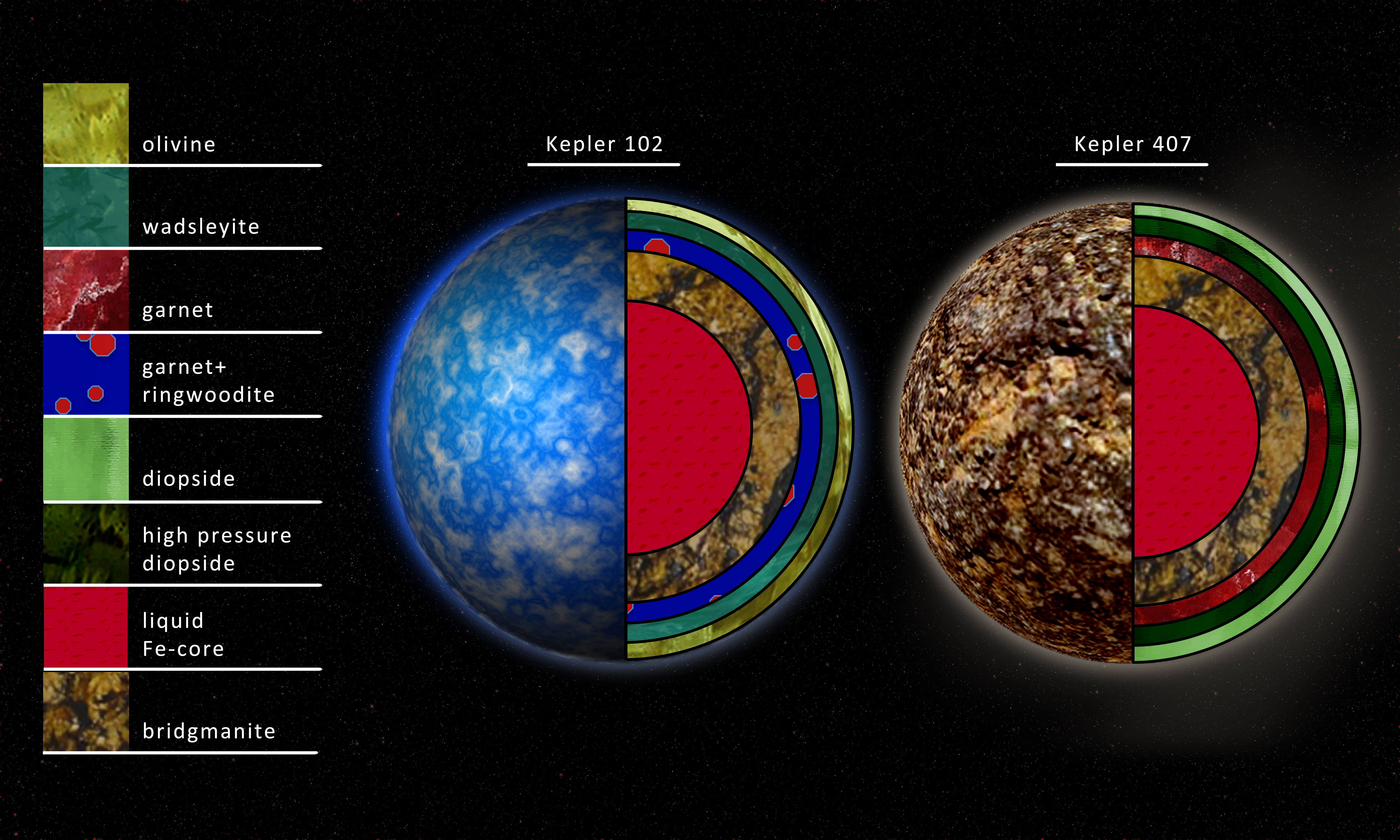
Artist rendition of interior compositions of planets around the stars Kepler 102 and Kepler 407.

The picture shows what minerals are likely to occur several different depths. Kepler 102 is Earth-like, dominated by olivine minerals, whereas Kepler 407 is dominated by garnet, so less likely to have plate tectonics.Click here for a larger version. Image Credit: Robin Dienel, Carnegie DTM


What makes a rocky planet Earth-like?

Astronomers and geoscientists have joined forces using data from the Sloan Digital Sky Survey (SDSS) to study the mix of elements in exoplanet host stars, and to consider what this reveals about their planets.

In results presented today at the American Astronomical Society (AAS) meeting in Grapevine, Texas, astronomer Johanna Teske explained, “our study combines new observations of stars with new models of planetary interiors. We want to better understand the diversity of small, rocky exoplanet composition and structure — how likely are they to have plate tectonics or magnetic fields?”

Earth-sized planets have been found around many stars — but Earth-sized does not necessarily mean Earth-like. Some of these Earth-sized planets have been found orbiting stars with chemical compositions quite different from our Sun, and those differences in chemistry could have important consequences.

Astronomers in the Sloan Digital Sky Survey have made these observations using the APOGEE (Apache Point Observatory Galactic Evolution Experiment) spectrograph on the 2.5m Sloan Foundation Telescope at Apache Point Observatory in New Mexico. This instrument collects light in the near-infrared part of the electromagnetic spectrum and disperses it, like a prism, to reveal signatures of different elements in the atmospheres of stars. A fraction of the almost 200,000 stars surveyed by APOGEE overlap with the sample of stars targeted by the NASA Kepler mission, which was designed to find potentially Earth-like planets. The work presented today focuses on ninety Kepler stars that show evidence of hosting rocky planets, and which have also been surveyed by APOGEE. 

In particular, Teske and colleagues presented solar systems around the stars Kepler 102 and Kepler 407. Kepler 102 is slightly less luminous than the Sun and has five known planets; Kepler 407 is a star almost identical in mass to the Sun and hosts at least two planets, one with a mass less than 3 Earth masses.

“Looking at these two exoplanet systems in particular,” Teske explains, “we determined that Kepler 102 is like the Sun, but Kepler 407 has a lot more silicon.”

To understand what a lot more silicon might mean for the planets around Kepler 407, astronomers turned to geophysicists for help. Cayman Unterborn of Arizona State University ran computer models of planet formation. “We took the star compositions found by APOGEE and modeled how the elements condensed into planets in our models. We found that the planet around Kepler 407, which we called ‘Janet,” would likely be rich in the mineral garnet. The planet around Kepler 102, which we called ‘Olive,’ is probably rich in olivine, like Earth.”

That seemingly-small difference in minerals might have major consequences for Janet and Olive. Garnet is a stiffer mineral than olivine, so it flows more slowly. Unterborn explains that this means that a garnet planet like Janet would be much less likely to have long-term plate tectonics. “To sustain plate tectonics over geologic timescales, a planet must have the right mineral composition,” Unterborn says.

Plate tectonics is believed to be essential for life on Earth, because of how volcanoes and ocean ridges recycle elements between Earth’s crust and mantle. This recycling regulates the composition of our atmosphere. Wendy Panero of the School of Earth Sciences at The Ohio State University says that “without these geological processes, life may not have had the chance to evolve on Earth.” 

Determining the likelihood of such geological processes on other planets will help distinguish which ones are the best targets for future missions searching for signs of life. “If we’re looking for a needle,” Panero says, “why not start in the sewing box?”

The next step in the team’s research is to extend this study to all of the stars observed by APOGEE that host small planets. That extension would allow astronomers to map out a wider range of planet compositions and structures to find those most likely to be Earth-like in their mineral content. Teske concludes, “As we’ve learned more about the Earth, we have learned about how many pieces come together to make it habitable. How often will exoplanets get that lucky?”


Saturday, January 07, 2017

Hubble Detects 'Exocomets' Taking the Plunge into a Young Star

Exocomets Plunging into Star (Artist's Illustration)
This illustration shows several comets speeding across a vast protoplanetary disk of gas and dust and heading straight for the youthful, central star. These "kamikaze" comets will eventually plunge into the star and vaporize. The comets are too small to photograph, but their gaseous spectral "fingerprints" on the star's light were detected by NASA's Hubble Space Telescope. The gravitational influence of a suspected Jupiter-sized planet in the foreground may have catapulted the comets into the star.

This star, called HD 172555, represents the third extrasolar system where astronomers have detected doomed, wayward comets. The star resides 95 light-years from Earth.  Credits: NASA, ESA, and A. Feild and G. Bacon (STScI). Hi-res image


Interstellar forecast for a nearby star: Raining comets! NASA's Hubble Space Telescope has discovered comets plunging into the star HD 172555, which is a youthful 23 million years old and resides 95 light-years from Earth.

The exocomets — comets outside our solar system — were not directly seen around the star, but their presence was inferred by detecting gas that is likely the vaporized remnants of their icy nuclei.

HD 172555 represents the third extrasolar system where astronomers have detected doomed, wayward comets. All of these systems are young, under 40 million years old.

The presence of these doomed comets provides circumstantial evidence for "gravitational stirring" by an unseen Jupiter-size planet, where comets deflected by the massive object's gravity are catapulted into the star. These events also provide new insights into the past and present activity of comets in our solar system. It's a mechanism where infalling comets could have transported water to Earth and the other inner planets of our solar system.

Astronomers have found similar plunges in our own solar system. Sun-grazing comets routinely fall into our sun. "Seeing these sun-grazing comets in our solar system and in three extrasolar systems means that this activity may be common in young star systems," said study leader Carol Grady of Eureka Scientific Inc., in Oakland, California, and NASA's Goddard Space Flight Center in Greenbelt, Maryland. "This activity at its peak represents a star's active teenage years. Watching these events gives us insight into what probably went on in the early days of our solar system, when comets were pelting the inner solar system bodies, including Earth. In fact, these star-grazing comets may make life possible, because they carry water and other life-forming elements, such as carbon, to terrestrial planets."

Grady will present her team's results Jan. 6 at the winter meeting of the American Astronomical Society in Grapevine, Texas.

The star is part of the Beta Pictoris Moving Group, a collection of stars born from the same stellar nursery. It is the second group member found to harbor such comets. Beta Pictoris, the group's namesake, also is feasting on exocomets travelling too close. A young gas-giant planet has been observed in that star's vast debris disk.

The Beta Pictoris Moving Group is important to study because it is the closest collection of young stars to Earth. At least 37.5 percent of the more massive stars in the group either have a directly imaged planet, such as 51 Eridani b in the 51 Eridani system, or infalling star-grazing bodies, or, in the case of Beta Pictoris, both types of objects. The grouping is around the age where it should be building terrestrial planets, Grady said.

A team of French astronomers first discovered exocomets transiting HD 172555 in archival data gathered between 2004 and 2011 by the European Southern Observatory's HARPS (High Accuracy Radial velocity Planet Searcher) spectrograph. A spectrograph divides light into its component colors, allowing astronomers to detect an object's chemical makeup. The HARPS spectrograph detected the chemical fingerprints of calcium imprinted in the starlight, evidence that comet-like objects were falling into the star.

As a follow-up to that discovery, Grady's team used Hubble's Space Telescope Imaging Spectrograph (STIS) and the Cosmic Origins Spectrograph (COS) in 2015 to conduct a spectrographic analysis in ultraviolet light, which allows Hubble to identify the signature of certain elements. Hubble made two observations, separated by six days.

Hubble detected silicon and carbon gas in the starlight. The gas was moving at about 360,000 miles per hour across the face of the star. The most likely explanation for the speedy gas is that Hubble is seeing material from comet-like objects that broke apart after streaking across the star's disk.

The gaseous debris from the disintegrating comets is vastly dispersed in front of the star. "As transiting features go, this vaporized material is easy to see because it contains very large structures," Grady said. "This is in marked contrast to trying to find a small, transiting exoplanet, where you're looking for tiny dips in the star's light."

Hubble gleaned this information because the HD 172555 debris disk surrounding the star is viewed close to edge-on through the disk, giving the telescope a clear view of comet activity.

Grady's team hopes to use STIS again in follow-up observations to look for oxygen and hydrogen, which would confirm the identity of the disintegrating objects as comets.

"Hubble shows that these star-grazers look and move like comets, but until we determine their composition, we cannot confirm they are comets," Grady said. "We need additional data to establish whether our star-grazers are icy like comets or more rocky like asteroids."

 
Contact

Donna Weaver / Ray Villard
Space Telescope Science Institute, Baltimore, Maryland
410-338-4493 / 410-338-4514

dweaver@stsci.edu / villard@stsci.edu

Carol Grady
Eureka Scientific Inc., Oakland, California,
and Goddard Space Flight Center, Greenbelt, Maryland
301-286-3748

carol.a.grady@nasa.gov


Newly formed stars shooting out strong whirlwinds

Newly formed stars shooting out strong whirlwinds

Researchers from, among others, ASTRON and the Niels Bohr Institute in Denmark have used the ALMA-telescope in order to observe the earliest stages in the formation of a new solar system. For the first time, they observed how strong "whirlwinds" shooting from the rotating cloud of gas and dust. The results will be presented on 15 December in the scientific journal Nature.

A new solar system is formed in a large cloud of gas and dust, which contracts as a result of the force of gravity and becomes denser. This ultimately produces a hot gaseous sphere in the middle, a star. Surrounding the star forms a disk in which the material gradually clumps together and eventually planets are formed.

It has long been known that newly formed stars, called protostars, are accompanied by whirlwinds and jets. But until now no one observed how these winds form.

"With the ALMA-telescopes we have observed a protostar in a very early phase. We see how the wind lifts material and gas from the rotating disk like a tornado, which is in the process of forming a new solar system." Explains Per Bjerkeli, post doc in Astrophysics and Planet-research of the Niels Bohr Institute at University of Copenhagen as well as Chalmers Technical University in Sweden.

The ALMA-observatory (Atacama Large Millimeter/submillimeter Array) consists of 66 telescopes, that together observe as if they were a single mirror with a diameter of 16 kilometers. The observed protostar is located 450 light years away. The enormous size of ALMA has made it possible for researchers to capture details that had never been seen before.

Slowing down

"Under the contraction of the gas cloud, material starts rotating faster and faster in the same way an ice skater can rotate faster by pulling the arms in toward the body. To slow this rotation the energy needs to be carried away. That is done by the wind ejected by the new star. The wind is formed in the disk and rotates together with it. When the rotating wind moves further away from the protostar it brings part of the rotation energy with it so that the protostar can continue collapsing", explains Per Bjerkeli.

Previously, it has been suggested that the rotating wind arose in the middle of the rotating gas and dust disk, but the new observations show something different.

"We can see that the rotating wind is spewed out from the entire disk, instead of from a small area very close to the young star. As in a tornado, the material is being lifted from the disk, and at some point the wind leaves the cloud. As a result, the rotation in the disk slows down and material gets a chance to form new planets, "explains Jes Jørgensen, associate professor at the University of Copenhagen.

"Future observations with ALMA and other telescopes will tell us more about the formation of galaxies around these and other protostars," explains Matthijs van der Wiel, 'telescope scientist' at ASTRON. "The next question for us is whether the regurgitated material is completely blown away by the wind, or that part of it can fall back on the disk and re-enters the planet-forming system."

Article: P. Bjerkeli, M.H.D. van der Wiel, D. Harsono, J.P. Ramsey, J.K. Jørgensen. Resolved images of a protostellar outflow driven by an extended disk wind. Nature 540, 406-409 (2016). http://dx.doi.org/10.1038/nature20600


Friday, January 06, 2017

Abell 3411 and 3412: Astronomers Discover Powerful Cosmic Double Whammy

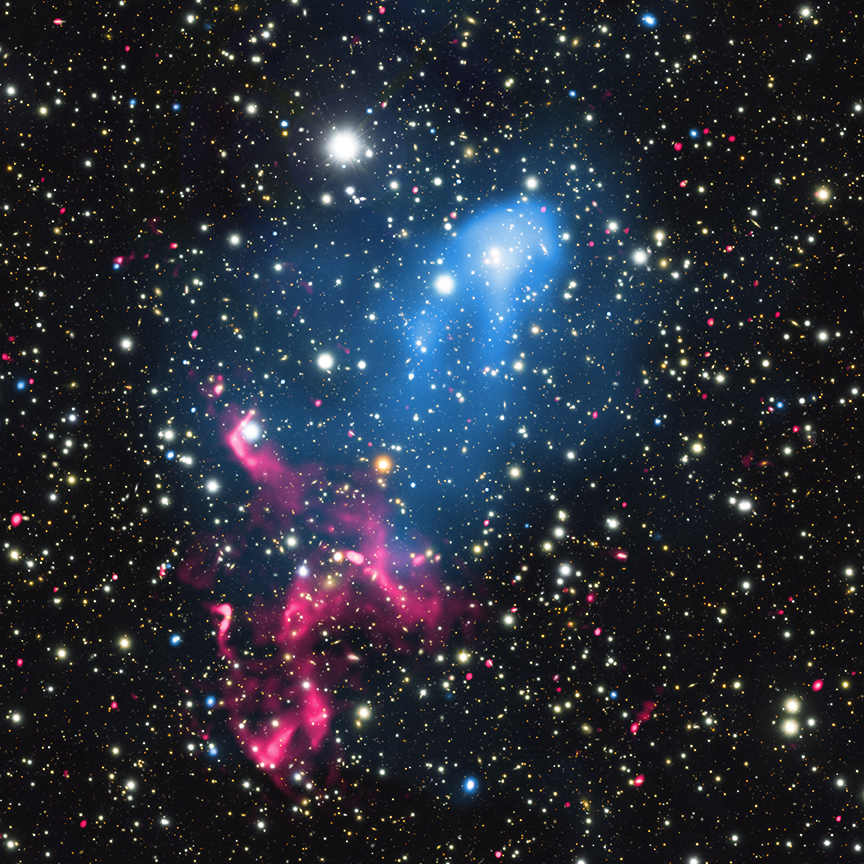
  Abell 3411 and Abell 3412 
(Credit: X-ray: NASA/CXC/SAO/R. van Weeren et al;
 Optical: NAOJ/Subaru; Radio: NCRA/TIFR/GMRT)


animation


Using data from NASA's Chandra X-ray Observatory and several other telescopes, astronomers have discovered a cosmic one-two punch unlike any ever seen in a pair of colliding galaxy clusters called Abell 3411 and Abell 3412. This result, described in our latest press release, shows that an eruption from a supermassive black hole combined with a galaxy cluster merger can create a stupendous cosmic particle accelerator.

This composite image contains X-rays from Chandra (blue) that reveals diffuse emission from multi-million-degree gas in the two clusters. The comet-shaped appearance of the hot gas provides clear evidence that the two clusters are colliding and merging. The "head" of the comet is hot gas from one cluster plowing through the hot gas of the other cluster, in the direction shown by the arrow in the labeled image.

Radio emission detected by the Giant Metrewave Radio Telescope in India (red) represents colossal shock waves — cosmic versions of sonic booms generated by supersonic aircraft — produced by the collision of the hot gas associated with the galaxy clusters. Optical data from the Subaru telescope atop Mauna Kea, Hawaii, shows galaxies and stars with a range of different colors.

This new image also shows three different supermassive black holes in galaxies located in the merging clusters. The upper one shows that a jet powered by a supermassive black hole is connected to large swirls of radio emission. The team of astronomers thinks this connection provides important information about how the radio emission was produced.

This spinning, supermassive black hole is producing a rotating, tightly-wound magnetic funnel. The powerful electromagnetic fields associated with this structure have accelerated some of the inflowing gas away from the vicinity of the black hole in the form of an energetic, high-speed jet. Then, these accelerated particles in the jet were accelerated again when they encountered the shock waves from the galaxy cluster collision.

Jets from the two other supermassive black holes (see labeled version of image) are likely having the same effect of accelerating particles before they get a second boost from the shock waves. The jets from one of the black holes are too short to be seen in the labeled image.

These results were presented at the 229th meeting of the American Astronomical Society meeting in Grapevine, TX. They were also described in a paper, led by Reinout van Weeren of the Harvard-Smithsonian Center for Astrophysics, which appeared in the inaugural issue of the journal Nature Astronomy on January 4, 2017.

NASA's Marshall Space Flight Center in Huntsville, Alabama, manages the Chandra program for NASA's Science Mission Directorate in Washington. The Smithsonian Astrophysical Observatory in Cambridge, Massachusetts, controls Chandra's science and flight operations.


Fast Facts for Abell 3411 and 3412:

Scale: Image is 17 arcmin across (about 8.15 light years)
Category: Groups & Clusters of Galaxies, Black Holes
Coordinates (J2000): RA 08h 41m 47.69s | Dec -17° 28' 45.84"
Constellation: Hydra
Observation Date: 26 Jan 2006
Observation Time: 45 hours 46 min
Obs. ID: 17193, 17496, 17497, 17583-17585
Instrument: ACIS
References: van Weeren, R. et al, 2017, Nature Astronomy
Color Code: X-ray (Blue), Optical (Red, Green, Blue), Radio (Pink)
Distance Estimate: About 2 billion light years


When galaxies collide

Credit: ESA/Hubble & NASA


This delicate smudge in deep space is far more turbulent than it first appears. Known as IRAS 14348-1447 — a name  derived in part from that of its discoverer, the Infrared Astronomical Satellite (IRAS for short) — this celestial object is actually a combination of two gas-rich spiral galaxies. This doomed duo approached one another too closely in the past, gravity causing them to affect and tug at each other and slowly, destructively, merge into one. The image was taken by Hubble’s Advanced Camera for Surveys (ACS).

IRAS 14348-1447 is located over a billion light-years away from us. It is one of the most gas-rich examples known of an ultraluminous infrared galaxy, a class of cosmic objects that shine characteristically — and incredibly — brightly in the infrared part of the spectrum. Almost 95% of the energy emitted by IRAS 14348-1447 is in the far-infrared!

The huge amount of molecular gas within IRAS 14348-1447 fuels its emission, and undergoes a number of dynamical processes as it interacts and moves around; these very same mechanisms are responsible for IRAS 14348-1447’s own whirling and ethereal appearance, creating prominent tails and wisps extending away from the main body of the galaxy.


Thursday, January 05, 2017

Chandra Deep Field South : Deepest X-ray Image Ever Reveals Black Hole Treasure Trove

Chandra Deep Field South
Credit: X-ray: NASA/CXC/Penn State/B.Luo et al.

animation


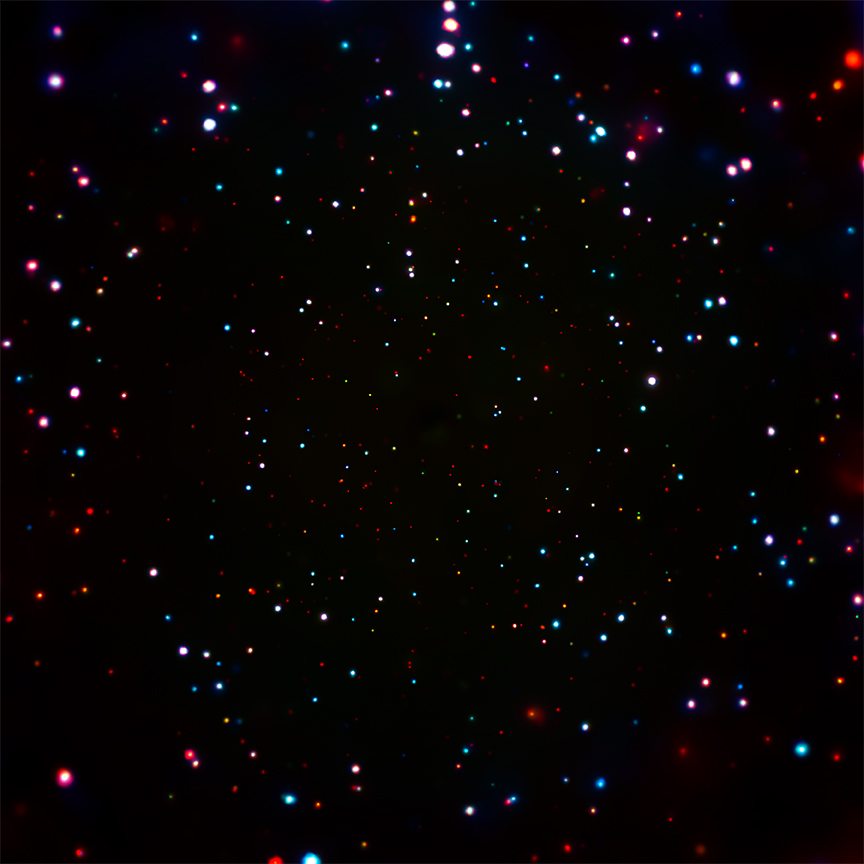
This is the deepest X-ray image ever obtained, made with over 7 million seconds of observing time with NASA's Chandra X-ray Observatory. These data give astronomers the best look yet at the growth of black holes over billions of years beginning soon after the Big Bang, as described in our latest press release.

The image is from the Chandra Deep Field-South, or CDF-S. The full CDF-S field covers an approximately circular region on the sky with an area about two-thirds that of the full Moon. However, the outer regions of the image, where the sensitivity to X-ray emission is lower, are not shown here. The colors in this image represent different levels of X-ray energy detected by Chandra. 

Here the lowest-energy X-rays are red, the medium band is green, and the highest-energy X-rays observed by Chandra are blue.

The central region of this image contains the highest concentration of supermassive black holes ever seen, equivalent to about 5,000 objects that would fit into the area of the full Moon and about a billion over the entire sky.

Researchers used the CDF-S data in combination with data from the Cosmic Assembly Near-Infrared Deep Extragalactic Legacy Survey (CANDELS) and the Great Observatories Origins Deep Survey (GOODS), both including data from NASA's Hubble Space Telescope to study galaxies and black holes between one and two billion years after the Big Bang.

In one part of the study, the team looked at the X-ray emission from galaxies detected in the Hubble images, at distances between 11.9 and 12.9 billion light years from Earth. About 50 of these distant galaxies were individually detected with Chandra. The team then used a technique called X-ray stacking to investigate X-ray emission from the 2,076 distant galaxies that were not individually detected. They added up all the X-ray counts near the positions of these galaxies, enabling much greater sensitivity to be obtained. Through stacking the team were able to achieve equivalent exposure times up to about 8 billion seconds, equivalent to about 260 years.

Using these data, the team found evidence that black holes in the early Universe grow mostly in bursts, rather than via the slow accumulation of matter. The team may have also found hints about the types of seeds that form supermassive black holes. If supermassive black holes are born as "light" seeds weighing about 100 times the Sun's mass, the growth rate required to reach a mass of about a billion times the Sun in the early Universe may be so high that it challenges current models for such growth. If supermassive black holes are born with more mass, the required growth rate is not as high. 

The data in the CDF-S suggest that the seeds for supermassive black holes may be "heavy" with masses about 10,000 to 100,000 times that of the Sun.

Such deep X-ray data like those in the CDF-S provide useful insights for understanding the physical properties of the first supermassive black holes. The relative number of luminous and faint objects — in what astronomers call the shape of the "luminosity function" — depends on the mixture of the several physical quantities involved in black hole growth, including the mass of the black hole seeds and the rate at which they are pulling in material. The CDF-S data show a rather "flat" luminosity function (i.e., a relative large number of bright objects) that can be used to infer possible combinations of these physical quantities. However, definitive results can only come from further observations.

The paper on black hole growth in the early Universe was led by Fabio Vito of Pennsylvania State University in University Park, Penn and was published in an August 10th, 2016 issue of the Monthly Notices of the Royal Astronomical Society. It is available online [https://arxiv.org/abs/1608.02614]. 

The survey paper was led by Bin Luo, also of Penn State and was recently accepted for publication in The Astrophysical Journal Supplement Series. It is also available online [https://arxiv.org/abs/1611.03501]


Fast Facts for Chandra Deep Field South :

Scale: Image is 16 arcmin across (about 8.15 light years)
Category: Cosmology/Deep Fields/X-ray Background, Black Holes
Coordinates (J2000): RA 03h 32m 28s | Dec -27° 48' 30.00
Constellation: Fornax
Observation Date: 102 pointings between 1999 and 2016
Observation Time: 1944 hours 27 min
Obs. ID: 1431, 441, 582, 1672, 2239, 2312, 2313, 2405, 2406, 2409, 8591-8597, 9575, 9578, 9593, 9596, 9718, 12043-12055, 12123, 12128, 12129, 12135, 12137, 12138, 12213, 12218-12220, 12222, 12223, 12227, 12230-12234, 16175-16191, 16450-16463, 16620, 16641, 16644, 17416, 17417, 17535, 17542, 17546, 17552, 17556, 17573, 17633, 17634, 17677, 18709, 18719, 18730
Instrument: ACIS
References: Luo, B. et al, 2016, ApJS (in press); arXiv:1611.03501; Vito, F. et al, 2016, MNRAS, 463, 348; arXiv:1608.02614
Color Code: X-ray (Red, Green, Blue)
Distance Estimate: About 9 to 11 billion light years


Home Galaxy of a Fast Radio Burst Identified

A number of radio telescopes weere used within the European VLBI Network (EVN) to observe FRB 121102 (Artist’s impression).


 For the first time astronomers have exactly pinpointed the location of a "fast radio burst" - a type of short-duration radio flash of unknown astrophysical origin - and have used this to identify its home galaxy. The galaxy, located over 3 billion light years away, is small, a so-called dwarf galaxy, and very different to our own Milky Way. Also, a persistent, compact radio source is close to the source of the bursts, which provides important insights into its astrophysical origin. The results from an international team, including Laura Spitler from the Max-Planck-Institute for Radio Astronomy in Bonn, Germany, appear today in three publications in Nature and the Astrophysical Journal Letters.

Fast Radio Bursts (FRBs) are visible for only a fraction of a second, and have puzzled astronomers since their discovery a decade ago. Precise localization of an FRB requires radio telescopes separated by large distances, which allow high resolution images to be made when these telescopes are used in combination with each other. Such follow-up observations were made possible with the first discovery of a repeating source of fast radio bursts, FRB 121102, using the 305-m Arecibo Radio Telescope in Puerto Rico, USA.

Prior to this discovery, astronomers had only indirect evidence that fast radio bursts come from far outside our Milky Way galaxy, because poor localization has prevented them from uniquely identifying their galaxy of origin. The new finding is critical because it has also allowed astronomers to precisely measure the distance to the source, and hence how much energy it is producing.

The Very Large Array in New Mexico, USA detected a total of nine radio bursts from FRB 121102. This determined its sky position to a fraction of an arc second, over 200 times more precise than previous measurements. “Near this position, astronomers found both steady radio and optical sources, which pointed the way to the galaxy hosting the FRB,” says Shami Chatterjee from Cornell University, the first author of the paper in “Nature”.

The team was able to zoom-in on the radio sources with a factor of 10 more precision using the Arecibo Radio Telescope and the European VLBI Network (EVN), which links telescopes spread across the world. "With a bit of luck, we were able to detect bursts from FRB 121102 with the EVN and now we know that the origin of the bursts is right on top of the persistent radio source", says Benito Marcote from JIVE in the Netherlands. The 100-m radio telescope in Effelsberg, Germany, is the largest and most sensitive member of the EVN. "Bursts from this source are faint, and Effelsberg played a key role in making this discovery possible," says Laura Spitler, postdoctoral researcher at the Max-Planck-Institute for Radio Astronomy (MPIfR), who discovered FRB 121102.

The team used one of the world's largest optical telescopes, the 8-m Gemini North on Mauna Kea in Hawaii, to discover that the bursts originate from a host galaxy, and use its measured spectrum to obtain a redshift value which places the source at a whopping distance of over 3 billion light-years. "This gives us incontrovertible confirmation that this FRB originates very deep in extragalactic space,” says co-author Cees Bassa (ASTRON). Though the mystery of the FRB’s distance is now solved, astronomers have a new puzzle on their hands. The galaxy hosting the FRB is surprisingly small - a so-called dwarf galaxy.

The fact that FRB 121102 is hosted by a dwarf galaxy may be a vital clue to its physical nature. Such galaxies contain gas that is relatively pristine compared to that found in the Milky Way. "The conditions in this dwarf galaxy are such that it may be possible to form much more massive stars than in the Milky Way, and perhaps the source of the FRB bursts is from the collapsed remnant of such a star," suggests co-author Jason Hessels (ASTRON, University of Amsterdam).

Alternatively, astronomers are considering a very different hypothesis in which the FRB bursts are generated in the vicinity of a massive black hole that is swallowing surrounding gas, a so-called active galactic nucleus.

To try and differentiate between these two scenarios, astronomers are continuing to study FRB 121102 using the world's premier radio, optical, X-ray and gamma-ray telescopes. "For example, if we can find a periodicity to the arrival of the bursts, then we will have strong evidence that it originates from a rotating neutron star", says Laura Spitler.

Deciphering the origin of the FRBs will also depend on localizing more such sources, and astronomers are debating whether all FRBs detected to date are of a similar physical origin or whether there are multiple classes of this new cosmic phenomenon.


The 100-m Effelsberg Radio Telescope of the Max Planck Institute for Radio Astronomy is located in a valley approximately 40 kilometers southwest of Bonn, Germany.

The European VLBI Network (EVN) is a collaboration of the major radio astronomical institutes in Europe, Asia and South Africa and performs high angular resolution observations of cosmic radio sources.

The 305-m William E. Gordon Telescope of the Arecibo Observatory is located close to Arecibo in Puerto Rico, USA.

The Karl G. Jansky Very Large Array consists of 27 radio antennas in a Y-shaped configuration on the Plains of San Agustin fifty miles west of Socorro, New Mexico, USA. Each antenna is 25 meters (82 feet) in diameter.


Local Contact

Dr. Laura Spitler
Phone:+48 228 525-314
Email: lspitler@mpifr-bonn.mpg.de
Max-Planck-Institut für Radioastronomie, Bonn

Prof. Dr. Michael Kramer
Direktor und Leiter der Forschungsabteilung "Radioastronomische Fundamentalphysik"
Phone:+49 228 525-278
Email: mkramer@mpifr-bonn.mpg.de
Max-Planck-Institut für Radioastronomie, Bonn

Dr. Norbert Junkes
Press and Public Outreach
Phone:+49 228 525-399
Email: njunkes@mpifr-bonn.mpg.de

Max-Planck-Institut für Radioastronomie, Bonn


Original Paper  

A direct localization of a fast radio burst and its host
S. Chatterjee et al., Nature, 05 January 2017.

The host galaxy and redshift of the repeating fast radio burst 121102
S. P. Tendulkar et al., The Astrophysical Journal Letters, Volume 834, Number 2 (January 04, 2017)

The repeating fast radio burst 121102 as seen on milliarcsecond angular scales
B. Marcote et al., The Astrophysical Journal Letters, Volume 834, Number 2 (January 04, 2017)


Links

Mysterious Cosmic Radio Bursts found to Repeat
MPIfR Press Release, March 02, 2016 (Spitler et al. 2016, Nature 531, 202-205)

Radio-burst discovery deepens astrophysics mystery
MPIfR Press Release, July 10, 2014 (Spitler et al. 2014, ApJ 790, 101)

Radioastro­nomische Fundamental­physik
Research Department "Fundamental Physics in Radio Astronomy" at MPIfR, Bonn, Germany

Radio Telescope Effelsberg
Effelsberg Radio Telescope

EVN
European VLBI Network

Arecibo
Arecibo Radio Observatory

VLA
Karl G. Jansky Very Large Array (VLA)

ASTRON
Netherlands Institute for Radio Astronomy (ASTRON), Dwingeloo, The Netherlands

JIVE
Joint Institute for VLBI in Europe (JIVE)

GEMINI
GEMINI Observatory, Hawaii & Chile


Wednesday, January 04, 2017

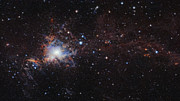
Hidden Secrets of Orion’s Clouds

The Orion A molecular cloud from VISTA

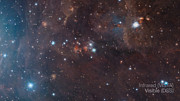
Highlights from VISTA image of Orion A


Videos

ESOcast 90 Light – Orion’s Cloudy Secrets 4K UHD

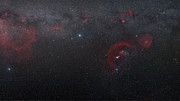
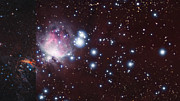
Visible/infrared comparison of views of the Orion A molecular cloud

Zooming in on a new VISTA image of the Orion A molecular cloud

Slider comparison of visible and infrared views of the Orion A molecular cloud


VISTA survey gives most detailed view of Orion A molecular cloud in the near-infrared

This spectacular new image is one of the largest near-infrared high-resolution mosaics of the Orion A molecular cloud, the nearest known massive star factory, lying about 1350 light-years from Earth. It was taken using the VISTA infrared survey telescope at ESO’s Paranal Observatory in northern Chile and reveals many young stars and other objects normally buried deep inside the dusty clouds.

The new image from the VISION survey (VIenna Survey In Orion) is a montage of images taken in the near-infrared part of the spectrum [1] by the VISTA survey telescope at ESO’s Paranal Observatory in Chile. It covers the whole of the Orion A molecular cloud, one of the two giant molecular clouds in the Orion molecular cloud complex (OMC). Orion A extends for approximately eight degrees to the south of the familiar part of Orion known as the sword [2].

VISTA is the world’s largest dedicated survey telescope, and has a large field of view imaged with very sensitive infrared detectors, characteristics that made it ideal for obtaining the deep, high-quality infrared images required by this ambitious survey.

The VISION survey has resulted in a catalogue containing almost 800 000 individually identified stars, young stellar objects and distant galaxies, This represents better depth and coverage than any other survey of this region to date [3].

VISTA can see light that the human eye cannot, allowing astronomers to identify many otherwise hidden objects in the stellar nursery. Very young stars that cannot be seen in visible-light images are revealed when observed at longer infrared wavelengths, where the dust that shrouds them is more transparent.

The new image represents a step towards a complete picture of the star formation processes in Orion A, for both low and high mass stars. The most spectacular object is the glorious Orion Nebula, also called Messier 42 [4] seen towards the left of the image. This region forms part of the sword of the famous bright constellation of Orion (The Hunter). The VISTA catalogue covers both familiar objects and new discoveries. These include five new young stellar object candidates and ten candidate galaxy clusters.

Elsewhere in the image, we can look into Orion A’s dark molecular clouds and spot many hidden treasures, including discs of material that could give birth to new stars (pre-stellar discs), nebulosity associated with newly-born stars (Herbig-Haro objects), smaller star clusters and even galaxy clusters lying far beyond the Milky Way. The VISION survey allows the earliest evolutionary phases of young stars within nearby molecular clouds to be systematically studied.

This impressively detailed image of Orion A establishes a new observational foundation for further studies of star and cluster formation and once again highlights the power of the VISTA telescope to image wide areas of sky quickly and deeply in the near-infrared part of the spectrum [5].


Notes


[1] The VISION survey covers approximately 18.3 square degrees at a scale of about one-third of an arcsecond per pixel.

[2] The other giant molecular cloud in the Orion Molecular Cloud is Orion B, which lies east of Orion’s Belt.

[3] The complete VISION survey includes an even larger region than is shown in this picture, which covers 39 578 x 23 069 pixels.

[4] The Orion nebula was first described in the early seventeenth century although the identity of the discoverer is uncertain. The French comet-hunter Messier made an accurate sketch of its main features in the mid-eighteenth century and gave it the number 42 in his famous catalogue. He also allocated the number 43 to the smaller detached region just north of the main part of the nebula. Later William Herschel speculated that the nebula might be “the chaotic material of future suns” and astronomers have since discovered that the mist is indeed gas glowing in the fierce ultraviolet light from young hot stars that have recently formed there.

[5] The successful VISION survey of Orion will be followed by a new, bigger public survey of other star-forming regions with VISTA, called VISIONS, which will start in April 2017.


More Information

This research is presented in a paper entitled “VISION - Vienna survey in Orion I. VISTA Orion A Survey”, by S. Meingast et al., published in the journal Astronomy & Astrophysics.

The team is composed of: Stefan Meingast (University of Vienna, Vienna, Austria), João Alves (University of Vienna, Vienna, Austria), Diego Mardones (Universidad de Chile, Santiago, Chile) , Paula Teixeira (University of Vienna, Vienna, Austria), Marco Lombardi (University of Milan, Milan, Italy), Josefa Großschedl (University of Vienna, Vienna, Austria), Joana Ascenso (CENTRA, Universidade de Lisboa, Lisbon, Portugal; Universidade do Porto, Porto, Portugal), Herve Bouy (Centro de Astrobiología, Madrid, Spain), Jan Forbrich (University of Vienna, Vienna, Austria), Alyssa Goodman (Harvard-Smithsonian Center for Astrophysics, Cambridge MA, USA), Alvaro Hacar (University of Vienna, Vienna, Austria), Birgit Hasenberger (University of Vienna, Vienna, Austria), Jouni Kainulainen (Max-Planck-Institute for Astronomy, Heidelberg, Germany), Karolina Kubiak (University of Vienna, Vienna, Austria), Charles Lada (Harvard-Smithsonian Center for Astrophysics, Cambridge, USA), Elizabeth Lada (University of Florida, Gainesville, USA), André Moitinho (SIM/CENTRA, Universidade de Lisboa, Lisbon, Portugal), Monika Petr-Gotzens (ESO, Garching, Germany), Lara Rodrigues (Universidad de Chile, Santiago, Chile) and Carlos G. Román-Zúñiga (UNAM, Ensenada, Baja California, Mexico).

ESO is the foremost intergovernmental astronomy organisation in Europe and the world’s most productive ground-based astronomical observatory by far. It is supported by 16 countries: Austria, Belgium, Brazil, the Czech Republic, Denmark, France, Finland, Germany, Italy, the Netherlands, Poland, Portugal, Spain, Sweden, Switzerland and the United Kingdom, along with the host state of Chile. ESO carries out an ambitious programme focused on the design, construction and operation of powerful ground-based observing facilities enabling astronomers to make important scientific discoveries. ESO also plays a leading role in promoting and organising cooperation in astronomical research. ESO operates three unique world-class observing sites in Chile: La Silla, Paranal and Chajnantor. At Paranal, ESO operates the Very Large Telescope, the world’s most advanced visible-light astronomical observatory and two survey telescopes. VISTA works in the infrared and is the world’s largest survey telescope and the VLT Survey Telescope is the largest telescope designed to exclusively survey the skies in visible light. ESO is a major partner in ALMA, the largest astronomical project in existence. And on Cerro Armazones, close to Paranal, ESO is building the 39-metre European Extremely Large Telescope, the E-ELT, which will become “the world’s biggest eye on the sky”.


Links


Contacts

Richard Hook
ESO Public Information Officer
Garching bei München, Germany
Tel: +49 89 3200 6655
Email:
rhook@eso.org

Source: ESO 

NASA Selects Mission to Study Black Holes, Cosmic X-ray Mysteries


NASA has selected a science mission that will allow astronomers to explore, for the first time, the hidden details of some of the most extreme and exotic astronomical objects, such as stellar and supermassive black holes, neutron stars and pulsars.

Objects such as black holes can heat surrounding gases to more than a million degrees. The high-energy X-ray radiation from this gas can be polarized – vibrating in a particular direction. The Imaging X-ray Polarimetry Explorer (IXPE) mission will fly three space telescopes with cameras capable of measuring the polarization of these cosmic X-rays, allowing scientists to answer fundamental questions about these turbulent and extreme environments where gravitational, electric and magnetic fields are at their limits.

“We cannot directly image what’s going on near objects like black holes and neutron stars, but studying the polarization of X-rays emitted from their surrounding environments reveals the physics of these enigmatic objects,” said Paul Hertz, astrophysics division director for the Science Mission Directorate at NASA Headquarters in Washington. “NASA has a great history of launching observatories in the Astrophysics Explorers Program with new and unique observational capabilities. IXPE will open a new window on the universe for astronomers to peer through. Today, we can only guess what we will find.”

NASA's Astrophysics Explorers Program requested proposals for new missions in September 2014. Fourteen proposals were submitted, and three mission concepts were selected for additional review by a panel of agency and external scientists. NASA determined the IXPE proposal provided the best science potential and most feasible development plan.

The mission, slated for launch in 2020, will cost $188 million. This figure includes the cost of the launch vehicle and post-launch operations and data analysis. Principal Investigator Martin Weisskopf of NASA’s Marshall Space Flight Center in Huntsville, Alabama, will lead the mission. Ball Aerospace in Broomfield, Colorado, will provide the spacecraft and mission integration. The Italian Space Agency will contribute the polarization sensitive X-ray detectors, which were developed in Italy.

NASA's Explorers Program provides frequent, low-cost access to space using principal investigator-led space science investigations relevant to the agency’s astrophysics and heliophysics programs. The program has launched more than 90 missions, including Explorer 1 in 1958, which discovered the Van Allen radiation belts around the Earth, and the Cosmic Background Explorer mission, which led to a Nobel Prize. NASA's Goddard Space Flight Center in Greenbelt, Maryland, manages the Explorers Program for the agency's Science Mission Directorate.


For more information about the Explorers program, visit:  http://explorers.gsfc.nasa.gov

For information about NASA, visit:  http://www.nasa.gov


Felicia Chou
Headquarters, Washington                                                                           
202-358-0257
felicia.chou@nasa.gov


Editor: Karen Northon


Tuesday, January 03, 2017

Interstellar filaments in Polaris

Interstellar filaments in Polaris
Copyright:  ESA and the SPIRE & PACS consortia, Ph. André (CEA Saclay) for the Gould’s Belt Survey Key Programme Consortium, and A. Abergel (IAS Orsay) for the Evolution of Interstellar Dust Key Programme Consortium. Hi-res image


Description: Just as the new calendar year begins, and with it a feeling of new beginnings, so this network of dust and gas shows a portion of sky where star birth is yet to take hold.

This region is in Polaris, 490 light-years away. It was imaged by ESA’s Herschel space observatory in 2011; a colour composite is presented here.

It shows several tens of tangled interstellar filaments. Such filaments can stretch for tens of light-years through space and can precede the onset of star formation, with newborn stars often found in the densest parts.

Embedded within the filaments are a number of denser patches of material, but hardly any currently appear to be the seeds of future stars. As they are now, the filaments are simply not massive enough to support star formation.

Whether or not this currently calm region becomes a stellar nursery in the future remains to be seen.

The region was imaged by Herschel’s Photodetector Array Camera and Spectrometer and Spectral and Photometric Imaging Receiver at infrared wavelengths of 250, 350 and 500 microns.


Monday, January 02, 2017

The Hydrangea project: high-resolution hydrodynamic simulations of galaxy clusters

Why do galaxies that live in the enormous structures known as galaxy clusters look different from normal, isolated galaxies, such as our Milky Way? To answer this question, an international research team led by MPA has created the Hydrangea simulations, a suite of 24 high-resolution cosmological hydrodynamic simulations of galaxy clusters. Containing over 20,000 cluster galaxies in unprecedented detail and accuracy, these simulations provide astrophysicists with a powerful tool to understand how galaxies have formed and evolved in one of the most extreme environments of our Universe.

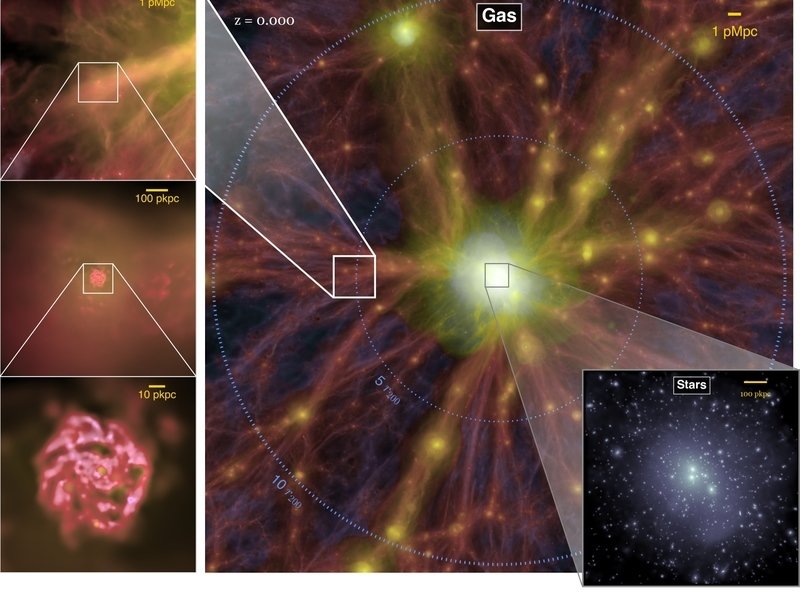
Fig.1: Visualization of the most massive galaxy cluster simulated as part of the Hydrangea project. The brightness of the image represents the gas density, while the colour encodes the temperature of the gas (blue: cold, white: hot). The hundred-million-degree hot gas in the central cluster is surrounded by a vast network of filaments stretching out into the surrounding Universe. Over a dozen smaller galaxy groups on the cluster outskirts are visible as yellow knots. The bottom-right inset shows the simulated stars, which are clumped into hundreds of galaxies in the cluster centre; each small point represents a galaxy similar to the Milky Way containing several hundred billion stars each. The three panels on the left-hand side zoom in to one individual galaxy, highlighting the vast dynamic range of the simulation.  Credit: Yannick Bahé / MPA


Galaxy clusters are giant associations of up to several thousand galaxies, embedded in diffuse hot gas and invisible dark matter (see Fig. 1). Observations have shown that these extreme environments influence the properties of the galaxies within: while isolated galaxies often contain star-forming discs where massive young stars shine in blue, cluster galaxies are mostly yellow or red - indicating that they stopped their star formation several billion years ago. Often, these cluster galaxies present an apparently featureless “elliptical” morphology. Understanding the origin of these differences has been a major unsolved problem in astrophysics for decades.

One key reason for this is that galaxies evolve on timescales of millions to billions of years. Astrophysicists therefore cannot directly observe this process through the telescope, they have to rely on computer simulations to “speed up time” and solve this mystery. Starting from the observed tiny density fluctuations in the early Universe (see Planck CMB results), such simulations calculate the growth of structure through the action of gravity, hydrodynamics, and astrophysical processes such as star formation and supernova explosions.

The latest generation of these simulations - for example, those produced by the EAGLE collaboration that also involved participation from MPA - have finally succeeded in producing galaxies that resemble those found in the real Universe in key properties such as their mass, size, and gas content (see here). In principle, such simulations therefore provide an ideal tool to study the physics of galaxy formation. However, galaxy clusters occupy only a tiny fraction of the Universe by volume and are therefore not well represented in the original EAGLE simulations.

The Hydrangea project, led by Yannick Bahé at MPA and involving researchers in Germany, the UK, the Netherlands, and Spain, has filled this gap with a large suite of 24 simulations of massive galaxy clusters. The project name is derived from the flower “Hydrangea”, whose petals change their colour between red and blue depending on their environment – an analogy to the aforementioned colour difference between field and cluster galaxies. These simulations employ the so-called “zoom-in” technique, which focuses computing power on a relatively small region (with a diameter approximately 100 million light years). This core region was carefully selected to contain a massive galaxy cluster, within a total volume that is many thousand times larger.

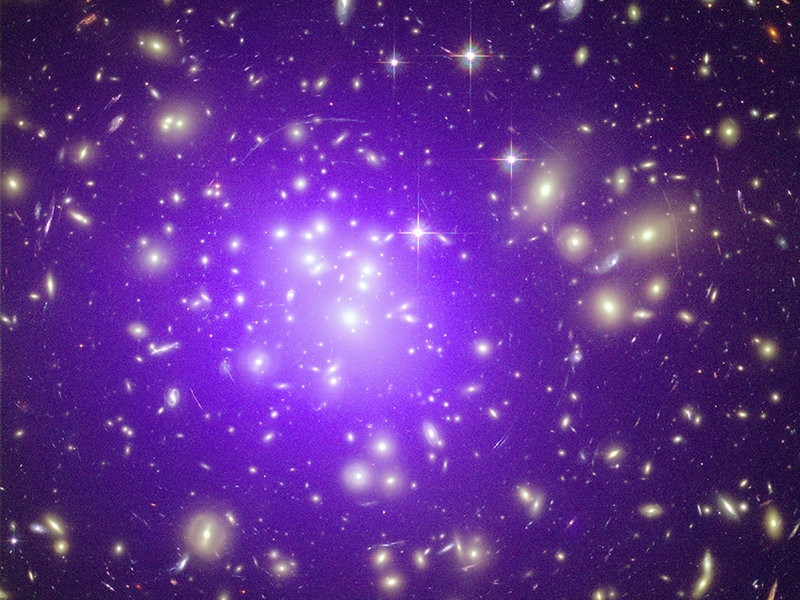
Fig.2: The Galaxy cluster “Abell 1689”, located approximately 2 billion light years away, is one of the most massive clusters in the known Universe. This picture is a composite of an optical image, taken with the Hubble Space Telescope, and an X-ray observation with the Chandra Space Telescope. The former shows starlight from more than 1000 galaxies, the latter (in purple) the hundred-million-degree hot gas which permeates the space between galaxies and contributes more mass to the cluster than all its galaxies together. Credit: X-ray - NASA/CXC/MIT/E.-H Peng et al; Optical - NASA/STScI


Even with this trick, the Hydrangea simulations constituted a major computational effort. This is due to the vast range of scales involved (see Fig. 2): a galaxy cluster exceeds an individual galaxy in mass by more than a factor of 1000. This means that for adequately resolving individual cluster galaxies, the simulations need to follow several billion particles, which interact both gravitationally and hydrodynamically.

The total computational cost of the suite thus exceeded 40 million CPU hours, corresponding to a serial run time of more than 4500 years - as long as the time since the construction of the great pyramids of Giza. Access to large supercomputing facilities, including the “Hazel Hen” system of HLRS (Stuttgart) and “Hydra” at MPCDF (Garching), where the simulations could be run on more than 10,000 CPUs simultaneously, was therefore crucial for completing the project in less than one year. Fig. 2 presents a visualization of one of the simulated galaxy clusters. The video below shows its formation from an initially nearly structureless “blob” over the course of 13.5 billion years.

In total, the Hydrangea simulations contain more than 20,000 galaxies. When the researchers compared them to the existing EAGLE simulations, they found a surprising difference: galaxies are, on average, more massive in the vicinity of galaxy clusters than those formed in more typical, lower density regions of the Universe. At least in part, this difference is likely due to the fact that dark matter haloes (into which all galaxies are embedded) form earlier in the vicinity of clusters. As a consequence, a larger fraction of the gas is concentrated into the star-forming centre, leading to a higher total mass of stars formed. This is an important prediction, not least because astronomers often use stellar mass to compare “similar” galaxies in different environments. Systematic variations in stellar mass fractions with environment could therefore cause biases in such comparisons and must be carefully taken into account.

The full analysis of the simulations is an ongoing effort that will take several years to complete. As well as testing the accuracy of the EAGLE model in the essentially unchartered regime of massive galaxy clusters, this effort will allow astrophysicists to gain ground-breaking new insight into how galaxies interact with their cluster environment. This will significantly improve our understanding of how the structures we see in the Universe formed and evolved over the last 13.7 billion years.


The formation of a galaxy cluster in the Hydrangea simulations
This movie shows the formation of the galaxy cluster shown in Fig. 2 over a period of 13.5 billion years. Starting from a nearly homogeneous structure a few hundred million years after the Big Bang, this first collapses to a sponge-like web. Several “proto-clusters” (yellow-white blobs in the movie) crystallize out of this web, and then successively merge into one massive cluster. These mergers drive shocks, which heat the gas to ever higher temperatures. Also visible are violent outbursts of hot gas from proto-clusters, which are driven by supermassive black holes in their centres.  Credit: Yannick Bahé / MP.

Acknowledgement: The simulations presented in this article were in part performed on the German federal maximum performance computer “HazelHen” at the maximum performance computing centre Stuttgart (HLRS), under project GCS-HYDA / ID 44067 financed through the large scale project “Hydrangea” of the Gauss Center for Supercomputing. Further computing resources were provided by the Max Planck Computing and Data Facility in Garching, and by the DiRAC system “Cosma5” hosted by Durham University (UK).


Bahe, Yannick
Postdoc

Phone: 2236

Fax: 2235


Sunday, January 01, 2017

The Beautiful Messiness of Star Birth

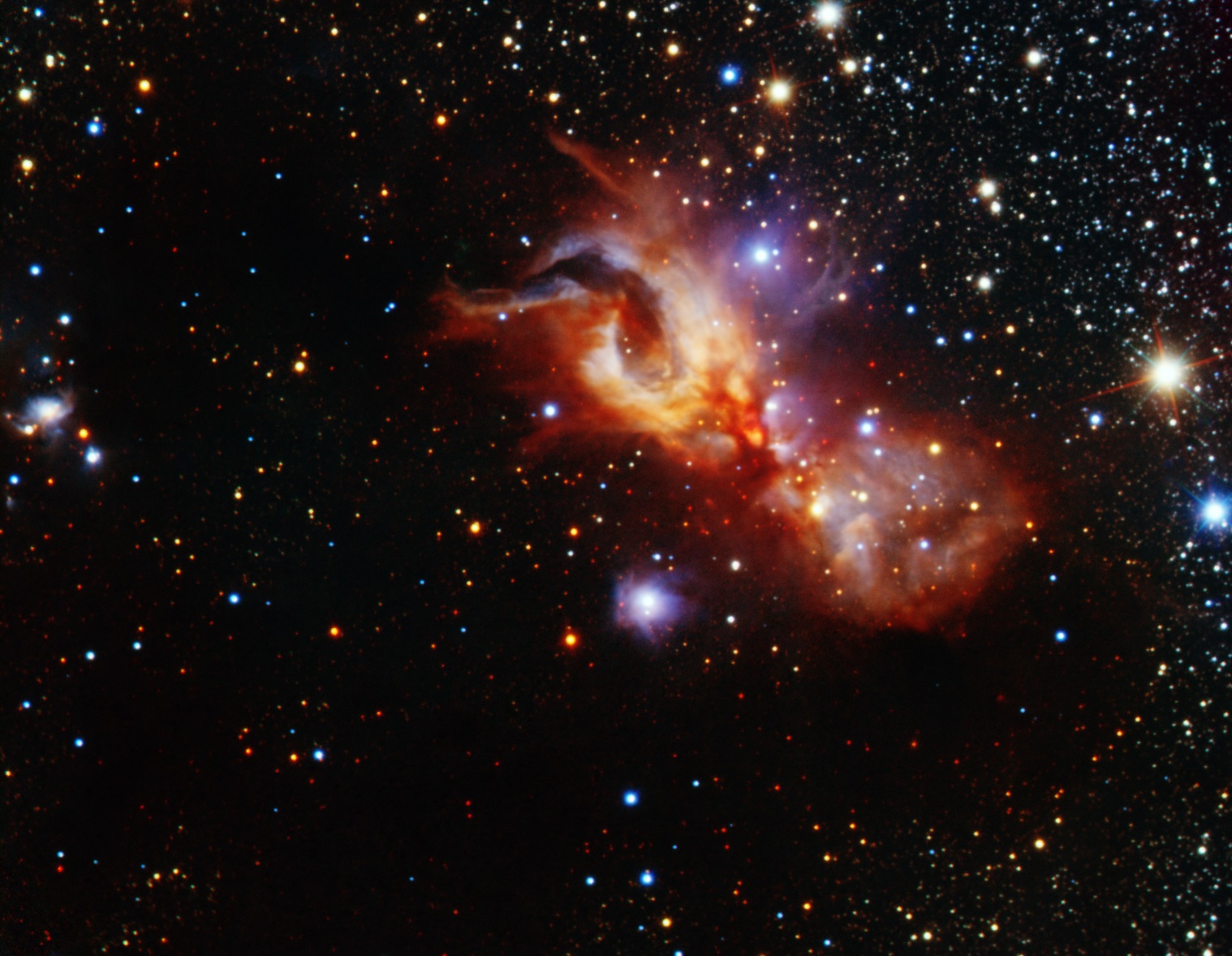
Reflection nebula GGD 27 revealing the chaotic and messy environment of a stellar nursery. This near-infrared image was obtained using FLAMINGOS-2, the infrared imager and spectrograph on the Gemini South telescope in Chile. It is a color composite made using four filters: Y (blue), J (cyan), H (green), and Ks (red). The total integration (exposure time) for all filters is just over one hour. The image is 4.6 x 3.5 arcminutes in size and is rotated 35 degrees clockwise from North is up and East is to the left. Image Credit: Gemini Observatory/AURA.   Full resolution TIFF/JPEG


A new image released today by the Gemini Observatory offers a deep, revealing view into an active stellar nursery. The infrared view peels back layers of obscuring gas and dust to unshroud the inner workings of star formation – and the chaos that accompanies the beautifully messy process of starbirth.

In the direction of the constellation of Sagittarius, some 5,500 light-years away in the southern Milky Way, is a chaotic caldron of stellar birth known as GGD 27. While such stellar nurseries are sprinkled liberally throughout our Milky Way Galaxy, GGD 27 presents an especially compelling snapshot of stellar birth.

At first glance it looks like chaos. However, this seemingly random cloud of gas and dust is home to several nascent stars interacting in complex, but predictable ways. Millions of years from now the prenatal cloud of gas and dust will disperse and a cluster of stars will emerge much like a butterfly from its chrysalis. Until then this beautiful cloud will slowly (by human standards) evolve and allow astronomers to explore the complex process of star birth.

The new infrared Gemini image peers deep into GGD 27 where a massive developing star (called a protostar) dominates the central region of the nebula. Identified as GGD 27-ILL this future star already glows several thousand times brighter than our Sun and powers a bipolar outflow where gas streams away at supersonic speeds propelled by intense magnetic fields. Other forming stars in the area complicate the scene while adding to its beauty.

Astronomer Jungmi Kwon (The University of Tokyo, NAOJ, ISAS/JAXA, and JSPS) has studied the region around GGD 27-ILL by using polarimetry to measure the polarization of light. Kwon’s team used the IRSF 1.4-meter telescope with the SIRPOL imaging polarimeter at the South African Astronomical Observatory to study the region around the protostar GGD 27-ILL and measure what is called circular and linear polarization. The measurement of light’s polarization can be a very powerful tool for inferring magnetic fields of circumstellar structures around protostars. Kwon explains, “... patterns of linearly and circularly polarized light around GGD 27-ILL appear to result from a combination of dense inner and fainter outer lobes, suggesting episodic outflows.” It is estimated that the outflows, known as bipolar outflows, surrounding GGD 27-ILL have the greatest expanse ever seen around a young protostar, extending over three light years from end-to-end.

"This new image from Gemini is quite stunning and shows many of the structures we have observed in our research, but in a whole new light," said Kwon.

Contacts:


  • Peter Michaud
    Gemini Observatory
    Hilo, Hawai‘i
    Email:
    pmichaud@gemini.edu
    Cell: (808) 936-6643


  • Fernanda Urrutia
    Gemini Observatory
    La Serena, Chile
    Email:
    furrutia@gemini.edu
    Phone: +56 (51) 2205794