Showing posts with label Orion A Molecular Cloud. Show all posts

Wednesday, January 04, 2017

Hidden Secrets of Orion’s Clouds

The Orion A molecular cloud from VISTA

Highlights from VISTA image of Orion A


Videos
ESOcast 90 Light – Orion’s Cloudy Secrets 4K UHD

Visible/infrared comparison of views of the Orion A molecular cloud

Zooming in on a new VISTA image of the Orion A molecular cloud
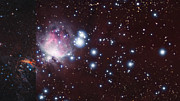

Slider comparison of visible and infrared views of the Orion A molecular cloud


VISTA survey gives most detailed view of Orion A molecular cloud in the near-infrared

This spectacular new image is one of the largest near-infrared high-resolution mosaics of the Orion A molecular cloud, the nearest known massive star factory, lying about 1350 light-years from Earth. It was taken using the VISTA infrared survey telescope at ESO’s Paranal Observatory in northern Chile and reveals many young stars and other objects normally buried deep inside the dusty clouds.

The new image from the VISION survey (VIenna Survey In Orion) is a montage of images taken in the near-infrared part of the spectrum [1] by the VISTA survey telescope at ESO’s Paranal Observatory in Chile. It covers the whole of the Orion A molecular cloud, one of the two giant molecular clouds in the Orion molecular cloud complex (OMC). Orion A extends for approximately eight degrees to the south of the familiar part of Orion known as the sword [2].

VISTA is the world’s largest dedicated survey telescope, and has a large field of view imaged with very sensitive infrared detectors, characteristics that made it ideal for obtaining the deep, high-quality infrared images required by this ambitious survey.

The VISION survey has resulted in a catalogue containing almost 800 000 individually identified stars, young stellar objects and distant galaxies, This represents better depth and coverage than any other survey of this region to date [3].

VISTA can see light that the human eye cannot, allowing astronomers to identify many otherwise hidden objects in the stellar nursery. Very young stars that cannot be seen in visible-light images are revealed when observed at longer infrared wavelengths, where the dust that shrouds them is more transparent.

The new image represents a step towards a complete picture of the star formation processes in Orion A, for both low and high mass stars. The most spectacular object is the glorious Orion Nebula, also called Messier 42 [4] seen towards the left of the image. This region forms part of the sword of the famous bright constellation of Orion (The Hunter). The VISTA catalogue covers both familiar objects and new discoveries. These include five new young stellar object candidates and ten candidate galaxy clusters.

Elsewhere in the image, we can look into Orion A’s dark molecular clouds and spot many hidden treasures, including discs of material that could give birth to new stars (pre-stellar discs), nebulosity associated with newly-born stars (Herbig-Haro objects), smaller star clusters and even galaxy clusters lying far beyond the Milky Way. The VISION survey allows the earliest evolutionary phases of young stars within nearby molecular clouds to be systematically studied.

This impressively detailed image of Orion A establishes a new observational foundation for further studies of star and cluster formation and once again highlights the power of the VISTA telescope to image wide areas of sky quickly and deeply in the near-infrared part of the spectrum [5].


Notes


[1] The VISION survey covers approximately 18.3 square degrees at a scale of about one-third of an arcsecond per pixel.

[2] The other giant molecular cloud in the Orion Molecular Cloud is Orion B, which lies east of Orion’s Belt.

[3] The complete VISION survey includes an even larger region than is shown in this picture, which covers 39 578 x 23 069 pixels.

[4] The Orion nebula was first described in the early seventeenth century although the identity of the discoverer is uncertain. The French comet-hunter Messier made an accurate sketch of its main features in the mid-eighteenth century and gave it the number 42 in his famous catalogue. He also allocated the number 43 to the smaller detached region just north of the main part of the nebula. Later William Herschel speculated that the nebula might be “the chaotic material of future suns” and astronomers have since discovered that the mist is indeed gas glowing in the fierce ultraviolet light from young hot stars that have recently formed there.

[5] The successful VISION survey of Orion will be followed by a new, bigger public survey of other star-forming regions with VISTA, called VISIONS, which will start in April 2017.


More Information

This research is presented in a paper entitled “VISION - Vienna survey in Orion I. VISTA Orion A Survey”, by S. Meingast et al., published in the journal Astronomy & Astrophysics.

The team is composed of: Stefan Meingast (University of Vienna, Vienna, Austria), João Alves (University of Vienna, Vienna, Austria), Diego Mardones (Universidad de Chile, Santiago, Chile) , Paula Teixeira (University of Vienna, Vienna, Austria), Marco Lombardi (University of Milan, Milan, Italy), Josefa Großschedl (University of Vienna, Vienna, Austria), Joana Ascenso (CENTRA, Universidade de Lisboa, Lisbon, Portugal; Universidade do Porto, Porto, Portugal), Herve Bouy (Centro de Astrobiología, Madrid, Spain), Jan Forbrich (University of Vienna, Vienna, Austria), Alyssa Goodman (Harvard-Smithsonian Center for Astrophysics, Cambridge MA, USA), Alvaro Hacar (University of Vienna, Vienna, Austria), Birgit Hasenberger (University of Vienna, Vienna, Austria), Jouni Kainulainen (Max-Planck-Institute for Astronomy, Heidelberg, Germany), Karolina Kubiak (University of Vienna, Vienna, Austria), Charles Lada (Harvard-Smithsonian Center for Astrophysics, Cambridge, USA), Elizabeth Lada (University of Florida, Gainesville, USA), André Moitinho (SIM/CENTRA, Universidade de Lisboa, Lisbon, Portugal), Monika Petr-Gotzens (ESO, Garching, Germany), Lara Rodrigues (Universidad de Chile, Santiago, Chile) and Carlos G. Román-Zúñiga (UNAM, Ensenada, Baja California, Mexico).

ESO is the foremost intergovernmental astronomy organisation in Europe and the world’s most productive ground-based astronomical observatory by far. It is supported by 16 countries: Austria, Belgium, Brazil, the Czech Republic, Denmark, France, Finland, Germany, Italy, the Netherlands, Poland, Portugal, Spain, Sweden, Switzerland and the United Kingdom, along with the host state of Chile. ESO carries out an ambitious programme focused on the design, construction and operation of powerful ground-based observing facilities enabling astronomers to make important scientific discoveries. ESO also plays a leading role in promoting and organising cooperation in astronomical research. ESO operates three unique world-class observing sites in Chile: La Silla, Paranal and Chajnantor. At Paranal, ESO operates the Very Large Telescope, the world’s most advanced visible-light astronomical observatory and two survey telescopes. VISTA works in the infrared and is the world’s largest survey telescope and the VLT Survey Telescope is the largest telescope designed to exclusively survey the skies in visible light. ESO is a major partner in ALMA, the largest astronomical project in existence. And on Cerro Armazones, close to Paranal, ESO is building the 39-metre European Extremely Large Telescope, the E-ELT, which will become “the world’s biggest eye on the sky”.


Links


Contacts

Richard Hook
ESO Public Information Officer
Garching bei München, Germany
Tel: +49 89 3200 6655
Email:
rhook@eso.org

Source: ESO 

Sunday, May 31, 2015

Herschel's hunt for filaments in the Milky Way

Left: The Aquila Rift. Credit: ESA/Herschel/SPIRE/PACS/Ph. André for the 'Gould Belt survey' Key Programme Consortium. Right: The star-forming cloud IC 5146. Credit: ESA/Herschel/SPIRE/PACS/D. Arzoumanian for the "Gould Belt survey" Key Programme Consortium 

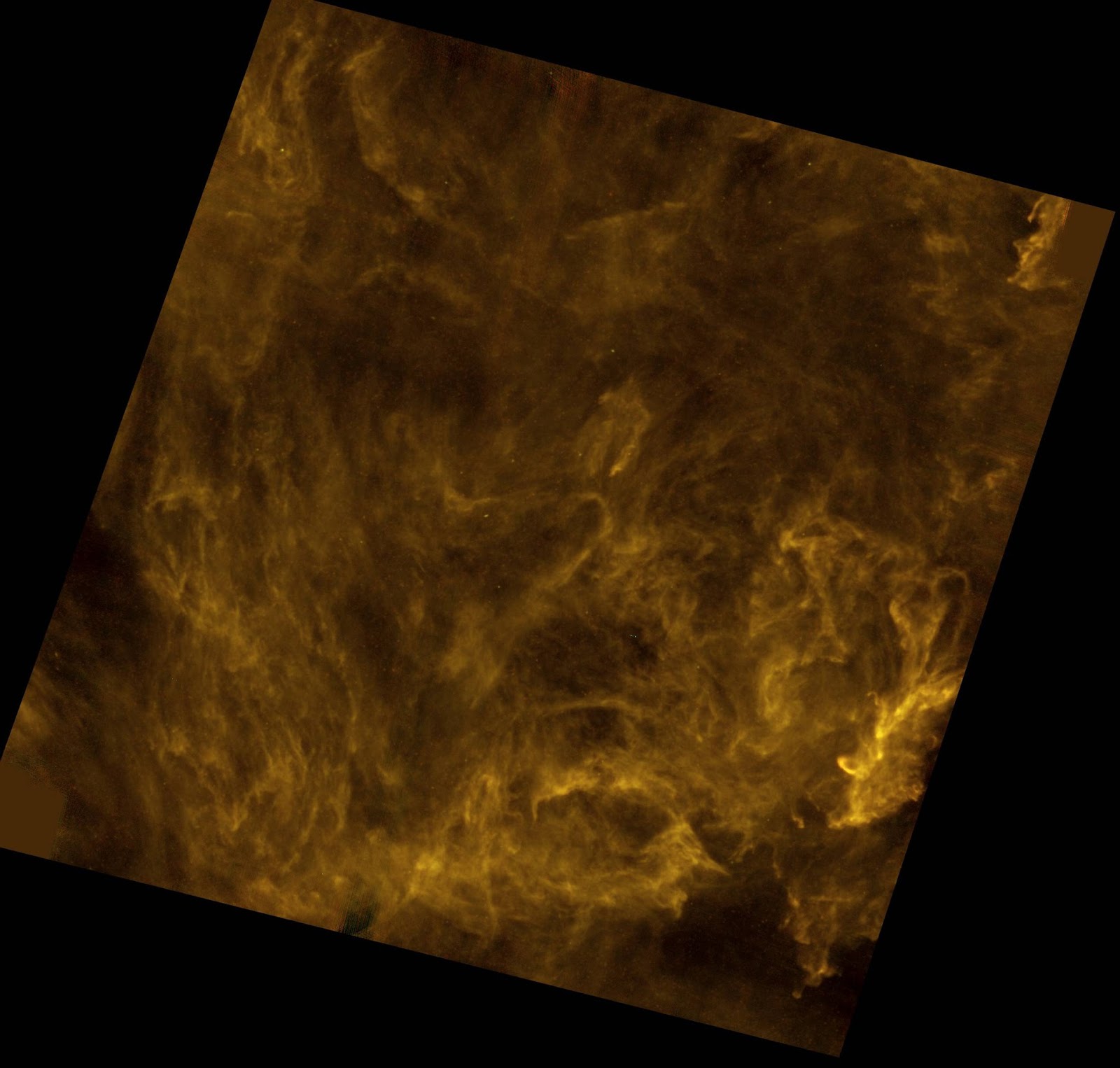
The Orion A Molecular Cloud.  
Credit: ESA/Herschel/Ph. André, D. Polychroni, A. Roy, V. Könyves, N. Schneider for the Gould Belt survey Key Programme
 
The Polaris Flare
Credit: ESA/Herschel/SPIRE/Ph. André for the "Gould Belt survey" Key Programme Consortium and A. Abergel for the "Evolution of Interstellar Dust" Key Programme Consortium
 

Observations with ESA's Herschel space observatory have revealed that our Galaxy is threaded with filamentary structures on every length scale. From nearby clouds hosting tangles of filaments a few light-years long to gigantic structures stretching hundreds of light-years across the Milky Way's spiral arms, they appear to be truly ubiquitous. The Herschel data have rekindled the interest of astronomers in studying filaments, emphasising the crucial role of these structures in the process of star formation. 

Stars are born in the densest pockets of the interstellar medium, a diffuse mixture of gas and dust that pervades galaxies, including our Milky Way. One of the most intriguing questions in astrophysics concerns understanding how this material, which is typically characterised by very low density, can come together, creating denser concentrations that later evolve into compact cores and, finally, give birth to stars.

In the search for answers, astronomers observe giant molecular clouds, the cosmic incubators where gas and dust are transformed into stars. While these studies are performed using a variety of techniques, one crucial approach is the observation of infrared light, since the interstellar material shines brightly at these long wavelengths.

In this context, ESA's Herschel space observatory has been a true game changer. Probing the portion of the electromagnetic spectrum that ranges from the far-infrared to sub-millimetre wavelengths, it has collected unprecedented data during its three and a half years of observing. One of the key aspects that emerged from these observations is the presence of a filamentary network nearly everywhere in our Galaxy's interstellar medium. The picture that is emerging is that these structures are closely linked to the formation of stars.

Prior to Herschel, astronomers had already identified several filaments in interstellar clouds and recognised their potential importance for star formation. However, only with the increased sensitivity and spatial resolution granted by this observatory, combined with its large-scale surveys, could they reveal the full extent of filamentary patterns in the Milky Way.

One of the surveys performed with Herschel – the Gould Belt Survey – focussed on a giant ring of star-forming regions, all located no more than 1500 light-years away from the Sun. The vicinity of these clouds allowed astronomers to obtain exceptionally detailed images using Herschel, unearthing intricate webs of filaments in each region that they examined.

The greatest surprise was the ubiquity of filaments in these nearby clouds and their intimate connection with star formation,” explains Philippe André from CEA/IRFU, France, Principal Investigator for the Herschel Gould Belt Survey.

But there is more: these observations revealed that filaments, which may extend to several light-years in length, appear to have a universal width of about one third of a light year. This suggests that something fundamental is lurking underneath.

The astronomers are still trying to understand the details of the star formation processes taking place in these clouds, aided by the abundance and variety of data collected with Herschel.

While most filaments are dotted with compact cores, suggesting that stars are readily taking shape in these dense 'fibres' of the interstellar medium, there are also regions that exhibit complex tangles of filaments but no signs of on-going star formation. A study of the most spectacular example of this phenomenon, the Polaris Flare, indicates that filaments must somehow precede the onset of star formation.

The scenario that has emerged from the new Herschel data suggests that star formation proceeds in two steps: first, turbulent motions of the interstellar gas and dust create an intricate web of filamentary structures; then, gravity takes over, causing only the densest filaments to contract and fragment, eventually leading to the formation of stars.

Indeed, the universal width of filaments seems to correspond, at least in the nearby clouds of the Gould Belt Survey, to the scale at which interstellar material undergoes the transition from supersonic to subsonic state.

In addition, the material along filaments is not at all static: astronomers have detected what appear to be accretion flows, with the most prominent filaments drawing matter from their surroundings through a network of smaller filaments. A striking example of such processes is seen in the Taurus Molecular Cloud, where the B211/B213 filament exhibits a series of so-called 'striations' perpendicular to the main filament.

This pattern is very similar to that predicted from numerical simulations that model the process of star formation in molecular clouds. According to these simulations, interstellar material flows towards dense filaments along routes that are parallel to the direction of the local magnetic field, as was observed, so the new data indicate the importance of interstellar magnetic fields in shaping these structures.

The B211/B213 filament in the Taurus Molecular Cloud.  
Credit: ESA/Herschel/PACS, SPIRE/Gould Belt survey Key Programme/Palmeirim et al. 2013

However, star formation does not appear to take place only in filaments. While these structures seem to be the preferred sites for stellar birth, the extraordinary data from Herschel confirmed that a small fraction of stars may also form far away from dense filaments.

In particular, a detailed study of the L1641 molecular clouds in the Orion A complex suggests that star formation along filaments is the preferential channel to produce typical solar-type stars, while stars that are born away from these dense, elongated structures tend to have lower masses. This dichotomy could be a result of the greater availability of raw material to protostars that are forming on a filament compared to those that take shape in less dense environments.

Another of Herschel's key findings is that the presence and abundance of filaments are not limited to our immediate neighbourhood. In fact, these structures appear everywhere also in the Herschel infrared Galactic Plane Survey (Hi-GAL), which scanned the distribution of the interstellar medium in the huge disc – about 100 000 light-years across – where most of the Milky Way's stars form and reside.

The filamentary structure of the Galactic Plane.  
Credit: ESA/PACS & SPIRE Consortium, S. Molinari, Hi-GAL Project

We detected a wealth of huge filaments, with lengths ranging from a few to a hundred light-years, revealing what seems to be the 'skeleton' of our Galaxy,” explains Sergio Molinari from IAPS/INAF, Italy, Principal Investigator for the Hi-GAL Project.

While it is possible that these structures arose from different physical processes than those giving rise to the small-scale filaments observed in the Sun's vicinity, the omnipresent aspect of filamentary structures in the Milky Way is beyond doubt.

In the post-Herschel era, one thing is certain: filaments play a leading role in the build-up of galactic material, creating favourable hubs for the formation of stars. This is likely a hierarchical process, starting on very large scales and propagating onwards, to smaller and smaller scales, funnelling interstellar gas and dust into increasingly denser concentrations and thus fostering stellar birth across the Galaxy.

Filaments in outer regions of the Galactic Plane
Credit: ESA/Herschel/PACS, SPIRE/Hi-GAL Project/Schisano et al. 2014

Large-scale filaments fragmenting into compact cores that later evolve into stars have been detected all across the Galactic Plane, even in its outermost, peripheral regions. As filaments grow more massive, the material within them contracts and forms smaller structures, preserving the filamentary pattern on all length scales.

Further investigation of the Hi-GAL survey has revealed new and even more prominent filaments, extending over hundreds of light-years and weaving their way through the spiral arms of the Milky Way. The study revealed nine filaments in some very dense, inner regions of the Galactic Plane, detecting these for the first time through the direct emission of dust within them, allowing an accurate determination of their mass, size and physical characteristics. Astronomers believe that almost a hundred similar, gigantic structures are still hiding in the data.

Some of the most prominent filaments detected in the Milky Way: G49 (top), G47 (bottom left) and G64 (bottom right). 
Credit: ESA/Herschel/PACS/SPIRE/Ke Wang et al. 2015

The intricate distribution of filaments in the interstellar medium revealed by Herschel has definitely revolutionised our view of how stars form in the Milky Way and, presumably, also in other similar galaxies,” comments Göran Pilbratt, ESA Herschel Project Scientist.

An increasingly coherent picture is now emerging from combining the analysis of these data with predictions from theory and numerical simulations, as astronomers continue to study the physical processes underlying the fascinating origin of stars and planets.


More information


Herschel is an ESA space observatory with science instruments provided by European-led Principal Investigator consortia and with important participation from NASA.

Herschel was launched on 14 May 2009 and completed science observations on 29 April 2013.


Related publications  

Ph. André et al. 2010, Astronomy & Astrophysics, 518, L102
S. Molinari et al. 2010, Astronomy & Astrophysics, 518, L100
D. Arzoumanian et al. 2011, Astronomy & Astrophysics, 529, L6
D. Polychroni et al. 2013, Astrophysical Journal Letters, 777, L33
P. Palmeirim et al. 2013, Astronomy & Astrophysics, 550, A38
D. Arzoumanian et al. 2013, Astronomy & Astrophysics, 553, A119
Ph. André et al. 2014, in Protostars and Planets VI, p. 27
D. Elia et al. 2013, Astrophysical Journal, 772, 45
E. Schisano et al. 2014, Astrophysical Journal, 791, 27
K. Wang et al. 2015, Monthly Notices of the Royal Astronomical Society, 450, 4043


Contacts  

Philippe André
CEA/DSM/IRFU Service d'Astrophysique
Centre d'Etudes de Saclay
Gif-sur-Yvette Cedex, France
E-mail:
pandre@cea.fr
Phone: +33-1-6908-9265

Sergio Molinari
IAPS/INAF
Roma, Italy
Email:
Sergio.molinari@iaps.inaf.it
Phone: +39-06-4993-4396

Göran Pilbratt
Herschel Project Scientist
Scientific Support Office
Science and Robotic Exploration Directorate
ESA, The Netherlands
Email:
gpilbratt@cosmos.esa.int
Phone: +31-71-565-3621

 Source: ESA/Herschel