Showing posts with label extrasolar systems. Show all posts

Tuesday, November 28, 2017

Newly Discovered Twin Planets Could Solve Puffy Planet Mystery

Upper left: Schematic of the K2-132 system on the main sequence. Lower left: Schematic of the K2-132 system now. The host star has become redder and larger, irradiating the planet more and thus causing it to expand. Sizes not to scale.  Main panel: Gas giant planet K2-132b expands as its host star evolves into a red giant. The energy from the host star is transferred from the planet's surface to its deep interior, causing turbulence and deep mixing in the planetary atmosphere. The planet orbits its star every nine days and is located about 2000 light years away from us in the constellation Virgo.  Credit: Karen Teramura, UH IFA


Maunakea, Hawaii - Since astronomers first measured the size of an extrasolar planet seventeen years ago, they have struggled to answer the question: how did the largest planets get to be so large? 

Thanks to the recent discovery of twin planets by a University of Hawaii Institute for Astronomy team led by graduate student Samuel Grunblatt, scientists are getting closer to an answer.

Gas giant planets are primarily made out of hydrogen and helium, and are at least four times the diameter of Earth. Gas giant planets that orbit scorchingly close to their host stars are known as "hot Jupiters." These planets have masses similar to Jupiter and Saturn, but tend to be much larger - some are puffed up to sizes even larger than the smallest stars.

The unusually large sizes of these planets are likely related to heat flowing in and out of their atmospheres, and several theories have been developed to explain this process. "However, since we don't have millions of years to see how a particular planetary system evolves, planet inflation theories have been difficult to prove or disprove," said Grunblatt.

To solve this issue, Grunblatt searched through data collected by NASA's K2 Mission to hunt for hot Jupiters orbiting red giant stars. These stars, which are in the late stages of their lives, become themselves significantly larger over their companion planet's lifetime. Following a theory put forth by Eric Lopez of NASA's Goddard Space Flight Center, hot Jupiters orbiting red giant stars should be highly inflated if direct energy input from the host star is the dominant process inflating planets.

The search has now revealed two planets, each orbiting their host star with a period of approximately nine days. Using stellar oscillations to precisely calculate the radii of both the stars and planets, the team found that the planets are 30 percent larger than Jupiter. 

Observations using the W. M. Keck Observatory on Maunakea, Hawaii also showed that, despite their large sizes, the planets were only half as massive as Jupiter. Remarkably, the two planets are near twins in terms of their orbital periods, radii, and masses.

Using models to track the evolution of the planets and their stars over time, the team calculated the planets' efficiency at absorbing heat from the star and transferring it to their deep interiors, causing the whole planet to expand in size and decrease in density. Their findings show that these planets likely needed the increased radiation from the red giant star to inflate, but the amount of radiation absorbed was also lower than expected.

It is risky to attempt to reach strong conclusions with only two examples. But these results begin to rule out some explanations of planet inflation, and are consistent with a scenario where planets are directly inflated by the heat from their host stars. The mounting scientific evidence seems to suggest that stellar radiation alone can directly alter the size and density of a planet.

Our own Sun will eventually become a red giant star, so it's important to quantify the effect its evolution will have on the rest of the Solar System. "Studying how stellar evolution affects planets is a new frontier, both in other solar systems as well as our own," said Grunblatt. "With a better idea of how planets respond to these changes, we can start to determine how the Sun's evolution will affect the atmosphere, oceans, and life here on Earth."

The search for gas giant planets around red giant stars continues since additional systems could conclusively distinguish between planet inflation scenarios. Grunblatt and his team have been awarded time with the NASA Spitzer Space Telescope to measure the sizes of these twin planets more accurately. In addition, the search for planets around red giants with the NASA K2 Mission will continue for at least another year, and NASA's Transiting Exoplanet Survey Satellite (TESS), launching in 2018, will observe hundreds of thousands of red giants across the entire sky.

"Seeing double with K2: Testing re-inflation with two remarkably similar planets orbiting red giant branch stars" has been published in November 27th edition of The Astronomical Journal as and is available online at http://iopscience.iop.org/article/10.3847/1538-3881/aa932d.


Contacts

Sam Grunblatt
skg3@hawaii.edu
Cell: 845-430-4603

Dr. Daniel Huber
huberd@hawaii.edu
Office: 808-956-8573

Dr. Roy Gal
Media Contact
Office: 808-956-6235
Cell: 301-728-8637

rgal@ifa.hawaii.edu


About W. M. Keck Observatory


The W. M. Keck Observatory telescopes are among the most scientifically productive on Earth. The two, 10-meter optical/infrared telescopes on the summit of Maunakea on the Island of Hawaii feature a suite of advanced instruments including imagers, multi-object spectrographs, high-resolution spectrographs, integral-field spectrometers, and world-leading laser guide star adaptive optics systems. 

Some of the data presented herein were obtained at Keck Observatory, which is a private 501(c) 3 non-profit organization operated as a scientific partnership among the California Institute of Technology, the University of California, and the National Aeronautics and Space Administration. The Observatory was made possible by the generous financial support of the W. M. Keck Foundation.
The authors wish to recognize and acknowledge the very significant cultural role and reverence that the summit of Maunakea has always had within the indigenous Hawaiian community. We are most fortunate to have the opportunity to conduct observations from this mountain.


Article Summary


A University of Hawaii Institute for Astronomy-led team discovers unusually large twin exoplanets. Desipite their large sizes, observations using the W. M. Keck Observatory on Maunakea, Hawaii show that the planets are only half as massive as Jupiter. The discovery could help astronomers understand how the largest planets became so large.


Saturday, January 07, 2017

Hubble Detects 'Exocomets' Taking the Plunge into a Young Star

Exocomets Plunging into Star (Artist's Illustration)
This illustration shows several comets speeding across a vast protoplanetary disk of gas and dust and heading straight for the youthful, central star. These "kamikaze" comets will eventually plunge into the star and vaporize. The comets are too small to photograph, but their gaseous spectral "fingerprints" on the star's light were detected by NASA's Hubble Space Telescope. The gravitational influence of a suspected Jupiter-sized planet in the foreground may have catapulted the comets into the star.

This star, called HD 172555, represents the third extrasolar system where astronomers have detected doomed, wayward comets. The star resides 95 light-years from Earth.  Credits: NASA, ESA, and A. Feild and G. Bacon (STScI). Hi-res image


Interstellar forecast for a nearby star: Raining comets! NASA's Hubble Space Telescope has discovered comets plunging into the star HD 172555, which is a youthful 23 million years old and resides 95 light-years from Earth.

The exocomets — comets outside our solar system — were not directly seen around the star, but their presence was inferred by detecting gas that is likely the vaporized remnants of their icy nuclei.

HD 172555 represents the third extrasolar system where astronomers have detected doomed, wayward comets. All of these systems are young, under 40 million years old.

The presence of these doomed comets provides circumstantial evidence for "gravitational stirring" by an unseen Jupiter-size planet, where comets deflected by the massive object's gravity are catapulted into the star. These events also provide new insights into the past and present activity of comets in our solar system. It's a mechanism where infalling comets could have transported water to Earth and the other inner planets of our solar system.

Astronomers have found similar plunges in our own solar system. Sun-grazing comets routinely fall into our sun. "Seeing these sun-grazing comets in our solar system and in three extrasolar systems means that this activity may be common in young star systems," said study leader Carol Grady of Eureka Scientific Inc., in Oakland, California, and NASA's Goddard Space Flight Center in Greenbelt, Maryland. "This activity at its peak represents a star's active teenage years. Watching these events gives us insight into what probably went on in the early days of our solar system, when comets were pelting the inner solar system bodies, including Earth. In fact, these star-grazing comets may make life possible, because they carry water and other life-forming elements, such as carbon, to terrestrial planets."

Grady will present her team's results Jan. 6 at the winter meeting of the American Astronomical Society in Grapevine, Texas.

The star is part of the Beta Pictoris Moving Group, a collection of stars born from the same stellar nursery. It is the second group member found to harbor such comets. Beta Pictoris, the group's namesake, also is feasting on exocomets travelling too close. A young gas-giant planet has been observed in that star's vast debris disk.

The Beta Pictoris Moving Group is important to study because it is the closest collection of young stars to Earth. At least 37.5 percent of the more massive stars in the group either have a directly imaged planet, such as 51 Eridani b in the 51 Eridani system, or infalling star-grazing bodies, or, in the case of Beta Pictoris, both types of objects. The grouping is around the age where it should be building terrestrial planets, Grady said.

A team of French astronomers first discovered exocomets transiting HD 172555 in archival data gathered between 2004 and 2011 by the European Southern Observatory's HARPS (High Accuracy Radial velocity Planet Searcher) spectrograph. A spectrograph divides light into its component colors, allowing astronomers to detect an object's chemical makeup. The HARPS spectrograph detected the chemical fingerprints of calcium imprinted in the starlight, evidence that comet-like objects were falling into the star.

As a follow-up to that discovery, Grady's team used Hubble's Space Telescope Imaging Spectrograph (STIS) and the Cosmic Origins Spectrograph (COS) in 2015 to conduct a spectrographic analysis in ultraviolet light, which allows Hubble to identify the signature of certain elements. Hubble made two observations, separated by six days.

Hubble detected silicon and carbon gas in the starlight. The gas was moving at about 360,000 miles per hour across the face of the star. The most likely explanation for the speedy gas is that Hubble is seeing material from comet-like objects that broke apart after streaking across the star's disk.

The gaseous debris from the disintegrating comets is vastly dispersed in front of the star. "As transiting features go, this vaporized material is easy to see because it contains very large structures," Grady said. "This is in marked contrast to trying to find a small, transiting exoplanet, where you're looking for tiny dips in the star's light."

Hubble gleaned this information because the HD 172555 debris disk surrounding the star is viewed close to edge-on through the disk, giving the telescope a clear view of comet activity.

Grady's team hopes to use STIS again in follow-up observations to look for oxygen and hydrogen, which would confirm the identity of the disintegrating objects as comets.

"Hubble shows that these star-grazers look and move like comets, but until we determine their composition, we cannot confirm they are comets," Grady said. "We need additional data to establish whether our star-grazers are icy like comets or more rocky like asteroids."

 
Contact

Donna Weaver / Ray Villard
Space Telescope Science Institute, Baltimore, Maryland
410-338-4493 / 410-338-4514

dweaver@stsci.edu / villard@stsci.edu

Carol Grady
Eureka Scientific Inc., Oakland, California,
and Goddard Space Flight Center, Greenbelt, Maryland
301-286-3748

carol.a.grady@nasa.gov


Monday, July 11, 2016

Exploring a Frozen Extrasolar World

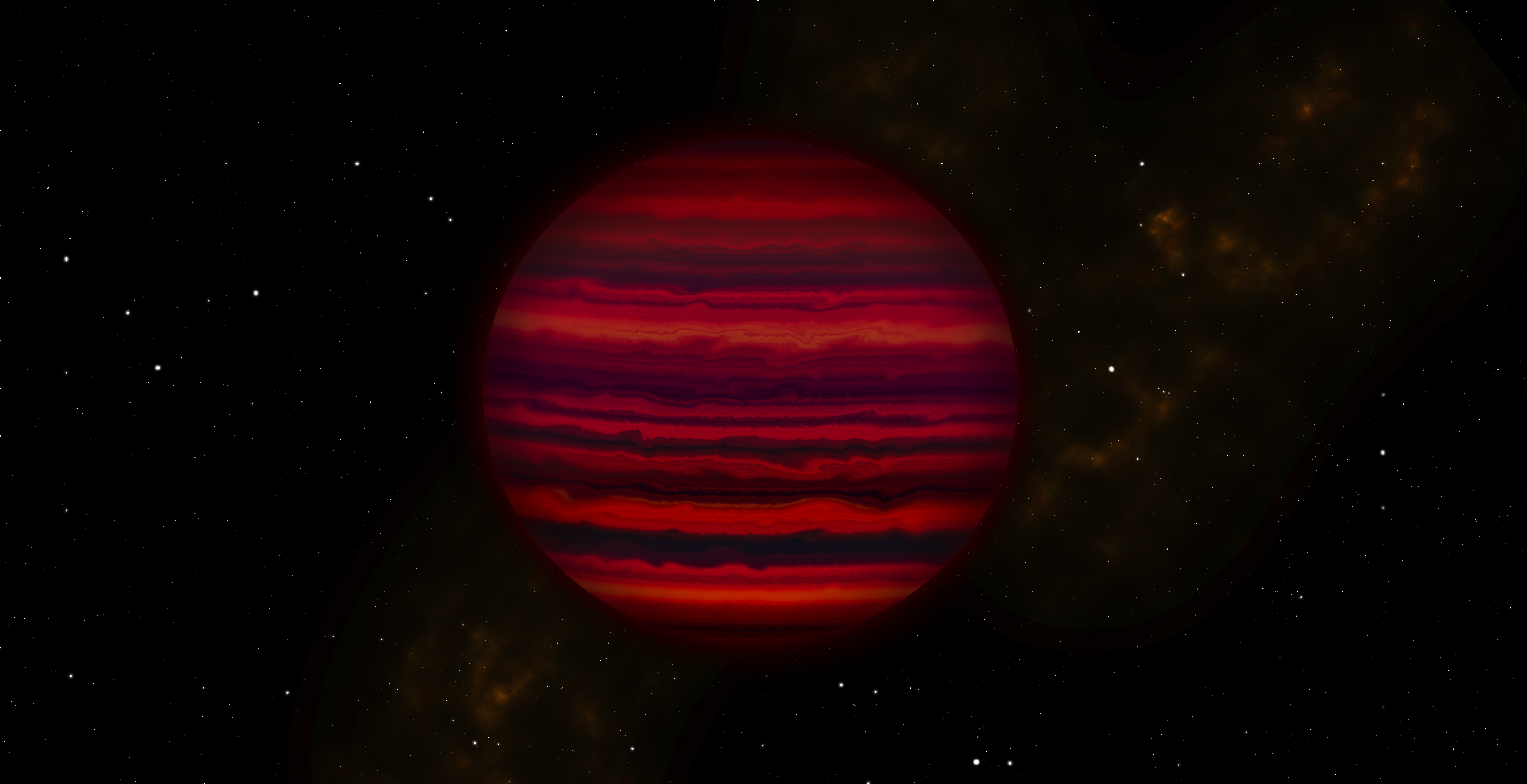
Artist's conception of how WISE 0855 might appear if viewed close-up in infrared light. 
Artwork by Joy Pollard, Gemini Observatory/AURA.  Full resolution TIFF | JPEG


As the Juno mission begins exploring Jupiter in our Solar System, scientists explore a solo world that researchers say looks more similar to Jupiter than any exoplanet yet discovered. 

Astronomers have “cracked” a very cold case with the dissection of light from the coldest known brown dwarf. In fact, the brown dwarf, named WISE 0855, is billed as the most frigid discrete world yet discovered beyond our Solar System. The research also presents the strongest evidence yet for water clouds in the atmosphere of an extrasolar object. 

The history of “failed stars” having masses between that of a star and planet – called brown dwarfs – continues to blur. Now, that distinction is even more ambiguous with the confirmation that WISE 0855 shares more of a likeness with Jupiter than many exoplanets. 

New evidence for this comes from the first spectroscopy, or light fingerprint, of the object, performed at the Gemini North telescope in Hawai’i. The spectrum presents astronomers with the most definitive evidence ever for water vapor in the atmosphere of an object outside of our solar system. The research also confirms that temperatures dip to about 20 below zero Celsius (-10 degrees F) in its cold atmosphere. 

WISE 0855 was discovered by Kevin Luhman of Penn State in 2014 using data from NASA’s Wide-field Infrared Survey Explorer (WISE) satellite. WISE 0855’s relatively close proximity – it’s only about 7.2 light years away, the fourth closest extrasolar object to the Sun – provides an advantage in capturing the object’s miniscule glow; however, it is still remarkably difficult to observe. 

"It's five times fainter than any other object detected with ground-based spectroscopy at this wavelength," said Andy Skemer of the University of California Santa Cruz. "Now that we have a spectrum, we can really start thinking about what's going on in this object. Our spectrum shows that WISE 0855 is dominated by water vapor and clouds, with an overall appearance that is strikingly similar to Jupiter." Skemer is first author of a paper on the new findings to be published in Astrophysical Journal Letters and currently available online

“I think everyone on the research team really believed that we were dreaming to think we could obtain a spectrum of this brown dwarf because its thermal glow is so feeble,” said Skemer. WISE 0855, is so cool and faint that many astronomers thought it would be years before we could dissect its diminutive light into a spectrum. “I thought we’d have to wait until the James Webb Space Telescope was operating to do this,” adds Skemer. 

The spectrum, obtained using the Gemini North telescope on Hawaii’s Maunakea, was obtained over a period of 13 nights (about 14 hours of data collection). “These observations could only be done on a facility like Gemini North. This is due to its location on Maunakea, where there is often remarkably little water vapor in the air to interfere with the sensitive observations, and the technology on the telescope, like its 8-meter silver-coated mirror,” says Jacqueline Faherty of the Carnegie Department of Terrestrial Magnetism. “We pushed the boundary of what could be done with a telescope here on Earth. And the result is spectacular." 

The resulting high-quality spectrum reveals water vapor and clouds in the object’s atmosphere, and opens opportunities to explore the atmosphere’s dynamics and chemistry. Gemini astronomer, and brown dwarf researcher, Sandy Leggett explains that the spectrum shows less phosphine than we see in Jupiter, “...suggesting that the atmosphere may be less turbulent, since mixing produces the phosphine seen in Jupiter's atmosphere.” 

Results from previous observations of WISE 0855, published in 2014, provided hints of water clouds based on very limited photometric data (the relative brightness of specific wavelengths of light). Skemer, also a coauthor of the 2014 paper, adds that with spectroscopy scientists are able to separate the object’s light into a wide range of infrared wavelengths, and probe the body’s molecular composition. “If our eyes could see infrared light, which is redder than the reddest light we can see, the data would look like a rainbow of colors.” He adds, “The relative brightness of each color gives us a glimpse into the environment of the object’s atmosphere.” 

The coauthors of the study include graduate student Caroline Morley and professor of astronomy and astrophysics Jonathan Fortney at UC Santa Cruz; Katelyn Allers at Bucknell University; Thomas Geballe at Gemini Observatory; Mark Marley and Roxana Lupu at NASA Ames Research Center; Jacqueline Faherty at the Carnegie Institution of Washington; and Gordon Bjoraker at NASA Goddard Space Flight Center. 

Observations for this work were made using the Gemini Near-InfraRed Spectrograph (GNIRS) which is mounted on the Gemini North telescope on Maunakea in Hawai‘i. The research team, and Gemini staff, are grateful to be able to observe from Maunakea, Hawaii’s highest peak, where conditions are ideal for these types of observations.


University of California, Santa Cruz press release.

A video about the discovery and study of WISE 0855 (rendered using the American Museum of Natural History's Digital Universe) is available at: https://www.youtube.com/watch?v=qT3pvWleFoU.


Media Contacts:
  • Peter Michaud
    Public Information and Outreach
    Gemini Observatory, Hilo, HI
    Email:
    pmichaud@gemini.edu
    Cell: (808) 936-6643
  • Tim Stephens
    University of California, Santa Cruz
    Email:
    stephens@ucsc.edu
    Phone: (831) 459-4352
Science Contacts:
  • Andrew Skemer
    University of California, Santa Cruz
    Email:
    askemer@ucsc.edu
    Phone: (831) 459-5753
  • Jacqueline Faherty
    Hubble Postdoctoral Fellow
    Carnegie Institution for Science
    Email:
    jfaherty17@gmail.com
    Cell: (201) 694-0807


Wednesday, January 28, 2015

Gigantic ring system around J1407b much larger, heavier than Saturn’s

Artist’s conception of the extrasolar ring system circling the young giant planet or brown dwarf J1407b. The rings are shown eclipsing the young sun-like star J1407, as they would have appeared in early 2007. Credit: Ron Miller


Astronomers at the Leiden Observatory, The Netherlands, and the University of Rochester, USA, have discovered that the ring system that they see eclipse the very young Sun-like star J1407 is of enormous proportions, much larger and heavier than the ring system of Saturn. The ring system – the first of its kind to be found outside our solar system – was discovered in 2012 by a team led by Rochester’s Eric Mamajek.

A new analysis of the data, led by Leiden’s Matthew Kenworthy, shows that the ring system consists of over 30 rings, each of them tens of millions of kilometers in diameter. Furthermore, they found gaps in the rings, which indicate that satellites (“exomoons”) may have formed. The result has been accepted for pexublication in the Astrophysical Journal.

“The details that we see in the light curve are incredible. The eclipse lasted for several weeks, but you see rapid changes on time scales of tens of minutes as a result of fine structures in the rings,” says Kenworthy. “The star is much too far away to observe the rings directly, but we could make a detailed model based on the rapid brightness variations in the star light passing through the ring system. If we could replace Saturn’s rings with the rings around J1407b, they would be easily visible at night and be many times larger than the full moon.”

“This planet is much larger than Jupiter or Saturn, and its ring system is roughly 200 times larger than Saturn’s rings are today,” said co-author Mamajek, professor of physics and astronomy at the University of Rochester. “You could think of it as kind of a super Saturn.”

The astronomers analyzed data from the SuperWASP project – a survey that is designed to detect gas giants that move in front of their parent star. In 2012, Mamajek and colleagues at the University of Rochester reported the discovery of the young star J1407 and the unusual eclipses, and proposed that they were caused by a moon-forming disk around a young giant planet or brown dwarf.

In a third, more recent study also led by Kenworthy, adaptive optics and Doppler spectroscopy were used to estimate the mass of the ringed object. Their conclusions based on these and previous papers on the intriguing system J1407 is that the companion is likely to be a giant planet – not yet seen – with a gigantic ring system responsible for the repeated dimming of J1407’s light.

The light curve tells astronomers that the diameter of the ring system is nearly 120 million kilometers, more than two hundred times as large as the rings of Saturn. The ring system likely contains roughly an Earth’s worth of mass in light-obscuring dust particles.

Mamajek puts into context how much material is contained in these disks and rings. “If you were to grind up the four large Galilean moons of Jupiter into dust and ice and spread out the material over their orbits in a ring around Jupiter, the ring would be so opaque to light that a distant observer that saw the ring pass in front of the sun would see a very deep, multi-day eclipse,” Mamajek says. “In the case of J1407, we see the rings blocking as much as 95 percent of the light of this young Sun-like star for days, so there is a lot of material there that could then form satellites.”


In the data the astronomers found at least one clean gap in the ring structure, which is more clearly defined in the new model. “One obvious explanation is that a satellite formed and carved out this gap,” says Kenworthy. “The mass of the satellite could be between that of Earth and Mars. The satellite would have an orbital period of approximately two years around J1407b.”

Astronomers expect that the rings will become thinner in the next several million years and eventually disappear as satellites form from the material in the disks.

“The planetary science community has theorized for decades that planets like Jupiter and Saturn would have had, at an early stage, disks around them that then led to the formation of satellites,” Mamajek explains. “However, until we discovered this object in 2012, no-one had seen such a ring system. This is the first snapshot of satellite formation on million-kilometer scales around a substellar object.”

Astronomers estimate that the ringed companion J1407b has an orbital period roughly a decade in length. The mass of J1407b has been difficult to constrain, but it is most likely in the range of about 10 to 40 Jupiter masses.

The researchers encourage amateur astronomers to help monitor J1407, which would help detect the next eclipse of the rings, and constrain the period and mass of the ringed companion. Observations of J1407 can be reported to the American Association of Variable Star Observers (AAVSO). In the meantime the astronomers are searching other photometric surveys looking for eclipses by yet undiscovered ring systems. 

Kenworthy adds that finding eclipses from more objects like J1407’s companion “is the only feasible way we have of observing the early conditions of satellite formation for the near future. J1407’s eclipses will allow us to study the physical and chemical properties of satellite-spawning circumplanetary disks.”

Contact Author(s)

   
585-276-6264
Email:  lsierra@ur.rochester.edu
Twitter: @leonor_sierra


Friday, October 10, 2014

Hubble Maps the Temperature and Water Vapor on an Extreme Exoplanet

Global Temperature Map of WASP-43b
This is a temperature map of exoplanet WASP-43b. The gas giant planet orbits very close to its parent star with a period of 19.5 hours. Because the planet keeps one side facing its star, there are huge temperature extremes between the day and night sides. The white-colored region on the daytime side is 2,800 degrees Fahrenheit. The nighttime-side temperatures drop below 1,000 degrees Fahrenheit. This steep gradient is in stark contrast to the predominantly uniform temperatures of the solar system's giant planets. Infrared observations with the Hubble Space Telescope measured how temperatures change with both altitude and longitude on the planet.  Credit: NASA, ESA, and K. Stevenson, L. Kreidberg, and J. Bean (University of Chicago)

Artist's Illustration of WASP-43b (Annotated)
Credit: NASA, ESA, K. Stevenson, L. Kreidberg, and J. Bean (University of Chicago), and Z. Levay (STScI)

A team of scientists using NASA's Hubble Space Telescope have made the most detailed global map yet of the glow from a planet orbiting another star, revealing secrets of air temperatures and water.

The map provides information about temperatures at different layers of the world's atmosphere and traces the amount and distribution of water vapor on the planet. The findings have ramifications for the understanding of atmospheric dynamics and the formation of giant planets like Jupiter.

"These measurements have opened the door for a new kind of comparative planetology," said team leader Jacob Bean of the University of Chicago.

"Our observations are the first of their kind in terms of providing a two-dimensional map of the planet's thermal structure that can be used to constrain atmospheric circulation and dynamical models for hot exoplanets," said team member Kevin Stevenson of the University of Chicago.

The Hubble observations show that the planet, called WASP-43b, is no place to call home. It's a world of extremes, where seething winds howl at the speed of sound from a 3,000-degree-Fahrenheit day side that is hot enough to melt steel to a pitch-black night side that sees temperatures plunge below a relatively cool 1,000 degrees Fahrenheit.

As a hot ball of predominantly hydrogen gas, there are no surface features on the planet, such as oceans or continents that can be used to track its rotation. Only the severe temperature difference between the day and night sides can be used by a remote observer to mark the passage of a day on this world.

WASP-43b is located 260 light-years away and was first discovered in 2011. WASP-43b is too distant to be photographed, but because its orbit is observed edge-on to Earth, astronomers detected it by observing regular dips in the light of its parent star as the planet passes in front of it.

The planet is about the same size as Jupiter, but is nearly twice as massive. The planet is so close to its orange dwarf host star that it completes an orbit in just 19 hours. The planet is also gravitationally locked so that it keeps one hemisphere facing the star, just as our moon keeps one face toward Earth.

The scientists combined two previous methods of analyzing exoplanets and put them together in one for the first time to study the atmosphere of WASP-43b. Spectroscopy allowed them to determine the water abundance and temperature structure of the atmosphere. By observing the planet's rotation, the astronomers were also able to measure the water abundances and temperatures at different longitudes.

Because there's no planet with these tortured conditions in our solar system, characterizing the atmosphere of such a bizarre world provides a unique laboratory for better understanding planet formation and planetary physics. "The planet is so hot that all the water in its atmosphere is vaporized, rather than condensed into icy clouds like on Jupiter," said team member Laura Kreidberg of the University of Chicago.

"Water is thought to play an important role in the formation of giant planets, since comet-like bodies bombard young planets, delivering most of the water and other molecules that we can observe," said Jonathan Fortney, a member of the team from the University of California, Santa Cruz.

However, the water abundances in the giant planets of our solar system are poorly known because water is locked away as ice that has precipitated out of their upper atmospheres. But on "hot Jupiters" — that is, large planets like Jupiter that have high surface temperatures because they orbit very close to their stars — water is in a vapor that can be readily traced. Kreidberg also emphasized that the team didn't simply detect water in the atmosphere of WASP-43b, but also precisely measured how much of it there is and how it is distributed with longitude.

In order to understand how giant planets form, astronomers want to know how enriched they are in different elements. The team found that WASP-43b has about the same amount of water as we would expect for an object with the same chemical composition as the Sun. Kreidberg said that this tells something fundamental about how the planet formed.

For the first time astronomers were able to observe three complete rotations of a planet, which occurred during a span of four days. This was essential to making such a precise measurement according to Jean-Michel Désert of the University of Colorado, Boulder.

The team next aims to make water-abundance measurements for different planets to explore their chemical abundances. Hubble's planned successor, the James Webb Space Telescope, will be able to not only measure water abundances, but also the abundances of carbon monoxide, carbon dioxide, ammonia, and methane, depending on the planet's temperature.

The results are presented in two new papers, one published online in Science Express on Oct. 9, and the other published in The Astrophysical Journal Letters on Sept. 12.

Contact:

Ray Villard
Space Telescope Science Institute, Baltimore, Md.
410-338-4514

villard@stsci.edu

Source: HubbleSite

Thursday, May 17, 2012

What is FINESSE?


FINESSE
EXPLORING NEW WORLDS AROUND OTHER NEWS STARS


Proposed for launch in 2016 as part of NASA's Explorers Program, FINESSE would take the first "family portrait" of extrasolar planets, or exoplanets. FINESSE is the first mission dedicated to finding out what exoplanet atmospheres are made of, what conditions or processes are responsible for their composition, and how our own solar system fits into the larger family of planets.

The last 15 years have witnessed extraordinary success in finding exoplanets; ground-based surveys and robotic space missions have collectively indentified hundreds of planets outside of our solar system. The number of candidate planets detected is now in the thousands.

FINESSE is designed to take the next step - probing the atmospheres of these far off worlds.

Source: FINESSE

Tuesday, February 21, 2012

NASA's Hubble Reveals a New Class of Extrasolar Planet

Artist's View of Extrasolar Planet GJ1214b
GJ1214b, shown in this artist's view, is a super-Earth orbiting a red dwarf star 40 light-years from Earth. New observations from NASA's Hubble Space Telescope show that it is a waterworld enshrouded by a thick, steamy atmosphere. GJ1214b represents a new type of planet, like nothing seen in our solar system or any other planetary system currently known. Credit: NASA, ESA, and D. Aguilar (Harvard-Smithsonian Center for Astrophysics) Release Images

Observations by NASA's Hubble Space Telescope have come up with a new class of planet, a waterworld enshrouded by a thick, steamy atmosphere. It's smaller than Uranus but larger than Earth.

Zachory Berta of the Harvard-Smithsonian Center for Astrophysics (CfA) and colleagues made the observations of the planet GJ1214b.

"GJ1214b is like no planet we know of," Berta said. "A huge fraction of its mass is made up of water."

The ground-based MEarth Project, led by CfA's David Charbonneau, discovered GJ1214b in 2009. This super-Earth is about 2.7 times Earth's diameter and weighs almost seven times as much. It orbits a red-dwarf star every 38 hours at a distance of 1.3 million miles, giving it an estimated temperature of 450 degrees Fahrenheit.

In 2010, CfA scientist Jacob Bean and colleagues reported that they had measured the atmosphere of GJ1214b, finding it likely that it was composed mainly of water. However, their observations could also be explained by the presence of a planet-enshrouding haze in GJ1214b's atmosphere.

Berta and his co-authors used Hubble's Wide Field Camera 3 (WFC3) to study GJ1214b when it crossed in front of its host star. During such a transit, the star's light is filtered through the planet's atmosphere, giving clues to the mix of gases.

"We're using Hubble to measure the infrared color of sunset on this world," Berta explained.

Hazes are more transparent to infrared light than to visible light, so the Hubble observations help tell the difference between a steamy and a hazy atmosphere.

They found the spectrum of GJ1214b to be featureless over a wide range of wavelengths, or colors. The atmospheric model most consistent with the Hubble data is a dense atmosphere of water vapor.

"The Hubble measurements really tip the balance in favor of a steamy atmosphere," Berta said.

Since the planet's mass and size are known, astronomers can calculate the density, of only about 2 grams per cubic centimeter. Water has a density of 1 gram per cubic centimeter, while Earth's average density is 5.5 grams per cubic centimeter. This suggests that GJ1214b has much more water than Earth does, and much less rock.

As a result, the internal structure of GJ1214b would be an extraordinarily different world than our world.

"The high temperatures and high pressures would form exotic materials like 'hot ice' or 'superfluid water,' substances that are completely alien to our everyday experience," Berta said.

Theorists expect that GJ1214b formed farther out from its star, where water ice was plentiful, and migrated inward early in the system's history. In the process, it would have passed through the star's habitable zone, where surface temperatures would be similar to Earth's. How long it lingered there is unknown.

GJ1214b is located in the direction of the constellation Ophiuchus, and just 40 light-years from Earth. Therefore, it's a prime candidate for study by the planned James Webb Space Telescope.

A paper reporting these results has been accepted for publication in The Astrophysical Journal and is available online.

CONTACT

Ray Villard
Space Telescope Science Institute, Baltimore, Md.
410-338-4514
villard@stsci.edu

David Aguilar / Christine Pulliam
Harvard-Smithsonian Center for Astrophysics, Cambridge, Mass.
617-495-7462 / 617-495-7463
daguilar@cfa.harvard.edu / cpulliam@cfa.harvard.edu

Zachory Berta
Harvard-Smithsonian Center for Astrophysics, Cambridge, Mass.
617-495-4484
zberta@cfa.harvard.edu

Friday, May 13, 2011

Why some planets orbit the wrong way; extrasolar insights into our solar system

A retrograde hot Jupiter: the transiting giant planet orbits very close to the star and in a direction opposite to the stellar rotation. This peculiar configuration results from gravitational perturbations by another much more distant planet .Credit: Lynette Cook

NSF-funded research in physics and astronomy yields unexpected results

More than 500 extrasolar planets--planets that orbit stars other than the sun--have been discovered since 1995. But only in the last few years have astronomers observed that in some of these systems, the star is spinning one way and the planet is orbiting that star in the opposite direction.

"That's really weird, and it's even weirder because the planet is so close to the star," said Frederic A. Rasio, a theoretical astrophysicist at Northwestern University. "How can one be spinning one way and the other orbiting exactly the other way? It's crazy. It so obviously violates our most basic picture of planet and star formation."

The planets in question are typically huge planets called "hot Jupiters" that orbit in very close proximity to their central star. Figuring out how these huge planets got so close to their stars led Rasio and his research team to also explain their flipped orbits. Details of their discovery are published in the May 12th issue of the journal Nature.

"And this discovery is a broader impact of NSF's MRI program support for the acquisition of a computer cluster" said Beverly Berger, an NSF Gravitational Physics Program director. Using it, and performing large-scale computer simulations, Rasio researchers became the first to model how a hot Jupiter's orbit can flip and go in the direction opposite to the star's spin. Gravitational perturbations by a much more distant planet result in the hot Jupiter having both a "wrong way" and a very close orbit.

"Once you get more than one planet, the planets perturb each other gravitationally," Rasio said. "This becomes interesting because that means whatever orbit they were formed on isn't necessarily the orbit they will stay on forever. These mutual perturbations can change the orbits, as we see in these extrasolar systems."

In explaining the peculiar configuration of an extrasolar system, the researchers also have added to our general understanding of planetary system formation and evolution and reflected on what their findings mean for the solar system.

"We had thought our solar system was typical in the universe, but from day one everything has looked weird in the extrasolar planetary systems," Rasio said. "That makes us the oddball really. Learning about these other systems provides a context for how special our system is. We certainly seem to live in a special place."

The physics the research team used to solve the problem is basically orbital mechanics, Rasio said, the same kind of physics NASA uses to send satellites around the solar system.

"It was a beautiful problem," said Naoz, "because the answer was there for us for so long. It's the same physics, but no one noticed it could explain hot Jupiters and flipped orbits."

"Doing the calculations was not obvious or easy," Rasio said, "Some of the approximations used by others in the past were really not quite right. We were doing it right for the first time in 50 years, thanks in large part to the persistence of Smadar."

"It takes a smart, young person who first can do the calculations on paper and develop a full mathematical model and then turn it into a computer program that solves the equations," Rasio added. "This is the only way we can produce real numbers to compare to the actual measurements taken by astronomers."

In their model, the researchers assume a star similar to the sun, and a system with two planets. The inner planet is a gas giant similar to Jupiter, and initially it is far from the star, where Jupiter-type planets are thought to form. The outer planet is also fairly large and is farther from the star than the first planet. It interacts with the inner planet, perturbing it and shaking up the system.

The effects on the inner planet are weak but build up over a very long period of time, resulting in two significant changes in the system: the inner gas giant orbits very close to the star and its orbit is in the opposite direction of the central star's spin. The changes occur, according to the model, because the two orbits are exchanging angular momentum, and the inner one loses energy via strong tides.

The gravitational coupling between the two planets causes the inner planet to go into an eccentric, needle-shaped orbit. It has to lose a lot of angular momentum, which it does by dumping it onto the outer planet. The inner planet's orbit gradually shrinks because energy is dissipated through tides, pulling in close to the star and producing a hot Jupiter. In the process, the orbit of the planet can flip.

Only about a quarter of astronomers' observations of these hot Jupiter systems show flipped orbits. The Northwestern model needs to be able to produce both flipped and non-flipped orbits, and it does, Rasio said.

###

http://www.blogger.com/img/blank.gif
The title of the paper is "Hot Jupihttp://www.blogger.com/img/blank.gifters From Secular Planet-Planet Interactions." In addition to Rasio and Naoz, other authors of the paper are Will M. Farr, a postdoctoral fellow at the Center for Interdisciplinary Exploration and Research in Astrophysics (CIERA); Yoram Lithwick, an assistant professor of physics and astronomy; and Jean Teyssandier, a visiting pre-doctoral fellow, all from Northwestern.

The National Science Foundation, Northwestern's CIERA and the Peter and Patricia Gruber Foundation Fellowship supported the research.

Contact:

Lisa-Joy Zgorski
703-292-8311
National Science Foundation

Source: Eureka Alert!