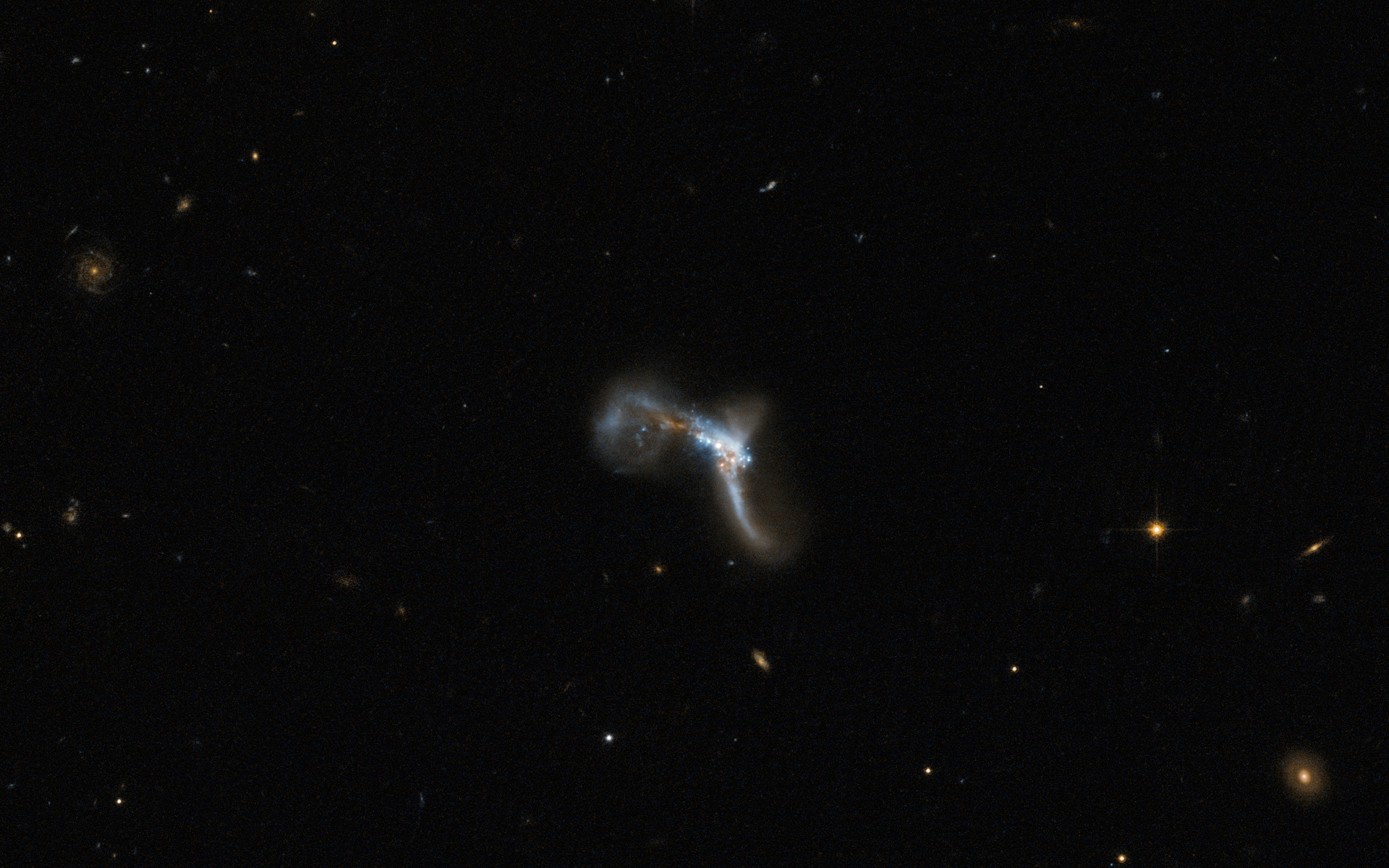
Astronomers have found evidence of magnetic fields associated with a disc of gas and dust a few hundred light-years across deep inside a system of two merging galaxies known as Arp220 (pictured). Credit: NASA, ESA, the Hubble Heritage (STScl/AURA), ESA, Hubble Collaboration, and A. Evans (University of Virginia, Charlottesville/NRAO/Stony Brook University)
Licence type: Attribution (CC BY 4.0)
Image showing the intensity of Arp 220 in the Submillimeter Array continuum bands (colour) with polarization vectors overlaid (left). These are rotated by 90 degrees in the image to show the orientation of the magnetic field. Credit: D.L. Clements et al.
Licence type: Attribution (CC BY 4.0)
The Submillimeter Array on Maunakea, Hawaii.
Credit: SMA/J. Weintroub
Licence type: Attribution (CC BY 4.0)
Credit: SMA/J. Weintroub
Licence type: Attribution (CC BY 4.0)
The missing ingredient for cooking up stars in the same way you might steam your Christmas pudding has been spotted for the first time by astronomers.
Much like a pressure cooker has a weight on top of its lid to keep the pressure in and get your festive dessert dense, moist and ready to eat, merging galaxies may need magnetic fields to create the ideal conditions for star formation.
Until now, however, the existence of such a force had only been theorised rather than observed.
An international team of researchers led by Imperial College astrophysicist Dr David Clements found evidence of magnetic fields associated with a disc of gas and dust a few hundred light-years across deep inside a system of two merging galaxies known as Arp220.
They say these regions could be the key to making the centres of interacting galaxies just right for cooking lots of hydrogen gas into young stars. This is because magnetic fields may be able to stop intense bursts of star formation in the cores of merging galaxies from effectively 'boiling over' when the heat is turned up too high.
A new paper revealing the discovery has been published today in Monthly Notices of the Royal Astronomical Society Letters.
"This is the first time we've found evidence of magnetic fields in the core of a merger," said Dr Clements, "but this discovery is just a starting point. We now need better models, and to see what's happening in other galaxy mergers."
Much like a pressure cooker has a weight on top of its lid to keep the pressure in and get your festive dessert dense, moist and ready to eat, merging galaxies may need magnetic fields to create the ideal conditions for star formation.
Until now, however, the existence of such a force had only been theorised rather than observed.
An international team of researchers led by Imperial College astrophysicist Dr David Clements found evidence of magnetic fields associated with a disc of gas and dust a few hundred light-years across deep inside a system of two merging galaxies known as Arp220.
They say these regions could be the key to making the centres of interacting galaxies just right for cooking lots of hydrogen gas into young stars. This is because magnetic fields may be able to stop intense bursts of star formation in the cores of merging galaxies from effectively 'boiling over' when the heat is turned up too high.
A new paper revealing the discovery has been published today in Monthly Notices of the Royal Astronomical Society Letters.
"This is the first time we've found evidence of magnetic fields in the core of a merger," said Dr Clements, "but this discovery is just a starting point. We now need better models, and to see what's happening in other galaxy mergers."
He gave a cooking analogy when explaining the role of magnetic fields in star formation.
"If you want to cook up a lot of stars (Christmas puddings) in a short period of time you need to squeeze lots of gas (or ingredients) together. This is what we see in the cores of mergers. But then, as the heat from young stars (or your cooker) builds, things can boil over, and the gas (or pudding mixture) gets dispersed," Dr Clements said.
"To stop this happening, you need to add something to hold it all together – a magnetic field in a galaxy, or the lid and weight of a pressure cooker."
Astronomers have long been looking for the magic ingredient that makes some galaxies form stars more efficiently than is normal.
One of the issues about galaxy mergers is that they can form stars very quickly, in what is known as a starburst. This means they're behaving differently to other star-forming galaxies in terms of the relationship between star formation rate and the mass of stars in the galaxy – they seem to be turning gas into stars more efficiently than non-starburst galaxies. Astronomers are baffled as to why this happens.
One possibility is that magnetic fields could act as an extra 'binding force' that holds the star-forming gas together for longer, resisting the tendency for the gas to expand and dissipate as it is heated by young, hot stars, or by supernovae as massive stars die.
Theoretical models have previously suggested this, but the new observations are the first to show that magnetic fields are present in the core of at least one starbursting galaxy merger.
Researchers used the Submillimeter Array (SMA) on Maunakea in Hawaii to probe deep inside the ultraluminous infrared galaxy Arp220. The SMA is designed to take images of light in wavelengths of about a millimetre – which lies at the boundary between infrared and radio wavelengths. This opens up a window to a wide range of astronomical phenomena including supermassive black holes and the birth of stars and planets.
Arp220 is one of the brightest objects in the extragalactic far-infrared sky and is the result of a merger between two gas-rich spiral galaxies, which has triggered starbursting activity in the merger's nuclear regions.
The extragalactic far-infrared sky is a cosmic background radiation made up of the integrated light from distant galaxies' dust emissions. About half of all starlight emerges at far-infrared wavelengths.
The next step for the research team will be to use the Atacama Large Millimeter/submillimeter Array (ALMA) – the most powerful telescope for observing molecular gas and dust in the cool universe – to search for magnetic fields in other ultraluminous infrared galaxies.
That is because the next brightest local ultraluminous infrared galaxy to Arp220 is a factor of four or more fainter.
With their result, and further observations, the researchers hope the role of magnetic fields in some of the most luminous galaxies in the local universe will become much clearer.
"To stop this happening, you need to add something to hold it all together – a magnetic field in a galaxy, or the lid and weight of a pressure cooker."
Astronomers have long been looking for the magic ingredient that makes some galaxies form stars more efficiently than is normal.
One of the issues about galaxy mergers is that they can form stars very quickly, in what is known as a starburst. This means they're behaving differently to other star-forming galaxies in terms of the relationship between star formation rate and the mass of stars in the galaxy – they seem to be turning gas into stars more efficiently than non-starburst galaxies. Astronomers are baffled as to why this happens.
One possibility is that magnetic fields could act as an extra 'binding force' that holds the star-forming gas together for longer, resisting the tendency for the gas to expand and dissipate as it is heated by young, hot stars, or by supernovae as massive stars die.
Theoretical models have previously suggested this, but the new observations are the first to show that magnetic fields are present in the core of at least one starbursting galaxy merger.
Researchers used the Submillimeter Array (SMA) on Maunakea in Hawaii to probe deep inside the ultraluminous infrared galaxy Arp220. The SMA is designed to take images of light in wavelengths of about a millimetre – which lies at the boundary between infrared and radio wavelengths. This opens up a window to a wide range of astronomical phenomena including supermassive black holes and the birth of stars and planets.
Arp220 is one of the brightest objects in the extragalactic far-infrared sky and is the result of a merger between two gas-rich spiral galaxies, which has triggered starbursting activity in the merger's nuclear regions.
The extragalactic far-infrared sky is a cosmic background radiation made up of the integrated light from distant galaxies' dust emissions. About half of all starlight emerges at far-infrared wavelengths.
The next step for the research team will be to use the Atacama Large Millimeter/submillimeter Array (ALMA) – the most powerful telescope for observing molecular gas and dust in the cool universe – to search for magnetic fields in other ultraluminous infrared galaxies.
That is because the next brightest local ultraluminous infrared galaxy to Arp220 is a factor of four or more fainter.
With their result, and further observations, the researchers hope the role of magnetic fields in some of the most luminous galaxies in the local universe will become much clearer.
Media contacts:
Sam Tonkin
Royal Astronomical Society
Mob: +44 (0)7802 877 700
press@ras.ac.uk
Robert Massey
Royal Astronomical Society
Mob: +44 (0)7802 877699
press@ras.ac.uk
Scientific contacts:
Dr Dave Clements
Imperial College London
d.clements@imperial.ac.uk"
Further information
The paper 'Polarized Dust Emission in Arp220: Magnetic Fields in the Core of an Ultraluminous Infrared Galaxy' by Dave Clements et al. has been published in Monthly Notices of the Royal Astronomical Society Letters. DOI: 10.1093/mnrasl/slae107.
Notes for editors
About the Royal Astronomical Society
The Royal Astronomical Society (RAS), founded in 1820, encourages and
promotes the study of astronomy, solar-system science, geophysics and
closely related branches of science.
The RAS organises scientific meetings, publishes international research and review journals, recognises outstanding achievements by the award of medals and prizes, maintains an extensive library, supports education through grants and outreach activities and represents UK astronomy nationally and internationally. Its more than 4,000 members (Fellows), a third based overseas, include scientific researchers in universities, observatories and laboratories as well as historians of astronomy and others.
The RAS accepts papers for its journals based on the principle of peer review, in which fellow experts on the editorial boards accept the paper as worth considering. The Society issues press releases based on a similar principle, but the organisations and scientists concerned have overall responsibility for their content.
The RAS organises scientific meetings, publishes international research and review journals, recognises outstanding achievements by the award of medals and prizes, maintains an extensive library, supports education through grants and outreach activities and represents UK astronomy nationally and internationally. Its more than 4,000 members (Fellows), a third based overseas, include scientific researchers in universities, observatories and laboratories as well as historians of astronomy and others.
The RAS accepts papers for its journals based on the principle of peer review, in which fellow experts on the editorial boards accept the paper as worth considering. The Society issues press releases based on a similar principle, but the organisations and scientists concerned have overall responsibility for their content.
Keep up with the RAS on X,Facebook, LinkedIn, Bluesky and YouTube.
Submitted by Sam Tonkin