Thursday, February 11, 2016

Scientists discover hidden galaxies behind the Milky Way

An annotated artist's impression showing radio waves travelling from the new galaxies, then passing through the Milky Way and arriving at the Parkes radio telescope on Earth (not to scale). Credit: ICRAR  

An artist’s impression of the galaxies found in the ‘Zone of Avoidance’ behind the Milky Way. This scene has been created using the actual positional data of the new galaxies and randomly populating the region with galaxies of different sizes, types and colours. Credit: ICRAR


An animation showing the location of the galaxies discovered in the 'Zone of Avoidance'. Until now this region of space has remained hidden from view because of the gas and dust of the Milky Way which blocks light at optical wavelengths from reaching telescopes on Earth. By using CSIRO's Parkes radio telescope to detect radio waves that can travel through our galaxy's gas and dust, hundreds of new galaxies have been found in the region of space known to astronomers as the 'Zone of Avoidance'. This animation has been created using the actual positional data of the new galaxies and randomly populating the region with galaxies of different sizes, types and colours. Credit: ICRAR. Music by Holly Broadbent.


An annotated animation showing the location of the galaxies discovered in the 'Zone of Avoidance'. Until now this region of space has remained hidden from view because of the gas and dust of the Milky Way which blocks light at optical wavelengths from reaching telescopes on Earth. By using CSIRO's Parkes radio telescope to detect radio waves that can travel through our galaxy's gas and dust, hundreds of new galaxies have been found in the region of space known to astronomers as the 'Zone of Avoidance'. This animation has been created using the actual positional data of the new galaxies and randomly populating the region with galaxies of different sizes, types and colours. Credit: ICRAR. Music by Holly Broadbent.

 
A visualisation showing the coordinates of the new 'hidden galaxies'. At the centre is Earth. Blue represents galaxies found in other surveys and other colours show the locations of the new galaxies. Credit: ICRAR

Hidden Galaxies Animation    
Download link


Hundreds of hidden nearby galaxies have been studied for the first time, shedding light on a mysterious gravitational anomaly dubbed the Great Attractor.

Despite being just 250 million light years from Earth—very close in astronomical terms—the new galaxies had been hidden from view until now by our own galaxy, the Milky Way.

Using CSIRO’s Parkes radio telescope equipped with an innovative receiver, an international team of scientists were able to see through the stars and dust of the Milky Way, into a previously unexplored region of space.

The discovery may help to explain the Great Attractor region, which appears to be drawing the Milky Way and hundreds of thousands of other galaxies towards it with a gravitational force equivalent to a million billion Suns.

Lead author Professor Lister Staveley-Smith, from The University of Western Australia node of the International Centre for Radio Astronomy Research (ICRAR), said the team found 883 galaxies, a third of which had never been seen before.

“The Milky Way is very beautiful of course and it’s very interesting to study our own galaxy but it completely blocks out the view of the more distant galaxies behind it,” he said.

Professor Staveley-Smith said scientists have been trying to get to the bottom of the mysterious Great Attractor since major deviations from universal expansion were first discovered in the 1970s and 1980s.

“We don’t actually understand what’s causing this gravitational acceleration on the Milky Way or where it’s coming from,” he said.

“We know that in this region there are a few very large collections of galaxies we call clusters or superclusters, and our whole Milky Way is moving towards them at more than two million kilometres per hour.”

The research identified several new structures that could help to explain the movement of the Milky Way, including three galaxy concentrations (named NW1, NW2 and NW3) and two new clusters (named CW1 and CW2).

University of Cape Town astronomer Professor Renée Kraan-Korteweg said astronomers have been trying to map the galaxy distribution hidden behind the Milky Way for decades.

“We’ve used a range of techniques but only radio observations have really succeeded in allowing us to see through the thickest foreground layer of dust and stars,” she said.

“An average galaxy contains 100 billion stars, so finding hundreds of new galaxies hidden behind the Milky Way points to a lot of mass we didn't know about until now.”

Dr. Bärbel Koribalski from CSIRO Astronomy and Space Science said innovative technologies on the Parkes Radio telescope had made it possible to survey large areas of the sky very quickly.

“With the 21-cm multibeam receiver on Parkes we’re able to map the sky 13 times faster than we could before and make new discoveries at a much greater rate,” she said.

The study involved researchers from Australia, South Africa, the US and the Netherlands, and was published today in the Astronomical Journal.


More Information

The International Centre for Radio Astronomy Research (ICRAR) is a joint venture between Curtin University and The University of Western Australia with support and funding from the State Government of Western Australia.

Professor Lister Staveley-Smith is ICRAR’s Director of Science at UWA and the Deputy Director of the ARC Centre of Excellence for All-sky Astrophysics (CAASTRO).

Dr Bärbel S. Koribalski is a CSIRO Science Leader, leading the HI group at CSIRO Astronomy and Space Science. Dr Koribalski and Prof Staveley-Smith are the principal investigators of WALLABY, the ASKAP HI All-Sky Survey.

The ‘Great Attractor’ is a diffuse concentration of mass 250 million light-years away, that’s pulling our galaxy, the Milky Way, and hundreds of thousands of other galaxies towards it.

CSIRO’s Parkes telescope, or “the Dish”, is a 64-metre radio telescope located in New South Wales, Australia. The telescope has been in operation since 1961 and continues to be at the forefront of astronomical discovery.


Original publication details:

‘The Parkes HI Zone of Avoidance Survey’, published in the Astronomical Journal February 9th, 2016. Available at this link.


Contacts:

Prof. Lister Staveley-SmithUniversity of Western Australia, ICRAR, CAASTRO
Ph: +61 425 212 592
E:
Lister.Staveley-Smith@icrar.org

Prof. Renée C. Kraan-KortewegUniversity of Cape Town
M: +27 21 650 5830
E:
kraan@ast.uct.ac.za

Dr Bärbel Koribalski CSIRO Astronomy and Space Science
M: +61 450 624 954
E:
Baerbel.Koribalski@csiro.au

Pete WheelerMedia Contact, ICRAR
M: +61 423 982 018
E:
Pete.Wheeler@icrar.org

Source: International Centre for Radio Astronomy Research (ICRAR)

Wednesday, February 10, 2016

A Star’s Moment in the Spotlight

Young star lights up reflection nebula IC 2631

PR Image eso1605b
The location of the reflection nebula IC 2631 in the constellation of Chameleon

The sky around reflection nebula IC 2631


Videos
 
Zooming in on the young star in the reflection nebula IC 2631

Close-up of the reflection nebula IC 2631


A newly formed star lights up the surrounding cosmic clouds in this new image from ESO’s La Silla Observatory in Chile. Dust particles in the vast clouds that surround the star HD 97300 diffuse its light, like a car headlight in enveloping fog, and create the reflection nebula IC 2631. Although HD 97300 is in the spotlight for now, the very dust that makes it so hard to miss heralds the birth of additional, potentially scene-stealing, future stars.

The glowing region in this new image from the MPG/ESO 2.2-metre telescope is a reflection nebula known as IC 2631. These objects are clouds of cosmic dust that reflect light from a nearby star into space, creating a stunning light show like the one captured here. IC 2631 is the brightest nebula in the Chamaeleon Complex, a large region of gas and dust clouds that harbours numerous newborn and still-forming stars. The complex lies about 500 light-years away in the southern constellation of Chamaeleon.

IC 2631 is illuminated by the star HD 97300, one of the youngest — as well as most massive and brightest — stars in its neighbourhood. This region is full of star-making material, which is made evident by the presence of dark nebulae noticeable above and below IC 2631 in this picture. Dark nebulae are so dense with gas and dust that they prevent the passage of background starlight.

Despite its dominating presence, the heft of HD 97300 should be kept in perspective. It is a T Tauri star, the youngest visible stage for relatively small stars. As these stars mature and reach adulthood they will lose mass and shrink. But during the T Tauri phase these stars have not yet contracted to the more modest size that they will maintain for billions of years as main sequence stars.

These fledging stars already have surface temperatures similar to their main sequence phase and accordingly, because T Tauri-phase objects are essentially jumbo versions of their later selves, they look brighter in their oversized youth than in maturity. They have not yet started to fuse hydrogen into helium in their cores, like normal main sequence stars, but are just starting to flex their thermal muscles by generating heat from contraction.

Reflection nebula, like the one spawned by HD 97300, merely scatter starlight back out into space. Starlight that is more energetic, such as the ultraviolet radiation pouring forth from very hot new stars, can ionise nearby gas, making it emit light of its own. These emission nebulae indicate the presence of hotter and more powerful stars, which in their maturity can be observed across thousands of light-years. HD 97300 is not so powerful, and its moment in the spotlight is destined not to last.


More Information

ESO is the foremost intergovernmental astronomy organisation in Europe and the world’s most productive ground-based astronomical observatory by far. It is supported by 16 countries: Austria, Belgium, Brazil, the Czech Republic, Denmark, France, Finland, Germany, Italy, the Netherlands, Poland, Portugal, Spain, Sweden, Switzerland and the United Kingdom, along with the host state of Chile. ESO carries out an ambitious programme focused on the design, construction and operation of powerful ground-based observing facilities enabling astronomers to make important scientific discoveries. ESO also plays a leading role in promoting and organising cooperation in astronomical research. ESO operates three unique world-class observing sites in Chile: La Silla, Paranal and Chajnantor. At Paranal, ESO operates the Very Large Telescope, the world’s most advanced visible-light astronomical observatory and two survey telescopes. VISTA works in the infrared and is the world’s largest survey telescope and the VLT Survey Telescope is the largest telescope designed to exclusively survey the skies in visible light. ESO is a major partner in ALMA, the largest astronomical project in existence. And on Cerro Armazones, close to Paranal, ESO is building the 39-metre European Extremely Large Telescope, the E-ELT, which will become “the world’s biggest eye on the sky”.

Links


Contacts

Richard Hook
ESO Public Information Officer
Garching bei München, Germany
Tel: +49 89 3200 6655
Cell: +49 151 1537 3591
Email:
rhook@eso.org


Source: ESO

Tuesday, February 09, 2016

A galaxy in distress: the spectacular tails of ionized gas in NGC 4569, the most massive spiral galaxy in the Virgo cluster

The colour image of the galaxy NGC 4569 in the Virgo cluster, obtained with MegaCam at the CFHT. The red filaments at the right of the galaxy show the ionised gas removed by ram pressure. This is about 95% of the gas reservoir of the galaxy needed to feed the formation of new stars (image ©2015 CFHT/Coelum).


An international team led by researchers from the Laboratoire d'Astrophysique de Marseille (LAM) has used MegaCam on CFHT to observe NGC 4569, the most massive spiral galaxy in the Virgo cluster. They observed, for the first time, spectacular tails of ionized gas that extend for over 300,000 light years, five times larger than NGC 4569 itself! This observation confirms that ram pressure stripping due to the intracluster medium is depriving NGC 4569 of its gas reservoir. This important constraint must be taken into account in any cosmological model striving to incorporate the effect of environment on the evolution of galaxies. The result also shows that MegaCam at CFHT is now a second-to-none world-class facility to study gas stripping and opens up a promising new avenue for understanding the role of environment in the evolution of galaxies.

Galaxies are not distributed uniformly throughout the universe. Some are found in dense clusters that can contain hundred to thousands of galaxies. Astrophysicists suspect that living in a cluster environment can have a strong influence in the way galaxies evolve. The tell-tail signs have long been recognized: for instance, compared to less dense regions, clusters contain proportionally more elliptical galaxies (spheroidal systems with little to no gas and dust) and fewer spirals (gas rich disky systems in which new stars are continuously formed from the gas in the interstellar medium). And even the few spiral galaxies found in clusters generally contain less gas and have an older population of stars than isolated spiral galaxies.

Several mechanisms have been proposed to explain the difference observed between galaxies in different environments. First, when two galaxies interact, tidal forces tend to rip apart and disrupt the outermost, less gravitationally bound and most diffuse parts. A second mechanism is the "dynamical pressure" exerted on the interstellar medium of a galaxy as it travels through the hot, diffuse medium that permeates the space in between galaxies, a process known as `ram pressure stripping’ (a biker travelling at high speed would experience a similar kind of pressure from the ambient air!). These two processes are able to lift gas from the disks of spiral galaxies, and therefore inhibit the formation of new stars. There is also a third mechanism that is thought to affect mostly the most massive galaxies: these galaxies host very massive black holes at their centres, and the energy liberated by the accretion onto these black holes, injected into the surrounding medium, can unbind the gas.

Identifying which of these processes is dominant is critical to constrain cosmological simulations that follow the evolution of galaxies. Observationally, however, observing the low density gas as it is being stripped is a tremendous challenge. The MegaCam Camera on the Canada France Hawaii Telescope (CFHT) has recently been equipped with a new, high efficient narrow-band filter that isolates the H-alpha emission line from the ionized gas, allowing it to be detected with high efficiency.

An international team led by researchers from the Laboratoire d'Astrophysique de Marseille (LAM) has used this instrument to observe NGC 4569, the most massive spiral galaxy in the Virgo cluster (at 45 million light years, the massive cluster of galaxies closest to the Milky Way). The Virgo cluster is still evolving, and therefore offers the opportunity to observe the transformation of galaxies as it takes place. NGC 4569 is moving through the cluster at a staggering 1200 km/s. The H-alpha image obtained with MegaCam at CFHT shows for the first time spectacular tails of ionized gas that extend for over 300,000 light years, five times larger than NGC 4569 itself ! This observation confirms that ram pressure stripping due to the intracluster medium is depriving NGC 4569 of its gas reservoir. An estimate of the mass of gas in these tails shows that 95% of the interstellar medium has already been removed from the disk of the galaxy, greatly limiting its ability to form new stars.

For a galaxy as massive as NGC 4569, it is perhaps surprising that internal gravitational forces are not strong enough to hold the gas together, counteracting the action of ram pressure stripping. Indeed, in cosmological models, it is hypothesised that in such massive galaxies, it is the activity related to the central supermassive black hole to cause the gas to be lost. The new observations show instead that the dominant effect is ram pressure: this important constraint must be taken into account in any cosmological model striving to incorporate the effect of environment on the evolution of galaxies.

The result also shows that MegaCam at CFHT is now a second-to-none world-class facility to study gas stripping and opens up a promising new avenue for understanding the role of environment in the evolution of galaxies.


Additional information: Scientific article

Information/Maiin contact:

Alessandro Boselli
Laboratoire d'Astrophysique de Marseille
38, rue Joliot-Curie
F-13388 Marseille cedex 13 -  France
alessandro.boselli@lam.fr


Monday, February 08, 2016

Earth-like Planets Have Earth-like Interiors


"We wanted to see how Earth-like these rocky planets are. It turns out they are very Earth-like," says lead author Li Zeng of the Harvard-Smithsonian Center for Astrophysics (CfA).

To reach this conclusion Zeng and his co-authors applied a computer model known as the Preliminary Reference Earth Model (PREM), which is the standard model for Earth's interior. They adjusted it to accommodate different masses and compositions, and applied it to six known rocky exoplanets with well-measured masses and physical sizes.

They found that the other planets, despite their differences from Earth, all should have a nickel/iron core containing about 30 percent of the planet's mass. In comparison, about a third of the Earth's mass is in its core. The remainder of each planet would be mantle and crust, just as with Earth.

"We've only understood the Earth's structure for the past hundred years. Now we can calculate the structures of planets orbiting other stars, even though we can't visit them," adds Zeng.

The new code also can be applied to smaller, icier worlds like the moons and dwarf planets in the outer solar system. For example, by plugging in the mass and size of Pluto, the team finds that Pluto is about one-third ice (mostly water ice but also ammonia and methane ices).

The model assumes that distant exoplanets have chemical compositions similar to Earth. This is reasonable based on the relevant abundances of key chemical elements like iron, magnesium, silicon, and oxygen in nearby systems. However, planets forming in more or less metal-rich regions of the galaxy could show different interior structures. The team expects to explore these questions in future research.

The paper detailing this work, authored by Li Zeng, Dimitar Sasselov, and Stein Jacobsen (Harvard University), has been accepted for publication in The Astrophysical Journal and is available online.

Headquartered in Cambridge, Mass., the Harvard-Smithsonian Center for Astrophysics (CfA) is a joint collaboration between the Smithsonian Astrophysical Observatory and the Harvard College Observatory. CfA scientists, organized into six research divisions, study the origin, evolution and ultimate fate of the universe.


For more information, contact:

Christine Pulliam
Media Relations Manager
Harvard-Smithsonian Center for Astrophysics
617-495-7463
cpulliam@cfa.harvard.edu


Friday, February 05, 2016

One from many

Credit:ESA/Hubble & NASA
Acknowledgement: Judy Schmidt (
Geckzilla)


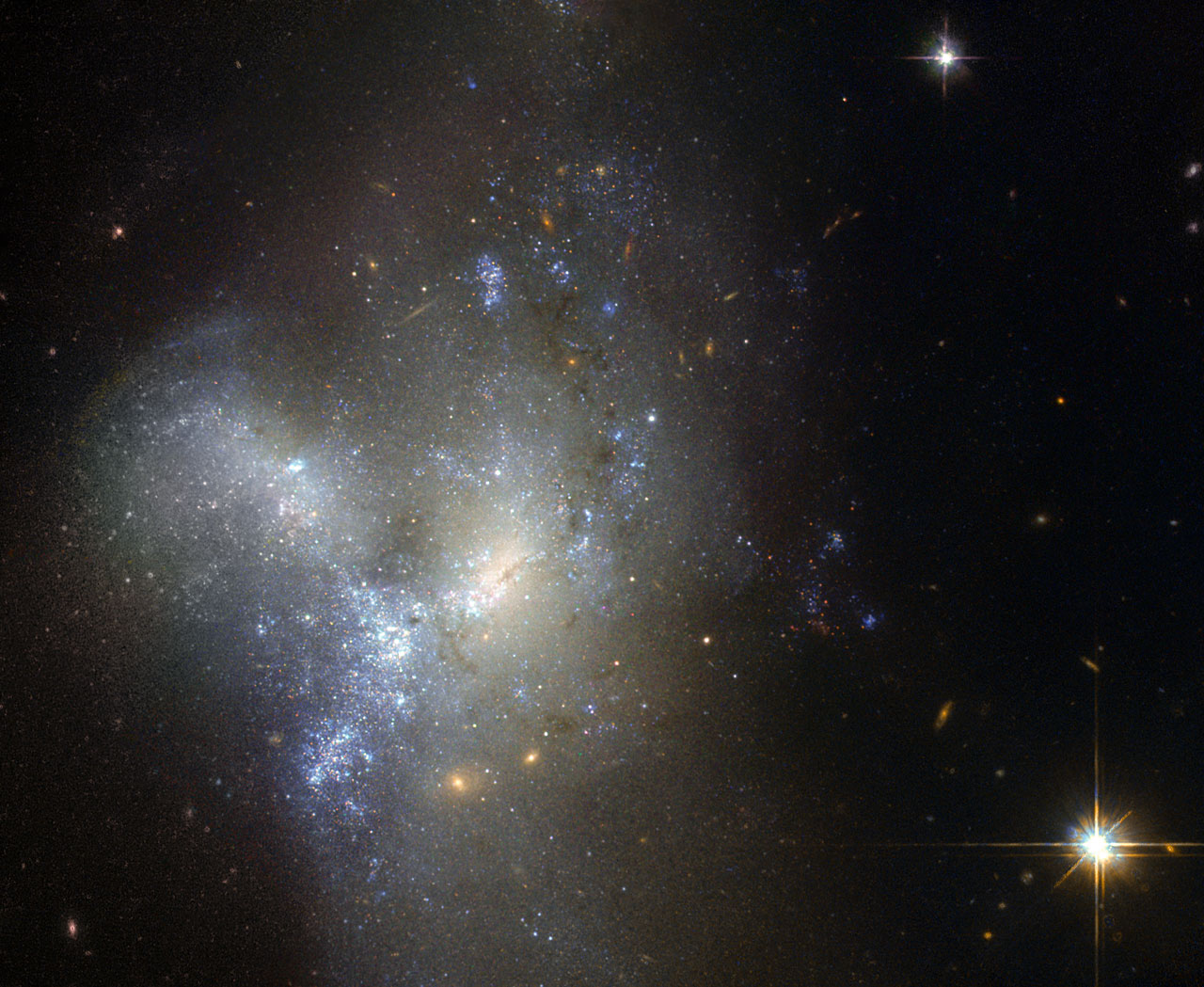
This image, taken by the NASA/ESA Hubble Space Telescope, shows a peculiar galaxy known as NGC 1487, lying about 30 million light-years away in the southern constellation of Eridanus.

Rather than viewing a celestial object, it is actually better to think of this as an event. Here, we are witnessing two or more galaxies in the act of merging together to form a single new galaxy. Each progenitor has lost almost all traces of its original appearance, as stars and gas have been thrown hither and thither by gravity in an elaborate cosmic whirl.

Unless one is very much bigger than the other, galaxies are always disrupted by the violence of the merging process. As a result, it is very difficult to determine precisely what the original galaxies looked like and, indeed, how many of them there were. In this case, it is possible that we are seeing the merger of several dwarf galaxies that were previously clumped together in a small group.

Although older yellow and red stars can be seen in the outer regions of the new galaxy, its appearance is dominated by large areas of bright blue stars, illuminating the patches of gas that gave them life. This burst of star formation may well have been triggered by the merger.


Thursday, February 04, 2016

Moon was produced by a head-on collision between Earth and a forming planet

The extremely similar chemical composition of rocks on the Earth and moon helped scientists determine that a head-on collision, not a glancing blow, took place between Earth and Theia. Copyright William K. Hartmann

Paul Warren, Edward Young (holding a sample of a rock from the moon) and Issaku Kohl
Credit: Christelle Snow/UCLA


UCLA-led research reconstructs massive crash, which took place 4.5 billion years ago


The moon was formed by a violent, head-on collision between the early Earth and a “planetary embryo” called Theia approximately 100 million years after the Earth formed, UCLA geochemists and colleagues report.

Scientists had already known about this high-speed crash, which occurred almost 4.5 billion years ago, but many thought the Earth collided with Theia (pronounced THAY-eh) at an angle of 45 degrees or more — a powerful side-swipe (simulated in this 2012 YouTube video). New evidence reported Jan. 29 in the journal Science substantially strengthens the case for a head-on assault.

The researchers analyzed seven rocks brought to the Earth from the moon by the Apollo 12, 15 and 17 missions, as well as six volcanic rocks from the Earth’s mantle — five from Hawaii and one from Arizona.

The key to reconstructing the giant impact was a chemical signature revealed in the rocks’ oxygen atoms. (Oxygen makes up 90 percent of rocks’ volume and 50 percent of their weight.) More than 99.9 percent of Earth’s oxygen is O-16, so called because each atom contains eight protons and eight neutrons. But there also are small quantities of heavier oxygen isotopes: O-17, which have one extra neutron, and O-18, which have two extra neutrons. Earth, Mars and other planetary bodies in our solar system each has a unique ratio of O-17 to O-16 — each one a distinctive “fingerprint.”

In 2014, a team of German scientists reported in Science that the moon also has its own unique ratio of oxygen isotopes, different from Earth’s. The new research finds that is not the case.

“We don’t see any difference between the Earth’s and the moon’s oxygen isotopes; they’re indistinguishable,” said Edward Young, lead author of the new study and a UCLA professor of geochemistry and cosmochemistry.

Young’s research team used state-of-the-art technology and techniques to make extraordinarily precise and careful measurements, and verified them with UCLA’s new mass spectrometer.

The fact that oxygen in rocks on the Earth and our moon share chemical signatures was very telling, Young said. Had Earth and Theia collided in a glancing side blow, the vast majority of the moon would have been made mainly of Theia, and the Earth and moon should have different oxygen isotopes. A head-on collision, however, likely would have resulted in similar chemical composition of both Earth and the moon.

“Theia was thoroughly mixed into both the Earth and the moon, and evenly dispersed between them,” Young said. “This explains why we don’t see a different signature of Theia in the moon versus the Earth.”

Theia, which did not survive the collision (except that it now makes up large parts of Earth and the moon) was growing and probably would have become a planet if the crash had not occurred, Young said. Young and some other scientists believe the planet was approximately the same size as the Earth; others believe it was smaller, perhaps more similar in size to Mars.

Another interesting question is whether the collision with Theia removed any water that the early Earth may have contained. After the collision — perhaps tens of millions of year later — small asteroids likely hit the Earth, including ones that may have been rich in water, Young said. Collisions of growing bodies occurred very frequently back then, he said, although Mars avoided large collisions.

A head-on collision was initially proposed in 2012 by Matija Ćuk, now a research scientist with the SETI Institute, and Sarah Stewart, now a professor at UC Davis; and, separately during the same year by Robin Canup of the Southwest Research Institute.

Co-authors of the Science paper are Issaku Kohl, a researcher in Young’s laboratory; Paul Warren, a researcher in the UCLA department of Earth, planetary, and space sciences; David Rubie, a research professor at Germany’s Bayerisches Geoinstitut, University of Bayreuth; and Seth Jacobson and Alessandro Morbidelli, planetary scientists at France’s Laboratoire Lagrange, Université de Nice.

The research was funded by NASA, the Deep Carbon Observatory and a European Research Council advanced grant (ACCRETE).


Media Contact

Stuart Wolpert
310-206-0511
swolpert@support.ucla.edu


Wednesday, February 03, 2016

The Deep-Frozen Flying Saucer

PR Image eso1604a 
The Flying Saucer protoplanetary disc around 2MASS J16281370-2431391
The Rho Ophiuchi star formation region in the constellation of Ophiuchus

The Rho Ophiuchi star formation region in the constellation of Ophiuchus

Zooming in on the Flying Saucer protoplanetary disc


ALMA finds unexpectedly cold grains in planet-forming disc

Astronomers have used the ALMA and IRAM telescopes to make the first direct measurement of the temperature of the large dust grains in the outer parts of a planet-forming disc around a young star. By applying a novel technique to observations of an object nicknamed the Flying Saucer they find that the grains are much colder than expected: −266 degrees Celsius. This surprising result suggests that models of these discs may need to be revised.

The international team, led by Stephane Guilloteau at the Laboratoire d'Astrophysique de Bordeaux, France, measured the temperature of large dust grains around the young star 2MASS J16281370-2431391 in the spectacular Rho Ophiuchi star formation region, about 400 light-years from Earth.

This star is surrounded by a disc of gas and dust — such discs are called protoplanetary discs as they are the early stages in the creation of planetary systems. This particular disc is seen nearly edge-on, and its appearance in visible light pictures has led to its being nicknamed the Flying Saucer.

The astronomers used the Atacama Large Millimeter/submillimeter Array (ALMA) to observe the glow coming from carbon monoxide molecules in the 2MASS J16281370-2431391 disc. They were able to create very sharp images and found something strange — in some cases they saw a negative signal! Normally a negative signal is physically impossible, but in this case there is an explanation, which leads to a surprising conclusion.

Lead author Stephane Guilloteau takes up the story: “This disc is not observed against a black and empty night sky. Instead it’s seen in silhouette in front of the glow of the Rho Ophiuchi Nebula. This diffuse glow is too extended to be detected by ALMA, but the disc absorbs it. The resulting negative signal means that parts of the disc are colder than the background. The Earth is quite literally in the shadow of the Flying Saucer!

The team combined the ALMA measurements of the disc with observations of the background glow made with the IRAM 30-metre telescope in Spain [1]. They derived a disc dust grain temperature of only −266 degrees Celsius (only 7 degrees above absolute zero, or 7 Kelvin) at a distance of about 15 billion kilometres from the central star [2]. This is the first direct measurement of the temperature of large grains (with sizes of about one millimetre) in such objects.

This temperature is much lower than the −258 to −253 degrees Celsius (15 to 20 Kelvin) that most current models predict. To resolve the discrepancy, the large dust grains must have different properties than those currently assumed, to allow them to cool down to such low temperatures.

To work out the impact of this discovery on disc structure, we have to find what plausible dust properties can result in such low temperatures. We have a few ideas — for example the temperature may depend on grain size, with the bigger grains cooler than the smaller ones. But it is too early to be sure,” adds co-author Emmanuel di Folco (Laboratoire d'Astrophysique de Bordeaux).

If these low dust temperatures are found to be a normal feature of protoplanetary discs this may have many consequences for understanding how they form and evolve.

For example, different dust properties will affect what happens when these particles collide, and thus their role in providing the seeds for planet formation. Whether the required change in dust properties is significant or not in this respect cannot yet be assessed.

Low dust temperatures can also have a major impact for the smaller dusty discs that are known to exist. If these discs are composed of mostly larger, but cooler, grains than is currently supposed, this would mean that these compact discs can be arbitrarily massive, so could still form giant planets comparatively close to the central star.

Further observations are needed, but it seems that the cooler dust found by ALMA may have significant consequences for the understanding of protoplanetary discs.


Notes:

[1] The IRAM measurements were needed as ALMA itself was not sensitive to the extended signal from the background.

 [2] This corresponds to one hundred times the distance from the Earth to the Sun. This region is now occupied by the Kuiper Belt within the Solar System.


More information

This research was presented in a paper entitled “The shadow of the Flying Saucer: A very low temperature for large dust grains”, by S. Guilloteau et al., published in Astronomy & Astrophysics Letters.

The team is composed of S. Guilloteau (University of Bordeaux/CNRS, Floirac, France), V. Piétu (IRAM, Saint Martin d’Hères, France), E. Chapillon (University of Bordeaux/CNRS; IRAM), E. Di Folco (University of Bordeaux/CNRS), A. Dutrey (University of Bordeaux/CNRS), T.Henning (Max Planck Institute für Astronomie, Heidelberg, Germany [MPIA]), D.Semenov (MPIA), T.Birnstiel (MPIA) and N. Grosso (Observatoire Astronomique de Strasbourg, Strasbourg, France).

The Atacama Large Millimeter/submillimeter Array (ALMA), an international astronomy facility, is a partnership of ESO, the US National Science Foundation (NSF) and the National Institutes of Natural Sciences (NINS) of Japan in cooperation with the Republic of Chile. ALMA is funded by ESO on behalf of its Member States, by NSF in cooperation with the National Research Council of Canada (NRC) and the National Science Council of Taiwan (NSC) and by NINS in cooperation with the Academia Sinica (AS) in Taiwan and the Korea Astronomy and Space Science Institute (KASI).

ALMA construction and operations are led by ESO on behalf of its Member States; by the National Radio Astronomy Observatory (NRAO), managed by Associated Universities, Inc. (AUI), on behalf of North America; and by the National Astronomical Observatory of Japan (NAOJ) on behalf of East Asia. The Joint ALMA Observatory (JAO) provides the unified leadership and management of the construction, commissioning and operation of ALMA.

The Institut de Radio Astronomie Millimétrique (IRAM) is supported by INSU/CNRS (France), MPG (Germany), and IGN (Spain).

ESO is the foremost intergovernmental astronomy organisation in Europe and the world’s most productive ground-based astronomical observatory by far. It is supported by 16 countries: Austria, Belgium, Brazil, the Czech Republic, Denmark, France, Finland, Germany, Italy, the Netherlands, Poland, Portugal, Spain, Sweden, Switzerland and the United Kingdom, along with the host state of Chile. ESO carries out an ambitious programme focused on the design, construction and operation of powerful ground-based observing facilities enabling astronomers to make important scientific discoveries. ESO also plays a leading role in promoting and organising cooperation in astronomical research. ESO operates three unique world-class observing sites in Chile: La Silla, Paranal and Chajnantor. At Paranal, ESO operates the Very Large Telescope, the world’s most advanced visible-light astronomical observatory and two survey telescopes. VISTA works in the infrared and is the world’s largest survey telescope and the VLT Survey Telescope is the largest telescope designed to exclusively survey the skies in visible light. ESO is a major partner in ALMA, the largest astronomical project in existence. And on Cerro Armazones, close to Paranal, ESO is building the 39-metre European Extremely Large Telescope, the E-ELT, which will become “the world’s biggest eye on the sky”.


Links


Contacts

Stephane Guilloteau
Laboratoire d'Astrophysique de Bordeaux
Floirac, France
Email: stephane.guilloteau@u-bordeaux.fr

Emmanuel di Folco
Laboratoire d'Astrophysique de Bordeaux
Floirac, France
Email: emmanuel.di-folco@u-bordeaux.fr

Vincent Pietu
IRAM
Grenoble, France
Email: pietu@iram.fr

Richard Hook
ESO Public Information Officer
Garching bei München, Germany
Tel: +49 89 3200 6655
Cell: +49 151 1537 3591
Email: rhook@eso.org


Source: ESO

Supermassive Black Hole - That Wasn't

Figure 1. GMOS-South image of the center of the Abell 85 galaxy cluster. The brightest galaxy in the middle was thought to hide a supermassive black hole in its core based on prior lower-resolution data. 

Figure 2. Surface brightness profile of the brightest cluster galaxy in Abell 85. The top panel presents the light emanating from that galaxy in the inner 6 kiloparsecs. The new Gemini data show a light excess, visible as a bump in the very center of the profile. In contrast, earlier observations (black) had suggested a light deficit at the core, but this is an artifact of their lower resolution.  


Research shows that supermassive black holes like to be the only residents on the block, as stars too close to them end up being thrown vast distances from the galaxy's center. As black holes eject stars around them, the neighborhood becomes darker. Astronomers have been hunting for these gloomy neighborhoods in galaxy cores for decades. The signature of supermassive black holes are known as light deficits, due to the lack of stars surrounding them. 

Gemini Science Fellow, Juan Madrid and Carlos Donzelli from the Cordoba observatory in Argentina were granted observations through the Director's Discretionary Time, and used new Gemini data to study the brightest galaxy of the galaxy cluster Abell 85 to verify earlier observations hinting that one of the most supermassive black holes ever discovered resided at the galaxy's core.

Gemini sets the record straight - in seven minutes

The Gemini Multi Object Spectrograph (GMOS) at Gemini South needed only seven minutes of observations to reveal that the brightest galaxy of Abell 85 does not have a light deficit. On the contrary, the high resolution of the Gemini data show that the core of this galaxy has a light excess incompatible with the theory that it hosts an especially massive black hole.

Paper Abstract:

New high-resolution r band imaging of the brightest cluster galaxy (BCG) in Abell 85 (Holm 15A) was obtained using the Gemini Multi Object Spectrograph. These data were taken with the aim of deriving an accurate surface brightness profile of the BCG of Abell 85, in particular its central region. The new Gemini data show clear evidence of a previously unreported nuclear emission that is evident as a distinct light excess in the central kiloparsec of the surface brightness profile. We find that the light profile is never flat nor does it present a downward trend towards the center of the galaxy. That is, the new Gemini data show a different physical reality from the featureless, "evacuated core" recently claimed for the Abell 85 BCG. After trying different models, we find that the surface brightness profile of the BCG of Abell 85 is best fit by a double Sérsic model.


Tuesday, February 02, 2016

Pictor A: Blast from Black Hole in a Galaxy Far, Far Away

 Pictor A
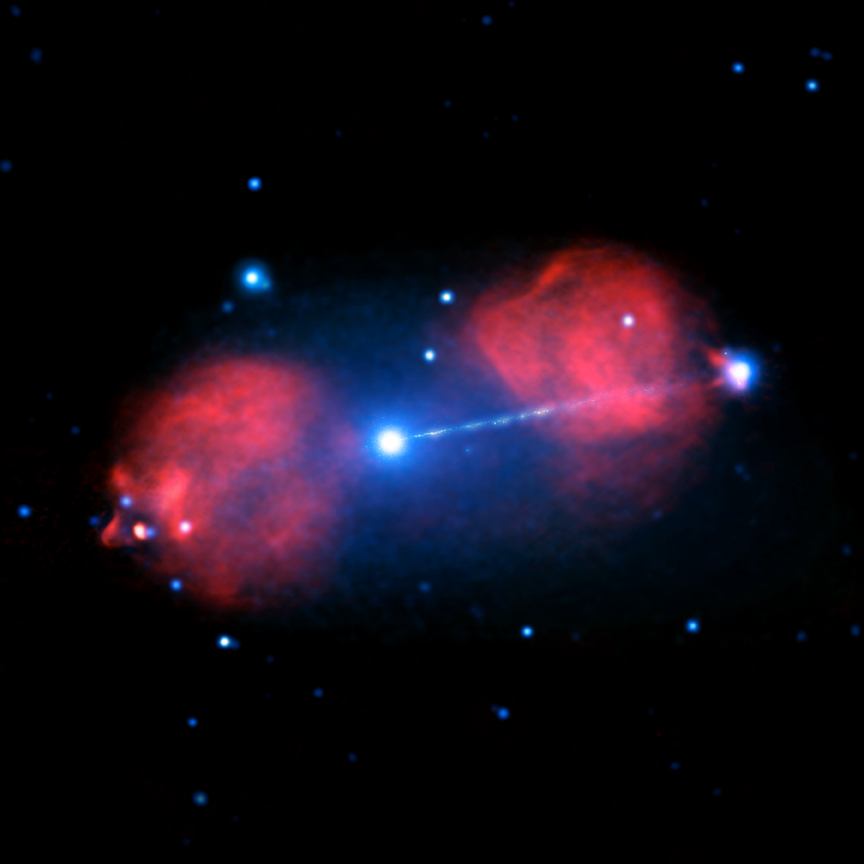
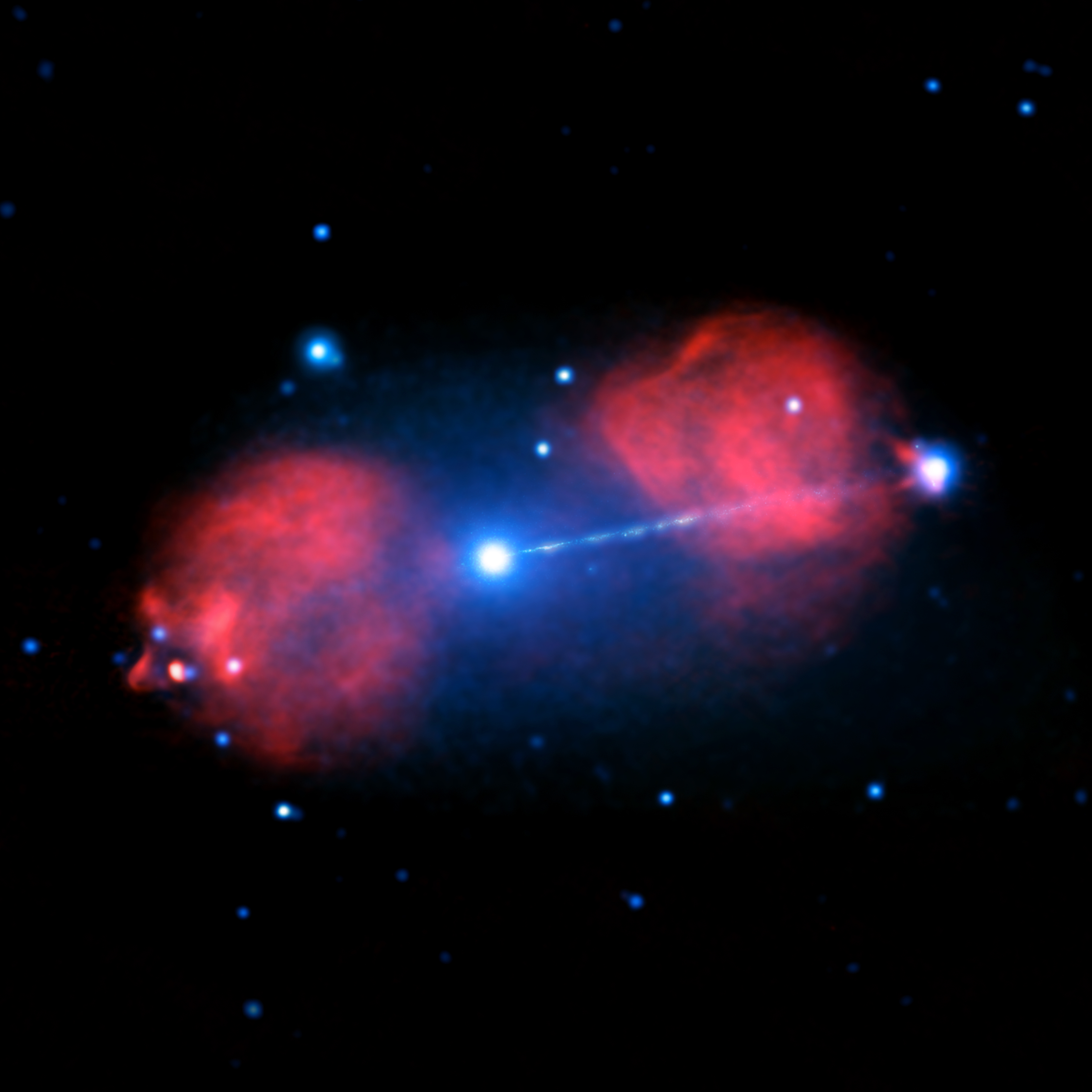
Credit: X-ray: NASA/CXC/Univ of Hertfordshire/M.Hardcastle et al., Radio: CSIRO/ATNF/ATCA

animation


The Star Wars franchise has featured the fictitious "Death Star," which can shoot powerful beams of radiation across space. The Universe, however, produces phenomena that often surpass what science fiction can conjure.

The Pictor A galaxy is one such impressive object. This galaxy, located nearly 500 million light years from Earth, contains a supermassive black hole at its center. A huge amount of gravitational energy is released as material swirls towards the event horizon, the point of no return for infalling material. This energy produces an enormous beam, or jet, of particles traveling at nearly the speed of light into intergalactic space.

To obtain images of this jet, scientists used NASA's Chandra X-ray Observatory at various times over 15 years. Chandra's X-ray data (blue) have been combined with radio data from the Australia Telescope Compact Array (red) in this new composite image.

By studying the details of the structure seen in both X-rays and radio waves, scientists seek to gain a deeper understanding of these huge collimated blasts.

The jet [to the right] in Pictor A is the one that is closest to us. It displays continuous X-ray emission over a distance of 300,000 light years. By comparison, the entire Milky Way is about 100,000 light years in diameter. Because of its relative proximity and Chandra's ability to make detailed X-ray images, scientists can look at detailed features in the jet and test ideas of how the X-ray emission is produced.

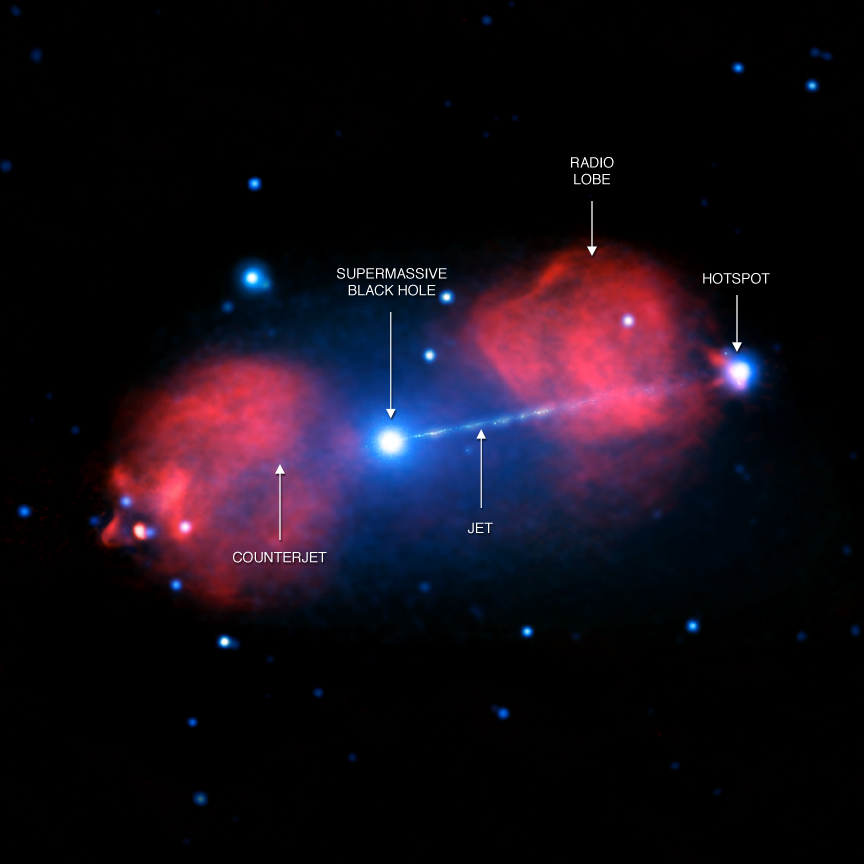
In addition to the prominent jet seen pointing to the right in the image, researchers report evidence for another jet pointing in the opposite direction, known as a "counterjet". While tentative evidence for this counterjet had been previously reported, these new Chandra data confirm its existence. The relative faintness of the counterjet compared to the jet is likely due to the motion of the counterjet away from the line of sight to the Earth.

The labeled image shows the location of the supermassive black hole, the jet and the counterjet. Also labeled is a "radio lobe" where the jet is pushing into surrounding gas and a "hotspot" caused by shock waves - akin to sonic booms from a supersonic aircraft - near the tip of the jet.

The detailed properties of the jet and counterjet observed with Chandra show that their X-ray emission likely comes from electrons spiraling around magnetic field lines, a process called synchrotron emission. In this case, the electrons must be continuously re-accelerated as they move out along the jet. How this occurs is not well understood

The researchers ruled out a different mechanism for producing the jet's X-ray emission. In that scenario, electrons flying away from the black hole in the jet at near the speed of light move through the sea of cosmic background radiation (CMB) left over from the hot early phase of the Universe after the Big Bang. When a fast-moving electron collides with one of these CMB photons, it can boost the photon's energy up into the X-ray band.

The X-ray brightness of the jet depends on the power in the beam of electrons and the intensity of the background radiation. The relative brightness of the X-rays coming from the jet and counterjet in Pictor A do not match what is expected in this process involving the CMB, and effectively eliminate it as the source of the X-ray production in the jet.

A paper describing these results will be published in the Monthly Notices of the Royal Astronomical Society and is available online. The authors are Martin Hardcastle from the University of Hertfordshire in the UK, Emil Lenc from the University of Sydney in Australia, Mark Birkinshaw from the University of Bristol in the UK, Judith Croston from the University of Southampton in the UK, Joanna Goodger from the University of Hertfordshire, Herman Marshall from the Massachusetts Institute of Technology in Cambridge, MA, Eric Perlman from the Florida Institute of Technology, Aneta Siemiginowska from the Harvard-Smithsonian Center for Astrophysics in Cambridge, MA, Lukasz Stawarz from Jagiellonian University in Poland and Diana Worrall from the University of Bristol.

NASA's Marshall Space Flight Center in Huntsville, Alabama, manages the Chandra program for NASA's Science Mission Directorate in Washington. The Smithsonian Astrophysical Observatory in Cambridge, Massachusetts, controls Chandra's science and flight operations.


Fast Facts for Pictor A:

Scale: Image is 10 arcmin across (about 1.4 million light years)
Category: Quasars & Active Galaxies
Coordinates (J2000): RA 05h 19m 49.70s | Dec -45° 46' 45"
Constellation: Pictor
Observation Date: 14 pointings between Jan 2000 and Jan 2015
Observation Time: 128 hours 53 min (5 days 8 hours 53 min)
Obs. ID: 346, 3090, 4369, 12039, 12040, 11586, 14357, 14221, 15580, 15593, 14222, 14223, 16478, 17574
Instrument: ACIS
References: Hardcastle, M. et al., 2016, MNRAS, 455, 3526; arXiv:1510.08392
Color Code: X-ray (Blue), Radio (Red)
Distance Estimate: About 480 million light years (z=0.035)


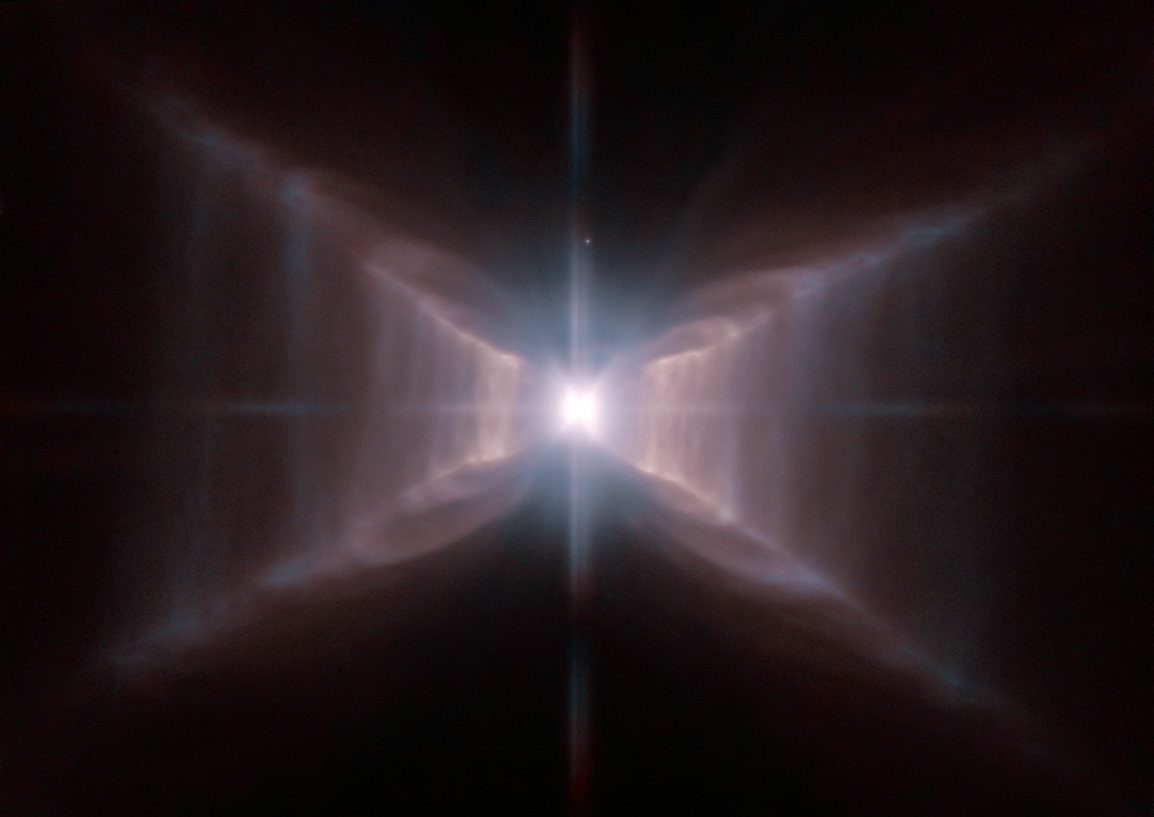
The Unearthly Beauty of the Red Rectangle

The Unearthly Beauty of the Red Rectangle
Copyright: ESA/Hubble and NASA
Hi-res JPG - TIF

Straight lines do not often crop up in space. Whenever they do, they seem somehow incongruous and draw our attention. The Red Rectangle is one such mystery object.

It first caught astronomers’ attention in 1973. The star HD 44179 had been known since 1915 to be double, but it was only when a rocket flight carrying an infrared detector was turned its way that the red rectangle revealed itself.

This image was taken later, in 2007, by the Hubble Space Telescope’s Advanced Camera for Surveys. It focuses on wavelengths of red light, in particular highlighting the emission from hydrogen gas.

This particular emission has been displayed in red. A second, broader range of orange–red light has also been recorded, and, to increase the contrast, this light has been colour coded blue on the image.

The Red Rectangle is some 2300 light-years away in the constellation of Monoceros. It arises because one of the stars in HD 44179 is in the last stages of its life. It has puffed up as the nuclear reactions at its core have faltered, and this has resulted in it shedding its outer layers into space.

Such a cloud of gas is known erroneously as a planetary nebula because Hanoverian astronomer William Herschel thought they look a bit like the pale disc of Uranus, the planet he had discovered.

The X-shape revealed in this image suggests that something is preventing the uniform expansion of the star’s atmosphere. Instead, a thick disc of dust probably surrounds the star, funnelling the outflow into two wide cones. The edges of these show up as the diagonal lines. Thankfully, while that explains the mystery of the object, it does not detract from its unearthly beauty.

This image was first published in June 2010.

Source: ESA/Images

Monday, February 01, 2016

Where are all of the nebulae ionized by supersoft X-ray sources?

Artist's depiction of an accreting white dwarf
© David A. Hardy/AstroArt.org


The ultimate fate of low-mass stars, like our own Sun, is to exhaust the nuclear furnace in their cores, expel their extended atmospheres, and leave behind a hot remnant called a white dwarf. Left to their own devices, these objects will simply cool slowly over billions of years. However, if a white dwarf comes to accrete material from some stellar companion, it can become an incredibly luminous source of extreme UV and soft X-ray emission, a “supersoft X-ray source” or SSS. Such radiation is readily absorbed by any surrounding interstellar gas, producing emission line nebulae. Therefore, we would expect such nebulae to be found accompanying all supersoft X-ray sources. However, of all SSSs found in the past three decades, only one has been observed to have such a nebula. Clearly, something is amiss in our understanding of these incredible objects. Now, scientists at MPA and the Monash Centre for Astrophysics have pieced together the puzzle.

Under the right conditions, a white dwarf accreting hydrogen-rich matter from a binary companion can process all of this material through nuclear burning at its surface, with luminosities and temperatures of thousands of times that of our Sun (1038 erg/s and 105K-106K, respectively). First discovered more than 30 years ago by NASA's Einstein observatory, these close binary supersoft X-ray sources soon became favoured candidates for the progenitors of type Ia supernovae: as white dwarfs accrete material, they may grow to reach the Chandrasekhar mass limit and explode. However, testing this hypothesis by trying to find the true number of such objects has been complicated by the great ease with which the emitted extreme UV and soft X-ray photons are completely absorbed by even a modest amount of intervening interstellar matter.

Therefore, an alternative approach is to use this absorption and search for nebular emission lines in interstellar matter that is ionized by these hot, luminous sources [1,2]. However, narrow-band observations of the vicinity of supersoft X-ray sources in the Magellanic Clouds revealed only one such nebula [3]. This led to a vexing question: is there something very wrong in our understanding of the nature of these sources? 

Or is there something special about the interstellar environment of CAL 83, where the nebula was found, ­ and not every other SSS? This dilemma put emission line studies of supersoft X-ray sources largely on hold for the next two decades.

In their recent work [4], Tyrone Woods (formerly at MPA, now a research fellow at the Monash Centre for Astrophysics) and Marat Gilfanov (MPA) noted that the gaseous nebula surrounding CAL 83 is at least ten-fold overdense relative to the gas densities found in most of the volume of typical star-forming galaxies. The high surface brightness nebula of CAL 83 thus appears to be the result of a chance encounter of the accreting white dwarf with a region of initially cold, dense interstellar matter. Additional analysis of the size and distribution of cold dense clouds in galaxies (with the aid of mathematics borrowed from the study of concrete porosity) provided further support for this interpretation. 

ISM density (vertical axis) required to produce a detectable nebula ionized by a accreting white dwarf (2x10^5 K, with bolometric luminosity L, horizontal axis). The three lines denote a signal-to-noise ratio of 50, i.e. clear detection, for 150, 1500, and 9000 seconds total integration times using the Magellan Baade telescope. For reference, the inferred density and time-averaged luminosity of CAL 83 is also shown. © MPA

Most supersoft X-ray sources are likely to lie in much lower density media, with correspondingly lower surface brightness nebulae, which extend to larger radii (up to more than 100 parsecs, compared with 10 parsecs for CAL 83). Even though such nebulae are below the detection threshold of past observations, they are detectable given modest integration times with large modern telescopes such as Magellan or the VLT (see fig. 2).

This not only re-opens a channel for the study of close binary supersoft X-ray sources; given that the decay time for any SSS nebula will be on the order of ten thousand to a hundred thousand years, one may also search for “fossil” nebulae surrounding the sites of SSSs, which have long since stopped accreting. In particular, this includes those that may have exploded as type Ia supernovae in the recent past and in our cosmic neighbourhood. This means that one should be able to resolve the surrounding nebula and inner supernova remnant separately. A deep narrow-band search using the Magellan Baade telescope is already underway, and we may soon measure (or tightly constrain) the temperatures and luminosities of the progenitors of nearby type Ia supernova remnants.


Authors :  Woods, T. E., & Gilfanov, M.


References:

1. Rappaport, S., Chiang, E., Kallman, T., & Malina, R.
Ionization nebulae surrounding supersoft X-ray sources.
1994, APJ, 431, 237.  Source

2. Woods, T. E., & Gilfanov, M.
He II recombination lines as a test of the nature of SN Ia progenitors in elliptical galaxies.
2013, MNRAS, 432, 1640.  Source

3. Remillard, R. A., Rappaport, S., & Macri, 
L. M. Ionization nebulae surrounding CAL 83 and other supersoft X-ray sources. 1995, ApJ, 439, 64.  Source

4. Woods, T. E. & Gilfanov, M.
Where are all of the nebulae ionized by supersoft X-ray sources?
2016, MNRAS, 455, 1770.  Source


Lonely planet finds mum a trillion kilometres away

Artist's impression of the planet with its star in the background
Credit: Neil James Cook/University of Hertfordshire
 
 2MASS J2126−8140 and TYC 9486-927-1,
False colour infrared image. Arrows shows motion over next 1.000 years
Credit: Simon Murphy


Astronomers studying a lonely planet drifting through space have found its mum; a star a trillion kilometres away.

The planet, known as 2MASS J2126−8140, has an orbit around its host star that takes nearly a million Earth years and is more than 140 times wider than Pluto's. This makes it easily the largest solar system ever found.

"We were very surprised to find such a low-mass object so far from its parent star," said Dr Simon Murphy of ANU Research School of Astronomy and Astrophysics.

"There is no way it formed in the same way as our solar system did, from a large disc of dust and gas."

Only a handful of extremely wide pairs of this kind have been found in recent years. The distance between the new pair is 6,900 Astronomical Units (AU) - 1,000,000,000,000 kilometres or 0.1 light years - nearly three times the previous widest pair, which is 2,500AU (370,000,000,000 km).

2MASS J2126−8140's parent is a red dwarf star called TYC 9486-927-1. At that distance, it would appear as only a moderately bright star in the sky, and light would take about a month to reach the planet.

Dr Murphy is part of an international team of scientists that studied 2MASS J2126−8140, a gas giant planet around 12 to 15 times the mass of Jupiter, as part of a survey of several thousand young stars and brown dwarfs close to our solar system.

Once they realised 2MASS J2126−8140 and TYC 9486-927-1 were a similar distance from the Earth - about 100 light years - they compared the motion of the two through space and realised they were moving together.

"We can speculate they formed 10 million to 45 million years ago from a filament of gas that pushed them together in the same direction," Dr Murphy said.

"They must not have lived their lives in a very dense environment. They are so tenuously bound together that any nearby star would have disrupted their orbit completely."

The research, which will be published in the Monthly Notices of The Royal Astronomical Society, was led by Dr Niall Deacon from University of Hertfordshire and included Dr Joshua Schlieder from the NASA Ames Research Center.