Showing posts with label ICRAR. Show all posts

Wednesday, April 21, 2021

Outback radio telescope discovers dense, spinning, dead star


Tile 107, or “the Outlier” as it is known, is one of 256 tiles of the MWA located 1.5km from the core of the telescope. The MWA is a precursor instrument to the SKA. Photographed by Pete Wheeler, ICRAR

Astronomers have discovered a pulsar—a dense and rapidly spinning neutron star sending radio waves into the cosmos—using a low-frequency radio telescope in outback Australia.

The pulsar was detected with the Murchison Widefield Array (MWA) telescope, in Western Australia’s remote Mid West region.

It’s the first time scientists have discovered a pulsar with the MWA but they believe it will be the first of many.

The finding is a sign of things to come from the multi-billion-dollar Square Kilometre Array (SKA) telescope. The MWA is a precursor telescope for the SKA.

Nick Swainston, a PhD student at the Curtin University node of the International Centre for Radio Astronomy Research (ICRAR), made the discovery while processing data collected as part of an ongoing pulsar survey.

“Pulsars are born as a result of supernovae—when a massive star explodes and dies, it can leave behind a collapsed core known as a neutron star,” he said.

“They’re about one and a half times the mass of the Sun, but all squeezed within only 20 kilometres, and they have ultra-strong magnetic fields.”

Mr Swainston said pulsars spin rapidly and emit electromagnetic radiation from their magnetic poles.

“Every time that emission sweeps across our line of sight, we see a pulse—that’s why we call them pulsars,” he said. “You can imagine it like a giant cosmic lighthouse.”

ICRAR-Curtin astronomer Dr Ramesh Bhat said the newly discovered pulsar is located more than 3000 light-years from Earth and spins about once every second.

“That’s incredibly fast compared to regular stars and planets,” he said. “But in the world of pulsars, it’s pretty normal.”

Dr Bhat said the finding was made using about one per cent of the large volume of data collected for the pulsar survey.

“We’ve only scratched the surface,” he said. “When we do this project at full-scale, we should find hundreds of pulsars in the coming years.”

Pulsars are used by astronomers for several applications including testing the laws of physics under extreme conditions.

“A spoonful of material from a neutron star would weigh millions of tonnes,” Dr Bhat said.

“Their magnetic fields are some of the strongest in the Universe—about 1000 billion times stronger than that we have on Earth.”

“So we can use them to do physics that we can’t do in any of the Earth-based laboratories.”


An artist’s impression of Pulsar — a dense and rapidly spinning neutron star sending radio waves into the cosmos. Credit: ICRAR / Curtin University.

Finding pulsars and using them for extreme physics is also a key science driver for the SKA telescope.

MWA Director Professor Steven Tingay said the discovery hints at a large population of pulsars awaiting discovery in the Southern Hemisphere.

“This finding is really exciting because the data processing is incredibly challenging, and the results show the potential for us to discover many more pulsars with the MWA and the low-frequency part of the SKA.”

“The study of pulsars is one of the headline areas of science for the multi-billion-dollar SKA, so it is great that our team is at the forefront of this work,” he said.


An artist’s impression of one of 256 tiles of the Murchison Widefield Array radio telescope observing a pulsar — a dense and rapidly spinning neutron star sending radio waves into the cosmos. Credit: Dilpreet Kaur / ICRAR / Curtin University


Publication
 
‘Discovery of a steep-spectrum low-luminosity pulsar with the Murchison Widefield Array’, published in The Astrophysical Journal Letters on April 21, 2021. Click here for the paper


More Info

ICRAR 
 
The International Centre for Radio Astronomy Research (ICRAR) is a joint venture between Curtin University and The University of Western Australia with support and funding from the State Government of Western Australia.

Murchison Widefield Array 
 
The Murchison Widefield Array (MWA) is a low-frequency radio telescope and is the first of four Square Kilometre Array (SKA) precursors to be completed. A consortium of partner institutions from seven countries (Australia, USA, India, New Zealand, Canada, Japan, and China) financed the development, construction, commissioning, and operations of the facility. The MWA consortium is led by Curtin University.


Contacts:

Dr Ramesh Bhat (ICRAR / Curtin University)

Ph: +61 430 910 055               E: Ramesh.Bhat@curtin.edu.au

Nick Swainston (ICRAR / Curtin University)

Ph: +61 402 566 321               E: Nicholas.Swainston@curtin.edu.au

Professor Steven Tingay (ICRAR / Curtin University)

Ph: +61 401 103 635               E: S.Tingay@curtin.edu.au

Kirsten Gottschalk (Media Contact, ICRAR)

Ph: +61 438 361 876               E: Kirsten.Gottschalk@icrar.org

Lucien Wilkinson (Media Contact, Curtin University)

Ph: +61 401 103 683               E: Lucien.Wilkinson@curtin.edu.au


Tuesday, March 23, 2021

Astronomers see a ‘Space Jellyfish’

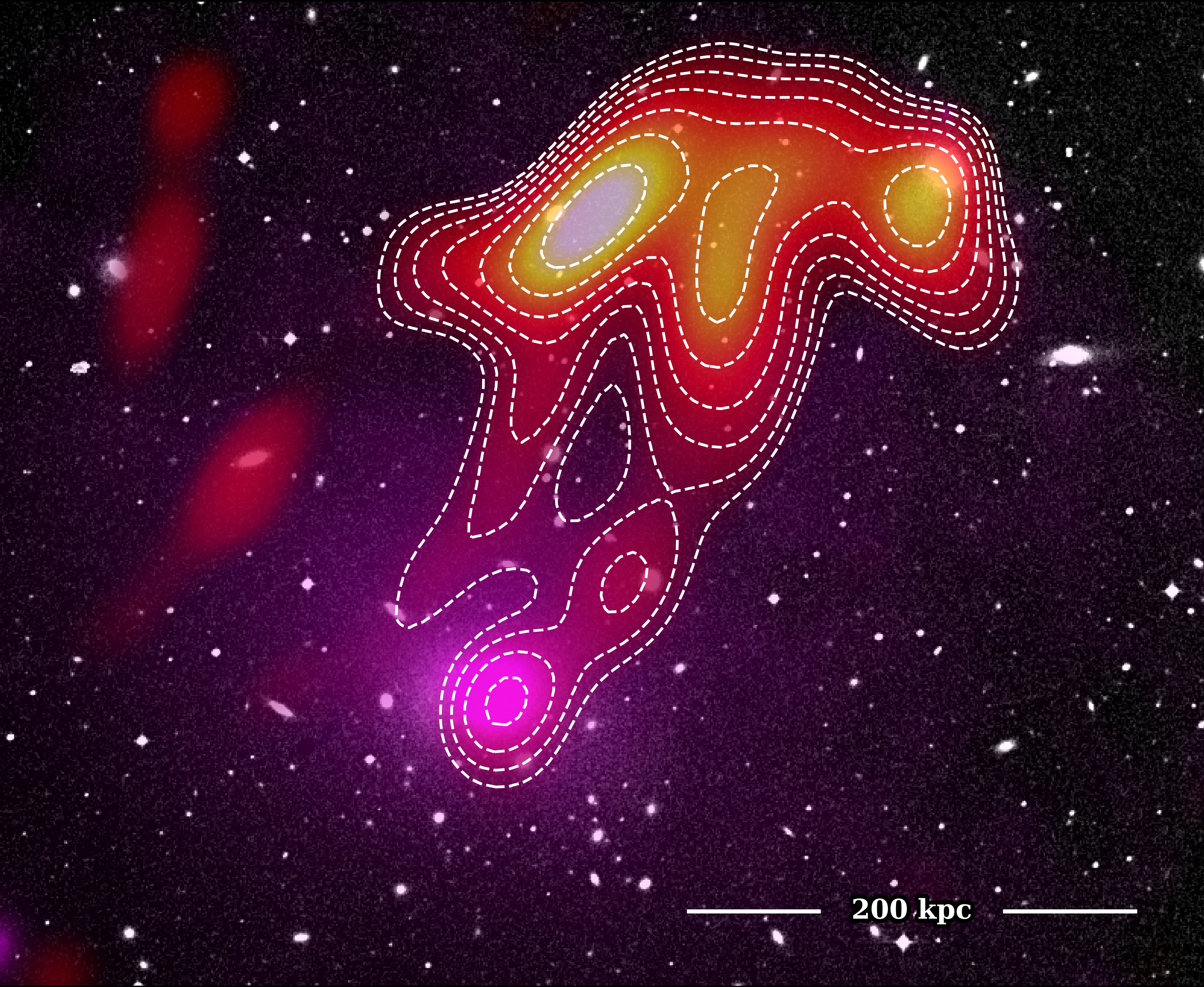
A composite image of the USS Jellyfish in Abell 2877 showing the optical Digitised Sky Survey (background) with XMM X-ray data (magenta overlay) and MWA 118 MHz radio data (red-yellow overlay). Credit: Torrance Hodgson, ICRAR/Curtin University.Hi-res image

A radio telescope located in outback Western Australia has observed a cosmic phenomenon with a striking resemblance to a jellyfish.

Published today in The Astrophysical Journal, an Australian-Italian team used the Murchison Widefield Array (MWA) telescope to observe a cluster of galaxies known as Abell 2877.

Lead author and PhD candidate Torrance Hodgson, from the Curtin University node of the International Centre for Radio Astronomy Research (ICRAR) in Perth, said the team observed the cluster for 12 hours at five radio frequencies between 87.5 and 215.5 megahertz.

“We looked at the data, and as we turned down the frequency, we saw a ghostly jellyfish-like structure begin to emerge,” he said.

“This radio jellyfish holds a world record of sorts. Whilst it’s bright at regular FM radio frequencies, at 200 MHz the emission all but disappears.

“No other extragalactic emission like this has been observed to disappear anywhere near so rapidly.”

Astronomers see a ‘Space Jellyfish’ from ICRAR on Vimeo

This uniquely steep spectrum has been challenging to explain. “We’ve had to undertake some cosmic archaeology to understand the ancient background story of the jellyfish,” said Hodgson.

“Our working theory is that around 2 billion years ago, a handful of supermassive black holes from multiple galaxies spewed out powerful jets of plasma. This plasma faded, went quiet, and lay dormant.

“Then quite recently, two things happened—the plasma started mixing at the same time as very gentle shock waves passed through the system.

“This has briefly reignited the plasma, lighting up the jellyfish and its tentacles for us to see.”

The jellyfish is over a third of the Moon’s diameter when observed from Earth, but can only be seen with low-frequency radio telescopes.
“Most radio telescopes can’t achieve observations this low due to their design or location,” said Hodgson.

The MWA—a precursor to the Square Kilometre Array (SKA)—is located at CSIRO’s Murchison Radio-astronomy Observatory in remote Western Australia.

The site has been chosen to host the low-frequency antennas for the SKA, with construction scheduled to begin in less than a year.

Tile 107, or “the Outlier” as it is known, is one of 256 tiles of the MWA located 1.5km from the core of the telescope. The MWA is a precursor instrument to the SKA. Photographed by Pete Wheeler, ICRAR.

Professor Johnston-Hollitt, Mr Hodgson’s supervisor and co-author, said the SKA will give us an unparalleled view of the low-frequency Universe.

“The SKA will be thousands of times more sensitive and have much better resolution than the MWA, so there may be many other mysterious radio jellyfish waiting to be discovered once it’s operational.

“We’re about to build an instrument to make a high resolution, fast frame-rate movie of the evolving radio Universe. It will show us from the first stars and galaxies through to the present day,” she said.

“Discoveries like the jellyfish only hint at what’s to come, it’s an exciting time for anyone seeking answers to fundamental questions about the cosmos.”


Composite image of the SKA-Low telescope in Western Australia. The image blends a real photo (on the left) of the SKA-Low prototype station AAVS2.0 which is already on site, with an artists impression of the future SKA-Low stations as they will look when constructed. These dipole antennas, which will number in their hundreds of thousands, will survey the radio sky in frequencies as low at 50Mhz. Credit ICRAR and SKAO.

Original Publication 

‘Ultra-Steep Spectrum Radio Jellyfish Uncovered in Abell 2877’, published in The Astrophysical Journal on March 18th, 2021.

More Infor: 

ICRAR

The International Centre for Radio Astronomy Research (ICRAR) is a joint venture between Curtin University and The University of Western Australia with support and funding from the State Government of Western Australia.

Murchison Widefield Array

The Murchison Widefield Array (MWA) is a low-frequency radio telescope and is the first of four Square Kilometre Array (SKA) precursors to be completed. A consortium of partner institutions from seven countries (Australia, USA, India, New Zealand, Canada, Japan, and China) financed the development, construction, commissioning, and operations of the facility. The MWA consortium is led by Curtin University.


Contacts


Source:  International Centre for Radio Astronomy Research (ICRAR)/News


Saturday, February 27, 2021

Big galaxies steal star-forming gas from their smaller neighbours

An artist’s impression showing the increasing effect of ram-pressure stripping in removing gas from galaxies, sending them to an early death. Credit: ICRAR, NASA, ESA, the Hubble Heritage Team (STScI/AURA)

Large galaxies are known to strip the gas that occupies the space between the stars of smaller satellite galaxies.

In research published today, astronomers have discovered that these small satellite galaxies also contain less ‘molecular’ gas at their centres.

Molecular gas is found in giant clouds in the centres of galaxies and is the building material for new stars. Large galaxies are therefore stealing the material that their smaller counterparts need to form new stars.

Lead author Dr Adam Stevens is an astrophysicist based at UWA working for the International Centre for Radio Astronomy Research (ICRAR) and affiliated to the ARC Centre of Excellence in All Sky Astrophysics in 3 Dimensions (ASTRO 3D).

Dr Stevens said the study provides new systematic evidence that small galaxies everywhere lose some of their molecular gas when they get close to a larger galaxy and its surrounding hot gas halo.

“Gas is the lifeblood of a galaxy,” he said.

“Continuing to acquire gas is how galaxies grow and form stars. Without it, galaxies stagnate.

“We’ve known for a long time that big galaxies strip ‘atomic’ gas from the outskirts of small galaxies.

“But, until now, it hadn’t been tested with molecular gas in the same detail.”

ICRAR-UWA astronomer Associate Professor Barbara Catinella said galaxies don’t typically live in isolation.

“Most galaxies have friends,” she says.

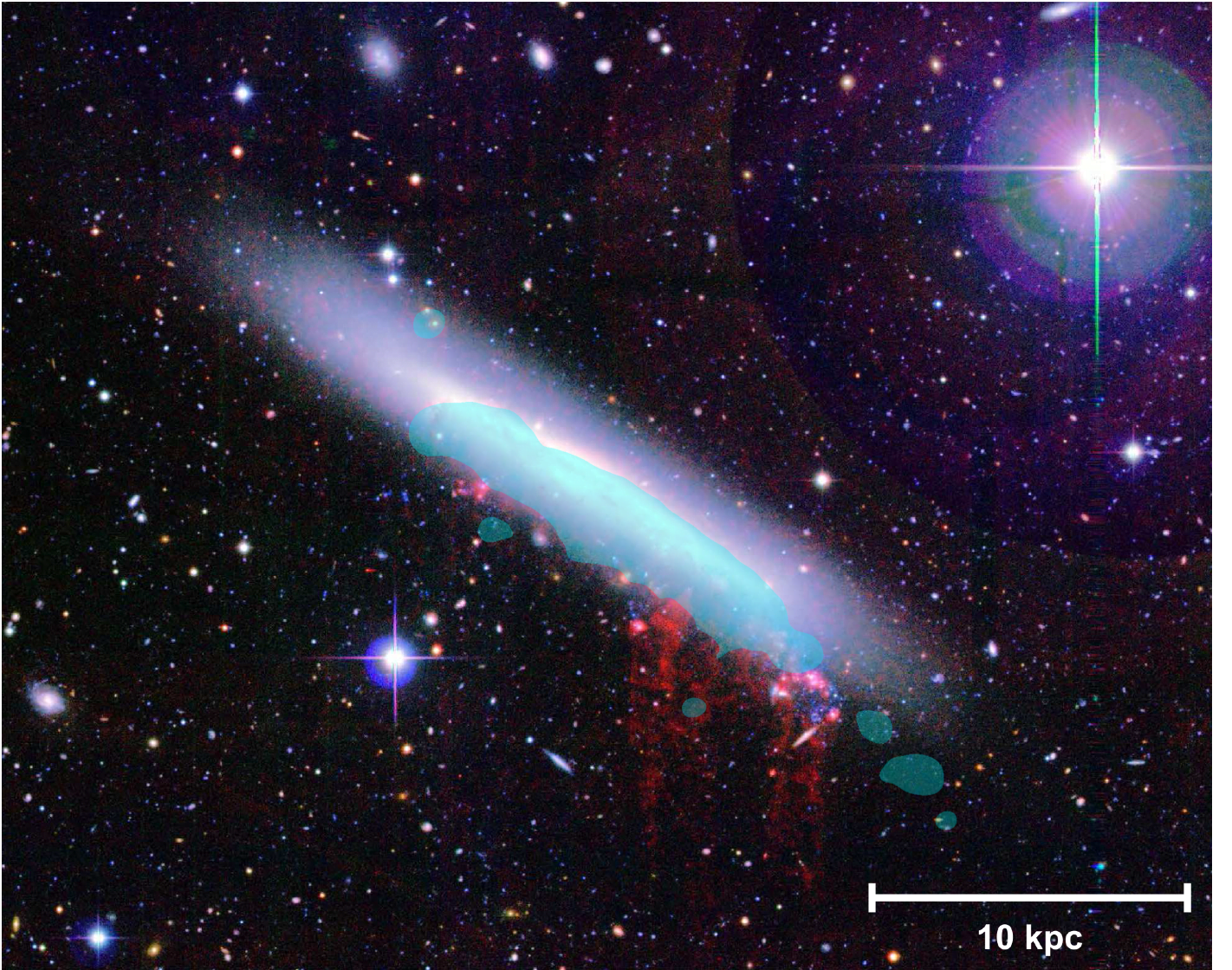
“And when a galaxy moves through the hot intergalactic medium or galaxy halo, some of the cold gas in the galaxy is stripped away.

“This fast-acting process is known as ram pressure stripping.”

Two viewing angles of a galaxy undergoing ram-pressure stripping in the IllustrisTNG simulation. Each column shows matter of a different form in the galaxy and its immediate surroundings. From left to right: (1) atomic gas; (2) molecular gas; (3) all gas; (4) stars; and (5) dark matter. Credit: Adam Stevens/ICRAR. Hi-res image

The research was a global collaboration involving scientists from the University of Maryland, Max Planck Institute for Astronomy, University of Heidelberg, Harvard-Smithsonian Center for Astrophysics, University of Bologna and Massachusetts Institute of Technology.

Molecular gas is very difficult to detect directly.

The research team took a state-of-the-art cosmological simulation and made direct predictions for the amount of atomic and molecular gas that should be observed by specific surveys on the Arecibo telescope in Puerto Rico and the IRAM 30-meter telescope in Spain.

They then took the actual observations from the telescopes and compared them to their original predictions.

The two were remarkably close.

Fly-through of galaxies having their gas stripped in the IllustrisTNG simulation.

Big galaxies steal star-forming gas from their smaller neighbours from ICRAR on Vimeo.

Associate Professor Catinella, who led the Arecibo survey of atomic gas, says the IRAM 30-meter telescope observed the molecular gas in more than 500 galaxies.

“These are the deepest observations and largest sample of atomic and molecular gas in the local Universe,” she says.

“That’s why it was the best sample to do this analysis.”

The team’s finding fits with previous evidence that suggests satellite galaxies have lower star formation rates.

Dr Stevens said stripped gas initially goes into the space around the larger galaxy.

“That may end up eventually raining down onto the bigger galaxy, or it might end up just staying out in its surroundings,” he said.

But in most cases, the little galaxy is doomed to merge with the larger one anyway.

“Often they only survive for one to two billion years and then they’ll end up merging with the central one,” Dr Stevens said.

“So it affects how much gas they’ve got by the time they merge, which then will affect the evolution of the big system as well.

“Once galaxies get big enough, they start to rely on getting more matter from the cannibalism of smaller galaxies.”

Original Publication:

‘Molecular hydrogen in IllustrisTNG galaxies: carefully comparing signatures of environment with local CO & SFR data’, published in Monthly Notices of the Royal Astronomical Society on February 23rd, 2021.   Click here for the paper

Contacts:

Dr Adam Stevens (ICRAR / ASTRO 3D / UWA)

Ph: +61 8 6488 7627                E: Adam.Stevens@icrar.org

Associate Professor Barbara Catinella (ICRAR / UWA)

Ph: +61 8 6488 7760                E: Barbara.Catinella@icrar.org

Kirsten Gottschalk (Media Contact, ICRAR)

Ph: +61 438 361 876               E: Kirsten.Gottschalk@icrar.org

Jess Reid (Media Contact, University of Western Australia)

Ph: +61 8 6488 6876                E: Jess.Reid@uwa.edu.au


 Source: International Centre for Radio Astronomy Research (ICRAR)/News


Monday, February 22, 2021

First black hole ever detected is more massive than we thought

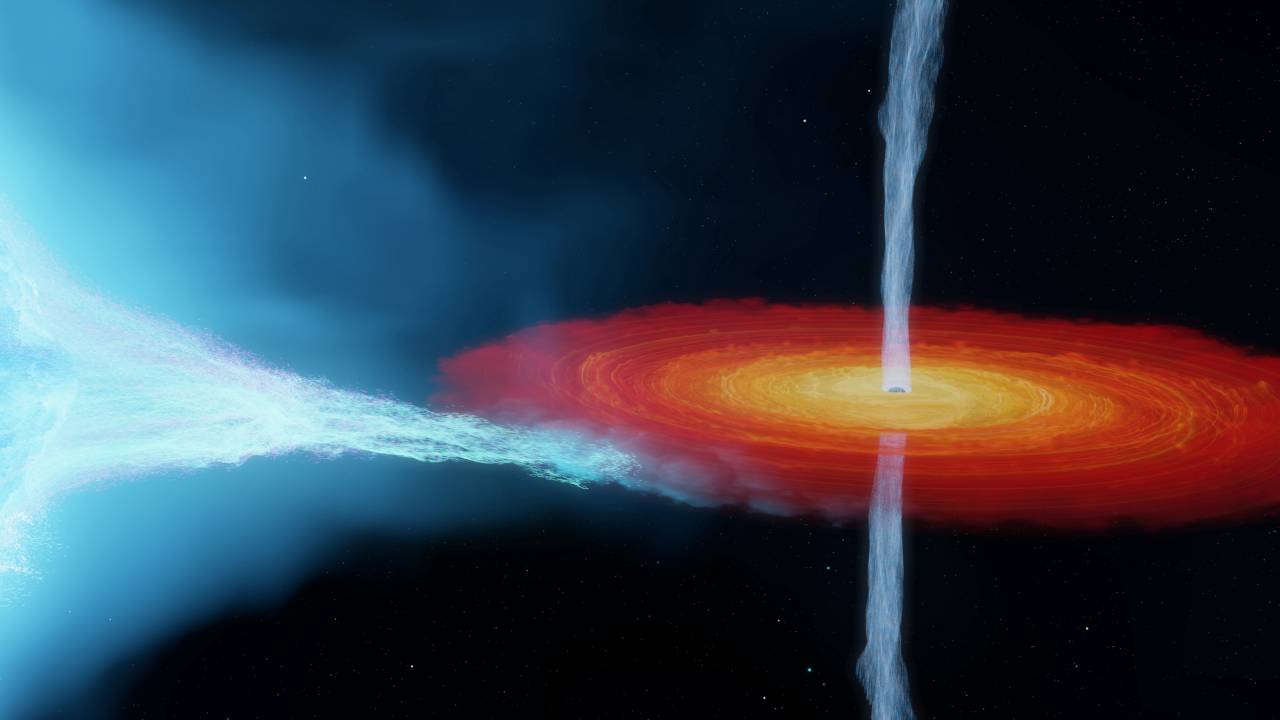
An artist’s impression of the Cygnus X-1 system. This system contains the most massive stellar-mass black hole ever detected without the use of gravitational waves, weighing in at 21 times the mass of the Sun. Credit: International Centre for Radio Astronomy Research. Credit: International Centre for Radio Astronomy Research. Hi-res image

New observations of the first black hole ever detected have led astronomers to question what they know aboeut the Universe’s most mysterious objects.

Published today in the journal Science, the research shows the system known as Cygnus X-1 contains the most massive stellar-mass black hole ever detected without the use of gravitational waves.

Cygnus X-1 is one of the closest black holes to Earth. It was discovered in 1964 when a pair of Geiger counters were carried on board a sub-orbital rocket launched from New Mexico.

The object was the focus of a famous scientific wager between physicists Stephen Hawking and Kip Thorne, with Hawking betting in 1974 that it was not a black hole. Hawking conceded the bet in 1990.

In this latest work, an international team of astronomers used the Very Long Baseline Array—a continent-sized radio telescope made up of 10 dishes spread across the United States—together with a clever technique to measure distances in space.

“If we can view the same object from different locations, we can calculate its distance away from us by measuring how far the object appears to move relative to the background,” said lead researcher, Professor James Miller-Jones from Curtin University and the International Centre for Radio Astronomy Research (ICRAR).

“If you hold your finger out in front of your eyes and view it with one eye at a time, you’ll notice your finger appears to jump from one spot to another. It’s exactly the same principle.”

Astronomers observed the Cygnus X-1 system from different angles using the orbit of the Earth around the Sun to measure the perceived movement of the system against the background stars. This allowed them to refine the distance to the system and therefore the mass of the black hole. Credit: International Centre for Radio Astronomy Research. Hi-res image

“Over six days we observed a full orbit of the black hole and used observations taken of the same system with the same telescope array in 2011,” Professor Miller-Jones said. “This method and our new measurements show the system is further away than previously thought, with a black hole that’s significantly more massive.”

Co-author Professor Ilya Mandel from Monash University and the ARC Centre of Excellence in Gravitational Wave Discovery (OzGrav) said the black hole is so massive it’s actually challenging how astronomers thought they formed.

An artist’s impression of the Cygnus X-1 system. A stellar-mass black hole orbits with a companion star located 7,200 light years from Earth. Credit: International Centre for Radio Astronomy Research. Hi-res image

“Stars lose mass to their surrounding environment through stellar winds that blow away from their surface. But to make a black hole this heavy, we need to dial down the amount of mass that bright stars lose during their lifetimes” he said.

“The black hole in the Cygnus X-1 system began life as a star approximately 60 times the mass of the Sun and collapsed tens of thousands of years ago,” he said. “Incredibly, it’s orbiting its companion star—a supergiant—every five and a half days at just one-fifth of the distance between the Earth and the Sun.

“These new observations tell us the black hole is more than 20 times the mass of our Sun—a 50 per cent increase on previous estimates.”

Recent observations show the black hole in the Cygnus X-1 system is 21 times the mass of the Sun—a 50 per cent increase on previous estimates. To form such a massive black hole, astronomers had to revise their estimates of how much mass stars lose via stellar winds. Credit: International Centre for Radio Astronomy Research. Hi-res image

Xueshan Zhao is a co-author on the paper and a PhD candidate studying at the National Astronomical Observatories—part of the Chinese Academy of Sciences (NAOC) in Beijing.

“Using the updated measurements for the black hole’s mass and its distance away from Earth, I was able to confirm that Cygnus X-1 is spinning incredibly quickly—very close to the speed of light and faster than any other black hole found to date,” she said.

“I’m at the beginning of my research career, so being a part of an international team and helping to refine the properties of the first black hole ever discovered has been a great opportunity.”

CYGNUS X-1: the most massive black hole near to Earth from ICRAR on Vimeo.

 
More Information:

The International Centre for Radio Astronomy Research (ICRAR) is a joint venture between Curtin University and The University of Western Australia with support and funding from the State Government of Western Australia.

Original Publication:

‘Cygnus X-1 contains a 21-solar mass black hole – implications for massive star winds’, published in Science on February 18th, 2021.

Companion Papers:

‘Reestimating the Spin Parameter of the Black Hole in Cygnus X-1’, published in The Astrophysical Journal on February 18th, 2021.

‘Wind mass-loss rates of stripped stars inferred from Cygnus X-1’, published in The Astrophysical Journal on February 18th, 2021.

Contacts:

Professor James Miller-Jones (ICRAR / Curtin University)

Ph: +61 488 484 825                        E: James.Miller-Jones@icrar.org

Professor Ilya Mandel (OzGrav / Monash University)

Ph: +61 8 466 710 590                     E: Ilya.Mandel@monash.edu

Pete Wheeler — Media Contact, ICRAR

Ph: +61 423 982 018                        E: Pete.Wheeler@icrar.org

Lauren Sydoruk (Media Contact, Curtin University)

Ph: +61 401 103 373                       E: Lauren.Sydoruk@curtin.edu.au

  
Source: International Centre for Radio Astronomy Research   ICRAR/News


Friday, May 29, 2020

Cosmic bursts unveil Universe’s missing matter

CSIRO’s ASKAP telescope continues to detect new FRBs, adding to the catalogue of these mysterious objects.
Credit: ICRAR and CSIRO/Alex Cherney

The FRB leaves its host galaxy as a bright burst of radio waves.
Credit: ICRAR

The FRB travels from its host galaxy to Earth.
Credit: ICRAR

When travelling through completely empty space, all wavelengths of the FRB travel at the same speed, but when travelling through the missing matter, some wavelengths are slowed down.  Credit: ICRAR.

CSIRO’s ASKAP measures the delay between the wavelengths of the FRB, allowing astronomers to calculate the density of the missing matter.  Credit: ICRAR and CSIRO/Alex Cherney

The density of the missing matter is calculated using the distance of the FRB from Earth and the delay between the wavelengths of the FRB.  Credit: ICRAR

A network of FRBs was used to measure the density of the missing matter.
Credit: ICRAR

A Hubble Space Telescope image of an FRB host galaxy, with the location of the FRB marked in red. This FRB was one of the network used to find the missing matter. Credit: J. Xavier Prochaska/UC Santa Cruz, Jay Chittidi (Maria Mitchell Observatory), and Alexandra Mannings (UC Santa Cruz)


Astronomers have used mysterious fast radio bursts to solve a decades-old mystery of ‘missing matter’, long predicted to exist in the Universe but never detected—until now.

The researchers have now found all of the missing ‘normal’ matter in the vast space between stars and galaxies, as detailed today in the journal Nature.

Lead author Associate Professor Jean-Pierre Macquart, from the Curtin University node of the International Centre for Radio Astronomy Research (ICRAR), said astronomers have been searching for the missing matter for almost thirty years.

“We know from measurements of the Big Bang how much matter there was in the beginning of the Universe,” he said.

“But when we looked out into the present Universe, we couldn’t find half of what should be there. It was a bit of an embarrassment.”

“Intergalactic space is very sparse,” he said.  “The missing matter was equivalent to only one or two atoms in a room the size of an average office.”

“So it was very hard to detect this matter using traditional techniques and telescopes.”

The researchers were able to directly detect the missing matter using the phenomenon known as fast radio bursts—brief flashes of energy that appear to come from random directions in the sky and last for just milliseconds.

Scientists don’t yet know what causes them but it must involve incredible energy, equivalent to the amount released by the Sun in 80 years. They have been difficult to detect as astronomers don’t know when and where to look for them.

Associate Professor Macquart said the team detected the missing matter by using fast radio bursts as “cosmic weigh stations”.

“The radiation from fast radio bursts gets spread out by the missing matter in the same way that you see the colours of sunlight being separated in a prism,” he said.

“We’ve now been able to measure the distances to enough fast radio bursts to determine the density of the Universe,” he said. “We only needed six to find this missing matter.”

The missing matter in this case is baryonic or ‘normal’ matter—like the protons and neutrons that make up stars, planets and you and me.

It’s different from dark matter, which remains elusive and accounts for about 85 per cent of the total matter in the Universe.

Co-author Professor J. Xavier Prochaska, from UC Santa Cruz, said we have unsuccessfully searched for this missing matter with our largest telescopes for more than 20 years.

“The discovery of fast radio bursts and their localisation to distant galaxies were the key breakthroughs needed to solve this mystery,” he said.

Associate Professor Ryan Shannon, another co-author from Swinburne University of Technology, said the key was the telescope used, CSIRO’s Australian Square Kilometre Array Pathfinder (ASKAP) radio telescope.

“ASKAP both has a wide field of view, about 60 times the size of the full Moon, and can image in high resolution,” he said. “This means that we can catch the bursts with relative ease and then pinpoint locations to their host galaxies with incredible precision.”

“When the burst arrives at the telescope, it records a live action replay within a fraction of a second,” said Dr Keith Bannister from Australia’s national science agency, CSIRO, who designed the pulse capture system used in this research.

“This enables the precision to determine the location of the fast radio burst to the width of a human hair held 200m away,” he said.

Associate Professor Macquart said the research team had also pinned down the relationship between how far away a fast radio burst is and how the burst spreads out as it travels through the Universe.

“We’ve discovered the equivalent of the Hubble-Lemaitre Law for galaxies, only for fast radio bursts,” he said.

“The Hubble-Lemaitre Law, which says the more distant a galaxy from us, the faster it is moving away from us, underpins all measurements of galaxies at cosmological distances.”

The fast radio bursts used in the study were discovered using ASKAP, which is located at the Murchison Radio-astronomy Observatory in outback Western Australia. The international team involved in the discovery included astronomers from Australia, the United States and Chile.

ASKAP is a precursor for the future Square Kilometre Array (SKA) telescope.

The SKA could observe large numbers of fast radio bursts, giving astronomers greater capability to study the previously invisible structure in the Universe.

Astronomers have used a network of mysterious fast radio bursts (FRBs) to detect half of the Universe’s normal matter, missing until now.  Credit: ICRAR with some footage supplied by CSIRO/Alex Cherney, ESO/y. Beletsky and ESO/R. Wesson


Chinese Language version of the FRB animation.


Publication

‘Localized fast radio bursts complete the baryon census of the Universe’ published in Nature on May 28th, 2020.


Contacts

A/Prof Jean-Pierre Macquart (ICRAR / Curtin University)
Ph: +61 9266 9248
Email:
jean-pierre.macquart@icrar.org

Kirsten Gottschalk (Media Contact, ICRAR)
Ph: +61 438 361 876
Email:
kirsten.gottschalk@icrar.org

April Kleer (Media Contact, Curtin University)
Ph: +61 9266 3353


Monday, February 03, 2020

Astronomers witness the dragging of space-time in stellar cosmic dance

The white dwarf-pulsar binary system PSR J1141-6545 discovered by the CSIRO’s Parkes radio telescope. Credit: Mark Myers, ARC Centre of Excellence for Gravitational Wave Discovery (OzGrav)

After almost 20 years of patient monitoring, an international team of astronomers have witnessed the very fabric of space-time being dragged around a rapidly-rotating exotic star known as a white dwarf. The effect is a consequence of Einstein’s General Theory of Relativity and the result was published today in the prestigious journal, Science.

When massive stars are born, they often are created in pairs, and at the end of their lives they leave behind super-dense cores in the form of a white dwarf, neutron star or black hole. Neutron stars emit regular clock-like pulses that enable astronomers to map their orbits to outstanding precision.

Dr Ramesh Bhat from the Curtin University node of ICRAR has been involved in this study since 2005. “This is an exotic stellar pair in which a tiny, super dense neutron star the size of Perth orbits another compact Earth-sized white dwarf star five times a day; both have masses about the same as our own Sun. It took 20 years of patient monitoring and careful scrutiny of data to figure out what is going on.”

Swinburne University’s Professor Matthew Bailes and his team began to map the orbit in a series of intensive observing campaigns at CSIRO’s Parkes 64-metre radio telescope. Over the course of two decades it became evident that the stars’ motion required Einstein’s General Theory of Relativity to explain their complex dance. Lead author Max Planck Institute for Radio Astronomy’s (MPIfR) Vivek Venkatraman Krishnan (VVK) took up the challenge of untangling the many intertwined Einsteinian effects at play in this naturally-occurring gravitational laboratory during his PhD at Swinburne University of Technology.

VVK explains, “At first the stellar pair appeared to exhibit many of the classic effects that Einstein’s theory predicted. We then noticed a gradual change in the orientation of the plane of the orbit”. MPIfR’s Dr Paulo Freire postulated that this might be, at least in-part, due to the so-called “frame-dragging” that all matter is subject to in the presence of a rotating body as predicted by the Austrian mathematicians Lense and Thirring in 1918.

“In a stellar pair, the first star to collapse is often rapidly rotating due to subsequent mass transfer from its companion”, explains Danish theorist Professor Thomas Tauris (Aarhus University). Tauris’s simulations helped quantify the magnitude of the white dwarf’s spin. “In this system the entire orbit is being dragged around by the white dwarf’s spin, which is misaligned with the orbit”.

“One of the first confirmations of frame-dragging used four gyroscopes in a satellite in orbit around the Earth, but in our system the effects are 100 million times stronger”, explains MPIfR’s Dr Norbert Wex.

ICRAR’s Dr Ramesh Bhat says that the effect makes the pulsar’s orbit tumble in space. “It provides yet another stunning confirmation of Einstein’s theory, which continues to shine in brilliance even after a century of its formulation. I find it truly fascinating.”

The result is especially pleasing for team members Bailes, Willem van Straten (Auckland University of Tech) and Ramesh Bhat (ICRAR-Curtin) who have been trekking out to the Parkes 64m telescope since the early 2000s, patiently mapping the orbit with the ultimate aim of studying Einstein’s Universe. “This makes all the late nights and early mornings worthwhile,” said Bhat.

The white dwarf-pulsar binary system PSR J1141-6545 discovered by the CSIRO’s Parkes radio telescope. The pulsar orbits its white dwarf companion every 4.8 hours. The white dwarf’s rapid rotation drags space-time around it, causing the entire orbit to change its orientation.


Publication:


Contacts:

Tania Ewing – OzGrav/Swinburne University of Technology
Ph: +61 408 378 422
Email: taniaewing@taniaewing.com

Pete Wheeler — Media Contact, ICRAR
Ph: +61 423 982 018
Email: Pete.Wheeler@icrar.org


Monday, November 25, 2019

Outback telescope captures Milky Way centre, discovers remnants of dead stars

A radio telescope in the Western Australian outback has captured a spectacular new view of the centre of the galaxy in which we live, the Milky Way.

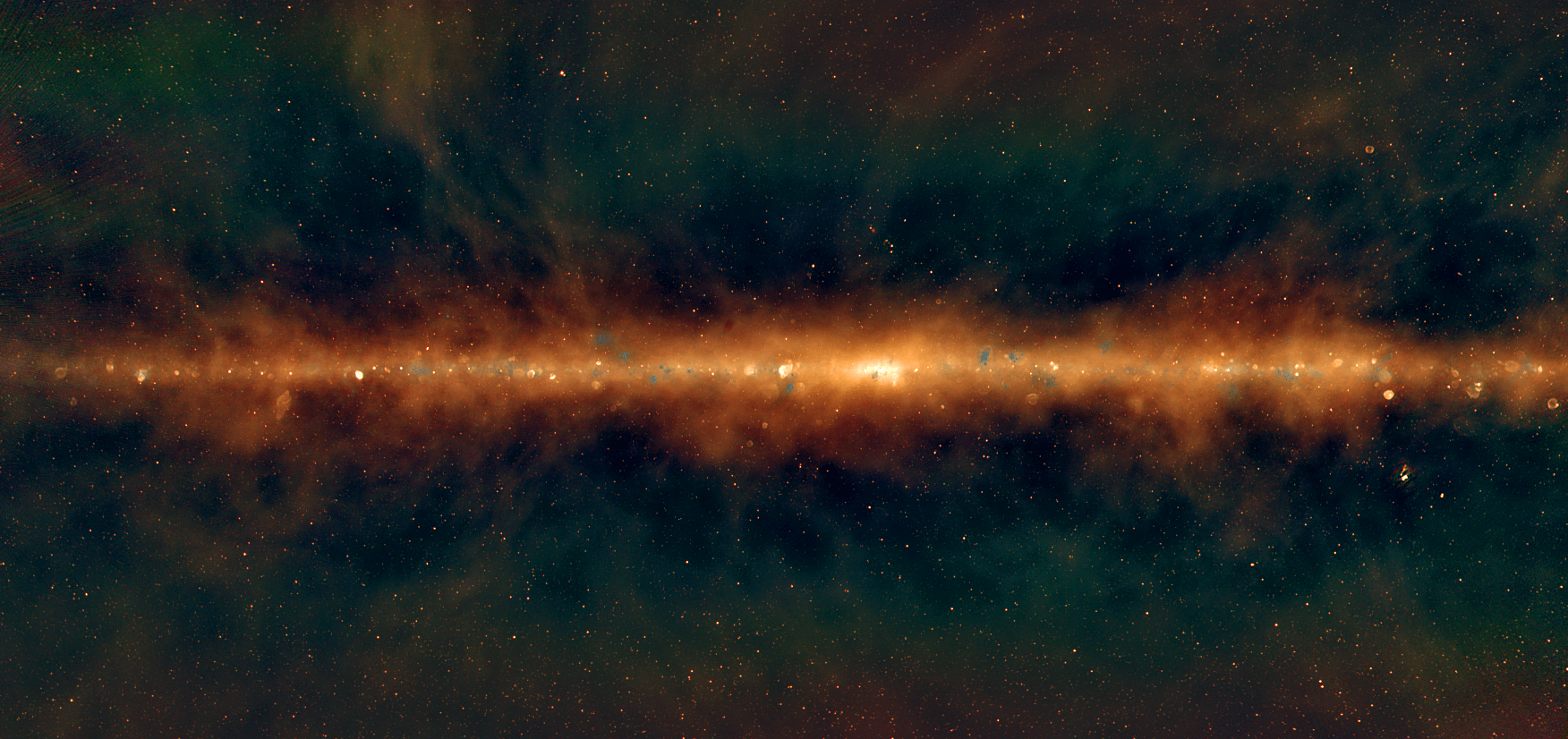
The image from the Murchison Widefield Array (MWA) telescope shows what our galaxy would look like if human eyes could see radio waves.

This image shows a new view of the Milky Way from the Murchison Widefield Array, with the lowest frequencies in red, middle frequencies in green, and the highest frequencies in blue. Huge golden filaments indicate enormous magnetic fields, supernova remnants are visible as little spherical bubbles, and regions of massive star formation show up in blue. The supermassive black hole at the centre of our galaxy is hidden in the bright white region in the centre. Credit: Dr Natasha Hurley-Walker (ICRAR/Curtin) and the GLEAM Team.

Astrophysicist Dr Natasha Hurley-Walker, from the Curtin University node of the International Centre for Radio Astronomy Research (ICRAR), created the images using the Pawsey Supercomputing Centre in Perth.

“This new view captures low-frequency radio emission from our galaxy, looking both in fine detail and at larger structures,” she said.

“Our images are looking directly at the middle of the Milky Way, towards a region astronomers call the Galactic Centre.”

The data for the research comes from the GaLactic and Extragalactic All-sky MWA survey, or ‘GLEAM’ for short.

The survey has a resolution of two arcminutes (about the same as the human eye) and maps the sky using radio waves at frequencies between 72 and 231 MHz (FM radio is near 100 MHz).

“It’s the power of this wide frequency range that makes it possible for us to disentangle different overlapping objects as we look toward the complexity of the Galactic Centre,” Dr Hurley-Walker said.

“Essentially, different objects have different ‘radio colours’, so we can use them to work out what kind of physics is at play.”

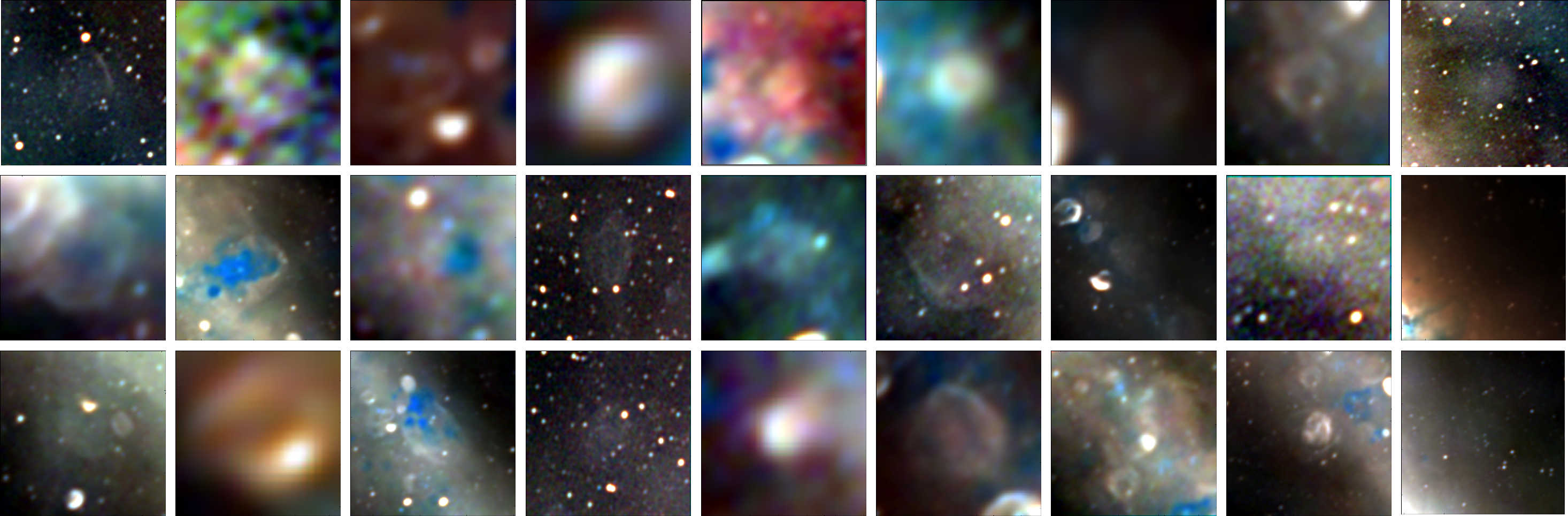
Using the images, Dr Hurley-Walker and her colleagues discovered the remnants of 27 massive stars that exploded in supernovae at the end of their lives.

These are the 27 newly-discovered supernova remnants—the remains of stars that ended their lives in huge stellar explosions thousands to hundreds of thousands of years ago. The radio images trace the edges of the explosions as they continue their ongoing expansion into interstellar space. Some are huge, larger than the full moon, and others are small and hard to spot in the complexity of the Milky Way. Credit: Dr Natasha Hurley-Walker (ICRAR/Curtin) and the GLEAM Team.

These stars would have been eight or more times more massive than our Sun before their dramatic destruction thousands of years ago.

Younger and closer supernova remnants, or those in very dense environments, are easy to spot, and 295 are already known.

Unlike other instruments, the MWA can find those which are older, further away, or in very empty environments.

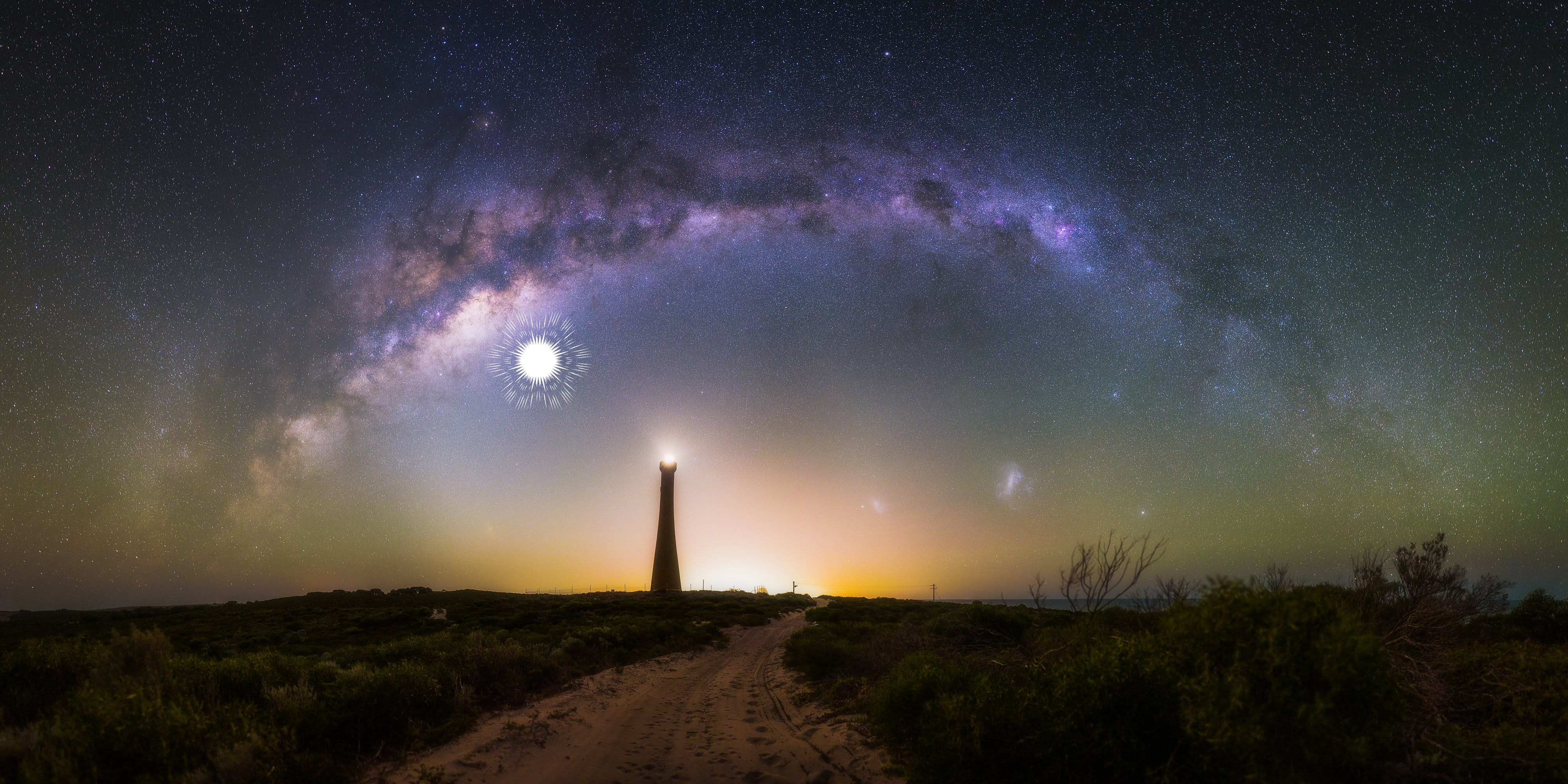
Dr Hurley-Walker said one of the newly-discovered supernova remnants lies in such an empty region of space, far out of the plane of our galaxy, and so despite being quite young, is also very faint.

“It’s the remains of a star that died less than 9,000 years ago, meaning the explosion could have been visible to Indigenous people across Australia at that time,” she said.

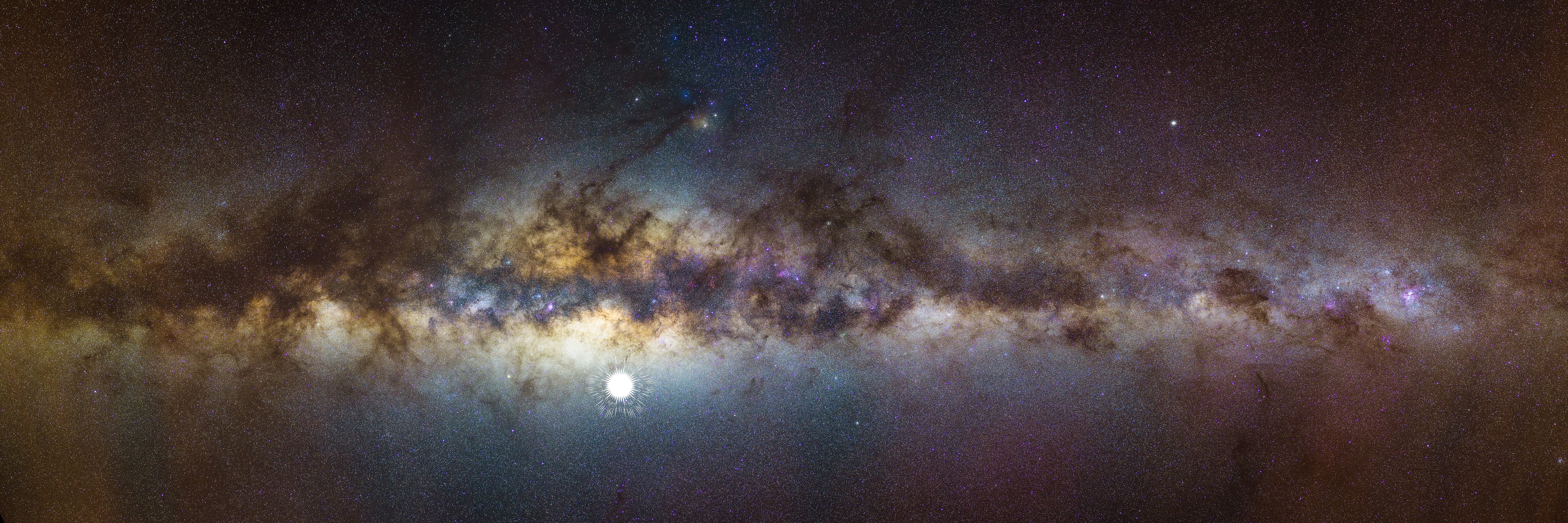
This 28 image photomosaic captures the arch of the milky way over the Guilderton Lighthouse in Western Australia, and the Large and Small Magellanic Clouds. The location of a supernova that would have exploded 9,000 years ago and been visible in the night sky is shown in the image. Credit: Paean Ng / Astrordinary Imaging.

An expert in cultural astronomy, Associate Professor Duane Hamacher from the University of Melbourne, said some Aboriginal traditions do describe bright new stars appearing in the sky, but we don’t know of any definitive traditions that describe this particular event.

“However, now that we know when and where this supernova appeared in the sky, we can collaborate with Indigenous elders to see if any of their traditions describe this cosmic event. If any exist, it would be extremely exciting,” he said. This is a 104 frame photomosaic capturing the Milky Way directly overhead taken at the Pinnacles Desert in Western Australia. A popular tourist location by day and incredible stargazing at night. The location of a supernova that would have exploded 9,000 years ago is shown in the image. Credit: Paean Ng / Astrordinary Imaging.

This is a 104 frame photomosaic capturing the Milky Way directly overhead taken at the Pinnacles Desert in Western Australia. A popular tourist location by day and incredible stargazing at night. The location of a supernova that would have exploded 9,000 years ago is shown in the image. Credit: Paean Ng / Astrordinary Imaging.

Dr Hurley-Walker said two of the supernova remnants discovered are quite unusual “orphans”, found in a region of sky where there are no massive stars, which means future searches across other such regions might be more successful than astronomers expected.

Other supernova remnants discovered in the research are very old, she said.

“This is really exciting for us, because it’s hard to find supernova remnants in this phase of life—they allow us to look further back in time in the Milky Way.”

The MWA telescope is a precursor to the world’s largest radio telescope, the Square Kilometre Array, which is due to be built in Australia and South Africa from 2021.

“The MWA is perfect for finding these objects, but it is limited in its sensitivity and resolution,” Dr Hurley-Walker said.

“The low-frequency part of the SKA, which will be built at the same site as the MWA, will be thousands of times more sensitive and have much better resolution, so should find the thousands of supernova remnants that formed in the last 100,000 years, even on the other side of the Milky Way.”

The new images of the Galactic Centre can be viewed via a web browser using the GLEAMoscope app or through an android device using the GLEAM app.


Source: International Centre for Radio Astronomy Research (ICRAR)/News


Publication:

‘New candidate radio supernova remnants detected in the GLEAM survey over 345° < l < 60°, 180° < l < 240°’, published in Publications of the Astronomical Society of Australia (PASA) on November 20th, 2019. Paper

‘Candidate radio supernova remnants observed by the GLEAM survey over 345° < l < 60°, 180° < l < 240°’, published in Publications of the Astronomical Society of Australia (PASA) on November 20th, 2019. Paper 

‘GaLactic and Extragalactic All-sky Murchison Widefield Array (GLEAM) survey II: Galactic Plane 345° < l < 67°, 180° < l < 240°’, published in Publications of the Astronomical Society of Australia (PASA) on November 20th, 2019. Paper


More Information: 

ICRAR

The International Centre for Radio Astronomy Research (ICRAR) is a joint venture between Curtin University and The University of Western Australia with support and funding from the State Government of Western Australia. 

The Murchison Widefield Array 

The Murchison Widefield Array (MWA) is a low-frequency radio telescope and is the first of four Square Kilometre Array (SKA) precursors to be completed. A consortium of partner institutions from seven countries (Australia, USA, India, New Zealand, Canada, Japan, and China) financed the development, construction, commissioning, and operations of the facility. The MWA consortium is led by Curtin University.


Contacts:

Dr Natasha Hurley-Walker — ICRAR / Curtin University
Ph: +61 8 9266 9178
E:Natasha.Hurley-Walker@curtin.edu.au

Pete Wheeler — Media Contact, ICRAR
Ph: +61 423 982 018

Lucien Wilkinson — Media Contact, Curtin University
Ph: +61 401 103 683


Wednesday, November 20, 2019

Sky survey provides clues to how they change over time

A simulation showing a section of the Universe at its broadest scale. A web of cosmic filaments forms a lattice of matter, enclosing vast voids. Credit: Tiamat simulation, Greg Poole.

A blond boy and a girl with dark hair are skating. The girl is chasing her friend and catching up, so she’s skating faster. When she reaches her friend, she grabs his hand in passing. Because the boy is slower, this sends them both into a rotation around a vertical axis. Credit: Charlotte Welker/brgfx /Freepik 

In the densest regions of the Universe – known as galaxy clusters – the spins of galaxies are expected to be pointing in random directions. But along the flow channels into clusters, our most advanced simulations predict the spins to be aligned along the filament, an effect seen for the first time in the SAMI survey. Credit: Joss Bland-Hawthorn


The direction in which a galaxy spins depends on its mass, researchers have found.

A team of astrophysicists analysed 1418 galaxies and found that small ones are likely to spin on a different axis to large ones. The rotation was measured in relation to each galaxy’s closest “cosmic filament” – the largest structures in the universe.

The research was driven by the ARC Centre of Excellence in All Sky Astrophysics (ASTRO 3D), based in Australia.

Filaments are massive thread-like formations, comprising huge amounts of matter – including galaxies, gas and, modelling implies, dark matter. They can be 500 million light years long but just 20 million light years wide. At their largest scale, the filaments divide the universe into a vast gravitationally linked lattice interspersed with enormous dark matter voids.

“It’s worth noticing that the spine of cosmic filaments is pretty much the highway of galactic migration, with many galaxies encountering and merging along the way,” says lead researcher Charlotte Welker, an ASTRO 3D researcher working initially at the International Centre for Radio Astronomy Research (ICRAR) and now at McMaster University in Canada.

The filaments are why the universe looks a little like a honeycomb, or a cosmic Aero chocolate bar.

Using data gathered by an instrument called the Sydney-AAO Multi-object Integral-field spectrograph (SAMI) at Australia’s Anglo-Australian Telescope (AAT), Dr Welker, second author and ASTRO 3D principal investigator Professor Joss Bland-Hawthorn from the University of Sydney, and colleagues from Australia, the US, France and Korea studied each of the target galaxies and measured its spin in relation to its nearest filament.

They found that smaller ones tended to rotate in direct alignment to the filaments, while larger ones turned at right angles. The alignment changes from the first to the second as galaxies, drawn by gravity towards the spine of a filament, collide and merge with others, thus gaining mass.

It is a phenomenon that Dr Welker likens to roller-skating in the company of a friend.

“The flip can be sudden,” she says. “Merging with another galaxy can be all it takes.

“Imagine you are skating after a friend and catching up. If you grab your friend’s hand while you are still moving faster, you will both start rotating on a vertical axis – a spin perpendicular to your horizontal path.

“However, if a small cat – a much lighter bit of matter – runs after your friend and jumps on her she probably won’t start spinning. It would take a lot of cats leaping on her at once to change her rotation.”

Co-author Scott Croom from the University of Sydney, also an ASTRO 3D principal investigator, says the result offers insight into the deep structure of the Universe.

“Virtually all galaxies rotate, and this rotation is fundamental to how galaxies form,” he says.

“For example, most galaxies are in flat rotating disks, like our Milky Way. Our result is helping us to understand how that galactic rotation builds up across cosmic time.”

He adds that a new instrument, called Hector, set to be installed at the Anglo Australian Telescope next year, will enable a significant expansion of research in the field.

“Hector will be able to carry out surveys five times larger than SAMI,” he says. “With this we will be able to dig into the details of this spin alignment to better understand the physics behind it.”

The Milky Way, by the way, has a spin well aligned with its nearest cosmic filament, but belongs to a class of intermediate size galaxies that, over all, show no clear tendency towards parallel or perpendicular spins.

“It’s like saying that there is no preference for tea or coffee among a group of people,” says Dr Welker. “Individuals may still prefer either tea or coffee, but overall there is no general tendency towards coffee in the group.”

The research has early access availability in the journal Monthly Notices of the Royal Astronomical Society (MNRS), and is also available in full on the preprint site arxiv.

ASTRO3D is the ARC Centre of Excellence for Astrophysics in 3 Dimensions.


Further information

Dr Charlotte Welker: 289 639 1918, time zone is GMT-5; please ask to speak to Dr Welker

Professor Scott Croom: 0450 103 695, time zone is GMT+11

Professor Joss Bland-Hawthorn: 0406 973 133, time zone is GMT+11

Professor Lisa Kewley, ASTRO 3D director: 0451 045 968, time zone is GMT+11

Further assistance: Andrew Masterson: 0488 777 179, time zone is GMT+11


The paper

The SAMI Galaxy Survey: First detection of a transition in spin orientation with respect to cosmic filaments in the stellar kinematics of galaxies.

MNRS version

Arxiv version


More about ASTRO 3D

ASTRO 3D is a seven-year $40 million Centre of Excellence project funded by the Australian Government through the Australian Research Council. The Centre began in June 2017 and will end in June 2024. It hosts around 200 investigators and professional staff, mostly based at six nodes: the Australian National University, Curtin University, Swinburne University of Technology, University of Melbourne, University of Sydney, and University of Western Australia.

More about SAMI The SAMI Galaxy Survey began in March 2013, with the intention of creating a large survey of 3000 galaxies across a large range of environment. The key science goals of the SAMI Survey are to answer the following questions:
  • What is the physical role of environment in galaxy evolution?
  • What is the relationship between stellar mass growth and angular momentum development in galaxies?
  • How does gas get into and out of galaxies, and how does this drive star formation?


More about the Anglo-Australian Telescope.

More about Hector


Saturday, September 21, 2019

First Canadian-led ALMA Survey to Investigate the Impact of Galaxy Environment on Star Formation

Optical image of the spiral galaxy NGC 4330, located in the Virgo Cluster. Ionised gas is shown in red. The blue overlay shows the expected ALMA observations of CO gas. Dr Brown and his colleagues will use the Atacama Compact Array (ACA) to study the influence of galaxy environment on star formation in the Virgo Cluster. Credit: T. Brown; Fossati et al., 2018. Hi-res image

The first-ever Canadian-led Atacama Large Millimeter/submillimeter Array (ALMA) Large Program has been announced and it will be led by Dr Toby Brown, a former ICRAR PhD student who is now based at McMaster University in Canada.

Where galaxies live in the Universe, how they interact with their surroundings (the intergalactic medium), and with each other is a major influence on star formation over cosmic time. But exactly how the so-called environment dictates the life and death of galaxies is a major focus of the astronomy community.

Dr Brown and his colleagues will use the Atacama Compact Array (ACA) to study the influence of galaxy environment on star formation in the Virgo Cluster. Galaxy clusters are the most extreme environments in the Universe, with huge gravitational forces acting on their member galaxies and super-heated plasma in the intergalactic medium.

Dr Brown said that the Virgo Cluster is an ideal location for detailed studies of the environment.

“It is our nearest massive galaxy cluster and is in the process of forming, which means that we can get a snapshot of galaxies in different stages of their lifecycle,” he said.

“This allows us to understand how star formation is shut off in cluster galaxies.”

Virgo has been studied at almost every wavelength, but a millimetre data set with the required sensitivity and resolution does not exist yet. Therefore, Dr Brown and his colleagues will use ALMA to map the star-forming gas, the fuel from which stars are born, at high resolution in 51 Virgo spiral galaxies.

With the new data, the team will study how the Virgo Cluster environment influences the molecular star-forming gas.

“One of the ways in which star formation can be stopped is gas removal or stripping,” Brown explains.

“When galaxies pass through the intracluster medium, hot plasma can sweep gas from the galaxies like a huge cosmic broom.”

Another environmental mechanism is starvation: when molecular gas used in star formation is not replenished and new stars cannot be formed.

“This ALMA Large Program allows us to better understand these mechanisms,” he said.

ALMA Large Programs are designed to address strategic scientific issues that will lead to a major advance or breakthrough in the field.

 Dr Toby Brown


More Information

The Atacama Large Millimeter/submillimeter Array (ALMA), an international astronomy facility, is a partnership of the European Organisation for Astronomical Research in the Southern Hemisphere (ESO), the U.S. National Science Foundation (NSF) and the National Institutes of Natural Sciences (NINS) of Japan in cooperation with the Republic of Chile. ALMA is funded by ESO on behalf of its Member States, by NSF in cooperation with the National Research Council of Canada (NRC) and the Ministry of Science and Technology (MOST) in Taiwan and by NINS in cooperation with the Academia Sinica (AS) in Taiwan and the Korea Astronomy and Space Science Institute (KASI).


ALMA construction and operations are led by ESO on behalf of its Member States; by the National Radio Astronomy Observatory (NRAO), managed by Associated Universities, Inc. (AUI), on behalf of North America; and by the National Astronomical Observatory of Japan (NAOJ) on behalf of East Asia. The Joint ALMA Observatory (JAO) provides the unified leadership and management of the construction, commissioning and operation of ALMA.

Tuesday, September 10, 2019

ASTRO 3D: Researchers hunt for a 12-billion-year-old signal that marks the end of the post Big Bang “dark age”.

In this image of the Epoch of Reionisation, neutral hydrogen, in red, is gradually ionizsed by the first stars, shown in white. The image was made by the University of Melbourne’s Dark-ages Reionisation And Galaxy Observables from Numerical Simulations (DRAGONS) programme. Credit: Paul Geil and Simon Mutch.

Dr Nichole Barry at The Murchison Widefield Array (MWA)
Credit: Ruby Byrne

In this simulation of the Epoch of Reionisation, neutral hydrogen, in red, is gradually ionised by the first stars, shown in white. The video was made by the University of Melbourne’s Dark-ages Reionisation And Galaxy Observables from Numerical Simulations (DRAGONS) programme. Credit: Paul Geil and Simon Mutch. Video


Astronomers are closing in on a signal that has been travelling across the Universe for 12 billion years, bringing them nearer to understanding the life and death of the very earliest stars.

In a paper on the preprint site arXiv and soon to be published in the Astrophysical Journal, a team led by Dr Nichole Barry from Australia’s University of Melbourne and the ARC Centre of Excellence for All Sky Astrophysics in 3 Dimensions (ASTRO 3D) reports a 10-fold improvement on data gathered by the Murchison Widefield Array (MWA) – a collection of 4096 dipole antennas set in the remote hinterland of Western Australia.

The MWA, which started operating in 2013, was built specifically to detect electromagnetic radiation emitted by neutral hydrogen – a gas that comprised most of the infant Universe in the period when the soup of disconnected protons and neutrons spawned by the Big Bang started to cool down.

Eventually these hydrogen atoms began to clump together to form stars – the very first ones to exist – initiating a major phase in the evolution of the Universe, known as the Epoch of Reionisation, or EoR.

“Defining the evolution of the EoR is extremely important for our understanding of astrophysics and cosmology,” explains Dr Barry.

“So far, though, no one has been able to observe it. These results take us a lot closer to that goal.”

The neutral hydrogen that dominated space and time before and in the early period of the EoR radiated at a wavelength of approximately 21 centimetres. Stretched now to somewhere above two metres because of the expansion of the Universe, the signal persists – and detecting it remains the theoretical best way to probe conditions in the early days of the Cosmos.

However, doing so is fiendishly difficult.

“The signal that we’re looking for is more than 12 billion years old,” explains ASTRO-3D member and co-author Associate Professor Cathryn Trott, from the International Centre for Radio Astronomy Research at Curtin University in Western Australia.

“It is exceptionally weak and there are a lot of other galaxies in between it and us. They get in the way and make it very difficult to extract the information we’re after.”

In other words, the signals recorded by the MWA – and other EoR-hunting devices such as the Hydrogen Epoch of Reionisation Array in South Africa and the Low Frequency Array in The Netherlands – are extremely messy.

Using 21 hours of raw data Dr Barry, co-lead author Mike Wilensky, from the University of Washington in the US, and colleagues explored new techniques to refine analysis and exclude consistent sources of signal contamination, including ultra-faint interference generated by radio broadcasts on Earth.

The result was a level of precision that significantly reduced the range in which the EoR may have begun, pulling in constraints by almost an order of magnitude.

“We can’t really say that this paper gets us closer to precisely dating the start or finish of the EoR, but it does rule out some of the more extreme models,” says Professor Trott.

“That it happened very rapidly is now ruled out. That the conditions were very cold is now also ruled out.”

Dr Barry said the results represented not only a step forward in the global quest to explore the infant Universe, but also established a framework for further research.

“We have about 3000 hours of data from MWA,” she explains, “and for our purposes some of it is more useful than others. This approach will let us identify which bits are most promising, and analyse it better than we ever could before.”

The research was conducted by multiple ASTRO-3D researchers based at the University of Melbourne, Curtin University, the CSIRO’s Astronomy and Space Science division in Epping, NSW, and the University of Washington.

They worked in collaboration with scientists from Arizona State University, Brown University and MIT in the USA, Kumamoto University in Japan and Raman Research Institute in India.

The paper is available here: https://arxiv.org/abs/1909.00561


Contacts

Andrew Masterson (Media Contact, Science in Public)
Ph: +61 488 777 179
E: andrew@scienceinpublic.com.au

Ingrid McCarthy (Media Contact, ASTRO 3D)
Ph: +61 261 258 022
E: ingrid.mccarthy@anu.edu.au


More Information

More about ASTRO-3D

ASTRO 3D is a seven-year $40 million Centre of Excellence project funded by the Australian Government through the Australian Research Council. The Centre began in June 2017 and will end in June 2024. It hosts around 200 investigators and professional staff, mostly based at six nodes: the Australian National University, Curtin University, Swinburne University of Technology, University of Melbourne, University of Sydney, and University of Western Australia. https://astro3d.org.au/ More about the MWA

The Murchison Widefield Array (MWA) is a low-frequency radio telescope, located at the CSIRO Murchison Radio-astronomy Observatory (MRO) in Western Australia. The telescope is operated by Curtin University on behalf of an international collaboration of 21 research organisations spanning Australia, New Zealand, Japan, China, Canada and the United States. More details are available at www.mwatelescope.org. Images available here: http://www.mwatelescope.org/multimedia/images