Tuesday, December 16, 2014

Stretched-out solid exoplanets

An artist’s impression of a stretched rocky planet in orbit around a red dwarf star. So close to the star, there is a difference in the strength of the gravitational field on each side of the planet, stretching it significantly. Credit: Shivam Sikroria. Click  here for a full size image


Astronomers could soon be able to find rocky planets stretched out by the gravity of the stars they orbit, according to a group of researchers in the United States. The team, led by Prabal Saxena of George Mason University, describe how to detect these exotic worlds in a paper in the journal Monthly Notices of the Royal Astronomical Society.

Since the first discovery in 1993, more than 1800 planets have been found in orbit around stars other than our Sun. These 'exoplanets' are incredibly diverse, with some gaseous like Jupiter and some mostly rocky like the Earth. The worlds also orbit their stars at very different distances, from less than a million km to nearly 100 billion km away. Planets that are very close to their stars experience harsh conditions, often with very high temperatures (>1000 degrees Celsius) and significant stretching from the tidal forces resulting from the stellar gravitational field. This is most obvious with planets with a large atmosphere (so-called 'hot Jupiters') but harder to see with rockier objects.

Prabal and his team modelled cases where the planets are in orbit close to small red dwarf stars, much fainter than our Sun, but by far the most common type of star in the Galaxy. The planets’ rotation is locked, so the worlds keep the same face towards the stars they orbit, much like the Moon does as it moves around the Earth. According to the scientists, in these circumstances the distortion of the planets should be detectable in transit events, where the planets moves in front of their stars and blocks out some of their light.

If astronomers are able to find these extreme exoplanets, it could give them new insights into the properties of Earth-like planets as a whole. Prabal comments, "Imagine taking a planet like the Earth or Mars, placing it near a cool red star and stretching it out. Analysing the new shape alone will tell us a lot about the otherwise impossible to see internal structure of the planet and how it changes over time."

The subtle signals from stretched rocky planets could be found by some current telescopes, and certainly by much more powerful observatories like the James Webb Space Telescope (JWST) and the European Extremely Large Telescope (E-ELT) that are due to enter service in the next few years.

Media contact
Dr Robert Massey
Royal Astronomical Society
Tel: +44 (0)20 7734 3307 x214
Mob: +44 (0)794 124 8035

rm@ras.org.uk

Science contact
Prabal Saxena
School of Physics, Astronomy and Computational Sciences
George Mason University
Virginia
United States
Tel: +1 516 978 2158

psaxena2@masonlive.gmu.edu

Further information
The new work appears in P. Saxena et al. "The observational effects and signatures of tidally distorted solid exoplanets", Monthly Notices of the Royal Astronomical Society, vol. 446, pp. 4271–4277, 2015, published by Oxford University Press.

Notes for editors
The Royal Astronomical Society (RAS), founded in 1820, encourages and promotes the study of astronomy, solar-system science, geophysics and closely related branches of science. The RAS organizes scientific meetings, publishes international research and review journals, recognizes outstanding achievements by the award of medals and prizes, maintains an extensive library, supports education through grants and outreach activities and represents UK astronomy nationally and internationally. Its more than 3800 members (Fellows), a third based overseas, include scientific researchers in universities, observatories and laboratories as well as historians of astronomy and others.  Follow the RAS on Twitter


Monday, December 15, 2014

The magnetic field along the Galactic plane

The magnetic field along the Galactic plane
Copyright: ESA/Planck Collaboration. 
Acknowledgment: M.-A. Miville-Deschênes, CNRS – Institut d’Astrophysique Spatiale, Université Paris-XI, Orsay, France
Hi-Res Image (5.58 MB)

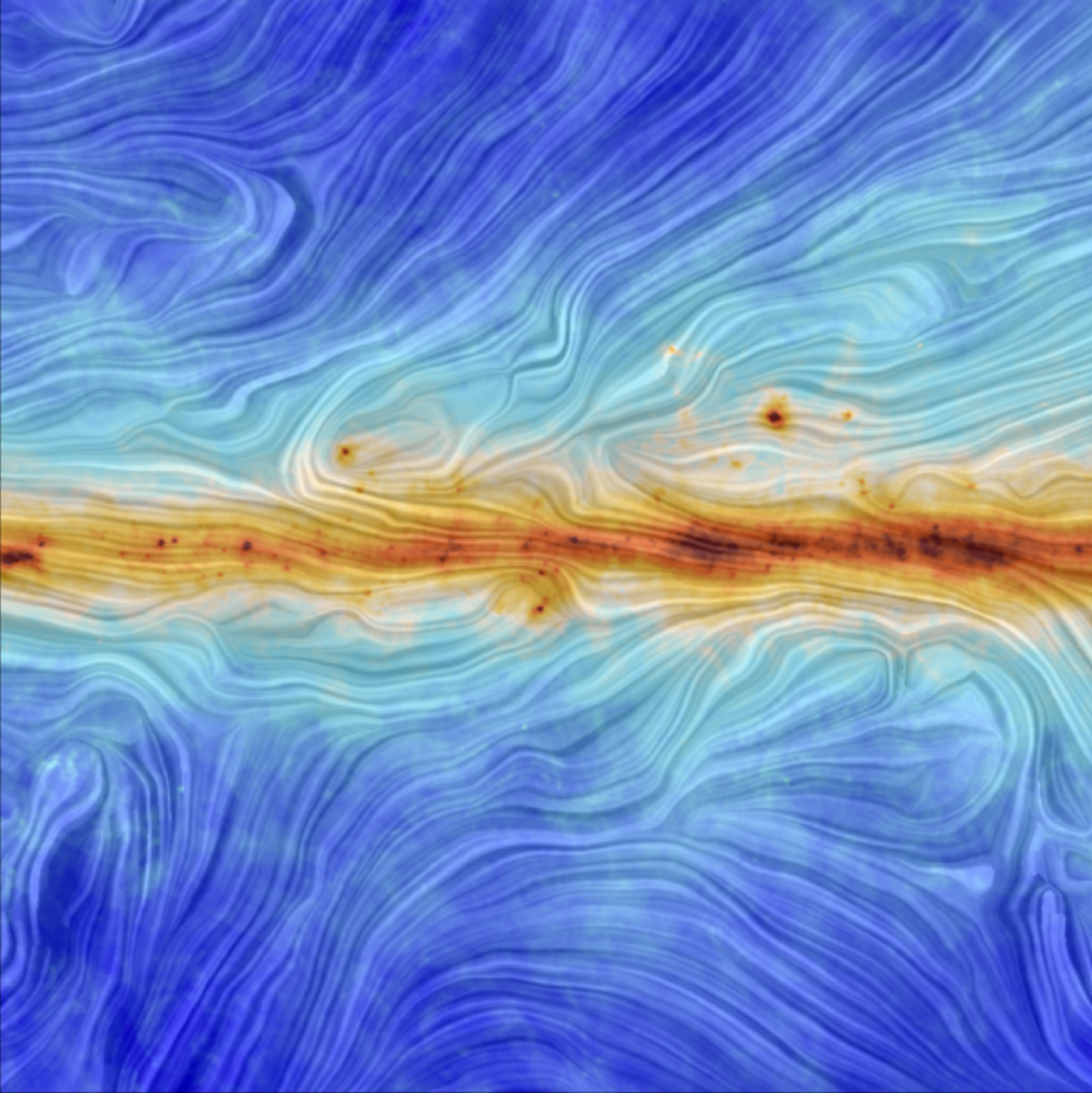
While the pastel tones and fine texture of this image may bring to mind brush strokes on an artist’s canvas, they are in fact a visualisation of data from ESA’s Planck satellite. The image portrays the interaction between interstellar dust in the Milky Way and the structure of our Galaxy’s magnetic field.

Between 2009 and 2013, Planck scanned the sky to detect the most ancient light in the history of the Universe – the cosmic microwave background. It also detected significant foreground emission from diffuse material in our Galaxy which, although a nuisance for cosmological studies, is extremely important for studying the birth of stars and other phenomena in the Milky Way.

Among the foreground sources at the wavelengths probed by Planck is cosmic dust, a minor but crucial component of the interstellar medium that pervades the Galaxy. Mainly gas, it is the raw material for stars to form.

Interstellar clouds of gas and dust are also threaded by the Galaxy’s magnetic field, and dust grains tend to align their longest axis at right angles to the direction of the field. As a result, the light emitted by dust grains is partly ‘polarised’ – it vibrates in a preferred direction – and, as such, could be caught by the polarisation-sensitive detectors on Planck.

Scientists in the Planck collaboration are using the polarised emission of interstellar dust to reconstruct the Galaxy’s magnetic field and study its role in the build-up of structure in the Milky Way, leading to star formation.

In this image, the colour scale represents the total intensity of dust emission, revealing the structure of interstellar clouds in the Milky Way. The texture is based on measurements of the direction of the polarised light emitted by the dust, which in turn indicates the orientation of the magnetic field.

This image shows the intricate link between the magnetic field and the structure of the interstellar medium along the plane of the Milky Way. In particular, the arrangement of the magnetic field is more ordered along the Galactic plane, where it follows the spiral structure of the Milky Way. Small clouds are seen just above and below the plane, where the magnetic field structure becomes less regular.

From these and other similar observations, Planck scientists found that filamentary interstellar clouds are preferentially aligned with the direction of the ambient magnetic field, highlighting the strong role played by magnetism in galaxy evolution.

The emission from dust is computed from a combination of Planck observations at 353, 545 and 857 GHz, whereas the direction of the magnetic field is based on Planck polarisation data at 353 GHz.


Source: ESA


Swarms of Pluto-Size Objects Kick Up Dust around Adolescent Sun-Like Star

Artist impression of the debris disk around HD 107146. This adolescent star system shows signs that in its outer reaches, swarms of Pluto-size objects are jostling nearby smaller objects, causing them to collide and "kick up" considerable dust. Credit: A. Angelich (NRAO/AUI/NSF)

ALMA image of the dust surrounding the star HD 107146. Dust in the outer reaches of the disk is thicker than in the inner regions, suggesting that a swarm of Pluto-size planetesimals is causing smaller objects to smash together. The dark ring-like structure in the middle portion of the disk may be evidence of a gap where a planet is sweeping its orbit clear of dust. Credit: L. Ricci ALMA (NRAO/NAOJ/ESO); B. Saxton (NRAO/AUI/NSF)

Cambridge, MA - Astronomers using the Atacama Large Millimeter/submillimeter Array (ALMA) may have detected the dusty hallmarks of an entire family of Pluto-size objects swarming around an adolescent version of our own Sun.

By making detailed observations of the protoplanetary disk surrounding the star known as HD 107146, the astronomers detected an unexpected increase in the concentration of millimeter-size dust grains in the disk's outer reaches. This surprising increase, which begins remarkably far -- about 13 billion kilometers -- from the host star, may be the result of Pluto-size planetesimals stirring up the region, causing smaller objects to collide and blast themselves apart.

Dust in debris disks typically consists of material left over from the formation of planets. Very early in the lifespan of the disk, this dust is continuously replenished by collisions of larger bodies, such as comets and asteroids. In mature solar systems with fully formed planets, comparatively little dust remains. In between these two ages -- when a solar system is in its awkward teenage years -- certain models predict that the concentration of dust would be much denser in the most distant regions of the disk. This is precisely what ALMA has found.

"The dust in HD 107146 reveals this very interesting feature -- it gets thicker in the very distant outer reaches of the star's disk," said Luca Ricci, an astronomer at the Harvard-Smithsonian Center for Astrophysics (CfA), and lead author on a paper accepted for publication in the Astrophysical Journal. At the time of the observations, Ricci was with the California Institute of Technology.

"The surprising aspect is that this is the opposite of what we see in younger primordial disks where the dust is denser near the star. It is possible that we caught this particular debris disk at a stage in which Pluto-size planetesimals are forming right now in the outer disk while other Pluto-size bodies have already formed closer to the star," said Ricci.

According to current computer models, the observation that the density of dust is higher in the outer regions of the disk can only be explained by the presence of recently formed Pluto-sized bodies. Their gravity would disturb smaller planetesimals, causing more frequent collisions that generate the dust ALMA sees.

The new ALMA data also hint at another intriguing feature in the outer reaches of the disk: a possible "dip" or depression in the dust about 1.2 billion kilometers wide, beginning approximately 2.5 times the distance of the Sun to Neptune from the central star. Though only suggested in these preliminary observations, this depression could be a gap in the disk, which would be indicative of an Earth-mass planet sweeping the area clear of debris. Such a feature would have important implications for the possible planet-like inhabitants of this disk and may suggest that Earth-size planets could form in an entirely new range of orbits than have ever been seen before.

The star HD 107146 is of particular interest to astronomers because it is in many ways a younger version of our own Sun. It also represents a period of transition from a solar system's early life to its more mature, final stages where planets have finished forming and have settled into their final orbits around their host star. 

"This system offers us the chance to study an intriguing time around a young, Sun-like star," said ALMA Deputy Director and coauthor Stuartt Corder. "We are possibly looking back in time here, back to when the Sun was about 2 percent of its current age."

The star HD 107146 is located approximately 90 light-years from Earth in the direction of the constellation Coma Berenices. It is approximately 100 million years old. Further observations with ALMA's new long-baseline, high-resolution capabilities will shed more light on the dynamics and composition of this intriguing object.

Additional authors on the paper include John M. Carpenter and B. Fu, Caltech; A. M. Hughes, Wesleyan University; and Andrea Isella, Rice University.

The National Radio Astronomy Observatory is a facility of the National Science Foundation, operated under cooperative agreement by Associated Universities, Inc.

The Atacama Large Millimeter/submillimeter Array (ALMA), an international astronomy facility, is a partnership of Europe, North America and East Asia in cooperation with the Republic of Chile. ALMA is funded in Europe by the European Organization for Astronomical Research in the Southern Hemisphere (ESO), in North America by the U.S. National Science Foundation (NSF) in cooperation with the National Research Council of Canada (NRC) and the National Science Council of Taiwan (NSC) and in East Asia by the National Institutes of Natural Sciences (NINS) of Japan in cooperation with the Academia Sinica (AS) in Taiwan and the Korea Astronomy and Space Science Institute (KASI).

ALMA construction and operations are led on behalf of Europe by ESO, on behalf of North America by the National Radio Astronomy Observatory (NRAO), which is managed by Associated Universities, Inc. (AUI) and on behalf of East Asia by the National Astronomical Observatory of Japan (NAOJ). The Joint ALMA Observatory (JAO) provides the unified leadership and management of the construction, commissioning and operation of ALMA.


Contacts: 

Charles E. Blue
Public Information Officer
(434) 296-0314 
Emailcblue@nrao.edu

Luca Ricci
Harvard-Smithsonian Center for Astrophysics

 Email: lucaricci83@gmail.com

Friday, December 12, 2014

All that glitters

Credit:  ESA/Hubble & NASA 
Acknowledgement: Gilles Chapdelaine

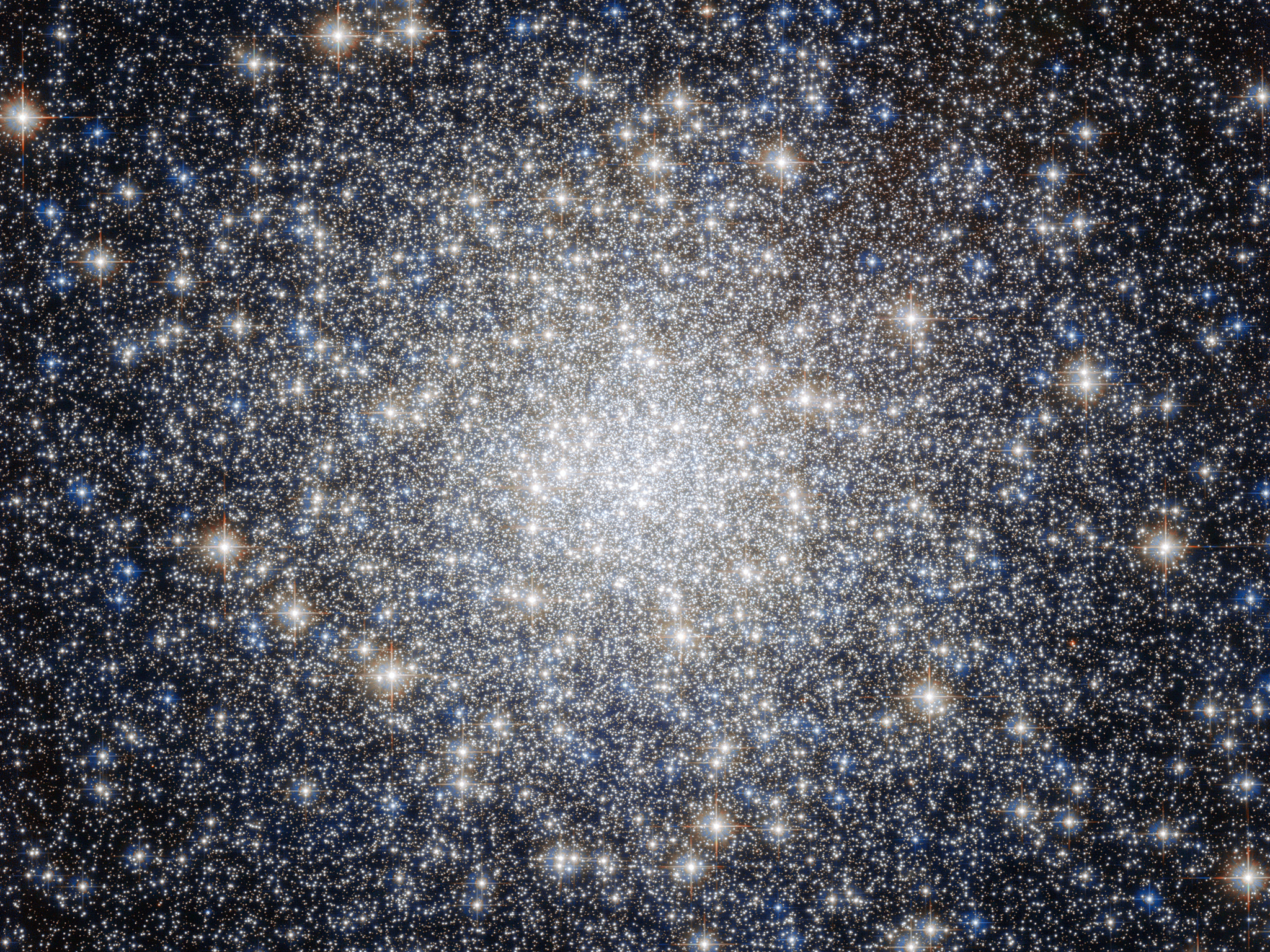
This striking new NASA/ESA Hubble Space Telescope image shows a glittering bauble named Messier 92. Located in the northern constellation of Hercules, this globular cluster — a ball of stars that orbits a galactic core like a satellite — was first discovered by astronomer Johann Elert Bode in 1777.

Messier 92 is one of the brightest globular clusters in the Milky Way, and is visible to the naked eye under good observing conditions. It is very tightly packed with stars, containing some 330 000 stars in total. As is characteristic of globular clusters, the predominant elements within Messier 92 are hydrogen and helium, with only traces of others. It is actually what is known as an Oosterhoff type II (OoII) globular cluster, meaning that it belongs to a group of metal-poor clusters — to astronomers, metals are all elements heavier than hydrogen and helium.

By exploring the composition of globulars like Messier 92, astronomers can figure out how old these clusters are. As well as being bright, Messier 92 is also old, being one of the oldest star clusters in the Milky Way, with an age almost the same as the age of the Universe.

A version of this image was entered into the Hubble’s Hidden Treasures image processing competition by contestant Gilles Chapdelaine.

Links


Source: ESA/Hubble - Space Telescope

Thursday, December 11, 2014

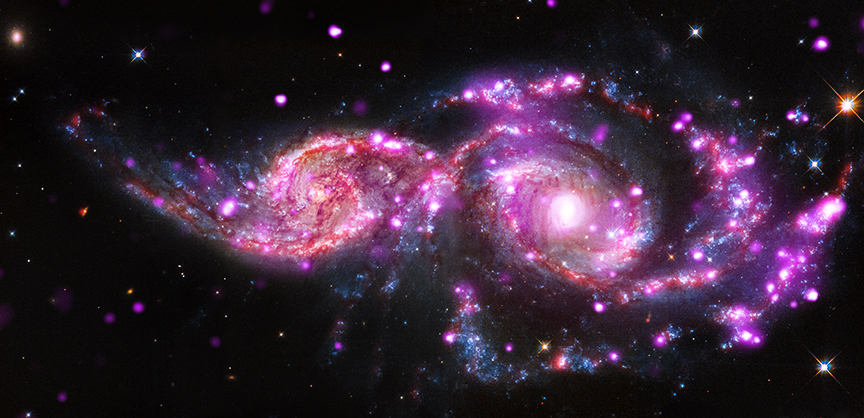
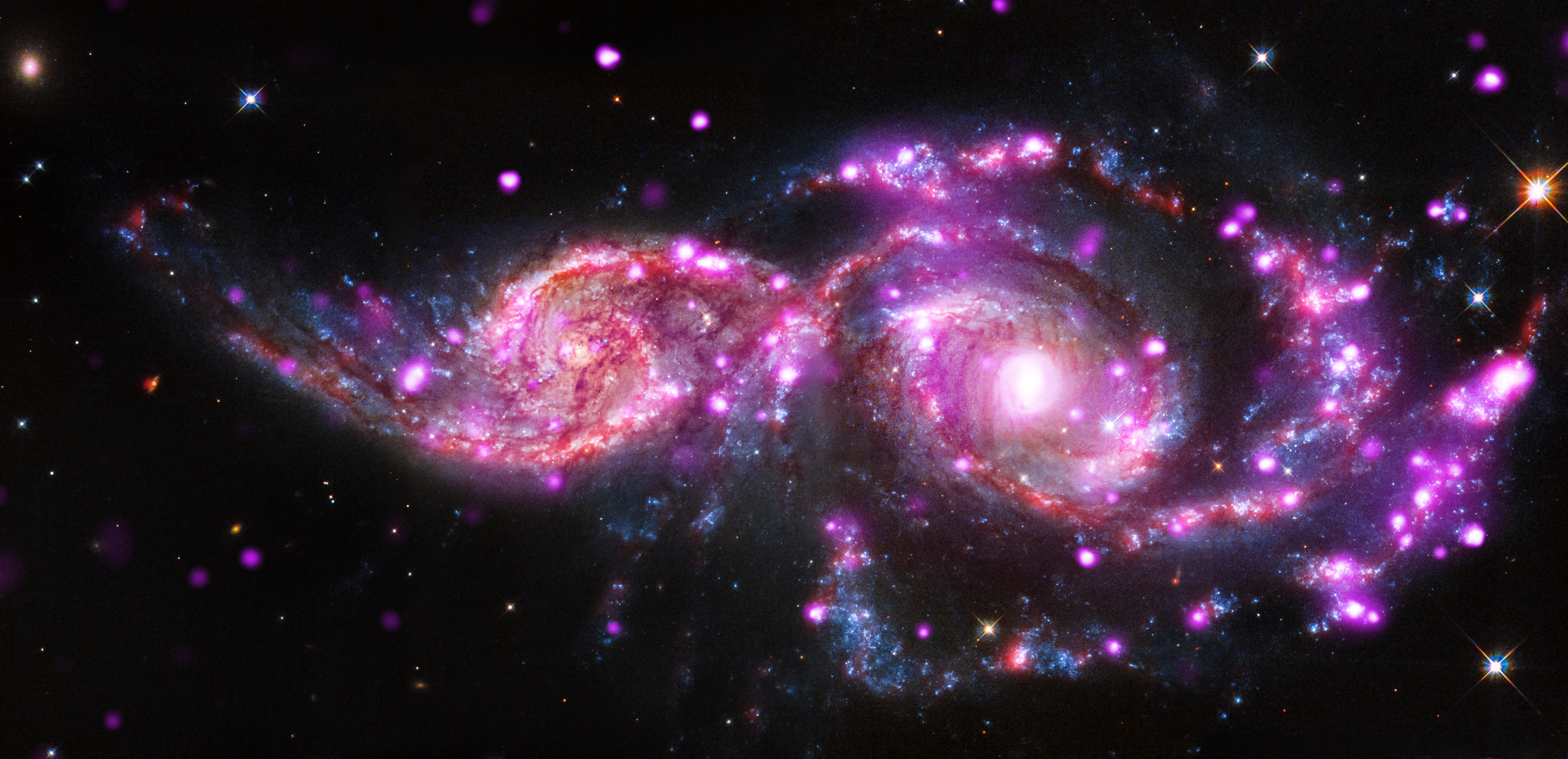
NGC 2207 and IC 2163: Galactic Get-Together has Impressive Light Display

NGC 2207 and IC 2163 (Composite)
Credit  X-ray: NASA/CXC/SAO/S.Mineo et al, Optical: NASA/STScI, Infrared: NASA/JPL-Caltech


At this time of year, there are lots of gatherings often decorated with festive lights. When galaxies get together, there is the chance of a spectacular light show as is the case with NGC 2207 and IC 2163

Located about 130 million light years from Earth, in the constellation of Canis Major, this pair of spiral galaxies has been caught in a grazing encounter. NGC 2207 and IC 2163 have hosted three supernova explosions in the past 15 years and have produced one of the most bountiful collections of super bright X-ray lights known. These special objects - known as "ultraluminous X-ray sources" (ULXs) - have been found using data from NASA's Chandra X-ray Observatory.

As in our Milky Way galaxy, NGC 2207 and IC 2163 are sprinkled with many star systems known as X-ray binaries, which consist of a star in a tight orbit around either a neutron star or a "stellar-mass" black hole. The strong gravity of the neutron star or black hole pulls matter from the companion star. As this matter falls toward the neutron star or black hole, it is heated to millions of degrees and generates X-rays.

ULXs have far brighter X-rays than most "normal" X-ray binaries. The true nature of ULXs is still debated, but they are likely a peculiar type of X-ray binary. The black holes in some ULXs may be heavier than stellar mass black holes and could represent a hypothesized, but as yet unconfirmed, intermediate-mass category of black holes.

This composite image of NGC 2207 and IC 2163 contains Chandra data in pink, optical light data from the Hubble Space Telescope in red, green, and blue (appearing as blue, white, orange, and brown), and infrared data from the Spitzer Space Telescope in red.

The new Chandra image contains about five times more observing time than previous efforts to study ULXs in this galaxy pair. Scientists now tally a total of 28 ULXs between NGC 2207 and IC 2163. Twelve of these vary over a span of several years, including seven that were not detected before because they were in a "quiet" phase during earlier observations.

The scientists involved in studying this system note that there is a strong correlation between the number of X-ray sources in different regions of the galaxies and the rate at which stars are forming in these regions. The composite image shows this correlation through X-ray sources concentrated in the spiral arms of the galaxies, where large amounts of stars are known to be forming. This correlation also suggests that the companion star in the binary systems is young and massive.

Colliding galaxies like this pair are well known to contain intense star formation. Shock waves - like the sonic booms from supersonic aircraft - form during the collision, leading to the collapse of clouds of gas and the formation of star clusters. In fact, researchers estimate that the stars associated with the ULXs are very young and may only be about 10 million years old. In contrast, our Sun is about halfway through its 10-billion-year lifetime. Moreover, analysis shows that stars of various masses are forming in this galaxy pair at a rate equivalent to form 24 stars the mass of our sun per year. In comparison, a galaxy like our Milky Way is expected to spawn new stars at a rate equivalent to only about one to three new suns every year.

A paper describing these results has been accepted for publication in The Astrophysical Journal and is available online. The authors of the paper are Stefano Mineo of the Harvard-Smithsonian Center for Astrophysics in Cambridge, MA; Saul Rappaport from the Massachusetts Institute of Technology (MIT) in Cambridge, MA; Alan Levine from MIT; David Pooley from Sam Houston State University in Huntsville, TX; Benjamin Steinhorn from Harvard Medical School in Boston, MA, and Jeroen Homan from MIT.


Fast Facts for NGC 2207 and IC 2163:

Scale: Image is 5 arcmin across (about 180,000 light years)
Category: Normal Galaxies & Starburst Galaxies
Coordinates (J2000): RA 06h 16m 22.10s | Dec -21° 22' 21.80"
Constellation: Canis Major
Observation Date: 4 pointings between Jul 2010 and Aug 2013
Observation Time: 17 hours 20 min
Obs. ID: 11228, 14799, 14914, 14915
Instrument: ACIS
References: Mineo, S. et al, 2014, ApJ, 797, 91; arXiv:1410.2472
Color Code: X-ray (Pink), Optical (Red, Green, Blue), Infrared (Red)
Distance Estimate: About 130 million light years


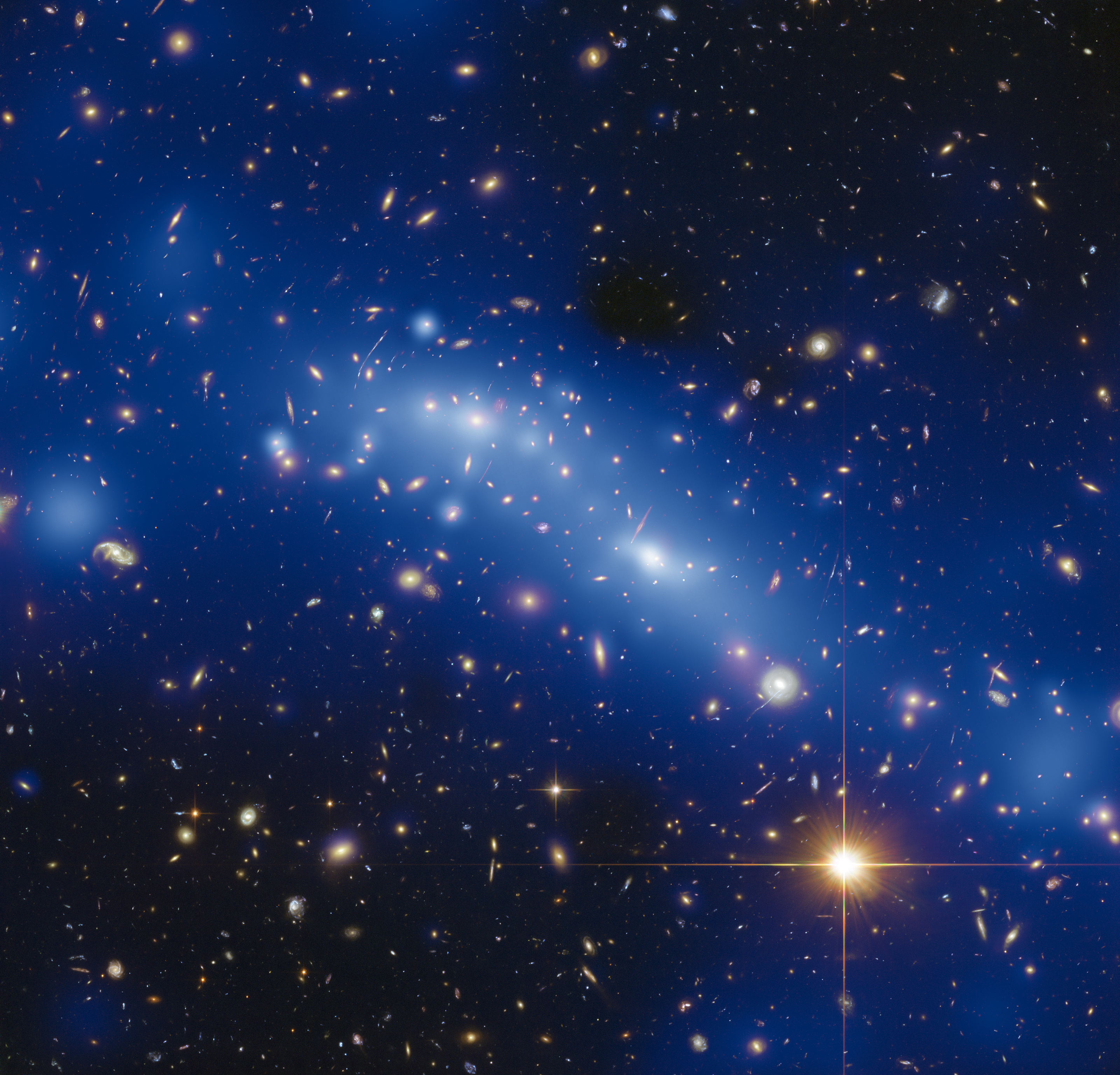
Mapping Mass in a Frontier Fields Cluster

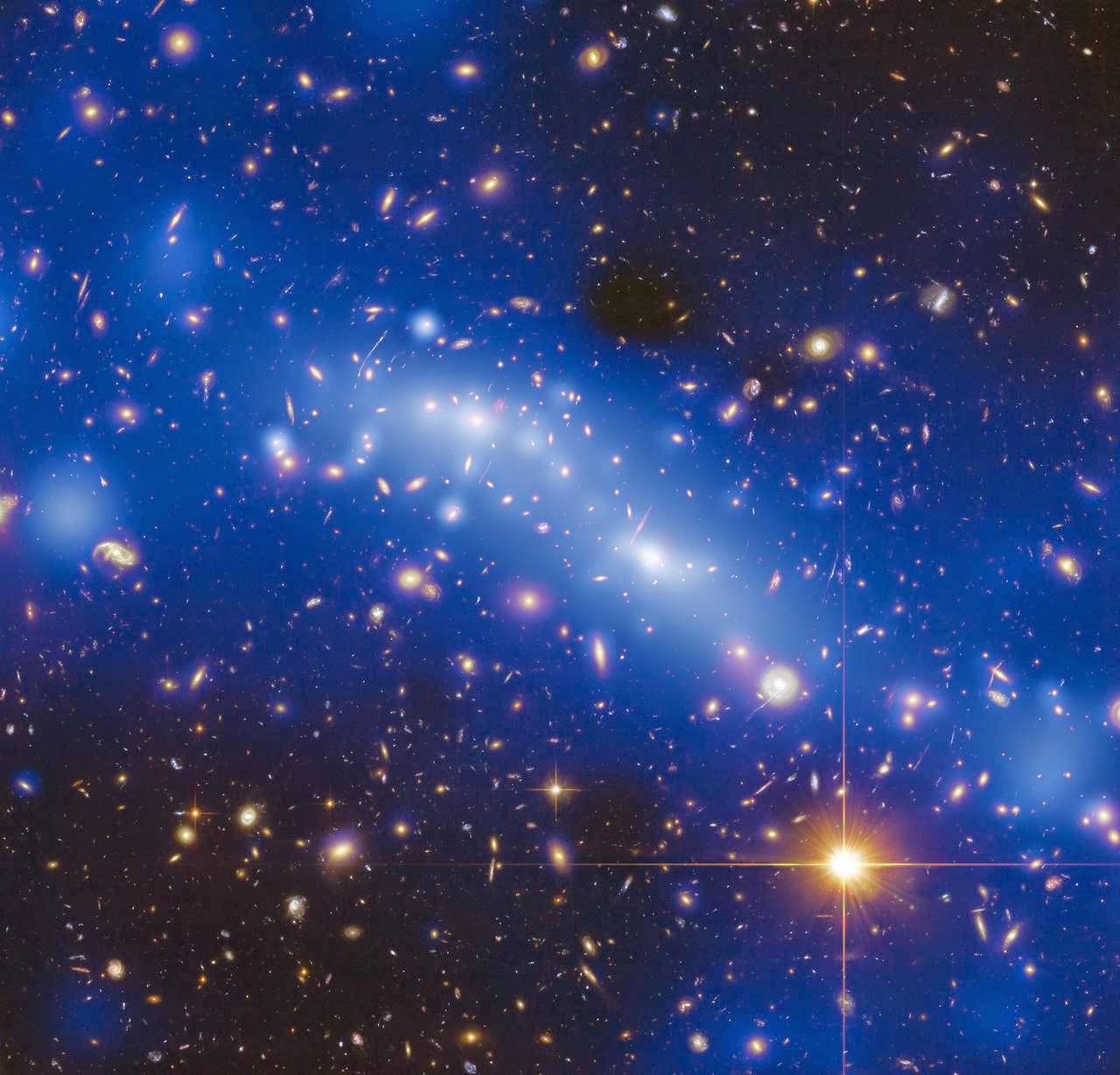
The galaxy clusters under observation in Frontier Fields are so dense in mass that their gravity distorts and bends the light from the more-distant galaxies behind them, creating the magnifying effect known as gravitational lensing. Astronomers use the lensing effect to determine the location of concentrations of mass in the cluster, depicted here as a blue haze. Credit: ESA/Hubble, NASA, HST Frontier Field. Hi-Res Image

Stronger lensing produces greater distortions. Astronomers can work backwards from the distortions to pinpoint the greater concentrations of mass responsible for producing such altered images. Credit: A. Feild (STScI). Hi-Res Image


The Frontier Fields project’s examination of galaxy cluster MACS J0416.1-2403 has led to a precise map that shows both the amount and distribution of matter in the cluster. MACS J0416.1-2403 has 160 trillion times the mass of the Sun in an area over 650,000 light-years across.

The mass maps have a two-fold purpose: they identify the location of mass in the galaxy clusters, and by doing so make it easier to characterize lensed background galaxies.

Astronomers use the distortions of light caused by mass concentrations to pinpoint the distribution of mass within the cluster, including invisible dark matter. Weakly lensed background galaxies, visible in the outskirts of the cluster where less mass accumulates, may be stretched into slightly more elliptical shapes or transformed into smears of light. Strongly lensed galaxies, visible in the inner core of the cluster where greater concentrations of mass occur, can appear as sweeping arcs or rings, or even appear multiple times throughout the image. And as a dual benefit, as the clusters’ mass maps improve, it becomes easier to identify which galaxies are strongly lensed, and which galaxies are farther away.

The depth of the Frontier Fields images allows astronomers to see extremely faint objects, including many more strongly lensed galaxies than seen in previous observations of the cluster. Hubble identified 51 new multiply imaged galaxies around this cluster, for instance, quadrupling the number found in previous surveys.

Because the galaxies are multiples, that means almost 200 strongly lensed images appear in the new observations, allowing astronomers to produce a highly constrained map of the cluster’s mass, inclusive of both visible and dark matter.

The dark matter aspect is particularly intriguing. Because these types of Frontier Fields analyses create extremely precise maps of the locations of dark matter, they provide the potential for testing the nature of dark matter. Learning where dark matter concentrates in massive galaxy clusters can give clues to how it behaves and changes. And as the mass maps become more precise, astronomers are better able to determine the distance of the lensed galaxies.

In order to obtain a complete picture of MACS J0416.1-2403’s mass, astronomers will also need to include weak lensing measurements. Follow up observations will include further Frontier Fields imaging, as well as X-ray measurements of hot gas and spectroscopic redshifts to break down the total mass distribution into dark matter, gas, and stars.

Source:  Frontier Fields


Tuesday, December 09, 2014

Twinkle, Twinkle New-Born Star

Newborn stars in the Rho Ophiuchi star-forming region as seen in the infrared by the Spitzer Space Telescope. The youngest stars, the reddest ones in the image, are surrounded by disks of dust and gas from which planetary systems are possibly forming. New observations of the light variability from these young stars confirm that probably all of them have clumpy dust disks. NASA/Spitzer

Stars are born in dense, cool clouds of molecular gas and dust. When the local density is high enough, the matter can gravitationally collapse to form a new star, a so-called young stellar object (YSO). In its early phases, a thick envelope dominates the infrared emission from the YSO, hiding what is going on within, but eventually the envelope flattens out into a warm circumstellar accretion disk. The disk emits more infrared than does the young star, and that excess radiation can be used to distinguish young stars from more mature stars whose disks and envelopes have disappeared. In recent years it has become possible to investigate these envelopes and disks in more detail, and astronomers have been building on these studies to address how planetary systems develop.

It turns out that an accretion disk does not extend all the way in to the central star. Instead, a gap is produced between the star and disk because the dust grains closer in are destroyed by the starlight or blown away by stellar winds. Disks can contain clumps or irregular structures which orbit around with the disk. 

When a YSO happens to be aligned such that we observe its light through its disk, these structures make it appear to twinkle, or more precisely, to vary in intensity. Clumps at a distance of about one astronomical unit (the average distance of the Earth from the Sun) produce flickering over times of years as they rotate, while those in the disk ten times closer in result in variations over timescales of days.

CfA astronomers Hans Gunther, Katja Poppenhaeger, Scott Wolk, and Joe Hora and their colleagues used the infrared camera, IRAC, on the Spitzer Space Telescope to monitor the variability of light from 882 previously identified YSOs in a nearby region of star formation, Lynds 1688, over a period of 1.6 years.

They report finding that seventy of them vary; ten have roughly periodic variations although none of these variations has the regularity or characteristics to suggest transit exoplanet transits. Combined with other information about these YSOs, the new results confirm that probably all YSOs are variable at infrared wavelengths to some degree, and moreover that the younger, more deeply embedded stars often have longer and larger intensity variations, consistent with the current disk evolution picture.

Reference(s):

"YSOVAR: Mid-Infrared Variability in the Star-Forming Region Lynds 1688," H. M. Gunther, A. M. Cody, K. R. Covey, L. A. Hillenbrand, P. Plavchan, K. Poppenhaeger, L. M. Rebull, J. R. Stauffer, S. J. Wolk, L. Allen, A. Bayo, R. A. Gutermuth, J. L. Hora, H. Y. A. Meng, M. Morales-Calder´on, J. R. Parks, and Inseok Song, ApJ 148, 122, 2014.


Warm Gas Pours 'Cold Water' on Galaxy's Star-Making

A new feature in the evolution of galaxies has been captured in this image of galactic interactions. (Annotated Version)
Credit: NASA/CFHT/NRAO/JPL-Caltech/Duc/Cuillandre› Full image and caption


Some like it hot, but for creating new stars, a cool cosmic environment is ideal. As a new study suggests, a surge of warm gas into a nearby galaxy -- left over from the devouring of a separate galaxy -- has extinguished star formation by agitating the available chilled gas.

The unique findings illustrate a new dimension to galaxy evolution, and come courtesy of the European Space Agency's Herschel space observatory, in which NASA played a key role, and NASA's Spitzer and Hubble space telescopes.

Astronomers want to understand why galaxies in the local universe fall into two major categories: younger, star-forming spirals (like our own Milky Way), and older ellipticals, in which fresh star making has ceased. The new study's galaxy, NGC 3226, occupies a transitional middle ground, so getting a bead on its star formation is critical.

"We have explored the fantastic potential of big data archives from NASA's Hubble, Spitzer and ESA's Herschel observatory to pull together a picture of an elliptical galaxy that has undergone huge changes in its recent past due to violent collisions with its neighbors," said Philip Appleton, project scientist for the NASA Herschel Science Center at the California Institute of Technology in Pasadena and lead author of a recent Astrophysical Journal paper detailing the results. "These collisions are modifying not only its structure and color, but also the condition of the gas that resides in it, making it hard -- at the moment -- for the galaxy to form many stars."

NGC 3226 is relatively close, just 50 million light-years away. Several star-studded, gassy loops emanate from NGC 3226. Filaments also run out from it and between a companion galaxy, NGC 3227. These streamers of material suggest that a third galaxy probably existed there until recently -- that is, until NGC 3226 cannibalized it, strewing pieces of the shredded galaxy all over the area.
A prominent piece of these messy leftovers stretches 100,000 light-years and extends right into the core of NGC 3226. This long tail ends as a curved plume in a disk of warm hydrogen gas and a ring of dust. Contents of the tail, thought to be the debris from that departed galaxy, are falling into NGC 3226, drawn by its gravity.

In many instances, adding material to galaxies in this manner rejuvenates them, triggering new rounds of star birth thanks to gas and dust gelling together. Yet data from the three telescopes agree that NGC 3226 has a very low rate of star formation. It appears that in this case, the material falling into NGC 3226 is heating up as it collides with other galactic gas and dust, quenching star formation instead of fueling it.

The outcome could have been different, as NGC 3226 hosts a supermassive black hole at its center. The influx of gas and dust might have ended up just feeding the black hole, setting off energetic outpourings as the material crashed together while whirling toward its doom. Instead, the black hole in NGC 3226's core is just snacking, not gorging, as the material has spread out in the galaxy's central regions.

"We are discovering that gas does not simply funnel down into the center of a galaxy and feed the supermassive black hole known to be lurking there," Appleton said. "Rather, it gets hung up in a warm disk, shutting down star formation and probably frustrating the black hole's growth by being too turbulent at this point in time."

NGC 3226 is considered something between a youthful "blue" galaxy and an old "red" galaxy. The colors refer to the predominantly galactic blue light radiated by giant, young stars -- a telltale sign of recent star formation -- and the reddish light cast by mature stars in the absence of new, blue ones.

This intermediary galaxy illuminates how galaxies accruing fresh gas and dust can bloom with new stars or have their stellar factories close shop, at least temporarily. After all, as the warm gas flooding NGC 3226 cools to star-forming temperatures, the galaxy should get a second wind.

Intriguingly, ultraviolet and optical light observations suggest that NGC 3226 may have produced more stars in the past, leading to its current intermediate color, somewhere between red and blue. The new study indicates that those traces of youth must indeed be lingering from higher levels of star formation, before the infalling gas scrambled the scene.

"NGC 3226 will continue to evolve and may hatch abundant new stars in the future," said Appleton. "We're learning that the transition from young- to old-looking galaxies is not a one-way, but a two-way street."
Other authors of the report are: C. Mundell of Liverpool John Moores University, England; M. Lacy of National Radio Astronomy Observatory, Charlottesville, Virginia; V. Charmandaris of University of Creete, Greece; P-A. Duc of CEA-Saclay, France; U. Lisenfeld of University of Granda, Spain; and T. Bitsakis, K. Alatalo, L. Armus and P. Ogle of Caltech.

Herschel is a European Space Agency mission, with science instruments provided by consortia of European institutes and with important participation by NASA. While the observatory stopped making science observations in April 2013, after running out of liquid coolant, as expected, scientists continue to analyze its data. NASA's Herschel Project Office is based at NASA's Jet Propulsion Laboratory, Pasadena, California. JPL contributed mission-enabling technology for two of Herschel's three science instruments. The NASA Herschel Science Center, part of the Infrared Processing and Analysis Center at Caltech, supports the U.S. astronomical community.

JPL manages the Spitzer Space Telescope mission for NASA's Science Mission Directorate, Washington. Science operations are conducted at the Spitzer Science Center at Caltech. Spacecraft operations are based at Lockheed Martin Space Systems Company, Littleton, Colorado. Data are archived at the Infrared Science Archive housed at the Infrared Processing and Analysis Center at Caltech.

Caltech manages JPL for NASA.

The Hubble Space Telescope is a project of international cooperation between NASA and the European Space Agency. NASA's Goddard Space Flight Center in Greenbelt, Maryland, manages the telescope. The Space Telescope Science Institute (STScI) in Baltimore conducts Hubble science operations. STScI is operated for NASA by the Association of Universities for Research in Astronomy, Inc., in Washington.

Fore more information about NASA's role in Herschel, visit: http://www.nasa.gov/herschel

For more information about Spitzer, visit: http://www.nasa.gov/spitzer

For more information about Hubble, visit: http://www.nasa.gov/hubble


Media Contact

Whitney Clavin
Jet Propulsion Laboratory, Pasadena, Calif.
818-354-4673

whitney.clavin@jpl.nasa.gov


Monday, December 08, 2014

Cassini’s view of Jupiter’s southern hemisphere

Cassini’s view of Jupiter’s southern hemisphere
Copyright: NASA/JPL/Space Science Institute

This Cassini image shows Jupiter from an unusual perspective. If you were to float just beneath the giant planet and look directly up, you would be greeted with this striking sight: red, bronze and white bands encircling a hazy south pole. The multicoloured concentric layers are broken in places by prominent weather systems such as Jupiter’s famous Great Red Spot, visible towards the upper left, chaotic patches of cloud and pale white dots. Many of these lighter patches contain lightning-filled thunderstorms.

Jupiter has very dramatic weather – the planet’s axis is not as tilted (towards or away from the Sun) as much as Earth’s so it does not have significant seasonal changes, but it does have a thick and tumultuous atmosphere filled with raging storms and chaotic cloud systems.

These clouds, formed from dense layers of ammonia crystals, are tugged, stretched and tangled together by Jupiter’s turbulence and strong winds, creating vortices and hurricane-like storms with wind speeds of up to 360 km per hour.

The Great Red Spot is actually an anticyclone that has been violently churning for hundreds of years. It was at one stage large enough to contain several Earth-sized planets but recent images from the Hubble Space Telescope show it to be shrinking. There are other similarly striking storms raging in both Jupiter’s cool upper atmosphere and hotter lower layers, including a Great Dark Spot and Oval BA, more affectionately nicknamed Red Spot Jr.

Jupiter’s south pole is at the very centre of this image, visible as a murky grey-toned circle. This patch is not as detailed as the rest of the planet because Cassini had to peer through a lot more atmospheric haze in the polar region, making it harder to see.

This polar map is composed of 18 colour images taken by the narrow-angle camera on NASA’s Cassini spacecraft during a flyby on 11–12 December 2000. This map is incredibly detailed; the smallest visible features in this image are about 120 km across. There is also an accompanying map of the planet’s north pole. In 2016, NASA’s Juno spacecraft will arrive at Jupiter and start to beam back images of the planet’s poles.

The Cassini–Huygens mission, launched in 1997 as a joint endeavour of ESA, NASA and Italy’s ASI space agency, flew past Venus, Earth and Jupiter en route to observe Saturn, its moons and rings. Observations with Cassini have given us an unprecedented understanding of the Saturnian system. ESA’s Juice mission aims to do the same for Jupiter. Planned for launch in 2022, the spacecraft will reach Jupiter in 2030 and begin observing the planet and three of its moons – Ganymede, Callisto and Europa. Previous flybys of these moons have raised the exciting prospect that some of them might harbour subsurface liquid oceans and conditions suitable to support some forms of life.

Juice was recently given the green light to continue to the next stage of development.


Source: ESA


Strange Galaxy Perplexes Astronomers

Radio-optical overlay image of galaxy J1649+2635. 
Yellow is visible-light image; Blue is the radio image, indicating the presence of jets.
Credit: Mao et al., NRAO/AUI/NSF, Sloan Digital Sky Survey

With the help of citizen scientists, a team of astronomers has found an important new example of a very rare type of galaxy that may yield valuable insight on how galaxies developed in the early Universe. The new discovery technique promises to give astronomers many more examples of this important and mysterious type of galaxy.

The galaxy they studied, named J1649+2635, nearly 800 million light-years from Earth, is a spiral galaxy, like our own Milky Way, but with prominent "jets" of subatomic particles propelled outward from its core at nearly the speed of light. The problem is that spiral galaxies are not supposed to have such large jets.

"The conventional wisdom is that such jets come only from elliptical galaxies that formed through the merger of spirals. We don't know how spirals can have these large jets," said Minnie Mao, of the National Radio Astronomy Observatory (NRAO).

J1649+2635 is only the fourth jet-emitting spiral galaxy discovered so far. The first was found in 2003, when astronomers combined a radio-telescope image from the Karl G. Jansky Very Large Array (VLA) and a visible-light image of the same object from the Hubble Space Telescope. The second was revealed in 2011 by images from the Sloan Digital Sky Survey and the VLA, and the third, found earlier this year, also was discovered by combining radio and visible-light images.

"In order to figure out how these jets can be produced by the 'wrong' kind of galaxy, we realized we needed to find more of them," Mao said.

To do that, the astronomers looked for help. That help came in the form of large collections of images from both radio and optical telescopes, and the hands-on assistance of volunteer citizen scientists. The volunteers are participants in an online project called the Galaxy Zoo, in which they look at images from the visible-light Sloan Digital Sky Survey and classify the galaxies as spiral, elliptical, or other types. Each galaxy image is inspected by multiple volunteers to ensure accuracy in the classification.

So far, more than 150,000 Galaxy Zoo participants have classified some 700,000 galaxies. Mao and her collaborators used a "superclean" subset of more than 65,000 galaxies, for which 95 percent of those viewing each galaxy's image agreed on the classification. About 35,000 of those are spiral galaxies. J1649+2635 had been classified by 31 Galaxy Zoo volunteers, 30 of whom agreed that it is a spiral.

Next, the astronomers decided to cross-match the visible-light spirals with galaxies in a catalog that combines data from the NRAO VLA Sky Survey and the Faint Images of the Radio Sky at Twenty Centimeters survey, both done using the VLA. This job was done by Ryan Duffin, a University of Virginia undergraduate working as an NRAO summer student. Duffin's cross-matching showed that J1649+2635 is both a spiral galaxy and has powerful twin radio jets.

"This is the first time that a galaxy was first identified as a spiral, then subsequently found to have large radio jets," Duffin said. "It was exciting to make such a rare find," he added.

Jets such as those seen coming from J1649+2635 are propelled by the gravitational energy of a supermassive black hole at the core of the galaxy. Material pulled toward the black hole forms a rapidly-rotating disk, and particles are accelerated outward along the poles of the disk. The collision that presumably forms an elliptical galaxy disrupts gas in the merging galaxies and provides "fuel" for the disk and acceleration mechanism. That same disruption, however, is expected to destroy any spiral structure as the galaxies merge into one.

J1649+2635 is unusual not only because of its jets, but also because it is the first example of a "grand design" spiral galaxy with a large "halo" of visible-light emission surrounding it.

"This galaxy presents us with many mysteries. We want to know how it became such a strange beast," Mao said. "Did it have a unique type of merger that preserved its spiral structure? Was it an elliptical that had another collision that made it re-grow spiral arms? Is its unique character the result of interaction with its environment?"

"We will study it further, but in addition, we need to see if there are more like it," Mao said.

"We hope that with projects like the Galaxy Zoo and another called Radio Galaxy Zoo, those thousands of citizen scientists can help us find many more galaxies like this one so we can answer all our questions," Mao said. Mao and her colleagues have dubbed these rare galaxies "Spiral DRAGNs," an acronym for the technical description, "Double-lobed Radio sources Associated with Galactic Nuclei."

Mao and Duffin worked with Frazer Owen, Emmanuel Momjian, and Mark Lacy, also of the NRAO; Bill Keel of the University of Alabama; Glenn Morrison of the University of Hawaii and the Canada-France-Hawaii Telescope; Tony Mroczkowski of the Naval Research Laboratory; Susan Neff of NASA's Goddard Space Flight Center; Ray Norris of CSIRO Astronomy and Space Science in Australia; Henrique Schmitt of the Naval Research Laboratory; and Vicki Toy and Sylvain Veilleux of the University of Maryland. The scientists are reporting their findings in the Monthly Notices of the Royal Astronomical Society.

The National Radio Astronomy Observatory is a facility of the National Science Foundation, operated under cooperative agreement by Associated Universities, Inc.

Contact:

Dave Finley, Public Information Officer
(575) 835-7302

dfinley@nrao.edu


Friday, December 05, 2014

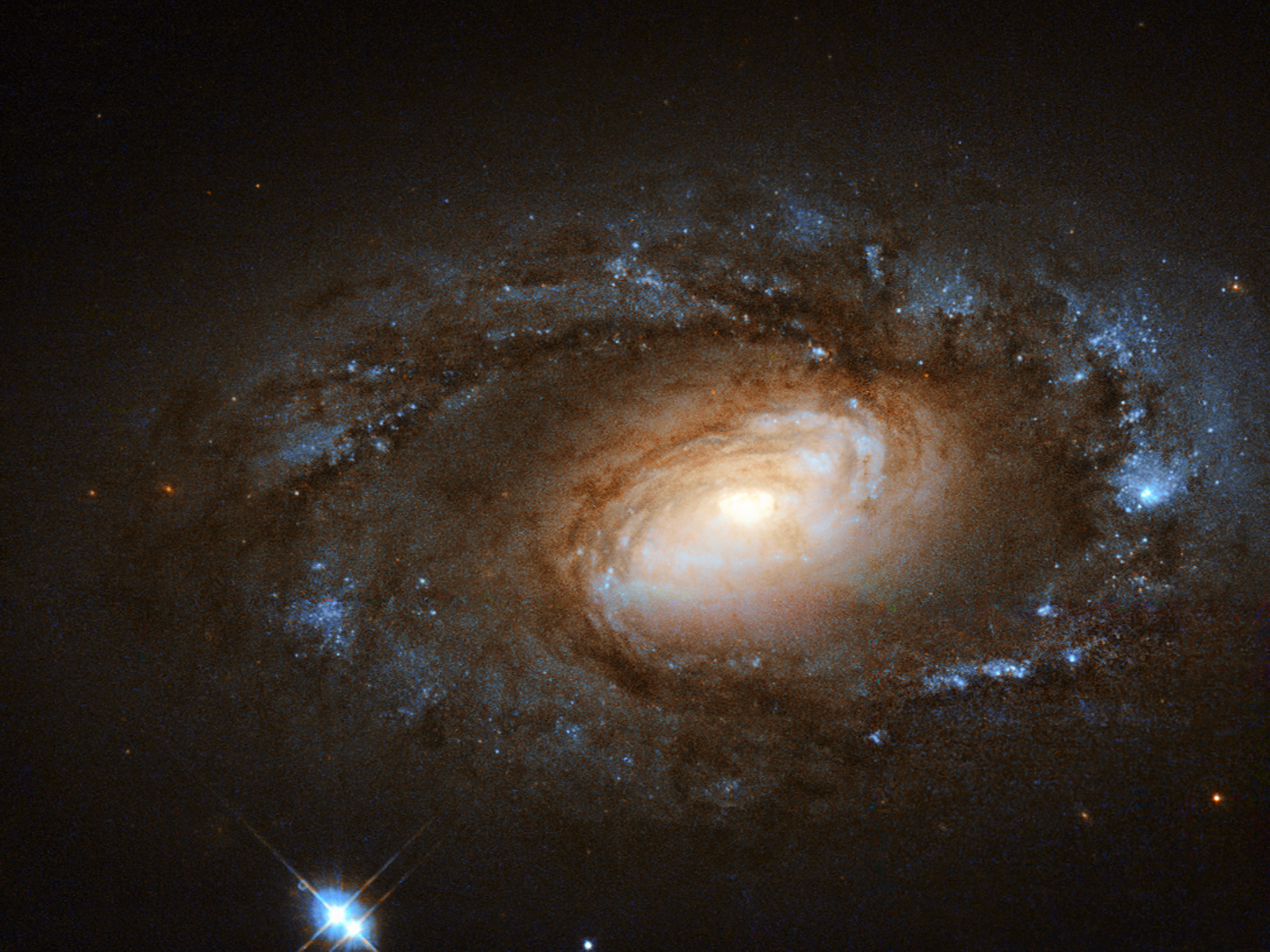
This is no supermodel spiral

Credit: ESA/Hubble, NASA and S. Smartt (Queen's University Belfast)
Acknowledgement: Renaud Houdinet


The NASA/ESA Hubble Space Telescope observes some of the most beautiful galaxies in our skies — spirals sparkling with bright stellar nurseries (heic1403), violent duos ripping gas and stars away from one another as they tangle together (heic1311), and ethereal irregular galaxies that hang like flocks of birds suspended in the blackness of space (heic1114, heic1207).

However, galaxies, like humans, are not all supermodels. This little spiral, known as NGC 4102, has a different kind of appeal, with its tightly-wound spiral arms and understated, but charming, appearance.

NGC 4102 lies in the northern constellation of Ursa Major (The Great Bear). It contains what is known as a LINER, or low-ionization nuclear emission-line region, meaning that its nucleus emits particular types of radiation — specifically, emission from weakly-ionised or neutral atoms of certain elements. Even in this sense, NGC 4102 is not special; around one third of all nearby galaxies are thought to be LINER galaxies.

Many LINER galaxies also contain intense regions of star formation. This is thought to be intrinsically linked to their centres but just why is still a mystery for astronomers — either the starbursts pour fuel inwards to fuel the LINERs, or this active central region triggers the starbursts. NGC 4102 does indeed contain a starburst region towards its centre, where stars are being created at a rate much more furious than in a normal galaxy. This star formation is taking place within a small rotating disc, around 1000 light-years in diameter and with a mass some three billion times the mass of the Sun.

This image uses infrared and visible observations taken using Hubble’s Wide Field Planetary Camera 2. A version of this image was submitted to the Hubble's Hidden Treasures image processing competition by contestant Renaud Houdinet.

A team of astronomers led by Stephen Smartt of Queen's University Belfast, the Principal Investigator for the observations making up this image, have spent the last 15 years searching for the progenitor stars of supernovae in galaxy images like this. A recent review article explores some of the results from such studies.


Link

Source: ESA/Hubble - Space Telescope


Thursday, December 04, 2014

It’s Filamentary: How Galaxies Evolve in the Cosmic Web

Galaxies are distributed along a cosmic web in the universe. “Mpc/h” is a unit of galactic distance (1 Mpc/h is more than 3.2 million light-years)
Image credit: Volker Springel, Virgo Consortium

Behnam Darvish (left) and Bahram Mobasher are astronomers in the Department of Physics and Astronomy at UC Riverside
Photo credit: UC Riverside


UC Riverside-led team proposes that filaments in the cosmic web played a critical role in the distant universe

RIVERSIDE, Calif. – How do galaxies like our Milky Way form, and just how do they evolve?  Are galaxies affected by their surrounding environment? An international team of researchers, led by astronomers at the University of California, Riverside, proposes some answers.

The researchers highlight the role of the “cosmic web” – a large-scale web-like structure comprised of galaxies – on the evolution of galaxies that took place in the distant universe, a few billion years after the Big Bang.  In their paper, published Nov. 20 in the Astrophysical Journal, they present observations showing that thread-like “filaments” in the cosmic web played an important role in this evolution.

“We think the cosmic web, dominated by dark matter, formed very early in the history of the universe, starting with small initial fluctuations in the primordial universe,” said Behnam Darvish, a Ph.D. graduate student in the Department of Physics and Astronomy at UC Riverside, who led the research project and is the first author on the paper.  “Such a ‘skeletal’ universe must have played, in principle, a role in galaxy formation and evolution, but this was incredibly hard to study and understand until recently.”

The distribution of galaxies and matter in the universe is non-random.  Galaxies are organized, even today, in a manner resembling an enormous network – the cosmic web.  This web has dense regions made up of galaxy clusters and groups, sparsely populated regions devoid of galaxies, as well as the filaments that link overdense regions.

“The filaments are like bridges connecting the denser regions in the cosmic web,” Darvish explained.  “Imagine threads woven into the web.”
Videos showing structures in the cosmic web:

It is well known in astronomy that galaxies residing in less dense regions have higher probability of actively forming stars (much like our Milky Way), while galaxies in denser regions form stars at a much lower rate.
“But the role of intermediate environments and, in particular, the role of filaments and the cosmic web in the early universe remained, until very recently, a mystery,” said coauthor Bahram Mobasher, a professor of physics and astronomy at UCR and Darvish’s adviser.

What greatly assisted the researchers is a giant section of the cosmic web first revealed in two big cosmological surveys (COSMOS and HiZELS).  They proceeded to explore data also from several telescopes (Hubble, VLT, UKIRT and Subaru).  They then applied a new computational method to identify the filaments, which, in turn, helped them study the role of the cosmic web.

They found that galaxies residing in the cosmic web/filaments have a much higher chance of actively forming stars.  In other words, in the distant universe, galaxy evolution seems to have been accelerated in the filaments.

“It is possible that such filaments ‘pre-process’ galaxies, accelerating their evolution while also funneling them towards clusters, where they are fully processed by the dense environment of clusters and likely end up as dead galaxies,” Darvish said.  “Our results also show that such enhancement/acceleration is likely due to galaxy-galaxy interactions in the filaments.”

Because of the complexities involved in quantifying the cosmic web, astronomers usually limit the study of the cosmic web to numerical simulations and observations in our local universe. However, in this new study, the researchers focused their work on the distant universe – when the universe was approximately half its present age.

“We were surprised by the crucial role the filaments play in galaxy formation and evolution,” Mobasher said.  “Star formation is enhanced in them.  The filaments likely increase the chance of gravitational interaction between galaxies, which, in turn, results in this star-formation enhancement. There is evidence in our local universe that this process in filaments also continues to occur at the present time.”

Darvish and Mobasher were joined in this research by L. V. Sales at UCR; David Sobral at the Universidade de Lisboa, Portugal; N. Z. Scoville at the California Institute of Technology; P. Best at the Royal Observatory of Ediburgh, United Kingdom; and I. Smail at Durham University, United Kingdom.
Next, the team plans to extend this study to other epochs in the age of the universe to study the role of the cosmic web/filaments in galaxy formation and evolution across cosmic time.

“This will be a fundamental piece of the puzzle in order to understand how galaxies form and evolve as a whole,” Sobral said.

The UCR researchers were supported in the study by a grant to Mobasher from NASA through the Space Telescope Science Institute.


Media Contact


Tel: (951) 827-6050
E-mail: iqbal@ucr.edu
Twitter:
UCR_Sciencenews


Additional Contacts  

Behnam Darvish
E-mail:
bdarv001@ucr.edu
 
Bahram Mobasher
Tel: 951 827 7190
E-mail:
mobasher@ucr.edu


Wednesday, December 03, 2014

Scientists Accurately Quantify Dust Around Planets in Search for Life

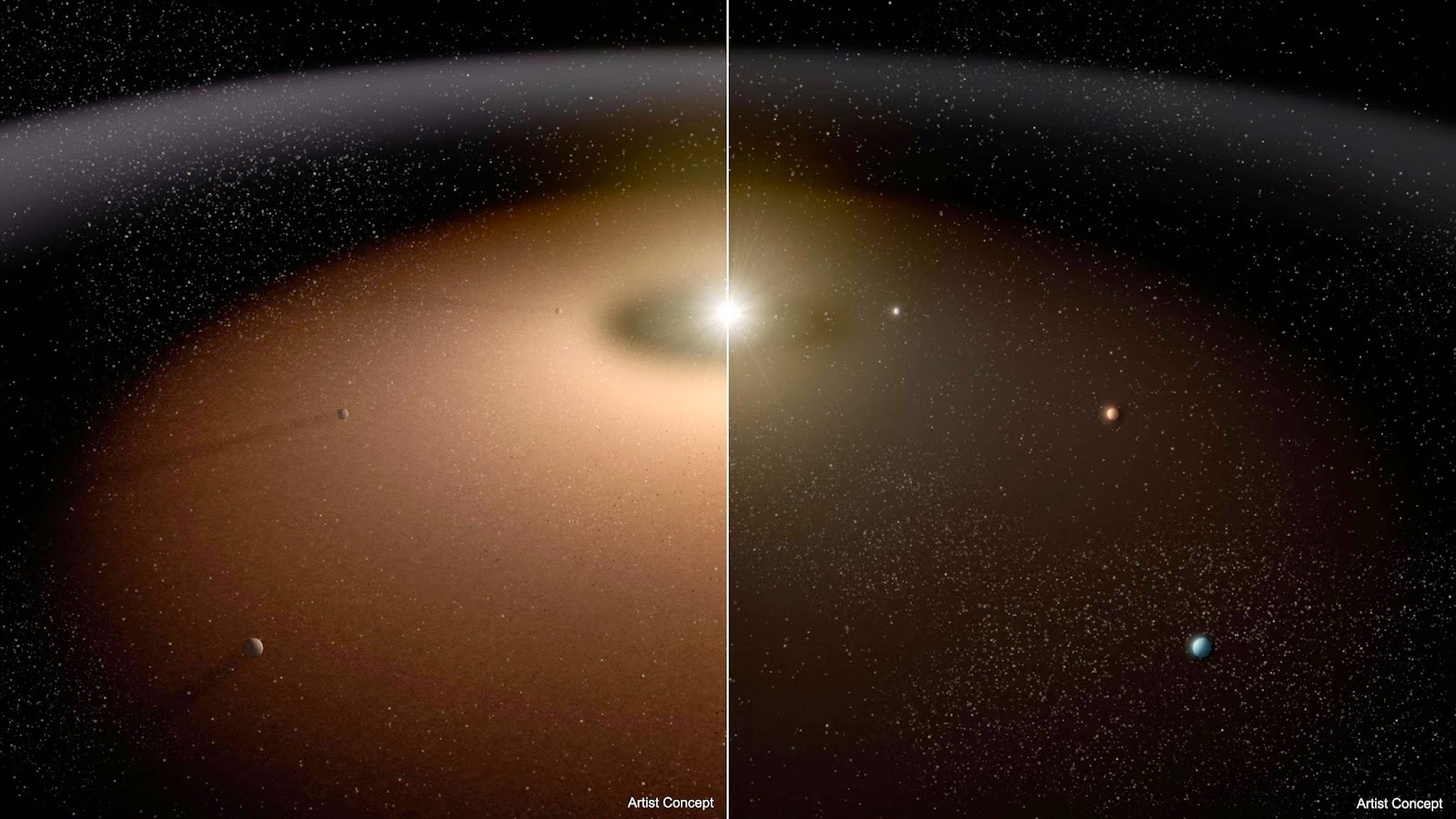
A dusty planetary system (left) is compared to another system with little dust in this artist's conception. Dust can make it difficult for telescopes to image planets because light from the dust can outshine that of the planets. Dust reflects visible light and shines with its own infrared, or thermal, glow. As the illustration shows, planets appear more readily in the planetary system shown at right with less dust. Research with the NASA-funded Keck Interferometer, a former NASA key science project that combined the power of the twin telescopes of the W. M. Keck Observatory atop Mauna Kea, Hawaii, shows that mature, sun-like stars appear to be, on average, not all that dusty. This is good news for future space missions wanting to take detailed pictures of planets like Earth and seek out possible signs of life. Image credit: NASA/JPL-Caltech.  Full image

MAUNA KEA, Hawaii — A new study from the Keck Interferometer, a former NASA project that combined the power of the twin W. M. Keck Observatory telescopes atop Mauna Kea, Hawaii, has brought exciting news to planet hunters. After surveying nearly 50 stars from 2008 to 2011, scientists have been able to determine with remarkable precision how much dust is around distant stars – a big step closer into finding planets than might harbor life. The discovery is being published in the Astrophysical Journal online, on December 8th.
“This was really a mathematical tour de force,” said Peter Wizinowich, Interferometer Project Manager for Keck Observatory. “This team did something that we seldom see in terms of using all the available statistical techniques to evaluate the combined data set. They were able to dramatically reduce all the error bars, by a factor of 10, to really understand the amount of dust around these systems.”

The Keck Interferometer was built to seek out this dust, and to ultimately help select targets for future NASA Earth-like planet-finding missions.

Like planets, dust near a star is hard to see. Interferometry is a high-resolution imaging technique that can be used to block out a star's light, making the region easier to observe. Light waves from the precise location of a star, collected separately by the twin 10-meter Keck Observatory telescopes, are combined and canceled out in a process called nulling.

“If you don't turn off the star, you are blinded and can't see dust or planets,” said co-author Rafael Millan-Gabet of NASA's exoplanet Science Institute at the California Institute of Technology in Pasadena, California, who led the Keck Interferometer's science operations system.

“Dust is a double-edged sword when it comes to imaging distant planets,” explained Bertrand Mennesson, lead author of the study who works at NASA's Jet Propulsion Laboratory, Pasadena, California. “The presence of dust is a signpost for the planet formation process, but too much dust can block our view.” Mennesson has been involved in the Keck Interferometer project since its inception more than 10 years ago, both as a scientist and as the optics lead for one of its instruments.

“Using the two Keck telescopes in concert and interfering their light beams, it is possible to distinguish astronomical objects much closer to each other than when using a single Keck telescope,” Mennesson said. “However, there is an additional difficulty when searching for warm dust in the immediate stellar environment: it generally contributes very little emission compared to the star, and that is when nulling interferometry comes into play.”

In addition to requiring high performance from a large number of hardware and software subsystems, the nuller mode requires them to work smoothly together as a single, integrated system, according to Mark Colavita, the Keck Interferometer System Architect. “The nulling mode of the interferometer uses starlight across a wide range of wavelengths, including visible light for the adaptive optics to correct the telescope wave-fronts, near-infrared light to stabilize the path-lengths, and mid-infrared light for the nulling science measurements.”

Planet Hunting

Ground- and space-based telescopes have already captured images of exoplanets, or planets orbiting stars beyond our sun. These early images, which show giant planets in cool orbits far from the glow of their stars, represent a huge technological leap. The glare from stars can overwhelm the light of planets, like a firefly buzzing across the sun. So, researchers have developed complex instruments to block the starlight, allowing information about a planet's shine to be obtained.

The next challenge is to image smaller planets in the “habitable” zone around stars where possible life-bearing Earth-like planets outside the solar system could reside. Such a lofty goal may take decades, but researchers are already on the path to get there, developing new instruments and analyzing the dust kicked up around stars to better understand how to snap crisp planetary portraits. Scientists want to find out: Which stars have the most dust? And how dusty are the habitable zones of sun-like stars?

In the latest study, nearly 50 mature, sun-like stars were analyzed with high precision to search for warm, room-temperature dust in their habitable zones. Roughly half of the stars selected for the study had previously shown no signs of cool dust circling in their outer reaches. This outer dust is easier to see than the inner, warm dust due to its greater distance from the star. Of this first group of stars, none were found to host the warm dust, making them good targets for planet imaging, and a good indication that other relatively dust-free stars are out there.

The other stars in the study were already known to have significant amounts of distant cold dust orbiting them. In this group, many of the stars were found to also have the room-temperature dust. This is the first time a link between the cold and warm dust has been established. In other words, if a star is observed to have a cold belt of dust, astronomers can make an educated guess that its warm habitable zone is also riddled with dust, making it a poor target for imaging smaller planets in the 'habitable zone' around stars, or exo-Earths.

“We want to avoid planets that are buried in dust,” said Mennesson.

Like a busy construction site, the process of building planets is messy. It's common for young, developing star systems to be covered in dust. Proto-planets collide, scattering dust. But eventually, the chaos settles and the dust clears – except in some older stars. Why are these mature stars still laden with warm dust in their habitable zones?

The newfound link between cold and warm dust belts helps answer this question.

“The outer belt is somehow feeding material into the inner warm belt,” said Geoff Bryden of JPL, a co-author of the study. “This transport of material could be accomplished as dust smoothly flows inward, or there could be larger cometary bodies thrown directly into the inner system.”

The Keck Interferometer began construction in 1997, and finished its mission in 2012. It was developed by JPL, the Keck Observatory and the NASA Exoplanet Science Institute at Caltech. It was funded by NASA as a part of the Exoplanet Exploration Program with telescope and instrument operations managed by the W. M. Keck Observatory.

The W. M. Keck Observatory operates the largest, most scientifically productive telescopes on Earth. The two, 10-meter optical/infrared telescopes near the summit of Mauna Kea on the Island of Hawaii feature a suite of advanced instruments including imagers, multi-object spectrographs, high-resolution spectrographs, integral-field spectrographs and world-leading laser guide star adaptive optics systems.

Keck Observatory is a private 501(c) 3 non-profit organization and a scientific partnership of the California Institute of Technology, the University of California and NASA.


SCIENCE CONTACT:

Bertrand Mennesson, PhD
Jet Propulsion Laboratory
(818)-354-0494

bertrand.mennesson@jpl.nasa.gov

MEDIA CONTACT

Steve Jefferson
Communications Officer
W. M. Keck Observatory
808.881.3827

sjefferson@keck.hawaii.edu


Ground-Based Detection of Super-Earth Transit Paves Way to Remote Sensing of Small Exoplanets

This artist's conception shows the super-Earth 55 Cancri e (right) compared to the Earth (left). Astronomers using a ground-based telescope have measure the transit of 55 Cancri e for the first time. It is the shallowest transit ever detected from the ground. Credit: NASA/JPL. High Resolution (jpg)  -  Low Resolution (jpg)

Astronomers have measured the passing of a super-Earth in front of a bright, nearby Sun-like star using a ground-based telescope for the first time. The transit of the exoplanet 55 Cancri e is the shallowest detected from the ground yet. Since detecting a transit is the first step in analyzing a planet's atmosphere, this success bodes well for characterizing the many small planets that upcoming space missions are expected to discover in the next few years.

The international research team used the 2.5-meter Nordic Optical Telescope on the island of La Palma, Spain, a moderate-sized facility by today's standards but equipped with state-of-the-art instruments, to make the detection. Previous observations of this planet transit had to rely on space-borne telescopes.

The host star, 55 Cancri, is located just 40 light-years away from us and is visible to the naked eye. During its transit, the planet crosses 55 Cancri and blocks a tiny fraction of the starlight, dimming the star by 1/2000th (or 0.05%) for almost two hours. This shows that the planet is about twice the size of Earth, or 16,000 miles in diameter.

"Our observations show that we can detect the transits of small planets around Sun-like stars using ground-based telescopes," says Ernst de Mooij of Queen's University Belfast in the United Kingdom, lead author of the study.

He continues, "This is especially important because upcoming space missions such as TESS and PLATO should find many small planets around bright stars and we will want to follow up the discoveries with ground-based instruments."

TESS is a NASA mission scheduled for launch in 2017, while PLATO is to be launched in 2024 by the European Space Agency; both will search for transiting terrestrial planets around nearby bright stars.

"With this result we are also closing in on the detection of the atmospheres of small planets with ground-based telescopes," says co-author Mercedes Lopez-Morales of the Harvard-Smithsonian Center for Astrophysics (CfA). "We are slowly paving the way toward the detection of bio-signatures in Earth-like planets around nearby stars."

"It's remarkable what we can do by pushing the limits of existing telescopes and instruments, despite the complications posed by the Earth's own turbulent atmosphere," says study co-author Ray Jayawardhana of York Univerity in Canada. "Remote sensing across tens of light-years isn't easy, but it can be done with the right technique and a bit of ingenuity."

The planet 55 Cancri e is about twice as big and eight times as massive as Earth. With a period of 18 hours, it is the innermost of five planets in the system. Because of its proximity to the host star, the planet's dayside temperature reaches over 3100° Fahrenheit (1700° Celsius), hot enough to melt metal, with conditions far from hospitable to life. Initially identified a decade ago through radial velocity measurements, it was later confirmed through transit observations with the MOST and Spitzer space telescopes.

Until now, the transits of only one other super-Earth, GJ 1214b circling a red dwarf, had been observed with ground-based telescopes. The Earth's roiling air makes such observations extremely difficult. But the team's success with 55 Cancri e raises the prospects of characterizing dozens of super-Earths likely to be revealed by upcoming surveys.

"We expect these surveys to find so many nearby, terrestrial worlds that space telescopes simply won't be able to follow up on all of them. Future ground-based instrumentation will be key, and this study shows it can be done," adds Lopez-Morales.

The research team also includes Raine Karjalainen and Marie Hrudkova of the Isaac Newton Group of Telescopes. Their findings appear in a paper to be published in The Astrophysical Journal Letters.

Headquartered in Cambridge, Mass., the Harvard-Smithsonian Center for Astrophysics (CfA) is a joint collaboration between the Smithsonian Astrophysical Observatory and the Harvard College Observatory. CfA scientists, organized into six research divisions, study the origin, evolution and ultimate fate of the universe.

For more information, contact:

David A. Aguilar 
Director of Public Affairs 
Harvard-Smithsonian Center for Astrophysics 
617-495-7462 
daguilar@cfa.harvard.edu

Christine Pulliam 
Public Affairs Specialist 
Harvard-Smithsonian Center for Astrophysics 
617-495-7463 
cpulliam@cfa.harvard.edu