Showing posts with label gravitational microlensing. Show all posts

Tuesday, September 05, 2023

Galactic isolation

A spiral galaxy. It is irregularly-shaped and its spiral arms are difficult to distinguish. The edges are faint and the core has a pale yellow glow. It is dotted with small, wispy, blue regions where stars are forming. A few stars and small galaxies in warm colours are visible around it.Credit: ESA/Hubble & NASA, A. Filippenko

The swirls of the galaxy IC 1776 stand in splendid isolation in this image from the NASA/ESA Hubble Space Telescope. This galaxy lies over 150 million light-years from Earth in the constellation Pisces.

IC 1776 recently played host to a catastrophically violent explosion — a supernova — which was discovered in 2015 by the Lick Observatory Supernova Search, a robotic telescope which scours the night sky in search of transient phenomena such as supernovae. A network of automatic robotic telescopes are spread across the globe, operated by both professional and amateur astronomers, and, without human intervention, reveal short-lived astronomical phenomena such as wandering asteroids, gravitational microlensing, or supernovae.

Hubble investigated the aftermath of the supernova SN 2015ap during two different observing programmes, both designed to comb through the debris left by supernovae explosions in order to better understand these energetic events. A variety of telescopes automatically follow up the detection of supernovae to obtain early measurements of these events’ brightnesses and spectra. Complementing these measurements with later observations which reveal the lingering energy of supernovae can shed light on the systems which gave rise to these cosmic cataclysms in the first place.


Friday, July 20, 2018

Gravitational Microlens Detection from Spitzer

Hubble Space Telescope images of a microlens system. The image on the left was taken 3.7 years after an observed microlensing event; the one on the right was taken 8.9 years later after the moving foreground (lensing) source had changed position. The lens and source components (A and B) are clearly resolved in the later image. Credit: NASA/Hubble

The path of light from a star as it passes by a massive body, like an exoplanet, will be bent and an observer looking towards the star will see its image distorted. Like an object seen through the stem of a wineglass, the stellar image could even be deformed into two bright peaks. That mass could influence light in this way was first confirmed in 1919, but some of the more subtle effects have only been detected in the past twenty-five years. In one such process, microlensing, a flash of light is produced when the path of a moving cosmic body (perhaps otherwise unknown) passes fortuitously in front of a star and briefly increases the intensity of its light. 

The Spitzer Space Telescope circles the Sun in an Earth-trailing orbit, and it is currently 1.66 astronomical units away from Earth (one AU is the average distance of the Earth form the Sun). Scientists had predicted that if it ever became possible to observe a microlensing flash from two well-separated vantage points, a parallax measurement (the apparent angular difference between the positions of the star as seen from the two separated sites) would determine the distance of the dark object. In fact, since 2014 Spitzer has been used successfully to measure the parallax for hundreds of microlensing events. In all these cases, Spitzer was used after ground-based observations had first identified a microlensing event underway.

CfA astronomers Jennifer Yee, Y. Jung, and In-Gu Shin were members of a collaboration that used Spitzer to record the first microlensing event in which only Spitzer (but not the ground-based sites) saw a double flash. Although this was in principle always possible, the effect had never before been observed, and proves that some double-peaked signals can be missed by ground-only observations. The result increases the importance of Spitzer observations beyond simply measuring parallax to include observing multiple-peak images and thus enabling a more precise characterization of the lens, which in the current instance is a binary system with a low-mass star and an orbiting companion.


Reference(s):

"OGLE-2017-BLG-1130: The First Binary Gravitational Microlens Detected from Spitzer Only," Tianshu Wang et al. ApJ 860, 25 (2018).


Friday, June 16, 2017

Einstein revisited

Credit: NASA, ESA, and K. Sahu (STScI)


A century ago, Albert Einstein published his famous theory of relativity. He proposed that all objects physically warp the fabric of space, with larger masses producing a more pronounced effect, and very massive objects (such as the Sun) causing light to travel along curved paths through space. Such an effect was first observed during the 1919 solar eclipse by English astronomer Arthur Eddington.

Researchers had to wait a century, however, to get a telescope powerful enough to detect this gravitational microlensing caused by a star outside the Solar System. Even around objects with very large masses, such as stars, this effect is very slight, making such detections extremely challenging for ground-based telescopes. It is, however, within the capabilities of the NASA/ESA Hubble Space Telescope, which gathered the data comprising this Picture of the Week.

The bright star in the centre of the image is the nearby white dwarf Stein 2051B, only 17 light-years from Earth. The smaller star below is about 5000 light-years away. Astronomers observed Stein 2051B eight times within two years while the white dwarf travelled in front of of the distant background star. During the close alignment, the white dwarf’s gravity bent the light from the distant star, making it appear offset by about 2 milliarcseconds from its actual position. This deviation is so small that it is equivalent to observing an ant crawl across the surface of a 1€ coin from 2300 kilometres away.

Links


Thursday, April 27, 2017

'Iceball' Planet Discovered Through Microlensing

This artist's concept shows OGLE-2016-BLG-1195Lb, a planet discovered through a technique called microlensing. 

 
Scientists have discovered a new planet with the mass of Earth, orbiting its star at the same distance that we orbit our sun. The planet is likely far too cold to be habitable for life as we know it, however, because its star is so faint. But the discovery adds to scientists' understanding of the types of planetary systems that exist beyond our own. 

"This 'iceball' planet is the lowest-mass planet ever found through microlensing," said Yossi Shvartzvald, a NASA postdoctoral fellow based at NASA's Jet Propulsion Laboratory, Pasadena, California, and lead author of a study published in the Astrophysical Journal Letters. 

Microlensing is a technique that facilitates the discovery of distant objects by using background stars as flashlights. When a star crosses precisely in front of a bright star in the background, the gravity of the foreground star focuses the light of the background star, making it appear brighter. A planet orbiting the foreground object may cause an additional blip in the star's brightness. In this case, the blip only lasted a few hours. This technique has found the most distant known exoplanets from Earth, and can detect low-mass planets that are substantially farther from their stars than Earth is from our sun. 

The newly discovered planet, called OGLE-2016-BLG-1195Lb, aids scientists in their quest to figure out the distribution of planets in our galaxy. An open question is whether there is a difference in the frequency of planets in the Milky Way's central bulge compared to its disk, the pancake-like region surrounding the bulge. OGLE-2016-BLG-1195Lb is located in the disk, as are two planets previously detected through microlensing by NASA's Spitzer Space Telescope.

"Although we only have a handful of planetary systems with well-determined distances that are this far outside our solar system, the lack of Spitzer detections in the bulge suggests that planets may be less common toward the center of our galaxy than in the disk," said Geoff Bryden, astronomer at JPL and co-author of the study.

For the new study, researchers were alerted to the initial microlensing event by the ground-based Optical Gravitational Lensing Experiment (OGLE) survey, managed by the University of Warsaw in Poland. Study authors used the Korea Microlensing Telescope Network (KMTNet), operated by the Korea Astronomy and Space Science Institute, and Spitzer, to track the event from Earth and space.

KMTNet consists of three wide-field telescopes: one in Chile, one in Australia, and one in South Africa. When scientists from the Spitzer team received the OGLE alert, they realized the potential for a planetary discovery. The microlensing event alert was only a couple of hours before Spitzer's targets for the week were to be finalized, but it made the cut.

With both KMTNet and Spitzer observing the event, scientists had two vantage points from which to study the objects involved, as though two eyes separated by a great distance were viewing it. Having data from these two perspectives allowed them to detect the planet with KMTNet and calculate the mass of the star and the planet using Spitzer data. 

"We are able to know details about this planet because of the synergy between KMTNet and Spitzer," said Andrew Gould, professor emeritus of astronomy at Ohio State University, Columbus, and study co-author. 

Although OGLE-2016-BLG-1195Lb is about the same mass as Earth, and the same distance from its host star as our planet is from our sun, the similarities may end there. 

OGLE-2016-BLG-1195Lb is nearly 13,000 light-years away and orbits a star so small, scientists aren't sure if it's a star at all. It could be a brown dwarf, a star-like object whose core is not hot enough to generate energy through nuclear fusion. This particular star is only 7.8 percent the mass of our sun, right on the border between being a star and not. 

Alternatively, it could be an ultra-cool dwarf star much like TRAPPIST-1, which Spitzer and ground-based telescopes recently revealed to host seven Earth-size planets. Those seven planets all huddle closely around TRAPPIST-1, even closer than Mercury orbits our sun, and they all have potential for liquid water. But OGLE-2016-BLG-1195Lb, at the sun-Earth distance from a very faint star, would be extremely cold -- likely even colder than Pluto is in our own solar system, such that any surface water would be frozen. A planet would need to orbit much closer to the tiny, faint star to receive enough light to maintain liquid water on its surface.
Ground-based telescopes available today are not able to find smaller planets than this one using the microlensing method. A highly sensitive space telescope would be needed to spot smaller bodies in microlensing events. NASA's upcoming Wide Field Infrared Survey Telescope (WFIRST), planned for launch in the mid-2020s, will have this capability. 

"One of the problems with estimating how many planets like this are out there is that we have reached the lower limit of planet masses that we can currently detect with microlensing," Shvartzvald said. "WFIRST will be able to change that." 

JPL manages the Spitzer Space Telescope mission for NASA's Science Mission Directorate, Washington. Science operations are conducted at the Spitzer Science Center at Caltech in Pasadena, California. Spacecraft operations are based at Lockheed Martin Space Systems Company, Littleton, Colorado. Data are archived at the Infrared Science Archive housed at the Infrared Processing and Analysis Center at Caltech. Caltech manages JPL for NASA. For more information about Spitzer, visit:  http://spitzer.caltech.edu - http://www.nasa.gov/spitzer


News Media Contact

Elizabeth Landau
Jet Propulsion Laboratory, Pasadena, Calif.
818-354-6425

elizabeth.landau@jpl.nasa.gov


Source:  JPL-Caltech/News

Thursday, December 15, 2016

Microlensing Study Suggests Most Common Outer Planets Likely Neptune-mass

A new statistical study of planets found by a technique called gravitational microlensing suggests that Neptune-mass worlds are likely the most common type of planet to form in the icy outer realms of planetary systems. The study provides the first indication of the types of planets waiting to be found far from a host star, where scientists suspect planets form most efficiently.

Neptune-mass worlds are likely the most common type in the outer realms of planetary system
Credits: NASA's Goddard Space Flight Center.  
This video can be downloaded from the Scientific Visualization Studio

This graph plots 4,769 exoplanets and planet candidates according to their masses and relative distances from the snow line, the point where water and other materials freeze solid (vertical cyan line). Gravitational microlensing is particularly sensitive to planets in this region. Planets are shaded according to the discovery technique listed at right. Masses for unconfirmed planetary candidates from NASA's Kepler mission are calculated based on their sizes. For comparison, the graph also includes the planets of our solar system. Credits: NASA's Goddard Space Flight Center. Hi-res image


"We've found the apparent sweet spot in the sizes of cold planets. Contrary to some theoretical predictions, we infer from current detections that the most numerous have masses similar to Neptune, and there doesn't seem to be the expected increase in number at lower masses," said lead scientist Daisuke Suzuki, a post-doctoral researcher at NASA's Goddard Space Flight Center in Greenbelt, Maryland, and the University of Maryland Baltimore County. "We conclude that Neptune-mass planets in these outer orbits are about 10 times more common than Jupiter-mass planets in Jupiter-like orbits."

Gravitational microlensing takes advantage of the light-bending effects of massive objects predicted by Einstein's general theory of relativity. It occurs when a foreground star, the lens, randomly aligns with a distant background star, the source, as seen from Earth. As the lensing star drifts along in its orbit around the galaxy, the alignment shifts over days to weeks, changing the apparent brightness of the source. The precise pattern of these changes provides astronomers with clues about the nature of the lensing star, including any planets it may host.

"We mainly determine the mass ratio of the planet to the host star and their separation," said team member David Bennett, an astrophysicist at Goddard. "For about 40 percent of microlensing planets, we can determine the mass of the host star and therefore the mass of the planet."

More than 50 exoplanets have been discovered using microlensing compared to thousands detected by other techniques, such as detecting the motion or dimming of a host star caused by the presence of planets. Because the necessary alignments between stars are rare and occur randomly, astronomers must monitor millions of stars for the tell-tale brightness changes that signal a microlensing event.

However, microlensing holds great potential. It can detect planets hundreds of times more distant than most other methods, allowing astronomers to investigate a broad swath of our Milky Way galaxy. The technique can locate exoplanets at smaller masses and greater distances from their host stars, and it's sensitive enough to find planets floating through the galaxy on their own, unbound to stars.

NASA's Kepler and K2 missions have been extraordinarily successful in finding planets that dim their host stars, with more than 2,500 confirmed discoveries to date. This technique is sensitive to close-in planets but not more distant ones. Microlensing surveys are complementary, best probing the outer parts of planetary systems with less sensitivity to planets closer to their stars.

"Combining microlensing with other techniques provides us with a clearer overall picture of the planetary content of our galaxy," said team member Takahiro Sumi at Osaka University in Japan.

From 2007 to 2012, the Microlensing Observations in Astrophysics (MOA) group, a collaboration between researchers in Japan and New Zealand, issued 3,300 alerts informing the astronomical community about ongoing microlensing events. Suzuki's team identified 1,474 well-observed microlensing events, with 22 displaying clear planetary signals. This includes four planets that were never previously reported.

To study these events in greater detail, the team included data from the other major microlensing project operating over the same period, the Optical Gravitational Lensing Experiment (OGLE), as well as additional observations from other projects designed to follow up on MOA and OGLE alerts.

From this information, the researchers determined the frequency of planets compared to the mass ratio of the planet and star as well as the distances between them. For a typical planet-hosting star with about 60 percent the sun's mass, the typical microlensing planet is a world between 10 and 40 times Earth's mass. For comparison, Neptune in our own solar system has the equivalent mass of 17 Earths.

The results imply that cold Neptune-mass worlds are likely to be the most common types of planets beyond the so-called snow line, the point where water remained frozen during planetary formation. In the solar system, the snow line is thought to have been located at about 2.7 times Earth's mean distance from the sun, placing it in the middle of the main asteroid belt today.

Neptune-mass exoplanets like the one shown in this artist's rendering may be the most common in the icy regions of planetary systems. Beyond a certain distance from a young star, water and other substances remain frozen, leading to an abundant population of icy objects that can collide and form the cores of new planets. In the foreground, an icy body left over from this period drifts past the planet. Credits: NASA/Goddard/Francis Reddy.  Hi-res image


A paper detailing the findings was published in The Astrophysical Journal on Dec. 13.

"Beyond the snow line, materials that were gaseous closer to the star condense into solid bodies, increasing the amount of material available to start the planet-building process," said Suzuki. "This is where we think planetary formation was most efficient, and it's also the region where microlensing is most sensitive."

NASA's Wide Field Infrared Survey Telescope (WFIRST), slated to launch in the mid-2020s, will conduct an extensive microlensing survey. Astronomers expect it will deliver mass and distance determinations of thousands of planets, completing the work begun by Kepler and providing the first galactic census of planetary properties.

NASA's Ames Research Center manages the Kepler and K2 missions for NASA's Science Mission Directorate. The Jet Propulsion Laboratory (JPL) in Pasadena, California, managed Kepler mission development. Ball Aerospace & Technologies Corporation operates the flight system with support from the Laboratory for Atmospheric and Space Physics at the University of Colorado in Boulder.

WFIRST is managed at Goddard, with participation by JPL, the Space Telescope Science Institute in Baltimore, the Infrared Processing and Analysis Center, also in Pasadena, and a science team comprising members from U.S. research institutions across the country.

For more information on how NASA’s Kepler is working with ground-based efforts, including the MOA and OGLE groups, to search for planets using microlensing, please visit:  https://www.nasa.gov/feature/ames/kepler/searching-for-far-out-and-wandering-worlds/


By Francis Reddy
NASA's Goddard Space Flight Center in Greenbelt, Maryland

Editor: Karl Hille


<

Monday, November 14, 2016

NASA Space Telescopes Pinpoint Elusive Brown Dwarf


Thursday, September 22, 2016

Hubble Finds Planet Orbiting Pair of Stars

OGLE-2007-BLG-349
Credit: NASA, ESA, and G. Bacon (STScI)


Astronomers using NASA's Hubble Space Telescope, and a trick of nature, have confirmed the existence of a planet orbiting two stars in the system OGLE-2007-BLG-349, located 8,000 light-years away towards the center of our galaxy.

The planet orbits roughly 300 million miles from the stellar duo, about the distance from the asteroid belt to our sun. It completes an orbit around both stars roughly every seven years. The two red dwarf stars are a mere 7 million miles apart, or 14 times the diameter of the moon's orbit around Earth.

The Hubble observations represent the first time such a three-body system has been confirmed using the gravitational microlensing technique. Gravitational microlensing occurs when the gravity of a foreground star bends and amplifies the light of a background star that momentarily aligns with it. The particular character of the light magnification can reveal clues to the nature of the foreground star and any associated planets.

The three objects were discovered in 2007 by an international collaboration of five different groups: Microlensing Observations in Astrophysics (MOA), the Optical Gravitational Lensing Experiment (OGLE), the Microlensing Follow-up Network (MicroFUN), the Probing Lensing Anomalies Network (PLANET), and the Robonet Collaboration. These ground-based observations uncovered a star and a planet, but a detailed analysis also revealed a third body that astronomers could not definitively identify.

"The ground-based observations suggested two possible scenarios for the three-body system: a Saturn-mass planet orbiting a close binary star pair or a Saturn-mass and an Earth-mass planet orbiting a single star," explained David Bennett of the NASA Goddard Space Flight Center in Greenbelt, Maryland, the paper's first author.

The sharpness of the Hubble images allowed the research team to separate the background source star and the lensing star from their neighbors in the very crowded star field. The Hubble observations revealed that the starlight from the foreground lens system was too faint to be a single star, but it had the brightness expected for two closely orbiting red dwarf stars, which are fainter and less massive than our sun. "So, the model with two stars and one planet is the only one consistent with the Hubble data," Bennett said.

Bennett's team conducted the follow-up observations with Hubble's Wide Field Planetary Camera 2. "We were helped in the analysis by the almost perfect alignment of the foreground binary stars with the background star, which greatly magnified the light and allowed us to see the signal of the two stars," Bennett explained.

Kepler has discovered 10 other planets orbiting tight binary stars, but these are all much closer to their stars than the one studied by Hubble.

Now that the team has shown that microlensing can successfully detect planets orbiting double-star systems, Hubble could provide an essential role in this new realm in the continued search for exoplanets.

The team's results have been accepted for publication in The Astronomical Journal.


Contact:

Felicia Chou
NASA Headquarters, Washington, D.C.
202-358-0257
felicia.chou@nasa.gov

Donna Weaver / Ray Villard
Space Telescope Science Institute, Baltimore, Maryland
410-338-4493 / 410-338-4514
dweaver@stsci.edu / villard@stsci.edu

David Bennett
NASA Goddard Space Flight Center in Greenbelt, Maryland
301-286-5473 (office) / 574-315-6621 (cell)
david.p.bennett@nasa.gov


Source : HubbleSite

Thursday, July 30, 2015

Identification of Exoplanet Host Star OGLE-2005-BLG-169 (Artist's Illustration)

Identification of Exoplanet Host Star OGLE-2005-BLG-169 (Artist's Illustration)
This graphic illustrates how a star can magnify and brighten the light of a background star when it passes in front of the distant star. If the foreground star has planets, then the planets may also magnify the light of the background star, but for a much shorter period of time than their host star. Astronomers use this method, called gravitational microlensing, to identify planets.  Credit: NASA, ESA, and A. Feild (STScI)


NASA's Hubble Space Telescope and the W. M. Keck Observatory in Hawaii have made independent confirmations of an exoplanet orbiting far from its central star. The planet was discovered through a technique called gravitational microlensing.

This finding opens a new piece of discovery space in the extrasolar planet hunt: to uncover planets as far from their central stars as Jupiter and Saturn are from our sun. The Hubble and Keck Observatory results will appear in two papers in the July 30 edition of The Astrophysical Journal.

The large majority of exoplanets cataloged so far are very close to their host stars because several current planet-hunting techniques favor finding planets in short-period orbits. But this is not the case with the microlensing technique, which can find more distant and colder planets in long-period orbits that other methods cannot detect.

Microlensing occurs when a foreground star amplifies the light of a background star that momentarily aligns with it. If the foreground star has planets, then the planets may also amplify the light of the background star, but for a much shorter period of time than their host star. The exact timing and amount of light amplification can reveal clues to the nature of the foreground star and its accompanying planets.

The system, cataloged as OGLE-2005-BLG-169, was discovered in 2005 by the Optical Gravitational Lensing Experiment (OGLE), the Microlensing Follow-Up Network (MicroFUN), and members of the Microlensing Observations in Astrophysics (MOA) collaborations — groups that search for extrasolar planets through gravitational microlensing.

Without conclusively identifying and characterizing the foreground star, however, astronomers have had a difficult time determining the properties of the accompanying planet. Using Hubble and the Keck Observatory, two teams of astronomers have now found that the system consists of a Uranus-sized planet orbiting about 370 million miles from its parent star, slightly less than the distance between Jupiter and the sun. The host star, however, is about 70 percent as massive as our sun.

"These chance alignments are rare, occurring only about once every 1 million years for a given planet, so it was thought that a very long wait would be required before the planetary microlensing signal could be confirmed," said David Bennett of the University of Notre Dame, Indiana, the lead of the team that analyzed the Hubble data. "Fortunately, the planetary signal predicts how fast the apparent positions of the background star and planetary host star will separate, and our observations have confirmed this prediction. The Hubble and Keck Observatory data, therefore, provide the first confirmation of a planetary microlensing signal."

In fact, microlensing is such a powerful tool that it can uncover planets whose host stars cannot be seen by most telescopes. "It is remarkable that we can detect planets orbiting unseen stars, but we'd really like to know something about the stars that these planets orbit," explained Virginie Batista of the Institut d'Astrophysique de Paris, France, leader of the Keck Observatory analysis. "The Keck and Hubble telescopes allow us to detect these faint planetary host stars and determine their properties."

Planets are small and faint compared to their host stars; only a few have been observed directly outside our solar system. Astronomers often rely on two indirect techniques to hunt for extrasolar planets. The first method detects planets by the subtle gravitational tug they give to their host stars. In another method, astronomers watch for small dips in the amount of light from a star as a planet passes in front of it.

Both of these techniques work best when the planets are either extremely massive or when they orbit very close to their parent stars. In these cases, astronomers can reliably determine their short orbital periods, ranging from hours to days to a couple years.

But to fully understand the architecture of distant planetary systems, astronomers must map the entire distribution of planets around a star. Astronomers, therefore, need to look farther away from the star-from about the distance of Jupiter is from our sun, and beyond.

"It's important to understand how these systems compare with our solar system," said team member Jay Anderson of the Space Telescope Science Institute in Baltimore, Maryland. "So we need a complete census of planets in these systems. Gravitational microlensing is critical in helping astronomers gain insights into planetary formation theories."

The planet in the OGLE system is probably an example of a "failed-Jupiter" planet, an object that begins to form a Jupiter-like core of rock and ice weighing around 10 Earth masses, but it doesn't grow fast enough to accrete a significant mass of hydrogen and helium. So it ends up with a mass more than 20 times smaller than that of Jupiter. "Failed-Jupiter planets, like OGLE-2005-BLG-169Lb, are predicted to be more common than Jupiters, especially around stars less massive than the sun, according to the preferred theory of planet formation. So this type of planet is thought to be quite common," Bennett said.

Microlensing takes advantage of the random motion of stars, which are generally too small to be noticed without precise measurements. If one star, however, passes nearly precisely in front of a farther background star, the gravity of the foreground star acts like a giant lens, magnifying the light from the background star.

A planetary companion around the foreground star can produce a variation in the brightening of the background star. This brightening fluctuation can reveal the planet, which can be too faint, in some cases, to be seen by telescopes. The duration of an entire microlensing event is several months, while the variation in brightening due to a planet lasts a few hours to a couple of days.

The initial microlensing data of OGLE-2005-BLG-169 had indicated a combined system of foreground and background stars plus a planet. But due to the blurring effects of our atmosphere, a number of unrelated stars are also blended with the foreground and background stars in the very crowded star field in the direction of our galaxy's center.

The sharp Hubble and Keck Observatory images allowed the research teams to separate out the background source star from its neighbors in the very crowded star field in the direction of our galaxy's center. Although the Hubble images were taken 6.5 years after the lensing event, the source and lens star were still so close together on the sky that their images merged into what looked like an elongated stellar image.

Astronomers can measure the brightness of both the source and planetary host stars from the elongated image. When combined with the information from the microlensing light curve, the lens brightness reveals the masses and orbital separation of the planet and its host star, as well as the distance of the planetary system from Earth. The foreground and background stars were observed in several different colors with Hubble's Wide Field Camera 3 (WFC3), allowing independent confirmations of the mass and distance determinations.

The observations, taken with the Near Infrared Camera 2 (NIRC2) on the Keck 2 telescope more than eight years after the microlensing event, provided a precise measurement of the foreground and background stars' relative motion. "It is the first time we were able to completely resolve the source star and the lensing star after a microlensing event. This enabled us to discriminate between two models that fit the data of the microlensing light curve," Batista said.

The Hubble and Keck Observatory data are providing proof of concept for the primary method of exoplanet detection that will be used by NASA's planned, space-based Wide-Field Infrared Survey Telescope (WFIRST), which will allow astronomers to determine the masses of planets found with microlensing. 

WFIRST will have Hubble's sharpness to search for exoplanets using the microlensing technique. The telescope will be able to observe foreground, planetary host stars approaching the background source stars prior to the microlensing events, and receding from the background source stars after the microlensing events.

"WFIRST will make measurements like we have made for OGLE-2005-BLG-169 for virtually all the planetary microlensing events it observes. We'll know the masses and distances for the thousands of planets discovered by WFIRST," Bennett explained.


Contact:

Donna Weaver / Ray Villard
Space Telescope Science Institute, Baltimore, Maryland
410-338-4493 / 410-338-4514
dweaver@stsci.edu / villard@stsci.edu

David Bennett
University of Notre Dame, Notre Dame, Indiana
574-315-6621
bennett@nd.edu

Jean-Phillipe Beaulieu
Institut d'Astrophysique de Paris, Paris, France
011-33-6-0398-7311
beaulieu@iap.fr

Source: HubbleSite

Monday, July 06, 2015

Astronomers use cosmic gravity to create a Black-Hole-Scope

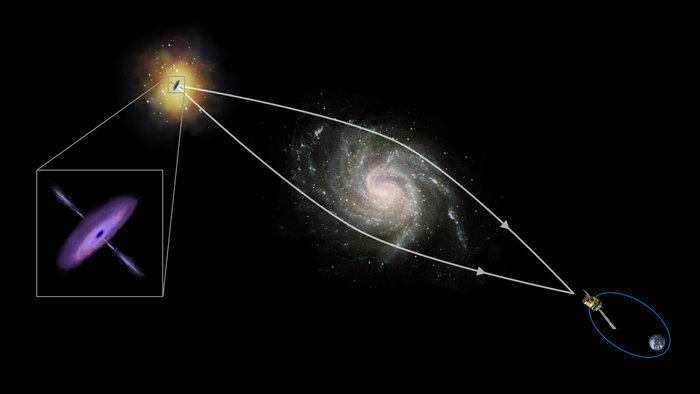
Gravitational lensing
Copyright: ESA/ATG medialab 
 
Simulated microlensing
Copyright: Courtesy of A. Neronov, ISDC, University of Geneva, Switzerland


The Integral, Fermi and Swift space observatories have used the magnifying power of a cosmic lens to explore the inner regions of a supermassive black hole. 

Gamma rays are highly energetic radiation emitted by some of the most extreme objects in our Universe. Jets of gamma rays moving at close to the speed of light stream from the areas around black holes, for example. These jets are thought to be emitted by superheated material spinning wildly as it is devoured by the hungry black hole. 

Our telescopes will never be powerful enough to reveal these inner regions, and scientists struggle to examine exactly how these jets are unleashed into the Universe.

“Because we can’t clearly see what’s going on, we don’t fully understand this behaviour,” says Andrii Neronov of the University of Geneva, Switzerland, lead author on the Nature Physics paper published online today. 

“However, our method allowed us to ‘resolve’ this region, and get an insight into the patch of space directly surrounding a supermassive black hole known as PKS 1830-211.” 

This black hole lies many billions of light-years away. Neither ESA’s Integral satellite nor NASA’s Fermi gamma-ray telescope can observe the region unaided, but a lucky coincidence provides a helping hand: gravitational microlensing. 

“From Earth, black holes are tiny. They’re just so very far away,” notes Dr Neronov. “Trying to observe PKS 1830-211 is like trying to look at an ant sitting on the Moon. 

“None of our telescopes can observe something so small, so we used a trick to resolve the ant: a huge gravitational lens.” 

Massive cosmic objects, from single stars to galaxy clusters, bend and focus the light that flows around them with their gravity, acting like giant magnifying glasses. 

Dr Neronov and colleagues used a star sitting between their target and Earth to ‘zoom in’ to the black hole and measure the size of the jet-emitting region – the first time this method has ever been used with gamma rays. 

They picked out structures on the same angular scale as that of the Moon ant. The observed patch of sky covers a region about 100 times the Earth–Sun distance. In astronomical terms, this is remarkably small. 

“Our observations demonstrate that the gamma rays come from the direct vicinity of the black hole itself,” says Dr Neronov. “This gives us some idea about what is and isn’t important in generating the jets. 

“It’s amazing to be able to see such tiny things at such enormous distances from us. I’m very excited to have a ‘black-hole-scope’ to investigate the inner regions of the jets.”

Observing the gamma-ray source with ESA’s Integral and NASA’s Fermi and Swift allowed the astronomers to build up a more complete picture of the radiation streaming out. 

The more energetic gamma rays, detected by Fermi, are seen to be coming from the tiny base of the jet – the ‘ant on the Moon’-size region – while the lower energy gamma rays, detected by Integral, were emitted from a much larger surrounding region. 

The team also studied X-rays using Integral and Swift. They found these X-rays to be emanating from a region stretching around the hole some 400 billion km or more. 

“This black hole is one of the most powerful known objects of its kind. Fully characterising its emission will hopefully give us real insight into how these jets form,” says Erik Kuulkers, ESA’s Integral project scientist.
“Fortunately, the black hole lies in the field of space located towards the centre of our Galaxy, so Integral sees it often. 

“These observations provide unique information about the high-energy processes taking place around supermassive black holes, by allowing us to ‘look inside’ tiny structures lying very far away from us.” 


Notes for Editors

The results described here are reported in “Central engine of a gamma-ray blazar resolved through the “magnifying glass” of gravitational microlensing,” by A. Neronov, I. Vovk and D. Malyshev, published online in Nature Physics on 6 July.  


For further information, please contact:

Markus Bauer


ESA Science and Robotic Exploration Communication Officer


Tel: +31 71 565 6799


Mob: +31 61 594 3 954


Email:
markus.bauer@esa.int 

Andrii Neronov
ISDC, Astronomy Department
University of Geneva
Switzerland
Tel: +41 22 379 2120
Email:
Andrii.Neronov@unige.ch

Erik Kuulkers
Integral Project Scientist
Directorate of Science and Robotic Exploration
European Space Agency
Tel: +34 918 131 358
Mob: +34 699 439 987
Email:
erik.Kuulkers@sciops.esa.int

Source: ESA


Thursday, December 11, 2014

Mapping Mass in a Frontier Fields Cluster

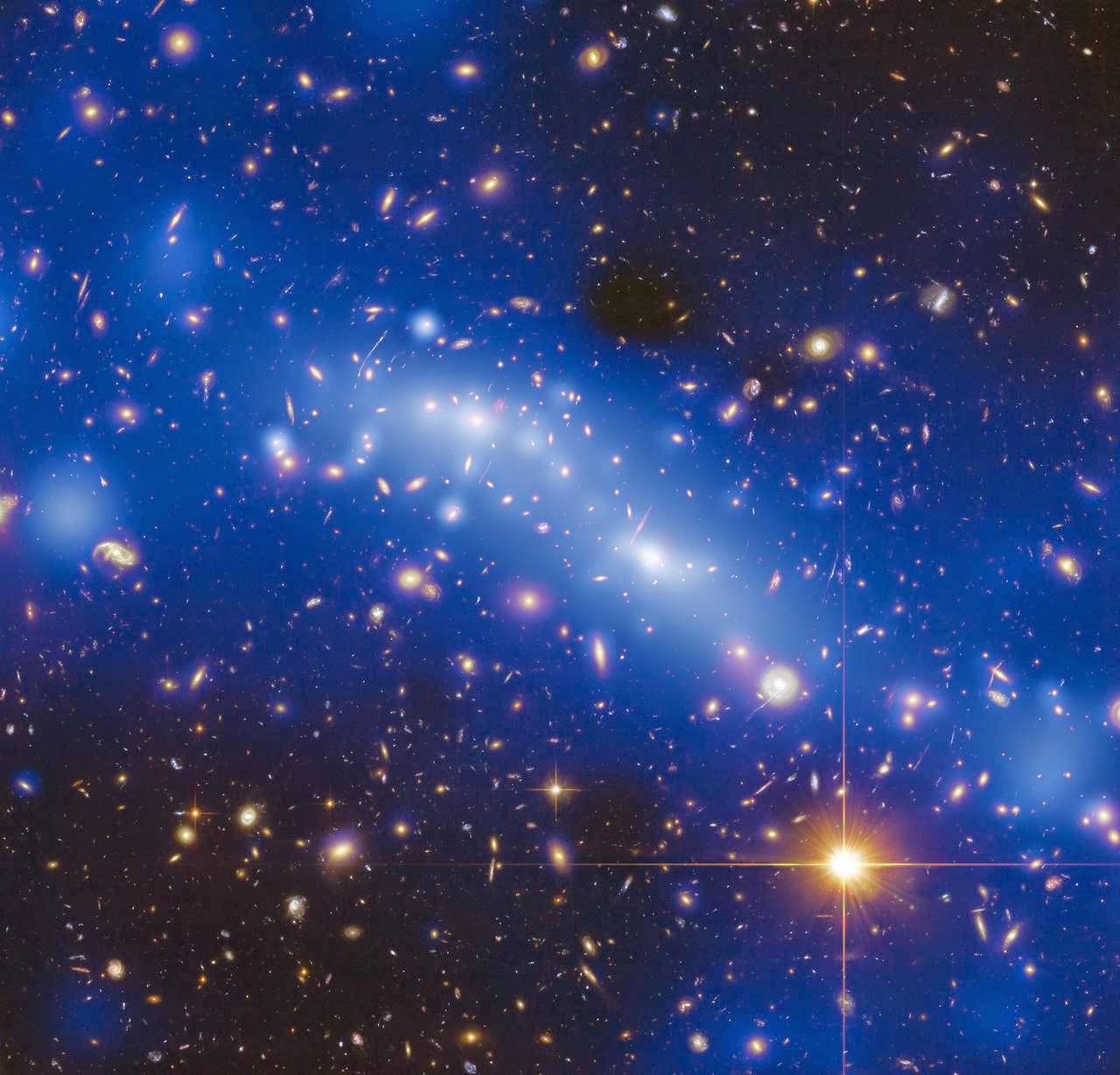
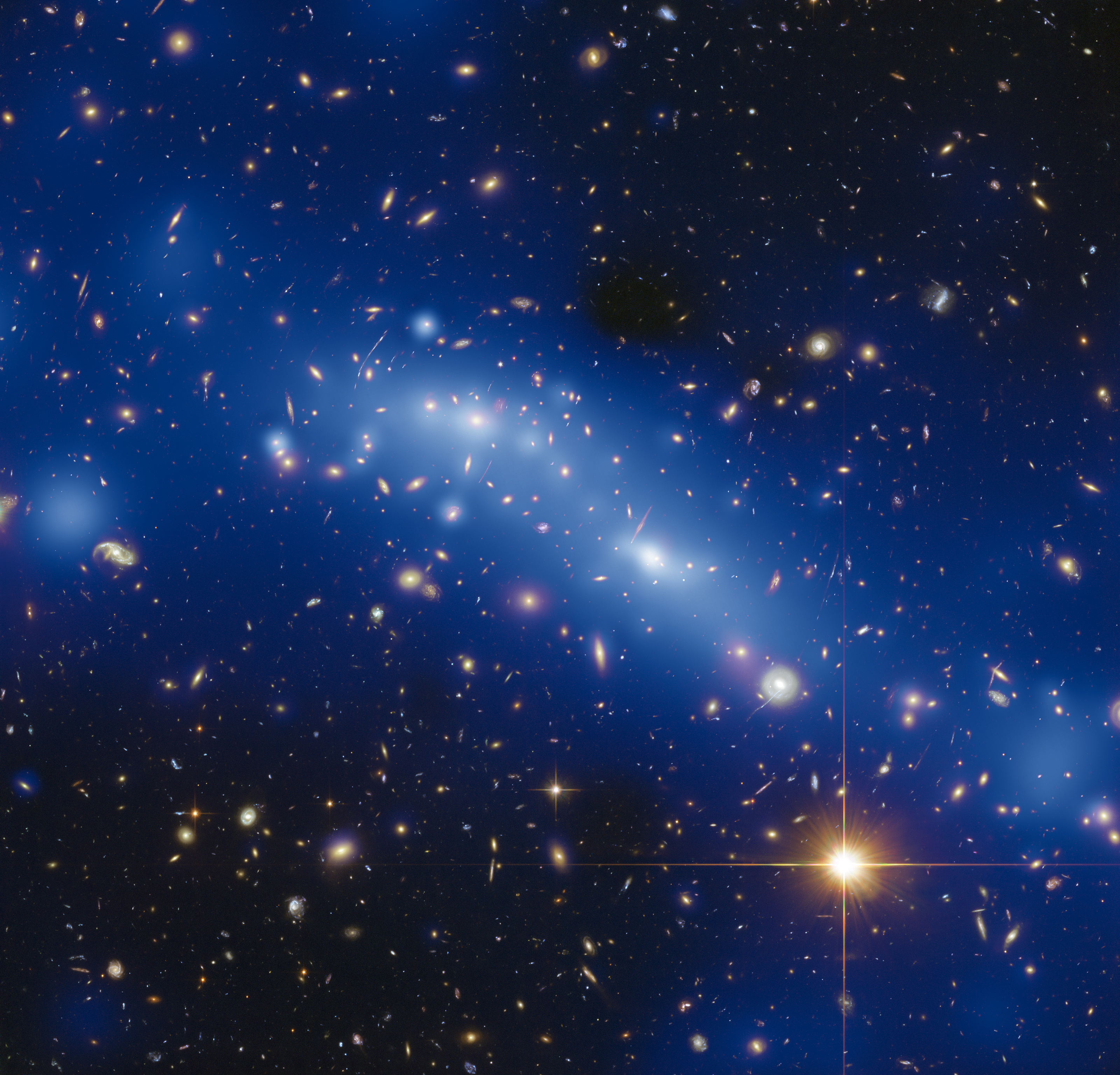
The galaxy clusters under observation in Frontier Fields are so dense in mass that their gravity distorts and bends the light from the more-distant galaxies behind them, creating the magnifying effect known as gravitational lensing. Astronomers use the lensing effect to determine the location of concentrations of mass in the cluster, depicted here as a blue haze. Credit: ESA/Hubble, NASA, HST Frontier Field. Hi-Res Image

Stronger lensing produces greater distortions. Astronomers can work backwards from the distortions to pinpoint the greater concentrations of mass responsible for producing such altered images. Credit: A. Feild (STScI). Hi-Res Image


The Frontier Fields project’s examination of galaxy cluster MACS J0416.1-2403 has led to a precise map that shows both the amount and distribution of matter in the cluster. MACS J0416.1-2403 has 160 trillion times the mass of the Sun in an area over 650,000 light-years across.

The mass maps have a two-fold purpose: they identify the location of mass in the galaxy clusters, and by doing so make it easier to characterize lensed background galaxies.

Astronomers use the distortions of light caused by mass concentrations to pinpoint the distribution of mass within the cluster, including invisible dark matter. Weakly lensed background galaxies, visible in the outskirts of the cluster where less mass accumulates, may be stretched into slightly more elliptical shapes or transformed into smears of light. Strongly lensed galaxies, visible in the inner core of the cluster where greater concentrations of mass occur, can appear as sweeping arcs or rings, or even appear multiple times throughout the image. And as a dual benefit, as the clusters’ mass maps improve, it becomes easier to identify which galaxies are strongly lensed, and which galaxies are farther away.

The depth of the Frontier Fields images allows astronomers to see extremely faint objects, including many more strongly lensed galaxies than seen in previous observations of the cluster. Hubble identified 51 new multiply imaged galaxies around this cluster, for instance, quadrupling the number found in previous surveys.

Because the galaxies are multiples, that means almost 200 strongly lensed images appear in the new observations, allowing astronomers to produce a highly constrained map of the cluster’s mass, inclusive of both visible and dark matter.

The dark matter aspect is particularly intriguing. Because these types of Frontier Fields analyses create extremely precise maps of the locations of dark matter, they provide the potential for testing the nature of dark matter. Learning where dark matter concentrates in massive galaxy clusters can give clues to how it behaves and changes. And as the mass maps become more precise, astronomers are better able to determine the distance of the lensed galaxies.

In order to obtain a complete picture of MACS J0416.1-2403’s mass, astronomers will also need to include weak lensing measurements. Follow up observations will include further Frontier Fields imaging, as well as X-ray measurements of hot gas and spectroscopic redshifts to break down the total mass distribution into dark matter, gas, and stars.

Source:  Frontier Fields


Wednesday, January 11, 2012

Planet Population is Plentiful

PR Image eso1204a
Planets everywhere

PR Image eso1204b
The Milky Way over the 1.54-metre Danish Telescope at La Silla

PR Video eso1204a
Planets everywhere

An international team, including three astronomers from the European Southern Observatory (ESO), has used the technique of gravitational microlensing to measure how common planets are in the Milky Way. After a six-year search that surveyed millions of stars, the team concludes that planets around stars are the rule rather than the exception. The results will appear in the journal Nature on 12 January 2012.

Over the past 16 years, astronomers have detected more than 700 confirmed exoplanets [1] and have started to probe the spectra (eso1002) and atmospheres (eso1047) of these worlds. While studying the properties of individual exoplanets is undeniably valuable, a much more basic question remains: how commonplace are planets in the Milky Way?

Most currently known exoplanets were found either by detecting the effect of the gravitational pull of the planet on its host star or by catching the planet as it passes in front of its star and slightly dims it. Both of these techniques are much more sensitive to planets that are either massive or close to their stars, or both, and many planets will be missed.

An international team of astronomers has searched for exoplanets using a totally different method — gravitational microlensing — that can detect planets over a wide range of mass and those that lie much further from their stars.

Arnaud Cassan (Institut dʼAstrophysique de Paris), lead author of the Nature paper, explains: "We have searched for evidence for exoplanets in six years of microlensing observations. Remarkably, these data show that planets are more common than stars in our galaxy. We also found that lighter planets, such as super-Earths or cool Neptunes, must be more common than heavier ones."

The astronomers used observations, supplied by the PLANET [2] and OGLE [3] teams, in which exoplanets are detected by the way that the gravitational field of their host stars, combined with that of possible planets, acts like a lens, magnifying the light of a background star. If the star that acts as a lens has a planet in orbit around it, the planet can make a detectable contribution to the brightening effect on the background star.

Jean-Philippe Beaulieu (Institut d'Astrophysique de Paris), leader of the PLANET collaboration adds: "The PLANET collaboration was established to follow up promising microlensing events with a round-the-world network of telescopes located in the southern hemisphere, from Australia and South Africa to Chile. ESO telescopes contributed greatly to these surveys.”

Microlensing is a very powerful tool, with the potential to detect exoplanets that could never be found any other way. But a very rare chance alignment of a background and lensing star is required for a microlensing event to be seen at all. And, to spot a planet during an event, an additional chance alignment of the planet’s orbit is also needed.

Although for these reasons finding a planet by microlensing is far from an easy task, in the six year's worth of microlensing data used in the analysis, three exoplanets were actually detected in the PLANET and OGLE searches: a super-Earth [4], and planets with masses comparable to Neptune and Jupiter. By microlensing standards, this is an impressive haul. In detecting three planets, either the astronomers were incredibly lucky and had hit the jackpot despite huge odds against them, or planets are so abundant in the Milky Way that it was almost inevitable [5].

The astronomers then combined information about the three positive exoplanet detections with seven additional detections from earlier work, as well as the huge numbers of non-detections in the six year's worth of data — non-detections are just as important for the statistical analysis and are much more numerous. The conclusion was that one in six of the stars studied hosts a planet of similar mass to Jupiter, half have Neptune-mass planets and two thirds have super-Earths. The survey was sensitive to planets between 75 million kilometres and 1.5 billion kilometres from their stars (in the Solar System this range would include all the planets from Venus to Saturn) and with masses ranging from five times the Earth up to ten times Jupiter.

Combining the results suggests strongly that the average number of planets around a star is greater than one. They are the rule rather than the exception.

“We used to think that the Earth might be unique in our galaxy. But now it seems that there are literally billions of planets with masses similar to Earth orbiting stars in the Milky Way,” concludes Daniel Kubas, co-lead author of the paper.

Notes

[1] The Kepler mission is discovering huge numbers of “candidate exoplanets” that are not included in this number.

[2] Probing Lensing Anomalies NETwork. More than half of the data from the PLANET survey used in this study come from the Danish 1.54-metre telescope at ESO's La Silla Observatory.

[3] Optical Gravitational Lensing Experiment.

[4] A super-Earth has a mass between two and ten times that of the Earth. So far 12 microlensing planets have been published in total, using various observational strategies.

[5] The astronomers surveyed millions of stars looking for microlensing events. Only 3247 such events in 2002-2007 were spotted as the precise alignment needed is very unlikely. Statistical results were inferred from detections and non-detections on a representative subset of 440 light curves.

More information

This research was presented in a paper, “One or more bound planets per Milky Way star from microlensing observations”, by A. Cassan et al., to appear in the 12 January issue of the journal Nature.

The team is composed of A. Cassan (Institut dʼAstrophysique de Paris, France [IAP]; ESO), D. Kubas (IAP), J.-P. Beaulieu (IAP), M. Dominik (University of St Andrews, United Kingdom), K. Horne (University of St Andrews), J. Greenhill (University of Tasmania, Australia), J. Wambsganss (Heidelberg University, Germany), J. Menzies (South African Astronomical Observatory), A. Williams (Perth Observatory, Australia), U. G. Jørgensen (Niels Bohr Institute, Copenhagen, Denmark), A. Udalski (Warsaw University Observatory, Poland), M. D. Albrow (University of Canterbury, New Zealand), D. P. Bennett (University of Notre Dame, Notre Dame, USA), V. Batista (IAP), S. Brillant (ESO), J. A. R. Caldwell (McDonald Observatory, Fort Davis, USA), A. Cole (University of Tasmania), Ch. Coutures (IAP), K. Cook (Lawrence Livermore National Laboratory, USA), S. Dieters (University of Tasmania), D. Dominis Prester (University of Rijeka, Croatia), J. Donatowicz (Technical University of Vienna, Austria), P. Fouqué (Université de Toulouse, France), K. Hill (University of Tasmania), N. Kains (ESO), S. Kane (NASA Exoplanet Science Institute, Caltech, USA), J.-B. Marquette (IAP), K. R. Pollard (University of Canterbury, New Zealand), K. C. Sahu (STScI, Baltimore, USA), C. Vinter (Niels Bohr Institute), D. Warren (University of Tasmania), B. Watson (University of Tasmania), M. Zub (Heidelberg University), T. Sumi (Nagoya University, Japan), M. K. Szymański (Warsaw University Observatory), M. Kubiak (Warsaw University Observatory), R. Poleski (Warsaw University Observatory), I. Soszynski (Warsaw University Observatory), K. Ulaczyk (Warsaw University Observatory), G. Pietrzyński (Warsaw University Observatory), Ł. Wyrzykowski (Warsaw University Observatory).

The year 2012 marks the 50th anniversary of the founding of the European Southern Observatory (ESO). ESO is the foremost intergovernmental astronomy organisation in Europe and the world’s most productive astronomical observatory. It is supported by 15 countries: Austria, Belgium, Brazil, the Czech Republic, Denmark, France, Finland, Germany, Italy, the Netherlands, Portugal, Spain, Sweden, Switzerland and the United Kingdom. ESO carries out an ambitious programme focused on the design, construction and operation of powerful ground-based observing facilities enabling astronomers to make important scientific discoveries. ESO also plays a leading role in promoting and organising cooperation in astronomical research. ESO operates three unique world-class observing sites in Chile: La Silla, Paranal and Chajnantor. At Paranal, ESO operates the Very Large Telescope, the world’s most advanced visible-light astronomical observatory and two survey telescopes. VISTA works in the infrared and is the world’s largest survey telescope and the VLT Survey Telescope is the largest telescope designed to exclusively survey the skies in visible light. ESO is the European partner of a revolutionary astronomical telescope ALMA, the largest astronomical project in existence. ESO is currently planning a 40-metre-class European Extremely Large optical/near-infrared Telescope, the E-ELT, which will become “the world’s biggest eye on the sky”.

Links
Research paper in Nature

Contacts

Arnaud Cassan
Institut d'Astrophysique de Paris
Université Pierre et Marie Curie , Paris, France
Tel: +33 1 44 32 80 00
Email: cassan@iap.fr

Daniel Kubas
c/o European Southern Observatory
Email: dkubas@eso.org

Richard Hook
ESO, La Silla, Paranal, E-ELT & Survey Telescopes Press Officer
Garching bei München, Germany
Tel: +49 89 3200 6655
Cell: +49 151 1537 3591
Email: rhook@eso.org