Tuesday, December 02, 2014

Staying Warm: The Hot Gas in Clusters of Galaxies

A false-color X-ray image of the core of the Virgo cluster of galaxies. The emission comes from very hot gas between the galaxies. This gas should cool off, but doesn’t, and a new paper presents a very plausible solution to this long-time mystery. The scale mark corresponds to a physical scale of 50 light-years. Credit: NASA/Chandra X-ray Observatory

Most galaxies lie in clusters, groupings of a few to many thousands of galaxies. Our Milky Way galaxy itself is a member of the "Local Group," a band of about fifty galaxies whose other large member is the Andromeda Galaxy about 2.3 million light-years away. The closest large cluster of galaxies to us is the Virgo Cluster, about 50 million light-years away, with about 2000 members.

The space between the galaxies in clusters is filled with very hot gas – its temperature is of order ten million kelvin, or even higher. Most of the matter in the so-called intracluster medium is in the form of this very hot gas. Hot gas should cool off, and one of the major puzzles about galaxy clusters is that the hot intracluster gas does not seem to cool. In fact, calculations based on the energy radiated indicate that the gas should cool about ten times faster than is observed. X-ray observations of the hot gas also suggest that it might be turbulent, perhaps driven by mechanical flows of matter pouring outward from the supermassive black holes at the centers of the clusters’ galaxies, perhaps creating inflating bubbles of fast-moving charged particles that stir and heat the gas. Unfortunately, current X-ray observatories do not have the ability to measure the supposed gas velocities to test this proposed solution.

A team of astronomers including CfA scientists Bill Forman and Alexey Vikhlinin have pioneered a new method to evaluate the turbulence of the hot intracluster gas. They took advantage of the superb spatial resolution and sensitive images from the Chandra X-Ray Observatory to probe small clumps distributed through two clusters, Perseus and Virgo. They analyze the structures as resulting from turbulence, and then inferred the turbulent velocities needed, deriving values up to about 145 kilometers per second. These velocities are indeed adequate to heat the gas over all the scales observed over the cluster, and could readily be produced by black hole jets. The results are very encouraging, though not definitive, and imply that no mysterious mechanisms needed to be invoked to explain the enduring hot gas.

Reference(s): 
"Turbulent Heating in Galaxy Clusters Brightest in X-rays," I. Zhuravleva, E. Churazov, A. A. Schekochihin, S. W. Allen, P. Arévalo, A. C. Fabian, W. R. Forman, J. S. Sanders, A. Simionescu, R. Sunyaev, A. Vikhlinin, & N. Werner, Nature, 515, 85, 2014.


A new standard ruler: Measuring angular diameter distances using time-delay strong lenses

Figure 1: Image of a strong lensing time delay system, B1608+656, taken by the Hubble Space Telescope (from Suyu et al. 2010). The centre of the lens galaxy (G1) and a satellite galaxy (G2) are surrounded by images of a background source (A, B, C and D). The ordering of the images follows the arrival time. (c) HST/NASA

Figure 2: Configuration of a strong gravitational lensing system. The thick solid line shows the two different paths that photons emitted from the source could take. The dotted lines show the angular positions where images and the source appear on the sky. The position of the source, however, is usually not observable as it is very close to the lens. Note that the plot is not to scale: The distance photons travel is much longer than the size of the lens or the source. Credit: Jee, Komatsu and Suyu 2014 

Figure 3: Distribution of angular diameter distances calculated from (top) the simulated aperture-averaged velocity dispersion of the lens system B1608+656, and (bottom) the velocity dispersion measured at the sweet-spot radius (see Figure 1). In both plots, the blue solid line shows the distribution when the input model is isotropic, whereas the green dashed line is the distribution when the simulated velocity dispersion is anisotropic. In the upper case, the distance can be determined to an accuracy of about 15%. If the radial profile of the velocity dispersion is taken into account (using the "sweet spot", see text), as the bottom panel shows, the uncertainty decreases to 12%.  Credit: Jee, Komatsu and Suyu 2014

Since the discovery of the expansion of the universe in 1929, measuring cosmological distances has played a fundamental role in testing the cosmological models. Scientists at MPA now propose a crucially improved ruler method in addition to the well-known standard candle and standard ruler methods, which use the known luminosity or the known size of an object, respectively. For their method, they use a strong gravitational lens system with a time-varying source (e.g. a quasar) to measure the angular diameter distance to the lens. This method opens a new avenue to chart our universe and to understand the origin of the acceleration of the universe.

Observing the universe has a fundamental limitation: the 3-dimensional universe is projected onto the 2-dimensional observation plane, which makes it hard to know the 'depth' of the universe (in other words, how far an object is from us). As a consequence, astronomers rely on indirect methods to measure cosmological distances. 

There are two methods to achieve this goal: One is the so-called 'standard candle' method, where the apparent luminosity of an object is compared to its intrinsic brightness that is assumed to be known. Using Type Ia supernovae as a standard candle, the method has led to the discovery of the accelerating expansion of the universe and the existence of dark energy. The other method is the 'standard ruler' method, which compares the apparent size of an object to its intrinsic size. For example, large-scale galaxy surveys allowed astronomers to use the so-called Baryonic Acoustic Oscillations as a standard ruler. 

However, both existing methods have limitations. We still do not know the progenitors of Type Ia supernovae, and thus using them to infer distances may be limited by our physical understanding of supernovae. The resources required to measure Baryonic Acoustic Oscillations are large, as we need to take spectra of millions of galaxies, and a given project takes many years and tens of millions of euros (or more) to complete. Therefore, there is a strong desire to find another candle or ruler, which is well understood physically and demands less observational resources. 

Recently, MPA scientists have substantially improved upon a method to use strong gravitational lens systems with measured time delays to infer the distance to the lens. The method was first proposed in 2009 by Paraficz and Hjorth, but no further study has been done since then. Strong gravitational lensing happens when a massive galaxy is almost, but not exactly, aligned to a source quasar that is located behind the galaxy. The light emitted from the source quasar passes through the gravitational field of the galaxy and is slightly bent towards the galaxy, according to General Relativity. 

Each photon passing through a different part of the galaxy experiences a different gravitational potential: As a result, the galaxy acts like an optical lens and the photons taking separate paths produce multiple images around the galaxy (see Figure 1). As each photon takes a different path to reach the observer, the path lengths and thus the arrival times of the photons differ, allowing the observer to measure the delay between each path as the source quasar changes its brightness in time (see schematic in Figure 2). The time difference between images is called the time delay. 

The physics behind the new ruler method is simple. The measured time delay is proportional to the mass of the galaxy. The measured velocity dispersion of the galaxy gives the gravitational potential of the lens. Combining both measurements yields the physical size of the lens. Then, by comparing the physical size of the lens that has been calculated and the angular size of the lens that has been observed, we can obtain the distance to the lens. 

The angular diameter distance to the lens galaxy measured in this way can be expressed in terms of several observables such as the time delay, velocity dispersion, lens redshift, and image positions. It also depends on the steepness of the mass profile of the lens, which can be determined by analysing the shape and brightness distributions of the lens and images. 

One big advantage of this new method, which was found by scientists at MPA, is that the effect of the external mass that lies along the line-of-sight between the observer and the source, which is called the 'external convergence', cancels out. In other words, the angular diameter distance does not change under the presence of external mass that causes extra bending of light rays. In principle, the external convergence acts like another lens added to the lens system, and adds uncertainty to the traditional cosmological measurements using strong lenses. A good analogy exists in the classical optics: It is impossible to tell the difference between a single lens system with a given focal length, and a multiple lens system consisting of lenses with different focal lengths which collectively form a system with the same effective focal length as that of the single lens. Likewise, gravitational lens systems with a single lens and multiple lenses cannot be distinguished by observables. 

However, in our case the resulting angular diameter distance does not depend on the external convergence, since the time delay and the velocity dispersion are both determined solely by the properties of the lens. Applying this method to one of the existing lens systems, B1608+656 (Figure 1), the researchers find that the distance can be measured with 15% accuracy (Figure 3). 

This new method requires precise estimation of the mass and the potential of the system from data. Challenges lie both in the observation and the modelling of the lens: Assuming that the lens galaxy (which is a massive elliptical galaxy in most cases) has reached dynamical equilibrium, the random motion of matter particles inside the galaxy counteracts the gravitational force so that the galaxy neither collapses nor expands. This is measured by the velocity dispersion of stars with respect to the centre of the galaxy. The Jeans equation relates the radial component of the velocity dispersion to the gravitational potential; however, it is impossible to observe just the radial component of the velocity dispersion. The measurement is done using the Doppler shift of stellar light, which means that only the line-of-sight component of the velocity dispersion is measurable. The fact that only the luminous tracers (such as stars) can be measured results in the observation of projected, luminosity weighted velocity dispersion. When the velocity dispersion is anisotropic, the situation becomes even more complicated. Moreover, the measured velocity dispersion is usually a quantity that is averaged over an aperture of size few tenth of arc seconds. In the end, it is not easy to relate the value we observe to the potential itself. 

To overcome this complication, we use spatially resolved spectroscopy of the lens galaxy to obtain the radial profile of the velocity dispersion. Then, we use a radius at which the scatter between different anisotropic profiles is minimised, the "sweet spot", which was derived previously by other researchers at MPA (Churazov et al.). With this method, the uncertainty from the anisotropic velocity dispersion is minimised and the accuracy in the determination of the angular diameter distance improves to 12%. 

This study demonstrates that, using a strong lens galaxy with measured time delays, the angular diameter distance can be measured accurately, providing a powerful, new way to chart our universe.

Inh Jee, Eiichiro Komatsu and Sherry H. Suyu(ASIAA)


References:

Inh Jee, Eiichiro Komatsu, Sherry H. Suyu, Measuring angular diameter distances of strong gravitational lenses, arXiv:1410.7770


Monday, December 01, 2014

Surprise within a Cloud

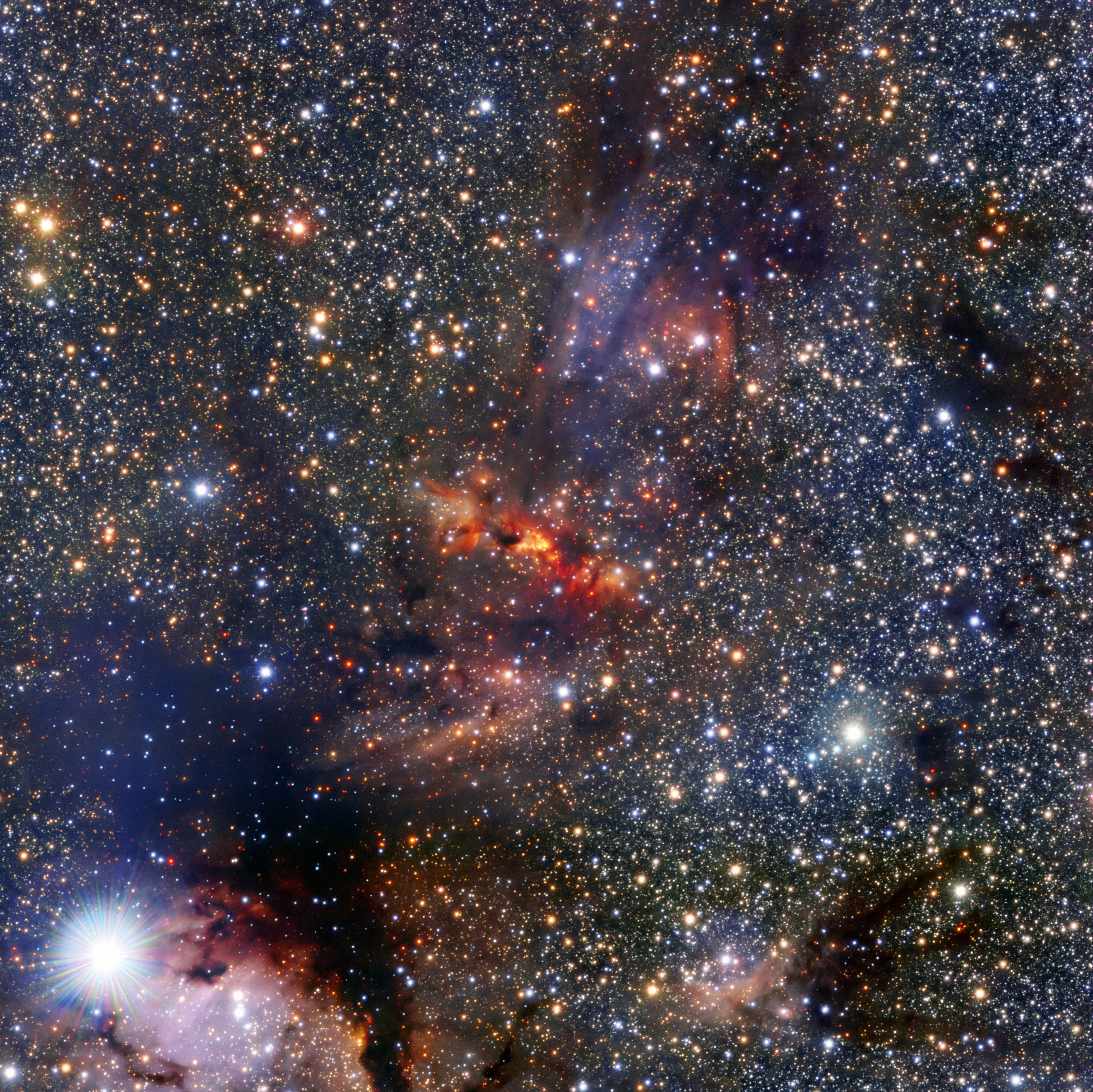
Credit: ESO/VVV Team/A. Guzmán

This image shows a region of the Milky Way that lies within the constellation of Scorpius, close to the central plane of the galaxy. The region hosts a dense cloud of dust and gas associated with the molecular cloud IRAS 16562-3959, clearly visible as an orange smudge among the rich pool of stars at the centre of the image.

Clouds like these are breeding grounds for new stars. In the centre of this cloud the bright object known as G345.4938+01.4677 can just be seen beyond the veil of gas and dust. This is a very young star in the process of forming as the cloud collapses under gravity.

The young star is very bright and heavy —  roughly 15 times more massive than the Sun — and featured in a recent Atacama Large Millimeter/submillimeter Array (ALMA) result. The team of astronomers made surprising discoveries within G345.4938+01.4677 — there is a large disc of gas and dust around the forming star as well as a stream of material flowing out from it.

Theories predict that neither such a stream, nor the disc itself, are likely to exist around stars like G345.4938+01.4677 because the strong radiation from such massive new stars is thought to push material away.

This image was made using the Visible and Infrared Survey Telescope for Astronomy (VISTA), which is part of ESO’s Paranal Observatory in the Atacama Desert of Chile. It is the world’s largest survey telescope, with a main mirror that measures over four metres across. The colour image was produced by the VVV survey, which is one of six large public surveys that are devoted to mapping the southern sky.

The bright star in the bottom left of the image is known as HD 153220.


Friday, November 28, 2014

‘Eye of Sauron’ Provides New Way of Measuring Distances to Galaxies

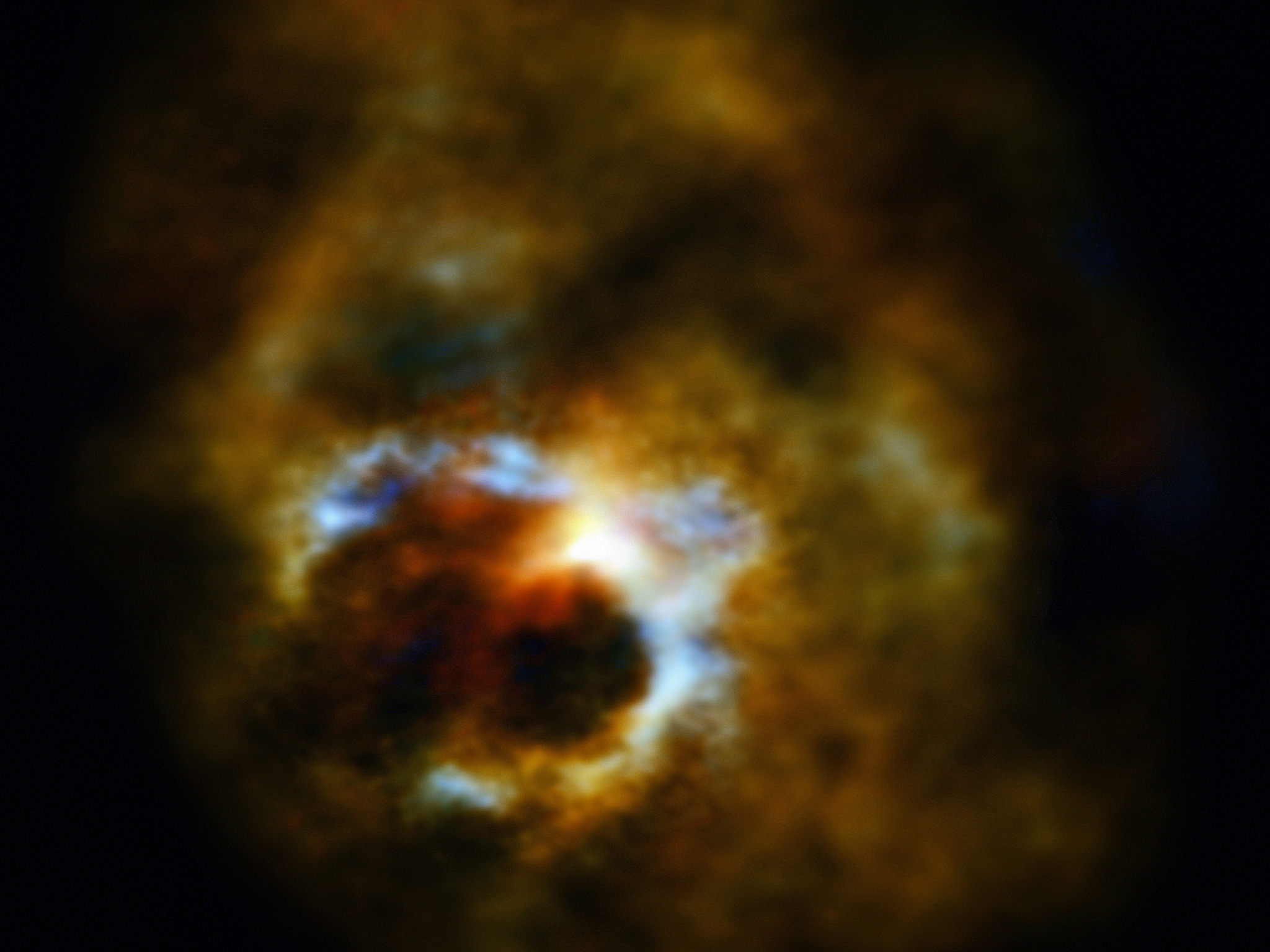
The Galaxy NGC 4151 called the, ‘Eye of Sauron’ due to its similarity to the eye in the film Lord of the Rings. The image shows the supermassive black hole, which is still active, that is to say that it engulfs gas and dust clouds from its surroundings. In this process, it emits ultraviolet radiation, which heats the ring-shaped dust cloud that orbits around the black hole at a distance and this causes the dust cloud to emit infrared radiation.  Credit: NASA

MAUNA KEA, Hawaii — A team of scientists, led by Dr. Sebastian Hoenig from the University of Southampton, has accurately measured the distance to the nearby NGC4151 galaxy, using the W. M. Keck Observatory Interferometer. The team employed a new technique they developed, which allows them to measure precise distances to galaxies tens of millions of light years away. The research was published today in the journal Nature.

The new technique is similar to that used by land surveyors on earth, who measure both the physical and angular – or ‘apparent’ – size of a distant object, to calculate its distance from Earth. 

Previous reported distances to NGC 4151, which contains a supermassive black hole, ranged from 4- to 29-megaparsecs, but using this new, more accurate method, the researchers calculated the distance to the supermassive black hole as 19 megaparsecs.

The galaxy NGC415 is dubbed the ‘Eye of Sauron’ by astronomers for the similarity to its namesake in the film trilogy The Lord of the Rings. As in the famous saga, a ring plays a crucial role in this new measurement. All big galaxies in the universe host a supermassive black hole in their center and in about 10 percent of all galaxies, these supermassive black holes are growing by swallowing huge amounts of gas and dust from their surrounding environments. In this process, the material heats up and becomes very bright — becoming the most energetic sources of emission in the universe known as active galactic nuclei (AGN).
This hot dust forms a ring around the supermassive black hole and emits infrared radiation, which the researchers used as the ruler. However, the apparent size of the Eye of Sauron’s ring is so small, the observations were carried out using the Keck Interferometer, which combines Keck Observatory’s twin 10-meter telescopes — already the largest telescopes on Earth — to achieve the resolving power of an 85m telescope.

To measure the physical size of the dusty ring, the researchers measured the time delay between the emission of light from close to the black hole and the more distant infrared emission. The distance from the center to the hot dust is simply this delay divided by the speed of light. 

By combining the physical size of the dust ring with the apparent size measured with the Keck Interferometer, the researchers were able to determine a distance to NGC 4151. 

“One of the key findings is that the distance determined in this new fashion is quite precise — with 90 percent accuracy,” Hoenig said. “In fact, this method, based on simple geometrical principles, gives the most precise distances for remote galaxies. Moreover, it can be readily used on many more sources than current methods. Such distances are key in pinning down the cosmological parameters that characterize our universe or in accurately measuring black hole masses. Indeed, NGC 4151 is a key to calibrating various techniques of estimating black hole masses. Our new distance implies that these masses may have been systematically underestimated by 40 percent.”

Hoenig, together with colleagues in Denmark and Japan, is currently setting up a new program to extend their work to many more AGN. The goal is to establish precise distances to a dozen galaxies using this technique and use them to constrain cosmological parameters to within few per cent. Combined with other measurements, this will provide a better understanding of the history of expansion of our universe.

The W. M. Keck Observatory operates the most scientifically productive telescopes on Earth. The two, 10-meter optical/infrared telescopes near the summit of Mauna Kea on the Island of Hawaii feature a suite of advanced instruments including imagers, multi-object spectrographs, high-resolution spectrographs, integral-field spectrographs and world-leading laser guide star adaptive optics systems. 

The Keck Interferometer began construction in 1997, and finished its mission in 2012. It was funded by NASA and managed by JPL. JPL is managed by Caltech for NASA.

Keck Observatory is a private 501(c) 3 non-profit organization and a scientific partnership of the California Institute of Technology, the University of California and NASA.

Contact:

W. M. Keck Observatory
65-1120 Mamalahoa Hwy.
Kamuela, HI 96743
Phone: 808.885.7887
Fax: 808.885.4464


A slashing smudge across the sky

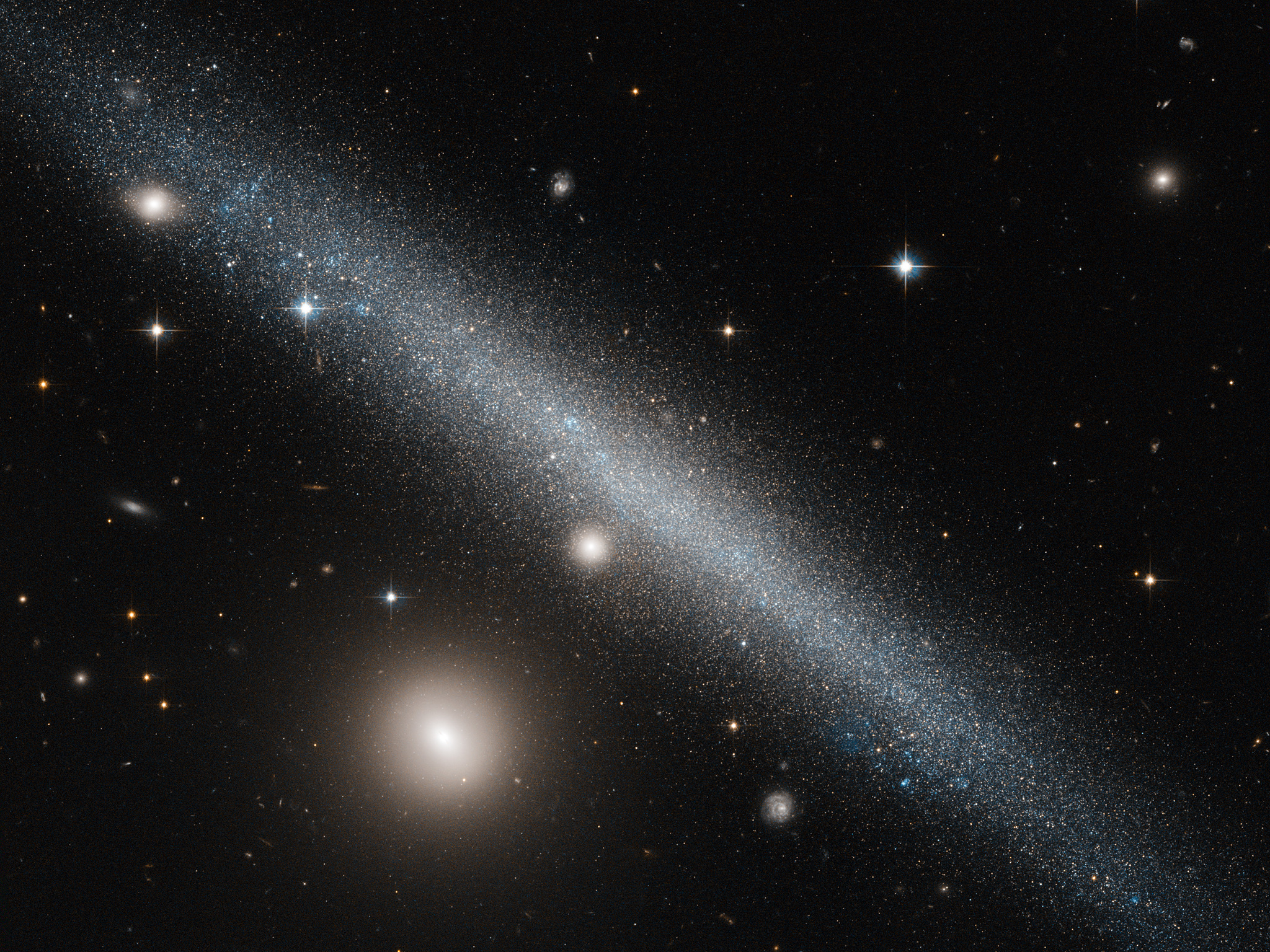
2MASX J01493473+3234464 - PGC 6700 -  UGC 1281

Credit: ESA/Hubble & NASA
Acknowledgement: Luca Limatola

The galaxy cutting dramatically across the frame of this NASA/ESA Hubble Space Telescope image is a slightly warped dwarf galaxy known as UGC 1281. Seen here from an edge-on perspective, this galaxy lies roughly 18 million light-years away in the constellation of Triangulum (The Triangle).

The bright companion to the lower left of UGC 1281 is the small galaxy PGC 6700, officially known as 2MASX J01493473+3234464. Other prominent stars belonging to our own galaxy, the Milky Way, and more distant galaxies can be seen scattered throughout the sky.

The side-on view we have of UGC 1281 makes it a perfect candidate for studies into how gas is distributed within galactic halos — the roughly spherical regions of diffuse gas extending outwards from a galaxy’s centre. Astronomers have studied this galaxy to see how its gas vertically extends out from its central plane, and found it to be a quite typical dwarf galaxy. However, it does have a slightly warped shape to its outer edges, and is forming stars at a particularly low rate.

A version of this image was entered into the Hubble's Hidden Treasures image processing competition by contestant Luca Limatola.  

Links

Source:  ESA/Hubble - Space Telescope


Wednesday, November 26, 2014

A Colourful Gathering of Middle-aged Stars

The colourful star cluster NGC 3532 

The location of the bright star cluster NGC 3532 in the constellation of Carina 

Wide-field view of the sky around the bright star cluster NGC 3532


********************************************************************************

Videos


Zooming in on the colourful star cluster NGC 3532

Panning across the colourful star cluster NGC 3532


The MPG/ESO 2.2-metre telescope at ESO’s La Silla Observatory in Chile has captured a richly colourful view of the bright star cluster NGC 3532. Some of the stars still shine with a hot bluish colour, but many of the more massive ones have become red giants and glow with a rich orange hue.

NGC 3532 is a bright open cluster located some 1300 light-years away in the constellation of Carina (The Keel of the ship Argo). It is informally known as the Wishing Well Cluster, as it resembles scattered silver coins which have been dropped into a well. It is also referred to as the Football Cluster, although how appropriate this is depends on which side of the Atlantic you live. It acquired the name because of its oval shape, which citizens of rugby-playing nations might see as resembling a rugby ball.

This very bright star cluster is easily seen with the naked eye from the southern hemisphere. It was discovered by French astronomer Nicolas Louis de Lacaille whilst observing from South Africa in 1752 and was catalogued three years later in 1755. It is one of the most spectacular open star clusters in the whole sky.

NGC 3532 covers an area of the sky that is almost twice the size of the full Moon. It was described as a binary-rich cluster by John Herschel who observed “several elegant double stars” here during his stay in southern Africa in the 1830s. Of additional, much more recent, historical relevance, NGC 3532 was the first target to be observed by the NASA/ESA Hubble Space Telescope, on 20 May 1990.

This grouping of stars is about 300 million years old. This makes it middle-aged by open star cluster standards [1]. The cluster stars that started off with moderate masses are still shining brightly with blue-white colours, but the more massive ones have already exhausted their supplies of hydrogen fuel and have become red giant stars. As a result the cluster appears rich in both blue and orange stars. The most massive stars in the original cluster will have already run through their brief but brilliant lives and exploded as supernovae long ago. There are also numerous less conspicuous fainter stars of lower mass that have longer lives and shine with yellow or red hues. NGC 3532 consists of around 400 stars in total.

The background sky here in a rich part of the Milky Way is very crowded with stars. Some glowing red gas is also apparent, as well as subtle lanes of dust that block the view of more distant stars. These are probably not connected to the cluster itself, which is old enough to have cleared away any material in its surroundings long ago.

This image of NGC 3532 was captured by the Wide Field Imager instrument at ESO’s La Silla Observatory in February 2013.


Notes

[1] Stars with masses many times greater than the Sun have lives of just a few million years, the Sun is expected to live for about ten billion years and low-mass stars have expected lives of hundreds of billions of years — much greater than the current age of the Universe.


More Information

ESO is the foremost intergovernmental astronomy organisation in Europe and the world’s most productive ground-based astronomical observatory by far. It is supported by 15 countries: Austria, Belgium, Brazil, the Czech Republic, Denmark, France, Finland, Germany, Italy, the Netherlands, Portugal, Spain, Sweden, Switzerland and the United Kingdom. ESO carries out an ambitious programme focused on the design, construction and operation of powerful ground-based observing facilities enabling astronomers to make important scientific discoveries. ESO also plays a leading role in promoting and organising cooperation in astronomical research. ESO operates three unique world-class observing sites in Chile: La Silla, Paranal and Chajnantor. At Paranal, ESO operates the Very Large Telescope, the world’s most advanced visible-light astronomical observatory and two survey telescopes. VISTA works in the infrared and is the world’s largest survey telescope and the VLT Survey Telescope is the largest telescope designed to exclusively survey the skies in visible light. ESO is the European partner of a revolutionary astronomical telescope ALMA, the largest astronomical project in existence. ESO is currently planning the 39-metre European Extremely Large optical/near-infrared Telescope, the E-ELT, which will become “the world’s biggest eye on the sky”.  


Links

Contacts

Richard Hook
ESO, Public Information Officer
Garching bei München, Germany
Tel: +49 89 3200 6655
Cell: +49 151 1537 3591
Email:
rhook@eso.org

Source: ESO


Measuring the Ancient Solar Nebula's Magnetic Field

Chondrules are millimeter-sized constituents of primitive meteorites that formed in brief heating events in the young solar nebula. Scientists have succeeded in determining the ancient magnetic field strength by measuring the field recorded in chondrules like this one containing the mineral olivine. The scale shows a length of 0.2 millimeters.Credit: Wu et al.

Astronomical observations of young protostars indicate that early planetary systems evolved from the dust in a protoplanetary disk very quickly - in under five million years. Such short timescales require very efficient mechanism(s) to transport material inward towards the central star, but the mechanism(s) that do this are uncertain. Several have been invoked, however, in which magnetic fields play a key role, either in the stellar wind or in the disk itself.

Astronomers cannot currently directly measure magnetic field strengths in planet-forming regions, but experiments on meteoritic materials in our own Solar system can potentially constrain the strength of early Solar nebular magnetic fields. Chondrules are millimeter-sized constituents of primitive meteorites that formed in brief heating events in the young solar nebula. They probably constitute a significant fraction of the mass of asteroids and even of terrestrial planet precursors. The formation of chondrules, therefore, very likely occurred during a key stage in the evolution of the early solar system. If a stable field was present during their cooling off phase, they should themselves have become slightly magnetized. Determining their magnetic fields should therefore not only constrain models of their formation, but of the disk's evolution as well.

Among the most pristine known meteorites is one called Semarkona. It contains chondrules of crystalline olivine which, due to their unique compositional and magnetic properties, can retain their primitive magnetization even over the eons since they formed and despite their subsequent histories in the solar system. CfA astrophysicists Xue-Ning Bai and Ron Walsworth, and their collaborators, isolated eight olivine chondrules from the Semarkona meteorite; they are tiny, less than a millimeter in size. Using newly perfected techniques that take advantage of cryogenic quantum measurements developed in Walsworth's laboratory, the team was able to detect magnetic fields in these minuscule crystal samples, and to conclude that the primitive nebula in which these chondrules formed had a field strength corresponding to about double the Earth’s current magnetic field (at its surface). The scientists conclude that the evidence supports the model of chondrules forming in shocks or collisions between larger bodies, rather than any of the stellar wind formation theories. They also conclude that the nebular magnetic fields were large enough to account for the measured rates of mass transport in the early evolutionary stages. Not least, the result is an impressive application of newly perfected quantum measuring techniques.

Reference(s): 
 
"Solar Nebula Magnetic Fields Recorded in the Semarkona Meteorite," Roger R. Fu, Benjamin P. Weiss, Eduardo A. Lima, Richard J. Harrison, Xue-Ning Bai, Steven J. Desch, Denton S. Ebel, Clement Suavet, Huapei Wang, David Glenn, David Le Sage, Takeshi Kasama, Ronald L. Walsworth, Aaron T. Kuan, Science, in press, 2014


Tuesday, November 25, 2014

The Egg Nebula

The Egg Nebula (CRL 2688)
Copyright Credit: NASA/ESA/Hubble Heritage Team (STScI/AURA). Acknowledgment: W. Sparks (STScI) & R. Sahai (JPL)
 
This colourful image shows a cosmic lighthouse known as the Egg Nebula, which lies around 3000 light-years from Earth. The image, taken with the NASA/ESA Hubble Space Telescope, has captured a brief but dramatic phase in the life of a Sun-like star.

The Egg Nebula is a ‘preplanetary nebula’. These objects occur as a dying star’s hot remains briefly illuminates material it has expelled, lighting up the gas and dust that surrounds it.

These objects will one day develop into planetary nebulas which, despite the name, have nothing at all to do with planets. They gained their rather misleading title because when they were discovered in the 18th century they resembled planets in our Solar System when viewed through a telescope.

Although the dying star is hidden behind the thick dust lane that streaks down the centre of this image, it is revealed by the four lighthouse-like beams clearly visible through the veil of dust that lies beyond the central lane.

The light beams were able to penetrate the central dust lane due to paths carved out of the thick cloud by powerful jets of material expelled from the star, although the cause of these jets is not yet known.

The concentric rings seen in the less dense cloud surrounding the star are due to the star ejecting material at regular intervals – typically every hundred years – during a phase of the star’s evolution just prior to this preplanetary nebula phase. These dusty shells are not usually visible in these nebulas, but when they are it provides astronomers with a rare opportunity to study their formation and evolution.

The fleeting nature of this phase in a star’s life – which occupies only a few thousand of the star’s few billion years of existence – and the fact that they are fairly faint make it rare to capture them in action. In fact, the Egg Nebula, the first of its kind to be identified, was discovered only 40 years ago.

This image was taken with Hubble’s Advanced Camera for Surveys. Artificial colours are used to represent how the light from the star reflects off the dust – this can tell scientists about the physical properties of the dust.

The image combines observations with three different polarising filters, each showing light vibrating at a specific orientation. The three filters have been coloured red, blue and green, and all three observations were made at a wavelength of 0.606 microns. The image spans 1.2 light-years.  North is to the right and east is up.

This image was previously published on the NASA Hubble Heritage website.


Source: ESA


Monday, November 24, 2014

Seeing into the Heart of Mira A and its Partner

Credit:  ESO/S. Ramstedt (Uppsala University, Sweden) & W. Vlemmings (Chalmers University of Technology, Sweden)

Studying red giant stars tells astronomers about the future of the Sun — and about how previous generations of stars spread the elements needed for life across the Universe. One of the most famous red giants in the sky is called Mira A, part of the binary system Mira which lies about 400 light-years from Earth. In this image ALMA reveals Mira’s secret life.

Mira A is an old star, already starting to throw out the products of its life’s work into space for recycling. Mira A’s companion, known as Mira B, orbits it at twice the distance from the Sun to Neptune.

Mira A is known to have a slow wind which gently moulds the surrounding material. ALMA has now confirmed that Mira’s companion is a very different kind of star, with a very different wind. Mira B is a hot, dense white dwarf with a fierce and fast stellar wind.

New observations show how the winds from the two stars have created a fascinating, beautiful and complex nebula. The remarkable heart-shaped bubble at the centre is created by Mira B’s energetic wind inside Mira A’s more relaxed outflow. The heart, which formed some time in the last 400 years or so, and the rest of the gas surrounding the pair show that they have long been building this strange and beautiful environment together.

By looking at stars like Mira A and Mira B scientists hope to discover how our galaxy’s double stars differ from single stars in how they give back what they have created to the Milky Way’s stellar ecosystem. Despite their distance from one another, Mira A and its companion have had a strong effect on one another and demonstrate how double stars can influence their environments and leave clues for scientists to decipher.
Other old and dying stars also have bizarre surroundings, as astronomers have seen using both ALMA and other telescopes. But it’s not always clear whether the stars are single, like the Sun, or double, like Mira. Mira A, its mysterious partner and their heart-shaped bubble are all part of this story.

The new observations of Mira A and its partner are presented in this paper.


NASA's Swift Mission Probes an Exotic Object: ‘Kicked’ Black Hole or Mega Star?

Zoom into Markarian 177 and SDSS1133 and see how they compare with a simulated galaxy collision. When the central black holes in these galaxies combine, a "kick" launches the merged black hole on a wide orbit taking it far from the galaxy's core. Related multimedia from NASA Goddard's Scientific Visualization Studio

The dwarf galaxy Markarian 177 (center) and its unusual source SDSS1133 (blue) lie 90 million light-years away. The galaxies are located in the bowl of the Big Dipper, a well-known star pattern in the constellation Ursa Major. Image Credit: Sloan Digital Sky Survey

Using the Keck II telescope in Hawaii, researchers obtained high-resolution images of Markarian 177 and SDSS1133 using a near-infrared filter. Twin bright spots in the galaxy's center are consistent with recent star formation, a disturbance that hints this galaxy may have merged with another. Image Credit: Credit: W. M. Keck Observatory/M. Koss (ETH Zurich) et al. Unlabeled version

SDSS1133 (bright spot, lower left) has been a persistent source for more than 60 years. This sequence of archival astronomical imagery, taken through different instruments and filters, shows that the source is detectable in 1950 and brightest in 2001. Image Credit: NASA's Goddard Space Flight Center/M. Koss (ETH Zurich)

An international team of researchers analyzing decades of observations from many facilities, including NASA's Swift satellite, has discovered an unusual source of light in a galaxy some 90 million light-years away.

The object's curious properties make it a good match for a supermassive black hole ejected from its home galaxy after merging with another giant black hole. But astronomers can't yet rule out an alternative possibility. The source, called SDSS1133, may be the remnant of a massive star that erupted for a record period of time before destroying itself in a supernova explosion.

"With the data we have in hand, we can't yet distinguish between these two scenarios," said lead researcher Michael Koss, an astronomer at ETH Zurich, the Swiss Federal Institute of Technology. "One exciting discovery made with NASA's Swift is that the brightness of SDSS1133 has changed little in optical or ultraviolet light for a decade, which is not something typically seen in a young supernova remnant."

In a study published in the Nov. 21 edition of Monthly Notices of the Royal Astronomical Society, Koss and his colleagues report that the source has brightened significantly in visible light during the past six months, a trend that, if maintained, would bolster the black hole interpretation. To analyze the object in greater detail, the team is planning ultraviolet observations with the Cosmic Origins Spectrograph aboard the Hubble Space Telescope in October 2015.

Whatever SDSS1133 is, it's persistent. The team was able to detect it in astronomical surveys dating back more than 60 years.

The mystery object is part of the dwarf galaxy Markarian 177, located in the bowl of the Big Dipper, a well-known star pattern within the constellation Ursa Major. Although supermassive black holes usually occupy galactic centers, SDSS1133 is located at least 2,600 light-years from its host galaxy's core.

In June 2013, the researchers obtained high-resolution near-infrared images of the object using the 10-meter Keck II telescope at the W. M. Keck Observatory in Hawaii. They reveal the emitting region of SDSS1133 is less than 40 light-years across and that the center of Markarian 177 shows evidence of intense star formation and other features indicating a recent disturbance.

"We suspect we're seeing the aftermath of a merger of two small galaxies and their central black holes," said co-author Laura Blecha, an Einstein Fellow in the University of Maryland's Department of Astronomy and a leading theorist in simulating recoils, or "kicks," in merging black holes. "Astronomers searching for recoiling black holes have been unable to confirm a detection, so finding even one of these sources would be a major discovery."

The collision and merger of two galaxies disrupts their shapes and results in new episodes of star formation. If each galaxy possesses a central supermassive black hole, they will form a bound binary pair at the center of the merged galaxy before ultimately coalescing themselves.

Merging black holes release a large amount of energy in the form of gravitational radiation, a consequence of Einstein's theory of gravity. Waves in the fabric of space-time ripple outward in all directions from accelerating masses. If both black holes have equal masses and spins, their merger emits gravitational waves uniformly in all directions. More likely, the black hole masses and spins will be different, leading to lopsided gravitational wave emission that launches the black hole in the opposite direction.

The kick may be strong enough to hurl the black hole entirely out of its home galaxy, fating it to forever drift through intergalactic space. More typically, a kick will send the object into an elongated orbit. Despite its relocation, the ejected black hole will retain any hot gas trapped around it and continue to shine as it moves along its new path until all of the gas is consumed.

If SDSS1133 isn't a black hole, then it might have been a very unusual type of star known as a Luminous Blue Variable (LBV). These massive stars undergo episodic eruptions that cast large amounts of mass into space long before they explode. Interpreted in this way, SDSS1133 would represent the longest period of LBV eruptions ever observed, followed by a terminal supernova explosion whose light reached Earth in 2001.

The nearest comparison in our galaxy is the massive binary system Eta Carinae, which includes an LBV containing about 90 times the sun's mass. Between 1838 and 1845, the system underwent an outburst that ejected at least 10 solar masses and made it the second-brightest star in the sky. It then followed up with a smaller eruption in the 1890s.

In this alternative scenario, SDSS1133 must have been in nearly continual eruption from at least 1950 to 2001, when it reached peak brightness and went supernova. The spatial resolution and sensitivity of telescopes prior to 1950 were insufficient to detect the source. But if this was an LBV eruption, the current record shows it to be the longest and most persistent one ever observed. An interaction between the ejected gas and the explosion's blast wave could explain the object's steady brightness in the ultraviolet.

Whether it's a rogue supermassive black hole or the closing act of a rare star, it seems astronomers have never seen the likes of SDSS1133 before.


Related Links:

Download HD video and print-resolution images from NASA Goddard's Scientific Visualization Studio: http://svs.gsfc.nasa.gov/goto?10082

Paper: "SDSS1133: an unusually persistent transient in a nearby dwarf galaxy": http://mnras.oxfordjournals.org/content/445/1/515

Simulations Uncover 'Flashy' Secrets of Merging Black Holes (09.27.12): http://www.nasa.gov/topics/universe/features/black-hole-secrets.html

Giant Black Hole Kicked Out of Home Galaxy (06.04.2012):  http://www.nasa.gov/mission_pages/chandra/news/H-12-182.html


Francis Reddy
NASA's Goddard Space Flight Center, Greenbelt, Md.


Friday, November 21, 2014

A spiral in a furnace

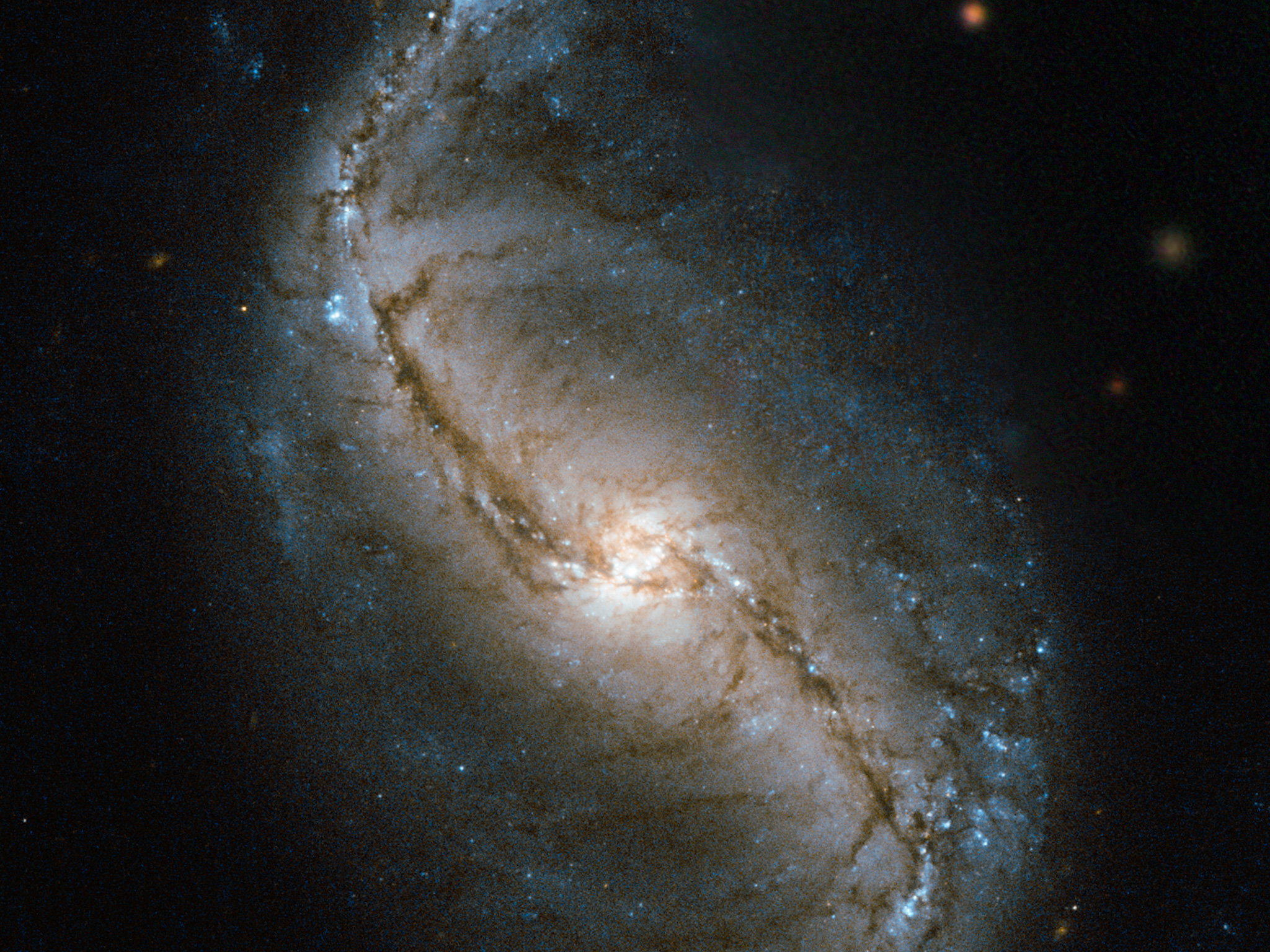
Credit:  ESA/Hubble & NASA

This new Hubble image is a snapshot of NGC 986 — a barred spiral galaxy discovered in 1828 by James Dunlop. This close-up view of the galaxy was captured by Hubble’s Wide Field and Planetary Camera 2 (WFPC2).

NGC 986 is found in the constellation of Fornax (The Furnace), located in the southern sky. NGC 986 is a bright, 11th-magnitude galaxy sitting around 56 million light-years away, and its golden centre and barred swirling arms are clearly visible in this image.

Barred spiral galaxies are spiral galaxies with a central bar-shaped structure composed of stars. NGC 986 has the characteristic S-shaped structure of this type of galactic morphology. Young blue stars can be seen dotted amongst the galaxy’s arms and the core of the galaxy is also aglow with star formation.

To the top right of this image the stars appear a little fuzzy. This is because a gap in the Hubble data was filled in with data from ground-based telescopes. Although the view we see in this filled in patch is accurate, the resolution of the stars is no match for Hubble’s clear depiction of the spiral galaxy.


Source:  ESA/Hubble - Space Telescope


Thursday, November 20, 2014

The riddle of the missing stars

Four globular clusters in Fornax

Four globular clusters in Fornax — annotated

Globular cluster Fornax 1

Globular cluster Fornax 2

Globular cluster Fornax 3

Globular cluster Fornax 5

Fornax galaxy with four globular clusters marked

Fornax dwarf galaxy


****************************************************************

Videos

 
Hubblecast 80: The riddle of the missing stars

Hubble and the sunrise over Earth

Globular cluster in 3D

Structure of a globular cluster


Hubble observations cast further doubt on how globular clusters formed

Thanks to the NASA/ESA Hubble Space Telescope, some of the most mysterious cosmic residents have just become even more puzzling. New observations of globular clusters in a small galaxy show they are very similar to those found in the Milky Way, and so must have formed in a similar way. One of the leading theories on how these clusters form predicts that globular clusters should only be found nestled in among large quantities of old stars. But these old stars, though rife in the Milky Way, are not present in this small galaxy, and so, the mystery deepens.

Globular clusters — large balls of stars that orbit the centres of galaxies, but can lie very far from them — remain one of the biggest cosmic mysteries. They were once thought to consist of a single population of stars that all formed together. However, research has since shown that many of the Milky Way's globular clusters had far more complex formation histories and are made up of at least two distinct populations of stars.

Of these populations, around half the stars are a single generation of normal stars that were thought to form first, and the other half form a second generation of stars, which are polluted with different chemical elements. In particular, the polluted stars contain up to 50-100 times more nitrogen than the first generation of stars.

The proportion of polluted stars found in the Milky Way's globular clusters is much higher than astronomers expected, suggesting that a large chunk of the first generation star population is missing. A leading explanation for this is that the clusters once contained many more stars but a large fraction of the first generation stars were ejected from the cluster at some time in its past.

This explanation makes sense for globular clusters in the Milky Way, where the ejected stars could easily hide among the many similar, old stars in the vast halo, but the new observations, which look at this type of cluster in a much smaller galaxy, call this theory into question.

Astronomers used Hubble's Wide Field Camera 3 (WFC3) to observe four globular clusters in a small nearby galaxy known as the Fornax Dwarf Spheroidal galaxy [1].

"We knew that the Milky Way's clusters were more complex than was originally thought, and there are theories to explain why. But to really test our theories about how these clusters form we needed to know what happened in other environments," says Søren Larsen of Radboud University in Nijmegen, the Netherlands, lead author of the new paper. "Before now we didn’t know whether globular clusters in smaller galaxies had multiple generations or not, but our observations show clearly that they do!"

The astronomers' detailed observations of the four Fornax clusters show that they also contain a second polluted population of stars [2] and indicate that not only did they form in a similar way to one another, their formation process is also similar to clusters in the Milky Way. Specifically, the astronomers used the Hubble observations to measure the amount of nitrogen in the cluster stars, and found that about half of the stars in each cluster are polluted at the same level that is seen in Milky Way's globular clusters.

This high proportion of polluted second generation stars means that the Fornax globular clusters' formation should be covered by the same theory as those in the Milky Way.

Based on the number of polluted stars in these clusters they would have to have been up to ten times more massive in the past, before kicking out huge numbers of their first generation stars and reducing to their current size. But, unlike the Milky Way, the galaxy that hosts these clusters doesn't have enough old stars to account for the huge number that were supposedly banished from the clusters.

"If these kicked-out stars were there, we would see them — but we don't!" explains Frank Grundahl of Aarhus University in Denmark, co-author on the paper. "Our leading formation theory just can't be right. There's nowhere that Fornax could have hidden these ejected stars, so it appears that the clusters couldn't have been so much larger in the past."

This finding means that a leading theory on how these mixed generation globular clusters formed cannot be correct and astronomers will have to think once more about how these mysterious objects, in the Milky Way and further afield, came to exist.

The new work is detailed in a paper published today, 20 November 2014, in The Astrophysical Journal.


Notes

[1] The Milky Way’s gravity keeps Fornax orbiting around us as a satellite galaxy.

[2] The clusters studied were named Fornax 1, 2, 3, and 5. Fornax 1, 3, and 5 are made up of approximately 40% first generation stars to 60% polluted second generation ones, while Fornax 2 contains around 60% first generation and 40% second generation.


Notes for editors

The Hubble Space Telescope is a project of international cooperation between ESA and NASA.

The international team of astronomers in this study consists of S. Larsen (Radboud University, the Netherlands), J. P Brodie (University of California, USA), F. Grundahl (Aarhus University, Denmark), and J. Strader (Michigan State University, USA).


More information

Image credit: NASA, ESA, S. Larsen (Radboud University, the Netherlands)


Links


Contacts

Søren Larsen
Radboud University
Nijmegen, Netherlands
Tel: +31 (0)24 365 2806
Email: s.larsen@astro.ru.nl

Frank Grundahl
Aarhus University
Aarhus, Denmark
Tel: +45 21 31 43 67
Email: fgj@phys.au.dk

Georgia Bladon
ESA/Hubble, Public Information Officer
Garching bei München, Germany
Cell: +44 7816291261
Email: gbladon@partner.eso.org


Subaru Telescope Detects Sudden Appearance of Galaxies in the Early Universe

Figure 1: Color composite images of seven LAEs found in this study as they appeared 13.1 billion years ago. This represents the combination of three filter images from Subaru Telescope. Red objects between two white lines are the LAEs. The LAEs of 13.1 billion years ago have a quite red color due to the effects of cosmic expansion on their component wavelengths of light. (Credit: ICRR, University of Tokyo)

Figure 2: This shows evolution of the Lyman-alpha luminosities of the galaxies. The yellow circle at 1 billion years after the Big Bang is used for normalization. The yellow circles come from previous studies, and the yellow dashed line shows the expected evolutionary trend of the luminosity. The current finding is shown by a red circle, and we can see that the galaxies appear suddenly when the universe was 700 million years old. This indicates that the neutral hydrogen fog was suddenly cleared, allowing the galaxies to shine out, as indicated by the backdrop shown for scale and illustration. Click here to see the diagram without the labels inside. (Credit: ICRR, University of Tokyo; Hubble Space Telescope/NASA/ESA)

A team of astronomers using the Subaru Telescope's Suprime-Cam to perform the Subaru Ultra-Deep Survey for Lyman-alpha Emitters have looked back more than 13 billion years to find 7 early galaxies that appeared quite suddenly within 700 million years of the Big Bang (Note 1). The team, led by graduate student Akira Konno and Dr. Masami Ouchi (Associate Professor at the University of Tokyo's ICRR) was looking for a specific kind of galaxy called a Lyman-alpha emitter (LAE), to understand the role such galaxies may have played in an event called "cosmic reionization". (Figure 1)

LAE galaxies are illuminated by strong hydrogen excitation (called Lyman-alpha emission) (Note 2). The team's discovery of these LAEs at a distance of 13.1 billion light-years suggests that LAE galaxies appeared rather suddenly in the early universe.

The universe was born in the Big Bang some 13.8 billion years ago. In its earliest epochs, it was filled with a hot "soup" of charged protons and electrons. As the newborn universe expanded, its temperature decreased uniformly. When the universe was 400,000 years old, conditions were cool enough to allow the protons and electrons to bond and form neutral hydrogen atoms. That event is called "recombination" and resulted in a universe filled with a "fog" of these neutral atoms.

Eventually the first stars and galaxies began to form, and their ultraviolet light ionized (energized) the hydrogen atoms, and "divided" the neutral hydrogen into protons and electrons again. As this occurred, the "fog" of neutrals cleared. Astronomers call this event "cosmic reionization" and think that it ended about 12.8 billion years ago (about a billion years after the Big Bang). The timing of this event – when it started and how long it lasted – is one of the big questions in astronomy.

To investigate this cosmic reionization, the Subaru team searched for early LAE galaxies at a distance of 13.1 billion light years. Although Hubble Space Telescope has found more distant LAE galaxies, the discovery of seven such galaxies at 13.1 billion light-years represents a distance milestone for Subaru Telescope (Note 3).
Mr. Konno, the graduate student heading the analysis of the data from the Subaru Telescope pointed out the obstacles that Subaru had to overcome to make the observations. "It is quite difficult to find the most distant galaxies due to the faintness of the galaxies." he said. "So, we developed a special filter to be able to find a lot of faint LAEs. We loaded the filter onto Suprime-Cam and conducted the most distant LAE survey with the integration time of 106 hours."

That extremely long integration time was one of the longest ever performed at Subaru Telescope. It allowed for unprecedented sensitivity and enabled the team to search for as many of the most distant LAEs as possible. According to Konno, the team expected to find several tens of LAEs. Instead they only found seven.

"At first we were very disappointed at this small number," Konno said. "But we realized that this indicates LAEs appeared suddenly about 13 billion years ago. This is an exciting discovery. Figure 2 shows how the luminosities of LAEs changed based on this study. We can see that the luminosities suddenly brightened during the 700-800 million years after the Big Bang. What would cause this?

According to the team's analysis, one reason that LAEs appeared very quickly is cosmic reionization. LAEs in the epoch of cosmic reionization became darker than the actual luminosity due to the presence of the neutral hydrogen fog. In the team's analysis of their observations, they suggest the possibility that the neutral fog filling the universe was cleared about 13.0 billion years ago and LAEs suddenly appeared in sight for the first time."

"However, there are other possibilities to explain why LAEs appeared suddenly," said Dr. Ouchi, who is the principal investigator of this program. "One is that clumps of neutral hydrogen around LAEs disappeared. Another is that LAEs became intrinsically bright. The reason of the intrinsic brightening is that the Lyman-alpha emission is not efficiently produced by the ionized clouds in a LAE due to the significant escape of ionizing photons from the galaxy. In either case, our discovery is an important key to understanding cosmic reionization and the properties of the LAEs in early universe."

Dr. Masanori Iye, who is a representative of the Thirty Meter Telescope (TMT) project of Japan, commented on the observations and analysis. "To investigate which possibility is correct, we will observe with HSC (Hyper Suprime-Cam) on Subaru Telescope, which has a field of view 7 times wider than Suprime-Cam, and TMT currently being built on the summit of Mauna Kea in Hawaii in the future. By these observations, we will clarify the mystery of how galaxies were born and cosmic reionization occurred."

This research is published in the November 20, 2014 issue of The Astrophysical Journal. The work was supported by the Carnegie Observatory, World Premier International Research Center Initiative (WPI Initiative), MEXT, Japan, and KAKENHI (23244025) Grant-in-Aid for Scientific Research (A) through Japan Society for the Promotion of Science (JSPS).

Notes:

  1. The values of the cosmic age and distance in this press release are based on the latest Planck results. Planck observes the cosmic microwave background. A previous press release on this subject used values based on the cosmological parameters derived from the measurements by WMAP (Wilkinson Microwave Anisotropy Probe).
    The parameters used here are H_0=67.1 km/s/Mpc, Ω=0.317, Λ=0.683 instead of the ones used in the past articles at Subaru Telescope's website H_0=71, Ω=0.27, Λ=0.73.
  2. Lyman-alpha emission line is a spectral line of hydrogen, with a wavelength of 121.6 nm (1nm is one billionth of a meter), and is in the ultraviolet portion of the spectrum. Galaxies illuminated by strong Lyman-alpha line are called "Lyman-alpha emitting galaxies" (LAEs).
  3. In previous studies, astronomers have found hundreds of LAEs existing 12.9 billion years ago, which corresponds to the epoch when cosmic reionization finally ended.