Wednesday, November 19, 2014

Spooky Alignment of Quasars Across Billions of Light-years

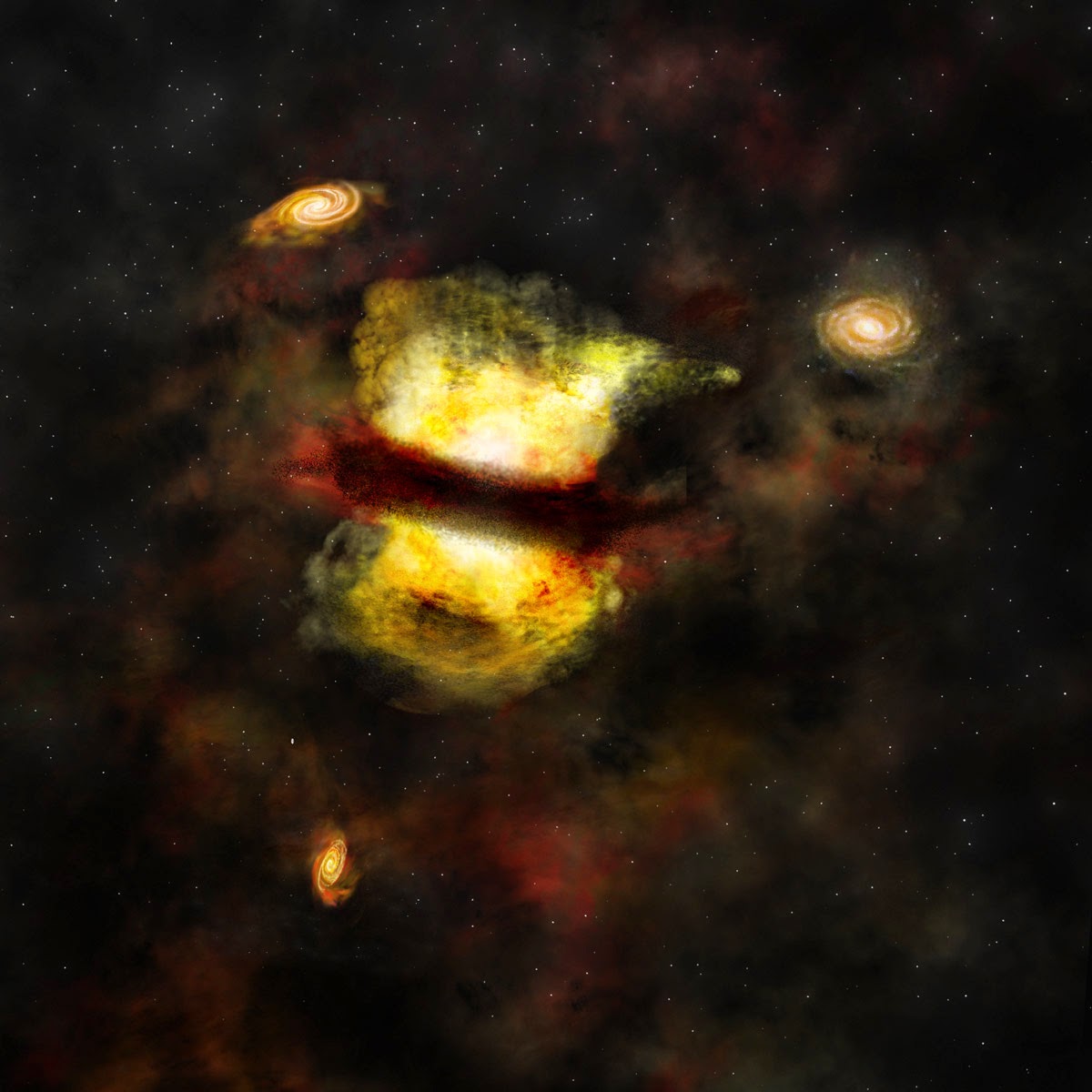
Artist’s impression of mysterious alignment of quasar rotation axes
Simulation of large scale structure

**************************************

Videos

Artist's impression of mysterious alignment of quasar rotation axes


VLT reveals alignments between supermassive black hole axes and large-scale structure

New observations with ESO’s Very Large Telescope (VLT) in Chile have revealed alignments over the largest structures ever discovered in the Universe. A European research team has found that the rotation axes of the central supermassive black holes in a sample of quasars are parallel to each other over distances of billions of light-years. The team has also found that the rotation axes of these quasars tend to be aligned with the vast structures in the cosmic web in which they reside.

Quasars are galaxies with very active supermassive black holes at their centres. These black holes are surrounded by spinning discs of extremely hot material that is often spewed out in long jets along their axes of rotation. Quasars can shine more brightly than all the stars in the rest of their host galaxies put together.

A team led by Damien Hutsemékers from the University of Liège in Belgium used the FORS instrument on the VLT to study 93 quasars that were known to form huge groupings spread over billions of light-years, seen at a time when the Universe was about one third of its current age.

The first odd thing we noticed was that some of the quasars’ rotation axes were aligned with each other — despite the fact that these quasars are separated by billions of light-years,” said Hutsemékers.
The team then went further and looked to see if the rotation axes were linked, not just to each other, but also to the structure of the Universe on large scales at that time.

When astronomers look at the distribution of galaxies on scales of billions of light-years they find that they are not evenly distributed. They form a cosmic web of filaments and clumps around huge voids where galaxies are scarce. This intriguing and beautiful arrangement of material is known as large-scale structure.

The new VLT results indicate that the rotation axes of the quasars tend to be parallel to the large-scale structures in which they find themselves. So, if the quasars are in a long filament then the spins of the central black holes will point along the filament. The researchers estimate that the probability that these alignments are simply the result of chance is less than 1%.

A correlation between the orientation of quasars and the structure they belong to is an important prediction of numerical models of evolution of our Universe. Our data provide the first observational confirmation of this effect, on scales much larger that what had been observed to date for normal galaxies,” adds Dominique Sluse of the Argelander-Institut für Astronomie in Bonn, Germany and University of Liège.

The team could not see the rotation axes or the jets of the quasars directly. Instead they measured the polarisation of the light from each quasar and, for 19 of them, found a significantly polarised signal. The direction of this polarisation, combined with other information, could be used to deduce the angle of the accretion disc and hence the direction of the spin axis of the quasar.

The alignments in the new data, on scales even bigger than current predictions from simulations, may be a hint that there is a missing ingredient in our current models of the cosmos,” concludes Dominique Sluse. 


More Information

This research was presented in a paper entitled “Alignment of quasar polarizations with large-scale structures“, by D. Hutsemékers et al., to appear in the journal Astronomy & Astrophysics on 19 November 2014.

The team is composed of D. Hutsemékers (Institut d’Astrophysique et de Géophysique, Université de Liège, Liège, Belgium), L. Braibant (Liège), V. Pelgrims (Liège) and D. Sluse (Argelander-Institut für Astronomie, Bonn, Germany; Liège).

ESO is the foremost intergovernmental astronomy organisation in Europe and the world’s most productive ground-based astronomical observatory by far. It is supported by 15 countries: Austria, Belgium, Brazil, the Czech Republic, Denmark, France, Finland, Germany, Italy, the Netherlands, Portugal, Spain, Sweden, Switzerland and the United Kingdom. ESO carries out an ambitious programme focused on the design, construction and operation of powerful ground-based observing facilities enabling astronomers to make important scientific discoveries. ESO also plays a leading role in promoting and organising cooperation in astronomical research. ESO operates three unique world-class observing sites in Chile: La Silla, Paranal and Chajnantor. At Paranal, ESO operates the Very Large Telescope, the world’s most advanced visible-light astronomical observatory and two survey telescopes. VISTA works in the infrared and is the world’s largest survey telescope and the VLT Survey Telescope is the largest telescope designed to exclusively survey the skies in visible light. ESO is the European partner of a revolutionary astronomical telescope ALMA, the largest astronomical project in existence. ESO is currently planning the 39-metre European Extremely Large optical/near-infrared Telescope, the E-ELT, which will become “the world’s biggest eye on the sky”. 

Links


Contacts:

Damien Hutsemékers
Institut d’Astrophysique et de Géophysique — Université de Liège
Liège, Belgium
Tel: +32 4 366 9760
Email:
hutsemekers@astro.ulg.ac.be

Dominique Sluse
Institut d'Astrophysique et de Géophysique — Université de Liège
Liège, Belgium
Tel: +32 4 366 9797
Email:
dsluse@ulg.ac.be

Richard Hook
ESO education and Public Outreach Department
Garching bei München, Germany
Tel: +49 89 3200 6655
Cell: +49 151 1537 3591
Email:
rhook@eso.org

Source: ESO


Tuesday, November 18, 2014

Astronomers dissect the aftermath of a Supernova

A labeled panel of images showing different views of Supernova Remnant 1987A
Left Panel: SNR1987A as seen by the Hubble Space Telescope in 2010.Middle Panel: SNR1987A as seen by the Australia Telescope Compact Array (ATCA) in New South Wales and the Atacama Large Millimeter/submillimeter Array (ALMA) in Chile. Right Panel: A computer generated visualisation of the remnant showing the possible location of a Pulsar. Credit: ATCA & ALMA Observations & data - G. Zanardo et al. / HST Image: NASA, ESA, K. France (University of Colorado, Boulder), P. Challis and R. Kirshner (Harvard-Smithsonian Center for Astrophysics). Labeled image - No labels image

A mosaic of images showing the latest observations of Supernova remnant 1987A at radio frequencies to the far infrared. Images below 100 GHz are from observations made with the ATCA telescope (NSW, Australia), and images above 100 GHz are from the ALMA telescope (Chile). The map on the bottom right of the mosaic is obtained by combining five images. This is used to investigate whether there is a pulsar wind nebula inside the remnant. Credit: G. Zanardo, ICRAR-UWA 

An outline of the equatorial ring and inner debris, as seen with the Hubble Space Telescope (green/blue contours), on top of ALMA observations of the remnant at 345 GHz (red/orange, with rendering). Credit: G. Zanardo, ICRAR-UWA

A simulated still showing components of Supernova Remnant 1987A. 

Credit: ICRAR

 
A video compilation showing Supernova Remnant 1987A as seen by the Hubble Space Telescope in 2010, and by radio telescopes located in Australia and Chile in 2012. The piece ends with a computer generated visualisation of the remnant showing the possible location of a Pulsar.

A visualisation showing how Supernova1987A evolves between May of 1989 and July of 2014
Credit: Dr Toby Potter, ICRAR-UWA, Dr Rick Newton, ICRAR-UWA 

In research published today in the Astrophysical Journal, an Australian led team of astronomers has used radio telescopes in Australia and Chile to see inside the remains of a supernova. 

The supernova, known as SN1987A, was first seen by observers in the Southern Hemisphere in 1987 when a giant star suddenly exploded at the edge of a nearby dwarf galaxy called the Large Magellanic Cloud.

In the two and a half decades since then the remnant of Supernova 1987A has continued to be a focus for researchers the world over, providing a wealth of information about one of the Universe’s most extreme events.

PhD Candidate Giovanna Zanardo at The University of Western Australia node of the International Centre for Radio Astronomy Research led the team that used the Atacama Large Millimetre/submillimeter Array (ALMA) in Chile’s Atacama Desert and the Australia Telescope Compact Array (ATCA) in New South Wales to observe the remnant at wavelengths spanning the radio to the far infrared.

"By combining observations from the two telescopes we’ve been able to distinguish radiation being emitted by the supernova’s expanding shock wave from the radiation caused by dust forming in the inner regions of the remnant,” said Giovanna Zanardo of the International Centre for Radio Astronomy Research (ICRAR) in Perth, Western Australia.
"This is important because it means we’re able to separate out the different types of emission we’re seeing and look for signs of a new object which may have formed when the star's core collapsed. It's like doing a forensic investigation into the death of a star."

“Our observations with the ATCA and ALMA radio telescopes have shown signs of something never seen before, located at the centre or the remnant. It could be a pulsar wind nebula, driven by the spinning neutron star, or pulsar, which astronomers have been searching for since 1987. It’s amazing that only now, with large telescopes like ALMA and the upgraded ATCA, we can peek through the bulk of debris ejected when the star exploded and see what’s hiding underneath."

More research published recently in the Astrophysical Journal also attempts to shine a light on another long-standing mystery surrounding the supernova remnant. Since 1992 the radio emission from one side of the remnant has appeared ‘brighter’ than the other.  
In an effort to solve this puzzle, Dr Toby Potter, another researcher from ICRAR’s UWA node has developed a detailed three-dimensional simulation of the expanding supernova shockwave.

“By introducing asymmetry into the explosion and adjusting the gas properties of the surrounding environment, we were able to reproduce a number of observed features from the real supernova such as the persistent one-sidedness in the radio images”, said Dr Toby Potter.

The time evolving model shows that the eastern (left) side of the expanding shock front expands more quickly than the other side, and generates more radio emission than its weaker counterpart. This effect becomes even more apparent as the shock collides into the equatorial ring, as observed in Hubble Space Telescope images of the supernova.

"Our simulation predicts that over time the faster shock will move beyond the ring first. When this happens, the lop-sidedness of radio asymmetry is expected to be reduced and may even swap sides.”

“The fact that the model matches the observations so well means that we now have a good handle on the physics of the expanding remnant and are beginning to understand the composition of the environment surrounding the supernova – which is a big piece of the puzzle solved in terms of how the remnant of SN1987A formed.”


Supporting Multimedia:  

The animation and images below are available for download from this link.


Original publication details:

‘Spectral and Morphological Analysis of the Remnant of Supernova 1987a with ALMA & ATCA’ G. Zanardo, L. Staveley-Smith, R. Indebetouw et al. Published in the in the Astrophysical Journal November 10th, 2014. Pre-print paper available at: http://arxiv.org/abs/1409.7811 and http://iopscience.iop.org/0004-637X/796/2/82 after 8am EST, November 10th.

‘Multi-dimensional simulations of the expanding supernova remnant SN 1987a’ T.M Potter, L Staveley-Smith, B. Reville et al. Published in the Astrophysical Journal October 20th, 2014. Available at http://arxiv.org/abs/1409.4068 and http://iopscience.iop.org/0004-637X/794/2/174.


Further information:

ICRAR is a joint venture between Curtin University and The University of Western Australia with support and funding from the State Government of Western Australia. 

Contact Details:

Dr Giovana Zanardo, ICRAR - UWA 
Ph: +61 8 6488 7765 | M: +61 414 531 081
E: Giovanna.Zanardo@gmail.com

Professor Lister Staveley-Smith, ICRAR Science Director - UWA 
Ph: +61 8 6488 4550 | M: +61 425 212 592
E: Lister.Staveley-smith@icrar.org

Pete Wheeler, ICRAR Media Contact 
Ph: +61 8 6488 7771 | M: +61 423 982 018
E: Pete.Wheeler@icrar.org

David Stacey, UWA Media Manager 
Ph: +61 8 6488 7977 
E: David.Stacey@uwa.edu.au


Monday, November 17, 2014

First observations of the surface of objects from the Oort cloud

CFHT observations of C/2014 S3 and C/1996 O1 (Hale Bopp)
The cometary coma is very strong on the Hale Bopp image while there is a faint hint of a coma on the image of C/2014 S3. 
Images Credits: K. Meech, O. Hainaut, and J. Bauer

Gemini image of C/2013 P2. 
Very little coma is seen despite the proximity to the Sun. 
Credits: K. Meech.

Astronomers from the University of Hawaii in Manoa, ESO, ASIAA in Taiwan, DLR in Berlin and IAA in Bangalore, India announced the discovery of two unusual objects in comet-like orbits but with almost no activity, giving scientists a first look at their surfaces. These results, presented at the annual meeting of the Division of Planetary Sciences of the American Astronomical Society in Tucson, Arizona, are particularly intriguing because the surfaces are different from what astronomers expected, and they give us clues about the movement of material in the early solar system as the planets were assembled.

The two objects, named C/2013 P2 and C/2014 S3, were discovered using Pan-STARRS survey telescope (PS1) on Haleakala, Maui, Hawaii. Both objects have the orbit of a comet coming from the Oort cloud, a spherical halo of comet nuclei in the outer solar system that extends to about 100,000 times the Earth-sun distance, which is known as 1 astronomical unit, or 1 AU. 

Follow-up observations were done on CFHT for both objects and C/2013 P2 was also followed-up with Gemini. Very little coma is seen despite the fact that they are both on a cometary orbit on its closest approach to the Sun. When they get that close to the Sun, comets erupt and produce tails that have been observed across all of humanity's History. In 1996, a team of astronomers at the University of Hawaii used MegaCam on CFHT to observe the center of comet Hale Bopp (C/1995 O1) where it clearly had a massive coma and tail. 

Furthermore, Gemini observations of C/2013 P2 also shows that this object may be an inactive Oort cloud comet. Such objects were hypothesized by Jan Oort back in 1950 when he inferred the existence of what we now call the Oort cloud. Oort suggested that these bodies might have a layer of "volatile frosting" left over from 4.5 billion years of space radiation that disappears after their first pass through the inner solar system. The activity seen in C/2013 P2 is consistent with ice sublimation models but at a level that is one thousand to a million times less than we typically see for comets coming from the Oort cloud. The CFHT data were critical for these models since they need brightness to be sampled over time. 

On the other hand, CFHT images of C/2014 S3 portrais it as a bluer object whose composition is similar to inner solar system asteroid material. This would make C/2014 S3 a unique asteroid that orbits the Sun like a comet. This discovery may help shed some light on some mysteries related to the formation of the solar system. There are several models that try to explain how the planets grew in the early solar system, and some of these predict that material formed close to the sun could have been thrown outward into the outer Solar System and Oort cloud, where it remains today. Bodies like C/2014 S3 could be evidence of this.


Additional information:  Official press release


Information:

Media contact:

Daniel Devost
Director of Science Operations.
Phone number (CFHT): (808)885-3163
devost@cfht.hawaii.edu

Dr. Karen Meech
Institute for Astronomy
+1 720-231-7048 (on MST)

Bin Yang, ESO
byang@eso.org

Henry Hsieh
hhsieh@asiaa.sinica.edu.tw
Cell: +1 808-729-4208 (until 11/22)
+886 0983 436 485 (Taiwan)


Saturday, November 15, 2014

Astronomers Thrilled by Extreme Storms on Uranus

Infrared images of Uranus (1.6 and 2.2 microns) obtained on Aug. 6, 2014, with adaptive optics on the 10-meter Keck II telescope. The white spot is an extremely large storm that was brighter than any feature ever recorded on the planet in the 2.2 micron band. The cloud rotating into view at the lower-right limb grew into the large storm that was seen by amateur astronomers at visible wavelengths. Credit: Imke de Pater (UC Berkeley) & W. M. Keck Observatory images.

Animation showing the movement of the bright spot as Uranus rotated over a two hour period on Oct. 4, 2014. The images were taken at the Pic du Midi telescope in the French Pyrénées. Credit: CLICK ON IMAGE TO SEE ANIMATED GIF Courtesy of Marc Delcroix and F. Colas (S2P).

Optical images of Uranus on Sept. 19 and Oct. 2, showing the dramatic appearance of a bright storm on a planet that normally displays only a diffuse bright polar region. Credit: Courtesy of Anthony Wesley, Murrumbateman, Australia. 

MAUNA KEA, Hawaii — The normally bland face of Uranus has become increasingly stormy, with enormous cloud systems so bright that for the first time ever, amateur astronomers are able to see details in the planet's hazy blue-green atmosphere.

"The weather on Uranus is incredibly active," said Imke de Pater, professor and chair of astronomy at the University of California, Berkeley, and leader of the team that first noticed the activity when observing the planet with adaptive optics on the W. M. Keck Observatory in Hawaii.

"This type of activity would have been expected in 2007, when Uranus's once every 42-year equinox occurred and the sun shined directly on the equator,” noted co-investigator Heidi Hammel of the Association of Universities for Research in Astronomy. “But we predicted that such activity would have died down by now. Why we see these incredible storms now is beyond anybody's guess."

In all, de Pater, Hammel and their team detected eight large storms on Uranus’s northern hemisphere when observing the planet with the Keck Observatory on August 5 and 6. One was the brightest storm ever seen on Uranus at 2.2 microns, a wavelength that senses clouds just below the tropopause, where the pressure ranges from about 300 to 500 mbar, or half the pressure at Earth's surface. The storm accounted for 30 percent of all light reflected by the rest of the planet at this wavelength.

When amateur astronomers heard about the activity, they turned their telescopes on the planet and were amazed to see a bright blotch on the surface of a normally boring blue dot.

‘I got it!’

French amateur astronomer Marc Delcroix processed the amateur images and confirmed the discovery of a bright spot on an image by French amateur Régis De-Bénedictis, then in others taken by fellow amateurs in September and October. He had his own chance on Oct. 3 and 4 to photograph it with the Pic du Midi one-meter telescope, where on the second night, "I caught the feature when it was transiting, and I thought, ‘Yes, I got it!’” said Delcroix.

“I was thrilled to see such activity on Uranus. Getting details on Mars, Jupiter or Saturn is now routine, but seeing details on Uranus and Neptune are the new frontiers for us amateurs and I did not want to miss that,” said Delcroix, who works for an auto parts supplier in Toulouse and has been observing the skies – Jupiter in particular - with his backyard telescope since 2006 and, since 2012, occasionally with the Pic du Midi telescope. “I was so happy to confirm myself these first amateur images on this bright storm on Uranus, feeling I was living a very special moment for planetary amateur astronomy.”Interestingly, the extremely bright storm seen by the 10-meter Keck II telescope in the near infrared is not the one seen by the amateurs, which is much deeper in the atmosphere than the one that initially caused all the excitement. De Pater’s colleague Larry Sromovsky, a planetary scientist at the University of Wisconsin, Madison, identified the amateur spot as one of the few features on the Keck Observatory images from August 5 that was only seen at 1.6 microns, and not at 2.2 microns. The 1.6 micron light is emitted from deeper in the atmosphere, which means that this feature is below the uppermost cloud layer of methane-ice in Uranus’s atmosphere.

“The colors and morphology of this cloud complex suggests that the storm may be tied to a vortex in the deeper atmosphere similar to two large cloud complexes seen during the equinox,” Sromovsky said

Such vortices could be anchored much deeper in the atmosphere and extend over large vertical distances, as inferred from similar vortices on Jupiter, including its Great Red Spot.

An expanded team of astronomers led by Kunio M. Sayanagi, an Assistant Professor at Hampton University in Virginia, leveraged the amateur observations to activate a “Target of Opportunity” proposal on the Hubble Space Telescope, which imaged the entire planet on Oct. 14. Observing at a variety of wavelengths, HST revealed multiple storm components extending over a distance of more than 9,000 kilometers (5,760 miles) and clouds at a variety of altitudes.

De Pater, Sromovsky, Hammel and Pat Fry of the University of Wisconsin will report the details of their observations on Nov. 12 at a meeting of the American Astronomical Society’s Division of Planetary Sciences in Tucson, Ariz.

Ice giant

Uranus is an ice giant, about four times the diameter of Earth, with an atmosphere of hydrogen and helium, with just a bit of methane to give it a blue tint. Because it is so distant – 19 times farther from the sun than Earth – astronomers were able to see little detail on its surface until adaptive optics on both Keck Observatory telescopes revealed features much like those on Jupiter.

De Pater and her colleagues have been following Uranus for more than a decade, charting the weather on the planet, including bands of circulating clouds, massive swirling storms and convective features at its north pole. Bright clouds are probably caused by gases such as methane rising in the atmosphere and condensing into highly reflective clouds of methane ice.

Because Uranus has no internal source of heat, its atmospheric activity was thought to be driven solely by sunlight, which is now weak in the northern hemisphere. Hence astronomers were surprised when these observations showed such intense activity.

Observations taken with the Keck II telescope by Christoph Baranec, an Assistant Professor at the University of Hawaii on Manoa, revealed that the storm was still active, but had a different morphology and possibly reduced intensity.

“If indeed these features are high-altitude clouds generated by flow perturbations associated with a deeper vortex system, such drastic fluctuations in intensity would indeed be possible,” Sromovsky added.

“These unexpected observations remind us keenly of how little we understand about atmospheric dynamics in outer planet atmospheres,” the authors wrote in their paper.

The W. M. Keck Observatory operates the largest, most scientifically productive telescopes on Earth. The two, 10-meter optical/infrared telescopes near the summit of Mauna Kea on the Island of Hawaii feature a suite of advanced instruments including imagers, multi-object spectrographs, high-resolution spectrographs, integral-field spectographs and world-leading laser guide star adaptive optics systems.

NIRC2 (the Near-Infrared Camera, second generation) works in combination with the Keck II adaptive optics system to obtain very sharp images at near-infrared wavelengths, achieving spatial resolutions comparable to or better than those achieved by the Hubble Space Telescope at optical wavelengths. NIRC2 is probably best known for helping to provide definitive proof of a central massive black hole at the center of our galaxy. Astronomers also use NIRC2 to map surface features of solar system bodies, detect planets orbiting other stars, and study detailed morphology of distant galaxies.

Keck Observatory is a private 501(c) 3 non-profit organization and a scientific partnership of the California Institute of Technology, the University of California and NASA.


SCIENCE CONTACTS

Imke de Pater

imke@berkeley.edu

Larry Sromovsky
larry.sromovsky@ssec.wisc.edu

Heidi Hammel
(203) 321-6929

hbhammel@aura-astronomy.org

Marc Delcroix
delcroix.marc@free.fr

MEDIA CONTACT:

Steve Jefferson
Communications Officer
W. M. Keck Observatory
808.881.3827

sjefferson@keck.hawaii.edu


Friday, November 14, 2014

The Party’s Over for These Youthful Compact Galaxies Release Images

Fast Evolution of a Galaxy
This graphic illustrates how a vibrant, star-forming galaxy quickly transforms into a sedate galaxy composed of old stars. The scenario begins when two galaxies merge (Panel 1), funneling a large amount of gas into the central region. The gas compresses, sparking a firestorm of star birth, which blows out most of the remaining star-forming gas (Panel 2). Devoid of its fuel, the galaxy settles into a quiet existence, composed of aging stars (Panel 3).  Illustration Credit: NASA, ESA, and A. Feild (STScI)Science Credit: P. Sell (Texas Tech University). Release Images 
 
Outflows from 12 Merging Galaxies
The 12 galaxies in these Hubble Space Telescope images are undergoing a firestorm of star birth, as shown by their bright white cores. Hubble reveals that the galaxies' star-making frenzy was ignited by mergers with other galaxies. The odd shapes of many of the galaxies are telltale evidence of those close encounters.

The new Hubble Wide Field Camera 3 observations suggest that energy from the star-birthing frenzy created powerful winds that are blowing out the gas, squelching future generations of stars. This activity occurred when the universe was half its current age of 13.7 billion years. The gas-poor galaxies may eventually become so-called "red and dead" galaxies, composed only of aging stars.

The galaxies are the most compact yet found. They contain as much mass as our Milky Way galaxy, but packed into a much smaller area. The smallest galaxies are about 650 light-years across.

The Hubble false-color images were processed to bring out important details in the galaxies. The images were taken in 2010. Credit: NASA, ESA, and P. Sell (Texas Tech University)

Researchers using NASA's Hubble Space Telescope and Chandra X-ray Observatory have uncovered young, massive, compact galaxies whose raucous star-making parties are ending early. The firestorm of star birth has blasted out most of the remaining gaseous fuel needed to make future generations of stars. Now the party's over for these gas-starved galaxies, and they are on track to possibly becoming so-called "red and dead galaxies," composed only of aging stars.

Astronomers have debated for decades how massive galaxies rapidly evolve from active star-forming machines to star-starved graveyards. Previous observations of these galaxies reveal geysers of gas shooting into space at up to 2 million miles an hour. Astronomers have suspected that powerful monster black holes lurking at the centers of the galaxies triggered the gaseous outflows and shut down star birth by blowing out any remaining fuel.

Now an analysis of 12 merging galaxies at the end of their star-birthing frenzy is showing that the stars themselves are turning out the lights on their own star-making party. This happened when the universe was half its current age of 13.7 billion years.
"Before our study, the common belief was that stars cannot drive high-velocity outflows in galaxies; only more powerful supermassive black holes can do that," explained Paul Sell of Texas Tech University in Lubbock, lead author of a science paper describing the study's results. "Through our analysis we found that if you have a compact enough starburst, which Hubble showed was the case with these galaxies, you can actually produce the velocities of the outflows we observed from the stars alone without needing to invoke the black hole."

Team member Christy Tremonti of the University of Wisconsin-Madison first identified the galaxies from the Sloan Digital Sky Survey as post-starburst objects spouting high-speed gaseous fountains. The sharp visible-light views from Hubble's Wide Field Camera 3 show that the outflows are arising from the most compact galaxies yet found. These galaxies contain as much mass as our Milky Way galaxy, but packed into a much smaller area. The smallest galaxies are about 650 light-years across.

In such small regions of space, these galaxies are forming a few hundred suns a year. (By comparison, the Milky Way makes only about one sun a year.) This makes for a rowdy party that wears itself out quickly, in only a few tens of millions of years. One reason for the stellar shutdown is that the gas rapidly heats up, becoming too hot to contract under gravity to form new stars. Another possibility is that the star-birthing frenzy blasts out most of the star-making gas via powerful stellar winds.

"The biggest surprise from Hubble was the realization that the newly formed stars were born so close together," said team member Aleks Diamond-Stanic of the University of Wisconsin-Madison, who first suggested the possibility of starburst-driven outflows from these galaxies in a 2012 science paper. "The extreme physical conditions at the centers of these galaxies explain how they can expel gas at millions of miles per hour."

To identify the mechanism triggering the high-velocity outflows, Sell and his team used the Chandra X-ray Observatory and other telescopes to determine whether the galaxies' supermassive black holes (weighing up to a billion suns) were the powerhouses driving them. After analyzing all of the observations, the team concluded that the black holes were not the source of the outflows. Rather, it was the powerful stellar winds from the most massive and short-lived stars at the end of their lives, combined with their explosive deaths as supernovae.

Based on their analysis of the Hubble and Chandra data, team members suggest that the "party begins" when two gas-rich galaxies collide, funneling a torrent of cold gas into the merging galaxies' compact center. The large amount of gas compressed into the small space ignites the birth of numerous stars. The energy from the stellar firestorm then blows out the leftover gas, quenching further star formation.

"If you stop the flow of cold gas to form stars, that's it," explained Sell, who conducted the research while a graduate student at the University of Wisconsin-Madison. "The stars stop forming, and the galaxy rapidly evolves and may eventually become a red, dead elliptical galaxy. These extreme starbursts are quite rare, however, so they may not grow into the typical giant elliptical galaxies seen in our nearby galactic neighborhood. They may, instead, be more compact."

The team's results were published in the July 11 edition of the Monthly Notices of the Royal Astronomical Society.


Contact:

Donna Weaver / Ray Villard
Space Telescope Science Institute, Baltimore, Md.
410-338-4493 / 410-338-4514

dweaver@nasa.gov / villard@stsci.edu

Paul Sell
Texas Tech University, Lubbock, Texas
806-742-7129

paul.sell@ttu.edu


Source: HubbleSite

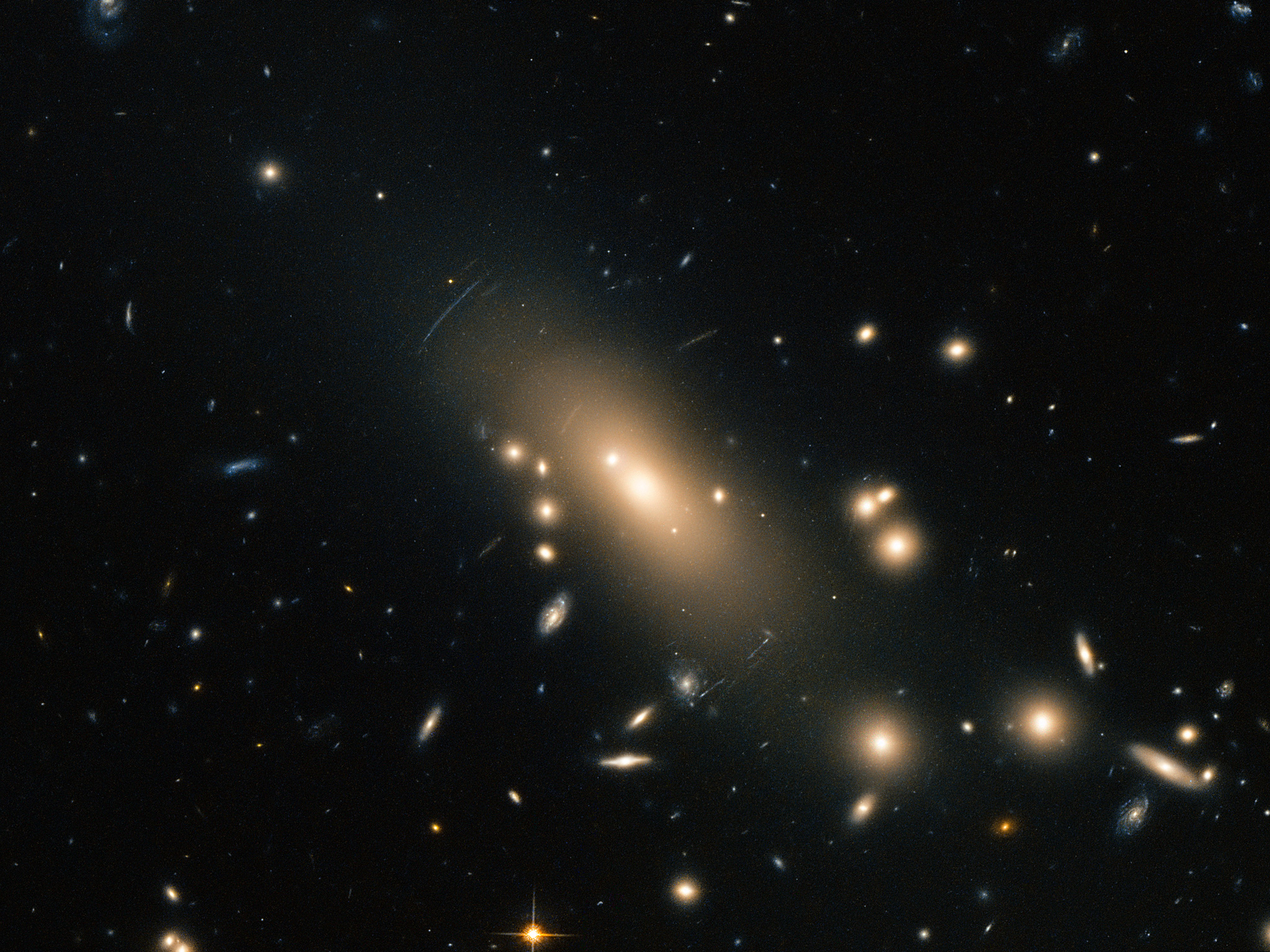
Hubble reveals a super-rich galactic neighbourhood

Credit: ESA/Hubble & NASA
Acknowledgement: Nick Rose

This new image from the NASA/ESA Hubble Space Telescope shows the super-rich galaxy cluster Abell 1413. Located between the constellations of Leo (The Lion) and Coma Berenices, the cluster is over 2 billion light-years from Earth. This image is dominated by a large and highly elliptical galaxy called MCG+04-28-097, with a halo of stars extending for more than 6.5 million light-years [1].

Abell 1413 is part of the Abell catalogue, a collection of over 4000 rich clusters of galaxies fairly close to Earth — at least from a cosmological perspective — their light took less than 3 billion years to reach us. The clusters are called rich due to the huge number of galaxies they play host to. Abell 1413 is observed to contain more than 300 galaxies held together by the immense gravity of the cluster.

The strong interactions between these galaxies cause the material in the cluster to be heated to extremely high temperatures of almost 100 million degrees. Because of this, the cluster emits very strong X-ray radiation.
Visible distortions in the image can be seen in the form of arcs, caused by gravitational lensing [2].

This image was created from optical and near-infrared exposures taken with the Wide Field Channel of Hubble’s Advanced Camera for Surveys (ACS). A version of this image was entered into the Hubble's Hidden Treasures image processing competition by contestant Nick Rose.


Notes

[1] The galaxies at the centre of Abell 1413 are found to be very highly elliptical whereas those at the periphery are more spherical.

[2] Gravitational lensing occurs when the intense gravity of the cluster bends space-time around it, causing a range of bizarre and beautiful optical phenomena for galaxies located in the background.


Source:  ESA/Hubble - Space Telescope


Thursday, November 13, 2014

Sagittarius A*: NASA X-ray Telescopes Find Black Hole May Be a Neutrino Factory

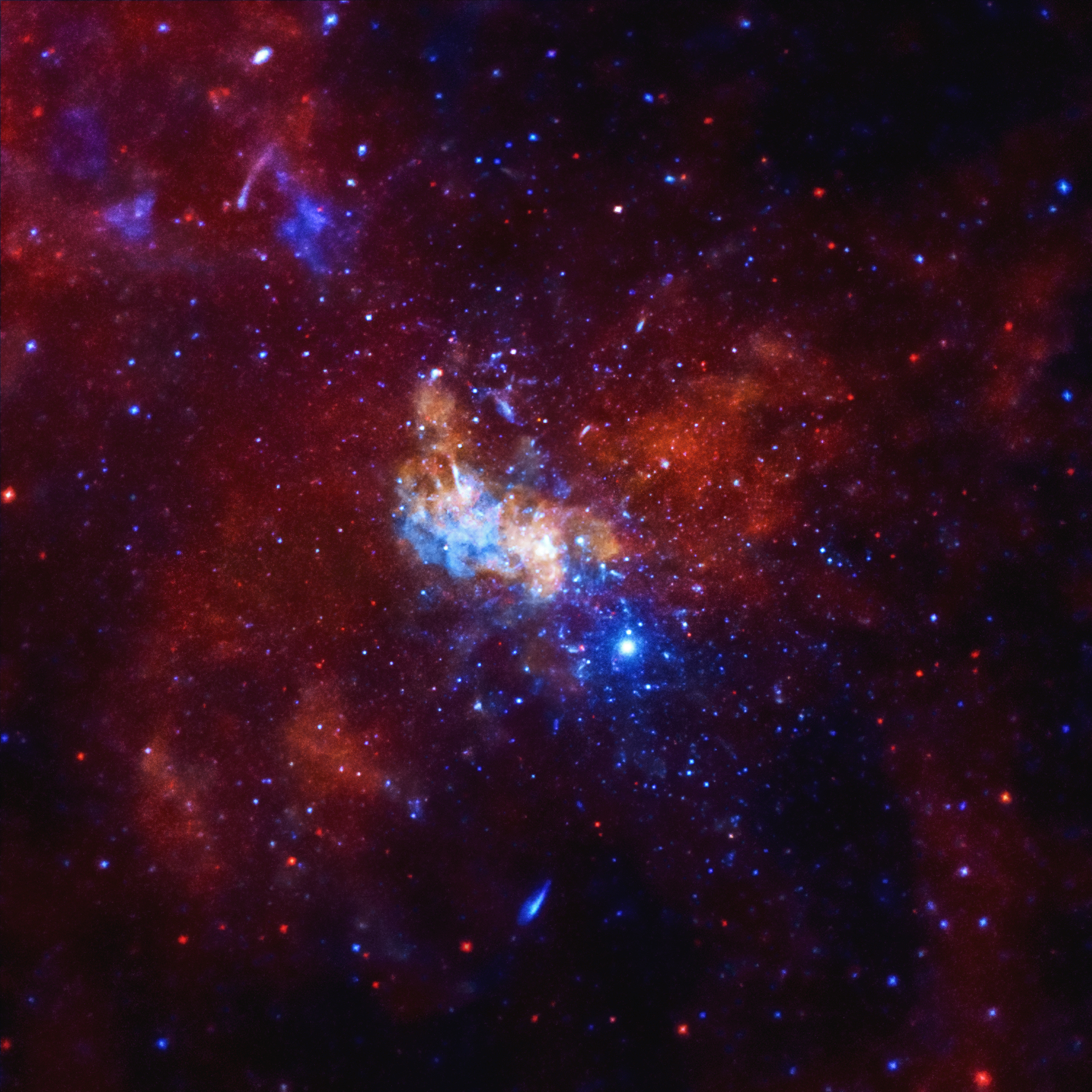
Sagittarius A*  
Credit: NASA/CXC/Univ. of Wisconsin/Y.Bai. et al.


Videos

animation
 

The supermassive black hole at the center of the Milky Way, seen in this image from NASA's Chandra X-ray Observatory, may be producing mysterious particles called neutrinos, as described in our latest press release. Neutrinos are tiny particles that have virtually no mass and carry no electric charge. Unlike light or charged particles, neutrinos can emerge from deep within their sources and travel across the Universe without being absorbed by intervening matter or, in the case of charged particles, deflected by magnetic fields.

While the Sun produces neutrinos that constantly bombard the Earth, there are also other neutrinos with much higher energies that are only rarely detected. Scientists have proposed that these higher-energy neutrinos are created in the most powerful events in the Universe like galaxy mergers, material falling onto supermassive black holes, and the winds around dense rotating stars called pulsars.

Using three NASA X-ray telescopes, Chandra, Swift, and NuSTAR, scientists have found evidence for one such cosmic source for high-energy neutrinos: the 4-million-solar-mass black hole at the center of our Galaxy called Sagittarius A* (Sgr A*, for short). After comparing the arrival of high-energy neutrinos at the underground facility in Antarctica, called IceCube, with outbursts from Sgr A*, a team of researchers found a correlation. In particular, a high-energy neutrino was detected by IceCube less than three hours after astronomers witnessed the largest flare ever from Sgr A* using Chandra. Several flares from neutrino detections at IceCube also appeared within a few days of flares from the supermassive black hole that were observed with Swift and NuSTAR.

This Chandra image shows the region around Sgr A* in low, medium, and high-energy X-rays that have been colored red, green, and blue respectively. Sgr A* is located within the white area in the center of the image. The blue and orange plumes around that area may be the remains of outbursts from Sgr A* that occurred millions of years ago. The flares that are possibly associated with the IceCube neutrinos involve just the Sgr A* X-ray source.

This latest result may also contribute to the understanding of another major puzzle in astrophysics: the source of high-energy cosmic rays. Since the charged particles that make up cosmic rays are deflected by magnetic fields in our Galaxy, scientists have been unable to pinpoint their origin. The charged particles accelerated by a shock wave near Sgr A* may be a significant source of very energetic cosmic rays.

The paper describing these results was published in Physical Review D and is also available online. The authors of the study are Yang Bai, Amy Barger, Vernon Barger, R. Lu, Andrea Peterson, J. Salvado, all from the University of Wisconsin, in Madison, Wisconsin.

NASA's Marshall Space Flight Center in Huntsville, Alabama, manages the Chandra program for NASA's Science Mission Directorate in Washington. The Smithsonian Astrophysical Observatory in Cambridge, Massachusetts, controls Chandra's science and flight operations.


Fast Facts for Sagittarius A*: 


Release Date: November 13, 2014
Scale: Image is about 12 arcmin across (about 91 light years)
Category: Black Holes, Milky Way Galaxy
Coordinates (J2000): RA 17h 45m 40s | Dec -29° 00' 28.00"
Constellation: Sagittarius
Observation Date: 43 pointings from September 21, 1999 to May 18, 2009
Observation Time: 278 hours (11 days 14 hours).
Obs. ID: 242, 1561, 2943, 2951-2954, 3392, 3393, 3549, 3663, 3665, 4683, 4684, 5360, 5950-5954, 6113, 6363, 6639, 6640-6646, 7554-7759, 9169-9174, 10556
Instrument: ACIS
Also Known As: Galactic Center
References: Bai, et al, 2014, Physics Review D, 90, 063012; arXiv:1407.2243
Color Code: Energy: Red (2-3.3 keV), Green (3.3-4.7 keV), Blue (4.7-8 keV)
Distance Estimate: About 26,000 light years


The Role of Magnetic Fields in Star Formation

A schematic illustration of the magnetic field and motions found in a massive star forming cluster. The core (gray-filled ellipse) is a flattened, rotating cloud of gas and dust (blue and red arrows indicate the sense of the rotation). It is fragmenting into new stars (evidenced by the three condensations/gray dots), and is threaded by an hourglass magnetic field ("B field" green lines) largely aligned with a bipolar outflow indicated with the arrows. Credit: Qiu et al.

Massive stars tend to form in clusters as the gas and dust in molecular clouds collapses and fragments under the influence of gravity. In the classic picture of star formation, gravity must eventually compete against the thermal pressure that develops in the collapsing core as the material heats up. Astronomers think they understand those steps, but there is a debate about the possible role of two other physical processes: turbulent motions and magnetic fields. One school argues that the turbulence that develops as the cloud shrinks leads to fragmentation and the formation of multiple young stars in a young cluster. The other camp argues that there are magnetic fields present in the original clouds, and calculates that as the cloud shrinks the fields become stronger, take on an hour-glass-shape, and produce a flattened cloud and stars with bipolar flows ejected along the direction of the field.

CfA astronomer Qizhou Zhang and five colleagues used the Submillimeter Array (SMA) to study the magnetic field in one massive young cluster known to have a flattened shape and a bipolar outflow. The region has a luminosity of about thirty thousand Suns, and is located about seventeen thousand light-years away. The team determined the properties of the magnetic field by using the SMA's ability to measure the polarization of the millimeter light from the region: Magnetic fields cause elongated dust grains in the cloud to line themselves up along the field, and arranged in this coherent pattern they scatter light preferentially in one polarization.

The scientists report detecting the clear signature of an hourglass-shaped magnetic field that is remarkably consistent with theoretical predictions of the classic paradigm. This is the first time that such an hourglass field, aligned with a well-defined outflow system, has been seen in a high-mass region. The new observations provide strong evidence that massive star and cluster formation proceeds in a way that astronomers think resembles the processes in the formation of Sun-like stars. Not least, the team notes that the magnetic field dominates over the turbulence.

Reference(s):

"Submillimeter Array Observations of Magnetic Fields in G240.31+0.07: An Hourglass in a Massive Cluster Forming Core," Keping Qiu, Qizhou Zhang, Karl M. Menten, Hauyu B. Liu, Ya-Wen Tang, and Josep M. Girart, ApJL 794, L18, 2014.


Wednesday, November 12, 2014

Quenching Star Formation in Cluster Galaxies

Left panel: the velocity vs. clustercentric radius phase space of galaxies in the nine GCLASS clusters. The velocities are in units relative to the individual cluster velocity dispersions and the radii are relative to the position of the brightest cluster galaxy scaled by the R200 of the cluster. The shaded regions are arbitrarily defined but are indicative of increasing time since infall (see text). Quiescent galaxies (red triangles), star forming galaxies (blue triangles), and poststarburst galaxies (green stars) all occupy distinct locations in phase space. Right panels: the ratio of quiescent and poststarburst galaxies compared to star-forming galaxies separated into the three radial bins marked by the dotted lines (top panel), and the three phase space bins marked by the shaded regions (bottom panel). The error bars are 1σ Poisson errors. Poststarburst galaxies are distributed fairly uniformly in the cluster by radius (top panel), with a peak in the middle bin; however, in phase space they are most prevalent in the middle bin and completely absent in the inner bin (bottom panel).

Result in a Nutshell: Understanding the behaviors of galaxies in clusters is a large and complex problem that has not daunted Adam Muzzin of the Leiden Observatory at Leiden University in The Netherlands. Muzzin led an international team using data from the Gemini Cluster Astrophysics Spectroscopic Survey (GCLASS) in order to explore galaxies that have recently stopped (quenched) the formation of stars. Their findings reveal that these galaxies are very different from other cluster galaxies, and for the first time show that these quenched galaxies tend to be closer to the cluster’s center and moving especially fast. As a critical part of their results, the team established unprecedented constraints on how long this quenching takes, and where it happens. It’s quick, by astrophysical timescales – between 100-500 million years, and happens roughly halfway out from the center of the cluster. 

 
For Scientists:

The paper is accepted for publication in the The Astrophysical Journal and can be accessed at http://iopscience.iop.org/0004-637X/796/1/65/ (subscription required) or at astro-ph

Scientific Abstract (from the paper):

We investigate the velocity versus position phase space of z ∼ 1 cluster galaxies using a set of 424 spectroscopic redshifts in nine clusters drawn from the GCLASS survey. Dividing the galaxy population into three categories: quiescent, star-forming, and poststarburst, we find that these populations have distinct distributions in phase space. Most striking are the poststarburst galaxies, which are commonly found at small clustercentric radii with high clustercentric velocities, and appear to trace a coherent “ring” in phase space. 

Using several zoom simulations of clusters we show that the coherent distribution of the poststarbursts can be reasonably well-reproduced using a simple quenching scenario. Specifically, the phase space is best reproduced if these galaxies are quenched with a rapid timescale (0.1 < τQ < 0.5 Gyr) after they make their first passage of R ∼ 0.5 R200 , a process that takes a total time of ∼ 1 Gyr after first infall. The poststarburst phase space is not well-reproduced using long quenching timescales (τQ > 0.5 Gyr), or by quenching galaxies at larger radii (R∼R200 ).We compare this quenching timescale to the timescale implied by the stellar populations of the poststarburst galaxies and find that the poststarburst spectra are well-fit by a rapid quenching (τQ = 0.4+0.3−0.4 Gyr) of a typical star-forming galaxy. The similarity between the quenching timescales derived from these independent indicators is a strong consistency check of the quenching model. Given that the model implies satellite quenching is rapid, and occurs well within R200 , this would suggest that ram-pressure stripping of either the hot or cold gas component of galaxies are the most plausible candidates for the physical mechanism. The high cold gas consumption rates at z ∼ 1 make it difficult to determine if hot or cold gas stripping is dominant; however, measurements of the redshift evolution of the satellite quenching timescale and location may be capable of distinguishing between the two. 


Tuesday, November 11, 2014

ALMA Finds Best Evidence Yet for Galactic Merger in Distant Protocluster

Artist's impression of the protocluster observed by ALMA. It shows the central starburst galaxy AzTEC-3 along with its labeled cohorts of smaller, less active galaxies. New ALMA observations suggest that AzTEC-3 recently merged with another young galaxy and that the whole system represents the first steps toward forming a galaxy cluster. Credit: B. Saxton (NRAO/AUI/NSF)

Artist's impression of the protocluster observed by ALMA. It shows the central starburst galaxy AzTEC-3 along with its labeled cohorts of smaller, less active galaxies. New ALMA observations suggest that AzTEC-3 recently merged with another young galaxy and that the whole system represents the first steps toward forming a galaxy cluster. Credit: B. Saxton (NRAO/AUI/NSF)

Combined data from Japan's Subaru telescope and ALMA of the AzTEC-3 region; the circled regions are members of this protocluster, which were previously highlighted by Subaru. The ALMA data are highlighted with arrows. Credit: Subaru/NASA/JPL, P. Capak (SSC/Caltech); ALMA (NRAO/ESO/NAOJ); B. Saxton (NRAO/AUI/NSF)

Image of the star-forming gas in AzTEC-3 (upper right) and its neighbor LBG-1 (lower left) observed by ALMA. Credit: ALMA (NRAO/NAOJ/ESO); B. Saxton (NRAO/AUI/NSF)


Nestled among a triplet of young galaxies more than 12.5 billion light-years away is a cosmic powerhouse: a galaxy that is producing stars nearly 1,000 times faster than our own Milky Way. This energetic starburst galaxy, known as AzTEC-3, together with its gang of calmer galaxies may represent the best evidence yet that large galaxies grow from the merger of smaller ones in the early Universe, a process known as hierarchical merging.

An international team of astronomers observed these remarkable objects with the Atacama Large Millimeter/submillimeter Array (ALMA).

"The ALMA data reveal that AzTEC-3 is a very compact, highly disturbed galaxy that is bursting with new stars at close to its theoretically predicted maximum limit and is surrounded by a population of more normal, but also actively star-forming galaxies," said Dominik Riechers, an astronomer and assistant professor at Cornell University in Ithaca, New York, and lead author on a paper published today (Nov. 10) in the Astrophysical Journal. "This particular grouping of galaxies represents an important milestone in the evolution of our Universe: the formation of a galaxy cluster and the early assemblage of large, mature galaxies."

In the early Universe, starburst galaxies like AzTEC-3 were forming new stars at a monstrous pace fueled by the enormous quantities of star-forming material they devoured and by merging with other adolescent galaxies. Over billions of years, these mergers continued, eventually producing the large galaxies and clusters of galaxies we see in the Universe today.

Evidence for this hierarchical model of galaxy evolution has been mounting, but these latest ALMA data show a strikingly clear picture of the all-important first steps along this process when the Universe was only 8 percent of its current age.

"One of the primary science goals of ALMA is the detection and detailed study of galaxies throughout cosmic time," said Chris Carilli, an astronomer with the National Radio Astronomy Observatory in Socorro, New Mexico. "These new observations help us put the pieces together by showing the first steps of a galaxy merger in the early Universe."

AzTEC-3, which is located in the direction of the constellation Sextans, is what astronomers refer to as a submillimeter galaxy, since it shines brightly in that portion of the spectrum, but is remarkably dim at optical and infrared wavelengths. This is due to light from its stars being absorbed by dust in the star-forming environments of the galaxy and then re-emitted by the dust at far-infrared wavelengths. As this light travels across the cosmos, it becomes stretched due to the expansion of the Universe, so by the time it arrives at Earth, the far-infrared light has shifted to the submillimeter/millimeter portion of the spectrum.

ALMA, with its remarkable sensitivity and high resolving power, was able to observe this system at these wavelengths in unprecedented detail. It also was able to study, for the first time, the star-forming gas in three additional, extremely distant members of an emerging galactic protocluster.

The ALMA data revealed that the three smaller, more normal galaxies are indeed producing stars from their gas at a relatively calm and steady pace. Unlike its neighbors, however, AzTEC-3 is burning through star-forming fuel at breakneck speed. Indeed, AzTEC-3 appears to form more new stars each day than our Milky Way galaxy forms in an entire year -- outpacing the normal galaxies in its proximity by about a factor of 100.

The researchers also observed very little rotation in AzTEC-3's dust and gas -- suggesting that something had disrupted its motion. Taken together, these two characteristics are strong indications that AzTEC-3 recently merged with another galaxy.

"AzTEC-3 is currently undergoing an extreme, but short-lived event," said Riechers. "This is perhaps the most violent phase in its evolution, leading to a star formation activity level that is very rare at its cosmic epoch."

The astronomers believe that AzTEC-3 and the other nearby galaxies appear to be part of the same system, but are not yet gravitationally bound into a clearly defined cluster. This is why the astronomers refer to them collectively as a protocluster.

The starburst galaxy was originally observed with and named after the AzTEC millimeter-wavelength camera, which was installed at the time on the James Clerk Maxwell Telescope, a single-dish radio telescope located on Mauna Kea, Hawaii. Only with ALMA has it become possible to understand the nature of this exceptional galaxy and those in its immediate environment.

#  #  #

The National Radio Astronomy Observatory is a facility of the National Science Foundation, operated under cooperative agreement by Associated Universities, Inc.

The Atacama Large Millimeter/submillimeter Array (ALMA), an international astronomy facility, is a partnership of Europe, North America and East Asia in cooperation with the Republic of Chile. ALMA is funded in Europe by the European Southern Observatory (ESO), in North America by the U.S. National Science Foundation (NSF) in cooperation with the National Research Council of Canada (NRC) and the National Science Council of Taiwan (NSC) and in East Asia by the National Institutes of Natural Sciences (NINS) of Japan in cooperation with the Academia Sinica (AS) in Taiwan. ALMA construction and operations are led on behalf of Europe by ESO, on behalf of North America by the National Radio Astronomy Observatory (NRAO), which is managed by Associated Universities, Inc. (AUI) and on behalf of East Asia by the National Astronomical Observatory of Japan (NAOJ). The Joint ALMA Observatory (JAO) provides the unified leadership and management of the construction, commissioning and operation of ALMA.

Contact: 

Charles E. Blue, Public Information Officer
(434) 296-0314;  
email: cblue@nrao.edu


Follow the Dust to Find Planets

This artist's concept depicts giant planets circling between belts of dust. Scientists think the star system HD 95068 may have a planetary architecture similar to this. While the star system's two dust belts are known, along with one massive planet, more giant planets may lurk unseen. Image credit: NASA/JPL-Caltech.   Larger image

This diagram illustrates two similar star systems, HD 95086 and HR 8799. Evidence from NASA's Spitzer Space Telescope has pointed to the presence of two dust belts in each system: warm, inner belts similar to our solar system's asteroid belt, and cool, outer belts like our Kuiper belt of icy comets. Image credit: NASA/JPL-Caltech.  Full image and caption

Researchers studying what appears to be a beefed-up version of our solar system have discovered that it is encased in a halo of fine dust. The findings are based on infrared data from NASA's Spitzer Space Telescope and the European Space Agency's Herschel Space Observatory, in which NASA is a partner. 

The dusty star system, called HD 95086, is located 295 light-years from Earth in the constellation Carina. It is thought to include two belts of dust, which lie within the newfound outer dust halo. One of these belts is warm and closer to its star, as is the case with our solar system's asteroid belt, while the second belt is cooler and farther out, similar to our own Kuiper belt of icy comets. 

"By looking at other star systems like these, we can piece together how our own solar system came to be," said Kate Su, an associate astronomer at the University of Arizona, Tucson, and lead author of the paper. 

Within our solar system, the planets Jupiter, Saturn, Uranus and Neptune are sandwiched between the two dust belts. Scientists think something similar is happening in the star system HD 95086, only on larger scales. One planet, about five times the mass of Jupiter, is already known to sit right inside HD 95086's cooler belt. Other massive planets may be lurking between the two dust belts, waiting to be discovered. 

Studies like this from Spitzer and Herschel point the way for ground-based telescopes to snap pictures of such planets in hiding, a technique referred to as direct imaging. The one planet known to exist in HD 95086 was, in fact, discovered and imaged using this technique in 2013. The images aren't sharp because the planets are so faint and far away, but they reveal new information about the global architecture of a planetary system. 

"By knowing where the debris is, plus the properties of the known planet in the system, we can get an idea of what other kinds of planets can be there," said Sarah Morrison, a co-author of the paper and a PhD student at the University of Arizona. She ran computer models to constrain the possibilities of how many planets are likely to inhabit the system. "We know that we should be looking for multiple planets instead of a single giant planet."

To learn what HD 95086 looks like, the astronomers turned to a similar star system called HR 8799. It too has an inner and outer belt of debris surrounded by a large halo of fine dust, and four known planets between the belts -- among the first exoplanets, or planets beyond our solar system, to be directly imaged. 

Comparing data from the two star systems hints that HD95086, like its cousin HR 8799, is a possible home to multiple planets that have yet to be seen. Ground-based telescopes might be able to take pictures of the family of planets.

Both HD 95086 and HR 8799 are much younger and dustier than our solar system. When planetary systems are young and still forming, collisions between growing planetary bodies, asteroids and comets kick up dust. Some of the dust coagulates into planets, some winds up in the belts, and the rest is either blown out into a halo, or funneled onto the star.

Herschel and Spitzer are ideally suited to study the dust structures in these systems, which glow at the infrared wavelengths the telescopes detect.

The researchers will present the findings at the Division for Planetary Science Meeting of the American Astronomical Society held in Tucson, Arizona from Nov. 8 to 15. 


Other coauthors of the paper include Zoltan Balog at the Max-Planck Institute of Astronomy, Heidelberg, Germany, and Renu Malhotra, Paul Smith and George Rieke of the University of Arizona.

NASA's Jet Propulsion Laboratory, Pasadena, California, manages the Spitzer Space Telescope mission for NASA's Science Mission Directorate, Washington. Science operations are conducted at the Spitzer Science Center at the California Institute of Technology in Pasadena. Spacecraft operations are based at Lockheed Martin Space Systems Company, Littleton, Colorado. Data are archived at the Infrared Science Archive housed at the Infrared Processing and Analysis Center at Caltech. Caltech manages JPL for NASA. For more information about Spitzer, visit:  http://www.nasa.gov/spitzer
 
Herschel is a European Space Agency mission, with science instruments provided by consortia of European institutes and with important participation by NASA. While the observatory stopped making science observations in April 2013, after running out of liquid coolant as expected, scientists continue to analyze its data. NASA's Herschel Project Office is based at JPL. JPL contributed mission-enabling technology for two of Herschel's three science instruments. The NASA Herschel Science Center, part of the Infrared Processing and Analysis Center, supports the U.S. astronomical community. More information is online at: http://www.nasa.gov/herschel

Media Contact

Whitney Clavin 818-354-4673
Jet Propulsion Laboratory, Pasadena, Calif.

whitney.clavin@jpl.nasa.gov 
 
 
Source:  JPL-Caltech